




Abstract
In the wake of the COVID-19 pandemic, transitions to online L2 learning have rapidly emerged. However, the impacts of these transitions on students’ attitudes toward online language learning are largely unknown. This study investigated how participation in remote EAP instruction impacted the attitudes of Thai university students (n = 263) toward online language learning. The study employed a longitudinal survey design and utilized a questionnaire instrument designed for the study containing 33 Likert scale items. The questionnaire was administered at the beginning and end of students’ first fully remote semester. Within- and between-groups comparisons were made of participants’ mean attitudinal ratings on eight multi-item subscales to measure the extent to which, and in what ways, students’ attitudes changed over time. Statistically significant differences were evident in the subscales of open-mindedness, autonomy, effectiveness of instruction, interactivity, and engagement over time; the general trend was toward a more positive perspective on online learning. Results indicated no statistically significant differences on three of the multi-item subscales (motivation, anxiety, and convenience) over time. The analysis showed a significant interaction between proficiency level and time in ratings for the effectiveness of instruction subscale only. Most subscales were weakly correlated with motivation at the beginning of the term; however, all subscales except interactivity showed a higher correlation at the end of the term. The results of this study will be of interest to educators who are seeking to understand learners’ attitudes toward online language instruction during times of crisis and emergency remote teaching (ERT).
Keywords
The COVID-19 pandemic has resulted in an unprecedented shift to online education. This shift to emergency remote teaching (ERT)—that is, unplanned, mandatory, and temporary online teaching meant to provide continuity of education (Hodges et al., 2020)—has deeply impacted the lives of students and teachers in a broad range of educational contexts, including language education (Adedoyin & Soykan, 2020). Of necessity, online second language (L2) learning has become much more prevalent during the pandemic; however, relatively little research published prior to the pandemic directly addresses either student attitudes toward online language learning or language learning during times of crisis. Moreover, despite the growing recognition of the importance of attitudes and motivation in language learning (e.g., Boo et al., 2015; Dörnyei & Ryan, 2015), few articles have directly addressed the impact of the mandatory transition from face-to-face to online modes of language learning (i.e., ERT) on students’ motivation and attitudes.
This article aims to contribute to understanding student motivation and attitudes toward online language learning during a time of crisis. It presents the results of a study conducted in an intensive English for academic purposes (EAP) program of a large public Thai university. The paper first reviews relevant literature then presents a questionnaire that was designed to assess the L2 learning motivation and attitudes toward online language learning—including anxiety, autonomy, convenience, effectiveness of instruction, engagement, interactivity, and open-mindedness—of the participants. The questionnaire was administered at the beginning and end of the first academic term of online instruction in the intensive EAP program to investigate to what extent students’ attitudes toward online language learning change over time, to what extent proficiency level impacts the change in attitudes over time, and the relationship between general L2 learning motivation and attitudes toward online language learning. The questionnaire results and their implications are presented and discussed.
Literature Review
Over the past few decades, numerous studies have linked L2 development, motivation, and attitudes (e.g., Al-Tamimi & Shuib, 2009; Boo et al., 2015; Chalak & Kassaian, 2010; Dörnyei, 2005; Gardner et al., 1997), and “the crucial role of motivation in academic learning is widely recognized” more broadly (Wentzel & Miele, 2016, as cited in Mayer, 2017, p. 417). The amount of literature in this strand underwent an “extraordinary surge” (Boo et al., 2015, p. 145) in the mid-2000s to mid-2010s. Several studies (e.g., Kormos & Csizér, 2008; Masgoret & Gardner, 2003) have illustrated that high levels of motivation and positive attitudes are often associated with enhanced language learning. In contrast, other studies (e.g., Teimouri et al., 2019) have linked anxiety with lower levels of linguistic achievement. The variables associated with attitudes that researchers have investigated vary greatly and have included pedagogical approach, materials, environment, content, and other factors. In addition, the definition and operationalization of key constructs related to attitudes and motivation also vary greatly across studies. Dörnyei (2010) and Gardner and Tremblay (1994), for example, take different stances on learners’ attitudes—Dörnyei (2010) claiming that attitudes are difficult to change and Gardner and Tremblay (1994) claiming that attitudes are somewhat more malleable.
In recent years, the number of studies being conducted internationally, particularly in non-Western contexts, increased sharply. Research on motivation has been conducted in diverse cultural contexts, including, for example, Taiwan (Huang et al., 2015), Pakistan (Islam, 2013), Iran (Papi, 2010), and Indonesia (Lamb, 2004), and recent literature has commented on the interrelationship between culture and motivation. Huang et al. (2015), for example, notes the role of social obligation in Eastern cultures, concluding that “within a Confucianism-influenced society such as Taiwan, the motivation to learn foreign languages is mediated by learners’ beliefs in their social role obligation” (p. 36). Other researchers have identified additional culturally mediated factors. For instance, Islam (2013) observed the role of national interest in L2 motivation among Pakistani students. In addition to explorations into the relationship between culture and motivation, significant research has also emerged on learners’ L2 motivation and attitudes toward technology and language learning, to which we turn next.
Student Attitudes Toward Technology and Language Learning
Studies have explored the role of learners’ beliefs and intentions (e.g., Alhamami, 2018), as well as motivation (e.g., Lamb & Arisandy, 2020; Ushida, 2005) in online language learning. Ushida’s (2005) study investigated the changes in students’ attitudes and motivation over time in online language (French and Spanish) courses. She found that students’ anxiety was high at the beginning of online language courses but that students remained positive about online language learning and motivated throughout the courses’ duration. Ushida (2005) emphasized the unfamiliarity of the online platform as a possible source of anxiety and the role of the teacher in maintaining students’ positive attitudes and motivation. Stracke (2007) investigated students’ reasons for dropping out of a blended language learning program; the reasons cited included a preference for reading paper materials and writing on paper as well as a simple rejection of the computer as a language learning tool. Webb et al. (2014) studied the attitudes of students and teachers in a Chinese EFL program toward flipped teaching and learning. They found that initially the flipped model did not meet students’ expectations but that students had grown more accepting of the approach by the end of a 15-week term. Similarly, in a study of two groups of students in Macau and in the U.S., Webb and Doman (2016) found that flipped learning led to larger gains in grammatical accuracy and confidence than traditional learning and that the flipped approach “boosted students’ buy-in” (p. 58). Other researchers have empirically established the relationship between motivation and factors such as self-regulation (Zheng et al., 2018) and strategy use (Lin et al., 2017) in online language learning.
While previous papers have explored the L2 motivation of English language learners in Thailand (e.g., Vibulphol, 2016), the use of classroom-based CALL in English language classes in Thailand (e.g., Khamkhien, 2012), blended learning in Thailand, and Thai learner motivation in taking MOOCs (Yamo, 2017), there is a gap in the literature regarding Thai learners’ motivation in online English language learning. More specifically, learners’ motivation during a rapid shift from face-to-face to online language instruction, such as the shift that has occurred during the COVID-19 pandemic, has not been sufficiently studied.
Challenges of Learning in an Online Environment
Many previous studies have documented the benefits of online learning (e.g., Ismail et al., 2012; Lenkaitis, 2020), and many more have investigated the different affordances of online and face-to-face language learning, such as the presence or absence of visual textual messages and paralinguistic cues (e.g., Hung & Higgins, 2016; Kim, 2014). Despite the potential affordances of online instruction, there are several challenges that students must contend with when learning in such an environment; such challenges are made all the more acute when coupled with the broader existential crisis (brought on by the pandemic) of what the future may hold. These challenges include the increased cognitive load demanded by online instruction (Mayer, 2017; Sweller, 2020); insufficient knowledge or comfort with digital technology—despite the common ascription of “digital nativeness” and the fallacious assumptions that go along with it (cf. Boyd, 2014); the lack of—and qualitative differences in—social interaction students may experience online, including feelings of isolation (Yuan & Kim, 2014); the inability to or changes in the nature of asking questions (i.e., lack of privacy), despite the existence of tools that allow one to do so (e.g., the chat function in Zoom); diminished opportunities for dynamic, personalized feedback; the general increase in intensity of interaction (i.e., a more highly concentrated flow of informational content) due to the marked difference in participation structures; a lack of “positive redundancy” to support comprehension (Mayer, 2017; Sweller, 2020); a lack of exposure to variation in teaching styles and activities; lack of access to adequate technology (Winke & Goertler, 2008), as well as to spaces for learning and studying (i.e., quiet spaces); and lastly, the ubiquitous problem of technical difficulties, which can bewitch even the most diligent of learners.
Though our focus in this paper is on L2 learners, it is worth noting the tremendous and largely similar challenges faced by teachers working within conditions of ERT as well—the effects of which come back to impact learners’ experience, and thus their attitudes (see also Ertmer et al., 2012; Tondeur et al., 2017). While a full review of such challenges is beyond the scope of this article, some of the more serious obstacles teachers must negotiate include the lack of student feedback (Lee & Pyo, 2003), as well as students’ diminished participation overall (Hew & Cheung, 2014; Yoon et al., 2020); the inadequate amount of preparation time (e.g., experimentation, observation of effective teaching models) for the transition to remote instruction, which is known to be vital for successful teacher adoption of instructional technology more generally (Gerard et al., 2011); and the increased cognitive load of teaching online (due to the multitasking and constant technical vigilance required to deliver remote classes; Mayer, 2017; Sweller, 2020).
It is evident that these challenges can induce a number of affective, attitudinal, and behavioral effects—many of which are similar to those faced by learners in crisis situations (see below). These various challenges helped inform the operationalizations of the attitudinal measures that were developed in this study, in addition to other known individual differences and attitudes that have been shown to play a role in student motivation in general, such as persistence and interest (Hidi & Harackiewicz, 2000; Hunsu et al., 2017; Major et al., 2006), and in L2 motivation in particular, such as ambiguity tolerance, willingness to communicate, and anxiety (Dewaele & Ip, 2013; Dörnyei & Ryan, 2015).
L2 Learning in Times of Crisis
Merriam-Webster (2022) Online Dictionary defines “crisis” variously as “an emotionally significant event or radical change of status in a person’s life”; “an unstable or crucial time or state of affairs in which a decisive change is impending . . . especially . . . one with the distinct possibility of a highly undesirable outcome.” According to this definition, education in times of crisis may include learning that occurs during or (usually immediately) following a natural disaster; a time of war, terrorism, or torture; forced immigration (as with refugees); a severe economic crisis; or a pandemic, among other situations. Yet, while the field of teaching English to speakers of other languages (TESOL) has a legacy of involvement in crisis and/or conflict areas (Nelson & Appleby, 2015), as many TESOL professionals come from (i.e., as immigrants or refugees) and go to such areas for work (i.e., as ESOL teachers), the research base on language learning in times of crisis is much less robust. At the same time, given the long history of research on individual differences in second language acquisition (SLA) research (e.g., L2 attitudes and motivation), including a growing concern in applied linguistics with emotion (see Prior, 2019), it is reasonable to suggest that research into the effects of crisis and trauma on L2 learning constitute an important area of inquiry. In particular, the current global spread of COVID-19, as an ongoing crisis situation, is likely to have unanticipated effects for some time to come. However, due to the unprecedented nature of the situation, little is actually directly known about what this means for L2 learning. Below, a small selection of studies is reviewed, which may indirectly illustrate how crisis situations have been shown to affect L2 learning.
Iida (2016) analyzed the L2 poetry writing of Japanese students in terms of content and themes, revealing students’ personal and emotionally fraught experiences of the Great East Japan Earthquake of 2011. Though the study was primarily focused on linguistic aspects of the poetry produced by students, it points to the significance of such traumatic events in students’ lives, indicating that these experiences are not easily forgotten, nor the emotional impacts quickly assuaged.
Finn (2010) describes an ESL program for refugee trauma survivors, outlining the specific challenges that arise when working with learners who have experienced or are currently experiencing trauma. A particular challenge stated by the author is the need to balance acknowledgment of students’ emotional/psychological states while maintaining the ongoing project of progressing through a curriculum. The author mentions how teachers feel they should not pressure students too much, suggesting concerns teachers have about raising students’ stress levels. Citing the work of Krashen (1982) and Finn (2010) posits that such affective work is necessary for lowering students’ Affective Filter, which is consistent with findings that elevated anxiety levels can have detrimental effects on language learning (cf. Teimouri et al., 2019).
Another study by Assaf (2018) described how low motivation and negative attitudes toward education (in general) and language learning (in particular) among Syrian university students amid the civil unrest caused by the Syrian civil war were positively impacted by the introduction of project-based learning. Similar to Iida’s (2016) study, these results show that even in times of crisis, well-planned and principled pedagogy can help learners overcome the many barriers to success they face in such difficult times.
In summary, the research reviewed above has been brought to bear on the topic of attitudes toward online language learning during times of crisis, with the aim of gleaning some insights into what can be expected of students’ attitudinal responses to the current pandemic situation. A commonality among these articles is that crises of any kind are likely to introduce heightened states of anxiety, lowered levels of motivation, feelings of depression and reduced self-efficacy, reduced willingness to communicate, and generally more negative attitudes toward learning. In other words, a large proportion of the individual differences known to have a significant impact on language learning could be affected by the coincidence of crises with language learning. In conducting this literature review, it became apparent that research on the broader topic of attitudes toward online L2 learning is widely and unpredictably dispersed. In particular, studies that have targeted online L2 learning in times of crisis, such as a pandemic, are almost non-existent. With this in mind, the following research questions are addressed in the present study:
RQ1: To what extent, and in what ways, does the amount of time learning remotely impact students’ attitudes toward online language learning?
RQ2: To what extent, and in what ways, does proficiency level impact attitudes toward online language learning over time?
RQ3: What is the relationship between attitudes toward online language learning and general L2 learning motivation? Does this relationship change over time? If so, in what way(s)?
Methods
This study employed a longitudinal survey design (i.e., a “panel study”; cf. Dörnyei, 2007). As Dörnyei (2007) explains, “Survey studies aim at describing the characteristics of a population by examining a sample of that group” (p. 101). In the specific case of panel studies, Dörnyei (2007) notes that “panel studies offer a powerful nonexperimental method for examining development and causality,” which allow researchers “to collect information about change at the micro level as it really happens” (p. 82). In order to track changes in participants’ attitudes toward online language learning over time, a questionnaire was designed for the study. The general construct of interest—attitudes toward online language learning—was operationalized in the questionnaire via eight subscales: open-mindedness, autonomy, effectiveness of instruction, interactivity, engagement, convenience, motivation, and anxiety (detailed further below). The instrument was administered during the first and last week of students’ first fully remote semester. Within- and between-groups comparisons were made of participants’ mean attitudinal ratings on the eight multi-item scales (Dörnyei, 2010) to measure the extent to which, and in what ways, students’ attitudes changed over time. In addition, we investigated whether there was a relationship between students’ attitudes toward online language learning and their general L2 motivation, and whether this relationship changed over time.
Participants
Participants constituted a convenience sample (Dörnyei, 2007) drawn from an intensive English program (IEP) at a Thai public university. Both authors had previously worked at the IEP and maintained close professional ties with the teachers and leadership there, thus facilitating access to potential participants. Of the 412 students enrolled in the IEP, 368 completed the beginning-of-term questionnaire; of those, 263 completed the end-of-term questionnaire, yielding a response rate of 64%. The number of respondents to the questionnaire from each IEP level were roughly proportional to the actual number of students in each level at the IEP, as in “quota sampling” (cf. Dörnyei, 2007). However, the sampling procedure used in this study is more accurately described as “dimensional sampling,” as strict proportional matching of population parameters was not followed (Dörnyei, 2007, p. 98). Table 1 categorizes the participants by level, gender identification, previous online learning experience, and age range.
IEP Level, Gender, Online Learning Experience, and Age of Participants.

Data Collection
As noted above, this study used a questionnaire to assess students’ attitudes toward learning English remotely. The questionnaire contained 33 Likert scale items, each on a 5-point scale ranging from 1 (“strongly agree”) to 5 (“strongly disagree”). Together, the items comprised eight multi-item subscales (Dörnyei, 2010) related to attitudes toward online language learning and general L2 motivation. For all subscales, a lower average rating (i.e., closer to 1) indicated a higher degree of agreement and thus a more positive attitude toward the sub-construct in question. For this reason, the entire anxiety subscale was reverse coded: A lower average rating on this scale indicated less anxiety, whereas a higher rating indicated greater anxiety. Reliability estimates (Cronbach’s alpha) for the subscales ranged from α = .54 (for the Autonomy subscale) to α = .78 (for the Effectiveness of instruction subscale). The alpha of the entire questionnaire was .92 (see also Nanni & Pusey, 2021). The sub-constructs and their operationalizations are described in Table 2 below. The full questionnaire instrument, including both the original English and the Thai translations, is included in Table A1 in the Appendix.
Attitudes Questionnaire Sub-Constructs and Operationalizations.

The questionnaire was designed specifically for this study but drew inspiration from instruments used in previous studies to measure similar attitudinal constructs (e.g., Gardner et al., 1997; Ushida, 2005; Webb & Doman, 2019). The researchers also attempted to operationalize attitudinal dimensions known to play a role in student motivation for learning generally (e.g., engagement) and L2 learning in particular (e.g., anxiety), and related these to online L2 learning specifically (e.g., convenience).
The questionnaire was created using Google Forms and administered through students’ learning management system during the first and final weeks of their first fully remote semester. Items were randomized so that each multi-item scale was encountered across the questionnaire (i.e., subscale items were not clustered); items were also reordered for the final administration. Furthermore, we used both positively and negatively worded items in order to mitigate “acquiescence bias” (Dörnyei, 2010, p. 43).
During the first administration, background information about students was collected (see Table 1). During the final administration, additional items were included in the final section of the questionnaire, which asked specific questions about students’ attitudes and learning preferences. These items were used for evaluation purposes and are not reported here.
The development of the questionnaire involved an iterative process of drafting and revising, then translating into Thai and piloting. Following recommendations from the L2 literature on questionnaire design (Dörnyei, 2010; Dörnyei & Csizér, 2012), the translation process involved a small collaborative team, which included two native speakers of English (the researchers)—one of whom maintains an intermediate level of proficiency in Thai, as well as three native Thai speakers with advanced to native-like proficiency level in English. After finalizing the English version of the questionnaire, the instrument was given to one of the Thai team members for translation. This initial translated version was then sent to a second Thai team member, who checked the document for errors, made minor revisions, and verbally “back-translated” (cf. Dörnyei, 2010, pp. 50, 51) the contents into English—the accuracy of which was confirmed by one of the researchers. At this point, the revised, translated questionnaire was sent to a third Thai team member for yet another evaluation of the translations, then returned to the original translator for a final check (which was readily approved). Thus, the final version of the questionnaire, including all directions, descriptions, and statements, was checked multiple times for accuracy, clarity, ease of understanding, and naturalness.
As mentioned above, the questionnaire was administered during the first and last weeks of the IEP’s 10-week term. Each time, the questionnaire link was activated for 5 days before being closed. The writing instructors from each level in the IEP informed the students of the purpose, opening date, and closing date of each questionnaire before posting the link on Google Classroom (the learning management system used in the IEP).
The university’s Institutional Review Board approved the study, and the Program Director’s permission to administer the questionnaire was sought and obtained. For the purpose of transparency, an English-language version of the questionnaire was provided to the Program Director and the writing instructors who shared the questionnaire in Google Classroom. Participants were requested, but not required, to complete the survey.
Data Analysis
To answer RQ1 and RQ2, a two-way ANOVA was used to perform within- and between-groups comparisons of mean ratings on eight multi-item scales in order to determine whether, and the extent to which, students’ attitudes toward online language learning changed from the beginning of the academic term to the end. When appropriate, post hoc tests were also performed to identify the location of specific differences between groups. To answer RQ3, the Spearman correlation coefficient was calculated between the pre-test motivation subscale and all other subscales and the post-test motivation subscale and all other subscales. All analyses were conducted in R (R Core Team, 2019).
Descriptive statistics of ratings on all subscales are included in Tables 3 and 4. Table 3 shows the mean ratings, 95% confidence interval, and standard deviation of all participants’ ratings across levels (n = 263). Table 4 contains the mean ratings on each subscale for each of the four levels of the program.
Descriptive Statistics of Ratings on Subscales (All Levels) at Time 1 and Time 2.

Note. n = 263.
Mean Ratings of Subscales by Level at Time 1 and Time 2.

Note. Level 1 (n = 44); Level 2 (n = 117), Level 3 (n = 45), and Level 4 (n = 57).
Results
The first two research questions asked, respectively, to what extent the amount of time learning remotely impacts students’ attitudes toward online language learning and to what extent proficiency (operationalized as level in the IEP) impacts language learning over time. These questions were investigated using a two-way ANOVA. Data were first visually inspected using QQ plots and found to be normally distributed, thus parametric statistics were applied.
For three of the sub-constructs—motivation, anxiety, and convenience—the ANOVA showed no significant effect of time or level. For motivation, there was no effect of time or level. Ratings stayed roughly the same from the beginning to the end of the academic term, and students across levels tended to agree with statements regarding their general motivation for L2 learning. There was no significant main effect of time, F(1, 259) = 2.12, p = .147, and no significant interaction, F(3, 259) = 1.70, p = .167. For anxiety, there was similarly no effect of time or level; ratings remained consistent from the beginning to the end of the semester, indicating that students’ anxiety about online language learning was not abated after a full 10-week academic term of remote instruction. No significant main effect of time was present, F(1, 259) = 1.19, p = .277, nor was any significant interaction, F(3, 259) = 0.11, p = .953. For convenience, no main effect of time was observed, F(1, 259) = 1.73, p = .189, nor was a significant interaction between time and level observed, F(3, 259) = 1.51, p = .210. The lack of a significant difference in the means of these constructs over time is visible in Figure 1 below.

Mean scores of subscales at time 1 and time 2.
For the remaining five sub-constructs—autonomy, effectiveness of instruction, engagement, interactivity, and open-mindedness—statistically significant effects were observed. For autonomy, there was a significant main effect of time when aggregating across levels, F(1, 259) = 24.41, p < .001 with attitudinal ratings becoming more favorable from the beginning to the end of the academic term. This effect was confirmed using a post hoc test (pairwise t test). The effect size was small (d = 0.30).
For effectiveness of instruction, there was a main effect of time, F(1, 259) = 11.08, p = .001, but there was also a significant level-time interaction, F(3, 259) = 3.96, p = .009. That is, attitudes changed over time, but only for students in particular levels. Post hoc tests showed that there was a statistically significant difference in the responses of students from Level 2 and Level 4 over time. There was a small effect of time (d = 0.26) for the Level 2 students and a moderate effect of time (d = 0.53) for the Level 4 students.
Regarding the sub-construct of engagement, the ANOVA results revealed a significant main effect of time, F(1, 259) = 5.77, p = .017, and level, F(3, 259) = 2.71, p = .046, but no significant interaction between the two. In other words, some levels tended to have overall higher or lower ratings regardless of when they completed the questionnaire. Post hoc tests for effect of level indicated differences between the following pairs of levels: Levels 1 and 3; Levels 2 and 3; and Levels 1 and 4. There was a difference in the mean scores over time when aggregating across levels; however, the effect size was very small (d = 0.158), indicating a negligible effect of time on ratings for engagement.
As for interactivity, there was a significant main effect of time F(1, 259) = 7.68, p = .006, no effect of level, and no interaction between time and level. The effect size of time was negligible (d = 0.158). Furthermore, a post hoc test for effect of time was also not significant (p = .054), which indicates that observed differences over time were small and should be interpreted with caution. For open-mindedness, the ANOVA revealed a significant main effect of time, F(1, 259) = 11.64, p < .001, no effect of level, and no interaction effect. The effect size was small (d = 0.233).
In summary, for motivation, anxiety, and convenience, there was no effect of time or level on students’ attitudinal ratings; for all other attitudinal sub-constructs, there were statistically significant effects. Specifically, there was a general trend toward more positive attitudes toward online language learning over time, as indicated by increased levels of agreement with statements regarding the various attitudinal sub-constructs measured by the questionnaire. Overall, changes in attitudes were more pronounced among the higher-level students (i.e., students in IEP level 4).
The third research question asked about the relationship between the attitudes toward online language learning and general L2 motivation as well as whether this relationship changes over time. This question was investigated by calculating the Spearman’s correlation between the motivation sub-construct and each of the seven attitudinal sub-constructs. These correlations were calculated both at the beginning and the end of the academic term (Time 1 and Time 2, respectively). The correlations for each time period are shown in Table 5 below.
Spearman’s Correlation Between Motivation and Attitudinal Subscales.
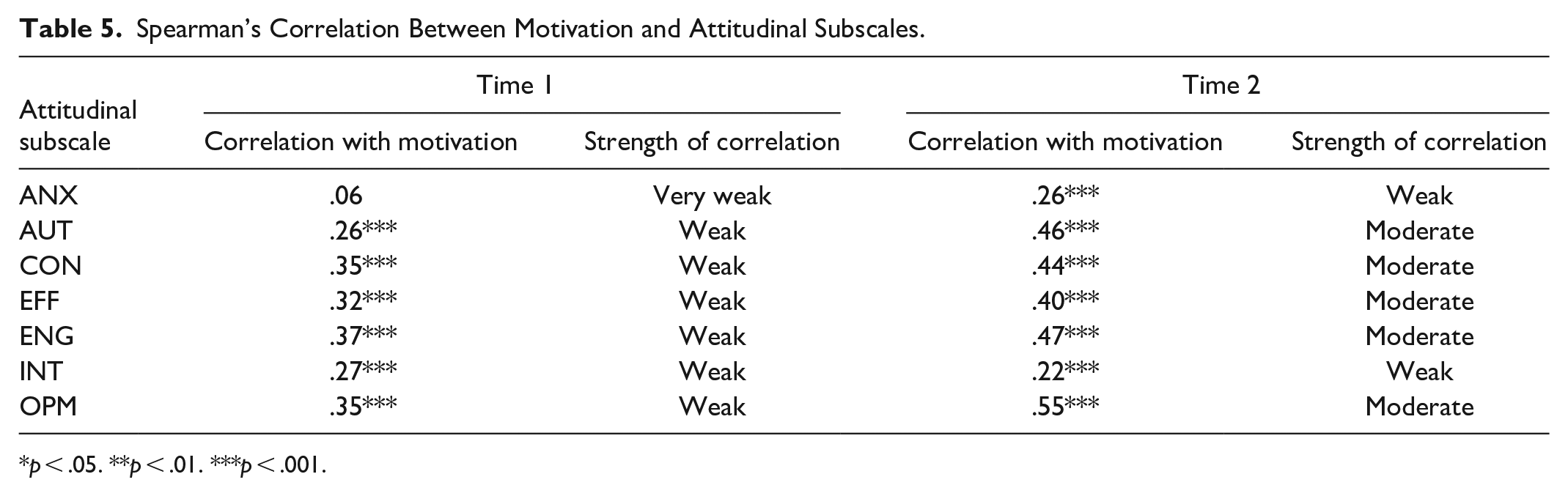
p < .05. **p < .01. ***p < .001.
Discussion
The first research question asked whether the duration of time learning remotely impacted students’ attitudes toward online language learning. ANOVA results showed a significant effect of time for autonomy, effectiveness of instruction, engagement, interactivity, and open-mindedness. These findings were confirmed through post hoc tests for autonomy, effectiveness of instruction, engagement, and open-mindedness; however, the post hoc test did not confirm the impact of time learning remotely on attitudes concerning interactivity. Also, no significant effect of time was found for motivation, anxiety, or convenience. The high anxiety found at the beginning of the period of remote instruction was consistent with the results of previous studies (e.g., Ushida, 2005). This anxiety is a cause for concern, as researchers (e.g., Teimouri et al., 2019) have found that increased anxiety is associated with lower levels of second language development. Moreover, given the combination of novel learning environment and the ongoing uncertainties—educational and otherwise—introduced by the pandemic, such feelings of anxiety are unlikely to abate quickly (cf. Iida, 2016).
The second research question asked whether proficiency level impacts the way(s) that students’ attitudes toward online language learning change over time. As described above, a significant interaction was found between time and level for ratings on effectiveness of instruction. Furthermore, greater changes in mean ratings were observed in the higher levels than in the lower levels. This result resonates to some degree with Lee and Pyo’s (2003) conclusion that “online classes would be more effective for certain groups who reached minimally functioning levels of English proficiency” (p. 108). However, these findings conflict somewhat with Lai et al. (2018) who found that language proficiency exerted little influence on students’ out-of-class language learning experiences with technology. Considering this pattern, it is interesting to consider what “proficiency” entails in this context. For instance, given the structure of the IEP, in which a higher level status often also implies previous experience as an IEP student (e.g., a Level 3 student is likely to have progressed upward from Level 1), proficiency-as-IEP-level could be considered as a proxy for “familiarity” with the program—not merely language ability. Familiarity, in this sense, determines to some degree the nature of students’ relationships with their teachers and other students, as well as their understanding of the general functioning of the IEP, including the curriculum and typical teaching and learning activities. Whereas Level 1 students have just started the program, have a low level of English language proficiency, and no familiarity with the program, many students in the higher levels have the advantage of previous experience. Such differences in experience may therefore have resulted in different attitudes among students from higher and lower IEP levels. These are merely speculations, however, and qualitative data would be needed to investigate such matters more fully.
The third research question asked about the relationship between general L2 learning motivation and the other attitudinal constructs, and how (or whether) this relationship changed over time. As shown in Table 5 above, six of the seven sub-constructs had a weak correlation with motivation at the beginning of the term; the remaining sub-construct, anxiety, had a very weak correlation. The (very) weak correlation of anxiety and motivation in this study is perhaps unsurprising. Gardner (2019) also found a weak negative correlation between the two constructs.
Although there was a weak relationship overall between attitudes and L2 motivation during the initial transition to remote instruction, the Spearman’s correlation between motivation and the majority of the sub-constructs—anxiety, autonomy, convenience, effectiveness of instruction, engagement, and open-mindedness—was higher at the end of the term. This shows a strengthening of their relationship over time. One possible interpretation of these results is that the abrupt transition to emergency remote teaching (ERT) was initially a shock to the students, regardless of their level of L2 motivation. Over time, the connection between motivation and the other attitudinal constructs strengthened. Researchers including Lee et al. (2021) have noted students’ resilience in the face of the challenges presented by the pandemic; thus, the strengthening correlation between motivation and the other sub-constructs could be interpreted as a sign of resilience. The only variable that failed to show a strengthening relationship with motivation was interactivity. Motivation and interactivity had a slightly lower Spearman’s correlation at the end of the term than they had at the beginning. Earlier research (e.g., Robinson & Hullinger, 2008) has commented on the ways in which the “pattern of engagement” (p. 101) of online students differs from that of students engaged in face-to-face study. Researchers have also noted how such ‘patterns’ impact teaching. For example, in their study of learning outcomes and student and teacher perceptions of online vs. offline language classes, Lee and Pyo (2003) observed that “due to the limited interaction with students . . . teachers had difficulty in identifying students’ needs, individual differences in . . . English proficiency level, [and] speed in the learning process” (p. 103). The differences in the interactivity of online and in-person classes may therefore partially explain the weakening correlation between motivation and interactivity found in the present study.
This study has certain limitations, including the relatively low Cronbach’s alpha of some of the attitudinal subscales, the inherent limitations of self-report data, and the social desirability bias that may influence participants’ responses. Given more time for preparation and development of the questionnaire, the Cronbach’s alphas of some subscales could have been increased. However, the urgency of the mandatory transition to online instruction did not permit time for extensive planning (e.g., piloting) and testing. Moreover, the inherent limitations of survey research are well documented. For instance, respondents may not be completely honest in their responses for various reasons and self-selection may bias the results (Dörnyei, 2007), though in this case the response rate was reasonably high. Despite these shortcomings, survey research was appropriate for this study as it allowed access to a large number of student participants, even in the midst of a crisis. While later studies could use mixed methods or a qualitative approach to add depth to the findings, the questionnaire was suitable for an initial exploration of the research questions.
Social desirability bias is another limitation to consider (Dörnyei, 2010). Respondents’ email addresses were collected, and the respondents may therefore have been more inclined to give responses that they thought to be in line with the researchers’ expectations. However, the advantages of collecting the respondents’ email addresses (i.e., eliminating duplicate responses and having access to more powerful statistical tests) more than compensated for this limitation.
Another major limitation is the difficulty of determining which attitudes are generated from online learning and which are derived from the general crisis situation that the participants are facing. This limitation is particularly apparent when attempting to account for the source of students’ anxiety. In addition to anxiety specific to online learning, students are likely to face ambient anxiety associated with the ongoing pandemic.
Future research could build on this study in several ways. One direction would be to replicate the study (as the situation permits) using a refined questionnaire to increase the Cronbach’s alpha. This would improve the reliability of the instrument. A second direction would be to conduct research investigating teachers’ perspectives on language education during crises. Recent efforts have been made in this regard (e.g., Pusey & Nanni, 2021). Combined with students’ perspectives, insights into teachers’ experience would complement this study by giving a more holistic understanding of language teaching and learning during crises. Finally, similar studies in diverse contexts could contribute greatly to the existing knowledge in this area, as they would allow broader generalizations to be made.
Conclusion
This study has investigated the attitudes that students in an intensive EAP program hold toward online language learning and how these attitudes change over time. The COVID-19 pandemic and consequent mandatory shift to online teaching and learning are unprecedented; for this reason, relevant literature is scarce. This study represents an attempt to contribute to the scholarly conversation surrounding language learning in times of crisis and ERT. Some of the findings are a cause for concern, for example, that the level of anxiety experienced by the students continued unabated over time. Other findings may be a source of encouragement, for example, the finding that the mean scores in autonomy, effectiveness of instruction, engagement, interactivity, and open-mindedness improved over time. As the situation surrounding the pandemic continues to evolve, research efforts should continue to be put toward furthering our understanding of how this ongoing crisis impacts language teaching and learning.
Footnotes
Appendix
Attitudes Toward Online Learning Questionnaire Specifications.
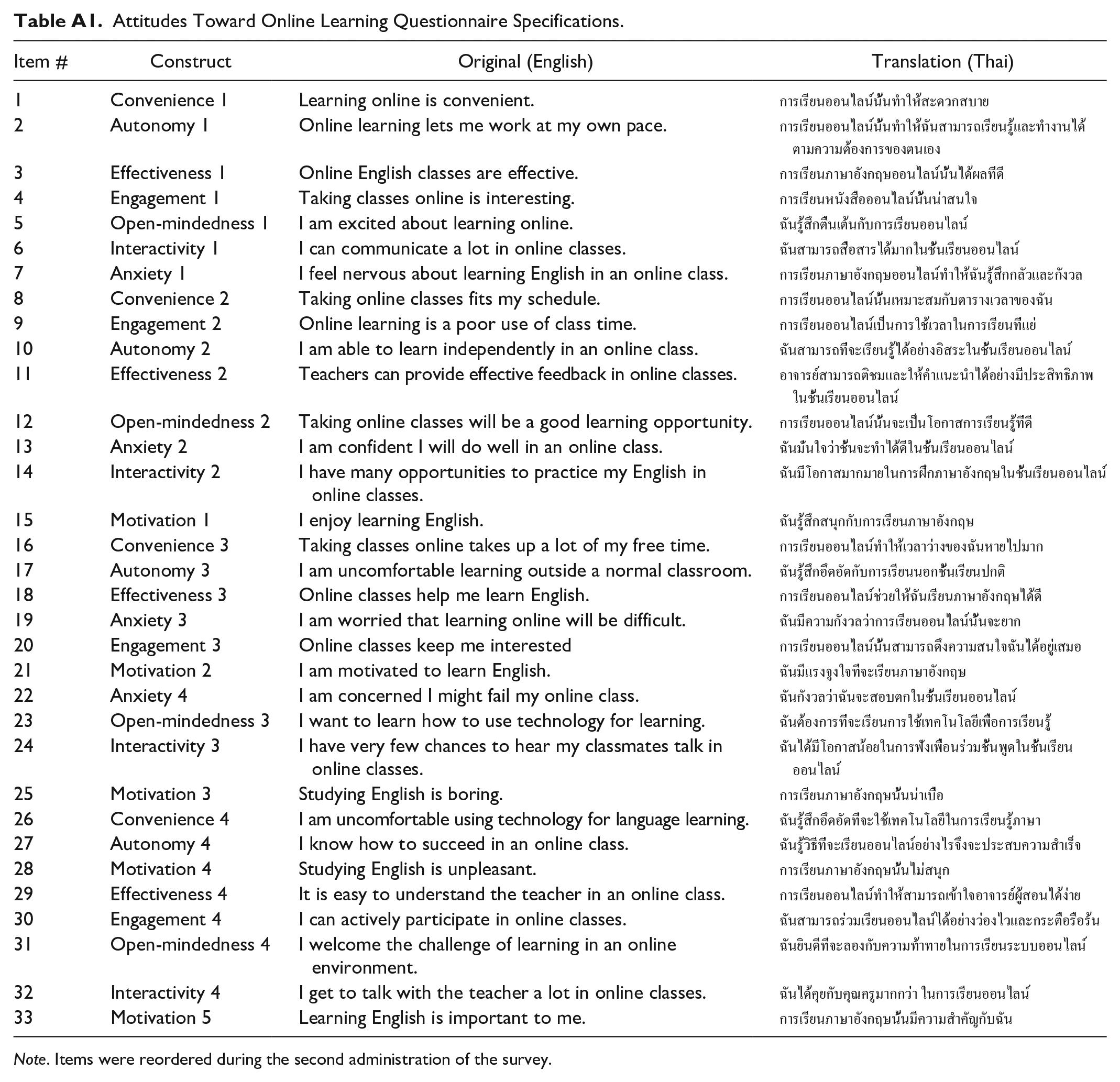
| Item # | Construct | Original (English) | Translation (Thai) |
|---|---|---|---|
| 1 | Convenience 1 | Learning online is convenient. | การเรียนออนไลน์นั้นทำให้สะดวกสบาย |
| 2 | Autonomy 1 | Online learning lets me work at my own pace. | การเรียนออนไลน์นั้นทำให้ฉันสามารถเรียนรู้และทำงานได้ตามความต้องการของตนเอง |
| 3 | Effectiveness 1 | Online English classes are effective. | การเรียนภาษาอังกฤษออนไลน์นั้นได้ผลที่ดี |
| 4 | Engagement 1 | Taking classes online is interesting. | การเรียนหนังสือออนไลน์นั้นน่าสนใจ |
| 5 | Open-mindedness 1 | I am excited about learning online. | ฉันรู้สึกตื่นเต้นกับการเรียนออนไลน์ |
| 6 | Interactivity 1 | I can communicate a lot in online classes. | ฉันสามารถสื่อสารได้มากในชั้นเรียนออนไลน์ |
| 7 | Anxiety 1 | I feel nervous about learning English in an online class. | การเรียนภาษาอังกฤษออนไลน์ทำให้ฉันรู้สึกกลัวและกังวล |
| 8 | Convenience 2 | Taking online classes fits my schedule. | การเรียนออนไลน์นั้นเหมาะสมกับตารางเวลาของฉัน |
| 9 | Engagement 2 | Online learning is a poor use of class time. | การเรียนออนไลน์เป็นการใช้เวลาในการเรียนที่แย่ |
| 10 | Autonomy 2 | I am able to learn independently in an online class. | ฉันสามารถที่จะเรียนรู้ได้อย่างอิสระในชั้นเรียนออนไลน์ |
| 11 | Effectiveness 2 | Teachers can provide effective feedback in online classes. | อาจารย์สามารถติชมและให้คำแนะนำได้อย่างมีประสิทธิภาพในชั้นเรียนออนไลน์ |
| 12 | Open-mindedness 2 | Taking online classes will be a good learning opportunity. | การเรียนออนไลน์นั้นจะเป็นโอกาสการเรียนรู้ที่ดี |
| 13 | Anxiety 2 | I am confident I will do well in an online class. | ฉันมั่นใจว่าชั้นจะทำได้ดีในชั้นเรียนออนไลน์ |
| 14 | Interactivity 2 | I have many opportunities to practice my English in online classes. | ฉันมีโอกาสมากมายในการฝึกภาษาอังกฤษในชั้นเรียนออนไลน์ |
| 15 | Motivation 1 | I enjoy learning English. | ฉันรู้สึกสนุกกับการเรียนภาษาอังกฤษ |
| 16 | Convenience 3 | Taking classes online takes up a lot of my free time. | การเรียนออนไลน์ทำให้เวลาว่างของฉันหายไปมาก |
| 17 | Autonomy 3 | I am uncomfortable learning outside a normal classroom. | ฉันรู้สึกอึดอัดกับการเรียนนอกชั้นเรียนปกติ |
| 18 | Effectiveness 3 | Online classes help me learn English. | การเรียนออนไลน์ช่วยให้ฉันเรียนภาษาอังกฤษได้ดี |
| 19 | Anxiety 3 | I am worried that learning online will be difficult. | ฉันมีความกังวลว่าการเรียนออนไลน์นั้นจะยาก |
| 20 | Engagement 3 | Online classes keep me interested | การเรียนออนไลน์นั้นสามารถดึงความสนใจฉันได้อยู่เสมอ |
| 21 | Motivation 2 | I am motivated to learn English. | ฉันมีแรงจูงใจที่จะเรียนภาษาอังกฤษ |
| 22 | Anxiety 4 | I am concerned I might fail my online class. | ฉันกังวลว่าฉันจะสอบตกในชั้นเรียนออนไลน์ |
| 23 | Open-mindedness 3 | I want to learn how to use technology for learning. | ฉันต้องการที่จะเรียนการใช้เทคโนโลยีเพื่อการเรียนรู้ |
| 24 | Interactivity 3 | I have very few chances to hear my classmates talk in online classes. | ฉันได้มีโอกาสน้อยในการฟังเพื่อนร่วมชั้นพูดในชั้นเรียนออนไลน์ |
| 25 | Motivation 3 | Studying English is boring. | การเรียนภาษาอังกฤษนั้นน่าเบื่อ |
| 26 | Convenience 4 | I am uncomfortable using technology for language learning. | ฉันรู้สึกอึดอัดที่จะใช้เทคโนโลยีในการเรียนรู้ภาษา |
| 27 | Autonomy 4 | I know how to succeed in an online class. | ฉันรู้วิธีที่จะเรียนออนไลน์อย่างไรจึงจะประสบความสำเร็จ |
| 28 | Motivation 4 | Studying English is unpleasant. | การเรียนภาษาอังกฤษนั้นไม่สนุก |
| 29 | Effectiveness 4 | It is easy to understand the teacher in an online class. | การเรียนออนไลน์ทำให้สามารถเข้าใจอาจารย์ผู้สอนได้ง่าย |
| 30 | Engagement 4 | I can actively participate in online classes. | ฉันสามารถร่วมเรียนออนไลน์ได้อย่างว่องไวและกระตือรือร้น |
| 31 | Open-mindedness 4 | I welcome the challenge of learning in an online environment. | ฉันยินดีที่จะลองกับความท้าทายในการเรียนระบบออนไลน์ |
| 32 | Interactivity 4 | I get to talk with the teacher a lot in online classes. | ฉันได้คุยกับคุณครูมากกว่า ในการเรียนออนไลน์ |
| 33 | Motivation 5 | Learning English is important to me. | การเรียนภาษาอังกฤษนั้นมีความสำคัญกับฉัน |
Note. Items were reordered during the second administration of the survey.
Declaration of Conflicting Interests
The author(s) declared no potential conflicts of interest with respect to the research, authorship, and/or publication of this article.
Funding
The author(s) received no financial support for the research, authorship, and/or publication of this article.
Ethical Approval
This study was approved by the Mahidol University Central IRB (MU-CIRB), approval number MU-COVID2020.004/1004.
