




Abstract
Due to the sudden change from traditional education to online education, the need for investigating online teaching practices of EFL instructors became an imperative. Studies revealed that most EFL instructors lacked sufficient training, technological, pedagogical knowledge and faced some difficulties. This mixed-methods study aimed at exploring online teaching experiences and perceptions of the EFL instructors working at preparatory schools of three state universities within the “Seven Principles for Good Practice” (SPGP) framework. Data collection instruments were an online questionnaire and an interview. 124 in-service instructors answered the questionnaire. To gather qualitative data, nine in-service instructors were interviewed. Quantitative data revealed that the instructors implemented the Seven Principles from a satisfactory to an excellent level. The least practiced principles were Active Learning and Cooperation among Students. The most practiced principle was Student-Faculty Contact. The interviews revealed a number of factors that hindered the implementation of these principles and provided suggestions for implementing them. The study yielded a number of implications to enhance the quality of online teaching such as the need for establishing rules, redesigning preparatory programs, integrating technological and pedagogical knowledge in preservice and in-service training, self-improvement, utilizing the SPGP as a rubric to evaluate and design programs and training.
Plain language summary
Due to the sudden change from traditional education to online education, the need for investigating online teaching practices of English as a Foreign Language instructors became an imperative. Studies revealed that most English as a Foreign Language instructors lacked sufficient training, technological, pedagogical knowledge and faced some difficulties. This mixed-methods study aimed at exploring online teaching experiences and perceptions of the English as a Foreign Language instructors working at preparatory schools of three state universities within the “Seven Principles for Good Practice” (SPGP) framework. Data collection instruments were an online questionnaire and an interview. 124 in-service instructors answered the questionnaire. To gather qualitative data, nine in-service instructors were interviewed. Quantitative data revealed that the instructors implemented the Seven Principles from a satisfactory to an excellent level. The least practiced principles were Active Learning and Cooperation among Students. The most practiced principle was Student-Faculty Contact. The interviews revealed a number of factors that hindered the implementation of these principles and provided suggestions for implementing them. The study yielded a number of implications to enhance the quality of online teaching such as the need for establishing rules, redesigning preparatory programs, integrating technological and pedagogical knowledge in pre-service and in-service training, self-improvement, utilizing the SPGP as a rubric to evaluate and design programs and training.
Keywords
Introduction
The outbreak of the COVID-19 pandemic forced many schools, colleges, and universities to transition to online teaching and blended learning. This new mode of education, whose content designed for face-to-face instruction, was adapted for or transferred to the online environments with little or no planning for the online instruction in mind beforehand due to the time constraints was named Emergency Remote Teaching (ERT). Hodges et al. (2020) emphasized that ERT is a temporary shift of instructional delivery to an alternate delivery mode due to crisis circumstances, providing temporary access to instruction and instructional supports during an emergency. ERT is considered as a subset of distance education. The main difference between online teaching and ERT is that ERT was unplanned practice, with no option than to use any kind of offline and/or online resources that may be at hand (cited in Bond et al., 2021). In this study, ERT refers to a mix of synchronous lessons by using instant messenger programs or video conferencing tools with or without voice and asynchronous lessons.
Both teachers and students at the tertiary level experienced various constraints during ERT worldwide. The challenges they faced and the effective implementation of online teaching became the focus of many studies (Fox & Langner, 2022; Walter & Fox, 2021). Additionally, many research studies examined the experiences of teachers and students during the ERT period (Dizon & Thanyawatpokin, 2021; Gao & Zhang, 2020; Iglesias-Pradas et al., 2021; Juárez-Díaz & Perales, 2021; Meşe & Sevilen, 2021; Salih & Omar, 2020; Şener et al., 2020). Regarding the effective implementation of online teaching, many studies also focused on what tools instructors use, how they design and integrate their activities. (Asratie et al., 2023; Çakmak, 2022; Chaves-Yuste & De-la Peña, 2023; Chen, 2022; Marzuki et al., 2023; Reynolds & Taylor, 2020; Taghizadeh & Ejtehadi, 2021.
However, the present study focuses on an underreseached issue and highlights the importance and need for critical thought about how best to utilize an online environment (Heggart & Yoo, 2018) and underlines that online teaching should be based on a sound pedagogical framework. Systematic evaluation of online practices is crucial for improving the quality of teaching and learning in any setting. Frameworks are essential to inform teachers about good practices, which they can utilize in their classes. Howard et al. (2021) highlighted that some learning contexts are under-researched in remote education, necessitating further studies to build a more comprehensive understanding of learning experiences. Notwithstanding a substantial body of literature on online teaching, there appeared to be limited resources focusing on the online practices of English instructors working at preparatory programs within well-researched and time-tested theories. To address this need, Seven Principles for Good Practice framework (SPGP; Chickering & Gamson, 1987), one of the prominent constructivist models of teaching, has been widely adopted to evaluate the effectiveness of online teaching and is recommended for online education programs today or in the future if transition to online education becomes imperative due to an emergency situation.
Originally developed for traditional classrooms to promote effective learning, Seven Principles for Good Practice framework, is suggested to be adapted to online learning environments as “equally effective guides in the implementation of online instruction” (W. Zhang & Zhu, 2020, p. 65). They serve as valuable criteria for blended and online learning, providing easy-to-read principles to guide teachers and administrators who aiming to improve learning (Bishoff, 2010). They consist of the following principles: (1) Encourages Student-Faculty Contact, (2) Develops Cooperation among Students, (3) Encourages Active Learning, (4) Gives Prompt Feedback, (5) Emphasizes Time on Task, (6) Communicates High Expectations, (7) Respects Diverse Talents and Ways of Learning. When Chickering and Gamson (1987) introduced these principles in undergraduate education, online or blended teaching did not exist in its current form. However, with the advent of online education, Chickering and Ehrmann (1996) published “Implementing the Seven Principles: Technology as Lever” to reaffirm these principles. Table 1 provides a summary of each principle with some examples:
Seven Principles for Good Practice Summary and Some Examples.

Several studies have evaluated online courses based on the SPGP (Çakıroğlu, 2014; Crews et al., 2015; W. Zhang & Zhu, 2020). However, to the best of the researchers’ knowledge, studies exploring the online practices and perceptions of English language instructors working in preparatory programs within the SPGP framework during the pandemic are almost nonexistent. This study aims to fill this gap by evaluating the practices of English as a Foreign Language (EFL) instructors based on “the premise of constructivism as a foundation for effectively-designed online language courses and the seven principles as a rubric to measure quality” (Tirrell & Quick, 2012, p. 582). In other words, the present study can bridge the gap between online teaching theory and practice and provide insights on designing more effective and student-friendly online platforms. It also informs about the instructors’ views on the factors impacting their implementation of the SPGP and their suggestions for improving the quality of online classes. The findings might help teachers, instructors, and institutions improve their online practices and serve as recommendations for enhancement. The study presents the findings as recommendations and a guide, which may also benefit education faculties in improving teaching programs. These theoretically and practically approved principles can inform pre-service and in-service training, helping teachers better prepare for online teaching experiences.
ERT courses are reported to be unplanned, under developed, rapidly delivered and likely of lower quality (Doornbos, 2020; Hodges et al., 2020; Whittle et al., 2020; Williamson et al., 2020; cited in Stewart et al., 2023). Exploring the sudden shift to ERT can shed light on future teaching practices (Thumvichit et al., 2021). According to Stewart et al. (2023), understanding the contextual manifestations of remote teaching and learning under emergency conditions is essential for future ERT scenarios such as natural disasters and social and political unrest. The SPGP framework can be utilized in current online education programs or in future emergency situations where transitioning to online education becomes imperative as Stewart et al. (2023) maintained.
In summary, the present study aims to reveal the factors that hindered EFL teachers working at three preparatory schools in Türkiye from promoting the Seven Principles in their online classes during ERT. It also seeks to present the suggestions of the instructors for promoting the implementation of the Seven Principles in online teaching environments.
Our study seeks to answer the following questions:
(1) Based on the perceptions of preparatory school EFL instructors, what factors hinder the implementation of the Seven Principles in online classes?
(2) What are the suggestions of preparatory school EFL instructors to promote the implementation of the Seven Principles in online classes?
Before presenting the results of this study, we will provide a general overview of the constraints of online language teaching as addressed in the literature for a comprehensive examination of the issue, along with related studies.
Literature Review
Constraints of Online Language Teaching
In this section, the major constraints of online language teaching and their implications will be discussed.
Limited Interaction and Non-participation
Limited interaction in the asynchronous and synchronous online classes was highlighted by Compton (2009b). Most participants stated that online courses were confined to individual tasks and they did not provide many opportunities for interaction. Students retrieved materials and completed assignments individually, often without collaborating with others. The findings of Erarslan and Arslan (2020) also indicated that “lack of interaction was among the reported deficiencies existing in online learning” (p. 55). Juárez-Díaz and Perales (2021) noted that limited interaction in online classes during the pandemic resulted from the limited experience of EFL teachers with online education. Instructors tended to focus more on content rather than promoting student-teacher and student–student interaction. A negative attitude toward online classes is triggered more due to by technical problems, as suggested by several scholars. Şener et al. (2020) agreed that the most prevalent and significant challenges undermining the effectiveness and efficiency of online education were infrastructure-related issues, such as slow internet connections and audio-visual quality problems. As a result of these negative factors, students often choose not to be active in the classes, muting themselves, turning off their cameras, and/or making excuses for their non-participation. Language teachers experienced demotivation and reduced participation in online classes during the pandemic (Nayman & Bavlı, 2022).
Time Issues and Workload
Another challenge of online learning and teaching is the increased workload. Juárez-Díaz and Perales (2021) reported that most teachers were overwhelmed due to increased work time and workload during online teaching. Tynan et al. (2015) investigated instructors’ workload data that were associated with e-teaching, indicating that e-teaching increased instructors’ workload. Teaching online led to more teaching tasks and hours since teachers spent time reading and answering emails, hosting synchronous or asynchronous chat sessions, and moderating bulletin boards. The increased workload was due to working both online and offline. Erarslan and Arslan (2020) highlighted personal factors that made time management difficult for students in their recent study. They suggested that time management is crucial for students in an online environment since they also face concentration problems and distractions from external factors such as family issues. Students have responsibilities at home and external factors to deal with, and teachers working from home may also have difficulty concentrating and managing other responsibilities that take time.
Limited Information Technology Literacy
One of the many hindrances to quality online language teaching and learning is limited digital literacy among teachers and students (Gao & Zhang, 2020; Stickler et al., 2020). EFL teachers often have limited digital literacy because they have not received any training before or needed to invest time in learning more about technology in education. Altunay (2019) added three more reasons, such as computer anxiety, teachers’ negative beliefs about online education, and a lack of continuous technical and administrative support. Lastly, they had not had to have this competence until the lockdown of schools forced them to move online (Winter et al., 2021). Most teachers had limited time to explore technology to support student learning (Iglesias-Pradas et al., 2021). Blake (2008) asserted that the continuous change in technology and tools is an obstacle for many language professionals, as staying current with technology requires significant time (Ersanli, 2016). Adnan (2018) highlighted the need for pre-training for instructors, suggesting institutions organize workshops, seminars, and short classes when introducing new applications or technologies. Şener et al. (2020) added that programs for basic computer and academic skills should be integrated into the curriculum for students to become familiar with technology.
Limited Pedagogical Knowledge
Apart from the need for training in online education, studies have highlighted another constraint related to the content of training programs. Much of the current instructional technology preparation in language teacher education focuses on hardware and software issues instead of pedagogy. These skills help teachers to use technology, but do not prepare them to use technology for language teaching (Compton, 2009a). Salih and Omar (2020) noted, “Earlier research on L2 distance learning was limited to investigating the various uses of diverse websites and applications in learning a language with little focus on teaching practices and L2 learning standards from a pedagogical angle, which makes it difficult to generalize on the effectiveness of distance learning for language teaching and learning” (p. 63).
Related Studies
Several studies have aimed to evaluate the quality of traditional and blended EFL/ESL teaching (Ben Ajiba & Zerhouni, 2019; Dang & Robertson, 2010; Larsen, 2012; Maghfur, 2019; Said, 2017; Yahyazade et al., 2014; W. Zhang & Zhu, 2020). However, there are few studies that examined online English teaching within the Seven Principles framework. W. Zhang and Zhu (2020) conducted a study at a university in China to determine whether Blended Learning is more effective in ESL courses compared to traditional learning and online learning from the student perspective. The questionnaire used to compare these three formats of teaching was based on the Seven Principles. The results indicated that blended learning is more effective than traditional and online learning. The study highlighted that the Seven Principles can be used as a tool to evaluate the effectiveness of different learning modes. In Türkiye, there are no studies examining online English language teaching within the Seven Principles framework. However, to the best of the researchers’ knowledge, there are three studies that examined the effectiveness of face-to-face English language teaching within the Seven Principles framework.
Çimen (2017b) conducted the first study in this regard. Fifteen EFL instructors working at the same university responded to open-ended questions about their understanding and beliefs about the vital components of English language education. The findings indicated that the participants’ perceptions align with five of the Seven Principles: Diverse Talents and Ways of Learning, Prompt Feedback, Student-Faculty Contact, Cooperation among Students, and Active Learning. Çimen (2017a) also conducted a mixed-methods study exploring EFL pre-service and in-service teachers’ perceptions and implementations of the Seven Principles. The findings revealed that the participants generally favored the Seven Principles, but did not know how to incorporate them into their courses. The study also identified factors hindering the implementation of these principles, showing a gap between the ideal teaching practices and the ongoing teaching practices in classrooms. Turhan (2020) conducted a quantitative study examining the use of the SPGP in English lessons and investigating whether teachers’ practices of the Seven Principles differ according to gender, seniority, degree programs. The findings revealed no significant difference between teachers’ implementation of the Seven Principles based on their gender, professional seniority, or undergraduate programs. Teachers who graduated from English teaching programs had higher mean scores in implementing the principles in their classes compared to teachers who graduated from other departments.
Methodology
This study is part of a larger body of work from a thesis. The original study utilized a mixed-methods approach, combining both quantitative and qualitative approaches. In this present study, the focus will be predominantly on the qualitative results based on the selected research questions. However, to provide a general picture of online teaching practices of EFL teachers during ERT within the SPGP framework, the mean scores from the questionnaire results will be shared to highlight the most and least problematic principles. This section presents the context of the study, data about the participants, data collection procedures, tools, and data analysis methods presented consecutively.
Participants
The study participants consisted of English language instructors working in English language preparatory programs at three universities in Ankara, Türkiye. The aim of these preparatory programs is to prepare students for their academic studies. Students can start studying in their departments on condition that they are successful at the proficiency exam. The EFL instructors at these universities teach different levels of classes. Due to the sudden shift to remote education, the instructors had to teach online. To address this unexpected change, the institutions provided online teaching training. During the data collection period (2020–2021 academic year), all EFL instructors conducted only online classes asynchronously and/or synchronously. At that time, it had been one and a half years since online education started. Convenience sampling was employed to collect data. The study included both questionnaire and interview participants.
Questionnaire Participants
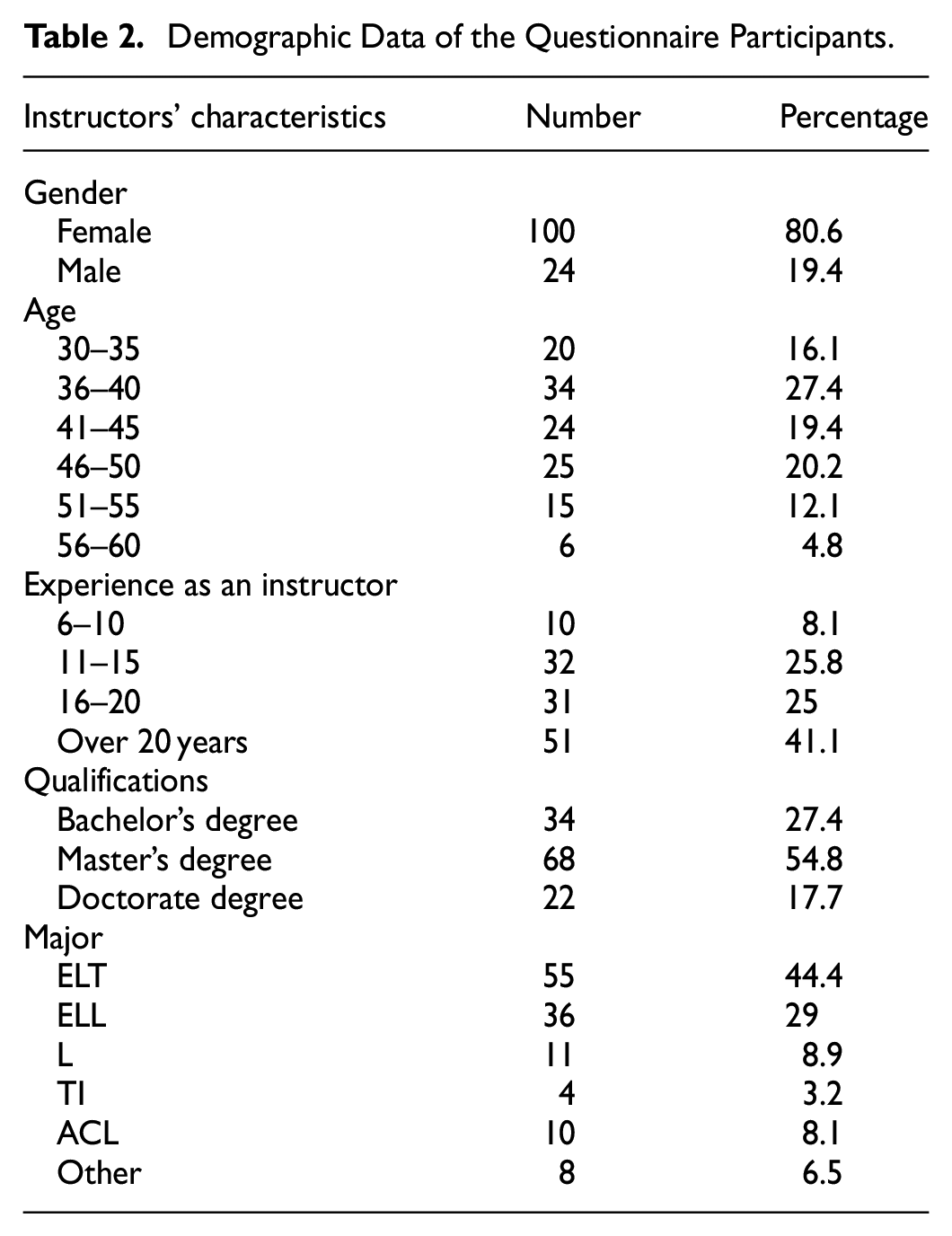
Online questionnaires were sent to 395 EFL instructors via email. Out of these, 124 (31.4%) instructors responded to the questionnaire. The respondents consisted of 100 female participants and 24 male participants, ranging in age from 30 to 60. The majority had over 20 years of experience. About 68 instructors held an M.A. degree, 34 held a B.A. degree, and 22 had a doctorate degree. Most of the instructors had their B.A. degrees in English Language Teaching (ELT). Table 2 demonstrates the demographic data of the questionnaire participants.
Demographic Data of the Questionnaire Participants.
Interview Participants
The interviews were conducted with nine EFL instructors who answered the online questionnaire and agreed to participate in the interview by approving the interview participation request stated in the questionnaire. Interview participants included seven females and two males, aged between 38 and 56, with 11 to 24 years of experience as EFL instructors. Most held a B.A. degree (n = 4), three held a Ph.D. degree, and two held an M.A. degree. The majority had their B.A. degree in English Language and Literature (ELL) department (n = 5). Two participants had their B.A. degree in Linguistics (L) department. The other two instructors had a B.A. degree in Translation and Interpreting Studies (TI) and American Culture and Literature (ACL) respectively. Table 3 presents the demographic data of the interview participants.
Demographic Data of the Interview Participants.

Data Collection Tools
Two instruments were used to collect data. These were online questionnaire and online interview. Both were administered after following the approval from Research and Ethics Committee, with the acceptance number (255-ODTU-2021). Participants were given informed consent forms prior to the questionnaires and the interviews. The consent forms informed them about the aim of the study and procedures. They were also informed that they could withdraw at any time or refuse to answer any question without any consequences. They were assured that all information provided would be kept confidential, evaluated only by the researchers, and used solely for academic purposes.
Questionnaire
Teachers were invited to participate in the online questionnaire prepared via Google Forms. The researchers utilized the original inventory, the “Seven Principles for Good Practice” inventory (Chickering et al., 1989) and its adaptation for online teaching to examine online English language teaching practices (Tanis, 2020). Before answering the questions, participants were asked to agree to participate in the study by giving consent. The questionnaire consisted of two sections. In Section 1, teachers responded 12 demographic questions. In Section 2, they responded the questionnaire composed of 60 items, aiming at investigating to what extent the instructors implemented the SPGP in their online classes (See Appendix A).
Semi-Structured Interviews
Nine instructors among the questionnaire participants who agreed to participate in the semi-structured interviews were interviewed. Before the interviews, participants were informed about the purpose of the study, the estimated length of the interview, and that it would be audio recorded. They were asked to give consent by filling out the interview protocol. Semi-structured interview questions were adapted from J. Zhang (2006).
Interview questions (See Appendix B) consisted of three open-ended questions aiming to gather brief information about the instructors and the online classes they taught as well as seven questions, each with three sub-questions, intended to explore the practices they conducted in their online classes that were in line with the Seven Principles, the factors that hindered the implementation of these principles, and their suggestions for promoting them in online classes. For example, they were asked: (a) Do you think your online class had a cooperative atmosphere? What did you do to develop cooperation among students? (b) Did you experience any constraints? Can you talk about the factors that hindered the implementation of cooperation? What constraints did you experience? (c) Do you have any suggestions and implementation ideas regarding developing cooperation? If you had a chance, what kind of changes would you make in your online language classes? Interviews were conducted in a virtual environment at times convenient for the instructors. They took approximately 60 to 70 min.
Data Analysis
This study employed semi-structured interviews to answer the research questions. However, as mentioned above, firstly the mean scores of questionnaire will be presented to provide a general picture and trend regarding the implementation of good practices in EFL classes during ERT. This section involves both quantitative and qualitative data analysis.
Quantitative Data Analysis
The quantitative data collected through the questionnaire were analyzed through SPSS Statistics 24.0 software package program. Firstly, the first section of the questionnaire that consisted of 12 questions to reveal demographic data was analyzed through descriptive statistics and presented in Table 2. The quantitative data collected through the questionnaire composed of 60 items were analyzed through SPSS Statistics 24.0. Descriptive statistics were conducted to analyze and interpret the data. To interpret the results, the mean value boundaries of each response were calculated by subtracting 1 (lowest value in the Likert scale) to the 5 (highest value in the Likert scale) and then, dividing the number 4 to 5, which was calculated to be 0.80 and the following mean value intervals (Çakıroğlu, 2014) were used to interpret the perceived level of the implementation of the Seven Principles: 1.00 to 1.79: not satisfactory; 1.80 to 2.59: merely satisfactory; 2.60 to 3.39: satisfactory; 3.40 to 4.19: highly satisfactory; 4.20 to 5.00: excellent. The result was organized into summary chart and analyzed based on the intervals stated (See Figure 1).

Instructors’ Perceived Level of the Implementation of the SPGP in Online EFL Classes.
Qualitative Data Analysis
Qualitative data were collected from semi-structured interviews with nine instructors. Interview data were analyzed using content analysis scheme of Creswell (2012) and the constant comparison method of Strauss and Corbin (1998). First, qualitative data were transcribed verbatim, read, memoed, and preliminary codes were formed by the researchers. The constant comparison method was then used to develop categories. The researchers analyzed the preliminary codes and compared the codes and themes for similarities and differences. Within-case and cross-case analysis were made. Recurring, most common themes were selected and categorized. After identifying the most common themes, their frequency was calculated and illustrated in the tables. Figure 2 illustrates the data analysis process employed in the study.
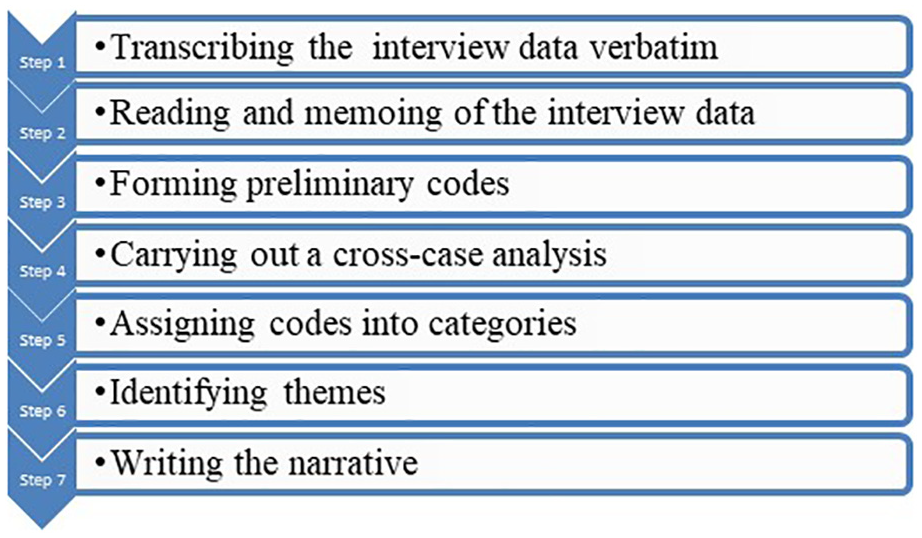
Summary of the qualitative data analysis.
Validity and Reliability
A pilot study was conducted to ensure the validity and reliability of the online questionnaire. Based on participant feedback (n = 32) and an external check by an academician, ambiguous parts were revised and altered. An item that lowered the reliability was removed. Reliability analyses were conducted for both the pilot and the main study. The reliability of the scale in the pilot study was 0.949 and in the main study, it was 0.955, indicating high reliability.
For the qualitative part of the study, first, the researchers coded the data individually and then, they compared the codes and themes for appropriateness and logical inferences and validated the themes. Later, interview participants’ comments that are context-rich and meaningful (Creswell, 2007; Denzin, 1989b) were selected and shared in quotes as indicators of plausibility, authenticity, and validation. Lastly, interview participants were sent the summary findings via e-mail and asked to verify the accuracy of the verbatim quotes and whether the summary of the findings represented their perspectives accurately. All nine interview participants validated the accuracy of the summary findings via email. Shortly, intercoding, detailed descriptions, and member checking (Creswell, 2012) were utilized to ensure credibility.
Findings and Discussion
This section presents the analysis of quantitative and qualitative data gathered through questionnaires and interviews. Firstly, quantitative data from questionnaire is presented.
Quantitative Findings
To examine to what extent the instructors implemented the Seven Principles in their online classes, teachers answered a questionnaire that consists of seven domains that involve Encourages Student-Faculty Contact, Develops Cooperation among Students, Encourages Active Learning, Gives Prompt Feedback, Emphasizes Time on Task, Communicates High Expectations, Respects Diverse Talents and Ways of Learning. First, the responses of the participants were entered into SPSS 24.0 and the mean scores were calculated.
The findings revealed the preparatory school EFL instructors’ implementation level of the Seven Principles in their online classes. Instructors’ perceived level of implementation of the Seven Principles is illustrated in Figure 1.
As shown in Figure 1, instructors generally implemented them at a satisfactory level. All the mean values are above (
Cooperation among Students and Active Learning scored the two lowest principles. This finding corroborates with the literature, which highlights the challenges of implementing these principles in online teaching (Çakıroğlu, 2014; Çimen, 2017a, 2017b; Tanis, 2020; J. Zhang, 2006). Active Learning scoring the lowest (
The study revealed that the mean value of Active Learning scored the lowest (X = 3.38). The item with the highest mean score is the provision of the content. This finding indicates that instructors easily can transfer their face-to-face teaching practices into the online environment. Provision of content via ppts, videos, and lecture notes is one of the most common practices they were conducting before online teaching. Instructors’ answers to the questionnaire show that they encourage critical thinking skills in their online classes. Assigning essays, paragraphs, and papers were reported as commonly utilized active learning practices. This result is not surprising since students are assigned many essays and paragraphs in preparatory classes as preparation for proficiency exams. Other common practices involved giving students authentic situations to analyze, asking them to relate outside events or activities to the topics covered in classes and asking them to deliver presentations. The item with the lowest mean score that was implemented at a merely satisfactory level is utilizing blogs, wikis, digital stories, or podcasts. Although there are many studies asserting the benefit of utilizing them (Altay, 2018; Okumuş, 2020; Wang, 2014), the findings revealed that few instructors integrate them into their classes.
This shows that there is a discrepancy between the academic studies and the realities of the classroom. Moreover, the second practice with the lowest mean score is asking students to carry out projects. Projects are mainly considered suitable for departmental classes where students specialize in their own fields instead of preparatory classes. Çimen (2017a) also highlighted the insufficient implementation of active learning principle into EFL classes “active learning strategies are not very well utilized in EFL classrooms” (p. 224). O‘Sullivan and Copper (2003) revealed that encouraging active learning is highly essential for student achievement: “students in an active learning classroom showed significant improvement in performance relative to students in a lecture-based course” (p. 448). Lastly, the connection between active learning and cooperation among students was highlighted by the instructors in Çimen’s (2017a) study. They suggested that these principles complete each other. “The implementation of cooperative learning naturally brings about active learning” (p. 225). To sum up, it is inferred that due to teacher’s beliefs, the structure of the program and time concerns, cooperation among students and active learning were insufficient in online classes.
Qualitative Findings
In the interviews, instructors were asked for the reasons why they had difficulty in implementing the SPGP and their practices in their online classes during the lockdown and some suggestions for implementing the SPGP in online classes. Data from the interviews revealed five main themes: (1) External barriers to the implementation of the seven principles in online classes, (2) Instructor-related barriers to the implementation of the seven principles in online classes, (3) Student-related barriers to the implementation of the seven principles in online classes, (4) Institution-directed suggestions to promote the implementation of the seven principles in online classes, (5) Instructor-directed suggestions to promote the implementation of the seven principles in online classes.
External Barriers to the Implementation of the Seven Principles in Online Classes
Interview data revealed that instructors faced external barriers to implementing the Seven Principles. The barriers, listed from the most to the least frequently stated, will be explained referring to each of the Seven Principles: Student-Faculty Contact, Cooperation among Students, Active Learning, Prompt Feedback, Time on Task, High Expectations and Diverse Ways, and Talent of Learning. The frequency table for external barriers is shown in Table 4 and explained below.
External Barriers to the Implementation of the Seven Principles in Online Classes.

Lack of rules and the structure of the preparatory program are the most frequently stated barriers to implementation of the Seven Principles. Lack of rules referring to absence of compulsory attendance and camera use diminished contact opportunities. This finding corroborates with Meşe and Sevilen (2021), suggesting that voluntary attendance was a barrier to student involvement and participation. Technological issues such as internet connectivity problems and lack of devices also hampered Student-Faculty Contact.
Cooperation among Students was one of the least frequently implemented principles during the pandemic days. The feeling of loneliness due to the lack of collaboration may lead to low achievement or even dropping out (González-Lloret, 2020). The structure of the preparatory program was reported as not encouraging collaborative tasks, as activities and tasks were mainly based on individual work. Instructor 1 commented on the lack of collaboration in preparatory programs: “The way our program is structured, the way we teach skills, we don’t encourage cooperation outside much.” Instructor 2 added: Speaking of the prep school, there’s a curriculum you have to follow, it is a fixed thing and you are not free, so it’s one of the limitations.
Some participants reported that government’s decision to make attendance non-compulsory hindered Active Learning, the least frequently implemented principles during lockdown. A rigid, exam-oriented focus further limited the integration of active learning practices such as role playing, drama, games, discussions, and projects. Internet and device limitations also disrupted active engagement. This finding is consistent with the literature indicating that during online sessions, learners faced technical problems related to computers and the internet, leading to learning problems and demotivation (Sun, 2011; Yüce, 2019; Zou et al., 2021). Instructor 3 noted: “Some of the students couldn’t attend the lessons because they said they didn’t have any Internet connection and in the house there was only one computer or one mobile phone.”
The primary barrier to Prompt Feedback mentioned by instructors was the increased workload. This finding is in line with Şener et al. (2020), who found that instructors had to give feedback and grade assignments 7/24. Likewise, in Juárez-Díaz and Perales (2021), most teachers reported being overwhelmed due to increased workload. Some of the instructors in the present study noted that online feedback required more time and effort compared to face-to-face interactions and it took so much time to check the papers and provide feedback. For example, Instructor 3 noted: It was a lot of workload because of a lot of papers and so since this is online because every time I needed to learn and practice something new, which is online, it took me an extremely long time. I was not ready to invest that much time every time.
Other barrier included technical problems and excessive screen time (Akulwar-Tajane et al., 2020; Dwajani et al., 2020). The fatigue associated with excessive screen time made the process of providing feedback less appealing.
Time on Task principle could not often be implemented due to unstable internet connections, which disrupted class continuity and student participation. Some interview participants criticized their institution since class hours were shortened to 30 min due to administrative decisions, making the time insufficient for effective teaching and beneficial tasks.
Lack of rules also was also one of the most important barriers that had a negative impact on the implementation of High Expectations principle. The absence of strict rules on attendance and academic integrity led to lower student engagement, cheating, and increased instances of plagiarism, undermining efforts to maintain high academic standards.
Lack of rules, leading to non-participation negatively impacted the implementation of Diverse Talents and Ways of Learning. Teachers had difficulty in building rapport with some of students since they did not attend the classes regularly or if they attended, they turned off their cameras. The online environment made it difficult to create a sense of community. Students often did not know each other personally, were shy, and hesitated to speak or participate in class without turning on their cameras. Instructors found it challenging to engage with students they did not know well, leading to less personalized instruction and participation. Moreover, in preparatory schools, the fixed curriculum restricted instructors’ ability to assign varied tasks and choose materials that cater to diverse learning styles. The curriculum was perceived as overloaded, leaving little time for activities tailored to different learning preferences. Instructor 8 illustrated this negative factor: “I want to say that our curriculum, program was quite overloaded. We didn’t have much time to do different things anyhow.” Lastly, one instructor reported that students with disabilities, such as visual impairments, faced significant challenges due to the lack of sufficient resources available for online education.
It is crucial to eliminate the barriers mentioned above to improve the quality of online EFL classes. Policies on attendance and participation, curriculum content, and hectic program often restricted the implementation of best teaching practices. Regulation of policies and redesign of curricula is necessary to better support online learning environments.
Instructor-Related Barriers to the Implementation of the Seven Principles in Online Classes
Interview participants reported various instructor-related barriers to implementing the Seven Principles. The barriers, listed from the most to the least frequently stated, will be explained referring to each of the Seven Principles: Student-Faculty Contact, Cooperation among Students, Active Learning, Prompt Feedback, Time on Task, High Expectations and Diverse Ways and Talent of Learning. The frequency table for instructor-related barriers are shown in Table 5 and explained below.
Instructor-related Barriers to the Implementation of the Seven Principles in Online Classes.

Lack of content, technological, and pedagogical knowledge and the demotivation of teachers are the most frequently stated barriers to implementation of the Seven Principles. These barriers negatively impacted the implementation of each principle.
Interview participants did not report any instructor-related barriers to the implementation of Student-Faculty Contact, but for them, Cooperation among Students could not be implemented due to teachers’ beliefs, teaching knowledge and experience. Some instructors believed that students inherently lacked a collaborative spirit, leading to unfair task allocation and a reluctance to design and integrate collaborative tasks. Instructors’ unfamiliarity with promoting online collaboration is another barrier to cooperation among students.
Another instructor-related barrier that hindered the implementation of Active Learning is the lack of content, technological, and pedagogical knowledge. Instructors struggled to effectively integrate technology with pedagogical methods due to insufficient training focusing on teaching what tools to use and how to use them. This finding aligns with Can and Silman-Karanfil (2021), which revealed that most in-service EFL instructors had low self-efficacy and a low level of technological and pedagogical knowledge in teaching remotely. In the present study, Instructor 6 addressed lack of pedagogical knowledge as a barrier to the implementation of the Active Learning principle: To facilitate active learning, teachers should consider the objectives and level for the following online class. You have to be firstly aware of what the objective is. For example, vocab exercises. How do I prepare vocab exercises? I have a list of vocab items and I create a context. It is like a full story. But what do some teachers do, they just enter the word to Google and they just copy and paste that example sentence from there, right? […] Second, the level may be high, so again you have to adapt it according to the level of the students.
Absence of previous online teaching experience negatively affected the implementation of Prompt Feedback. Some instructors struggled with online feedback systems, finding the transition from traditional methods overwhelming. Implementation of Time on Task principle was also problematic due to unrealistic expectations of the administration regarding insufficient class hours and online teaching protocols, demotivated teachers.
High Expectations principle could not be ensured due to teachers insufficient competencies and limited training. Interview participants suggested that instructors should set high expectations as an instructor and improve themselves to achieve them. Some instructors criticized their inadequate language and technological knowledge. Instructor 7 emphasized the importance of personal development, criticizing her insufficient lexical sources as a speaker of English. She believed an instructor should be a role model, and her lack of continuous development as an impediment to achieving high expectations: During the last one and a half years, I realized that my lexical source as a speaker of English was very weak. Every time I tried to set high expectations for speaking, for example, I wanted to be an example to my students; I was disappointed with my vocabulary knowledge, with my spoken performance.
Zou et al. (2021) noted that teachers without prior experience or training in online instruction might find their efficiency reduced. Atmojo and Nugroho (2020) highlighted the challenge teachers faced due to the pandemic, reporting that instructors did not have enough preparation for online teaching. Digital immigrants among instructors were particularly nervous about using technology. Due to their lack of knowledge, learning a new tool took a lot of time and since they already had lots of responsibilities, they could not invest their time to learn new tools or create purposeful and meaningful activities. A representative quote of Instructor 7 echoes this: Maybe another reason was my nervousness about using the computer efficiently because every time I needed to learn and practice something new, which is online, it took me an extremely long time. I was not ready to invest that much time every time.
Qualitative data revealed that insufficient training in online education methodologies was a barrier for some instructors. The importance of pedagogical knowledge was highlighted by Erarslan (2021), which investigated the effects of the pandemic on online teaching and the learning of English. He maintained that “for quality online teaching of English in schools, the policymakers and teacher training programs need to make alterations in terms of equipping the teachers with the necessary pedagogical knowledge on these different modes of teaching” (p. 359).
Lastly, teachers could not implement Diverse Talents and Ways of Learning due to pandemic fatigue leading to demotivation. Instructors reported a loss of motivation due to the pandemic, which negatively impacted their ability to address diverse learning needs. Nervousness and lack of proficiency with technology made it difficult to implement varied teaching methods effectively. Limited technological knowledge required them to invest time on learning new tools. The need to constantly learn and practice new technological skills was time-consuming and deterred some instructors from exploring diverse teaching methods.
In summary, instructor-related barriers significantly hinder the effective implementation of the Seven Principles in online classes. These barriers stem from a lack of necessary knowledge and training, demotivation, and insufficient experience with online teaching. Addressing these issues requires targeted professional development, continuous support, and realistic expectations from administration to enhance the quality of online education and support instructors in overcoming these challenges.
Student-Related Barriers to the Implementation of the Seven Principles in Online Classes
Interview data revealed that instructors faced student-related barriers to implementing the Seven Principles. The barriers, listed from the most to the least frequently stated, will be explained with reference to each of the Seven Principles: Student-Faculty Contact, Cooperation among Students, Active Learning, Prompt Feedback, Time on Task, High Expectations and Diverse Ways and Talent of Learning. The frequency table for student-related barriers is shown in Table 6 and explained below.
Student-related Barriers to the Implementation of the Seven Principles.

The demotivation of the students and lack of accountability are the most frequently stated student-related barriers to implementation of the Seven Principles. These barriers impacted the implementation of each principle negatively. As mentioned before, Student-Faculty Contact is the least problematic principle that teachers implemented during the pandemic. However, demotivation of the students limited the contact between teachers and students. The distancing effect of online teaching, pandemic, living with families, lack of autonomy, and lack of social interactions caused some students to be stressed and give up trying, so they rejected having contact. Pandemic-induced anxiety, stress, and communication problems contributed to their reluctance to attend classes and minimal interaction (Dizon & Thanyawatpokin, 2021). They were less engaged and less likely to respond to faculty outreach. Nayman and Bavlı (2022) also revealed that during remote teaching, language teachers faced non-participation or minimum participation of the students in their online classes.
Student demotivation also impacted Cooperation among Students. During online classes, some students were less likely to participate in collaborative tasks. One instructor reported that their students don’t have a tendency to cooperate for producing work. Limited cooperation stems from the student profile. Another reason why collaboration does not lead to intended learning outcomes is that inconsistent contributions in group work lead to unfair workload distribution. Some students work more than others. Similarly, Bishoff (2010) and J. Zhang (2006) reported that group works may not work since some students do not work and other students have to carry those who do not contribute much. However, the studies reveal that fair allocation can be maintained if teachers assign individual tasks in the group, include peer evaluations (Bishoff, 2010), monitor student interactions, and ask each student in the group to send a summary of their activities (Schwiebert, 2012). An instructor asserted that collaboration is even weak in face-to-face classes due to the student profile. She believes that students in the country do not have a tendency to work together. This weak issue became worse in virtual classes for her. Lack of accountability and integrity as a barrier to the implementation of collaboration and active learning is reported by Inst. 1: If I assigned them a group presentation, usually, it is one student doing the whole work for the group and the others getting the grade, so I don’t believe in group projects as a teacher. Of course, that might be a shortcoming on my part, but I believe in individual work, individual learning.
Active Learning that is the weakest implemented principle could not be implemented in online lessons related to the demotivation of students, their lack of accountability and discipline. Since attendance and opening the cameras is not compulsory in few institutions, teachers could not facilitate active learning. Instructors reported that most students were not willing to study much. Active learning principle is said to be hindered by lack of student discipline. There were some students, who never completed assignments. “The newfound freedom in online courses” (Meşe & Sevilen, 2021, p. 14) can also be the reason why it was difficult to be disciplined for students. During the lockdown, some of the students were not active learners since they did not produce, participate and submit their assignments and some students cheated while writing homework. Teachers think that students might have asked a family member or a friend to do their homework. Students’ resorting to other sources while doing their assignments, in other words, plagiarism or having lack of academic integrity was reported by interview participants as an impediment to holding higher academic standards and implementing the practices in line with the principles since students copied others’ ideas and did not strive to improve themselves.
Regarding the feedback practices, some instructors reported that they could not implement some of Prompt Feedback practices during online education such as peer feedback since their students are not used to working together with their peers to assess each other. Interview participants also reported that students’ not having required programs, such as word processing applications and some technical problems impeded feedback practices.
Demotivation of the students impacted the implementation of Time on Task principle negatively as well. Driven by non-compulsory attendance and students’ lack of participation, institutional policies hindered interactive and effective class dynamics. Also, in some institutions, the lack of performance-based grading in the online format decreased student motivation to spend sufficient time on tasks. Instructors believed that for students to stay on task with the coursework, attendance should be compulsory as a facilitator and an external regulator (Meşe & Sevilen, 2021) Since rules facilitate instructors’ time management and class management, lack of it leads to weak implementation of time on task principle.
Instructors regarded demotivation of the students as a barrier to High Expectations. This finding corroborates with J. Zhang (2006). They consider that having online classes, the pandemic conditions, being away from school, friends, not having available conditions at home may have caused students to be overwhelmed. Also, one of the instructors reported that due the novelty of online education, they could not be so realistic regarding the amount of assignment they asked. They assigned a lot of tasks without giving adequate amount of time. It is inferred that excessive assignments without adequate time for completion demotivated students and reduced their ability to meet high expectations. Additionally, since attendance was not obligatory in some schools. Students, who were aware of this lack of obligation, did not attend the classes as regularly as possible. Also, since the exams did not take place in actual classrooms, students utilized other sources to complete their assignments. Because of these reasons, students did not show so much effort to achieve high standards expected from them. Lack of compulsory attendance and lack of integrity were listed as reasons for not facilitating higher expectations. Lastly, teachers reported that addressing Diverse Ways and Talent of Learning was not sufficient during online teaching since students were reluctant to engage in the classes. Teachers suggested that limited engagement is also related to the voluntary attendance and distancing effect of online education.
Student-related barriers, particularly demotivation and lack of accountability, significantly hinder the effective implementation of the Seven Principles in online classes. These barriers are compounded by the stress and anxiety induced by the pandemic, lack of compulsory attendance, and the newfound freedom of online learning. To improve motivation in online teaching, more collaborative and engaging activities can be planned. Teachers can benefit from interactive online tools, projects, feedback practices can be varied such as combination of voiced feedback with written feedback. One feedback sessions can be benefited. Students who need extra support can be determined and necessary actions can be taken. Teachers can be more organized and informative. They can post announcements regularly or upload informative videos and materials. Also, the class requirements can be more meaningful and realistic so that students feel more engaged and included.
All in all, the successful implementation of the seven educational principles relies on overcoming various barriers mentioned above. Collaborative tasks, active learning, and prompt feedback are particularly challenging in an online setting due to these barriers. This calls for a reevaluation of current practices to better align with the demands of remote learning environments.
Institution-Directed Suggestions to Promote the Implementation of the Seven Principles in Online Classes
The study aimed at finding ways to eliminate the constraints mentioned above in online teaching. Interviews revealed some suggestions from in-service EFL instructors for promoting the implementation of the Seven Principles. They will be explained with reference to each of the Seven Principles. The suggestions, directed mainly at institutions, are illustrated in Table 7.
Institution-directed Suggestions to Promote the Implementation of the Seven Principles in Online Classes.

Establishing rules and redesigning the preparatory program are the most common suggestions proposed by the participants. Instructors believed that good practices can be better implemented if institutions establish some rules such as, making attendance compulsory which would ensure students do not miss classes and complete tasks. This would lead students to get more input and produce more output. Establishing rules emerged as the most prominent categories which related to the implementation of almost every single principle. According to some participants, if the administration and authorities bring policies about opening webcams and participation in classes, Student-Faculty Contact will also be enhanced. Instructors will have more qualified contact with the students and their workload will decrease if communication policies are established.
Active Learning principle was the weakest principle implemented by the EFL preparatory school instructors. To encourage active learning, instructors came up with suggestions directed to the authorities and themselves. The participants suggested that the administration should implement policies about webcams and attendance. The most common suggestion proposed by the participants to facilitate active learning was related to the lack of rules regarding attendance. Some instructors suggested that there be some rules about opening the webcams.
Interview data indicated that lack of rules had also negative impact on the implementation of time on task. According to the participants, an institution should establish the rules stated above to provide academic discipline and success. This finding is in line with the literature (Meşe & Sevilen, 2021). The students in their study believe that attendance should be compulsory since it is hard for them to have discipline without the rules.
Instructors also underlined the importance of rules to hold higher academic standards. Policy about attendance and webcams were brought forward again in relation with the implementation of High Expectations. To achieve higher academic standards, instructors also came up with more specific, but useful suggestions. Integrating corpus into the classes is one of them. Instructor 2 believes that integrating corpus into the classes can help students to produce better academic writings.
If I had a chance, I might have thought of including corpus in my classes. You know I partly did this, so maybe if I had more time, I would integrate corpus more into my classes through which I can, you know, help students to be better writers, you know, improve their writing on their own at the same time. […] I just use ColloCaid. It has a very user-friendly interface.
It is asserted that if students use corpus regularly, they will be better writers since they will learn new words, new combinations of words, and collocations. Apart from corpus, rubrics are also regarded as essential tools to improve students’ academic writing (Brooks, 2013). One instructor in the present study suggested that the rubrics for writing provided by the institution should be changed from analytical type to holistic type to make it easier for students. In this regard, another instructor also suggested that for students to provide better academic essays, instructors and the institution should provide sample works, templates, and exemplars.
In addition, it was suggested that pedagogical knowledge is not enough, so the training given to English teachers during pre-service and in-service years should consist of tasks to teach pedagogical knowledge integration to facilitate active learning. The importance of pedagogical knowledge was highlighted by Erarslan (2021) in his study that aimed to investigate the effects of the pandemic on online teaching and the learning of English. He maintained that it is essential for policymakers and teacher training programs to make changes in terms of equipping teachers with the necessary pedagogical knowledge of different modes of teaching.
Another frequently offered suggestion was redesigning the program related to Cooperation among Students and Active Learning. In preparatory schools, fixed programs and syllabi limit instructors’ freedom to add or delete tasks. Most instructors believe redesigning the program to involve more collaborative tasks can improve student achievement and well-being, as Çimen (2017a) reported in her study. In the present study, the suggestion offered by Instructor 5 can be given to support this belief: “The program should be redesigned. If I had a chance, I would redesign the syllabus or the program to facilitate collaboration.” Interview participants also noted that the curriculum is already hectic and limited class hours make it difficult to complete tasks effectively in their programs. Çimen (2017a) also reached similar findings. In her study, she drew attention to the hectic programs of preparatory schools and limited time as barriers to quality teaching. Accordingly, the participants of the present study suggested that the institution should provide a more realistic and simpler plan by taking the realities of the online environment into account.
Instructor-Directed Suggestions to Promote the Implementation of the Seven Principles in Online Classes
Interview participants reported several suggestions to enhance the success of online classes, specifically directed at instructors. They will be explained with reference to each of the Seven Principles. These suggestions, focusing on self-reflection and modifying teaching practices, are illustrated in Table 8.
Instructor-directed Suggestions to Promote the Implementation of the Seven Principles in Online Classes.

As indicated above, self- improvement and integrating technological and online tools appeared to be the most frequently stated instructor-directed suggestions to implementation of the Seven Principles. Self-improvement emerged frequently in relation with Cooperation among Students, Active Learning, High Expectations and Diverse Talents and Ways of Learning principles.
As the quantitative data indicated that Cooperation among Students and Active Learning principles were the weakest principles implemented by the instructors in the online classes. At that point, some self-criticism came from the participants and they stated that for future classes, instructors can design and integrate more collaborative tasks, add technology, such as Google Docs and applications to promote this principle. If they had a chance, they would improve themselves more by joining training to conduct more effective classes. One instructor stressed the importance of pedagogical knowledge, advocating for continuous improvement in content, technological skills, and pedagogy to help students achieve higher standards and serve as role models. In the same vein, some instructors suggested that instructors should strive to improve themselves in terms of content, technological and pedagogical knowledge. Interview participants suggested that instructors can also attend training sessions and consult their colleagues.
Integrating technological and online tools emerged in relation to the implementation of Cooperation among Students, Active Learning and Diverse Talents and Ways of learning principles.
In order to address diverse abilities and needs, instructors’ knowledge and abilities of online technologies are among the factors that influence their students’ learning as advocated by Instructor 7 with these words: “To address the diversity of learning styles, I would learn different tools, like different programs, using different applications, etc. I would learn to apply them in my class.”
Regarding the implementation of Prompt Feedback, suggestions involved integrating different types of feedback into the classes. Complementing written feedback with voiced feedback was suggested by Instructor 3 since the feedback can become more clear and comprehensible: “Audio feedback, maybe I can use it next year or I could just use maybe more different techniques to give feedback.” It can be inferred that using one type of feedback is regarded as a weak implementation of feedback. However, time constraints might deter instructors from providing combined feedback. If administration allocates time for specific feedback sessions in the program, this problem can be resolved. The study also revealed that some instructors utilized voice messages on Whatsapp to clarify misconceptions. The suggestion of combining written feedback with voiced feedback was tested by Solhi and Eğinli (2020). Their study revealed that the group who received audio-recorded comments on their writing outperformed the latter in their organization and content.
Instructors also suggested searching for more tools to provide feedback, in other words, self-improvement and integrating other forms of feedback, such as automated grading. Instructor 2 suggested an alternative way of providing feedback. For him, instructors should utilize computer grading to assess students’ papers and he added improving oneself continuously is also essential: I would search for more tools to provide feedback. Always we have things to learn about, maybe some more advanced tools. They could help. I’m also working on a project right now. We are working on automated grading right now. In other words, computer grading predicting human grading.
Furthermore, due to the distancing effect of the online environment, instructors highlighted the importance of their presence and organizational skills. Being organized was also emphasized in the study by Lewis and Abdul-Hamid (2006), which stressed the importance of careful planning in online teaching. One suggestion included weekly email updates to keep students on track. Lastly, the drawback of online teaching is lack of direct personal contact and direct interpersonal interactions that students and teachers need. Direct human interactions cannot be duplicated by technology (J. Zhang, 2006). Therefore, it may be a fair suggestion that occasional face-to-face meetings can be conducted to motivate students, meet their affective needs and add genuine interaction. McKenzie et al. (2000) found majority of online instructors considered face-to-face meetings helpful for online instruction.
Conclusion
The study aimed to investigate the factors that hindered EFL teachers working at three preparatory schools in Türkiye from promoting the Seven Principles in online classes during the COVID-19 pandemic. The principles include Encouraging Student-Faculty Contact, Developing Cooperation among Students, Encouraging Active Learning, Giving Prompt Feedback, Emphasizing Time on Task, Communicating High Expectations, and Respecting Diverse Talents and Ways of Learning in their online classes during ERT. It also seeks to present the suggestions of the instructors for promoting the implementation of the Seven Principles in online teaching environments. The quantitative findings, based on instructor questionnaires, revealed that Student-Faculty Contact was the highest implemented principle. Time on Task, Prompt Feedback, High Expectations, and Diverse Talents and Ways of Learning were also implemented effectively, indicating instructors’ success in these areas. However, Cooperation among Students and Active Learning were less effectively implemented, aligning with previous research that highlights the challenges of fostering collaboration and active engagement in online environments. The qualitative findings from instructor interviews identified several barriers to the implementation of the Seven Principles, categorized into external, instructor-related, and student-related barriers. External barriers included lack of rules, compulsory attendance, internet connectivity issues, and a fixed curriculum structure. Instructor-related barriers involved lack of technological and pedagogical knowledge, demotivation, and insufficient training for online teaching. Student-related barriers included demotivation, lack of accountability, and minimal interaction due to the distancing effects of online education.
All in all, the study underscores the need for policy adjustments, curriculum redesign, targeted professional development and the need for both designing and evaluating preparatory programs and training around sound pedagogical frameworks to enhance quality of online EFL education, academic success as well as the well-being of the students and instructors.
Implications for Online Teaching in EFL
The study findings suggest several implications for administrators, teacher educators, and instructors to improve the quality of online education.
Redesigning Preparatory Programs
Instructors faced challenges in incorporating the SPGP in their classes due to rigid, content-heavy, exam-focused, time-constrained programs. Administrators should realistically arrange the class hours and program, considering instructors’ workload. Programs and textbooks should involve collaborative and interactive activities and tasks that encourage active, cooperative, and diverse learning. Assessment tools that accommodate diversity, cooperation, and active learning can be prioritized. School administrations can involve instructors in decision-making process to effectively implement these educational enhancements.
Redesigning In-service Training Programs
Most instructors experienced problems when implementing active learning and cooperation among students. Administration can design training programs, especially targeting the integration of these two principles into the classes, addressing existing weaknesses. Consistent with previous research (Çakıroğlu, 2014), this study found positive correlations between the implementation of the SPGP, interaction, effective learning and teaching. Training programs can inform teachers about the Seven Principles and their practical applications, focusing on improving class and program weaknesses. Administrators may design training programs that integrate technological and pedagogical knowledge, addressing teachers’ criticism regarding the misuse of technology. The findings can aid administrators in understanding the need for well-prepared EFL teaching that integrates pedagogical and technological knowledge.
Redesigning Pre-service Training Program
Current teacher education programs may be ignoring pedagogical knowledge while overemphasizing familiarity with websites and tools. Teacher educators may emphasize the importance of pedagogy through explicit instruction. Technological tools should be taught in relation to specific instructional goals and tasks. The findings highlight the effectiveness of tools like H5P videos for content delivery and feedback, advocating their integration into training curricula. Instructors can receive guidance on implementing effective feedback practices, including peer feedback and the use of rubrics and checklists can be produced with teacher candidates, or in-service teachers or sample ones can be shared. Practical training sessions can be dedicated to familiarizing instructors with Word, LMS and various online, audio, video, and automated feedback tools. The study also identifies a gap between academia and classroom reality, suggesting that teacher educators can address real-world challenges faced by in-service teachers through problem-solving tasks, scenarios and reflective discussions. Innovative approaches could include designing additional courses to bridge this gap effectively.
Limitations and Suggestions
The study has several limitations related to the participants, methods utilized, context, the time period it was conducted, and limited time. Some suggestions are given in parallel to these limitations. Firstly, data were collected only from the teachers, which may introduce biases. Future studies should include students’ perspectives for a more holistic study. Secondly, the study examined only the experiences of preparatory school EFL instructors of the state universities, limiting the generalizability of the findings. Future research can compare private university instructors’ practices and examine a larger number of universities and participants for maximum variation. Additionally, student achievement can be evaluated after teachers are provided training that was prepared based on the Seven Principles. Moreover, the qualitative data relied solely on semi-structured interviews. Future studies should use classroom observations, document analysis, and focus group interviews to gather more detailed information. Lastly, the study was conducted online during the COVID-19 pandemic, limiting participant numbers due to contextual and accessibility issues. These limitations can be considered when interpreting the study findings.
Supplemental Material
sj-docx-1-sgo-10.1177_21582440251339899 – Supplemental material for Viewing Emergency Remote Teaching Within a Pedagogical Framework: Voices from English as a Foreign Language Instructors
Supplemental material, sj-docx-1-sgo-10.1177_21582440251339899 for Viewing Emergency Remote Teaching Within a Pedagogical Framework: Voices from English as a Foreign Language Instructors by Berna Gün and Müge Gündüz in SAGE Open
Supplemental Material
sj-docx-2-sgo-10.1177_21582440251339899 – Supplemental material for Viewing Emergency Remote Teaching Within a Pedagogical Framework: Voices from English as a Foreign Language Instructors
Supplemental material, sj-docx-2-sgo-10.1177_21582440251339899 for Viewing Emergency Remote Teaching Within a Pedagogical Framework: Voices from English as a Foreign Language Instructors by Berna Gün and Müge Gündüz in SAGE Open
Footnotes

Ethical Considerations
Ethics Committee Approval was received for this study from Middle East Technical University Human
Subjects Ethics Committee
Approval Date: 23.06.2021
Ethics Document’s Number: 255-ODTU-2021
Note 1: This paper is based on the MA thesis entitled “Viewing Emergency Remote Teaching within the Seven Principles for Good Practice framework: Voices from Preparatory School EFL Instructors” (2022).
Note 2: The paper was proofread as it was based on the thesis stated above.
Consent to Participate
The authors confirm that they have obtained written informed consents from the participants.
Author Contributions
Berna Gün: Conceptualization; Data curation; Investigation; Methodology; Resources; Writing – original draft; Writing – review & editing. Müge Gündüz: Conceptualization; Data curation; Methodology; Resources; Writing – review & editing.
Funding
The author(s) received no financial support for the research, authorship, and/or publication of this article.
Declaration of Conflicting Interests
The author(s) declared no potential conflicts of interest with respect to the research, authorship, and/or publication of this article.
Data Availability Statement
The datasets generated during and/or analyzed during the current study are not publicly available due to [restrictions e.g., their containing information that could compromise the privacy of research participants] but are available from the corresponding author on reasonable request.
Supplemental Material
Supplemental material for this article is available online.
References
Supplementary Material
Please find the following supplemental material available below.
For Open Access articles published under a Creative Commons License, all supplemental material carries the same license as the article it is associated with.
For non-Open Access articles published, all supplemental material carries a non-exclusive license, and permission requests for re-use of supplemental material or any part of supplemental material shall be sent directly to the copyright owner as specified in the copyright notice associated with the article.
