




Abstract
In this study, we examine the fundamental difference hypothesis in language motivation, which suggests that language learning—at the motivational level—is qualitatively different from learning other school subjects. Despite being a long-standing assumption, few investigations have directly examined it. Using a comparative cross-sectional approach, we adapted the L2 Motivational Self System and collected data from South Korean high school students (N = 644) related to their motivation to learn English (L2), Chinese (L3), and mathematics (a nonlanguage subject). Contrary to the fundamental difference hypothesis, the L2 Motivational Self System fit these three subjects well and did not reveal clear uniqueness pointing toward a qualitative difference in favor of language learning motivation. We use these findings to discuss the possibility of a more global and parsimonious learning motivation theory to accommodate multiple languages in addition to nonlanguage subjects. We also discuss the need for language learning researchers to reengage with other learning sciences.
Keywords
Introduction
Leading scholars in the field of second language (L2) motivation have speculated whether learning an L2 is a “special case” (Ushioda, 2012a, 2012b). This speculation stems from a long-standing assumption in the language motivation field that learning an L2 is different from other school subjects. Historically, the genesis of this notion may be traced back to the work of Gardner and Lambert (1959; see Al-Hoorie, 2017, for a historical overview). According to Gardner (1985), . . . the second language course is very different from other courses in the student’s curriculum. Other courses such as mathematics, history, and geography, all involve aspects of the student’s own culture, or at least perspectives of his or her own culture . . . When confronted with modern languages, however, students face material from another cultural community. Moreover, students are not asked simply to learn about the language; they are required to learn the language, to take it in, as it were, and make it part of their behavioural repertoire. The words, sounds, grammatical principles and the like that the language teacher tries to present are more than aspects of some linguistic code; they are integral parts of another culture. (p. 6)
That learning a second language is, at the motivational level, distinct from learning other school subjects has become a central assumption in the language motivation field. For example, Dörnyei (2005) argued that this idea “has been accepted by researchers all over the world, regardless of the actual learning situation they were working in” (p. 67). He also described it as a “breakthrough” that has “rightfully influenced the motivation research [for] decades” (Dörnyei, 1994b, p. 519). (For similar arguments, see Dörnyei, 2003, pp. 3–4; 2009, p. 9; Williams, 1994, p. 77.)
These views and conceptualizations point to a central conclusion: The motivation to learn an L2 is qualitatively different from learning other school subjects, and thus L2 motivation requires theories that suit its distinctive nature. In this article, we refer to this assumption as the fundamental difference hypothesis in language motivation. We adapted this term from Bley-Vroman’s (1990) fundamental difference hypothesis, which posits that L1 and L2 acquisition are fundamentally different because younger learners use domain-specific linguistic mechanisms, whereas older learners can only use domain-general problem-solving skills. The fundamental difference hypothesis in language motivation posits that learning a language is fundamentally different from learning other school subjects.
In this article, we start by examining the basis of this assumption and how it was rationalized by L2 motivation theorists. We then review comparative research investigating the motivational processes of learning second languages and of learning other nonlanguage subjects. Building on this analysis, we finally present our study, which compares learning English (L2), Chinese (L3), and mathematics (a nonlanguage subject) to further shed light on this assumption.
What Makes L2 Motivation Different?
Theorists positing unique motivational processes in the context of L2 learning consistently evoke the role of identity. Identity accounts revolve around two major grounds: Identity construction and identity subtraction. In terms of identity construction, “acquisition involves making the language part of the self” (Gardner, 2010, p. 7). van Lier (2007) further explained that L2 learning “involves a struggle to forge a new identity” (p. 47).
From this perspective, language learning is not a matter of discrete linguistic elements of a communication code to be learned. Instead, language learning is presumed to be deeply social requiring incorporation of social elements belonging to a different linguistic community (Dörnyei, 2003). To successfully learn an L2, the learner is expected to go beyond skills, rules, and grammar; they are expected to additionally engage in alteration of self-image, adoption of cultural and social behaviors, and new ways of being (Williams, 1994). Similarly, Noels and Giles (2009) pointed out that there is general agreement about the involvement of self and identity processes in L2 learning regardless of scholars’ ontological, epistemological, and methodological standpoints. Simply put, “This view has been broadly endorsed by L2 researchers” (Dörnyei, 2003, p. 4).
These conceptualizations have colored language motivation theories and frameworks. For example, Gardner’s (1979, 1985) early work postulated four different aspects of the learning process: social milieu (cultural and educational backgrounds), individual differences (intelligence, aptitude, motivation, and anxiety), acquisition contexts (formal vs. informal), and outcomes (linguistic vs. nonlinguistic). The integrative motive (Gardner, 2010) suggests that identification with L2 speakers and a positive outlook toward them contributes to L2 learning success. Following these steps, Dörnyei (2009) argued that developing an ideal L2 self similarly involves a critical cultural element related to the speakers of the L2 group: “it is difficult to imagine that we can have a vivid and attractive ideal L2 self if the L2 is spoken by a community that we despise” (Dörnyei, 2009, p. 28).
This argument was taken a step further with the advent of globalization. Learning English is argued to be qualitatively different from learning other languages since English has become a global language not associated with a specific language community (see Dörnyei & Al-Hoorie, 2017). In recognition of the increasing globalization in English learning, Lamb (2004) argued that L2 learners no longer affiliate with a specific (i.e., Anglophone) community but a more global community of multilingual language speakers. Going even further, Norton (2013) argued that L2 learners may identify with imagined communities. These communities may be historical reconstructions or completely imagined communities that promise identity enhancement opportunities, thus investment in L2 learning.
The second process presumed to make L2 learning unique is identity subtraction. According to Lambert (1973), L2 learning may trigger uneasiness in learners who feel that L2 learning is associated with L1 loss. Although relatively less attention has been paid to identity subtraction processes relative to identity construction, the consequences of identity subtraction can be found in a number of theoretical accounts (see Al-Hoorie, 2016a, 2016b). For instance, Clément’s (1980) sociocontextual model emphasizes the acquisition of norms, values, and behaviors of the L2 culture. Clément, following Lambert’s lead, argued that language learning involves “a delicate balance” (p. 148) between the status of the L1 and L2 communities, which then leads either to openness to the L2 community and culture or to fear of assimilation. Schumann’s (1975) acculturation model also underscores openness to the L2 group, since the successful L2 learner is expected to be “non-ethnocentric, non-authoritarian and non-machiavellian” (p. 218). More recent approaches, while expanding understanding in the field, remain allied with this characterization. Emphasizing openness to L2 speakers and cautioning against ethnocentrism and fear of assimilation, Yashima (2002) introduced the notion of international posture, which, among other things, involves a nonethnocentric attitude toward different cultures.
Thus, for decades, L2 motivation scholars have argued that L2 motivation is unique and inherently different from other school subjects due to the involvement of identity construction and subtraction processes. This view has naturally resulted in an abundance of “native” motivation theories that are specific to L2 learning. On the flip side, this view has also resulted in relatively sparse engagement with motivation theories in other fields (see Oga-Baldwin et al., 2019). Such engagement is sometimes characterized by wariness given that those motivation theories need to be adapted and filtered through an L2 lens, which Dörnyei (2009) considers a “challenge” (p. 34). From this perspective, when L2 motivation researchers do engage with and adapt theoretical frameworks originally developed for other subjects, they still have to account for the underlying assumption that L2 motivation is special, unique, and different. If a motivation theory successfully accounts for motivation in, say, mathematics, it may still need to be somehow “tailored” to fit the distinctive nature of L2 learning. For example, Noels et al. (2000) adapted their intrinsic motivation scale to reflect the belief that “an individual’s motivation to learn an L2 is sustained by both attitudes toward the L2 community and the goals, or orientations, sought through the acquisition of the L2” (p. 36). Curiously, motivation research into other school subjects has expressed sentiments similar to various tenets found in the L2 field, as explained in the next section.
Motivation in Nonlanguage Subjects
Looking on the other side of the fence, so to speak, we find that education scholars outside of the language sciences have over the decades studied topics that are parallel to topics associated with L2 motivation. Work in school subjects, such as mathematics, acknowledges that social, and cultural, and even political dimensions shape education and learning outcomes in classrooms (e.g., Clements et al., 2013). Just like L2 learning, forging a new identity has been argued to play a key role in learning mathematics (e.g., Boaler, 2002; Darragh, 2016; Gutiérrez, 2013; Nasir & de Royston, 2013). In fact, it is exactly the lack of identity engagement in mathematics that is thought to have led many students to dislike this subject and fail to achieve satisfactory competence in it. As Boaler and colleagues explain, It is our contention that any explanation of what happens in mathematics classrooms will be incomplete if it ignores the essentially social nature of schooling. The students who are learning mathematics in secondary schools are also trying to negotiate conflicting constraints in developing their identities . . . Most students want to be successful at school, not least to avoid conflict with parents, but they also want to negotiate a way of being successful that does not alienate them from groups with whom they feel affinity. In some cases, the playing out of these social [processes] will lead students towards particular individuals or groups, while in others, it will be influenced by a desire not to be like an individual or a group. (Boaler et al., 2000 p. 10, original emphasis)
The same applies to the argument that L2 learning involves notions of power, conflict, and social struggles (e.g., Noels & Giles, 2009; Pavlenko & Blackledge, 2004). Again, a very similar situation is found in STEM (science, technology, engineering, and mathematics) subjects. For instance, systematic inequalities based on gender, ethnicity, and socioeconomic status continue to abound both in the United States (National Science Foundation, 2017, pp. 6–9) and the United Kingdom (State of the Nation, 2016, pp. 59–62), two of the most progressive countries in the world. In fact, the commission of the State of the Nation (2016) expressed this notion very clearly: “Over recent years there has been growing concern in our country—and across many developed nations—that the link between demography and destiny is not weakening, but strengthening” (p. 1).
There is now a wealth of research into STEM indicating that learning experiences structured interactively in collaborative contexts positively impact learners’ values and achievement (Webel, 2013; Wood & Kalinec, 2012), and that race, gender, and identity impact how students navigate the educational landscape (Nasir & de Royston, 2013; Nosek et al., 2002). Just like L2 learning, research has also demonstrated that mathematics learning implicates anxiety along with various other emotions (Hannula, 2015; Zan et al., 2006). Research on mathematics has also shown how developing key learning strategies contributes to learners’ classroom success (Murayama et al., 2013) and the way self-concept and other self-relevant beliefs influence on-task behaviors and classroom engagement with the subject matter (Skaalvik et al., 2015; Usher & Pajares, 2009). The debate regarding the optimal age to commence deliberate learning is also equally robust in STEM education (e.g., Cannon & Ginsburg, 2008). Similarly, layperson notions that mathematics requires more direct instruction and has only distant connections to the daily activities of learners are not at all consistent with the social-constructivist turn in education research (e.g., Lerman, 2000). Finally, work explicitly examining the challenges teachers experience as they dynamically transition from being a learner of mathematics to a teacher of mathematics—concepts language teacher research would find germane and current—is well-established (Jones et al., 2000).
This review shows that when considering the literature on learning other school subjects, similarities reveal themselves and point to a great deal of overlap with the literature on L2 motivation. This raises the question as to what makes L2 motivation unique and special. The following section reviews empirical research investigating this issue.
Comparative Research
Perhaps the most direct way to examine uniqueness of L2 learning motivation is to empirically compare the motivation across different school subjects. Some comparative research has shown that, interestingly, L2 motivation models may actually be applicable to other school subjects as well. For example, in their paper “Statistics as a Second Language,” Lalonde and Gardner (1993) applied Gardner’s socio-educational model to learning statistics and found that the model fit the data and explained both effort and eventual achievement in statistics over and above mathematical aptitude. Lalonde and Gardner argued that . . . the social factors involved in learning statistics are very similar to those involved in the acquisition of a second language . . . For example, both statistics and a second language are associated with a particular group of individuals who use them (e.g., the French vs. individuals who engage in empirical research), both involve new vocabularies that are foreign to the learner (e.g., “le plus-que-parfait” vs. “sampling distributions”), and both are capable of eliciting affective responses when they are spoken to an individual learner (e.g., anxiety). (Lalonde & Gardner, 1993, pp. 111–112)
Another, more recent, study by MacIntyre et al. (2012) tested the socio-educational model on learning music. Music integrativeness in MacIntyre et al.’s study, as is the case with L2 integrativeness, involves an interest in taking on the characteristics of musicians. Despite the sharp contrast between statistics and music—one being a representation of the mathematical sciences and the other the arts—the same conclusion was reached. The socio-educational model showed strong fit with the data and accounted for both perceived competence in music and self-reported achievement level.
Another longitudinal study by Fryer and Oga-Baldwin (2017) compared self-efficacy in the context of L1, L2, and mathematics. Their results showed similar dynamics among the three subjects. Analysis of change in self-efficacy revealed a consistent pattern of decline over time across all subjects (see Al-Hoorie, 2019). In another longitudinal study on these three subjects, Fryer and Oga-Baldwin (2019) found, again, that their results supported the shared role of intrinsic motivation and self-efficacy in achievement. Across all three subjects, they further found reciprocal relations between learner motivation and beliefs, on one hand, and perceptions of instruction, on the other (see also Oga-Baldwin & Fryer, 2020).
Some research did point out some fine-grained, domain-specific results. In their longitudinal study, Arens et al. (2019) found L2 learning and mathematics to actually be more similar to each other than L1 learning. For the L1, prior value perceptions (intrinsic value and attainment value) had an impact on later self-perceptions of competence. For L2 and mathematics, the opposite pattern was observed in that former perceptions of competence had an impact on later value perceptions. To quote Arens et al. (2019), L2 and mathematics “are perceived as defined, homogenous, sequential, and static school subjects” (p. 678). Such patterns do not strike us as pointing toward any fundamental difference in one domain over another. They can be explained by a Chomskyan principles versus parameters metaphor: The parameters governing motivational dynamics in each domain might vary, but they are well within the general principles (e.g., competence, intrinsic value, attainment value) of conventional theories of educational motivation (see also Huang, 2008; Trautwein & Lüdtke, 2007).
Some comparative research has also been conducted within the L2 Motivational Self System framework (L2MSS; Dörnyei, 2005, 2009) Unlike the socio-educational model, the L2MSS has its roots in psychological research rather than language learning-specific research. Therefore, it would be reasonable to expect that it is possible to apply it “back” in other non-L2 domains (see, for example, Henry, 2010, 2017; Henry & Thorsen, 2018). Indeed, in a study by Taylor et al. (2013), the researchers found similar patterns in L2 and mathematics in four European countries: Bulgaria, Germany, the Netherlands, and Spain. Thus, there seems to be little empirical evidence suggesting that the patterns and processes underlying L2 motivation are unique.
The Present Study
In this article, we do not dispute the association between language learning and identity or a community of multilingual speakers (local, global, or imagined), findings that draw on decades of research (Kramsch, 2008; van Lier, 2004). Instead, our aim was to investigate the question of whether—at the motivational level—there is any evidence that such patterns and processes are unique to L2 learning versus other school subjects. We investigated this question by comparing motivation to learn English (a global L2), Chinese (a nonglobal L3), and mathematics (a nonlanguage subject). As reviewed above, L2 learning has been construed as inherently different from learning other highly valued subjects, such as mathematics, in terms of some core educational characteristics including social implications, type of activities and tasks involved, teacher’s role and teaching approach, and cognitive demands (Dörnyei & Ryan, 2015). Furthermore, it has been argued that English in particular has acquired a special status relative to other languages, making it qualitatively different (Dörnyei & Al-Hoorie, 2017).
In the context of this study (South Korea), there are some key structural contingencies that make the classroom learning of foreign languages—primarily English, but to a lesser extent also Chinese—of equal instrumental utility to learning mathematics. In the present setting, there is also relative parity with regard to the social value ascribed to mathematics and L2 achievement, an occurrence influenced by the outsized weighting each is given on standardized assessments in compulsory education, and in the perceived importance of each in tertiary education that serves as a metric of success for subsequent entry to the workplace. In practice, then, these both serve as social stratification metrics because success in classroom language learning and in mathematics is key to success at various stages of life and in many areas of society, and failure in either one of these target domains could relegate an individual to lower-tier learning institutions and types of employment perceived as being less desirable.
In our study, we investigated the following research questions:
For this research question, we investigated the model represented in Figure 1. Following previous research (e.g., Al-Hoorie, 2016b; Lamb, 2012), Figure 1 hypothesizes that while intended effort is predicted by all exogenous variables in the model, actual achievement is primarily predicted by the learner’s prior achievement. Meta-analytic research (Al-Hoorie, 2018) has shown that the ideal L2 self, the ought-to L2 self, the L2 learning experience, and intended effort are all weak and nonsignificant predictors of L2 achievement. However, as some recent evidence suggests that the L2 learning experience might be a significant predictor of achievement in multilingual research (Huang, 2019), we hypothesized a link between the L2 learning experience and achievement. Furthermore, some research has suggested that it might actually be higher achievement that fosters intended effort, rather than vice versa (Hiver & Al-Hoorie, 2020a). To reflect this ambiguous causal directionality, we allowed the residuals of these two variables to covary. (We additionally explored the possibility that achievement is predicted by the ideal L2 self and the ought-to L2 self.) We tested this model on each of the three school subjects separately and examined their model fit indices. We reasoned that if the L2MSS was capturing uniqueness in the motivation for language learning, the model would fit well in the case of L2 English and L3 Chinese, but poorly in the case of mathematics. Alternatively, if it fit all three subjects, this would provide no evidence for a fundamental difference.

The model tested in the first research question.
For this research question, we investigated the model in Figure 2. We reasoned that if language learning was indeed distinct in that it is related to cultural impact and identity subtraction, then—logically—ethnocentrism and fear of assimilation would exhibit a negative association with language-related outcome variables. At the same time, there would be no association between mathematics-related outcomes and the extent to which the learner espouses ethnocentric and fear of assimilation tendencies.

The model tested in the second research question.
Having two language subjects, rather than just one, serves as a more rigorous test of any fundamental difference between learning a language versus learning another subject. This is because, if this hypothesis was valid, differences would have to be consistent: The two language subjects should be more similar to each other than to mathematics. By testing our comparisons with two languages, we therefore intended to minimize the likelihood of Type I error.
These two research questions were preregistered prior to data collection (a time-stamped copy can be obtained at https://osf.io/h63sb). Preregistration involves specifying in advance research questions, detailed study design, as well as the analytical strategy and statistical models. This aims to demarcate exploratory versus confirmatory research and to minimize researcher degrees of freedom, which can bias the results in favor of preferred or anticipated outcomes.
For completeness, we also performed exploratory follow-up analyses. We examined whether the paths in Figures 1 and 2 vary across the three school subjects. We also examined whether intended effort, the ideal self, and the ought-to self predict achievement. These follow-up analyses were not preregistered and are therefore exploratory.
Method
Participants
The participants in this study were 10th through 12th grade students (N = 644, female = 349, age range = 16–18) sampled from eight high schools in the most populous regions of South Korea—the capital (n = 222), the province surrounding the capital (n = 308), and the southern-most province (n = 114). In the Korean educational system, students take compulsory mathematics and English (as an L2) classes. All Korean high schools also offer some form of mandatory L3 class, and although European languages have tended to dominate, in the past several years, Mandarin Chinese has become an increasingly popular choice for this high school graduation requirement (Kim, 2014) due in part to Korea’s geographic proximity to China and the perceived current and future importance of the language.
Materials
Seven-point Likert-type scales were adapted from the L2MSS literature to measure the ideal self, the ought-to self, the learning experience, and intended effort. Following the design of previous comparative studies (e.g., Trautwein & Lüdtke, 2007), these scales used parallel wording to address each school subject (English, Chinese, and Mathematics), ensuring the data elicitation measures are comparable. Two further scales, related to ethnocentrism and to fear of assimilation, were also administered (see the appendix for all items). Table 1 presents the reliabilities of all scales. A higher score in each scale reflects a higher level in the respective trait. The participants also reported their final grades from the previous year and from the current year for each of the three school subjects.
Scales Used in This Study and Their Reliabilities for Each School Subject.

Procedure
The questionnaire was first translated into the respondents’ L1 (Korean) by a nonaffiliated researcher and then back-translated by the authors for consistency. Following institutional review board (IRB) approval, we formally approached administration and teaching faculty at a number of schools to obtain both institutional and parental consent. Students from the schools that had agreed to participate completed the survey in the week following their winter finals (i.e., a period of time typically used for remedial work or to wrap up the semester). The research assistant administering the questionnaire reminded the respondents that participation was voluntary and assured them of the confidentiality of their responses. Throughout all data collection, the participants were treated in accordance with APA ethical guidelines.
The response rate was satisfactory (81%). However, students from one school (n = 87) had the choice to opt out of the regular high school L3 requirements, and thus students at this school (an STEM-track high school) were not taking any L3.
Data Analysis
Mplus 7 (Muthén & Muthén, 1998–2012) was used for all analyses. Missing data were handled using the default function in Mplus, which estimates the model under missing data theory using all available data. Standard errors and chi square tests were corrected to account for nonindependence of observations, as participants came from 26 classrooms. A robust weighted least squares (WLSMV) estimator using a diagonal weight matrix was used, which is a standard approach to handle ordinal data. We allowed the predictors to covary, and the residuals of the two outcome variables to covary, to reflect their noncausal and unclear causal relationships, respectively.
To answer the first research question, we examined the model fit for each school subject. For the second research question, we constrained the paths from ethnocentrism and from fear of assimilation to be equal across the three school subjects. We then examined (using the Wald test) whether the model fit deteriorated significantly as a result of this equality constraint. Deterioration of model fit would indicate that the paths are not equal across the three school subjects. We followed standard structural equation modeling (SEM) guidelines for model fit indices: comparative fit index (CFI), Tucker–Lewis index (TLI) (more than .95, or at least .90), and root mean square error of approximation (RMSEA; less than .06, or at least .08).
In our data analysis, we followed our preregistration protocols. We, however, deviated from these protocols with respect to one point. While testing the model represented in Figure 2 to answer the second research question, we obtained an error related to the matrix not being positive definite. This error was resolved only after excluding the ideal self, the ought-to self, and the learning experience. However, for the purpose of the second research question—which is concerned specifically with ethnocentrism and fear of assimilation—these three variables are not relevant. We therefore do not believe that excluding these variables had an impact on our results.
Finally, in our preregistration form, we described the procedure of the second research question as a “multiple-group SEM.” This may be misleading, as multiple-group SEM requires independent samples responding to the same variables (e.g., related to one school subject). In our case, we had the same sample responding to different school subjects. However, the actual analytical procedures we followed are the same as those described in our preregistration form and in this article.
Results
Measurement Model
We first conducted a confirmatory factor analysis to investigate the measurement model for each school subject separately. Tables 2 to 4 present the factor loadings for the three subjects, showing that most standardized factor loadings are in excess of .70 and higher. Table 5 presents the reliability and validity of each construct, again showing equivalent levels across the three school subjects. Finally, the overall fit (Table 6) shows little difference across the three subjects. These results suggest that, had the L2MSS been originally developed for L3 or Mathematics, it would have served that purpose equally well.
Standardized and Unstandardized Factor Loadings, Standard Errors, and z Ratios of the Measurement Model for English.

Note. All coefficients significant at the .001 level.
Standardized and Unstandardized Factor Loadings, Standard Errors, and z Ratios of the Measurement Model for Chinese.
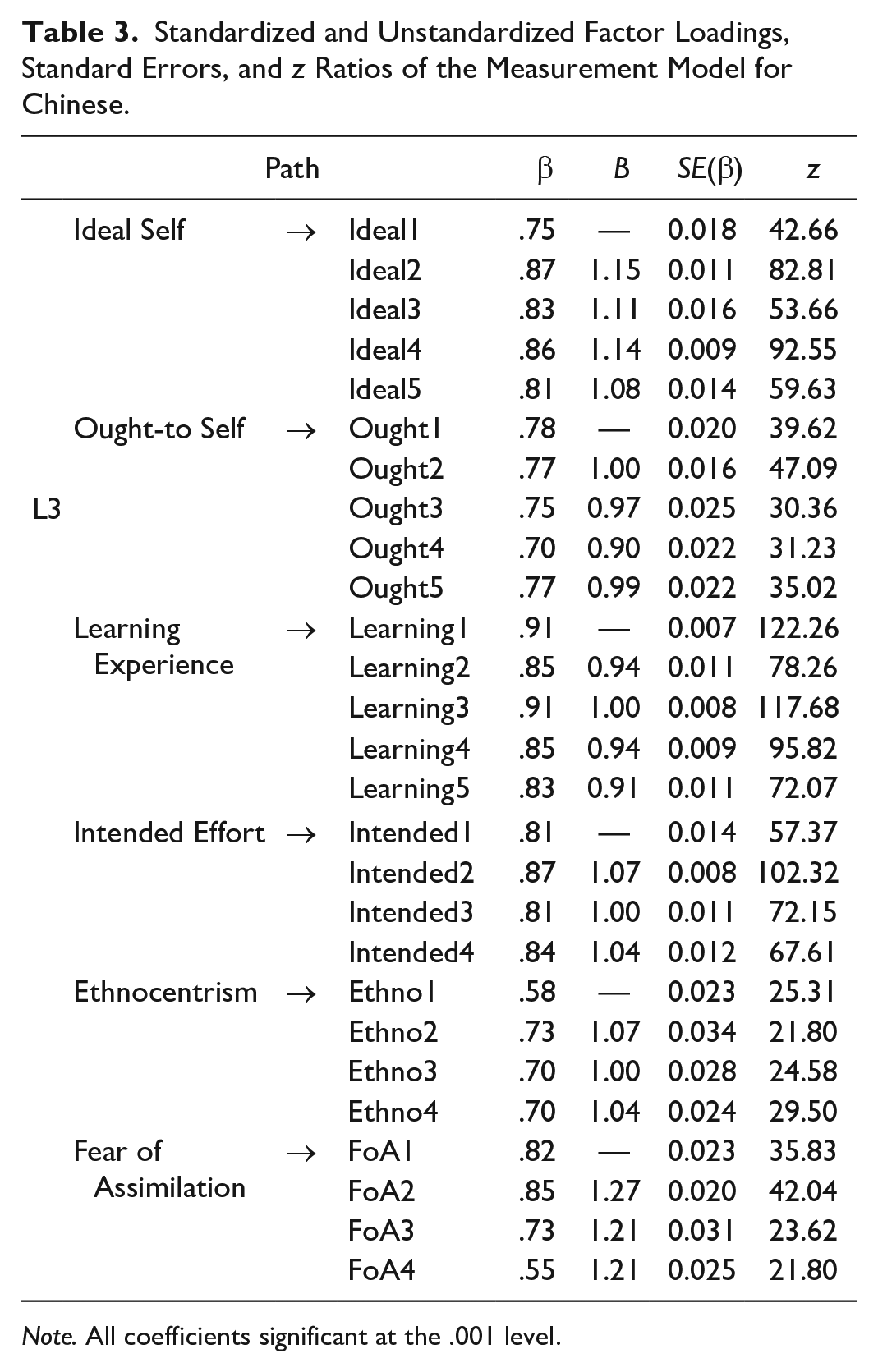
Note. All coefficients significant at the .001 level.
Standardized and Unstandardized Factor Loadings, Standard Errors, and z Ratios of the Measurement Model for Mathematics.

Note. All coefficients significant at the .001 level.
Reliability and Validity of the Constructs in the Measurement Model and Their Inter-Construct Correlations for Each School Subject.
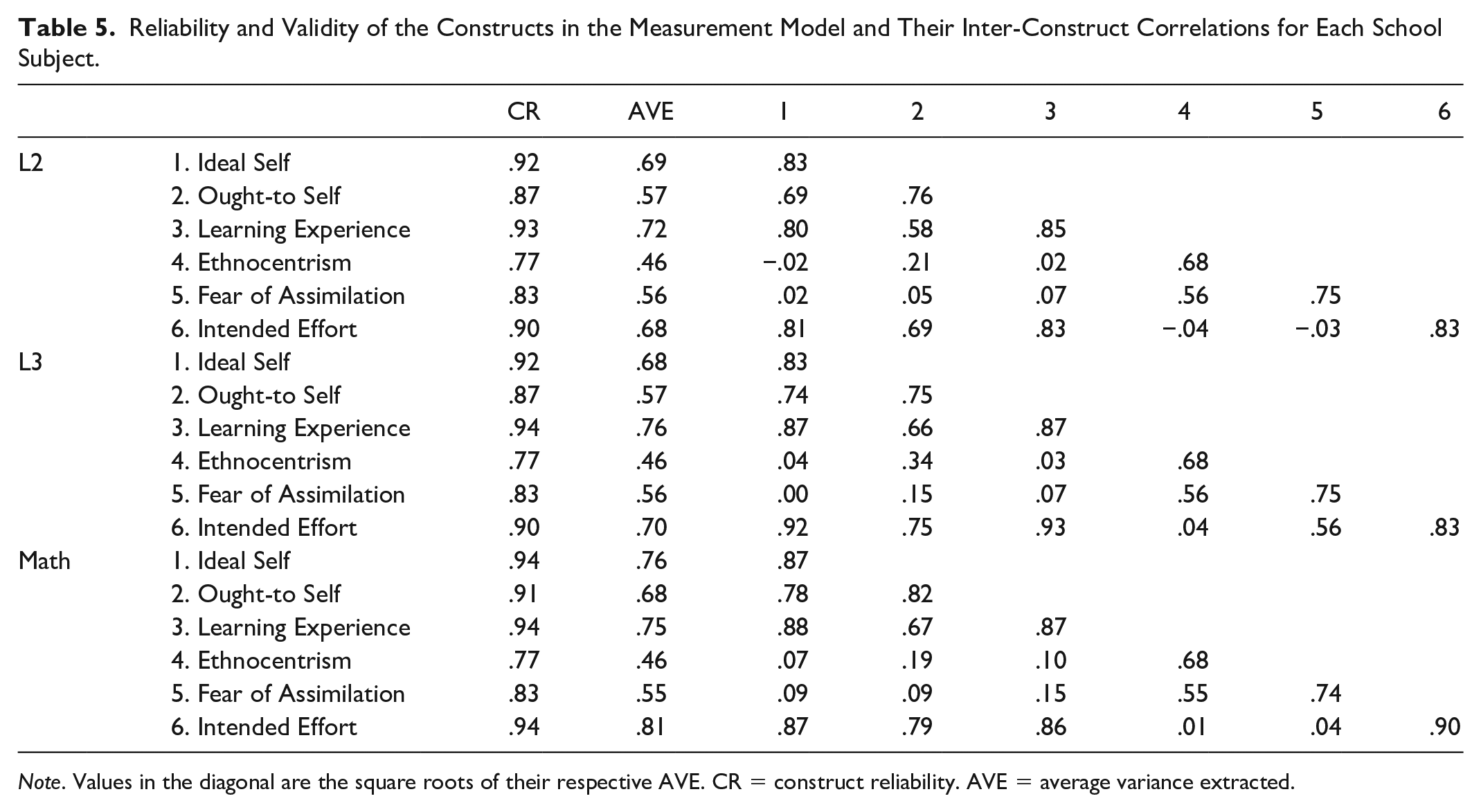
Note. Values in the diagonal are the square roots of their respective AVE. CR = construct reliability. AVE = average variance extracted.
Fit of the Measurement Model for the Three School Subjects.

Note. CFI = comparative fit index; TLI = Tucker–Lewis index; RMSEA = root mean square error of approximation; CI = confidence interval.
RQ1: Model Fit Across the Three Subjects
The first research question aimed to investigate the structural model of each of the three school subjects. Table 7 presents the path coefficients for each subject, whereas Table 8 presents the model fit. Generally speaking, the results are very similar across the three subjects. CFI, TLI, and RMSEA showed adequate fit, with the only exception of a minor misfit for L3 which is nonetheless within the acceptance range. A notable observation from Table 7 is that the Learning Experience was a significant predictor of Post Achievement only in the case of Mathematics.
Standardized and Unstandardized Coefficients, Standard Errors, and z Ratios for the Structural Model of the Three School Subjects.
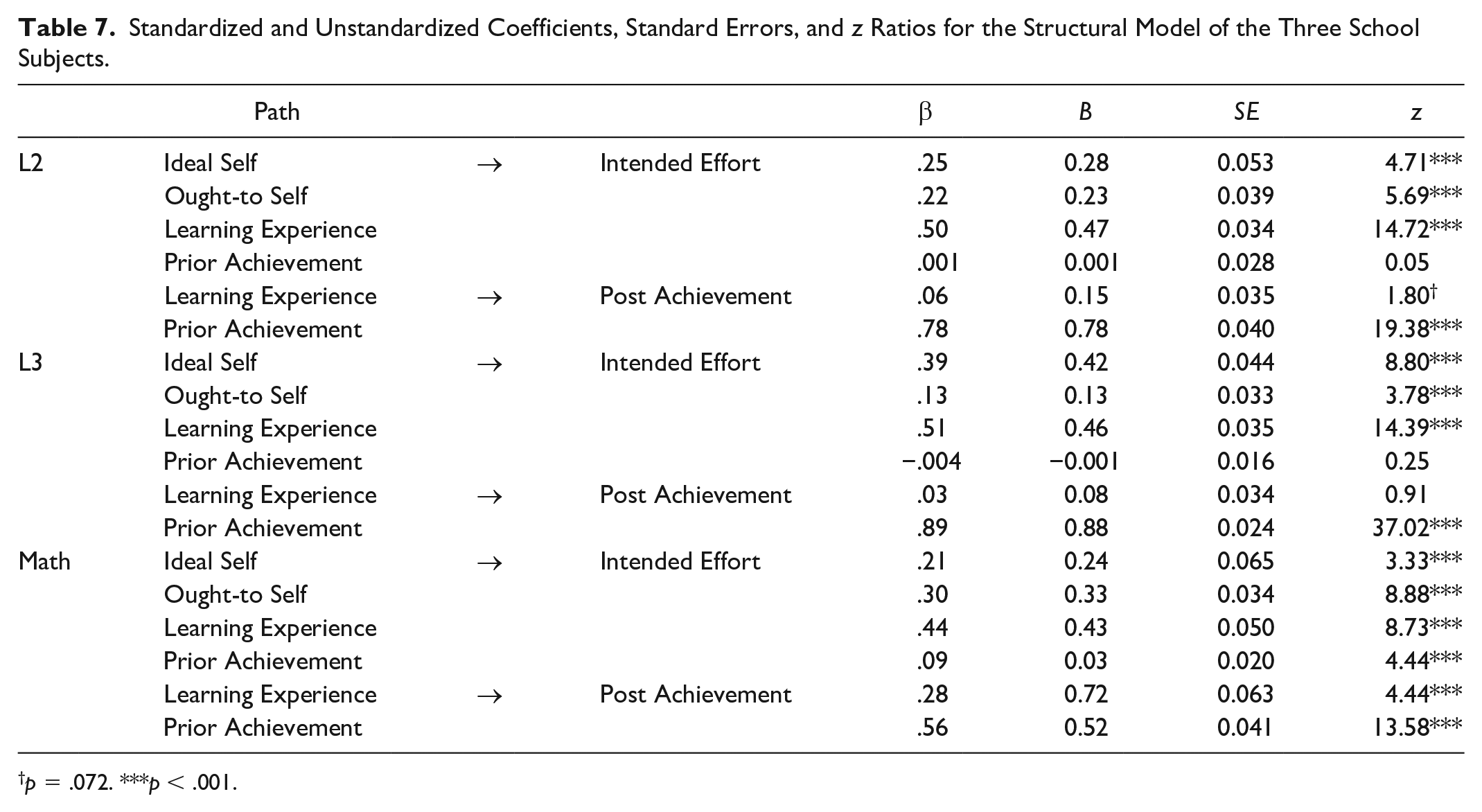
p = .072. ***p < .001.
Fit of the Structural Model for the Three School Subjects.

Note. CFI = comparative fit index; TLI = Tucker–Lewis index; RMSEA = root mean square error of approximation; CI = confidence interval.
Finally, our model proposed no association between Intended Effort and Post Achievement (see Figure 1). To find out whether this was indeed the case, we inspected their residuals in each of the three school subjects. The residuals did not covary significantly either for L2 (θ = −.095, p = .095) or L3 (θ = .081, p = .151). However, it did reach significance in the case of Mathematics (θ = −.14, p = .019), though the relationship was negative (rather than positive as implied by using Intended Effort as a criterion measure). This pattern suggests that those who report an intention to work harder are those who are already struggling.
RQ2: Ethnocentrism and Fear of Assimilation Across the Three Subjects
The second research question was concerned with whether Ethnocentrism and Fear of Assimilation would be significant predictors in the language subjects but not in Mathematics. The results in Table 9 showed that both Ethnocentrism and Fear of Assimilation were weak and nonsignificant predictors of either Intended Effort or Post Achievement. The only exception was a positive association between Ethnocentrism and Post Achievement in the case of Mathematics. Post hoc analysis showed that the coefficient for Mathematics is significantly larger than both L2 and L3. This finding is contrary to the expectation that Ethnocentrism and Fear of Assimilation would be negative predictors of performance in the language subjects.
Standardized Coefficients and Wald Tests of Parameter Constraints for Ethnocentrism and Fear of Assimilation.
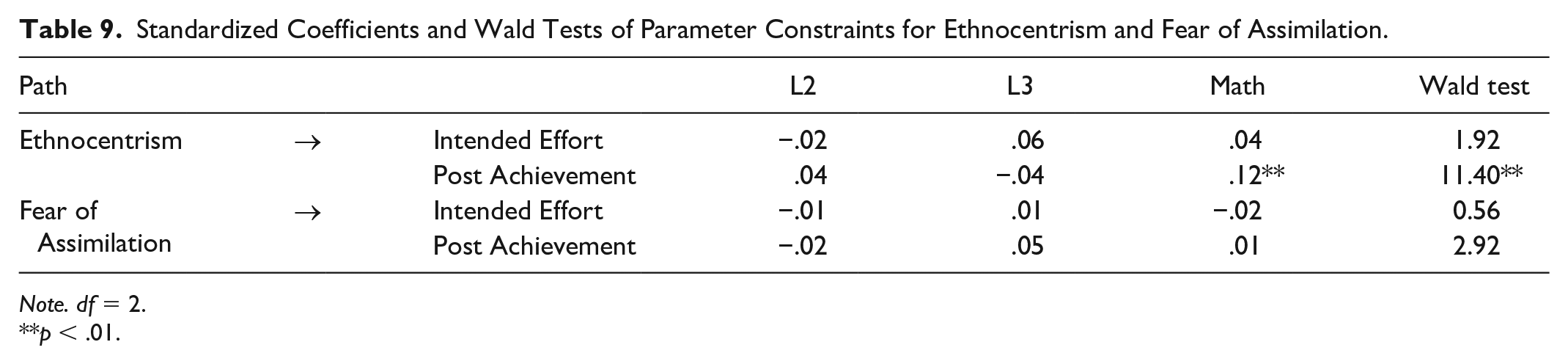
Note. df = 2.
p < .01.
Exploratory Analyses
Our model proposed that neither the ideal self nor the ought-to L2 self had a direct effect on achievement. We conducted exploratory follow-up analyses to find out whether this is indeed the case. We examined whether the Ideal Self and the Ought-to Self would predict Post Achievement in their respective subject. Table 10 presents the path coefficients and Table 11 presents the model fit for each model.
Standardized Coefficients and Wald Tests of Parameter Constraints for the Ideal and Ought-to Selves.

Note. df = 2.
p = .040.
Fit of the Structural Model for the Two Models.

Note. CFI = comparative fit index; TLI = Tucker–Lewis index; RMSEA = root mean square error of approximation; CI = confidence interval.
The Wald test showed no significant differences among the three school subjects in either model. The Ideal Math Self did predict Post Achievement, but its magnitude was small and not significantly larger than that of the other two language subjects (i.e., it was significantly different from zero but not from the two language subjects).
Discussion
In this article, we set out to test empirically what we called the fundamental difference hypothesis in language motivation. This hypothesis suggests that—at the motivational level—language learning is qualitatively different from learning other school subjects, as second and additional foreign languages have a social component and belong to another community. This assumption has dominated the language motivation field since its inception.
Our results showed that, overall, the three subjects exhibit very similar patterns. The results further offered no evidence that language learning is unique given its relationship to identity subtraction. As with results from the socio-educational model (Lalonde & Gardner, 1993; MacIntyre et al., 2012) and from self-determination theory (Fryer & Oga-Baldwin, 2017, 2019), our comparisons using the L2MSS revealed few clear or systematic differences between the two language subjects and mathematics. The only exception was in the learning experience and ethnocentrism predicting achievement, but this occurred in mathematics rather than in the two language subjects. Because it is in the opposite direction, any conclusions remain tentative until this pattern is replicated in future comparative research. Apart from this, empirically, we are so far unable to find support for the validity of a fundamental difference hypothesis either between language versus nonlanguage subjects or between global English versus Chinese.
Nevertheless, we are cautious not to accept the null, as future research might indeed reveal some uniqueness to learning languages. However, it is also likely that such differences might be better characterized as various manifestations of the same underlying motivational process, rather than a fundamental difference, per se, between language and nonlanguage learning. As an illustration, Norton and Toohey (2001) argued that the “good language learner” is not just someone with a certain constellation of personality characteristics, cognitive styles, attitudes, motivations, or past learning experiences. Instead, successful language learners are the ones who are additionally able to exercise their agency and have access to social networks and resources in their language communities (see, for example, Henry, 2017). While this might be true, it is not clear why this should be unique to language learning. The same principle applies to mathematics (to take one side of the spectrum) where access to a community of math experts would certainly facilitate learning the subject; it also applies to the arts (to take the other side of the spectrum) where access to the artistic expertise of musicians, painters, photographers, and so on, would also facilitate excelling in one’s respective field.
In the absence of empirical support for cross-subject uniquenesses, it might be more constructive to move toward a unified theory of learning that is inclusive of the various psycho-social factors at play (cf. Baumeister, 2016). This theory would involve more general principles and common terminology applicable to both language and nonlanguage subjects. Research into this unified theory would also involve comparative analysis of multiple subjects, rather than an exclusive focus on language learning phenomena. Until clear evidence for qualitative difference between language and nonlanguage subjects becomes available, a unified theory drawing on the rich body of evidence in educational psychology and the learning sciences appears to be more parsimonious.
The very same topics and constructs that feature in research on language learning are equally prominent outside of it, but the current publication practices in our field are characterized by a disconnect from educational psychology and other learning sciences (see Al-Hoorie et al., in press; Hiver et al., in press; Oga-Baldwin et al., 2019). Relatively few applied linguists or second language scholars would venture to publish in mainstream educational journals. Similarly, very few scholars in educational psychology or the learning sciences publish in or are familiar with applied linguistics journals on language learning and motivation. This isolation further extends to citations, with little overlap in reference lists between second language acquisition journals and contemporary educational psychology and learning sciences journals. We would suggest that this rift on topics of mutual interest is neither justified nor conducive to scholarly progress and advancement.
This L2 focus has also caused a rather confused state in the language motivation field. While researchers have asserted for decades that language learning motivation is different from learning other school subjects, many scholars have at the same time also called for “catching up” with advances in educational psychology and the learning sciences (e.g., Crookes & Schmidt, 1991; Dörnyei, 1994a, 1994b; Oxford, 1994; Oxford & Shearin, 1994). If language learning is different from other school subjects, then mainstream educational psychology would be, by definition, the “wrong” place to look for insight. Fortunately, research into the psychology of language learning is increasingly drawing from educational psychology and the learning sciences in recent theorizing (Joe et al., 2017; MacIntyre et al., 2016; Mercer & Kostoulas, 2018; Oxford, 2017; Yun et al., 2018). There is also increasing interest in complexity theory (e.g., Dörnyei et al., 2015; Hiver & Al-Hoorie, 2016, 2020b), which originates from the mathematical sciences and also contradicts the assumption that language learning is qualitatively distinct. Because complex dynamic systems have found relevance in many social domains, it is highly unlikely that they are applicable only to language learning (see, for example, Capra & Luisi, 2014). Thus, there is reason to believe that common motivational principles would apply equally well to language learning as to other school subjects. As Ushioda explains, once we begin to consider motivation from the experiential perspective of the person engaged in the business of L2 learning, it becomes evident that we need to broaden our theoretical focus beyond features of motivation distinctive to language learning. Indeed, it would seem surprising if more generic concepts of motivation that apply to all areas of conscious and intentional human learning did not apply also to language learning. (Ushioda, 2012a, p. 16)
Limitations and Conclusion
This article has introduced the fundamental difference hypothesis in language motivation. Our results do not point toward a qualitative difference between mathematics and the language subjects. Instead, differences seem to be in degree rather than in kind, and potentially explainable by a unified theory of educational motivation.
Nevertheless, future comparative research should apply more rigorous designs to shed light on these cross-subject differences. In our case, for example, there did not seem to be a direct way to formally compare the fit of different SEM models. Neither were we able to combine the three school subjects into one model due to the large size of the resulting model and the close parallel of its items. It would therefore be informative for future research to zoom in on specific areas that have the potential to reveal such cross-domain differences.
Footnotes
Appendix
Declaration of Conflicting Interests
The author(s) declared no potential conflicts of interest with respect to the research, authorship, and/or publication of this article.
Funding
The author(s) disclosed receipt of the following financial support for the research, authorship, and/or publication of this article: This study was supported by the Florida State University Open Access Publishing Fund.
Ethical Statement
IRB approval was obtained from the authors’ institution as explained within the manuscript.
