




Abstract
This study explores how strongly and through which mechanisms issue exposure (amount and emphasis of coverage) and news factor exposure (content of coverage that provides newsworthiness reasons) stimulate individual-level agenda-setting effects. Based on a three-wave panel survey that was linked with fitting content analysis data, this is the first field study that comprehensively shows that exposure to news factors in news coverage exert agenda-setting effects at the individual level. Issue exposure and news factor exposure about equally contribute to agenda-setting effects. Their effects are fully cognitively mediated through media salience perceptions (MSP) and news factor perceptions (NFP). Mediation analyses suggest gradual differences between the mediation routes of the two types of exposure, but no clearly distinct paths. The results resonate with recent theorizing and experimental evidence that news consumers consider both amount and content of coverage to appraise and update issue salience. The study also contributes to the theorizing about the psychological processes that underlie agenda-setting effects. The mediation routes and the heuristic inferences they involve reveal high latent trust in journalists’ news selection.
Keywords
Issues move in and out of the public spotlight and news coverage plays an important part in shaping the public agenda (Wanta & Ghanem, 2007). Which issues surpass the threshold of public attention (and which do not) and how public salience of the issue develops is consequential for opinion formation and policymaking (Geiß, 2015; McCombs, 2007). Agenda-setting scholars have recently started delving more deeply into the psychological mechanisms (McCombs et al., 2014; McCombs & Stroud, 2014) or “transmitters” behind the well-documented de-facto relations between media salience and public salience of issues (Wanta & Ghanem, 2007). Two emerging lines of research appear particularly promising:
(1) New predictors of issue salience: Beyond the “traditional” exposure to news stories about an issue (issue exposure), studies have explored the effects of exposure to news factors, relevance cues, compelling arguments, issue attributes, and agenda reasons. The common denominator of all these concepts is that it allows looking at how much news content highlights qualities that might make these issues worthy of news coverage and public attention (news factor exposure): News factors can provide a rationale as to why and how the issue could be interesting or important to the audience. This may also give the audience a better understanding why an issue matters. News factor exposure may stimulate agenda-setting effects beyond those of simple exposure to the issue (Bulkow et al., 2013; e.g., Pingree & Stoycheff, 2013).
(2) New mediators transmitting effects on issue salience: Studies have theorized or tested which cognitions are associated with changes in issue salience and that react to news cues (Huck et al., 2009; Miller, 2007). Associated theoretical models specify which cognitive heuristics and psychological mechanisms news consumers use to infer issue salience from news cues (Huck et al., 2009; Lee, 2019; Pingree & Stoycheff, 2013). The main mediators emerging from these studies are, though with varying labels, media salience perceptions (MSP) and news factor perceptions (NFP) relating to the issue. News factor perception is the individual’s belief that an issue possesses particular attributes that typically contribute to appraising the issue as interesting or important.
If citizens rely on (1) multiple cues in news content and (2) different heuristics, this may be interpreted as a sign of citizen competence and a “trace of rationality” in using their limited capacities of opinion formation. It should also be more resilient against flawed inputs such as “media hype” coverage (Vasterman, 2018), enabling a more adequate distribution of limited opinion formation capacities than solely relying on issue exposure and MSP. However, different cues and heuristics have their pitfalls that may lead to false assessments of the importance of issues.
This study seeks to improve our understanding of these types of exposures and transmission mechanisms. The evidence on cognitive processes mediating agenda-setting effects of news factor exposure (and also: issue exposure) is scattered and was primarily collected in laboratory experiments (Bulkow et al., 2013; Lee, 2019; Miller, 2007; Pingree & Stoycheff, 2013). The current study bundles emerging lines of research into a mediation model. It tests how two types of exposure influence issue salience, and how MSP and NFP mediate these effects. It looks for differences or similarities in the agenda-setting effects of news factor exposure in contrast to issue exposure. The data allow comparing the transmission paths’ relative importance. It discusses which heuristics may underlie these paths, based on previous theorizing (Huck et al., 2009; Lee, 2019).
News Factors and Agenda-Setting
News Factors’ Impact on Selecting and Processing News Stories
From journalists’ perspective, news factors are components of events or news stories that serve to decide and show that it constitutes news. From the audience’s perspective, news factors are pieces of information that help in judging how newsworthy an even or issue is (DeWerth-Pallmeyer, 1997). In short, they should signal newsworthiness and justify why the outlet chose to cover this issue. News stories are likely to include and highlight news factors to capture audience attention and justify news selection (DeWerth-Pallmeyer, 1997). It is useful to introduce some additional concepts. News factor exposure is the extent to which individuals have contact with content that highlights reasons why the issue craves attention. Newsworthiness reasoning—borrowing from Pingree and Stoycheff’s (2013) agenda reasoning concept—is the psychological process in which individuals subjectively rate the newsworthiness of the issue on one or several dimensions. NFP is the perception to what extent the issue holds properties that make it worthy of media or public attention. Despite some potential for consensus, considerable variation between individuals and change over time is to be expected regarding which issues hold which news factors.
How Do News Factors Fit Into Agenda-Setting Theory?
News factors have the potential to fill a gap in agenda-setting theory that has slowly surfaced in the last two decades: The focus on the effects of the sheer amount of media attention for issues (or issue exposure of the individual) has led to a disregard for the specific content in the news that may exert agenda-setting effects beyond simple contact with the issue. Agenda-setting scholars have independently developed multiple concepts to understand how content can induce agenda-setting effects. Citizens view issues as having attributes (McCombs et al., 2000). News media’s presentation of issues has an impact on perceived attributes of issues. Some attributes can serve as compelling arguments (McCombs, 2007) that persuade news consumers that the issue deserves (more) attention. In a similar vein, Pingree and Stoycheff (2013) have proposed that news consumers may engage in agenda reasoning, meaning that they process agenda reasons that an issue might be important. Bulkow et al. (2013) explored how explicit and implicit importance judgments by journalists in news stories affect issue salience. Indirect evidence of the agenda-setting relevance of news factors comes from work on need for orientation (NFO; Weaver, 1980). The NFO concept recognizes that individuals evaluate the relevance of issues and their levels of uncertainty, and that this affects an issue’s agenda-setting potential (Camaj, 2019; Matthes, 2008). NFPs are conceptually related to NFO because relevance and uncertainty (as depicted in news stories) are major components of newsworthiness (Eilders, 2006). But in contrast to NFO, NFPs are viewed as changeable and responsive to information input, for example, from the news.
After all, news factors fit well into agenda-setting theory where they can function as issue attributes, compelling arguments, and/or agenda reasons, potentially shifting individuals’ NFO. Integrating news factors into agenda-setting theory adds more links between journalism and audience perspectives (Galtung & Ruge, 1965), specifies which attributes can serve as compelling arguments (Eilders, 2006), and adds empirical evidence in how news content affects issue salience (Sande, 1971; Schulz, 1982; Weber & Wirth, 2013). This fosters tracing the psychological mechanisms behind changes in issue salience (McCombs & Stroud, 2014).
Conceptualizing Issue Salience
Attention for an issue is a prerequisite for forming (more) well-founded opinions. The varying (between issues and over time) degrees of cognitive focus on current affairs issues has been termed “issue salience” (Weaver, 1991). The current study focuses on two principal aspects of issue salience: (1) the importance citizens ascribe to issues and (2) their interest in the issue. Feelings of interest and importance both provide motivation to engage with an issue, think, talk, and get information, reflect about the pro’s and con’s—in short: motivations for forming an opinion about an issue (Geiß et al., 2020). Interest and importance are related, but distinct components of issue salience: Issues perceived as important may still be boring. Issues may elicit interest but lack importance. Interest is experienced as an emotion (Silvia, 2006) eliciting motivation that is foremost intrinsic (process-focused): one wants to do something because it is interesting (e.g., who prevails in a sports contest). Importance involves more explicit judgment about, for example, specific consequences of an issue. It may also exert strong motivation, but it is foremost extrinsic (outcome-focused): one should do something to achieve some important goal (e.g., whether a pension cut gets implemented; Touré-Tillery & Fishbach, 2014). This leads up to three construct validation assumptions to be tested:
Issue interest and issue importance are separate cognitions;
Issue interest and issue importance are sub-dimensions of issue salience;
Issue interest and importance lead to more (less) information seeking (avoidance).
The latter validation hypothesis links interest and importance to opinion formation efforts, which are often conceptualized as correlates or even as indicators of issue salience (Lee, 2019; Scharkow & Vogelgesang, 2011).
Mediation of News Factors’ Agenda-Setting Effects
Although scattered, there is ample evidence of news factors’ effects on issue salience (Bulkow et al., 2013; Miller, 2007; Pingree & Stoycheff, 2013). The presence of certain news factors in news stories increases the likelihood of memorizing their content (Sande, 1971), and raises awareness of political events (Schulz, 1982). Stressing particular “resonant” issue attributes can propel an issue upward on the public agenda (McCombs, 2007). Relatedly, coverage of positive news has been observed to result in agenda deflation (i.e., reduction of issue salience), most likely because the issue appears to be less pressing (Schönbach & Semetko, 1992). Conversely, news factors stressing the severity of the problem should have an agenda-setting potential. I hypothesize that greater news factor exposure leads to greater issue salience (H1).
The effects of news factor exposure on issue salience is most likely not (wholly) an immediate effect; rather, there will be intermediate cognitive steps that can be traced empirically. This study will explore (1) direct effects; (2) mediation via NFP; (3) mediation via MSP; (4) a more complex two-step mediation process.
Direct Effects
News factor exposure on issue salience might be only partly mediated, with residual direct effects. Direct effects without cognitive mediators can indicate (1) “automatic and unthinking” (Takeshita, 2006, p. 290) processing, (2) omission of important mediating variables, or (3) fleeting cognitive processes that leave no traces in memory. Some evidence challenges the notion of direct effects of media cues on issue salience (Miller, 2007), but it is not yet conclusive. Therefore, I ask: Are there any unmediated (direct) effects of news factor exposure on issue salience (RQ1)?
Mediation Through NFP
News factor exposure to NFP
Greater news factor exposure is conceptualized as the primary antecedent of learning about newsworthiness reasons and engaging in newsworthiness reasoning (analogous to Pingree & Stoycheff, 2013). The influence of news factor exposure (or exposure to similar cues) on issue salience has been theorized (Bulkow et al., 2013; Huck et al., 2009; McCombs, 2007; Pingree & Stoycheff, 2013) and has been empirically demonstrated in a variety of experimental laboratory studies (Bulkow et al., 2013; Miller, 2007; Pingree & Stoycheff, 2013). News value research has established that news factor exposure increase the salience of the events covered (Sande, 1971; Schulz, 1982) and affects the rating of an event’s relevance (Weber & Wirth, 2013).
NFP to issue salience
Those who recognize that an issue holds many characteristics that create social pressure or serve significance or updating reasons (high NFP) are more likely to draw the conclusion that the issue is interesting and/or important (McCombs et al., 2014). Pingree and Stoycheff (2013) directly manipulated NFP by showing participants positive or negative descriptions of the qualities of the issues. This manipulation strongly affected issue salience (Pingree & Stoycheff, 2013).
Mediation path M1
Together, there are good theoretical arguments and empirical evidence for a mediation path M1: News factor exposure’s effect on issue salience is (partly) mediated via NFP (H2). Example: After reading an article that emphasizes the “immense” costs of the Child Care Benefit for taxpayers, the individual concludes that the issue is characterized by high potential damage (NFP). This increases the issue’s salience.
I assume that this path M1 is typical for the processing of news factor exposure due to the immediate psychological connection between news factors (stimulus), newsworthiness reasoning (process), NFP (immediate conclusion), and issue salience (possible final inference). News factor exposure effects along M1 can be thought of as successful persuasion: news factors serve to get news consumers attracted to the issue by explaining or showing why the news is interesting or important. M1 can be regarded a systematic processing route that necessitates substantial attention and cognitive effort (Chen & Chaiken, 1999; Pingree & Stoycheff, 2013).
Mediation Through MSP
News factor exposure to MSP
Another source of issue salience is the perceived emphasis of an issue in the news media (MSP; Atwater et al., 1985). Actual exposure to coverage about the issue (“issue exposure”) is regarded the primary antecedent of MSP through cognitive accessibility: The more often the cognitive representation of the issue gets activated (e.g., when processing a news story about the issue), the more easily will the issue come to mind and be mentioned as interesting or important.
But we should not prematurely exclude the possibility that news factor exposure could exert its effect via that MSP-based mediation route as well, for two reasons: First, news factors draw attention during the processing of messages, make messages more memorable, and leave stronger residual activation of the issue (Price & Tewksbury, 1997). Through the accessibility heuristic, one would judge that media salience is higher when news factor exposure is greater (even if there is no difference in issue exposure). Second, people may infer that the high density of news factors is indicative of positive journalistic news judgments that in turn would result in greater media salience.
MSP to issue salience
Independent of which news cues MSP responds to, there is strong evidence that MSP infuses judgments of issue salience in experimental (Pingree & Stoycheff, 2013) and field studies (Atwater et al., 1985; Matthes, 2008).
Mediation path M2
Combining the paths outlined above, a possible mediation path M2 comes into view, which is explored by RQ2: Does news factor exposure affect MSP which in turn affects issue salience? I assume that this path M2 is typical for the processing of issue exposure and less typical for the processing of news factor exposure. It is a more heuristic way of making judgments about issue salience which does not try to understand how and why the issue is important (in the spirit of “enlightened understanding”) but merely tried to make a good guess which issues might be how interesting or important with as little effort as possible. Example: After reading an article emphasizing the “immense” costs of the Child Care Benefit, the individual recalls the article vividly and infers that the media cover the issue intensively. This increases the issue’s salience.
Two-Step Mediation
From MSP to NFP
Audience members may jump to additional conclusions “switching tracks” from M2 to M1. They may infer from high MSP that there must be (good) newsworthiness reasons (high NFP). Such inferences are rationalizations based on the widespread trust in both the accuracy of news reporting and in the adequacy of news selection (Kohring & Matthes, 2007): citizens rationalize that if the media cover an issue intensively, it must also be newsworthy.
Mediation path M3
This creates a third mediation route M3, with two rather than one mediation steps. Example: After reading an article emphasizing the “immense” costs of the Child Care Benefit, one infers that Child Care is highly salient in the media (MSP); one concludes that the reason for the intense media attention is the high newsworthiness of the issue (NFP); high NFP, in turn, increases the issue’s salience. This possible mediation path is explored by RQ3: Does news factor exposure affect issue salience indirectly, first affecting MSP, then MSP infusing NFP, and NFP driving issue salience? I assume that this path M3 is typical for the processing of issue exposure and less typical for the processing of news factor exposure. While deliberating about possible reasons for the issue’s interestingness or importance, these deliberations are based only on a rationalization of the perception of the issue’s media salience. This makes it a more heuristic route that allows little insight into the nature of the issue and how it is interesting or important.
Controlling for Issue Exposure
This study focuses on news factor exposure and the way it affects issue salience, following recent developments in the agenda-setting literature. However, it also considers the more classical notion of agenda-setting that issue exposure affects issue salience. Considering the effects of issue exposure is important for two reasons. First, this study will control for the impact of issue exposure because issue exposure and news factor exposure will co-vary systematically. For instance, chances are that in intensely reported issues, news factor intensity is also high—both reflecting journalists’ news judgment. Effects of issue exposure may be misinterpreted as effects of news factor exposure if issue exposure is not controlled. Second, including issue exposure allows contrasting them with the effects of news factor exposure to put effect sizes and mediation paths’ importance into perspective. Despite substantial cumulative evidence from correlational field studies (Wanta & Ghanem, 2007; Geiß, 2019b) and experiments (Bulkow et al., 2013; Camaj, 2019; Pingree & Stoycheff, 2013) in search of mediators of issue exposure, I will refrain from formulating hypotheses for issue exposure’s effects and mediation pathways to focus the study on news factor exposure.
Figure 1 summarizes the model, the hypotheses, and research questions.

The mediation model for agenda-setting effects of issue and news factor exposure that guides the present study.
Method
A three-wave panel survey study in a metropolitan area in Germany (April 23–May 12, 2012) was combined with an analysis of TV, online, and newspaper news (April 16–May 12, 2012). For assessing media’s depictions and citizen’s perceptions of issues in high temporal resolution, I selected three issues from the newly established or reprised issues with high media salience in the study’s time frame. The goal was to cover different types of issues regarding geographical focus, policy area, and rationale of its relevance.
The selected issues and the event background were: (1) Syria Conflict: On April 12, 2012, a ceasefire between the Syrian Government and the Opposition came into effect. A UN mission was established to monitor the ceasefire, which was violated repeatedly and overshadowed by terrorist attacks (type: international conflict). (2) Breivik Trial: In 2011, Anders Breivik had killed 77 people in Oslo and Utøya, Norway, in a terrorist attack. His trial started on April 16, 2012 and attracted major media attention (type: judicial trial). (3) Child Care Subsidy Controversy: The German government coalition had agreed to introduce a monetary compensation for families with children under three that organize child care privately rather than using public day care centers (“Child Care Subsidy”). The opposition and parts of the government heavily criticized the plans (type: domestic policy).
Content Analysis
Procedure and sampling
All eleven news media used by at least 5% of the respondents in the (regional) panel sample were analyzed: five TV news outlets (Tagesschau, Tagesthemen, Heute, Heute Journal, and RTL Aktuell), two regional newspapers (Allgemeine Zeitung and Mainzer Rheinzeitung), two national quality newspapers (Frankfurter Allgemeine Zeitung and Süddeutsche Zeitung), and two Internet news sites (spiegel.de and tagesschau.de).
Measures
Various measures of placement and visualization of news stories (specific for TV, newspaper, and online outlets) were combined into an index of visibility. The length of news stories was assessed based on word count (newspapers and online news) or duration (TV; 140 words per minute were assumed). Multiplying likelihood of exposure and length of news stories yielded weights which are estimates of users’ duration of contact with each news story.
The intensity of news factors in news coverage was measured along three dimensions of newsworthiness reasons on 4-point scales (0 = no reasons; 3 = high intensity and frequency of reasons) rated per paragraph (TV: per 30 seconds chunks): intensity of significance reasons, updating reasons, and social reasons. The codebook featured an exhaustive list of signals (e.g., news factors) that would be interpreted as significance, updating, or social reasons. The codebook is documented in the Supplemental Appendix.
All four trained coders completed coding reliability tasks consisting of 24 news stories. Intercoder reliability scores (Krippendorff’s α; interval scaling) were excellent for length (.997) and visibility index (.997), good for conflict (.908) and significance reasons (.891), and mediocre for updating reasons (.685). Standard errors of reliability scores ranged between .030 and .050.
Panel Survey
Procedure and sampling
Participants were recruited (CATI) in early April 2012. A sample of 5,208 random landline telephone numbers in a metropolitan area in Germany were called. Siegfried Gabler at GESIS generated the numbers according to the widely used Gabler–Häder method. A total of 443 respondents accepted participating in the panel study (305 in the main study, 138 as standby). The conservatively estimated response rate (RR3) was .176 (Smith, 2009). The field periods for the three weekly panel telephone waves (CATI) were April 23 to 28, April 30 to May 5, and May 7 to 12, 2012. The final sample of 301 respondents participating in one or more panel waves differs from the adult population of the metropolitan area and of Germany: Respondents were slightly older, more highly educated and more politically interested. There were no meaningful differences in distributions of sex, occupation, and family status, however.
Measures
Respondents reported in each wave which news outlets they had used on how many of the past 7 days (0–7). Six items measured NFP for the issues (5-point Likert items), partly drawing on the survey of motivations for naming an issue as “most important problem” used in McCombs (1999) and on news factor catalogs (Eilders, 2006). Five items captured judgments of issue importance and feelings of issue interest (4-point scales). A single item captured MSP (5-point scale) to indicate the number of news stories about the issue they were exposed to in the previous 7 days: 0 (0), 1 to 2 (1), 3 to 5 (2), 6 to 10 (3), and 11 or more stories (4). Using the non-linear scale-points (scale points: 0, 1, 2, 3, and 4) approximately corresponds to logarithmized perceived contact counts (contact count: 1, 2, 4, 8, and 16). All 12 items were repeated for each of the three issues and in each panel wave. The item wordings are reported in Table 1.
Measurement Models of NFP Items and Issue Salience Items.

Note. Standardized loadings. Italicized: lead indicators of the factor. Item nonresponse was rate and the few missing values were replaced using a multiple imputation algorithm (Honaker et al., 2011).
The originally assumed single factor “newsworthiness reasons” was split up into “significance,” “updating,” and “social reasons” with an overarching second-order according to modification indices. χ2(5) = 30.3; CFI = 0.990; TLI = 0.970; RMSEA = 0.054; 95% CI = [0.036, 0.073]; SRMR = 0.020.
The originally assumed model assigned only IS2 to the importance first-order factor and IS1, IS3 to 5 to the interest first-order factor; in response to modification indices, IS1 was moved from the “interest” to the “importance” first-order factor. χ2(3) = 3.4; CFI = 1.000; TLI = 1.000; RMSEA = 0.009; 95% CI = [0.000, 0.042]; SRMR = 0.006.
Linking Survey and Content Data
Issue salience and its validation
The measures of issue salience were tested in a confirmatory factor analysis. The initial model was defined as follows: First-order factors importance (single item) and interest (general interest and interest in three current headlines) load on a second-order factor, issue salience. This solution was not feasible: χ2(5) = 67.2; CFI = 0.977; TLI = 0.944; RMSEA = 0.095, 95% CI [0.076, 0.116]; SRMR = 0.028.
Modification indices suggested to transfer the general interest item from the interest to the importance factor. This modified solution was feasible: χ2(3) = 3.4; CFI = 1.000; TLI = 1.000; RMSEA = 0.009, 95% CI [0.000, 0.042]; SRMR = 0.006 (see Table 1). This shows that modeling interest and importance as separate sub-dimensions of a superordinate “issue salience” factor is feasible. As expected, there was a strong positive correlation between importance and non-habitual information seeking (r = .517) and a strong negative correlation with non-habitual information avoidance (r = −.464). A similar result was obtained for issue interest’s correlation with information seeking (r = .481) and with avoidance (r = −.407). The validation procedure was successful.
News factor perceptions
The measures of NFP applying to issues were tested in a confirmatory factor analysis. The initial model was defined as a single factor model, comprising reach, personal consequences, ongoing development, suspense, issue popularity, and civic duty to deal with the issue. Model fit was unsatisfactory: χ2(9) = 131.3; CFI = 0.950; TLI = 0.916; RMSEA = 0.090, 95% CI [0.077, 0.104]; SRMR = 0.040. According to modification indices, overall newsworthiness (second-level factor) rested on three subordinate (first-level) factors: significance reasons (reach, personal consequences, civic duty), updating reasons (ongoing development, suspense), and social reasons (popularity, civic duty). This modified solution proved feasible: χ2(5) = 30.3; CFI = 0.990; TLI = 0.970; RMSEA = 0.054, 95% CI [0.036, 0.073]; SRMR = 0.020. The second-order factor is used as a measure of overall NFP.
Issue and news factor exposure
Content analysis data were linked to each survey response, estimating the amount and content of exposure to coverage about the three issues (e.g., Erbring et al., 1980; Geiß, 2015, 2019a). All content received during the last 7 days before the date of the interview was considered, with acceleratingly decreasing weights (weights for content 1, 2, 3, 4, 5, 6, and 7 days old on the day of the interview: 1.0, 0.92, 0.83, 0.71, 0.56, 0.36, and 0.00); this means that recently consumed news content counts fully (1.0), whereas exposure that occurred 1, 2, 3. . . days ago is gradually weighted down. Additionally, each news story was then weighted with the estimated time of exposure (Geiß, 2019a) to give longer (=more exposure time) and better-placed (=greater probability of exposure) news stories more weight.
The estimated time of exposure to the issue (in minutes) was used as an index of issue exposure (Min = 0, Max = 36.00, M = 1.78, SD = 3.24). The average intensity of conflict-related news factors (M = 1.39; SD = 0.63), of updating-related news factors (M = 1.24; SD = 0.60), and of significance-related news factors (M = 1.45; SD = 0.44) were combined into an average index of news factor exposure (Mix = 0.50; Max = 2.59; M = 1.40; SD = 0.36; Cronbach’s α = .84; McDonald’s ωhierarchical = .80).
Results
The hypotheses were tested using two different analytical set-ups (similar to Shah et al., 2005): First, a between-model assessed the reasons of structural between-person and between-situation differences (h = 867 cases based on 1,737 responses by n = 301 respondents). Here, within-variation was removed by averaging responses by the same person regarding the same issue). Second, a first-differences panel model captured which predictors explain within-person change (h = 815 change scores by n = 207 respondents). Using change scores between panel waves removed between-variation. All models used cluster-robust standard errors that account for repeated measurement concerning the same respondents and the same issues.
The full structural equation models (S1, C1) connect both types of exposure (issue exposure, news factor exposure) with both kinds of issue perceptions (MSP, NFP, M1–M3) and with issue salience (direct effects); they connect MSP with NFP (M3). Both MSP and NFP are connected to issue salience. NFP and issue salience are represented as latent factors (with associated measurement models). Issue exposure, news factor exposure, and MSP are manifest variables.
Structural Differences (Between Model)
Are there still direct effects or unknown mediation pathways?
No, there are not. If there were any direct effects of exposure or yet-unknown mediating processes, removing the direct effects paths from the complete model should lead to deterioration of model fit. To check this, I removed the complete model’s (S1) direct effects paths between exposure and issue salience (which equals model S2) by fixing the path coefficient to 0 (Figure 2). A non-nested model comparison (Vuong’s test) found no significant difference between S1 and S2 (z = 1.097; p = .136; Table 2). This means that the model without direct effect paths should be preferred because it is more parsimonious and fits the data equally well; comparing the fit indices corroborates this test result. There are no signs of overlooked mediation paths or unmediated effects. The exposure effects were fully mediated. This answers RQ1.
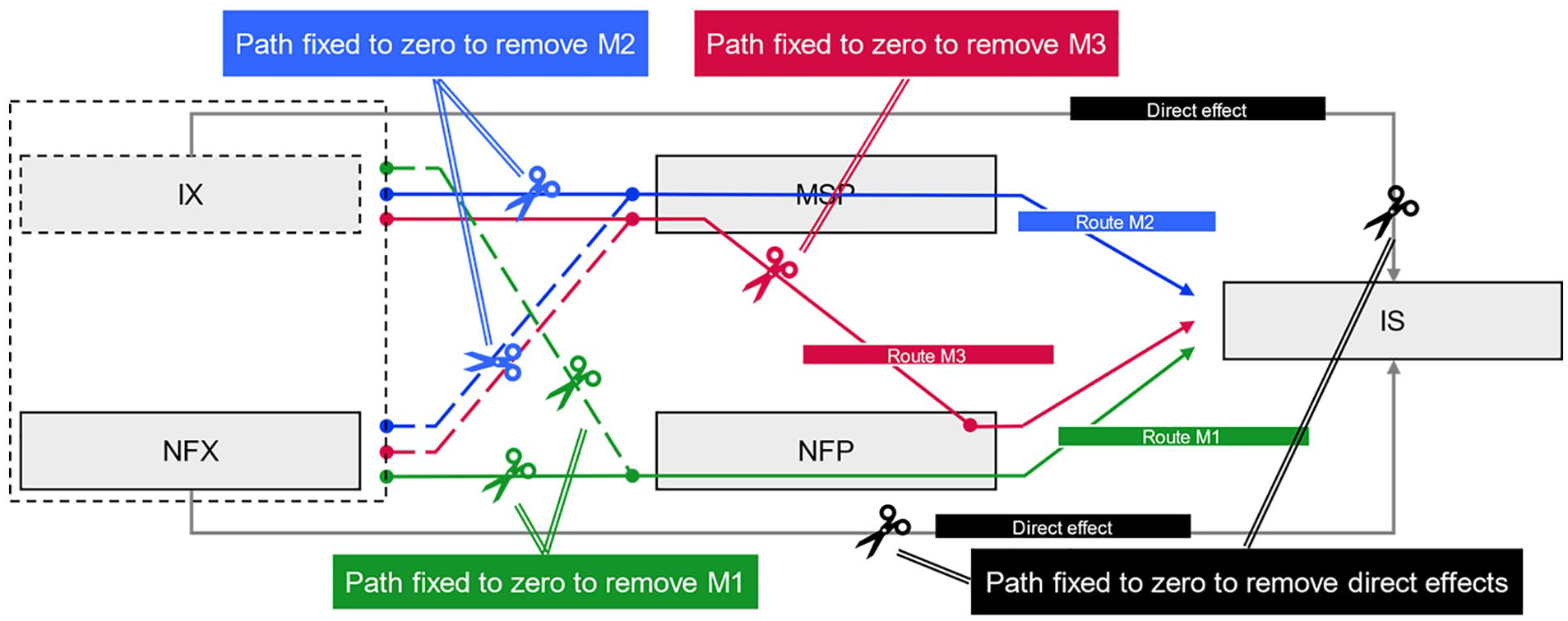
Modifications of complete models S1 and C1 to test which transmission paths are necessary for explaining agenda-setting effects.
Model Fit of Different Modeling Options—Structural Differences Models S1 to S6.
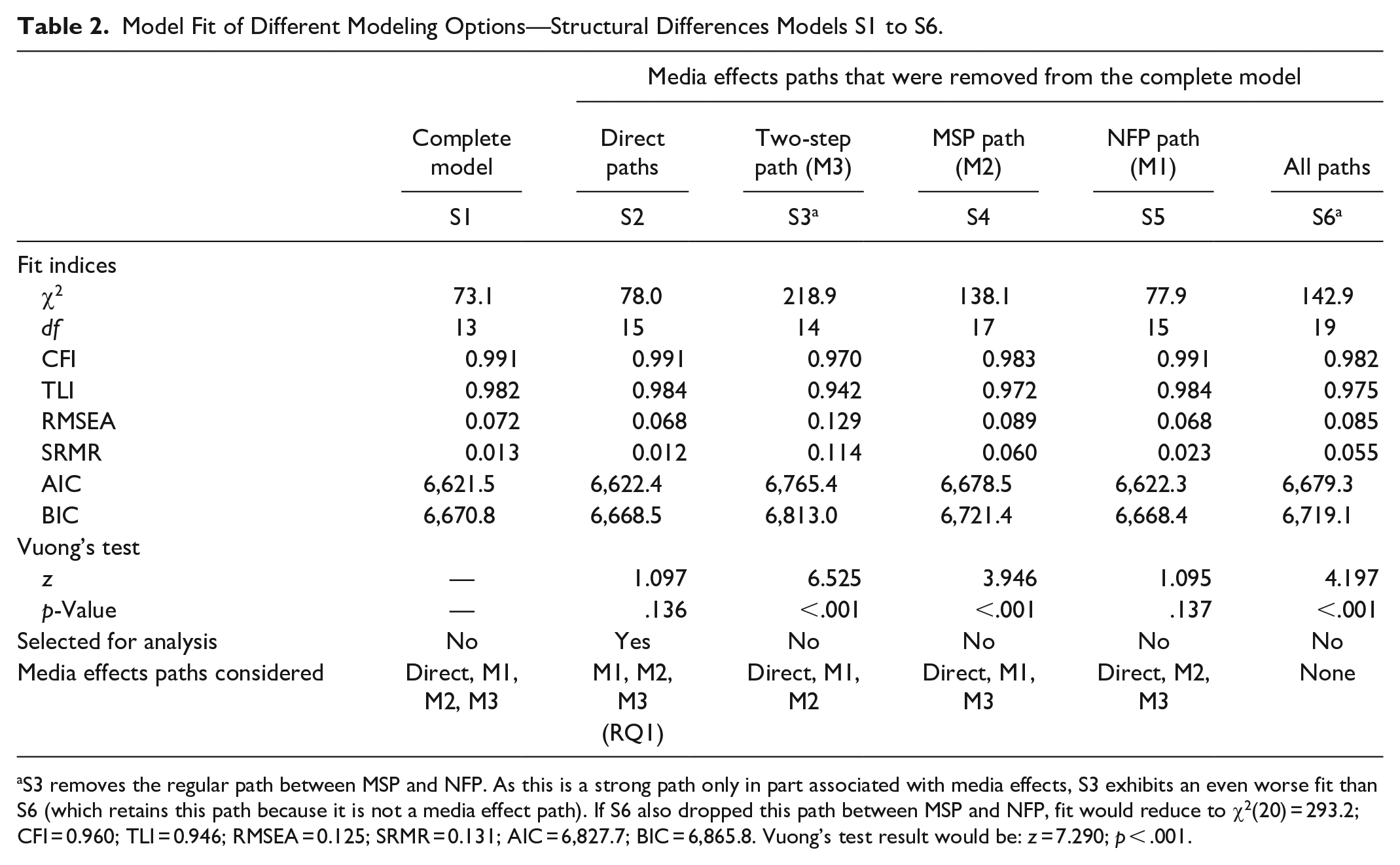
S3 removes the regular path between MSP and NFP. As this is a strong path only in part associated with media effects, S3 exhibits an even worse fit than S6 (which retains this path because it is not a media effect path). If S6 also dropped this path between MSP and NFP, fit would reduce to χ2(20) = 293.2; CFI = 0.960; TLI = 0.946; RMSEA = 0.125; SRMR = 0.131; AIC = 6,827.7; BIC = 6,865.8. Vuong’s test result would be: z = 7.290; p < .001.
Do we need all those mediation pathways?
We could probably drop M1, but M2 and M3 are clearly needed. Like with the direct effects paths, we can check the three mediation mechanisms M1 to M3 for their overall relevance for the model’s fit with the data. If removing these pathways (by fixing their path coefficients to 0) leads to deterioration of model fit, they are essential for the model. If model fit is not affected, the pathways can be omitted to obtain a more parsimonious model (Figure 2). Removing the two-step mediation path M3 (S1 → S3: z = 6.525; p < .001) or the mediation via MSP along path M2 (S1 → S4: z = 3.946; p < .001) leads to significant deterioration of model fit according to Vuong’s test for comparing non-nested models. The mediation via NFP along path M1 could be removed (S1 → S5: z = 1.095; p = .137; Table 2). This means that the mediation routes M2 and M3 are essential to understanding the psychological mechanisms behind structural differences in agenda-setting processes. Despite the possibility to omit M1, I used model S2 (which retained M1, M2, and M3 but drops the direct media effects paths from the complete model) to test the hypotheses and answer the research questions based on the estimated coefficients. One reason was that dropping both the direct effects and M1 led to a more problematic deterioration of model fit according to Vuong’s test that approaches statistical significance (z = 1.570; p = .058).
Total exposure effects
The data support H1. Exposure to news factors had a positive total effect on issue salience (β = .058; SE = .025; p = .035; Figure 3, Table 4). This means that those persons rated issues importance and interest more favorable if they had been exposed to a higher density of news factors in issue-related news stories in the past week.

Mediation paths of the effects of news factor exposure and issue exposure in within-person change.
Psychological mechanisms of news factor exposure
Along M1, between-differences in news factor exposure did not indirectly affect issue salience by heightening NFP (β = .025; SE = 0.023; p = .275). H2 is rejected (Figure 3, Table 4). News factor exposure did affect issue salience through M2 (β = .015; SE = .007; p = .047) and M3 (β = .018; SE = 0.009; p = .044), however. This answers RQ2 and RQ3 (Figure 3, Table 4).
Psychological mechanisms of issue exposure
Contrasting the mediation paths for news factor exposure with those for issue exposure is informative as issue exposure is the more widely studied predictor of agenda-setting effects. As expected, issue exposure exerted positive effects by increasing MSP, which in turn led to higher issue salience (route M2; β = .043; SE = 0.009; p < .001). Additionally, higher MSP translated into higher NFP which in turn increased issue salience (route M3; β = .054; SE = 0.011; p < .001). In contrast, there was no significant indirect effect via NFP, and the estimate was negative (route M1; β = −.037; SE = 0.020; p = .071). Still the total effect of issue exposure was positive, as expected (route M1; β = .061; SE = 0.025; p = .014; Figure 3, Table 4).
Within-Person Changes (Panel First Differences Model)
Direct effects
I dropped the direct effects from the complete model C1, leading to C2 (Figure 2). A comparison between the two non-nested models (Vuong’s test) found no significant difference between C1 and C2 (z = 1.180; p = .119; Table 3). Direct effects were therefore dropped. This answers RQ1.
Model Fit of Different Modeling Options—Within-Person Change Models C1 to C6.
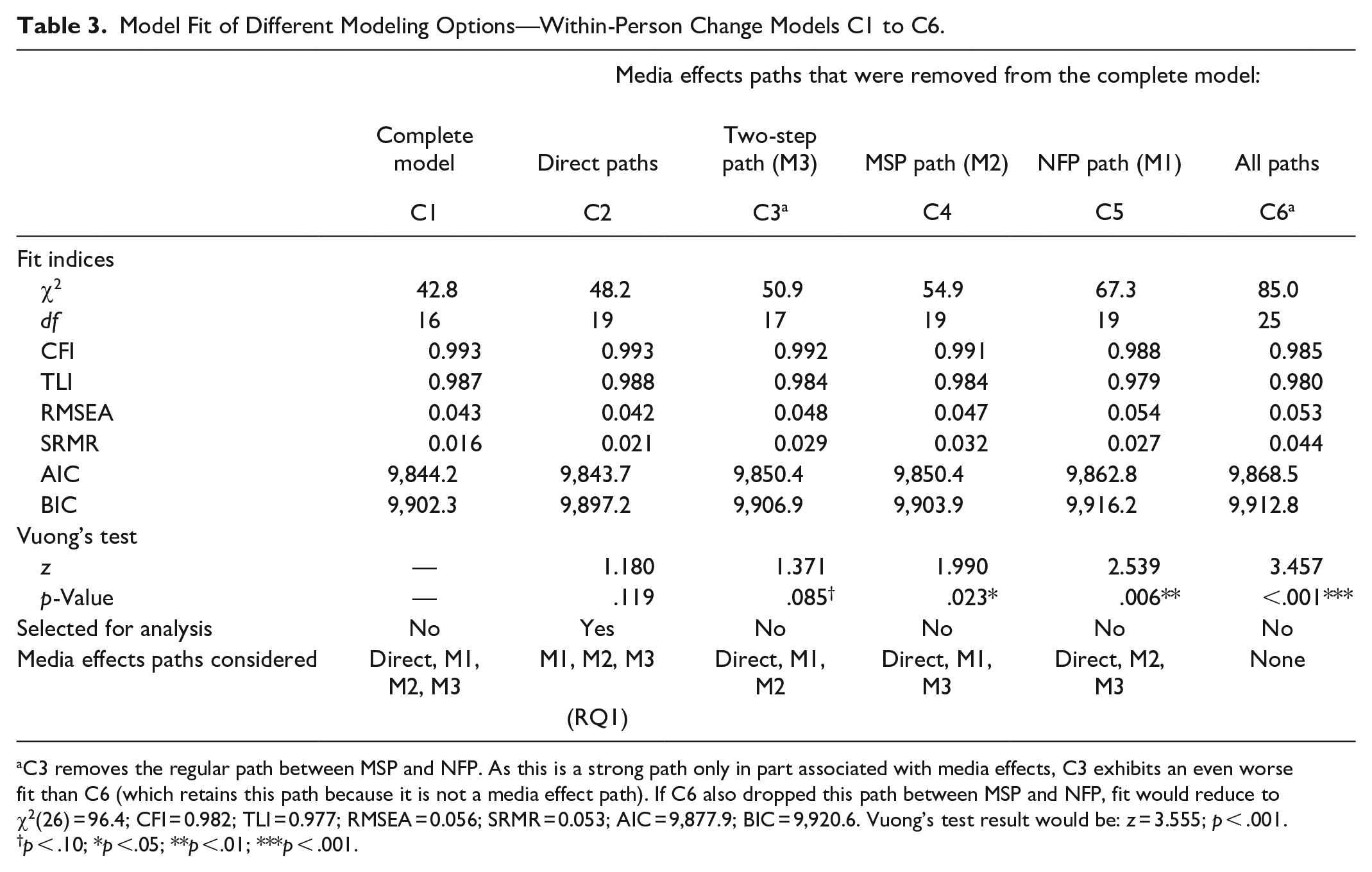
C3 removes the regular path between MSP and NFP. As this is a strong path only in part associated with media effects, C3 exhibits an even worse fit than C6 (which retains this path because it is not a media effect path). If C6 also dropped this path between MSP and NFP, fit would reduce to χ2(26) = 96.4; CFI = 0.982; TLI = 0.977; RMSEA = 0.056; SRMR = 0.053; AIC = 9,877.9; BIC = 9,920.6. Vuong’s test result would be: z = 3.555; p < .001.
p < .10; *p <.05; **p <.01; ***p < .001.
Mediation paths
Removing mediation pathways M1 (C1 → C5: z = 2.539; p = .006) or M2 (C1 → C4: z = 1.990; p = .023) resulted in significant drop in model fit, respectively. Dropping the two-step route M3 might be possible as Vuong’s test is only marginally significant (C1 → C3: z = 1.371; p = .085); however, in this borderline case, I chose C2. It retained M3 (in addition to M1 and M2), also to preserve symmetry between the within-person change model and the structural differences model (Table 3), and to allow coefficient-based tests of hypotheses and exploration of research questions.
Total exposure effects
In line with H1, change in news factor exposure exerted a significant total effect on change in issue salience (Figure 4; Table 4; β = .044; SE = 0.013; p < .001). The next set of analyses explored through which mechanisms this total effect was mediated.
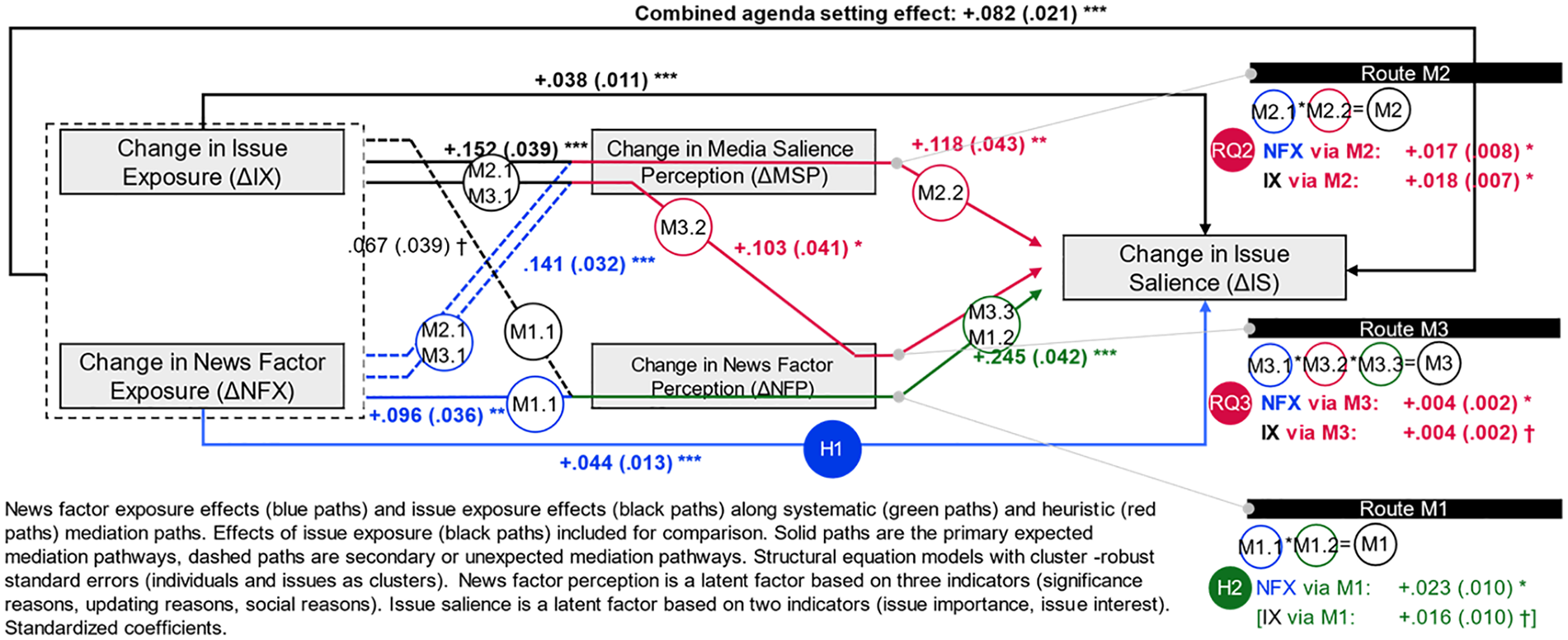
Mediation paths of the effects of news factor exposure and issue exposure in within-person change.
Model Estimates for Structural Differences and Within-Person Change.

Note. The coefficients were estimated according to the selected models S2 and C2.
p < .10; *p < .05; **p < .01; ***p < .001.
Psychological mechanisms: News factor exposure
Change in news factor exposure took effect along path M1: change in news factor exposure led to change in NFP which in turn affected issue salience (β = .023; SE = 0.010; p = .015). This supports H2 for within-person change. Change in news factor exposure exerted effects along M2 (β = .017; SE = 0.008; p = .030) and M3 (β = .004; SE = 0.002; p = .043) as well. Overall, change in news factor exposure exerted some effects via M1, M2, and M3, where M1 was more important than M2 and M2 was more important than M3, if we consult the standardized regression coefficients (Figure 4, Table 4).
Psychological mechanisms: Issue exposure
I contrasted the mechanisms of news factor exposure with those of issue exposure for within-person change. There were significant total effects of change in issue exposure on change in issue salience (β = .038; SE = 0.011; p < .001). The processing of change in issue exposure was associated with MSP change, which in turn was associated with issue salience change (M2; β = .018; SE = 0.007; p = .015). The mediation route via MSP. M1 (β = .016; SE = 0.010; p = .095) and M3 (β = .004; SE = 0.002; p = .064), were only marginally significant transmission paths (Figure 4, Table 4).
Discussion
The study provided unique contributions to the agenda-setting literature, substantially extended previous themes (Huck et al., 2009; Pingree & Stoycheff, 2013) and paves avenues of future research in the psychological foundations of agenda-setting (McCombs & Stroud, 2014). The current study selected three issues that were intensively covered in the media at the time, allowing precise measurement of the perceptions individuals hold about the issue (MSP, NFP). In a three-wave panel design, it matched individual media use data with content analysis data of the news stories published in the week before the respective interview. This allows a precise estimate of individual’s exposure. It is the first field study that traces the psychological mediating mechanisms between two relevant kinds of exposure in agenda-setting processes: “issue exposure” and “news factor exposure.” It allowed estimating (a) their relative importance in explaining differences and change in issue salience and (b) the degree to which degree the effect is mediated via MSP, NFP, or both. The study tested all hypotheses and explored all research questions once for structural differences (between variance) and once for within-person change (within variance).
Understanding Structural Differences in Issue Salience
How do different information inputs (exposure) relate to between-person differences in perceptions of issues (MSP, NFP) and issue salience? Why do some persons attribute high interestingness and importance to some issues while other persons rather prioritize other issues?
Such structural differences are co-driven by issue exposure and by news factor exposure, in about equal strength. Both types of exposure use mediation routes M2 and M3, where exposure influences MSP which then influences issue salience, either directly (M2) or indirectly via NFP (M3).
The cornerstone of exposure effects on structural differences in issue salience is mediation through MSP; NFP clearly has a secondary role of mediating structural differences. This is true despite NFP being the more potent predictor of issue salience compared to MSP. In contrast to MSP, NFP driven by direct exposure to a lesser extent. Issue exposure and news factor exposure trigger relatively similar psychological mechanisms that lead up to higher issue salience, rather than using different psychological mechanisms. While one could think that (a) issue exposure would mostly work through M2 (and probably M3) and (b) news factor exposure would work through M1 (and probably M3), this is not the case for structural differences.
The marginal and indirect role of M1 in predicting between-variation in issue salience is puzzling. One explanation could be that the perception of an issue’s characteristics (and its newsworthiness) may in a large part be a residual from previous instances of contact with this issue or with similar issues that individuals have stored and activate when confronted with the issue (Kepplinger & Daschmann, 1997). This would explain why differences in news factor exposure mostly affected MSP but not NFP. Notably, the three issues studied were all continuations of previous instances of coverage.
Understanding Within-Person Change in Issue Salience
A different research problem is how the change of issue salience within an individual comes about. Given the initial level of issue salience, which changes in information input give rise to changes in perceptions (MSP, NFP) and in issue salience as an issue develops?
The mechanisms that govern within-person change in issue salience are similar to the mechanisms found for structural differences in several ways: First, there are no substantial differences between issue exposure and news factor exposure in how they affect issue salience. Second, change in issue exposure and change in news factor exposure about equally contribute to change in issue salience. Third, the indirect effects that involve MSP (M2 and M3) prove statistically significant for both types of exposure. But in contrast to structural differences, the role of the indirect effect via NFP (M1) is more consistent and more important in within-person change. There is a positive coefficient for both types of exposure; it is statistically significant for news factor exposure and marginally significant for issue exposure.
My interpretation is that citizens’ perceptions which characteristics an issue has can incrementally change as the issue develops and the density of news factors in coverage varies; when eliminating the between-variance, we see that the psychological response to changes in the portrayal of issues (but also their media salience) can lead to moderate intra-individual adjustments of NFP.
Error-Prone Heuristics
The findings are useful the analyze potential problems in how a public manages its limited attention for public affairs issues. Very few issues can capture (almost) universal attention of the entire public at the same time, and recent developments in terms of more personalized news use can further shrink that “common core” (Möller et al., 2016; Magin et al., 2021). There are two main dangers are to be considered: (1) To overlook issues that warrant public attention and (2) to use too much attention on some issues which do not warrant so much attention; both dangers are connected in that overspending attention on some issues leads to a shortage of attention for other issues (Ricchiardi, 2003, 2008).
In a nutshell, media users draw on both issue exposure and news factor exposure. This means that the strongest stimulation of public attention for an issue can be expected if many different news media jointly decide to cover an issue intensively and emphasize (and thereby, to some extent, justify) its newsworthiness. Interestingly, news consumers use both issue exposure and news factor exposure primarily to judge the media salience of the issue (MSP) from which they infer the issues NFP. NFP thereby mainly reduces to a rationalization of high MSP rather than a separate impression formation based on news factor exposure. This set of inferences (M3) can give rise to a dangerous error of judgment: citizens may believe that their evaluations of issue salience are based on better information (i.e., on impressions of the issues content and characteristics) than they are (i.e., rationalization of the amount of coverage). They could think that their NFP and MSP “match” and “validate” one another (increasing the certainty in their judgment of issue salience), but in fact they are not independent perceptions.
This rationalized perception of an issue’s newsworthiness is driven by the heuristic that “intense news coverage indicates high newsworthiness.” This trust in news selection heuristic is only valid if (and therefore presupposes that) journalists select news stories according to newsworthiness as the audience understands it. In that presupposition, the heuristic shares many characteristics of gatekeeping trust (Pingree et al., 2013) or trust in news selection (Kohring & Matthes, 2007): News users rely more on their trust in journalists’ news judgment than on their own understanding of whether the news event or issue has qualities that render it interesting or important. And researchers have demonstrated multiple times that news coverage intensity can become detached from rational news judgment such that media hypes and news waves without substance can emerge (Elmelund-Præstekær & Wien, 2008; Fishman, 1978; Kepplinger & Habermeier, 1995).
Citizens barely make use of news factors in coverage to understand how and why an issue deserves attention, which is disenchanting. Clearly, using one’s news factor exposure to judge an issues newsworthiness is not necessarily better: It also involves a heuristic: “if the news media attribute many newsworthy qualities to an issue, the issue actually has many newsworthy qualities.” This trust in news reality heuristic heuristic is only valid if news media cover issues in an accurate and adequate manner. It reflects a trust in fact selection and a trust in presentation of facts (Kohring & Matthes, 2007). And this trust is not always justified either (Sheppard, 2008). Hence, relying more on this second heuristic would not solve all problems in public attention management, but be an important addition and corrective in case the trust in news selection heuristic fails and news media give disproportionate attention to issues without a reasonable justification why that issue warrants so much attention. By relying so strongly on the trust in news selection heuristic, however, news consumers largely let this opportunity slip.
The mediators of agenda-setting effects presuppose substantial trust in journalism—trust into news selection, news reality, or both. That is true despite the availability of alternative sources of information and the low levels of trust in (and high cynicism toward) news media reported in public opinion polls (Jackob, 2010). This could mean that low trust in the news does not fully inhibit agenda-setting processes (but see Tsfati, 2003). One reason might be the overconfidence in one’s judgments of issue salience due to rationalization along the two-step mediation route inferences (M3) demonstrated in the current study.
Overconfidence and gullibility regarding issue emphasis in the news (Vasterman, 2018) could also have serious implications for processing disinformation (Tucker et al., 2018), particularly if citizens mistake it for serious news coverage. By simply emphasizing an issue (probably amplified by social bots: Hagen et al., 2020), disinformation messages could lead citizens to both (a) overestimate the issues media salience and (b) inaccurately assess the issues newsworthiness, leading to maladjustment of issue salience.
Conceptualization and Measurement of Issue Salience (IS) and News Factor Perceptions (NFP)
Besides the main contributions in exploring psychological processes in agenda-setting through mediation analysis, the study has also two brief, but important side contributions with regard to conceptualization and measurement:
Issue salience
Most studies of agenda-setting processes rely on a single indicator of issue importance. This study conceptualized issue salience as bundling issue interest and importance, with the possibility to add more subdimensions. “Motivating cognitions for opinion formation” may be a more precise, but also awkward alternative term for issue salience as it is used here. The data fit the notion that ratings of importance and interestingness reflect a common underlying construct “issue salience” that is associated with intensified information behavior.
News factor perception
Related to the conception of agenda reasoning (Pingree & Stoycheff, 2013), this study conceptualized a mediating mechanism where news users would subjectively rate the issue along several criteria (“news factors”) that can contribute (mostly additively) bit by bit to its total perceived newsworthiness. This is similar to the idea that “news factor” that individuals attribute to an issue reflect a little piece of their total perceived newsworthiness (Galtung & Ruge, 1965). The data suggested to group the “news factors” as indicators of three sub-dimensions of total newsworthiness: significance reasons, updating reasons, and social reasons of newsworthiness. Significance reasons relate to potential or actual consequences of the issue. Updating reasons relate to ongoing development, resolution of ambiguities, surprise, or novelty; both significance and updating correspond well with established news factor catalogs (Eilders, 2006). Social reasons relate to broader societal attention and/or normative expectations (DeWerth-Pallmeyer, 1997). Social reasons illustrate that an issue is or should be salient for society and the public (McCombs, 1999). Even the popularity cues found in social media can signal how much attention others devote to the issue, affecting how much attention individuals devote to the issue themselves (Dvir-Gvirsman, 2019). Huck et al. (2009) point out that the impression that many others find an issue interesting or important can exert social pressure to join the others (see also Jeffres et al., 2008). Such social reasons take two main forms: the perception that an issue has gotten public attention (popularity) or warrants public attention (civic duty; Poindexter & McCombs, 2001). More favorable news factor perceptions on these dimensions may in turn increase issue salience (motivation for opinion formation). Which “news factors” can be thought of as significance, updating, or social reasons is shown in Table A1 (see Supplemental Appendix). This conception is open for expanding the list of indicators and/or dimensions.
The relationship between issue salience and news factor perceptions. The study also showed that ratings of issue salience are distinct from more immediate perceptions of issues’ qualities that may work as NFPs. NFPs are not simply an extended measurement of issue salience but as one of several antecedents of issue salience.
Limitations and Outlook
The present study focuses on the development of perceptions of issues over time, which leads to some limitations in other respects. Sample size could be larger, response rate could be higher and panel mortality lower, but the rates are in the normal range (for instance, the 2013 German Longitudinal Election Study [rolling cross-section two-wave panel] reported a response rate of 20% [17.6% here] and a panel mortality of 33% between waves 1 and 2 [26% here]). The data are also relatively old, but nevertheless provide unique insights into the basic mechanisms of agenda-setting—an area where abrupt change is unlikely. The ongoing transformation of information environments can change the patterns of exposure, but most likely, the same mechanisms will be used to process these cues.
Also, the study focused on a narrow set of issues within a short time frame in a single country, impeding generalizability. Furthermore, the study is blind to recipients’ preconceptions regarding the issues under study. For newly reprised issues, earlier coverage may have shaped the NFPs we measure now (Kepplinger & Daschmann, 1997). Directly studying news consumers’ preconceptions about issues would remedy this shortcoming. More directly tapping the heuristics behind the mediation paths is a challenging, but promising task for future investigations. Particularly, testing how trait trust in news influences the mediations observed here would be interesting. If they moderate the mediation processes observed here, this points to more rational or systematic processing of news cues (Pingree & Stoycheff, 2013; Tsfati, 2003). If the actual degree of trust does not make a difference, this points to more automatic, hard-wired mechanisms that simply presuppose trust in the news (Jackob, 2010).
Supplemental Material
sj-docx-1-sgo-10.1177_21582440221091259 – Supplemental material for The Agenda-Setting-Effects of News Factor Exposure: A Field Study Comparing the Transmission Paths and Impact of Issue Exposure and News Factor Exposure
Supplemental material, sj-docx-1-sgo-10.1177_21582440221091259 for The Agenda-Setting-Effects of News Factor Exposure: A Field Study Comparing the Transmission Paths and Impact of Issue Exposure and News Factor Exposure by Stefan Geiß in SAGE Open
Footnotes
Declaration of Conflicting Interests
The author declared no potential conflicts of interest with respect to the research, authorship, and/or publication of this article.
Funding
The author disclosed receipt of the following financial support for the research, authorship, and/or publication of this article: This research was financially supported by the Research Unit Media Convergence (Johannes Gutenberg University Mainz), the Friends’ Association of the Department of Communication at the Johannes Gutenberg University Mainz, and the Alumni Foundation of Mainz Communication Students.

Supplemental Material
Supplemental material for this article is available online.
References
Supplementary Material
Please find the following supplemental material available below.
For Open Access articles published under a Creative Commons License, all supplemental material carries the same license as the article it is associated with.
For non-Open Access articles published, all supplemental material carries a non-exclusive license, and permission requests for re-use of supplemental material or any part of supplemental material shall be sent directly to the copyright owner as specified in the copyright notice associated with the article.
