




Abstract
The purpose of this study was to look at factors that might influence whether or not academics will use e-learning during the Corona Virus Disease 2019 (COVID-19) pandemic. The goal of this paper is to look into the effect of perceived interaction, educational materials, playfulness, perceived enjoyment, self-efficacy, perceived usefulness, and perceived ease of use on students’ attitudes toward and intentions to use e-learning in Saudi Arabia higher education during the COVID-19 pandemic, as well as the indirect impact of student satisfaction with their actual use of e-learning. The research model was evaluated using structural equation modeling (SEM) and route analysis, which were based on e-learning user data collected through a survey. Student happiness and desire to use e-learning both had a beneficial impact on actual use, according to the statistics. During the COVID-19 epidemic, perceived interaction and self-efficacy were shown to be the most important factors influencing perceived usefulness and ease of use, which affected students’ intentions and satisfaction with e-learning. The study’s participants were e-learning users from a government university in Saudi Arabia. Previous studies on e-learning in developing nations have seldom taken a holistic approach. This paper also aims to include a literature review of recent published studies in the field of e-learning usage during the COVID-19 outbreak.
Keywords
Introduction
COVID-19 has had a huge impact. When this text was created, there were over 96 million instances known (WHO, 2020). The COVID-19 epidemic has altered the teaching-learning process and the connection between professors and students in higher education institutions. Universities were forced to conduct all of their activities online with students as a result of the epidemic (Sobaih et al., 2020). The virus’s virulence has been severe, and one of the COVID-19 epidemic’s consequences has been the closure of institutions and schools. Using technology for educational purposes during a pandemic is thus inescapable; numerous current researchers have clearly highlighted this concern (Kerres, 2020; Mailizar et al., 2020; Wang et al., 2020). E-learning, which is a media integration for instructions that employs a centralized framework to coordinate communication processes throughout classroom practices, is one of the technologies used during COVID-19. E-learning, Social Networking sites, Forum, Mooc, and other cutting-edge technical platforms, as well as HEI-developed platforms, are transforming e-learning from computer-assisted to participatory online learning. To make meaningful success on their learning assignments, students must employ e-learning (Omar et al., 2011). To create e-learning in HEIs, two variables are commonly used: acceptance of perceived utility and convenience of use to enhance learning effects (Clark & Mayer, 2016). The goal of implementing e-learning into daily circumstances is to improve the adaptability, productivity, and effectiveness of face-to-face learning (Abuhassna et al., 2020). A slew of research have looked into the use of e-learning as a learning tool (Megahed & Mohammed, 2020; Shi et al., 2020). Several current findings on e-learning tools in education was also presented at COVID-19 (Abbasi et al., 2020; Favale et al., 2020; Mailizar et al., 2020; Radha et al., 2020). According to data, the closure has touched more than 1.7 billion students worldwide, with 160 countries enacting closures as a result of the epidemic (UNESCO, 2020). According to estimations, COVID-19 has reached 91% or more of the global student population. At the same time, the crisis has provided an opportunity for both the use of technology and the difficulties that it confronts. On the other hand, it has offered students all around the world a fresh view of the role of technology in changing learning, supporting sustainable education, and allowing remote educational teaching (Abbasi et al., 2020). However, research on the adoption of e-learning in developing nations and throughout the world is limited. As a result, this study was conducted utilizing route study to identify understand the variables that influence student acceptance of e-learning. To contain the spread of COVID-19, institutions and schools were shuttered. As a consequence, this study employed the Social constructionist and Technology Adoption Model (TAM) as a leading characterized to create a novel model that detects the effects of exogenous or endogenous constructions on real e-learning utilization in Saudi Arabia during the COVID-19 pandemic.
The Usage of E-learning in University Education
IT is continually evolving, and it now offers a wide range of internet platforms to organizations and institutions, particularly in the area of e-learning (Wu & Hwang, 2010). Khan (2005) defines e-learning as “remote, virtual learning“ and “the use of information innovations to enhance the teaching—learning activities“ (Sridharan et al., 2010). E-learning is defined as the use of the Internet or Other computer networks to obtain pedagogical content or in lecturer-student contact, according to the literature (Wu & Hwang, 2010). As a consequence, colleges have shifted their teaching and learning paradigms from conventional to e-learning (Tan, 2013; Yakubu et al., 2020). Individual and group education efficacy has grown as a result of this teaching technique, which has also boosted flexibility and removed geographical barriers (Santhanam et al., 2008). COVID-19 has affected the education of approximately a billion students throughout the world, with nearly 120 nations abandoning face-to-face instruction. E-learning is used by the majority of higher education institutions (Azzi-Huck & Shmis, 2020; Shahzad et al., 2020). Meanwhile, practically every country in the globe, including the ministry of education in Saudi Arabia, has issued a directive to close school systems and higher education facilities as a preventive step to prevent the COVID-19 epidemic from growing. E-learning is becoming increasingly popular around the world these days. E-learning is the use of technology and social media to offer education (Aljawarneh, 2020; Hong et al., 2017). Almost every institution and organization has created an E-learning portal for its students and lecturers (Moore et al., 2011). In addition, institutions are adapting their teaching methods to integrate knowledge assets, and high-quality education as well as world—class infrastructure, such as computers and modern IT tools, are in highly popular (Alvino et al., 2020; Di Vaio et al., 2020).
Development of Theoretical Model and Hypotheses
TAM was created by Davis (1989) to explain IS/IT adoption, and it revealed two fundamental assumptions that drive IS usage: perceived benefit and perceived ease of use. As a result, the study’s primary focus is on the approval of perceived usefulness and ease of use. The behavior of learners toward e-learning environments is investigated using constructivist methods to technology adoption. TAM has shown to be a very useful method for assessing user attitudes and intentions to adopt computer technology (Venkatesh & Davis, 1996). Learner attitudes about a specific technology are impacted by user expectations of ease of use, usability, pleasure, playfulness, device quality, knowledge quality, and service quality, according to several researches (Al-Maatouk, Othman, Aldraiweesh, et al., 2020; Islam, 2013). Students take an active part in the process under a constructivist framework because they not only receive information, but also link it to earlier assimilated learning to develop new learning (Huang et al., 2010). Constructivist principles are fundamental to our understanding of e-learning learning, according to a growing corpus of research (Al-Rahmi, Alzahrani et al., 2020). Learner satisfaction and self-efficacy, according to Liaw and Huang (2016) and Alamri et al. (2020), had a significant favorable influence on learners’ attitudes toward technologies like e-learning. The current study starts with a review of existing work on technological adoption, followed by a synthesis of major theories and past relevant investigations. As previously said, different researchers used TAM in different ways depending on a variety of factors including their needs, contexts, study focus, and TAM conceptualization. This study included experience because it was necessary to investigate the impact of instructors’ previous e-learning experience on their evaluated usefulness, perceived ease of use, and behavior intention. There is a scarcity of research in this topic, as noted in this paper, and evaluating it helps us comprehend its relevance and impact. TAM (Figure 1) is a Davis (1989) model for examining how and when consumers adopt new technology. TAM has shown to be a useful tool for explaining how people use computers (Teo, 2009). This model depicts the relationship between perceived ease of use (PEU), perceived usefulness (PU), attitude toward usage (ATT), and intention to use technology (BI). As a result of this investigation, a model of the key constructs of real e-learning use was developed. The dissemination of constructivism’s ideology and the acceptance model of technology are merged in this study to create a methodology to measure students’ intentions to utilize and actual usage of e-learning during the COVID-19 pandemic. See Figure 1.

Research model and hypotheses.
Perceived Interaction (PI)
E-learning provides various tools that support active learning in media-based, student-centered, and immersive learning settings (Huffaker & Calvert, 2003; Zhang et al., 2004). Recent research has focused on a larger range of characteristics that influence student uptake of e-learning. Students’ adoption of e-learning is influenced by their level of involvement (Martínez et al., 2007). E-learners adapt their learning teaching processes according to their personal desires, drawing on their experience and the behavior impact of interactivity on e-learning continuity (Coursaris & Sung, 2012), and no investigation has considered its potential effect on the actual continued use of e-learning during the COVID-19 pandemic (Blasco-Arcas et al., 2013). On the basis of the above debate, the following theories were proposed:
H1: PI has a positive relationship with PU.
H2: PI has a positive relationship with PEU.
Self-Efficacy (SE)
The idea that a learner can complete a task and achieve a goal is referred to as self-efficacy (Bandura, 1977). “generative capacity,“ defined as “the ability to assemble cognitive, social, and behavioral subskills into integrated courses of action to suit a variety of objectives.“ “the capacity to combine cognitive, social, and behavioral subskills into integrated action courses that may be used for a variety of objectives“ (p. 391). According to Liaw and Huang (2013), self-efficacy is a good quality of effective learning. In e-learning scenarios, a high level of perceived self-efficacy is linked to improved learning accomplishment and improved behavioral retention (Chu & Chu, 2010; Liaw & Huang, 2013). The phrase “self-efficacy“ refers to a person’s belief in their ability to deal with specific tasks, challenges, and scenarios that a lecturer may provide (Hornung, 2020; Kinicki & Kreitner, 2012). Self-efficacy “emphasizes people’s trust in their ability to generate a given achievement,“ according to Bandura (2006, p. 307). Self-efficacy levels are often viewed as having high validity for a certain task area, and most research suggest that self-efficacy is positively related to student performance. Adversity will be viewed as a challenge to be conquered by those who have a high feeling of self-efficacy. They will set ambitious goals and remain committed to attaining them. This is supported by the fact that people are more likely to succeed when they research the same or similar hobbies. Failure to complete a task, on the other hand, may have a negative impact on self-efficacy (Eastin & LaRose, 2006; Pratap, 2020). As a conclusion, throughout the COVID-19 epidemic via e-learning, learners’ self-efficacy impacts the student learning, skill development, activity choosing, and continued motivation to study. The following hypotheses have been presented as a result of the foregoing debate:
H3: SE has a positive relationship with PU.
H4: SE has a positive relationship with PEU.
Teaching Materials (TM)
Teaching materials have a positive impact on learners’ perceived benefits in the setting of e-learning. According to Lederer et al. (2000), easy comprehension and study of diverse web materials indicate ease of use. If sufficient information tailored to meet their needs is provided, learners will become more likely to perceive that using e-learning services is straightforward. Learner-centered initiatives that provide learners with learning information on a regular and consistent manner can increase perceived ease of use during the COVID-19 pandemic in the context of e-learning. The following hypotheses have been presented as a result of the foregoing debate:
H5: TM has a positive relationship with PU.
H6: TM has a positive relationship with PEU.
Playfulness (PL)
Playfulness is characterized as a lusory temperament and lighter attitude in numerous circumstances (Balkaya & Akkucuk, 2021; Nørgård et al., 2017). The involvement attitude and intention of online learning users have a direct influence on the teacher effectiveness of online learning for adding fun teaching and situational components that reflect the universities’ capabilities to respond to crises (Wang et al., 2021). The act of calculating mobility is commonly referred to as “playfulness.“ Individuals’ joy, psychological stimulation, and desire to use playfulness are all elements that may be changed (Csikszentmihalyi, 1990). Moon and Kim (2001) define playfulness as a situational attribute including a person’s interaction with the event. One of three components of perceived playfulness provided by the web-based framework is the degree to which an individual feels that his or her awareness is focused on the interaction with the web-based system throughout the engagement and that the interaction is instantly enjoyable or fascinating (Moon & Kim, 2001). Although online learning takes place with a technology, one’s level of knowledge (or self-efficacy) and product involvement may have an impact on one’s level of playfulness when shopping online (Koufaris, 2002). Other studies have discovered that e-learning experiences influence playfulness (Hackbarth et al., 2003; Webster & Martocchio, 1992). As a result, playfulness will have an impact on the perceived usefulness and ease of use of e-learning. On the basis of the above debate, the relevant theories were proposed:
H7: PL has a good relationship with PU.
H8: PL has a good relationship with PEU.
Perceived Enjoyment (PE)
Perceived pleasure refers to how learners regard certain activities or services as delightful, regardless of any potential repercussions (Van der Heijden, 2004). As a result, in the current study, perceived enjoyment is defined as learners’ delight resulting from the usage of the E-learning approach in a way that enhances their learning experiences. According to researchers, perceived pleasure may be used to define a person’s desire to utilize information technologies (Punnoose, 2012). Saadé et al. (2008) found that a student’s subjective feelings of pleasure, relaxation, enjoyment, and a good holistic experience play a crucial role in explaining e-user learning acceptance and use behavior. The research (Van der Heijden, 2004) demonstrated that motivating factors such as perceived enjoyment can affect a user’s motivation to utilize information systems such as e-learning; the results indicated that perceived enjoyment had a significant impact on the student’s intention to use e-learning. The following hypotheses were suggested as a result of the discussion:
H9: PE has a good relationship with PU.
H10: PE has a favorable relationship with PEU.
Perceived Ease of Use (PEU)
Perceived ease of use, which has been defined as the degree during which learners felt it would be straightforward to use e-learning during the COVID-19, was among the primary criteria in the original TAM. Perceived ease of use is described as a person’s opinion that utilizing a system would be straightforward (Davis, 1989), and it is a critical component in the adaptation of innovative innovation applications (Venkatesh, 2000). According to previous study, perceived ease of use influences the decision to employ e-learning (Chen & Tseng, 2012; Islam, 2013; Moafa et al., 2018). As a conclusion, the better the perceived ease of use of e-learning, the more likely it will be used; hence, the higher the possibility of using it. In the context of e-learning, perceived ease of use, as well as perceived usefulness, are regarded to provide an indirect impact on the intention to use (Chen & Tseng, 2012). As a consequence, during the COVID-19 pandemic, the perceived ease of use is expected to have an indirect impact on user intention via the perceived benefits of e-learning usage. The following theories were suggested as a result of the discussion:
H11: PEU has a good relationship with PU.
H12: PEU has a good relationship with ATT.
H13: PEU has a good relationship with BIU.
Perceived Usefulness (PU)
The perceived utility was stated as students believing that adopting e-learning will boost performance during COVID-19. In the 21st century, perceived utility is a key predictor of purpose, encouraging users of information systems to embrace more creative and user-friendly technologies that give them greater autonomy (Pikkarainen et al., 2004). The perceived usefulness of e-learning systems was found to have a considerable beneficial impact on whether or not they are used (Cheng, 2012; Chen & Tseng, 2012; Islam, 2013). As a result, the higher the perceived value of e-learning, the stronger the desire to use it, and therefore the higher the possibility of doing so. The following theories were suggested as a result of the discussion:
H14: PU has a positive relationship with ATT.
H15: PU has a positive relationship with BIU.
Attitude Toward Use (ATT)
In this study, students’ attitudes are defined as particular actions related to their use of e-learning during COVID-19. The attitude was projected to have a significant relationship to the behavior’s purpose. According to Mohammadi (2015) and Al-Rahmi, Yahaya et al. (2020), when the number of such activity connected to the use of technologies is larger, it is also more important to use the technology. Finally, behavioral intention, which is defined as students’ motivation to use e-learning during COVID-19, was integrated based on the TAM. The behavior target in this study is projected to have a statistically significant relationship with actual e-learning use during COVID-19. Previous study has revealed a relationship between behavior intention and actual technological use, particularly e-learning (Ramírez-Correa et al., 2015; Teo et al., 2019), suggesting that students’ views about e-learning play a role. The following hypotheses were suggested as a result of the discussion:
H16: ATT has a good relationship with BIU.
H17: ATT has a good relationship with SS.
H18: ATT has a good relationship with AU.
Behavior Intention to Use (BIU)
The intention to use behavior, which is the major variable seen in research based on the TAM, is described as the likelihood of a person using an information system and instructional technology. The significance of objective in the practical use of modern technology cannot be emphasized (Davis, 1989). In the context of e-learning, some researchers have looked at the relationship between goal and actual usage in the area of acceptance (Alkhalaf et al., 2012; Chow et al., 2012; Ing et al., 2020). It is proved that there is a favorable association between intent to use and actual utilization (Venkatesh et al., 2003). As a consequence, the desire to use was judged to have a beneficial influence on real e-learning utilization during the COVID-19 outbreak in the context of this study. The following hypotheses were suggested as a result of the discussion:
H19: BIU has a good relationship with SS.
H20: BIU has a good relationship with AU.
Students’ Satisfaction (SS)
Human satisfaction is described as the extent to which one’s needs, priorities, and aspirations have been met (Sanchez-Franco, 2009), and it pertains to one’s overall view of digital learning (Wang et al., 2009). Several research have indicated that satisfaction has a strong positive impact on the intention to use e-learning systems (Al-Maatouk, Othman, Alsayed, et al., 2020; Chang, 2013; Islam, 2013; Petter et al., 2008). Satisfaction has been shown to have a considerable positive impact on actual use. In their study, Alyoussef et al. (2019) observed that happiness had a positive influence on the actual usage of e-learning. As a consequence, according to this study, satisfaction during the COVID-19 outbreak was expected to have a positive impact on both the intention to use and actual use of e-learning. The following theory was offered based on the aforementioned debate:
H21: SS has a good relationship with AU.
Actual Use of E-Learning During COVID-19 Pandemic (AU)
Colleges are striving to keep up with students’ shifting needs, aspirations, and demands, and the higher education system is in turmoil. University operations are becoming increasingly dependent on digital technology and e-learning platforms, with these universities spending in online systems and gadgets at a quickening pace (Popovici & Mironov, 2015). One of the most important problems for universities in this technology era is the creation of novel e-learning technologies to enhance and simplify both learning and teaching (Fischer et al., 2014). E-learning has an amount of characteristics that aid in the learning-teaching process, including the capacity to communicate knowledge and sharing files in a variety of formats. Because it’s a web-based platform, no additional resources are required, and users may access the content at any moment once it’s been published (Raheem & Khan, 2020). Because of the unique circumstances created by the COVID-19 epidemic, academics are particularly interested in the pandemic’s influence on education, institutions, professors, and students. During the COVID-19 pandemic, Allo (2020) noticed that students had a positive attitude about the use of e-learning, researching students’ perspectives on online learning and finding it advantageous and successful in the midst of the pandemic’s crisis. Furthermore, how technological advances are employed is heavily influenced by a person’s behavior goals (Budu et al., 2018). The Technology Acceptance Model (TAM) illustrates how users’ behavioral goals influence their use of technology (AU). Furthermore, when there is a strong desire to change behavior, the use of ICT as a teaching-learning tool should be mirrored in the actual usage of the Internet to educate (Cidral et al., 2018). Life after the COVID-19 epidemic will not be the same, even when the lockdown is lifted, and online learning will coexist with regular offline schools. Because the pandemic’s duration and risk of reinfection are uncertain, social seclusion could become the accepted norm (Muthuprasad et al., 2021).
Research Methodology
We gathered data for this study during the COVID-19 epidemic. As a result, getting a large number of answers proved challenging. From October 2020 to January 2021, when the Saudi Arabia government announced university closures commencing in March 2020, this study was done via an online survey. A survey instrument was created and verified before to the major data collection to evaluate parameters predicting the adoption of e-learning among students during COVID-19. Random sampling was used to determine the study’s population (Fraenkel & Warren, 2002). A total of 158 people responded to the questionnaire from the art education department, out of a total of 180 people who took part. However, another 26 participant responses were removed from the research because they were incomplete. 131 individuals’ responses were entered into the SPSS program. This study focuses on undergraduate and postgraduate students at a public university in Saudi Arabia who were regular members of e-learning during the COVID-19 outbreak. To validate the model’s validity, confirmatory factor analysis is used. SmartPLS 2.0.0 employs partial least square structural equation modeling (PLS-SEM). To offer a quantitative framework of study, questionnaires were utilized as a data collection tool. The main statistical analysis tool, PLS-SEM, was utilized in line with Krejcie and Morgan’s (1970) technique, with data gathering and sample size calculation done with SPSS software. Composite reliability was used to determine a reasonable level of dependability. Construct validity was evaluated in two stages: first, convergent validity was calculated, and then discriminant validity was examined. Convergent validity was calculated using three methods to ensure that the model’s fit was acceptable before testing hypothesis: factor loadings, average variance calculated using AVE, and composite reliability. In accordance with Hair et al. (2019), validity was investigated utilizing the criterion test, as detailed in section four . At the second level, the structural model was analyzed. The tool is changed from the current study in data gathering, and noteworthy studies are used. The questionnaire was graded on a five-point Likert scale, with respondents rating their level of agreement with each statement on a range of one to five: (1) Agree; (2) Disagree; (3) Neither agree nor disagree; (4) Agree; and (5) Agree strongly. Because some unique circumstances may lead to inaccuracies in the results, the data should not be utilized in any study that does not follow the guidelines (Hair et al., 2019). For further information, see the questionnaire’s appendix. Playfulness was adapted from four items (Hwang et al., 2021; Lee et al., 2009), self-efficacy from three items (Abdullah et al., 2016; Amin et al., 2021), teaching materials from three items (Hwang et al., 2021; Lee et al., 2009), and three items were adapted from three items (Hwang et al., 2021; Lee et al., 2009) (Abdullah et al., 2016; Amin et al., 2021). During in the COVID-19 pandemic, four items adapted from perceived ease of use (Masrom, 2007; Ratna & Mehra, 2015), four items from perceived usefulness (Ratna & Mehra, 2015), four items from attitude toward use (Masrom, 2007; Ratna & Mehra, 2015), 4 items from behavior intention to use (Masrom, 2007; Ratna & Mehra, 2015), and 5 items from students’ satisfaction (Lind (Peral et al., 2014; Ratna & Mehra, 2015).
Results and Analysis
Gender, age, educational level, and specialism were used to classify demographic characteristics. In terms of gender, 27 (20.6%) of the respondents were male and 104 (79.4%) were female. Six (4.6%) of the respondents were between the ages of 18 and 21, and 22 (16.8%) were between the ages of 22 and 25. Furthermore, 14 respondents (10.7%) are between the ages of 26 and 29, 24 (18.3%) are between the ages of 30 and 33, and 65 (49.6%) are above 34. The degree of education level is as follows: undergraduate students account for 41 (31.3%) and postgraduate students account for 90 (68.7%). Finally, 15 (11.5%) of respondents are scientists, 5 (3.8%) of respondents are engineers, 11 (8.4%) of respondents are in science and technology, 10 (7.6%) of respondents are in business management, 4 (3.1%) of respondents are in medical science, and 86 (65.6%) of respondents are in art education. Cronbach’s coefficient of reliability was .984 for all constructs (perceived interaction, self-efficacy, teaching materials, playfulness, perceived usefulness, perceived ease of use, perceived joy, attitude toward use, intention to use actions, satisfaction of students, actual use of e-learning during the COVID-19 pandemic in higher education). Discriminant validity (DV) is considered adequate when the factor index is less than 0.80 (Hair et al., 2019), each construct’s average extracted variance (AVE) value is equal to or greater than 0.50, and each construct’s square root value of AVE is greater than the inter-construct correlations (IC) linked to the factor (Hair et al., 2019). Furthermore, the Cronbach alpha (CA) values must be equal to or better than .70, and the Factor Loading (FL) Confirmatory Factor Analysis (CFA) values must be equal to or better than 0.70 (Hair et al., 2019). The composite (CR) dependability has also been considered, with a minimum value of 0.70.
Measurement of the Model and the Instruments
The use of Smart PLS 2.0.0 is the first step in ensuring that this model is valid. The model’s dependability was assessed in two steps before the assumptions were tested using partial least square structural equation modeling (PLS-SEM).
Measurement of the Structure Validity
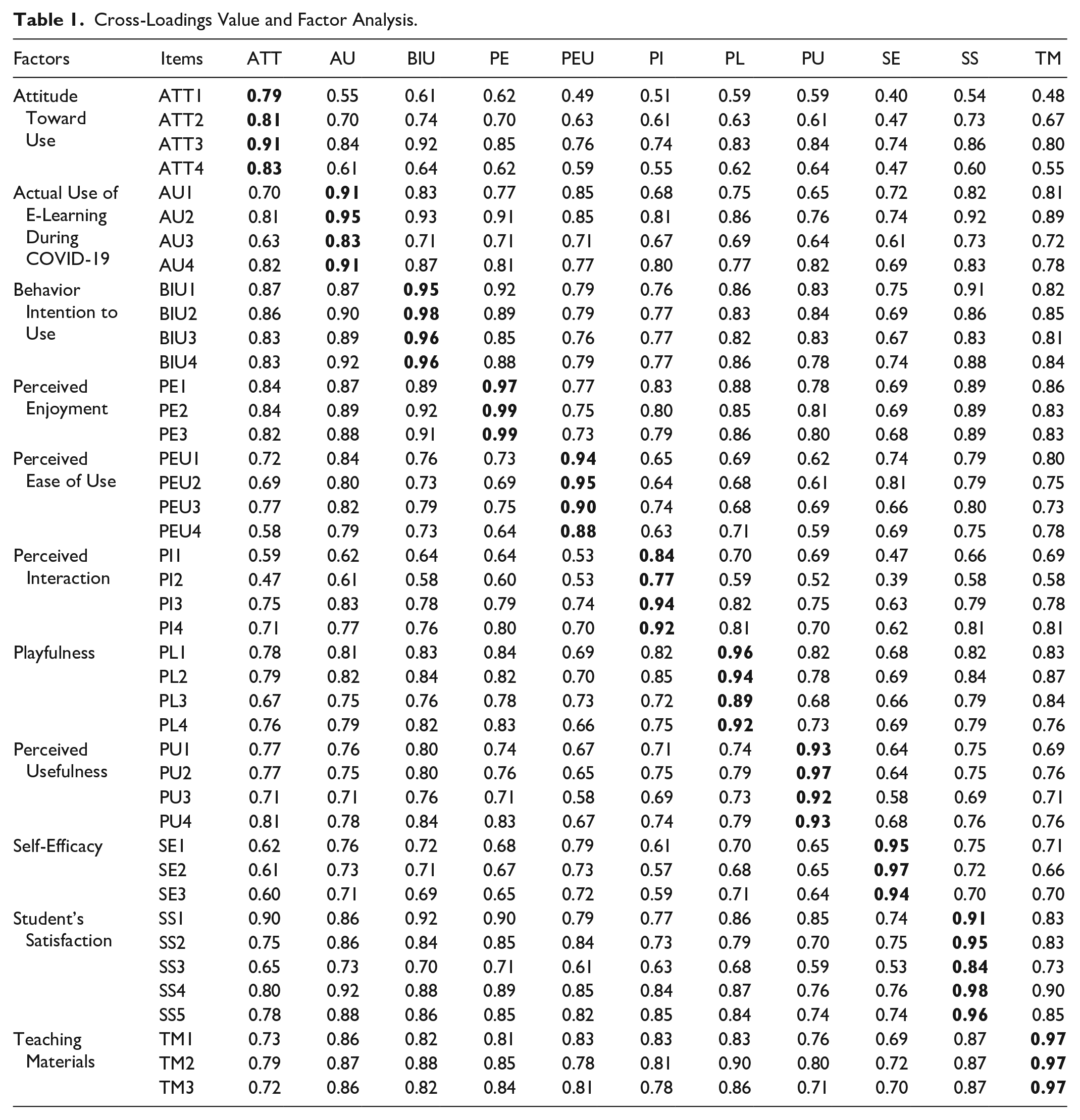
Construction validity refers to the degree to which anything that has to be assessed can be measured by a test. The three main types of validation proof are construct validity, object validity, and criterion validity (Hair et al., 2019). Item loading and cross-loading both were found to be high in the variables’ analysis (Table 1).
Cross-Loadings Value and Factor Analysis.
Validity of the Measuring Model That is Convergent
The composite dependability ratings varied from 0.988213 to 0.925855, with 0.988213 ranking best and 0.925855 ranking lowest. Because these values are greater than the 0.70 limit, all structures can be examined. Cronbach alpha scores ranged from .994807 to .892360, all beyond the .60 threshold. At the same time, as shown in Table 2, average variance extracted (AVE) values ranged from 0.965455 to 0.6969999, exceeding the minimum limit of 0.50, key element loadings exceeded 0.50, and group satisfaction varied from 0.758435 to 0.965455 (Hair et al., 2019).
Measurement Model Confirmatory Factor Analysis.

Model of Measurement With Discriminant Validity
Discriminant validity refers to how different a latent variable is from other latent variables. It is considered to have discriminant validity when a latent variable can explain more variation in the observed variables linked to it than (a) measurement error or related external unquantified influences in the observed variables linked to it; or (b) other constructs within the conceptual model. If this isn’t the case, verifying each of the indications will result in an incorrect construction (Hair et al., 2019), as seen in Table 3 and Figure 2.
The Measurement Model’s Discriminant Validity.


Path coefficients results.
All hypotheses were agreed as shown in Table 4 as all the 11 variables were statistically important. We may therefore claim the Attitude Toward Use -> Behavior Intention to Use (β = .394536, t = 5.325323), Attitude Toward Use ->E-Learning Use (β = .062439, t = 1.671299), Attitude Toward Use -> Student Satisfaction (β = .156415, t = 1.837078), Behavior Intention to Use ->E-Learning Use during COVID-19 pandemic (β = .605631, t = 5.996900), Behavior Intention to Use -> Student’s Satisfaction (β = .767703, t = 5.875825), Perceived Ease of Use -> Attitude Toward Use (β = .360785, t = 3.839323), Perceived Ease of Use -> Behavior Intention to Use (β = .294892, t = 5.194466), Perceived Ease of Use -> Perceived Usefulness (β = .058010, t = 1.877487), Perceived Enjoyment -> Perceived Ease of Use (β = .150000, t = 1.776079), Perceived Enjoyment -> Perceived Usefulness (β = .319636, t = 1.538278), Perceived Interaction -> Perceived Ease of Use (β = .146830, t = 1.904838), Perceived Interaction -> Perceived Usefulness (β = .208513, t = 1.820168), Perceived Usefulness -> Attitude Toward Use (β = .569130, t = 6.415212), Perceived Usefulness -> Behavior Intention to Use (β = .331396, t = 4.434867), Playfulness -> Perceived Ease of Use (β = .287917, t = 1.673804), Playfulness -> Perceived Usefulness (β = .213960, t = 1.910468), Self-Efficacy -> Perceived Ease of Use (β = .411339, t = 3.767370), Self-Efficacy -> Perceived Usefulness (β = .162450, t = 1.799853), Student’s Satisfaction -> E-Learning Use during COVID-19 pandemic (β = .420037, t = 3.171878), Teaching Materials -> Perceived Ease of Use (β = .536925, t = 2.925121), and Teaching Materials -> Perceived Usefulness (β = .072285, t = 1.820600).
Hypotheses Testing.

Discussions and Implementations
Under COVID-19 stay-at-home orders, this study looked at university students’ perspectives of online emergency learning usage, adoption, and acceptability. In order to examine characteristics influencing the use of e-learning during COVID-19, a form of constructivist and extended TAM was effectively used in this study to describe the system experienced by students during the adoption of e-learning during COVID-19. Other researchers interested in studying technology integration, especially during pandemics like COVID-19 and based on virtual-based studies among college students, can review and change the scale in the future based on the results. According to the findings of this survey, in the aftermath of Corona, the majority of students had a good opinion about online courses. Online learning was deemed advantageous since it offered learners with flexibility and convenience. As a result, once the COVID-19 pandemic is over, we may witness a continuation of learning that leverages online platforms as study material, but in a hybrid way with classroom setting. The research assists in resolving structural equation analysis’ major significance to the creation of academic methods. According to the model validity and measurement items, the model is accurate and reliable. Similar measurements were used in previous study (Ramírez-Correa et al., 2015) to estimate their level. Perceived interaction, self-efficacy, educational materials, playfulness, and perceived enjoyment were all shown to have a significant relationship with perceived utility and simplicity of use, showing that the current study’s assumptions were justified. During the COVID-19 epidemic in higher education, learners’ attitudes about using, intending to use, and contentment with e-learning had a favorable connection with actual usage, according to the report’s results. It may be inferred that, during the COVID-19 pandemic, offering favorable conditions such as adequate facilities, a nice atmosphere, and a fast Internet connection would make it easier for students to accept e-learning. E-learning use was also shown to be a robust predictor of both usefulness and perceived ease of use over time (Alalwan et al., 2019; Muhaimin et al., 2019; Nikou & Economides, 2017). The model revealed a significant relationship between perceived engagement, self-efficacy, teaching materials, playfulness, and perceived usefulness, indicating that the setting and e-learning tools enhance the positive effects of e-learning as reported by students during COVID-19. The findings contrast those of a previous study (Muhaimin et al., 2019), which found that forecasting ability had no impact on perceived usefulness for Web 2.0 adoption.
Perceived utility is significantly predicted by judged ease of use, according the result of this research; when e-learning is perceived to be client, respondents’ sentiments regarding the usefulness of the tools increase throughout the COVID-19. This result was supported up by previous research findings (Al-Rahmi, Alzahrani et al., 2020; Mohammadi, 2015; Zhang et al., 2008). It’s also claimed that perceived ease of use has a strong link to attitude, suggesting that more students consider e-learning is simple, the better they act when using it during COVID-19. Buabeng-Andoh et al. (2019) used a meta-analysis research and Muhaimin et al. (2019) used qualitative data to validate this conclusion. Perceived usefulness, on the other hand, was not a strong predictor of this attitude, which is in line with earlier research (Sukendro et al., 2020). It was also discovered that there was a substantial correlation between perceived utility and intention to use. Other e-learning integrating research have discovered that participants’ motivation to utilize technology improves when they perceive it supports instructional tasks (Alhussain et al., 2020; Nikou & Economides, 2017; Ramírez-Correa, 2015; Teo et al., 2019; Zhang et al., 2008). In addition, the more favorable respondents’ sentiments toward e-learning adoption during COVID-19, the more likely they are to learn utilizing the platform. A substantial correlation between attitudes and behavioral intentions to use technology in education has also been discovered in previous study (Muhaimin et al., 2019). Finally, data from Teo (2009), Teo et al. (2019), and Zhang et al. (2008) revealed that the desire to utilize e-learning was critical in predicting actual use during COVID-19. They also observed that the intent of conduct during teaching and learning processes was a major predictor of e-learning adoption. The level of e-learning instructional materials has an impact on student satisfaction (Sun et al., 2008), hence it’s critical to make an effort to make learners happy with their use of technology during epidemics like COVID-19. In our study, students’ evaluations of online courses as a new teaching modality during the COVID-19 outbreak were extremely favorable, and students’ overall satisfaction with digital training was good. The connection between teachers and students is also vital to examine. Students were impacted by a lack of contact with both professors and peers, according to our results. Students, on the whole, perceive the E-learning platform as a great tool for online learning during the COVID-19 outbreak. Our results indicate that the Technology Acceptance Model (TAM) could be reinforced by considering external forces including such technological conditions university education, technical conditions of students, teaching style of teachers, technological skills of teachers, and student-teacher interaction via the platform. If the TAM model can explain the motivation to use e-learning platforms as a complement to a conventional educational process, an upgraded model might explain the urge to use it just for online learning during pandemics like COVID-19. According to this poll, after switching to online learning, students have utilized more platforms and online instructional resources. Students’ knowledge of technology resources improved as a result of their use of urgent e-learning tools, according to Murphy (2020).
Conclusions and Suggestions for Further Studies
During the COVID-19 outbreak, this study analyses university student perspectives, revealing that online learning modes were a participatory and efficient source of e-learning. Online learning, according the students, is a flexible and effective form of teaching and learning since it provides for easier management and availability of distant learning while consuming fewer time and resources. Regardless of time restrictions, learners may easily obtain instructional content. In conventional higher education, the constructivist and TAM models were often utilized to examine e-learning. According to several studies, e-learning has been applied in countries all over the world. Variables influencing the uptake of e-learning during epidemics like COVID-19 should be examined in a variety of contexts and scenarios. Constructivist and TAM-based connections were shown to be highly related during COVID-19 by focusing on learners’ e-learning. Furthermore, this study focuses on areas of access where few students have sufficient technology tools and formulate appropriate, such as internet access. As a consequence, the current study contributes to the emerging literature by clarifying the condition of open and distance learning during university and school closures due to pandemics, as well as giving a useful guideline for future research. Students are finding it much more difficult and probable to adjust and use e-learning than in the past due to the closure of universities and colleges. As a result, it’s vital to make the most of higher education in this country e-learning investments. Students’ perceptions of learning’s ease of use or utility were impacted by their e-learning environment, according to the results of this study. Furthermore, students’ attitudes regarding e-learning had a substantial impact on their behavioral intention to use it throughout the epidemic. According to the COVID-19, perceived usefulness in relation to perceived ease of use strongly predicts perceived usefulness; participants’ opinions about the utility of e-learning improve when e-learning is judged user-friendly. Future researchers who want to do similar research will need help understanding the results of the analysis. Participants should improve their distant learning strategies in the case of an outbreak. While this study demonstrates that statistical data is accessible, it also has severe limitations. Future research will require more respondents from a range of majors because the respondents of the study are all from the same institution. However, during pandemics like COVID-19, a few studies looked at the use of e-learning. Finally, the limits of the study should be identified and addressed ahead of time. To begin with, volunteers for this study came from only one university. It might have an influence on the findings’ generalizability. Second, the present investigation was limited to a single theory: prior e-learning knowledge. Extrinsic variables of behavioral intention to utilize e-learning during the epidemic, on the other hand, may exist. As a corollary, any future research on e-learning uptake should take into account other external factors.
Footnotes
Appendix

| Perceived Usefulness |
| Using E-learning system would enhance my effectiveness in studying. |
| Using E-learning system would improve my course performance. |
| Using E-learning system would improve my productivity in courses. |
| I find E-learning system useful for my studies. |
| Perceived Ease of Use |
| I find E-learning system easy to use. |
| Mastering E-learning system would be easy for me. |
| My interaction with E-learning system is clear and understandable. |
| It would be easy for me to find the required information using E-learning system. |
| Attitude towards Use |
| I dislike the idea of using E-learning system. |
| I have a generally favourable attitude towards using E-learning system. |
| I believe it is (would be) a good idea to use E-learning system for my study process. |
| Using E-learning system is a foolish idea. |
| Behavior Intention to Use |
| I intend to use E-learning system during the semester. |
| I will return to E-learning system often. |
| I will continue to use E-learning system. |
| I intend to use E-learning system frequently for my study process. |
| Actual Use |
| I use E-learning system frequently. |
| I tend to use the E-learning system frequently. |
| I spend a lot of time exploring within the E-learning system. |
| I get involved a lot with the E-learning system. |
| Perceived Enjoyment |
| I find E-learning system process enjoyable. |
| The actual process of using E-learning system is pleasant. |
| I have fun using E-learning system. |
| Self-Efficacy |
| I am confident of using E-learning system even if there is no one around to show me how to do it. |
| I am confident of using E-learning system even if I have never used such a system before. |
| I am confident of using E-learning system even if I have only the software manuals for reference |
| Playfulness |
| I feel E-learning system helps me improve my creativity. |
| I feel E-learning system helps me improve my imagination by obtaining information. |
| I feel I can have a variety of experiences without any interference via E-learning system use. |
| I feel E-learning system is fun regardless of usage purposes. |
| Students Satisfaction |
| I am pleased to use the E-learning system as a learning tool. |
| The E-learning system is effective for gathering knowledge. |
| The E-learning system is efficient for the analysis of knowledge. |
| The E-learning system is efficient for the construction of knowledge. |
| The E-learning system is efficient for the exchange of knowledge. |
| Perceived Interaction |
| I discuss relevant topics with others on the discussion board. |
| I send e-mails to others as a way of communicating. |
| I engage in simultaneous learning interaction with others. |
| In general, I think this E-learning environment provides good opportunities for interaction with other students. |
| Teaching Materials |
| E-learning system provides me with teaching materials that are easy to use. |
| E-learning system provides me with teaching materials that fit with the learning objectives. |
| E-learning system provides me with sufficient teaching materials. |
Acknowledgements
The authors extend their appreciation to the Deanship of Scientific Research at King Saud University for funding this work through the Undergraduate Research Support Program.
Declaration of Conflicting Interests
The author(s) declared no potential conflicts of interest with respect to the research, authorship, and/or publication of this article.
Funding
The author(s) disclosed receipt of the following financial support for the research, authorship, and/or publication of this article: This work was supported by King Saud University, Riyadh, Saudi Arabia, through Researchers Supporting Project RSP-2022/R417.
