




Abstract
COVID-19 is an emerging and highly infectious disease that is becoming a global health challenge affecting all sectors. To prevent COVID-19 transmission, all education institutions were closed and advised to turn to online learning. The present study sought to determine the factors affecting the acceptance and use of electronic learning among Ugandan University students in three universities. The study relied on two data collection instruments: a questionnaire and a semi-structured interview. An online cross-sectional survey was conducted on a population of students in three pre-selected universities: Kyambogo (KYU), Makerere (MAK), and Kampala International University (KIU). Of the 614 questionnaires returned, 578 were valid; 65.4% of the respondents were males; 60.7% were from MAK and the majority being in their third year of study (49%). Overall, 69.2% had good knowledge, 22.5% had positive attitudes toward e-learning. The semi-structured interviews revealed connectivity and skills challenges as the main barriers to the implementation of e-learning. For better implementation of e-learning by Universities, effective planning needs to be done with active students’ involvement to avert negative attitudes. We recommend more studies be done on the Universities’ preparedness for the implementation of e-learning. Universities should collaborate with telecommunication companies to provide subsidized prices for internet costs and information and communications technology (ICT) equipment to students.
Introduction
Coronavirus disease 2019 (COVID-19) is an illness caused by a novel coronavirus named Severe Acute Respiratory Syndrome coronavirus 2 (SARS-CoV-2; formerly called 2019-nCov; Zhu et al., 2020). COVID-19 is a new respiratory infection that was first discovered in December 2019 in Wuhan city, Hubei Province, China, and has been characterized by rapid human-to-human transmission (Huang et al., 2020; Zhu et al., 2020). This called for international drastic measures to limit spread of the life-threatening disease which included total lockdowns in some countries.
According to the World Health Organization (WHO; 2021 )guidelines, combatting crowdedness has been one of the approved measures in preventing spread of COVID-19. As a way of implementing this guideline, many nations closed schools and all universities shifting to online learning from the traditional face-to-face learning (Kamble et al., 2021).
In Uganda, a total lockdown on April 15, 2020, ensued after registration of the index case on March 21, 2020 (“Uganda Confirms First Coronavirus Case,” 2020).This was preceded by closure of all schools on March 18, 2020, as these were considered concentration points that would fuel the spread of COVID-19 (Network, 2021). After closure of schools, Uganda National Council for Higher Education (NCHE) released guidelines to tertiary institutions and universities on the adoption and use of electronic learning (e-learning) to minimize COVID-19 transmission risk (Education|UNICEF, 2021).
E-Learning is often referred to as “online learning” and by definition, online learning is simply education that takes place over the internet (Stern, 2021). E-learning presents enormous opportunities that significantly facilitate the effectiveness of delivering the learning contents and gaining access to an immense pool of educational information if appropriately utilized (Salloum et al., 2019; Tumwesige, 2020).
Previous studies (Hobbs, 2002; Yaghoubi et al., 2008) done have shown that students’ perception play a significant role in improving adaption and efficiency of e-learning. A study done by Bhuasiri et al. (2012) revealed that a positive attitude among students is important in the adoption and success of e-learning.
COVID-19 pandemic has bolstered up the use of e-learning by students in Uganda who have been used to the traditional face-to-face learning. Despite the several benefits of e-learning, the sudden shift to a virtual environment needs a comprehensive study. Our current study was therefore conducted to assess the drivers affecting acceptance and use of e-learning by Ugandan University students during the COVID-19 Pandemic.
Methods
Study Design
A descriptive cross-sectional survey using mixed-methods sequential explanatory study design was conducted for over 11 days from July 29, 2020, to August 8, 2020.
Study Setting
Universities in Uganda are categorized into public and private, and by 2016, according to the Uganda Bureau of statistics, there were a total of 50 universities (11 public, 39 private).
This study was carried out in two public universities and one private university which were pre-selected because of easy accessibility of representatives of those particular universities. The two public universities were Makerere University and Kyambogo University whereas the private university was Kampala International University.
Study Population
Undergraduate and postgraduate students in the three pre-selected universities were eligible to participate in the study.
Data Collection
At the time of data collection, all universities were closed. Therefore, we opted to use online platforms for data collection.
Quantitative data
A pre-tested questionnaire was used with an online consent form attached to it. The questionnaire was uploaded on google form (via docs.google.com/forms), and by employing the convenience sampling method, the google form link was sent through emails and WhatsApp Messenger. On receiving and clicking on the link, participants were auto-directed to the information about the survey which they were to fill in.
The questionnaire had both dependent and independent variables.
The independent variables were age, gender, university, year of study, employment status, place of residence, and the course being offered.
The dependent variables were knowledge on e-learning, attitudes toward e-learning, barriers of e-learning, and the usage of e-learning based on location.
Qualitative data
Semi-structured interviews on 15 pre-selected participants (five participants from each of the three enrolled universities) were carried out to explore participants’ views in more depth. The participants were student leaders of their respective universities.
Open-ended questions were uploaded on google forms and a link was sent to the pre-selected participants through WhatsApp Messenger. On clicking the link, participants were directed to the consent form page. After consenting, they would be directed to the page with interview questions. The semi-structured interview contained three questions about (a) thoughts on replacing face-to-face teaching with e-learning, (b) challenges, and (c) implementation strategies for e-learning.
Data Processing and Analysis
Quantitative Data
The data were exported to and analyzed using Microsoft Office Excel 2016 and STATA 15 statistical software. Categorical data were presented as frequencies and percentages. To determine the participants’ views, a Likert-type scale with 5 points was used (strongly agree, agree, neutral, disagree, and strongly disagree). To get the average response of each question from the participants, five equal responses were used by getting a range of 0.80 which was calculated using the formula (maximum value − minimum value) divided by the number of alternatives, that is, (5 − 1) / 5, adopted from the study of Eltahir MEJIA (2019). Table A contains the scale used in categorizing participants’ responses.
Categorizing Scale.

Source. Adapted from Eltahir MEJIA (2019).
Furthermore, the average score of each participant was obtained for the three questions of knowledge and then the eight questions on attitude. To grade the knowledge, an average score of 3.41 to 5 represented good knowledge, 2.61 to 3.4 represented moderate knowledge, while an average score of <2.61 represented poor knowledge. The same grading system was used to grade the attitude of the participants. Chi-square test was applied to assess the factors associated with good knowledge and positive attitudes at bivariate analysis. A p < .05 was considered statistically significant.
Qualitative Data
N.T. grouped sentences or paragraphs that conveyed similar messages as meaning units (Mukunya et al., 2020). N.T. and J.N. thereafter assigned meaning units with codes. Similar or related codes were aggregated to form categories. Categories were analyzed further forming subthemes and themes. Themes were derived in relation to the research objectives. A narrative was generated from the dominant themes. Some quotes were used to represent the narrative. NVivo Software Version 12 was used to organize the data and analysis process. As a way of increasing credibility (Thomas & Magilvy, 2011), three co-authors peer reviewed the interviews, meaning units, codes, categories, and themes.
Ethical Consideration
The study was approved by Mulago Hospital Research and Ethics Committee, protocol number MHREC 1898.
When participants clicked on the google form link, the online condensed consent form was the first to appear. Whoever consented to participate in the study was directed to the questionnaire page. The study was conducted following the Declaration of Helsinki and participation was entirely voluntary.
Results
Quantitative Results
A total of 578 students took part in the study. Of these, 34.6% were female, while 65.4% were male. Makerere University students contributed 60.7% while Kyambogo University and Kampala International University students were 12.6% and 26.6%, respectively. In all, 83.7% of the participants were aged between 21 and 29 years (Table 1).
Socio-Demographic Characteristics of Survey Participants.

Note. MAK = Makerere University; KYU = Kyambogo University; KIU = Kampala International University.
Of the participants, 542 (94%) reported having heard of e-learning. Out of the maximum score of 5, the average mean scores are knowledge = 3.70 (74%), attitude = 2.86 (57%), barriers = 3.77 (75%), and usage of e-learning = 2.66 (53%) (Table 2).
Description of Responses for the Survey Participants.

Note. ICT = information and communications technology.
Results as evidenced in Table 2 show that most of the students agreed with the statements that were assessing knowledge with a mean score of 3.70.
The results in Table 2 indicate that majority of the respondents were neutral to the statements on attitude toward e-learning with a total mean score of 2.86. Concerning the usage of e-learning, Table 2 indicated that there was a high mean score (2.87) of the participants who had used e-learning than while at home (mean score = 2.44).
At chi-square test analysis, factors that were associated with knowledge were gender (p = .025) and place of residence (p = .023). The majority of the female participants (75.5%, n = 200) stated to have good knowledge compared with the males (65.9%, n = 378). There was no statistically significant association between knowledge and the other socio-demographic variables (age, university, year of study, employment status, and course type) at p > .05 (Table 3).
Factors Associated With Knowledge on E-Learning Among Survey Participants.

Note. MAK = Makerere University; KYU = Kyambogo University; KIU = Kampala International University.
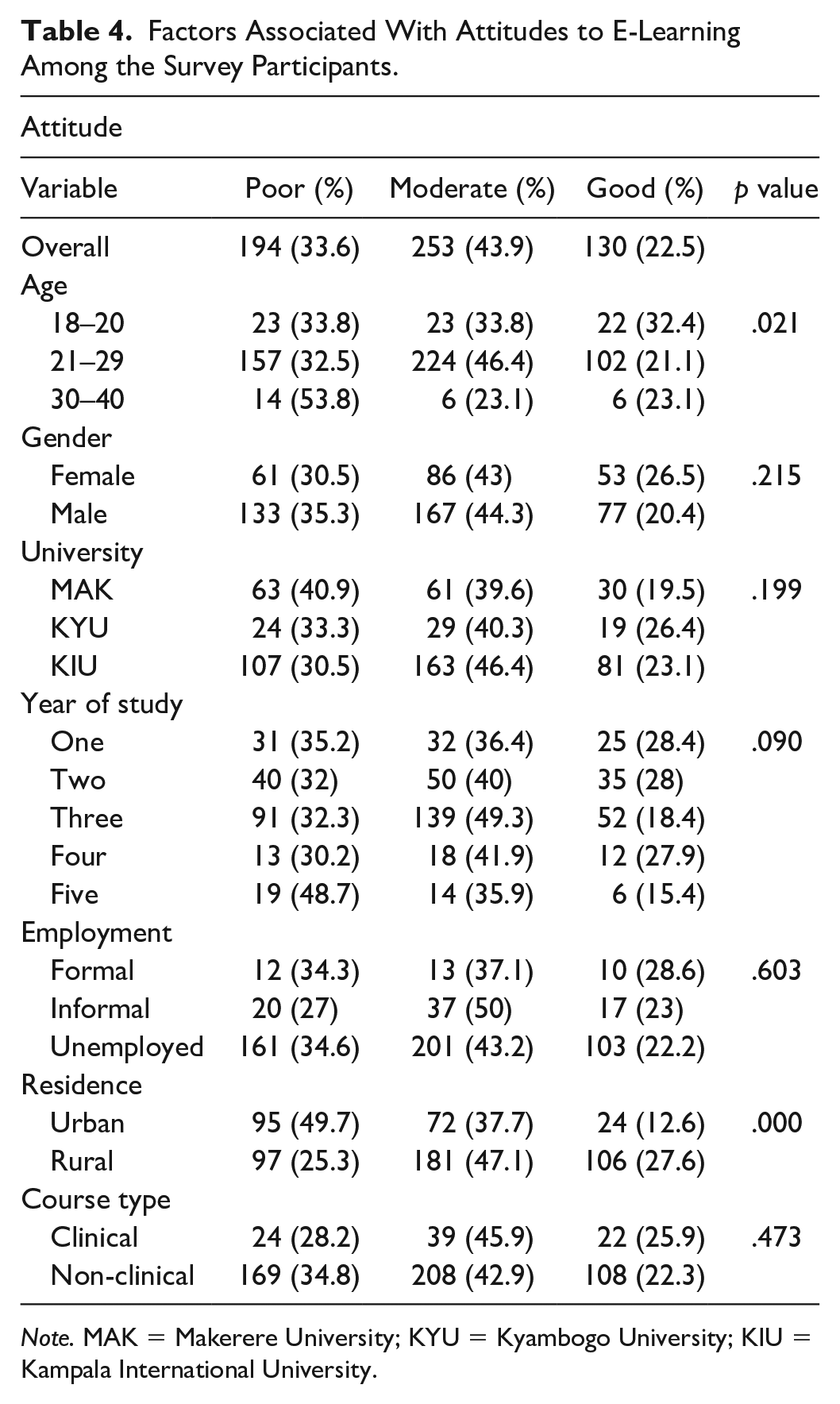
Only 22.5% (n = 130) had good/positive attitude. At chi-square test analysis, factors that were associated with attitude were age (p = .021) and place of residence (p = .000). There was no statistically significant association between attitude and the socio-demographic variables (gender, university, year of study, employment status, and course type) at p > .05 (Table 4).
Factors Associated With Attitudes to E-Learning Among the Survey Participants.
Note. MAK = Makerere University; KYU = Kyambogo University; KIU = Kampala International University.
Qualitative Results
A total of 15 participants were recruited for the semi-structured interviews. Most of the respondents were aged from 21 to 30 years (60.0%, n = 9) and were females (53.3%, n = 8). Five participants were recruited from each university and most were in their third year of study (26.7%, n = 4) (Table 5).
Characteristics of Participants of the Semi-Structured Interviews.

Note. MAK = Makerere University; KYU = Kyambogo University; KIU = Kampala International University.
Face-to-face learning and e-learning: e-learning can only be blended with face-to-face learning.
We found that e-learning cannot replace face-to-face learning but rather be blended. Given that students offered different courses, those offering practical and clinical courses like medicine preferred a mixed teaching method of both physical and virtual teaching.
Participant 5 said that “It’s a fair solution but better used together with face to face learning given some courses are practical.” Similarly participant 7 said that E-learning cannot completely replace face-to-face learning especially for students doing clinical cases because only with physical exposure and hands on practice can one become a well experienced medical practitioner but for the biomedical classes e-learning can be blended with face to face learning unlike the clinical students.
Challenges of E-Learning: Internet Connectivity and Unskilled Lecturers and Students
We found that high internet costs, poor network coverage, and lack of necessary gadgets (computers and mobile phones) were the major challenges that could hinder implementation of e-learning. A participant told us, “Expensive data bundles from the service providers in the country which cannot be afforded by all students in the universities” (Participant 1). As regards to students lacking the necessary gadgets, one of the interviewee said, “First being poverty; not everyone can afford a smart phone, laptop or even afford to pay for data services” (Participant 12).
In addition, we found that some of the students reside in remote areas where internet connectivity is a huge challenge: Poor spread of the internet to some areas where by some areas have good connectivity while others lack completely. (Participant 9) Then there is inconsistency in attendance because some people stay in remote areas where there are network challenges. (Participant 11)
We found that students and lecturers lack enough skills of using computers thus making e-learning implementation a hurdle. One of the participants thought, “Some lecturers don’t understand its (e-learning) usage” (Participant 3), Similarly, Participant 14 thought that both students and lecturers have insufficient knowledge and skills about technology: “Insufficient knowledge and skills about technology and use of computer by most of the lecturers.”
Implementation Strategies: Universities Should Partner With Network Companies
We found that universities should work with telecommunication companies to avail affordable computers and data bundles strictly for e-learning. One of the participants told us that “Universities should form partnerships with some network companies, and see that students can access data bundles at a low cost” (Participant 11). Similarly, Participant 15 echoed that “Universities should lease with telecommunication companies to avail affordable bundles even if they are strictly for e learning.”
Some participants advised that video or audio classes should be recorded and shared among students who could have missed due to network challenges: Zoom classes can be recorded and shared among students who could have missed due to Network issues. (Participant 13)
In addition, one of the participants advised that universities should have a common e-learning platform which all students can access such that accessibility of learning materials and schedules is easy: “The universities should as well have one common e-learning platform where students can access the lectures from” (Participant 1).
Participants further advised that university administration should continuously train lecturers and other staff on how to deliver online classes: “Train the lectures, and other stuff on how to deliver and access study material via e-learning” (Participant 7).
In addition, we found out that students wanted lecturers to be more welcoming when consulted on their social media platforms like emails, WhatsApp, Facebook messenger, and private calls. One of the participant said, “Lecturers should be open and welcoming to students for consulting via email, social media or private calls in case they were affected by network and did not get the concepts” (Participant 13).
Discussion
COVID-19 is a global health challenge affecting all kinds of sectors (Kassema, 2020). In March 2020, Uganda decreed numerous non-pharmaceutical actions to curb COVID-19 transmission which included closure of schools, non-essential businesses, and restriction of large gatherings. The overgrowing population of students with particular interest at tertiary institutions imposes restrictions on healthy, comfortable learning environments due to limited infrastructure at many of these institutions. With thoughtful establishment of online learning, congestion or crowdedness could be kept in check. This study was done to assess the driving factors for the usage of e-learning among Ugandan university students. With the identification of factors that would influence e-learning usage and acceptance, it will be useful in providing better e-learning services (Salloum et al., 2019).
From the study, we ascertained that 69% of the participants (more than six in 10 students) had good knowledge of e-learning. The knowledge among students was not significantly associated with the universities they were studying in, year of study, or even the course type they were pursuing. Knowledge influences the intention and usage of e-learning. A study done in the United Arab Emirates (UAE) by Salloum and colleagues (2019) revealed that knowledge affected positively on e-learning acceptance among students.
From our study, the majority of the respondents agreed that video conferencing applications like zoom can be used as e-learning platforms with a mean score of 3.82. Through video conferencing, students can meet people from another part of the world providing them the opportunity to learn and participate in two-way communication. A study done by Carville and Mitchell revealed that video conferencing was an increasingly cheap way for students in remote areas, the nearest thing to face-to-face learning (Carville & Mitchell, 2000).
The statement on social media and e-mail being platforms for e-learning had a mean score of 3.56, with majority of the respondents agreeing to it. Multiple studies have revealed that social media encourages involvement, with expansion of both informal and formal learning (Manca & Ranieri, 2016).
With majority of students agreeing that video conferencing and social media are platforms of e-learning, it would be easier to deliver learning materials on these platforms.
Our study also revealed that majority of the female students stated to have had good knowledge in comparison with their male counterparts. This is in the line with the study done by Adamus and colleagues (2009) who pointed out women’s predilection for communicative activities.
Studies done by Park (2009) and Jan and Contreras (2011) revealed that students with a good attitude toward e-learning had a stronger intent to embrace the teaching method and thus were more inclined to use it. From our study, few students (23%) had a good attitude toward e-learning which was in contrast with the study done in India by Thakkar and Joshi (2017). The age range 18 to 20 had good attitudes toward e-learning whereas those in the age range 30 to 40 had the poorest attitudes. This is consistent with the study that was done in Sofia University (Peytcheva-Forsyth et al., 2018), This can be explained by the fact that young people have an earlier contact with technology hence being more motivated in using it in learning and the way they perceive it.
Place of residence was also associated with attitudes whereby students in the rural areas had good attitudes toward e-learning as compared with their counterparts in the urban areas. However, there was a weak positive relationship between the knowledge and attitude of students to e-learning.
The statement in Table 2, “E-learning is for everyone” has the lowest mean score among the statements assessing attitude, with majority of the respondents disagreeing with it. Another statement that majority of the respondents disagreed with was, “E-learning will be accepted by the majority of the students.” This result corresponds with the study done by Vululleh (2018). This was not surprising because previous studies conducted on e-learning implementation in countries that are developed revealed that e-learning system was not widely accepted when it begun (Eltahir MEJIA, 2019).
As evidenced in Table 4, it shows that the statement, “Ugandan institutions don’t have experience with e-learning” had the highest mean score, with majority of the respondents agreeing with it. This is consistent with previous studies (Aung & Khaing, 2015; Mayoka et al., 2012; Wanga et al., 2012). However, majority of the respondents had a neutral thought on the statement, “Lecturers don’t have the required skills for e-learning to be implemented.” This was confirmed by the interviewees’ responses as shown in Table 5. The interviewees reported that both students and lecturers lack adequate skills of using information and communications technology (ICT). This conforms to the study that was done in Uganda by Wanga et al. (2012) that highlighted that the biggest challenge to technology in Africa is the cost of acquisition because of high levels of poverty and a weak economy which inhibits the power to purchase. To a large number of universities that only depend on the collection of tuition fees as their source of income, it becomes extremely difficult to acquire new technologies for use in their academic environment to ease the process of teaching and learning (Wanga et al., 2012). For this particular barrier, from our study, interviewees suggested that university administration should train the lecturers and other staff on how to deliver and access study materials.
From our study, majority of students agreed with the statement, “Students don’t have ICT equipment like smartphones hence hindering e-learning.” The interviewees as seen in Table 5 also reported the same barrier, where they said that some students lack the necessary gadgets (computers and mobile phones). This was similar to studies of Aung et al. (2015) and Mayoka et al. (2012) that showed the main obstacle for adopting and using e-learning as, “the cost of acquiring, managing and maintaining ICT equipment and infrastructure.” This study finding was also similar to our findings where the interviewees reported the high internet costs which are not affordable to most of the students. This result was also similar to the study done by Andersson and Grönlund (2009) who highlighted that the lack of adequate ICT infrastructure in developing countries makes it difficult for ICT solutions to thrive. Likewise, a study that was done by Tarus and Gichoya (2015) in Kenya revealed that “technological challenges hindered successful and quality performance of e-learning in Kenya.” It is moderately clear that in developing countries, infrastructure penetration is so poor and inadequate. Similarly, a study done by Mtebe and Raisamo (2014) in Tanzania revealed that an undependable supply of electricity power complicated the access of internet. With this, therefore, government and training universities should invest in ICT infrastructure development and access. From this study, the interviewees advised that universities should work with telecommunication companies to avail affordable data bundles strictly for e-learning.
The study also revealed that there was a substantial decrease in the number of students who were using e-learning at home compared with while they were at school. This could be attributed to the barriers mentioned above.
The study had some limitations. First, there is no standardized tool for assessing knowledge and attitudes toward e-learning that has been validated. We, therefore, had to modify previously used tools in the different published research studies, for example, the study done by Eltahir MEJIA (2019). However, internal reliability was checked using Cronbach’s alpha and was within acceptable levels.
The study has been carried out in only three universities and has been web-based; hence caution should be taken when generalizing the findings of this study and thus may not reflect knowledge and attitudes toward e-learning among all university students. Participants for the semi-structured interviews were pre-selected which could have led to bias in their responses. However, this was minimized by ensuring confidentiality and encouraging them not to send their names in the responses such that the responses received were anonymous.
Conclusion
In conclusion, the study found out that more than half of the participants had adequate/good knowledge of e-learning. However, less than a quarter of the participants had positive attitudes toward e-learning. With barriers like inequitable spread of internet coverage in the country and high internet costs, there should be an investment increase at both institutional and national levels into the ICT for applicability and sustainability of e-learning. For better implementation of e-learning by the Universities, effective planning needs to be done with active students’ involvement.
Footnotes
Acknowledgements
We would like to acknowledge Makerere College of Health Sciences Students Association for the help accorded to this study. We also acknowledge Professor Harriet Kizza Mayanja for being the supervisor of this study and Dr. Cecily Banura for reviewing the study protocol. We acknowledge Mulago Hospital for according us with the approval for conducting this study.
Author Contributions
All authors made a significant contribution to the work reported, whether that is in the conception, study design, execution, acquisition of data, analysis, and interpretation, or in all these areas; took part in drafting, revising, or critically reviewing the article; gave final approval of the version to be published; have agreed on the journal to which the article has been submitted; and agree to be accountable for all aspects of the work.
Declaration of Conflicting Interests
The author(s) declared no potential conflicts of interest with respect to the research, authorship, and/or publication of this article.
Funding
The author(s) received no financial support for the research, authorship, and/or publication of this article.

Data Availability
The corresponding author can be contacted to discuss sharing of the data on a case-by-case basis.