




Abstract
COVID-19 has led to quarantines, isolations, and social separations worldwide. Universities use distance education and blended learning especially for practical courses. The purpose of this study was to investigate the effectiveness of blended learning via Edmodo on students’ performance and attitude when learning some fundamental boxing skills. Thirty-two students from 124 enrolled in a boxing sport course were randomly selected. A quasi-experimental design was used by creating a control group and an experimental group. A flipped classroom strategy was used to teach basic boxing skills to the experimental group via Edmodo. The control group was taught via teacher command style. Results of the post-measurements of overall skill performance score indicated that the experimental group outperformed the control group with a large effect size of (
Introduction
Globally, isolation, quarantine, and social separation have been employed to reduce COVID-19 pandemics. In schools and universities, studies are suspended as one of the most important measures. UNESCO reported that over 1.5 billion children and teenagers were affected by school closures in 195 countries. In higher education, distance education has been used exclusively for some courses, while blended learning has been used for others, particularly practical courses. (UNESCO, 2020).
Consequently, UNESCO and ILO (2020) have jointly recognized the importance of teacher professional development (TPD) and online and blended learning (OBL). It is therefore crucial for faculty members to integrate technology into university teaching and for students to use this educational technology for continuing their education in light of the COVID-19 pandemic. Particularly in light of the dramatic changes taking place in modern technology, which have changed life itself and have affected the methods used by educational institutions.
Blended learning is a mix of online learning and face-to-face instruction (Graham, 2006; Morton et al., 2016). Paechter and Maier (2010) explained how blended learning can provide an independent and collaborative learning environment and facilitate an interactive learning community through free and interactive online platforms. According to Bonk and Graham (2012), internet technology and face-to-face interaction promote access to information and improve the quality of education.
Suartama et al. (2019) argued that blended learning is not optimal unless a suitable learning system is created. In addition, Conner et al. (2021) emphasize that the definition of BL should encompass context, theory, and method and not simply combine face-to-face instruction and technological guidance.
Therefore, blended learning involves the application of theories, methods, and techniques to improve learning. There are many models available for integrating technology into education. In these models, developers are given a comprehensive framework that outlines the steps that should be followed to design an effective course or program emphasizing the learners rather than the teachers. Students will find the program more relevant and meaningful.
According to Koper (2006), instructional design (ID) models describes a learning unit (e.g., a course, a lesson, or another type of learning activity). An important feature of ID is the way it represents the learning and support activities undertaken by both teacher and learner. Almost all ID models are based on the general ADDIE model (Chen, 2011). The proposed blended learning program for learning boxing fundamentals will follow the ADDIE design model. Tian and Suppasetseree (2013) stated that the ADDIE model aims to develop effective pedagogical tools to support learning.
In blended learning, the online component is dominated by the second generation of Web 2.0 technologies, including social networking sites (SNS) such as Facebook, Twitter, and Wikis. These sites are extremely useful for educators and learners because they are easily accessible and easy to use. In addition to providing a diverse context, they allow learners to acquire knowledge of different types, whether visual, audio, audio-visual, spatial, or textual (Adcock & Bolick, 2011).
In addition to SNSs, other educational sites with similar performances have emerged. These are known as social learning networks (SLNs) and include Edmodo, Ning, Elgg, and ValuePulse. With SLNs, teachers and students can take advantage of social networking technologies for educational purposes such as tests and assignments without worrying about security or privacy concerns (Durak et al., 2017).
In the International Olympic Committee (IOC), the International Amateur Boxing Association (AIBA) organizes boxing. The sport has been included in the Olympics since 1904 except in Stockholm, where Swedish law prohibited it. Women’s boxing was added to the Olympics in 2012 (Bianco et al., 2013; Tjønndal, 2016).
Combat sports performance outcomes are determined by factors such as physical fitness, technical skills, tactical insight, and mental state. In order to reach peak performance, athletes must consider all four aspects, but their mental aspect increases their effectiveness most (Khan & Jiju, 2021).
The correct understanding of the technical performance of sports skills generally, and in boxing, particularly, contributes to improved results in the educational and training processes, as well as access to optimal kinetic techniques (Rakha & Saleh, 2015).
The current study aims to achieve the desired outcomes of a boxing course (boxing level 1 for boys), which is offered in Port-Said University’s Faculty of Physical Education Department of Theories and Applications of Combat and Individual Sports. The blended learning approach takes into account the precautionary measures of COVID-19 by reducing the amount of face-to-face time that students have. Several forms of interactive multimedia are used to publish the course’s educational content on Edmodo, including images, videos, quizzes, discussions, and assignments. Furthermore, in the combat sports gym of the college, education activities are limited to practicing skills.
According to Kasraie and Alahmad (2014), digitally literate students have the potential to extend learning and conversations beyond the classroom. Thus, to help the students in the experimental group learn from the online course content and participate in education activities such as discussions and assignments, the researchers provided training on the Edmodo platform.
Hence, the importance of this study is related to designing and evaluating a proposed educational program using the Edmodo platform. This is a method for providing the content to students in such a way that it captures their attention and provides suspense while identifying the resulting effects on their performance regarding certain fundamental boxing skills, as well as their attitudes toward using the proposed program to achieve the desired learning outcomes.
This study investigates the effectiveness of blended learning via Edmodo platform on students’ performance and attitude in some fundamental boxing skills. To accomplish these goals, the following questions will be answered:
How does using blended learning with the Edmodo platform affect students’ performance of some fundamental skills in boxing? Ha: There were statistically significant differences between the control and experimental groups in the post-measurement outcomes of some fundamental boxing skills, which favored the experimental group.
What are the students’ attitudes toward blended learning using the Edmodo platform to learn some fundamental boxing skills?
Theoretical Framework
Blended Learning
According to Graham (2006) and Morton et al. (2016), blended learning combines online and face-to-face learning, while Paechter and Maier (2010) described blended learning as providing a collaborative and independent learning environment as well as facilitating an interactive learning community through interactive eLearning.
A blended learning approach was proposed by Christensen et al. (2013), incorporating several methods for accessing the course content, as shown in Figure 1. These methods include:
(1) The rotation model, in which classroom instruction and online instruction alternate in terms of delivery of the same lesson. (a) Station rotation: In this approach, students are divided into groups, with some of them instructed through group work or teacher guidance while others are taught online, and the students rotate between the groups. (b) Lap rotation: In this approach, students alternate between classroom instruction and eLearning based on a set schedule or as directed by their teacher; that is, they rotate between their classrooms and computer labs within their educational facilities. (c) Flipped classroom: In this approach, students receive online content outside of the educational institution whenever and wherever they choose and then participate in face-to-face lessons on the institution’s campus during school hours. (d) Individual rotation: In this approach, students rotate between the classroom and eLearning according to the teacher’s recommendations, taking into account their unique capabilities.
(2) The flex model: in which online learning plays an important role in student learning, even if this sometimes involves offline activities. Whenever students request it, face-to-face instruction is provided; this instruction can include activities such as small group instruction, group projects, or individual instruction.
(3) The a la carte model: in which a student can take one or more courses online through online tutors belonging to their institution while simultaneously taking other courses at the institution’s campus. Consequently, students can take an online course both inside and outside their institution.
(4) Enriched virtual learning: which involves the use of both classroom and distance learning to provide students with a cohesive learning experience. A virtual learning environment enriched with face-to-face instruction is combined with full-time online learning.
Heinze and Procter (2004) indicated that one of the key advantages of blended learning is its compatibility with courses and real-life situations, its suitability for a variety of learners, its improvement of e-learning, and its ability to provide quality student support. According to Singh (2021), blended learning originally referred to a combination of traditional classroom training and online training, such as asynchronous work that learners could access outside of the classroom at any time and at their own pace. In recent years, the term has come to include a wide variety of learning strategies. Lo and Hew (2022) identified a lack of experience among teachers as one of the major challenges facing blended learning, which can be addressed through professional development. There is also a challenge of too many students in the class, which could be addressed by assigning additional teachers. Moreover, students are challenged to operate technically and institutions should be able to provide them with sufficient hardware and internet data to participate in online courses. Another challenge is the development of effective digital and virtual reality (VR) systems to replace the practice of real-world learning. According to Dziuban et al. (2018), equal access to education is one of the most pressing needs in disadvantaged communities. Considering the importance of improving equity in education, how can blended learning benefit our low-income students by increasing access and alleviating some of their problems? Designers and monitors of education quality should consider this carefully to correct such shortcomings in education.

Blended learning models.
Blended learning is highly distinctive among practical courses and in the effective and efficient integration of active learning strategies (Hsu et al., 2014; Kang & Kim, 2021; Korkmaz & Karakus, 2009; McLaughlin et al., 2015; Qutieshat et al., 2020).
Flipped Classroom Strategy
Flipping classrooms (also called inverted classrooms) have gained a lot of attention recently. Instead of wasting limited class time on introducing concepts (often via lecture), instructors can create video lectures, screencasts, or vodcasts. It frees up class time for more engaging (and collaborative) activities. Besides “take home” videos (or screencasts), the strategy should include other components. It should involve formative and summative assessments. This strategy is most commonly associated with two Colorado high school teachers, Jonathan Bergman and Aaron Sams, who created screencasts and podcasts for their students in 2006 (Milman, 2012).
The flipped classroom is an innovative blended learning method aimed at improving learning outcomes, such as achievement, motivation, critical thinking, and self-regulation (Jdaitawi, 2019).
There are three phases of flipped classroom work: pre-class learning preparation, in-class learning activities, and post-class learning consolidation. Pre-class preparation utilizes online learning platforms to allow students to go at their own pace. Following this, students and teachers discuss, debate, present, and simulate the lesson’s content in class. In-class activities reinforce and expand students’ understanding. During post-class learning consolidation, students review materials to enhance the learning outcomes, practice what they have learned, collaborate with their peers, and receive feedback from teachers (Kong, 2014; McLaughlin et al., 2014; Rotellar & Cain, 2016).
Several studies examined the impact of flipped classrooms. All agreed that this strategy is the most effective way to use classroom contact hours to promote active learning through cooperative and problem-solving learning strategies. In this way, it promotes independent learning and enhances students’ social connectedness. As well, before face-to-face learning, it enabled students to understand the material at their own pace, in their own time, and according to their own path through online learning platforms (Aburezeq, 2020; Jdaitawi, 2019; Koo et al., 2016; Lo & Hew, 2019; McLaughlin et al., 2014; Rahman et al., 2014; Rotellar & Cain, 2016; Sergis et al., 2018; Yuan et al., 2014).
Social Learning Networks (SLNs)
Social networking sites (SNS) such as Facebook, Twitter, and Wikis are part of the second generation of Web 2.0 technologies. These websites are very useful for teachers and learners due to their ease of access and use. Additionally, they enable learners to acquire knowledge of different types, including visual, auditory, audio-visual, spatial, and textual (Adcock & Bolick, 2011). In addition to SNSs, other learning sites have emerged with similar performance. These networks are known as social learning networks (SLNs) and include Edmodo, Microsoft Yammer, and Learnium, which allow teachers and students to utilize social networking technologies for educational purposes without security or privacy concerns (Durak et al., 2017).
Edmodo Platform
Kongchan (2008) and Holland and Muilenburg (2011) define Edmodo as a social learning platform that offers free services for enhancing school administration and learning. It combines social networking capabilities with learning management tools, thereby allowing students, teachers, parents, and administrators to collaborate on educational materials. Additionally, it has features similar to those of most popular learning systems, such as Blackboard. Edmodo works in a similar fashion to that of Facebook; therefore, students who are aware of social networking should have no trouble getting used to it. It is easy to use and has a high level of acceptance among teachers. It is a powerful tool for setting up virtual classrooms without technical support.
The education features provided by Edmodo include the following:
(1) The “groups” feature gives the teacher the ability to create a classroom or a main group, including subgroups, and distribute tasks to students with ease, using first and last names, passwords, and/or group codes.
(2) The “send a note” feature allows the teacher to send messages, videos, or websites to the students, who can also reply.
(3) The “library” feature organizes and categorizes educational resources (PDF files, pictures, videos, tests, assignments) so that teachers can retrieve and develop them. These resources can also be saved on Microsoft OneDrive or Google Drive.
(4) The “planner” feature can be used to build an integrated educational plan in which the dates of lessons, exams, and assignments are clearly visible to students.
(5) The “assignments” feature allows the creation of tasks for groups, the setting of due dates, the notification of students of assignments, and the recording of responses, that is, whether the response was on time or late.
(6) The “quiz” feature helps the teacher create quizzes with various patterns, such as multiple choice, right and wrong, delivery, fill in the blanks, etc., and allows students the time to take the quizzes, correct them, and send them back to the teacher with feedback.
(7) The “alert” feature makes it possible to send a student an alert based on the school’s schedule, as well as upcoming required educational tasks.
(8) The “progress” feature provides information about a student’s progress in the classroom, the size of his or her interaction, and the tasks that he or she has completed.
(9) The “badges” feature shows badges that teachers can award to students to encourage them to attend the course.
(10) The “polls” feature allows the teacher to survey student opinions on specific issues.
(11) The “apps” category contains applications that enhance learning, such as Happy Not Perfect, which adds a little excitement and motivation to classroom activities (EDMODO, 2021).
Several studies have shown that Edmodo has a positive impact on encouraging students to use the internet effectively and make progress in their learning, as indicated by Almansa-Martínez et al. (2019); Alqahtani (2019); Altinay et al. (2020); Altunkaya and Ayranci (2020); Holland and Muilenburg (2011); Mejías and Elena (2020); Ryane (2020); Wahyuni et al. (2019, 2020); and Yünkül and Çankaya (2017).
ADDIE Model
One of the most popular ID models for developing educational contents and integrating technology in learning is the ADDIE model. As shown in Figure 2 (Rakha, 2023), the acronym summarizes the following five stages:
(1) Analyze: This involves analyzing the students, the tasks they will learn, and the results desired.
(2) Design: is concerned with learning outcomes, content, strategies, methods, and activities.
(3) Development: this includes the development of multimedia and learning-based systems.
(4) Implementation: The process of delivering educational materials and systems to students.
(5) Evaluation: which occurs at each stage of the model, ensures that the process remains on track by allowing entry at various stages of the process depending on the circumstances, and ensuring that the teaching and learning processes deliver the desired outcomes (Allen, 2006; Branch, 2009).

ADDIE model.
A project’s entry point can be determined using the ADDIE model. The model can be applied to a wide range of activities, making it useful for new or inexperienced instructional designers (Davis, 2013).
Inexperienced or new instructional designers can use the ADDIE model because it is widely known and widely used and can be applied to a wide range of activities (Cheung, 2016; Wahyuni et al., 2019). This model can be easily adapted to curricula that teach knowledge, skills, and attitudes, as well as develop them and help teachers meet their students’ needs.
Materials and Methods
Ethics Statement
Research Ethics Committee, Faculty of Physical Education for (Men-Girls), Port-Said University approved the study (Approval No. 21-10-32). In a consent form, participants were informed that their participation was voluntary; that they had the right to withdraw from the study, and that the study was confidential.
Design
Quasi-experimental design was used by creating experimental and control groups. For the experimental group, the flipped classroom strategy was utilized on the Edmodo platform to teach fundamental boxing skills. Control groups, on the other hand, are taught a program based on teacher command. Post-test designs were made for the two groups. Due to the sample being beginners with no previous experience with the skill under study, there was no pre-test/post-test design. Due to this, a performance evaluation pre-test was impossible.
Study Population and Sample
Participants were selected from the Faculty of Physical Education at Port Said for the 2021/2022 academic year since the study plan included a boxing course (level 1) for boys. From 124 students enrolled in boxing courses, 40 students were randomly selected. Students were initially divided into two equal groups, and then they were randomly assigned to experimental or control groups. Due to the Corona pandemic, four students were excluded from each group of the most absent students, so 16 students were included in each group.
Inclusion and Exclusion Criteria
Eight students with previous experience in boxing, kickboxing, taekwondo, or karate were excluded from the study. In the research sample, homogeneity within the group and equivalency between the groups were assessed based on age, weight, height, high IQ test (Khairy, 1972), and physical fitness based on the college’s fitness admission tests. Arbitrators evaluated boxing stances and footwork skills using a checklist developed by Khalifa (2002).
As shown in Table 1, the control group’s skewness values ranged from −0.47 to 1.15 (SE = 0.56). In the experimental group, skewness values ranged from −0.26 to 0.56 (SE = 0.56). Accordingly, the skewness values for both groups are less than the absolute value (1.96 × .56 = 1.10), which is acceptable for a normal distribution (Field, 2013; Wright & Herrington, 2011).
Experimental and Control Group Descriptive Statistics of Moderator Variables (n1 = n2 = 16).

According to Table 2, the Kolmogorov-Smirnov test D values for fundamental boxing skills in the experimental group ranged from D(16) = 0.14, p = .20 to D(16) = 0.19, p = .13. Since the p values greater than .05 indicate the experimental group scores followed a normal distribution in post-measurements, we accepted the null hypothesis. For the control group, D values ranged from D(16) = 0.14, p = .20 to D(16) = 0.18, p = .16. Due to the p values greater than .05, we accepted the null hypothesis that the control group scores also followed a normal distribution. As a result, we can use the independent samples t-test to determine whether there were any differences between the two groups (Berger & Zhou, 2014).
The Normality of Moderator Variables Scores in the Experimental and Control Groups (n1 = n2 = 16).

Table 3 shows the results for Levene’s test for equality of variances. This test identifies whether the variances of the two groups are significantly different. The F values for Levene’s tests ranged from 0.00 to 2.05, and the p value was greater than .05; that is, the variances were not significantly different from one another. Therefore, we are able to use the t value and degrees of freedom.
Independent Samples t-Test for Investigate the Equivalence of the Experimental and Control Groups in the Moderator Variables (n1 = n2 = 16).

According to an independent samples t-test, scores were statistically non-significant, with t values ranging from t(30) = 0.06 to t(30) = 1.33, and a p value was greater than .05 (p
Data Collection Tools and Equipment
A digital stadiometer was used to measure height and weight.
The high IQ test (Khairy, 1972) was used to measure the university students’ intelligence. The test consists of 42 questions of varying difficulty and covers different mental functions. Several studies with samples similar to the current study sample have used the test, such as Abdelkader (1999); Ashor (2002); Khudair (2001); and Muhammed (2000); the validity coefficient of the test was 0.69, and the reliability coefficient was 0.84.
The fitness tests for admission to the Faculty of Physical Education of Port Said was also used. This test has been used in several previous boxing studies (Al-Azab, 1990; Khalifa, 2002; Rakha, 2010).
Skill performance evaluation checklist; these checklist were designed (Khalifa, 2002) and include the following components: (a) Technical criteria, which are used to evaluate fundamental skills and their scores by arbitrators. (b) Evaluation stage for fundamental skills. (c) Skill performance evaluation score sheet.
These checklist have been used in numerous previous studies on samples similar to that of the current research, such as Khalifa (2002) and Rakha (2004, 2010), where they were found to have a validity coefficient of 0.97 and a validity stability coefficient of 0.87.
5- An evaluation scale for students’ attitudes toward blended learning via Edmodo. We developed this self-checklist as indicated by Conner et al. (2021), the checklist included three main axes, namely, cognitive (7 items), emotional (8 items), and behavioral (12 items). A final scale was developed from the 27 items of the three axes, which used a Likert scale consisting of five answers: strongly agree, agree, neutral, disagree, and strongly disagree. The response direction was positive; thus, the responses were given the following values: 5, 4, 3, 2, 1. The validity and reliability were calculated as follows: (a) Content validity: Initially, the scale was presented to five arbitrators who hold PhD degrees in fields such as educational technology, curricula, and assessment methods for physical education. Some of the items were revised based on their opinions and suggestions. The scale originally contained 30 items, of which 3 were deleted due to repetitions in the behavioral axis according to unanimous agreement by most of the arbitrators, thereby giving the scale in its final form a total of 27 items. (b) Internal consistency validity: To measure the degree of correlation between each item and its axis, 20 students from the research community and from outside the main research sample were randomly selected to participate in an exploratory sample. As part of their learning about boxing stance and footwork skills, these students interacted with Edmodo during three lectures that took place on Sunday, October 17; Tuesday, October 19; and Thursday, October 21, in order to gain enough experience with the Edmodo platform to allow them to respond to the proposed scale. On the last day, the scale was applied, and the correlation coefficients are shown in Table 4.
The Pearson correlation coefficient was calculated between each item and its axis. Table 4 in the Supplemental Materials ensures the consistency validity of each item with its axis, where r(18) = .65:.69, p < .01 for Items 1, 7, 19, 10, and 14; these are moderate positive correlations. The remaining items display outcomes of r(18) = .70:.92, p < .01, which suggest strong positive correlations (Schober et al., 2018).
(c) Reliability: Cronbach’s alpha test was used to determine the questionnaire reliability. Table 5 showed that the Cronbach’s alpha values ranged from .85 to .96. These values are greater than the threshold of 0.7 and therefore indicate good reliability (Taber, 2018).
Pearson Bivariate Correlation Between Every Item and Their Axis (n-pilot = 20).

Correlation is significant at the .05 level (two-tailed).
Correlation is significant at the .01 level (two-tailed).
Cronbach’s alpha (n-pilot = 20).

The Educational Program Using the Edmodo Platform
Using the ADDIE learning design model, we designed the educational program to be delivered on the Edmodo platform as follows.
Analysis
During this stage, the primary focus was on determining the general goal of the Edmodo classroom, the characteristics of the students, and the educational activities. This stage proceeded as follows:
General objective: In accordance with the research objective, the following objective was set: “To improve the effectiveness of students taking the boxing (level 1) course at Port Said’s Faculty of Physical Education in learning straight punches and techniques for defending against them in boxing.”
Characteristics of students from 17 to 21 years old: Spano (2004) explained that at this age range and in regard to physical changes, most young people have experienced their growth spurts, although some continue to gain height, weight, muscle mass, and body hair. At this age range, students have the ability to set goals and achieve them, articulate ideas, display work ethics, have individual responsibility, have an interest in the future, display cognitive development, and maintain a sense of one’s role in life.
The content: students will learn the following skills based on a description of boxing: (a) Lead arm straight punch to the head and trunk in standing position, in addition to forward, backward, and side steps. (b) Rear arm straight punch to the head and trunk in standing position, in addition to forward, backward, and side steps. (c) Two-punch combinations (lead arm straight punch to the head—rear arm straight punch to the head). (d) Basic defense skills (block—elbow block—swaying back—stepping back).
There are two types of educational activities; one is performed by the teacher, and the other is performed by the student: (a) Teacher’s activities: In preparation for using the Edmodo platform, the teacher instructed students about how to use the platform (creating an account, joining a class, submitting assignments and tests, and communicating with the teacher and other students), as well as how to use the task sheets that are used during the practical lectures. When students interact with the Edmodo platform, their teacher designs educational activities for them, follows their progress, answers questions, and corrects assignments; he or she also sees the results of the quizzes that the students respond to, and the teacher provides the students with feedback and reinforcement badges. (b) Student activities: Edmodo enables students to interact with the platform, view the posts prepared by the teacher, comment on these posts, communicate with their teacher and colleagues, submit assignments on time, take tests, and practice the skills included on these tests by using task sheets.
Design
Among the tasks included in this stage are the formulation of behavioral objectives, the determination of the teaching strategy, the formation of the evaluation strategy, the composition of the scenario, and the designing of the task sheets for practical work.
Formulation of behavioral objectives: Based on Bloom (1956); Krathwohl (1964); and Simpson (1972) behavioral objectives were developed for describing learners’ expected behavior as follows: (a) Cognitive domain: – The student demonstrates the technical aspects of the skill (25 skills). – The student describes the educational steps taken to acquire the skill (25 skills). – The student offers defensive methods against an opponent’s punches (25 skills). (b) Psychomotor domain: – The student performs the skill correctly (25 skills under study). (c) Effective domain: – The student is responsible for making decisions. – The student shows an ability to cooperate with others and displays emotional stability. – The student sets an example of positive behavior for others.
Teaching strategy: Flipped classrooms have been defined as a method of delivering educational content via the Edmodo platform outside an academic institution, as long as students are able to access the platform from wherever they are at any time. Each session in the current study was followed by face-to-face interactions in the college gymnasium to implement applied learning activities during the formal study portion of the day.
Evaluating strategy: A mastery test based on Rakha (2004) was used as the evaluation strategy. There is a standard for the degree of mastery (90/90/90) in this achievement test. It is expected that 90% of students will achieve 90% of the objectives in 90% of the topics, which aims to measure the extent to which students understand and perceive the correct skill performance sequence for the skills under study; this approach was used in the formulation of electronic questions on Edmodo’s learning platform. In the gym, standard cards designed by Khalifa (2002) were used to assess skill performance.
Scenario: In the boxing course (level 1), the scientific materials were transformed into a scenario that will describe the interactive multimedia (videos, audio commentary, images, and written texts) on the Edmodo platform. Our goal was to keep the scenario brief, avoid repetition and long sentences, create a logical flow, and keep the content simple (Cattaneo et al., 2019).
Task sheets were prepared for the experimental group to use during practical applications to allow self-learning under the teacher’s guidance. The sheets included guidelines, tasks, performance times, rest times, and total time. Using task sheets reduces students’ dependency on teachers and allows them to participate actively in the task, according to Mosston and Ashworth (1986). As a result, the teacher and student are more efficient and communicate better. They reduce repeated explanations from the teacher and teach students how to follow written instructions. Furthermore, their use allows the application of all physical education teaching theories, including practice, reciprocal, self-check, and inclusion.
Time frame: Based on the time period of the boxing course (level 1), the time frame for the practical application of the experimental and control groups for the skills under study was determined. Two 90-min lectures per week were given to the experimental and control groups for 6 weeks. The lecture time in each group was divided into 5 min of administrative work, 10 min of general warming up, and 60 min in which the experimental group used the Edmodo platform, whereas the control group used the command style, including 10 min of physical preparation, and 5 min of calming and closing exercises.
Development
We developed images of the skills using Adobe Photoshop 12.0 and used existing 3D educational videos for the skills (Rakha & Saleh, 2015). Education resources were uploaded to the Edmodo Library, where they were organized and categorized. The “assignment” function allows teachers to create assignments, schedule a time for delivering the assignment, notify students of the assignment, and track student responses, that is, whether they are on time or late. The “quiz” function allows the teacher to create online tests with a variety of options, such as multiple-choice and true or false questions.
Implementation
The basic experiment was conducted over a 6-week period from 10/24/2021 to 11/30/2021, in which the proposed program was applied on the Edmodo platform to the experimental group and by using the command style to the control group. A posttest was conducted for each group by the researchers on 5–6 December 2021 to determine performance skills scores. In addition, attitudes toward the use of the Edmodo platform were assessed in the experimental groups.
Statistical Analysis
IBM SPSS Statistics for Windows (2017; version 25; IBM Corp, Armonk, NY, USA) was used for the following statistical analysis: frequencies, percentage (%), mean (M), standard division (SD), Pearson correlation (R), Cronbach’s alpha (α), skewness coefficient, Kolmogorov-Smirnov test (D), Levine’s test (F), and independent samples T test.
Results
Research Question 1. How Does Using Blended Learning With the Edmodo Platform Affect Students’ Performance of Some Fundamental Skills in Boxing?
Ha: There were statistically significant differences between the control and experimental groups in the post-measurement outcomes of some fundamental boxing skills, which favored the experimental group.
According to Table 6, the Kolmogorov-Smirnov test D values for fundamental boxing skills in the experimental group ranged from D(16) = 106, p = .20 to D(16) = 197, p = .10. Since the p values greater than .05 indicate the experimental group scores followed a normal distribution in post-measurements, we accepted the null hypothesis. For the control group, D values ranged from D(16) = 0.09, p = .20 to D(16) = 197, p = .10. Due to the p values greater than .05, we accepted the null hypothesis that the control group scores also followed a normal distribution. As a result, we can use the independent samples t-test to determine whether there were any differences between the two groups.
The Normality of Post-Measurements Scores of Boxing Skills Performance (n1 = n2 = 16).

Table 7 showed that the F values for Levine’s test ranged from 0.02 to 1.70, and the p value was greater than .05; thus, the variances were not significantly different from one another. Therefore, we are able to use the t value and degrees of freedom.
A Comparison Between the Experimental and Control Groups Using Independent Samples t-Test in Regards to Post-Measurements Scores of Boxing Skills Performance (n1 = n2 = 16).
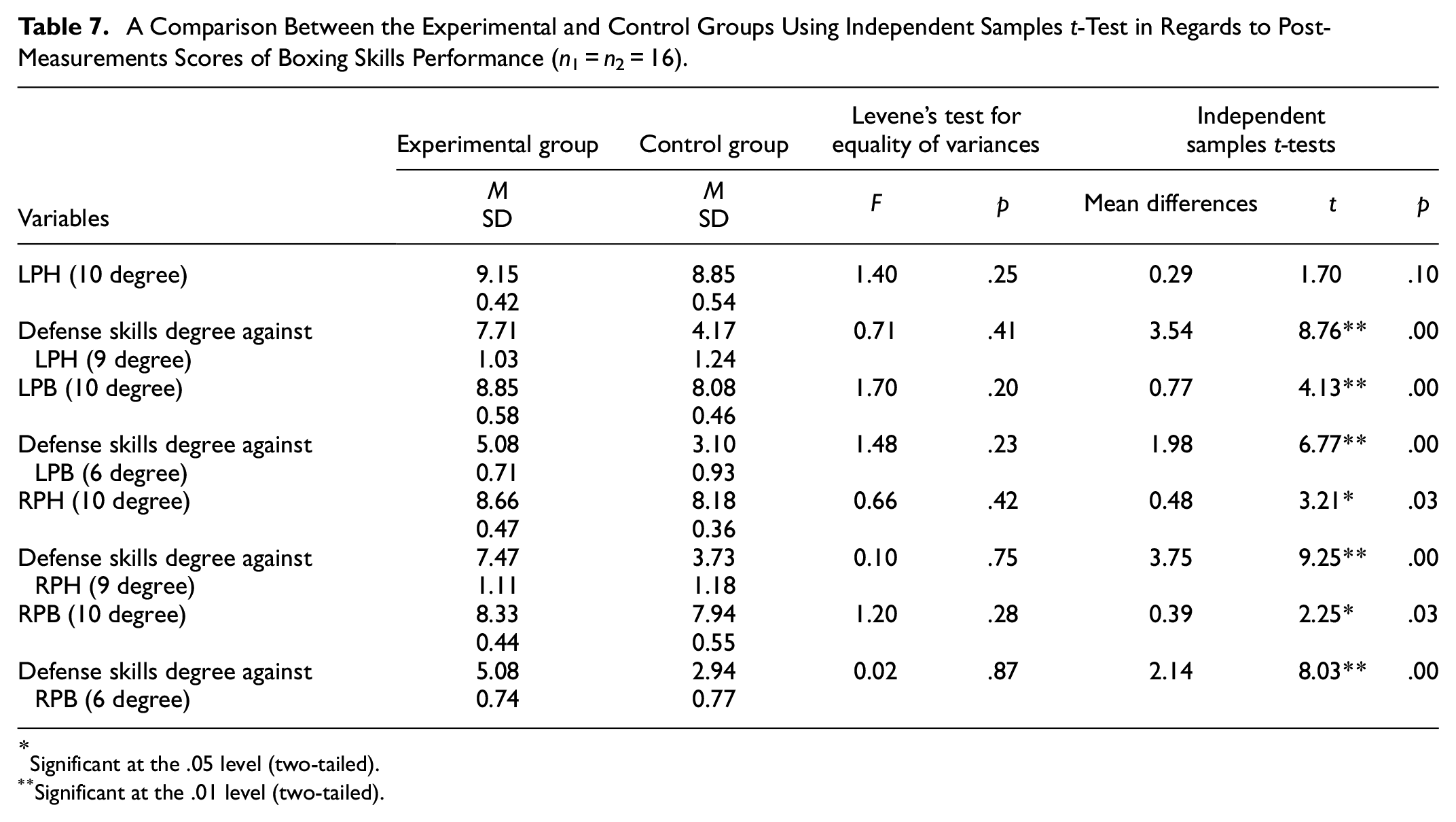
Significant at the .05 level (two-tailed).
Significant at the .01 level (two-tailed).
For the LBH scores, Table 7 and Figure 3 showed that neither the 16 participants who used Edmodo to learn (M = 9.15, SD = 0.42) nor the 16 participants in the control group (M = 8.85, SD = 0.54) indicated any significant differences, t(30) = 1.70, p = .10. We therefore accept this null hypothesis.

Comparing the performance scores of fundamental boxing skills between the control and experimental groups.
In the rest of the skills, the averages of experimental group ranged from (M = 5.08, SD = 0.41) to (M = 8.85, SD = 0.58). They were higher than those of the control group, whose averages ranged from (M = 3.10, SD = 0.93) to (M = 8.18, SD = 0.36). According to the independent samples t-test results, the t values ranged from t(30) = 2.25 to t(30) = 9.25 with a p values ≤.05. Therefore, there were statistically significant differences between the two groups. The experimental group outperformed the control group for these skills. Thus, the null hypothesis is rejected.
Based on Table 8 and Figure 4, the overall skill performance score for the experimental group (M = 60.29, SD = 5.38) was higher than that of the control group (M = 52.58, SD = 5.91). There was statistically significant difference between the two groups, t(30) = 3.86, p ≤ .01. Therefore, this null hypothesis was rejected. As a result, the experimental group outperformed the control group in the post-measurements of overall skill performance score.
A Comparison Between the Experimental and Control Groups Using Independent Samples t-Test in Regards to Post-Measurements Scores of the Overall Boxing Skills Performance (n1 = n2 = 16).


Comparing the overall performance scores of fundamental boxing skills between control and experimental groups.
The Effect Size
In the post-test, the effect size of the differences between the two groups the overall skill performance degree was (

Cohen’s (d) value was 1.36, which is higher than 0.8. This confirms the previous result of
The Power Analysis
The G*Power 3.1 tool was used for a post-hoc power analysis (Faul et al., 2009; Verma & Verma, 2020). After a study is conducted, post-hoc power analyses are often useful. A post-hoc analysis determines power (1 − β) by taking into account (α), the effect size parameter, and the sample groups size (Cohen, 1988). In this way, it becomes possible to determine if a statistical test published in the study had a fair chance of rejecting an incorrect H0. Further, similar to an a priori analysis, a post-hoc analysis requires an H1 effect size for the underlying population. Using retrospective data, post-hoc analysis estimates the observed power from sample data and the true effect size. Retrospective power analysis was carried out to investigate the highly questionable assumption that sample effect size (n) is the same as population effect size (N) (Faul et al., 2009).
A Power post-hoc analysis was conducted by the G*Power 3.1 tool with using the following factors: Cohen’s (d) = 1.36 for an independent samples t-test (two groups) at .05 significance level, and sample size for each group was n1 = n2 = 16. Consequently, the power (1 − β) = 0.92 was greater than 0.80, indicating a true effect size (Faul et al., 2009). This means that the results can be reliably applied to the whole population based on the sample as shown in Figure 5.

The relationship between the total sample size and the power analysis.
Research Question 2. What Are the Students’ Attitudes Toward Blended Learning Using the Edmodo Platform to Learn Some Fundamental Boxing Skills?
According to Table 9, the experimental group’s cognitive attitudes toward Edmodo are high; that is, they range from strongly agree to agree. The top-ranking item, Item 2, describes Edmodo posts with multimedia (text, photos, and videos), which were shown to enhance learning outcomes and scientific content (M = 4.56, SD = 0.37); Item 7, which is concerned with assignments and tests on Edmodo, also helped the student gain a deeper understanding of the skills learned and provide feedback (M = 4.56, SD = 0.51). The results of the affective attitude axis agree with the results of the cognitive attitude because the attitude of the experimental group was also high, as evidenced by their responses that ranged from strongly agree to agree. The fourth item on the list came in first place, which indicates that the students enjoyed following Edmodo posts about the boxing course (M = 4.81, SD = 0.40). The first item came in second place, which indicates that the students enjoyed taking the boxing course through Edmodo (M = 4.75, SD = 0.58); item 5 also had good results, which indicates that Edmodo makes it interesting and fun to follow information on the boxing course (M = 4.75, SD = 0.58). Additionally, the results of the behavioral attitude axis ranged between strongly agree and agree, and Item 4 ranked first, which indicates that the teacher was able to provide quick feedback on students’ questions and comments (M = 4.88, SD = 0.34). In second place was item 2, which indicates that the students in the experimental group could access the classroom from any device, that is, a mobile or a computer (M = 4.81, SD = 0.40).
Descriptive Statistics of the Students’ Attitudes Toward the Edmodo Platform to Learn Some Boxing Basic Skills.

Discussion
As indicated by the first question, the experimental group achieved better overall skill performance than the control group. Experimental group members excelled at LPB, RPH, and RPB punches. As well as skills in defending against the four types of straight punches. As a result, the Edmodo platform is shown to provide a superior learning model compared to the traditional method based on command-style instruction. We believe this result is due to Edmodo’s interactive platform, which provided the experimental group with a stimulating, independent, and collaborative learning environment that let them access information about the technical performance of these skills anywhere and at any time. Similar to Hourdequin (2014), these findings confirm that Edmodo provides useful tools for students and educators to exchange information outside of the classroom anywhere and at any time.
According to Balasubramanian et al. (2014), Edmodo offers a student-centered, technology-enabled learning environment in which students actively engage and apply responsible learning processes. In the experimental group, the superiority is due to the fact that they have an understanding of how the skills perform technically prior to applying them during practical lectures through interactive media such as sequential images, videos, texts, and comments regarding participation. In line with this argument, Puji and Umamah (2018) indicate that Edmodo users can upload documents, links, libraries, e-books, movies, and audio files. It has also been emphasized by Halil (2020) that Edmodo is effective because of its simple interface, useful features, and support for different types of files.
Further, this result is attributed to the “assignment” feature and the feedback that students receive from their teachers, as well as the answers to quizzes given on those skills. The formative assessment method that consists of assignments and quizzes enhances the kinetic perception of technical performance. This is done by measuring the extent of learners’ progress in the classroom while using the Edmodo platform. In addition to the simplicity and logical sequence of the educational content, it is free from printed restrictions. This fact encouraged the experimental group students to engage in mental processes such as criticism, analysis, comparison, and evaluation.
A recent study, namely, Etfita (2019), in which students were asked to reflect on Edmodo’s use as an assessment tool found similar findings. The results showed that most of these students were motivated, that Edmodo greatly reduced their test anxiety and that they preferred to be assessed through Edmodo.
In addition, these results can also be attributed to the continuation of individual application in practical lectures through the use of worksheets. Therefore, the teacher was able to provide feedback individually to each participant in the experimental group, which allowed them to correct their performances quickly and thereby increase the amount of practice time in their practical lectures. Similarly, Mosston and Ashworth (1986) indicate that worksheets can provide learners with feedback of four types, namely, value, corrective, neutral, and ambiguous. Comparatively, the control group used the command style, where the teacher explained a skill and demonstrated it. This approach does not take into account individual differences and prevents the teacher from providing individual feedback effectively. The main focus is on correcting common mistakes. Mosston and Ashworth (1986) describe this focus as the nature of command style.
The Edmodo platform has been indicated to be effective in many studies whose results agree with the findings of the present study, such as the study by Budiana et al. (2020), which shows that the Edmodo platform is effective in the learning of table tennis skills, and the study by Khudair et al. (2020), which analyses the learning of gymnastics skills. Furthermore, a study by Latif (2021) aimed to analyze the learning of volleyball skills.
The results show that the lead straight punch performance does not differ statistically significantly between the two groups. This is because it is the first punch to learn and is easier to use than other punches. Additionally, it was repeated throughout the educational program and combined with other punches.
According to the results of the second question, cognitive attitudes toward Edmodo were also high in the experimental group. One of these questions focuses on Edmodo’s multimedia posts (texts, images, videos), which can be used to improve student-learning outcomes. Moreover, Edmodo assignments and quizzes enable students to gain a deeper understanding of the skills learned and provide feedback. The results of this study are in agreement with the results of Goda (2019); Prasetya and Taroreh (2018); Purnawarman et al. (2016); and Vania et al. (2018), which concluded that students’ cognition improves with the use of Edmodo. In addition, students are allowed to develop their cognitive creativity.
Among the most meaningful results of the affective attitude, the students enjoyed viewing Edmodo posts about boxing and enjoyed studying for the boxing course. The results of this study are in accordance with those of (Ekmekçi, 2016; Fauzi, 2017; Hastomo, 2016; Manowong, 2016), who found that the Edmodo platform is an effective learning tool that improves motivation, flexibility, and participation in online learning activities and decreases students’ test anxiety.
One of the most meaningful results of the behavioral attitude axis was that the teacher was able to respond quickly to students’ questions and comments. Additionally, students in the experimental group were able to access their classrooms using any device, such as a computer or a phone. These results are in agreement with the findings of previous studies (Arwansyah et al., 2019; Enriquez, 2014; Mahmud et al., 2021; Wicaksana et al., 2020) that agree on the ease of use of the Edmodo application. Its multiple functionalities allow the platform to be used via a mobile device or computer, thereby enabling users to receive notifications, interact with posts, solve assignments, see their progress easily, and communicate with other students and teachers.
The large effect size indicates that there was a statistically significant difference between the two groups, and the power post-hoc analysis further confirms this by showing that the effect size was not due to random chance. Therefore, the results can be generalized to the entire population with a high degree of accuracy.
Conclusion
In this study, the effectiveness of blended learning via Edmodo on developing fundamental boxing skills and students’ attitudes was explored. According to the results, the experimental group performed better at boxing skills than the control group, which was taught through teacher command. Additionally, the results indicated that the experimental group had a positive attitude toward Edmodo. Consequently, blended learning through Edmodo provides students with a way to collaborate, engage, and reinforce their learning. With blended learning, class time is freed up for more engaging (and collaborative) activities and skills practice. Additionally, prior learning through Edmodo enhanced students’ understanding of the skills technique, helped teachers use contact hours effectively, and helped students gain experience, especially during COVID-19 pandemic.
Limitations
Since the boxing sport course is exclusively for males, all participants in this study were males. Blended learning might be explored in other courses with female students using Edmodo or other SNL applications.
Implications
The Edmodo platform can be used as a practical and safe learning model in practical classes, especially in light of the COVID-19 pandemic. Moreover, more studies related to different sports should be conducted in the future to achieve the highest level of motor skills education.
Footnotes
Acknowledgements
The Researchers would like to thank the Deanship of Graduate Studies and Scientific Research at Qassim University for financial support (QU-APC-2024-9/1).
Author Contributions
All authors contributed to the conceptualization, resources, methodology, materials, analysis, writing, review, and editing of the paper.
Declaration of Conflicting Interests
The author(s) declared no potential conflicts of interest with respect to the research, authorship, and/or publication of this article.
Funding
The author(s) received no financial support for the research, authorship, and/or publication of this article.

Data Availability Statement
Data available within the article.