




Abstract
This research paper investigated the adoption behavior of college students toward the e-learning system amidst the current COVID-19. The model was developed and validated based on the Technology Acceptance Model (TAM) and the partial least squares-structural equation modeling (PLS-SEM) was used to analyze the data. The data was generated from 316 Chinese college students based on the convenient sampling technique. The research outcomes indicate that the perceived ease of use is a significant predictor of the intention to use and perceived usefulness of an e-learning system. To our surprise, perceived usefulness does not determine the intention to use an e-learning system. Computer self-efficacy and technical support respectively were significant determinants of the perceived usefulness and the perceived ease of use of an e-learning system. Interestingly, the study showed that internet experience does not influence students’ sensitivity to the usefulness and ease of use associated with an e-learning system. The theoretical and managerial implications of these results findings are thoroughly interrogated.
Introduction
Information and Communication Technology has enabled the transformation of many sectors of human endeavors from economic, environmental, political, and societal sectors. One such transformation is on the educational front where technology has changed the magnitude of the nature of the delivery of education for individual citizens and the general public. The application of the right information technologies to enhance the effectiveness and efficiency in the delivery of education is termed e-learning. E-learning is formally defined as the use of information and communication technologies (ICTs) such as computers, networks, and multimedia systems to enhance the delivery of learning activities (Garcia et al., 2018; Horton, 2001; Lahn, 2004; Wong, 2007). It is also defined as the provision of teaching instructions and activities through technology devices like computers, smartphones, or mobile systems to offer a better learning experience to learners as well as improvement in the quality of education (Alharthi et al., 2019; Clark et al., 2011; Ong et al., 2004). E-learning systems can offer students real and non-real-time learning resources based on their personalization learning environments such as self-owned teaching and learning conditions which is instrumental to the independent study and academic performance of students (Dai & Xia, 2020).
E-learning systems have become even more relevant particularly during the current COVID-19 pandemic which has raged over the world. According to Almaiah et al. (2020), e-learning tools are playing a crucial role in the fight against the pandemic. E-learning systems can offer education institutions the skills to manage, plan, deliver, and track learning and teaching (Almaiah et al., 2020) during this COVID-19 pandemic. Governments and educational institutions have temporarily closed schools and universities as a concerted effort to contain the spread of the COVID-19 pandemic. This has resulted in the use of distance and online learning by schools and universities and thus has revived the necessity to take advantage of e-learning adoption opportunities (Almaiah et al., 2020). Globally, according to the World Health Organization (WHO, 2020) data from 216 countries indicates that as of 1 August 2020, there are about 17.4 million confirmed cases of COVID-19 and about 675,060 confirmed deaths. The unpreparedness on the part of educational institutions and students in the phase of the COVID-19 has led to the poor implementation and adoption of e-learning systems due to no experience and thus making it ineffective (Almanthari et al., 2020; Zaharah et al., 2020).
The mainland China COVID-19 cases indicated 84,337 confirmed cases, 78,989 recoveries, and 4,634 deaths. Due to the monumental impact of COVID-19 on the education system in China, in January 2020, the Ministry of Education issued policy guidelines titled “School in Out but Class is On” which outlined a multiplicity of high-quality online teaching resources for schools related teaching resources for selection nationally and locally (Dai & Xia, 2020). Schools and universities in China were shut down amidst the countrywide lockdown in China. The severity of the lockdown can be felt not only on businesses and society but also on college students in China who were cut up amid the COVID-19. Finding from a study indicated that international students in China welcome the e-learning programs initiated by all schools and universities and were willing to embrace them (Demuyakor, 2020). It was also revealed that the cost involved in participating in online learning was higher particularly for students who were outside the university campus who depended on internet mobile data for online learning activities (Demuyakor, 2020). Another challenge for online learning for students is the low internet connectivity for students leaving on the university campus in China (Demuyakor, 2020). While China adopted e-learning programs during the COVID-19 pandemics for all schools and universities to conduct online teaching and learning, the efficacy of these technologies in the educational system was not well known (Dai & Xia, 2020). It was highlighted that online system based self-learning was conducive to students and that school self-developed e-learning platform was more effective in enhancing students’ achievement than other non-school self-developed types (Dai & Xia, 2020).
China has broadened the scope of traditional education by the systematic development of e-learning systems via modern technologies (Ting et al., 2018). E-learning is a new system of acquiring education in China that has been integrated with computer networks, satellite TV, and telecommunications technologies (Ting et al., 2018). In the heat of the COVID-19 pandemic, China introduced two new world online learning platforms to support the educational needs of students and the general Chinese populace. With the backing of the Ministry of Education of China and the Chinese National Commission for UNESCO two e-learning systems were launched such as “XuetangX” (www.xuetangx.com) and “iCourse international” (www.icourse163.com; UNESCO, 2020a). These systems were designed to provide learning instructions and resources in English and other languages from top universities worldwide with adequate technical backup (UNESCO, 2020a). “XuetangX” for instance offers about 3,000 online courses from world-class first-class universities which included Tsinghua and Peking University. On the other hand, the “iCourse” system had over 9,000 Massive Open Online Courses (MOOCs) and more than 13,000 online courses in addition to the “iCourse international” which delivers about 193 English taught courses (UNESCO, 2020a). The number of online education users was reported to have reached an estimated 331 million people in China in 2020 which was an increase of 23% that year as compared to 2019 (Statista, 2020). The online education market size saw a correlational increase to 257.3 billion Yuan in 2020 which was higher than the market size in the previous year 2019 (Statista, 2021). These increases in the number of users and the market size of online education in China can be attributed to the unexpected appearance of the deadly COVID 19 pandemic.
This paper seeks to interrogate the college students’ adoption desires of e-learning systems within the midst of the COVID-19 in China. The COVID 19 pandemic has necessitated and forced the closure of classrooms and universities which has since affected about 1.5 billion students and 63 million education stakeholders particularly in terms of face-to-face academic practices (UNESCO, 2020b; Valverde-Berrocoso et al., 2020; Worldbank, 2020). Understanding the factors influencing college students’ decision to use e-learning systems is crucial and fundamental in developing sustainable e-learning systems that will not only meet the ever-changing educational environment but any natural events that may disrupt the educational systems domestically and internationally. Besides, e-learning system success will be based on the extent to which students are prepared to accept and adopt e-learning platforms and without it, the anticipated benefits from e-learning systems on key stakeholders will not be accomplished (Almaiah & Alismaiel, 2019; Shawai & Almaiah, 2018). The conduct of this study would attempt to contribute to the e-learning literature by demonstrating the extent to which computer self-efficacy, internet experience, and technical support can influence the adoption intention of e-learning systems. The two fundamental research questions to be explored are: what are the factors determining college students’ intention to adopt an e-learning system amid COVID-19? And what is the significant effect of these factors on the adoption of e-learning systems amid COVID-19?
Our paper is structured in this manner: research background and literature review, research hypotheses development, the depiction of the research model, description of the research methodology adopted, the results and analysis undertook, the discussions of the findings along with its managerial and practical implications, the summary in the form of conclusion, and drawbacks of the study.
Research Background and Literature
Electronic Learning (E-Learning)
Definition and concept
E-Learning is defined as an approach to teaching and learning which is dependent on the use of electronic systems or media and devices as tools to improve the access to education, training, communication, and interaction and to facilitate the development of new methods to learning and teaching (Gordon et al., 2013). In short, e-learning is the use of ICTs to improve and support teaching and learning processes (Sife et al., 2007; Yoloye & Nwokeafor, 2015). E-Learning is vital in conventional education due to its flexibility, broad resource-sharing capacity, and cost-effective scalability (Allen & Seaman, 2011). E-learning can be compartmentalized into two: learning and technology (Aparicio et al., 2016). The learning part is seen as the cognitive process for attaining knowledge and new skills while technology serves as a powerful enabler of the learning process (Aparicio et al., 2016).
E-learning systems are based on the concept of Computer-Assisted Instruction (CAI; Zinn, 2003). The theoretical framework of the development of an eLearning system is based on three major components of information systems such as people, technology, and services (Aparicio et al., 2016). Any developed e-learning system must interact with its intended users and thus e-learning technologies provide the direct or indirect interaction of different categories of peoples and users (Aparicio et al., 2016). The technological aspect seeks to provide technical support to ensure the integration of content, enable communication, and availability of collaboration tools (Aparicio et al., 2016). In terms of the service part of an e-learning system, e-learning services, and activities are designed to align with the e-learning pedagogical and instructional modalities and strategies (Aparicio et al., 2016). The concept of an e-learning systems theoretical framework is depicted in Figure 1.

Holistic e-learning systems theoretical framework (Aparicio et al., 2016).
Challenges of e-learning systems
E-learning technologies just like any new system have their challenges. Some of these challenges are learning style and culture, pedagogical e-learning, technology, technical training, and time management challenges (Islam et al., 2015; Maatuk et al., 2021). Others have also indicated challenges of e-learning systems such as inadequate ICT and e-learning infrastructure, financial constraints, lack of affordable and adequate internet bandwidth, lack of operational e-learning policies, lack of technical skills on e-learning and e-content development, lack of interest and commitment to e-learning systems use, and the amount of time required to developed e-learning content (Vershitskaya et al., 2020). Some of these selected challenges are discussed below:
Learning style and culture
The individual learning style along with cultural differences among different people is a challenge in the adoption of any e-learning system. System designers and developers of the e-learning system must endeavor to understand the learning preference and styles of students learning and their e-learning environment (Irfan et al., 2020; Islam et al., 2015). Understanding students learning styles can influence the designing of e-learning systems to achieve the best learning outcomes (Islam et al., 2015; Zalat et al., 2021).
Cultural differences in terms of Hofstede’s dimensions of cultural variability have implications for e-learning (Ghos et al., 2020; Hofstede, 1980; Olaniran, 2009). For instance for individualistic cultures, certain cultures remain high context and power distant like African, Japanese, and Asia countries (Olaniran, 2009). High-context cultural information is internalized within the individual or situation while power distant cultures recognize or accept the fact that power is not evenly distributed within the society (Ghos et al., 2020; Hofstede, 1980; Olaniran, 2009). According to Olaniran (2009), these cultural differences have both implicit and explicit implications for learning tendencies and thus can influence the use and selection of technologies in e-learning.
Pedagogical e-learning
The best approach to be adopted to achieve effective learning is known as pedagogy (Hussein & Al-Chalabi, 2020; Tarno et al., 2011). The creation of multi-faceted pedagogical practices through the utilization of ICTs can empower students and learners to achieve higher learning and interaction (Aljaber, 2018; Portuguez Castro & Gomez Zermeno, 2020). One of such efforts in creating a good pedagogical system is what is called computer-supported collaborative learning (CSCL) which is intended to create dominant learning and communication atmosphere via the application of integrated collaborative learning and the use of ICT (Lin & Lin, 2019; Lukas & Yunus, 2021). The CSCL can drive better peer interaction and group work, and promote higher levels of dissemination and sharing of knowledge and expertise within the learning society (Lukas & Yunus, 2021; Wahyuningtyas & Idris, 2020). Pedagogy is fundamental and instrumental in achieving well-desired learning outcomes (Manazir & Rubina, 2020; Olaniran, 2009). Pedagogy thus needs the teacher to understand how students learn to integrate, design, and deliver course materials and mentor students adequately (Ananga, 2020; Olaniran, 2009). Pedagogy is therefore instrumental and the cornerstone to the development and diffusion of e-learning technology since without it the desired learning outcomes cannot be achieved (Monjaraz-Fraustro et al., 2021; Olaniran, 2009). E-learning systems must be designed to meet the different approaches to pedagogy especially in areas such as individual and group interaction and online assessment (Ananga, 2020; Olaniran, 2009).
An e-learning pedagogy should have the following characteristics; learner-centered, engaged and active, constructive, situated and contextual, social and collaborative, reflective, and timely feedback mechanism (Dehtiarova et al, 2020; Vrasidas, 2004; Yelland & Tsembas, 2008). Achieving a good pedagogical e-learning environment may be hampered by lack of; adequate skills and knowledge required to design and teach virtually, support and training required for developing e-learning instructions, real-time face to face interaction, requisite design and development tools to effectively deliver teaching online, good technological infrastructure and incentives, and compensation as motivation for teachers to delivery lectures online (Enbuska et al.,, 2018; Monjaraz-Fraustro et al., 2021; Vrasidas, 2004).
Technical training
Technical support and training are integral components of the development, implementation, and integration of ICT in the education environment but this element is overlooked by my stakeholders (Nawaz & Qureshi, 2010; Taat & Francis, 2020). Training challenges have to do with the training requirement that will enable the teacher to adapt to and learn the features and function appropriately to use the system effectively (Hadullo et al., 2018; Olaniran, 2009). Familiarity with technology is vital in achieving a successful learning experience in the e-learning system (Beinicke & Bipp, 2018; Olaniran, 2009). With adequate availability of technical support, it can influence the extent of participation and readiness toward the adoption of e-learning systems and is considered as one of the cardinal factors in the success of e-learning systems (Alhomod & Shafi, 2013).
The issue of technical support and training is vital for both students and teachers. The technical training and support for teachers are required to empower the teacher with the needed resources and technical knowledge as well as skills for the successful integration of technology in the traditional classroom systems (Ayu, 2020; Farhan et al., 2019). On other hand, for students, technical support and training facilitate their acquisition of knowledge and skills in their learning and academic targets (Nawaz & Qureshi, 2010; Portuguez Castro & Gomez Zermeno, 2020). It can cover areas such as installations, operation, maintenance, security, and network system management, and hard and software challenges (Maatuk et al., 2021; Nawaz & Qureshi, 2010).
E-learning development in China
The application of information and communication technologies (ICTS) has empowered the acquisition of knowledge via different methods and models which includes network learning, multimedia education, online and open education, and blended learning in China (Wang et al., 2018; Zhang et al., 2020). Since the advent of e-learning systems in the 1990s, the Chinese government has put much effect on the development of quality and efficient e-learning systems (Thongsri et al., 2020; Wang et al., 2018). This phenomenon has resulted in achievements within the e-learning market in terms of availability of resources, the building of infrastructure, academic education, and non-academic education for people of diverse groups (Wang et al., 2009, 2018). With more than 20 years in the development and promotion of e-learning systems at both basic and higher education, formal and informal education has been provided to thousands and millions of people which include teachers, students, and university learning resource centers (Wang et al., 2018).
As part of the systematic and progressive development of e-learning structures and systems in China, many major programs have been initiated by the Chinese Ministry of Education which includes: “211 Project” (Ministry of Education [MOE], 2011a), “985 Project”(MOE, 2011b), “Education Promotion Plan for the 21st century “(MOE, 1998), “Rural Elementary and Secondary School Distance Education Project” (MOE, 2005), “Campus Computer Network Construction Project for Universities in West China “(MOE, 2002), “Network Between Schools Project”(MOE, 2001), “Project of the construction of network courses for the new century” (MOE, 2004), “Tens of Thousands Of Provincial level and school-level high-quality courses” (MOE, 2013), and “the construction of high-quality open video courses (MOE, 2014; Wang et al., 2018). Through these systematic programs, the emphasis has been shifted to the development of public service and information technology systems which has provided the fundamental for the construction of digital resources such as national-level quality programs, quality video open courses, Massive Open Online Courses (MOOCs), micro-lectures, and many other digital systems databases (Wang et al., 2018).
Massive open online courses (MOOCs)
The development and implementation of MOOCs started in Chinese colleges in 2013 after its world surge in 2012 and is considered a powerful tool in the delivery of distance education in China (Lin & Zhang, 2014; Wang et al., 2018). Tsinghua University, Shanghai Jiaotong University, Peking University, and other well-known universities started the implementation of MOOCs in China (Li, Chen, & Gong, 2017). MOOCs are considered a powerful tool in the delivery of distance education in China (Lin & Zhang, 2014). MOOCs development is seen as a great revolution in the Chinese educational sector that redefines how teaching and acquisition of knowledge can be undertaken (Li et al., 2017; Lin & Zhang, 2014). It is integrated with some major features which include course wares such as weekly video mini-lectures, discussion forums to facilitate the exchange of knowledge, feedback systems from computer-graded quizzes, peers, and instructors, the deadline for quizzes and exams/assignments, a pedagogy which provides a better reflective model of teaching (Lin & Zhang, 2014).
The MOOCs users in China are considered younger and well-educated as compared to India and the USA (Li, 2017). They undertake courses on MOOCs systems to advance their professional skills and they often use the mobile system to access the MOOCs system (Li, 2017). XuetangX which is the only non-English MOOC system with other 400 courses is considered the third biggest MOOC Chinese service provides in the world (Li, 2017). To meet the demands of the market it has developed integrative applications for iOS, Android, IPAD, and Smart TV (Li, 2017). It offers multiple programs which include degree and certificate courses.
Theoretical Framework and Hypotheses Development
The Technology Acceptance Model (TAM)
Technology Acceptance Model (TAM) was developed and validated as means to predict the behavioral intention of the use of new technology within an organizational context (Davis, 1989; Davis et al., 1989). The technology acceptance model was developed based on the Theory of Reasoned Action (TRA; Ajzen & Fishbein, 1980) and the Theory of planned behavior (Ajzen, 1985, 1991). The technology acceptance model is based on the assumption that the use and acceptance of new technologies can be explained by the individual user’s internal beliefs, attitudes, and intentions and thus can be instrumental in predicting future use of technology (Davis, 1989; Davis et al., 1989; Turner et al., 2010). TAM has four internal constructs that can explain the actual use of new technologies such as perceived usefulness, perceived ease of use, attitude toward use, and behavioral intention to use (Davis, 1989). TAM uses behavioral intention as both a dependent construct and an independent construct. Behavioral intention becomes a dependent variable when predicting these two constructs (perceived usefulness and perceived ease of use) and as an independent variable when it predicts the actual use of new technology (Davis, 1989; Davis et al., 1989). Perceived usefulness and perceived ease of use are considered the most reliable determinant of the behavioral adoption of any new technology (Davis, 1989).
A revised TAM was later proposed (TAM2) which excluded attitudes toward use and added new constructs such as experience and subjective norm with the core ideology of the model remaining the same (Turner et al., 2010; Venkatesh & Davis, 2000). Since its development decades ago, TAM has been adapted, replicated, and validated across multiple different fields of study such as e-commerce (Alves & Reis, 2020; Huong et al., 2020), e-government (Alkraiji, 2020; Mensah & Adams, 2020), e-learning (Al-Fraihat et al., 2020; Tawafak et al., 2020), and electronic and mobile health (Dahleez et al., 2020; Klingberg et al., 2020) adoption research. This extensive and multiple validations of TAM is a testament to its robustness in providing reliable results comes that can better explain the individual user’s intention to use new technology.
Perceived usefulness
Perceived usefulness is defined as the degree to which the individual user believes that the use of new technology will contribute greatly to improving his or her work performance (Davis, 1989). As new technologies spring up, users will be attracted to use it more when they appreciate that using it will bring in more benefits particularly in terms of completing their tasks efficiently and effectively. Perceived usefulness is considered as a key determinant that can influence the adoption of new innovative technologies that is user-friendly and provides more freedom (Pikkarainen et al., 2004). It thus follows that the greater the perceived usefulness of e-learning systems, the more positive attitudes and intention to use will be demonstrated. Studies have found that there is a direct relationship between perceived usefulness and the intention to adopt an e-learning system (Al-Fraihat et al., 2020; Al-Rahmi et al., 2018; Mohammadi, 2015; Tarhini et al., 2017). Accordingly, H1 was proposed.
Perceived ease of use
Perceived ease of use is one of the key determinants of the intention to use and it is defined as the perception of the individual user that the use of a new technological system would be free from effort (Davis, 1989). The ease of use associated with a new technology couple with its user-friendly features will encourage more participation and adoption. That is the greater the perceived ease of use of an e-learning system, the more positive intentions users will harbor toward its adoption and it can influence the user’s perception of the usefulness of the e-learning system (Davis, 1989; Mohammadi, 2015). Previous studies have demonstrated that perceived ease of use has a direct significant impact on the intention to use (Chang et al., 2017; Tarhini et al., 2017) and perceived usefulness (Mohammadi, 2015; Salloum, Al-Emran, et al., 2019). Consequently, H2 and H3 were proposed.
Computer self-efficacy
Self-efficacy is considered to be instrumental in the decision of the user to adopt any new technology. It is seen as a vital concept in social learning theory and it is defined as an individual user’s belief that he or she can perform or undertake a particular task successfully (Bandura, 1977). Computer self-efficacy is thus considered as the individual perception that he or she has the needed capabilities to undertake any course of action successfully through the mediated medium of computer systems and applications. In the context of e-learning, computer self-efficacy is seen as the college students’ self-confidence in their abilities to perform learning tasks through an e-learning system (Abbad et al., 2009). Students with strong potential and skills in completing an e-learning task through an e-learning system will develop a more positive perception of its ease of use and usefulness (Abbad et al., 2009). Prior studies have shown that there is a direct impact of self-efficacy on the perceived usefulness (Sánchez & Hueros, 2010) and ease of use (Abbad et al., 2009; Ibrahim et al., 2017) of an e-learning system. Accordingly, H4 and H5 were proposed.
Internet experience
The extent of internet experience that users possess has the potential to influence their apprehension of the ease of use and usefulness associated with any particular technology such as an e-learning system. Having the right internet experience will empower users to search for information and manipulate web browsers to navigate to obtain accurate information and services. It is estimated that users with low levels of internet experience will search and acquire information and services less efficiently as compared to users with rich internet experience (Frias et al, 2008). This is because inexperienced users may have less knowledge of the system and thus may not have the same skills the experienced users may have which may result in difficulty managing information flow (Chevalier & Kicka, 2006; Frias et al., 2008; Liu & Shrum, 2009). Prior research has demonstrated that internet experience is instrumental in determining both perceived usefulness and ease of use of an e-learning system (Abbad et al., 2009). H6 and H7 were therefore proposed.
Technical support
Technical support is considered crucial to the adoption of e-learning and teaching development and delivery (Moule et al, 2011). Without the provision of adequate technical support, the development of e-learning and teaching platforms will be a challenge. Since users who lack the needed technical support will be deprived of the chance to use e-learning systems (Moule et al., 2011). The provision of the right technical support for users of any e-learning system will enhance the perception of users toward the perceived usefulness and ease of use of an e-learning system. It has been revealed that technical support has a direct significant impact on the usefulness (Abbad et al., 2009; Ngai et al., 2007) and ease of use (Hsia et al., 2014; Ngai et al., 2007) associated with an e-learning system. Consequently, H8 and H9 were proposed.
Research Model
The research model to be explored in this study is shown in Figure 2.

Research model.
Research Methodology
Measurement Instrument
A survey research questionnaire was used to acquire the data for this study. Questionnaire-based surveys are considered a common approach to collect data and the interpretation of research results that may be used as a basis to inform policy debate or decisions (Bowden et al., 2002). The content of the survey questionnaire was based on previous literature but question items were modified to reflect the confines of the current study. Constructs in the questionnaire were adopted as follows: perceived usefulness perceived ease of use and intention to use (Davis, 1989), computer self-efficacy (Compeau & Higgins, 1995), internet experience (Liaw et al., 2007; Tan & Teo, 2000), and technical support (Alenezi et al., 2011; Moule et al., 2011; Venkatesh, 1999). The items in the questionnaire were measured on a 5-point scale from 1 = Strongly Disagree (SD) to 5 = Strongly Agree (SA). It contained a total of 18 items with each construct having a three unique questions. The content of the measurement instrument is attached as Appendix 1.
Questionnaire Design and Administration
The questionnaire instrument was made up of two parts: the first part was about the basic demographic information of the respondents while the second part was about the six constructs examined in this study. Before the mass online collection of data, the questionnaire was pre-tested and piloted among the expected sample of the study; however, the results obtained were not used as part of the final analysis of the study. The pre-testing and piloting are to enable us to reduce any level of ambiguity that respondents may have in completing or responding to any of the questions in the instrument. The pre-testing and piloting enables researchers to gage the meanings attributed to the survey questions, assess the feasibility of full-scale survey, developing and testing the adequacy of research instruments, collect preliminary data, and determine if the sampling framework and techniques are effective (Bowden et al., 2002; Van Teijlingen & Hundley, 2001). The questionnaire was then hosted online for 3 months for respondents (500 samples) to complete who are college students at Jiangxi University of Science and Technology. After the 3 months of hosting online, a total of 316 responses were received and this accounted for 63.2% of the expected sample. The valid responses received were then captured and used for the data analysis by using the structural equation modeling technique. Then sample size was determined through the use of a confidence level of 95%, a margin of error of 5%, population proportion of 25%, and an estimated number of students’ population of 25,000. With these stated parameters, the minimum sample size required is 285 (Calculator.net, 2021), but as stated above, the paper received valid responses (sample of 316) which are above the minimum number the sample size required. This then provided the researchers with the confidence to proceed with this valid sample of 316 for the data analysis.
Sampling Technique
A convenient sampling technique was used. The convenient sampling is considered a system used by researchers to collect research data from conveniently and readily available population/pool of respondents and it is widely adopted due to its timeliness/promptness, not complicated, and its economically sound nature (Battaglia et al., 2008; Etikan et al., 2016; Scholtz, 2021). In addition, the convenient sampling approach is preferred in cases where large populations are concerned and thus making it practically impossible to examine/test all members of the population (Jawale, 2012). One useful nature of this sampling technique is that there are no criteria needed for members to be part of the sample and hence makes it simple to research targeted members/components of the population (Costanza et al., 2015; Singh, 2015). In summary, this paper used a convenient sampling approach because it empowered the researchers to gather data promptly, its inexpensive methodology, easy to undertake the research, readily available sample, and its low-cost dimension.
Data Analysis Tool
The Smart Partial Least Squares (PLS) 3.0 was used as the statistical tool in conjunction with the Structural Equation Modeling (SEM) technique to complete the data analysis and the testing of the hypothesized structures in the research model. The SEM is considered as the much better approach to understand the reliability and validity of theories with experimental data (Hair et al., 2019; Shiau et al., 2019). The PLS-SEM has deliberated a unique method for analyzing composite-based path models and it is recommended for use when: the analysis concerns the testing of a theoretical framework from the prediction view; the structural model is complex and includes many constructs, indicators, and model relationships; and the path model consists of one or more formatively measured constructs (Hair et al., 2019, 2020; Sarstedt et al., 2017).
Common Method Bias
Common method bias is said to occur when both the independent and dependent variables are measured from the same measurement instrument which is considered a limitation of self-acquired data (Podsakoff et al., 2003; Wang et al., 2020). Researchers are often concerned with the common method bias since it can influence item validity, reliability, and the co-variations between latent variables (Kock, 2015; MacKenzie & Podsakoff, 2012). CMB draws attention to the fact that any measuring instrument inevitably has: (1) systematic items variance due to the features that are intended to represent the constructs of interest, (2) systematic error variance due to characteristics of the specific method being used which may be common to measures of the other constructs, and (3) random error variance (MacKenzie & Podsakoff, 2012). The exploratory factor analysis with Harman’s single factor analysis (Harman, 1960) was employed to estimate the CMB. The analysis indicates that no single factor explained more than 23.75% of the majority of the variance and thus an indication that CMB does not exist (not a threat) in this research. As stipulated by Schriesheim (1979), CMB is said to be a threat if one factor explains more than 50% of the majority of the variance of the study.
Results and Data Analysis
Demographic Statistics
The results of the demographic statistics of the respondents who participated in the study are shown in Table 1. Male respondents represented 42.7% while female respondents were 57.3%. A higher number of respondents were between the ages of 22 to 25 years (58.5%). In terms of education, the majority were undergraduate students (64.2%).
Demographic Statistics.

Measurement Model
The goodness of fit of the measurement model was examined using the confirmatory factor analysis (CFA). The threshold or cut off point for goodness of fit to be established for seven indices as recommend by Hair et al. (2016) are: χ2/df (<3), root mean square error of approximation (RMSEA < 0.08), root mean square residual (RMR < 0.08), normed fit index (IFI > 0.9), incremental fit index (>0.9), and comparative fit index (CFI > 0.90). The good fit of the data gathered with the measurement model was achieved since the values obtained meet the minimum requirement for the goodness of fit to exit: χ2 = 454.104, df = 350, CMIN/df = 1.563, RMR = 0.030, GFI = 0.875, NFI = 0.902, IFI = 0.904, CFI = 0.917, RMSEA = 0.041).
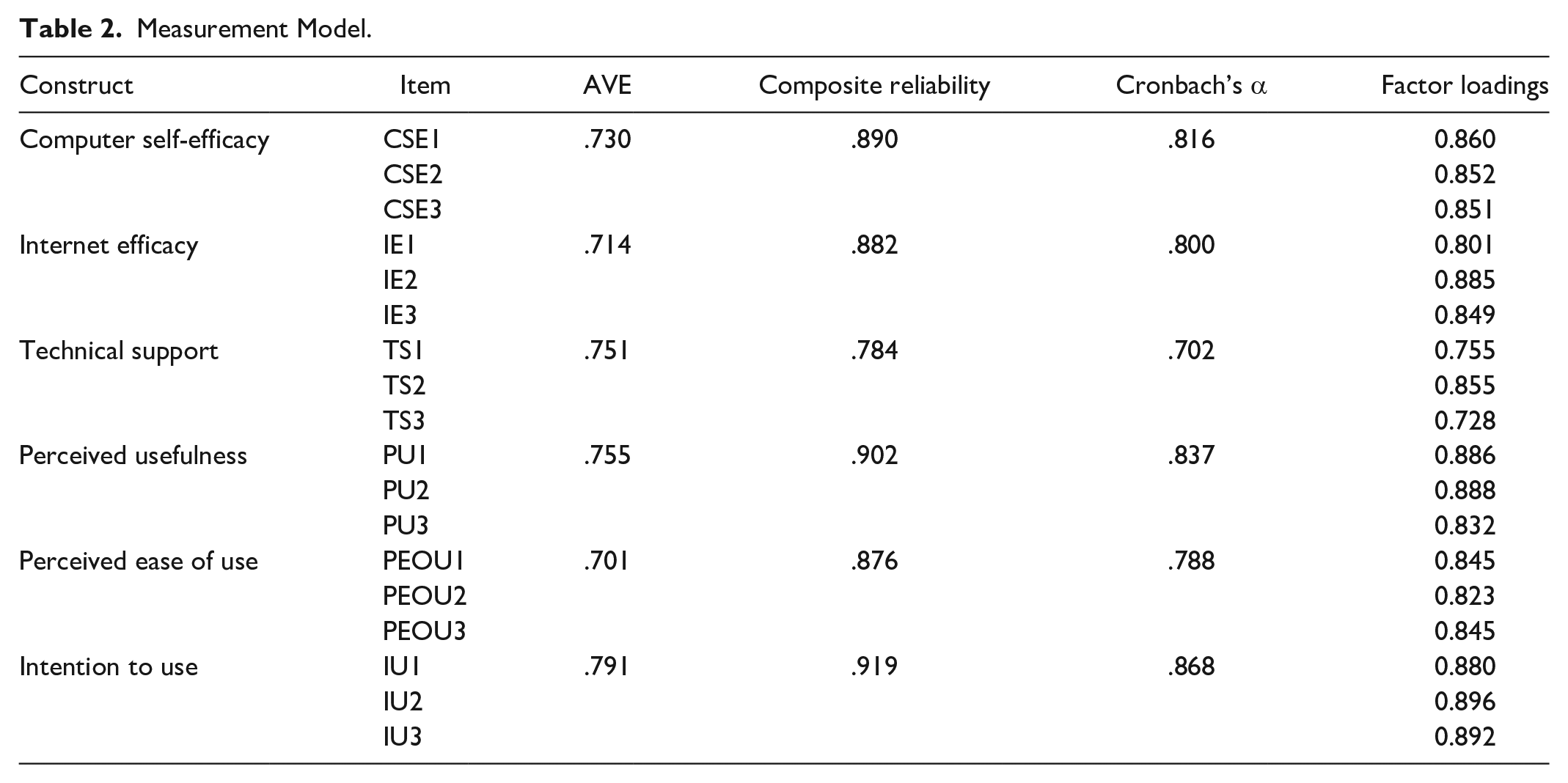
Furthermore, the average variance extracted (AVE), composite reliability, Cronbach’s alpha, and factor loading were used to check the validity and reliability of the measurement used in this study. The results are shown in Table 2. Factor loadings, composite reliability, and Cronbach’s alpha are recommended to be greater than .70 (Hair et al., 2010; Henseler et al., 2009; Sarstedt et al., 2014). The average variance extracted should have values not less than .50 (Hair et al., 2012; Henseler et al., 2009). As shown in Table 2 all the requirement for testing the measurement model has been met which demonstrates a good convergent validity of the data and reliability in the scale used.
Measurement Model.
Also, the discriminant validity of the data was conducted. The results are shown in Table 3. The Fornell-Larcker criteria and cross-loadings criteria were used to determine the discriminant validity. This criterion indicates that the square root of AVE should be greater than all correlations between each pair of constructs (Chin, 1998). The cross-loadings principle states that the loadings of each indicator should be greater than all cross-loadings (Fornell & Larcker, 1981). As shown in Table 3, all the diagonal values (square root of AVE) are greater than the off-diagonal values (correlations between the constructs) which are an indication that of the discriminant validity of the scales used in our study.
Discriminant Validity.

Note. Constructs correlation and the square root of AVE (in bold). CSE = computer self-efficacy; IE = internet efficacy; ST = technical support; PU = perceived usefulness; PEOU = perceived ease of use; IU = intention to use.
Structural Model
The results of the research hypotheses tested are shown in Table 4 and depicted structurally in Figure 3. The results show that while perceived usefulness was not significant in determining the intention to use (β = .114, p > .05), perceived ease of use (β = .513, p < .05) was however significant in predicting the intention to use. Accordingly, H1 was not supported while H2 was supported. Also, perceived ease of use was found to be a significant determinant of the perceived usefulness of an e-learning system (β = .536, p < .05). H3 was therefore supported. In addition, the results show that computer self-efficacy was significant predictors of both perceived usefulness (β = .267, p < .05) and perceived ease of use (β = .705, p < .05) of e-learning system. H4 and H5 were thus supported. Surprisingly, Internet experience was not significant in predicting both the perceived usefulness (β = .078, p > .05) and perceived of use of an e-learning system (β = .006, p > .05). Consequently, H6 and H7 were not supported. Finally, technical support was significant in determining both the perceived usefulness (β = .081, p < .05) and perceive ease of use (β = .091, p < .05) an eLearning system. H8 and H9 were hence supported.
Results of Hypotheses Tested (Structural Model).

Note. Estimation of partial least squares (***/*Supported). CSE = computer self-efficacy; IE = internet experience; ST = technical support; PU = perceived usefulness; PEOU = perceived ease of use; IU = intention to use.

Validated structure model with standardized beta values and explained variance (***/* supported).
Discussion
This study investigated college students’ behavioral intention to adopt an e-learning system. The results have demonstrated that while perceived ease of use was found to be significant in predicting the intention to adopt an e-learning system, perceived usefulness however was not significant in determining the intention to use. The non-significant impact of perceived usefulness on the intention to use contradicts previous studies that have reported that the perceived usefulness of an e-learning system is a positive significant predictor of the intention to use (Abbad et al., 2009; Liu & Wei, 2018; Rafique et al., 2020; Salloum, Al-Emran, et al., 2019; Salloum, Alhamad, et al., 2019). Our finding on the positive impact of perceived ease of use on the intention to use is in line with prior studies that also demonstrated a positive and significant relationship between perceived ease of use and intention to adopt an e-learning system (Abbad et al., 2009; AlHamad, 2020; Salloum, Al-Emran, et al., 2019; Salloum, Alhamad, et al., 2019). Also, the results show that the perceived ease of use of an e-learning system was significant in predicting the perceived usefulness of an e-learning system. This finding does support other previous research that indicated that perceived ease of use has a direct significant impact on the intention to use e-learning (Abbad et al., 2009; Mousa et al., 2020; Salloum, Al-Emran, et al., 2019; Salloum, Alhamad, et al., 2019).
Additionally, we found that computer self-efficacy was significant in determining the perceived usefulness and ease of use of an e-learning system. This implies that people who exhibit higher levels of confidence in using the computer to completing e-learning actions will be prone to appreciating the benefits and user-friendly nature of e-learning systems. This result finding supports past studies that have shown that computer self-efficacy is significant in influencing the perceived usefulness and perceived ease of use of an e-learning system (Abbad et al., 2009; Thongsri et al., 2019). However, these result findings contradict studies that demonstrated that computer self-efficacy does not influence the perceived usefulness and perceived ease of use of an e-learning system (Al Kurdi et al., 2020). This mix findings on the effect of computer self-efficacy on perceived usefulness and perceived ease of use as shown in the study of (Salloum, Al-Emran, et al., 2019; Salloum, Alhamad, et al., 2019) that revealed that while computer self-efficacy was not significant in predicting the perceived usefulness of an e-learning system, it was, however, a positive significant determinant of the perceived ease of use of an e-learning system.
Contrarily to our expectations internet experience was not significant in predicting both the perceived usefulness and perceived ease of use of an e-learning system. These findings are in sharp contrast with previous studies that have reported that internet experience is a significant predictor of perceived usefulness and perceived ease of use (Abbad et al., 2009). The non-significant impact of internet experience on perceived usefulness and perceived ease of use could be due to the over familiarization and frequency in the use of the internet and thus the issues of benefits and ease of use associated with the use of the internet do not surface.
Finally, the study has demonstrated that technical support is significant in predicting both the perceived usefulness and perceived ease of use of an e-learning system. This is supported by other studies that have also shown that technical support is a positive and significant determinant of perceived usefulness and perceived ease of use of an e-learning system (Abbad et al., 2009; Al Kurdi et al., 2020). These findings demonstrate the importance of the provision of technical support such as troubleshooting, lower upload, and download for e-learning system adopters can have in enhancing their perception of usefulness and ease of use in the use of an e-learning system.
Theoretical Implications
The theoretical implication of our study lies in the application of the Technology Acceptance Model (TAM). The results have provided important indicators for scholars to continue to refine and modify the TAM for its application within the e-learning adoption research and thereby contributing to enriching the theoretical fundamentals of TAM. The variance explained toward the intention to use e-learning systems can be attributed to perceived usefulness and perceived ease of use which accounted for 36.3% in understanding the college students’ decision to use e-learning systems. Besides, perceived ease of use, computer self-efficacy, internet self-efficacy, and technical support all accounted for about 59.2% of the factors accounting for the perceived usefulness of e-learning systems. Finally, computer self-efficacy, internet self-efficacy, and technical support accounted for 54.8% of the variance toward the perceived ease of use of an e-learning system.
Managerial Implications
Perceived ease of use was confirmed to influence both the intention to use and the perceived usefulness of an e-learning system. This implies that the individual students’ understanding of the level of ease of use associated with the use of an e-learning platform; will drive them to use such technologies. Also, the e-learning graphic interfaces that are designed with user-friendly functions, website navigation, frequently asked questions and user instructions can provide better experiences to students and thus may have a good perception toward the use of an e-learning system. This will ultimately influence their intention to adopt and usefulness of e-learning systems.
Also, the study revealed that computer self-efficacy is vital in determining students’ perception of the usefulness and ease of use that comes with the use of an e-learning system. Students’ confidence and trust in their ability to use or operate an e-learning system through a computer system are fundamental in students’ appreciation of the ease of use and usefulness associated with e-learning. This thus implies that academic institutions must ensure that students are equipped with the right computer skills through regular training programs in ICT. These training programs can bolster the confidence of the students in the use of computer-related applications and thus they have a better appreciation of the usefulness and ease of use associated with e-learning. In other words, these training programs will increase the computer self-efficacy of students which will, in turn, influence their idea of the benefits and how easy they operate an e-learning system independently.
Furthermore, we have demonstrated that technical support is very instrumental in students’ appreciation of the usefulness and ease of use that comes with the use of an e-learning system. It has been indicated that students will be reluctant to adopt an e-learning system without readily available technical support (Moule et al., 2011). The provision of technical support is instrumental in the development and diffusion of e-learning systems. The key stakeholders such as institutions and developers of e-learning systems must put in mechanisms to ensure that students are provided with the right technical support if they ever encounter any challenges in the process of using an e-learning system. Technical support measures will improve the students’ apprehension of the usefulness and ease of use of an e-learning system.
Conclusion
This study investigated the intention of college students’ to adopt e-learning systems amidst the current COVID-19 epidemic that the world is confronted with including China. The impact of the COVID-19 could be felt across different sectors of the world’s social and economic structures, affecting both individual, corporate, and government institutions. One such impact of COVID-19 is on educational institutions that have had to cancel physical classes (in-class lectures) and resorting to e-learning systems for students to take classes and tests. Our study has established that students’ adoption of e-learning systems is influenced by the PEOU of e-learning systems. Also, PEOU was found to predict the usefulness associated with the use of e-learning systems. Computer self-efficacy and technical support respectively predict the perceived usefulness and perceived ease of use of e-learning systems. These results have provided important factors for education institutions, e-learning designers and developers, and policymakers to consider when implementing an e-learning policy and strategy for college students particularly amid the COVID-19 pandemic and any other unforeseen disasters that may destabilize the academic system.
Limitation and Future Research
The first limitation has to do with the sample size used in the study and thus the interpretation and generalization of the study should be carried out with care. Secondly, the conditions influencing the use of e-learning systems during the COVID 2019 may vary from country to country, and therefore the methods and model in the study could be applied in other studies but the results may be different from our study. Thirdly, not all the factors determining the adoption of e-learning systems were explored in our study, future study will thus explore the moderating impact of technological infrastructure, cost of internet bundle, and leadership commitment on the adoption of e-learning systems. In addition, the study will attempt to examine the mediation effect of perceived usefulness and perceived ease of use in the model evaluated in this paper.
Footnotes
Appendix A: Questionnaire Items
Declaration of Conflicting Interests
The author(s) declared no potential conflicts of interest with respect to the research, authorship, and/or publication of this article.
Funding
The author(s) disclosed receipt of the following financial support for the research, authorship, and/or publication of this article: This research was supported by Jiangxi Higher Education Teaching Reform Research Project (number: JXJG-20-7-32).
