




Abstract
In developing African countries, a considerable body of knowledge exists about the evolving stages of corporate social responsibility (CSR) practices from mere philanthropic actions to damage control strategy, especially in the mining sector. However, little is known about the emerging strategic CSR as a competitive strategy particularly its dimensional outcomes among diverse sectors in the region. Applying a multidimensional perspective of corporate social responsibility activities, we explored how customers’ perception of a firm’s economic, legal, ethical, and social responsibility actions influence the firm’s product rating, consumer loyalty, and firms’ strategic legitimacy among telecoms subscribers in Nigeria. A probability sampling technique was used to select 126 subscribers with a proportionate representation of the five mobile phone service providers in Nigeria. From the collected data, descriptive statistics were applied to analyze the demographic profile of the participants while the partial least squares structural equation modeling (PLS-SEM) was used to test the hypotheses. Contrary to expectations, the outcomes suggest that consumer perception of telecoms firms’ economic responsibilities has no significant positive influence on the firms’ product rating, consumer loyalty, and the firms’ strategic legitimacy. Conversely, the outcomes support our propositions that the consumer perception of telecoms firms’ social, legal, and ethical responsibility actions has a significant positive influence on the firms’ product rating, consumer loyalty, and firms’ strategic legitimacy. The findings suggest the need for telecoms firms to focus on social, legal, and ethical responsibility dimensions as competitive strategies.
Keywords
Introduction
Strategic corporate social responsibility (CSR) is a firm’s voluntary concerted actions aimed at increasing the firm’s competitiveness and reputation (Orlitzky et al., 2011). Well-crafted and implemented CSR actions attract positive outcomes to firms (Huber & Schormair, 2021). As a result, firms design CSR actions to match the peculiar nature of the local community they operate (Porter & Kramer, 2011; Singal, 2021) and the context of their sectoral affiliation (Agyei et al., 2021; Apaydin et al., 2021). Therefore, understanding the influence of consumer perceptions of firms’ strategic CSR dimensions on firms’ outcomes in diverse contexts is important (Farooq et al., 2019). This accounts for continued research interest in CSR actions among researchers and practitioners (Raza et al., 2020).
The use of CSR as a marketing strategy among firms in Nigeria is nascent in the sense that CSR was traditionally deployed by the oil mining sector as a “damage control strategy” to cushion the devastating environmental impacts of their oil mining operations on the immediate host communities (Amaeshi & Amao, 2009; Amaeshi et al., 2006; Eweje, 2006; Helg, 2007; Idemudia, 2007; Osemeke et al., 2016). Scholars also describe the CSR practices in the non-sectors in Nigeria as “informal CSR initiatives” as such CSR practices are largely uncoordinated intermittent charitable deeds (Helg, 2007; Osemeke et al., 2016).
However, the deregulation of the Nigerian telecommunication industry brought about the emergence of mobile phone services in 2001 (Nigerian Communications Commission, 2020). With this development, many multinational and indigenous telecoms firms that provide mobile phone services now engage in strategic CSR initiatives as a marketing tool. The mobile phone service market in Nigeria has 196,039,869 subscribers (Nigerian Communications Commission, 2020). The telecoms firms make their CSR actions very visible to the Nigerian populace following the requirements by the Securities and Exchange Commission’s Corporate Governance Code (2003 as revised in 2011) which mandated companies to disclose their economic, legal-ethical, social responsibility performance (Osemeke et al., 2016).
In spite of the high volume of CSR research, it is documented in the literature that studies that provide an understanding of the link between CSR actions and firm outcomes on country-specific are limited (Agyei et al., 2021; Javeed & Lefen, 2019). The unique demographic nature of each country/region of the world calls for context-specific CRS studies to provide perspective insights on customers’ perceptions of CSR actions (Amini & Dal Bianco, 2017; Kim et al., 2020; Porter & Kramer, 2011). For example, Porter and Kramer (2011) observed that firms design CSR activities to suit the local community they operate. Given the socio-economic disparity between developed and developing countries (Raza et al., 2020), providing such insights on CSR actions from the African context is important (Agyei et al., 2021).
Apart from the need to understand country-specific CSR actions, it is also crucial to understand customers’ perceptions of CSR actions from a sector-specific perspective (Amini & Dal Bianco, 2017; Apaydin et al., 2021). In Latin America, Amini and Dal Bianco (2017) observed that although CSR positively relates to financial performance, the outcomes significantly vary along with the country’s industrial structure. In the Indian extractive industry, Singal (2021) found that CSR actions are majorly focused on local social development with inconsequently attention given to environmental dimensions of CSR. For some other scholars, companies in the extractive industry deploy CSR actions to address the environmental impacts of their operations on the local communities (Porter & Kramer, 2011; Rodrigues & Mendes, 2018).
Studies have provided sufficient insight on the evolvement of CSR actions from merely charitable deeds to damage control strategy aimed at addressing the environmental impacts of oil mining operations on the oil-bearing communities in Nigeria (Adegbite & Nakajima, 2011; Amao & Amaeshi, 2008; Osemeke et al., 2016).
However, studies are scarce in Africa that examined the outcomes of strategic CSR actions in diverse sectors, particularly how consumer perception of firms’ CSR actions influences firms’ strategic legitimacy, product rating, and consumer loyalty. Another important gap in CSR research is the failure of most studies to separately determine the contribution of each CSR dimension (economic, ecological, ethical, and social) to firm performance (Cui et al., 2015; Sardana et al., 2020) particular in developing economics (Hu et al., 2021).
In an attempt to close the gaps and advance CSR scientific research, the perceptions of mobile phone service providers’ CSR actions (economic, legal, ethical, and philanthropic) by the mobile telephone service users in the Nigerian service market were collected and analyzed. This is in line with Carroll’s (1979) CSR dimensions. Anchoring this current study on the framework makes it possible to separately determine how each of the CSR dimensions relates to the firms’ strategic legitimacy, product rating, and consumer loyalty among the service users.
This study makes significant theoretical and practical contributions to CSR literature. First, by anchoring this current study on Carroll’s (1979) CSR theory, this study extends the empirical evaluation of customers’ perceptions of the four CSR dimensions to the African context. This is a response to the suggestions by researchers for context-specific CSR studies (Agyei et al., 2021; Apaydin et al., 2021; Kim et al., 2020; Porter & Kramer, 2011; Singal, 2021). Second, sectoral-specific insights provided by this study will enable the telecoms firms to design their CSR actions to suit the nature of their sectoral affiliations (Agyei et al., 2021).
The Trends in CSR Practices in Nigeria
A Review of CSR literature indicates that CSR is basically practiced either as a damage control strategy in the oil mining sector or as “informal CSR initiatives” in Nigeria. The damage control CSR strategy in the oil mining sector is traceable to the remedial actions of the multinational oil companies aimed at mitigating the devastating environmental effects of their oil mining activities on the immediate communities (Adegbite & Nakajima, 2011; Amao & Amaeshi, 2008; Osemeke et al., 2016).
These CSR initiatives in the oil-rich Niger-Delta region are largely prompted by public advocacy, host community agitations, and court litigations. This trend explains why CSR activities in Nigeria are most popular in the Niger-Delta region (Amaeshi et al., 2006; Osemeke et al., 2016; Wheeler et al., 2002). The reason why CSR is not used as a competitive strategy by the oil mining firms is that the oil mining firms are only contracted to mine crude oil for the federal government of Nigeria, and therefore, do not have direct business dealings with the Nigerian consumers (Amaeshi & Amao, 2009; Amaeshi et al., 2006; Helg, 2007; Idemudia, 2007; Eweje, 2006; Osemeke et al., 2016). Similarly, the CSR practices in the non-oil sectors in Nigeria are termed “informal CSR initiatives.” Such CSR practices according to studies, largely involve uncoordinated intermittent charitable deeds such as solicited donations to communities on invitations (Helg, 2007; Osemeke et al., 2016).
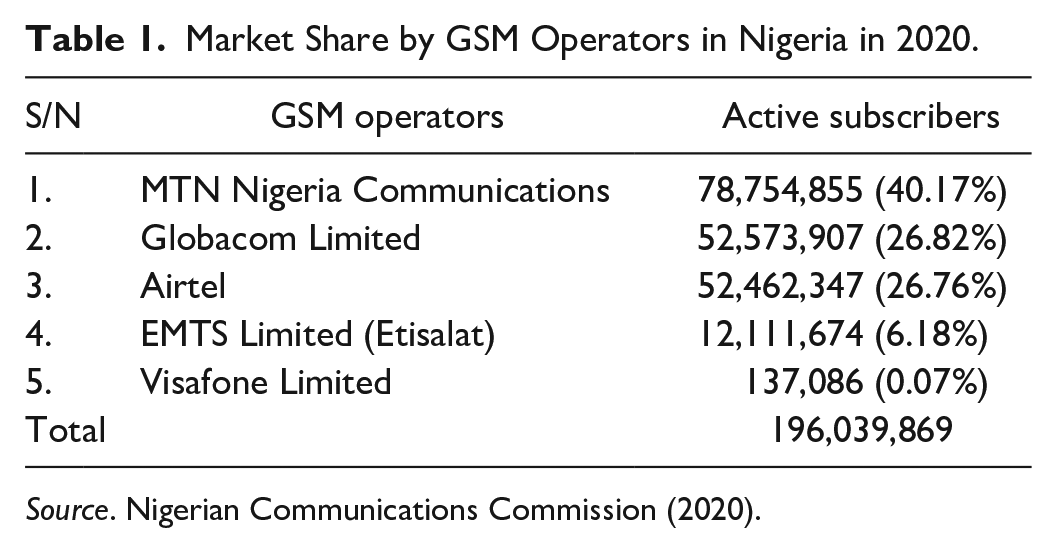
The deregulation of the Nigerian telecommunication industry led to the emergence of many private telecoms firms in 2001 (Nigerian Communications Commission, 2020), resulting in fierce competition for a larger market share. There are 196,039,869 mobile phone subscribers in Nigeria with varying market shares among the five firms in the market. Based on the Nigerian Communications Commission’s (2020) report, MTN Nigeria Communications’ market share stands at 78,754,855 (40.17%); Globacom Limited, 52,573,907 (26.82%); Airtel, 52,462,347 (26.76%); EMTS Limited, 12,111,674 (6.18%); Visafone Limited, 137,086 (0.07%).
The mobile phone service companies make their CSR actions very visible to the Nigerian populace following the requirements by the Securities and Exchange Commission’s Corporate Governance Code (2003 as revised in 2011) which mandated companies to disclose their economic, ethical, social, and environmental sustainability performance (Osemeke et al., 2016). The outcomes of this current study will empirically provide insights on customers’ perceptions of the telecommunications’ CSR activities which may partly explain the existing disparity in the market share among the five mobile phone service providers in Nigeria.
Theoretical Framework and Hypotheses Development
The current study is anchored on Carroll’s (1979) model. The framework remains the most accepted and the most applied model in management research (Maignan & Ferrell, 2001). The theory proposes that organizations have the obligation to discharge economic, legal, ethical, and philanthropic responsibilities to society. The economic perspective which is the most crucial of it all is concerned with productivity, profitability, and growth. The Legal dimension entails firms’ responsibility to be law-abiding in their operations. The ethical angle requires firms to go beyond mere legal requirements and have ethical codes and norms that particularly emphasizes honesty to their employees and customers. The philanthropic dimension which is discretional in nature entails voluntary initiatives that are tailored toward advancing the well-being and development of society as a whole.
Carroll (2016) went further to classify the four CSR dimensions into two namely “required” and “expected/desired” by society. According to the classification, first, firms are “required” to fulfill their economic responsibilities to society by producing what society wants in order to earn profit and remain in business. Second, firms are “required” to fulfill their legal responsibilities to society or get punished. Similarly, ethical responsibility is “expected” by society from businesses in order to be seen as honest organizations. The philanthropic dimension of CSR is classified as “expected/desired” of businesses by society as it is discretional in nature.
This theory enables the current study to explain how each of the CSR dimensions is perceived among Nigerian mobile service users and the influence of such perception on the rating of the telecoms firms’ product, consumer loyalty, and the firms’ strategic legitimacy.
Economic Responsibility Dimension and Product Rating, Consumer Loyalty Firms’ Legitimacy
Society believes that for firms to earn profit and remain in business, it is required of them to fulfill economic responsibilities to society by producing what society wants (Carroll, 2016). In the competitive business world, firms must continue to invest, reinvest, innovate to meet the needs of consumers in order to remain profitable and sustain their operations (Kim et al., 2020). This suggests that the economic responsibilities of firms are mandatory requirements that firms must fulfill to society for profitability and sustainability purposes.
However, studies have argued that despite the economic responsibilities of firms being a mandatory requirement for firms’ survival, it is still a huge concern for consumers if firms are perceived to be neglecting it. For instance, research has discovered in the US that it is dangerous for firms to focus on social responsibilities without recording superior achievements in economic responsibilities (Maignan & Ferrell, 2004). The study cited the case of Ben and Jerry’s Inc., an ice cream manufacturer that faced repeated criticisms from the customers for neglecting economic responsibility performance in pursuit of robust philanthropic activities.
Regarding the link between firms’ economic responsibilities and performance, it is argued that firms should integrate economic operations with other dimensions of CSR for value creation, profit maximization, and sustainability (Bosch-Badia et al., 2013; Parmar et al., 2010). Black (2001) reported the Australian experience of CSR where economic responsibility is given utmost priority ahead of legal, philanthropic, and ethical responsibility. Yang et al. (2019) found a positive link between firms’ economic responsibilities and firms’ performance among others. Al-Shammari et al. (2021) empirically demonstrated that firms’ economic responsibilities lead to better performance.
Based on the foregoing, we assume that consumer perception of telecoms firms’ economic responsibilities will result in positive outcomes. Therefore, it is proposed that:
H1a: Customers’ perception of a firm’s economic responsibility actions has a direct significant influence on the rating of the firm’s product.
H1b: Customers’ perception of a firm’s economic responsibility actions has a direct significant influence on consumer loyalty.
H1c: Customers’ perception of a firm’s economic responsibility actions has a direct significant influence on the firm’s strategic legitimacy.
Social Responsibility Dimension and Product Rating, Consumer Loyalty Firms’ Legitimacy
The social responsibility dimension entails the discretionary environmental and philanthropic activities of firms that enhance the development of society (Carroll, 2016). Although firms’ social responsibilities are discretionary, they are expected by society to fulfill them (Carroll, 2016; Cowper-Smith & de Grosbois, 2011; Kim et al., 2020). Since it is expected by society, firms often use it as a competitive strategy (Chung et al., 2015; Lho et al., 2019; Stanisavljević, 2017). For example, Stanisavljević (2017) found that philanthropic responsibility has the strongest influence on consumers ahead of other CSR dimensions. In China, Chung et al. (2015) demonstrated that after “Consumer Protection,” Philanthropic responsibilities rank highest among CSR dimensions in influencing Chinese consumers’ satisfaction and loyalty to a brand. In Malaysia, Rahim et al. (2011) found that Malaysian consumers prioritized philanthropy over legal and ethical responsibilities contrary to Carroll’s CSR pyramid that prioritizes philanthropy last. Similarly, adopting Carroll’s CSR theory as a framework for their study, Kim et al. (2020) found in South Korea that airlines’ customers increased their loyalty to the firm when they perceived the firm to be discharging environmental and philanthropic social responsibilities than when they perceived the firm to be discharging economic and legal responsibilities. Han et al. (2019) discovered that environmental responsibilities play a significant positive role in customer loyalty among airlines’ customers.
It is argued that firms that pursue the social dimension of CSR enjoy goodwill from society and sustainable long-term demand for their products (Cho et al., 2019; Kim, 2019). Al-Shammari et al (2021) also found that firms that discharge social responsibilities experience better performance than companies that fail in such responsibilities. This is as a result of the ability of social responsibility to improve firms’ image, reputation, product rating, and customer choice of products (Kludacz-Alessandri & Cygańska, 2021; Saeidi et al., 2015).
Based on the arguments in the literature, we hypothesize as follows:
H2a: Customers’ perception of a firm’s social responsibility actions has a direct significant influence on the rating of the firm’s product rating.
H2b: Customers’ perception of a firm’s social responsibility actions has a direct significant influence on consumer loyalty.
H2c: Customers’ perception of a firm’s social responsibility actions has a direct significant influence on the firm’s strategic legitimacy.
Legal-Ethical Responsibility Dimension and Product Rating, Consumer Loyalty Firms’ Legitimacy
Every society has rules and regulations that guide every aspect of business activities which firms must obey or get punished (Wagner-Tsukamoto, 2019). Similarly, society believes that laws are not always efficient in regulating business operations. Therefore, businesses are expected to discharge ethical responsibilities that conform to the norms even if such responsibilities are not expressly written in the law (Chang & Lu, 2019).
Despite the fact that legal and ethical responsibilities are “required” of firms by society, such actions are very instrumental in influencing customer perception of firms. Research has shown that firms that are perceived to be ethically responsible will automatically have such positive perceptions transferred to product rating among the customers (Sureschchandar et al., 2002). In Australia, legal responsibility was prioritized second ahead of the other CSR dimensions (Black, 2001). Studies have demonstrated that business legitimacy is vital to the survival of the firm in the sense that stakeholders customers are only motivated to deal with legitimate organizations (Deephouse et al., 2017). Amatulli et al. (2018) found among others, that customers are more willing to pay higher when they perceive that a firm is performing legal and philanthropic responsibilities. Lee et al. (2019) discovered that CSR actions of legal, economic, philanthropic, and environmental responsibilities all have significant positive effects on airlines’ corporate image, resulting in increased customer loyalty. We, therefore, propose that:
H3a: Customers’ perception of a firm’s legal-ethical responsibility actions has a direct significant influence on the rating of firms’ products.
H3b: Customers’ perception of a firm’s legal-ethical responsibility actions has a direct significant influence on consumer loyalty.
H3c: Customers’ perception of a firm’s legal-ethical responsibility actions has a direct significant influence on the firm’s strategic legitimacy.
Methods
To test the hypotheses and achieve our set objectives, the survey design was utilized in collecting quantitative data from the mobile phone subscribers in the Nigerian market through their social media accounts. We chose the service market because studies have established that a stronger and direct relationship exists between the consumers and the service market (intangible goods) than the tangible goods market (Gronroos, 1994; Moisescu, et al., 2020; Raza et al., 2020; Zeinthaml & Bitner, 2000). The mobile telecommunications service market in Nigeria has five companies namely MTN Nigeria Communications, Globacom Limited, Airtel, EMTS Limited, and Visafone Limited that fiercely compete against each other with the same product offer. The companies place their CSR activities in the public domain. Therefore, it is crucial to access how the companies’ CSR efforts are perceived by mobile phone service subscribers in Nigeria, and the resultant consequences of such perceptions on the firms’ strategic legitimacy, service rating, and consumer loyalty among the users.
Measures
Explanatory variables
To be properly guided in measuring the CSR actions of the five firms, we considered and adopted the 11–item CSR instrument designed by Ma del Mar et al. (2005). The data collection instrument measures the four dimensions of CSR based on Carroll’s (1979) framework. The scale had a Cronbach’s alpha of .78 and a composite reliability coefficient value of .85 which exceeds .7 threshold (Hair et al., 1999). The first dimension of the scale is the economic questions that refer to the consumers’ perceptions of the companies’ drive for performance and profits. This section was termed economic responsibility actions. The next dimension was the integrated legal-ethical perspectives with statements relating to the companies’ obedience to the law, fulfillment of obligations, honest business dealings, and the prioritization of ethical consideration over economic behavior. Finally, the third dimension is the social aspects (philanthropic responsibility) with statements bordering on environmental concerns, social events, and corporate donations for community well-being.
Criteria variables
To measure strategic legitimacy (a move by companies to derive operational resources from their cultural environment), we considered Suchman (1995) and Zimmerman and Zeitz (2002) normative legitimacy construct (firms’ obedience to social norms/values of the community, and the professional norms) because the focus of the current study is to determine the link between CSR and business legitimacy in society. We finally used these constructs above to adapt Jean-Philippe’s (2011) validated organizational legitimacy scale. The scale consists of four dimensions: The environmental legitimacy dimension measures the congruence of the firm’s operations with environment-related norms (e.g., by not hiding toxic waste, respecting environmental safety standards in erecting telephone masts). The competitive legitimacy dimension measures the congruence of a firm’s operations with the competitive norms (e.g., by avoiding bid-rigging). The accountability legitimacy dimension measures the congruence of a firm’s operations with accounting standards (e.g., avoiding the overstating of earnings) while transactional legitimacy dimension measures the congruence of a firm’s operations with ethical norms (e.g., prevention of abuse of a firm’s power for a personal undue advantage during official transactions such as bribery and sexual harassment).
We adopted Ma de Mar et al.’s (2005) validated service valuation scale that reported a Cronbach’s alpha of .83 and composite reliability of .76, and consumer loyalty scale with a reported Cronbach’s alpha of .86 and composite reliability of .62. These two scales were used to measure product rating and consumer loyalty respectively. Product rating was measured in three dimensions in relation to the technical and functional qualities of the service as well as the subscribers’ perceived price value of the service. Ma del Mar et al. (2005) developed the scale for evaluating service based on the works of Olsen and Johnson (2003) and Lee and Feick (2001). Regarding consumer loyalty, the scale measured it in three dimensions which include behavioral, attitudinal, and cognitive perspectives.
Population/Sampling Technique
The respondents were recruited from the active subscribers of the five mobile phone companies through the purposive non-probabilistic sampling technique. This technique made it possible to target a specific mobile phone service user of each of the companies and thereby prevent the concentration of our sample in one service provider (Table 1).
Market Share by GSM Operators in Nigeria in 2020.
Sample Size Determination
This study used G*power (3.1) to determine the sample size. Cohen (1988) suggested that the accepted minimum level of power is 0.80. The assumption of 0.80 minimum is based on the significance threshold of .05, the ratio of a Type 2 error (1-power) to a Type 1 error of .20/.05. However, in this study, 0.95 level of power was used as Faul et al. (2009) recommended. It is noteworthy that the input parameters used were a two-tailed t-test, a medium effect size of f2 = 0.15 with 0.95 power level. The sample size of 126 was randomly shared among the five telecommunication companies based on their market share. The questionnaire copies were distributed as follows: MTN Nigeria Communications, 48(38.1%); Globacom Limited, 34 (27.0%); Airtel, 32 (25.4%); EMTS Limited, 10(7.9%); and Visafone Limited 2 (1.6%).
Data Collection
A structured questionnaire was used to collect quantitative data from the users of the companies’ mobile phone services. The instrument was structured in a 7-point Likert scale that ranges from “strongly agree to strongly disagree.” Utilizing the social media platform to recruit the respondents, we first of all purposively identified blog, Twitter, and Facebook users and asked them to indicate their mobile phone service providers among the five service firms in Nigeria (MTN, GLO, Airtel, Etisalat, and Visafone). This was after explaining the aim of the research exercise to them, and our vow to keep them anonymous and treat the information with the utmost confidentiality. Thereafter, the respondents supplied us with their email addresses through which the questionnaire was mailed to them. Utilizing the social media platform to recruitment participants with the aim of eliciting their perceptions of an organization’s activities is superior to the conventional approach because individual opinions on Facebook, blogs, and tweets posts about an organization give a clue on the individual perception of such an organization’s actions in society (Etter et al., 2018). We eliminated the case of an unreturned questionnaire by continually recruiting new respondents to replace the ones who failed to return theirs. We particularly adopted this method of data collection because it made it possible to collect data from the sample across Nigeria.
Results
Confirmatory Factor Analysis
The constructs were subjected to composite reliability, average variance extracted (AVE) estimate, and Cronbach’s Alpha using SPSS and Smart PLS software. The authors administered 20 copies of the questionnaire to the customers of the five mobile phone service providers in a pilot study. The outcomes of the pilot study showed that the data were normally distributed, and all the values of the scale reliabilities were above the recommended benchmarks, as depicted in Tables 2 and 3.
Confirmatory Factor Analysis.

Demographic Variable of the Respondents.

The variance inflation factor (VIF), a collinearity statistic, was used to test for common method bias. It’s worth noting that if a VIF occurs more than 3.3 times, it indicates that the model is susceptible to common method bias. The model does not suffer from common method bias if all factor-level VIFs from a comprehensive collinearity test are equal to or less than 3.3. Therefore, all the VIF values of each of the items and constructs of measurement for corporate social responsibility variables, rating of firms’ products, consumer loyalty, and rating of firms’ legitimacy are less than 3.3. This implies that the model presented in Figure 1 is considered free of common method bias.

PLS bootstrapping model with β and p values of CSR (CPFERA, CPFSRA, and CPFLERA), firms’ products rating, consumers loyalty, and firms’ legitimacy rating model.
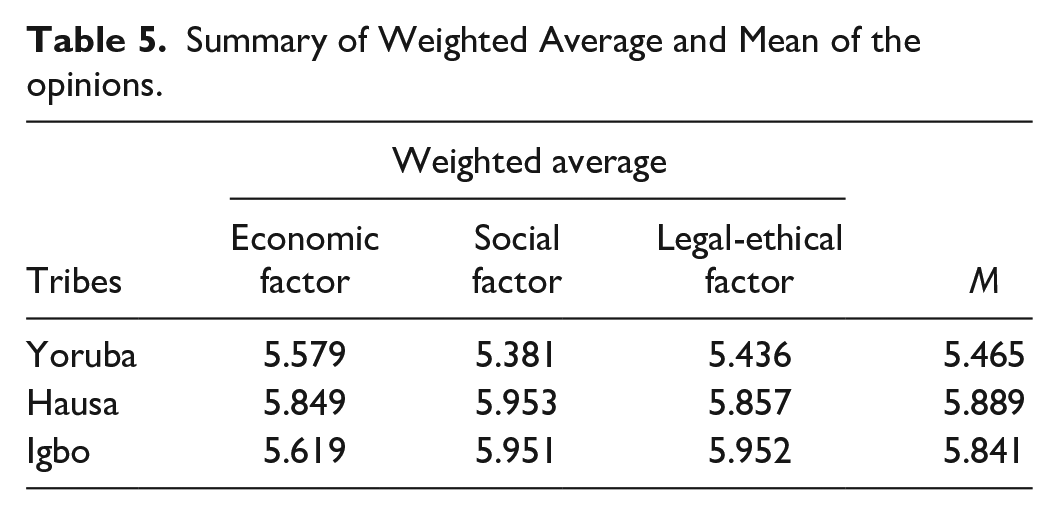
The opinions of the mobile phone subscribers from the three major ethnic groups in Nigeria on the dimensions of CSR activities among Nigerian telecoms firms are presented in Table 4 while the weighted average and mean results are presented in Table 5. The weighted average becomes essential to consider the relative importance or frequency of CSR factors in the data set as expressed by the three major tribes in Nigeria. This also helps to accurately portray the study’s sample in relation to the population. As the results have shown, there is no difference in the opinions of the three major tribes in Nigeria (Igbo, Yoruba, and Hausa) on the telecoms firms’ CSR actions.
The Opinions of the Three Major Ethnic Groups on the Dimensions of CSR Activities Among the Nigerian Telecoms Firms.

Summary of Weighted Average and Mean of the opinions.
Inferential Statistics
The PLS algorithm model depicted in Figure 1 displays the level of the interplay between the dimensions of corporate social responsibilities (economic, legal-ethical, and social factors), product rating (technical quality, functional quality, and perceived price), customer loyalty (behavior, commitment, and price tolerance), and strategic legitimacy (accountability, environmental, transactional, and competitive legitimacy). The structural path illustrates the level and the extent of the relationships between the variables under investigation. It is noteworthy to mention that bootstrapping was increased from 500 to 5000 to enhance the outcome of the model as suggested by Garson (2016 as cited by Falola et al., 2020). The path coefficients and the p-values of the observed variables are depicted in Figure 1 (Table 6).
Test of Hypotheses.
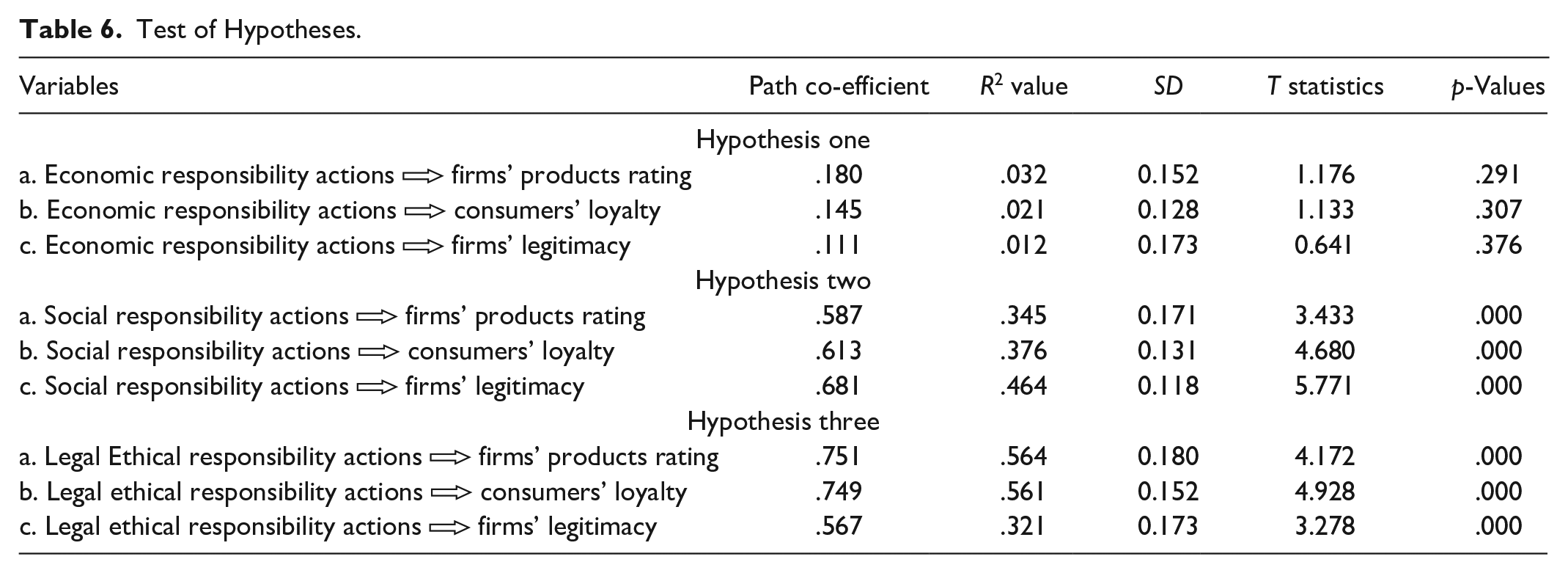
Results from hypotheses 1a, 1b, and 1c show that consumer perception of telecoms firms’ economic responsibility actions has no direct significant positive influence on the rating of the firms’ products, consumer loyalty and the firms’ strategic legitimacy at path coefficients values of .180, .145, and .111 with the R2 values of .032, .021, and .012, respectively. This implies that it is only a 3.2% rating of the telecoms firms’ products by the consumers can be explained by consumer perception of the firms’ economic responsibility actions with the p-value of .291 > .05). Also, only 2.1% of consumer loyalty can be explained by consumer perception of the telecoms firms’ economic responsibility actions with the p-value of .307 > .05). Similarly, only 1.2% of the firms’ strategic legitimacy can be explained by consumer perception of the firms’ economic responsibility actions with the p-value of .376 > .05). Overall, the results imply that consumer perception of telecoms firms’ economic responsibility actions has no direct significant influence on the rating of the firms’ products, consumer loyalty, and the firms’ strategic legitimacy.
Conversely, the outcomes from hypothesis 2a reveal that consumers’ perception of telecoms firms’ social responsibility actions has direct significant influence on the rating of the firms’ products by the consumers (β = .587, R2 = .345, T-statistic = 3.433 > 1.96, p = .000 < .05). The same outcomes were also obtained in hypotheses 2b as consumers’ perception of the firms’ social responsibility actions significantly influences consumers’ loyalty (β = .613, R2 = .376, T-statistic = 4.680 > 1.96, p = .000 < .05). Further, hypothesis 2c results indicate that consumer perception of telecoms firms’ social responsibility actions has direct significant influence on the firms’ strategic legitimacy (β = .681, R2 = .464, T-statistic = 5.771 > 1.96, p = .000 < .05). In sum, the findings indicate that consumer perception of telecoms firms’ social responsibility actions has a direct significant influence on the rating of the firms’ products, consumer loyalty, and the firms’ strategic legitimacy.
Similarly, hypothesis 3a results reveal that consumer perception of telecoms firms’ legal-ethical responsibility actions has significant influence on the rating of the firms’ products by the consumers (β = .751, R2 = .564, T-statistic = 4.172 > 1.96, p = .000 < .05). In hypothesis 3b, it was found that consumers’ perception of telecoms firms’ legal-ethical responsibility actions has significant influence on consumers loyalty (β = .749, R2 = .561, T-statistic = 4.928 > 1.96, p = .000 < .05). Lastly, hypothesis 3c outcomes indicate that consumers’ perception of telecoms firms’ legal-ethical responsibility actions has significant influence on the firms’ strategic legitimacy (β = .567, R2 = .321, T-statistic = 3.278 > 1.96, p = .000 < .05). In sum, the findings show that consumer perception of telecoms firms’ legal-ethical responsibility actions has a direct significant influence on the rating of the firms’ products, consumer loyalty, and the firms’ strategic legitimacy.
Discussion of the Findings
The outcomes from H1a, H1b, and H1c suggest that consumers’ perception of the telecoms’ firms’ economic responsibilities has no positive significant influence on the rating of the firms’ product, consumer loyalty, and the firms’ strategic legitimacy. The results align with previous studies that found that customers prioritized firms’ philanthropic responsibility actions over economic responsibility actions in many countries such as Malaysia, China, and South Korea (Chung et al., 2015; Kim et al., 2020; Rahim et al., 2011).
In the Nigerian context, many reasons may account for the outcomes among mobile phone customers. First, the insignificant influence of the firms’ economic responsibility actions on Nigerian customers in relation to product rating, customer loyalty, and firms’ strategic legitimacy may be explained by low income and educational level as Nigeria is predominantly populated with people of low income and education. A customer with low income has the tendency to attach more importance to firms’ philanthropic actions than being offered high product quality (economic responsibility). Second, the low level of education of Nigerians may also account for these results. Customers with low educational levels may not understand the full benefits of firms’ high-quality products. As such may not be influenced by firms’ economic responsibility actions toward the society such as innovative and high-quality products. For instance, it was found among airlines customers in South Korea that customers that possessed high levels of education and income displayed greater customer loyalty when they perceive that their airlines are discharging economic and legal responsibilities while customers who possessed only higher education but with low income only increase their loyalty to their airlines when they perceive that the firms are discharging philanthropic and environmental responsibilities (Kim et al., 2020).
Third, the failure of the telecoms firms’ economic responsibility actions to influence their consumers may be explained by Carroll’s (2016) theory that proposes that firms are “required” by business survival motives to fulfill economic responsibilities to society if they must remain in business. Relating our findings to this theory, it seems Nigerian customers may feel that the mobile phone companies are not doing them any favor by providing quality services but rather providing such quality services for profit-making and business sustainability. In the competitive business world, firms must continue to innovate to meet the needs of consumers in order to remain profitable and sustain their operations (Kim et al., 2020).
The outcomes from H2a, H2b, and H2c indicate that customers’ perception of the telecoms firms’ social responsibility actions significantly influences the rating of the firms’ product, customers loyalty, and the firms’ strategic legitimacy. These outcomes conform to earlier studies that found that firms’ social responsibility actions such as philanthropic and environmental responsibilities are used by firms as competitive strategies (; Chung et al., 2015; Lho et al., 2019; Stanisavljević, 2017). In China, for instance, Chung et al. (2015) demonstrated that after “Consumer Protection,” philanthropic responsibilities rank highest in influencing Chinese consumers’ satisfaction and loyalty to a brand. The outcomes also corroborate earlier research that documented that firms that pursue the social dimension of CSR enjoy goodwill from the society and sustainable long-term demand for their products (Cho et al., 2019; Kim, 2019). The low-income level of African consumers may also play a role in the positive influence of social responsibility actions on the customers in relation to product rating, customer loyalty, and strategic legitimacy of the firms. Customers with a low-income level are more likely to be influenced by charitable deeds toward a firm that focuses on philanthropic responsibility actions in neglect of economic responsibility actions than customers with high-income level.
The outcomes from H3a, H3b, and H3c show that customers’ perception of the mobile phone service providers’ legal-ethical responsibility actions has a direct significant influence on the firms’ service rating, customer loyalty, and the firms’ strategic legitimacy. These outcomes are in line with previous studies that found customers’ perception of firms’ ethical responsibility actions to positively influence the customers’ positive attitudes toward the firms (Moisescu et al., 2020; Raza et al., 2020). Our outcomes suggest that the mobile phone market share disparity in Nigeria could be explained by the users’ perception of the firms’ CSR legal-ethical responsibility actions. Firms’ demonstration of strict adherence to legal and ethical conduct is capable of creating trust among the consumers which can exert a positive influence on the consumers’ rating the firms’ services positively, induce customer loyalty, and boost the firms’ legitimacy. This argument aligns with the work of Carson et al. (2015) that reported that organizations evolve from implicit CSR activities to explicit CSR activities when such organizations want to gain strategic legitimacy. This may explain why the telecoms firms in Nigeria have not faced serious criticisms and condemnations from the Nigerian public in spite of their nationwide operational installations and large market size, unlike the oil mining firms.
The telecoms service customers may be moved to be rewarding the firms through positive service rating, customer loyalty, and legitimacy following the willingness of the telecoms firms of obeying legal and ethical rules in their operations without being forced to do so through agitations and court litigations unlike what is obtainable in the oil mining sector.
Theoretical Implications
The current study makes significant theoretical contributions to strategic CSR literature. First, in spite of the high volume of strategic CSR research, the studies that provide insight on the link between CSR actions and customer outcomes in country-specific and sectorial-specific contexts in developing economies are very limited (Agyei et al., 2021; Javeed & Lefen, 2019). There are suggestions in the literature for country/regional-specific CSR studies due to the demographic variables that influence customers’ perceptions of firms’ CSR dimensions (Ali & Frynas, 2018; Javeed & Lefen, 2019). Therefore, by examining the link between CSR and product rating, customer loyalty, and firms’ strategic legitimacy in the Nigerian context, this study has responded to the suggestions by researchers for studies on the link between CSR and customer outcomes in developing economies (Javeed & Lefen, 2019) particularly in the African context (Agyei et al., 2021).
Second, this study provides insights on the contributions of each of Carroll’s (1979, 1991) CSR dimensions to product rating, customer loyalty, and firms’ legitimacy in the Nigerian context. It is documented in CSR literature that is unclear how each of the CSR dimensions impacts firms outcomes due to the failure of most of the studies to separately examine the effect of each CSR dimension on customer outcomes (Cui et al., 2015; Sardana et al., 2020) particular in developing economics (Hu et al., 2021).
Third, this study enriches CSR literature by shifting CSR research focus from the oil mining sector which basically uses CSR as a damage control strategy in Nigeria (Adegbite & Nakajima, 2011; Amaeshi & Amao, 2009) to the service sector particularly to the telecoms firms that mainly apply CSR as a competitive strategy. Telecom firms in Nigeria have visible diverse CSR actions (Osemeke et al., 2016) and are also in fierce competition for a larger market share. Lastly, the outcomes confirm Carroll’s (2016) CSR theory that posits that although firms’ philanthropic responsibility dimension of CRS is discretionary to the firm, society expects firms to fulfill them. This expectation may partly account for the reason why the telecoms firms enjoy positive outcomes from their social, legal, and ethical actions among the subscribers.
Managerial Implication
The outcomes of this study have important implications for managers. First, the outcomes indicate that among all the CSR dimensions, it is only the economic responsibility dimension that does not significantly influence customers’ favorable rating of the telecoms firms’ product, customer loyalty, and legitimacy. This implies that managers must focus their CSR attention on legal, ethical, and social responsibility dimensions to achieve significant outcomes for the firm. Firms design CSR activities to suit the demographic peculiarities of the customers they serve (Porter & Kramer, 2011; Raza et al., 2020).
Second, the outcomes suggest the need for managers to critically assess and understand the socioeconomic demographics of the community they operate before adopting the economic responsibility dimension of CSR as a competitive strategy as customers with high educational and income levels are more likely to be influenced by such strategy than customers with low educational and income (Kim et al., 2020). This may account for the reason why the consumers were not influenced by the economic responsibility of the telecoms firms. Again, this indicates that managers may require more training on how best to apply strategic CSR actions to positively influence firms’ outcomes. This will enable managers to understand the class of customers they serve so as to know the appropriate dimension of CSR to deploy.
Lastly, managers should understand that the realization of firms’ strategic CSR benefits is a function of consumers’ perception of CSR actions. To achieve this, firms must adequately disclose and communicate their CSR actions to the consumers. For example, CSR activities such as healthy living tips and environmental protection enlightenment information can be communicated through text messages directly to the active subscribers’ phones.
Limitations and Suggestions for Future Research
This current study only investigated intangible products in the telecommunication sector. To generalize the outcomes of this study to all the sectors of the Nigerian economy, we suggest that studies should be conducted in other service organizations such as transportation, hospitality, banking, and tangible product producing organizations such as manufacturing firms.
We did not take into account the customers’ social and economic status such as income and educational levels in determining the influence of the perceptions of CSR dimensions on product rating, consumer loyalty, and firms’ strategic legitimacy among the consumers. It is therefore suggested that future research should investigate the roles of socioeconomic demographic factors in the relationship between consumer perception of CSR dimensions and product rating, consumer loyalty, and firms’ legitimacy among consumers in Nigeria. Such studies will provide deeper insights into the underlying mechanisms behind consumer perceptions of firms’ CSR dimensions in low-income African countries.
Another limitation of this study is the exclusion of internal stakeholders such as the employees from the sample. We encourage future research to evaluate the influence of firms’ CSR actions (e.g., employee welfare schemes, educational, and health incentives) on firms’ performance in Nigeria.
Research Data
sj-docx-1-sgo-10.1177_21582440221089966 – for The Evolving Strategic CSR Practices in Africa: Exploring the Multidimensional Implications for Telecommunication Firms’ Outcomes in Nigeria
sj-docx-1-sgo-10.1177_21582440221089966 for The Evolving Strategic CSR Practices in Africa: Exploring the Multidimensional Implications for Telecommunication Firms’ Outcomes in Nigeria by Imhanrenialena Benedict Ogbemudia, Ebhotemhen Wilson, Apreala Solomon Ebiladei, Chukwu Benjamin Ibe, Moguluwa Shedrach Chinwuba and Ilo Sylvester Okechukwu in SAGE Open
Research Data
sj-sav-2-sgo-10.1177_21582440221089966 – for The Evolving Strategic CSR Practices in Africa: Exploring the Multidimensional Implications for Telecommunication Firms’ Outcomes in Nigeria
sj-sav-2-sgo-10.1177_21582440221089966 for The Evolving Strategic CSR Practices in Africa: Exploring the Multidimensional Implications for Telecommunication Firms’ Outcomes in Nigeria by Imhanrenialena Benedict Ogbemudia, Ebhotemhen Wilson, Apreala Solomon Ebiladei, Chukwu Benjamin Ibe, Moguluwa Shedrach Chinwuba and Ilo Sylvester Okechukwu in SAGE Open
Footnotes
Declaration of Conflicting Interests
The author(s) declared no potential conflicts of interest with respect to the research, authorship, and/or publication of this article.
Funding
The author(s) received no financial support for the research, authorship, and/or publication of this article.

References
Supplementary Material
Please find the following supplemental material available below.
For Open Access articles published under a Creative Commons License, all supplemental material carries the same license as the article it is associated with.
For non-Open Access articles published, all supplemental material carries a non-exclusive license, and permission requests for re-use of supplemental material or any part of supplemental material shall be sent directly to the copyright owner as specified in the copyright notice associated with the article.
