



Abstract
This study examines the role of Corporate Social Responsibility (CSR) in enhancing customer loyalty by exploring direct and mediating effects of trust, credibility, and word of mouth. Cross-sectional data of 463 respondents was taken from Pakistan using an online survey because of the limitations of covid19. Hypotheses were tested using SmartPLS-3. Findings of the study revealed that CSR has affected customer loyalty significantly and positively. The mediating role of trust was found insignificant. Credibility and word of mouth were found as significant mediating variables in the linkage between CSR and Customer Loyalty. This study has provided a direction for the hoteling industry to incorporate CSR activities in their operation for gaining customer loyalty using empirical analysis. In this regard, this paper makes a significant contribution to the existing literature regarding the connections between CSR and customer loyalty with the help of trust, credibility, and word of mouth as mediators, which are not tested empirically in the existing literature.
Introduction
Organizations are now moving toward adopting ethical values in business practices. Service organizations are primarily focusing toward a positive shift by adding up ethical and socially acceptable practices in their operations, thus enabling them to follow Corporate Social Responsibility (CSR) practices (Martínez & Rodríguez del Bosque, 2013). All such norms and ethical values being adopted by the organizations must be shared with stakeholders (Fatma & Rahman, 2017). This shift toward CSR enabled operations has paved ways to increased research about doing social good and following CSR (Fatma et al., 2020; Wang, Xu et al., 2020).
Hoteling industry has been Flourishing for the last few decades. Fulfilling the needs of hotel visitors has increased problems like air pollution, noise pollution, loss of biodiversity, generation of waste, and fundamental labor standards are also being avoided (Chan, 2011; Wong et al., 2019). There is 1% contribution of the hotel industry in global emission which is expected to increase if this demand continues to increase. Sustainability issues faced by industry have also been clearly and practically responded by International Tourism Partnership (ITP). ITP has also emphasized on the understanding of Sustainable Development Goals by the industry to retain growth. According to the report published by United Nations Climate Change (2018). It needs to reduce greenhouse gasses emissions, organize employability programs for youngsters, awareness for human rights, risks during hotel construction and in labor supply chain. To address these issues, managers of hotels are required to accomplish corporate goals by presenting CSR (Kim & Kim, 2016a). They should consider the negative impact of their activities on nature, culture, and society (Chan, 2011). CSR basically, refers to the obligations a company has toward all of its stakeholders (Reder, 1994) that is to care for both aspects, that is, firm’s internal activities and its influence in the surroundings.
It has also become necessary for the hotel industry to conduct CSR activities to gain positive feedback from customers (Kim & Ham, 2016). In the trend of increasing competition in the corporate world, CSR plays a significant role in making firms achieve their goals. Customer loyalty is an illustration of a firm’s performance (Garcia de Los Salmones et al., 2009). For examining the relationships between CSR and customer loyalty, several research endeavors have been conducted but for hotel industry the relationship is not empirically clear, which requires more examinations (Kim & Kim, 2016). In this line of research specifically, there exists a research gap, that companies can achieve the goal of customer loyalty with certain complexities, and it is not an easy job to have loyalty. The model proposed for its linkage to CSR clears up with the addition of explanatory variables, that enhance the impact of CSR indirectly on customer loyalty. For example, initially, literature suggested that CSR practices by the hotel industry depend upon the credibility of firm (Iqbal et al., 2013), word of mouth (Jalilvand et al., 2017b), positive feedback from customers which is possible by having trust in the quality of services (Mombeuil & Fotiadis, 2017). Other studies have shown that these outcomes have a positive and direct influence on customer loyalty (Lai, 2019). But their roles as a mediator on perception of customers about CSR and customer’s loyalty seems to be not inspected in a unified way, resulting in the unclear mechanism to understand relationships between the CSR and customer’s loyalty (Aramburu & Pescador, 2019; Latif et al., 2020; Rather et al., 2019a). Existing research shows that these outcomes cannot be anticipated directly from the impact of CSR, and it has other factors through which loyalty can be developed in customers.
Furthermore, Chen et al. (2012) evaluated the overall impression of CSR on loyalty, and arbitrating results of identification, trust, and satisfaction about hotels have also been examined by Martínez and Rodríguez del Bosque (2013). The role of trust was also identified by Yeon et al. (2019) and the credibility of the company has also been discovered by Gunawan et al. (2020) and Kadhim et al. (2020) and the role of word of mouth was assessed by Issock et al. (2019) and Oh and Ki (2019) respectively. But a single comprehensive model for hotel industry did not explain the role of trust, credibility, and word of mouth.
Different hotels perform different types of CSR activities and because of this reason, feedback of customers for CSR perception will not be consistent and it varies depending upon other factors (Fatma & Rahman, 2017). Secondly, customer reactions also change on the diversity of CSR expectations of stakeholders as they will be having influenced by different other factors (Su et al., 2017). Stakeholder’s decision making processes are often found affected by differences in preferences and values, in spite of the fact that trend of CSR is having increasing trend. In tourism and hospitality industry various antecedents have been investigated to identify the loyalty intents of the customers. Various research endeavors like (Hollebeek & Rather, 2019; Rather, 2020; Rather & Camilleri, 2019) have explored loyalty in luxury hotels, airlines, and in some other tourism related services along with service innovativeness. The role of tourism destination was also assessed along with trust, usage intention, satisfaction, brand experience, customer loyalty and electronic word of mouth and co creation (Hollebeek et al., 2014; Rather, 2018b, Rather, 2020; Rather, Hollebeek et al., 2019). Few research endeavors have also explored customer loyalty in online brand communities, social media-oriented tourism services, bookings of hotels and resorts using online mediums (Ahn & Back, 2018; Islam et al., 2018). Business, primarily hoteling industry in the recent past has shown a tremendous trend of connecting their business activities associated with social causes and social activities, thus, to gain a competitive edge over other competitors in the market (Latif et al., 2020; Martínez et al., 2014). Some of the hotels in Pakistan are adopting the trendy phenomenon of having environmentally friendly practices in their operations and they are indulging themselves in multiple philanthropic activities and many other CSR related activities. It was also assessed by some scholars, who have recently investigated the impacts of CSR in the development of customer loyalty, customer satisfaction, and in internal marketing programs, etc. in Pakistan (Irshad et al., 2017; Latif & Sajjad, 2018; Latif et al., 2020; Lin et al., 2021).
Furthermore, CSR has emerged as the area of concern these days, universities are also teaching this as a subject. So, students are expected to be aware of this concept and that is why they are conscious of this phenomenon. Existing research has also utilized students as a sample in the hospitality industry (He et al., 2019; Horng et al., 2019; Martínez & Nishiyama, 2019). In existing research on the hospitality industry, it has been witnessed that the data was collected from both restaurant and hotels visitors and some scholars have gathered data from students who have visited hospitality industry (Font & Lynes, 2018; Gallarza et al., 2019; Hameed et al., 2019; Heo & Lee, 2016; Iyer & Jarvis, 2019; Martínez & Nishiyama, 2019).
A model proposed in this study fills up the gap theoretically and empirically in the linkage between CSR and customer loyalty. This model incorporates mediating variables including trust, credibility, and word of mouth, that mediated the relationship between CSR and the customer loyalty focusing primarily on the hoteling industry. The mediated relationship between customer loyalty and CSR was investigated across Pakistan. Research hypotheses, for this reason, were created depending on social identity theory presented by (Tajfel & Turner, 1986), signaling theory presented by (Spence, 1973), and the stakeholder theory by (Freeman, 1984).
By bridging up these identified gaps, this research endeavor will contribute more to the existing literature through the findings made in this study. Firstly, depending upon the comparative shortage of accessible integrating research, the present study reacts toward the various research calls to discover the intervening components that help in identifying, how the customer loyalty is affected by the perception of CSR in the hoteling industry. For this purpose, the intrinsic significance of the CSR seems to be barely tested, but there exists a need to justify firm’s investment in CSR and then to understand its possible positive results for companies still remain an untapped niche (Akbari et al., 2021; Jalilvand et al., 2017b; Liu et al., 2019). To the best of our information, past experimental research in the hoteling industry, have not considered identified mediating variables into the model to clarify the effect of CSR on the customer’s loyalty. Thus, on the basis of previous literature facts, clear understandings still not exist about the impact of CSR using various routes impacting customer loyalty (Latif et al., 2020; Rivera et al., 2016a).
The current study will identify those variables that will help in strengthening customer loyalty by practicing CSR. Moreover, the present study considers coordinating three theoretical propositions which involve stakeholder, signaling, and social identity theories. So, for this purpose, the social identity perspective based past studies are also extended to understand the link of CSR and customer loyalty. To illustrate the customer perception of CSR in developing customer loyalty, sample was collected from Pakistan. The study will help professionals and researchers to center their CSR endeavors and investments decisions a bit better. As the existing literature has not investigated the impacts of CSR on customer loyalty with the help of trust, credibility, and word of mouth as mediators, so this study is especially vital in this regard. Findings of the study will help research scholars to enhance literature on CSR and its outcomes. The results of this research endeavor will provide insight for the hotel managers regarding the fruitfulness of the socially responsible operations and resultantly leading to better customer loyalty and enhancing positive feedback from the customers and building credibility of the hotel services. It will also lead toward the hazard less environment in the country and ultimately it will lead to enhance the favorable attitude of the customer by developing strong loyalty for opting the services of socially responsible hotel (Shams et al., 2020).
Literature Review and Development of Hypotheses
Corporate Social Responsibility (CSR)
Bowen (1953) characterized CSR by saying that “the commitment of a firm to seek after such arrangements, to create those choices, or to take after such lines of activity that are captivating in term of the destination and value of the society.” This concept has basically advanced from charitable approach necessary for a firm in order to achieve a competitive advantage over others more effectively (Ahn et al., 2020; Latif & Sajjad, 2018). So, these days CSR is considered as a procedure to gain firm’s objectives (Kim & Kim, 2016a; Rivera et al., 2019). Also considering and minimizing its negative impacts of firm’s operations on common and social situations (Al-Ghamdi & Badawi, 2019). According to many researchers, CSR conjoins natural and societal commitments of company to all of its stakeholders (Aljarah & Ibrahim, 2020; Chang & Lee, 2020), counting inside and outside operations with coordinated impact on all or few of them with respect to the societal good.
The stakeholder theory has governed the research on CSR (Latif & Sajjad, 2018). Stakeholder can be defined as any individual or group or any type of entity to which the organization cooperates or interacts while seeking after its objectives and goals (Wherther & Chandler, 2010). Clarkson (1995) proposed that management of the businesses and firms mainly reacted to the needs of stakeholders. So, focusing on stakeholders’ longings and perceptions is a fundamental and essential element for businesses to grow since they can impact the operations of the businesses directly. Based on these facts, organizations tend to involve CSR exercises to meet stakeholder’s tendencies and grasp such kind of CSR related activities and initiatives that fits the organization’s core policies as well (Boesso et al., 2015). Prior studies on this topic have suggested that CSR relates to these consenting results. These involve improved reviews for the organization’s reputation and brand image amongst the stakeholders of the organizations (Glaveli, 2021), increased customer loyalty (Ahn et al., 2020), enormous word of mouth (Valmohammadi, 2014).
Relating to the social identity context, the impact of satisfaction and identification of brands with respect to the loyalty in hotel sector is found to be unexplored area and needs further exploration (Huang et al., 2017; So et al., 2013; Yang et al., 2017). As in this contemporary world, with the help of information and communication technologies, the customer centered strategy for operations of hotel is on the rise. The competition has been raised because of the emergence of social economy, growing competition, social media, growing customer demands. Therefore, now understanding the customers’ social exchange process and social identification processes are progressively more important (Rather, 2018a; Rather & Hollebeek, 2019; Tuškej & Podnar, 2018). The social identity perspectives encourage to have insights about the customer’s self-esteem, self-enhancement, identity motives, and self-expressions in building strong relational ties with the service providers (Kuenzel & Halliday, 2008; Rather, 2018b). Therefore, the social identity perspectives are found to be useful for having insight about the customer’s behavior as usually, the customer tends to see themselves as an important element of social group or society (Bhattacharya & Sen, 2003; Rather et al., 2020). Visitors in hospitality industry are likely to opt for such services with strong brand identification and they also recommend these service providers to others as well. Some studies have also found that all those hotels with stronger brand identification enjoy stronger customer loyalty (Rather, 2018b; Rather & Hollebeek, 2019; Yang et al., 2017).
The study’s main focus surrounds the advantages of CSR linked with customers for gaining customer loyalty. Customer’s response now depends on ethical and social practices done by a business, quality, and price of product or services provided are now not the most competitive preferences in the business world, so CSR is now recognized as a mainstream quality inside a market (Al-Ghamdi & Badawi, 2019; Bernal-Conesa et al., 2017). Customers regard for CSR activities to point out how caring a company is and the firm’s engagement in CSR makes them satisfy about their choices and preferences (Ajina et al., 2020; McNamara et al., 2017; Raza et al., 2020a).
Corporate Social Responsibility (CSR) and Customer Loyalty
Customer loyalty is being characterized as the most salient feature of the customer’s behavioral intentions to preserve a long lasting and stable relationship with a firm (Ailawadi et al., 2014). Business growth is ultimately dependent on customer loyalty and causes improvement in competitive advantage by the stability of the customer base (Kotler & Armstrong, 2008). Within the hoteling industry, the management of the hotels needs to capture and maintain their visitors by identifying and focusing on those variables, which are considered to have an impact on the decision making of customers. For this purpose, hotels need to be upgraded the foremost important patterns in the operations of their businesses to viably meet the needs and demands of progressively advanced visitors (Cheng & Rashid, 2015; Jalilvand et al., 2017a). In the hospitality context, hotels and other service providers can obtain loyalty using different corporate social responsibility activities like social campaigns, philanthropic works, and other charity works (Shams et al., 2021; Rather et al., 2021). Even after any service failure, perception of CSR related activities may alleviate the development of favorable attitude toward the hotels offering the CSR related services and environmentally and socially responsible behavior and thus ultimately leads to the development of customer loyalty (Martínez & Rodríguez del Bosque, 2013; Rather et al., 2018; Rather, 2020; Shams et al., 2020). Customer perception regarding CSR activities, is the influential sector for marketing research, for the firms which are striving to maintain customer loyalty (Kim & Ham, 2016; Raza et al, 2020b). In this regard, CSR has been considered to be an essential aspect that shapes up the ongoing perceptions about the product or services and guides stakeholders’ behavior mainly of customer (Alam & Noor, 2020; Kim & Kim, 2016a). In lieu of this perspective, hoteling industry was among the primary stakeholders that have noticed CSR’s significance in this industry (Fatma & Rahman, 2017). Since then, the concept of CSR has been evolved to be a flourishing research area within hoteling industry. Analysts concluded that CSR activities have a key signified impact on customer loyalty (Aljarah et al., 2018; Farhan et al., 2020).
Surprisingly, there are positive connections between customers’ CSR perception and their loyalty within hoteling industry (Kim & Kim, 2016a; Mohammed & Al-Swidi, 2019; Mombeuil & Fotiadis, 2017; Su and Swanson, 2017). Their preferences and loyalty for hotel will build up when they would have a positive perception of the hotel’s CSR initiatives (Kim et al., 2017). In previous studies, attention toward the factors of social identity to customers’ loyalty has been found inadequate and they have not integrated the roles of trust and credibility, commitment, satisfaction, and some other aspects in their research models. They have also spotlighted the collection of samples from few other countries to have generalizability of result in the development of customer loyalty (Hollebeek & Rather, 2019; Martínez et al., 2014; Popp & Woratschek, 2017; Rather, 2018b; Rather et al., 2019b; So et al., 2013; Su et al., 2016). As the Social Identity Theory postulates that, the connection of customers’ recognition of CSR activities with the customers’ loyalty has been clarified (Tajfel & Turner, 1986). This hypothetical system indicates the positive connection of CSR and customer perception regarding a firm, which results in maximum customer loyalty, this happens as the customer accepts that firm is seeking after potential CSR activities. And at that point, these clients recognize the worth and builds up a stronger bond with this firm. Now forming this theory, a base, positive impact of customer loyalty and their perception of CSR has also been reported in the field of marketing (Latapí Agudelo et al., 2019; Lu et al., 2017). But few research endeavors failed to endorse an immediate connection among both variables. Subsequently, the disputed conclusion from their research reinforces the need to examine the relationship between CSR and loyalty in hoteling industry (García de Los Salmones et al., 2005).
Trust helps in maintaining the relationship between the consumer and the seller, it is a behavioral ingredient that shows reliance and confidence toward an entity (Sharma & Jain, 2019). Trust is the major ingredient in building up the relation whether it is between individual or between the customers and company (Upamannyu et al., 2015). When the organizations engage with socially responsible practices, it is most likely to meet the customers’ needs and expectations. CSR practices have a positive and stronger impact upon customer trust (Nikbin et al., 2016; Palacios-Florencio et al., 2018). Trust develops with the evolution of relationships; it is about the willingness for reliance on your ally. Customer trust develops a bond between the company and consumers based upon social identity theory. Trust is developed by firms’ CSR performance and corporate values (Pérez & del Bosque, 2017). The customer dimension of Corporate Social Responsibility (CSR) is strongly related to customer trust which assists in the indirect impacts of CSR on customers’ loyalty (Chang, 2014; Liu et al., 2019).
Corporate Social Responsibility (CSR) practices and policies have positive effects on organizational trust (Nguyen et al., 2020). The corporate relationships between an organization and the customers are based upon mutual trust, that trust is earned through the absence of opportunistic behavior by the business companies so that the brand and its customers are consequently considered as business partners (Glaveli, 2021; Iglesias et al., 2020). Various studies have investigated that commitment and trust should be treated as the main mediator in the connection between customers’ loyalty and corporate activities (Chaudhuri & Holbrook, 2001; Rather, 2018b). Trust was defined as the confidence level in partners’ reliability and integrity, and it has been considered due to some other factors like benevolence, competency, consistency, and honesty. Trust can also be categorized into two sub-dimensions like performance trust and benevolence trust. In hotel industry’s context, benevolence trust is considered as the customers’ reliance upon benevolence, care, concern, and honesty as revealed by the hotels. The performance trust endorses the infrastructures of hotels, knowledge of employees, skills, and abilities to offer promised services (Rather, 2018). The ethical and philanthropic CSR activities build a corporate reputation through the mediation of customer trust. It suggests that both aspects help foster customers’ belief and trust in the company (Yeon et al., 2019). CSR emerged as a fundamental strategy to excel in developing the level of trust, which results in the flourishing of the hotel sector in the long term. The analysis of the model also reveals CSR as an antecedent of trust and reputation (Park et al., 2017).
Credibility is about the confidence of customers in a specific brand, product, or service (Erdem et al., 2002). Setyawan et al. (2020) reported that the brand credibility and the firm image regarding CSR bring positive outcomes. However corporate ability lies in the services and products offered by the company, yet CSR initiatives affect firm credibility and reputation by introducing the company’s values (Chouthoy & Kazi, 2016; Iqbal et al., 2013). The studies confirm that the hotels, which focus on CSR activities, can send positive signals to the customers which help in establishing a firm’s reputation (Ghaderi et al., 2019; González-Rodríguez et al., 2019). Literature shows that the companies that are engaged in CSR practices have their credibility and reputation (Davvetas & Diamantopoulos, 2017; Farmaki, 2019; Theodoulidis et al., 2017).
Many studies show that reputation and credibility have the main part in attracting and retaining customers (Luu, 2017; Su et al., 2017). There are studies from hospitality industries that show the association of CSR practices with customer loyalty via firm reputation and credibility (Farmaki, 2019; González-Rodríguez et al., 2019; Rhou & Singal, 2020; Theodoulidis et al., 2017). Studies also found a positive relationship between customer loyalty and corporate credibility (Ghaderi et al., 2019; Iglesias et al., 2019b). The feelings of intimacy about a particular organization are a bridge toward credibility (Kim & Park, 2020). The assessment of credibility is done through emotions or rationales related to an entity. Hence the cognitive aspect is about the positive assessment while the effective aspect is related to the negative assessment. So, companies should find a way to deal with negative emotions such as skepticism, to drive more positive feelings (Setyawan et al., 2020). The brand signals are based on credibility, upon which the decision-making process, choice behaviors, and process of purchase get influence and thus it is considered as an important aspect in building customer loyalty intent (Rather, 2018b, Rather, 2020; Shams et al., 2020). The CSR authenticity is a strategic tool to curb all those negative feelings associated with the company with its altruistic and ethical motivation (Gunawan et al., 2020; Kadhim et al., 2020). As a result, credibility establishes, and it works as a weapon against distrust and doubts. Hur et al. (2014) in their study found the direct and positive impact of CSR on corporate credibility.
Based on signaling theory (Spence, 1973) it has been observed that CSR and other ethical and social good activities also effects directly on the word of mouth creations and in credibility enhancement. Companies tend to develop positive word of mouth through various mediums by portraying their ethicality and spreading that they care for nature and other socially acceptable activities along with their prime services. Keeping in mind this concept, hotels are now moving toward providing their services linked with CSR activities and they try to communicate it through word of mouth and attach feelings and emotions with their environment-friendly activities (Fatma et al., 2018). Positive word of mouth means to recommend the products to other users. It is a phenomenon of having a close relation with the firm (Carvalho & Fernandes, 2018; Isada & Isada, 2014; Issock et al., 2019).
Word of mouth is a kind of informal communication or discussion about a certain feature of a product or service in a good and admiring way (Kim, 2017). Individuals are more often engage in positive Word of Mouth (WoM) after being studied with the product or service (Jalilvand et al., 2017a; Tsao et al., 2015). Word of mouth plays a major role in formulating behaviors and views regarding a product, brand, or firm. It benefits the company for a positive reputation and brand image (Chang & Lee, 2020). Supriyatno (2018) explored trust and corporate reputation as mediating variables between CSR and word of mouth in Indonesia. In the past era, a surge was seen in the demand for hotels with luxurious services and for meeting these demands, various hotels offered multiple services with added comforts and amenities for the retention of customers. These facilities were appreciated by the visitors of the hotels as well. But to have long term loyalty status the value of engaging in positive word of mouth remained unavoidable (Rather & Camilleri, 2019). Socially responsible companies take care of all their stakeholders; consequently, the stakeholders also give them a positive response in the form of endorsing them (Jalilvand et al., 2017a; Oh & Ki, 2019). CSR offers unlimited benefits to the companies, it is beyond just selling the product. But it creates a chain of goodwill for the company through words of mouth (Markovic et al., 2018).
Mediating Role of Trust, Credibility, and Word of Mouth
This study has previously suggested that social awareness and information regarding social good programs played a vital role in research analysis of impacts of CSR on customers but direct and indirect routes of CSR toward building customer loyalty in the hoteling industry are still slightly understandable and this niche should be explored more (Rivera et al., 2016a). Numerous variables influence this connection which is suggested by Peloza and Shang (2011) in the literature review. So, there is a further need of understanding that in what ways Corporate Social Responsibility has an impact on customers in building their loyalty toward the services of hotels. The mediating factors found important in this process are explained in the study that includes trust, word of mouth, and credibility. From the literature, it can be elaborated that mediation linkage between CSR and customer loyalty being presented in this study has not yet been explored properly and hence the current study will contribute a positive input in the literature significantly.
Previous and contemporary literature reported the role of word of mouth (WoM), Trust, and Credibility as the mediator between many CSR and loyalty investigations. The studies also found these mediating variables as the antecedent of customer loyalty. Customers’ loyalty is based upon the customer’s word of mouth, trust, and satisfaction (Mariño-Romero et al., 2020). CSR is an effective strategy to develop feelings of trust and loyalty among customers. It does not have direct effects upon customer trust and loyalty yet indirectly it has a significant and positive influence upon trust and loyalty (Supriyatno, 2018). CSR also enhances brand credibility, repeat purchases, and encourages positive word of mouth. Brand credibility mediates the association between CSR and patronage intention as well. It proves that CSR practices help in attaining brand credibility which in turn affects word of mouth and loyalty feelings for repurchase (Abu Zayyad et al., 2021). The behavioral loyalty of hotel customers is amplified through CSR practices and activities regarding all its main elements such as societal, customer, and employee (Aljarah & Ibrahim, 2020).
CSR has become obligatory within the hotel or hospitality industry, as it is much influential in promoting customer loyalty. A framework to investigate the CSR impacts upon customer loyalty, trust, and identification with the mediation of customer identification and satisfaction was studied in Spanish hotels (Martínez & Rodríguez del Bosque, 2013). Various other studies show that CSR with the mediation of trust affects loyalty. These studies confirm CSR as a major influencer of customer loyalty antecedents such as trust and satisfaction (Pérez & Rodríguez del Bosque, 2015; Pivato et al., 2007). The perceived CSR significantly affects customer trust and loyalty hence, customer trust plays the role of mediator in the comprehensive framework. The study shows the importance of CSR practices, with its ethical and legal dimensions, by the managers in restoring customer loyalty. Perceived CSR directly influences customer loyalty as well as indirectly through the mediation of trust. The relationship between trust and loyalty confirms the positive effects of trust on loyalty (Marakanon & Panjakajornsak, 2017).
An analysis of customers’ behavioral intention of loyalty with relation to customer brand identification, affective commitment, customers satisfaction, and brand trust is studied in the tourism and hospitality industry. The findings show the direct as well as an indirect effect, mediated with trust (Rather et al., 2019). Cita et al. (2020) reveal that there is a significant positive effect of word of mouth on loyalty. A significant and positive relation of word of mouth with loyalty has been found in the literature. Word of mouth mediates the effect of customer relationship marketing on customer loyalty. Customer trust mediates the effect of customer relationship marketing on customer loyalty. The effect of customer trust on customer loyalty reported recently. CSR proved as a strong antecedent of WOM, and WOM is also positively linked with trust (Jalilvand et al., 2017a). The results prove the positive impact of CSR activities on the customers’ trust in the hotels. Thus, it can be said that customer relationship marketing affects customer loyalty with the mediation of trust and word of mouth in the hotel industry (Lai, 2019; Mariño-Romero et al., 2020).
According to Purwanto et al. (2020), the mediation of trust proved successful between the linkage of corporate image, security, trust, word of mouth, and loyalty. The study was conducted on mobile banking users in Indonesia. Another contemporary study aims to investigate the impacts of brand identification, satisfaction, commitment, and trust on customer loyalty for four and five stars hotels. The mediation of trust, commitment, and satisfaction are analyzed between brand identification and loyalty. The direct influence of all constructs is positive and significant. Customers get identification through firms’ CSR activities, which allow them to relate themselves with the company, so they engage in positive feedback and positive word of mouth (Rather & Hollebeek, 2019). Gürlek and Tuna (2019) reported the mediation of corporate image between economic responsibility and customer loyalty. The awareness of the firm’s CSR initiatives, by consumers, results in a high fit from a low fit (Lee et al., 2019). It is concluded that CSR alone cannot be effective for customers’ behavioral outcomes rather they need communication of trust to develop loyalty (Khan & Fatma, 2019).
Research Methodology
For testing the hypotheses made in this research, we have used a cross-sectional research survey, conducted in the major cities of Pakistan. This research has used Smart PLS-3 software for Partial Least Square Structural Equation Modeling (PLS-SEM) technique. This technique is considered to be a valid technique for the estimation of complex cause and effect relationship models in the field of management (Gudergan et al., 2008).
This research has used convenience based sample technique to gather data to find the mediating link between CSR and customer loyalty. The sample of the study was comprised of the customers of the hotels who have recent visits to any hotel located in Pakistan which is involved in any type of philanthropic or CSR related initiatives. The term hotels in Pakistan is used in generic terms, it includes both restaurants where people dine in and hotels where people stay. The data was collected from the period of June 2020 to October 2020 through online survey forms and using personal visits. Five hundred questionnaires were distributed in major cities of Pakistan for getting a good representative sample. From these 500 samples, 463 questionnaires were filled up and found useable with a response rate of 92.6%.
From the sample of 463, the demographic characteristics indicate that the ratio of male and female respondents was almost the same. Among these 463 respondents, 243 (52.48%) were male and 220 (47.52%) were female. The mean age of respondents was approximately 26 years. With respect to the occupation of these 463 respondents from this sample, 244 (52.7%) were students, 44 (9.5%) were self employed, 144 (31.1%) were employed, 1 (0.22%) respondent was a retired person and 30 (6.48%) were unemployed. So, the major responses were from students and employed persons. With respect to the qualification of these 463 respondents from this sample, 8 (0.03%) were having secondary school education, 52 (11%) were having college level education 273 (59%) were having graduate level education and 128 (28%) were having post graduate level education as mentioned in Table 1. So, the major responses were from graduate and post graduate respondents.
Descriptive Statistics.

As per the recommendations by Hair et al. (2014) while using PLS-SEM the sample size should be considered 10 times of the arrows that points at a variable in the conceptual model of the study. So as mentioned above our sample size is higher than this threshold and even bigger than this recommendation. Questionnaires were developed in the English language and distributed across Pakistan, as the medium for communication in the country is English. The initial part of the questionnaire was based on the demographics, including age, gender, occupation, and academic qualification. The second part of the questionnaire was based on the questions adapted from various sources about the variables of the study, which include corporate social responsibility, trust, credibility, word of mouth, and loyalty. All of the items were developed using 5-point Likert scale measurements, where 1 was depicting strongly disagree and 5 was depicting strongly agree. Scale for corporate social responsibility was adapted from Kim and Kim (2016) and Latif et al. (2020) using eight items. The customer loyalty scale was adapted from Choi and La (2013) and Latif et al. (2020) using eight items. Trust was measured using nine items, based on the work of Pérez and del Bosque (2017), Fatma et al. (2020), and Jalilvand et al. (2017b). Credibility was measured using seven items, from Hur et al. (2014), Setyawan et al. (2020), and Abu Zayyad et al. (2021). Word of mouth was measured using seven items, from Fatma et al. (2020) and Jalilvand et al. (2017a). The research framework is presented in figure 1.
Research Model

Research model.
Data Analysis and Results
Reliability, Validity, and Descriptive Analysis
Cronbach Alpha and composite reliability were used to test the reliability and validity of the variables and the complete sample was tested and the items found with low factor loading that were below 0.600 were eliminated from the sample. The results obtained against the reliability and validity are presented in Table 2 along with factor loadings of the items. Based on the results, all values of Cronbach alpha and composite reliability were found above the recommended threshold, that is, 0.700 and Average Variance Extracted (AVE) along with composite reliabilities CRs were also found above or near to 0.500 and 0.700, respectively and it validates the convergent validity.
Loading, Reliability, Validity, and VIF.

Discriminant validity was measured by assessing cross loadings and the issues of multicollinearity were also measured as the value for every indicator’s VIF was less than 5 as shown in the table. All of the figures about cross loadings of items have been reported in Table 3. It was also seen that the values of cross loadings are less than the values of factor loadings, which indicated the discriminant validity. It has also been tested by criteria recommended by Heterotrait-Monotrait Method (HTMT) and by Fornell and Larcker. These results are shown in the following Table 4. The results of the descriptive analysis are shown in Table 5 and it shows that the perceptions of the respondents were good enough with respect to all constructs used in the conceptual model of this study.
Fornell-Larcker Criterion.

Note: Italicized values in the table represent the square root of AVE.
Heterotrait-Monotrait Ratio (HTMT).

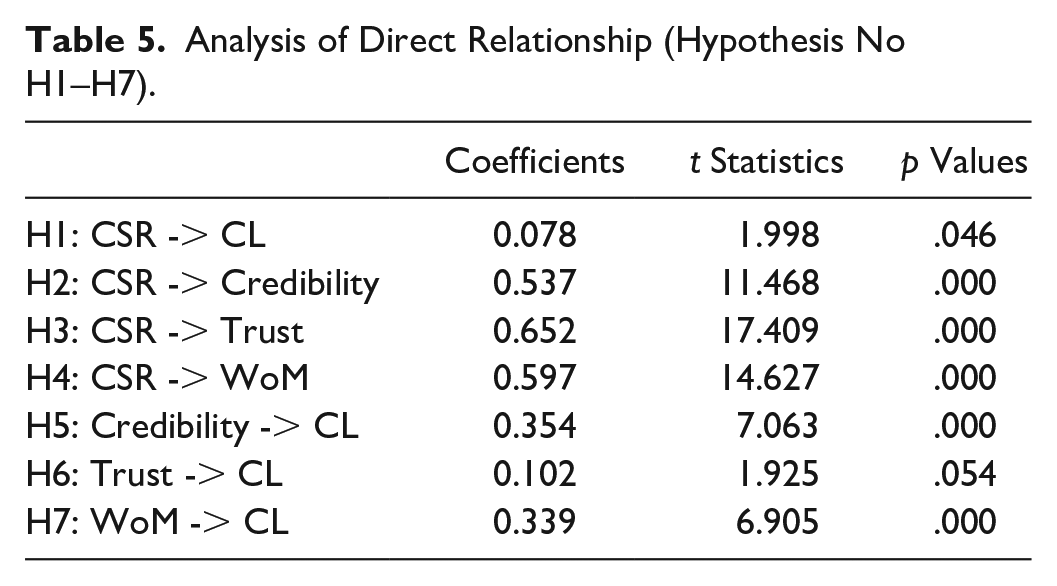
Analysis of Direct Relationship (Hypothesis No H1–H7).
Common Method Bias
In cross sectional research surveys when any single factor reports most of the covariances, then common method bias is detected and can create problems in justifying the results. So, for this reason, the method suggested by Podsakoff et al. (2003) was employed to check the existence of common method bias in this research. For testing this bias, Harman’s single factor test was conducted, and the results revealed that the total variance explicated by one factor was 44.15%, which is below the limit of 50% threshold. Thus, it can be said that common method bias is not an issue in the current study (Podsakoff et al., 2003; Rather & Hollebeek, 2021).
Structural Model
R-Square for each of the endogenous constructs was analyzed. R-Square for CL was 0.584, this shows that 58.4% change in CL is accounted by CSR, Credibility, Trust, and WOM. R-Square for Credibility was 0.288, this shows that 28.8% variance in Credibility can be accounted to CSR. R-Square for Trust was 0.425, this shows that 42.5% change in trust can be accounted to CSR. R-Square for word of mouth was 0.357, this shows that 35.7% change in WOM can be accounted to CSR.
Hypothesis testing was the next step, and the results of direct relationships are shown in Table 5. The results reveal a significant impact of CSR on Customer Loyalty (β = .078, t = 1.998, p = .046), hence H1 is accepted. The study found a significant impact of CSR on Credibility (β = .537, t = 11.468, p = .000), hence, H2 is accepted. The analysis has found a significant impact of CSR on Trust (β = .652, t = 17.409, p = .000), hence H3 is accepted. The study shows a significant impact of CSR on Word of Mouth (β = .597, t = 14.627, p = .000), hence H4 is accepted. The analysis reveals that there is a significant impact of Credibility on Customer Loyalty (β = .354, t = 7.063, p = .000), hence H5 is accepted. Based on the results of the study, Trust is found with an insignificant impact on Customer Loyalty (β = .102, t = 1.925, p = .054), hence H6 is rejected. The study demonstrates a significant impact of Word of Mouth on Customer Loyalty (β = .339, t = 6.905, p = .000), hence H7 is accepted as shown in the structural model in Figure 2.

Structural model.
Mediation Analysis
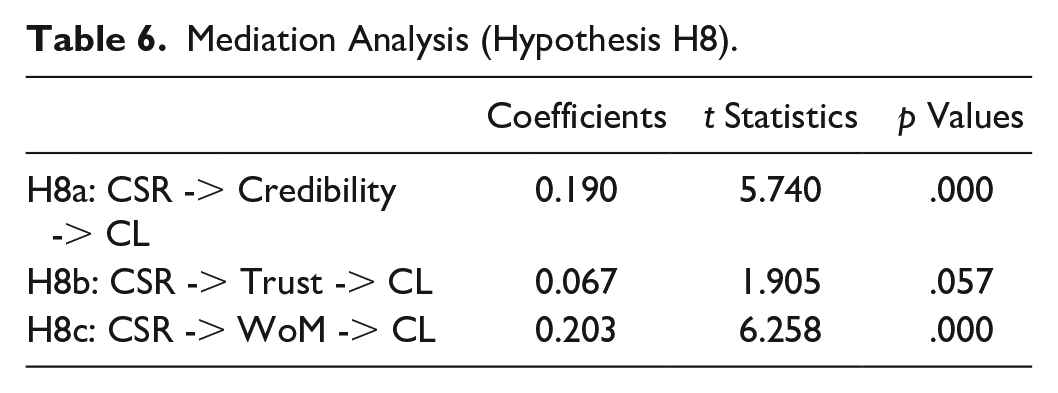
Analysis on the basis of the mediation relationship has been shown in this section. For this purpose, the results of mediation analysis carried out on the overall sample are shown in Table 6. These results have revealed that the mediating role of trust (β = .067, t = 1.905, p = .057) was insignificant and role of credibility (β = .190, t = 5.740, p = .000) and word of mouth (β = .203, t = 6.258, p = .000) was significant and on the basis of this result, hypotheses H8a and H8c are accepted and hypothesis H8b is rejected.
Mediation Analysis (Hypothesis H8).
Discussion and Conclusion
This research endeavor has examined the role of customers’ perception about corporate social responsibility in enhancing the customer’s loyalty and investigating the direct and mediating effect through trust, credibility, and word of mouth. Based on the findings of the sample, it has been observed that a positive and significant relationship between corporate social responsibility and customer loyalty has been supporting the findings of (Arikan et al., 2016; Latif et al., 2020; Pérez & Rodríguez del Bosque, 2015). These findings are aligned with the social identity theory that validates this claim about the customer’s perceptions that they get affectionate and show affiliation with the companies having an influence on their social identity. Thus, based on this assumption, it can be said that at the time of evaluation about hotel, customers will give significant attention to corporate social responsibility. This study distinguishes itself by examining the role of mentioned mediators into one single study assessing the impact of CSR on customer loyalty. It expands our understanding of the relationship between CSR and customer loyalty with the mediation linkage of trust, credibility, and word of mouth. The current research also attracts the academicians and practitioners toward important concerns like how to establish and enhance the loyalty of the hotels’ visitors with the help of CSR related services in their offerings and how they can gain positive word of mouth with credible and trusted reputation in the hospitality market segment.
According to the results, corporate social responsibility was having a significant impact on credibility (Abu Zayyad et al., 2021; Pratihari & Uzma, 2018) and word of mouth (Chang & Lee, 2020; Fatma et al., 2020). While associating stakeholder’s theory, the results can be described with this reality that the customers are prime stakeholder for whom hotel will he holding responsibilities (Kim & Ham, 2016). Firms are now recognizing the facts that customers tend to attract toward their socially responsible type of initiatives and such practices can help the hoteling industry to focus more on introducing CSR practices in their operations and thus can obtain strong credibility (Chouthoy & Kazi, 2016) and positive word of mouth (Jalilvand et al., 2017a). This support has also been highlighted in the existing literature (Choudhury, 2014; Erdem & Swait, 2004). Referring to the signaling theory, it depicts the significant impact on developing the perceptions of the customers toward CSR and then sends positive signals into their evoked sets, thus providing a strong positive imprint that could help in developing credibility and ultimately leading to the generation of positive word of mouth about such hotels which are adopting CSR activities in gaining the customer loyalty (Arikan et al., 2016; Chang & Lee, 2020; Turban & Greening, 1997).
The significance of Credibility and word of mouth corroborates the findings of previous research endeavors which highlighted that credibility (Abu Zayyad et al., 2021; Pratihari & Uzma, 2018) and word of mouth (Fatma et al., 2020; Issock et al., 2019) plays pivotal roles in developing customer loyalty. Contrary to these findings, the effects of trust on customer loyalty were insignificant and these results are contradictory to the existing findings of previous literature, which highlighted that trust also plays a vital role in developing customer loyalty (Martínez & Rodríguez del Bosque, 2013; Pérez & del Bosque, 2017; Upamannyu et al., 2015).
The insignificant findings related to the role of trust on customer loyalty can be explained by the fact that there is a possibility of other factors like reputation and word of mouth, that may be not allowing the customer to build their loyalty toward that hotel. This shows that trust may not always guarantee building customer loyalty and the same was also found true in the studies by Minta (2018) and Trini and Salim (2018), who have found the insignificant and weak role of trust in developing customer loyalty. It is also observed from the findings of the analysis carried out on the results of this study, the linkage of trust and customer loyalty is not strongly insignificant, but it is near to significant state and this insignificance may be impacted by any subdimensions of trust. The threshold being opted for acceptance or rejection of hypotheses was p < .05, that is 95% confidence interval. If it is measured at 6% or at 10% that is at 90% confidence interval, it can be considered as significant. So, based on this fact the role of trust was found to be having weak significance and that is why it has been shown as insignificant. Therefore, further research is also needed to find out the proper linkage between trust and customer loyalty in the hoteling industry so to track the linkage between these two variables.
Taking into consideration the results of mediation, the current research has not found valid mediation effect of trust in CSR and customers loyalty link, while on the other hand, credibility and word of mouth have significantly mediated the relationship between CSR and customers loyalty in the hoteling industry of Pakistan (Lin et al., 2021). Though previous studies on the CSR and customers loyalty linkage in the hoteling industry at large and primarily in Pakistan, has overlooked the role of these variables as mediators, the finding of the current study has revealed that for the sake of improvement in the hoteling industry, these CSR initiatives should be incorporated with a large focus on developing customer’s trust and doing such practices that will enhance their credibility, so that all of the CSR activities may positively foster the relationship between all of the stakeholders associated with hoteling industry (Latif et al., 2020). In contrast to the rest of the world, it is evident that companies in Pakistan have started CSR oriented activities in the recent decade and primarily the hoteling industry is focusing more on this concept since last few years and some of them are also pronouncing their CSR activities to their customers as well. Therefore, it can be assumed that some of the customers are not aware of these CSR related practices and this reality can clarify the differential impact of CSR on customer loyalty (Lin et al., 2021).
Implications
The current research gives theoretical contribution in the literature by identifying the untapped variables, those who were not identified and investigated deeply in the existing literature available on CSR and customer loyalty in hoteling industry. As recommended by various studies like Latif et al. (2020), Rather (2020) and Rather and Hollebeek (2019), theoretically the current study gets support to the progression of social identity perspectives by exploring the impacts of CSR and other mediating variables in the development process of customer loyalty in the hospitality sector. Rather et al. (2019a) and Rather (2018b) also have investigated the social identity perspectives for the exploration of customer loyalty in the tourism & hospitality context. Based on the findings, the current study also emphasizes developing such integrative and conceptual research models that illustrate the linkage between CSR and customer loyalty is not straightforward and direct (Palacios-Florencio et al., 2018). Rather this relationship and linkage is mediated through various other variables that develop linkages between corporate social responsibility and customer loyalty indirectly through other connecting constructs (Aljarah & Ibrahim, 2020; Aramburu & Pescador, 2019). Besides other variables used as mediators, trust, credibility, and word of mouth are primarily more relevant and they must be considered while developing any other research model aiming to explain the corporate social responsibility and customer loyalty linkages in any other setting. Furthermore, the current research is first in the Pakistani context to explore this CSR and customer loyalty linkage with the mediating role of the above-mentioned variables in hoteling industry.
Pertaining to the managerial implications of the study, it is found evident that corporate social responsibility initiatives by the hoteling industry will help them in gaining positive customer feedback and outcomes and thus ultimately leading to enhanced customer loyalty (Ajina et al., 2020). By doing so, the hoteling industry of Pakistan can add more sustainable and hazardous less environment in the society instead of making pollution and other hazardous risks to the environment. For enhancing customers intention toward a repeat behavior while availing any service from the hotel, the hotel must include CSR related activities fringed with their services to gain a more favorable customer attitude, that will result in a positive customers intention to opt for that hotel (Latif et al., 2020; Lin et al., 2021). So, the CSR practices can play a vital role for hotels to manage the strong relationship with their customers, as such kind of activities in the concurrent era is deemed as the righteous activities from any organization and it helps them by sending right and positive signals to the stakeholders and thus shaping up their reputational perceptions about the hotel services (Abu Zayyad et al., 2021; Ahn et al., 2020; Leiva et al., 2016).
Managers of the hotel must rethink the branding strategy due to the rapidly growing world economy backed by multiple technological factors. They should opt for such strategies which lead the customers to the stronger brand identification and ultimately toward a stronger brand relationship pertaining to the service offerings by their hotels (Hollebeek & Rather, 2019; Rather, 2018b). They must also take care of the influence of social media and brand attachment strategies and should remain vigilant to care about the competitive environment and must opt for such marketing strategies, which are coherent and contemporary to the digitalized social economy. By opting such strategies, managers can promote positive word of mouth and can earn the trust of the customers in their services and thus leading toward a strong brand loyalty.
Hoteling industry can get lots of benefits from the findings of this study. As it is evident that companies, who are involved in building strong perceptions about their CSR activities are expected to grow their intangible assets like building trust and credibility and can develop a positive word of mouth about themselves. Ultimately, in the long run, all these capabilities will thus lead to enhanced customer loyalty. Therefore, companies should strive for acknowledging the global shift toward communication and implementation of corporate social responsibility (Akbari et al., 2021; Chang & Lee, 2020). These directions are primarily important for less developed countries, where the novelty of corporate social responsibility is not penetrated yet in the decision making process of customers. Without creating customer activism and social awareness about corporate social responsibility, principles of CSR cannot be amalgamated in the hoteling industry of Pakistan, which might lead this country toward a most sustainable and developed tourism industry (Lin et al., 2021). So, hoteling industry should focus on putting more resources for awareness campaigns to enhance customers’ knowledge and CSR activism in Pakistan.
Limitations and Future Direction
This study has multiple limitations. This study has assessed the impact of corporate social responsibility initiatives on customer loyalty in hoteling industry only in Pakistan. Therefore, it is needed to enhance this exploration in a cross-country comparison study for the generalization of results. The second limitation of the study comprised of the fact that the current study has gathered data using cross sectional method. In the future, studies can focus on using longitudinal data that will help in ascertaining the dynamic shifts of corporate social responsibility, customer loyalty, trust, credibility, and word of mouth. Third, it is highly recommended that further studies can also assess the mediating roles of other variables in measuring the relationship of CSR and customer loyalty like reputation, service quality, social discount practices. Although, trust plays an important role in shaping up behavior, but in this study, trust is found to be insignificant in the current study. So, further studies should include it as a potential mediator along with others to explore its impact in similar models for finding conclusive results pertaining to the role of trust in CSR and customer loyalty linkage. Some of the previous research studies shed light on an impact aspect of generalizability of the collected samples, as it needs to be collected from other countries as well to generalize the findings of the study on a broader canvas (Popp & Woratschek, 2017; Rather, 2018b; Rather et al., 2020; Rather & Parrey, 2018; Su et al., 2016). As the samples in the study were obtained from the hoteling industry. Therefore, further research avenues can theoretically and empirically test the model in other contexts like in banking, retailing, professional services, telecom, airline, education, and even in other cultural settings for the generalizability of the findings as recommended by few researchers as well (Clark et al., 2020; Raza et al., 2020b). Lastly, the current study has not assessed the moderating role of any variable. Therefore, further studies may use moderation using variables like governmental policies, culture, religious orientation, and market orientation.
Footnotes
Author Note
Muhammad Usman Shah is now affiliated to Department of Management Sciences, COMSATS University Attock, Punjab, Pakistan.
Declaration of Conflicting Interests
The author(s) declared no potential conflicts of interest with respect to the research, authorship, and/or publication of this article.
Ethics Statement
This article does not have any kind of ethicality issues.
Funding
The author(s) received no financial support for the research, authorship, and/or publication of this article.
