




Abstract
This study explored occupational health and safety among fuel pump attendants at selected oil and gas service stations in Accra, Ghana. Respondents completed a questionnaire battery on proactive personality, safety climate perceptions, safety compliance, and safety participation. Regression models showed that safety climate perceptions and proactive personality each had significant positive main effects on safety compliance and safety participation. Moreover, we found that the positive relationship between safety climate perceptions and safety compliance, and between safety climate perceptions and safety participation was weaker when proactivity was high than when it was low. The theoretical and managerial implications of the results are discussed.
Introduction
Employee personality is increasingly considered an important determinant of safety performance in organizations (Cellar et al., 2001; Hogan & Foster, 2013; Landay et al., 2020; Rau et al., 2020; Sutherland & Cooper, 1991). Proactive personality, described as an innate willingness to take personal initiative to improve current workplace situations or to create new ones (see Crant & Bateman, 2000; Seibert et al., 2001; Teye-Kwadjo & de Bruin, 2021), has been found to relate positively to employee safety attitudes (Ji et al., 2019). Proactive personality is a personality trait that is enduring and relatively stable over time (Seibert et al., 1999). Available meta-analytic work (see Spitzmuller et al., 2015) has shown that more than 50% of variance in proactive personality is not related to the Big Five personality traits (also known as the five-factor model; Gerber et al., 2011; McCrae & Costa, 2013). This information suggests that proactive personality is a unique theoretical construct. For more information on the theoretical development of proactive personality, see Fuller and Marler (2009) and Spitzmuller et al. (2015) for meta-analytic reviews. Unlike passive and reactive people, proactive employees actively seek and take part in activities that could improve organizational circumstances (McCormick et al., 2019; Wang et al., 2017), including safety. Proactive employees are, therefore, considered valuable to organizations (Bakker et al., 2012; Parker & Bindl, 2016; Parker et al., 2010). There is evidence that proactive individuals can shape their environment by staying away from negative behavior such as cutting corners (Yan et al., 2021). As the people who manage fuel pumps and sell gasoline and liquefied petroleum gas (LPG) to the public, fuel pump attendants in Ghana play a crucial role in occupational safety at oil and gas service stations. Thus, understanding the determinants of safety behavior of fuel pump attendants would seem an important research goal. For example, fuel pump attendants high in proactive personality may take action to change their work environment in order to enhance workplace safety. They may also refrain from cutting corners in pursuit of workplace safety. The aim of the present study was to examine the association between safety climate perceptions and safety compliance, and between safety climate perceptions and safety participation in a sample of fuel service pump attendants in the Greater Accra Region of Ghana. Another aim was to assess the moderating effect of proactive personality on the relationship between safety climate perceptions and safety compliance, and between safety climate perceptions and safety participation.
Explosions at Oil and Gas Service Stations in Ghana
A growing number of explosions and fires occur at oil and gas service stations each year in Ghana (see Appiah, 2020; Arhinful, 2020; BBC, 2016, 2017; Joy News, 2015). In Ghana, oil and gas service stations are stations where people purchase LPG for domestic cooking purposes; or purchase petrol for fueling vehicles and machines. An industry classification of workplace accidents recorded in 2016 showed that, of 70 non-fatal and 14 fatal accidents, oil and gas service stations accounted for 64.3% and 85.7%, respectively (Ghana Statistical Service, 2016; Ministry of Employment and Labour Relations, 2017). Allotey (2017) reported that between 2014 and 2017, Ghana recorded eight major explosions at oil and gas service stations, killing hundreds of people, injuring several others, and destroying property worth millions of Ghana Cedis (see also Ansah, 2012; Yirenkyi, 2016 for similar research findings). The causes of the explosions are often said to be due to human error (Addo, 2017; GH Ghana News, 2017), with industry regulators and government officials blaming oil and gas service station attendants for not adhering to known, standard safety practices and procedures. It seems clear that research is needed to answer the question: How do individual difference factors such as proactive personality (a personality trait) and safety climate perceptions affect safety compliance and safety participation of fuel pump attendants? How does proactive personality interact with safety climate perceptions to influence safety compliance and safety participation of fuel pump attendants?
Safety Culture in Ghana
The explosions at oil and gas service stations in Ghana seem to emanate, in part, from a national, pathological safety culture and reactive safety culture (Annan et al., 2015; Parker et al., 2006; Puplampu & Quartey, 2012; Stemn et al., 2019). According to Parker et al. (2006), organizations with a pathological safety culture do not seem to care when employers and employees violate safety rules, whereas those with a reactive safety culture treat safety as an important issue only after a safety breach has occurred. See also Kalteh et al.’s (2021) systematic review on the relationship between safety culture and safety climate perceptions. From Parker et al.’s (2006) safety framework and based on the available data on the gas explosions in Ghana, we argue that pathological and reactive safety cultures are prevalent at oil and gas service stations across Ghana.
Consequently, the operations of oil and gas service stations pose a real threat to life and property in Ghana. Yet, little research efforts have been devoted to this public health problem. A related problem is that there seems to be no national policy on occupational health and safety to promote worker well-being in Ghana (see Annan et al., 2015; Gyekye, 2006; Mock et al., 2005). Unsafe work behavior may be costly for both the organization and the employee because aside from deaths of employees and financial losses to the organization, employee injuries can lead to long-term disability with devastating consequences (International Labour Organisation [ILO], 2021). Therefore, Ghanaian families and communities as stakeholders are directly or indirectly impacted by the operations of fuel service stations. The ILO (2021) estimates that 2.3 million workers die each year because of poor workplace safety, contributing 3.94% to global GDP annually. Information on the economic burden posed by poor occupational safety on Ghana’s GDP is not available. Given this, there appears to be an urgent need for research to raise awareness regarding workplace safety at oil and gas service stations in Ghana, particularly among fuel pump attendants. This research may help to gain a better understanding of the person-level factors (e.g. personality) and the organizational-level factors (e.g. safety climate; [see Christian et al.’s (2009) meta-analytic work]) considered to be the proximal determinants of the explosions at the fuel service stations.
Organizational Safety Climate and Safety Outcomes
Scholars have devoted much effort to the study of occupational safety (see Hofmann et al., 2017). Correspondingly, extant meta-analyses and systematic reviews have identified person-and situation-related factors as important antecedents of safety outcomes at the workplace (Christian et al., 2009). The person-related factors include, but are not limited to, proactive personality, safety climate perceptions, safety compliance, and safety participation (see Beus et al., 2015; Christian et al., 2009; Clarke, 2006; Huang et al., 2006; Seibert et al., 1999). Taken together, the proliferation of and explosions at oil and gas service stations in Ghana have raised concerns about employee proactivity, organizational safety climate, safety compliance, and safety participation in adhering to known safety standards and procedures. According to Zohar (2010), safety climate at the workplace describes employees’ perceptions of the organization’s policies, procedures, and practices regarding safety. Those perceptions are expected to guide employees’ work attitudes and behavior as they adjust themselves to remain in line with those policies, procedures, and practices (Guldenmund, 2010; Zohar, 2010). Various researchers, working independently, found that organizational safety climate perceptions had a positive relationship with safety compliance and safety participation (Neal & Griffin, 2002, 2006; Wu et al., 2008). For example, Shin et al. (2015) found that safety climate perceptions had a positive relationship with safety participation among construction workers in South Korea. Tholén et al. (2013) reported that perceptions of safety climate influenced safety behavior among employees of a Swedish construction firm. A meta-analytic work found that safety climate is an important determinant of safety behavior (see Jiang et al., 2019).
Griffin and Neal (2000) argued that safety compliance and safety participation are two distinct but related concepts (i.e. they reflect safety behavior). Safety participation involves taking safety initiatives as well as improving and promoting safety practices within the workplace (Neal & Griffin, 2000; Vinodkumar & Bhasi, 2010). In other words, safety participation describes employees’ engagement in safety programs, practices, and procedures at the workplace. Safety compliance, on the other hand, involves adhering to standard safety operating procedures and safety checklists by employees (Neal & Griffin, 2000; Pilbeam et al., 2016). To engage in safety behavior at a workplace, individual employees may require relevant safety knowledge and skills, supportive organizational safety climate, and a proactive personality disposition (Gray & Silbey, 2011; Griffin & Hu, 2013; Lievens & Vlerick, 2014). Based on this literature, we propose the following hypothesis.
Available literature suggests that certain individuals may be more prone to workplace accidents than others due to differences in personality (Dekker, 2002). Therefore, we expect proactive personality dispositions to vary between individuals working at oil and gas service stations in Ghana. Research has found personality traits such as conscientiousness and agreeableness to be associated with safety behavior (see Rau et al., 2020; Toppazzini & Wiener, 2017). Baba et al. (2009) found a positive relationship between proactive personality and safety behavior. They noted that people with proactive personality seemed more concerned about the safety climate of their work environments. In addition, Ji et al. (2019) demonstrated that proactive personality is strongly, positively linked to employee safety attitudes. Based on this literature, we propose the following hypothesis.
Moreover, there is a growing research interest in gaining a better understanding of the mechanisms under which safety climate perceptions affect the safety behavior of employees (Fugas et al., 2012; Zohar & Luria, 2005). This interest has led various researchers to focus on moderators and mediators of the safety climate-safety behavior relationship (Clarke, 2010, 2013; Huang et al., 2006; Wallace et al., 2006). For example, Ji et al. (2019) found that proactive personality interacted positively with safety climate to predict safety behavior of flight attendants. Based on this literature, we propose the following hypothesis.
Method
Participants
Participants in this study were 206 pump attendants recruited from 26 oil and gas service stations in Accra. The sample was 67.5% male, and the mean age was 25.96 years (SD = 6.65). About 79.6% of the sample reported receiving secondary school education. Approximately, 49.0% of the sample had work experience spanning 1 to 2 years, whereas 29.1% reported a work experience between 3 and 5 years at their current fuel service stations. About 78.2% reported being never married, and 91.3% indicated that their religious affiliation to be Christianity.
Measures
A questionnaire on the main study variables as well as biographical variables such as age, gender, marital status, educational level, religious affiliation, and work experience was used for the data collection.
Proactive personality
We assessed proactive personality with the 10-item scale developed by Bateman and Grant (1993) and validated by Seibert et al. (1999) and by Islam et al. (2018). All items were rated on a 5-point Likert-type scale ranging from 1 (strongly disagree) to 5 (strongly agree). Scale scores were calculated such that higher scores indicated greater proactive personality dispositions. Sample items are “I am constantly on the lookout for new ways to improve my life.” and “If I see something I don’t like, I fix it.” In the present study Cronbach’s alpha coefficient for the 10 items was .84, 95% confidence interval (CI) [0.80, 0.87].
Safety climate perceptions
Safety climate perceptions at the organizational level were measured using nine items adapted from Adutwum (2010). The items tapped employees’ perceptions of safety at the workplace relative to their supervisors and co-workers. All items were rated on a 5-point Likert-type scale ranging from 1 (strongly disagree) to 5 (strongly agree). Scale scores were calculated such that higher scores indicated a greater perceived organizational safety climate. Sample items were “My supervisor often reminds workers of the potential risks and hazards in our unit.” and “Workers in this unit usually discuss changes that could improve safety.” In the present study, Cronbach’s alpha coefficient for the nine items was .84, 95% CI [0.81, 0.87].
Safety compliance
Safety compliance was measured using a 4-item scale validated in previous research (Vinodkumar & Bhasi, 2010). The items required participants to indicate their agreement on a 5-point Likert-type scale ranging from 1 (strongly disagree) to 5 (strongly agree). Scale scores were calculated such that higher scores indicated greater compliance with safety measures at the workplace. The four items were “I carry out my work in a safe manner.” and “I ensure the highest levels of safety when I carry out my job.” In the present study, Cronbach’s alpha coefficient for the four items was .74, 95% CI [0.68, 0.80].
Safety participation
We assessed safety behavior using a five-item scale by Vinodkumar and Bhasi (2010). All items were rated on a 5-point Likert-type scale ranging from 1 (strongly disagree) to 5 (strongly agree). Scale scores were calculated such that higher scores reflected greater safety behavior. The five items were “I help my co-workers when they are working under risky or hazardous conditions.” and “I put extra effort to improve the safety of the workplace In the present study, Cronbach’s alpha coefficient for the five items was .78, 95% CI [0.73, 0.82].
Procedure
The sample was recruited at their workplace from various fuel service stations in the Greater Accra metropolis, using a purposive sampling technique. The fuel stations included
Shell, Goil, Oando, Glory Gas, Glory Oil, Sonnidom, Unity Oil, Agapet, AP Oil, Puma Energy, EV Oil, Rich Oil, Royal Roses, Infin, Kaysens Gas, Top Oil, Excel Oil, Petrosol, AP Oil, Allied Oil, Seam Oil, Benab, Sky Petroleum, Lucky Oil, Compass Oleum, and Frimps Oil. The Greater Accra Region was chosen as the location for this study because the Region seems to be overrepresented in oil and gas explosions (see Abdul-Hamid, 2017; Ministry of Employment and Labour Relations, 2017). The fuel stations are owned by oil/gas marketing companies. The attendants were responsible for serving or dispensing fuel to customers at the various stations. Permission was obtained from managers of oil and gas service stations to engage attendants to participate in the study. In the absence of station managers, shift captains were contacted to seek permission in engaging their members. Participants who expressed interest in the study were given information about the study, including questionnaire completion. Inclusion criteria included being an oil and gas service station attendant, aged 18 years and older, with basic literacy in the English language, the language of the survey questionnaire. Exclusion criteria included being a manager, supervisor, and a shopping mart attendant at the service station.
A total of 245 oil and gas service station pump attendants were recruited for the study and handed survey questionnaires during their working hours. Of this number, 220 questionnaires were returned with 206 being fully completed. Due to work pressure at most service stations in the Greater Accra metropolis and because fuel attendants usually stand throughout the day and night to perform their duties, the questionnaires together with consent forms were given to them in an envelope to complete at home or when they were off-duty to be collected at a later date by the research team. This procedure ensured that the completion of the questionnaire did not interfere with their work at the service stations. Respondents were not compensated for their time to complete the survey.
Ethical Approval
The study was approved by the Ethics Committee for the Humanities (ECH035/17-18), University of Ghana.
Data Analysis
We calculated descriptive statistics for the sample (i.e. age, gender, marital status, educational level, religious affiliation, and work experience). Following this, we checked item distribution on the main study variables for correspondence with univariate normality and other parametric assumptions. Next, we assessed the factor structure and construct dimensionality of the main study variables in exploratory factor analysis (EFA) with principal component extraction. We retained scale items that met the minimum factor loading threshold (r = .40; Field, 2009). Then, we calculated Cronbach’s alpha reliability, computed total scale scores for each scale, and intercorrelations among the variables (see Table 1). We conducted hierarchical regression and statistical moderation analyses following the recommendation by Cohen et al. (2003) and by Jaccard and Turrisi (2003).
Means, Standard Deviations, Reliabilities, and Intercorrelations Among Study Variables (N = 206).

Note. Cronbach’s alpha reliabilities are on the diagonal. M = mean; SD = standard deviation.
p < .05. **p < .01. ***p < .001.
To enhance the interpretability of the interaction term and to reduce multicollinearity, we standardized the predictor variable (safety climate perceptions) and the moderating variable (proactive personality) before calculating the interaction term. The interaction term was used in the statistical moderation analysis. Because this study had two dependent variables (i.e. safety compliance and safety participation), we performed two separate hierarchical regression analyses. Each analysis was conducted in three steps (see Table 2). At step 1, the dependent variables together with the following demographic variables (age, gender, marital status, educational level, religious affiliation, and work experience) were entered into the regression equation to statistically control for any effect they may have on the dependent variables. At step 2, the dependent variables (i.e. safety compliance and safety participation) were regressed on the predictor variable (i.e. safety climate perceptions) and the moderating variable (i.e. proactive personality). At step 3, the interaction term (i.e. safety climate perceptions × proactive personality) was added to the regression equation. To detect an interaction effect, the interaction term must be statistically significant at p < .05 decision rule (Preacher & Hayes, 2008). To probe statistically significant two-way interaction effects in this study, we used interaction plots (see Figures 1 and 2) following the recommendation by Dawson (2014) and Preacher et al. (2006). Thus, we assessed the conditional effect of the focal predictor (i.e. safety climate perceptions) at low, medium, and high values of the moderator (i.e. proactive personality). All analyses were conducted in SPSS statistics package (v21). Simple slopes analyses were performed in PROCESS macro for SPSS (Hayes, 2013; Hayes & Rockwood, 2017).
Multiple Regression Model Predicting Safety Behavior From Safety Climate and Proactive Personality.

Note. Age (quantitative data); Gender (1 = male, 2 = female); Educational level (1 = junior high school, 2 = senior high school, 3 = professional, 4 = tertiary); Marital status (1 = married, 2 = single, 3 = divorced); Religious affiliation (1 = Christianity, 2 = Islam, 3 = Other); Work experience (1 ≤ 1 year, 2 = 1–2 years, 3 = 3–5 years; 4 = 6–10 years, 5 ≥ 10 years).
p < .05. **p < .01. ***p < .001.

The moderation effect of proactive personality in the relationship between safety climate perceptions and safety compliance. Low, medium, and high proactive personality are defined as −1.0, mean, and 1.0 from the mean, respectively.
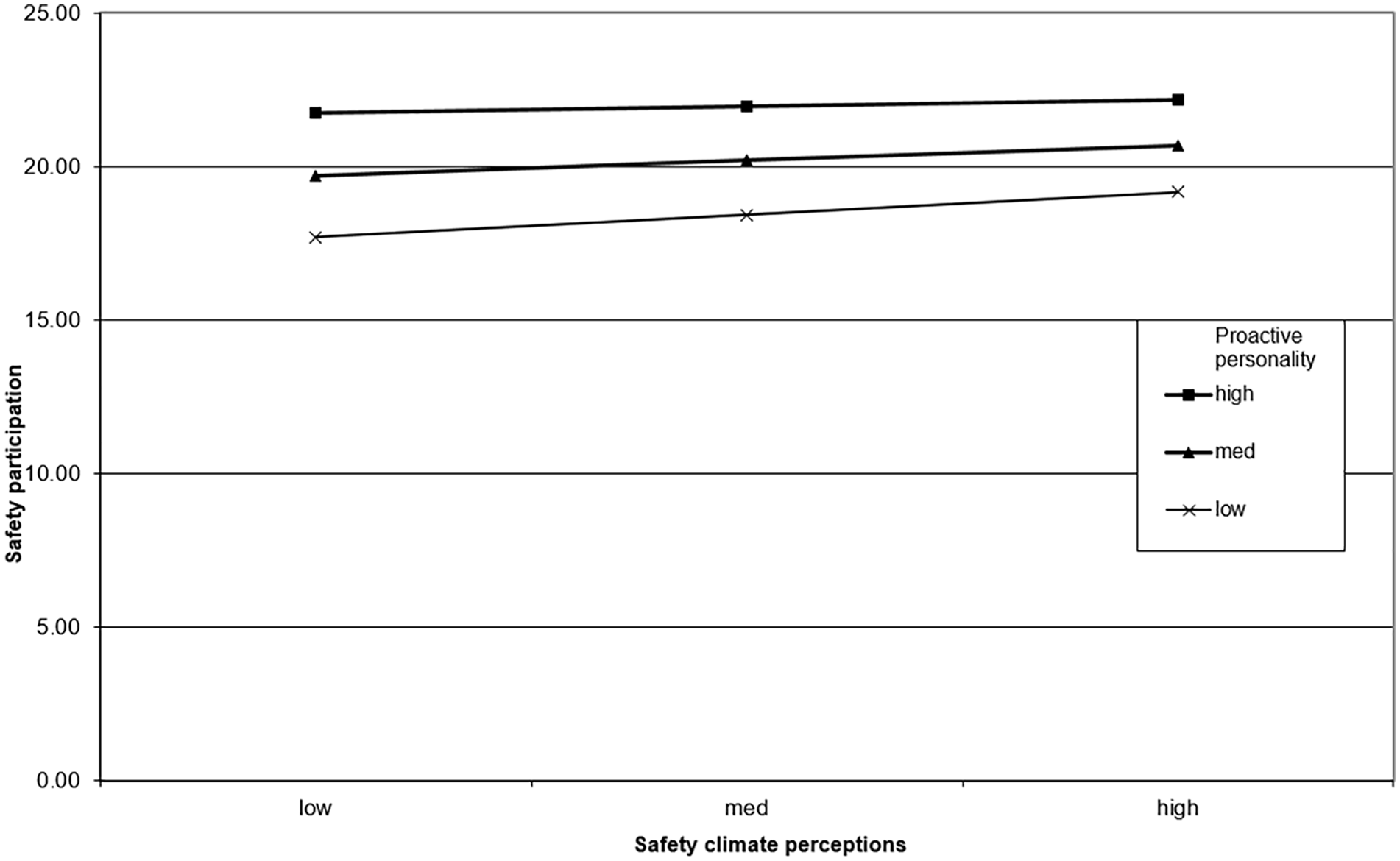
The moderation effect of proactive personality in the relationship between safety climate perceptions and safety participation. Low, medium, and high proactive personality are defined as −1.0, mean, and 1.0 from the mean, respectively.
Results
Table 1 presents means, standard deviations, internal consistency reliability, and intercorrelations among the study variables. Table 2 presents the results of the hierarchical regression and statistical moderation analyses. As can be seen in Table 2, for the safety compliance outcome variable, the model at step one was not statistically significant (R2 = .03, F(6, 198) = 1.148, p = .336), whereas for the safety participation outcome variable the model was statistically significant (R2 = .06, F(6, 198) = 2.243, p < .05). In addition, the model at step two was significant for safety compliance (ΔR2 = .43, ΔF(2, 196) = 78.565, p < .001) and safety participation (ΔR2 = .38, ΔF(2, 196) = 66.580, p < .001), accounting for 43% and 38% of the variance in safety compliance and safety participation respectively. Specifically, the model at step two showed that safety climate perceptions were significantly positively associated with safety compliance (β = .40, p < .001) and safety participation (β = .14, p < .05), confirming H1. In addition, it showed that proactive personality was significantly positively associated with safety compliance (β = .37, p < .001) and safety participation (β = .54, p < .001), providing support for H2. That is, consistent with our prediction, safety climate perceptions and proactive personality had significant main effects on safety behavior (i.e. [a] safety compliance and [b] safety participation).
Similarly, we proposed that the relationship between safety climate perceptions and safety behavior (i.e. [a] safety compliance and [b] safety participation) would vary as a function of proactive personality. The statistical moderation model at step 3 was significant for safety compliance (ΔR2 = .01, ΔF(1, 195) = 5.071, p < .05) and safety participation (ΔR2 = .02, ΔF(1, 195) = 5.439, p < .05), explaining incremental 1% and 2% of the variance in safety compliance and safety participation, respectively. Specifically, the moderation results showed that safety climate perceptions and proactive personality interacted to predict safety compliance (β = −.14, p < .05) and safety participation (β = −.15, p < .05). This result, although statistically significant, was, however, contrary to the direction we had predicted in H3, disconfirming H3. In other words, in this sample, higher proactivity weakens the effect of safety climate perceptions on safety behavior.
Regarding the safety compliance outcome variable, the addition of the interaction term to the model helped to explain an incremental variance (47%) in safety compliance than did the main effects of the predictor and moderating variable (46%). Similarly, for the safety participation outcome variable, the addition of the interaction term to the model helped to explain an incremental variance (46%) in safety participation than did the main effects of the predictor and moderating variable (44%).
As can be seen in Table 2, the significant interaction between safety climate perceptions and safety behavior (i.e. [a] safety compliance and [b] safety participation) demonstrates that the relationship between safety climate perceptions and safety behavior is contingent on the level of proactive personality. The interaction term’s negative sign suggests a buffering effect, which is statistically referred to as interference or antagonistic interaction (see Andersson et al., 2014; Cohen et al., 2003). According to Cohen et al. (2003), an interference or antagonistic interaction is one “in which both predictors work on the criterion in the same direction, and the interaction is of opposite sign (p. 286). Figures 1 and 2 display the interaction plots from the simple slopes analysis. Inspection of the plots indicates that the influence of safety climate perceptions on safety compliance and safety participation is stronger when proactivity is low.
Discussion
Our aim in this study was to explore occupational safety and proactivity from the perspectives of fuel service pump attendants in the Greater Accra Region of Ghana. We proposed that the relationship between safety climate perceptions and safety compliance and safety participation is contingent on the level of employee proactivity. In addition, we predicted that safety climate perceptions and proactive personality would each have a significant main effect on safety compliance and safety participation. Consistent with our prediction, the results showed that safety climate perceptions were positively associated with safety compliance and safety participation, confirming H1. Further, proactive personality had a significant, positive main effect on safety compliance and safety participation, confirming H2.
Our results are consistent with the findings of various studies that found a positive relationship between safety climate perceptions and safety behavior (see Christian et al., 2009; Lyu et al., 2018; Panuwatwanich et al., 2017; Shin et al., 2015; Wu et al., 2008). The present results, although considered preliminary, provide important insights into the safety climate —safety behavior link (see Casey et al., 2017) in the Ghanaian context. In other words, it would seem that safety climate provides a conceptual frame of reference to guide the safety behavior (i.e. safety compliance and safety participation) and attitudes of pump attendants at oil and gas service stations in Accra. In this sample, the results demonstrate that fuel pump attendants are more likely to take greater safety precautions in a more safety-supportive work environment. From an occupational health and safety (OHS) perspective, we argue that fuel station managers in Accra who invest more time and money in safety training; and those who enforce standard operating safety procedures may bring about an increase in safety compliance and safety participation in their employees.
Further, the results offer preliminary evidence that safety climate perceptions and proactive personality are important for safety compliance and safety participation. In other words, our results seem to suggest that employees who possess higher levels of proactivity (proactive personality) will demonstrate higher levels of safety compliance and safety participation. These results find support in previous research. For example, Toppazzini and Wiener (2017) and Seibokaite and Endriulaitiene (2012) investigated the role of personality dispositions in safety behavior. They found that personality traits were associated with safety behavior. Moreover, Seibert et al. (2001) demonstrated that employees with proactive personality dispositions tended to influence their work environment by exhibiting proactive behavior (see also, Turban et al., 2017).
Moreover, in this study, safety climate perceptions interacted with proactive personality in influencing safety compliance and safety participation. This result confirmed that the relationship between safety climate perceptions and safety compliance, and between safety climate perceptions and safety participation varied as a function of proactive personality. However, contrary to our prediction, the result showed that when proactive personality is higher, the influence of safety climate perceptions on safety compliance and safety participation becomes weaker. The plots of the significant interactions are presented in Figures 1 and 2. Both interaction terms had negative beta weights, suggesting a substitution effect or antagonistic effect (see Andersson et al., 2014; Cohen et al., 2003; Fairchild & McQuillin, 2010; Voss et al., 2010).
In other words, as proactive personality increases, the association between safety climate perceptions and safety compliance and safety participation tends to diminish. This result indicates a clear case of a substitution effect between safety climate perceptions and proactive personality. That is, proactive personality seems to substitute for (or buffer) the effect of safety climate perceptions on safety compliance and safety participation. Our study, thus, suggests that proactive personality is an important substitute for safety climate perceptions. This result indicates that investment in both safety climate and in individuals high in proactivity may not turn out to be a prudent use of organizational resources. This result reflects an important contribution of the present study to the safety literature because research that has not considered the influence of both safety climate perceptions and proactive personality on safety compliance and safety participation may fail to realize this substitution effect.
Substitute interaction effects are said to occur when the marginal contribution of each variable in a two-way interaction decreases as the level of the other variable increases (see Siggelkow, 2002; Voss et al., 2010). Simply put, buffering effect occurs when an increase in the moderator leads to a decrease in the effect of the predictor variable on the outcome variable (Andersson et al., 2014). Correspondingly, at fuel service stations where pump attendants perceive safety climate to be lower or non-existent, proactive personality dispositions would be more crucial to safety compliance and safety participation than at stations where they perceive safety climate to be higher. A possible explanation for this result is that, in Ghana, mostly young adults in their prime ages are hired to work as pump attendants. They may, therefore, possess the proactive tendency needed to follow safety procedures and practices and translate them into action. There is evidence that individuals high in proactive personality have a greater likelihood to comply with safety rules and practices, which, in turn, predict their actual safety behavior (Baba et al., 2009; Beus et al., 2015). However, high proactivity and high perceptions of safety climate seem to have compensatory effects, writing off any gains to be derived from their combined effects.
Practical Implications of the Results
From a managerial perspective, this study provides preliminary evidence suggesting that fuel station managers in the Greater Accra Region have the option of either improving the safety climate at their workplace or investing in hiring individuals high in proactivity in order to achieve optimal overall safety performance. That is, investment in both safety climate and in individuals high in proactivity may not be necessary as one variable has the ability to substitute for the other, at least from this research. From a theoretical perspective, our results extend the extant safety literature by demonstrating that fuel pump attendants with high proactivity seem relatively unconstrained by situational and environmental factors to take action to impact workplace safety. This well-known theoretical position of proactive personality is well articulated in prior research (see Fuller & Marler, 2009; Teye-Kwadjo & de Bruin, 2021). More research is warranted to corroborate our findings regarding the substitution effect between proactive personality and safety climate perceptions.
Limitations of the Study
As with most previous studies reported in the occupational health and safety literature (see McLinton et al., 2018; Oah et al., 2018; Petitta et al., 2017), this study used self-report measures, cross-sectional research design, and a purposive sampling technique, which are known to be associated with some limitations. Another possible limitation to note is the relatively small sample size used. In addition, because we used self-report measures to collect the data, it is probable that socially desirable responses may have attended our data. That is, some of our participants may have exaggerated safety issues at the workplace whereas others may have under-reported them, intending to please the researchers. These limitations should be taken into consideration in interpreting the results.
Conclusion
Our results advance the occupational health and safety literature, as they have increased our knowledge regarding when safety climate perceptions influence safety compliance and safety participation in the presence of proactive personality in the Ghanaian context. The results show that to increase the safety compliance and safety participation of fuel pump attendants, managers and supervisors could either use personality assessment tools to identify individuals high in proactive personality dispositions to hire or could improve the safety climate of their fuel stations.
Footnotes
Author Contributions
ETK, SAB, and IAN conceptualized the study. SAB collected the data. ETK analyzed the data and interpreted the results. ETK wrote the manuscript. ETK and IAN reviewed the manuscript for critical intellectual content. All authors read and approved the final manuscript.
Availability of Data and Materials
The data are available from the corresponding author on reasonable written request.
Declaration of Conflicting Interests
The author(s) declared no potential conflicts of interest with respect to the research, authorship, and/or publication of this article.
Funding
The author(s) received no financial support for the research, authorship, and/or publication of this article.
Compliance With Ethical Standards
The study was approved by the Ethics Committee for the Humanities (ECH035/17-18), University of Ghana. All procedures performed in the study were in accordance with the ethical standards of the Ethics Committee of the University of Ghana and with the 1964 Helsinki Declaration and its later amendments or comparable ethical standards.
Informed Consent
Informed consent was obtained from all the participants of the study.
