




Abstract
The occupational health and safety education program (OHS) is an important intervention strategy to prevent injuries among young workers. This study aims to emphasize the importance of inclusive and integrated occupational safety education in an Inclusive Vocational School for students at 10th grade. In this study, we investigated the success levels and the awareness of the students before and after the education on occupational safety. The purpose of the study is to investigate the effects of 12-hour basic OHS education on the students’ levels of awareness and knowledge and the retention of these effects. A questionnaire comprising 10 questions and an open-ended exam comprising 20 questions that measure their knowledge level on OHS were applied to the students who had just met with the workshop environment before and after the education. As a result, OHS education delivered to students has improved the students’ awareness of OHS positively. It was observed that the knowledge levels before receiving OHS education increased according to their knowledge level after regular OHS education.
Introduction
The European Union strategy on health and safety has established further education as being essential to enhance the preventive occupational health and safety (OHS). Education about OHS does not begin with access to work; it should be a part of the school curriculum or a vocational subject in custom (Burgos-Garcia, 2007). Vocational school programs provide further education in a broad range of occupational fields, through school-based and work-based learning. It plays a critical role in providing school dropout rates and promoting school-to-work transition (Atkinson, 2016; Musset, 2019; Musset et al., 2019; OECD, 2020). These programs provide students with the education hours when they start an apprenticeship in the workplace. Integrating occupational health and safety into the school curriculum, and especially in vocational education curricula, is a primary mission. A school-based OHS program is an essential intervention strategy for accident prevention among young workers. The aim is to empower students with the knowledge and the skills for coping with the hazards they may encounter in their future working environment (Rodrigues et al., 2018). After the 9th grade, students studying at inclusive vocational schools in Turkey take only theoretical courses and choose the department in which they want to study based on their interests and abilities. All students receive intensive vocational education in workshops in the 10th and the 11th grades within their departments. They receive intensive vocational education at school and out of school in the business environment within “Skill Education” schemes in enterprises for 3 days a week. Therefore, this study was conducted with the 10th graders who haven’t yet worked in workshops (typically developed students and students with special needs) in Inclusive Vocational and Technical Anatolian School, Adana, Turkey.
Context of OHS in Vocational and Technical Anatolian Schools in Turkey
From an OHS perspective, safety and health are priorities for students at all stages in life and are an integral part of planning and decision-making processes and activities in educational institutions and companies. Inclusive Vocational and Technical Anatolian School in this study is so effective in adapting and improving the classroom that all students achieve success in OHS educations. Students with special needs follow theoretical classes and workshops at school settings, like typically developed peers. The OHS education program in school has been made by the high school teacher, who has Master of Science degree in OHS education. The OHS education program is provided as a free tutorial in Vocational and Technical Anatolian Schools in Turkey but it is not feasible elsewhere.
The Vocational and Technical Anatolian School organize apprenticeship for all students with the companies. The apprenticeship premium is paid by the employer. The owner or the manager shows students the company and the processes. If there are any issues, students can contact the student counselor. The school manager read the reports and monitor how well students take part in the company. Students then receive a final grade. The OHS apprenticeship is usually the first contact that students have with work. They experience hands-on what workplace safety and health means. If students with special needs aren’t ready to do an apprenticeship yet, they can also take on duties at the office setup. For example, they can work in the secretary’s office. In the classroom, students receive intensive vocational education, and “Skill Education” out of school in in enterprises within business environment for 3 days a week.
Vocational schools are classified under the “hazardous class” according to the hazard classes corresponding to NACE (Nomenclature des Activités Économiques dans la Communauté Européenne) codes. Students study in environments determined by considering the hazard class activity areas in the NACE codes. If necessary measures are not taken and sufficient attention is not paid to occupational health and safety, occupational accidents can occur, resulting in injuries—even deaths. Considering the hazard class activity areas in the NACE codes, it is estimated that physical and non-physical harms arising from an accident may be very high. Young workers’ being severely injured will lead to an increase in the impairment cases in society, which can result in more serious damage to society of adult workers experiencing similar injuries (Breslin & Smith, 2005; ILO, 2018; Lavack et al., 2008; Schulte et al., 2005).
The number of the young employees (aged 15–24) experiencing abnormal working environment injuries (not fatal injuries) is estimated to be twice as high as those experienced by workers aged 25 or over (Eu-osha, 2013; Okun et al., 2016). Young employees and employees with special needs are more likely to be injured at work than older workers (Laberge & Ledoux, 2011) and this appears to be related to inexperience. As revealed by Breslin and Smith (2006), short job tenure is a stronger predictor of occupational injury than age. Similarly, Sorock et al. (2001) showed that work accidents happen more frequently while the worker is performing an unusual task.
OHS is a basic human right. High rates of injury among young employees and employees with special needs are of particular concern as one accident can destroy a life and a lifetime of career opportunities, potential earnings and general well-being. Education influences awareness levels of OHS positively (Burke et al., 2011). This study aimed to emphasize the importance of inclusive occupational safety education and to investigate occupational health and safety education in an inclusive vocational school setting. The success levels and the awareness of the students were measured before and after the OHS education. Basic occupational health and safety education was given to evaluate their success levels and assessments were conducted based on these results. The suggestions related to possible solutions are presented in line with the information obtained.
Material and Methods
Subjects
This study included a total of 370 students who study in the 10th grade of Vocational and Technical Anatolian School in the Adana–Seyhan district. In this study, convenience sampling methods was used. Convenience sampling involves choosing the nearest individuals to serve as respondents and continuing that process until the required sample size is obtained from those who happen to be available and accessible at the time. The researcher simply chooses the sample from those who are easily accessible. In convenience sampling, the results do not represent any group apart from itself, and thus, generalizing the findings to a wider population; is irrelevant. The researcher, of course, must note that generalizability in this type of sampling is negligible (Cohen et al., 2018; Fraenkel et al., 2012). There were 275 students (216 male and 59 female) who attended all study protocols. Since 84 students did not participate in one of the pre-test/post-test/retention tests, these data were excluded from the analysis using the listwise method in SPSS (Figure 1).
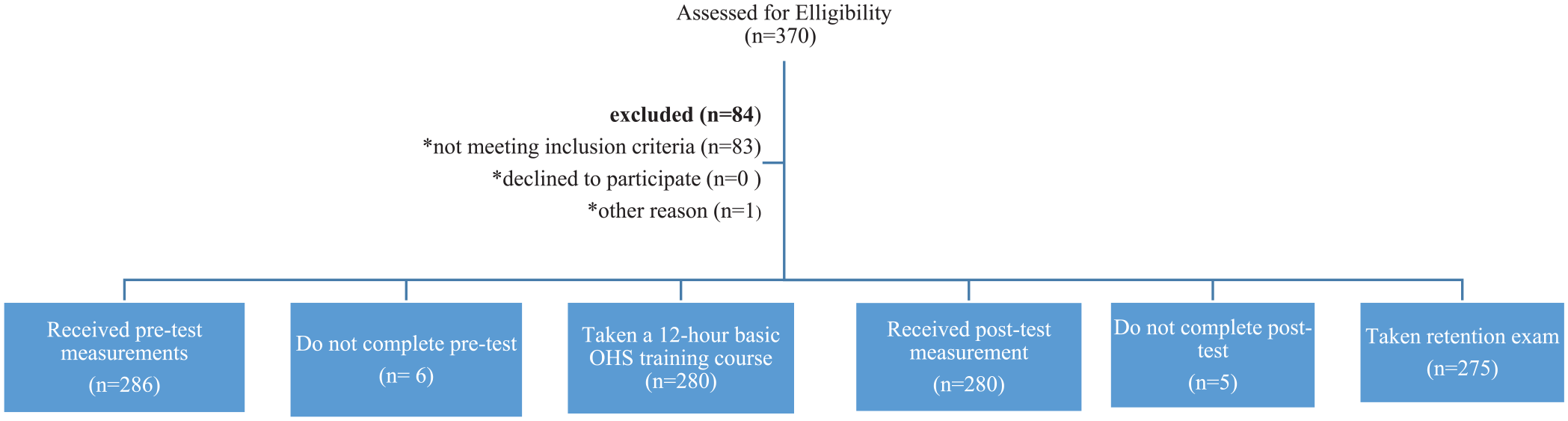
Subject inclusion schema.
Design of the Study
The relational survey model (quantitative research method) was used in this study. The relational screening method is used to determine the relationships between variables and to predict possible outcomes. The study attempts to measure the level of relationship between two or more variables through statistical tests. It was conducted to evaluate the effect of occupational safety training given to students in vocational schools (Cohen et al., 2018; Fraenkel et al., 2012). The independent variables in the research are gender and the students’ departments. Dependent variables are students’ OHS awareness levels and OHS achievement levels.
Data Collection Tools
An internal questionnaire consisting of 10-item survey with a 5-point Likert scale (Maximum point 50, minimum point 10) questions prepared to determine students’ OHS awareness was used as the data collection tool. Since there is no measurement tool with validity and reliability analysis to serve this purpose, such a questionnaire has been developed. An expert opinion was consulted for the validity of the questions. Again, an open-ended exam consisting of 20 technical questions was prepared by the second researcher to measure the success in OHS.
Student performance on open-ended exam was observed by simple rubric assessment to gather data about the students’ progress on a particular assignment or skill. All open-response data were exported, and the quality of the responses was assessed using the constructive feedback rubric to establish a numerical score (Table 1).
Rubric Assessment of Open-Ended Technical Exam.

Another OHS expert was consulted for the content validity of the questions. In addition, in order to determine the reliability of the measurement tool, the inter-rater reliability was determined by scoring the exam papers by two OHS experts (Cohen et al., 2018). The students’ exam scores were calculated by taking the average of these two scores.
Research Diary
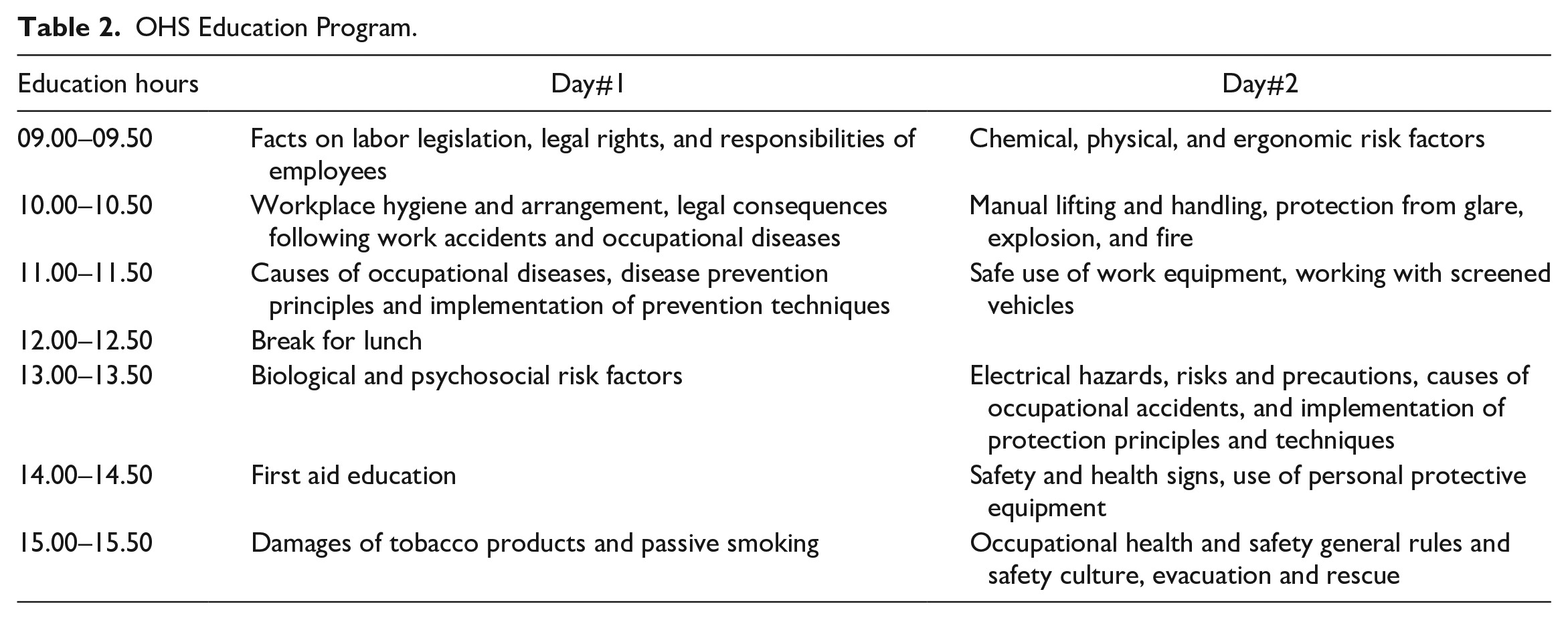
The research was conducted in a Vocational and Technical Anatolian School in Adana, with students studying in five different departments (Informatics, Electricity & Installation, Cartography, Construction and Engine) in the 2018–2019 academic year. Before the education was given in the research, pre-test measurements were taken by applying measurement tools to the students. Later, the students took a 12-hour basic OHS education course prepared by the researcher, who is an occupational safety specialist. The education was given in accordance with the Family, Labor and Social Services standards regulated by the Ministry of European Union of the Republic of Turkey for delivering education and training to health and safety of employees, which is given in Table 2. These were explained to students. After the education, the same measurement tools were applied to the students in the same way to assess the post-test results. Therefore, it was imperative to observe the differences in the students’ awareness and their knowledge levels on OHS. One month after the education, the same measurement tools were applied to the same students, and the retention levels in both awareness and success scores were measured. OHS knowledge is permanently stored in students’ long-term memories and can be successfully retrieved in a variety of circumstances. Retrieval based questionnaires in OHS education are the most effective way of permanent learning (Dunlosky et al., 2013). Carpenter et al. (2012) suggest that testing cycles should be spaced at 10% to 20% of the test delay. The data obtained were analyzed and interpreted through the SPSS program.
OHS Education Program.
Data Analysis
The data obtained in this study were analyzed through the SPSS 20.0 program (SPSS 20.0, IBM Inc., USA), which is licensed to the first author. First, the data obtained in the study were considered as normality assumptions. Since the sample size was larger than 30, Kolmogorov-Smirnov was preferred for the normality test. A p (significance) value higher than .05 in the Kolmogorov-Smirnov test shows that the analysis performed is significant. It shows that the data are distributed normally (Tabachnick et al., 2019). Since the normality test results for the pre-test, post-test, and retention exam scores of the participant students showed normal distribution, independent group t-test was applied to examine the changes between the scores of each exam.
The t-test is a parametric test used to analyze whether the difference between arithmetic means is significant when the data show a normal distribution. That the p (significance) value is less than .05 as a result of the t-test indicates that there is a statistically significant difference between the two averages. In this study, it was observed that the awareness questionnaire data of the students did not reveal a normal distribution. For this reason, the Wilcoxon Signed-Ranks Test, one of the non-parametric tests, was used for the analysis of the scores obtained from the questionnaire. The Wilcoxon Signed Rank Test (Wilcoxon Signed Rank Test) is designed for repeated measures. It is used when participants are evaluated over two situations or when two different situations are evaluated. The Wilcoxon converts scores into ranks and compares them with variables and can also be used in settings of a matched pair in which participants are matched on certain criteria.
Results
Normality tests were conducted to see if the data obtained from the measurement tools applied to the students provide the assumption of normality. The rationale has been derived for collecting data from only 275 students.
Since the sample size in the study was over 30, Kolmogorov-Smirnov was preferred as the normality test (p > .05). Normal distribution was observed only in open-ended exams. For this reason, parametric tests were used in the analysis of open-ended exams in this study. Since the data obtained from the awareness questionnaire were not normally distributed according to the test results, non-parametric tests were used in the analysis.
Amongst the 275 students participating in the study, 78.5% were males and 21.5% were females. As for their departments, 12.4% of the students studied in informatics, 24.7% in electricity/ installation, 15.6% in cartography, 36.4% in construction, and 10.9% in the engine department. While 76.7% of the students chose their departments voluntarily, 7.6% were placed at the request of their parents, 6.2% because their grades were sufficient, 4% with the recommendation of teachers, and 5.5% for other reasons (Figure 2). Among the 275 students, 10 students with special needs did not participate in every step of the pre- or post-measurements (Table 3).

Distribution of students by demographic characteristics.
Demographic Information of the Students With Special Needs Attending Occupational Health and Safety Educations.
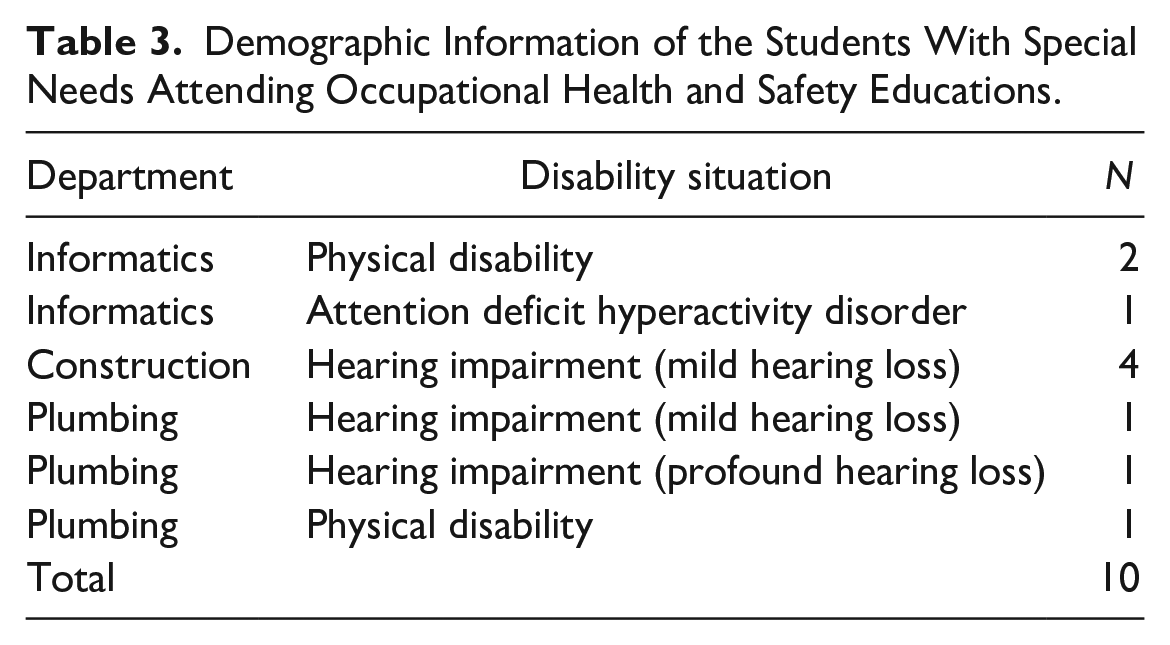
The students with special needs took part in inclusive education in three different departments of the school. When the pre-education awareness of the students was examined, it was determined that the statement with the highest score was “I think that education on occupational health and safety is necessary for schools,” “I think that education on occupational health and safety is necessary for schools” (
A Wilcoxon signed rank test revealed that the students’ attitude scores were significantly higher after the education (Md = 42.00, n = 275) compared to the scores before education (Md = 38.00, n = 275), z = −10.12, p = .000, with a medium effect size, r = .43 (Table 4).
Wilcoxon Signed Rank Test Results of Awareness Survey Scores for OHS.

Wilcoxon signed-ranks test.
Based on negative ranks.
Table 5 shows the comparison of the pre-test and the post-test scores on the OHS education open-ended exam. The difference between the average scores on the exams taken before and after the education by the students who participated in the occupational safety education was determined by conducting t-test for the related samples. There was a significant difference between the average of pre-test scores (
T-test Results Related to Open-Ended Exam Pre-Test and Post-Test Scores of Students Participating in OHS Education.

The difference between the post-test exam scores (

The percentage of increasing awareness of the students.
T-test Results Regarding Open-Ended Post-Test and Retention Test Scores of Students Participating in OHS Education.

It was determined that the pre-test scores of the occupational health and safety achievement test did not differ significantly according to the gender of the students (p > .05). Occupational health and safety achievement test post-test (t = 2.23; p < .05) and retention test (t = 2.91; p < .05) scores were found to differ significantly based on the students’ genders. The post-test and the retention test scores of male students were significantly higher than the scores of female students (Table 7).
Comparison of Open-Ended Exam Scores of Students Participating in OHS Education by Gender.

Occupational health and safety achievement test pre-test (F = 3.90; p < .05), post-test (F = 3.01; p < .05) and retention test (F = 5.91; p < .05) scores were found to differ significantly based on department variable. According to the LSD post-hoc test results conducted to determine the source of the difference between the groups, it is found that:
(1) Occupational health and safety achievement test pre-test scores of students studying in the map, construction, and engineering departments are significantly higher than those of the students studying in the informatics and electrical/installation departments.
(2) Occupational health and safety achievement test post-test scores of students studying in the construction and engineering departments are significantly higher than the scores of students studying in the informatics department.
(3) Occupational health and safety achievement test retention test scores of students studying in the departments of informatics, electricity/installation are significantly higher than the scores of students studying in the construction and engine departments.
Few students with special needs participated in OHS educations, but not all of them completed the awareness questionnaire. In addition, only one of 10 mainstreaming students participated in the achievement test measurement regarding the education they received. The pre-test success score average of the IT student with attention deficit and hyperactivity disorder was found to be
Discussion
After empowering the students with the OHS knowledge to cope with the dangers, they may encounter OHS in their workplaces. The effect of OHS education on the students’ awareness levels, knowledge levels, and their retention levels were measured, and the results were discussed accordingly. It is seen that there are more male students than females. Female students prefer Vocational and Technical Anatolian Schools less. The department with the highest number of students is the department of civil engineering, followed by the electrical engineering, mapping and surveying, informatics, and other engineering departments respectively. Considering that most of the students taking part in the OHS education were from the construction department and the construction activities are in the very dangerous category of the hazard class, it can be stated that the education served its purpose. Almost half of the total investments in Turkey are in the construction sector. The construction industry enables several subsectors in production. Therefore, construction department is the most popular department for students in Vocational Schools. OHS education in Vocational School settings has a deep impact on raising qualified workforce.
A significant difference is seen in favor of the final measurements between the students’ OHS awareness levels both before and after the education. The OHS education given to the students at school has achieved its purpose. Einarsdóttir and Snorradóttir (2020) found similar results to the questions they asked using a questionnaire similar to the one used in this study. A significant difference was found between the total pre-test and post-test scores of the students who participated in OHS education. This situation shows that applied occupational safety education has a significant effect on students’ occupational safety exam scores. It can be claimed that pre-job education increases success. Andersson et al. (2015) concluded in their study that on-the-job education was not very effective. A significant difference was found in favor of the post-test scores, although the post-test and the retention test scores are close to each other. There was also a significant difference between the post-test and the retention test total scores of the students. The permanence test success scores of the students was taken approximately 1 month after the occupational safety education and was slightly lower than the post-test scores, which can be explained by the possibility of forgetting some of the information. A recent study suggests that, in order to promote long-term retention of OHS knowledge, students should receive re-exposure to previously learned information. Particularly if the goal is long-term retention, it may be beneficial to review this information after a time of at least several weeks (Carpenter et al., 2012).
The open-ended test scores of the students taking part in the education differ significantly by gender in favor of male students only in the post-test and the retention test. The male students are more achievement oriented, whereas females are more socially and performance oriented. However, there was no significant difference between the genders in the pre-test scores. This result shows that students’ readiness levels were the same regardless of their gender (Wehrwein et al., 2007).
In Table 8, the highest scores in the open-ended post-test exam by the department are seen to be in the engineering, cartography, electrical/installation, construction, and informatics departments, respectively. Also, there was a significant difference between the scores of these departments. Considering the fact that the departments with the highest mean scores are in the very dangerous category according to the hazard classification in OHS, it can be said that the students have acquired OHS awareness and the OHS culture has spread among the students.
Comparison of Open-Ended Exam Scores of Students Participating in OHS Education by Department.

Moreover, only one student with special needs from the informatics department (the student with attention deficit and hyperactivity disorder) participated in every stage of the open-ended exam. It can be stated that this outcome stems from the fact that students are not given OHS education according to their disability. For the students with special needs, it is necessary to organize education according to their needs. It is then possible to hypothesize that an intervention, as intermittent workshops supporting the development of students with special needs at work, will also be effective.
Limits
The most important limit is the small sample size of students with special needs. Also, it would have been interesting to measure preventive behaviors of the students with special needs’ before participating in workshops, which was not possible because of the curriculum grid of the study programs. Future research projects should consider measuring the efficacy of such intermittent workshops for students with special needs conducting a randomized controlled trial with a large number of participants.
Although this study is innovative and pioneer about the OHS education in Inclusive Vocational Anatolian Schools, is the study is also limited to the small sample size from different departments. Indeed, only one Inclusive Vocational Anatolian School from Turkey took part in the study, which limits the generalizability of the results to other schools or OHS educations. Also, it would be interesting to measure preventive behaviors of the students’ previous to their participation in OHS educations, which was not possible because of the curriculum grid of the study programs. Finally, a measure of students’ knowledge about OHS education taken before and after the OHS education, and retention test after 1 month may have also allowed to get a baseline value and ensured the permanence of OHS education, enriching results coming from this study. To measure formally the efficacy of such OHS educations on students’ permanent learning performance, a randomized controlled trial could be conducted in a future research project.
Conclusions
The education given on occupational health and safety is extremely important. An accident or injury that may happen to a student or young worker can have irreversible consequences. When the pre-education awareness questionnaire expressions were examined in the study, the statement with the highest score was “I think that education given on occupational health and safety is necessary in schools”, which was mentioned by one participant. This result shows that students were aware of the necessity of occupational health and safety before participating in occupational health and safety education. The occupational health and safety education provided for students increased student success levels as desired. For this reason, it should be ensured that the level of occupational health and safety perception in students is constantly high by increasing the amount of education provided. Thus, the risk of an accident and injury to the student will be minimized.
In this study, it is concluded that it is important to educate students with special needs in inclusive-integrative education for occupational health and safety. Only some mainstreaming students who attended the education completed the relevant tests. This situation revealed the necessity of preparing educational contents suitable for the disability of the mainstreaming students in order to motivate them. In addition, the effectiveness of the education can be investigated by including different vocational schools such as Girls’ Vocational Schools of Health and Trade.
In conclusion, students in vocational schools have safety and health risks. Therefore, providing occupational health and safety education is effective in inclusive vocational schools. The education provided will keep students’ awareness of occupational safety constantly active in workplaces that are dangerous. In this way, accidents and injuries that could be experienced both during and after education will be prevented.
Footnotes
Declaration of Conflicting Interests
The author(s) declared no potential conflicts of interest with respect to the research, authorship, and/or publication of this article.
Funding
The author(s) received no financial support for the research, authorship, and/or publication of this article.
