




Abstract
Recently, there has been a plethora of studies about students’ attitudes toward the use of artificial intelligence (AI) technologies in education, particularly in higher education and language education; however, research on AI use in high school settings has gained relatively little attention, leaving a huge research gap in the literature. This study seeks to address this research gap by examining high school students’ attitudes toward using AI-powered tools in education in Cambodia. Utilizing evidence from an online survey with 315 students (female = 62.50%), the study showed that Cambodian high school students expressed generally favorable attitudes toward utilizing AI-powered tools in education, particularly pertaining to the use of AI to aid in completing school work. However, the study identified key concerns about data privacy and security issues, the risk of becoming over-dependent on AI, and limited originality about students’ work. It was also found that students tended to be less concerned with the potential reduction in their critical thinking and creativity skills, and the possibility of receiving false or incorrect responses from AI. Key opportunities of using AI in education were also identified, including the potential to assist students in learning languages and help them summarize texts, translate languages, and/or brainstorm ideas. The study underscored the significance of developing students’ AI literacy through training and awareness raising programs, and the importance of formulating comprehensive AI policies to promote the ethical and effective use of AI technologies in high school settings. The study concluded with some limitations and directions for future studies.
Keywords
Introduction
Technology has become an essential part of human’s day-to-day life (Kizilcec, 2024; Özçeliäk & Ekşi, 2024). With the advent of advanced technologies, there is the rise of artificial intelligence (AI), a term that has been initially coined in the 1950s (Mintz et al., 2023; Zawacki-Richter et al., 2019). AI has gained significant attention after the launch of chat generative pre-trained transformer (ChatGPT) in November 2022 by an AI company, called OpenAI. AI technologies have considerably permeated today’s world, and the field of education is no exception (Mogavi et al., 2024; Zhang & Tur, 2023). Research has indicated that AI technologies have significantly shifted education by offering better innovative pedagogical and assessment practices, given their impressively profound capacities to produce human-like texts with instantaneous, systematic, and timely outputs or responses tailored to individuals’ needs and preferences (Albadarin et al., 2024; Mogavi et al., 2024; Tang, 2024). AI technologies, for example, can be leveraged to assist in generating instructional materials, producing personalized learning, writing an email to reply to the students’ queries, and creating coding for research (Chiu, 2024; Chiu et al., 2023).
AI technologies have been typically utilized for varying activities in the realm of education, particularly in K-12 education settings, to provide greater support to teachers and students (Zhang & Tur, 2023). Specifically, AI-enabled technologies, such as ChatGPT, are capable of assisting and facilitating teachers in automatically creating lesson plans, drafting instructional assessments, establishing personalized content, designing individualized instructions, and engaging in continuous professional development (Chiu et al., 2023; Jauhiainen & Guerra, 2023; Mintz et al., 2023). With AI, teachers are enabled to support their students’ individual needs more efficiently and productively (Giannini, 2023; Jauhiainen & Guerra, 2023; Lo, 2023). Moreover, AI technologies have the potential to support students in optimizing their texts, reflecting on scientific practices, editing and proofreading texts, and preparing for exams (Marx, 2023; von Garrel & Mayer, 2023). Notably, these state-of-the-art technologies are also commonly used as personal virtual tutors to assist students, particularly non-native English users, in learning and enhancing their English language through receiving immediate and consistent feedback for enhancement, accelerating learning motivation, adapting and simplifying written texts, and brainstorming ideas for different types of writing (Mohamed, 2024; Pang et al., 2024; Sol & Heng, 2024; Zou et al., 2023).
Despite these significant advantages regarding the adoption of AI-enabled tools in education, there have been notable risks and challenges surrounding irresponsible and unethical uses, privacy and security, and ethical issues, as indicated by a growing body of research (Akgun & Greenhow, 2022; Holmes, 2023; Tlili et al., 2023; Zhai et al., 2021). As Tlili et al. (2023) argued, there is no general agreement regarding the emergence of groundbreaking AI-powered tools, like ChatGPT, as a future opportunity or shortcoming. Specific concerns of employing AI in education included too much dependance on AI technologies, leading to decline in the development of critical thinking, creativity, and problem-solving skills (Holmes, 2023; M. Liu et al., 2023; Mogavi et al., 2024), decrease in interaction among teachers and students (Mintz et al., 2023; Othman, 2023; Zhang & Tur, 2023), potential breaches of academic honesty, such as cheating and plagiarism (Lee et al., 2024; M. Liu et al., 2023; Zhang & Tur, 2023), and falsified or superficial responses which negatively impact the study quality (Ngo, 2023). In this context, it is imperative to ensure that both students and teachers are introduced to ethical challenges that may arise while using AI for educational activities by offering a series of professional training and learning resources (Akgun & Greenhow, 2022; Miao & Holmes, 2023).
While a proliferation of studies has been conducted globally on leveraging AI-powered tools in education, there remains a notable research gap in developing contexts, such as Cambodia (Pum & Sok, 2024; Sok & Heng, 2024b; Sol et al., 2024). A review article conducted by Pum and Sok (2024) showed that most of the articles on AI use in Cambodian education were opinion pieces, online newspapers, commentaries, and reports, with the exception of studies by S. Heng (2023) and Sol et al. (2024) that involved empirical data. Pum and Sok (2024) called for more empirical research on the use of AI in Cambodian education to address the knowledge gap, particularly regarding the perceptions of Cambodian students toward the adoption of AI in education.
Against this background, this study aims to bridge the research gap by investigating Cambodian high school students’ attitudes toward leveraging AI-powered tools in education. The study contributes to the scholarly and general discourse over the use of AI in education, particularly in the high school context where there is limited research investigating students’ attitudes toward AI use. The study seeks to address the following three research questions.
1. What are Cambodian high school students’ attitudes toward the use of AI in education?
2. What are Cambodian high school students’ perceived challenges of using AI in education?
3. What are Cambodian high school students’ perceived opportunities of using AI in education?
Literature Review
The Use of AI in Education
Recently, a growing body of research has indicated that AI-enabled tools are widely employed to promote self-regulated learning, as they are capable of providing personalized learning that caters to students’ and teachers’ needs (Albadarin et al., 2024; Sol et al., 2024; von Garrel & Mayer, 2023; Wood & Moss, 2024). A systematic review of 14 empirical studies across varying levels of education on the use of ChatGPT by Albadarin et al. (2024) found that this AI tool was leveraged in various ways, including as an online innovative assistant (explaining sophisticated concepts or topics with immediate and high-quality feedback), a language and writing supporter (brainstorming ideas, summarizing, and checking grammatical errors), and a key resource for students’ autonomous learning (offering them self-paced learning with exposure to a wide range of helpful sources of information). ChatGPT was also used to help students by facilitating and fostering individualized learning, as well as enabling them to better understand how to do homework and assignments, and offering systematic study guides, thereby developing students’ overall knowledge and skills and fostering their study success (Albadarin et al., 2024). It was nonetheless found that students’ collaborative learning capacities and innovative abilities may be negatively influenced by excessive utilization of this sophisticated AI tool.
In addition to accelerating students’ learning and development, AI tools can be leveraged for teaching and assessment innovation (Labadze et al., 2023; Sok & Heng, 2024a; Sol et al., 2025; Wood & Moss, 2024). Research has indicated that AI systems are being leveraged to foster engagement among students and enable automatic support through conversational functions (Martin et al., 2024). Sok and Heng (2023), for example, argued that AI-enabled tools, such as ChatGPT, are utilized to design engaging and interactive materials and lesson plans to promote teaching engagement within the classroom, possibly leading to improved learning outcomes. Moreover, despite some possible risks of AI’s superficial or inaccurate outputs, teachers also employed AI-powered tools, like ChatGPT, to design learning assessments that cater to modules’ aims and objectives as well as students’ learning needs (M. Liu et al., 2023). These advanced AI tools can also be deployed to aid teachers in assessing and marking students’ work, resulting in the enhancement of grading consistency with detailed and helpful feedback and the reduction of teachers’ workloads, thereby saving their time and effort (Holmes & Tuomi, 2022; Ma et al., 2020; Martin et al., 2024). Thus, it is evident that AI-powered tools, when properly leveraged, are capable of revolutionizing conventional teaching–learning approaches, leading to increased productivity, innovation, and convenience for students and teachers.
Challenges of Using AI in Education
Research has shown that the adoption of AI-enabled tools in education presents a number of challenges (Ahmad et al., 2023; Elsayed, 2023; Miao & Holmes, 2021; Mogavi et al., 2024). Indeed, the current accessibility of AI-powered tools can be utilized for academic work or writing assignments, potentially impeding human decision-making and critical thinking skills (Elsayed, 2023), limiting students’ ability to develop independent thinking (Kooli, 2023), and decreasing students’ learning engagement (Ahmad et al., 2023; Sarwanti et al., 2024). AI may not fully grasp the nuances of certain subjects, making it unable to provide the depth of analysis and critical thinking that humans can (Farrokhnia et al., 2023; Haleem et al., 2022). It was found that scripted and standardized AI support could limit students’ capacity to learn effectively, limit their critical thinking skills, and affect their ability to cope with problems independently (Çela et al., 2024; Seo et al., 2021). It was also found that too much support from AI technologies could restrict teachers’ options for exploration and discovery, which are essential for their growth and development (Seo et al., 2021). Likewise, excessive dependence on these advanced technologies in educational systems might lead to students’ lack of engagement in learning (Sevnarayan & Potter, 2024; Song & Song, 2023). Moreover, AI use may exacerbate educational inequality, as these intelligent tools could be employed by some students to complete their academic work, while others may not have this opportunity (Ahmad et al., 2023; Cheng, 2023; Kooli, 2023).
As AI technologies continue to evolve in education, their use for search results has brought legal concerns, given the potential illegal and unethical use of data (Jodha & Bera, 2023; Zirpoli, 2023). Such unethical and irresponsible use can result in instances of academic misconduct (Akgun & Greenhow, 2022). As private governance of AI has increased, with developers imposing normative systems without user consent and consideration of data privacy and information security (Carmody et al., 2021; Miao & Holmes, 2021), there is greater potential for misuse of personal data when teachers and students interact with AI chatbots (Tlili et al., 2023).
Moreover, although AI-driven tools can quickly generate human-like outputs, it is questionable about their accuracy and reliability (Chan & Hu, 2023; Haleem et al., 2022; Sarwanti et al., 2024). While conflicts between students and teachers may arise due to AI-based misunderstandings or misleading information, which could ultimately hinder the learning experience for both parties, students are also concerned that AI may provide false answers and consequently damage their grades if they rely too heavily on it for help with assignments and exams (Seo et al., 2021). These advanced technologies can sometimes generate incomplete answers and meaningless explanations, which may negatively impact students, particularly young learners (Tlili et al., 2023). In particular, because AI-generated and human-written texts are of challenge to differentiate (Kreps et al., 2022), misleading information is easily accessible, potentially resulting in significant effects on human’s beliefs, especially when it contradicts prior knowledge (Pillai & Fazio, 2021).
Opportunities of Using AI in Education
Despite the various challenges discussed above, AI has provided students worldwide with a variety of opportunities (Crompton & Burke, 2024; Darwin et al., 2024; Khalifa & Albadawy, 2024; Schmohl et al., 2020). The integration of AI writing tools, for example, can prove beneficial in elevating the quality of student writing (Marzuki et al., 2023) and writing organization (Marzuki et al., 2023; Strobl et al., 2019). Song and Song (2023), for example, found that students who received AI-assisted instruction had significant improvements in both writing skills (e.g., coherence, organization, grammar, and vocabulary) and motivation compared to those who did not. Likewise, Khalifa and Albadawy (2024) showed that AI-enabled tools can enhance content quality, optimize methodologies, and process large data sets for comprehensive analysis. By using AI-based writing assistance, students could learn to take the teacher’s perspectives and could better anticipate how a good academic text should be structured, allowing them to minimize common mistakes (Schmohl et al., 2020).
AI-driven tools also have the potential to support personalized learning which is an educational approach that aims to customize learning for each student’s strengths, needs, skills, and interests (Crompton & Burke, 2024; Somasundaram et al., 2020). AI technologies can indeed be used to analyze student’s individual strengths and weaknesses, fostering comprehension and retention (Seldon et al., 2020; World Economic Forum, 2024). Extant research has shown that individualized tutoring improved student learning outcomes (Nickow et al., 2020; Robinson, & Loeb, 2021) and engagement and satisfaction (Das et al., 2023). AI technologies can also help tailor learning experiences, benefiting students with diverse needs and abilities (Chen et al., 2020; World Economic Forum, 2024). In addition, AI language learning tools could enhance efficiency and speed by automating tasks, providing personalized experiences, and offering immediate feedback, enabling learners to improve their skills faster (De la Vall & Araya, 2023; Xie et al., 2019).
It has been reported that enabling students to complete their take-home assignments and fostering creativity and problem-solving skills were among the key benefits that students received while employing AI-enabled tools in education, particularly in K-12 settings (Krecar et al., 2024; Marrone et al., 2022; Walan, 2024). A study investigating students’ perceptions of using ChatGPT for their academic assignment revealed that the majority of the students found ChatGPT beneficial for their homework (Kanabar, 2023), since this AI chatbot could offer concise explanations, suggest relevant resources, and produce practice and exam questions that are predicated on the students’ prior knowledge (Labadze et al., 2023; Yang et al., 2024). Students could also use AI tools like ChatGPT to complete assignments, including finding content that interests them, doing a deeper examination of a subject, and drafting written assignments such as essays (Krecar et al., 2024). Darwin et al. (2024) showed that AI-powered tools can be an asset in the development of critical thinking skills. These advanced AI tools could also offer unique viewpoints and suggestions that students may not have considered on their own. This resulted in a more diverse range of ideas being explored, ultimately leading to more innovative and creative outcomes (Habib et al., 2024). In addition, AI tools can help students brainstorm ideas and summarize texts, making it easier for them to comprehend and retain information (Wieland et al., 2022; Yang et al., 2023).
Research into Students’ Attitudes Toward the Use of AI in Education
Research from diverse geographical and socioeconomic areas on students’ attitudes toward leveraging AI-powered tools in education tend to show positive attitudes (Ajlouni et al., 2023; Baidoo-Anu et al., 2024; Y. Liu et al., 2024; Vo & Nguyen, 2024; von Garrel & Mayer, 2023). A recent study by Y. Liu et al. (2024) employing data from interviews (n = 12) and a questionnaire survey (n = 475) in China, for example, revealed that despite risks of using AI-enabled tools in academic communication, students tended to exhibit generally positive attitudes toward the utilization of AI tools, particularly regarding the language learning aspects, including grammar, writing, reading, and vocabulary. Tlili et al. (2023) who analyzed 2,330 tweets of different users on the adoption of ChatGPT in educational settings found that the participants demonstrated generally positive attitudes toward ChatGPT for educational activities.
A nationwide survey involving 6,300 university students from a range of disciplines in Germany by von Garrel and Mayer (2023) showed that 63.4% of the students experienced using AI-powered tools, such as ChatGPT, for their learning activities. The study also indicated that the students leveraged these AI-enabled tools in varying approaches mainly depending on their field of study. In particular, social science students utilized these advanced tools for doing research and literature review, translating texts, and generating texts, while engineering students leveraged these sophisticated tools to do research, translate texts, and assist in decision-making and problem-solving. Similarly, Abdaljaleel et al. (2024) who explored the factors contributing to students’ attitudes and utilization of the AI-powered tool across Arab countries involving Kuwait, Egypt, Iraq, Jordan, and Lebanon (n = 2,240) found that the students held positive attitudes toward the use of ChatGPT.
Vo and Nguyen (2024) examined Vietnamese students’ perceptions (n = 369) regarding the utilization of AI-enabled tools, like ChatGPT. It was found that over 60% of the participants expressed a positive attitude toward using ChatGPT for learning English. It was also noted that AI-enabled tools, like ChatGPT, played a significant role in supporting students in terms of giving resourceful materials or comprehensive guidelines for practicing English language, offering good clues for reading comprehension, and generating outputs or ideas for academic work (Vo & Nguyen, 2024). Similarly, Othman (2023) explored English students’ awareness, perceptions, and attitudes toward the use of AI chatbots in Saudi Arabia (n = 75). It was found that the students were aware of the values of using AI chatbots in English language learning, and most of them expressed a positive belief about the employment of chatbots to enhance their English skills. Overall, students from different educational and geographical contexts tended to hold generally positive views regarding the adoption of AI-powered tools in education.
The Use of AI in Cambodian Education
While the use of AI-enabled tools in education has received increasing attention, particularly in the Global North, such a phenomenon has received relatively little attention in developing contexts such as Cambodia. Pum and Sok (2024) noted that empirical research into AI use in the Cambodian context is relatively limited. The Ministry of Industry, Science, Technology & Innovation ([MISTI], 2023) emphasized the importance of using AI in enhancing Cambodian education by suggesting the inclusion of AI-related courses and programs in the school curriculum starting from elementary schools. MISTI also highlighted the need to train teachers to facilitate AI-related courses and establish an educational policy that supports lifelong learning. However, the growing use of AI in Cambodian education, particularly higher education, has posed major concerns about its ethical use. Sok and Heng (2024b) discussed the issue of academic misconduct resulting from AI misuse. They called for policymakers and academic leaders to create new academic integrity policies or revise existing ones to navigate the unethical use of AI in Cambodian higher education.
A few empirical studies have examined the use of AI in Cambodian higher education, focusing on the perceptions and experiences of English-majored students (Sol et al., 2024) and the experiences of university teachers and students (S. Heng, 2023). Based on their survey, Sol et al. (2024) found that Cambodian English as a Foreign Language (EFL) university students widely used AI tools in English language education. Many of them, nonetheless, had not received any training on how to ethically and effectively utilize AI tools. It was also found that students expressed their concerns about data privacy and security, limited interactions among humans, and inaccurate AI-generated content (Sol et al., 2024). S. Heng (2023) revealed, from lecturers’ perspectives, that AI-powered tools, such as ChatGPT, were beneficial for students. It was also found that university lecturers believed that Cambodian university students should use AI-powered tools or applications to ask for feedback, help with tasks and homework, and conduct general information searches. However, there were concerns about the reduction in students’ critical thinking and the rise of academic misconduct (S. Heng, 2023).
With the exception of these few studies, there exists a significant research gap when it comes to attitudes toward AI, particularly in high school settings. Therefore, the present study aims to address this knowledge gap by examining Cambodian high school students’ attitudes toward leveraging AI-powered tools in education. It also explores the challenges and opportunities perceived by high school students when it comes to AI use in education. This study is useful in that it provides a comprehensive understanding of high school students’ attitudes toward the use of AI in education in a developing country. It also offers insights into similar research in K-12 education contexts which remain limited in the international literature (Yusuf et al., 2024). Such important insights can inform policymakers and instructional designers to reflect on the ethical and effective integration of AI use in high school settings and enhance students’ learning experiences in the world of AI by adjusting pedagogical practices and redesigning instructional materials.
Research Methods
Research Design
This study adopted an internet-based survey using Google Forms as part of a quantitative design (Cohen et al., 2018). It aimed to investigate Cambodian high school students’ attitudes toward the adoption of AI-powered tools in education. Cohen et al. (2018) argued that an internet-based survey offers more benefits than those of its counterparts (e.g., face-to-face, telephone, or paper surveys). In particular, not only does the internet-based survey or e-survey provide convenience and cost savings, but it also enables researchers to reach a large number of participants with a wide range of geographical areas while reducing the amount of time to distribute (Cohen et al., 2018). This study design and data collection tools are, therefore, suitable for this research.
Research Setting
The study took place in Cambodia, involving participants from the capital city and provinces across the country. Cambodia is a developing country bordering Vietnam, Thailand, and Laos. It has 24 provinces and one capital city, called Phnom Penh. Figure 1 shows the map of Cambodia in the context of Southeast Asia. It envisions becoming an upper-middle-income country by 2030 and a high-income country by 2050. It also aspires to develop into a knowledge-based society (K. Heng, 2024). Cambodia is trying to promote digital education and has been introducing reforms to its education system to improve its quality, both in general and higher education (K. Heng, 2021; MoEYS, 2023). According to the Education Congress report (MoEYS, 2023), in the school year 2022 to 2023, there were 571 public and 245 private high schools, and there were 401,605 high school students (54.41% were females).

Map of Cambodia.
Sample and Sampling Strategy
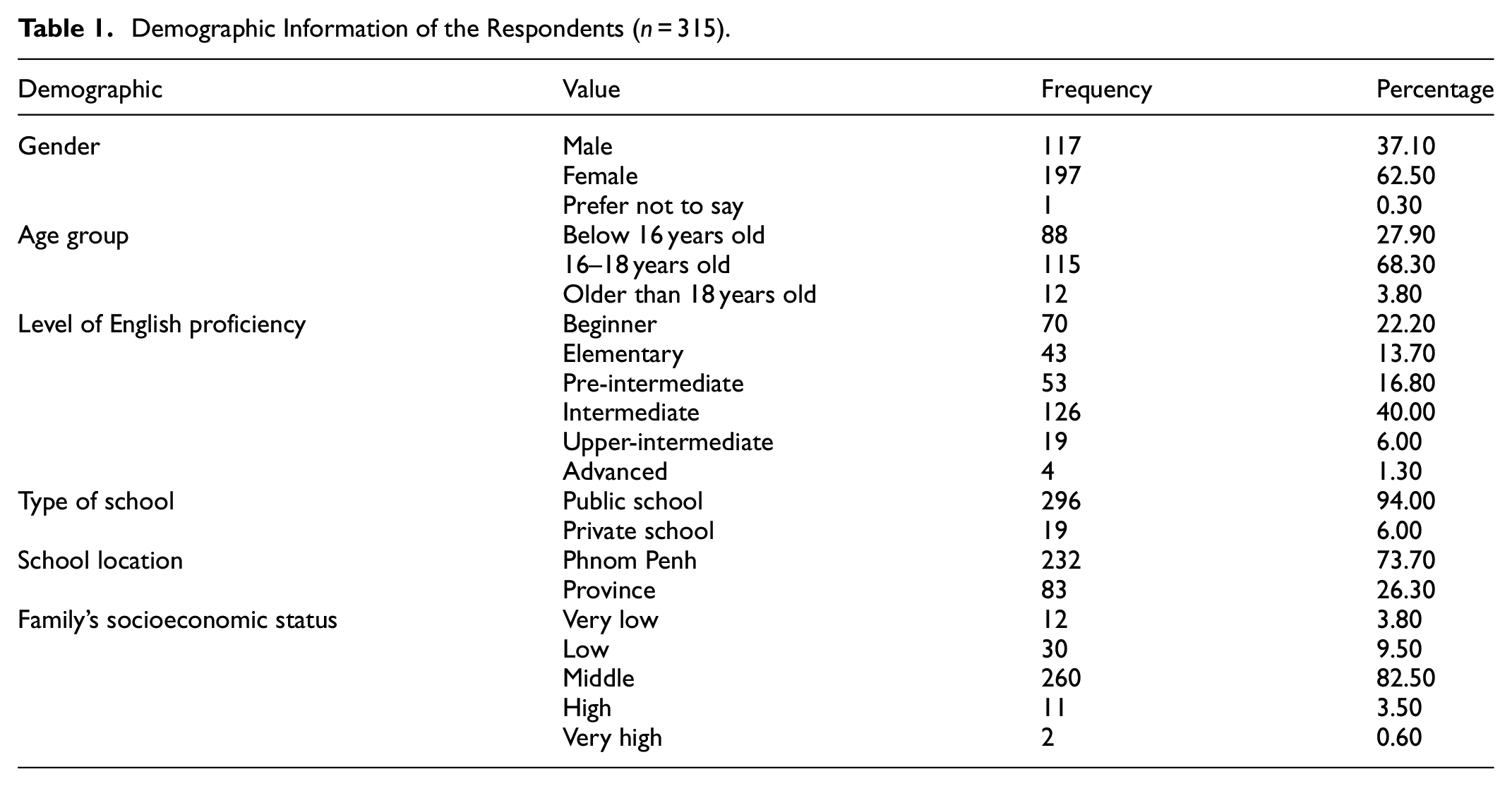
A simple and convenient random sampling was used to select the participants for the study. The participants in this study were Cambodian high school students from grade 10 through 12 selected via their voluntary responses to an online survey. There were a total of 315 (female = 62.50%) anonymous and voluntary responses to the survey. The age distribution of all the participants was diverse, ranging from below 16 to over 18, with the age group of 16 to 18 being the most (68.30%). Regarding their English proficiency, almost half of the participants (40.00%) were at an intermediate level, and 22.20% were beginners. The other participants’ English levels were pre-intermediate (16.80%), elementary (13.70%), upper-intermediate (6%), and advanced (1.30%). Moreover, a vast majority of the participants (94.00%) were from public schools while only 6.00% were from private schools. Almost three-quarters of the participants (73.70%) were from Phnom Penh, whereas about one-quarter of them (26.30%) were from the provinces. Most participants (82.50%) reported to be from a middle socioeconomic family status, followed by a low status (9.50%), very low status (3.80%), high status (3.50%), and very high status (0.60%). Table 1 provides demographic information of the respondents.
Demographic Information of the Respondents (n = 315).
Research Instruments
The survey questionnaire was designed in both Khmer and English to provide the participants with ease of understanding of the questionnaire items. The questionnaire was developed by the first author and was reviewed and improved by the second and third authors. All authors possess extensive experience in the education field, including in high school settings. All authors reviewed the questionnaire to ensure its validity, reliability, comprehensiveness, and ease of understanding. The development of the questionnaire was informed by several studies, including Ajlouni et al. (2023), Baidoo-Anu et al. (2024), Ngo (2023), Pum and Sok (2024), and Sol et al. (2024). In particular, Baidoo-Anu et al. (2024) and Ngo (2023) informed the questionnaire items regarding Cambodian high school students’ attitudes toward the use of AI in education. In addition, findings from these two studies along with those of Ajlouni et al. (2023), Pum and Sok (2024), and Sol et al. (2024) informed items about perceived challenges and opportunities of the use of AI in education.
The questionnaire comprised four sections, focusing on the participants’ general information, their attitudes toward the use of AI-powered tools in education, perceived challenges of utilizing AI, and perceived opportunities of using AI. The first section examined the participants’ gender, age, grade, level of English proficiency, current school types, school location, and family socioeconomic statuses. The second section contained 12 question items using a five-option-Likert scale from 1. Strongly disagree to 5. Strongly agree. The third and fourth sections each consisted of 10 question items using a 5-point Likert scale. They examined the challenges and opportunities of using AI in education, respectively.
Data Collection and Analysis
The questionnaire was administered online using Google Forms. To ensure the validity and reliability of the questionnaire, a pilot test was conducted with 10 students. The purpose was to gather feedback to improve the questionnaire, particularly in terms of ease of understanding, and ensure internal consistency of the questionnaire items. As noted, an acceptable Cronbach’s alpha score for internal consistency is 0.7 or greater. After the pilot test, an internal reliability analysis was conducted, yielding the Cronbach’s alpha scores for each key construct, such as attitudes toward using AI in education (12 items), perceived opportunities of using AI (10 items), and perceived challenges of using AI (10 items) to be 0.92, 0.95, and 0.92, respectively. This indicates excellent internal consistency across all 32 questionnaire items.
After the pilot test, some wordings and Khmer translations in the questionnaire were revised to enhance ease of understanding. The questionnaire was distributed via social networking sites, including Telegram groups and channels, Messenger, and Facebook pages. The researchers also asked their friends and colleagues who are working in high school, particularly teachers, to share the survey link with potential student participants. The goal was to reach prospective participants from diverse geographical and socioeconomic backgrounds across Cambodia.
In this study, the Statistical Package for the Social Sciences (SPSS) version 21 was employed for data analysis. The data collected via Google Forms were transferred to Microsoft Excel for cleaning and coding. The cleaned data were then imported into SPSS for analysis. The analysis focused on frequency, percentages, means, and standard deviations. As the goal of this research was to examine students’ general attitudes toward the use of AI in education as well as the perceived challenges and opportunities regarding AI use in education, no inferential statistics were used to investigate relationships between variables.
Ethical Considerations
This study was undertaken in line with general ethical standards. All the participants voluntarily participated in the study by completing the online survey. We assured the participants that all information related to their identities (e.g., names, email addresses, affiliations, and phone numbers) were not collected to ensure anonymity of their participation. In the survey, we explicitly stated that by filling the questionnaire, the participants offered us the consent to employ the data for research and publication purposes. The participants were also informed in the questionnaire that they have the full right to withdraw from the study at any time without having to provide any reasons. Although permission from the students’ parents was not sought due to the anonymous nature of the participation, permission from the students’ teachers and school administrators was granted before the administration of the questionnaire.
Findings
The following sections present the main findings in response to the three research questions focusing on high school students’ attitudes toward AI use, their perceptions about the challenges of using AI, and opportunities of using AI in education.
Table 2 illustrates the participants’ level of agreement with 12 statements about the students’ attitudes toward using AI-powered tools in education. Overall, the participants had generally positive attitudes toward leveraging AI tools in education (M = 3.39, SD = 0.98), with nearly half of them either agreed or strongly agreed with the statements. Specifically, the participants tended to believe that the use of AI-powered tools could potentially assist them in school exercises, such as mathematics, English, physics, and chemistry (M = 3.60, SD = 1.03), and they believed that using AI tools was a wise choice in the future (M = 3.54, SD = 0.90). In addition, they were likely to agree that they were enthusiastic about learning how to use AI tools (M = 3.48, SD = 0.83), would continue using AI tools for learning purposes (M = 3.47, SD = 1.07), thought that using AI tools was important for their study (M = 3.45, SD = 1.01), believed that AI tools were crucial for their academic success (M = 3.44, SD = 1.01), and believed that AI tools could enable them to enhance their study performance (M = 3.43, SD = 0.96). Moreover, they moderately agreed that it was not difficult to learn how to use AI tools (M = 3.34, SD = 0.98), using AI tools was fun and interesting (M = 3.34, SD = 1.04), using AI tools could produce better outcomes than not using it (M = 3.34, SD = 1.00), and using AI tools was typical among their classmates and school friends (M = 3.24; SD = 0.95).
Cambodian High School Students’ Attitudes Toward Using AI in Education.
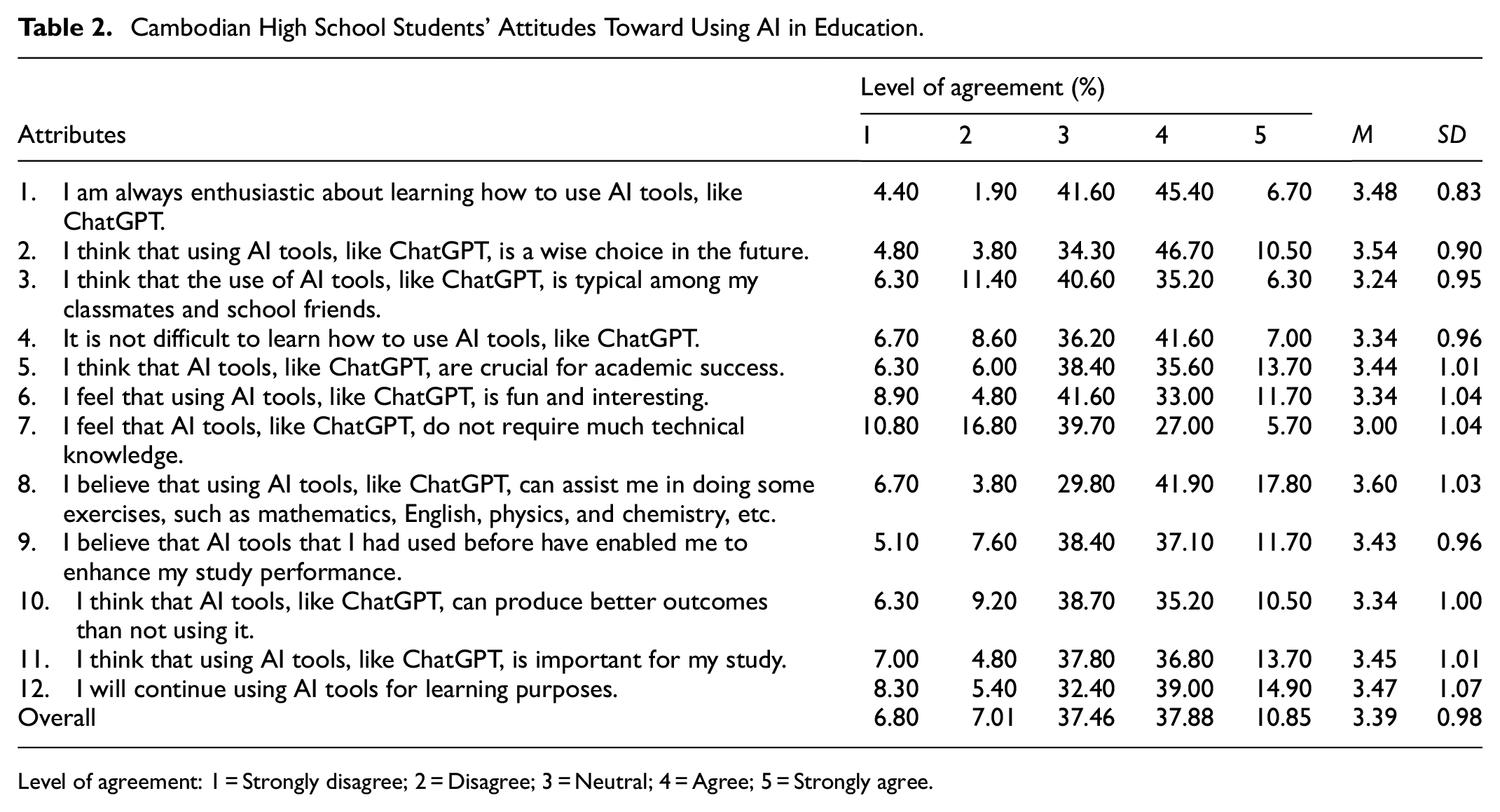
Level of agreement: 1 = Strongly disagree; 2 = Disagree; 3 = Neutral; 4 = Agree; 5 = Strongly agree.
Table 3 presents the participants’ level of agreement with 10 statements about the challenges of using AI in education. The participants exhibited a moderate agreement with the statements on the challenges of AI use in education (M = 3.20, SD = 1.01). They moderately agreed that AI tools could pose potential privacy and security risks (M = 3.27, SD = 1.04) and that using AI lead to over-reliance on AI tools (M = 3.27, SD = 1.06). Moreover, they tended to moderately agree that using AI tools could lead to a lack of originality in their assignments, homework, and other tasks (M = 3.25, SD = 1.00), risks of being accused of plagiarism (M = 3.24, SD = 1.02), risks of academic integrity issues (M = 3.22, SD = 0.99), issues of having biased learning assessment among their classmates (M = 3.20, SD = 1.00), and a lack of human interaction (M = 3.20, SD = 1.02). They also had moderate agreement with statements related to having fear of reducing their critical thinking and creativity skills (M = 3.12, SD = 0.99), having limited trust in AI (M = 3.12, SD = 1.00), and receiving false or incorrect responses produced by AI tools (M = 3.10, SD = 1.01).
Perceived Challenges of Using AI.

Level of agreement: 1 = Strongly disagree; 2 = Disagree; 3 = Neutral; 4 = Agree; 5 = Strongly agree.
Table 4 provides insights into the participants’ views on the opportunities of using AI tools or applications in education. The participants, on average, tended to agree with the 10 statements, indicating a positive attitude toward the role of AI-enabled tools in education (M = 3.65, SD = 0.92). The highest level of their agreement was, nonetheless, with the statement related to the usage of AI to assist in learning languages, such as English, easily and quickly (M = 3.80, SD = 0.93), followed by the assistance of AI in summarizing texts, translating languages, and/or brainstorming ideas (M = 3.72, SD = 0.91), saving time and effort to complete homework or assignments on time (M = 3.67, SD = 0.91), and making the learning process more convenient (M = 3.66, SD = 0.91). The participants were also likely to agree that AI-powered tools could help them simplify by explaining in detail about difficult terms, concepts, and topics (M = 3.66, SD = 0.98), offering a good source of information for their homework or assignments (M = 3.63, SD = 0.90), supporting to better understand difficult exercises, homework, or assignments (M = 3.63, SD = 0.93), and helping to enhance overall study performance (M = 3.63, SD = 0.89). They were also likely to agree that AI-powered tools could be a good virtual tutor that helps them whenever they need help (M = 3.53, SD = 0.88) and helps them improve creativity and problem-solving skills (M = 3.52, SD = 0.92).
Perceived Opportunities of Using AI.

Level of agreement: 1 = Strongly disagree; 2 = Disagree; 3 = Neutral; 4 = Agree; 5 = Strongly agree.
Discussion
This study has revealed that Cambodian high school students had broadly favorable attitudes toward the use of AI technologies in education, especially with regard to AI use to assist in completing their school work in various subjects (e.g., English, mathematics, chemistry, and physics). However, there is a need to interpret these findings with caution, given that students’ enthusiasm toward AI use may not reflect their deep learning engagement, and thereby suggesting the need for future investigation on the correlations between students’ AI enthusiasm and learning engagement. This study’s findings are generally aligned with empirical evidence from previous research in international contexts, including in Vietnam (Vo & Nguyen, 2024), China (Y. Liu et al., 2024), Arab countries such as Jordan, Kuwait, Egypt, Iraq, and Lebanon (Abdaljaleel et al., 2024), Germany (von Garrel & Mayer, 2023), and Saudi Arabia (Othman, 2023). Despite the difference in educational settings (high school vs. university), the findings of this study are also in agreement with studies by S. Heng (2023) and Sol et al. (2024) who investigated attitudes and experiences regarding the use of AI among Cambodian university students and lecturers. This study, for instance, corroborated Sol et al. (2024) who found that Cambodian university students had positive attitudes toward the use of AI-enabled tools to facilitate learning. Despite being aware of the concern associated with issues of academic honesty or unethical use of AI tools, most students perceived AI-powered tools, like ChatGPT, to be useful for their learning (Sol et al., 2024).
This study has also indicated that Cambodian high school students had moderate agreement with the challenges regarding the use of AI tools in education. They tended to be more concerned with the challenges related to the potential threat of data privacy and security and the possibility of becoming over-dependent on AI-assisted tools. These findings support the general concern in the literature about the issues of data privacy and security when using AI tools (Akgun & Greenhow, 2022; Chan & Hu, 2023; Sol et al., 2024; Tlili et al., 2023; Zirpoli, 2023). The concern will likely exacerbate, as there have been increasing private governance of AI technologies, in which AI developers appear to impose prescriptive systems on users without their consent (Carmody et al., 2021; Miao & Holmes, 2021), and there is growing concern about the issues of data privacy and protection awareness amid the increasing use of digital technologies (Bélanger & Crossler, 2011; Hallinan et al., 2012). As Tlili et al. (2023) argued, the data that users interact with AI technologies are usually recorded, viewed, and utilized, potentially leading to violation of privacy laws. This study also showed that Cambodian high school students seemed to be concerned about becoming excessively dependent on AI-assisted tools. This result is in line with what has been discussed in previous research in different contexts (Baidoo-Anu et al., 2024; Lin & Chen, 2024; Sok & Heng, 2024a).
It is important to highlight that Cambodian high school students tended to be less concerned about the fear of reducing critical thinking and creativity skills, and receiving false or incorrect responses produced by AI tools. This finding is interesting and could be explained by the limited understanding among high school students about the negative impact of over-reliance on using AI technologies, as well as the fact that they had limited understanding of the issues concerning AI that may stem from a lack of training and awareness raising on the ethical and effective use of AI in the Cambodian context (Sol et al., 2024). This finding provides important implications for policymakers and practitioners about AI literacy training and awareness raising to ensure that students are well aware of the issues concerning the use of AI tools to assist them in their learning.
Regarding the opportunities of utilizing AI tools in education, this study has shown that Cambodian high school students had positive attitudes toward AI and its role in education, particularly in assisting them in translating texts, brainstorming ideas, summarizing texts, and completing assignments. These results corroborate the findings of previous studies such as Chan and Hu (2023), Sarwanti et al. (2024), Sol et al. (2024), and Zou et al. (2023). Sarwanti et al. (2024), for example, showed that Indonesian university language students perceived ChatGPT as beneficial for supporting their writing, boosting productivity, brainstorming ideas, personalizing learning, and providing supplementary resources. Sol et al. (2024) also found that Cambodian university students were likely to use AI-enabled tools to support their English language study and research.
Conclusion
This study has investigated high school students’ attitudes toward the use of AI-powered tools in education. While the study found that Cambodian high school students had generally positive attitudes toward the use of AI-enabled tools, they were concerned about the issues of data privacy and security, the risk of becoming over-reliant on AI, and the lack of originality in their academic work. This study suggests the a need for stakeholders in Cambodian education to collectively work to find effective approaches to tackle these concerns while empowering the use of AI in school settings. The study has also shown that AI tools have the potential to assist in learning and completing other important academic tasks. Thus, AI use should be encouraged rather than banned; however, it is important to develop clear AI policies to manage the ethical and responsible use of AI among students.
This study has a few limitations. One limitation lies in the fact that most participants were from public schools in the capital city, which limits the generalizability of the findings. Therefore, future research should include a more diverse sample that can offer more nuanced perspectives on the experiences and attitudes toward AI. Future studies should also focus on investigating the attitudes of high school students in the provinces across Cambodia, as the perspectives of these students are generally neglected in research (K. Heng, 2024). Furthermore, given the nature of self-reported data, this study’s findings might be influenced by biases, which may weaken their credibility. To address this limitation, we call for research using a combination of in-depth interviews, focus group discussions, observations, and surveys to triangulate data and produce more comprehensive insights into high school students’ attitudes toward the use of AI-powered tools in education. In addition, given that this study’s aim was to investigate the general patterns of AI use in high school, it is important for further research to examine relationships between key variables, such as the participants’ gender, English proficiency, institution type, and socioeconomic background, and the key underlying factors influencing their perceptions of the use of AI in education. Research into the impacts of the use of AI-powered tools on students’ motivation, engagement, and academic performance in K-12 education, language education, and higher education in developing contexts like Cambodia is also highly recommended to contribute to the burgeoning body of work on users’ experiences and attitudes toward AI. Moreover, future research may explore the issue concerning the potential breaches of academic integrity identified by this study in order to understand how to reap the benefits of AI use for education in the context of an AI-driven world.
Footnotes

Ethical Considerations
All the participants voluntarily par the study by completing the online survey. Although permission from the students’ parents was not sought due to the anonymous nature of the participation, permission from the students’ teachers and school administrators was granted before the administration of the questionnaire. In the survey, we explicitly stated that by filling the questionnaire, the participants offered us their consent to use the data for research and publication purposes. The participants were also informed in the questionnaire that they have the full right to withdraw from the study at any time without having to provide any reasons.
Funding
The author(s) received no financial support for the research, authorship, and/or publication of this article.
Declaration of Conflicting Interests
The author(s) declared no potential conflicts of interest with respect to the research, authorship, and/or publication of this article.
Data Availability Statement
The data are available from the corresponding author upon reasonable request.