




Abstract
The current study strives to examine the impact of HR practices, working condition, intergroup relations, goal congruence, passion for work and organizational learning culture toward employee engagement and organizational innovation. In addition to that the moderating effect of servant leadership is tested between employee engagement and organizational innovation. The research design of this study is grounded in quantitative research approach. Data were retrieved from employees working in Saudi manufacturing organizations. Overall, 241 respondents have participated in this voluntarily research survey. Research framework was tested with structural equation modeling technique. Results revealed that human resource practices, working condition, intergroup relations, passion for work, goal congruence and organizational learning culture have explained large variance
Keywords
Introduction
The outbreak of COVID-19 pandemic has largely affected global economy and human life worldwide. According to Kloutsiniotis et al. (2022) high number of infection and death ratio led employees to experience psychological pressure including anxiety, depression and stress at workplace. Another research conducted by Demirović Bajrami et al. (2021) has revealed that COVID-19 pandemic has created disruptive situation due to unprecedented lockdown resulting shut down of businesses and lay off employees. Therefore, employee engagement has become an essential factor for human resource practitioners and policy makers (Demirović Bajrami et al., 2021). The term employee engagement at workplace is basically representing to employee attitude toward work excellence and productivity resulting higher organizational performance (Chanana, 2021). Alongside that organizational innovation has been recognized an important factor to determine business excellence in time of crisis (Iwanaga et al., 2021; Lee & Trimi, 2021). Authors like Lee and Trimi (2021) has postulated that organizations could survive in disruptive and dynamic environment if they adopt innovative strategies in their business operations (Iwanaga et al., 2021; Lee & Trimi, 2021). Therefore, current research strives to unveil factors which influence employee attitude toward work engagement and organizational innovation.
Although employee engagement has been studied in achieving organizational productivity Burnett and Lisk (2019) nevertheless employee engagement in time of crisis is yet to be investigated. To fill this research gap current research develops an amalgamated research framework depicted in Figure 1 comprises human resource practices, working condition, intergroup relations, passion for work, goal congruence, and organizational learning culture to investigate employee work engagement in time of crisis. The human resource practices shape employee skills according to job requirement and engage into work Kloutsiniotis et al. (2022) therefore, working condition boost employee satisfaction and well-being and increase their work productivity (Poggi, 2010; Raziq & Maulabakhsh, 2015). Moving further intergroup relationship indicates to activities occur among employees or groups to enhance organizational efficiency (Raziq & Maulabakhsh, 2015). Similarly, goal congruence representing to consistency among employees and organizational goals and motivate employees toward work engagement (Lubogoyi et al., 2018). In addition to that passion for work and organizational learning culture have shown substantial role in developing employee attitude toward work engagement (Akgün et al., 2023; Meher et al., 2022). The conceptual linkage among exogenous and endogenous factors is given in following section.

Research framework.
Literature Review
Human Resource Practices and Working Condition
The human resource practices shape employee skills and behavior which in turn help organizations to gain maximum productivity from employees (Kloutsiniotis et al., 2022). The key role of HR practices is to ensure fair performance appraisal, rewards and recognition, work life balance, safety and adequate training to uplift employees career (Ahmed et al., 2020; Siyal et al., 2020). Nevertheless, the scope of HR practices is not limited to employee career development but these practices enhance firm profitability in competitive markets over their rivals (Ahmed et al., 2020). According to El-Kassar et al. (2022) HR practices have proved to engage employee at workplace and boost creativity and innovation at workplace. HR literature has substantial support in developing relationship between HR practices and employee creative engagement at workplace (Azizi et al., 2021; Chanana, 2021; Chang et al., 2014; Durrah et al., 2021; Zhang et al., 2018). In the context of COVID-19 pandemic authors like Kloutsiniotis et al. (2022) have revealed that HR practices reduces employee anxiety and loneliness at workplace resulting high engagement toward work. Working condition has been found essential factor in developing employee attitude toward work engagement (Poggi, 2010). Literature has shown that working condition is positively impact employee satisfaction and well-being and increase their productivity (Poggi, 2010; Raziq & Maulabakhsh, 2015). Therefore, this research has assumed that HR practices and working condition will positively impact employee attitude to get engaged at workplace in time of crisis. Thus, following hypotheses are proposed:
H1: Human resource practices positively relates to employee engagement at workplace.
H2: Working condition positively relates to employee engagement at workplace.
Intergroup Relations and Goal Congruence
The complex and dynamic organizational environment demands team based structure with fair intergroup relationship (Iddagoda & Opatha, 2020; Poggi, 2010; Roberts, 2019). Intergroup relationship is the degree wherein activities occur among employees or groups collectively with the help of other employees or groups (Raziq & Maulabakhsh, 2015). There are basically two main streams in literature that highlight the importance of intergroup relationship with relation to employee engagement at workplace namely effectiveness and dispute resolution based relationship (Bokemeier & Lacy, 1987; Richter et al., 2005). Nevertheless, consistent with effectiveness stream this study has established relationship between intergroup relationship and its effectiveness toward employee engagement at workplace (Roberts, 2019). Employee goals have gained importance in volatile and turbulent environment. According to Lubogoyi et al. (2018) employee motivation toward goal achievement is essential for organization success and sustainability. Therefore, this study has conceptualized linkage between goal congruence and employee work engagement in time of crisis. The concept of goal congruence is explained as the degree wherein consistency located between employee goals and organization goals to create an environment that motivate employee to develop positive behavior toward goal achievement (Lubogoyi et al., 2018). Consistency between employee goals and organizational goals brings satisfaction among employees and boost operational efficiency and organizational performance (Kristof-brown et al., 2005). Similarly, studies have shown that goal congruence develops constructive behavior among employees and inspire them to achieve strategic objectives of the organizations (Ding et al., 2017; Siyal et al., 2020). Conversely, lacking of goal incongruity allows employees to follow their individual goals which in turn negatively impact organizational performance (Bouckenooghe et al., 2015; Siyal et al., 2020). Therefore, following hypotheses are assumed:
H3: Intergroup relation positively relates to employee engagement at workplace.
H4: Goal congruence positively relates to employee engagement at workplace.
Passion for Work and Organizational Learning Culture
Another factor that influence employee attitude toward work engagement is employee passion and denotes to the extent wherein employee shows excitement and personal satisfaction while working in organization (Gulyani & Bhatnagar, 2017). Prior studies have underscored the importance of passion for work in stimulating employees to complete jobs proactively and engage into working activities effectively and productively (Gulyani & Bhatnagar, 2017; Trépanier et al., 2014). Aside of working passion work engagement hinges upon organizational learning culture (Xie et al., 2022). Therefore, learning culture is addressed in this study and defined as organizational set of norms and values to perform a function (Srirama et al., 2020). Prior studies have shown that organizational learning culture is an effective additive to engage employee at workplace (Akgün et al., 2023; Kucharska & Bedford, 2020; Meher et al., 2022; Srirama et al., 2020). In pandemic scenario authors like Blaique et al. (2022) have confirmed positive linkage between organizational learning culture and employee work engagement in time of crisis. Organization with learning values creates an atmosphere that allows employees to make mistakes and solve those mistakes by acquiring new information which in turn increase employee engagement and innovation at workplace (Kucharska & Bedford, 2020; Srirama et al., 2020). On the flip side, organizations lacking learning culture have found less motivated employees (Akgün et al., 2023; Meher et al., 2022). Prior research has established that employee shows positive attitude toward work engagement under learning organizational culture (Akgün et al., 2023; Blaique et al., 2022; Kucharska & Bedford, 2020; Meher et al., 2022; Škerlavaj et al., 2010; Srirama et al., 2020). Thus, following hypotheses are proposed:
H5: Passion for work positively relates to employee engagement at workplace.
H6: Organizational learning culture positively relates to employee engagement at workplace.
Servant Leadership
The human resource literature has explained numerous leadership styles including paternalistic leadership, ethical leadership, transformational leadership, authentic leadership, and empowering leadership. Nevertheless, the current research is focused on servant leadership that allows employees to complete organizational goals effectively (Arefin et al., 2022). Servant leadership denotes to leadership style that assist subordinates to align with organization strategic goals and give priority to followers interest instead of leaders own interest and need (Ding et al., 2017). Literature has explained that servant leadership style motivates employees to set targets and meet goals by developing one on one communication with leaders (Adhyke et al., 2023; Hoch et al., 2018; Khan et al., 2020; Lemoine et al., 2019; Saleem et al., 2020). According to Jo et al. (2020) servant leaders create an atmosphere that encourage employee to become creative and self-decision makers at workplace. Another study conducted by Ruiz-Palomino et al. (2022) stated that employee depression in time of crisis could be reduced with servant leadership assistance. Similarly, studies have shown strong association between servant leadership and employee productivity (Jo et al., 2020; Lai et al., 2020; Qiu & Dooley, 2022; Ruiz-Palomino et al., 2022). Following above arguments servant leadership is outlined as moderating factor between employee work engagement and organizational innovation. It is assumed that servant leadership reduces employee fear in time of crisis and boost employee engagement and organizational innovation (Jaiswal & Dhar, 2017; Ruiz-Palomino et al., 2022; Shim et al., 2021; Winston & Fields, 2015). Thus, following hypotheses are proposed:
H7: Employee engagement at workplace is positively associated with organizational innovation.
H8: The positive relationship between employee work engagement and organizational innovation will be stronger when servant leadership is higher.
Designing Research Methods
Instrument Development
The research instrument of this study is adopted from past studies and then adapted into current research context. The reason behind adopting instrument was that scale instruments were already established and confirmed in past studies. All scale instruments were adopted and measured on 7 point Likert scale wherein 1 indicating to strongly disagree and 7 representing to strongly agree and consistent with prior studies (Hair et al., 2014; Rahi, 2022). Scale instrument for the measure HR practices was adopted from El-Kassar et al. (2022) and Kooij et al. (2010). Scale items for working condition were adopted from Ozcelik (2013). Instrument for intergroup relations was adopted from Richter et al. (2005). Goal congruence instrument was adopted from Ozcelik (2013). Similarly, measurement items passion for work were adopted from Gulyani and Bhatnagar (2017). Organizational learning culture items were adopted from Kucharska and Bedford (2020). Scale items for employee engagement at workplace were adopted from Seppälä et al. (2009). Moving further scale items for organizational innovation were adopted from Afriyie et al. (2020). Finally, scale items for the measure savant leadership were adopted from Jaiswal and Dhar (2017) and Winston and Fields (2015).
Research Strategy, Sampling, and Data Collection
The research design of this study is based on quantitative research methods. The quantitative kind of research test causal effects among exogenous and endogenous factors. Moving further, quantitative research requires numerical data set to accept or reject assumptions. To select sample size first population of the study was identified. As this study investigates employee engagement and organizational innovation in time of crisis therefore employees working in manufacturing organizations were considered as relevant population. Therefore, sample size was selected following recommendations provided by Rahi et al. (2018) asserted that sample of 200 respondents is enough to conduct factor analysis. Therefore, researcher aim is to target maximum responses which in turn help to reduce sampling error (Rahi et al., 2018). Concerning with sampling approach researcher has selected convenience sampling approach for data collection consistent with prior studies (Rahi, 2022; Yamin, 2021; Yamin & Sweiss, 2020). Research survey was carried out toward employees working in Saudi manufacturing organizations. Before conducting research survey respondents were contacted via phone calls and emails. Therefore, after getting respondents consents survey questionnaire was dropped with a request to fill questionnaire according to their understanding about employee engagement at workplace in time of crisis. Overall, 315 employees were approached and requested to fill questionnaires. Nevertheless, only 248 employees have participated in this voluntary research survey. Research questionnaires were further reviewed and 7 questionnaires were discarded due to inappropriate and blank answers. Thus, 241 responses were analyzed to investigate employee work engagement behavior in time of crisis. For data estimation structural equation modeling approach was applied. Nevertheless, before applying structural equation modeling analysis missing value analysis was incorporated. Results of the missing value analysis revealed that maximum percentage of missing value was less than 5% which is acceptable (Rahi, 2017). Additionally, missing value analysis had confirmed that data was missing completely at random (MCAR) and ignorable using expectation maximization likelihood method (Rahi, 2017).
Data Analysis
Testing Common Method Biasness
The common method bias issue was assessed before structural equation modeling estimation. There are two known remedies to test data biasness namely procedural remedies and statistical remedies. Literature has recommended that data biasness should be established prior to inferential analysis (Hair et al., 2014; Rahi, 2017; Yamin, 2019). Therefore, procedural and statistical remedies were followed in this study to test the data biasness. According to Rahi et al. (2018) procedural remedy suggest to mix up survey questionnaires. Thus, survey questionnaire was jumbled up before conducting research survey. Therefore, for statistical validation Harmans single factor analysis is employed following threshold value ≤40% (Fornell & Larcker, 1981; Rahi et al., 2018). Results of the Harmans analysis revealed that first factor value was 19% and hence ratifying that data is valid for further analysis.
Structural Equation Modeling
The research framework of this study is evaluated through structural equation modeling approach by using Smart-PLS software v.3.3.3 (Rahi, 2017). Structural equation modeling has competency to test multiple exogenous and endogenous constructs at once through measurement model estimation and structural model. In following section measurement model is estimated first to confirm constructs convergent and discriminant validity (Rahi, 2017).
Measurement model evaluation
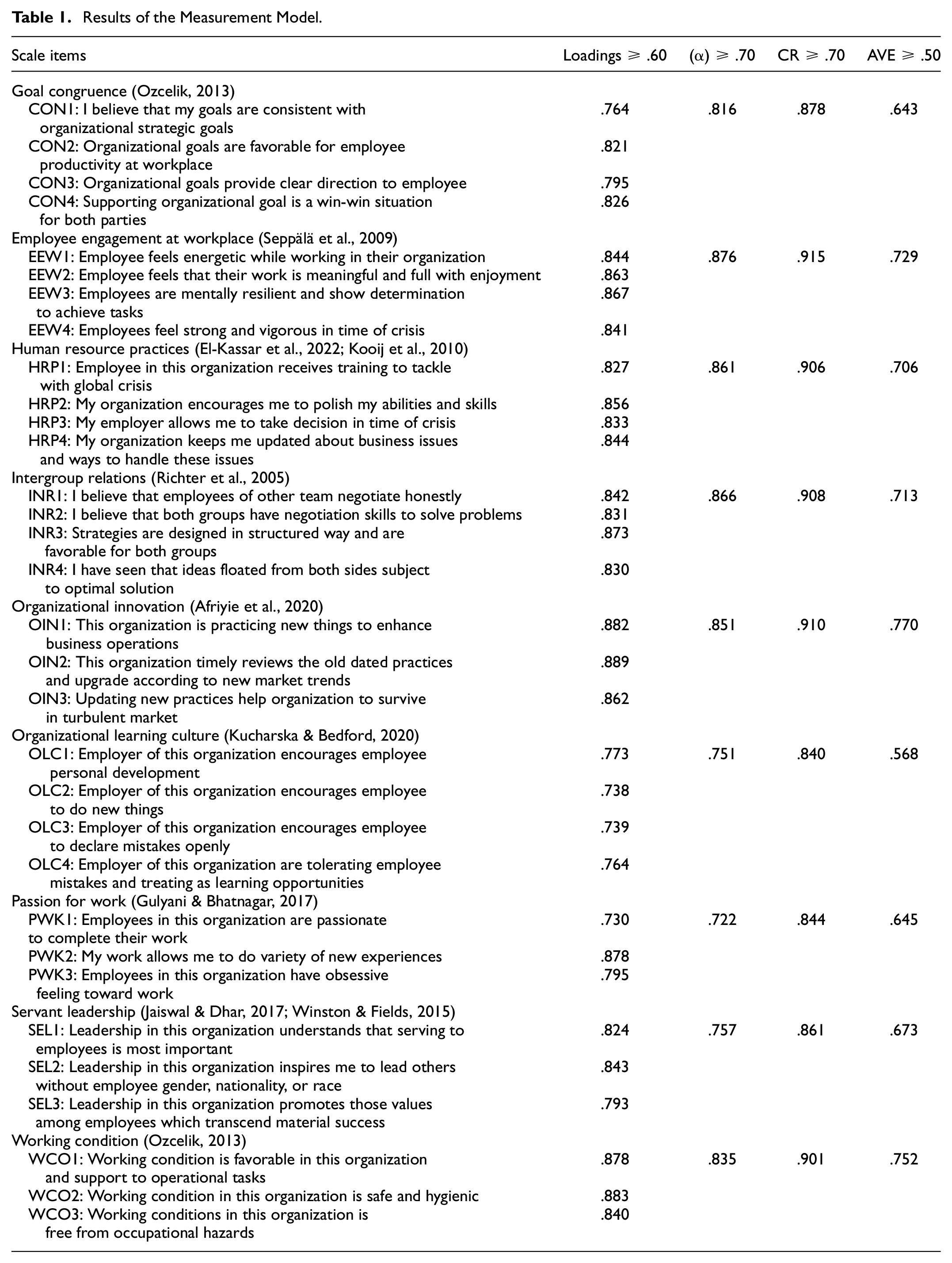
The measurement model is basically first step in structural equation modeling approach and test constructs convergent and discriminant validity. In addition to that indicator reliability and construct reliability are assessed in measurement model. To confirm convergent validity it is essential that values of average variance extracted should be higher than .50 consistent with (Rahi, 2017). Therefore, indicator reliability is conformed following threshold value .60 (Rahi et al., 2018). Similarly, constructs reliability is achieved following notion that values of alpha and composite reliability must be higher than .70 and supported by prior studies (Hair et al., 2016; Rahi et al., 2018). The results of the measurement model evaluation unfurled adequate indicator reliability, construct reliability, and convergent validity and exhibited in Table 1.
Results of the Measurement Model.
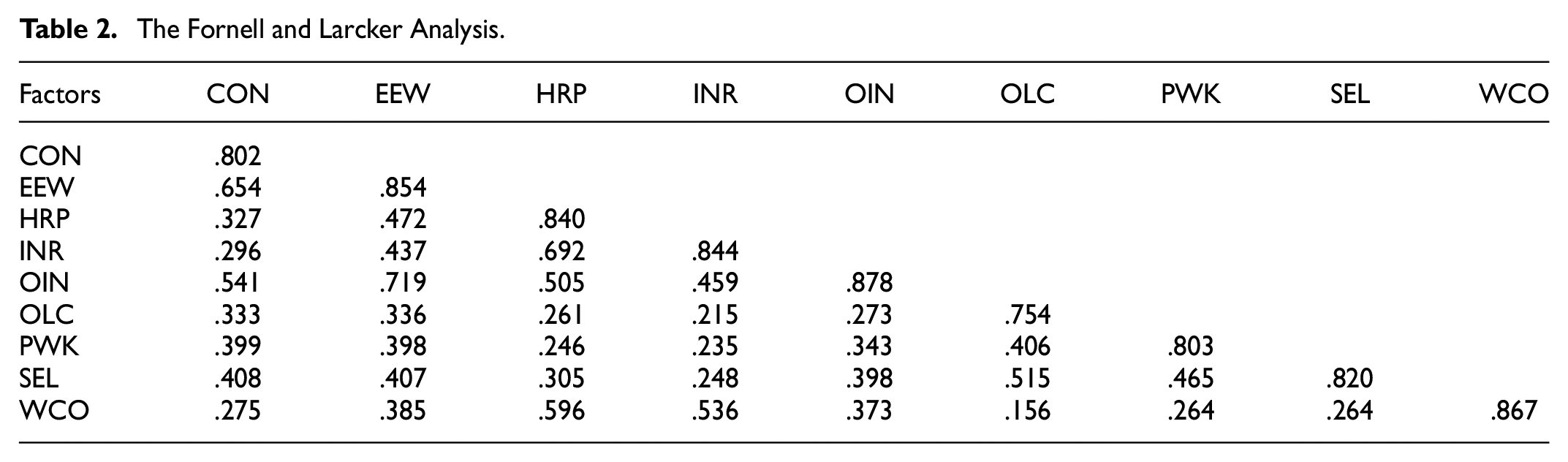
The measurement model is assessed the discriminant validity of the factors. There are three well-known method to test discriminant validity of the factors including Fornell and Larcker method, HTMT and cross loading confirmation (Rahi, 2022; Yamin, 2020a). Initially Fornell and Larcker analysis was employed to confirm discriminant validity of the factors. Results of the Fornell and Larcker analysis unfurl that measures are discriminant as average variance extracted square root was higher comparing with other factors correlation. Therefore, discriminant validity of the factors was confirmed. Table 2 presents results of the discriminant validity including square root of AVE and correlation of corresponding measure.
The Fornell and Larcker Analysis.
In second stage discriminant validity was established with cross loading analysis. In cross loading analysis loadings of the instrument was compared with other constructs loadings (Rahi, 2017; Yamin, 2020b). Therefore, result of the cross loadings has confirmed that loadings of factors were higher when comparing with other factors loadings and hence establishing discriminant validity of the factor. Table 3 depicts results of the cross loading analysis.
Cross Loadings Analysis.

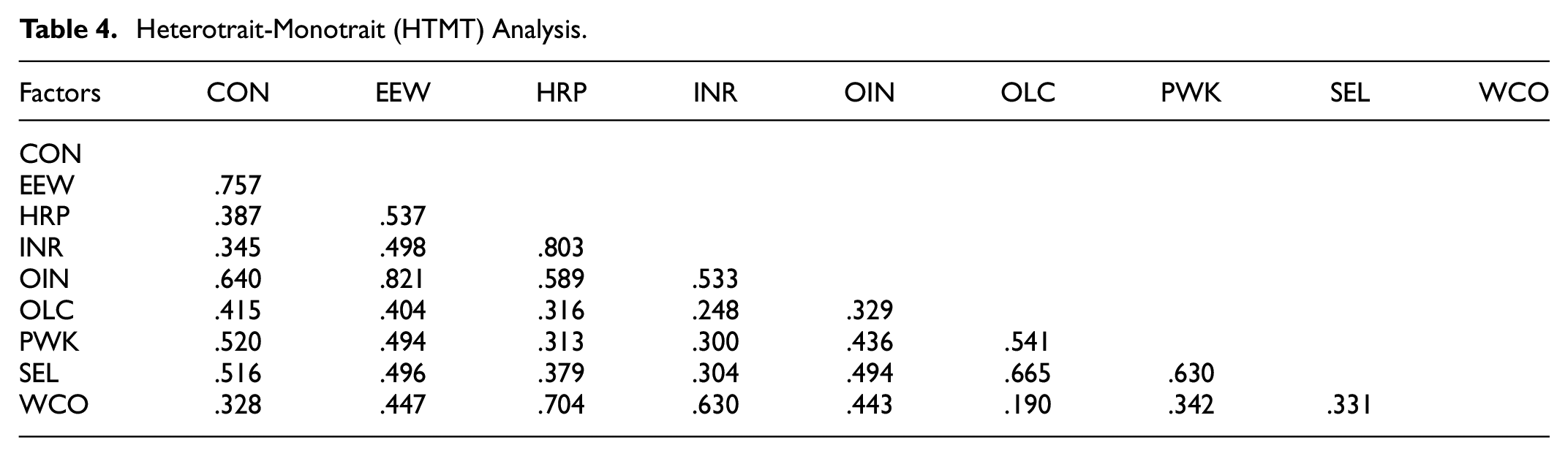
Finally, discriminant validity is achieved through Heterotrait monotrait ratio (HTMT) method. The HTMT method is the latest method to confirm discriminant validity of the factor and proposed by Gold et al. (2001), Kline (2011). According to Kline (2011) to confirm discriminant validity values of HTMT ratio should be ≤.85 indicating adequate discriminant validity of the constructs. Nevertheless, HTMT result unfurled that all HTMT values were ≤.85 and hence confirming discriminant validity of the factors. Table 4 shows results of the HTMT analysis.
Heterotrait-Monotrait (HTMT) Analysis.
Structural model assessment
The structural model assessment is the second most important stage of structural equation modeling. In this stage hypotheses are tested with path coefficient, significance level, standard error, and t-statistics. Nevertheless, data were bootstrapped to unfurled these values with dummy sample 3000 (Rahi et al., 2018; Yamin, 2019). Results of the bootstrapping are shown in Table 5 including significance of the path, t-statics and path values.
Hypotheses Testing.

The research framework has combined altogether human resource practices, working condition, intergroup relations, passion for work, goal congruence, and organizational learning culture to investigate employee engagement at workplace and explained 52.8% variance which is substantial. Similarly, organizational innovation is estimated through employee work engagement and servant leadership and explained 55% variance in organizational innovation in time of crisis. Table 5 also exhibits predictive relevance of the model using predictive power analysis
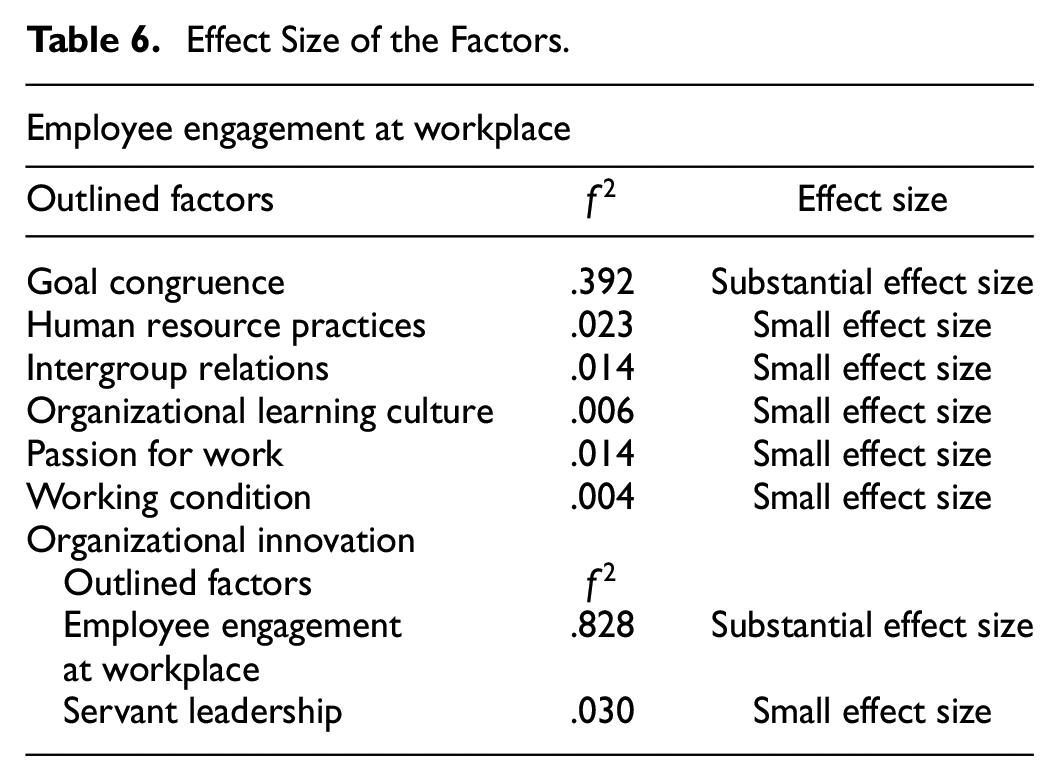
Factors effect size independently
The research model has shown substantial variance in determining employee work engagement and innovation. Nevertheless, effect size of each factor must be calculated to understand the importance of outlined factors (Rahi, 2017). Therefore, effect sizes were computed using
Effect Size of the Factors.
Importance performance analysis
Looking at the complexity of the research model factors importance and performance were measured with importance performance analysis (Yamin, 2020b). Importance and performance of the factors were measured by rescaling items from 1 to 100 (Rahi, 2017). The organizational innovation was selected as an outcome variable and estimated using Smart PLS software. Results revealed that employee engagement in time of crisis has highest importance to measure organizational innovation. Goal congruence stands second level in determining organizational innovation. Factors such as HR practices and servant leadership have revealed intermediate level of importance. Nevertheless, working condition has least importance in measuring organizational innovation. Table 7 presents importance and performance of the factors in measuring organizational innovation.
Factors Importance and Performance Using IPMA.
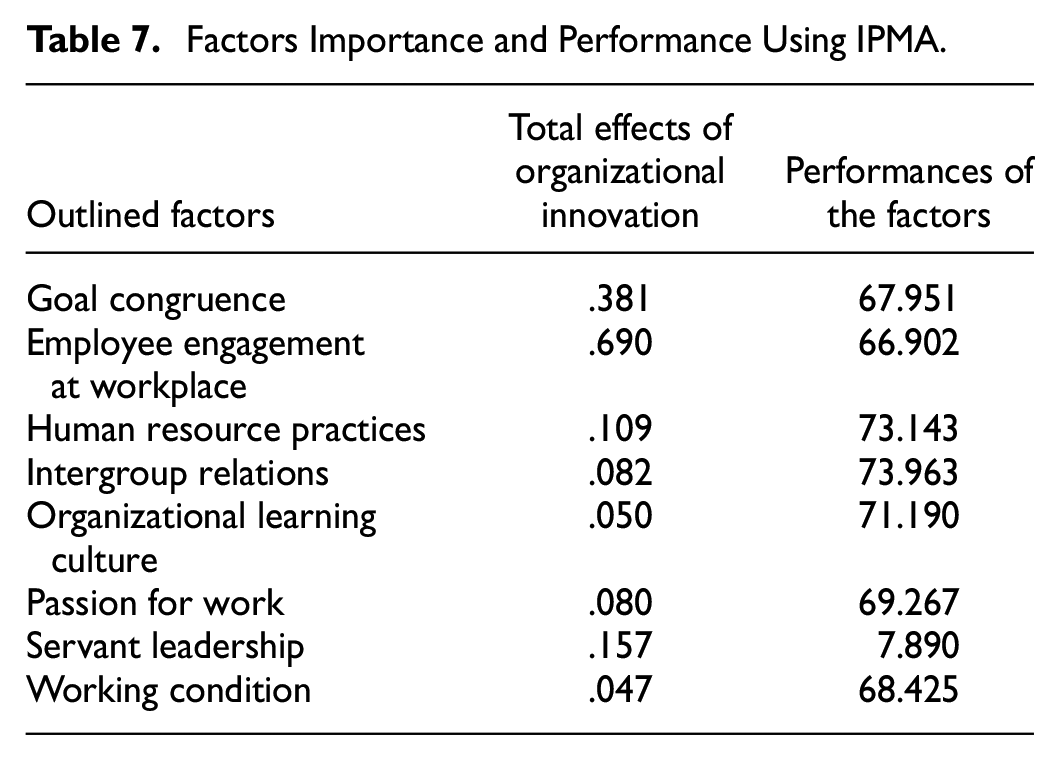
The importance performance map as exhibited in Figure 2 shows that working condition, passion for work, intergroup relations, and learning culture have minimum importance determining organizational innovation. Therefore, IPMA findings suggest that goal congruence, human resource practices, servant leadership, and employee engagement need managerial attention to enrich organizational innovation in time of crisis.

IPMA analysis map.
Servant Leadership
Servant leadership is outlined as moderating factor in research framework and moderates the relationship between employee engagement and organizational innovation. The moderating effect is tested with product indicator approach (Rahi, 2017; Yamin, 2019). Findings indicate significant moderating effect of servant leadership between employee engagement at workplace and organizational innovation and supported by β = .138 significance at p < .001 and t-statistics 6.814 and therefore H8 was confirmed. The output of moderating estimation is exhibited in Figure 3 including t-statistics and path values.

Results of moderating analysis.
The moderating effect is assumed as “the positive relationship between employee work engagement at workplace and organizational innovation will be stronger when servant leadership is higher” and has been assessed through simple slope analysis. Simple slope analysis revealed that organizational innovation at +1 SD gradient indicating sharp incline and therefore on the flip side at −1 SD gradient has downward and descending pattern. These findings established that positive relationship between employee work engagement at workplace and organizational innovation will be stronger when servant leadership is higher. Figure 4 displays trend of the moderating effect using positive, neutral, and negative gradient.

Simple slope map.
Discussion
The outbreak of COVID-19 has shattered global economies and demolished several businesses. Nevertheless, organizations could survive in time of crisis through employee engagement and organizational innovation. Therefore, current research strives to examine factors which impact employee attitude toward work engagement and organization innovation. The research framework has outlined factors such as human resource practices, working condition, intergroup relations, passion for work, goal congruence and organizational learning culture to investigate employee engagement at workplace and explained large variance 52.8% in employee engagement. Similarly, organizational innovation is estimated with employee work engagement and servant leadership and explained 55% variance in organizational innovation. Concerning with assumptions results indicate that human resource practices is positively associated with employee engagement at workplace in time of crisis and consistent with prior studies (Poggi, 2010; Raziq & Maulabakhsh, 2015). Nevertheless, the relationship between working condition in time of crisis and employee engagement was found insignificant and therefore rejecting arguments developed by El-Kassar et al. (2022). The intergroup relations and goal congruence have shown positive impact in employee engagement and in line with past studies (Bouckenooghe et al., 2015; Siyal et al., 2020). Concerning with passion for work and organizational learning culture both have shown positive impact in determining employee engagement and in line with Akgün et al. (2023) and Meher et al. (2022). Moving further strong association was found between work engagement and organizational innovation and consistent with past studies (Kucharska & Bedford, 2020; Srirama et al., 2020). The research model has confirmed moderating effect of servant leadership and supporting to arguments developed by Jo et al. (2020), Qiu and Dooley (2022), and Ruiz-Palomino et al. (2022). Though research model has shown substantial variance in measuring employee engagement and organizational innovation however predictive power of the research model was tested with
Implication to Theory, Practice, and Methods
There are several contributions to theory, practice and methods. For instance this study has revealed that factors such as human resource practices, working condition, intergroup relations, passion for work, goal congruence, and organizational learning culture are valid determinants of employee work engagement and organizational innovation especially in time of crisis. Similarly, the large size of variance has explained that research framework is theoretically valid and therefore enriches the organizational innovation literature. Another unique theoretical contribution of this study is to test the moderating effect of servant leadership between the relationship of employee work engagement and organizational innovation and hence contribute to leadership and organizational innovation literature. In terms of methods, data were estimated with structural equation modeling. In addition to that effect size analysis was incorporated to see the actual effect of each construct. Similarly, the predictive power of the research model was tested with Stone-Geisser’s Q2 analysis and hence enriches methodology. Moving further constructs importance and performance were tested with importance performance matrix methods and hence contributes to research methods. In practical context, help is taken from importance performance matrix. The findings of importance performance matrix analysis suggest that goal congruence, human resource practices, servant leadership could engage employees at workplace in time of crisis and boost organizational innovation which in turn helps organization to survive in competitive business environment.
Conclusion
The COVID-19 pandemic has raised threat among employees to get infected from virus resulting lack of interest toward organizational task. Therefore, organizations are now struggling to engage employees at workplace. In this essence current study examines the influence of HR practices, working condition, intergroup relations, goal congruence, passion for work, and organizational learning culture toward employee engagement and organizational innovation. Likewise, the moderating effect of servant leadership was confirmed between employee engagement and organizational innovation. Data were collected from employees working in Saudi manufacturing organizations. Overall, 241 respondents had participated in this voluntarily research. Findings of the analysis revealed that human resource practices, working condition, intergroup relations, passion for work, goal congruence and organizational learning culture to investigate employee engagement at workplace and explained
Research Limitations and Future Directions
Despite several contributions this study has some limitations. For instance HR practices have been studied as single factor that may reduce the importance of human resource practices. Future researcher may examine HR practices with some other known dimensions like training, appraisal, staffing, and employee compensation that could motivate employees toward work. Although this study has confirmed that factors such as goal congruence, human resource practices, servant leadership, intergroup relationship, organizational learning culture positively influence employee attitude toward work engagement and organizational innovation. However, this research has not claimed to include all factors which influence employee work engagement and organizational innovation. Future researchers may extend current study with some other factors like health safety, hygiene working environment, rewards, and recognition to see how these factors boost employee attitude toward work and enhance organizational innovation. Another research limitation of this study is the sampling method. The convenience sampling approach has been used for data collection. Nevertheless, future researchers could administrate research survey through probability sampling approach. Finally, this research has followed cross-sectional approach and therefore conducted at once. Nevertheless, longitudinal kind of research could reveal useful findings to understand employee behavior toward work engagement in time of crisis and organizational innovation.
Supplemental Material
sj-xlsx-1-sgo-10.1177_21582440231175150 – Supplemental material for Nurturing Employee Engagement at Workplace and Organizational Innovation in Time of Crisis With Moderating Effect of Servant Leadership
Supplemental material, sj-xlsx-1-sgo-10.1177_21582440231175150 for Nurturing Employee Engagement at Workplace and Organizational Innovation in Time of Crisis With Moderating Effect of Servant Leadership by Ali Falah Dalain in SAGE Open
Footnotes
Appendix
Declaration of Conflicting Interests
The author declared no potential conflicts of interest with respect to the research, authorship, and/or publication of this article.
Funding
The author disclosed receipt of the following financial support for the research, authorship, and/or publication of this article: This work was funded by the University of Jeddah, Saudi Arabia, under grant No. (UJ-20-061-DR). the authors, therefore, acknowledge with thank the university technical and financial support.

Supplemental Material
Supplemental material for this article is available online.
References
Supplementary Material
Please find the following supplemental material available below.
For Open Access articles published under a Creative Commons License, all supplemental material carries the same license as the article it is associated with.
For non-Open Access articles published, all supplemental material carries a non-exclusive license, and permission requests for re-use of supplemental material or any part of supplemental material shall be sent directly to the copyright owner as specified in the copyright notice associated with the article.
