



Abstract
Based on Edgar Schein’s Organizational culture and leadership theory, this quantitative cross-sectional study examined how leadership competencies mediate the relationship between organizational culture and structure. This study examined data from 355 managers in Ghanaian SMEs using structural equation modelling in AMOS version 23. Notably, organizational culture demonstrated a negative and significant effect on organizational structure, highlighting the influence of cultural norms and values on structural arrangements within SMEs. Additionally, the study revealed a positive and significant impact of organizational culture on leadership competencies, emphasizing the role of cultural factors in shaping leadership capabilities within these organizations. The findings indicated a positive and significant relationship between leadership competencies and organizational structure, suggesting that effective leadership skills contribute to the establishment of appropriate organizational structures. Furthermore, leadership competencies were identified as a partial mediator in organizational culture and structure, underscoring the relationship between cultural dynamics, leadership capabilities, and structural arrangements in SMEs. Managers in SMEs should prioritize fostering a positive organizational culture that supports the company’s strategic objectives. Investing in leadership development programs will empower leaders to navigate cultural dynamics effectively, driving positive change. Aligning leadership competencies with the organizational structure ensures agility, collaboration, and strategic decision-making, fostering growth and responsiveness.
Plain language summary
This quantitative cross-sectional study evaluated how leadership competences mediate organizational culture and structure using Edgar Schein’s “Organisational Culture and Leadership” paradigm. In AMOS version 23, structural equation modeling was used to analyze 355 Ghanaian SME managers’ data. Cultural norms and values affect structural arrangements in SMEs, as organizational culture has a negative and significant effect on structure. The study also found a favorable and significant effect of organizational culture on leadership competencies, highlighting the relevance of culture in molding leadership in these businesses. Leadership competencies were positively and significantly correlated with organizational structure, showing that strong leadership skills help create acceptable organizational structures. Leadership competences were also found to partially mediate the relationship between organizational culture and structure, highlighting the complicated relationship between cultural dynamics, leadership skills, and structural arrangements in SMEs. Small business managers should foster a positive culture that supports strategic goals. Investment in leadership development programs helps executives negotiate cultural dynamics and create positive change. Leadership abilities that match organizational structure promote agility, collaboration, and strategic decision-making, boosting growth and responsiveness.
Keywords
Introduction
The relationship between organizational culture and structure is pivotal in shaping a company’s identity and operational efficacy within the dynamic landscape of organizational dynamics (Soderstrom & Weber, 2020). These intertwined factors significantly influence how an organization operates and responds to external challenges (Ravasi & Schultz, 2006).
In Ghana, small and medium-sized enterprises (SMEs) stand at the nexus of opportunity and transformation amid the global evolution of work paradigms (Agyapong, 2016; Amaglo, 2019; Tsatsenko, 2020). Organizational culture, denoting a company’s collective behaviors, beliefs, and values, serves as the bedrock of its identity (Ravasi & Schultz, 2006), while the organizational structure acts as the framework guiding communication, decision-making, and formal role delineations (Cunliffe, 2008; McEvily et al., 2014).
The organizational structure in SMEs is crucial for defining responsibilities, aiding decision-making, maximizing resource distribution, improving communication, and fostering adaptability (Lada et al., 2023). It elucidates responsibilities, facilitates streamlined operations, and prompts reactions to market fluctuations. It guarantees efficient resource allocation, promotes coordination, and enables scalability as the firm expands. A clearly outlined organizational structure is crucial for SMEs to accomplish their goals efficiently and durably (Boeske and Murray, 2022).
The organizational culture in SMEs in Ghana significantly impacts employee behavior and the workplace atmosphere. An optimistic culture boosts employee engagement, encouraging motivation, and dedication (Uddin et al., 2019). It fosters teamwork, transparent communication, and trust, leading to higher production and innovation. Furthermore, a culture that prioritizes the needs and preferences of customers enhances their pleasure and loyalty. A flexible culture that promotes constant improvement facilitates adaptability and creativity. A positive culture helps attract and keep talented individuals, enhancing the SME's reputation and brand image (Monteiro et al., 2020). Organizational culture significantly influences the success and longevity of Ghana’s SMEs.
Organizational culture significantly influences decision-making, communication structures, staff responsibilities, and SMEs’ ability to adjust to change (Ketprapakorn & Kantabutra, 2019). Hierarchical cultures emphasize top-down decision-making, whereas participatory cultures promote employee involvement, leading to a flatter structure. Communication styles mirror the dominant culture, where open communication supports decentralized systems, whereas formal, hierarchical communication can result in centralized systems (Pilny et al., 2020). Culture influences employee roles, with innovative cultures promoting numerous jobs, flexible structures, and stability-focused cultures resulting in more limited positions and rigidity. Cultures that are open to change promote agile structures with lower hierarchies and cross-functional teams. In contrast, cultures that oppose change may encourage bureaucratic and hierarchical structures, which can impede innovation (Lampela, 2023).
Schein’s Model of Organizational Culture consists of three levels: artifacts and behaviors, avowed ideals, and underlying assumptions (Bailey, 2022). Artifacts and behaviors, such as rituals and symbols, influence the visible components of SMEs’ organizational structure. Espoused values affect formal structures by influencing professed beliefs and goals and shaping rules and procedures. Implicit assumptions and firmly established attitudes impact informal institutions, such as power dynamics and resistance to change. This model demonstrates how culture and structure are interconnected and influence organizational dynamics in SMEs.
Little research exists on how organizational culture affects organizational structure, especially in Ghana and its SMEs (Janićijević, 2013). This study only looked at a literature review on the relationship without any empirical study to explore how organizational culture impacts organizational structure, creating a significant knowledge gap in the literature. Also, how leadership competencies mediate this relationship has not been investigated, creating a knowledge gap in the literature. There is a need for empirical research on the relationship between organizational culture and structure and how leadership competencies mediate this relationship in a Ghanaian setting, especially in SMEs.
Leadership competencies are crucial in influencing the relationship between organizational culture and structure. They impact how organizational values are implemented as practical strategies and practices within the organizational structure (Lobschat et al., 2021). Skilled leaders influence the corporate culture to match the preferred behaviors and decision-making methods outlined in the structure. Leaders facilitate change and adaptation by bridging the gap between cultural aspirations and structural realities through successful leadership styles and communication (Caligiuri et al., 2020). Leadership qualities are essential for integrating corporate culture and structure to achieve organizational goals (Streimikiene et al., 2021).
The objective of the study is to investigate the influence of organizational culture on organizational structure in Ghanaian SMEs, with a specific focus on the mediating role of leadership competencies. By addressing this gap in the literature, the study aims to provide a deeper understanding of how organizational culture shapes the structural aspects of SMEs in Ghana and how leadership competencies mediate this relationship. Through empirical research, the study seeks to uncover insights that can inform organizational practices and leadership development strategies tailored to the Ghanaian SME context, ultimately enhancing organizational effectiveness and performance.
The study makes a significant contribution to the literature by examining the relationship between organizational culture and structure. While both culture and structure are critical for effective management, there is still a gap in understanding their interaction, particularly regarding their influence on organizational creativity and adaptability. By exploring this relationship in depth, businesses can better align their structural processes with their cultural values, thereby enhancing overall performance and resilience. This research addresses the knowledge gap by illustrating how cultural factors may shape or constrain structural decisions, thereby enriching theoretical perspectives and providing valuable organizational design tools for academics and practitioners.
Additionally, the article investigates the connection between organizational culture and leadership competencies, offering an important but often neglected perspective in leadership development. It reveals that leadership attributes aligned with cultural values foster cohesion, trust, and effective communication, although this alignment is infrequently explored. The study enriches leadership literature by shedding light on this intersection, which has practical implications for training and development initiatives. Organizations can gain pragmatic insights into cultivating leaders who uphold and reinforce core cultural principles.
Furthermore, the research explores how leadership competencies influence organizational structure, revealing avenues for building flexible and adaptable organizations. This is crucial, as the capabilities of a leadership team impact decision-making hierarchies and organizational responsiveness. By addressing this gap, the study offers a significant contribution to strategic management and organizational design. It aids researchers and practitioners in developing competency-based frameworks that enhance flexibility and operational effectiveness.
The study uniquely contributes to bridging the knowledge gap by analyzing the mediating role of leadership competencies in the relationship between organizational culture and structure. This research provides fresh insights into how leadership can connect structural efficiency with cultural values, emphasizing the role of competencies in this dynamic relationship. The findings offer both theoretical advancements and practical strategies for leveraging leadership as a mechanism for structural alignment and cultural integration, thereby benefiting organizational and leadership practices.
Literature Review and Hypothesis Development
Theoretical Background
Schein’s (2020) organizational culture and leadership model provides a robust philosophical underpinning, particularly in the distinctive context of Ghanaian SMEs. The model’s delineation of three levels of culture offers a structured approach to dissecting the spheres of influence within an organization. Ghanaian SMEs exhibit unique cultural artifacts and behaviors, encompassing customary rituals, collaborative work environments, and region-specific communication practices (Amoako, 2012; Ansong-Kumah, 2016). These outward manifestations of culture assume significance in comprehending the organizational structure as per Schein’s (2020) framework. Ghanaian SMEs often espouse values of reverence for elders, community cohesion, and collective responsibility (Asumadu, 2021). This study delves into how these values impact staff dynamics, decision-making processes, and organizational ethos. It is imperative to unearth the assumptions and implicit beliefs prevalent within Ghanaian SMEs. Schein’s conceptual framework facilitates the exploration of these tacit rules guiding daily actions, thereby influencing organizational structure and workplace dynamics.
Schein’s model categorizes organizational culture into three levels: artifacts, espoused values, and underlying assumptions. This framework is instrumental in analyzing the complex interrelationships between organizational culture, structure, and leadership capabilities. By exploring these connections, Schein’s model reveals that an organization’s structure often reflects its underlying, and frequently unconscious, cultural principles. Thus, effective management necessitates the integration of culture and structure.
According to Schein’s model, leadership capabilities and shared values shape an organization’s culture (Alankarage et al., 2024; Saeed, 2023). Leaders can foster a more adaptive and unified organizational environment by aligning structural frameworks with cultural norms. Such alignment is essential for developing leadership competencies that reinforce organizational culture and promote greater cohesion.
Furthermore, Schein’s model illustrates how leadership competencies serve as a bridge between culture and structure. Leaders who embody and promote core cultural values are able to synchronize structural practices with cultural expectations, thereby enhancing both organizational flexibility and stability (Khripunov, 2023). This study applies Schein’s methodology to address a crucial yet underexplored area in organizational research: the influence of culture on structural and leadership dynamics.
Leadership competency is a pivotal factor mediating the interplay between organizational culture and structure within Ghana’s SME sector. Culturally astute leaders in Ghanaian SMEs adeptly navigate regional customs and values while steering their organizations toward innovation and growth (Sandeep, 2015). Schein underscores the pivotal role of leadership in shaping organizational culture. Leaders within Ghanaian SMEs serve as architects of culture, shaping the company’s espoused values and outward behaviors (Atuahene, 2016). Their adeptness positions them as catalysts for translating cultural attributes into tangible structural manifestations. Schein’s model serves as a guiding lens for SMEs in Ghana, facilitating examining the relationship between organizational culture and structure. Through this lens, the study aims to illuminate the intricate processes through which competent organizational leaders mold the essence of their corporate identities, enabling Ghanaian SMEs to thrive and maintain resilience in an ever-evolving business landscape.
Hypotheses Development
Influence of Organization Culture on Organization Structure
Corporate culture, defined as the shared values, attitudes, and behaviors within an organization, profoundly influences formal arrangements and corporate structure dynamics (ElKelish et al., 2024). These two components intricately interact, significantly shaping how an organization functions and responds to its environment.
Rožman et al. (2023) contend that organizational culture guides employee interactions and collaboration, thereby steering decision-making processes. These cultural norms inevitably mold the structure of the business. For instance, organizations fostering innovation and risk-taking may adopt a decentralized and flexible structure conducive to swift decision-making and adaptability (Alateeg & Alhammadi, 2024).
The various archetypes outlined in the Competing Values Framework, developed by Cameron and Quinn (2006), further expound the nexus between organizational culture and structure. For instance, a clan culture emphasizing staff development and collaboration often aligns with a decentralized, team-based organizational structure. Conversely, a hierarchical, performance-driven organization may resonate with a “market culture” prioritizing competition and outcomes.
Schein (2010) underscores the influence of organizational culture on decision-making and problem perception within an organization, which, in turn, shapes organizational structures. Cultures valuing teamwork and consensus-building may adopt a flatter, more egalitarian structure to facilitate communication (Luqman & Agathsya, 2024).
Moreover, organizational culture dictates how companies respond to external opportunities and challenges. Organizations fostering innovation may embrace an organic, flexible structure in rapidly changing business environments (Cameron & Quinn, 2006). Conversely, stability-oriented cultures may prefer bureaucratic, hierarchical structures to maintain control and order (Einhorn et al., 2024).
Organizational culture interacts dynamically and intricately with corporate structure, shaping the organization’s DNA. The Competing Values Framework (Cameron & Quinn, 2006) and perspectives from Schein (2010) offer valuable insights into how cultural attributes intertwine with an organization’s structural elements.
It is imperative for organizations seeking alignment between their structures and cultural values to understand and leverage this interaction. Recognizing the influence of culture on communication, decision-making, and adaptability enables organizations to purposefully craft structures reflecting their cultural identity, thereby enhancing resilience and flexibility in an ever-evolving business landscape. This assumption is formulated based on the above:
H1: Organizational culture significantly influences corporate structure.
Influence of Organization Culture on Leadership Competencies
Organizational culture and leadership competence share a dynamic and mutually influential relationship, where each factor shapes and is shaped by the other (Toufighi et al., 2024). The prevailing organizational culture and leadership abilities, encompassing organizational leaders’ skills, qualities, and attributes, are closely intertwined.
Organizational culture serves as a crucible for refining and molding leadership abilities (Cacioppe, 2000; Dyer, 2023). Cultural norms and values guide leaders’ expectations and behaviors (Mould, 2023). The ability to foster teamwork, mentorship, and employee development often indicates leadership competence in organizations prioritizing collaboration and staff growth (Meuser & Smallfield, 2023). In addition to possessing technical skills pertinent to their roles, effective leaders must align their expertise with the organizational culture (Pedraza-Rodríguez et al., 2023; Schein, 2010). For instance, leadership competence in cultures valuing risk-taking and innovation may involve fostering innovation, embracing ambiguity, and promoting experimentation (Chimakati & Macharia, 2024).
Communication strategies and decision-making processes exemplify how organizational culture profoundly influences leadership competence (Orieno et al., 2024). Martinez et al. (2023) emphasize that executives must navigate cultural diversity to make decisions congruent with organizational values. Competent leaders facilitate open communication and encourage diverse viewpoints in cultures, emphasizing inclusivity and consensus-building (Jimenez-Luque & Trimble, 2020). Cultural adaptation, a facet of leadership skills, enables leaders to adeptly navigate diverse cultural environments within an organization (Raza, 2022). In multinational firms prioritizing international collaboration, competence may be characterized by the ability to communicate across cultural boundaries and comprehend diverse perspectives (Waham et al., 2023). Successful organizations establish a strong alignment between their leadership competencies and cultural values.
Leaders can adapt their competence to align with the standards set by the prevailing organizational culture by understanding the cultural peculiarity defining effective leadership within the organization. This fosters a more cohesive and effective leadership environment in the long run. The hypothesis created out of this is:
H2: Organizational culture significantly influences leadership competencies.
Influence of Leadership Competencies on Organizational Structure
Leadership competencies, comprising the abilities, qualities, and skills of organizational leaders, significantly influence the design and operation of organizational structures (Northouse, 2021). The leadership traits exhibited by individuals often dictate the ideal organizational structure. As noted by Northouse (2021), leaders with a strategic vision and the ability to foster creativity may advocate for a more flexible and decentralized organizational structure. Conversely, leaders prioritizing operational efficiency may favor a centralized, hierarchical organization to enhance control and coordination.
Decision-making processes are heavily influenced by leadership competencies, shaping the flexibility of organizational structures (Joseph & Gaba, 2020). Leaders demonstrating strategic thinking and adaptability may promote a flexible and organic structure, enabling swift responses to market changes (Pacheco-Cubillos et al., 2024). Conversely, executives emphasizing stability and risk aversion may establish a rigid bureaucratic structure.
Effective leaders impact organizational structure through their communication strategies. Leaders fostering open dialogue and teamwork may facilitate the development of team-based or matrix structures (Tabak et al., 2024). Effective communication is a crucial leadership skill that can break down silos in hierarchical structures and foster cross-functional collaboration.
Leadership qualities also influence organizational culture, thereby impacting structural preferences. Leaders encouraging an innovative and employee-centric culture may gravitate toward flatter, decentralized structures promoting autonomy, and creativity (Liu et al., 2020; Jerab & Mabrouk, 2023). Conversely, leaders emphasizing stability and control may contribute to the prevalence of hierarchical structures.
The dynamic interplay between leadership abilities and organizational structure significantly shapes the form and function of organizations. Insights from Cameron and Quinn (2006) and Northouse (2021) underscore the importance of leadership qualities in shaping structural preferences. Based on the above discussion, the following hypothesis is advanced:
H3: Leadership competencies significantly influence organizational structure
Mediating Role of Leadership Competencies in the Relationship Between Organizational Culture and Corporate Structure
Edgar Schein’s Organizational Culture and Leadership model offers valuable insights into the intricate interplay between company culture, leadership competencies, and organizational structure (Schein, 2010). Schein’s model delineates organizational culture into three levels: professed ideals, artifacts and behaviors, and underlying assumptions, providing a systematic framework for understanding their interrelationships.
In the context of SMEs in Ghana, organizational culture mirrors a blend of regional customs, international business trends, and indigenous values. Traditional rituals, collaborative work environments, and localized communication approaches serve as tangible artifacts and behaviors within Ghanaian SMEs (Amoako, 2012; Quan-Baffour, 2023). Values such as community cohesion, respect for elders, and shared accountability often form the bedrock of espoused values. At the same time, underlying assumptions may encompass beliefs in connection and teamwork, guiding implicit behavior.
The formal structures comprising duties, responsibilities, and reporting lines within an organization closely align with the prevailing organizational culture in Ghanaian SMEs (Atuahene, 2016; Asumadu, 2021). A decentralized, team-based organizational structure may harmonize with a clan culture, prioritizing cooperation and staff development. Conversely, a hierarchical, performance-driven organization may resonate with a market culture emphasizing competition and outcomes (Antwi, 2023; McBride-Walker, 2013).
At the heart of this dynamic relationship lie leadership competencies. Leaders with skills in innovation and adaptability may shape presumptions that lead to a flexible and organic organizational structure. Equipped with cultural insights, leaders of Ghanaian SMEs play a pivotal role in translating cultural attributes into tangible structural expressions. The notion that adept leaders function as cultural architects, influencing outward behaviors, professed ideals, and underlying assumptions, aligns with Schein’s model, underscoring the critical role of leadership in shaping organizational culture (Schein, 2010). From the above discussion, the following hypothesis is posited:
H4: Leadership competencies mediate the relationship between organizational culture and organizational structure
The study model shown below was built using the literature review and hypothesis development (Figure 1).

Research model (Authors own construct, 2025).
Research Methodology
Research Design
The research design employed in this study was a cross-sectional descriptive design. This design entails portraying the characteristics of a subject without manipulation (Obeng, 2023; Pandey & Pandey, 2021). This approach provides practical insights for managers and policymakers, aiding strategic decision-making and organizational development and thus enhancing SME performance and sustainability.
Sample and Data
This study focused on Ghana’s SMEs, which have created numerous employment opportunities and made significant contributions to the country’s GDP. These companies often faced challenges related to leadership development, structural adaptation, and cultural alignment, largely due to financial constraints, shifting market demands, and an unstable socioeconomic environment.
By examining managers in Ghanaian SMEs, the study provided a comprehensive understanding of how leadership abilities influenced organizational effectiveness in resource-limited contexts. Managerial competencies in these SMEs were crucial for navigating structural and cultural challenges unique to Ghana’s business landscape, given the wide range of responsibilities managers assumed. This highlighted the need for flexible leadership, as SME managers often had to adjust organizational practices to balance local expectations with global standards. The research offered valuable insights into how culture, structure, and leadership intersected in developing countries, providing practical benefits for local managers and informing international scholars focused on enhancing the resilience and growth of SMEs.
The study required managers to work for SMEs in Ghana that were registered with the Registrar General’s Office, ensuring the firms’ legitimacy, and regulatory compliance. Managers needed at least one year of management experience within their organizations to provide informed insights into the company’s culture and structure. The SMEs had to operate in key industries relevant to the research—such as manufacturing, retail, or services—to ensure alignment with the study’s objectives. Additionally, participating managers had to be actively involved in shaping corporate culture and in decision-making processes to ensure their perspectives were pertinent to the study.
Managers from large organizations or enterprises not classified as SMEs were excluded, as their organizational dynamics could differ significantly. Interim or temporary managers were also excluded, as they might lack the necessary knowledge or experience with the organization’s long-term strategies and values. Managers from SMEs operating for less than 1 year were not considered, since sufficient time was needed to establish a strong organizational culture and structure. Furthermore, managers who were unable or unwilling to participate in the survey due to time constraints or other commitments were omitted to ensure comprehensive and reliable responses.
Sample Size
This study utilized Cochran’s (1977) formula for indeterminate population size, as accurately ascertaining the population size proved challenging due to the extensive dispersal of SMEs across Ghana’s regions. Cochran’s method aims to deliver a statistically valid sample size that ensures representativeness even in the absence of specific demographic information and when the population size remains unspecified (Obeng et al., 2025a).
This technique enables the study to accurately choose a sample size that considers potential variance among SMEs across different locations while ensuring high precision. This method ensures that the results apply to the broader SME sector in Ghana, facilitating the formulation of robust conclusions free from bias or mistakes due to an improperly calculated population size. The formula is quoted as

“n” is the required sample size,
“Z” is the Z-score corresponding to the desired confidence level,
“e” is the desired margin of error.

Sampling Strategy and Procedures of Data Collection
A convenience sampling method was utilized to collect data from around 384 participants via computer-assisted web interviewing. This advantageous strategy facilitated efficient data collection from many Ghanaian SME managers. Due to logistical problems and time limitations in accessing a scattered population, convenience sampling provided an effective alternative to improve data collection efficiency.
Convenience sampling may bring biases, including selection bias, leading to a sample that does not correctly represent the broader population of SME managers (Arhinful et al., 2025a). It is essential to acknowledge this. This limitation may impact the applicability of the findings. To address these potential biases, the researchers employed various measures. By incorporating managers from various industries and geographical areas, they ensured participant diversity, thereby facilitating the acquisition of a broader spectrum of perspectives. The correctness and consistency of the results were ensured by the thorough examination conducted during the data cleansing procedure.
During this review, 29 responses were classified as imprecise and excluded from the final analysis. Thus, the study employed 355 valid responses, yielding a respectable response rate of 92.45%. The data’s dependability is bolstered by the elevated response rate, signifying that the respondents were significantly engaged and providing a solid basis for inferences related to the study's aims. The study aims to provide significant insights into the links among organizational culture, structure, and leadership competencies in Ghanaian SMEs by proactively mitigating potential biases and focusing on a representative sample.
Measures
Joseph and Kibera (2019) developed the organizational culture questions adopted for this study. This measure comprises four principal dimensions: adhocracy culture (three items), clan culture (three items), hierarchical culture (three items), and market culture (three items). Each factor has a significant impact on the operations of SMEs in Ghana. Adhocracy culture emphasizes adaptation and creativity, which are essential for effectively addressing market volatility. Clan culture cultivates a spirit of camaraderie and collaboration among personnel. Hierarchical culture emphasizes the need for structure and control, while market culture promotes competitiveness and outcomes, which are crucial for success in difficult situations.
This study utilized questions fromJohari et al. (2010) developed to assess organizational structure. The surveys had 15 items, classified into 4 dimensions: rule observation (2 items), job codification (5 items), hierarchy of authority (4 items), and decision-making (4 items). These characteristics are crucial, as they are significant organizational structure elements that influence SMEs’ success. The rule observation is act of making decisions underscores how the decision-making process has a significant impact on organizational responsiveness and agility. The hierarchy of authority enhances operational efficiency by clarifying management levels and facilitating communication. Job codification ensures clarity of roles, which is vital for employee understanding and maintains consistency and quality in organizational procedures, while adherence to rules underscores conformity with established protocols.
This study adopted Yim’s et al. (2022) questions to assess leadership competencies. It assessed two dimensions: communication (four items) and self-confidence and innovation (six items). The aggregate count of measures was 10. Within the study framework, these attributes are crucial as they define the essential qualities that managers of SMEs must possess. Leaders with confidence and inventiveness are more skilled at fostering a creative culture and encouraging innovation, expediting the company’s growth. Effective communication skills are vital for fostering a cohesive work atmosphere and promoting collaboration and information sharing among team members. The integration of these talents amplifies leaders’ ability to successfully attain strategic goals and address the challenges encountered by SMEs in Ghana.
A five-point Likert scale, derived from Nyarko et al. (2024), was employed to align the questions (see Appendix A) chosen for each idea. The scale extended from strongly disagree (1) to strongly agree (5). The five-point Likert scale allows participants to clearly express their degrees of agreement, facilitating the collection of responses and the quantification of opinions. This facilitates more complex data processing and pattern recognition.
Data Analysis
Data collected from electronic questionnaires were analyzed using AMOS software, enabling a detailed examination of relationships within SMEs. Covariance-Based Structural Equation Modeling (CB-SEM) was employed because it is well-suited for evaluating and validating concepts within established theoretical frameworks (Vinkóczi et al., 2024 Obeng et al., 2025b). This method is particularly effective for investigating the complex interrelations among organizational culture, leadership competencies, and organizational structure, as it systematically assesses the connections between latent variables. Additionally, the large sample size increased the reliability and robustness of the findings.
Path analysis provides the findings relating to the direct relationship between the variables, while mediation analysis provides an indirect relationship between the variables. Confirmatory factor analysis (CFA) provided the standardized loadings that enable the computation of the maximum shared variance (MSV), average variance extracted (AVE), composite reliability (CR), and Cronbach alpha (α) that were used to assess the validity and reliability of the constructs.
Empirical Findings
Socio-Demographic Characteristics of the Participants
Table 1 presents the demographic details of the 355 participants in the study. The analysis provides valuable insights into the sample’s composition. The gender distribution shows that females (57.18%) outnumber males (42.82%). This suggests that gender-inclusive policies may enhance organizational performance and innovation, highlighting the significant role women play in managing SMEs in Ghana.
The Personal Information of the Participants.,

Regarding educational qualifications, most participants (38.03%) hold bachelor’s degrees, followed by those with high school diplomas (26.48%). This emphasizes the importance of SMEs employing educated personnel to enable strategic planning and informed decision-making, giving them a competitive edge.
A notable proportion of participants (34.93%) fall within the 26 to 35 age range, indicating a predominantly youthful workforce. This suggests that SMEs are attracting young talent, which could drive growth and innovation by bringing fresh ideas and adaptability to technological advancements.
The data also show that SMEs are primarily concentrated in manufacturing (40.28%), followed by services (30.70%) and real estate (24.23%). This indicates a heavy reliance on the manufacturing sector in Ghana’s economy, suggesting that targeted support and resource allocation to this sector could spur economic growth.
Role-wise, many participants are engaged in line management (39.54%), with a significant number in middle management (29.58%). Given this distribution, investing in management education and leadership training could enhance operational efficiency and employee engagement.
Approximately 49.58% of participants are employed in firms with fewer than ten employees, reflecting the dominance of microbusinesses within the SME sector. This underscores the economic importance of microbusinesses in Ghana, indicating that policies supporting these small enterprises are crucial for economic development.
Lastly, 24.51% of the workforce has more than 21 years of experience, while 29.86% have 11 to 15 years of experience. The distribution of work experience is relatively balanced, suggesting a mix of innovation, and expertise within the workforce. This highlights the potential benefits of mentorship programs, where experienced employees can guide and support newer staff, thereby strengthening SME performance.
Descriptive Statistics of the Study’s Variables
Table 2 presents the descriptive statistics of the study variables. The average score for organizational culture indicates that employees have a positive perception of their work environment. This favorable outlook fosters collaboration, innovation, and adaptability—critical attributes for navigating Ghana’s dynamic commercial landscape.
Descriptive Statistics of the Study Variables.

The average score for organizational structure reflects a strong assessment of clarity and effectiveness within the organizational framework. Participants perceive their firms as having clearly defined roles, responsibilities, and processes, which likely enhance operational efficiency and improve decision-making.
The average score for leadership competencies suggests a moderate evaluation of leadership effectiveness in these SMEs. While essential leadership qualities are recognized, there are areas needing improvement, particularly in leaders’ ability to effectively inspire and engage their teams. The findings emphasize the need for targeted initiatives to strengthen leadership competencies, leveraging organizational culture and structure to drive improved performance in Ghanaian SMEs.
Assessment of Model Fitness (Measurement Model)
Table 3 presents the results of the CFA model fit, assessed using six techniques. The CFA aimed to achieve strong standardized loadings to evaluate the validity and reliability of the constructs using AVE, MSV, CR, and α. The analysis included the CMIN/df statistic, a widely used measure of model fit. According to Obeng, Arhinful, Mensah, and Osei (2024), a suitable model is indicated by a CMIN/df ratio between 3 and 5. Our study produced a CMIN/df value of 3.457, which falls within the acceptable range, confirming a satisfactory model fit.
Assessment of Measurement Model Fitness.
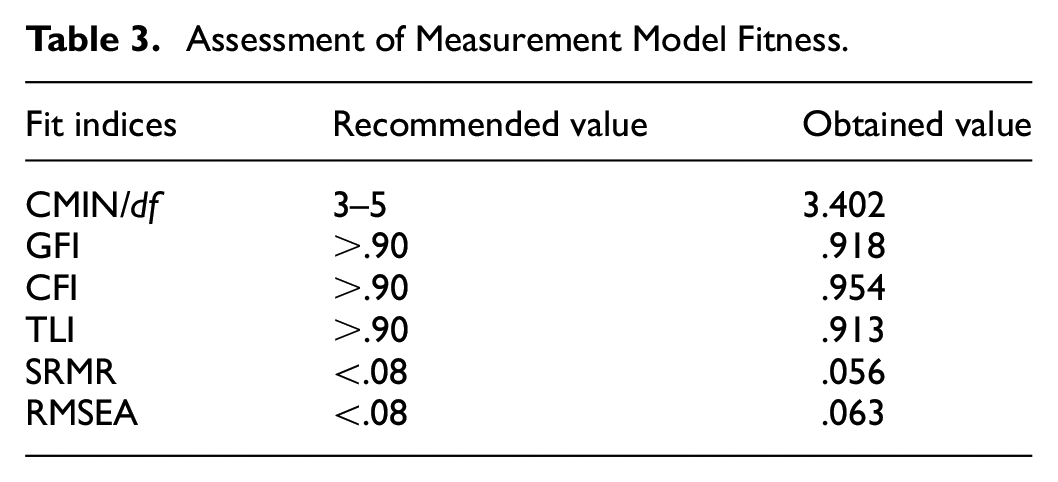
The Tucker–Lewis Index (TLI), Comparative Fit Index (CFI), and Goodness-of-Fit Index (GFI) were also employed to provide a comprehensive evaluation of the model’s fit. Following the multi-index approach recommended by Obeng, Arhinful, Mensah, and Owusu-Sarfo (2024), these indices offered a robust assessment of model fitness. Notably, the TLI, CFI, and GFI values all exceeded the .90 threshold, indicating that the model fit the data well.
Additionally, the analysis considered the Standardized Root Mean Square Residual (SRMR) and the Root Mean Square Error of Approximation (RMSEA). According to criteria outlined by sources (Pavlov et al., 2021; Obeng, Tessema, Nuhu, et al., 2024) a model is deemed to have excellent fit if SRMR and RMSEA values are below .080. Our research found that both SRMR and RMSEA values were under this threshold, further validating the model’s suitability. In summary, the model’s consistent performance across six evaluation methods, meeting established benchmarks, provides strong evidence of a satisfactory model fit.
Assessment of Normality, Reliability, and Validity Test Results
Table 4 provides a complete overview of the study’s reliability, convergent validity, and normality tests. The skewness and kurtosis criteria were utilized to evaluate the normality of the data sets.
Factor Loadings, Normality, and Reliability Test Results.

Normality Assessment
Skewness quantifies the degree of asymmetry in a distribution, whereas kurtosis assesses the extent of deviation from normality. These metrics improve statistical analysis’s integrity, accuracy, and reliability, allowing researchers and practical applications to make better-informed decisions. The skewness and kurtosis values of ±1.96 indicate strong conformity to a normal distribution (Obeng, Arhinful, Mensah, & Osei, 2024; Arhinful et al., 2025b). The data set has a normal distribution, as shown by the fact that all of the questionnaire items’ skewness and kurtosis values are within the acceptable range. This means that parametric analysis can be used.
Convergent Validity Assessment
Standardized loadings, MSV, and AVE were used to evaluate convergent validity. These are necessary tests for determining the presence of convergent validity of the constructs. The construct's convergent validity installs confidence in the research findings. Convergent validity is deemed present when the AVE surpasses .50, the MSV is lower than the AVE, and the factor loadings exceed .50 (Obeng, Arhinful, Mensah, & Owusu-Sarfo, 2024; Tessema et al., 2024). The loadings for each item under each construct and the AVE and MSV values for the constructs met the specified criteria, indicating that the study exhibited excellent convergent validity. Figure 2 depicts the standardized loadings (measurement model).

Measurement model.
Reliability Assessments
To ensure the accuracy and reliability of the measures, we conducted reliability tests using composite reliability (CR) and α (see Table 4). The constructs’ ability to consistently produce accurate outcomes demonstrates high reliability. CR and α coefficients of .70 signify robust reliability, whereas values below .70 indicate subpar dependability (Arhinful et al., 2023; Obeng & Atan, 2024). According to the results of CR and values over .70, the study constructs exhibit high reliability and internal consistency.
Assessment of Discriminant Validity
Table 5 displays the discriminant validity results of the constructs using the Fornell and Larcker (1981) criteria. This method compared the square root of the AVE for each construct to the correlations among constructs (Afthanorhan et al., 2021; Arhinful et al., 2024). To confirm the presence of discriminant validity of the constructs, the square root of the AVE for each construct must surpass its correlations with all other constructs in the model in a diagonal (Obeng et al., 2025c).
Composite Reliability, Convergent and Discriminant Validity Test Results.

The findings confirm discriminant validity by showing that the AVE of each component exceeds its correlations with other constructs (Asare Obeng et al., 2025). The average value of HC (.907) is higher than the correlation values for AC (.844), AC (.783), COMM (.037), SCI (.028), RO (−.007), JC (.044), HOA (.823), DM (.803), MC (.769), and CC (.853). This finding highlights the model’s distinctiveness, as each construct evaluates a separate facet of the underlying reality. The results validate the study’s measurement approach and provide strong evidence of discriminant validity among the dimensions, confirming their independence.
Hypothesis Testing
Direct Effect
Table 6 and Figure 3 summarize the structural model fit analysis results. The indices utilized to assess the model's fitness include CMIN/df (3.440), TLI (.918), CFI (.972), GFI (.924), SRMR (.041), and RMSEA (.052). TLI, CFI, and GFI values surpassing .90 signify an acceptable model fit (Atan & Obeng, 2024; Kaveh et al., 2023). The TLI, CFI, and GFI scores are above the threshold, indicating adequate fitness. Similarly, the RMSEA (.066) and SRMR (.058) values were lower than the suggested threshold of .080 (Goretzko et al., 2024; Asare Obeng & Atan, 2025).
Direct Effect Test Results.


Structural model.
The direct relationship findings between the variables were obtained through the path analysis, and the indirect (mediation) relationship was obtained through a bootstrapping method with a bootstrap sample size of 5,000 and a 5% confidence interval (Alfons et al., 2022; Arhinful et al., 2025c). The study found that organizational culture had a negative and significant influence on organizational structure (β = −.409, t = −9.627, p < .05), supporting the first study hypothesis (H1). Additionally, organizational culture was found to have a positive and significant influence on leadership competencies (β = .454, t = 18.683, p < .05), confirming the second hypothesis (H2). Furthermore, leadership competencies positively and significantly influence organizational structure (β = .934, t = 14.172, p < .05), supporting the third hypothesis (H3).
Table 6 also presents the coefficient of determination (R2) values. R2 values offer insights into the extent to which the model explains variance (Obeng & Atan, 2024; Birinci et al., 2025), though they have certain limitations. A high R2 does not necessarily indicate a strong model fit or the presence of significant predictors, as it can be inflated by irrelevant factors. On the other hand, a low R2 does not always imply inefficiency; it may instead reflect inherent variability within the data. Furthermore, R2 does not account for the influence of individual predictors or biases introduced by omitted variables. Therefore, R2 should be interpreted alongside additional diagnostic tests and statistical measures to provide a more comprehensive assessment of model fit (Obeng et al., 2025d).
The R-square value of .496 indicates that approximately 49.6% of the variance in leadership competencies can be explained by organizational culture. Furthermore, the R-square value of .362 for organizational structure suggests that around 36.2% of the variations in organizational structure can be accounted for by the combined influence of organizational culture and leadership competencies.
Indirect Effect
Table 7 illustrates the results of the indirect relationship (mediation analysis). It was found that leadership competencies positively and partially mediate the relationship between organizational culture and organizational structure (β = .242, t = 4.566, p < .05), supporting the hypothesis (H4). The partial mediation resulted from the significant direct relationship between the organizational culture and structure presented in Table 6.
Indirect Test Results.

Discussion and Conclusions
Several inferences emerged from the study’s findings. First, organizational culture had a significant negative impact on organizational structure. Schein’s organizational culture model emphasizes that an organization’s culture strongly influences its processes and structure, which aligns with the study’s results. According to Saeed (2023), an organization’s culture consists of shared values, assumptions, and beliefs that shape how employees interact and collaborate. When organizational culture fosters rigid procedures, it can hinder communication and collaboration, making the organization less adaptive and responsive.
A plausible explanation for these findings is the presence of a hierarchical culture that prioritizes control over cooperation. Such a structure may lead to centralized decision-making, where the perspectives of lower-level employees are overlooked, stifling creativity. Consequently, an inflexible organizational structure can limit performance and adaptability by restricting dynamic interactions and reducing organizational fluidity (Pacheco-Cubillos et al., 2024).
Another consideration is the lack of shared commitment and values among employees. If the organizational culture fails to promote a sense of community or common purpose, employee engagement and motivation to collaborate may be negatively affected. This disengagement can lead to a fragmented system that does not adequately support teamwork, collaborative problem-solving, or effective communication.
This finding aligns with that of Janićijević (2013), who demonstrated the impact of organizational culture on the development and execution of organizational structure. The culture establishes the background and frame of reference for designing the organizational structure through assumptions, beliefs, conventions, and attitudes. The cultural environment can significantly influence the ease or delay of implementing the chosen structure throughout its implementation phase (Kineber et al., 2020). Organizational culture justifies the behavior and decisions enforced on employees and management by the organizational structure based on accepted values and norms of behavior (Martin, 2001; Schein, 2009). Ravasi and Schultz (2006) reiterate the significance of organizational culture in guiding leaders as they reassess their understanding of the organization and as a means of influencing internal perceptions through their actions.
These findings have important economic implications for SMEs in Ghana. An ineffective organizational culture can lead to inefficiency, reduced employee satisfaction, and poor overall performance. Managers need to understand the relationship between structural flexibility and cultural transformation activities that enhance employee engagement. By fostering a more positive workplace culture, managers can improve adaptability and creativity—two essential qualities for success in today’s fast-paced business environment. Strengthening organizational culture can benefit both Ghana’s administration and the national economy, driving increased productivity and profitability.
Additionally, organizational culture significantly influences leadership competencies. These findings align with Schein’s organizational culture model, which highlights the connection between leadership and organizational culture. Schein argues that a strong corporate culture shapes individual behavior and fosters the development of leadership skills essential for guiding the company toward its goals. A culture that promotes collaboration, innovation, and open communication creates an environment conducive to leadership skills development (Ogbeibu et al., 2021).
A plausible explanation for this positive relationship is that leaders are motivated to uphold values that encourage collaboration and diversity within a supportive organizational environment. In such settings, leaders are more inclined to engage with employees, seek feedback, and nurture a sense of unity. This interaction facilitates the development of key leadership skills, including the ability to inspire, emotional intelligence, and effective communication.
Another crucial factor is the organization’s leadership style and how well it aligns with the company culture. When the organization emphasizes adaptation and innovation, leaders are encouraged to develop strategic thinking and creative problem-solving skills (Raza & Wang, 2023). This alignment enhances leadership performance by enabling leaders to navigate challenges and drive organizational change effectively.
This study’s findings align with Akanji et al. (2020), who identified hierarchical, patriarchal, servile, and interdependent values as the foundational traits of organizational culture that influence the selection of leadership styles in Nigerian universities. Yim et al. (2022) found that clan culture has a significant and positive impact on leadership competencies. The results of this study further align with those of Yim et al. (2022). Organizational cultures that grant employees authority and cultivate confidence tend to prompt increased initiative and proactive conduct (Men & Yue, 2019).
In SMEs, when employees have a sense of trust and support, they are more inclined to assume leadership positions, make independent decisions, and actively contribute to good changes inside the firm. SMEs in Ghana that give high importance to the growth and training of their employees and offer abundant chances for learning may observe a more pronounced connection between their organizational culture and the development of leadership qualities. When employees are actively encouraged to engage in continuous learning and personal development, they are more inclined to cultivate and exhibit leadership skills such as problem-solving, decision-making, and strategic thinking (Lassoued et al., 2020). This has a good impact on the overall leadership competencies throughout the business.
These findings have significant economic implications for SMEs in Ghana. A firm’s success is closely linked to employee engagement and retention, which can be enhanced by fostering a positive corporate culture that supports leadership development. Managers who recognize the importance of a strong organizational culture are better equipped to implement leadership strategies that improve performance. As team skills develop, leaders are more effective at motivating employees and achieving strategic goals, thereby boosting productivity and profitability. Creating a more resilient and innovative business environment benefits both individual firms and Ghana's broader economic growth.
Moreover, leadership competencies have a significant positive impact on organizational structure. These findings are consistent with Schein’s model, which underscores the importance of competent leadership in shaping and maintaining organizational structures. According to this theory, strong leadership qualities—such as the ability to inspire and influence others, effective communication, and strategic thinking—are essential for establishing a clear and cohesive organizational structure (Samimi et al., 2022). These competencies enable leaders to design and implement organizational frameworks that align with company goals and improve operational efficiency.
A plausible explanation for this positive relationship is that leaders with strong competencies are better equipped to navigate the complexities of organizational dynamics. Their ability to assess the needs of the organization and its employees allows them to create a structure that enhances decision-making, clarifies roles and responsibilities, and promotes efficiency (Snowden & Boone, 2007). This adaptability enables leaders to develop frameworks that foster agility and responsiveness, which are crucial for SMEs operating in competitive markets.
Additionally, exceptional leaders contribute to these outcomes by promoting transparent communication and collaboration within the organization. Leaders who prioritize these qualities create an environment where employees feel comfortable sharing their ideas and opinions. This collaboration can lead to a more flexible organizational structure, further enhancing productivity, and innovation.
Prior research has demonstrated that swift changes in the corporate landscape led to enhancements in organizational management and the growth of managerial skills (Bodolica & Spraggon, 2021; Del Giudice et al., 2021). The findings are consistent with those of a prior study by Paulienė (2017). On the other hand, this study’s results contradict the findings of Amoako et al. (2022), who found that organizational leadership had a negligible impact on the success of e-HRM. Effective leadership fosters a culture of empowerment and delegation, wherein employees are encouraged to take ownership of their roles and responsibilities.
Leaders who empower their teams and efficiently delegate authority tend to decrease hierarchical structures and distribute decision-making responsibilities across the organization (Saiti & Stefou, 2020). As a result, the organizational structure becomes less centralized, enabling individuals with authority to participate actively in innovation, problem-solving, and continuous improvement. Leadership skills related to communication, motivation, and team-building can influence the organizational structure by enhancing employee engagement and morale (Mobolade & Akinade, 2021). Effective communication of a company’s vision, values, and goals by executives motivates people to exert their maximum efforts in achieving those objectives. This heightened engagement can foster a more cohesive and collaborative organizational structure, wherein teams work together seamlessly toward common goals.
These findings have significant economic implications for SMEs in Ghana. Recognizing the positive impact of leadership competencies on organizational structure enables managers to prioritize leadership development programs that enhance skills and capabilities. This commitment to leadership development fosters greater employee engagement and retention, which in turn boosts productivity and improves overall organizational performance. Strengthening the competitiveness of Ghana’s business environment can be achieved by promoting innovation and growth through effective leadership in SMEs. Given SMEs’ crucial role in driving economic growth and creating job opportunities, prioritizing leadership competency development becomes an essential strategic objective.
Finally, we discovered that leadership competencies partially mediate the relationship between organizational culture and structure. Effective leadership is crucial for understanding and interpreting an organizational culture’s values, norms, and objectives and using that knowledge to make specific decisions concerning the company’s structure. The findings of this study align with a previous study that suggests that the social intelligence abilities of project managers have an impact on project performance through the development of team social capital (Doan et al., 2020; Zaman et al., 2019). Furthermore, the cognitive intelligence abilities of project managers directly influence short-term projects’ success and an indirect influence through the accumulation of team social capital in long-term projects (Lee et al., 2013).
Organizational culture defines the principles, convictions, and standards that direct the conduct of employees. Leadership qualities significantly influence how cultural values are understood and demonstrated in daily activities (Edonomokumor et al., 2025). Leaders who demonstrate actions consistent with the existing company culture strengthen cultural norms and motivate people to imitate them (Ouma, 2017). Consequently, the organizational structure may change to mirror these common beliefs and behaviors, but this synchronization may not be fully achieved, resulting in limited intervention by leadership skills.
Varying leadership styles affect the decision-making process and the allocation of authority inside the business. In SMEs where executives demonstrate transformational or participative leadership styles, they actively engage employees in decision-making and grant them the authority to contribute their ideas and solutions (Cortes & Herrmann, 2020). Although these leadership characteristics may be consistent with some aspects of the company culture, they may not wholly dictate the structural architecture. Alternatively, combining leadership behaviors and other environmental circumstances may influence the organizational structure, leading to partial mediation. Leadership qualities have a direct influence on how employees perceive the culture and structure of a business. Competent leaders can explain the reasons for making changes to an organization’s structure and gain employees’ support by connecting these changes to the values and objectives of the company. Nevertheless, it is essential to note that perfect alignment between perceived cultural standards and institutional arrangements may not always be attainable, resulting in disparities (Kozik et al., 2019). In these instances, leadership qualities partially mediate the connection, affecting employee attitudes and behaviors without ultimately dictating the structural outcome.
Theoretical Implications
This study provides an array of significant theoretical ramifications based on Edgar Schein’s “Organizational Culture and Leadership” paradigm. First of all, the finding that organizational culture has a notable, albeit negative, impact on organizational structure supports Schein’s theory that culture profoundly impacts organizational outcomes and processes. This adverse influence emphasizes the need for an in-depth understanding of how culture affects organizational dynamics by implying that some parts of culture may obstruct structural flexibility and adaptability. Furthermore, Schein’s theory that leaders act as the major carriers and interpreters of culture is supported by the firm and positive correlation that has been found between leadership competencies and organizational culture. This research highlights how important it is for leaders to comprehend, represent, and share cultural values inside their organizations to impact how leadership competencies develop and emerge. Schein’s theory that effective leadership plays a crucial role in forming organizational practices and structures is further supported by leadership competencies’ noteworthy and beneficial influence on organizational structure. It implies that highly competent leaders are better suited to successfully negotiate the intricacies of organizational structure and match them with the underlying cultural values to advance the success and effectiveness of the organization. The dynamic interplay between culture, leadership, and structure is highlighted by the partially mediating role of leadership abilities, consistent with Schein's concern with organizational dynamics’ subtle and multidimensional character. This reinforces how crucial it is to view leadership abilities as a mediating mechanism by which culture affects structural arrangements.
Managerial/Practical Implications
It is crucial to provide SME managers with concrete, actionable recommendations to enhance the managerial implications of the study’s findings. Managers should regularly assess their organizational culture to identify any gaps between the desired structural objectives and the existing cultural framework. Surveys, focus groups, and staff interviews can be used to gain a thorough understanding of cultural dynamics and areas that require improvement. By understanding the prevailing culture, managers can develop targeted initiatives that align with the organization’s goals.
Leadership development programs should focus on competencies that align with the desired cultural values. Training sessions on effective communication, emotional intelligence, and conflict resolution will equip leaders with the skills needed to foster a collaborative and inclusive work environment. Additionally, mentorship programs, where experienced leaders guide less-experienced managers, can ensure that leadership competencies are in sync with corporate culture and help strengthen the leadership pipeline.
Managers should encourage transparency and open communication by implementing regular feedback sessions, town hall meetings, and employee recognition initiatives. These efforts can build employee loyalty and trust by aligning their personal values with the organization’s objectives. Leaders should also adopt an open-door policy to ensure employees feel valued and involved in decision-making processes, promoting discussions about organizational changes.
To foster an adaptable and flexible workplace, managers should implement agile project management practices that enable quick adjustments to changing market conditions. Encouraging cross-functional collaboration through interdepartmental initiatives and team-building activities can help break down silos and create a unified company perspective. This collaboration will support employees in driving structural changes that align with the evolving culture.
Performance management systems should be tailored to reflect the organization’s cultural values and objectives. Managers must ensure that performance indicators not only evaluate individual and team achievements but also their contributions to the desired organizational culture. By incorporating regular feedback mechanisms and rewarding behaviors that align with organizational values, managers can improve accountability and consistency in cultural alignment efforts.
By following these specific recommendations and leveraging leadership competencies, SMEs can strategically align their organizational culture and structure, creating a cohesive and effective organization capable of capitalizing on market opportunities and overcoming challenges. Ongoing monitoring and assessment will ensure that the organization remains resilient and adaptable in a dynamic business environment, enabling informed decision-making, and continuous improvement.
Limitations and Directions for Future Research
While this study yields valuable insights into the mediating role of leadership qualities in the relationship between organizational culture and structure, several vital limitations warrant consideration. Firstly, the cross-sectional methodology employed in this study limits the ability to infer causality, underscoring the need for longitudinal research designs to establish temporal precedence and causality among the variables. Additionally, reliance solely on managers' self-reported data may introduce social desirability and common method biases, highlighting the importance of employing multi-source and multi-method approaches in future research endeavors.
Moreover, the study’s specific focus on SMEs in Ghana restricts the generalizability of its findings to different organizational contexts and settings. To enhance the external validity of the findings, future research should aim to replicate the study across diverse industrial and cultural environments. Furthermore, while structural equation modelling provides a robust analytical framework, complementary insights can be gleaned from alternative statistical approaches, such as qualitative methods or hierarchical linear modelling, offering a more significant understanding of the complex interplay among structure, leadership, and culture.
Additionally, this study primarily explores the direct and mediating effects of leadership qualities, overlooking potential moderators or additional mediators in the relationship between culture and structure. Subsequent studies could explore how contextual factors, employee attitudes, or organizational climate influence this connection. Furthermore, a more comprehensive understanding of these dynamics may be achieved by examining the effects of specific organizational culture dimensions and leadership qualities on various components of organizational structure.
Footnotes
Appendix

| Construct | Dimension/items | Source |
|---|---|---|
| Organizational culture | Adhocracy culture | Joseph and Kibera (2019) |
| Investment in research and innovation | ||
| Focus on external environment takes priority over internal orientation | ||
| Strategies reviewed from time to time to effectively respond to environmental changes | ||
| Clan culture | ||
| Employees embrace teamwork | ||
| Management creates bonding sessions at least once a year | ||
| Inputs of every employee is considered in management decision | ||
| Hierarchical culture | ||
| Structural adjustments are carried out to adapt to changes in the market | ||
| Existence of established effective systems, policies, and guidelines | ||
| Risks are avoided in business practices | ||
| Market culture | ||
| Emphasis on customers and competitors by CEO across departments | ||
| Departmental heads strive to deliver superior customer value | ||
| Customer satisfaction is the basis of employee reward | ||
| Organizational structure | Decision making | Johari et al. (2010) |
| Management in this organization does not seek inputs and feedbacks from employees in the process of making important decisions | ||
| Management in this organization does not solicit inputs and feedbacks from employees especially on decisions that affect employees’ services and wellbeing | ||
| Employees in this organization are not encouraged to be involved in decision making | ||
| Employees in this organization are not given the opportunities to be involve in decision making | ||
| Hierarchy of authority | ||
| Little action can be taken until a supervisor approves a decision | ||
| A person who wants to make his or her own decision without consulting his or her supervisor will be quickly discouraged | ||
| Even small matters have to be referred to someone higher up for a final answer | ||
| I have to ask my boss before I do almost anything | ||
| Any decision I make has to have my boss’s approval | ||
| Job codification | ||
| I feel that I am my own boss in most matters | ||
| A person can make his or her own decisions without checking with anybody else | ||
| How things are done here is left up to the person doing the work | ||
| People here are allowed to do almost as they please | ||
| Most people here make their own rules on the job | ||
| Rule observation | ||
| The employees are constantly being checked on for rule violations | ||
| I feel as though I am constantly being watched to see if I obey all the rules | ||
| Leadership competencies | Self-confidence and innovation | Yim et al. (2022) |
| Introspecting and understanding oneself | ||
| Balancing contradictory requirements | ||
| Consistently learning | ||
| Thinking and acting strategically | ||
| Organizational routine management skills such as goal setting, decision making and problem solving | ||
| Internalization of leadership values such as morality/integrity/positiveness | ||
| Communication | ||
| Building and maintaining relationship | ||
| Effective teamwork | ||
| Communication skills | ||
| Ability to foster others |

Ethical Considerations
Ethical permission was taken from the Ethics Committee of our university.
Funding
The author(s) received no financial support for the research, authorship, and/or publication of this article.
Declaration of Conflicting Interests
The author(s) declared no potential conflicts of interest with respect to the research, authorship, and/or publication of this article.
Data Availability Statement
Data will be made available on reasonable request through correspondent author.