




Abstract
The coronavirus disease (COVID-19) has spread to many countries and has been causing serious repercussions as a pandemic. The use of digital technologies has increased significantly during the pandemic and they have helped transform people’s lives. In this study, COVID-19-related news disseminated by four news sites in Turkish Republic of Northern Cyprus (TRNC) were analyzed. It was investigated whether news sites are broadcast in accordance with ethical principles. Semi-structured interviews were held with communication specialists and psychologists to identify the reasons, effects, and prevention methods of ethical violations on digital journal news. It was found that ethical principles are not completely considered owing to the expectations to increase the number of clicks and profits of the four news sites examined. It is recommended that trainings should be conducted on ethical principles, personal rights, and awareness creation. Additionally, revisions should be made in relevant laws and an “Internet News Site Ethics Committee” should be established.
Introduction
In the 21st century, computers and the Internet are interconnected to fast-developing technologies. In particular, Internet usage is continually increasing, and it is becoming a necessity rather than a pleasure tool. In line with this, newspapers, which are traditionally the main source of news, are being overshadowed by news sites that are broadcast over the Internet. This situation enables the news, which happens even in remote places of the world, to be reached by individuals at any location by quickly crossing the continents in a short time (Boholano, 2017).
The increased use of the Internet has led to negative consequences such as uncontrolled access to information, dissemination of fake or misleading information on the Internet, and violation of human rights. In some cases, these human rights violations can result in criminal proceedings (Henriksen et al., 2016).
The coronavirus disease (COVID-19) first emerged in Wuhan, Hubei Province, China, and spread to other countries within a short span of time, eventually becoming a pandemic (Wang et al., 2020). The severe acute respiratory syndrome coronavirus 2 (SARS-CoV-2) belongs to the same family of viruses that caused similar outbreaks such as severe acute respiratory disorder syndrome (SARS) and Middle East respiratory syndrome (MERS). The SARS-CoV-2 is called “corona” (which means crown in Latin due) to its crown-like protrusions (Drosten et al., 2003; Zaki et al., 2012).
COVID-19 spread too fast after its initial emergence in China owing to the easy transmission capability of the virus and the late precautions or insufficient protection of the countries. Moreover, the development and means of transportation in the developing world have played an important role in the spread of the virus. The means of communication have also influenced the spread of news about the virus (Centers for Disease Control and Prevention [CDC], 2020b).
Communication tools include internet and news websites. The Internet provides opportunities for each individual to become a content producer and, thus, can share information. In fact, in the modern world impacted by the COVID-19 pandemic, shared information that has not been confirmed, or false or misleading news, may violate personal rights and reach large masses (Sahni & Sharma, 2020).
If a large number of people access such news and posts, it can cause confusion and panic. This situation adversely affects the management of the pandemic and complicates the process (Liu & Huang, 2020).
The COVID-19 pandemic has had devastating effects in all areas, especially in health and economics. Hence, this study aims to examine the effects of news published in digital newspapers and the status of the relevant content within the framework of journalism and newswriting ethics. The study was limited to a TRNC media context.
This study aimed to determine whether there are ethical violations in the broadcasts of internet news sites through media screening and, if any, in which categories they are gathered. Through in-depth interviews, we aimed to determine how ethical violations in publications on internet news sites affect society, the reasons for the occurrence of ethical violations, and how they can be prevented. The press screening and in-depth interviews led to the main conclusion as two important complementary parts of this research.
In this context, the answers to the following questions are sought.
Research questions based on New Sites Content Review:
Does the digital journal abide by the principles of journalism ethics?
If they do not abide by them, in which categories and sub-categories are publications contrary to the principles of journalism ethics collected?
Research questions based on Interviews:
What are the effects of publishing news contrary to the principles of journalism ethics with regard to both individuals and society?
What are the reasons for ethical problems in news sites according to the participants?
What are the precautions that should be taken for publishing in accordance with journalism ethics?
In the study, the purposive non-random sampling method was adopted and qualitative and quantitative research methodologies were used to analyze the data. The data, based on the publications of four news sites between March 20 and 30, 2020, were analyzed using the content analysis method.
In-depth interviews were held in a semi-structured form with five psychologists and five communication specialists, and the data were analyzed using the content analysis method.
Conceptual Framework
New Media and Digital Journalism
The term of “new media” is commonly used when referring to all communication areas that are made possible by Internet technology (Web 2.0). Through Web 2.0, Internet users can not only view the content but also become creators of their own content. This information is readable and writable. In this framework, Internet journalism has been launched (digital newspapers and blog sites), and sites such as YouTube have been established to watch and broadcast videos. Development is not limited to these examples: social networking sites such as Facebook and Twitter were also established shortly and it was observed that there was a large increase in the number of users (Avşar & Öngören, 2010, p. 13; Dolunay et al., 2017, p. 10).
As McLuhan (1994) stated in his global village theory (Rigel, 2005), with the development of mass media and technology, people are becoming more aware of each other as if they are living in a small village. In this framework, the world has become a global village where information can be shared within seconds. Within this framework, news on news sites and posts on social media platforms can reach a wide audience within seconds (Krishnamurthy & Cormode, 2008; Özüdoğru, 2014, p. 37).
Humans are social creatures, and individuals feel more confident in groups than alone (Demirkıran, 2019). Owing to the COVID-19 outbreak, individuals may feel anxious and lose control due to decreased contact with other people, and they may start to spend more time alone. Previous studies have revealed that the feeling of isolation and loneliness affects individuals negatively (Çetin & Anuk, 2020; Hwang et al., 2020).
Due to the compulsory social isolation experienced today, individuals are more focused on performing services online, such as education, banking, education, and shopping. Parallel to this, people have started to spend more time on digital media, especially through social media platforms. It is also possible to follow news from news sites and social media. While digital media sometimes provides the correct information, it can also spread fake and misleading information, which could lead to information pollution, panic and anxiety, and even human rights violations due to misuse or deliberate negative use of information. In particular, through the spread of false and misleading news about COVID-19, individuals who are at risk may think that the virus is even more threatening, causing stress situations, and death anxiety (Kecmanovic, 2020).
After the discussion regarding concept and transformation of new media; it is important to mention the journalism based on the new media: digital journalism.
Electronic communication examples, which started with the messages sent by newsgroups to their subscribers’ e-mails, gave birth to online journalism, or in other words, virtual journalism, with the development of different hardware and software applications on the Internet. Virtual newspapers first appeared in the USA. In 1995, eight major newspapers in the USA (including The Washington Post, Times, and Mirror) came together to instantly transfer print-ready newspaper pages to readers’ computers and started the virtual era in publishing at the corporate level. Following this development, newspapers in other countries (such as Der Spiegel, USA Today, and China Business Journal) started to publish their virtual versions by accessing the Internet (Gürcan, 1999, p. 32; Kırçıl & Karagüler, 2003, p. 2).
Unlike traditional newspapers, internet newspapers have no beginning or end pages. In other words, internet newspapers can be accessed randomly. This facilitates the retrieval of desired data anytime with ease. Finally, Internet websites have become places where any information needed can be found. Internet publishing is independent of time. With the help of a computer and necessary equipment, it is possible to broadcast anytime from anywhere. Online publications and archives are open to access at any time. Thanks to the interaction provided, new media members of news sites can shape their publications as per the reader’s choices.
Digital journalism has five basic features (Manovich, 2001, p. 21): (i) digital representation, (ii) modularity, (iii) automation, (iv) variability, and (v) code conversion.
With these features, the concepts of new media, journalists, and citizens are intertwined; this has made it possible for every citizen to become a journalist. The new medium is an epistemic break. It creates a negotiation field such as information and news for the individual; however, it also provides instant access to information everywhere. Despite the diversity of the information which the new media provide with the aim of spreading it more rapidly and interactively, the possibility of disinformation, its adverse effects on the professions, etc., might also increase in future (Gitelman, 2006, p. 6).
Along with new media technologies, the classical literacy concept has turned into new media literacy. Despite the efforts to increase the importance of new media literacy among researchers, educators, and politicians, the uncertainty about new media literacy has not been completely removed (Lin et al., 2013, pp. 160–168). Websites that make use of Internet journalism have the chance to reach far more readers through publications they have made independently of time and place. Beyond traditional newspapers that can reach only a certain audience within the country, with the development of the Internet, journalism has had a chance to reach the global population. Hence, every internet newspaper can now be accepted as an internationally published newspaper. The most important accomplishment of Internet publishing is that, as McLuhan (1994) has mentioned before, the world has transformed into a global village in which every person has the chance to learn everything happening anywhere in the world. The rapid flow of information that is otherwise impossible to follow and is the fastest way to reach the reader, is the most important proof that Internet journalism will become a form of journalism in the future.
Additionally, another important advantage of Internet journalism is that it is not only limited to texts and photographs but also enriched with videos and sounds and presented to the reader. Throughout history, there has always been a distance between journalists and readers. However, as Internet publishing becomes increasingly prominent, this distance has begun to disappear. Today, internet newspapers share things not only written by the staff working in the newspaper, but the comments and opinions of the readers are shared with the public as well. Therefore, the readers have the opportunity to share and discuss their views about a story more widely on the Internet rather than criticizing it at coffee shops or at home.
Following the definition of digital journalism, it is necessary to mention the ethical rules that must be followed in digital journalism as well as mainstream journalism. In this context, the concept of ethics and the concepts of journalism ethics will be discussed.
General Frameworks of Ethics and Journalism Ethics
The origin of the concept can be based to a French word éthique (moral), which comes from the Greek word ethikós (something related to morals; Dolunay & Kasap, 2018, p. 665; Ethics word origin, n.d.).
It is difficult to determine boundaries of the concept because of the wide meaning. On the other hand, when the concept analyzed; can be explained as “describes what is moral, which develops means for scrutiny, has a disciplinary nature, includes a group of people or society, creates universal rules and sanctions, and builds the criteria for what is considered good and bad or right and wrong” (Dolunay & Kasap, 2018, p. 665; Girgin, 2000; Moressi, 2006).
In this framework, while the ethics have universal validity; the morals have a geographical validity (Dolunay & Kasap, 2018, p. 665). For example, what is considered moral in the French society may not be moral in the Turkish Cypriot community.
Badiou (2004) argues that“there is not just one ethic, but there are ethics of arts, sciences, politics, and other areas”. Pieper, cited in Uzun, “contended that ethics are not only a theoretical scientific concept but also something that can be practically performed”. For Badiou, “ethics can take a solid state when general precepts are applied to a specific life or action” (Dolunay & Kasap, 2018, p. 665; Uzun, 2007). All these theories allow to consider ethics as “communication ethics” in the context of the subject as follow.
Communication ethics include the codes of conduct of those working in following areas:
The mainstream media (newspapers, radio & tv, news agencies); Internet news sites; other spaces which is creating media content other than the news; advertising products and services; public relations (Dolunay & Kasap, 2017, 2018, p. 665; Uzun, 2007).
On the other hand, as a part of communication ethics, the journalism ethics regulate the journalism processes. Journalism ethics include important principles that must be followed by journalists in preparing, writing, and publishing news:
“The Public Utility; Impartiality and Objectivity; Personal Rights and Respect for Private Life; Accuracy and Honesty; Distinguishing between News and Commentary; Respect and Loyalty to Occupational Confidentiality and the Anonymity of News Sources; Not-Transgressing the Limits of Criticism–to Avoid Maligning, Insulting and Denigrating, Denying Individual Interests, Attitudinizing Against Terrorism, Violence, and Pornography” (Dolunay & Kasap, 2018, p. 665).
News That Are Not Integrated With Journalism Ethics
Journalism ethics is a set of rules and principles that journalists must follow in their profession. These ethical principles guide journalists by stating which actions are good and ethical (or better) and which practices should be avoided (Ceylan, 2012, p. 45; İrvan, 2003). Within the scope of journalism ethics of media members, they are expected to perform their profession in accordance with general principles. All of the principles are important; however, as is emphasized in the context of the study, the journalist, a member of the internet news site, which especially has a very high speed of transmission, should follow these principles:
- The principle of truthfulness/honesty: Journalists should confirm whether the information they have obtained is correct and avoid publishing false news (see Sander, 2002; Ward, 2005; Witschge et al., 2016).
- The principle of respecting personal rights and private life: Journalists should avoid using the surnames and photographs of individuals without permission. Journalists should refrain from showing people’s homes and their lives; they should also keep aside their interfering journalistic approach in such confidential areas (Banar, 2006, p. 31; Öngören, 1996, pp. 26–27; Sander, 2002; Uzun, 2007, pp. 100–106).
- The principle of not exceeding the limits of criticism: Journalists should not slander or insult anyone in an unacceptable way that overcomes the limits of criticism, damaging personal rights. They should also refrain from publishing defamation, insults, and malicious content (Dolunay, 2018, p. 35; Dolunay & Kasap, 2017, p. 539)
- The principle of public interest and order: Journalists should avoid producing news that would damage public order and cause the society to encounter panic and anxiety; it should be in the public interest and in positive terms (Dolunay, 2014, p. 8, 2015, pp. 92–93; Sander, 2002).
These principles of professional ethics are also regulated in the context of personality rights, the limit of criticism and public order, and criminal sanctions can be imposed by the courts in situations where these principles are violated.
It is important to consider the types of ethical violations listed with regard to the COVID-19 period.
News with unconfirmed information and violation of personal rights
During this period of the pandemic, one of the resources used by the public to follow the news has been news sites. They sometimes deliver news accurately and quickly to the public. However, they can also produce false or misleading news due to the desire to make the first announcement of the news, get more clicks, and gain more followers. For instance, a news article regarding COVID-19 was published on a news website with an unconfirmed and misleading report of a person who was a resident in TRNC.
As news on news sites can reach the individuals in no time, they subsequently share the relevant news via their personal social media accounts, sometimes to gain popularity, get more likes, or convey the correct information. However, if the content of the news is incorrect, it may be shared among people, or even worse, it may reach a wider audience, which can consequently lead to anxiety in a large number of people.
The individual rights of the person are the ethical and legal elements that enable them to develop their dignity and personality freely in the society. These rights are personal, untouchable, non-transferable, and indispensable (İlkiz et al., 2006). Personal rights include the right to live, the right to ensure physical integrity, the right to freedom, security, and the right to privacy of life (TMMOB, 2020). Acting against these rights is a violation of universal personal and privacy rights. Sharing them is considered a crime under the Communicable Diseases Law and the Personal Data Protection Law that came into force in 2018. Both fines and imprisonment are foreseen for the perpetrators of such a crime (Law on Protection of Personal Data, 2016).
Panic and anxiety due to disinformation in press and social media
There can be two different ways in which news can lead to public disorder and cause panic and anxiety in society.
Unconscious acts can sometimes cause panic and anxiety. However, the main purpose is not specifically to create panic and anxiety. For example, news made to reach more clicks and earn money, and news prepared in a quick and sloppy manner to break it first. Trying to attract attention with the title and content that will create a shock is also included in this.
On the contrary, if conscious efforts are made to cause panic and anxiety in society, it can be defined as “disinformation.” The expression, disinformation, originated from French and means information corruption (Dezenformasyon (Disinformation), n.d.). It is an attempt to change the truth to serve a purpose, usually by deliberate intention, and to try to make false perceptions.
For example, some social media users claimed that the COVID-19 outbreak was due to 5G technology and that there was a connection between 5G technology and COVID-19. And the coronavirus was not actually a virus but a technology to reduce the global population and that the vaccines produced for the treatment of the virus were actually chips to be placed in humans. These allegations spread out through the social media quickly and caused anxiety and as a result, some 5G base stations were set on fire in many countries (Parveen & Waterson, 2020). However, the Food and Drug Administration (FDA) and Federal Communications Commission (FCC) have stated that many studies indicate that there is no link between the radio frequency signals emitted from mobile phones and base stations and diseases (Mi et al., 2020).
News that exceed the limits of criticism
In news media, broadcasts and shares may contain statements that exceed the limits of criticism for decisions made and practices implemented to combat the pandemic. The reviews by news sites and individuals for various reasons may exceed the limits of criticism and turn into systematic insults or severe criticism against the government or members of the government.
The criticisms made on social media during such a time do not have constructive effects on other individuals. Sometimes, such criticisms may have a negative impact, rather than helping to create solutions by focusing on real problems.
Sharing and comments made on news sites by users may violate personal rights and freedom and exceed the limits of criticism. Consequently, legal proceedings can be initiated. For example, a legal process has been initiated as a result of a complaint that was filed against a person who used the word “trickster” in a live broadcast published on social media with reference to the former Prime Minister of TRNC, Ersin Tatar.
COVID-19 and SARS-CoV-2
SARS-CoV-2, which causes COVID-19, is a coronavirus. Coronaviruses are RNA viruses that belong to the family Coronaviridae (Richman et al., 2016). Considering the cases of MERS among these outbreaks, 35% of those who became ill died according to a World Health Organization (WHO, 2019) report.
On January 7, 2020, Chinese scientists were able to isolate and identify SARS-CoV-2 from patients in Wuhan for the first time (Wang et al., 2020). Subsequently, new cases were reported by many countries and it was concluded that the virus is highly infective. According to CDC (2020a) in the USA, it can infect individuals who are in close contact (approximately within a distance of 2 m) with an infected person, through secretions that spread through cough or sneeze. In addition, although there is no primary source of contamination, there is a risk of infection when a person touches their mouth, nose, or eyes after touching any infected surface or object.
According to the guidelines for protection against COVID-19, it is recommended that hands should be washed thoroughly for at least 20 seconds with water and soap; disposable napkins should be used when sneezing or coughing, and when they are not available, the inner side of the elbow should be used, and all contacts such as handshaking should be avoided (National Institute for Public Health and the Environment, 2020). In addition, individuals should not leave the house unless necessary and follow social distancing when outside, which are important aspects of virus protection (European Centre for Disease Prevention and Control [ECDC], 2020). The common symptoms experienced by patients with COVID-19 include fever, dry cough, dyspnea, and headache. The disease can cause respiratory failure and even death due to alveolar damage (Zhou et al., 2020).
The only way to find effective and safe treatments for COVID-19 and future outbreaks will be through rapid and simultaneous combinations of supportive care and randomized clinical trials (Kalil, 2020). In addition to all these treatments, the first attempt to vaccinate against COVID-19 was initiated at the Kaiser Permanente Washington Health Research Institute (KPWHRI) in Seattle, USA (NIH, 2020).
In a report published by the World Health Organization on March 25, 2020, it was reported that the number of COVID-19 cases worldwide was 414,179, and 18,440 people died due to the virus (WHO, 2020d).
In TRNC, COVID-19 was first identified in a 65-year-old German tourist in early March, 2020. After the first known case, all tourists who traveled with the infected individual were quarantined with the hotel staff at the hotel where they stayed (Euro News, 2020). A prejudiced approach against foreigners as potential carriers came to the fore as the first cases were among German tourists visiting TRNC for vacation, and the media brought this issue to the forefront (Yenidüzen, 2020). However, new studies indicate that the first case was not the German tourist. The first case was a 17-year-old local (TRNC’s first COVID-19 case is local, not German!, February 8, 2021). With the rapid increase in the number of cases across the country, all entrances and exits, except for the citizens, were banned until May 15, 2020 by the Cabinet of Ministers (TRNC Ministry, 2020).
TRNC Government had taken successful precautions. “A total of 72.290 cases of COVID-19 were identified in TRNC; 68.421 recovered and 201 died” (COVID-19 General Situation, 2022). However, anxiety still continues in TRNC, like the rest of the world.
Methods
Research Model
Figure 1 presented below lays down the research procedures. In the study, the content analysis is used both as a quantitative and qualitative research method. Additionally, purposive non-random sampling method was used in the study to determine the 10-day-range of the content review of the news sites, and the participants of the interview group.

Data collection procedure.
Sampling
News sites content review
The data were collected by following the broadcasts and shares of four news sites that were published in TRNC between March 20 and 30, 2020, and then analyzed using the content analysis method. The emergence of the pandemic and the absence of practices such as quarantine and curfew caused confusion and anxiety in society. The uncertainty of the pandemic situation, which had not been encountered before, rapidly affected TRNC new media. Newspapers were scanned for 10 days to investigate the ethical dimensions of the impact of the pandemic on TRNC media and reflections of the attitude of the new media on social perception. The scanning process of the new media was limited to 10 days to determine the general effects of the attitude of the new media news sites and to take necessary precautions to prevent ethical violations.
In this context, purposive sampling was conducted to reflect different political views in newspapers.
The main objective of a purposive sample is to produce a sample that can be logically assumed to be representative of the population. This is often accomplished by applying expert knowledge of the population to select in a non-random manner a sample of elements that represents a cross-section of the population (Lavrakas, 2008).
Two news sites each with left- and right-wing political inclinations were included in the sampling of this study in terms of diversity.
Diversity sampling is a type of sampling in which researchers deliberately choose members so that all views are represented (Başaran-Koç, 2017; Patton, 1987, 2014).
In this context, Detay Kıbrıs (Identity, n.d.a), Gazedda (Identity, n.d.b), Gündem Kıbrıs (Identity, n.d.c), and Kıbrıs Manşet (Identity, n.d.d) news sites have been included in the sampling.
Detay Kıbrıs is owned by Taner Ulutaş and a group of journalists (Identity, n.d.a), who mainly support the left political wing. The click rates can be seen by newspaper officials. The site does not share a click rate in this direction with its reader, and also reaches the reader in print.
Gazedda: This website states its publishing principles and its stance on journalism as follows: “Gazedda Kıbrıs is a media organ that publishes with the understanding of citizen journalism, regards the citizens as a party and believes in the principles of professional ethics in journalism.” The news site’s founders and editors are Çağdaş Ögüç and Nuri Sılay (Identity, n.d.b). The news site has an opposing and critical attitude in its publications and has a structure close to that of the left wing.
Gündem Kıbrıs: The newspaper was established in Famagusta City of TRNC; it was founded by the young entrepreneur Enver Karakaya. The society believes that Gündem Kıbrıs was sold to businessman Halil Falyalı. However, his name is not written on the page of the news site. Mehmet Uzunca, the editor-in-chief, is also the manager of a hotel belonging to the mentioned businessman. Although the exact political side is not seen, it is thought to be close to the right wing, when the publications are examined.
Manşet Kıbrıs: The newspaper is owned by Ziya Emir (Identity, n.d.d). In addition to being published on the Internet, it also reaches the readers in print. Ziya Emir is known as a real estate appraiser who invests in the construction industry. He makes investments in TRNC under the name Ziya Emir Group. The editorial article in the newspaper is anonymous. The newspaper has a right-wing political inclination.
In-depth interviews with specialists
In many branches of social science, such as journalism, law, and medicine, “interviews” are used as a professional technique or an auxiliary tool (Kahn, 1983; Tekin, 2006, p. 101). While the interview, which is a data collection technique frequently used in qualitative research, provides the opportunity for the interviewees to express themselves (directly), the researcher also has the opportunity to make a comprehensive observation of the person being interviewed (McCracken, 1998, p. 9; Tekin, 2006, p. 102).
The interviewees were asked questions covering all dimensions of the research subject, and detailed answers were received; it is a technique that allows information to be collected directly (Johshon, 2002, p. 106; Tekin, 2006, p. 102). Interviews can be divided into three categories: unstructured, semi-structured, and structured (Punch, 2005, p. 166; Tekin, 2006, p. 104). In semi-structured interviews, while pre-determined questions are used, they are more limited than unstructured interviews, but it is possible to ask spontaneous questions based on the course of the interview and to detail the targeted data/responses.
Interviews were held in a semi-structured manner with five psychologists and five communication specialists residing in and working in TRNC.
Although the number of psychologists and communication specialists residing and working in TRNC can be officially determined, individuals who could be reached quickly to bring speed and practicality to the work were contacted.
The interviews were conducted with five psychologists and five communication specialists in a semi-structured form. While the previously prepared questions were directed to the interview group during the course of the interviews, spontaneous questions were also included.
Participants have been given the codes (P1, P2, P3, etc.)
The questions addressed to the interview group were aimed at understanding the sources from which psychology specialists and communication specialists obtain information, which sources they trust, and what their suggestions are with regard to violations in the news.
The questions addressed to psychology specialists were to obtain information about the effects of news with ethical violations on individuals and society within the framework of COVID-19.
With regard to the questions asked only to communication specialists, they were provided with news sites to evaluate whether they complied with journalism ethics in their COVID-19-related news articles and whether they made other ethical violations. In the analysis, the direct opinions of the interview group were included in the rate of 20%.
Data Analysis Procedure
Content analysis is a research technique in which valid comments extracted from the text are revealed as a result of successive processes (Koçak & Arun, 2006, p. 22; Weber, 1989, p. 5). The data obtained from following the four news sites from March 20 to 30, 2020 were analyzed using qualitative and quantitative content analysis methods.
First, all news published on the four news sites between March 20 and 30, 2020 were archived. News related to COVID-19 were separated from other news. Results of press analysis, reflections of paragraphs in news context, and detailed explanations of the above were codified under “information not confirmed,” “phrases violating individual rights,” “phrases against public order,” and “phrases exceeding the limits of criticism.” These codifications have been collected under one theme called “contrary to journalism ethics.”
Depending on the context of the specific study, highly detailed coding may or may not be required (Karataş, 2017, p. 80; Yıldırım & Şimşek, 2008, p. 233). Owing to the nature of the study, it was not necessary to create more intricate coding and themes within the framework of the quality of the data reached in the process of screening the news.
In this study, researchers specialized in different areas. Researcher 1 was a specialist in communication, ethics, and law, researcher 2 was a specialist in communication and ethics, and researcher 3 was a specialist in public health. Within this scope, researchers are competent in analyzing the data within the framework of journalism ethics and public health.
Analysis
Analysis is presented in two sections that are stated in research questions.
Analysis of News Sites Review
In this section, the first quantitative findings are given, and then qualitative findings are presented within the framework of examples.
Quantitative analysis of COVID-19-related news of news sites

Total news, COVID-19 news, contains/does not contain ethical violations.
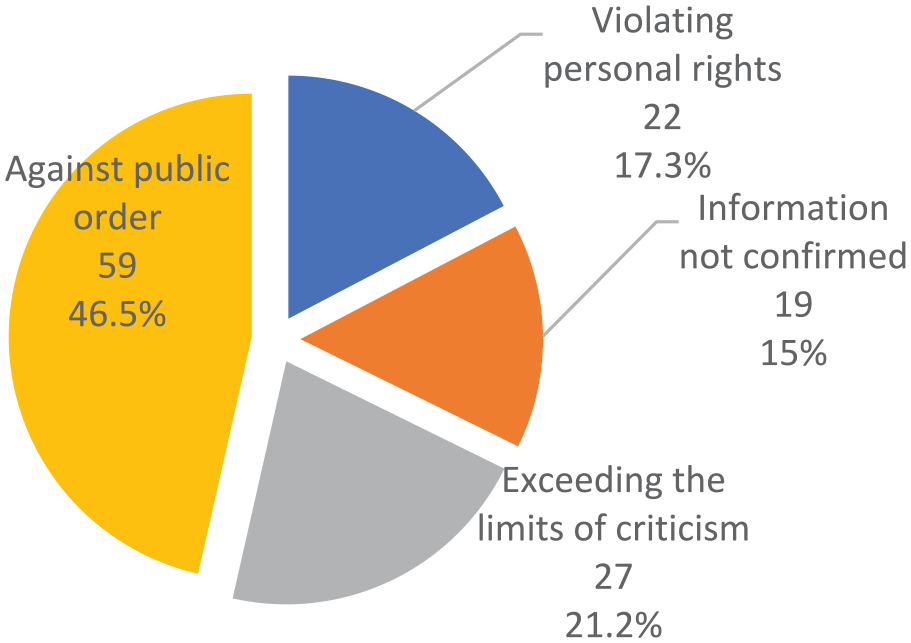
Types of ethical violations.
Detay Kıbrıs
A total of 70 articles were published on the Detay Kıbrıs news site; 70 of them (43%) were COVID-19-related news. Ethical violations were found in 20 (28.5%) of them (Figure 4).

Total news, COVID-19 news, contains/does not contain ethical violations news on Detay Kıbrıs news site.
The Detay Kıbrıs news site published 70 articles, and almost half of the news were COVID-19 themed. About 28.5% of the COVID-19-themed news made ethical violations. This was related to fast and sloppy publishing (Juntunen, 2010).
The most detected sub-category among Detay Kıbrıs news site’s ethically violated COVID-19-themed news was news against public order (panic and anxiety and/or misinformative news in the community) (Figure 5). It was 55%, a high rate that could have a large negative impact on society.

Types of ethical violations on Detay Kıbrıs news site.
Gazedda Kıbrıs
A total of 373 news articles were published on the Gazedda Kıbrıs news site, 211 (57%) were COVID-19-related news. Ethical violations were found in 7 news articles (3.3%) out of 211 (Figure 6).
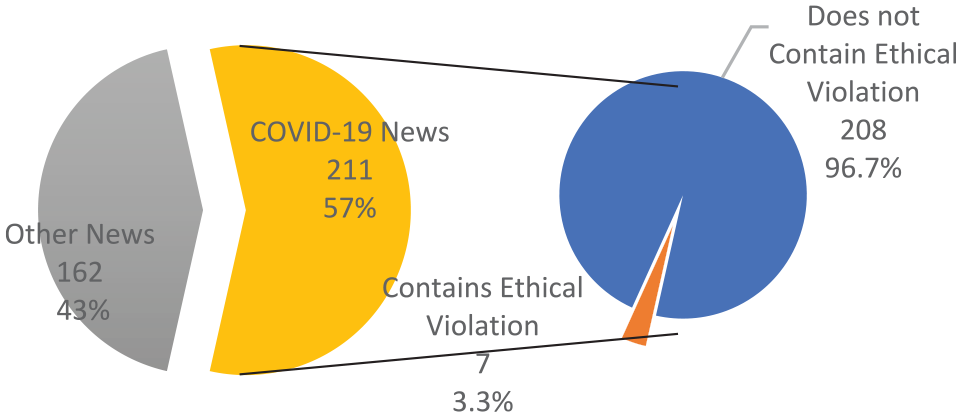
Total news, COVID-19 news, contains/does not contain ethical violations on Gazedda Kıbrıs.
The Gazedda Kıbrıs news site published 373 articles and almost half of the news were COVID-19 themed. However, only 3.3% of COVID-19-themed news included ethical violations. This shows that there are conscious publications, in comparison to the other sites.
The most detected sub-category among Gazedda Kıbrıs news site’s ethically violated COVID-19-themed news was news against public order (panic and anxiety and/or misinformative news in the community) (Figure 7). It was 71.4%. Although it looks like a high rate, the number of news articles should also be considered. They have only seven news articles that violated ethics, and the most detected sub-category was news against public order. Even though the number is small, the news site should still be careful.
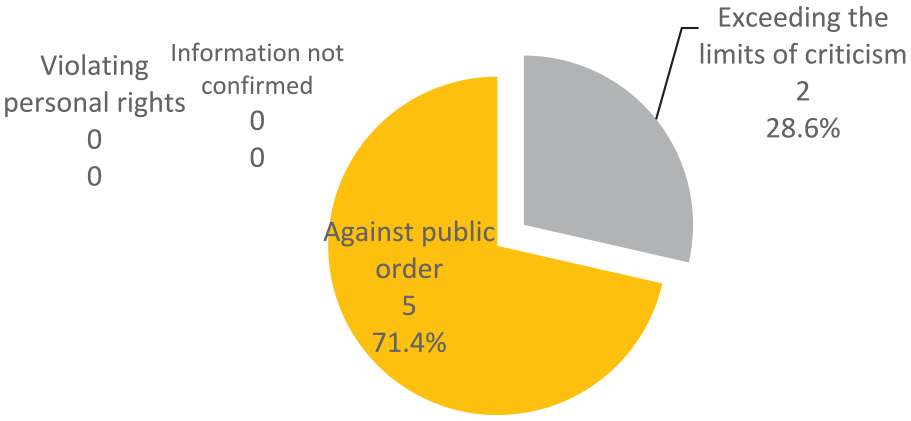
Types of ethical violations on Gazedda Kıbrıs.
Gündem Kıbrıs
A total of 447 news articles were published on Gündem Kıbrıs news sites; 215 (48%) were COVID-19-related news. Ethical violations were found in 60 (28%) of them (Figure 8).

Total news, COVID-19 news, contains/does not contain ethical violations news on Gündem Kıbrıs news site.
The Gündem Kıbrıs news site published 447 articles, and almost half of the news were COVID-19 themed. About 28% fall under ethical violations. This was related to fast and sloppy publishing (Juntunen, 2010).
The most detected sub-category among Gündem Kıbrıs news site’s ethically violated COVID-19-themed news was news against public order (panic and anxiety and/or misinformative news in the community) (Figure 9). It was 50%, a rate that could have a large negative impact on society. High rates were detected on news that violates personal rights and news that exceeds the limits of criticism sub-categories as well.
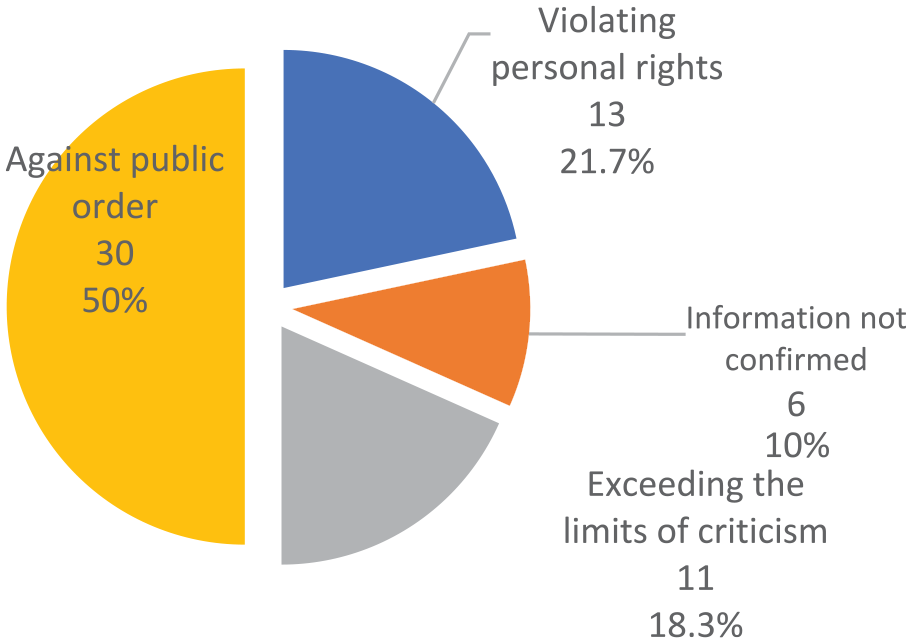
Types of ethical violations on Gündem Kıbrıs.
Kıbrıs Manşet
A total of 460 news articles were published on Kıbrıs Manşet news sites; 223 (49%) of them COVID-19-related news. Ethical violations were found in 40 (18%) of the 223 COVID-19 related news articles (Figure 10).

Total news, COVID-19 news, contains/does not contain ethical violations on Kıbrıs Manşet.
Kıbrıs Manşet news site published 460 articles, and almost half of the news were COVID-19 themed. About 18% of them were included in ethical violations. This is related to fast and sloppy publishing (Juntunen, 2010). However, the average rate was higher which was better than some other news sites.
The most detected sub-category among Gündem Kıbrıs news site’s ethical violated COVID-19 themed was news against public order (panic and anxiety and/or misinformative news in the community). It was 32.5%. High rates were detected on news that violates personal rights and news that exceeds the limits of criticism sub-categories as well (Figure 11).

Types of ethical violations on Kıbrıs Manşet.
Qualitative analysis of COVID-19-related news of news sites
First, it should be noted that COVID-19 continues to be the primary topic in the media since its emergence in Wuhan, China. In this context, the fact that half of the news published in the relevant e-newspapers were related to COVID-19 seems appropriate.
However, 18% of the published news violated journalism ethics due to sloppy and fast publishing.
Deuze (2005) remarks that speed can be seen both as an essentialized value and as a problematized side effect of news work. Within this framework, it is necessary to publish news that is much more informed and ethical. But Kellner (2007) notes that the more intense competition for attention is “leading the media to go to sensationalistic tabloidized stories in an attempt to attract maximum audiences for as much time as possible.” Unfortunately, the eagerness to break the news (i.e., journalists trying to be the first publishers of news) is ahead of ethical values, like an unacceptable “need for speed” game in real life (see Juntunen, 2010).
This unacceptable situation creates panic and anxiety in society and violates people’s personal rights and privacy. The society, which has already gone through a difficult period both physically and psychologically due to the COVID-19 pandemic, is even more affected by such reporting approaches.
In this context, it is important to examine the relevant news sites which published COVID-19-themed news. The qualitative findings are presented via examples from news sites for each ethical violation sub-category.
News containing unconfirmed information
Title: 55 years old Selim Çelik died of COVID-19 (55 yaşındaki Selim Çelik koronadan hayatını kaybetti, 2020, March 29)
While preparing news content, members of the press must confirm the information they receive. Incorrect information will mislead the society.
In the news, it is stated that the 55-year-old Selim Çelik died due to COVID-19. This news contains unconfirmed information because the person concerned did not die due to COVID-19. There were no other COVID-19 patient deaths on the day that the news was reported.
Consequently, the Ministry of Health made a statement and correct information was added to the last part of the news by the news site. However, the title of the news and the part containing the wrong information did not change. Giving unconfirmed information on such a sensitive issue will mislead society and increase the state of panic and anxiety.
Moreover, names, surnames, and photographs of people should not be used without permission. Doing so is considered a violation of personal rights (see Banar, 2006, p. 31; İlkiz et al., 2006; Öngören, 1996, pp. 26–27; Sander, 2002; TMMOB, 2020; Uzun, 2007, pp. 100–106). In this case, it also violated the personal rights of the family members with regard to the name, surname, and association with COVID-19. The suspicion that the family may have been infected with COVID-19 is likely to leave them in a difficult situation because of the stigma attached to COVID-19.
News that violates personal rights and news that exceeds the limits of criticism
Title: Is there any problem with his battery? (Pilinde sıkıntı mı var?, 2020, March 30)
The government and the Minister of Health are criticized for their analogy, “a weak, weak, battery-operated doll.” The emphasis on “baby with battery” was made by the Minister of Health, Ali Pilli, whose surname in English means battery. Criticism is an indispensable element in the state of law, with democracy, and freedom of expression. The press also has the right to freely interpret and criticize information and documents. However, the limits of criticism should not be exceeded. It is unacceptable to exceed the limits of criticism by damaging personal rights and publishing defamation, insults, and malicious content (Dolunay, 2018, p. 35; Dolunay & Kasap, 2017, p. 539).
As per the decisions of the European Court of Human Rights politicians should be more flexible and tolerant of criticism. However, the relevant flexibility and tolerance does not mean that statements containing heavy insults and swearing can be used (Case of Eon v. France, June 14, 2013).
In this framework, the statements in the news that “. . .the head and the “hindquarters” of the government are playing separately. . .” can be accepted as expressions that exceed the limits of criticism.
News against public order (panic and anxiety and/or misinformative news in the community)
Title: 34 positive tests from Salamis Hotel! Re-validation tests are being performed (Salamis Otel’den 34 Pozitif test! Yeniden doğrulama testleri yapılıyor, March 25, 2020)
In the article, it was stated that 34 of the tests performed on 100 employees in a hotel operating in the Famagusta region of TRNC were positive. However, it was stated that the samples were sent to the central hospital for further examination, as the relevant tests had 65% accuracy.
In the news, it was also stated that when there was a hotel under quarantine, the police contacted their families and assigned seven police officers on duty.
In the following period, different from the content of the news, it was found that all 34 people in question were not positive.
News should not cause panic or anxiety in the public. This is one of the most important ethical principles (Dolunay, 2014, p. 8, 2015, pp. 92–93; Sander, 2002). Thus, the news violates journalism ethics within the framework of “being the first to give the news,” “reporting without verification and carelessly” and in this context, causing panic and anxiety.
Analysis of Interviews
The data obtained from the semi-structured interviews with the interview group were analyzed through content analysis under the following themes and codes (Table 1):
Themes and Codes.

The analyses of the interviews will be presented both qualitatively and quantitatively under the themes and codes.
The status of the news in terms of journalism ethics
The questions regarding the evaluation of the news published on news sites in terms of journalism ethics were only addressed to the communication specialists within the interview group due to their specific expertise.
Ethical violation existence and causes
All of the communication specialists (100%, n5) expressed the opinion that the news published on news sites have made ethical violations, and this is due to the very fast and sloppy news preparation for the purpose of increasing clicks and earnings:
P7: “I definitely think there are ethical violations. This is caused by sloppy, earnings-oriented journalism.”
P8: “Unfortunately, ethical violations are frequently encountered, because some news sites may adopt sloppy approaches to be the first to announce the news.”
Types of ethical violations
Journalists and e-newspapers “must” be careful about the ethical rules; they should not violate personal rights (Banar, 2006, p. 31; Öngören, 1996, pp. 26–27; Sander, 2002; Uzun, 2007, pp. 100–106), not cross criticism limits (Dolunay, 2018, p. 35; Dolunay & Kasap, 2017, p. 539), not create panic and anxiety in the society (Dolunay, 2014, p. 8, 2015, pp. 92–93; Sander, 2002), not use unconfirmed information (see Sander, 2002; Ward, 2005; Witschge et al., 2016).
Communication specialists listed the types of ethical violations under the following headings (100%): violating personal rights, crossing criticism limits, creating panic and anxiety in the society, and spreading unconfirmed information.
P6: “Violations include reporting that violates the rights of individuals, statements that exceed the limits of criticism, content that creates panic in the society and information that is not confirmed.”
P9: “Ethical violations appear in the form of sharing patients’ information, making severe criticisms, unconfirmed, informal information, and public distress.”
Effects of news
Questions regarding the evaluation of the individual and social effects of the news published on the news sites were directed only to psychology specialists within the interview group due to their particular expertise.
Causing panic and anxiety in the community
The principle of public interest and order (Dolunay, 2014, p. 8, 2015, pp. 92–93; Sander, 2002): Journalists should avoid producing news that could damage public order and cause society to encounter panic and anxiety; in other words, the news should be in the public interest and in positive terms.
While the answers of the entire interview group (100%, n = 5) varied from person to person, some expressed that individuals have already experienced panic and anxiety, and objectionable publications on news sites may create even more panic and anxiety among individuals and the wider society.
P3: “It is a great danger that individuals tend to act with it by disabling their superego, and in this context, they “live according to forest law” and create chaos in society.”
P5: “The news may cause chaos by enhancing the feelings of individuals and society who already feel uncertain, desperate, have economic concerns, feel depressed, and worry about death and loss.”
Alienation
The principle of respecting personal rights and private life: Journalists should avoid using the surnames and photographs of individuals without permission. Journalists should avoid the defamation of people in front of society, which could damage dignity and cause discrimination and exclusion in society. Journalists should avoid showing people’s homes and their lives; they should also discontinue their interfering journalistic approach in such confidential areas (Banar, 2006, p. 31; Öngören, 1996, pp. 26–27; Sander, 2002; Uzun, 2007, pp. 100–106).
The entire interview group (100%, n = 5) stated that individuals who were suspected of being ill were marginalized by violating their personal rights:
P1: “False information will easily make people alienated and be perceived as an enemy. A hostile attitude toward groups at high risk of carrying the virus in social media is an example of this.”
P2: “Particularly sick individuals are stigmatized and marginalized. This could lead to trauma in the individuals involved.”
Creating consciousness
The interview group stated that 40% (n = 2) of the related news created panic and anxiety, while some news created awareness:
P1: “It not only raised panic and anxiety, but also offered ways to make the person feel strong against this danger. Such information about protection from the virus raised awareness to stay at home.”
Suggestions
With regard to questions where the interview group could make more than one suggestion, the answers were gathered under the following codes:
Conscious approach by internet news sites
About 80% (n = 8) of the interview group emphasized that news sites should take conscious approaches. The suggestions are collected under the headings that the news should be prepared and published in accordance with ethical and legal codes (with respect to personal rights, content that will not create fear and panic, the accuracy of the information should be confirmed, and it should not exceed the limits of criticism).
P9: “Although news sites think they are against the basic principles of journalism, they should not broadcast quickly. By using official, precise information, they should be aware of the rules of law and ethics, should not cause panic in the society and should publish with respect for personal rights.”
P8: “Respect for professional ethics and laws is essential. Critical content, whose accuracy is not confirmed, will cause fear, violate the rights of individuals and should be avoided.”
Official resources and experts make more frequent and/or more qualified disclosures
In total, 60% (n = 6) of the interview group shared the opinion that more frequent and qualified explanations should be made about the development of COVID-19 from official sources:
P10: “Government officials and competent persons are required to make more frequent/qualified statements within the framework of crisis management.”
Increasing educational activities
About 50% (n = 5) of the interview group stated about educational activities and that training should be organized to raise the awareness of media professionals about professional literacy and society in terms of media literacy:
P6: “Educational activities should be carried out for individuals in terms of media literacy. In this way, they will not be influenced without confirming the accuracy of the information.”
Revising legal regulations and establishing a legally authorized supervisory board
About 50% (n = 5) of the interview group stated that legal regulations should be revised, and punitive mechanisms be applied in ways that would not harm the freedom of expression or the freedom of the press. Again, they emphasized that an “Internet News Site Ethics Committee” which consists of field experts should be formed and enforced.
P7: “By legislating and revising legal regulations, deterrent and punitive mechanisms should be established; Internet ethics boards should be established including expert members such as media representatives and lawyers with the power to apply sanctions.”
Findings
As mentioned, this study aimed to determine whether there are ethical violations in the broadcasts of internet news sites and, if any, in which categories they are gathered. Through in-depth interviews, we aimed to determine how ethical violations of internet news sites affect society, the reasons for the occurrence of ethical violations, and how they can be prevented. In this context, press screening and in-depth interviews led to the main conclusion as two important complementary parts of this research.
The findings obtained in this study will be reviewed below under the headings of a new site content review and semi-structured interviews with specialists.
New Sites Content Review
Between March 20 and 30, 2020, 1,446 news articles published on four news sites were examined in the study; 719 (50%) of them were related to COVID-19. Ethical violations were found in 127 (18%) of the 719 COVID-19-related news articles.
Accordingly, the answer to the first research question, “Do the digital journals publish by the ethical principles of journalism?” is that digital news sites do not publish in accordance with ethical principles and have different rates of ethical violation.
The fact that half of the published news articles were about COVID-19 stems from the importance of the issue. However, ethical violations occurred in 18% of the related news items, which is a substantial rate.
When the rates of ethical violations were analyzed based on news sites, the following findings were obtained: In Detay Kıbrıs, 20 (28.5%) of 70 COVID-19 news articles; in Gündem Kıbrıs, 60 (28%) of 215 COVID-19 news articles; in Kıbrıs Manşet, 40 (18%) of 223 COVID-19 news articles; and in Gazedda Kıbrıs, 7 (3.3%) of 211 COVID-19 news articles were found to violate ethical principles (Figure 12).

COVID-19 news in terms of containing/not containing ethical violations.
It has been determined that Detay Kıbrıs and Gündem Kıbrıs news sites have the most ethical violations, with highly similar rates. They were followed by the Kıbrıs Manşet news site. Although it has a lower rate, it does not pay due attention to the principles of journalism ethics. It was found that Gazedda Kıbrıs has a very low ethical violation rate and publishes in accordance with journalism ethics.
The answers to the second research question, “In which categories and sub-categories are publications contrary to the principles of journalism ethics collected?” were determined as follows:
The most ethical violations encountered in news included the ones that cause panic and anxiety in society. This was followed by highly critical news, news that violates personal rights, and news that contains unconfirmed information (Figure 13).

COVID-19 news in terms of types of ethical violations by news sites.
Semi-Structured Interviews
The interview group consisted of communication and psychology specialists.
The research question “What are the reasons for ethical problems on the news sites according to the participants?” was answered as follows:
Communication specialists (100%) expressed the opinion that ethical violations frequently encountered in COVID-19-related news on news sites were due to the fast and sloppy preparation of news for high clicks and profits.
It is stated that ethical violations are under the categories of personal rights violations, crossing the limits of criticism, violation of public order (panic and anxiety and/or concerning the society), and spreading unconfirmed information.
Thus, it was concluded that ethical rules were violated under the same categories in the interviews and the media screening.
Another research question “What are the effects of publishing news contrary to the principles of journalism ethics in terms of both individuals and society?” was answered as follows:
Psychology specialists stated that the news that violated journalism ethics caused panic and anxiety in society (100%). On the contrary, they emphasized that the news that was created consciously promoted calm, trust, and consciousness in the society.
The last research question “What precautions should be taken for publishing to be in accordance with journalism ethics?” was answered as follows:
The interview group’s recommendations for the prevention of ethical violations/effects were as follows.
News sites should take a more conscious approach (80%).
Officials and institutions should make more frequent and/or qualified statements (60%).
Educational activities should be increased for both members of the press and wider society (50%).
Legal regulations should be revised, and a legally authorized internet news website audit institution should be established (50%).
Discussion and Conclusion
The new media is an indispensable part of our lives within the framework of mainstream media and Internet technology. Both have functions such as informing, entertaining, educating, and guiding the masses. However, new media can have a significantly larger effect owing to its speed and ease of spreading information. All types of data can reach large populations within seconds. As Deuze (2005) remarks, speed can be seen both as an essentialized value and as a problematized side effect of news work. Therefore, it is necessary to publish news that is much more informed and ethical. But Kellner (2007) notes that the more intense competition for attention is “leading the media to go to sensationalistic tabloidized stories in an attempt to attract maximum audiences for as much time as possible.” Unfortunately, owing to the speed (journalists’ trying to be the first publishers of news), ethical values like an unacceptable “need for speed game in real life” are being overlooked (see Juntunen, 2010).
Home quarantine during the pandemic has led individuals to access digital platforms more frequently. The scarcity of printed newspapers increases the duties and responsibilities of news sites. They can provide vital information to raise the awareness of the society within the framework of conscious journalism, which is a very important task during this period. However, the publication of news that contravenes ethical principles can lead to serious problems.
In this study, it was found that Detay Kıbrıs and Gündem Kıbrıs, which are news sites of TRNC, should pay considerable attention to the principles of journalism ethics in COVID-19 news. Even Kıbrıs Manşet should pay more attention to its ethical principles in COVID-19 news. The Gazedda Kıbrıs news website exhibits considerable ethical publishing with regard to COVID-19 news.
News that makes the most prominent ethical violations may cause individuals and society to panic and become anxious. This may also cause alienation of individuals. It can lead to severe anxiety and chaos among individuals and society, who are already experiencing a difficult time.
News against public order (panic, anxiety, and/or misinformative news in the community, 46.5%) were first placed on ethical violations. This was followed by news that exceeded the limits of criticism (21.2%), news that violated personal rights (17.3%), and news with unconfirmed information (15%).
In studies conducted outside Cyprus, it was also revealed that the media caused anxiety disorders during the pandemic. Hossain et al. (2020) reported that the media caused anxiety disorders in Bangladesh. Similarly, Bendau et al. (2021) found that the use of media during the pandemic increased depression and anxiety. In a study conducted in India by Sahni and Sharma (2020), it was revealed that the misinformation in the media during the pandemic spread faster than the disease itself and caused negative effects on people’s health. The explained effects occurred because of the publication of unethical news.
Ethical violations are caused by the fast and sloppy preparation of news for high clicks and earnings. To prevent this situation and/or reduce its effects, the following recommendations should be considered:
The news should be prepared and published in accordance with ethical and legal codes (with content that will not create fear and panic, respect for personal rights, by confirming the accuracy of information and not exceeding the limit of criticism).
Frequent and qualified statements should be made about the development of COVID-19 by official sources.
In terms of educational activities, trainings should be organized to improve the level of awareness of media professionals in terms of professional ethics and society in terms of media literacy.
By legislating and revising legal regulations, deterrent and punitive mechanisms should be established.
An “Internet News Site Ethics Committee” that consists of field specialists should be established and enforced.
Footnotes
Declaration of Conflicting Interests
The author(s) declared no potential conflicts of interest with respect to the research, authorship, and/or publication of this article.
Funding
The author(s) received no financial support for the research, authorship, and/or publication of this article.
