




Abstract
The relationship among different media types is a long and exciting subject for researchers. It can not be denied that the rise of online media has contributed to the decline of traditional media consumption. Despite their conflict, traditional media can take full advantage of social media’s user base for their benefit. At one point in this relationship, the Covid-19 pandemic occurred as a massive event that changed the world beginning in 2020. In the new situation, people’s emotions, information seeking motivation, and intention change, ultimately affecting their choice of mediums to acquire information. The study found differences in people’s emotions, motivation, and medium’s re-use intention during the Covid-19 outbreaks and after they were controlled. Furthermore, the results illustrate that one medium’s re-use intention is affected by its credibility and other medium’s credibility and re-use intention. These impacts could signify the complementary effect in a multiplatform context.
Keywords
Introduction
Mobile devices and the Internet have become an essential part of our lives, with about 5.27 billion mobile phone users (66.9% of the world population) and 4.80 billion internet users worldwide (60.9% of the world population). Also, an average person spends 6 hr and 55 min per day using the Internet, higher than the time spent watching television which was 3 hr and 20 min daily in 2021 (Datareportal, 2021b). Internet dependency has affected the advertising market; the 2017 annual Global digital advertising spending has reached 208.82 billion U.S. Dollars, surpassing the same criteria for television, which reached 178.48 U.S. Dollars (Kafka & Molla, 2017). However, the news repertoire approach affirms a pattern of multiple media use for acquiring and assessing news (Yuan, 2011). The pressure from the advertising market and the threat of substitution have pushed traditional media organizations to publish their content on online platforms to reach their audiences (Wolf & Schnauber, 2015).
In this context, media credibility is a crucial factor, for its close relationship with media motivation and media use, that one can predict the other (T. J. Johnson & Kaye, 1998, 2004; T. Johnson & Kaye, 2010; T. J. Johnson & Kaye, 2015; D. Kim & Johnson, 2009; Wanta & Hu, 1994). From this approach, traditional media gained many advantages for using information from the government’s official source, with trained journalists prioritizing quality information (Miller & Kurpius, 2010). Indeed, T. J. Johnson and Kaye (2015) found that social network sites’ (SNS) credibility is lower than traditional media. Meanwhile, newspapers and their online counterparts were rated as having the highest credibility, followed by television (Kiousis, 2001). In this case, it is critical to understand that the traditional media’s credibility can be transferred to its extensions (e.g., fan page, website, and apps) by establishing a consistent brand image as a trustworthy source of information (Kaye & Johnson, 2020; Westlund, 2015). However, the media competition continues to intensify, changing the news organizations within and spurring concerns about journalism’s future (Westlund et al., 2021)
At one point in the conflict, the covid-19 pandemic happened. The crisis altered people’s behaviors in order to alleviate anxiety through the provision of sufficient information (Lim et al., 2021). People are more cautious in verifying the information obtained from the Internet, which is well-known for being a source of misleading and false information (Hashim et al., 2020; van der Linden et al., 2020). Furthermore, Casero-Ripolles (2020) also reported an increase in news consumption, with television and print media rated as the most credible sources of information during the health crisis in the United States. Despite the Internet’s global nature, most media credibility studies focus on the United States (D. Kim & Johnson, 2009). In considering that media credibility in the crisis is a global issue, it is critical to examine their effects in various countries, with various people and cultures. In this instance, Vietnam presents a particular research opportunity.
Since 1986, Vietnam has undergone 35 years of economic renovation, transforming from one of the world’s poorest nations into a lower middle-income country (The World Bank, 2021). Along with the rapid economic development, the country’s media system is state-owned and actively supports government and democracy (Hong, 2002). In 2020, Vietnam was very successful in controlling the Covid-19 pandemic (Willoughby, 2021). Although the new Sars-Cov-2 virus delta variant outbreak in late April 2021 harmed the country’s efforts (T. H. Le, 2021), the Vietnamese were experiencing both crisis and normalcy. This situation enabled researchers to compare the differences between the two periods regarding negative emotions, information seeking motivation, media credibility, and media re-use intention. Additionally, this study further analyzes the factors affecting media re-use intention in the two periods.
Literature Review
The Multiplatform Trend in the Media Industry
The explosion of the World Wide Web and technological advancements have changed the way people access information, shifting from traditional media delivered to online sources (Flanagin & Metzger, 2001). By democratizing the content creation process, social media empowers its users with the capability of free speech, transforming them into “prosumers” (Wu, 2018). Unsurprisingly, research has found that one of the social media motivations, namely anti-traditional media sentiment, demonstrates a distrust of traditional media, which they perceive as biased (Kaye & Johnson, 2017). Moreover, social media come in a variety of platforms to meet the diverse needs of their users: Facebook for multi-purpose, Twitter for general information, YouTube for video, Tiktok for brief videos, or Twitch for video game live streaming (Esteban, 2019; Kaye & Johnson, 2017; Sixto-García & Losada-Fernández, 2023). Soon enough, social media have become the most relevant information source worldwide, compared with television, which now falls to second place (Golin, 2017). In America, 86% of adults acquire news from their digital devices, compared to 68% from television (Shearer, 2021). However, it is recognized that digital media have also encountered numerous challenges, including privacy and security concerns, addiction, as well as misinformation and fake news, which undermine their credibility (Dhiman, 2023). The issue of social media credibility erosion is complicated, owing to the numerous stakeholders involved in the process (Salaverría & León, 2022). As the youths’ reliance on social media increases, influencing their attitudes and perceptions, researchers have proposed tactics for news and social media literacy (Cho et al., 2022; Swart, 2023). Nonetheless, a growing number of social media users believe they can be informed without actively seeking news through other channels; this phenomenon has been named “news finds me perception” (NFMP) (De ZúñIga et al., 2020). Additionally, T. Diehl and Lee (2022) demonstrated that social media reliance, in conjunction with the NFMP, influences the probability that social media users consider fake news as credible.
From the advertising expenditure perspective, a unique aspect of the media industry is to attract viewers’ attention, enhancing the position and value in their perception to benefit from advertising (Hamilton, 2003). According to this viewpoint, with its large user base, social media is an essential marketing tool that allows marketers to reach, interact, and engage with their customers. (Appel et al., 2020). Therefore, it is not difficult to recognize the fierce competition between traditional and contemporary mediums. In 2017 and 2018, advertising spending for digital content surpassed television, leaving other mediums behind (Luck et al., 2020).
Regarding the relationship among mediums, researchers hold contradictory views. From the media evolution approach, a new medium is created to replace an older one, particularly when their functions are equivalent (Mcintyre, 2014; Ramirez et al., 2008). From the complementary theory perspective, traditional and contemporary media are intended to complement one another (Stempel et al., 2000). The complementary theory is supported by the media repertoire approach, in which people use multiple mediums simultaneously to meet their needs and motivations (S. J. Kim, 2016). In reality, people often employ the Internet to verify information from television or the press, and vice versa (Stempel et al., 2000). After all, numerous mediums continue to co-exist and support one another in numerous ways (Stefanone et al., 2010).
Since then, numerous studies have investigated the complementary relationship between different mediums. Television viewers occasionally use Facebook to follow celebrities from reality shows (Dubrofsky, 2011). According to Lysak et al. (2012), many television stations and reporters use social media to connect with their audiences.Conversely, the SNS can be an information source for the newsroom. However, Curiel (2015) argued that social media information sources lack the credibility of traditional media. In some cases, incorporating SNS components into television news has diverse effects on the audience’s assessment of the journalistic quality and the news’s credibility (Gearhart & Kang, 2014). After all, a model for predicting television ratings based on Facebook reactions has been suggested, encouraging television stations to continue maintaining their social media identities (Cheng et al., 2016). Additionally, in the context of cross-media study, in considering the relationship between individuals with a mediums repertoire, they are referred to as media users rather than newspaper readers or television viewers specifically (Picone, 2017). In marketing, the multiple-screen or media multitasking habit has undeniably become a feature of media users (S. Diehl et al., 2022).
Until recently, traditional mediums have recognized that having their presence on the online platform would be beneficial (Wolf & Schnauber, 2015). Indeed, multiplatform media has become a trend; advertiser attempt to appear on as many media channels as possible (Luck et al., 2020), and media organizations are increasingly shifting from single-sector to multiplatform content providers (Doyle, 2015). A television channel may expand its presence on SNS by creating its page or profile, publishing its content on a YouTube channel, or developing its app, while retaining its well-known characteristics, allowing users to recognize that these expansions are a part of and belong to the original medium (Vogan, 2018). The method shares many similarities with the celebrity identity linkage strategy (C. Li et al., 2019). In fact, during the Covid-19 pandemic, although social media is a source of fake news, the government and traditional official mediums employed it to provide timely updates to citizens, crisis management and combat misinformation (Tsao et al., 2021; Venegas-Vera et al., 2020).
The Media Situation in Vietnam
The Vietnamese media market is diverse, with the participation of many different media types, which the top three mediums are television, social media, and digital press (Datareportal, 2021a). In 2022, on an average daily basis, a Vietnamese spent 2 hr and 47 min watching television, 2 hr and 28 min using social media, 1 hr and 55 min reading press media, 1 hr and 12 min for music streaming, 1 hr and 12 min for gaming, 44 min for podcasts, 38 min for radio (Datareportal, 2022). Although the press media daily time-spent includes both printed and digital press, it is acknowledged that the majority of Vietnamese read news online (Vnexpress, 2017).
Among the top-used mediums, music streaming and games are inappropriate for this study’s research direction because they are not intended for news-seeking purposes. Moreover, radio and podcasts have less than half the daily usage duration of the top three dominant mediums (Datareportal, 2022). Also, during the third and fourth Covid-19 outbreaks in 2021, daily radio consumption decreased by 3 min, whereas daily podcast usage remained unchanged, demonstrating their lesser importance to Vietnamese media users (Datareportal, 2021a, 2022). As a result, this study chose three dominant mediums as its focus: television, digital press, and SNS.
Television and digital press are strictly regulated under Press Law No. 103/2016/QH13 (2016), prioritizing honesty and monitoring journalistic quality. The law required journalists to register the press card as a certificate for their ability to produce news. On the contrary, under the Information Technology Law No. 67/2006/QH11 (2006), liberal news websites and social media are administered with less control and more freedom, which allows them to share their information on many subjects that is not prohibited by the Cybersecurity Law No. 24/2018/QH14 (2018). As a result, this study focuses on television and digital press as two official government mediums and SNS as a liberal medium. However, it is known that the Vietnamese cannot distinguish between the digital press and liberal news websites (Vnexpress, 2017). Although the survey attempts to distinguish between these two media types, confusion may still occur. Therefore, the study will use the term “news websites” as a precaution measure.
The rivalry between traditional and new media in Vietnam is well-known. On May 25, 2021, a personal Livestream one-sidedly accused many celebrities in Vietnamese showbiz of misappropriating charity money, reaching 388,000 people watching simultaneously on Facebook and YouTube (Thanh Chi, 2021); compared with the number of 10,000 people who watched the news on a Vietnamese cable TV channel at the same timeframe (A. Nguyen, 2021). To react, the Vietnam television broadcasted on VTV1 channel News informed about the official dispatch number 1800/BTTT-PTHT&TTDT of the Vietnam Ministry of Information and Communications, dealing with false information on SNS.
Moreover, From the media repertoire perspective, it is typical for people to combine various types of traditional and new media to meet their demands (Gong et al., 2020; S. J. Kim, 2016). As a result, they are extremely familiar with various media types and how to employ them to achieve their goals. Hence, the concept of media using intention is not appropriate in this situation. Instead, this study follows the repeat using intention (re-use intention) approach, focusing on media users who have experienced the mediums and attempting to understand what factors influence their decisions to continue using such mediums to obtain information. The study also follows the media repertoire approach to assess the influences across media. For instance, the research will attempt to answer the question if users’ perception of one medium credibility and its re-use intention influence other medium re-use intention (Yoo, 2011). After all, the objective of maintaining customers’ engagement and stimulating their repeat using intention is the focus of media and marketing experts (Chung & Yoo, 2008; Luck et al., 2020).
The Role of the Media in the Covid-19 Pandemic in Vietnam
Vietnam has experienced four Covid-19 outbreaks since January 23, 2020 (Nixon, 2021). Before May 2021, the country was considered successful in containing the Covid-19 pandemic, with only 5,857 confirmed cases and 35 deaths (VGP, 2021). However, the fourth wave of the Covid-19 pandemic, from April 27 until October 2021, when the authorities stated to basically control the pandemic (Vietnamnet, 2022). In estimation, from the beginning of the fourth wave to November 18, 2021, there were 1,060,394 confirmed COVID-19 cases and 23,476 reported deaths (Lan, 2021). Strict scenarios with enhanced social distancing and lockdowns were enforced in many regions to control the situation (Reuters, 2021).
In the crisis of the Covid-19 pandemic in Vietnam, the official government media played an active role in propagating information to the public and assisting the government responses (La et al., 2020). Furthermore, the mentioned mass media could impact the citizen’s behavior to ensure the success of social distancing measures (Nguyen, Nguyen Cuong et al., 2020).
However, disseminating false information through social media platforms hinders the government’s efforts to control the crisis (Ahmad et al., 2022). From February 1 to May 31, 2020, there were 560.048 articles published in the press, the majority of which were positive or neutral (77.43%); compared to 17 million mentions of Covid-19 that were made on social network sites in the first 5 months of 2020 (Vietnam Ministry of Health, 2020); According to a report on media monitoring in Vietnam, the frequency of fake news publications rises in conjunction with the crisis level (Oxford University Clinical Research Unit - Vietnam, 2021).
In the Covid-19, information credibility is the most important factor, while the “infodemic” with rapidly spreading news poses a risk to its quality in general (Gallotti et al., 2020). When confronted with a crisis and repeatedly exposed to inaccurate media, fear, and anxiety set in (Lăzăroiu et al., 2020). It is suggested that the official media should take on the duty of offering accurate news to support crisis management (Lăzăroiu & Adams, 2020). In fact, to face the threat of uncontrollable false information, the government has implemented several regulations to prevent the spread of fake news (La et al., 2020). Additionally, a series of successful information campaigns have been launched to keep the public informed about the current situation, using a combination of various channels to disseminate accurate information, such as the official press, liberal news websites, radio, television, and also social media (Tran et al., 2020).
Information Seeking Motivation
The first factor to consider in this study is media users’ motivations, which are thoroughly investigated by the Uses and gratification theory (UGT), which affirms that people are goal-oriented and actively seek media to satisfy their needs (Katz et al., 1973). Knowing their motivations allows the media producer to create content that meets their needs, thus influencing their choice. Mcquail et al. (1972) proposed four primary motivations: diversion, personal relationships, personal identity, and surveillance. Over the years, many different media types’ motivations have been found for newspapers, television, news website, and SNS (Berelson, 1949; Joinson, 2008; Kaye & Johnson, 2017; Phua et al., 2017; Rubin, 1983; Yoo, 2011). It is essential to notice that information seeking motivation is common among the listed media, being called by different names such as interpreting affairs, information seeking, information, or improving social knowledge. This overlap is common in UGT research (Sundar & Limperos, 2013).
UGT believes that users’ motivations will be satisfied through media exposure. Consequently, they will obtain gratification, which enhances their media repeat using intention (re-use intention) (Katz et al., 1973; Yoo, 2011). According to Gong et al. (2020), people often employ several mediums to obtain diverse information and to verify the news they receive. Information verification can be accomplished using various methods, such as message convergence, which compare several mediums against one another (Anthony et al., 2013). Thus, one medium’s characteristics will affect users’ perception of another medium.
The information is regarded as a vital resource during a crisis, serving to cope with uncertainty and reduce anxiety. During the Covid-19 pandemic, researchers observed increased people’s information seeking behaviors and news consumption (Casero-Ripolles, 2020; Lim et al., 2021). Indeed, the Covid-19 information seeking behavior has been illustrated to positively influence people’s attitude and intention to prevent Covid-19 (J. Li & Zheng, 2022). However, continuously exposed to fake news, people tend to avoid information and employ heuristics in processing Covid-19 data (H. K. Kim et al., 2020). A study on information seeking in Covid-19 in Greece reveals a pattern of focusing on television and news websites while avoiding social media, reflecting the participants’ perception of the misinformation on this platform (Skarpa & Garoufallou, 2021). Another study in Spain also showed that people frequently seek information on mainstream mediums and WhatsApp—a smartphone application (Moreno et al., 2020). Thus, it can be realized that different nations will have different information seeking patterns in Covid-19, based on the different characteristics of these countries. Therefore, with its unique media situation and Covid-19 management policies, Vietnam will be an interesting case to analyze.
Media Credibility
Media credibility is a sophisticated and multidimensional concept that is inextricably linked with media users’ motivation in the context of news mediums selection. The broad definition of such a relationship can be stated in two ways: credibility predicts motivations (T. J. Johnson & Kaye, 1998, 2015), or motivations and gratifications impact credibility (T. J. Johnson & Kaye, 2000). In general, the influence of media credibility and users’ information motivations to media reliance and repeat using intention has been illustrated on many occasions (Gaziano, 1988; T. J. Johnson & Kaye, 1998, 2015; Kaye & Johnson, 2017; Yoo, 2011). After all, credibility is one of the most important factors in the context of news media (Neuberger, 2014).
Scholars often focus on different aspects of media credibility, such as source and medium (Golan, 2010). Newhagen and Nass (1989) described a state of confusion between the two concepts due to the ambiguity of the information source’s definition, which could be an individual, group, organization, or even a media channel (e.g., television or newspaper). However, the line that separates them is thin (Kiousis, 2001).
Since Hovland and Weiss (1951) explained source credibility impacts on persuasion. Researchers proceed to investigate the concept’s characteristics and how it affects attitude change in an interpersonal context (Chartprasert, 1993; Hovland et al., 1953; Park & Lin, 2020). At the same time, many studies have examined source credibility as a multidimensional concept. However, the results differ across research (Berlo et al., 1969; McCroskey et al., 1974; Ohanian, 1990; Seiter et al., 2010; Vanden Bergh et al., 1981; Whitehead, 1968).
The source credibility and newspaper reporting accuracy research have built the foundation of medium credibility, focusing on the channel that transmits the information (Gaziano & McGrath, 1986). Westley and Severin (1964) was one of the first medium credibility research that measured the concept by accuracy and truthfulness. Their findings included the effects of demographic factors on a person’s perceived credibility. Additionally, television news is perceived to be more credible than newspapers. Through time, various types of media were employed for medium credibility research as the newspaper, radio, television, political blogs, news website, and SNS (Abel & Wirth, 1974; T. J. Johnson & Kaye, 2004; Kaye & Johnson, 2017; D. Kim & Johnson, 2009; Westley & Severin, 1964).
In addition, considerable effort was spent to measure the concept of medium credibility by inheriting the scale from source credibility research (R. S. H. Lee, 1978; McCroskey & Jenson, 1975). However, Edelstein (1978) was concerned about the inappropriateness of source credibility items, which developed from the interpersonal context in mass communication research. The most popular measurement is the 12-dimension scale, proposed by Gaziano and McGrath (1986), including fair, bias, complete, accurate, trustworthy, concern about the community’s well-being, concern about the public interest, factual, respect for people’s privacy, watch after reader/viewer interest, separate from fact and opinions, and reporter’s quality. The scale was then refined by Meyer (1988), leaving only five factors: fairness, bias, completeness, accuracy, and trustworthiness. These two scales have been widely used in media credibility research ever since.
From the traditional view, medium credibility researchers are concerned with (1) analyzing differences in perceived credibility based on the customer’s demographics (Greenberg, 1966; Westley & Severin, 1964; (2) comparing different media types’ credibility (Carter & Greenberg, 1965; Davies & Cairncross, 2013; Jacobson, 1969; Shaw, 1973); and (3) exploring the relationship between media credibility and other factors as media motivations, usage, or reliance (T. J. Johnson & Kaye, 1998; T. Johnson & Kaye, 2010; T. J. Johnson & Kaye, 2015; Wanta & Hu, 1994).
However, the situation has changed. Firstly, traditional media credibility has witnessed a decline since 1990 (Pew Research Center, 1996). Additionally, among a plethora of online sources (e.g., SNS, blogs) that allow its users to actively create and spread the news while concealing their identity, the media consumer is now responsible for determining the information’s credibility (T. J. Johnson & Kaye, 2014). This situation has compelled scholars to shift their focus to new sources and new medium credibility as websites, blogs, and social media (Flanagin & Metzger, 2000; T. J. Johnson & Kaye, 2000, 2004; Metzger et al., 2003).
In the multiplatform era, one medium will try to expand its identity across other platforms to broaden its reach. As a result, any medium expansion is expected to carry its characteristics, including credibility. Kaye and Johnson (2020) confirmed that media users’ perceived credibility is transferable from the original traditional medium to its mobile. Moreover, the app is considered by users as an extension of their trusted medium.
In the Covid-19 crisis, fake news and misinformation have been proven to harm the pandemic control efforts (Ahmad et al., 2022). Therefore, it is important to provide people with the ease to access accurate information through multiple platforms (La et al., 2020; Lăzăroiu & Adams, 2020; Tran et al., 2020). In this instance, the traditional mediums extensions on social network sites have several advantages, such as being the government’s official information source (Hong, 2002); and having higher credibility due to their long existence and journalistic quality (Casero-Ripolles, 2020; Gaziano & McGrath, 1986). Although the media situation varies by country, resulting in differences in media selection patterns and medium credibility assessments, people in crisis tend to select the medium that they perceive to be credible to be the main information source (Casero-Ripolles, 2020; Moreno et al., 2020; Skarpa & Garoufallou, 2021)
Negative Emotions in Crisis
After considering the cognitive side of people in crisis, the study moves on to evaluating their crisis emotions. Emotions are humans’ responses to the crisis based on their perception of it (Lazarus, 1991). Jin (2009) proposed the four primary negative emotions that appear in a crisis based on their level of predictability and controllability. In a situation of high predictability and controllability, people will feel angry. On the opposite, people frighten of uncontrollable and unpredictable crises. However, in the case of a crisis of high predictability and low controllability, people feel sad. Finally, anxiety appears in a situation that is unpredictable but can be controlled.
The mentioned negative emotions caused by the Covid-19 pandemic can be strengthened by regularly exposing oneself to fake news (Lăzăroiu et al., 2020). Anger and anxiety have even been shown to influence people’s attitudes toward government policies (Renström & Bäck, 2021). Therefore, it is important to satisfy the population’s need for accurate information to balance their negative emotions in order to successfully control the pandemic (Lwin et al., 2020).
From the media selection perspective, negative emotions affect the decision process differently, including choosing media to obtain information in a crisis (Jin, 2009; Lerner et al., 2015). Scholars recommend that people limit their time and frequency of use of social media in times of crisis to control negative emotions (Wang et al., 2023). Indeed, many people have blamed social media for fostering negative emotions (Faize & Husain, 2021). As a result, official information sources that take a balanced approach to positive, neutral, and negative information may be a better option (Vietnam Ministry of Health, 2020).
Research Questions
Based on the previous discussion, the study was carried out to investigate the following research questions:
RQ1: Are there any differences between the two periods (during the Covid-19 outbreak and when it is controlled) regarding negative emotions, information seeking motivation, perceived media credibility, and media re-use intention?
RQ2: In a multiplatform context, what factors predict the television re-use intention during the Covid-19 outbreak and when it is controlled?
RQ3: In a multiplatform context, what factors predict the news website re-use intention during the Covid-19 outbreak and when it is controlled?
RQ4: In a multiplatform context, what factors predict the SNS re-use intention during the Covid-19 outbreak and when it is controlled?
Methodology
Participants and Procedures
Participants Selection
For participants recruitment, this study employs the convenience sampling method for several reasons:
First, the online surveys were carried out in two waves: the first from January 2 to January 27, 2021 and the second from April 1 to April 27, 2021. The mentioned periods were the few rare instances when the Covid-19 pandemic was under control, and no new cases were discovered in Vietnam. The time gap between these two waves was due to the third pandemic outbreak in February 2021. Additionally, the survey was interrupted on April 27, 2021, due to a new pandemic outbreak, which prolonged to October 2021. Thus, understandably, the negative effects of the Covid-19 pandemic outbreaks complicate the participant selection process, leaving only the convenience sampling method as a viable option.
Additionally, the authors considered the prevalence of SNS, news websites, and television in Vietnam as three dominant mediums, with the majority of users from 18 to 44 years old (Datareportal, 2022).
Moreover, the convenience sampling method’s appropriateness has been demonstrated in prior research on users’ continuance using intention for digital platforms (D. G. Nguyen & Ha, 2022), social advertising (Rehman & Al-Ghazali, 2022), and news consumption during the Covid-19 pandemic (Apuke & Omar, 2021; He et al., 2021).
The Procedure
The researchers initially asked the participants which medium they frequently use to acquire news in general. If their options do not include SNS, television, or news websites, which are the focus of this study, the researchers will recognize their participation and stop the survey process. On the contrary, participants will proceed to answer the questions if their options include all three of the mentioned mediums.
The survey was separate into four parts and twelves sections (detailed in Table 1). Banners are used to signal different mediums (by colors) and periods’ sections (by icons).
The Survey Outline.

The separation of different periods evaluation in the survey: The survey is separated into two sections to explore what participants think and feel in two different periods:
(1) During the Covid-19 crisis (during the crisis): the three events of the first, second, and third Covid-19 outbreaks were utilized to reinforce the participants’ memory. Nevertheless, because the third outbreak occurred in-between the surveys’ first and second waves, the first wave’s participants are required to remember the first and second outbreaks, but the second wave’s participants have to recall their memory of all the first, second, and third outbreaks.
(i) The first outbreak (March 6 to April 23, 2020): from March 6, 2020, the 17th Vietnamese Covid-19 positive case was found (famously known as patient number 17), followed by almost 2 months of a fierce battle against the pandemic. The number of Covid-19 cases skyrocketed to 268 cases until April 15, 2020. In this time length, two directives have been enforced by the government: the Directive Number 15/CT-TTg on March 27, 2020, provides a general guideline toward social distancing rule for 15 days in the Directive Number 16/CT-TTg on April 1, 2020 (Tran et al., 2020). The social distancing process was prolonged to 23 days until it ended on April 23, 2020, after 7 days of no new cases of Covid-19 were found and no deaths were reported (La et al., 2020; Vietnam General Department of Preventive Medicine, 2021).
(ii) The second outbreak: (July 25 to December 1, 2020): a new case of Covid-19 have been discovered in Danang’s C hospital on July 25, with an unknown infection source, which was later determined to be illegal immigrants from other nations (T. H. Le & Tran, 2021). The wave lasted for 129 days until December 1, 2020, resulting in 554 community cases and, for the first time, recording 35 deaths by Covid-19 in Vietnam (H. N. M. Le et al., 2021).
(iii) The third outbreak (January 28 to March 25, 2021): the event duration is officially recorded by the press from January 27 to April 26, 2021 (Vietnamnet, 2022). However, as of March 25, 2021, no new community transfer cases have been found, and many activities have been restored to normal (Nhan Dan press, 2021). The wave has been reported with 1,303 cases, including 910 community cases and no deaths (H. N. M. Le et al., 2021; Vietnamnet, 2022).
(2) When Covid-19 outbreak was under control (post-crisis): the term has been chosen as it reflects the time when the online surveys were processed, when the pandemic outbreak was controlled, and most activities have returned to normal. The participants were asked to consider their current status and answer the questions.
The separation of different mediums evaluation in the survey: In considering the multiplatform trends in the media market these days (Wolf & Schnauber, 2015). Traditional and new media are intertwined (Cheng et al., 2016; Gearhart & Kang, 2014; Kaye & Johnson, 2020). To effectively evaluate participants’ perceptions of various mediums’ motivation, credibility, and intention, it is important to separate the research mediums. However, this study also hopes to find the relationship among different mediums in a multiplatform context. Thus, the mediums separation should be implied, not specifically mentioned. Consequently, several controls have been used:
First, in the survey’s preliminary part, participants were asked if they had watched traditional television, used social media, or read news websites in the previous month. The mentioned questions are asked three times, once per medium, in separation. The purpose of these questions is to emphasize the context in which mediums are evaluated separately
Moreover, the next part of the survey was divided into different sections, with different color banners for different mediums: blue for SNS (the color of Facebook, the primary SNS in Vietnam); red for news websites (as the primary Vietnamese news websites, and also digital press is Vnexpress, which logo’s color is red); and green for television (to remind participants about the RGB theme which represented in all the Vietnamese television logos). In these sections, participants’ perceptions regarding negative emotions, information seeking motivation, different mediums’ credibility, and intention are scored separately.
Furthermore, in each section, several examples of the mediums are given: for television, the examples are the digital, cable, and traditional television channels such as VTV (Vietnam television) and HTV (Hochiminh television); for SNS, the examples are: Facebook, Twitter, Instagram, and Youtube; for news websites, Vnexpress and Vietnamnet are mentioned.
Participants’ Characteristics
The total number of valid responses is 408, including 258 samples from the first wave and 150 samples from the second wave. Among the respondents, 163 are males (40%), and 245 are females (60%). More than nine out of ten (93.4%) are from 18 to 44 years old. Almost all (99%) reported attending university or having a bachelor’s degree or higher. Additionally, the respondents consist of 169 university students (41.4%), 121 government sector workers (29.7%), and 118 private workers (28.9%). Finally, more than half of the respondents (57.6%) are social network active users who use SNS for more than 2 hr and 30 min a day, surpassing the Vietnamese daily time spent on social media, according to Datareportal (2022). The respondents’ characteristics are detailed in Table 2.
Respondents’ Characteristics.

Measures
Unless otherwise specified, the measures in this survey questionnaire are based on a five-point Likert scale, ranging from 1 (strongly disagree) to 5 (strongly agree). The items were inherited from previous research, going through expert interviews to eliminate unrelated or inappropriate items for the Vietnamese context.
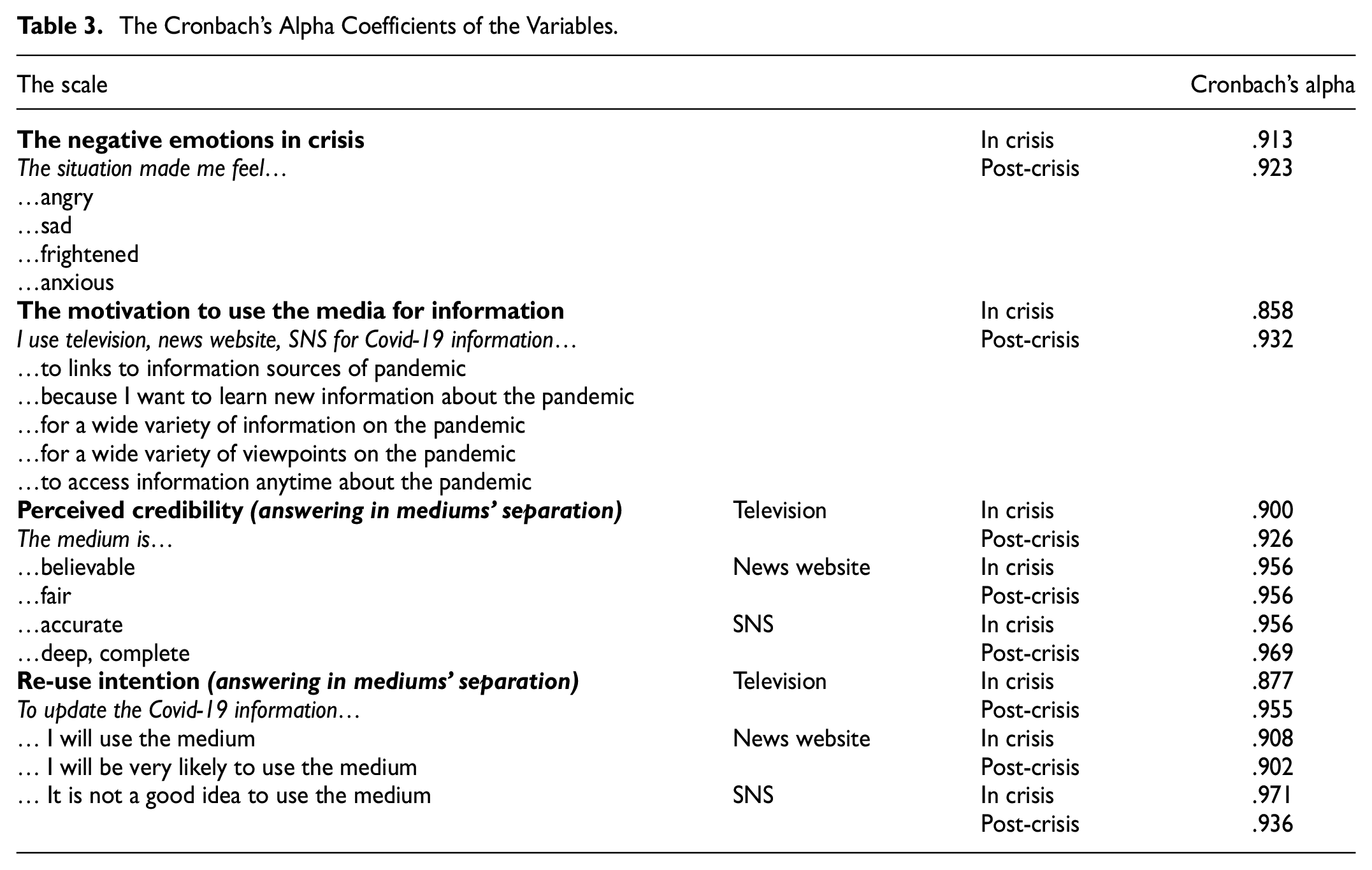
The Covid-19 information seeking motivation for media use was assessed by five items inherited from T. J. Johnson and Kaye (2015). The negative emotions in crisis are anger, sadness, fright, and anxiety, proposed by Jin (2009), ranging from 1 (not at all) to 5 (very much). The media credibility was measured using believability, fairness, accuracy, and depth/completeness (Flanagin & Metzger, 2000; T. Johnson & Kaye, 2010; S. Lee et al., 2020). The media re-use intention was measured by three items inherited from Yoo (2011). Respondents were asked to rate their perceived credibility and re-use intention of each medium separately. The Cronbach’s alpha coefficients of the eight scales ranged from .858 to .969 (detailed in Table 3).
The Cronbach’s Alpha Coefficients of the Variables.
Data Analysis
At first, the paired sample t-test was performed to compare the differences in negative emotions, information seeking motivation, media credibility, and media re-use intention between the two periods: during and post-crisis. Furthermore, the research compares different medium’s credibility and re-use intention to each other during and post-crisis.
Then, a series of hierarchical regressions proceeded to analyze the selected medium re-use intention’s predictors: (1) demographics (gender, age, education, job) were entered in the first block of independent variables, (2) information seeking motivation was in the second block, (3) negative emotions (Fright, anxiety, anger, sadness) were in the third block, (4) different types of medium’s credibility (television, news website, SNS) were added in the fourth block, and (5) other types of medium re-use intention were in the fifth block. The hierarchical regression was done twice for each medium, once using the crisis data and the second time employing the post-crisis data.
The analyses are carried out and assessed according to the suggestion of Kaye and Johnson (2019, 2020). Moreover, in the hierarchical regression process, the study also evaluates the variance inflation factors (VIFs) if they are less than 10, indicating no multicollinearity issues with the data and results (Hair et al., 2006). The criteria have been used in assessing multicollinearity problems in Covid-19 mass media research (Al-Dmour et al., 2022).
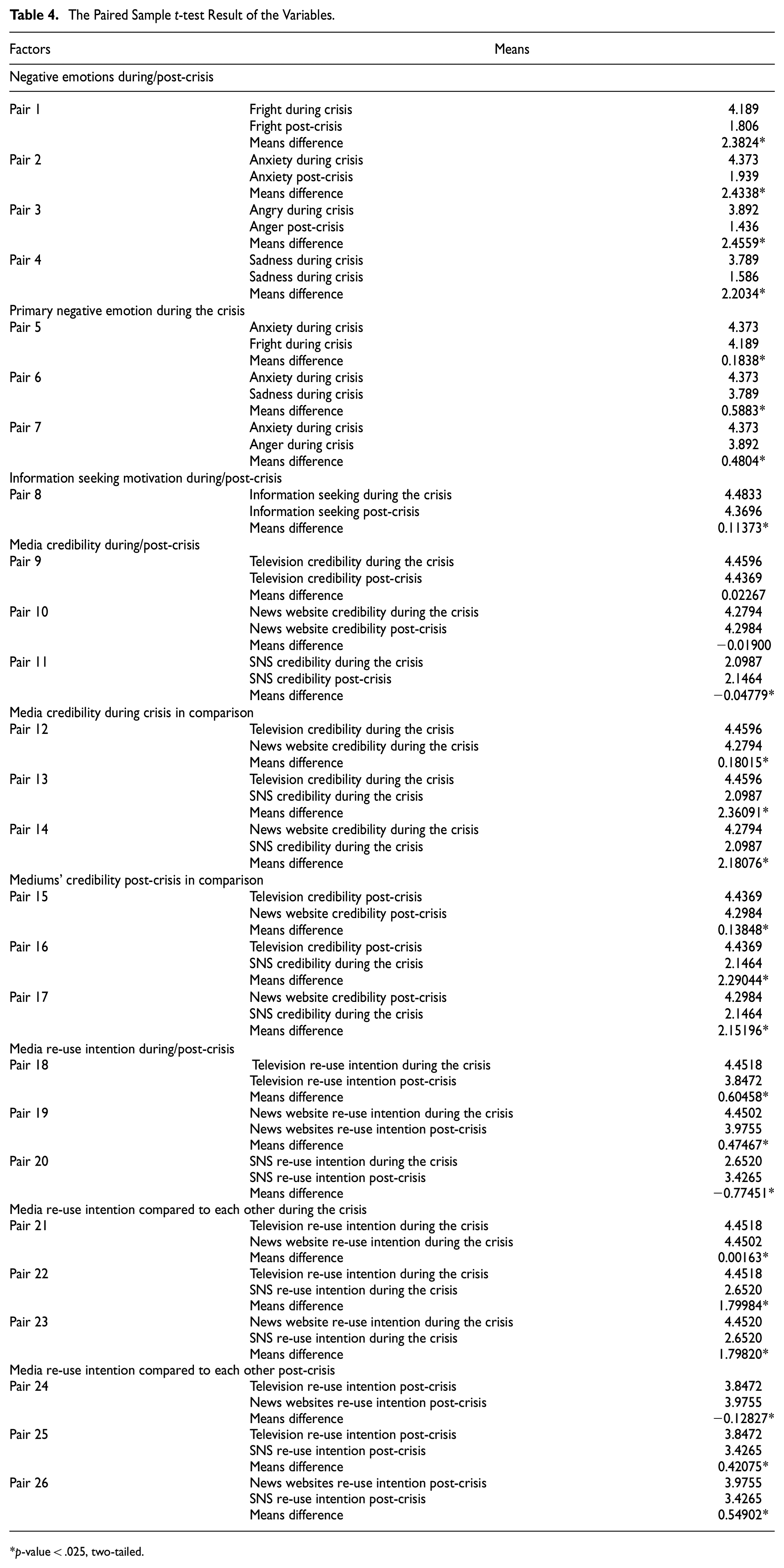
The paired sample t-test was carried out to compare the differences between the mean of the concepts during the Covid-19 outbreak and when it was controlled to answer the first research question (RQ1) (detailed in Table 4).
The Paired Sample t-test Result of the Variables.
p-value < .025, two-tailed.
The negative emotions during the crisis were higher than post-crisis (p-value = .000). The differences in the means of negative emotions are more than three on a scale of five. The result also shows that all four negative feelings (fright, anxiety, anger, and sadness) simultaneously existed at a high level during the crisis. Furthermore, the primary negative emotion reported during the crisis of the Covid-19 pandemic was anxiety (Mean = 4.373, the highest).
The need for Covid-19 information during the crisis was higher than post-crisis (p-value = .000). However, the difference is relatively low (approximately 0.1137). This result is consistent with the findings of Casero-Ripolles (2020)
The credibility of the television and news website does not change during the Covid-19 outbreak and when it is controlled (p-value > 0,05). By contrast, the SNS credibility post-crisis was higher than during the crisis (p-value = .006), although the difference is relatively low (approximately 0.05). In general, the credibility of television (Mean>4.4) is rated the highest by the viewers, followed by the news website (Mean>4.2), then the SNS (Mean<2.2).
The re-use intentions of television and news websites for information purposes during the crisis were higher than they are post-crisis. On the other hand, the intention to re-use the SNS for information when the Covid-19 outbreaks are controlled is higher than during the outbreaks (all by p-value = .000). The results demonstrate the differences in how people choose information sources during the crisis compared to the normal situation. In both periods, Covid-19′s primary source of information is news websites, television, and social network sites. However, the differences in the re-use intention between television—SNS and news websites—SNS are smaller post-crisis than during the crisis.
First, all the factors’ VIFs are below 5.236, within the threshold (lesser than 10) proposed by Hair et al. (2006) and practice in Al-Dmour et al. (2022) on mass media influence in the Covid-19 pandemic in Jordan, indicating the lack of multicollinearity in this study.
The result of the hierarchical regression analysis of the different media re-use intentions is detailed in Table 5. The variance of television re-use intention is explained at R2 = 57.1% during the crisis and R2 = 60.2% post-crisis; news website re-use intention is explained by R2 = 65.8% during the crisis and R2 = 51.7% post-crisis; SNS re-use intention is explained by R2 = 80.4% during the crisis and only R2 = 48.5% post-crisis.
The Hierarchical Regression Analysis Results.

(n) Represents the number of the added block when the factor’s effect vanishes.
p-value < .05. **p-value < .01. ***p-value < .001.
Information seeking: It should be noticed that the factor is not always the significant predictor for media re-use intention in the final model (model 5), except for the television re-use intention during the crisis (β = .176, p-value = .000) and SNS re-use intention post-crisis (β = .128, p-value = .007). In other cases, information seeking significantly predicted SNS re-use intention during the pandemic in model 2 (β = −.105, p-value = .005) before adding negative emotions. The factor had an impact on the television (β = .168, p-value = .000) and news website (β = .280, p-value = .000) re-use intention post-crisis in model 3, before the participation of media credibility. It also predicted the news website’s re-use intention during the crisis in model 4 (β = .136, p-value = .003) before the other media re-use intention took its part.
Negative emotions: the same circumstance happened with the negative emotions, as anxiety positively affected the television re-use intention post-crisis (β = .234, p-value = .011), sadness had a negative impact on television re-use intention during the pandemic uprising (β = −.150, p-value = .034), and fright positively predicted the news website re-use intention during the crisis (β = .186, p-value = .006) in model 3 before their effects vanish with the implement of media credibility.
This phenomenon can be explained casewise, that the information seeking and some negative emotions might be fully mediated by media credibility and other mediums’ re-use intention, as proposed by Baron and Kenny (1986).
Predictors of Television Re-use Intention
The second research question (RQ2) looks into finding the television re-use intention predictors during the Covid-19 outbreak and when it is controlled in a multiplatform context.
During the crisis of Covid-19, the information seeking motivation explains 25.9% of the variance, the media credibility accounts for 18.6%, and the other media re-use intention provides the additional 4%. Generally, information seeking motivation (β = .176, p-value = .000) and television credibility (β = .562, p-value = .000) positively predict television re-use intention. In addition, the complement effect between news websites and television has been shown, as news website credibility negatively affects (β = −.186, p-value = .006), whereas news website re-use intention positively affects (β = .327, p-value = .000) television re-use intention.
When the outbreak is controlled, the information seeking motivation no longer predicts television re-use intention and only explains 2.5% of television re-use intention. It is no surprise that the need for information has reduced post-crisis, thus weakening its affection. The model explains the variance of the television re-use intention post-crisis mostly by demographics (19.1%), media credibility (18.6%), and other media re-use intention (15.9%).
Consistent with the result during the crisis, television re-use intention is positively affected by its credibility (β = .573, p-value = .000). Its complement relationship with news websites is again demonstrated by the negative impact of news websites’ credibility (β = −.656, p-value = .000) and the positive impact of news websites’ re-use intention (β = .484, p-value = .000).
On the contrary, television re-use intention is positively impacted by SNS credibility (β = .284, p-value = .000) and negatively impacted by SNS re-use intention (β = −.155, p-value = .000). This result makes sense in a multiplatform identity context, where television programs are distributed on multiple channels, including SNS. Cross-platform credibility is possible (Kaye & Johnson, 2020). However, media users only choose the more convenient medium for accomplishing the same task (Kaye & Johnson, 2003).
The Predictors of News Website Re-use Intention
The third research question (RQ3) looks for factors that predict the news website re-use intention during the Covid-19 outbreak and when it is controlled in the co-existence of many different media.
During the crisis of Covid-19, the demographic factors explain 30.2% of the dependent variable’s variance, adding 15.9% from information seeking motivation and 12.9% from media credibility. In the final regression, news website re-use intention is best predicted by its credibility (β = .621, p-value = .000), consistent with past research on media credibility.
The complement relationship between television and news website has been demonstrated once again as television credibility negatively affects (β = −.170, p-value = .000) while television re-use intention positively affects (β = .260, p-value = .000) news websites re-use intention. The same explanation could be applied to the relationship between the news website and SNS; the SNS re-use intention positively affects news website re-use intention (β = .169, p-value = .011). Furthermore, the result indicates that the older people are, the more likely they are to use a news website. (β = .175, p-value = .000). However, the status of anxiety might prevent people from reading news from websites (β = −.146, p-value = .002).
When Covid-19 is under control, the news website’s re-use intention’s variance is explained mostly by the media credibility (17.9%) and other media’s re-use intention (22.5%). The result of this event is consistent with the previous one; the impacts are also stronger. The news website re-use intention post-crisis are predicted by news website credibility (β = .750, p-value = .000), television re-use intention (β = .587, p-value = .000), SNS re-use intention (β = .264, p-value = .000), and television credibility (β = −.386, p-value = .000). In addition, one more negative emotion, which is anger (β = −.124, p-value < .049), also impedes the use of news websites post-crisis.
The Predictors of SNS Re-use Intention
In a multiplatform setting, the fourth research question (RQ4) explored which factors predict SNS re-use intention during the COVID-19 pandemic and after it is controlled.
During the crisis, the demographic factors and media credibility are responsible for 71.7% of the SNS re-use intention’s variance explanation. According to the result, the SNS users are likely to be young (β = −.135, p-value = .000) and trust the information they got from the SNS (β = .598, p-value = .000). Furthermore, sadness hampers the users from reading Covid-19 information on SNS, although the effect is relatively low (β = −.081, p-value = .044).
The news website has proved to be a worthy opponent to SNS regarding usability and credibility. Users who believe in the news website will be less likely to use the SNS for information (β = −.268, p-value = .000). However, news website re-use intention has a minor positive effect on SNS re-use intention (β = .097, p-value = .011), indicating the complement effect in terms of information verification.
In the post-crisis, consistent findings are shown, SNS users are more likely to be young (β = −.144, p-value < .0001) who believe in SNS’ trustworthiness (β = .558, p-value = .000) while distrusting the news website (β = −.234, p-value = .002). In addition, the television re-use intention has a negative impact on SNS re-use intention (β = −.200, p-value = .000), demonstrating once again the effects of a multiplatform identity; just one medium is sufficient to acquire the same information. Finally, it is essential to realize the reappearance of information seeking motivation as a predictor (β = .128, p-value = .007).
Discussions
The crisis impacts human emotions, motivation, intention, and behavior (Casero-Ripolles, 2020; Jin, 2009; Lim et al., 2021). During the Covid-19 pandemic, negative emotions such as fear, anxiety, anger, and sadness surged simultaneously. In addition, anxiety was reported as the primary negative emotion, demonstrating the unpredictable but controllable nature of the crisis, as proposed by Jin (2009). This result is understandable, given that Vietnam successfully contained the pandemic at the time of the survey. Moreover, people are more cautious in choosing the information source to satisfy their need for knowledge on the current situation, resulting in choosing the more credible medium such as news websites and television instead of SNS. Hence, the television and digital press should participate in controlling the situation via the agenda-setting strategy (Wanta & Hu, 1994). However, in many cases, multiple media will be used for information’s validity checking as proof of the complementary among different types of media (Dutta-Bergman, 2004). Thus, one should be careful not to overuse such a strategy.
Technology development brings many new media with advantages in function and ease-of-access that keep people informed 24/7. From then, many concerns appeared that the new media might displace the traditional media by taking away customers (P. S. N. Lee & Leung, 2008; Mcintyre, 2014). However, in many cases, different types of media, which function differently from each other, co-exist, event complementing each other (Kaye & Johnson, 2003; Lin, 2001).
It is essential to recognize the numerous functional distinctions and similarities among television, news website, and SNS in the multiplatform context of Vietnamese media. On the one hand, both television and digital press are the official government media in Vietnam. However, participants might confuse the official government digital press with several liberal news websites; this fact might jeopardize their overall credibility. Additionally, television has the advantage of audio-visual functions (Carter & Greenberg, 1965). Meanwhile, the news websites retain the newspaper’s particular characteristics to describe the event through words. Furthermore, the news website’s priority is bringing the news as quickly as possible. In comparison, television only has a fixed number of official news programs throughout the day, giving journalists enough time to validate the information thoroughly. As a result, the television credibility (Mean>4.4) is slightly higher compared to the news website (Mean>4.2). On the other hand, the SNS is a well-known platform that promotes conspiracy theories and fake news during a crisis like the Covid-19 pandemic (van der Linden et al., 2020). It was built on the premise of a social system that allows anyone to connect and share information within the system (Boyd & Ellison, 2007). Until today, the number of SNS users has reached 4.33 billion worldwide, equal to 55% of the global population (Datareportal, 2021c), even though its credibility is frequently questioned (Aillerie & McNicol, 2018). Unsurprisingly, SNS credibility is rated below average (Mean<2.1). Furthermore, from the cross-media perspective, information seeking motivation and negative emotions effects on the medium’s re-use intention are significant in various situations, before the addition of mediums’ credibility and re-use intention. The phenomenon could be a sign that they are mediated by the mediums’ credibility and re-use intention, which demonstrated the importance of media credibility and the complementary effect among different mediums in crisis control. In fact, as evidenced by the data, in Covid-19, the government’s official outlets, such as television and news websites, have done an outstanding job of keeping people informed about the Covid-19 outbreaks’ status. Unsurprisingly, Vietnam’s first three Covid-19 outbreaks were effectively controlled (Nguyen et al., 2020). In the long term, television stations and news websites must establish their presence on various social media platforms (Facebook fan pages, YouTube channels, and Tik Tok profiles) to effectively reach Vietnam’s young generation.
In addition, it is established one medium credibility strongly predicts its re-use intention (β = 0.558–0.750). This finding is consistent with many previous studies that approved the correlation between media credibility and its use, thus, demonstrating the importance of media credibility and the media selection process of users. (T. J. Johnson & Kaye, 1998, 2004; T. Johnson & Kaye, 2010; T. J. Johnson & Kaye, 2015; D. Kim & Johnson, 2009; Wanta & Hu, 1994). Furthermore, the crisis’ negative emotions, such as anxiety, anger, and sadness, directly reduce the news websites and SNS re-use intention. The effects are more noticeable and significant in Covid-19. It is known that online interaction requires digital competencies such as information and socio-emotional skills (Kaakinen et al., 2018) and places themselves at risk of emotional contagion (Hatfield et al., 1992, 1993), ultimately aggravating their negative emotions further. Hence, the news content should be carefully organized in order to prevent the pattern of information avoidance across multiple platforms (H. K. Kim et al., 2020). Such a method is well implemented by the government’s official media from the agenda-setting perspective (Wanta & Hu, 1994), illustrated by the number of positive and neutral articles published by the government’s official press and television during the crisis (Vietnam Ministry of Health, 2020). Moreover, it is acknowledged that news website users are older, whereas SNS users are younger in Vietnam.
A key finding of this study is the complementary effect between different types of media in a multiplatform context as the relationship between television-news websites and news websites-SNS. These relationships make sense in considering the contradictory effects of one medium’s credibility and re-use intention toward the other medium’s re-use intention. For instance, while the news website’s credibility negatively affects the television’s re-use intention, the use of news websites will be accompanied by television serving as an information verification tool. The same explanation could be applied to the relationship between news websites and SNS. These findings are consistent with previous research (Kaye & Johnson, 2003; Lin, 2001; Yuan, 2011). However, it is worth noting that the complement effect between news websites and television is greater post-crisis than during the crisis, as news websites’ credibility and re-use intention have a lesser impact on television re-use intention during the crisis than they do post-crisis, and vice versa. This indicates that individuals used different tactics during different periods of the Covid-19 pandemic. In this case, there is a trade-off between the act of information validation and the amount of time required to validate it. Nonetheless, in the case of news websites and SNS, only the impact of news websites’ re-use intention has increased post-crisis, while the influence of news websites’ re-use intention on SNS re-use intention has slightly decreased. This result demonstrates the rapidity with which information may be validated via the Internet. Hence, the trade-off is absent in this instance.
The study also found a sign of the multiplatform identity in the relationship between television and SNS post-crisis. In this situation, television broadcasted the whole news program on their YouTube and Facebook extensions, resulting in their loss. Although the television’s credibility could be transferred to its SNS channels (Kaye & Johnson, 2020), media users typically choose only one medium to accomplish the same task (Kaye & Johnson, 2003; P. S. N. Lee & Leung, 2008). As a result, the more convenient medium has been chosen, the SNS. It is advisable that television channels take full advantage of their credibility to build their mobile apps instead of broadcasting the whole show on YouTube channels or Facebook pages. The SNS could be utilized as television expansion territory, with a portion of the show being popularized as a trailer or sneak peek to entice users to watch the entire show on the apps or directly on television. Thus, television will achieve the maximum benefit from the audience’s view and increase the rating. The news websites employed this strategy, which resulted in a complementarity effect with the SNS. However, the influence between Television and SNS re-use intention is missing during the Covid-19 outbreaks. This phenomenon could be caused by SNS’s low perceived credibility during the crisis, rendering it useless as an information validity tool and a trusted source of information.
Overall, the research added knowledge on the change in human emotions, cognition, and behavior during the crisis of the Covid-19 pandemic. It also provides insight into the connection among different media types based on their credibility and re-use intention.
Limitations and Future Implications
Although the study looked at several important outcomes, such as differences in news consumption during Covid-19 outbreaks and when Covid-19 was under control, it has some limitations. First, because survey participants were chosen conveniently, the demographic profile may not reflect the current media population in Vietnam. Furthermore, the survey method asks respondents to recall their previous status. Even though the events chosen are not too far in the past, they may still have an impact on the outcome. Thus, future research will benefit from employing a random or quota sampling method to accurately reflect its media status, in addition to conducting the survey at the time of the crisis to capture participants’ status more accurately. Additionally, it has been observed in some cases that the independent variables, such as information seeking and crisis’ negative emotions (fear, anxiety, and sadness), have significant effects on the selected media re-use intention before adding media credibility and other media re-use intention into the model. Future studies could examine the mediation effects of media credibility and media re-use intention in the stated relationships, as proposed by Baron and Kenny (1986).
Footnotes
Declaration of Conflicting Interests
The author(s) declared no potential conflicts of interest with respect to the research, authorship, and/or publication of this article.
Funding
The author(s) disclosed receipt of the following financial support for the research, authorship, and/or publication of this article: This research is funded by University of Economics and Law, Vietnam National University Ho Chi Minh City/VNU-HCM

Ethical Statement
Hereby, I consciously assure that for the manuscript “media credibility and re-use intention for information seeking in crisis: A case of cross-platform media complementary effect in covid-19 pandemic in Vietnam” the following is fulfilled:
(1) This material is the authors’ own original work, which has not been previously published elsewhere. (2) The paper is not currently being considered for publication elsewhere. (3) The paper reflects the authors’ own research and analysis in a truthful and complete manner. (4) The paper properly credits the meaningful contributions of co-authors and co-researchers. (5) The results are appropriately placed in the context of prior and existing research. (6) All sources used are properly disclosed (correct citation). Literally copying of text must be indicated as such by using quotation marks and giving proper references. (7) All authors have been personally and actively involved in substantial work leading to the paper and will take public responsibility for its content.