



Abstract
The COVID-19 pandemic has affected the way of teaching and learning in medicine. Conventional medical education has been fully transformed to open distance learning that includes the full utilization of various digital platforms. Thus, this study explored the impact of digital learning usage on learning motivation among medical students of Universiti Kebangsaan Malaysia (UKM) before and during the COVID-19 pandemic period. A validated Students Motivation towards Science Learning (SMTSL) tool was used to assess the learning motivation of UKM undergraduate medical students throughout years 1 to 5. Digital learning during the COVID-19 pandemic was significantly higher compared to before the pandemic (p < .05) but there was no significant difference (p = .872) in learning motivation. The use of digital learning among clinical students was significantly higher during the COVID-19 pandemic as compared to preclinical students (p < .05). There was a moderately strong correlation (r = .512) between digital learning and learning motivation. Hence, digital learning should be utilized as an additional driving factor to increase learning motivation, especially during this current pandemic.
Introduction
The novel Coronavirus Disease 2019 (COVID-19) has impacted the transformation of teaching and learning in medicine. The sudden shift from conventional medical education to exclusive digital learning is challenging and the effect on learning motivation among medical students needs to be elucidated. Generally, open distance learning, also known as digital learning comprises digital teaching materials, digital tools, digital delivery, and autonomous learning (Keane, 2012). It allows students to self-curate the way they learn in a mixture of both synchronous and asynchronous worlds without the restriction of time and location (Khan et al., 2019). The development of an online platform especially the Learning Management System (LMS) offers a ‘blended learning’ environment for the students where they can communicate with lecturers, submit their assignments, discuss with peers, and share group work through the platform (Adams et al., 2018).
The current generation of medical students is tech-savvy and they support the use of digital learning as it is interactive, cost-effective, and the learning contents are readily available (Mahajan, 2018). However, students and educators are pressured by the increasing time constraints and demands (Männistö et al., 2020; O’Doherty et al., 2018), network issues, and the availability of infrastructures. Apart from digital learning, medical students also use textbooks as a personal medium of learning (Baudains et al., 2013).
Learning motivation inculcates behavior toward achievement and is known to be a key determinant of academic success. Several factors influence learning motivation including age and gender, interpersonal determinants such as academic conditions, cognitive and affective outcomes including anxiety and depression, and behavioral outcomes such as academic engagement (Orsini et al., 2016). Support from both parents and teachers (Tanaka & Watanabea, 2012), as well as positive personality traits such as perseverance, gratitude, and craving for learning (Wagner & Ruch, 2015), also contribute to a positive correlation with learning motivation. All these factors could play a role in affecting the student’s motivation during open distance learning.
Hence, it is crucial to explore the difference in digital learning and learning motivation among medical students before and during the COVID-19 pandemic. This study also aimed to identify the preferred sources of digital learning, the frequency of digital learning usage, the relationship between digital learning and learning motivation, and the difference in learning motivation among preclinical and clinical students of Universiti Kebangsaan Malaysia (UKM).
Methodology
A set of questionnaires including an information sheet and a consent form were distributed via Google Forms, from October 2019 to May 2020. Our initial study was to explore how digital learning can supplement physical teaching and learning in UKM. With the sudden emergence of the pandemic, a transformation to fully digitalized teaching and learning has piqued our interest to observe its impact on learning motivation among our medical students. The pre-COVID respondents were recruited during the pre-pandemic period while the COVID-19 respondents were recruited 2 months after the initiation of the restriction movement in Malaysia.
All UKM students undertaking the course of Doctor of Medicine during the study period were involved in this study. A stratified convenience sampling was used in which the n sample was arranged by year of study, where each year contributed an equivalent ratio to the population. The target sample size was 255, determined by identifying the smallest acceptable demographic subgroup in which the UKM medical faculty population size was 700 with a ±5% margin of error and a confidence level of 95% (Israel, 1992). Using the calculation, there were a total of 302 respondents, consisting of 150 and 152 year 1 to year 5 UKM undergraduate medical students that participated in this study before and during the COVID-19 pandemic period, respectively.
The questionnaire was adapted from the Students Motivation towards Science Learning (SMTSL) survey tool (Tuan* et al., 2005), consisting of six scales: self-efficacy, active learning strategies, medical learning value, performance goal, achievement goal, and learning environment stimulation. A 5-point Likert-type scale was used, and respondents were asked to rate their agreement for each statement as the following: 1 = strongly disagree, 2 = disagree, 3 = no opinion, 4 = agree, and 5 = strongly agree. Based on the total motivation score, the students were grouped into 3 levels of motivation: “Low” (score <115), “Moderate” (score 115–131), and “High” (score >131; Tuan* et al., 2005). The questionnaire was modified for medical students and minor adjustments in grammar were made to avoid confusion among the medical students. A pilot study to validate the questionnaire was done on 35 UKM medical students with Cronbach’s Alpha, α = .91.
Demographic data and educational background of samples were also collected including the age of the respondents, year of study, and phase of the study. The study phase consisted of Year 1 and Year 2 representing the preclinical phase, and Year 3 to Year 5 for the clinical phase. Respondents were also required to rank their preferred digital learning sources and choose their frequency of digital learning usage. The frequency of digital learning usage was divided into five groups; does not use, use less than one time per week, one to two times per week, three to four times per week, and more than five times per week. Respondents rated the frequency based on their usage other than regular class purposes. As most of the UKM medical students had an average of two to three teachings, group discussions, or lab sessions per week, hence the frequency of digital learning usage was further divided into high usage (use at least three times and above per week) and low usage (use less than three times per week).
Results were recorded using Statistical Package for Social Science (SPSS) Version 22 by the IBM Corporation, New York, United States. The statistical significance level was set at p < .05. Descriptive analyses were included for frequencies and percentages of digital learning usage while Student’s t-tests and chi-square analysis were utilized to determine the difference between groups for selected variables. Eta coefficient test was used to determine the association between digital learning usage and learning motivation among UKM medical students.
Results
Demographic Characteristics
There was a total of 302 UKM undergraduate medical students who participated in this study, 150 (49.7%) respondents participated before the COVID-19 pandemic, and the remaining 152 (50.3%) respondents were involved during the COVID-19. The mean age for the study population was 21.94 ± 1.63 (Table 1).
Demographic Characteristics of Respondents (n = 302).

Analysis of Digital Learning Usage
Before the COVID-19 pandemic, 50% of the study population had high digital learning usage (>5× per week) and only 6% of respondents had never used any digital learning tool apart from search engine platforms (Figure 1a). The trend was seen to increase during the COVID-19 period in all categories of usage. Overall, a higher digital learning usage was evident during the COVID-19 period (86.8%) as compared to the pre-COVID-19 period (76.7%; Figure 1b). The data was further analyzed quantitatively with chi-square analysis and the differences were noted as significant (p < .05; Figure 1c). E-books were the most preferred choice (40.67%) and audiotapes (6.00%) were the least preferred method before the pandemic. However, during COVID-19, videos (38.16%) were the most preferred choice with a reduction of usage for e-books (36.84%) and online research articles (11.84%). The utilization of videos (38.16%), online courses (21.05%), games (16.45%), simulation software (11.84%), and audiotapes (9.97%) was noted to be increased during the pandemic period (Figure 1d).
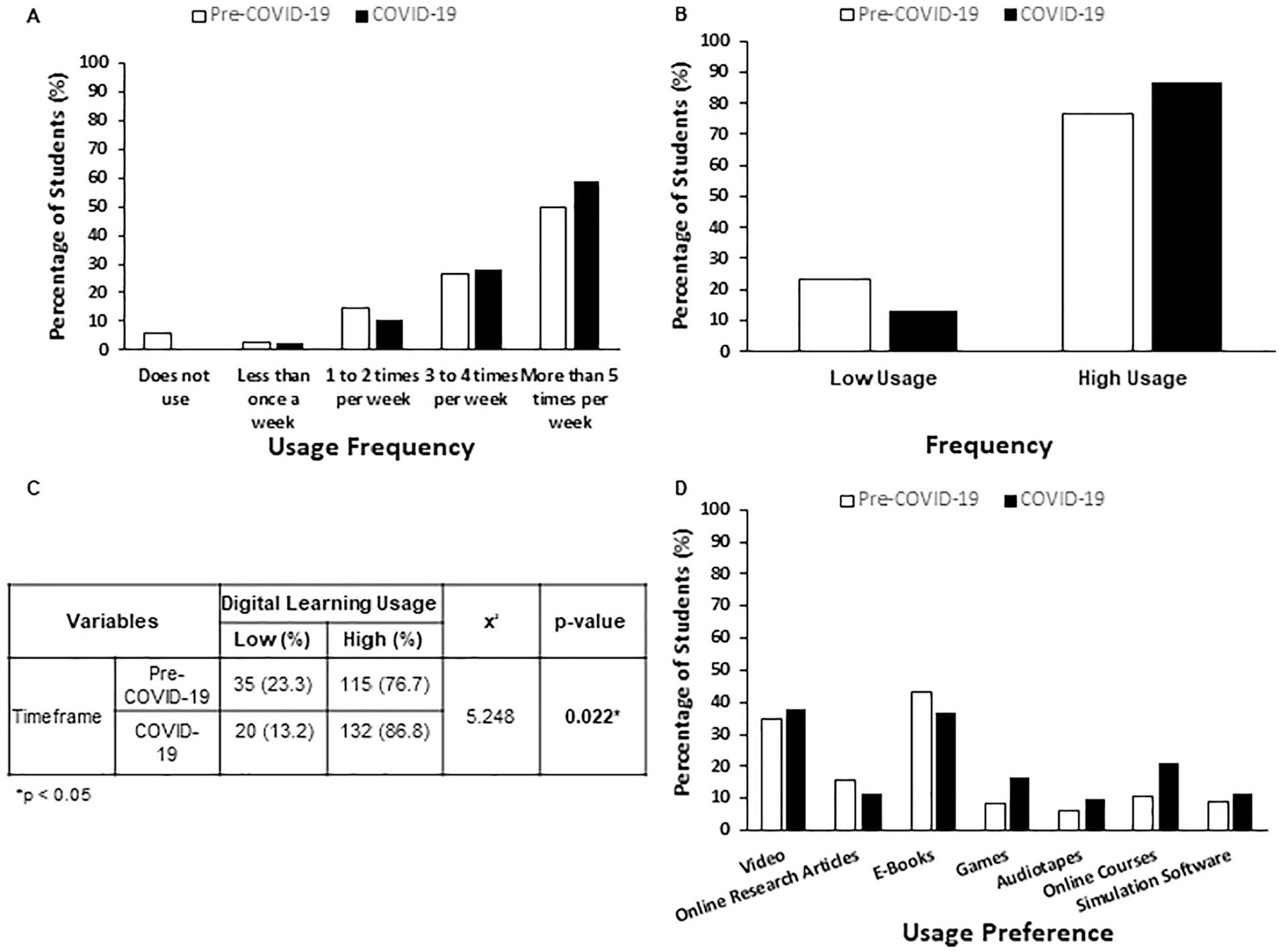
Digital learning usage before and during COVID-19. (A) Usage frequency of digital learning, (B) The frequency of low and high usage, (C) the statistical difference between pre-COVID-19 and COVID-19 timeframes, and (D) the usage preference of the type of digital learning among UKM students
Analysis of Learning Motivation
The samples before the COVID-19 period had an average high learning motivation score of 135.8 ± 11.67. The mode and median of the total learning motivation score were both 136, while the lowest and highest scores were 102 and 161, respectively. Most of the students showed high motivation (56.9%), followed by moderate motivation (37.9%) and low motivation (5.2%) levels. The results during the COVID-19 period were also normally distributed with a similar average high learning motivation of 135.59 ± 11.50, mode scores of 132 and 140 and a median score of 135. However, there was an increment in the percentage of respondents with a high level of learning motivation (67.80%; Figure 2a). Student’s t-test analysis revealed the level of learning motivation was significantly higher (p < .01) with a high frequency of digital learning usage during the COVID-19 period (Figure 2b). Nevertheless, the level of learning motivation before and during the COVID-19 period was found to be not significant (p = .872; Figure 2a). There was also no significant difference between the frequency of digital learning usage and learning motivation before the pandemic (p = .053; Figure 2b).

Learning motivation before and during COVID-19. (A) Three types of learning motivations, low, moderate and high and the statistical differences between two timeframes, pre-COVID-19 and COVID-19, and (B) The statistical analyses between low and high usage of digital learning platforms between two timeframes, pre-COVID-19 and COVID-19.
Analysis of Digital Learning Usage and Learning Motivation
There was a weak correlation (r = .239) between digital learning and learning motivation during COVID-19. However, a moderately strong correlation was found (r = .512) between learning motivation and digital learning being the dependent variable. Further analysis showed that clinical students had a higher frequency of digital learning usage during COVID-19 (87.1%) as compared to before COVID-19 (74.5%) and the difference was significant (p < .05; Figure 3a). However, there was no significant difference in the level of learning motivation among clinical students before and during COVID-19 (Figure 3b). No significant difference was also noted for both digital learning usage (p = .38) and level of learning motivation (p = .237) between pre-COVID-19 and COVID-19 periods among preclinical students (Figure 3a and b).
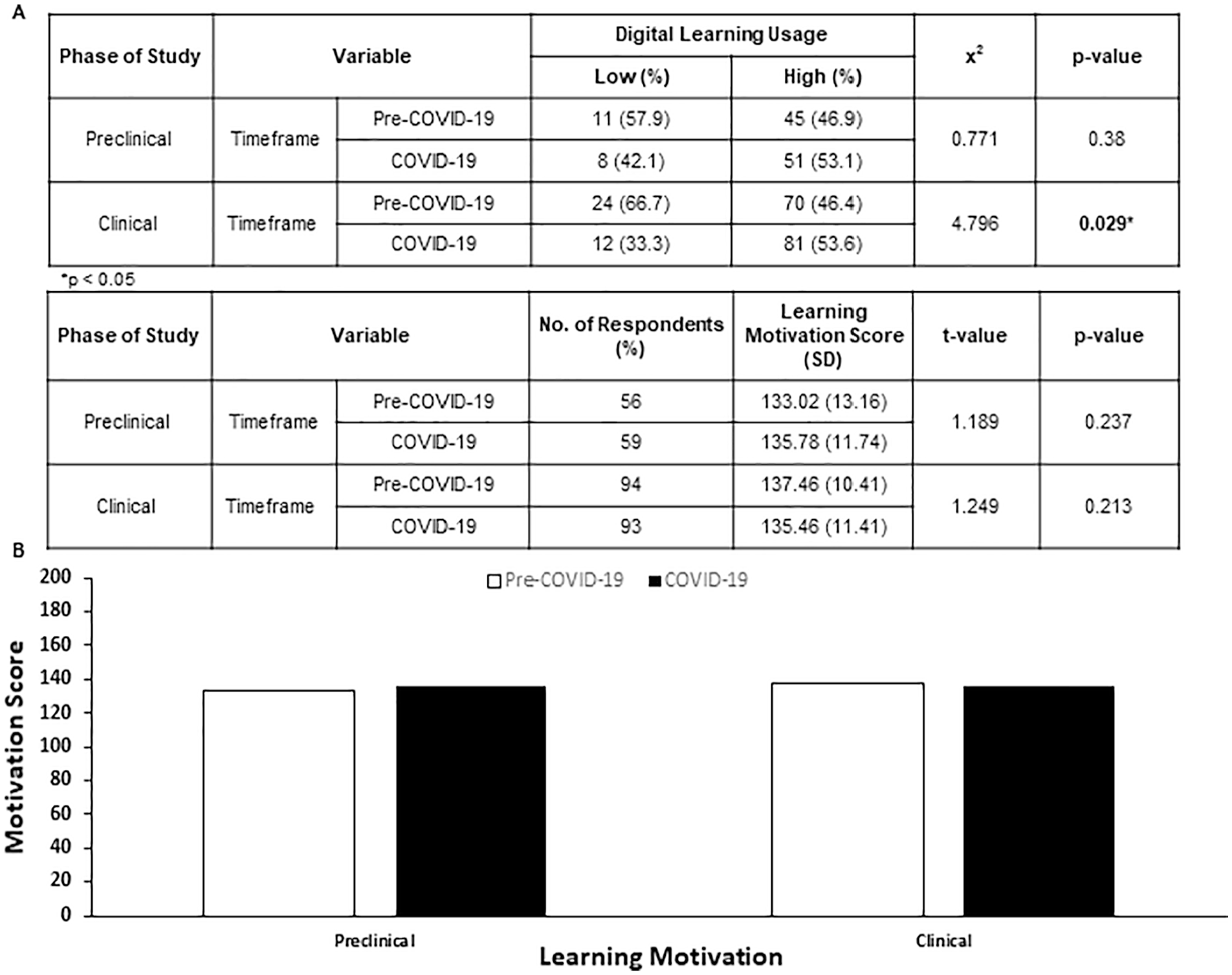
Learning motivation and digital learning usage based on phase of study. (A) The relationship of digital learning usage and learning motivation score between preclinical and clinical students with two timeframes, pre-COVID-19 and COVID-19. (B) The learning motivation score between preclinical and clinical students.
Discussion
Open distance learning has emerged as the new method of teaching and learning in medical education during the COVID-19 pandemic (Alsoufi et al., 2020; Olum et al., 2020; Stoehr et al., 2021). The flexibility of open distance learning encourages freedom, and independence of learning. However, it remains skeptical that this approach could not replace the conventional teaching-learning methods in medical education that require substantial face-to-face bedside teaching and hands-on skills (Ghanizadeh et al., 2018). The sudden transformation into open distance learning is not without challenges. The availability of infrastructures, skills, resources, institutional strategies, and support are the key barriers to the implementation of open distance learning (O’Doherty et al., 2018). The lack of infrastructure and technology such as poor coverage, low speed, and network congestion has been the main issue faced by low and middle-income countries in implementing open distance learning (Bediang et al., 2013; Lakbala, 2015; Ming et al., 2012; Olum et al., 2020; Rajab et al., 2020). Our preliminary data indicated that 40% of our medical students had a poor internet connection (<5 Mbps) thus this factor alone can be a hindrance to utilizing digital learning.
Generally, our study showed that the digital learning usage in UKM before the COVID-19 pandemic was high due to the pre-existing blended learning, however, during COVID-19, the digital learning usage was significantly higher. The current pandemic has forced a full digitalization of teaching and learning in medical education. This has been a similar phenomenon in medical schools worldwide (Dost et al., 2020; Grafton-Clarke et al., 2022). Lecturers and medical students are required to be creative in utilizing the available resources in digital learning to get the utmost knowledge and skills. There were a variety of innovative ideas being incorporated into medical education such as online team-based learning (Jun Xin et al., 2022), virtual clerkships (Saiboon et al., 2021), digital clinical placements, remote patient consultations, and patient simulators to ensure a smooth transition into open distance learning during the pandemic (Alkhowailed et al., 2020; Chandra et al., 2020; De Ponti et al., 2020; Parker et al., 2020; Sam et al., 2020; Torres et al., 2020; Zaleha et al., 2020). Studies before the pandemic period have shown that medical students have a positive perception of the use of simulation-based (Joseph et al., 2015) and virtual reality (Sattar et al., 2019). Both learning methods provide hands-on practice and improve learning competencies with clinical reasoning skills. Hence, when conventional teaching and learning cannot be done during the pandemic, medical students would be more inclined toward these digital learning methods to acquire clinical skills. This was in accordance with our results as a higher percentage of students’ preference shifted toward the usage of videos, online courses, games, simulation software, and audio recording during the pandemic.
Our findings revealed that most medical students possessed high learning motivation in using digital platforms as a process of learning (Figure 4). This trend was found to be similar before and during COVID-19. A constant high learning motivation among medical students is not directly affected by digital learning usage but other factors are driving the continuous motivation. The most plausible factor could be autonomous motivation as medical students are known to have high intrinsic motivation as compared to other undergraduate students (Campos-Sánchez et al., 2014). However, the significantly higher learning motivation with a high frequency of digital learning usage during the pandemic period could be explained as online distance learning being the only source of learning during COVID-19. Thus, medical students with preexisting high intrinsic motivation will use all available resources for their study and depend on digital sources. Similar findings were seen in other studies that reported digital learning improves learning motivation through increased levels of competency (Bolatov et al., 2022; Haftador et al., 2021; Jun Xin et al., 2021). This was further supported by the Eta coefficient analysis in our study as a moderately strong correlation was found between learning motivation and digital learning as the dependent variable.

The relationship between digital learning usage and learning motivation in open distance learning.
Data from the preclinical students have reported no significant difference in both digital usage and learning motivation in both pre-COVID-19 and COVID-19 periods. Interestingly, clinical students had significantly higher digital learning usage during COVID-19 but learning motivation remained high during these two periods. The plausible explanation could be that preclinical students have been adapting digital learning platforms to understand the principles of medical sciences. This is dissimilar to the clinical students where clinical clerkships have been crucial in their learning without relying on digital sources as clerkship tools. Hence, clinical students will employ various digital sources available to substitute their clinical clerkships and sustain learning motivation during the pandemic period. Similar situations were observed in clinical students in countries worldwide that include virtual case discussions and telehealth environments to provide authentic patient experiences to clinical students (Rose, 2020).
Since this is a pioneer study that highlights the digital learning usage and learning motivation among medical students, the outcomes can be utilized for the transformation of digital learning especially during the COVID-19 pandemic to replace conventional teaching and learning in medical education. The pandemic makes us recognize that medical education is a vulnerable asset in times of health crisis and should not be taken for granted in its conventional form. An open distance learning environment should be developed and implemented to enhance its complementary role in medical education. Reflections and evaluations must follow to augment learning motivation among medical students to sustain lifelong learning.
There were limitations to the representativeness and generalization of our findings to other medical faculties as only UKM medical students were involved in this study. There is also a lack of qualitative approach in assessing the impact of open distance learning on learning motivation holistically. More longitudinal studies with mixed methods are recommended to determine the associations between open distance learning and learning motivation as well as to identify the challenges and solutions in improving medical education.
Conclusion
Digital learning usage increased significantly during the COVID-19 pandemic period, especially among clinical students. However, there was no significant difference in learning motivation between before and during the COVID-19 pandemic as most medical students remained highly motivated. A moderately strong correlation was found between digital learning and learning motivation. Hence, digital learning should be utilized as an additional driving factor to further increase learning motivation, especially during this pandemic period where face-to-face teaching and learning methods are no longer an option. This could implicate the whole picture in medical education, where digitization should be embraced without jeopardizing the quality of learning.
Footnotes
Acknowledgements
We would like to thank all medical students from Year 1 to 5 from UKM for spending their valuable time in participating in this study during the Movement Control Order due to COVID-19.
Author Note
JXL, JYN, and AHAA are medical graduates of UKM. NASI is also affiliated with Medical Education, UKM.
Author Contributions
JXL, JYN, and AHAA collected the data. JXL, JYN, and NASI wrote the main manuscript text. AHAA performed the statistical analysis and prepared all figures and tables. All authors have reviewed the manuscript.
Declaration of Conflicting Interests
The author(s) declared no potential conflicts of interest with respect to the research, authorship, and publication of this article.
Funding
The author(s) disclosed receipt of the following financial support for the research, authorship, and/or publication of this article: This study has been funded by the Faculty of Medicine, UKM (FF-2020-037) and GP-2021-K015635.
Ethical Approval
Ethics approval was obtained from Universiti Kebangsaan Malaysia (UKM; UKM PPI/111/8/JEP-2019-702). All methods were performed in accordance with the relevant guidelines and regulations. Information sheets containing study objectives with written consent had been explained and informed consent was obtained from all respondents prior to completing the questionnaire, in which participation in this study was entirely voluntary.

Availability of Data and Materials
All data and materials are available from the corresponding author by request