




Abstract
Currently, few studies have examined whether people who experience an undesirable social predicament in an intercultural context would perceive this predicament the same way—and act in the same manner—in an intracultural situation. The authors of this study investigated how perpetrators’ cultural backgrounds impacted victims’ cognitive assessments of, and communicative responses to, social predicaments. Through a survey with three scenarios of other-caused predicaments, participants (N = 384) were asked to respond to social predicaments caused by either a cultural in-group or out-group perpetrator. The findings showed that victims differed in their perceived severity and attribution of these predicaments depending on the perpetrators’ cultural background. However, cultural background indirectly, rather than directly, influenced victims’ responses by interacting with attributed intent and uncertainty.
In a globalized world, communication among people of different cultural backgrounds is an everyday situation, visible in healthcare organizations (El-Amouri & O’Neill, 2011), education (Gareis, 2000), business environments (Fatehi & Choi, 2019), and personal relationships such as marriage (Tili & Barker, 2015). However, intercultural communication is prone to misunderstanding due to discrepancies in communicators’ cognitions, behavioral patterns, and emotional displays (Armstrong & Kaplowitz, 2001; Cannon-Bowers & Salas, 2001; Li, 1999). This poses a challenge for those who may find themselves thrown into undesirable situations as a result of their intercultural conversation partners’ behaviors. For example, in Chinese culture, when a younger person calls someone who is much older “old,” they usually mean to show respect, since senior citizens are generally respected for their seniority in Chinese culture. The senior person would not be offended by being called “old,” since they would interpret the message as it was intended. However, a different interpretation of the same message would occur if the Chinese person used the word “old” to address an American because being “old” has negative connotations such as incompetence and dependence in U.S. culture (Hummert et al., 1998). Effective management of these problematic interactions is not only beneficial to building long-lasting intercultural relationships but a demonstration of intercultural communication competence, an essential feature needed in today’s globalized society.
During undesirable situations where our positive images are threatened or our poise is disrupted, we are motivated to mend social damage by means of communicative acts (Schlenker & Darby, 1981). However, communicative strategies used in these situations such as apology, justification, humor, and denial are mostly understood in intracultural situations with cultural in-group parties (e.g., Cupach & Metts, 1994; Lee & Park, 2017). Little is known about whether people perceive undesirable social situations in intercultural predicaments with cultural out-group members in the same ways as they do in intracultural situations and whether similar strategies are utilized to manage these situations. Therefore, the current study seeks to examine differences of victims’ communicative responses between intracultural (i.e., cultural in-group) and intercultural (i.e., cultural out-group) contexts, especially when remedial strategies are absent from perpetrators who are unaware of their offenses.
Intracultural Versus Intercultural Social Predicaments
Social predicaments are characterized by social actors’ loss of desirable impressions, which then motivates involved parties to manage situations so as to re-establish social equilibrium (Schlenker & Darby, 1981). Therefore, in this study, intercultural social predicaments are problematic social interactions taking place between people of different cultural backgrounds.
A common cause of intercultural social predicament is that communicators violate each other’s cultural norms, oftentimes unknowingly. This is because intercultural communicators do not share the same cultural assumptions and behavioral standards, which lead to their varying expectations. Thus, they interpret conversations according to their own values, since they believe that the other party shares the same beliefs and norms as themselves (e.g., Boudjelal, 2014). Social norms function as standards of the behaviors that are deemed acceptable (Sherif, 1936), which vary from culture to culture (Fung & Scheufele, 2014). People have internalized their own culture’s behavioral norms by the time of adulthood and rarely examine their cultural assumptions (Brislin, 1993). These internalized norms are largely, though not completely, affected by the cultural norms one has grown up in (Morris et al., 2015). Therefore, individuals often behave in accordance with their own cultural norms in intercultural contexts with cultural out-group members as if they were in intracultural contexts with cultural in-group members. Increased cultural knowledge could help prevent such problematic communication; however, questions remain about how the offended person would react and what factors would influence their reactions.
Whether they are intracultural or intercultural, social predicaments can be divided into two general categories: self-induced (i.e., a social actor is responsible for the undesirable outcome) and other-induced (i.e., a social actor experiences the predicament as a consequence of others’ behaviors) (Cupach & Metts, 1994). The key difference between self- and other-induced social predicaments is assumed responsibility, which directly impacts the involved parties’ management of predicaments. Specifically, victims are thrown into situations passively in other-induced predicaments, having lost some control over their presentation. Victims also have high stakes in restoring their threatened social impressions in other-induced predicaments—especially if perpetrators are unaware of having caused the predicaments and thus unlikely to offer restorative tactics, which would leave the victims’ damaged impressions unaddressed. As impression management is ubiquitous in any kind of social interaction (Bolino et al., 2016), this means that there is no exception for the victims in other-induced social predicaments to take communicative actions to repair social damage, even though they did not cause it.
Communicative Responses to Other-Induced Social Predicaments
Social predicaments often come with negative emotions such as anger, blame, and shame (Kam & Bond, 2009), which can lead to confrontational and retaliatory behaviors. This is because victims want to seek justice for their social loss (Guan & Lee, 2017; Schlenker & Darby, 1981) by bringing problematic actions to light for evaluation, leading perpetrators to full awareness of their offenses and eventual concession (Hodgins & Liebeskind, 2003). Victims can request an explanation of the perpetrators’ intentions in their behavior, questioning the acceptability of their actions. More aggressively, victims can directly complain about the offenses and criticize the perpetrators’ actions (Choi & Jiang, 2013), demanding a full apology. However, researchers also found that after hurtful messages and acts, particularly if attributed as intentional, people tend to distance themselves from hurtful sources instead of confronting them (McLaren & Solomon, 2008). Vangelisti and Young (2000) explained that disengagement from perpetrators after hurtful messages is how victims protect themselves from exposure to further damage. Therefore, two general categories of communicative responses to social predicaments emerge: Victims can either confront perpetrators to seek remedy for the damage or withdraw from the conversation to avoid further social loss.
Strategies to manage other-induced predicaments have primarily been studied in intracultural situations, wherein perpetrators are cultural in-group members with victims. However, the features of dissimilar cultural backgrounds might contribute to conversation partners’ differing perceptions, feelings, and consequently, behaviors, compared to those of communicators in culturally similar contexts. When communicating with intercultural parties, people tend to experience stronger feelings of anxiety, nervousness, awkwardness (Spencer-Rogers & McGovern, 2002), incoherence, and overall increased dissatisfaction (Staples & Zhao, 2006), which might lead to different communicative outcomes compared to that of intracultural dyads. Researchers found significant differences between intracultural and intercultural dyads in topics (Chen, 1995), levels of understanding (Brett & Okumura, 1998), frequency of interruptions (Li, 2001), cooperation and competition (Matsumoto & Hwang, 2011), and influence strategies (Rao & Hashimoto, 1996).
The cultural backgrounds of communicators may explain the different outcomes in intracultural and intercultural contexts. However, such differences are not consistent. For example, Tse et al. (1994) discovered that neither Chinese nor Canadian business practitioners changed their negotiation strategies, regardless of their partners’ cultural backgrounds. Pekerti and Thomas (2003) found that people may change their behaviors from an intracultural to an intercultural situation, but this change was not designed to adapt to their culturally different partners; instead, it served to exaggerate their existing dominant communication style. Liu et al. (2012) also noted that although consensus seems easier to achieve in intracultural than intercultural dyads, individual differences such as motives and need for closure are played into the effect of culture. Therefore, the current study will examine whether victims will be different in their communicative responses to predicaments with an intracultural context and cultural in-group perpetrators versus an intercultural context with cultural out-group perpetrators. These communicative responses would be determined by victims’ perception of the attributed cause of the predicament and attributed uncertainty.
Attribution
Our perceptions of, and reactions to, other-induced predicaments are invariably affected by our attributed cause of the situation (Jones & Davis, 1965). Attribution illustrates the process which creates these inferences to give meaning to the visible action (Shaver, 2016). Triandis (1975) explains that isomorphic attributions occur when a victim attributes the perpetrator’s behavior to the same causes to which the victim attributes their own behavior, and this could be a useful tool for effective intercultural communication. Perceived intentionality plays a significant role in attributors’ subsequent reactions. Manusov (1993) found that the perceived intentionality of nonverbal behaviors in interpersonal communication is more likely to result in a victim’s dislike of a perpetrator. However, Shaver (2016) mentioned that responsibility and causality have a complicated relationship, which is not always linear. Sometimes environmental and personal characteristics affect the level of perceived responsibility associated with the victim toward the offender. A study also showed that perceived controllability has a negative relation with causality (Rickard, 2014), which means if the victim feels that the offense was out of the other party’s control, it may cause the victim to feel less confrontational and more avoidant. Looking at previous studies, we assume that the victim may be more confrontational, and less avoidant, in an other-induced social predicament if they feel it is intentional. Thus, we predicted that victims’ intentional attribution will be related to their confrontational response more than their avoidant response in other-induced social predicaments.
However, not all predicaments caused by others are viewed as intentional and purposeful attacks. Unintentional attribution is generally believed to be associated with benign perceptions and unaggressive behavioral consequences. Cushman (2008) found that when controlling for the same outcome, people tended to assign less blame and lighter punishment to unintentional perpetrators than to intentional ones. However, if unintentional attribution is coupled with the absence of any remedy from perpetrators, victims might feel the need to address the situation. According to Jehle et al. (2012), victims who receive an apology, voluntary or coerced, have more positive perceptions of perpetrators and assign lighter punishment to them than victims who receive no apology at all. Therefore, it is possible that victims would still confront perpetrators even if they believe these perpetrators did not intend harm but lacked proper acknowledgement of responsibility or remorse for causing undesirable outcomes. Accordingly, the current study will investigate how victims’ unintentional attribution will be associated with their communicative responses when the perpetrators do not initiate any remedial efforts.
When it comes to how people evaluate behaviors in an intracultural context with cultural in-group members versus in an intercultural context with cultural out-group members, attribution biases are present (see review by Hewstone, 1990). The same positive outcome tends to elicit positive attribution for in-group members, but accidental attribution for out-group members (e.g., Islam & Hewstone, 1993). However, another study showed that intergroup contact can produce more positive than negative outcomes (Gonzales et al., 1992). Also, as opposed to previous studies suggesting that positive out-group behaviors are an anomaly, it has been observed that positive out-group behaviors are seen more as a disposition than negative out-group behaviors (Austers, 2002). As social predicaments cause discomfort and threaten a positive image, it is reasonable to believe that cultural in-group perpetrators would receive harsher evaluations than cultural out-group perpetrators, since in-group members are expected to know the culture’s social norms while out-group members may be unfamiliar with the culture itself. Our study will evaluate how context—which is intracultural with cultural in-group members, versus intercultural with cultural out-group members—will impact people’s attribution.
Intergroup attribution of norm violations might have another direction of bias. Expectancy violation theory in intergroup communication (Burgoon & Jones, 1976) suggests that when someone violates stereotyped expectations, our evaluation of the person deviates significantly depending on the direction of violation. Expectations of intercultural communication can be driven by existing stereotypes of cultural out-group members. International students tend to be viewed as “outsiders who are culturally maladjusted, naïve and confused” (Spencer-Rogers & McGovern, 2002, p. 613). This prevalent negative stereotype might serve as the anchor of the expectation that culturally different others will behave out of the norm, and interactions with them will be uncomfortable or awkward. Therefore, when intercultural perpetrators deliver impolite comments, victims experience less cognitive dissonance and seem unsurprised. By contrast, members of the same cultural background do not harbor negative stereotypes against those of their fellow culture and hold no expectation that they will deviate from the norm. A violation from a person within the same culture is surprising because it fails to meet expectations. As a result, it is expected that intracultural perpetrators will receive harsher attribution than intercultural perpetrators.
Uncertainty
Whenever we gauge another person’s behavioral intention, there is always some degree of uncertainty when explaining and predicting behaviors in interpersonal communication (Berger & Calabrese, 1975). When communicating with unfamiliar people—for example, those who are from a different cultural background—we tend to experience higher uncertainty than with those familiar to us because of unshared worldviews, emotional displays, and behavioral norms with conversation partners (Cannon-Bowers & Salas, 2001; Gudykunst & Nishida, 1986). That is, compared to intracultural interactions, communicators in an intercultural context tend to have less confidence in explaining and predicting their partners’ behaviors (Beaupré & Hess, 2006). Therefore, we hypothesize that victims will experience less uncertainty of attribution with cultural in-group perpetrators than cultural out-group perpetrators.
Uncertainty reduction theory (Berger & Calabrese, 1975) maintains that when uncertainty is experienced in interpersonal communication, people tend to reduce it by gaining more information about one another. However, uncertainty might not always lead to information seeking. When uncertainty is extremely high, one is unsure of both one’s own and the other party’s feelings and behaviors. As a result, people tend to decrease interaction or avoid the situation completely (Stephan & Stephan, 1985). This avoidance occurs even though information-seeking aims to reduce uncertainty because it can also expose social actors to further ambiguities, which could be even more unpleasant. In other-caused social predicaments, victims’ uncertainty may stimulate them to confront perpetrators for explanations. Alternatively, the uncertainty could be so great that it deters victims from any further interaction with perpetrators. If victims are relatively sure (i.e., uncertainty is low) that the perpetrators’ intention was malicious, they either approach perpetrators to “get even” or disengage from perpetrators to avoid potential further hurt. If victims are relatively sure that perpetrators’ offenses were unintentional, they might ignore the offenses altogether. However, if victims are highly unsure of perpetrators’ intentions (i.e., uncertainty is high), they might simply leave the situation as it is for fear of further discomfort. Thus, it is reasonable to expect that uncertainty will moderate the relationship between victims’ attribution and communicative responses.
As uncertainty experienced by victims can affect their reactions, the cultural backgrounds of perpetrators may further complicate how uncertainty moderates the relationship between attribution and behavioral reactions. It is possible that when uncertainty is high, victims may either seek further information about perpetrators’ motives to reduce uncertainty or let perpetrators go unpunished in both intracultural and intercultural contexts. It is also possible that, since uncertainty is higher in intercultural than intracultural contexts, victims would be more likely to ignore cultural out-group perpetrators’ offenses due to insufficient cultural knowledge in an intercultural context but to seek clarification of perpetrators’ motives in an intracultural context. If uncertainty is low, it is unknown whether perpetrators’ cultural backgrounds make any difference in victims’ attribution and behavioral reactions. If victims are certain with their attribution, whether they perceive an intentional attack or unintentional mistake, will they act toward cultural in-group and cultural out-group perpetrators in a similar or different fashion? This leads to the last research question, which examines how uncertainty, attribution, and perpetrators’ cultural backgrounds together will affect victims’ communicative responses. To summarize, the current study will examine the following:
H1: Victims’ intentional attributions will be associated with their confrontational response more than avoidant response in other-induced social predicaments.
H2: Victims’ attributions will be more positive for cultural out-group than cultural in-group perpetrators.
H3: Victims will experience greater uncertainty of attribution with cultural out-group than cultural in-group perpetrators.
H4: Uncertainty will moderate the relationship between victims’ attributions and communicative responses.
RQ1: Will victims differ in their communicative responses to predicaments caused by cultural in-group versus cultural out-group perpetrators?
RQ2: How will victims’ unintentional attribution be associated with their communicative responses when no remedial efforts are initiated by the perpetrators?
RQ3: How will uncertainty, attribution, and perpetrators’ cultural backgrounds together influence victims’ communicative responses?
Method
Pre-Study
The pre-study employed an open-ended questionnaire, asking participants to recall incidents when someone from either the same or a different culture had violated norms and caused them discomfort. Forty participants (U.S. American = 17 and Chinese = 23) returned their questionnaires, resulting in 35 usable incidents related to norm violation. After examining the realistic possibilities of scenarios with different genders and cultural backgrounds, three were selected for the main study.
Main Study
The main study adopted scenarios from the pre-study to examine potential moderating relationships among variables. Using fixed scenarios maintains the consistency of situational conditions, which also tend to have higher criterion validity compared to ranking and attitude surveys (Peng et al., 1997). By considering the characteristics of particular scenarios, random effects on participants’ reactions are also examined. Incorporating replication of the same type of scenario helps secure the validity of the findings (Jackson, 1992).
Design and participants
A two (intracultural context with a cultural in-group perpetrator vs. intercultural context with a cultural intercultural perpetrator) × two (male vs. female perpetrator) 1 between-subject factorial design was used. A total of 384 participants (female = 49%, Mage = 20.05, SD = 1.88, European American = 82%, African American = 11%) were recruited from a large Midwestern University in the U.S. International participants’ responses were excluded, as they might not fit in the intended intracultural or intercultural context. All participants received extra credit as a reward for their participation. No participants in the pre-study were a part of the main study.
Instrument and measurements
A survey with three scenarios of other-caused predicaments was distributed to participants. The “jacket” scenario depicts the perpetrator commenting that the color of the participant’s jacket would be better if it was different; the “weight” scenario depicts the perpetrator commenting on the participant’s recent weight gain, and the “gift” scenario depicts the perpetrator scolding the participant for spending money on a birthday gift. In each scenario, perpetrators were described as either men or women, and as either Americans with common Western names or as Chinese international students. See the “weight” scenario:
Intracultural context with cultural in-group perpetrator: Alex is a classmate of yours. You two got to know each other from working on a group project together. One day you run into Alex on campus. After you greet him (or her), Alex says to you, “How have you been? You seem to have gained a few pounds.” Intercultural context with cultural out-group perpetrator: Ming is a classmate of yours. You two got to know each other from working on a group project together. Ming is an international student from China. One day, you run into Ming on campus. After you greet him (or her), Ming says to you, “How have you been? You seem to have gained a few pounds.”
Participants were asked to report their perceptions and indicate their behavioral responses after reading each scenario. All measures used a 5-point Likert-type scale (1 = strongly disagree to 5 = strongly agree). Table 1 shows descriptive statistics of each variable and reliabilities of the variables. The Appendix includes the complete items. The reliabilities (Cronbach’s α) ranged from .81 to .94.
Means, Standard Deviations, and Correlations (N = 384).
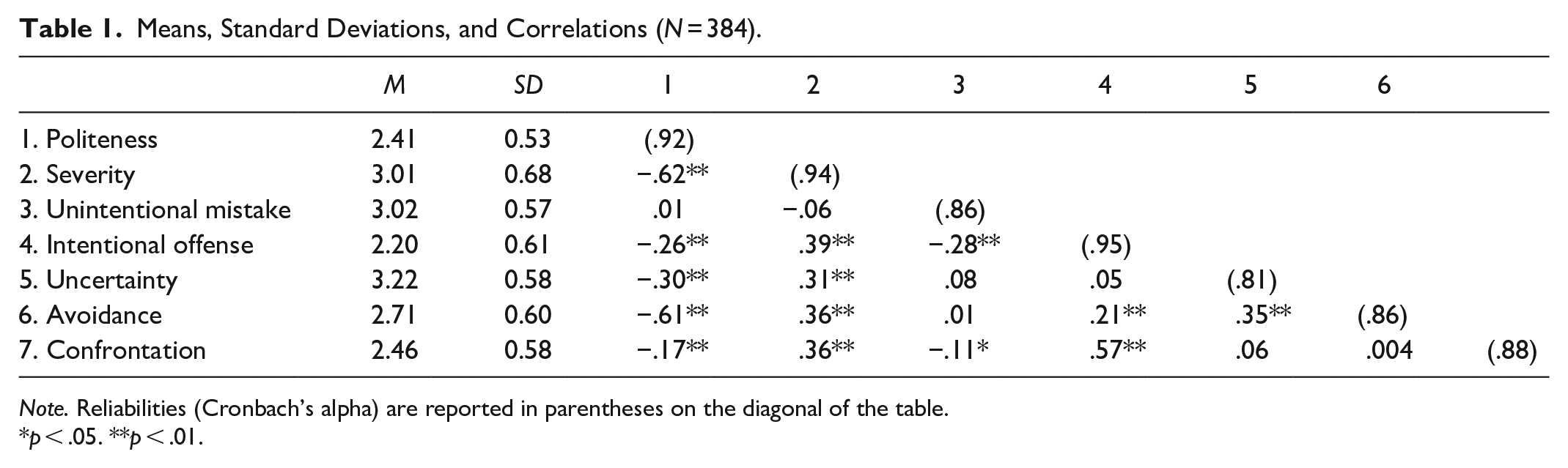
Note. Reliabilities (Cronbach’s alpha) are reported in parentheses on the diagonal of the table.
p < .05. **p < .01.
Manipulation check
To confirm that the scenarios were viewed as violations of social norms, participants were asked to report their perceptions of the adequateness of depicted messages and acts. Politeness was measured with five items, which were modified from Park et al. (2005). Higher scores mean greater politeness. An exploratory factor analysis (EFA) indicated that all five items loaded onto one factor (eigenvalue = 3.64, explaining 72.82% of the variance; individual factor loading ranged from 0.80 to 0.90). One-sample t-test was conducted on the average politeness (M = 2.41, SD = 0.53), ranging from MWeight = 1.96, SD = 0.66 to MJacket = 2.92, SD = 0.84, with the scale mid-point (i.e., 3), and showed that all three scenarios were viewed as impolite and inadequate in both contexts, t (384) = −21.73, p < .001, η2 = .55.
Severity
The magnitude of affective reaction to predicaments was assessed by victims’ negative emotions following the norm violations. Four items were used, and a higher score means greater severity. The items were modified from the offended person’s emotional response in Guan et al. (2009). An EFA indicated that all four items loaded onto one factor (eigenvalue = 3.34, explaining 83.43% of the variance; individual factor loading ranged from 0.90 to 0.94).
Attribution
Victims’ cognitive assessment was operationalized as unintentional and intentional attribution, and each was measured by four items. This measure was operationalized for the study using Cushman (2008) and Islam and Hewstone (1993) as the basis of the item development. An EFA indicated that the four items of unintentional attribution loaded onto one factor (eigenvalue = 2.63, explaining 65.78% of the variance; individual factor loading ranged from 0.72 to 0.88). Also, an EFA indicated that the four items of intentional attribution loaded onto one factor (eigenvalue = 2.55, explaining 64.96% of the variance; individual factor loading ranged from 0.88 to 0.96).
Uncertainty
Victims’ cognitive assessment was also demonstrated through participants’ degree of uncertainty in attribution. This measure was operationalized for the study based on Gudykunst and Nishida (1986). Five items were used, and a higher score indicates higher certainty. An EFA indicated that all five items loaded onto one factor (eigenvalue = 2.73, explaining 68.35% of the variance; individual factor loading ranged from 0.82 to 0.84).
Communicative responses
Communicative responses are victims’ behavioral tendency to avoid further interaction with perpetrators and to confront them, respectively. The items were modified based on Guan and Park (2010), which showed avoidance and confrontation are not bipolar opposites on a single behavioral dimension. An EFA indicated that the five items of avoidance loaded onto one factor (eigenvalue = 3.02, explaining 60.41% of the variance; individual factor loading ranged from 0.62 to 0.83). Also, an EFA indicated that the six items of confrontation loaded onto one factor (eigenvalue = 3.06, explaining 51.00% of the variance; individual factor loading ranged from 0.64 to 0.76).
Results
Two hierarchical moderated regression analyses were conducted separately for the communicative responses of avoidance and confrontation. To reduce multicollinearity, continuous independent variables were mean-centered (cf., Cohen et al., 2003). Tolerance of the predictors ranged from .51 to .93, and the variance inflation factor ranged from 1.08 to 1.98. Therefore, there was minimum collinearity among the four predictors.
Since context is a categorical variable, it was dummy coded as Intracultural = 0 and Intercultural = 1 with the intracultural context as reference. To test interaction effects, the dependent variables were regressed onto product terms of independent variables. Simple slope analyses were conducted for significant interaction effects.
Intracultural (Cultural In-Group Perpetrator) Versus Intercultural (Cultural Out-Group Perpetrator) Context
RQ1 asked how the cultural backgrounds of perpetrators affect victims’ communicative responses. Table 2 shows that some, but not all, factors are different depending on the perpetrators’ cultural backgrounds. When the same predicaments occur, they are viewed more impolite in intercultural (M = 2.34, SD = 0.51) than intracultural contexts (M = 2.49, SD = 0.55), t (382) = 2.74, p = .006, η2 = .02, but victims do not perceive the predicaments in an intercultural context (M = 3.06, SD = 0.69) as more severe than in an intracultural context (M = 2.94, SD = 0.66), t (382) = −1.73, p = .09. Across scenarios, participants were also more likely to avoid and withdraw in an intercultural (M = 3.03, SD = 0.86) than intracultural (M = 2.79, SD = 0.90) context, t (382) = 2.65, p < .01, η2 = .02. However, participants did not vary in the tendency to confront perpetrators between intercultural (M = 2.42, SD = 0.56) and intracultural contexts (M = 2.52, SD = 0.61), t (382) = 1.84, p = .07.
Means Comparison Between Intracultural and Intercultural Contexts.

Note. Means with different subscripts differ significantly from each other based on two tailed independent t-tests (p < .05).
H2 predicted that attribution of the predicament would be more positive for intercultural than intracultural contexts. Table 2 shows that unintentional attribution is significantly higher for cultural out-group (M = 3.07, SD = 0.58) than in-group perpetrators (M = 2.95, SD = 0.56), t (382) = −2.06, p = .04, η2 = .01. Attributing the predicament to intentional malicious attack is significantly higher for cultural in-group (M = 2.28, SD = 0.67) than out-group perpetrators (M = 2.12, SD = 0.58), t (382) = 2.60, p = .01, η2 = .02. Therefore, H2 was supported.
Attribution and Uncertainty
H1 was concerned with the main effects of attributing perpetrators’ intentions as purposefully hurtful to victims’ behavior. Table 3 shows that intentional attribution was a significant and positive predictor of victims’ preferences for avoidance, β = .13, SE = 0.05, t = 2.40, p < .01, and confrontation, β = .49, SE = 0.05, t = 10.79, p < .001. Given the size of the standardized β, intentional attribution is a stronger predictor for confrontation than for avoidance, which lent support to H1.
Hierarchical Regression Analysis Predicting Avoidance and Confrontation (N = 384).

p < .05. **p < .01. ***p < .001.
As predicted by H3, participants reported greater uncertainty in their attribution with cultural out-group perpetrators in an intercultural context (M = 3.32, SD = 0.56) than with cultural in-group perpetrators in an intracultural context (M = 3.08, SD = 0.58), t (382) =−4.08, p < .001, η2 = .04 (see Table 2).
RQ2 was concerned with victims’ unintentional attribution and behaviors. Attributing victims’ intentions as innocent mistakes was not a significant predictor for either avoidance or confrontation.
Interaction Effects
H4 was concerned with how uncertainty moderated the relationship between victims’ attribution and behavior. No two-way interactions involving uncertainty and attribution were observed. Therefore, H4 was not supported. However, Table 3 shows that perpetrators’ cultural backgrounds moderated the relationship between intentional attribution and avoidance. Simple slope analysis in Figure 1 shows when intentional attribution was low, victims did not differ much in their tendency to avoid perpetrators between contexts, but when intentional attribution was high, victims were much more likely to withdraw from the interaction in intercultural than intracultural contexts.

Interaction between intentional attribution × context for avoidance.
RQ3 was concerned with the three-way interaction involving context, uncertainty, and unintentional attribution. Significant results were also observed for both avoidance and confrontation, though the results were of opposite directions. Simple slope analyses in Figure 2 showed that for avoidance, unintentional attribution and uncertainty had significant interaction effects for intercultural contexts, but insignificant effects for intracultural ones. Figure 2 shows that when victims encountered perpetrators of the same cultural background, unintentional attribution led to avoidance regardless of whether victims were confident about attribution. However, with perpetrators of different cultural backgrounds, as uncertainty increased, victims’ tendency to avoid perpetrators strongly increased along with unintentional attribution. That is, uncertainty strengthened the positive relationship between unintentional attribution and avoidance for cultural out-group perpetrators in intercultural context.

Interaction between unintentional attribution × uncertainty × context for avoidance.
For confrontation, the result pattern was reversed. Unintentional attribution and uncertainty had significant interaction effects for intracultural contexts, but insignificant effects for intercultural ones. Figure 3 shows that when victims encountered cultural in-group perpetrators in an intracultural context and experienced a high level of uncertainty, the degree of unintentional attribution did not have a significant impact on victims’ tendency to confront. However, when victims were fairly confident in their attribution (i.e., in a low uncertainty condition), their preference for confronting perpetrators was significantly reduced when their unintentional attribution increased. In an intercultural context, victims’ tendency to confront was reduced as unintentional attribution increased, in a manner similar to how uncertainty moved from low to high levels. In short, the uncertainty level strengthened the negative relationship between unintentional attribution and confrontation only for cultural in-group perpetrators in an intracultural context.

Interaction between uncertainty × unintentional attribution × context for confrontation.
Discussion
The current study examined multiple scenarios of other-induced social predicaments and found that people differed in their perceptions of these situations depending on the cultural backgrounds of perpetrators; however, their communicative responses to predicaments were more thoroughly explained by a combination of cognitive and affective factors than by the cultural backgrounds of perpetrators alone. Some—although not all—communicative responses to predicaments differed depending on the perpetrator’s cultural background, which also showed significant interaction with uncertainty and unintentional attribution. Victims’ intentional attribution was related to confrontation and avoidant response, whereas unintentional attribution did not show any significance with either avoidance or confrontation.
Additionally, victims’ unintentional attribution was higher for cultural out-group perpetrators in an intercultural context than cultural in-group perpetrators in an intracultural context while showing more avoidance and withdrawal, whereas victims’ intentional attributions were higher for cultural in-group perpetrators than cultural out-group perpetrators. However, there were no significant differences in confrontation between intracultural and intercultural contexts. Victims experienced greater uncertainty about attribution with cultural out-group perpetrators in intercultural contexts than with cultural in-group perpetrators in intracultural contexts, and uncertainty predicted victims’ tendency toward avoidance. However, unlike what was predicted, uncertainty did not moderate the relationship between victims’ attribution and communicative response. Overall, it can be summarized that perpetrators’ cultural backgrounds indirectly affected people’s behavior in social predicaments.
First, this study revealed both significant similarities and differences between intracultural and intercultural communication research. Consistent with prior studies, people experienced higher uncertainty in intercultural than intracultural contexts (e.g., Armstrong & Kaplowitz, 2001; Cannon-Bowers & Salas, 2001), and uncertainty predicted withdrawal and avoidant behaviors (e.g., Duronto et al., 2005). More importantly, however, the cultural backgrounds of perpetrators did not have any main effects on victims’ communicative reactions to social predicaments. Context (i.e., intracultural vs. intercultural) only interacted with cognition (e.g., attribution and uncertainty) to influence behaviors. This is to say that intercultural communicators were not necessarily more avoidant or confrontational in response to social predicaments. Rather, this depended on individual levels of uncertainty and attribution. It is related to problematic integration (PI) theory, which suggests that people feel the constant need to evaluate probabilities of occurrences as a part of making sense of everyday situations under four different types: divergence of probabilities and evaluation, ambiguity, ambivalence, and impossibility (Babrow, 1992). Communication is where PI is created and resolved (Babrow, 1992). Based on this, uncertainty—along with other problematic integrations—has a distinct meaning for each individual, group, and culture (Babrow, 2001). Thus, seeing different levels and patterns of uncertainty is normal. Babrow (2001) also mentions that cultural context has an effective role in creating different probabilistic orientations, which eventually leads individuals to create their own ideas and expectations about other people. However, the problem lies in the fact that different cultures have different thinking systems and failure to see which can more easily cause misunderstandings.
The current study shows that culture can either accentuate or diminish the effects of victims’ uncertainty levels on their behavioral responses in social predicaments by either enabling or limiting the change of intentional or unintentional attribution. That is, the influence of culture on behavior is not uniform among individuals. This may be because everyone has their own internalized culture, separate from their environment’s culture (Morris et al., 2015). To put it another way, everyone is unique in that their way of thinking is affected not only by culture, but also by their distinct experiences (Xin, 2016). Practically, this means that investigating individual differences in cognitive and emotional processes, in addition to communicators’ cultural backgrounds, will more fully inform why and how people behave in other-induced social predicaments.
Second, a very interesting finding of the study is that the intentional attribution and seriousness of predicaments predicted both behavioral reactions—avoidance and confrontation—in the same direction. Perplexing as the results may appear, they reveal that people experience a more complex psychological process in response to predicaments than previously indicated. One plausible explanation can be seen in how humans react to stress, which is often understood as the fight-or-flight response. When exposed to new stressors, our decision of whether to engage or avoid is dependent upon a quickly calculated chance of success. If the belief that we can overcome the predator dominates, we are likely to fight; otherwise, we leave (Cannon, 1932). Predictability of the situation is an important factor in whether or not to react, especially when there is corresponding anxiety. People usually tend to give up interacting during highly anxious and unpredictable situations (Logan et al., 2016). This is to say that upon encountering an unexpected breach of social norms caused by others, people are motivated to manage undesirable situations and remedy wounded images; however, the remedial process is affected by more than one motive and can entail completely different behavioral outcomes.
Richman and Leary’s (2009) multimotive theory can shed further light on this finding. According to the researchers, by following negative social evaluations, individuals can behaviorally either seek acceptance, withdraw, or retaliate, motivated by a series of factors; on the one hand, avoidance and withdrawal are positively predicted by available alternative relationships and pervasiveness of rejections, and negatively predicted by expectations of relational repair and high relationship value (Richman & Leary, 2009). In the current study, perpetrators were portrayed as acquaintances; the non-intimate nature of the relationships indicated not only that there was little reward in restoring equilibrium with the perpetrators, but also that more affirming relationships were probably available for the victims elsewhere. Establishing the perpetrators as acquaintances also meant the victims had limited personal knowledge about the perpetrators, which led to difficulty in predicting whether the perpetrators’ hurtful behaviors would likely repeat.
On the other hand, aggressive actions, such as retaliation and confrontation, are predicted by perceptions of unfairness, expectations of relational repair, and relationship value (Richman & Leary, 2009). Low relationship value and expectation of relational repair indicated reduced social cost to engage perpetrators, which justified aggressive and confrontational measures. Both Richman and Leary’s (2009) theory and the current study showed that the same factors can lead to completely different behavioral reactions. It is very likely that individual differences would determine which factor takes priority and drives the subsequent behavior. This means people’s reactions following negative episodes of interpersonal encounters “involve a complex, interactive, dynamic system of cognitive, emotional, motivational, and behavioral responses” (Richman & Leary, 2009, p. 378).
In the current study, although participants attributed intercultural perpetrators’ actions and comments to innocent and unintentional mistakes more than to intentional offenses, unintentional attribution did not directly lead to avoidance or confrontation. This is probably because unintentional attribution itself was more complex than intentional attribution. Understanding the intention—which most of the time does not have a verbal confirmation—can be tricky, as not only cultural context but the physical context in which the communication happens should be understood by both parties (Xin, 2016). In scenarios presented in this study, intentional attribution meant that victims believed perpetrators were fully aware of the consequences, but still decided to deliver inappropriate comments or perform inadequate acts. In victims’ eyes, this could not be explained by anything but a spiteful and callous personality. However, unintentional attribution had multiple, and equally plausible, possibilities: the impolite comments and inappropriate actions were simply social faux pas, or perpetrators lacked communication skills and were insensitive to social norms. Multiple explanations of unintentionality increased victims’ uncertainty in attribution, adding more hesitation to taking aggressive actions.
Finally, uncertainty played a more salient role than perpetrators’ cultural backgrounds in understanding victims’ behaviors in social predicaments. This may be because, even though cultural background can contribute to uncertainty, there are more factors that can increase uncertainty such as nonverbal cues, physical environment, relationship status, and so on. Uncertainty has also been associated with both information seeking and avoidance (e.g., Berger & Calabrese, 1975; Duronto et al., 2005) in communication processes. In the current study, uncertainty was positively associated with avoidance in both contexts. People’s behaviors were generally stable despite unintentional attribution level, except that with cultural out-group perpetrators in intercultural contexts, high uncertainty strengthened the relationship between unintentional attribution and avoidance. These findings indicated that high uncertainty paralyzes people, preventing them from taking active measures in social predicaments. Additionally, among an array of cognitive factors, uncertainty seemed to be the driving force to reduce or eliminate further exchange with the other interactant in social predicaments. Practically, however, this means uncertainty can further inhabit effective and satisfactory communication (Neulip & Ryan, 1998). Terminating conversations without exploring further information may also reinforce negative stereotypes of culturally dissimilar interactants, which would adversely affect future interactions.
Limitations and Future Directions
This study extended our understanding of individuals’ cognitive processes and behavioral responses in intercultural and intracultural contexts where social predicaments resulted from another’s norm violation. However, the study had a few weaknesses. First, situational factors, such as severity and intentional attribution, had main effects on people’s behaviors, but they accounted for only a portion of the variance. Although the interaction effects were observed, the effect sizes were small. In fact, even for statistically significant findings, η2 was as low as nearly .02. Hence, such findings ought to be viewed with more caution. The low effect size could also mean that factors under investigation might be associated with each other in a different pattern. Future studies should examine the possibilities of mediating relationships and impacts of individual differences in addition to the situational conditions in the current study.
Next, the methodological approach could have affected the results. Although there is a strong relationship between behavioral intention and actual behavior (cf. Webb & Sheeran, 2006), some studies found that observations of behaviors revealed different results compared to self-reported surveys of hypothetical situations (e.g., Donaldson & Grant-Vallone, 2002; Jehle et al., 2012), which were employed in the current study. Therefore, caution should be exercised when interpreting hypothetical situation findings.
Last, behavioral responses to social predicaments were measured through victims’ tendency to avoid and to confront. Both scores were relatively low, which might imply that alternative behavioral responses to other-caused predicaments were possible. The low scores of confrontation, in particular, could also be related to the nature of the predicaments depicted in the study, which were of mild to moderate severity. Although these predicaments generated less drastic behavioral responses, they were more realistic and more likely to take place in actual intracultural and intercultural communication. Future studies should also investigate the impact of varying degrees of severity on people’s behavioral responses in predicaments.
Footnotes
Appendix

| Politeness of act |
| The comment was appropriate |
| The comment was polite |
| The comment was proper |
| The comment was considerate |
| The comment showed good manners |
| Severity of act |
| I was angry at what the person said |
| I was upset by the person’s comment |
| I was left with negative feelings after hearing the comment |
| I was not happy with the person’s comment |
| Unintentional attribution |
| The person was making an innocent cultural mistake |
| The person did not know how the comment might be perceived |
| The person had no idea that their comment might be inappropriate |
| The person would not have made the comment if they knew it would be seen as inappropriate |
| Intentional attribution |
| The person was trying to insult me |
| The person intentions were mean-spirited |
| The person was trying to hurt my feelings |
| The person was trying to make me feel bad |
| Uncertainty/attributional confidence |
| I am absolutely certain of the person’s intentions in giving the comment |
| It is very clear to me why the person gave me the comment |
| I am definite about the person’s intentions |
| I am not sure of the intention of the comment (reverse coded) |
| I am confident in my explanation as to why the person gave the comment |
| Avoidance |
| I said nothing more on the topic |
| I ignored the comments |
| I changed the topic |
| I ended the conversation |
| I made an excuse to leave the scene |
| Confrontation |
| I confronted the person about what was said |
| I challenged the person about what was said |
| I acted defensively |
| I demanded an apology from the person |
| I demanded an explanation from the person |
| I pointed out the rudeness of the person’s comments |
Declaration of Conflicting Interests
The author(s) declared no potential conflicts of interest with respect to the research, authorship, and/or publication of this article.
Funding
The author(s) disclosed receipt of the following financial support for the research, authorship, and/or publication of this article: This work was supported by the Ministry of Education of the Republic of Korea and the National Research Foundation of Korea (NRF-과제번호)(NRF-2020S1A3A2A02095619).
