



Abstract
In the context of Muslim-friendly tourism, marketers have to pay attention to the needs of their main target, Muslim tourists. This study aimed to examine the influence of destination attributes, including both generic and Islamic attributes, on overall tourist satisfaction to get a more comprehensive view. Likewise, this study investigated the effect of overall tourist satisfaction on its consequences. The moderation effect of Islamic religiosity on the relationship between Islamic attributes and overall tourist satisfaction was also considered. An online survey was conducted, with a sample of 231 Muslims who traveled to Muslim-majority cities, and the data were analyzed using Structural Equation Modeling. The results showed that both generic and Islamic attributes positively influence overall tourist satisfaction, while its consequences affected their behavioral, attitudinal loyalty, and churn intention. Overall tourist satisfaction was not found to affect complaint intention. Likewise, the moderation effect of Islamic religiosity was insignificant.
Keywords
Introduction
Customer satisfaction is one of the most researched topics in marketing, because it can be used to predict a company’s success in the future (Forozia et al., 2013). The importance of customer satisfaction was also mentioned by Poon and Low (2005), who note that satisfaction is the most important criterion in determining the quality of services delivered to customers.
In addition to creating satisfaction, companies also try to maintain it, because it is key to retaining customers and increasing profits (Mittal et al., 2001). Every company strives to retain its customers, since doing so is more profitable than attracting new ones. It costs less to keep the repeat customers (Um et al., 2006; Yeoh et al., 2013). The importance of research on satisfaction can predict future customer behavior such as revisit intention, positive word-of-mouth, and willingness to recommend the company to others (Chen & Chen, 2010; Fajriyati et al., 2020; Yoon et al., 2010). These are the characteristics of loyalty. Customer loyalty can be classified into behavioral loyalty which includes the intention to revisit/repurchase and attitudinal loyalty which is characterized by willingness to spread positive word-of-mouth, willingness to recommend to others and positive attitude toward products/companies (Fajriyati et al., 2020; Mechinda et al., 2009; Yolal et al., 2017; Yoon & Uysal, 2005). In contrast to customer retention, which only covers behavioral aspects, this study also examined attitudinal loyalty to provide more comprehensive results.
If satisfaction is predicted to positively affect loyalty, it can be assumed that satisfaction can also negatively affect complaint intention and churn intention (Ahn et al., 2006; Dmitrović et al., 2009; Lee et al., 2015). Complaint and churn intention are negative consequences that should be avoided by service providers. Therefore, research on satisfaction and its consequences needs to be carried out with consideration of the benefits and losses that might result.
In tourism, one of the factors that contribute to satisfaction is destination attributes (Alegre & Garau, 2010; Rahman, 2014; Tanford & Jung, 2017). These attributes constitute a combination of different elements that are able to attract tourists. Tourists usually assess the existence of generic attributes offered by destinations. In this context of study on Muslim-friendly tourism, the main targets are Muslim tourists. They have special needs regarding their obligations as a Muslim. Besides the generic attributes, a destination also needs to pay attention to those attributes that can specifically meet their needs while traveling. These are called the Islamic attributes of a destination (Eid & El-Gohary, 2015; Fajriyati et al., 2020; Rahman, 2014). However, previous studies that specifically address Muslim-friendly tourism have focused more on researching Islamic attributes than other attributes (Battour et al., 2014; Eid & El-Gohary, 2015). So, to fill the gap, the present Muslim-friendly tourism study examines both types of attributes together to provide a broader and more holistic perspective.
Research on Muslim-friendly tourism also cannot be separated from the role of religiosity that underlies a Muslim tourist’s choice of the type of tourism that fits their needs (Battour et al., 2014; Eid & El-Gohary, 2015). Religiosity is a major influence in shaping people’s behavior and attitudes (Eid & El-Gohary, 2015; Zamani-Farahani & Musa, 2012). It also describes the way of life which is reflected in the values and attitudes of an individual and societies then formed their behavior (Eid & El-Gohary, 2015). Although some previous studies have examined the relationship between Islamic attributes and satisfaction, there has been only limited investigation into the impact of religiosity on that relationship. This study measures Islamic religiosity using indicators specific to the tourism context (Henderson, 2016; Shakona et al., 2015).
Overall, the purpose of this study was to examine the effect of both generic and Islamic attributes in influencing overall tourist satisfaction and its consequences for loyalty, complaint intention, and churn intention in the context of Muslim-friendly tourism. The result of this study will provide information related to the destination attributes that fit tourists’ needs, so that destination marketers can improve their products and services to satisfy the Muslim tourists. This research also tried to examine the moderation effect of Islamic religiosity on the relationship between Islamic attributes and overall tourist satisfaction.
Literature Review and Hypotheses Development
Muslim-Friendly Tourism and Its Concept
The development of the Muslim tourism market raises several terms to explain the concept of tourism in accordance with the needs of Muslims. The most common terminologies used to explain the concept are “Islamic tourism,” “halal tourism,” and “Muslim-friendly tourism/MFT.” These terminologies are frequently used interchangeably as if the concepts are similar, whereas basically they have different meanings. Tours conducted with the purpose of getting pleasure from Allah are called Islamic tourism. In other words, the intention that distinguishes Islamic tourism from other tourism. The term “Islamic” is only used in matters directly related to the faith and its doctrine, such as Islamic/sharia law, Islamic values, Islamic principles, and beliefs (Fajriyati et al., 2020). Whereas halal tourism is every object and action that is allowed according to Islamic teachings to be used by Muslims in the tourism industry (Battour & Ismail, 2016). In other words, according to Wilson and Liu (2011), halal interpreted as what is permissible and is often considered to be explicitly stated. Halal tourism is a conscious approach by God to offer Muslims equal access to facilities—from their perspective (Wilson, 2017). This includes a variety of products and services offered to Muslim populations and is not only limited to foods and drinks. If a product or activity is called “Islamic” it means that the activity or product meets all the requirements and rules in Islamic sharia, which may not always be met in halal tourism activity or product. Equating Islamic and halal tourism is inappropriate. It would be better to use “Halal” rather than “Islamic” for related product and service in tourism industry (Battour & Ismail, 2016).
In the practice of halal tourism, it can be a challenge for the providers since they serve not only Muslim customers but also non-Muslim customers. For example, about providing alcohol in the hotels (El-Gohary, 2016). Battour and Ismail (2016) mentioned that halal tour packages offered do not meet all the requirements of Islamic Sharia or halal concepts, so they are not fully halal. However, almost all halal tour packages strive to meet the needs of Muslim consumers in a Muslim-friendly manner. So, it would be more appropriate to use the term “Muslim-friendly tourism” (Battour & Ismail, 2016; Eid & El-Gohary, 2015).
Muslim-friendly tourism itself is a type of tourism that strives to provide comfort for Muslim tourists while they are traveling, facilitating their ability to perform their religious obligations (Battour, 2016). It is almost akin to the concept of “Halal Tourism” but has a wider context to enable Muslims to perform their religious duties. Muslim-friendly destinations not only offer halal food and drinks, separate swimming pools based on gender, etc. It also offers a convenient place for Muslims to do their daily prayers. So, this study used the concept of Muslim-friendly tourism since it has a broader scope compared to the other two terms (Fajriyati et al., 2020).
Muslim tourists are one of the most growing segments in tourism and this segment is the main target of Muslim-friendly tourism (COMCEC, 2016; Stephenson, 2014). In recent years, countries have tried to take the opportunity to serve this segment. Muslims tourists have some special needs different from those of other tourists. These are related to the implementation of daily prayers (five times a day), the availability of halal (permissible to consume) foods and beverages, the prohibition of alcohol and gambling, the segregation of men and women in public places, and rules for Muslim women when traveling. They have to travel with a mahram (a husband or a man whom marriage would be considered haram/forbidden in Islamic law). Also, Muslim women must not expose their hair and body according to the Islamic teachings (Battour et al., 2011; Shakona et al., 2015).
Generic Attributes and Islamic Attributes
The generic attributes of a destination refer to the common attributes that are usually available at a destination, regardless of whether the destination is Muslim-friendly or not (Fajriyati et al., 2020). They are related to the attractions offered by the destination and serve as a consideration for tourists deciding whether to visit and may also influence their satisfaction (Boit & Doh, 2014). A number of studies about generic attributes have been conducted. Mussalam and Tajeddini (2016) categorized these attributes into destination brand/reputation, tourism attractions, tourism infrastructure, and tourism services. In another study, Alegre and Garau (2010) examined destination attributes including accommodation, culture, climate, information, cleanliness, scenery, security, prices, and historical sites for their effect on satisfaction. While friendliness, accessibility, food, location, natural scenery, activity, lodging, friendly services/quality, and outdoor activities were generic attributes used in the study of Meng et al. (2008).
Studies have revealed a positive and significant influence between generic attributes and tourist satisfaction. Ozturk and Gogtas (2016) found that attributes such as transportation, safety, and prices strongly influence satisfaction. Ragavan et al. (2014) also support the notion that destination attributes like culture and climate have a significant positive influence on overall tourist satisfaction. Meng et al. (2008) found that attributes importance, attributes performance, and motivation were variables to measure tourist satisfaction.
As stated above, Muslim tourists have some obligations related to Islamic teaching even when they are traveling. This makes them consider not only the generic attributes but also the availability of Islamic attributes. As mentioned by Battour et al. (2014), the tourism literature supports that generic attributes positively affect overall tourist satisfaction and also recommends further investigating the Islamic attributes. The study conducted by Eid and El-Gohary (2015) classified Islamic Attributes into physical and non-physical attributes. Physical attributes included prayer facilities, halal food, the Quran, and Muslim-friendly toilets, while non-physical attributes or intangible attributes consisted of the availability of segregated services, Sharia TV channels, Sharia entertainment tools, and arts that do not depict human forms. Similarly, Battour et al. (2011) classified Islamic attributes into tangible and intangible aspects. Tangible aspects related to the availability of halal food and prayer facilities (mosques/prayer rooms, Quran, Qibla, and Muslim-friendly toilets). Intangible attributes involve Islamic entertainment, Islamic dress codes, observance of Islamic morality, and Azan (Fajriyati et al., 2020).
Further research by Battour et al. (2014) detailed the Islamic attributes in four broad categories with a total of 18 attributes: (1) worship facilities, (2) halalness, (3) absence of alcohol and gambling, and (4) Islamic morality. The result of this research showed that the availability of Islamic attributes is a source of Musim tourists’ satisfaction. Rahman’s (2014) findings also support that the Islamic attributes, including availability of mosques, Al-Quran, prayer facilities, Qibla and halal food, had a positive influence on tourist satisfaction. From the description above, the following hypotheses are proposed:
H1: Generic attributes have a positive influence on overall tourist satisfaction.
H2: Islamic attributes have a positive influence on overall tourist satisfaction.
Overall Tourist Satisfaction
Customer satisfaction can be defined as the customer’s overall post-purchase evaluation and judgment about the extent to which the product or service purchased has met customer needs (Fornell, 1992). The post-purchase reaction is an emotional state, which can include anger, dissatisfaction, neutrality, or pleasure. Satisfaction can also be interpreted as a customer’s subjective assessment after a purchase and consumption experience has occurred (Lovelock & Wright, 1999). Satisfaction in the tourism context is interpreted as a tourist’s total evaluation of destination attributes. It is considered an important thing that determines the success of a destination because it will affect the consumer’s choice of destinations, consumption of related products and services, and decision to revisit (Kozak & Rimmington, 2000).
Behavioral and Attitudinal Loyalty
Several studies have examined the effect of tourists’ satisfaction on loyalty toward the destination. Tourist loyalty in this study includes behavioral and attitudinal aspects. Behavioral loyalty is a customer’s long-term choice of a brand or company, intention to revisit and their commitment not to switch to other brands, while attitudinal loyalty includes recommendations to others, refusal of competitors’ offerings and willingness to pay premium prices (Chi & Qu, 2008; Yoon & Uysal, 2005). In the tourism literature, Mohamad and Ghani (2014) mentioned behavioral loyalty as the intention to revisit the same destination, whilst attitudinal loyalty can be seen in the willingness to recommend the destination to others.
Studies examining the effect of satisfaction on behavioral or attitudinal loyalty have been conducted in general marketing contexts such as in the health industry (Lee & Kim, 2017), restaurants (Kim et al., 2013), the performing arts (Hume, 2008), and, as in the context of this study, tourism (Chi & Qu, 2008; Rahman, 2014; Um et al., 2006). Several previous studies have investigated the influence of satisfaction on behavioral and attitudinal loyalty and have proven that there are influences between these variables. Al-Refaie et al. (2014) proved that satisfaction positively influenced behavioral loyalty. In the tourism context, satisfaction also affected loyalty, which is characterized by the intention to revisit in the future (Rahman, 2014). Other studies such as Suhartanto et al. (2016) revealed that satisfaction affected behavioral loyalty in the context of domestic and international tourists’ intention to revisit Bali on a shopping tour. From the description above, the following hypothesis is proposed:
H3: Overall tourist satisfaction has a positive influence on behavioral loyalty.
Studies examining the relationship between satisfaction and attitudinal loyalty, such as Chi and Qu (2008), confirmed that satisfaction leads to positive WOM, which is an indicator of attitudinal loyalty. If customers are satisfied with the product/service, they will be more likely to continue the purchase and spread positive WOM and recommendations. Another study conducted by Suhartanto et al. (2016) found that satisfaction positively influences attitudinal loyalty, which is characterized by the intention to recommend Bali to others. In line with these findings, Al-Refaie et al. (2014) also reported that satisfaction positively influences the attitudinal loyalty. Thus, the following hypothesis is proposed:
H4: Overall tourist satisfaction has a positive influence on attitudinal loyalty.
Complaints and Churn Intention
The negative impact of unfulfilled satisfaction is the possibility of complaints and churn intention. As mentioned in the exit voice theory (Hirschman, 1970), when customers are satisfied, they will reduce their intention to make complaints and increase their loyalty toward the company’s products/services. Conversely, if customers feel dissatisfied, they usually choose to voice their complaints or stop buying and move on to competitors. This is in line with the findings of Mingfang (2011) that the consequences of tourist satisfaction can be in the form of loyalty or vice versa, which may affect the intention to make a complaint. Tourists’ satisfaction can influence their intention to revisit and spread positive WOM; conversely, if tourists are dissatisfied, they have the choice not to revisit or to switch to another destination and voice/express their complaints. Dmitrović et al. (2009) also mentioned that dissatisfaction among customers (tourists) can lead to negative behaviors such as complaints and churn.
From the description above, it can be concluded that satisfaction can negatively affect complaint intentions. More satisfied tourists will further reduce their complaint intention. Conversely, the more dissatisfied the tourists are, the more likely they will be to voice complaints (Dmitrović et al., 2009; Lee et al., 2015; Song et al., 2011). Thus:
H5: Overall tourist satisfaction has a negative influence on complaint intention.
Not all dissatisfied customers choose to voice their complaints. Some consider it to be easier to simply stop using the service and leave the company. Churning-out refers to the situation when dissatisfied customers stop using the service or use it less often (Lee et al., 2015). In tourism, dissatisfied tourists will usually choose to leave the destination, for example by switching to another destination (Song et al., 2011, 2012). Keramati and Ardabili (2011) also mentioned that dissatisfaction was one of the main factors that contribute to creating customer churn. From the statements above, the following hypothesis is proposed:
H6: Overall tourist satisfaction has a negative influence on churn intention.
Islamic Religiosity
In addition to examining the effect of destination attributes on overall tourist satisfaction, this study also evaluated the moderating role of religiosity in the relationship of Islamic attributes with overall tourist satisfaction. The study of religiosity has long been developed by several researchers. Allport (1950) built the measures of religiosity that have been widely used in religiosity researches. Further researchers continue to develop the measures, including Cornwall et al. (1986) and Maselko and Kubzansky (2006). Most of these measures of religiosity were suited to one particular religion, generally Christianity. Although some of the scales/indicators used may have several concepts and items that can be applied to Muslims, they are not always suitable for measuring the religiosity of Muslims (Khraim, 2010).
Attempts to develop more specific research on Islamic religiosity were made by researchers such as Albelaikhi (1997), Eid and El-Gohary (2015), Krauss et al. (2005), Tiliouine and Belgoumidi (2009), and Zamani-Farahani and Musa (2012). For example, the Moslem Religiosity Personality Measurement Inventory (MRPI) introduced by Krauss et al. (2005) measures religiosity using two main dimensions. The first is the Islamic worldview, which refers to a belief of Islamic teachings (Aqeedah) and belief/faith in the pillars of Islam (Faith). The second dimension is religious personality. This refers to the real form of the Islamic worldview, including worship (which relates directly to God), prayer, fasting, charity, and the relationship between oneself and others. Another measure of Islamic religiosity was developed by Tiliouine and Belgoumidi (2009), called the Comprehensive Measure of Islamic Religiosity (CMIR). In this measure, Islamic religiosity is divided into religious belief, religious practice, religious altruism, and enrichment of religious experience. Albelaikhi (1997) used Islamic belief and practice in research by adding another dimension, namely attitudes. This measure is called the Muslim Religiosity Scale (MRS) and has 88 indicators.
In the context of tourism, several researchers have examined religiosity, such as Zamani-Farahani and Musa (2012). They researched the relationship between Islamic religiosity and the socio-cultural impact on tourism by using measurements based on the perspectives of Islamic belief (Faith) and Islamic practice (Charity). Both of these dimensions include 17 items. Furthermore, in 2015, Eid and El-Gohary also researched the role of religiosity in tourism. The measurement was also based on two dimensions, Islamic belief and practice as measured in the research of Zamani-Farahani and Musa (2012), but not including several indicators such as “I believe in God strongly” and “I perform Friday Prayer regularly.” This research found that religiosity moderated the influence of Islamic attributes on satisfaction.
From all of these measures, it can be seen that most authors agree with the existence of two dimensions, religious belief and religious practice. The inclusion of these two dimensions is also in line with the notion of religiosity by some researchers, such as Yousaf and Shaukat Malik (2013) who state that religiosity describes the degree to which followers of a religion accept the main beliefs of and practice that religion.
This study used indicators from previous studies like those of Henderson (2016) and Shakona (2013) which measure Islamic religiosity specifically in the tourism context. In their studies, religiosity was measured by indicators that refer to Islamic religious beliefs and practices that have been adapted to the tourism context.
H7: Islamic religiosity moderates the relationship between Islamic attributes and overall tourist satisfaction.
Research Methodology
Measures
This study used a questionnaire developed according to literature review and revised according to the result of a pretest conducted with 80 respondents. The questionnaire consisted of three parts, with the first including screening questions to ensure the respondents fit the specified criteria. The questions included: destination the respondent last visited (in the past year), the purpose of the visit, and the respondent’s religion and age.
The second part included the main questions, measuring the eight variables to be examined (generic attributes, Islamic attributes, overall tourist satisfaction, behavioral loyalty, attitudinal loyalty, complaint intention, churn intention, and Islamic religiosity). All items were operationalized using a six-point Likert scale. The generic attributes consisted of 13 items, adopted from several researchers (Alegre & Garau, 2011; Chi & Qu, 2008; Mussalam & Tajeddini, 2016; Ragavan et al., 2014). The Islamic attributes included 18 items (Battour et al., 2014; Eid & El-Gohary, 2015; Nassar et al., 2015; Stephenson, 2014). Overall tourist satisfaction had seven questions (Albayrak, 2018; Eid & El-Gohary, 2015; Lee et al., 2015; Song et al., 2012) measured with a six-point Likert scale ranging from 1 (very dissatisfied) to 6 (very satisfied). Behavioral and attitudinal loyalty were each measured by six indicators (Al-Refaie et al., 2014; Hsu et al., 2014; Kaur & Soch, 2012; Suhartanto et al., 2016; Yolal et al., 2017). Complaint intention, adopted from Kim and Boo (2011) and Lee et al. (2011), had five questions, and churn intention had four questions (JoshiSujata et al., 2015; Lee et al., 2015). Islamic religiosity, which served as a moderation variable, was developed from Henderson (2016), Shakona (2013) and measured using 13 questions. All these items used a six-point Likert scale where 1 = strongly disagree to 6 = strongly agree. The final section was 15 demographic questions.
Samples
All selected respondents were Muslim tourists who had traveled to one of the 16 Muslim-majority cities mentioned in the questionnaire. The selection of these 16 cities was based on the most visited Muslim-majority cities according to Euromonitor International (2017). The 16 most visited Muslim-majority cities were Abu Dhabi, Antalya, Artvin, Cairo, Dammam City, Doha, Dubai, Edirne, Istanbul, Jakarta, Johor Bahru, Kuala Lumpur, Marrakech, Mecca, Penang Island, and Riyadh. The other criteria required that respondents must be above 18 years old and with the purpose of visit for leisure or business + leisure (bleisure). The sample size in this study was determined based on the rules of thumb for using Structural Equation Modeling (SEM), that is a minimum of 150 cases (Anderson & Gerbing, 1988; Hair et al., 2013; Muthén & Muthén, 2002) or 200 cases (Boomsma, 1982). After the data cleaning, 231 questionnaires were completed and were usable for the data analysis.
Data Collection
This study was conducted through an online survey using the SurveyMonkey online survey application. To select the potential respondents, a purposive sampling technique was used to ensure respondents complied with the intended criteria. The potential respondents were randomly selected through several media: travelers’ blog, travelers’ vlogs, Facebook, and Instagram. For Facebook and Instagram, the respondents were selected from the traveler groups (both domestic and international), such as “international backpackers,” “Muslim travelers,” and “The Muslim women travel groups” and using hashtags on Instagram like #halaltravellers, #muslimtravel, #muslimtravellers, #hijabtraveller, #muslimvacation that showed photos of respondents traveling to the destinations. Next, potential respondents were contacted personally (via direct messages or email) and given a link directing them to the SurveyMonkey online questionnaire.
Result
In this study, Structural Equation Modeling (SEM) was employed using LISREL 8.8 software, and the descriptive analysis was performed by SPSS 23. This section is divided into three main parts: (1) Respondents’ sociodemographics, (2) Measurement model analysis, and (3) Structural model and hypothesis testing.
Respondents’ Sociodemographics
This part describes the characteristics of the respondents. After a descriptive analysis was conducted, the result showed that the cities most frequently visited by respondents in this study were Kuala Lumpur, Istanbul, and Dubai. By gender, the 231 respondents collected were 23.81% male and 76.19% female. Their ages were mostly between 25 and 34 years old (45.89%). The respondents visited the destinations for leisure (90.04%) and bleisure (9.96%), and 45.89% traveled independently rather than with an organized tour. Finally, the majority of respondents visited the destinations in October (17.32%). This report is presented in more detail in Table 1.
Sociodemographic Characteristics of the Respondents.

Measurement Model Analysis
Confirmatory factor analysis (CFA) was performed to evaluate the validity and reliability of the measurement model. This analysis consisted of overall model fit, validity, and reliability tests. Analyses were performed for eight latent variables of this study: (1) Generic Attributes (GA), (2) Islamic Attributes (IA), (3) Overall Tourist Satisfaction (OTS), (4) Behavioral Loyalty (BL), (5) Attitudinal Loyalty (AL), (6) Complaint Intention (CP), (7) Churn Intention (CI), and (8) Islamic Religiosity (RL).
Overall model fit was analyzed to evaluate the goodness of fit between the research model and the research data (Fajriyati et al., 2020). The estimated goodness of fit indices (GOFI) and GOFI criteria for a good fit were compared (RMSEA = ≤.08; NNFI = ≥.90; CFI = ≥.90; IFI = ≥.90; RFI = ≥.90; SRMR = ≤.08**; GFI = ≥.90; NCS = ≤2). For the validity test, standardized factor loading (SFL) of each indicator (observed variable) was evaluated. The criterion for SFL was ≥0.50, indicating that the indicator was valid as a related latent variable. Whereas if SFL <.50, the indicator can be excluded from the measurement model (invalid). For the reliability test according to Hair et al. (2006) the composite reliability (CR) was expected to be ≥.70 and the average variance extracted (AVE) ≥.50 (Hair et al., 2006). Other researchers stated that AVE ≥.40 is still considered acceptable (Fornell & Larcker, 1981; Huang et al., 2013). Table 2 below reports the result of the CFA.
Confirmatory Factor Analysis of Eight Variables.

Note. GOFI: RMSEA = .062 (≤.08**); NNFI = .95 (≥.90**); CFI = .95 (≥.90**); IFI = .95 (≥.90**); RFI = .90 (≥.90**); SRMR = .067 (≤.08**); GFI = .71 (≥.90**); NCS = 1.89 (≤2**).
Criteria for a good fit.
Table 2 details each SFL of all valid indicators for the related latent variables (≥.50). Invalid indicators with SFL <.50 were dropped from the measurement model. For the reliability test, the result showed that the CR values ranging from .81 to .92, so all the CR met the criteria. The AVE values also fulfilled the requirement, except for generic attributes, indicating a limitation of the study. For the overall model fit, most of GOFI showed a good fit, while GFI had a marginal fit. Thus, one can conclude that each measurement model has a good overall model fit.
Structural Model and Hypothesis Testing
The significance of the relationship between variables and the hypothesis testing were performed using a structural model analysis. The structural model was estimated, the results showed the significance among the latent variables (presented in the path diagram in Figure 1). Based on these results, the next step was to test the hypothesis (Table 3).
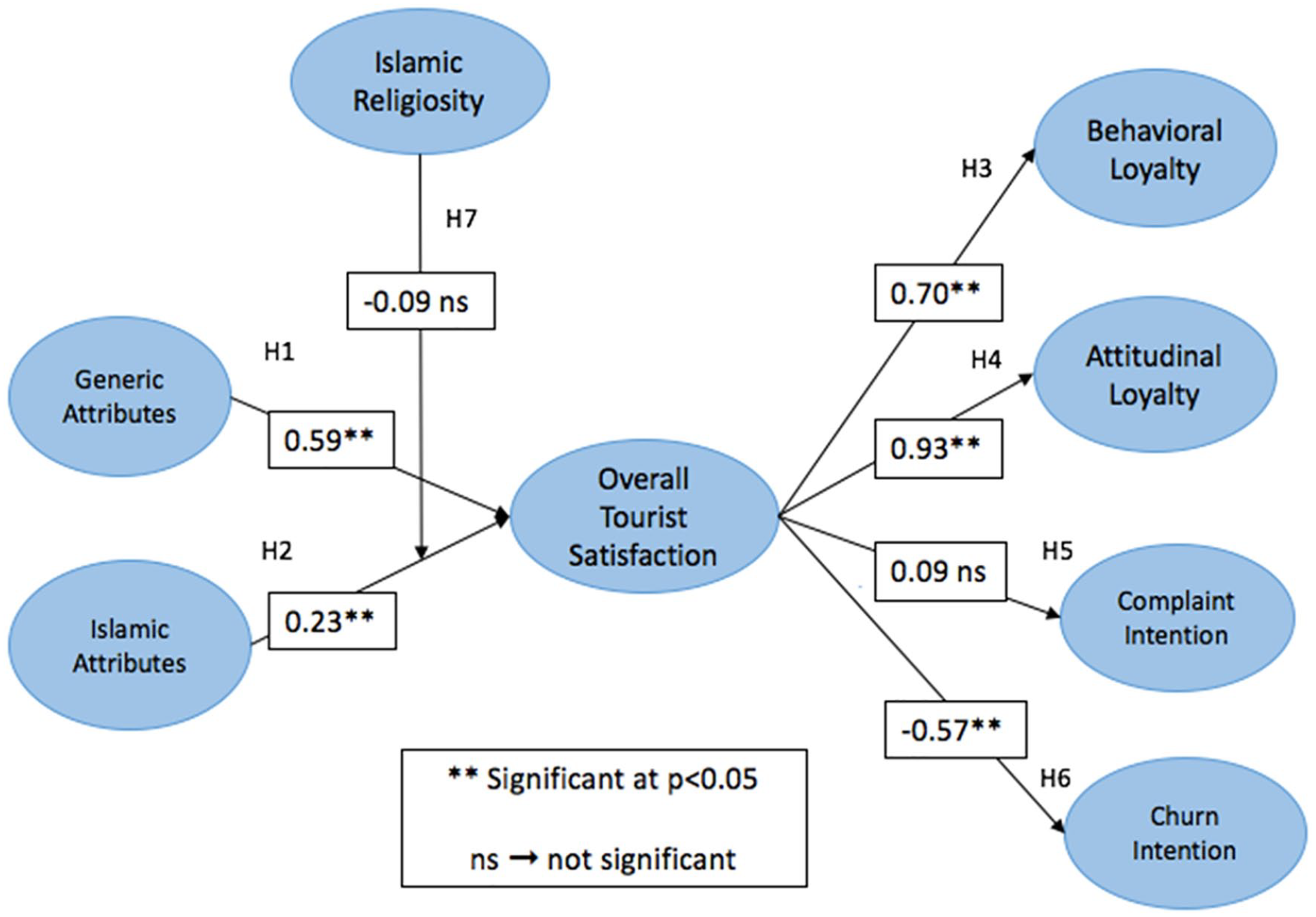
Structural model results.
The Result of Hypotheses Testing.

Note. GOFI: RMSEA = .067 (≤.08**); NNFI = .95 (≥.90**); CFI = .95 (≥.90**); IFI = .95 (≥.90**); RFI = .90 (≥.90**); SRMR = .10 (≤.08**); GFI = .71 (≥.90**); NCS = 2.0 (≤2**).
Criteria for a good fit.
The empirical results indicated that both destination attributes (generic and Islamic) significantly and positively influenced overall tourist satisfaction (the t-values were 8.26 and 3.71, respectively). So, the proposed H1 and H2 were accepted. These findings are in line with the previous studies like Ozturk and Gogtas (2016), Ragavan et al. (2014), Meng et al. (2008), Battour et al. (2014), and Rahman (2014). Next, the examination of the consequences of overall tourist satisfaction on loyalty. For behavioral loyalty, overall tourist satisfaction was shown to have a significant effect, with a t-value of 9.03. This indicates that H3 was accepted, such as the studies conducted by Rahman (2014), Al-Refaie et al. (2014), and Suhartanto et al. (2016). Likewise, with attitudinal loyalty, the results indicated overall tourist satisfaction had a significant and positive effect on this variable. Thus, H4 was also accepted (t-value = 13.33). The present finding strengthen past investigations (Al-Refaie et al., 2014; Chi & Qu, 2008; Suhartanto et al., 2016). On the other hand, overall tourist satisfaction was not found to influence complaint intention. Thus, the proposed H5 was rejected (t-values = 1.27). As Keramati and Ardabili (2011) found, churn intention in this study was also to be affected by overall tourist satisfaction (t-values = −7.56); H6 was accepted. Lastly, the moderating effect of Islamic religiosity was not proven to affect the relationship between Islamic attributes and overall tourist satisfaction. The result showed the rejection of H7 with the t-value of −1.54.
Discussion
The first objective of this study was to examine the influence of destination attributes, including generic and Islamic attributes, on to overall tourist satisfaction in the context of Muslim-friendly tourism. The empirical results of this study showed that both of the types of attributes had a positive and significant effect on overall tourist satisfaction (H1 and H2). This means that the more effectively the destination provides both attributes, the higher will be the satisfaction of Muslim tourists. The generic attributes found to have the greatest influence on overall tourist satisfaction. The activities, entertainment, and attractions offered at the destination; the cleanliness, image, safety, and infrastructure of the destination; and the information and local transportation available at the destination were some of the generic attributes that enhance tourist satisfaction. This finding was in line with previous studies that found destination attributes influence overall tourist satisfaction (Ozturk & Gogtas, 2016; Ragavan et al., 2014). As mentioned by Rahman (2014) in Malaysia and Golmohammadi et al. (2011) in Iran, a good destination image can affect and increase tourist satisfaction. Research conducted by Battour and Ismail (2014) also found that generic attributes such as activities, entertainment, and attractions, significantly affect the satisfaction of Muslim tourists.
The result of this study also reveals that, in addition to paying attention to the availability of generic attributes, Muslim tourists also consider Islamic attributes that provide comfort for them when traveling. In line with the previous findings such as Battour et al. (2014) and Rahman (2014), Islamic attributes positively affected overall tourist satisfaction. In Muslim-majority destinations, Muslim tourists expect some Islamic attributes to be present, such as accessibility of segregated public areas for men and women, the prevalence of Islamic dress codes in public places, entertainment in line with Islamic teachings, promotion/marketing programs following Islamic ethics, and Muslim staff/employees at the destination; thus, the more these attributes are available, the more satisfied these tourists will be. In Muslim-majority cities, the availability of Islamic attributes are easier to find because these attributes are part of the daily life.
For the consequences of overall tourist satisfaction, the findings of the present study show that tourist satisfaction affected both behavioral and attitudinal loyalty. It has a greater effect on attitudinal loyalty. Previous studies in line with these results have shown that the success of destinations depends on how well they satisfy their tourists. Satisfied tourists will show a good attitude toward the destination, feel loyal, willing to spread positive WOM, and willing to recommend the destination to others (Chi & Qu, 2008; Chiou & Droge, 2006; Mechinda et al., 2009; Rahman, 2014). Moreover, the results also confirmed that the higher tourist satisfaction is associated with higher behavioral loyalty. This finding is in line with the theory and previous studies like Al-Refaie et al. (2014), Rahman (2014), and Suhartanto et al. (2016) which showed that tourist satisfaction can further increase the tourists’ willingness to revisit in the future, which is one of the characteristics of behavioral loyalty.
While satisfaction affected both attitudinal and behavioral loyalty positively, overall tourist satisfaction was expected to negatively influence complaints and churn intentions. That is, the more satisfied tourists are, the less likely they will be to make complaints and churn. The findings of this study revealed that these hypotheses were partially accepted. Regarding complaint intention, overall tourist satisfaction was not found to affect it. In other words, not all dissatisfied customers choose to voice their complaints. As Tronvoll (2012) mentioned, several streams of literature have found that the majority of customers do not voice their complaints to organizations. Some factors that may inhibit this complaining behavior are personality, assessment of cost/benefits they will get from complaints, social benefits, and situational and contextual elements. Lack of time, inability to get in touch with the right person and lack of access to an appropriate complaint channel may also be reasons for them not to voice their complaints. Other possible reasons came from the tourists themselves, such as a lack of knowledge of how to make a complaint or uncertainty regarding the standards that might be expected from a company, as well as an inability to argue their reasons for complaining (Tronvoll, 2012). As stated above, not all dissatisfied customers voice their complaints. Some consider it easier to stop using the service and leave the company. This leads to the hypothesis that overall tourist satisfaction has a negative effect on churn intention, which was accepted. This finding indicates that if tourists are not satisfied, they tend to have the intention not to revisit the same destination (i.e., they tend to switch to other destinations). The results of this study were in line with those of previous studies such as Lee et al. (2015) and Mechinda et al. (2009).
The last hypothesis examined the moderating variable of Islamic religiosity (RL) on the relationship between Islamic attributes and overall tourist satisfaction. Some previous studies on Muslim-majority destinations such as Eid and El-Gohary (2015) and Yaakop et al. (2017) mentioned that religiosity moderates the relationship between Islamic attributes and tourist satisfaction. This indicates that tourists who have a high level of religiosity perceive the value of the Islamic attributes to be more important than others when evaluating a tour package (Eid & El-Gohary, 2015). This study showed a different result, as it found that religiosity as a moderating variable does not significantly influence the relationship between Islamic attributes and overall tourist satisfaction. Thus, religiosity cannot strengthen the relationship between these variables.
In this study, the majority of tourists came from Muslim-majority countries, like Indonesia and Malaysia. This may be because tourists who come from Muslim countries are familiar with the existence of Islamic attributes in their home cities/countries. For example, in Muslim-majority countries, segregated areas for men and women are common in places of worship or tourist attractions like fitness centers, salons, and spas, or in hotels that provide segregated swimming pools and beaches. Another possibility is that, because the destinations they visited were cities with a Muslim-majority population as well, the tourists may have expected to easily find these attributes. Thus, it may be for these reasons that religiosity (at any level) was not found to significantly influence the relationship between Islamic attributes and satisfaction (Nassar et al., 2015; Putra et al., 2016).
Conclusion, Research Contributions, and Future Study
Conclusion
The results of this study showed that both generic and Islamic attributes positively influence overall tourist satisfaction, while its consequences affected their behavioral, attitudinal loyalty, and churn intention. On the other side, overall tourist satisfaction was not found to affect complaint intention. Likewise, the moderation effect of Islamic religiosity was insignificant.
Theoretical Contributions
In the tourism discipline, Muslim-friendly tourism is an emerging field that needs to be further explored (Yaakop et al., 2017). The result of this study offer several contributions. First, in relation to understanding the destination attributes of Muslim-friendly tourism, this study examined the destination attributes (both generic and Islamic) that influence overall tourist satisfaction. The inclusion of these two types of attributes complements the lack of previous studies which mostly tested only the Islamic attributes in the Muslim-friendly tourism context. So, it offers a more comprehensive view than examining one type alone.
Second, in addition to investigating the antecedents of overall tourist satisfaction, this study also evaluated its consequences. Specifically, overall tourist satisfaction was tested for its impact on behavioral and attitudinal loyalty. The results showed a significant and positive influence between these variables. In addition to the positive impact of satisfaction, this study also investigated the effect of overall tourist satisfaction on complaint and churn intention as negative impacts that an unsatisfactory destination might suffer.
The third contribution is related to specific indicators of Islamic religiosity in the tourism context. Usually, research on religiosity in this context has used general indicators, which measure religious beliefs and practices such as prayer, pilgrimage, zakat, fasting, and other indicators in general. Thus, its use in the tourism context is considered less appropriate to describe the tourists’ condition. This study used specific indicators of religiosity in the tourism context developed by Shakona (2013) with several adjustments.
Managerial Contributions
The results of this study also provide managerial contributions. Research conducted on destination attributes can help marketers, governments, and related parties to adjust products and services to meet the needs of Muslim tourists and encourage them to revisit the destination. Based on the results of the study, it can be concluded that Muslim tourists not only consider the existence of generic attributes to satisfy them but also the presence of Islamic attributes at the destination to facilitate them as Muslims when traveling. This study examined the Islamic and generic attributes together to provide more comprehensive input to help the destination marketers improve their marketing strategies to attract more Muslim tourists.
The finding of this study explained some of the generic attributes that contributed to these tourists’ satisfaction, including the availability of tourist information and safety, as well as the activities, entertainment, and attractions at the destination. Recommendations related to these attributes include the provision of sufficient information at the destination. Tourist Information Centers (TICs) can be provided in public places (e.g., airports and tourist attractions) that are visited by many tourists. TICs will ease the tourists’ access to information related to tourist attractions, accommodations, and transportation. Today, the information can also be communicated through the local tourism website so tourists can access it easily. Also, signposts indicating the locations of tourist attractions and supporting facilities should be provided in sufficient quantities and in languages that can be understood internationally. Other recommendations include the development of entertainments that can be offered to tourists. For example, man-made attractions can be made to complement the natural attractions. To attract more tourists, destination marketers can also provide additional entertainments such as performing arts, shopping centers, and other activities that characterize the destination.
For Islamic attributes, the findings indicated that destination marketers should offer alcohol- and gambling-free areas. Fulfillment of these attributes can be challenging, because the destinations also try to satisfy the needs of non-Muslim tourists at the same time. An example approach would be for a restaurant to provide separate drinking and non-drinking sections for different patrons. Related parties also have to ensure there is no gambling goes on at the destination. Other necessary attributes include segregated areas for men and women in public places, like prayer rooms, ablution places, and swimming pools. Also, in Muslim-majority cities, advertisements should be made using models that dress modestly, and entertainment should be provided following Islamic teachings.
Future Study
In this study, a quantitative method was used to test the hypotheses that have been built based on the theories and previous studies. The results showed most of the hypothesis (five out of seven hypothesis were accepted). The future studies may conduct the research with a qualitative design to enrich the result and get a deeper discussion.
This study examined the antecedents (destination attributes) of overall tourist satisfaction and its consequences for tourist behavior, such as attitudinal and behavioral loyalty, complaint, and churn intention. To get a deeper understanding, future studies can examine moderating variables such as novelty-seeking on the relationship between overall tourist satisfaction and loyalty. This can determine whether tourists’ desire to travel new destinations will affect the variables which previously had a significant influence.
This research is one of the studies to attempt to develop indicators of Islamic religiosity specifically in the tourism context. As such, it differs from previous tourism studies which examined religiosity by using general indicators that are less relevant for this context. The indicators of religiosity used were adopted from Shakona (2013) with some adjustments. Future studies can examine and further develop these indicators to sharpen the measurement of Islamic religiosity in the context of tourism.
Footnotes
Author Note
Ilisa Fajriyati is now affiliated with Universitas Islam Kalimantan Muhammad Arsyad Al Banjari, Banjarmasin, Indonesia.
An Ethics Statement
Post graduate research ethical committee universitas Indonesia.
Declaration of Conflicting Interests
The author(s) declared no potential conflicts of interest with respect to the research, authorship, and/or publication of this article.
Funding
The author(s) received no financial support for the research, authorship, and/or publication of this article.
