




Abstract
This study examines how the ultimate attribution error (group attribution bias) plays out in the interaction between trust/distrust in a political actor and the success or failure of the actor’s proposed policy initiative. We conducted an experiment where student participants (n = 222) from Latvian universities evaluated reasons for the success versus failure of a policy initiative proposed by a trusted versus untrusted political party in terms of the perceived benevolence, competence, and integrity of the political party as dispositional factors contributing to the initiative’s outcome, or external circumstances not under the political party’s control. The results showed evidence of the ultimate attribution error in the participants’ answers. The success of a policy initiative was explained more in terms of positive dispositions of the authoring party when the initiative came from a trusted political party than when it came from a distrusted party, and an initiative’s failure was explained more in terms of a lack of these positive dispositions when the initiative came from a distrusted party. There were no indications of the ultimate attribution error when explaining an initiative’s success or failure by external factors not controlled by the party authoring the initiative. The results provide additional insight into how the mechanisms of intergroup attribution play out in the context of political trust and may influence both overall trust in political actors and the evaluation of specific policy initiatives authored by these actors.
Keywords
For decades, political trust has been a central theme for political science and political psychology (Braithwaite & Levi, 2003). Many studies have focused on underlying factors of trust (Burke et al., 2007; Frazier et al., 2010; Schoorman et al., 2007) and the way trust influences the assessment of a variety of policy initiatives (Fairbrother, 2016; Habibov, 2014; Hammar et al., 2009; Hetherington & Husser, 2012; Konisky et al., 2008; Popp & Rudolph, 2011; Rudolph & Evans, 2005; Rudolph & Popp, 2009; Van Dijke & Verboon, 2010). One may assume that political trust has never played a more critical role in democracies than at this point in history, especially when public action is required to ensure public safety (Woelfert & Kunst, 2020). Low levels of political trust are closely related to low voter turnout and are linked with populist voting (Hooghe, 2017). More recently, higher levels of political trust have positively affected compliance with various restrictions serving to protect societies in a time of crisis, such as social distancing and travel restrictions (Bargain & Aminjonov, 2020, Chan et al., 2020). Therefore, knowledge about the dynamics of political trust and its underlying factors has never been more significant. A better understanding of how such individual-level psychological processes as social perception and attribution are related to political trust can substantially contribute to this knowledge (Leach & Sabatier, 2005). This paper seeks to systematically examine how the mechanisms of intergroup attribution—more specifically, the group attribution bias, or the ultimate attribution error (Hewstone, 1990; Pettigrew, 1979)—can be identified in the context of an explanation of policy initiative outcomes depending on whether the initiative was authored by a trusted or an untrusted political actor (political party).
Theoretical Framework
Political Trust in Policy Evaluation
Political trust, defined as an individual’s perception that those in power are competent, benevolent, and have the integrity to respond to the public’s interests and needs, can be a robust predictor of policy assessment. Trust in the national parliament and the national government predicts higher levels of perceived social cohesion and eases the adverse effects of the felt economic tension on social structure perception (Andrews et al., 2014). Social and political trust has positively predicted support for environmental protection policies regardless of political attitudes, beliefs, or orientations (Fairbrother, 2016; Konisky et al., 2008). Individual-level analysis has shown a positive relationship between institutional trust and attitudes concerning welfare expenditure (Habibov, 2014). In addition, political trust is a positive predictor of support for a wide range of economic policies, for example, economic recovery plans, tax cuts, and social security privatization, especially among people with contradicting ideological beliefs and orientations (Popp & Rudolph, 2011; Rudolph & Evans, 2005; Rudolph & Popp, 2009), the evaluation of tax policies and tax compliance (Birskyte, 2014; Hammar et al., 2009; Van Dijke & Verboon, 2010;), and governmental policies across a wide range of economic, social, and security domains that are relevant in the public discourse (Hetherington & Husser, 2012).
The cited studies illuminate the crucial role of political trust in evaluating general and specific policy initiatives at all levels of governance. This phenomenon extends from trust in one institution or the public administration to other institutions and policies (Christensen & Lægreid, 2005). The effect is substantially more prominent when regarding political distrust than trust, negatively impacting institutions, politicians, and policies (Levi & Stoker, 2000). From a psychological perspective, some researchers see this effect as a search for consistency in forming attitudes (Gawronski, 2012; Simon et al., 2015), a phenomenon that affects policy evaluation, among other things (Calmfors et al., 2013). In the context of policy evaluation, trust serves as a heuristic for making an evaluative judgment under conditions of insufficient information (Rudolph, 2017), with initiatives from trusted sources evaluated more positively than initiatives from distrusted sources. A similar search for consistency in attitude formation may also account for group-serving biases in explanations of policy outcomes, as demonstrated in several studies of partisan attribution, where policy success is more often attributed to one’s own political party and policy failures to opposing parties (Rico & Liñeira, 2018; Rudolph & Grant, 2002; Shtudiner et al., 2017; Tilley & Hobolt, 2011; Zell et al., 2021). However, to our knowledge, previous studies have not looked at group attribution bias in the context of trust in a political party as the criterion for in-group-out-group distinction rather than identification with or voting for a political party. This study attempts to close this knowledge gap.
Underlying Factors of Political Trust
Previous research in organizational psychology has suggested that three main aspects affect the foundation and retention of trust—perceived competence, perceived benevolence, and perceived integrity (Burke et al., 2007; Frazier et al., 2010; Schoorman et al., 2007). The first aspect regards the actors’ perceived competence in skills, competencies, and characteristics that aid the actor in influencing a specific field. Perceived benevolence is the degree to which an actor is trusted to serve in the trustor’s interest rather than one’s own. The perceived integrity of the actor is their devotion to a set of moral values that the trustor finds appropriate (Schoorman et al., 2007). In the present study, we look at these three aspects as dispositional traits characterizing members of a political party and examine how the attribution of these traits—or lack thereof—are used to explain the success or failure of a policy initiative. If the source of a policy initiative is trusted, their perceived competence, benevolence, and integrity should be used as explanations for the success of an initiative; similarly, a failure by a distrusted source should be attributed to their lack of these traits. In addition, we wanted to examine whether there would be any differences between these traits in terms of how pronounced this attribution pattern would be.
Ultimate Attribution Error and Political Trust
Asymmetric pattern in the perceived attribution of external versus internal factors based on the success or failure of an action corresponds to the so-called ultimate attribution error, or the group-serving bias. As first proposed by Thomas F. Pettigrew back in 1979, the ultimate attribution error suggests that undesirable acts by actors of an out-group will be explained by their traits rather than situational factors, whereas, in the case of positive acts, situational factors, such as luck, will be more prominent explanations, and the opposite pattern will be observed for in-group actors (Pettigrew, 1979). Similarly, group-serving bias points individuals towards internal attributions for in-group successes, external attributions for their setbacks, and vice versa for out-group actors (Taylor & Doria, 2010). Also, in the case of trusted versus distrusted actors, the discounting principle might be applied in the attribution process—in the case of trusted actors, to maintain a more favorable image of them, situational causes of the outcome can prevail in the event of failure (Vonk & Konst, 1998). Furthermore, Hewstone (1990) concludes that there is reliable evidence for intergroup attributions for achievements and that the effects are more robust for failure than for success—an out-group actor’s failure is attributed more to their lack of ability than an in-group actor’s failure. Respectively, in-group defence in failure seems to be more critical than enhancing internal attribution in the event of success. Weiner (2008) also emphasizes the role of a negative outcome as more dominant for creating in-group protecting attributions.
In politics, the classic division between internal and external attributions, attributions of the intent of action in terms of beneficiaries, is important when individuals consider the actions of and individual benefits from political actors. In-group leaders are viewed more positively than political actors of the out-group in terms of trust and actions favoring the national interests (in-group) versus the egoistic interests of an actor (out-group; Arieli et al., 2019). Tilley and Hobolt (2011) found that British opposition partisans found the government more responsible for negative policy outcomes and less responsible for positive policy outcomes compared to responsibility attributions for the same outcomes by pro-government partisans. Shtudiner et al., (2017) showed that Israeli participants who identified with the ruling party blamed socio-economic problems on outside sources rather than the prime minister or the ruling party. Zell et al. (2021) in two studies with American participants, found a clear pattern that positive policy outcomes were attributed more to one’s own political party and negative outcomes less attributed to one’s own party than to an opposing party, and this pattern was more pronounced among those with more extreme political orientations. Rico and Liñeira (2018) and Rudolph and Grant (2002) also report systematic differences favoring one’s own political party/candidate in attributing policy outcomes. In this study, we expect to see these internal factors (perceived competence, perceived benevolence, and perceived integrity) as explanations for success but not for the failure of an initiative by a trusted political party and vice versa for a distrusted political party. Conversely, unknown external factors should be revealed as the explanation for the failure of an initiative by a trusted political party and not for its success and vice versa for a distrusted political party.
Pettigrew also noted that perceivers could differ substantially in the level they commit to the ultimate attribution error (Pettigrew, 1979). Ma-Kellams (2020), in her review, observes that evidence for the universality of the ultimate attribution error is controversial, with reported effects occurring in some cultures and contexts but not in others. However, it is important to note that ultimate attribution error has been found in Latvian context in previous research, where results of the attributional pattern were similar to other research based on Hewstone (1990) conceptual reasoning (Austers, 2002). Notably, the effect could be less evident when the individual must reflect on some subjectively insignificant preferences. Taken together, these findings suggest that individual differences might influence the level of the displayed ultimate attribution error. In the context of political trust and policy evaluation in particular, one can identify two relevant individual difference variables. The first is the extent to which the individual trusts the author of the policy initiative because trust may serve as a heuristic in evaluating the initiative (Rudolph, 2017). The second is the initiative’s evaluation because previous research has shown that subjective evaluation of initiative (e.g., cost-benefit considerations) is independent of trust judgments (Dimdins et al., 2019) and may constitute a significant predictor of the evaluation of initiative outcome. Both variables are included and controlled for in the current study.
Hypotheses and Overview of the Study
To determine how the success or failure of a policy initiative interacts with trust in a political party, the underlying aspects of trust (perceived competence, benevolence, and integrity), and the influence of external factors in explanations of an initiative’s outcome, this study tested the following hypotheses:
H1: When explaining the reasons for the success of a policy initiative, underlying aspects of trust (perceived competence, benevolence, and integrity) will be used as an explanation to a more considerable extent in cases when a trusted political party authored the initiative, but to a lesser extent for a distrusted political party.
H2: When explaining the reasons for the failure of a policy initiative, underlying aspects of trust (perceived competence, benevolence, and integrity) will be used as an explanation to a more considerable extent in cases when a distrusted political party authored the initiative, but to a lesser extent for a trusted political party.
H3: When explaining the reasons for the success of a policy initiative, the perceived influence of external factors will be used as an explanation to a more considerable extent in cases when a distrusted political party authored the initiative, but to a lesser extent for a trusted political party.
H4: When explaining the reasons for the failure of a policy initiative, the perceived influence of external factors will be used as an explanation to a more considerable extent in cases when a trusted political party authored the initiative, but to a lesser extent for a distrusted political party.
To test these hypotheses, we conducted a 2 × 2 experiment where the participants (a student sample) evaluated the same policy initiatives, as proposed by a trusted versus untrusted political party. We proposed an initiative that had succeeded versus failed in reaching its goals and asked the participants to evaluate the reasons for its success versus failure in terms of the benevolence, competence, or integrity (or lack thereof) of the political party authoring the initiative, or external circumstances not under the party’s control. The policy initiative chosen for this study concerned limitations on the opening hours of shopping malls, which would mean that they would be closed on Sundays and holidays. We chose this policy initiative as it should have been easy for the participants to relate to and, at the time of the data collection, was being discussed in the public arena.
This study was approved by the University of Latvia, Faculty of Education, Psychology and Art Ethics Committee (approval no. 30-47/17).
Method
Participants
We employed a 2 × 2 experimental design, which had trusted versus untrusted political party and the success versus failure of the initiative in reaching its goal as independent variables. A convenience sample of university students from multiple study fields was used. Two research assistants approached students during their study breaks and in university classes on the university premises. The assistants tried to maximize participants’ gender, age, and study field variability. When capturing demographical data, we asked the participants to indicate their age and gender. The sample (N = 222) consisted of 54 male and 165 female respondents; 3 respondents did not specify their gender. The mean age of the participants was 26.69 years (SD = 8.88). The participants completed the questionnaire in the Latvian language. The “trusted versus distrusted party” and “successful versus failed initiative” versions of the questionnaire were randomly assigned between the participants, forming four groups: trust/success (n = 54), trust/failed (n = 55), distrust/success (n = 53), and distrust/failed (n = 60). Post hoc sample power analysis with a statistical power of 0.8 determined the minimum sample size at 73, which shows that our sample was more than sufficient to detect the effects of the size observed in our study.
Materials and Procedure
The participants were recruited in their university classes and during their study breaks, and compleated paper form surveys that were anonymous. Participation in this study was voluntary and without any remuneration. Everyone could ask the research assistant if something was not clear.
The respondents received one of the four versions of the questionnaire at random. In the trust condition, the participants indicated a political party that they “trust the most.” The participants could choose a political party from a list or enter another political party in an empty field. In the distrust condition, the participants indicated a political party they “distrust the most.” After indicating this (dis)trusted party, the participants indicated their level of trust in that party on a 10-point Likert scale ranging from “do not trust at all” (1) to “trust completely” (10).
After completing the first part of the questionnaire, the participants read a passage about the proposed policy initiative:
“Imagine a situation – the political party you trust [do not trust in the distrust condition] has put forward a legislative initiative aimed at limiting the opening hours of supermarkets and shopping centres, and that law has been passed by the legislature. After some time, evaluating the results of this initiative, industry experts, trade unions, and the opposition admit that the legislative initiative has successfully achieved [has not achieved in the failure condition] its goals.”
The use of imaginary and somewhat ambiguous scenarios as stimuli is well established in research of ultimate attribution error (Hewstone, 1990; Taylor & Jaggi, 1974; Misra & Mishra, 2020; Wagner et al., 1989). At the time of data collection, the initiative was discussed by the Association of Latvian Traders and Union of Latvian Trade workers on the supportive side versus commercial trade unions, which included the largest malls in Latvia. The initiative was also submitted to the public online initiative platform “My voice,” where individuals can sign legislative concerns to be acted upon by the government. However, the initiative was never discussed by any political party at that time, which made it perfect for our hypothetical scenario, as participants had no preconception about political parties’ position upon this issue. This improved the experiment’s internal validity, as external information about political position did not interfere with our measures.
After reading the passage, the participants were asked to rate their attitude towards such an initiative on a 7-point Likert scale ranging from “very negative” (1) to “very positive” (7). This measure allowed us to control for the subjective importance of the policy initiative presented.
The participants then rated the perceived benevolence, competence, integrity (or lack thereof in the failure condition) of the political party and the role of external circumstances not under the control of the chosen political party as explanations for the policy outcome. Each component was measured by two statements, forming a subscale. For each subscale, we subsequently created an additive index.
For example, the statements for rating perceived benevolence as an explanation for success read as follows: “This initiative was successful because the politicians of this political party truly care about the welfare of the Latvian people” and “This initiative was successful because the politicians of this political party are willing to work selflessly for the Latvian people.” To measure perceived benevolence, competence, and integrity in the failed initiative condition, we used altered statements, for example, the same statements for measuring benevolence were altered in the following way: “This initiative failed because the politicians of this political party do not care about the welfare of the Latvian people” and “This initiative failed because the politicians of this political party are not willing to work selflessly for the Latvian people.”
To test the reliability of these subscales, the Spearman-Brown coefficients for the two perceived benevolence, two perceived competence, and two perceived integrity items were calculated and returned results of .84, .83, and .82, respectively.
To measure whether the respondents thought that the result of the initiative was due to external circumstances not under the actor’s control, we asked the following two questions regardless of the success or failure of the initiative: “This initiative was successful (failed) because its implementation did not depend on the characteristics and actions of the political party’s politicians” and “This initiative was successful (failed) because its implementation was facilitated by external circumstances beyond the control of the political party’s politicians.”
The reliability of the subscale, represented by the Spearman-Brown coefficient for the two perceived influence of external factors items was .72.
The participants indicated their responses on 7-point Likert scales ranging from “completely disagree” (1) to “completely agree” (7).
Results
First, we conducted a manipulation check to compare both experimental groups on their indicated level of trust. To compare the differences between trust/distrust groups in the single-item measurement of overall trust, we conducted an independent sample t-test. We found the measurements for the distrust (M = 2.75, SD = 1.75) and trust (M = 6.28, SD = 1.63) conditions differed significantly (t (208) = −15.08, p = .000). Data from 12 participants who did not indicate their level of trust in the mentioned political party were excluded from further analysis. The results show that the participants in the trust condition indicated higher levels of trust towards the political party they had mentioned.
Next, we conducted four 2 × 2 ANOVAs to test our hypotheses. In Hypothesis 1, we predicted that when explaining reasons for the success of a policy initiative, underlying aspects of trust (perceived competence, benevolence, and integrity) would be used as an explanation to a more considerable extent when a trusted political party authored the initiative, but to a lesser extent for a distrusted political party. This hypothesis can be supported by looking at the trust by outcome interaction in the ANOVA. In Hypothesis 2, with the same interaction effect, we tested the opposite pattern—that in the event of a failure, a lack of underlying aspects of trust (perceived competence, benevolence, and integrity) would be used as an explanation to a more considerable extent when a distrusted political party authored the initiative, but to a lesser extent for a trusted political party. Our analysis shows that perceived benevolence had a significant effect on the initiative’s outcome (F(1,206) = 4.14, p = .043), reflecting a pattern that participants in the successful policy initiative group (M = 3.71; SD = 1.47) considered the outcome to be due to the perceived benevolence of the political party to a larger extent than those in the failed initiative group (M = 3.34; SD = 1.43). Furthermore, the interaction between the trust/distrust condition and the success/failure of the initiative condition was significant (F(1,206) = 51.03, p < .000), thus supporting Hypotheses 1 and 2 Figure 1 illustrates the interaction effects of initiative outcome and trust manipulation for each dependent variable.

Mean perceived benevolence as an explanation for the initiative’s outcome.Mean perceived competence as an explanation for the initiative’s outcome.Mean perceived integrity as an explanation for the initiative’s outcome.Mean perceived influence of external factors as an explanation for the initiative’s outcome.
Further analysis showed a significant main effect from the initiative’s outcome (F(1,206) = 26.84, p < .000), wherein the participants in the successful policy initiative group (M = 4.40; SD = 1.37) attributed the outcome to the perceived competence of the party to a larger extent than those in the failed initiative group (M = 3.45; SD = 1.44), and the interaction between the trust/distrust condition and the success/failure of the initiative was also significant (F(1,206) = 19.97, p < .000). However, a simple effects test showed that, in the failed initiative condition, the difference between the trust and distrust conditions was not significant (F(1,107) = 3.11, p = .081). These results support Hypothesis 1 however reject Hypothesis 2.
For perceived integrity as an explanation for the initiative’s outcome, the results show no significant main effects. Nevertheless, the interaction between the trust/distrust condition and the success/failure of the initiative was significant (F(1,206) = 59.97, p < .000), thus supporting Hypotheses 1 and 2.
Finally, the results for the perceived influence of external factors as an explanation for the initiative’s outcome showed a significant main effect (F(1, 206) = 11.21, p = .001)—in the successful policy initiative group (M = 3.91; SD = 1.27), the participants attributed the outcome to the perceived influence of external factors to a lesser extent than in the failed initiative group (M = 4.50; SD = 1.26). However, the interaction between the trust/distrust condition and the success/failure of the initiative was not significant (F(1,206) = 1.02, p = .315), rejecting both Hypotheses 3 and 4.
To test the possible effects of the respondents’ trust level in the selected political party and the initiative’s evaluation, we repeated all four analyses with these two measures added as covariates. The results showed that both measures had significant effects only for perceived benevolence as an explanation for the initiative’s outcome—both the trust level (F(1,204) = 4.91, p = .028) and the significance of the initiative (F(1,204) = 5.35, p = .022) were significant as covariates. These covariates also reduced the main effect of the initiative’s outcome from F(1,206) = 4.14, p = .043 to F(1,204) = 3.30, p = .071, resulting in non-significant differences between the initiative outcome conditions. However, these results are still in line with Hypotheses 1 and 2. Table 1 provides detailed results of both models.
Fixed Between-Subjects Effectsfor Attribution of Initiative Outcome.
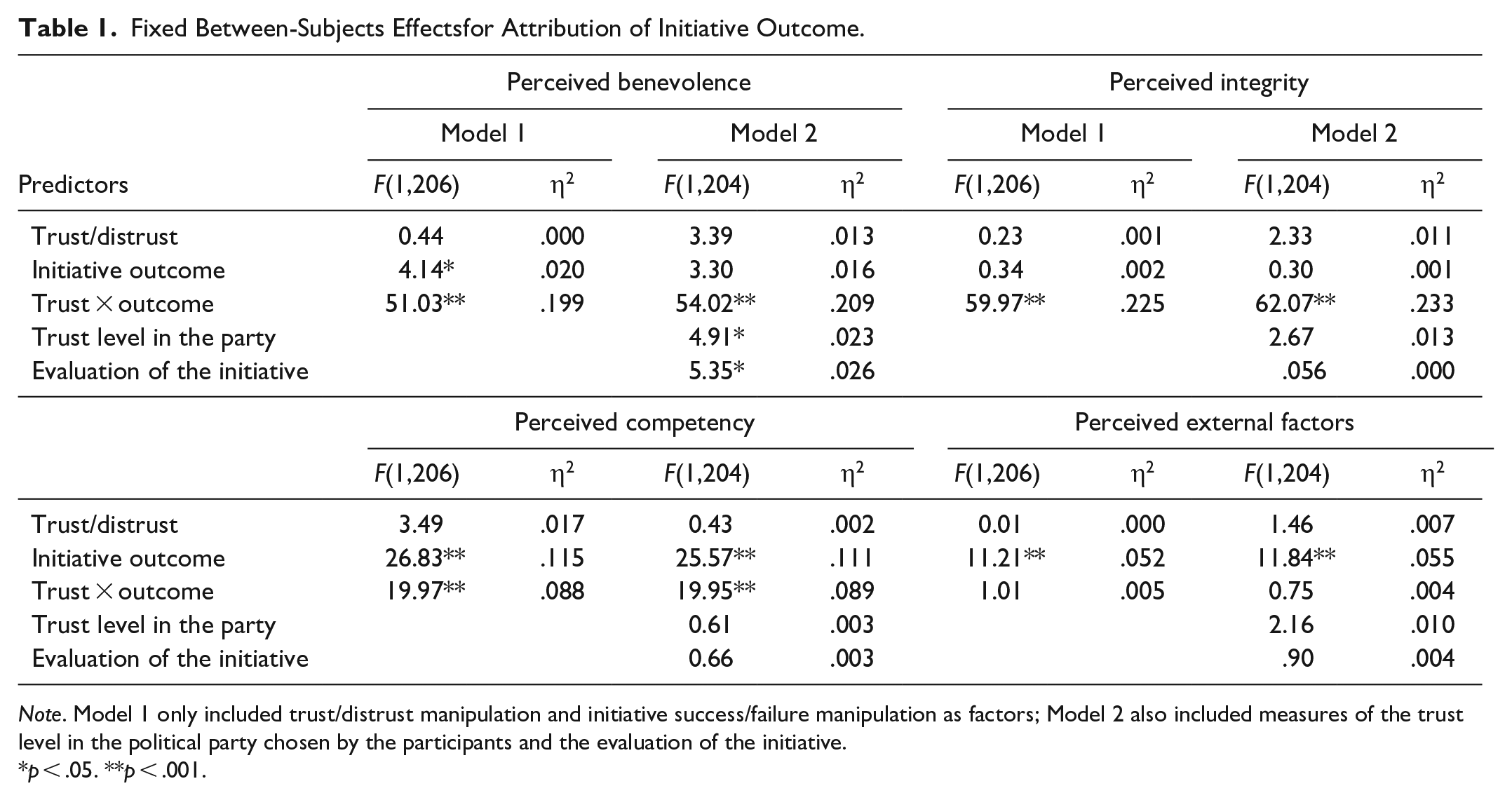
Note. Model 1 only included trust/distrust manipulation and initiative success/failure manipulation as factors; Model 2 also included measures of the trust level in the political party chosen by the participants and the evaluation of the initiative.
*p < .05. **p < .001.
Discussion
We saw significant differences in perceived benevolence and integrity as an explanation for both success and failure of the initiative between trusted and distrusted groups. Also, we saw a similar difference in usage of perceived competence as an explanation for initiative’s success between trusted and distrusted groups. These results indicate that the participants showed the ultimate attribution error pattern when explaining the initiative outcome. Our findings provide an additional demonstration of how socio-psychological mechanisms, in this case, the mechanisms of intergroup attribution, play out in the context of political trust. Previous studies had shown evidence of partisan attribution, with policy success more often attributed to own political party and policy failures to opposing parties (Rico & Liñeira, 2018; Rudolph & Grant, 2002; Shtudiner et al., 2017; Tilley & Hobolt, 2011; Zell et al., 2021). The current study adds to this literature by demonstrating the same attributional pattern of the ultimate attribution error in a context where the in-group and out-group are defined by political trust and distrust. From the perspective of political psychology, these findings contribute to our understanding of how trust works as an evaluative heuristic, helping to categorize the social environment into in-group and out-group actors, prompting group-serving biases to appear in explanations of the successes and failures of those actors. At the same time, it should be noted that the authorship (trusted vs. distrusted party) of the policy initiative did not significantly affect the evaluation of that initiative per se, only the explanation of the outcome. This observation is in line with previous findings showing that economic considerations may play a significant role in evaluating policy initiatives (see Dimdins et al., 2019). From the respondent’s perspective, the content of the policy concerns the self; thus, the evaluation is based more on rational considerations and is less affected by trust in the author of the initiative, especially if the initiative’s costs are not high (Hetherington & Globetti, 2002). The evaluation of the outcome of the initiative, on the other hand, is more concerned with the initiative’s author; thus, trust in the initiative’s author is used as a criterion for formulating one’s judgment to a much greater extent. From the perspective of social psychology, our findings demonstrate the robustness of the group attribution bias, or the ultimate attribution error, adding another illustration to the rich observation base of this phenomenon (Hewstone, 1990).
However, three of our hypotheses were not fully supported, and these results require some additional discussion. First, there were no significant differences between trust and distrust conditions for rating the perceived lack of competence as an explanation for the failure of the initiative. One may argue that while competency is a critical trait for gaining trust, it is much less so with regard to retaining it. Contrary to benevolence and integrity as traits associated with high ethical or moral standards, competency is perceived simply as the ability to reach the set goals (Frazier et al., 2010). Thus, it may have a less evaluative dimension in an intergroup context, especially in a situation where a failure needs to be explained and a lack of competence is an obvious and feasible explanation.
Second, there were no significant differences between trust and distrust conditions for the perceived influence of external forces as an explanation for the success or failure of the initiative. Interestingly, both trusted and distrusted political parties had lower ratings for the perceived influence of external factors as explanations for the initiative’s success and higher ratings when explaining the initiative’s failure. It has been shown that attributing negatively evaluated behaviors of in-groups and positively evaluated behaviors of out-groups to external causes happens primarily to protect the self-esteem of the in-group where this group esteem is under threat, especially in situations of apparent intergroup conflict (Hewstone, 1990; Weber, 1994). One may argue that the context of the current study did not prompt a need for protective attributions, as the success of the fictitious initiative authored by a distrusted party, or a failure of the same initiative authored by a trusted one, did not pose a significant threat to the participants’ self-esteem. It should also be noted that the external factors mentioned in the survey were ambiguous, and the issue at hand might not have been significant for most respondents.
To control the contextual factors and individual differences, we conducted an additional analysis with the level of trust in the participants’ selected political party and the initiative’s evaluation as covariates. The results showed that these factors only played a minor role in perceived benevolence as an explanation for the initiative’s outcome and did not play any role for others. These results suggest that in our experiment, when the respondents gave their answers about reasons for the initiative’s success or failure, a simple, category-based evaluation happened—the reasoning is based on whether one trusts or distrusts the actor, and the degree of the trust and the evaluation of the initiative has little influence on the group attributions. This is in line with previous research, where trust serves as a heuristic for judgment (Rudolph, 2017).
Some practical implications of this study include the role of political trust in evaluating policy initiatives. Our findings illuminate the importance of social-psychological factors as an additional factor to an initiative’s objective success or failure. Therefore, in the case of political actors, explanatory communication has limited ability to influence individual perception regardless of one’s partisanship, particularly in a narrative of influence of external factors as drivers for the failure of one’s actions. If one seeks support from the public in a specific field or contain fallout from failed policy initiatives, the foundation of such public response likely lies in the long-term building of political trust, rather than situationally relevant discussion of factors contribution to specific policy outcomes.
There are some limitations and shortcomings of this study that need to be addressed. First, the student sample is not representative of the overall population. In further research, our results should be replicated with more diverse community samples and representative samples. Second, the initiative used as the stimulus material for our study was fictitious. Even though the issue was publicly discussed and relevant at the time of the experiment, the outcome evaluated by the participants was artificial. It should be noted, though, that there were a couple of benefits to this approach. First, although the fictitious initiative was of low personal significance to the respondents, it avoided strong preconceptions and attitudes that the participants might have held about more relevant, real-world examples. Second, our approach allowed us to manipulate the success versus failure of the initiative’s outcome, which would have been problematic with a genuine policy initiative, where the participants would have been likely to have preconceptions and judgments of the initiative’s success or failure. The third limitation is that the external factors as explanations for success/failure were measured with ambiguously formulated statements, which might have contributed to the observed lack of effects. As a limitation and note for further research, the order of measures of trust in a party and initiative’s importance was not randomized in the current study. This means that the evaluation of the policy initiative could be affected by the trust or distrust in the political party proposing the initiative. However, even if we might observe some carry-over effects from the trust measure to the initiative evaluation, there still was a sufficient variance among participants in the trusted and distrusted political party subgroups. Future studies should control for this possible effect by randomizing the order of trust and initiative evaluation measures. Lastly, the current study is limited to a specific culture and political context. In future research, studies in other countries and cultures could be used to better understand the manifestation of socio-psychological mechanisms in political judgments and cognitions, as the results may depend on the overall level of interpersonal and political trust in each society, cultural norms governing attributions, and specific social, economic, historical, and geographical contexts for the evaluation of specific policy initiatives and their outcomes.
Conclusions
To summarize, the present analysis adds to the literature of attributional pattern of the ultimate attribution error where political trust and distrust defines the in-group and out-group. These findings contribute to theoretical and practical observations of how trust can be viewed as an evaluative heuristic in political and social psychology fields. The most substantial evidence of ultimate attribution error was found for benevolence and integrity as underlying factors of trust; however, competence showed no significant differences between trust and distrust conditions in the case of the failed initiative. There were no significant differences for the perceived impact of external forces to explain the initiative’s success or failure, suggesting that the context of the current study did not prompt a need for protective attributions. However, the external factors might play a significant role if the initiative at hand would be seen as more important from the individual’s perspective.
Footnotes
Declaration of Conflicting Interests
The author(s) declared no potential conflicts of interest with respect to the research, authorship, and/or publication of this article.
Funding
The author(s) disclosed receipt of the following financial support for the research, authorship, and/or publication of this article: This research is funded by the Latvian Council of Science, project Developing and testing a psychological model of political trust, project No. lzp-2018/1-0402.
Ethical Approval
This study was approved by the University of Latvia, Faculty of Education, Psychology and Art Ethics Committee (approval no. 30-47/17).
