



Abstract
There have been many studies on spiritual leadership (SL) and its effects on organizational outcomes, ranging from commitment to organizational citizenship behaviors (OCBs). Precisely, researches regarding SL and OCB were conducted in different regions, cultures, and industries. These topics attracted a growing interest in the second half of the last decade. To clarify the SL–OCB relationship with regard to varied regions and industries, a meta-analysis was needed. Thus, the purpose of this study was to systematically analyze the quantitative studies exploring SL and OCB and to determine whether region, school, or other variables have any moderating effects on the link between SL and OCB. Upon a thorough analysis of the papers on the relationship between both SL and OCB in the literature, 43 studies met the search terms, but only 17 of them were included in this study. The results revealed a mean effect size of
Introduction
Throughout social transformations driven by technology and economic capital, “the being, spiritual, and inner life” of persons has become an intriguing topic in management circles. Benefiel (2003, p. 383), accordingly, states that the terms of spirituality and management, which were once thought to be incompatible, “have fallen in love.” Neal and Biberman (2003) reported a sudden increase in books, conferences, and workshops on spirituality in the workplace, starting around 1992. This increasing interest in people’s spirituality, as well as their inner life and inner motivation, has led to the formation of an academic field that specializes in spiritual leadership (SL; See, Fairholm, 1996; Fry, 2003). Thus, the organizational leadership literature demonstrated that researchers have studied more about sources of inner motivation apart from material incentives.
Extra roles, like working overtime without any expectation of reward, are known as organizational citizenship behaviors (OCBs; Organ, 1988). These behaviors are based on inner motivation and can be regarded as signs of spiritual development. The Hawthorne experiments made it possible to infer that there were other more human factors than workplace’s physical aspects (Aslan & Korkut, 2015; Baloğlu & Karadağ, 2009). In this aspect, a work environment that identifies people with their mind and soul and helps them find meaning in their work would create beneficial consequences to both the members and the organization (Belwalkar et al., 2018). Oh and Wang (2020), in their comprehensive analysis of SL studies, stated that they found OCB occurred within follower outcomes. These studies imply that creating more room for OCB in the workplace is possible with SL practices. SL-based practices help employees opt for voluntary behaviors that are good for themselves, their organization, and their coworkers.
The literature on the relationship between SL and OCB behavior has grown exponentially in the last decade following the studies of Chen and Yang (2012) as well as Madison and Kellermanns (2013). The increasing studies stated that OCB could be easily fostered under the leadership of spiritually minded leaders or workplace spirituality management (Kaya, 2015; Kazemipour et al., 2012). Both constructs have a statistically significant relationship that positively affects organizations and individuals (Bozkurt & Töremen, 2015). This relationship is what this study intended to reveal through a meta-analytic review of the related studies, along with a focus on regions and schools versus industry-related factors.
While several studies claim that SL and its dimensions are statistically significant predictors of OCB, from a school context (Çimen, 2016) to a manufacturing industry (Chen & Li, 2013), there has not been any study that examined the magnitude of the relationship between SL and OCB. Therefore, we explored the magnitude of the relationship between SL and OCB. Moreover, we included moderators of region and culture, as well as a school environment versus that of other industries to study their effect on the link between SL and OCB. As a result, this study is aimed at examining the relationship between SL and OCB based on existing studies, and whether region, culture, school, and industry have statistically significant effects on these variables. To achieve this goal, we defined (a) SL, (b) OCB, (c) the relationship between both terms, and (d) regional and sectoral (school versus industry) factors. This study is of paramount importance in that it will contribute significantly to the literature by explaining the hypotheses below.
SL
The search for new effective leadership models in the public arena has always been on the agenda (Fry, 2016). One of the latest searches which contributed to the proper understanding of leadership is a person’s spirit. Fairholm (1996, p. 11) defines spirit, the core notion of SL, as “the vital, energizing force or principle in the person, the core of self.” Fry (2003, p. 711) defines SL as “comprising the values, attitudes, and behaviors that are necessary to intrinsically motivate oneself and others to create a sense of spiritual survival through calling and membership.”
An SL model is based on and measured using dimensions of hope/faith, altruistic love, vision, calling/meaning, membership, organizational commitment, and productivity (Fry et al., 2007, p. 35). This type of leadership is summarized as faith in a clear, compelling vision that produces a sense of calling, thereby making a difference (Fry & Slocum, 2008). It outlines a vision to be achieved based on the leaders’ and employees’ hope, faith, conviction, trust, and action. SL is realized through a person’s inner life or spiritual practice in developing the attitudes, values, and behaviors that are “necessary to intrinsically motivate” himself or herself and others to attain spiritual well-being (Fry & Cohen, 2009). Thus, with the inner power of the concept of SL, leaders can encourage their followers to internalize their vision of the organization, increase their faith at work, foster their feeling of meaningful work, and improve their organizational commitment. Those changes could inspire positive behavior in employees, thereby enabling them to achieve their organizational goals (Khiabani et al., 2015).
Chen and Li (2013) focused on the fact that leadership is evolving into a more value-based approach. The labor force needs leaders with spiritual qualities who act as a strong source of motivation in the areas of self-development and authenticity, along with a universal value-based understanding. Spiritual leaders in organizations establish the need for mutual care and emphasize respectful and caring behaviors to make employees feel motivated through understanding and appreciation. They encourage such feelings by creating an organizational sense of membership (Chen & Yang, 2012).
Organizations need committed and motivated human resources (Gilani et al., 2016). SL is an effective way to strengthen them. While workers suffer from interpersonal alienation and exhaustion at work, their leaders face overwork and occupational burnout, often neglecting family and friends (Chen & Yang, 2012). The role of workers in such a sophisticated system (Phuong et al., 2018, p. 61) cannot be overemphasized. Hence, there is a need for leaders to give employees a sense of transcendence in the workplace with SL at work (Madison & Kellermanns, 2013).
OCB
People in organizations are oftentimes expected to assume extra roles, behaviors, and responsibilities for the betterment of their organization (Hunsaker, 2017). These roles may not be part of employees’ official duties and might be performed voluntarily to contribute to the organization’s success. These types of behaviors are generally analyzed in the literature under the term “organizational citizenship behavior.” OCB in the workplace is strengthened by socially received rewards (Rezaei et al., 2016), such as appreciation, getting others’ consent, and benevolence. In fact, employees might value OCBs more than extra financial rewards.
Organ (1988, p. 4) defines OCB as “individual behavior that is discretionary, not directly or explicitly recognized by the formal reward system, and that on the aggregate promotes the effective functioning of the organization.” When employees volunteer to take on additional work for their organization or job, even though it is not part of their responsibilities, their actions are classified as OCBs (Putra et al., 2019). In the most general sense, OCB can be defined as a group of appropriate actions or behaviors that employees take on for the benefit of the organization without any expectation of formal reward. OCBs promote collaboration, along with a focus on maintaining official organizational tasks efficiently (Hosseini & Nematllahi, 2017).
OCB can be mainly examined under two forms: OCBI (behaviors targeting individuals) and OCBO (behaviors targeting the organization). OCBI denotes the behaviors intended to help other individuals, while OCBO denotes the acts that primarily benefit the organization at a holistic level (Harper, 2015). Apart from these, OCB has five subdimensions, including altruism, courtesy, sportsmanship, conscientiousness (originally called generalized compliance), and civic virtue (Organ, 1988). Nafei (2018, p. 15), based on Organ’s study (1988, 1990), defines altruism as a behavior aimed at helping others in work-related tasks; courtesy as a behavior aimed at preventing the problems of working with others through consultation and advice. Sportsmanship portrays the behavior of an individual’s willingness to work without complaint; general compliance is defined as a behavior that includes the employee’s commitment and respect for the organization’s labor laws and rules; and civic virtue is a behavior that reflects the extent of the employee’s desire to integrate and contribute to the development of the organization. Under these dimensions, OCB can improve employee performance in the organization by lending a helping hand, showing kindness, sharing, respecting others, and the desire to contribute to the organization. According to Podsakoff et al. (2009), OCB may signal an employee’s commitment to the organization’s success.
The Relationship between SL and OCB
One crucial factor in fostering OCB is spirituality (Helmy & Wiwoho, 2016). SL mainly operates on one’s hope, faith, vision, inner life, and altruistic life (Fry, 2016). These factors could be said to support a person’s desire to work and sacrifice their time and effort for the wellbeing of the organization. Several studies support this supposition because SL has a positive and statistically significant relationship with OCB at varying degrees with correlation values from .285 (Phuong et al., 2018) to .524 (Bozkurt & Töremen, 2015), and .732 (Rezaei et al., 2016). When spiritual needs are fulfilled, employees are more likely to show OCB (Madison & Kellermanns, 2013).
SL is a type of value-based leadership (Hunsaker, 2017, p. 487). A value-based leader will keep the members of an organization together by allowing the voluntary performance of their tasks (Helmy & Wiwoho, 2016). SL has been found to have a statistically significant and positive relationship with OCB, among other variables at varying degrees (Allahverdi & Khodaie, 2018; Allameh et al., 2014; Arinnandya & Hukama, 2018; Bahrami & Harandi, 2019; Hunsaker, 2016; Jung & Lee, 2017; Kaya, 2015; Ke et al., 2014; Lee & Kwon, 2018; Moradzadeh et al., 2015; Nahruddin, 2019; Wu & Li, 2015). Raddanipour and Siadat (2013) mentioned leadership style as an essential factor in the formation of extra-role behaviors.
Spiritual leaders work by nourishing employees’ inner world to produce a higher intrinsic motivation for employees to exhibit better OCB within the organization (Sholikhah et al., 2019). In addition, Chen and Yang (2012) showed that spiritual leaders help employees experience meaningful work and give them a sense of membership at work as well as influence employees’ OCB. Yang et al. (2019) found SL to be positively related to team performance and team OCB through a climate of meaningfulness. Kaya (2015, p. 597) found positive results in teacher samples, stating that SL predicts all four dimensions of OCB, especially the dimension of civic virtue. There was found strong support for the relationship between SL, a spiritual survival bond, and OCBs (Madison & Kellermanns, 2013). Thus, SL could contribute to OCBs by helping employees recognize the meaning of their work, creating a common perspective, common values, and an increase in organizational commitment, participation, capability, and productivity. Our first hypothesis was therefore:
SL and OCB in Regional and Sectoral Studies
Existing studies as noted above have already displayed a positive relationship between SL and OCB from different contexts. Identifying the variables that moderate the SL–OCB relationship could contribute to our understanding of how SL is related to OCB. Studies conducted on the link between SL and OCB do not give comparative results concerning regions or work type; however, the relationship between SL and OCB was studied in several studies with regard to different sectors and regions. The sample groups included in the studies concerning the link between SL and OCB written in the last decade were mainly from schools and industries and were also scattered mainly around Far Eastern and Middle Eastern countries (See, Table 2). For example, while Wu and Li (2015) based their study on retail services industries in Taiwan, Çimen (2016) completed his SL and OCB study about teachers in Turkey. There are very few studies on the link between SL and OCB in a western context. Similarly, Oh and Wang (2020, p. 240) stated that while SL was originally introduced in the West and the United States, the phenomenon has captured more research attention in the eastern countries (e.g., China, South Korea, and Turkey).
The recent SL and OCB studies conducted in Asian countries and on teachers and industry groups have led us to ask if these factors may have statistically significant effects on the relationship between SL and OCB. That being said, Khiabani et al. (2015) also supported the fact that further studies on SL and OCB need to be conducted to determine its impact on other industries, regions, and cultures. Therefore, two moderators are taken and described below.
Regions and countries
SL is an emerging global construct that needs further exploration, testing, and validation in different cultural settings (Benefiel et al., 2014). Based on its national context with different cultural values, each country may perceive leadership differently. Hofstede (2001) mentions significant cultural differences between the United States and Asian countries, which include Taiwan, China, and others. Some societies emphasize a long-term perspective on situations, like the East Asian cultures, as well as the Eastern and Central European societies, while other societies take a more short-term outlook, such as the North American, Australian, Latin American, African, and Muslim-majority countries (Hofstede, 2011). In their study, Hofstede et al. (2010) present indexes of power distance, individualism, masculinity, uncertainty avoidance, long-term orientation, and indulgence for 93 countries. For example, while Turkey has 37 points in individualism, 66 points in power distance, and 46 points in long-term orientation; China has 20 points in individualism, 80 points in power distance, and 87 points in long-term orientation. Overall, this means Turkey, a Middle Eastern country, has more individualism, less collectivism, and lower levels of power distance or hierarchy perception and long-term orientation compared to China, a Far Eastern country. This finding compared with other country profiles in Hofstede et al.’s (2010) study led us to question if region or cultures can cause significant differences with regard to the relationship between SL and OCB.
Accordingly, Far Eastern countries seem to resonate more with spirituality and extra-role behaviors at work due to Confucian-centric philosophies (See, Hunsaker, 2016, 2017). Musick et al. (2000, p. 73) stated that there is more inclination toward spirituality in the modern world, which draws many of its beliefs and rituals from the religious traditions in the Far East. Aside from that, Yen and Niehoff (2004), in their study on Taiwanese employees, define these behaviors based on the cultural value of familism, which means they can provide help to coworkers as much as they do for their family members. Due to familism, it is natural to examine OCB inherently in a Far Eastern culture. These culture-based characteristics and differences among countries may lead to different perceptions and assumptions about SL and OCBs. Thus, in this study, we examined countries from different regions to see the difference between Far Eastern and Middle Eastern countries and to understand whether region or culture plays a significant role in the link between SL and OCB perceptions. To come up with this choice, we examined SL and OCB on a regional basis.
School versus other industries
The studies on the link between SL and OCB included samples from different industries and educational organizations than this study. For example, Hunsaker (2016, 2017), Chen and Yang (2012), Wu and Li (2015), Madison and Kellermanns (2013), and Phuong et al. (2018) conducted their studies on companies and different industries, while several writers like Bozkurt and Töremen (2015), Çimen (2016), Göçen and Kaya (2020), and Kaya (2015) completed their studies using both terms in schools with teacher samples. In fact, the studies examining the relationship between SL and OCB in the teacher samples in this study generally seem to have a high correlation mean value compared to that of other samples from companies, governmental bodies, and general industrial management (See, Table 2). Schools need teachers with a willingness to perform extra-role behavior to go beyond the call of duty; thus, OCB stands out as one of the most essential tasks for school principals to embed in school culture (Sholikhah et al., 2019).
Karadağ et al. (2020) state that the more SL perception of teachers increases, the higher their school culture perception. School culture is also strengthened by OCB as related behaviors stimulate performance, establish best practices, ease coordination, create group membership, and empower followers (Oğuz, 2010). Furthermore, a school management that pays attention to teachers’ transcendence, meaning, sense of team, and self-development within a spiritual approach will affect the organization positively (Göçen & Terzi, 2019) because teachers desire to have these experiences in their lives. This has led us to believe that schools may have significant effects on SL and OCB compared to nonschool contexts.
In line with these hypotheses, a meta-analysis study was performed.
Method
A meta-analysis (Glass, 1976) was conducted to meet the main research goal posed in the present study. Meta-analysis can be defined as the synthesis of quantitative studies focused on the same research question (Şen & Yıldırım, 2020). The studies that examined the relationship between SL and OCB were included in the meta-analysis for this study. Details of the meta-analysis procedure are presented below, following the guidelines recommended by PRISMA (Moher et al., 2009).
Literature Search
An extensive search was conducted in several databases and search engines, including Web of Science, EBSCOhost, ERIC, PsycINFO, MEDLINE, and Google Scholar. The search terms included combinations of “spiritual leadership” and “organizational citizenship behavior,” as well as “spiritual leadership” or “organizational citizenship behavior.” A search string was created ad hoc combining keywords with the use of the Boolean operators “AND” and “OR.” The search string was “spiritual leadership” OR/AND “organizational citizenship behavior.” The keywords and searches yielded 1,690 results in Google Scholar and lesser numbers in other databases (April 15, 2020). The Web of Science Core Collection produced 27 articles for the same word group. The search results included both target terms in any part of the study, including references. There was no time limit placed on the study. The term “spiritual leadership” got more recognition with Fairholm’s (1996) study and Fry’s (2003) theory of SL. It is a relatively new term compared to other terms, such as organizational commitment and extra-role behaviors. We examined all articles with these keywords in the title, abstract, or method. Table 1 shows all quantitative studies found with the target keywords in their title, abstract, or method section.
The Studies Including SL and OCB Keywords in Their Title, Abstract, or Method Section.

As Table 1 shows, there are 43 studies within the scope of this article; however, not all of them have the intended values for a meta-analysis or they are in a non-English format, which makes it difficult for us to find the required information. Only 17 of them were included in this study, which yielded 19 effect sizes (ESs). Chen and Yang (2012) and Chen and Li (2013) had two different samples in their studies and reported different correlation values for various groups in the same study.
Upon a thorough analysis of databases with these keywords, we checked all the references under each downloaded paper on SL and OCB as well. This check led us to find papers that were not in databases or downloadable and were sometimes in a non-English format (Tabatabei et al., 2014). The authors whose papers were not full text or lacked the statistical values required for meta-analysis were sent emails with requests for their full text and for intended information, such as sample size and r value (Bahrami & Harandi, 2019; Helmy & Wiwoho, 2016). Unfortunately, the authors did not notice the mails or did not reply with the needed information, which limited this study.
Inclusion/Exclusion Criteria
The first collection of data produced a total of 43 papers, but only 17 of them were included in this study based on the inclusion criteria:
Papers written only in English and Turkish.
Papers with Pearson correlation values (r).
Papers in the following forms: research articles, proceedings, and oral presentations.
The excluded papers (k = 26) as shown in Table 1 were either content in other languages, but had English abstracts (Allahverdi & Khodaie, 2018; Jung & Lee, 2017), without full text (Yaghoubi, 2015), or with full texts, but no intended values (Pio & Lengkong, 2020; Pio & Tampi, 2018; Sholikhah et al., 2019). We also found studies for SL and OCB with a qualitative approach (Bambale et al., 2011; Vandenberghe, 2011). The 17 studies included in the final data set are marked with an asterisk in the reference list as well.
Data Coding
A coding form was developed to determine the studies to be selected in the scope of the meta-analysis with inclusion criteria. The title of the studies and authors, their year of publication, the samples, the country, statistical values, and all the other information with added value were all entered into the coding form. Literature search and data collection were completed as shown in Figure 1. The researchers did the data coding using all these details. To cross-check papers regarding the link between SL and OCB, researchers examined the papers separately. Upon data collection with the keywords, both researchers compared their own findings and checked the cases that could have gone unnoticed.

PRISMA flowchart shows selection of included studies.
Rater reliability was calculated as .96 using a two-way (effects and raters) intraclass correlation coefficient (ICC). Cases of disagreement were discussed between the two raters until a full agreement was resolved for use in the final analysis. This meta-analysis study also investigates whether the link between SL and OCB is affected by potential moderators: regions (cultures) and industry regarding samples. In data coding, we grouped the moderators “Middle Eastern” and “Far Eastern” to categorize the regions, and “school” and “other industries” for the organizations in the samples.
The study consists of 17 papers that reported on studies carried out in China, Egypt, Indonesia, Iran, South Korea, Taiwan, Turkey, the United States, and Vietnam. Thus, we grouped countries as “Middle Eastern” (Egypt, Iran, and Turkey) and “Far Eastern” (South Korea, Taiwan, China, and Vietnam). This study excluded the United States sample because there was only one study from the West. Then, we categorized the organization of samples as “school” (k = 4), being the largest sample group in the meta-analysis, and “others” (general administration units, service, retailing, manufacturing, etc.). The reason for including countries and industries as moderators are explained in the moderators’ section above.
Calculation of ESs and Statistical Analysis
Since the relationship between SL and OCB was the main interest in this study, the Pearson product-moment correlation (r) was selected as the effct size (ES) in this meta-analysis. A closer assessment of the literature showed that most of the studies were correlational. Among those studies, there are two distinct kinds of methodologies applied: (a) bivariate correlations between SL and OCB; and (b) analyses including SL and OCB variables based on regression, path analysis, and structural equation models.
Since the relationship between SL and OCB is essentially affected by different factors in the model, regression coefficients from multiple regression, path, and SEM analyses do not directly show the relationship between SL and OCB. Along these lines, we constrained our quantitative meta-analysis to the studies which reported correlation values between SL and OCB. Since the distribution of the Pearson correlation coefficient (r) has some undesirable statistical properties (see Lipsey & Wilson, 2001), the r coefficients were converted into Fisher’s z scale (zr). All analyses were performed using Fisher’s transformed zr values (i.e., ES). The inverse of N – 1 was used as a variance of zr. All analyses were conducted using comprehensive meta-analysis (CMA) (Borenstein et al., 2005) software version 2. Results of the meta-analysis were converted back to Pearson correlation coefficients using the following equation:

All the interpretations were made based on r. When multiple ESs within a single study share a common sample, taking those ESs into the meta-analysis results in biased estimation due to violation of the statistical independence assumption. In this study, the mean of the multiple correlation values within each study was used as an ES index to avoid a dependency problem (Madison & Kellermanns, 2013). However, all the ESs were used in the meta-analysis when the multiple ESs within a single study do not share a common sample.
Fixed-effect and random effects models are two different model types commonly used in meta-analysis (Borenstein et al., 2009). It is assumed that each study in the meta-analysis has the same population ES under the fixed-effect model. Thus, ESs calculated from the studies vary from each other due to sampling errors. However, it is assumed that the population ES varies across all the studies under the random effects model. The difference between the true ESs of each study is another source of variation under the random effects model. The random effects model is considered to be a more realistic approach in the social sciences (Borenstein et al., 2009; Field & Gillett, 2010). Thus, the random-effects model was considered in this study. However, the fixed-effect model was also estimated to investigate the heterogeneity of all included studies. For the heterogeneity investigation, Q-statistics and I2 (Higgins et al., 2003) values were computed using the information provided by the fixed-effect model. In addition, subgroup analyses were also conducted in cases of heterogeneity. We examined the statistically significant effects of categorical moderators using an analog to the ANOVA (Lipsey & Wilson, 2001) method.
The Assessment of Potential Publication Bias
Most of the published studies reported significant and large ESs rather than nonsignificant and low ESs. The inclusion of those studies into a meta-analysis can lead to a problem called “publication bias.” As our meta-analysis included published studies, the possibility of publication bias was investigated with the following analyses: (a) a funnel plot based on correlations and their standard errors, (b) fail-safe N values developed by Rosenthal (1979) and Orwin (1983), (c) publication bias tests based on relationship between ESs and sample sizes (Begg & Mazumdar, 1994; Egger et al., 1997), (d) the trim and fill method (Duval & Tweedie, 2000). Publication bias is detected in different ways with these methods. For example, an asymmetric shape of the funnel plot due to missing studies and a smaller N computed by fail-safe N statistics can indicate possible publication bias. Significant p values produced from two publication bias tests can also be considered an indicator of publication bias. The methods mentioned so far can be used to detect publication bias. However, the trim and fill method can be used to correct publication bias by removing the asymmetry in the funnel plot. In this study, the trim and fill method was used to estimate the adjusted mean ES in case of publication bias.
Results
Overview
The meta-analysis consisted of 17 studies, including 19 independent samples that reported correlations between SL and OCB. Table 2 presents sample sizes, measurements used, originally reported statistics, ESs, country, and business-type information for all the studies. The measurements generally used in sample studies are mostly based on or adapted from the works of Fry (2003) and Fry et al. (2005, 2007) with items related to vision, hope and faith, altruistic love, meaning and calling, productivity, organizational commitment, as well as membership. We used the works of Organ (1988), Podsakoff and MacKenzie (1989) with items related to altruism, courtesy, sportsmanship, civic virtue, and conscientiousness, as well as the works of Williams and Anderson (1991) and Lee and Allen (2002) with items related to the individual (OCBI) and the organization (OCBO).
Descriptive Characteristics for all Included Studies in This Study.
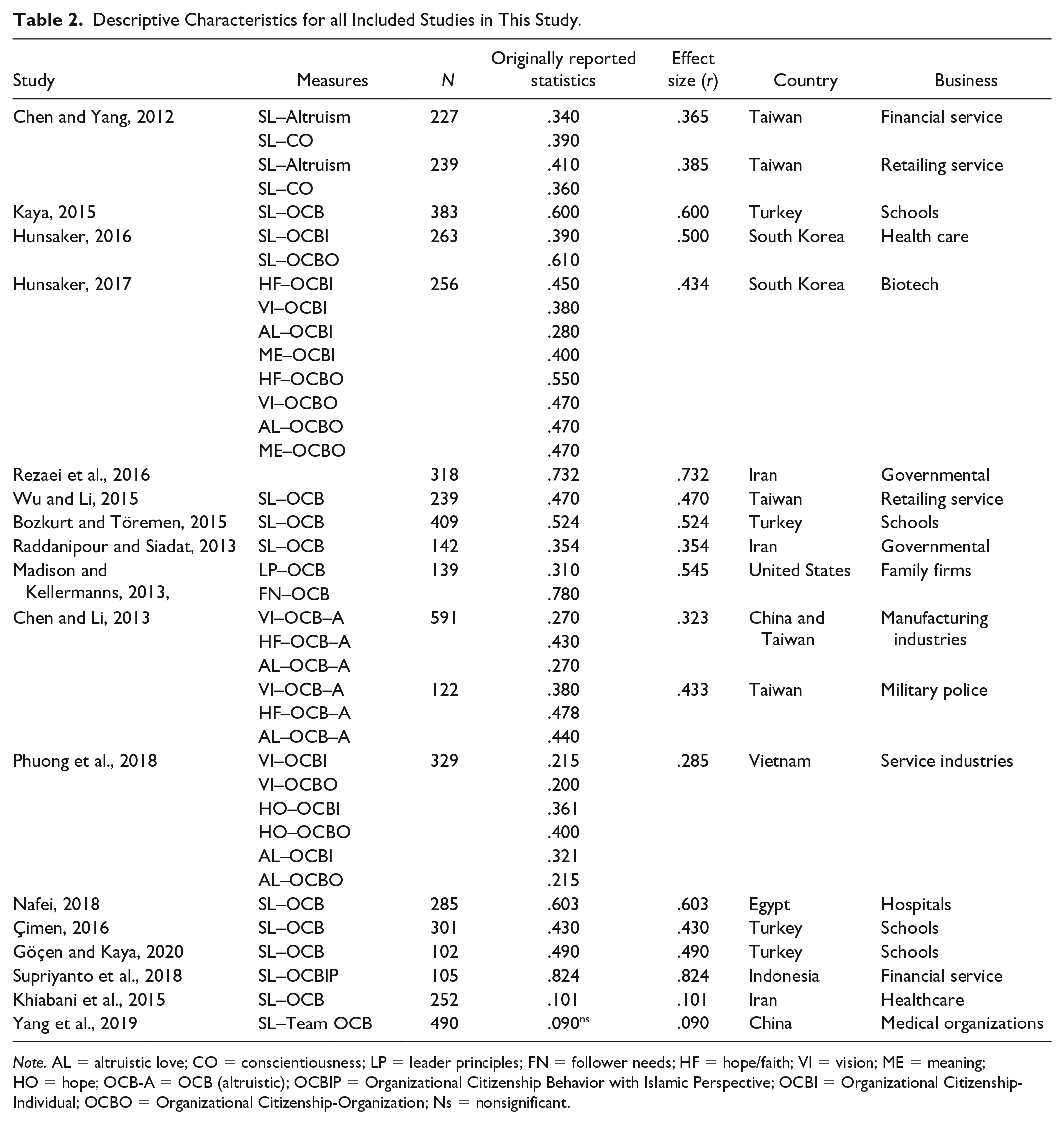
Note. AL = altruistic love; CO = conscientiousness; LP = leader principles; FN = follower needs; HF = hope/faith; VI = vision; ME = meaning; HO = hope; OCB-A = OCB (altruistic); OCBIP = Organizational Citizenship Behavior with Islamic Perspective; OCBI = Organizational Citizenship-Individual; OCBO = Organizational Citizenship-Organization; Ns = nonsignificant.
A total of 19 ESs from 17 studies were available for the analyses. The 17 studies included in the meta-analysis were published between 2012 and 2020. The overall sample size involved 5,192 participants, whereas the sample sizes of the primary studies varied from 102 to 591. The primary studies were conducted in nine countries: China (k = 2), Egypt (k = 1), Indonesia (k = 1), Iran (k = 3), South Korea (k = 2), Taiwan (k = 5), Turkey (k = 4), the United States (k = 1), and Vietnam (k = 1). The ES estimates (rs) ranged from .09 to .824 with a mean value of .447 and a standard deviation of .183. A stem-and-leaf plot of 19 ESs to two decimal places can be seen in Figure 2.

Stem-and-leaf plot of all effect sizes (rs).
Positive ESs indicate a positive direct relationship between SL and OCB. The forest plot with correlation coefficients for all included studies is displayed in Figure 3. The correlations for the relationship between SL and OCB were also statistically significant and positive in all studies except for one (Yang et al., 2019).

Forest plot for all included studies.
Analysis of ESs
Field and Gillett (2010) recommended that the random effects model should be considered for meta-analyses in social sciences. Therefore, we began our analyses by estimating the mean ES using a random effects model. The results of the basic meta-analysis and heterogeneity analyses are presented in Table 3. As shown in Table 3, the overall ES of the relationship between SL and OCB was estimated as
Meta-Analytic Results of Correlation Values.

Publication Bias
This meta-analysis incorporates 19 ESs from 17 studies that yield a z value of 33.998 and a corresponding two-tailed p value of <.001 for the classical fail-safe N analysis. The fail-safe N was found to be 5,699. This result means that we would need to locate and include 5,699 “null” studies for the combined two-tailed p value to exceed .050. That is, there is a need for approximately 300 missing studies for every observed study to nullify the effect.
The Orwin fail-safe N was found to be 168. This means that we would need to locate 168 studies with mean Fisher’s z of 0 in missing studies to bring the combined correlation under .048. Figure 4 shows the funnel plot created for this meta-analysis. A funnel plot is another figure that can be used for publication bias assessment. As shown in Figure 4, the studies are not symmetrically distributed around the mean ES. This result indicates publication bias. However, the funnel plot method is criticized due to its subjective interpretation. In addition, two statistical tests (i.e., Begg & Mazumdar’s rank correlation test and Egger’s test) were conducted for publication bias assessment. For the rank correlation test, Kendall’s tau is 0.117 with one-tailed p = .484. For Egger’s test, the intercept (b0) is 5.263, with a 95% confidence interval from −2.874 to 13.400, and a one-tailed p value of .095. Nonsignificant p values produced from these two tests indicated that publication bias is absent.

Funnel plot examining the relationship between ES (zr) and standard error in studies.
Finally, Duval and Tweedie’s trim and fill method was used to see if any missing study would be inputted. Under the random effects model, Duval and Tweedie’s trim and fill analyses for all correlations between the OCB and SL variables suggested that five missing studies are likely to fall on the right side of the mean ES. Thus, five studies (see Figure 4) were imputed, and the combined effect was recomputed. Using the trim and fill method, the adjusted mean estimate was .539 (95% CI = [.443, .622]) under the random effects model. Overall, we can conclude that publication bias is not a concern in this study.
Subgroup Analyses
The significance of moderating variables was assessed using the analog to the ANOVA method for all examined outcomes. Comparisons were performed, examining (a) the difference between Middle Eastern countries and Far Eastern countries and (b) the difference between schools and other institutions in terms of the relationship between SL and OCB. The statistical significance of two variables (region and institution type) was tested at the p < .05 level for analog to the ANOVA analyses. Countries were categorized as Middle Eastern versus Far Eastern to create a regional variable. Middle Eastern countries included Egypt (k = 1), Iran (k = 2), and Turkey (k = 4), whereas Far Eastern countries included China (k = 2), Indonesia (k = 1), South Korea (k = 2), Taiwan (k = 5), and Vietnam (k = 1). The United States was not included for the analog to the ANOVA analysis of the region variable, as it was the only western country in the study, and it did not have matching country to be considered a group. Supriyanto et al.’s (2018) study from Indonesia was not included in this subgroup analysis because their study was done according to organizational citizenship behavior Islamic philosophy (OCBIP) and was different from other studies in the Far Eastern sample. The cultural differences in the same region may have different effects on the regional result. The mean ESs for each country are presented in Table 4.
Mean Effect Sizes for Eastern Countries Based on Random Effects Model.

An analog to the ANOVA was also used to examine the heterogeneity of ES across categories of the regional variable (Far East and Middle East) using the Q-statistic (a chi-square test) under both fixed- and mixed-effect models. In the present analysis, region was used as the grouping factor (Far East and Middle East), and the ES served as the dependent variable. Based on an analog to the ANOVA results from the mixed effects model, the mean ES was estimated to be .427 (95% CI = [.298, .541]) for the studies conducted in Far Eastern countries (Z = 5.980, p < .001). Clearly, the relationship between SL and OCB is significantly different within studies conducted in Far Eastern countries. The mean ES was .500 (95% CI = [.358, .619]) for the studies conducted in Middle Eastern countries (Z = 6.192, p < .001) under the mixed-effect model. It is also clear that the relationship between SL and OCB is significantly different within studies conducted in Middle Eastern countries. The test to compare the two ESs (.427 vs. .500) yields a Q value of 0.628 with 1 df for the total and a corresponding p value of .428, which indicates no statistically significant difference between Far Eastern and Middle Eastern countries. The relationship between SL and OCB by region indicated that the mean ESs for Far Eastern countries were not significantly lower than those for Middle Eastern countries (p > .05). Thus, we can conclude that the variability between ESs cannot be attributed to the moderating effect of the region under the mixed-effect model. These results did not support the second hypothesis that the SL/OCB association would be significantly stronger in Far Eastern–based studies compared to Middle Eastern studies. However, a significant p value (<.001) for the total between obtained from the fixed-effect model indicated that the relationship between SL and OCB for Far Eastern countries (.358) was significantly lower than those for Middle Eastern countries (.523).
In the present analysis, industry type was used as the grouping factor (school and other industries), and the ES served as the dependent variable. The Q statistics for the “within-group” study were 270.556 with a p value of <.001, which indicates statistically significant heterogeneity. Between-group variation was statistically significant, Q(1) = 19.731, p < .001, suggesting that the relationship between SL and OCB was heterogeneous between these two subgroups under the fixed-effect model. For studies conducted in schools, the mean ES was estimated to be .518 with a confidence interval of .437 to .591, a Z value of 10.667 and a corresponding p value of <.001. Clearly, the relationship between SL and OCB is significantly different within studies conducted in schools. For studies in other institutions, the mean ES is .454 with a confidence interval of .333 to .560, a Z value of 6.675, and a corresponding p value of <.001. It is also clear that the relationship between SL and OCB is significantly different in studies conducted in other institutions. For the test comparing the two ESs (.518 vs. .454), the mixed-effect model yields a Q value of 0.855 with 1 df and a corresponding p value of .355, which indicates no statistically significant difference between school and other institutions in terms of the relationship between SL and OCB. Thus, we can conclude that the variability between the ESs cannot be attributed to the moderating effect of the school variable. These results did not support the third hypothesis that the SL/OCB association would be significantly larger in teacher samples than other industry samples.
Discussion
Several studies confirmed the positive link between SL and OCB, but there has not been any meta-analysis to show the overall ES for SL and OCB. Thus, this study was performed on a set of 17 studies to examine the magnitude of the relationship between SL and OCB and included moderators of regions (culture) and schools versus other industries to see their effect on the link between SL and OCB.
According to the analysis in the study, the first hypothesis—SL is significantly and positively related to OCBs—is supported as there exists an overall medium-level, positively significant relationship between SL and OCB (n = 5,192;
It is known that due to measurement error in one or both variables of interest, the observed correlation coefficients tend to be attenuated. Thus, each case in the meta-analysis has different internal consistency estimates for the constructs in question, making the correlation coefficients among studies unequally representative of the actual effect. A correction for attenuation could be applied if we knew the measurement reliabilities of the variable. However, most of the studies have not reported reliability estimates of the observed variables. Thus, we used Hunter and Schmidt’s (1994) methods of meta-analysis valuable to correct the ESs for measurement error. In this study, the Hunter and Schmidt’s correction was applied using an R package called metafor (Viechtbauer &Viechtbauer, 2015). This procedure was applied by generating some reasonable measurement reliability values for the SL and CB variables. Random values were drawn from a uniform distribution with bounds of .60 and .85 for the SL and CB variables. The correction for attenuation was applied to the observed correlations. Based on these analyses, the corrected mean ES was found to be .577, 95% CI = [0.449, 0.705]. The mean ES was also found to be statistically significant (p < .05).
The second hypothesis of our study—the SL/OCB association would be significantly stronger in Far Eastern–based studies compared to Middle Eastern studies—was not supported. Some studies claimed cultures varied in several dimensions, and it is possible to measure the position of different collectives, like countries, along these dimensions (Jackson et al., 2013). We aimed to determine whether the Far East region and the cultural differences might help to moderate the relationship between SL and OCB because we expected that the Far Eastern culture, which is known as a source of spirituality with its rituals from its religious traditions, could explain the relationship more. Far Eastern countries seem to resonate more with spirituality and extra-role behaviors at work due to Confucian-centric philosophies. For example, Hunsaker (2016) found that the Confucian mind-set, comprised of values such as empathy, conscientiousness, respect, and conviction, strongly influences the relationship between SL and OCBO/OCBI. Going further into this topic, Steiner (1983) expressed the relationship between the East and West symbolically by saying that light comes from the East, and spiritual life comes from that source as well. However, the region category produced no significant difference in favor of the second hypothesis in the study. One person’s perception of “spirituality” or “extra-role behaviors” seem to differ from others’ in many aspects, such as personal experiences, culture, group factors, national differences, politics, and philosophies; thus, the category of region seems to be too broad to signify a significant difference for any culture in the study.
When the Chen and Li’s (2013) study on the link between SL and OCB was examined, the correlation value was stated to be at a low level (r = .32) for the mixed group composed of the Chinese and Taiwanese groups. According to Hofstede et al. (2010), China is a more collectivist nation, with a higher index of power distance and masculinity and a lower level of uncertainty avoidance compared to other study samples. To search for connections between Hofstede’s dimensions and the link between SL and OCBs, China, with the abovementioned features and compared to other study samples, might prove to be a fruitful subject for further research. Further studies are needed to test whether these indexes may directly or indirectly affect the link between SL and OCB.
A third major goal of our study was to determine whether schools versus other industries might serve as a variable to moderate the relationship between SL and OCB. SL could be a natural type of leadership in learning environments where value-based behaviors intrinsic to OCB are taught. A spiritual teacher or principal as a leader intrinsically is expected to motivate students, colleagues, and other stakeholders for better role behaviors that ultimately benefit organizations and individuals alike and set role models for OCB in the school. However, the third hypothesis—that the SL/OCB association will be significantly larger in teacher samples than other industry samples—was not supported. The analysis for determining the moderating effect of schools on both terms has not produced significant results. This result reveals that the distinctiveness of schools, compared to other sectors, such as health, biotech, and governmental bodies, does not play any role in the link or relationship between SL and OCBs. However, the studies done on teachers’ samples all displayed higher levels of positive results for both concepts in terms of correlation and regression outputs. Interestingly, all teacher-sampled studies (k = 4) were seen to be conducted in Turkey with a total sample of n = 1,195, each study producing a correlation value between r = .60 and r = .43. Bozkurt and Töremen (2015), Çimen (2016), Göçen and Kaya (2020), and Kaya (2015) all found a statistically significant relationship between SL and OCB in teacher samples. Bozkurt and Töremen (2015), specifying the importance and effect of SL and OCB, suggested that school principals set up a motivating, enabling atmosphere so that teachers are encouraged to model extra-role behaviors, and thus, schools are made more effective and efficient. Despite the high correlations between SL and OCB in teacher samples, the study has not produced a statistically significant difference in favor of our third hypothesis.
Finally, this review has certain limitations. We used search terms (e.g., SL and OCB) to identify the studies relevant to the topic of our interest. While our search was comprehensive, we may have missed some studies in the non-English and Turkish contexts due to search criteria. We may have missed studies which might not directly include the searched terms (e.g., SL and OCBs), but other phrases such as extra-role behaviors, faith, and spirituality at work, under which our target variables may have been analyzed.
