




Abstract
A considerable amount of literature has concluded that employee relations has always been overlooked in the area of crisis communication. Therefore, the aim of this study is to investigate the antecedents of internal crisis communication (ICC) that include safety culture, supportive environment, social media usage, management commitment and the consequences on the other hand comprising affective commitment, perceived organizational support, and employee crisis perception in the context of high risk industry in Malaysia. Past literature are used to develop a self-administered questionnaire and in-depth interview, was conducted for 277 employees of oil and gas industry while structural equation model (SEM) was employed as the tool of the analysis technique. The results show that safety culture, supportive environment, and management commitment have positive effects on internal crisis communication but with no effect on social media usage. Also, ICC is reported to correlate positively with affective commitment, perceived organizational support, and employee crisis perception. The model is developed on the basis of Situational Crisis Communication Theory and Sense-making Theory as the underpinning theories.
Keywords
Introduction
According to Johansen et al. (2012), crisis management scholars have primarily devoted their attention to crisis communication and its external aspect in the last decade. However, the internal stakeholders (employees) are equally important as they are the power unit of an organization. The employees in fact are acknowledged as the human capital which is an organization’s most valuable asset. A considerable amount of literature has concluded that, internal crisis communication is yet to be explored in the area of crisis communication (Frandsen & Johansen, 2011; Heide, 2013; Heide & Simonsson, 2015; Johansen et al., 2012; Taylor, 2010). Therefore, to fully understand a crisis situation, researchers must first comprehend internal process and its relationship with an organization (Johansen et al., 2012; Mohamad et al., 2018; Taylor, 2010).
Scholars of crisis communication have posited that, how an organization handles and responds to a crisis is influenced by the internal leadership, relations, and processes (Hiede, 2013). For instance, Frandsen and Johansen (2011) mentioned that organizational factors such as social media usage, safety culture, supportive environment, and management commitment can have both negative and positive effects on ICC. In a context of an organization, introducing a social media is always related to expectation of change in terms of production and structure of the organization, better cooperation between the workers, flatter hierarchy, and increase in productivity (Orlikowski et al., 1999). As a matter of time, resisting social media is tantamount to backwardness and could endanger the survival of the organization; lack of presence on social media is likely equal to being invisible in reality (Merkelsen, Möllerström & von Platen, 2015). While a number of studies have examined external crisis communication and social media (Schultz et al., 2011), there is paucity of studies about the relationship between ICC and social media in the context of high risk industry which this study intends to investigate.
Furthermore, recent evidence suggests that safety culture in high risk industry is also important to internal crisis communication. In fact, how an organization handles or responds to a crisis is defined by the functions of its internal processes, relations, sense-making, and sense-giving processes, safety culture, and leadership (Bakar et al., 2016; Hiede, 2013). As noted by scholars, leadership is a collective and dynamic process in crisis situation that demands for sense-making (Wooten & James, 2008). This shows that a leader can play a big role in enacting safety practice in an organization. In addition, the role of leader is important in creating a supportive environment and management commitment for the internal communication practice in an organization. The challenges of crisis management leadership have been highlighted by Jamal and Bakar (2015). The study tested the character and quality of leaders and their communication skills. Thus, in the context of ICC, safety culture, supportive environment, and management commitment have become important variables to organizational leadership. Hence, the need for empirical analysis to further test the relationships.
With the incorporation of these antecedents (i.e., safety culture, supportive environment, social media perceived usefulness, and management commitment), extant literature has shown that internal crisis communication has an effect on organizational performance, resulting to outcomes such as affective commitment, perceived organizational support and employee crisis perception. Relevant literature also highlighted that internal crisis communication is a well-established factor that exerts a significant influence on affective commitment in organizations (Frandsen & Johansen, 2011; Johansen et al., 2012; Mazzei & Ravazzani, 2015). Commitment denotes the sense of being bound emotionally or intellectually, which can include the relationship of an individual with another group, organization, or other individuals to perform some sets of action (Eisenberger et al., 1986). Therefore, taking a look at this relationship will provide new evidence within the literature on internal crisis communication.
Moreover, it can be argued that understanding perceived organizational supports (Korn & Einwiller, 2013) and employee crisis perception (Lee, 2019b) as consequences is crucial. For example, when employees perceive that their wellbeing is being taken care of and their contributions are valued, they are less likely to leave their responsibilities. Therefore, quality internal crisis communication can create a sense of support to the employees during a crisis. After the global financial crisis in 2008 which affected virtually every business domain in the world, the demand for internal crisis communication became serious which forced companies to face downsizing, consumption deficit, and spread of uncertainty and trust reduction (Mazzei & Ravazzani, 2015). Therefore, investigating the consequences (perceived organizational support and employee crisis perception) of ICC in this study is in line with previous studies (Frandsen & Johansen, 2011; Heide, 2013; Heide & Simonsson, 2015; Johansen et al., 2012; Taylor, 2010).
Meanwhile, from a methodological perspective, a thematic analysis conducted by An and Cheng (2010) indicates that studies on crisis communication from 1996 to 2006 are largely using qualitative research method. This implies that using quantitative research is relatively low. In particular, scholars have often indicated that it has become visible that researches on crisis communication are dominated with case studies that are using in-depth interview or content analysis (Coombs, 2007, 2010; Heide, 2013; Jaques, 2007; Schultz et al., 2011). Similarly, Ulmer (2001) argued that Situational crisis communication theory (SCCT) has moved the study of crisis communication beyond the case study approach to empirical based research. To fill this gap, the present study utilizes mix-method approach with more focus on the quantitative parts.
In addition, the few empirical studies on internal crisis communication found in extant literature have been conducted predominantly in Europe. For instance, Frandsen and Johansen (2011) offered an integrative framework for investigating ICC; Heide and Simonsson (2015) investigated the role of practitioners in relations to internal aspect of crisis; Ravazzani (2016) explore internal crisis communication in a multicultural setting; and Strandberg and Vigsø (2016) explore employee sense-making during crisis. Moreover, the aforementioned studies are largely qualitative and conceptual researches but none is found in the context of Asia, specifically in Malaysia. Hence, internal crisis communication deserves further investigation in Malaysia because the findings of the previous studies may not be generalizable to the Malaysia context due to industry, cultural and contextual differences.
In order to complement the present knowledge and research, the purpose of ICC has been given meaningful effort to examine the concept. In this study, there are two main research objectives. First, the study aims to examine empirically the framework within an organization setting in order to easily examine the dimensions of ICC. This comprises evaluation and operationalization of some assumptions and reassessment of the dimensionality of the constructs connected to the findings from the existing literature. Meanwhile, to develop a model that can give explanation on the antecedents and consequences of ICC is the second objective of this study. Therefore, this study proposed to examine and identify the effect of social media usage, safety culture, supportive environment, and management commitment as the key antecedents to ICC. The study also seeks to explain the influence of ICC on organizational performance in Malaysia high risk industry.
Literature Review
The theory of situational crisis communication provides underpinnings to support the relationship between antecedents (safety culture, supportive environment, social media usage, and management commitment) with consequences (affective commitment, perceived organizational support, employee crisis perception) and internal crisis communication. The theory assumes that crisis is a negative occurrence that cause stakeholders to have attribution about crisis responsibilities and affecting how they interact with the organizations (Coombs, 2007; Coombs & Holladay, 2002; Holdsworth, 2014). The interactions with the organizational members are determined by the organizational culture, two-way communication, supportive environment, and manager’s commitments. This is in line with the study of Coombs (2001) that demonstrated a way forward and how crucial stakeholders need to protect themselves before shifting attention to reputational concerns. Coombs (2007) concluded that behavioral is considered negative when a person is responsibly judged and leads to anger. In the same vein, behavioral response is positive when a person is responsibly judged and leads to empathy (Weiner, 2006).
The behavioral outcomes that were not studied within the realm of this theory are affective commitment and perceived organizational support which can in other way be manifested by internal stakeholders in a form of positive response. To mitigate crisis perceptions and attributions, SCCT offers crisis response strategies. Coombs (2004) argues that SCCT focuses on the application of communication in form of strategic crisis response to preserve and protect organizations most cherish reputation. Moreover, Coombs and Holladay (2005) asserted that how organization manages pre- and post-crisis phase affects the effectiveness of the crisis response, which is related to internal organizational activities such as prevention, preparation, learning from errors, and successes. Also, other internal factors like supportive environment, effective use of two-way communication using digital platforms, and management commitment can elicit crisis scanning and prevention spirit in employees. Additionally, the swift nature of social media limits the time frame to think of the necessary crisis response; as social media presents several opportunities to foresee incoming crisis, time can be won in the preparation phase (Holdsworth et al., 2014). In particular, investigating social media usage from internal stakeholder’s perspective can offer new insight on crisis responses application as identified by SCCT. It is predicted that this theory would provide a support for the relationship between the antecedents and consequences of internal crisis communication in the current research context.
Internal Crisis Communication
According to Kent (2010), the necessities to change the paradigm of communication to media, immediate problems of an organization, and other areas which include different stakeholders have been documented by several studies. Importantly, crises do not occur as out-of-the-way events but as its formation and management that are connected closely to internal communication practice (Heide & Simonsson, 2015; Taylor, 2010). For that reason, internal communication is considered to serve as a knob that assists in positive reactions, minimizes damage, crisis prevention and ultimately yields positive results (Adamu et al., 2016; Mazzei et al., 2012; Lee, 2020; Mazzei & Ravazzani, 2015). Therefore, ICC is defined as “a connection among managers and employees through communication, in an organization before, during and after a crisis” (Johansen et al., 2012).
Similarly, it is high time organizations started focusing on the internalized dimensions of crisis communication as it is visible that the area is still currently under-studied. Notably, ICC comprises dealing with the importance of internal stakeholders and their morale has increased for taking further action and restore the situation (Hiede, 2013). Additionally, Palm (2016) reported that employees are the people who hold the highest vulnerability if the organization fails or survives. In some cases, communication failure during crisis can be as a result of not recognizing the employees as important stakeholders (Ecklebe & Löffler, 2021; Ravazzani, 2016; Xu & Li, 2013). Therefore, a distinction must be made between the internal and external crisis communication (Strandberg & Vigsø, 2016).
Resilience and mindfulness of organizational crisis, as well as the ability of internal stakeholders to recover from the crisis and returned to working are examined by other studies relevant to internal crisis communication (Weick & Sutcliffe, 2001). High reliability organizations have been classified as organizations committed to resilience, such as organizations engaging in anticipate activities, which include learning from failure (Weick & Sutcliffe, 2001). In general, the concept of resilience means the ability of an organization to continue to operate under stress or recover from a major mishap. Therefore, such organization trains their internal stakeholders on how to manage trauma which is as a result of crisis. Past studies also offered that internal stakeholders have behavioural, affective, and cognitive reactions to crises (Mazzei et al., 2012; Myer, Conte & Peterson, 2007). When an organization is engulfed in crisis, it is normal for internal stakeholders to have the feeling of fear, anger, and sadness. More specifically, the psychological aspect of internal stakeholders has to be examined as highlighted by the above studies on internal crisis communication.
Moreover, internal stakeholders must develop a capacity for resilience to manage and overcome feeling and emotion (Mitroff, 2005). According to Mazzei and Ravazzani (2015), effective internal communication with employees during the organizational crisis can minimize the severity of the crisis. Awareness, collaboration, and understanding of situation during crises are influenced by the expectation and commitment of the employees which internal communication should support and enrich (Mazzei & Ravazzani, 2013). Mazzie and Ravazzani (2015) on crisis maintain that internal communication can be a failure or success of any crisis situation or major change but with the same logical rigor that is given to external crisis communication.
Antecedents of ICC
Safety culture
According to Frandsen and Johansen (2011), one of the important and effective factors on internal crisis communication as recognized by researchers is safety culture. Researchers have demonstrated how safety culture is a sub-division of organizational culture with an emotional effect on the attitudes and behavior of the employee in regards to ongoing health and safety performance in their organization for the past two decades (Cooper, 2000). It is the shared and learned experience, meaning of work and safety, and interpretation that direct the action of the employees to accident, risk, and prevention (Richter & Koch, 2004). As a result of breakdown in the organizational safety culture, the concept of safety culture was originally given attention after the nuclear disaster of Chernobyl in 1986 (Glendon & Stanton, 2000). The concept has also been widely adopted as a method to understand an accident in various sectors including oil and gas, aviation, and healthcare (Waterson et al., 2019). Safety is a property, rather than a component of a property which must be contained at the system level rather than as a component (Leverson et al., 2009). In order to establish culture and safety outcomes, employees have been subjected to various studies on organizational safety culture (Nævestad et al., 2019).
In several studies, the connection between internal crisis and safety culture has been highlighted. Turner et al. (1989) for instance, demonstrated that, safety culture is related to social and technical practices, beliefs, norms, and attitudes that are related to alleviating the exposure of external and internal stakeholders to situations well-thought out to be risky. Also, Frandsen and Johansen (2011) demonstrated that there is a strong relationship between safety culture and organizational capacity to address a crisis. Another reflection by a think tank suggested that safety culture is about the views of the internal stakeholders of an organization on the shared accident, ill health, and risk (CBI, 1991). Communication efficiency will be improved by achieving all these set of principles by organizational employees before and during a crisis situation. Therefore, the following hypothesis is proposed:
Hypothesis 1: Safety culture is positively associated with ICC.
Supportive environment
According to Okhomina (2010), previous studies have shown that environmental factors such as supportive environment have significant effect on the psychological behavior of the employees. Taylor (2008) added that organization with the ability to create supportive relationship at work becomes highly productive; this relationship leads to creation of committed employees and reduce the level of interruption of work and other job related distraction. Kazmi and Naaranoja (2015) added that as a matter of fact, organization’s internal environment is the determinant of the organizational failure or success. Similarly, supportive environment is linked closely to superior support which is “the degree to which managers are perceived to place a great importance on safety, responding to safety concerns, and provide support and encouragement for subordinates who comply with safety procedures and participate in safety activities” (Neal & Griffin, 2004). Equally, the culture for safety inside organization is described in terms of employees’ perception and attitudes toward internal factors such as supportive environment (Cox & Cheyne, 2000). This study operationalized the concept of supportive environment in line with the above definition.
It can be deduced from the discussion above that employees that relate very well with their managers in relations to safety issues will communicate effectively during crisis. Studies in support of this proposition highlight that superior supportive attitude is an effective strategy for maintaining good behaviors by employees (Wan & Pfau, 2004). In general, Falkheimer et al. (2009) reported that communication is a two-way process where the managers and the employees mutually understand the approach necessary to create supportive and positive environment. It is expected that both perception of management responsibility for safety and support during crisis and employees understanding of the organizations response will explain the relationships between ICC and supportive environment based on the relationship between manager employee communication and supportive environment. Therefore, the following is expected:
Hypothesis 2: Supportive Environment is positively associated with ICC.
Social media usage
The degree at which a user of social media has confidence in the use of a particular social media platform in order to achieve relevant objectives of an individual is called social media perceived usefulness (Rauniar et al., 2013). Social media has transformed the way organizations communicate both internally and externally as reported by several studies (El Sayed et al., 2018; Moreno et al., 2017). Perceived usefulness is a variable which has effect on the behavioral intention to use a system (Elkaseh et al., 2016). Also, perceived usefulness has been highlighted to be the driver that influences attitudes toward technology use (Teo & Zhou, 2014). Basically, the intention of a user on technological adoption (Hassan et al., 2018) depends on the assessment of the usefulness of the technology (Davis, 1989; Lacka & Chong, 2016). According to Cheng (2018), evaluating the effects of social media on internal crisis communication has provided two contradictory patterns. On one hand, social media is more frequently used than the traditional one in the organizational crisis management (Kim & Liu, 2012) while Utz et al. (2013) argued that social media channels have strong impact on the effectiveness of internal crisis communication.
More studies that will re-examine the difference between communications within an organization from those working in the organization and from interaction of various stakeholders influencing crisis perception have been called for by researchers in the field of crisis communication (Bundy et al., 2017). Crisis managers need to show frankness, openness, and honesty to prevent their stakeholders from getting their information from unreliable source (Veil et al., 2011). Social media is said to help in the dissemination of messages to employees as it has potential to reach as many people as possible in different locations (Hallahan, 2009; Veil et al., 2011). The study of Utz et al. (2013) investigates the effects of social media and types of crisis and reported that social media influences crisis communication effectiveness because it is considered as a clue for the eagerness to swiftly inform the stakeholders by an organization and to have dialogue and engagement.
The relationship between ICC and social media use has been empirically tested in the context of crisis. The study of Adamu and Mohamad (2019a) investigated the impact of Whatsapp on internal crisis communication. The results showed that Whatsapp as a platform is not an effective medium for communication with employees during crisis. Other studies have shown that internal stakeholders perceive quality internal communication when they enter dialogue with the organization in time of crisis (Ecklebe & Löffler, 2021). There needs and aspirations are better met through social media communication in times of urgency.
Many scholars have emphasized that during a crisis, organizations are still yet fully to understand how social media is used to communicate (Eriksson, 2012; Floreddu et al., 2014; Jin & Pang, 2010; Ki & Nekmat, 2014; Veil et al., 2011), despite the continuous increase in the importance of social media during crisis communication (McCorkindale et al., 2013; Schultz et al., 2011). This lack of understanding can lead to crisis mismanagement, thereby endangering the competitive position of the organization. Therefore, the following is proposed:
Hypothesis 3: Social Media perceived usefulness is positively associated with ICC.
Management Commitment
Strategic management approach has been highlighted to be effective in building relationship with employees in the context of ICC (Kim, 2018). It is difficult to think about employees as the only internal stakeholders as they also have other roles and belong to other stakeholder groups inside and outside the organization (Frandsen & Johansen, 2011). Freeman (1984) highlighted that managers can leverage on employees as conduit through which external stakeholders can be reached by applying stakeholder approach internally. Therefore, top management commitment and visible leadership can improve the quality of relationship between employees and customers (Babakus et al., 2003).
Studies over the past two decades have provided important information on management commitment. For instance, it has been established that the commitment displayed by management can have influence specifically on employee attitude (Michael et al., 2005). In the same vein, scholars asserted that depicting management commitment from a contextual lens of actions like sharing an organizational vision can create positive employee behavior (Babakus et al., 1999). It has been established that management functions in corporate communication according to Mohamad et al. (2019) includes planning, organizing, controlling and coordinating communication to external and internal stakeholders.
Employees in turn treat their customer well, when organizational management treat their employees in a good manner (Kim et al., 2009). The most important aspects of top management commitment focus are on production, quality, and safety (Kim et al., 2009). Management commitment focuses on the safety rules and commitment that organization shows and how they are perceived by the employees. More specifically, management commitment is defined in line with Jone (2014) as how committed management is to safety. Organizations that invest in employee safety with constant effort on internal communication create trust and make them act as ambassadors of the organization (Mazzie et al., 2012). No effective crisis management will take place if there is no commitment and planning from the senior management (Jaques, 2007). Thus, effective issues of crisis management need top management commitment.
As a construct, the effect of management commitment has been empirically tested in relation with other variables such as job satisfaction (Michael et al., 2005), job strain and engagement (Hansez & Chmiel, 2010), and empowerment (Ashill et al., 2008). Therefore, this study proposed that organizational management committed to the safety of the employees may lead to effective internal crisis communication. Hence, the following hypothesis is proposed:
Hypothesis 4: Management Commitment is positively associated with ICC.
The Consequences of ICC
Perceived organizational support
Adamu and Mohamad (2019b) empirically examined the relationship between ICC and perceived organizational support. The study found a positive relationship between ICC and perceived organizational support. Organizations that tend to have high degree of quality ICC will achieve tangible and positive result on pre-social conduct and career advancement for their employees (Adamu & Mohamad, 2019a; Eisenberger et al., 1990). In the same vein, high level of perceived organizational support can lead to a feeling of obligation whereby the employees feel that they have to be committed to the organization and feel obliged to reciprocate the organization commitment by involving in action that supports the objectives of the organization (Wayne et al., 1997). Additionally, Korn and Einwiller (2013) demonstrated that, employees that are well informed about the situation occurring in their organization via internal communication channels will depend on the organization.
In furtherance, Adamu and Mohamad (2019a) examine the relationship between perceived organizational support and ICC. The finding of the study showed that effective ICC influences the perception of employees and that the organization cares about their wellbeing. It can be argued in line with the above findings that communication with employees during crisis in high risk industries has impact on perceived organizational support. The following hypothesis is therefore proposed:
Hypothesis 5: ICC is positively associated with Perceived organizational support.
Affective commitment
Timing of crisis-related information dissemination is important for organizational management to minimize the negative effect of an incident which may grow into full-blown crisis as reported by a significant number of studies (Kim et al., 2019). The variables of outcomes are the second set of variables that are vital to understand the impact of communication during crisis because they reflect efforts to manage and signify the factors that the communication strategies can influence (Coombs, 2015). Also, emotion has been identified as one of the most common consequences of crises as organizational stakeholders are always nervous on the harmful effect after the occurrence of the crises (Jin & Pang, 2010). The emotional feelings mostly appear in form of anxiety and anger which can lead to negative word of mouth (Tucker & Melewar, 2005). Employees have cognitive, affective and behavioral reaction to crisis which can affect their overall psychological wellbeing and commitment (Adamu & Mohamad, 2019a; Frandsen & Johansen, 2011). These components demonstrate commitment as a psychological state that characterizes the relationship of employees with their organizations and the consequence of the decision whether to continue the membership of the organization or not, as highlighted by the previous studies (Meyer & Allen, 1991).
Meyer et al. (2004) identified three dimensions of commitments as “affective commitment,” “normative commitment” and “continuance commitment.” Solinger et al. (2008) stated that affective commitment is the emotional attachment, identification, or involvement of employees to/with an organization. Attachment maybe maintained by an employee to a given target as they are willing to (affective commitment) (Meyer & Allen, 1997). In fact, existing researches recognize the critical role played by affective commitment dimension. Meyer et al. (2006) reported that affective commitment has a relatively positive and strong relationship with desirable workplace behavior such as job performance, citizenship behavior, attendance, and advocacy. Similarly, the study of Adamu and Mohammad (2019a) reported a positive relationship between ICC and affective commitment in the context of ICC. Heide (2013) has also highlighted a close relationship between ICC and employee obligation at work place. Therefore, it is safe to conclude that affective commitment has a positive relationship with ICC.
Hypothesis 6: ICC is positively associated with employees’ affective commitment.
Employees crisis perception
The framework of this study also includes crisis perception in addition to the outcome that is previously discussed. It is theorized that effective internal crisis communication will have influence on crisis perception of the employees. The study of Billing et al. (1980) supports the proposition asserting that clearly understanding organizational stakeholder’s process of crisis definition is an obligatory step because individual perceptions may either lead to or be caused by shared social perceptions. Employees varying perceptions about a crisis situation may influence their active communication behavior (Lee, 2019b).
For instance, when information is gathered by the employees from the public, it is received as irregular segment of events and behavior rather than as a flow of continuous situations. However, the views of the management about the event affect the punctuation of the segments of behavior which indicates the manner in which management frame problems and solutions have implications on organizational member’s behavior (Kiesler & Sproull, 1982). This shows that response from the management can affect perceptions because employees view those events and feel they are capacitated to act (Weick, 1980). The level at which an organization is eager to have engagement on activities of crisis management is therefore capable to be influenced by perception (Coombs, 1995; Penrose, 2000).
It is quite predictable that management continuing internal communication with employees during crisis will positively affect their perception and move them toward ambassadorial behavior, given the advantages of effective communication in time of crisis outlined in the previous paragraph. Based on this rationale, the following is expected:
Hypothesis 7: ICC is positively associated to employee crisis perception.
The Figure 1 presents the model of the research developed to examine the antecedents and the consequences of internal crisis communication (ICC). The causal relationships among all the four variables (safety culture, supportive environment, and social media usage and management commitment) is illustrated in the context of high-risk industry. In this causative relationship, safety culture, supportive environment, social media usage, and management commitment are assumed to lead to positive ICC. In addition, ICC affects employee crisis perception, perceived organizational support, and affective commitment.
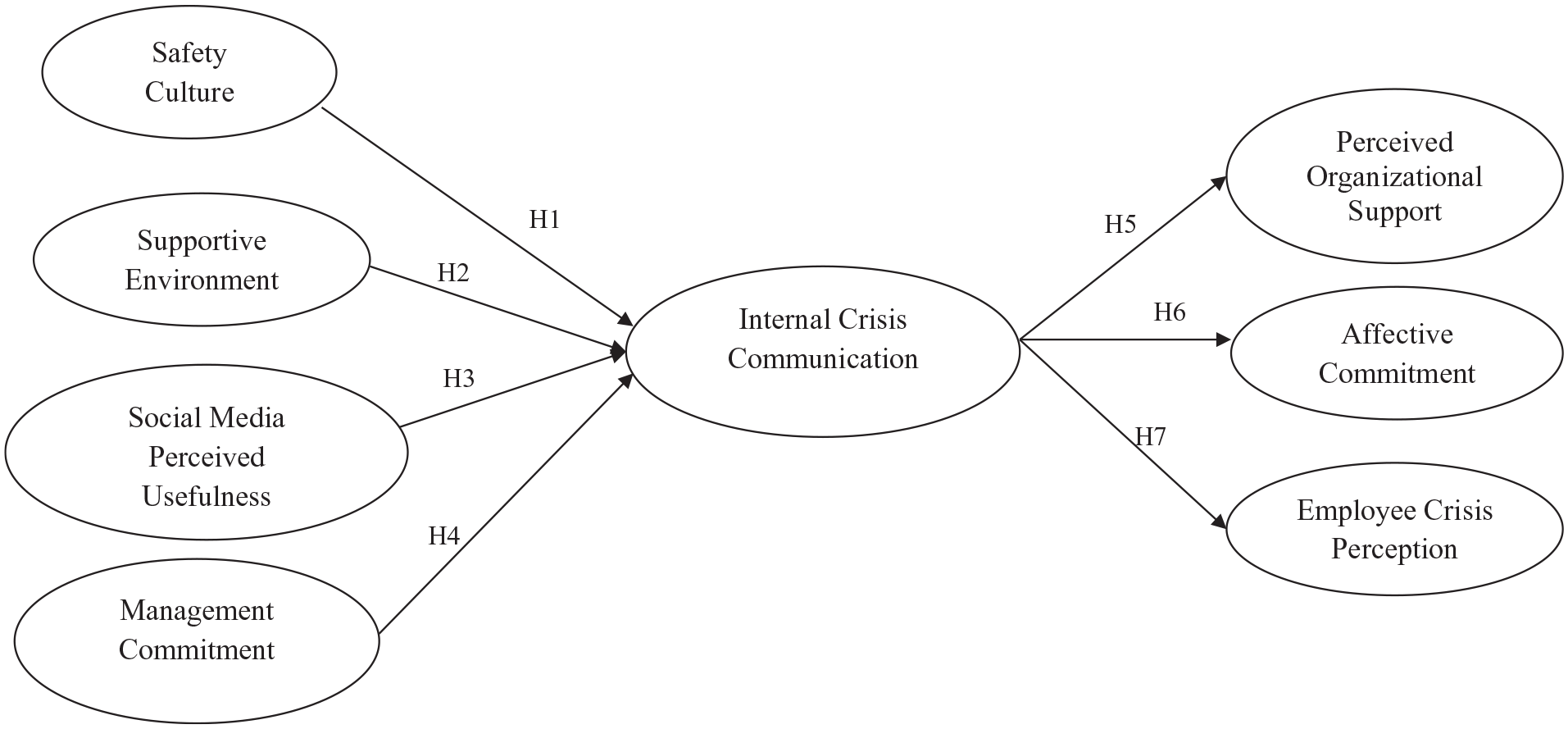
Conceptual model of ICC in high risk industry.
Methods
Measurements
The instrument is developed in accordance with the suggestion of Churchill (1979). First step is the creation of item in order to create pools of items by identifying those items from existing scales. The second step involves interview with nine site engineers and managers of oil and gas companies in ensuring items cited from literature are in accordance contextually with the study. Additional items appeared in this stage and they were added to the existing scales. This is followed by the face validity process and scale of content validation. A panel of judges is expected to confirm the item validation based on the clarity and representativeness of the items. The last step is combining the various scales after the face and content validity are set for instrumentation. To gain the initial indication of the reliability of the scales, the questionnaire instrument was distributed to 50 respondents. The results show that all the constructs have high Cronbach Alpha coefficient between .839 and .950.
For the main survey, the data collection consists of eight variables. Internal Crisis Communication (ICC) measured 15 items on the employee perception on internal communication during the crisis (e.g., “I have been clearly informed by the management on how to respond to the public when crisis happens”). Safety culture (Hajmohammad & Vachon, 2014; McFadden et al., 2009) consisted of ten items (e.g., “senior management listens to and cares about employees’ safety concerns”) that assessed an employee’s feeling on the safety culture of the organizations. Supportive environment (Cox & Cheyne, 2000) includes seven items that determined respondents’ perception on the management support (e.g. “I am strongly encouraged to report unsafe conditions”). The social media usage includes seven items (Rauniar et al., 2014) such as “Whatsapp enables me to get connected with people in my organization.” Management commitment (Cox & Cheyne, 2000) consists of ten items such as “In my workplace management acts quickly to correct safety problems.” Perceive organizational support (Afsar & Badir, 2016) consists of ten items that determined respondents’ perception on the employee support (e.g., “My organization cares about my opinions”). Affective commitment (Meyer & Allen, 1997) consists of 11 items (e.g., “I would be very happy to spend the rest of my career with this organization.”) that assessed employees on their commitment to the organizations. Finally, employee crisis perception (Kim & Grunig, 2011) consists of nine items on the employee perception on crisis (e.g., “I believe all crises are important to my company”). All the constructs are measured using a seven-point scale of rating (1 = strongly disagree, 7 = strongly agree). The demographic information gathered comprises age, gender, level of education, job position, and years of experience with the company and in the present position.
Research Setting, Sampling, and Data Collection
In the context of Malaysia, high risk industries such as oil and gas and commercial aviation have developed rapidly. The demand for internal crisis communication becomes severe after the series of crisis such as the missing flight of MH370 and MH17 plane crash. To understand the global and regional current market for high-risk industry, Malaysian organizations need to develop a corporate reputation through excellence crisis communication management. Therefore, the ICC should be effectively and consistently communicated to the relevant stakeholders. Under these conditions, organizations have realized the roles of ICC to be powerful source of maintaining their operation and reputation. Strategically, managing ICC enhances organization to develop competitive advantage over their competitors. As a consequence, a significant number of organizations in high-risk industry in Malaysia have started to develop and implement internal crisis communication as part of their strategic growth and expansion.
The population sample of this study is the employee of oil and gas companies in Malaysia. According to the Malaysian Petroleum Resources Corporation (MPRC), there are more than 3,600 companies in the hydrocarbon industry of Malaysia. Recently, oil and gas and other condensates constitute the second largest export after electrical and electronic products which contributed up to 20% GDP of the country in 2014. The contribution of the oil and gas industry is significant to the company of Malaysia.
Malaysia. Currently, there are more than 70 Production Sharing Contract (PSC) of oil and gas with various companies, including Petronas Carigali Sdh Bhd which holds about 43% of the total production of Malaysia. Other dominant players are ExxonMobil and Shell with total production of 16% and 22%, respectively.
These oil and gas related companies are across the upstream, midstream, and downstream spectrum. Thus, practicing ICC as a strategic management function for these companies would be a natural course of activities for the companies. With these requirements, oil and gas companies are considered as the most appropriate targeted audience. Furthermore, the online Google form which is a prominent software in the market is used as online survey questionnaire. A total number of 2000 online questionnaire were sent to employees working in oil and gas companies. The response rate is 13.85% which indicates 277 responses from the whole questionnaires sent out. In the sample, 9.0% of the respondents are in the downstream sector, 35.4% in mid-stream sector, and 55.6% in upstream sector.
Data Analysis
The Smart-PLS 3.0 is employed to estimate the measurement and the structural models using a correlation with the topmost likelihood. How the latent variables (i.e., safety culture, supportive environment, social media perceived usefulness, affective commitment, perceived organizational support, and employee crisis perception) are measured were assessed by the measurement model for the observed indicators (X and Y variables). The inter-item reliability between items is established using Cronbach alpha (Akanmu et al., 2020). The causal relationships among these latent variables are examined using the structural model in order to test the hypotheses as presented in Figure 1.
The overall fit of the model was assessed using the predictive relevance of the model (Blindfolding) and R2 value (Cohen, 1988; Hair et al., 2017; Shmueli et al., 2019). First, the Stone-Geisser’s Q² value (Geisser, 1974; Hair et al., 2017; Stone, 1974) as a criterion of predictive relevance is examined. The Q² value of latent variables in the PLS path model is obtained by using the blindfolding procedure. The predictive relevance of the model can be examined by performing blindfolding procedure using Smart-PLS software. The blindfolding step is designed while handling them as missing values for estimation of parameters. Due to this blindfolding process, a general cross validating metrics Q2 is produced.
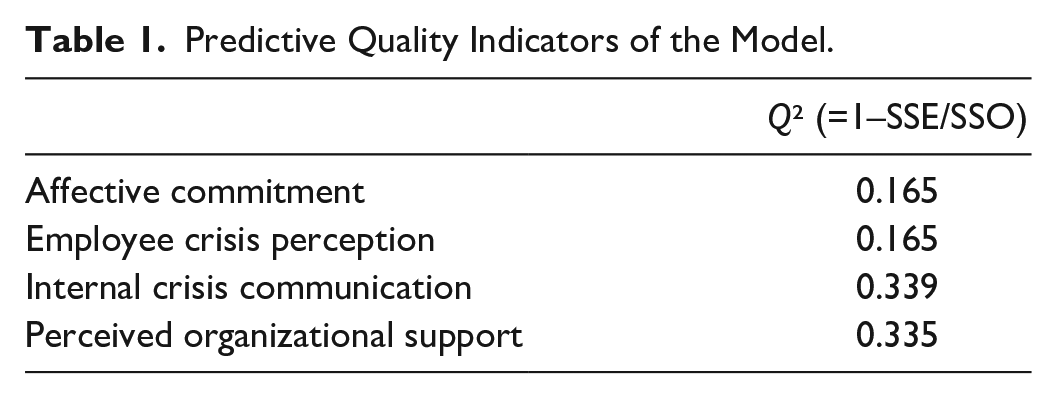
A cross-validated redundancy Q2 is the result when the data point prediction is acquired by the latent variable. For all the endogenous variables, the redundancy communality was discovered to be larger than zero (Stone, 1974). The Table 1 presents the cross-validated redundancy for Affective Commitment, Employee Crisis Perception, ICC, and Perceived Organizational Support to be 0.165, 0.165, 0.339, and 0.335. Based on the Stone (1974), if the value is higher than 0, it shows that the predictive validity of the model is adequate. For more detail Hair et al. (2017) has suggested the value 0.35 is substantial, 0.15 is moderate and 0.02 is weak. The results indicated that the model had an acceptable predictive relevance. The structural model is therefore appropriate.
Predictive Quality Indicators of the Model.
Also, the researcher evaluates the magnitude of the R² values as a criterion of predictive accuracy. The quality of the variables present in the model is determined by the value of R-square (Hair et al., 2010). To assess the level of R2, there are many criteria that can be employed as guidelines. According to Cohen (1988), R2 when more than .26 is considered substantial, .13 is considered medium while .02 is considered weak. From this criterion, the values of the R2 for the endogenous variables namely: Affective Commitment, Employee Crisis Perception, ICC, and Perceived Organizational Support are respectively 0.329, 0.353, 0.674, and 0.497 as provided in Table 2. The results indicate that the quality of the variables is substantial.
R2.

Result and Discussion
Measurement Model Assessment
The measurement model takes into consideration the relationship between the latent variable and the manifest variables (observed variables). The measurement model is tested by assessing the reliability and validity of the constructs and items in the model (Akanmu et al., 2017). This is to ensure that only construct measures that are valid and reliable are used before assessing the overall nature of the relationship in the model. There are two different outer models in the PLS path modeling: the formative and reflective measurement models (Jarvis et al., 2003). In this study, the model is conceptually developed following the reflective measurement path modeling as the indicators of the constructs are considered to be caused by the constructs (Park et al., 2017).
Reflective measurement
Bollen and Davis (1989) states that the assessment of the reflective measurement model should be done in accordance with their validity and reliability. As discussed above, Cronbach alpha is often used as the traditional criterion. The Table 3 shows that all the constructs have the satisfactory levels of Cronbach alpha ranging between .839 and .950. However, Cronbach alpha tends to provide a severe underestimation of the internal consistency reliability of latent variables in PLS path models (Henseler et al., 2009). The composite reliability being a different measure is more appropriate (Werts et al., 1974). The composite reliability also considers that indicators having different loadings can be interpreted just like the Cronbach alpha. In terms of the internal consistency, the data shows a robust reliability as indexed by the composite reliability as shown in Table 4. The value of the composite reliability of the constructs range from 0.879 to 0.957 which all exceed the required threshold value of 0.8/0.9 (Nunnally & Bernstein, 1994).
Items Dropped from Reflective Measurement Model.

Note. SC = Safety Culture, SE = Supportive Environment, SMU = Social Media Perceived Usefulness, MO = Management Commitment, ICC = Internal Crisis Communication, AC = Affective Commitment, POS = Perceived Organizational Support, and ECP = Employee Crisis Perception.
Overview Results of Reflective Measurement Model.
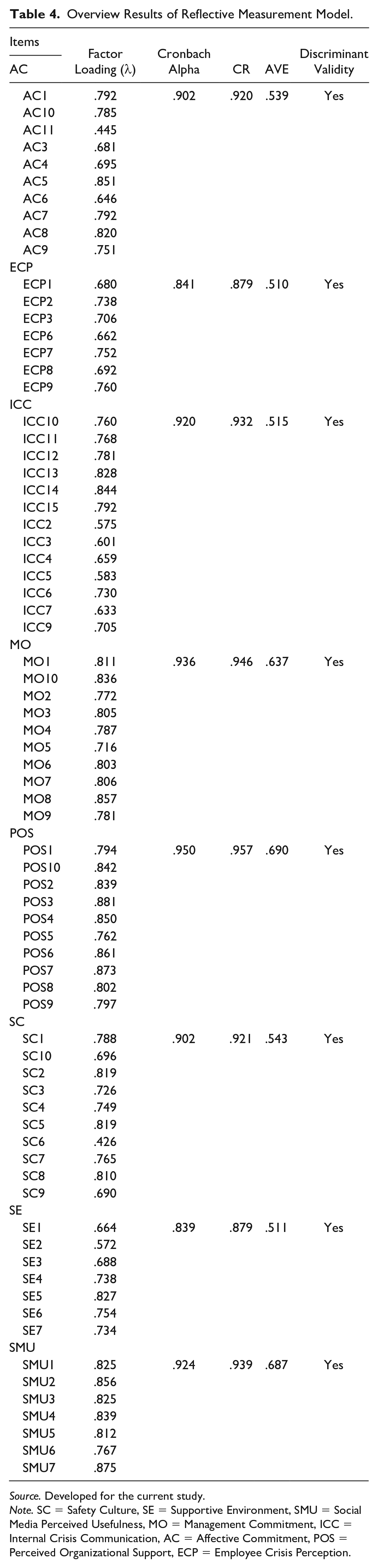
Source. Developed for the current study.
Note. SC = Safety Culture, SE = Supportive Environment, SMU = Social Media Perceived Usefulness, MO = Management Commitment, ICC = Internal Crisis Communication, AC = Affective Commitment, POS = Perceived Organizational Support, ECP = Employee Crisis Perception.
Structural Model
The relationship between the latent constructs is specified by the structural model. Estimating the paths between the constructs is used to test the structural model which is an indicator of the predictive ability of the model. For the path coefficient and each of the endogenous construct in the model, the squared multiple correlation (R2) is provided by the Smart PLS. The percentage of the construct’s variance in the model is indicated by the R2 while the strength of the relationships between the constructs is indicated by the path coefficient (Chin, 1998). It is important to ensure that, there is no issue of collinearity in the inner model of the study prior to assessing the structural modeling. The Table 5 presents the outcome of the model’s collinearity test. The VIF values below 5 for each of the constructs indicates collinearity is not an issue (Diamantopoulous & Siguaw, 2006).
Assessment of Collinearity.

Note. VIF < 5 (No Multicollinearity).
To support the hypotheses, the t-values must be significant at the other hand. Parameter with an absolute t-value greater than 1.96 shows a significance at the level of .05 (p < .05), greater than 2.58 shows a significance at the level of 0.01 (p < .01) and greater than 3.26 shows a significance at the level of .001 (p < .001) The PLS results supporting all the hypotheses 1 to 7 is presented in Table 6, Figure 2.
The Summary of the Results of Hypotheses Testing.

Note. SC—Safety Culture, SE—Supportive Environment, SMU—Social Media Perceived Usefulness, MO—Management Commitment, ICC—Internal Crisis Communication, AC—Affective Commitment, POS—Perceived Organizational Support and ECP—Employee Crisis Perception
significant at the level of 0.05 (p < .05).

Validated structural model.
In support of H1, the results in Tables 6 and 7 show that safety culture among the workers in oil and gas industry has positive and significant effect on ICC. On the other hand, the path coefficient of safety culture to internal crisis communication is significant with medium effect size (β = .462, p < .001, f2 = 0.175). This finding supported H1 and suggested safety culture has influence on ICC. This is confirmed by Frandsen and Johansen (2011) and Turner et al. (1989) that there must be a strong connection between safety culture and the organization capacity to address a crisis. It is the learned and shared experience, interpretation, and meaning of safety and work that direct the action of the employees to accident, risk, and prevention (Richter & Koch, 2004). The safety culture has been widely adopted as a method to understand an accident in various sectors including oil and gas (Waterson et al., 2019). This study therefore concludes that the safety culture remains the functional instrument in constructing an effective ICC. Its roles can help an oil and gas companies operating in high risk environment.
Effect Size (f2).
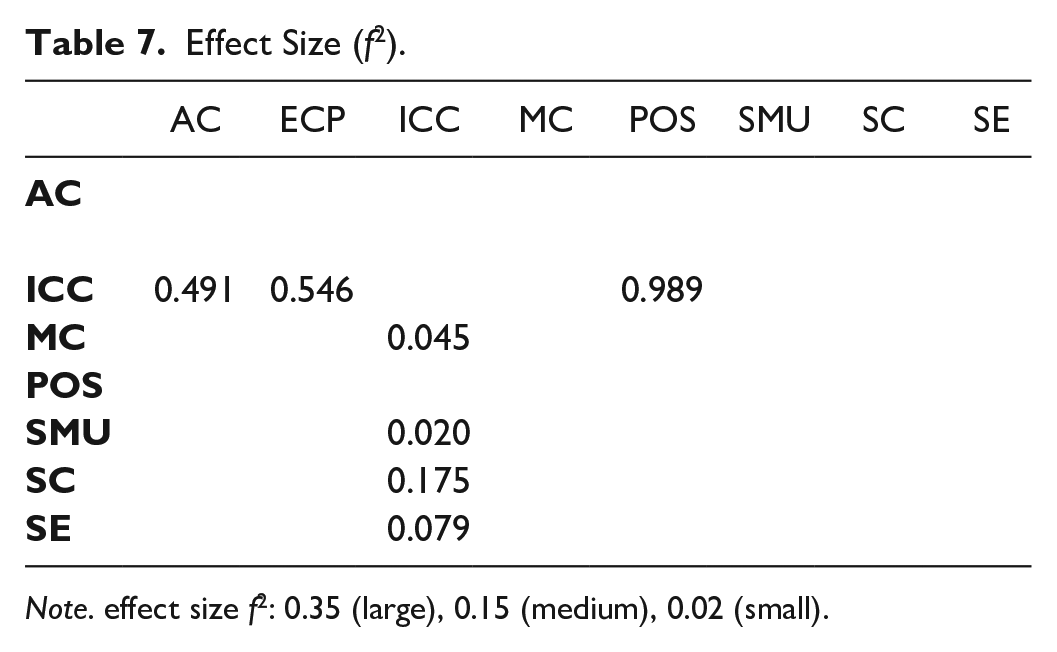
Note. effect size f2: 0.35 (large), 0.15 (medium), 0.02 (small).
With regard to H2, it was hypothesized that supportive environment will affect internal crisis communication among the workers in oil and gas industry. As expected, it is found that the industry’s supportive environment influences internal crisis communication. The coefficient of the path from supportive environment to internal crisis communication is significant with medium-size effect (β = .270, p < .001, f2 = 0.079). The result from the quantitative analysis indicates that supportive environment as a direct antecedent to organizational success or failure including ICC as suggested by Kazmi and Naaranoja (2015). The study of Falkheimer and Heide (2006) also showed that communication is a two-way approach where the managers and employees mutually understand the strategies to create supportive and positive environment. Based on the H2 on the relationship between manager-employee communication and supportive environment, it is expected that both perception of management responsibility for safety and support during crisis and employees understanding of the organization’s response will explain the relationship between supportive environment and ICC in the context of high risk industry.
On hypothesis H3, the path coefficient from social media perceived usefulness to internal crisis communication is insignificant and negative with small-size effect (β = −.099, p > .05, f 2 = 0.175). Therefore, the hypothesis H3 is not supported. This is a surprising result as it is only related to the contextual issue. There are particular aspects of social media that can improve internal communication in one context but may not be effective in another context (Friedl & Vercic, 2011; Valentini, 2015). For example, in the context of high risk industry the stakeholder are concerned more about the information that is shared online and the possible consequence on the level of information-processing capacity and online trust (Rainie et al., 2013). The use of social media for organizational and business purpose is yet to be fully explored (Kent, 2010). This is also consistent with the Friedl and Vercic (2011) who found that employees are preferred to discuss with managers in discussion forums and employee meetings rather than on social media.
With regards to H4, Table 6 shows that management commitment has significant relations with internal crisis communication among the workers in oil and gas industry. Management commitment shows a positive and significant relationship with internal crisis communication with medium-size effect, confirming H4 (β = .211, p < .05, f2 = 0.045) to be fully supported. Employees felt commitment from the management helping them during the crisis. This finding supported the involvement of top management in satisfying emotion of the employees on the internal communication (Kim et al., 2009). This finding is consistent with the argument of Jone (2014) and Mazzie et al. (2012) that constant effort of management commitment will create trust among the employees. For example, the commitment of senior managers or engineers to improve the internal communication during the crisis can improve the quality of relationship between employees and customers (Babakus et al., 2003) and influence employee attitude (Michael et al., 2005).
From the hypothesis H5, the Table 6 reveals that internal crisis communication in oil and gas industry has significant relations with employees’ perceived organizational support. This indicates that perceived organizational support shows a significant and positive relationship with internal crisis communication with large-size effect, confirming H5 (β = .705, p < .001, f2 = 0.989). It is concluded that, H5 is fully supported. The result is in consistent with the notion that the positive ICC is a form of achieving an employee’s support for the organization (Adamu et al., 2018). The current study shows that the effect of employee perceived organizational support are based on high degree of quality ICC such as career advancement and pre-social conduct (Adamu et al., 2018; Eisenberger et al., 1990). Therefore, the findings illustrate that if the ICC are well managed and positive, the employees feel that they have to be committed to the organization and feel obliged to reciprocate the commitment of the organization by engaging in behavior that supports the objectives of the organization (Wayne et al., 1997).
Similarly, the results from the Table 6 and 7 show that ICC has significant relations with affective commitment of the employees in oil and gas industry. This is an indication of significant and positive relationship between ICC and affective commitment with large-size effect, confirming H6 (β = .574, p < .001, f2 = 0.491) as a hypothesis is fully supported. This result is also in line with the studies of Adamu and Mohamad (2019a) and Frandsen and Johansen (2011) that urge employees to have cognitive, affective, and behavioral reaction to crisis in order to achieve overall psychological wellbeing and commitment. In addition, the past studies have also highlighted that these components demonstrate commitment as a psychological state that characterizes the relationship of employees with their organization and the consequence of the decision whether to continue the membership of the organization or not (Allen & Meyer, 1996).
Finally, it can be derived from the Tables 6 and 7 that internal crisis communication has significant relations with employee crisis perception in oil and gas industry. This indicates that crisis perception has a significant and positive relationship with internal crisis communication with large-size effect (β = .594, p < .001, f2 = 0.546). It is concluded that H7 is fully supported. This is supported by the study of Kiesler and Sproull (1982) that indicates that the employee’s behavior is an outcome from the management solving the problems and finding solutions to the organization. Furthermore, the response from the management can affect perceptions because employees view those events and feel they are capacitated to act (Weick, 1980). Therefore, perception is capable to influence the level at which an organization is eager to have engagement on activities of crisis management (Penrose, 2000). The findings of the study suggest that management act on crisis will affect the perception of the employees. Employees’ different perceptions on a crisis situation may influence their active communication behavior (Lee, 2019a).
Implication and Conclusion
Theoretical Implication
This study explores a structural model that examines the relationship between safety culture, supportive environment, social media perceived usefulness, management commitment, ICC, affective commitment, perceived organizational support, and employee crisis perception in Malaysian high risk industry. The study also provides insight to the researchers and managers for understanding structural relationship between antecedents and consequences of ICC. The conceptual model has demonstrated robustness while the theoretical model has shown to be significantly useful to organizations. Despite ICC having positive relationship with safety culture, supportive environment, and management commitment have no effect on social media perceived usefulness. Furthermore, ICC demonstrates a positive association with affective commitment, perceived organizational support, and employee crisis perception. Therefore, the antecedents and consequences of ICC addressed in this study are found to be influential factors.
Extant literature has highlighted the importance of identifying the information that is relevant to employees in time of crisis and actively incorporating them into the organization decision-making (Ecklebe & Löffler, 2021). Given that internal crisis communication depicts organizational efforts to both identify crises and dialogue with employees, this research adds additional insights to existing studies by highlighting the significance of organizational strategic, planned, and symmetrical internal crisis communication practices in enhancing employee crisis management capacity. The result further suggests that quality internal crisis communication is an important predictor of employees’ attitude to their organization which enunciate the significance of internal communication for organizations (Ecklebe & Löffler, 2021; Lee et al., 2020).
Managerial Implication
The Malaysian high-risk industries for a decade has strongly focused on external stakeholders during crisis. More specifically, they target government regulatory agencies, media, and the general public in their crisis response efforts. As a result, Malaysia high risk industries become external oriented and management focus on their crisis communication approach (Olsson, 2014). The knowledge of internal crisis communication and the challenges of creating best practices for internal crisis management are of greatest interests among the high-risk industries and business community due to this development. Organizations now believe in the importance of understanding the factors that contribute to the practices of internal crisis communication and their effects on organizational support and commitment. Findings in this study for example would have the potential to enlighten managers within high-risk industries to work consciously and harder in order to strengthen and improve internal crisis communication for better relationship with the employees. Internal crisis communication functions such as employee communication, employee organization relationships, and internal reputation should attract more attention as the functions have significant and positive effect on performance.
Also, the study revealed internal crisis communication to be an important instrument to minimize feeling of insecurity and uncertainty during an organizational crisis (Frandsen & Johansen, 2011). The functions of strong internal crisis communication are essential for organization to execute strategies of management crisis to the employees by producing desired results through good communication. Therefore, internal crisis communication is perceived to be important as instrument that supports the organizational pursuit in mitigating the negative feelings of employees in times of crisis. The strategic functions of internal crisis communication are shown in this study. These functions can be implemented by managers to improve perceived organizational support and affective commitment.
According to this study, internal crisis communication is found to be important factor to minimize negative emotions as agreed upon by Kim et al. (2019). By setting up an effective environment, high risk industries should aim at increasing the degree of constructs that positively affect internal crisis communication such as safety culture, supportive environment, social media perceived usefulness, and management commitment prior to achieving an effective internal crisis management. Internal crisis communication is influenced by these constructs. Additionally, when the top management communicates with the internal stakeholders, implementation of strong policies is ensured. Clearly, this study shows that the top management is concerned about the factors encouraging and discouraging internal crisis communication. These factors are considered important in order to provide effective and better communication system within high risk industries.
Similarly, the importance of internal crisis communication is recognized by many corporate communication practitioners; however, they have little knowledge of internal crisis communication functions (Adamu et al., 2018; Frandsen & Johansen, 2011). They are not well-informed on the factors influencing internal crisis communication. Safety culture is demonstrated by this study to have strong impact and it is confirmed to be one of the critical factors in achieving best practices of internal crisis communication. Other studies also support safety culture to be important factor that explains the communication activities in an organization (Sriramesh & Vercic, 2003). Therefore, emphasis on safety culture can influence crisis managers to focus on internal crisis communication in order to create effective internal crisis communication. For example, elements of culture such as adopting appropriate leadership style, enhancing loyalty among members and setting goals for the organization should be focused on by the managers. This is because internal crisis communication will be affected if the safety culture is not in good shape. Therefore, organizational culture should be focused on by the top management as success of an organization depends more on the cultural focus (Schneider, 1990). Finally, perceived organizational support, affective commitment, and employee crisis perception shows a positive outcome.
Conclusion
There are limitations in this study. First, the measurement scale from the literature is adapted from this study’s survey. During the item refinement process, some measuring items were culled out as those items did not measure very well the construct domain as it might be that a same study is carried out in a different context. In the data screening process, most of the items were deleted before the CFA that might be a significant item to the overall model fit.
In the collection stage of the quantitative data, the online survey was conducted based on the sample of employees from the Malaysian oil and gas companies. The organizational attitude and behavior of oil and gas companies cannot be generalized to other types of organizations or companies such as the aviation, construction, and civil services. Lastly, the response for this study is only restricted to the Malaysians. Therefore, the results cannot be generalized as representative of non-western culture.
Footnotes
Appendix
Declaration of Conflicting Interests
The author(s) declared no potential conflicts of interest with respect to the research, authorship, and/or publication of this article.
Funding
The author(s) disclosed receipt of the following financial support for the research, authorship, and/or publication of this article: This research is supported by Ministry of Higher Education (MoHE) of Malaysia through Fundamental Research Grant Scheme (FRGS/1/2018/SS09/UUM/02/2).
