




Abstract
The quality of life (QoL) of workers during the Covid-19 pandemic is an important issue that must be considered. Unfortunately, research related to the QoL of workers during the Covid-19 pandemic for the non-health sector is still very limited. Moreover, no one has comprehensively investigated QoL involving not only the perceived threat of Covid-19, Covid-19-related workplace policy, and job insecurity but also digital literacy, perceived organizational support (POS) during Covid-19, quality culture, and safety culture. Therefore, to fill the gap in the literature, this study studied QoL by involving perceived threat of Covid-19, Covid-19 related workplace policy, job insecurity, digital literacy, POS, quality culture, and safety culture. Quantitative research method was carried out in this research. Data collection was conducted through an online survey. The research respondents were 181 non-health sector workers in Indonesia. SEM-PLS was used as an analytical tool. The results showed that QoL was directly and positively affected by POS and safety culture. In addition, QoL was also indirectly affected by Covid-19-related workplace policy, quality culture and safety culture by post. However, several factors, namely the perceived threat of Covid-19, job insecurity, and digital literacy did not have a significant effect on the QoL of non-health sector workers during the Covid-19 pandemic. In addition, this research also found that quality culture did not affect Covid-19 related workplace policy and job insecurity. The perceived threat of Covid-19 was not affected by the Covid-19-related workplace policy and safety culture. Job insecurity was affected by the perceived threat of Covid-19.
Plain Language Summary
Purpose—This study studied QoL of workers in the non-health sector by involving perceived threat of Covid-19, Covid-19 related workplace policy, job insecurity, digital literacy, POS, quality culture, and safety culture. Methods—Quantitative research method was carried out in this research. Data collection was conducted through an online survey. The research respondents were 181 non-health sector workers in Indonesia. SEM-PLS was used as an analytical tool. Conclusion—QoL was directly and positively affected by POS and safety culture. QoL was also indirectly affected by Covid-19-related workplace policy, quality culture and safety culture by post. However, several factors, namely the perceived threat of Covid-19, job insecurity, and digital literacy did not have a significant effect on the QoL of non-health sector workers during the Covid-19 pandemic. In addition, this research also found that quality culture did not affect Covid-19 related workplace policy and job insecurity. The perceived threat of Covid-19 was not affected by the Covid-19-related workplace policy and safety culture. Job insecurity was affected by the perceived threat of Covid-19. Implications—The findings of this research can be used as an input for developing an intervention strategy in order to improve QoL of workers in the non-health sector. Limitations—This research was only conducted in Indonesia. In order to generalize the findings, it should be tested in other contexts than Indonesia.
Introduction
Background
The quality of life of workers is an important issue that needs attention (Mert et al., 2022; Zia et al., 2022). This is due to the view of the importance of a humanistic approach in managing workers so that they can work well (Agarwal, 2021; Cao et al., 2022; Gruman & Budworth, 2022). Attention to the quality of life of workers is an effort to apply a humanistic approach to managing workers. Attention to the quality of life of workers is believed to have a positive impact on companies, such as improving performance (Abiddin et al., 2022; Tarigan et al., 2021), organizational commitment (Son et al., 2022), innovative work behavior and organizational citizenship behavior (Zia et al., 2022).
Currently, the issue of the quality of life of workers is also important to discuss given the global health problem, namely the Covid-19 pandemic. Until October 2022, there were more than 600 million people affected by Covid-19 with a mortality rate of around 1% (Worldometers, 2022). The Covid-19 pandemic has changed the activity and mobility of businesses and offices (Abiddin et al., 2022). Restrictions and regulations of social and economic life are carried out by governments in many countries (Chen et al., 2021; García et al., 2021; Mondragon et al., 2021). Therefore, the Covid-19 pandemic can not only cause physical health problems but also mental health problems (Abiddin et al., 2022). The quality of life of workers during the Covid-19 pandemic has the possibility to decline (Chen et al., 2021; Mondragon et al., 2021). In other words, appropriate strategies and approaches are needed in maintaining the quality of life of workers. Therefore, in order to develop appropriate strategies and approaches in maintaining the quality of life of workers, it is important to study the factors that affect the quality of life of workers during the Covid-19 pandemic.
Several studies have been conducted to study the quality of life of workers during the Covid-19 Pandemic (Bahamdan, 2021; Chen et al., 2021; Mondragon et al., 2021; Serrão et al., 2022; Son et al., 2022; Vafaei et al., 2020; Wong et al., 2022; Woon et al., 2021; Zhang et al., 2021). However, most of the research was conducted for workers in the health sector. Meanwhile, researches on the quality of life of workers in the non-health sector are very limited. On the other hand, workers in the non-health sector during the Covid-19 pandemic may have different conditions from health workers. For example, workers in the health sector tend to be required to work by meeting physically while workers in the non-health sector during the Covid-19 pandemic can work from home. During the Covid-19 pandemic, health sector workers are urgently needed while the sustainability of work in the non-health sector can be disrupted due to the economic downturn caused by restrictions on activity and social mobility. These conditions can cause the determinants of the quality of life of non-health sector workers which may differ from the determinants of the quality of life of sector workers. Therefore, this research intends to explore the factors that affect the quality of life for workers in the non-health sector. These conditions can cause the determinants of the quality of life of non-health sector workers which may differ from the determinants of the quality of life of sector workers. Therefore, this research intends to explore the factors that affect the quality of life for workers in the non-health sector.
Research Gaps
Research on the quality of life (QoL) of workers in the non-health sector during the Covid-19 pandemic is still very limited. Several studies related to the quality of life (QoL) of workers in the non-health sector during the Covid-19 pandemic were carried out by Wong et al. (2022), Mondragon et al. (2021), and Chen et al. (2021). These studies have identified the important role of the perceived threat of Covid-19, Covid-19-related workplace policy and job insecurity in influencing QoL. However, no research understands QoL by integrating these factors with digital literacy, perceived organizational support (POS) during Covid-19, quality culture, and safety culture. On the other hand, these four factors are relevant to explain the QoL of non-health sector workers during the Covid-19 pandemic.
In the non-health sector, during the pandemic, the “work from home” rule is one of the most popular rules applied (Abelsen et al., 2021; Abiddin et al., 2022; Nayak et al., 2022). This policy requires workers to be able to work by utilizing digital technology (Abelsen et al., 2021; Manroop & Petrovski, 2022; Nayak et al., 2022). The use of digital technology is also important at a time when physical restrictions are widely practised (Abelsen et al., 2021; Nayak et al., 2022). Therefore, digital literacy is important in increasing the QoL of workers.
Quality culture and safety culture are two organizational cultures that tend to be applied to improve performance and gain competitiveness (Rahnuma, 2020; Williams et al., 2020; Wu, 2015; Wu et al., 2011). A good quality organizational culture will make the company focus on customer needs, including internal customers—workers (Rahnuma, 2020; Wu, 2015; Wu et al., 2011). Safety culture will make companies focus on the threat of disease that can interfere with workers and their work (Deepak & Mahesh, 2021; Naji et al., 2021; Williams et al., 2020). Therefore, quality culture and safety cultures will encourage companies to be more responsive to the needs of workers during the Covid-19 pandemic. Furthermore, these conditions can increase the QoL of workers.
POS is an important factor that has the potential to increase the QoL of workers (Miller et al., 2017). During the Covid-19 pandemic, the role of POS in improving QoL will be even more relevant. This is because POS represents assistance/support provided by the company to employees, both material and psychological assistance/support (Meyers et al., 2020).
Research Objectives
This research was performed to develop and test a QoL model of non-health sector workers that involves not only the perceived threat of Covid-19, Covid-19-related workplace policy and job insecurity factors but also digital literacy, perceived organizational support/POS during Covid-19, quality culture, and safety culture. More specifically, the formulation of the problem in this study is as follows:
Does job insecurity affect the quality of life of non-health sector workers?
Does the perception of the threat of Covid-19 affect the job insecurity and quality of life of non-health sector workers?
Does POS during Covid-19 affect job insecurity, perception of the threat of Covid-19, and quality of life for non-health sector workers?
Do workplace policies related to Covid-19 affect POS during Covid-19, perceptions of the threat of Covid-19, and the quality of life of non-health sector workers?
Does digital literacy affect the quality of life of non-health sector workers?
Does the quality culture affect POS during Covid-19, workplace policies related to Covid-19, job insecurity and quality of life of non-health sector workers?
Does safety culture affect workplace policies related to Covid-19, POS during Covid-19, perceptions of the threat of Covid-19, and the quality of life of non-health sector workers?
Literature Review and Conceptual Model
Quality of Life
Quality of life (QoL) shows an individual assessment of the living conditions he/she has (Mondragon et al., 2021). Furthermore, QoL can be seen as overall life satisfaction (Mert et al., 2022; Sirgy & Lee, 2016; Sirgy et al., 2008; Zia et al., 2022). In addition, QoL also describes an individual’s well-being (Kapuria, 2016; Mert et al., 2022; Sirgy & Lee, 2016; Sirgy et al., 2008; Varatharajan & Chen, 2012). Therefore, in the literature, QoL can also be seen as the equivalent of the concepts of “life satisfaction” and “well-being” (Annor, 2016; Kapuria, 2016; Mert et al., 2022; Sirgy & Lee, 2016; Sirgy et al., 2008; Varatharajan & Chen, 2012; Zia et al., 2022).
In the context of workers, many studies have been conducted regarding QoL. In general, QoL tends to be seen as a form of employee evaluation of the condition of physical, and psychological health, social relationships, and the surrounding environment (Kale & Gedik, 2020; Mondragon et al., 2021; Woon et al., 2021). These indicators reflect a holistic aspect of human life so that it can represent QoL comprehensively. Therefore, this study looks at QoL as a person’s assessment of a non-health sector worker on physical, psychological, and social relations and the surrounding environment. A worker in the non-health sector with a high QoL means he has high satisfaction with his physical, and psychological health, social relationships, and the surrounding environment.
The QoL of workers is affected by various factors. These factors can come from internal and external. In the context of worker QoL, factors related to company intervention can play an important role (Annor, 2016; Sirgy et al., 2008; Yucel & Minnotte, 2017). Based on a search of the QoL literature and organizational management, this study identifies: the perceived threat of Covid-19, Covid-19 related workplace policy, job insecurity, digital literacy, perceived organizational support/POS during Covid-19, quality culture, and safety culture as a determinant of worker QoL during the Covid-19 pandemic. Visually, the relationship between these factors is shown in the conceptual model shown in Figure 1.

Conceptual model.
Job Insecurity
Job insecurity is generally seen as a worker’s perception of the sustainability of the work he does (Vu et al., 2022). In other words, job insecurity describes an individual’s assessment of the level of job stability (Mondragon et al., 2021; Pacheco et al., 2020). More specifically, job insecurity can be viewed as an employee’s assessment of the potential for job loss (Jung et al., 2021; Viñas-Bardolet et al., 2020), which includes the loss of the job as well as the loss of certain features of the job (Vu et al., 2022). Based on this description, this research defines job insecurity as a worker’s perception of the possibility of losing a job or some features of the job.
Job insecurity can affect the quality of life of workers considering that losing a job can cause stress or other psychological disorders (Jung et al., 2021), which is an indicator of the quality of life. Furthermore, job loss will also have an impact on the welfare of a worker (Pacheco et al., 2020). Empirically, the research of Viñas-Bardolet et al. (2020) has proven that job insecurity has a negative effect on the forming dimensions of the quality of life of workers. The results of this study are supported by other studies, such as Norström (2021). In the context of the Covid-19 pandemic, research also proves that there is a negative effect of job insecurity on QoL in non-health workers (e.g., Ikeda et al., 2022; Mondragon et al., 2021; Pacheco et al., 2020). Therefore,
H1: Job insecurity negatively affects the QoL of non-health sector workers during the Covid-19 pandemic.
Perceived Threat of Covid-19
The perceived threat of disease, which is often referred to as perceived risk, is one of the central concepts in the health behavior literature (Sumaedi, Sumardjo, et al., 2021). In the context of the Covid-19 pandemic, the perceived threat of Covid-19 has been studied by several studies related to the Covid-19 pandemic (Sumaedi, Sumardjo, et al., 2021). In general, the perceived threat of Covid-19 tends to be viewed as an individual’s assessment of the threat of Covid-19, which includes the probability of being exposed to Covid-19 and the impact felt if exposed to Covid-19 (Sumaedi, Sumardjo, et al., 2021). One will perceive a high Covid-19 threat if he feels that he has a high chance of being exposed to Covid-19 and the significant impact of Covid-19 on him. This study also follows this view in defining the perceived threat of Covid-19.
During the Covid-19 pandemic, the perceived threat of Covid-19 can affect the quality of life of workers. This is because the threat of Covid-19 will be able to cause disturbances in the components of quality of life, such as physical health and psychological health (Zhang et al., 2021). In addition, the threat of Covid-19 creates restrictions on social interaction. Thus, it can interfere with other components of quality of life, namely social relations (Zhang et al., 2021). Empirically, several studies have proven the negative effect of the perceived Covid-19 threat on quality of life (Chen et al., 2021; Wong et al., 2022; Zhang et al., 2021). Therefore, this research suspected that the perception of the threat of Covid-19 has a negative effect on the Quality of Life of non-health sector workers.
The Covid-19 pandemic not only poses a health threat but also poses a threat to business and economic activities (Vu et al., 2022). Government policies that restrict people’s movement and activities make business and economic growth decline. In a non-health context, the Covid-19 pandemic can cause unemployment problems and company closures. This is different from health services which are in fact increasingly needed. This condition showed that the threat of Covid-19 can lead to an increase in job insecurity for non-health sector workers (Vu et al., 2022). Empirically, research by Vu et al. (2022) showed a positive relationship between the perceived threat of Covid-19 and the job insecurity of workers. Therefore, this research suspected that the perceived threat of Covid-19 has a positive effect on the job insecurity of non-health sector workers. The second and third hypotheses of this study are stated as follows.
H2: The perceived threat of Covid-19 negatively affects QoL of non-health sector workers during the Covid-19 pandemic.
H3: The perceived threat of Covid-19 positively affects job insecurity for non-health sector workers during the Covid-19 pandemic.
Digital Literacy
Digital literacy is related to an individual’s ability to utilize digital technology (Jin et al., 2020; Oh et al., 2021; Rodríguez-de-Dios et al., 2016). In the context of workers, digital literacy can be seen as the capacity of workers to utilize digital technology for their own benefit in supporting their work (Bokek-Cohen, 2018; Chan et al., 2021; Kozanoglu & Abedin, 2021). In more detail, digital literacy tends to be seen as a set of competencies that includes computer literacy, information and communications technology (ICT) literacy, information literacy and media literacy (Jin et al., 2020). This paper also adopted the same view.
Information and communications technology (ICT) advances offer many conveniences for humans to improve their quality of life. Empirically, several studies have proven a positive relationship between the use of digital technology and quality of life (Alhassan & Adam, 2021; Damant et al., 2016; Rosnan et al., 2022). In the context of workers, ICT advancements can also make it easier for workers if they have good digital literacy (Bokek-Cohen, 2018; Chan et al., 2021; Kozanoglu & Abedin, 2021). In other words, digital literacy can have a positive effect on the quality of life of workers. During the Covid-19 pandemic, non-health sector workers are required to follow work policies that limit physical gatherings. Thus, they need to take advantage of ICT. Therefore, during the Covid-19 pandemic, digital literacy is increasingly having an important role in influencing the quality of life of non-health sector workers (Maingi & Wachira, 2022). The fourth hypothesis of this research is formulated as follows.
H4: Digital literacy positively affects the QoL of non-health sector workers during the Covid-19 pandemic.
Perceived Organizational Support During Covid-19
Perceived organizational support (POS) is an important concept in management literature. POS has its roots in Organizational Support Theory (Rhoades & Eisenberger, 2002). In the context of QoL studies, POS has also been identified as a factor that can have an important role in improving employee QoL (Mariappanadar, 2020).
POS shows an employee’s assessment of the company’s commitment to the conditions and contributions made by employees (Akgunduz et al., 2018; Le & Lei, 2019). More specifically, the perception of organizational support tends to be seen as the company’s level of concern for employee conditions and the company’s level of appreciation for employee contributions (Akgunduz et al., 2018; Le & Lei, 2019). Someone who has a high perception of organizational support will feel a high concern and appreciation from the company for him (Le & Lei, 2019).
During the Covid-19 pandemic, companies can provide different support during non-Covid-19 pandemic times (García et al., 2021). For example, companies can provide health assistance programs that can be used to improve employee health in dealing with Covid-19 (Mahmud et al., 2021). Hence, this research defines the perception of organizational support during Covid-19 as the company’s level of concern for employee conditions and the company’s level of appreciation for employee contributions given specifically due to the Covid-19 pandemic.
POS is an important predictor of worker QoL. Empirically, POS has been shown to have a positive effect on QoL (Baker & Kim, 2020; Vafaei et al., 2020; Woon et al., 2021). Besides, POS can also create a worker’s confidence in the stability of his job (Salvador et al., 2022). Empirically, POS has been shown to have a negative effect on job insecurity (Salvador et al., 2022). During the Covid-19 pandemic, POS made the QoL of workers increase, considering that health support, psychological conditions, social relations and the environment of workers were needed during a pandemic (Woon et al., 2021). In addition, POS also makes workers believe their company is more stable. Thus, it can have a negative effect on job insecurity. Company support for workers during the Covid-19 pandemic can also make the perception of the threat of Covid-19 decrease. Therefore, the fifth to seventh hypotheses of this study are formulated as follows.
H5: POS positively affects the QoL of non-health sector workers during the Covid-19 pandemic.
H6: POS negatively affects job insecurity for non-health sector workers during the Covid-19 pandemic.
H7: POS negatively affects the perceived threat of Covid-19 for non-health sector workers during the Covid-19 pandemic.
Covid-19 Related Workplace Policy
Workplace policy is an important factor in the management of a company. The ISO 9001:2015 standard emphasizes the importance of companies managing the work environment (ISO 2015). In the context of the Covid-19 pandemic, workplace policies are important to pay attention to give the high chance of transmitting Covid-19 between people who are at the same time and location (Wong et al., 2022).
In the context of the QoL study in the Covid-19 pandemic, Workplace policy related to Covid-19 has been discussed (Abiddin et al., 2022). Covid-19-related workplace policy shows the extent to which companies have policies to regulate the workplace to mitigate the risk of Covid-19 (Wong et al., 2022). Furthermore, Covid-19-related workplace policies can also be seen as practices implemented by companies in the workplace in preventing Covid-19 (Vu et al., 2022; Wong et al., 2022). This can consist such as company arrangements regarding employee attendance, health protocols that employees must display while in the workplace, the facility arrangements and disinfectant programs (Vu et al., 2022; Wong et al., 2022). Empirically, Covid-19 related workplace policy has a significant effect on the perception of the threat of Covid-19 (Vu et al., 2022; Wong et al., 2022) and QoL (Mondragon et al., 2021; Wong et al., 2022). Specifically, Covid-19-related workplace policies can increase QoL and reduce the threat of Covid-19. In addition, the Covid-19-related workplace policy can also be seen as a form of company support for employees during the Covid-19 pandemic (Mahmud et al., 2021). Therefore, the Covid-19-related workplace policy is suspected to have a positive effect on POS. Therefore, the eighth to 10th hypotheses of this study are formulated as follows.
H8: Covid-19-related workplace policy positively affects the QoL of non-health sector workers during the Covid-19 pandemic.
H9: Covid-19-related workplace policy positively affects POS for non-health sector workers during the Covid-19 pandemic.
H10: Covid-19-related workplace policy negatively affects the perceived threat of Covid-19 for non-health sector workers during the Covid-19 pandemic.
Quality Culture
Quality culture is part of organizational culture (Ehlers, 2009; Hildesheim & Sonntag, 2020; Rahnuma, 2020; Wu, 2015). Many definitions have been proposed. Quality culture is generally viewed as an organizational culture to focus on quality, customer satisfaction, and continuous improvement (Wu, 2015; Wu et al., 2011). Therefore, this research viewed quality culture as the degree to which the company and its personnel believe in the importance of focusing on quality, customer satisfaction, and continuous improvement and trying to implement it in the form of real practices in the company.
Quality culture is closely related to company performance, including performance related to the company’s internal parties (Elci et al., 2007; Wu, 2015; Wu et al., 2011). Quality culture will direct the company to external and internal customer satisfaction and continuous improvement (Wu, 2015). This condition will make the company issue policies that support employees and improve aspects of forming employee QoL, such as employee health and feelings of pleasure at work. Furthermore, a quality culture will make companies proactive in responding to opportunities and risks that come from the company’s business environment (Wu et al., 2011). In other words, during the Covid-19 period, the quality culture will be able to have a positive effect on the Covid-19-related workplace policy run by the company. Quality culture will make the company more sustainable and adaptive to changes in the business environment (Woo et al., 2014). This condition will create job stability for employees. Therefore, the 11th to 14th hypotheses of this study are formulated as follows.
H11: Quality culture positively affects the QoL of non-health sector workers during the Covid-19 pandemic.
H12: Quality culture positively affects POS for non-health sector workers during the Covid-19 pandemic.
H13: Quality culture positively affects Covid-19-related workplace policy for the non-health sector during the Covid-19 pandemic.
H14: Quality culture positively affects job insecurity for non-health sector workers during the Covid-19 pandemic.
Safety Culture
Safety culture is an important topic that is often discussed in business and management literature. This is because business activities have risks related to work safety (Kuo et al., 2020; Naji et al., 2021). Safety culture is a component of organizational culture (Kuo et al., 2020; Naji et al., 2021). Many definitions have been expressed regarding safety culture (Naji et al., 2021). One of the comprehensive views related to safety culture is the definition revealed by Guldenmund (2000). Based on the definition of Guldenmund (2000), safety culture shows the extent to which companies and company personnel believe in the importance of workplace safety and apply it to practices that can realize work safety. In other words, safety culture also includes tangible aspects (e.g., policies, procedures, and mechanisms) as well as intangible aspects, namely values, beliefs, and assumptions (Guldenmund, 2000). This research used this view.
Safety culture is oriented towards the health and safety of employees as the basis for generating competitive advantage (Kuo et al., 2020; Williams et al., 2020). A safety culture will encourage companies to adopt practices that protect and improve the health and safety of employees (Kuo et al., 2020; Williams et al., 2020). This condition makes companies with a good safety culture can adapt well to risks that can interfere with the health and safety of employees, such as Covid-19 (Panahi et al., 2021). In other words, a company with a good safety culture will be able to produce workplace policies that are protective of risks that can interfere with the health and safety of employees while reducing negative threats from these risks (Panahi et al., 2021). Employee health and safety-oriented practices can be seen as a form of support for employees and increasing QoL (Mahmud et al., 2021). Therefore, during the Covid-19 pandemic, companies with a good safety culture can produce Covid-19 related workplace policies, reduce the threat of Covid-19, and increase the POS and QoL of their employees. The 15th to 18th hypotheses of this research are formulated as follows.
H15: Safety culture positively affects the QoL of non-health sector workers during the Covid-19 pandemic.
H16: Safety culture positively affects POS for non-health sector workers during the Covid-19 pandemic.
H17: Safety culture positively affects Covid-19-related workplace policies for the non-health sector during the Covid-19 pandemic.
H18: Safety culture negatively affects the perceived threat of Covid-19 for non-health sector workers during the Covid-19 pandemic.
Research Method
Variables and Measures
This study used quantitative research methods. Eight main variables were involved in this research. The eight variables consisted of quality of life (QOL), perceived threat of Covid-19, Covid-19 related workplace policy, job insecurity, digital literacy, perceived organizational support (POS) during Covid-19, quality culture, and safety culture. Each variable was measured by multiple indicators adapted from previous studies and literature. For example, perceived threat of Covid-19 was measured by four indicators taken from Sumaedi, Sumardjo, et al. (2021). This was conducted to ensure content validity (Sekaran & Bougie, 2010). More completely, Table 1 shows the measurement indicators of each variable and the references of the indicators. Indicators are measured on a 5-point Likert scale from strongly disagree (1) to strongly agree (5).To ensure that each indicator was understood by the respondents, the research instrument was tested on 5 people who met the requirements as respondents. They were asked whether the measurement indicators were understandable and needed improvement.
Variables and Measures.

Data Collection
Data was collected using an online survey. The selection of online surveys as a method was based on two main considerations. First, the research was conducted during the Covid-19 pandemic. Second, previous studies related to behavior and/or QoL during the Covid-19 pandemic also used online surveys (e.g., Serrão et al., 2022; Son et al., 2022; Woon et al., 2021; Zhang et al., 2021).
Given the data analysis using PLS-SEM, the target number of research respondents was between 100 and 200 people. We selected the sample size of 100 to 200 samples due to the requirements of PLS-SEM (Chin, 2010; Laguir et al., 2021). Furthermore, the sample size of 100 to 200 samples was also employed by PLS-SEM study in various contexts (e.g., Asiaei et al., 2022; Hossain et al., 2020; Kim et al., 2020; Mooi, 2018; Niu et al., 2020).
The selection of respondents was carried out by purposive sampling technique. This was due to three things. First, it was the limited information and access related to the population that could be respondents due to the Covid-19 pandemic. Second, the purposive sampling technique was used by previous studies related to behavior related to Covid-19 (e.g., Sumaedi et al., 2020; Sumaedi, Bakti, et al., 2021; Sumaedi, Sumardjo, et al., 2021). Third, this technique was well tolerated for model testing (Calder et al., 1981 cited in Park & Sullivan, 2009).
The population of this research was non-health sector workers aged 17 and over and had worked at least 3 months in the last company/institution in Indonesia. The age of 17 years was used as a criterion considering that the age of 17 was the legal age limit in Indonesia. Meanwhile, the three-month working period limit was used as a criterion based on considerations so that respondents had sufficient knowledge and experience to assess questions related to companies/institutions.
The data collection process was as follows. The researcher distributed the questionnaire online through the network of jobs and universities owned by the researcher. More specifically, the questionnaire was distributed via WhatsApp. Respondents were given an introductory narration explaining the purpose of the research and asked to click on the questionnaire link if they were willing to participate in the survey. In addition, it was also explained that participation in research was voluntary.
At the initial stage, the questionnaire contained questions to select respondents who could participate in this research. In this case, there were three criteria, namely the Indonesian population aged 17 years and over, working at least 3 months in the current company/institution, and working in the non-health sector. Respondents who answered questions according to these criteria would proceed to the main research questions. The questions consisted of two parts, namely questions related to the main research variables previously mentioned and questions related to demographic profiles. The data used in the analysis was data from respondents who meet three criteria and answer all questions completely. This research obtained responses from 206 respondents. After checking the completeness of the answers, the number of respondents who met the requirements of 181 respondents. This number satisfies the requirements for SEM-PLS analysis (Sun et al., 2022; Yang et al., 2022). In addition, this number was also more than some research related to behavior related to Covid-19 (e.g., Sumaedi et al., 2020; Sumaedi, Bakti, et al., 2021). Table 2 shows the demographic profile of the respondents.
Demographic Profile.

The issue of method bias in this research was not significant due to two main reasons. First, the source of method bias can be generally divided into respondent related source and measurement related source (Kock et al., 2021). Regarding the respondent related source, this research didn’t collect social information that can significantly cause the social desirability bias. In Indonesia, there are several social questions, such as religion, race, tribes, political preference and income, that may have significant impact on the respondents’ responses. This research didn’t collect those data. This condition may reduce the possibility of method bias (Conway & Lance, 2010). Second, regarding the measurement related source, this research implemented several procedural controls that can prevent method bias, such as clear questionnaire instructions, simple and non-ambiguous survey items, anonymous responses, and concise survey length (Kock et al., 2021; Podsakoff et al., 2012). Furthermore, this research also avoided overlap indicator for each construct and ensured construct validity (Conway & Lance, 2010).
Data Analysis
Data analysis was performed using PLS-SEM. The selection of PLS-SEM was based on two main considerations. First, the technique can accommodate a small sample size, making it suitable for research during the Covid-19 pandemic (Sun et al., 2022; Yang et al., 2022). During the Covid-19 pandemic, there was limited access to respondents. Second, a lot of research uses this technique.
Data analysis performed in this research was based on Chin’s (1998) approach. According to Chin (1998), PLS-SEM simultaneously evaluates the psychometric properties of measurement model and the proposed hypotheses. Several previous PLS-SEM studies also used Chin’s (1998) data analysis approach (e.g., Asiaei et al., 2022; Niu et al., 2020). More specifically, the data analysis consisted of two parts. First, there were convergent validity, discriminant validity, and the reliability of each construct were analyzed. Convergent validity was assessed based on the outer loading value with a minimum limit of 0.7 and the AVE value. Indicators that had an outer loading value below 0.7 were dropped and re-evaluated until each indicator of each construct has a minimum value of 0.7 (Seema et al., 2021). The variable meets convergent validity if the AVE value is at least 0.5 (Yang et al., 2022). Discriminant validity is evaluated based on the Fornell–Larcker criterion and cross-loading (Sun et al., 2022; Yang et al., 2022). To be able to meet the discriminant validity criteria, the results of the Fornell–Larcker criterion must show that the square root of the AVE of a construct was higher than the correlations (Yang et al., 2022). Furthermore, the results of the cross-loading test had to show that the indicator has the largest loading on its construct with a minimum difference of 0.1 with the loading value on other constructs (Sun et al., 2022). Construct reliability was assessed based on composite reliability (CR) and Cronbach alpha (CA) (Sun et al., 2022; Yang et al., 2022). To meet construct reliability, a construct must have a minimum CR and CA value of 0.6 (Sun et al., 2022). Second, hypotheses and conceptual models were analyzed based on path coefficients (Sun et al., 2022; Yang et al., 2022).
Results and Discussion
Results
Construct Validity and Reliability Analysis Results
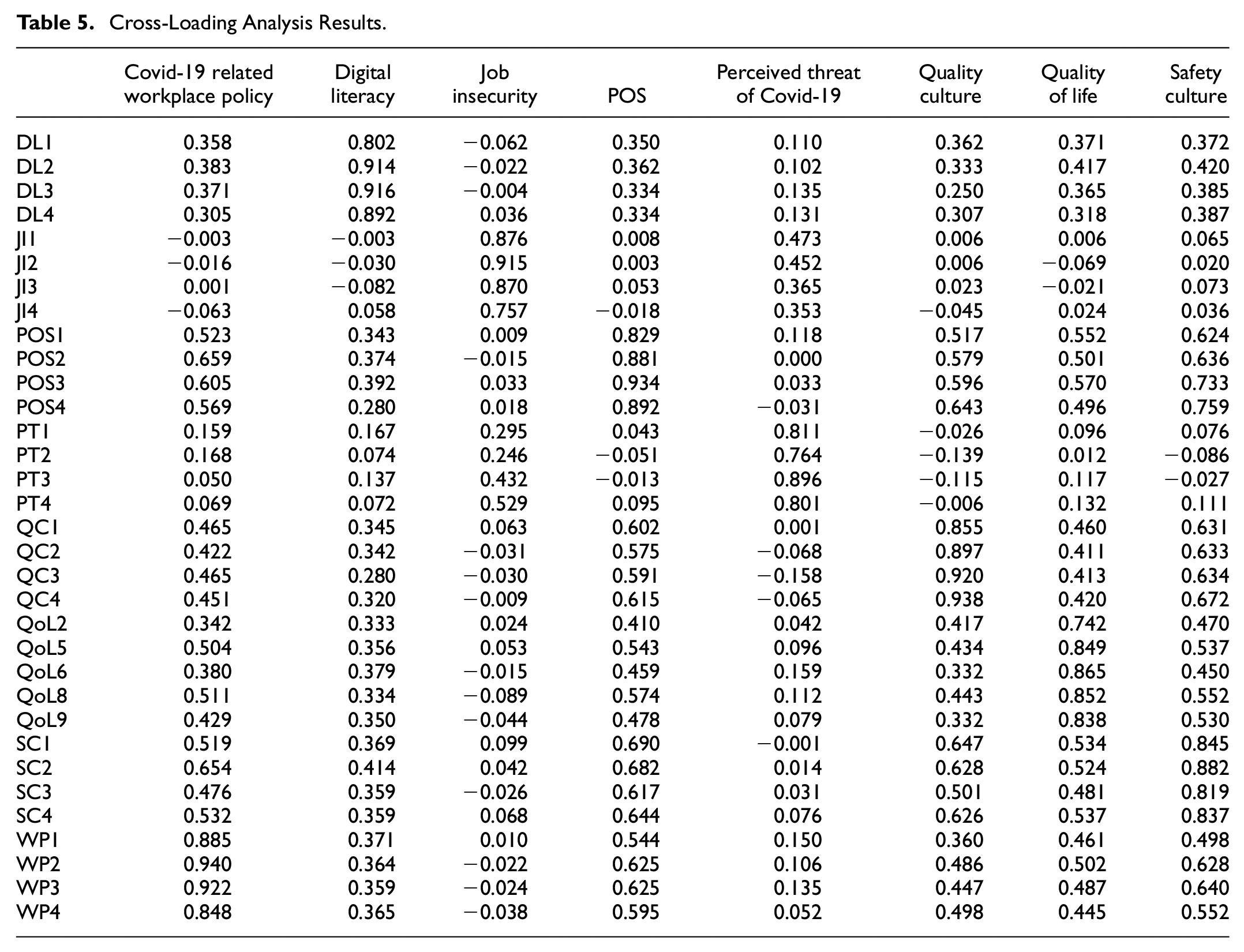
The results of the convergent validity analysis can be seen in Table 3. From Table 3, the AVE value of each construct was above 0.5 (Yang et al., 2022). In addition, the value of each outer loading of the indicator is maintained above 0.7 (Seema et al., 2021). Thus, each construct of this research met the criteria of Convergent Validity. In the aspect of discriminant validity, the test results of The Fornell–Larcker criterion can be seen in Table 4. From Table 4, each construct had a value of the square root of AVE that was higher than the correlations (Yang et al., 2022). Table 5 shows the results of the cross-loading analysis. Based on Table 5, all constructs had indicators with the largest loading values on their constructs with a minimum difference of 0.1 with the loading values on other constructs (Sun et al., 2022). Thus, each construct met the requirements of discriminant validity. In the aspect of construct reliability, the CR and CA values were also shown in Table 3. Each construct has a CR and CA value above 0.6 (Sun et al., 2022). Therefore, the requirements for construct reliability were also met.
The Convergent Validity and Reliability Test Results.

Fornell–Larcker Criterion Testing Results.

Cross-Loading Analysis Results.
Structural Model Analysis and Hypotheses Testing Result
Figure 2 and Table 6 show the results of the path coefficient analysis. Based on path coefficient analysis, there were seven hypotheses supported by the data, namely H3, H5, H9, H12, H15, H16, and H17. The rejected hypotheses were H1, H2, H4, H6, H7, H8, H10, H11, H13, H14, and H18. Based on the results of the hypothesis test, it can be concluded that the factors that had a significant effect on the QoL of non-health sector workers during the Covid-19 pandemic are POS, Safety Culture, Quality Culture, and Covid-19 related workplace policy. More specifically, POS has a direct and positive effect on QoL. Safety culture had a direct effect and an indirect effect through POS. Quality culture and Covid-19-related workplace policies had an indirect effect on QoL through POS.

The results of PLS-SEM on the structural model.
Hypothesis Testing Results.

The first hypothesis stated that job insecurity negatively affects the QoL of non-health sector workers during the Covid-19 pandemic. The finding of this study shows that the first hypothesis was rejected (β = −.092, p = .148). This shows that job insecurity doesn’t significantly affect the QoL of non-health sector workers during the Covid-19 pandemic. This finding is different with Pacheco et al. (2020), Mondragon et al. (2021), and Ikeda et al. (2022).
The second hypothesis stated that perceived threat of Covid-19 negatively affects the QoL of non-health sector workers during the Covid-19 pandemic. The finding of this study shows that the second hypothesis was rejected (β = −.117, p = .086). This shows that perceived threat of Covid-19 doesn’t significantly affect the QoL of non-health sector workers during the Covid-19 pandemic. This finding is different with Zhang et al. (2021), Chen et al. (2021), and Wong et al. (2022).
The third hypothesis stated that perceived threat of Covid-19 positively affects job insecurity for non-health sector workers during the Covid-19 pandemic. The finding of this study shows that the third hypothesis was supported (β = .493, p = .000). This shows that the higher perceived threat of Covid-19 the higher QoL of non-health sector workers during the Covid-19 pandemic and vice versa. This finding supports the finding of Vu et al. (2022).
The fourth hypothesis stated that digital literacy positively affects the QoL of non-health sector workers during the Covid-19 pandemic. The finding of this study shows that the fourth hypothesis was rejected (β = .133, p = .091). This shows that digital literacy doesn’t significantly affect the QoL of non-health sector workers during the Covid-19 pandemic. This finding doesn’t support Maingi and Wachira (2022).
The fifth hypothesis stated that POS positively affects the QoL of non-health sector workers during the Covid-19 pandemic. The finding of this study showed that the fifth hypothesis was supported (β = .234, p = .041). This shows that the higher POS the higher QoL of non-health sector workers during the Covid-19 pandemic and vice versa. This finding supports the finding of Baker and Kim (2020), Woon et al. (2021), and Vafaei et al. (2020).
The sixth hypothesis stated that POS negatively affects job insecurity for non-health sector workers during the Covid-19 pandemic. The finding of this study showed that the sixth hypothesis was rejected (β = −.050, p = .569). This shows that POS doesn’t significantly affect job insecurity for non-health sector workers during the Covid-19 pandemic. This finding is different with Salvador et al. (2022).
The seventh hypothesis stated that POS negatively affects perceived threat of Covid-19 for non-health sector workers during the Covid-19 pandemic. The finding of this study showed that the seventh hypothesis was rejected (β = −.065, p = .632). This shows that POS doesn’t significantly affect perceived threat of Covid-19 for non-health sector workers during the Covid-19 pandemic. This finding is different with Labrague and De Los Santos (2020).
The eighth hypothesis stated that Covid-19-related workplace policy positively affects the QoL of non-health sector workers during the Covid-19 pandemic. The finding of this study shows that the eighth hypothesis was rejected (β = .102, p = .242). This shows that Covid-19-related workplace policy doesn’t significantly affect the QoL of non-health sector workers during the Covid-19 pandemic. This finding is different with Mondragon et al. (2021) and Wong et al. (2022).
The nineth hypothesis stated that Covid-19-related workplace policy positively affects POS for non-health sector workers during the Covid-19 pandemic. The finding of this study shows that the nineth hypothesis was supported (β = .264, p = .000). This shows that more positive the Covid-19-related workplace policy the higher POS for non-health sector workers during the Covid-19 pandemic. This finding supports Mahmud et al. (2021).
The 10th hypothesis stated that Covid-19-related workplace policy negatively affects perceived threat of Covid-19 for non-health sector workers during the Covid-19 pandemic. The finding of this study shows that the 10th hypothesis was rejected (β = .191, p = .087). This shows that Covid-19-related workplace policy doesn’t significantly affect perceived threat of Covid-19 for non-health sector workers during the Covid-19 pandemic. This finding is different with Vu et al. (2022) and Wong et al. (2022).
The 11th hypothesis stated that quality culture positively affects the QoL of non-health sector workers during the Covid-19 pandemic. The finding of this study shows that the 11th hypothesis was rejected (β = .020, p = .849). This shows that quality culture doesn’t significantly and directly affect the QoL of non-health sector workers during the Covid-19 pandemic. Furthermore, this finding doesn’t support the notion that a quality culture that directs companies to focus on employee satisfaction will automatically increase QoL (Wu, 2015).
The 12th hypothesis stated that quality culture positively affects POS for non-health sector workers during the Covid-19 pandemic. The finding of this study shows that the 12th hypothesis was supported (β = .193, p = .026). This shows that the higher quality culture the higher POS for non-health sector workers during the Covid-19 pandemic. This finding supports the notion that a quality culture that directs companies to focus on employee satisfaction will automatically increase POS (Wu, 2015).
The 13th hypothesis stated that quality culture positively affects Covid-19-related workplace policy for non-health sector workers during the Covid-19 pandemic. The finding of this study shows that the 13th hypothesis was rejected (β = .078, p = .411). This shows that quality culture doesn’t significantly and directly affect workplace policy for non-health sector workers during the Covid-19 pandemic. Furthermore, this finding doesn’t support the notion that a quality culture that directs companies to anticipate opportunities and risks that come from the company’s business environment will automatically increase workplace policy (Wu et al., 2011).
The 14th hypothesis stated that quality culture negatively affects job insecurity for non-health sector workers during the Covid-19 pandemic. The finding of this study shows that the 14th hypothesis was rejected (β = .072, p = .412). This shows that quality culture doesn’t significantly and directly affect job insecurity for non-health sector workers during the Covid-19 pandemic. Furthermore, this finding doesn’t support the notion that a quality culture that directs companies to become more sustainable and adaptive to changes in the business environment will automatically reduce job insecurity (Woo et al., 2014).
The 15th hypothesis stated that safety culture positively affects the QoL of non-health sector workers during the Covid-19 pandemic. The finding of this study showed that the 15th hypothesis was supported (β = .294, p = .011). This shows that the higher safety culture the higher QoL of non-health sector workers during the Covid-19 pandemic and vice versa. This finding supports Mahmud et al. (2021).
The 16th hypothesis stated that safety culture positively affects POS for non-health sector workers during the Covid-19 pandemic. The finding of this study showed that the 16th hypothesis was supported (β = .470, p = .000). This shows that the higher safety culture the higher POS for non-health sector workers during the Covid-19 pandemic and vice versa. This finding supports Mahmud et al. (2021).
The 17th hypothesis stated that safety culture positively affects workplace policy for non-health sector workers during the Covid-19 pandemic. The finding of this study showed that the 17th hypothesis was supported (β = .592, p = .000). This shows that the higher safety culture more positive workplace policy for non-health sector workers during the Covid-19 pandemic and vice versa. This finding supports Panahi et al. (2021).
The 18th hypothesis stated that safety culture negatively affects perceived threat of Covid-19 for non-health sector workers during the Covid-19 pandemic. The finding of this study shows that the 18th hypothesis was rejected (β = −.038, p = .753). This shows that safety culture doesn’t significantly affect perceived threat of Covid-19 for non-health sector workers during the Covid-19 pandemic. This finding doesn’t support Panahi et al. (2021).
Theoretical Implications
The QoL of non-health sector workers during the Covid-19 pandemic is still rarely discussed. Furthermore, the literature discussing the QoL of non-health sector workers during the Covid-19 pandemic tends to focus on factors perceived threat of Covid-19, Covid-19-related workplace policy and job insecurity. This research provides a fundamental contribution in the form of developing and testing a QoL model for non-health sector workers during the Covid-19 pandemic by involving: not only the perceived threat of Covid-19, Covid-19 related workplace policy and job insecurity but also digital literacy, perceived organizational support/POS during Covid-19, quality culture, and safety culture.
The results of this research indicated that the QoL of non-health sector workers during the Covid-19 pandemic was directly and positively affected by POS and safety culture. In addition, QoL was also indirectly affected by Covid-19 related workplace policy, Quality Culture and Safety Culture through POS. However, several factors, namely digital literacy, the perceived threat of Covid-19, and job insecurity, did not have a significant effect on the QoL of non-health sector workers during the Covid-19 pandemic.
This study revealed that job insecurity did not significantly affect the QoL of non-health sector workers during the Covid-19 pandemic. This finding was different from the previous study conducted by Pacheco et al. (2020), Mondragon et al. (2021), and Ikeda et al. (2022). This difference was due to the context of research conducted on workers who were still working at companies/institutions after the Covid-19 pandemic lasted more than 2 years. This showed that the company/agencies had good resilience in facing Covid-19. In addition, at the time the research was conducted, the Indonesian government was intensifying economic recovery programs and incentives to support the industry in recovering from Covid-19. All of these conditions were likely to create perceptions from workers regarding job security. Therefore, job insecurity was not a significant factor affecting the QoL of non-health sector workers during the Covid-19 pandemic.
This research found that the perceived threat of Covid-19 did not significantly affect the QoL of non-health sector workers during the Covid-19 pandemic. This contrasts with the findings of Zhang et al. (2021), Chen et al. (2021), and Wong et al. (2022). This difference is likely closely related to the context of the research conducted at a time when the number of Covid-19 cases had decreased significantly. The Indonesian government had begun to reduce the strictness of Covid-19 control for the community. In addition, workers generally received a complete Covid-19 vaccination.
The findings of this research showed that digital literacy had no significant effect on the QoL of non-health sector workers during the Covid-19 pandemic. This finding showed a difference with the alleged role of digital literacy that will have an important effect on QoL considering the Covid-19 pandemic had limited physical interaction and the need for digital technology assistance. The insignificance of digital literacy to the QoL of non-health sector workers during the Covid-19 pandemic may be due to two things. First, the use of digital technology not only has a positive impact but can also have a negative impact, such as stress and more unlimited work time (Chan et al., 2021; Manroop & Petrovski, 2022). Workers with high digital literacy have the potential to be given a higher workload when the use of digital technology is needed to facilitate work. The increased workload had the potential to cause emotional stress. The positive and negative impacts of digital literacy make the effect of digital literacy on QoL insignificant. Second, the insignificance of digital literacy to QoL can also be caused by the context of the research conducted when the restrictions imposed by the government began to be reduced. This condition caused problems that initially could only be solved with the help of digital technology to be solved without the help of digital technology, such as physical meetings.
Practical Implications
This research revealed that three important factors affected the QoL of non-health sector workers, namely POS, Covid-19-related workplace policy, Quality Culture and Safety Culture. For non-health sector companies/institutions that wanted to increase the QoL of their workers. There were several practical implications. First, companies/institutions need to measure and monitor not only the QoL of their workers but also POS, Covid-19-related workplace policy, Quality Culture and Safety Culture regularly. The measurement model used in this research could be used to measure and monitor worker conditions related to these factors.
Second, companies/institutions needed to improve the POS of their workers. POS was a concept that described workers’ perceptions of the company’s appreciation and concern for employees (Akgunduz et al., 2018; Le & Lei, 2019). In that context, to improve the POS of their workers during the Covid-19 pandemic, companies/agencies need to provide support to workers who can be perceived as appreciating and being concerned about the company during the Covid-19 pandemic. For example, companies/institutions can give awards for employee contributions for working during the Covid-19 pandemic. Companies/agencies could also assist employees if employees and their families are affected by Covid-19. Furthermore, Companies needed to provide support in the form of responses to employee complaints related to working conditions during the Covid-19 pandemic. In addition, companies needed to provide the support that ensured worker satisfaction at work during the Covid-19 pandemic.
Third, companies/institutions needed to develop a quality culture and safety culture and consistently apply Covid-19 related workplace policies. Quality culture and safety culture were sub-sets of organizational culture. Organizational culture development too time. In that context, one thing that organizations could do was implement a management system that supports the establishment of a positive Quality and safety culture. More specifically, organizations can adopt and implement ISO 9001, a standard that can have an impact on the formation of a quality culture, and OHSAS 18001 or ISO 45001, standards that focus on a safety culture.
Conclusion, Limitations and Future Research
This research aims to study the QoL of non-health sector workers during the Covid-19 pandemic by involving not only the perceived threat of Covid-19, Covid-19-related workplace policy and job insecurity factors but also digital literacy, perceived organizational support/POS during Covid-19, quality culture, and safety culture. The results showed that QoL is affected directly and positively by POS and safety culture. In addition, QoL is also indirectly affected by the Covid-19-related workplace policy, quality culture and safety culture through POS. However, several factors, namely digital literacy, the perceived threat of Covid-19, and job insecurity, do not have a significant influence on the QoL of non-health sector workers during the Covid-19 pandemic. In addition, this research also found that quality culture did not affect Covid-19 related workplace policy and job insecurity. The perceived threat of Covid-19 is not affected by the Covid-19-related workplace policy and safety culture. Job insecurity is affected by the perceived threat of Covid-19.
Although this research provides some useful findings, some limitations and opportunities for further research need to be considered. First, this research was only conducted in the context of workers working in Indonesia. To test the model in other contexts, research needs to be done involving workers working in other countries. Second, this research was conducted with a cross-sectional approach. To test the stability of the research results, research using a longitudinal approach needs to be conducted. Third, R2 of QoL in this research was 45.5%. This means that the QoL can be explained by 54.5% by factors other than those in this study. Future research needs to identify these factors.
Footnotes
Author Contributions
All authors listed have made a substantial, direct, and intellectual contribution to the work, and approved it for publication. All authors are the main contributors to the writing of this article.
Declaration of Conflicting Interests
The author(s) declared no potential conflicts of interest with respect to the research, authorship, and/or publication of this article.
Funding
The author(s) disclosed receipt of the following financial support for the research, authorship, and/or publication of this article: We would like to extend our appreciation to King Saud University for funding this work through the Researcher Supporting Project (RSP2024R481), King Saud University, Riyadh, Saudi Arabia.

Data Availability Statement
The data supporting the findings of this study are available upon request from the corresponding author.