




Abstract
This paper adopted a historical institutionalist framework to identify the major developmental stages of Chinese foundations that were established from the 1980s onward and examined their emergence and evolution. By examining primary and secondary data, and conducing statistical analysis results, this study demonstrates Chinese foundations’ developmental characteristics from 2008 to 2017. The emergence of public fundraising foundations (PFFs) has followed in the wake of the developmental path of such foundations; the government’s intention has been to use them to supplement the functions of administrative departments. Subsequent developments demonstrate that there was a stronger relationship between the working model of each PFF and the developmental direction of the entire foundation in relationship to previous developments regarding the state. Such foundations have increased rapidly since 2004, and interactions of foundations with grassroots NGOs started in 2008. However, later interactions with grassroots NGOs did not have a transformative effect on the operation of these foundations. This study’s findings reveal that, in China, government-affiliated foundations formulated their own approaches for fundraising and for creating and using operating models; furthermore, right from the early stages, Chinese foundations excluded grassroots NGOs from their operating mechanisms.
Introduction
Few studies have examined the social and political contexts amid which Chinese philanthropic foundations developed. Despite the long history of civic organization in China (DuBois, 2015), most studies have focused on philanthropic foundations established from the 1980s (Ma et al., 2017) onward; this is mainly because there had been little space for establishing and developing foundations and grassroots NGOs during modern China’s earliest years (1949 to 1978) because of the government’s assumption of sole responsibility for conducting social welfare (Deng, 2001; Yang, 2010). As Xu (2010) has explained, the government’s adoption of long-term egalitarianism and the paucity of necessary resources reduced any potential economic base for philanthropic activities. Moreover, the Chinese government labeled philanthropy as a tool for imperialist spies to exploit outdated feudal rules to win public support (Zhou & Lin, 2014).
When major reforms were first instituted in 1987, the Chinese economy was still underdeveloped, and government agencies often sought private financial resources to plug any resource gaps that could hamper provision of social services including poverty alleviation and educational development. Government agencies established several governmental or “government-led foundations.” These institutions aimed to raise funds from the public and absorbing financial resources from overseas Chinese and international organizations that were more likely to cooperate with and support social organizations compared to the government (Chan & Lai, 2018). These foundations were mostly established by the government and by subordinate groups under the supervision of government agencies and institutes or state-owned enterprises. 1 While the public was still unfamiliar with these institutions, they were able to gain support and raise funds based on this mechanism.
During this period, one distinct function of foundations was raising funds in various ways and providing public welfare and social services in order to bridge the gaps left by government agencies. Because of the relatively relaxed political situation and economic growth induced by China’s reforms and “opening-up” policy, foundations flourished during the 1980s; however, the absence of any legal and regulatory mechanisms for registering or governing such entities caused chaos, particularly in the southern coastal areas. Due to the rapid economic development of this period, expatriates hailing from the southern coastal areas began to gain wealth rapidly, and many of them wished to give back to their communities. Consequently, non-government-affiliated foundations were established across rural areas; these entities presented various financial and management risks (Xu, 2010; Yang, 2010).
Before the promulgation of the Regulations on the Management of Foundations of 2004 (henceforth RMF-2004), only the government could establish such foundations. The Regulations on the Administration of Foundations of 1988 (RMF-1988 hereafter) had left many aspects of the form or operations of foundations unregulated. Furthermore, because of government-dominant foundations already reaching a bottleneck and experiencing significant limitations, RMF-1988 was unable to cater to the developmental and management needs of later foundations; the new economic reforms and opening-up policies of China, gradual improvement in the market economic system, and reforms aimed at government institutions after 1992 (Kang et al., 2011) also contributed to this situation. During the late 1990s, international scholars reported that China did not have a mature or “true” civil society because social organizations, especially foundations, could not exist independently from government interference and implement any projects within the top-down, government-organized political system (Shieh, 2017; Wakeman, 1993).
After several private enterprises and individuals who had accumulated wealth expressed interest in the non-profit sector, the government realized its potential for mobilizing supplemental resources and promoting participation from social forces in public welfare (Kang et al., 2011). Consequently, to encourage social sectors to supplement public welfare and other similar undertakings, the central government amended foundation-related regulations based on China’s social service provision practices and international experiences since 2000.
Above all, philanthropic foundations have played an active role in resolving social issues and promoting innovation in the development of socio-economic diversification. Estes (1998) and Yang (2010) concluded that Chinese foundations emerged through two major movements: (1) the government’s establishment of the China Children and Teenagers’ Fund (CCTF) in 1981 and the China Soong Ching Ling Foundation (SCLF) in 1982 as public fundraising foundations (PFFs); and (2) the emergence of nonpublic fundraising foundations (NPFFs) as social associations that could be registered as charitable foundations during the second year of the RMF-1988. The foundations in the first category were financed by private, government, and international NGOs’ funds instead of government endowment funds; the foundations established during this period varied in terms of size and had a variety of funding sources (Estes, 1998, pp. 170–173).
Similarly, Chan and Lai (2018) establish a distinction between foundation regimes established before and after the 2004 reforms. They designated foundations that were established during the first stage before 2004 as belonging to the “statist model,” wherein most foundations were established by government agencies in order to serve as executive helpers. Foundations established during the second stage after 2004 were referred to as belonging to the “corporatist model,” wherein Chinese foundations were nominally independent but generally expected to supplement the central government’s social welfare provisions. As Chan and Lai (2018, p. 1806) claimed, “theoretically, nongovernmental foundations could apply for public fundraising status, but it turned out that only a handful of cases were successful as the authorities seemingly wanted to protect the major governmental foundations in the fundraising market.”
Therefore, this paper identifies the developmental stages of Chinese foundations from the 1980s and examines their emergence and evolution by exploring the historical development of Chinese foundations since the establishment of the People’s Republic of China (PRC) and the introduction of the 1980s’ reforms. Specifically, this study proposed two research questions as follows: (1) How have Chinese philanthropic foundations evolved from 1949 until 2017, and what were the social, political, and legal contexts of those developments? (2) What common management, growth, and interaction-relationship patterns regarding Chinese foundations can be identified since the establishment of grassroots NGOs in 2008? We adopted a historical institutionalism as an approach to examine major chronological developments and changes regarding foundations, especially regarding the interaction patterns between foundations and grassroots social organizations (SOs). This topic can not only shed light on the broader issues of SO activities in China but also provide a framework to understand foundations in Eastern societies, and may help to conduct more comparative studies.
Theoretical Framework: Historical Institutionalism
This study introduces a theoretical framework for understanding major developmental changes within Chinese foundations from the perspective of historical institutionalism (HI). Like Chan and Lai (2018), this paper divides the development of Chinese foundations into two main stages that occurred before and after the emergence of NPFFs, with RMF-2004 being a critical juncture. The first stage refers to the period from 1981 to 2003, and the second stage is divided into two periods: from 2004 to 2007 (the early appearance of NPFFs) and from 2008 to 2017 (rapid growth of Chinese foundations).
One key concept of HI is path dependence, which could be useful for exploring historical and current developments and for understanding the political dynamics of Chinese foundations. According to Pierson (2000), there are certain self-reinforcing processes in and among institutions that make them path-independent; this makes it difficult to change relevant policies once a pattern has been selected and established.
In this context, the timing and sequencing of institutional developments are of critical importance for determining causal mechanisms and critical junctures (Capoccia & Kelemen, 2007; Sorensen, 2015), regarding to the development of Chinese foundations. Critical junctures constitute the starting point of these evolutionary processes; they represent “specific periods of time during which decisions taken not only reflect major digressions from previous policies but also have a lasting and significant impact on subsequent outcomes and structures” (Gal & Bargal, 2002, p. 432). Major events and important decisions made during such periods can directly determine the direction and path of the next stage of a given historical development. Using historical institutionalism to examine various developments and changes regarding Chinese foundations in a chronological manner helps to build a holistic understanding of any future directions of such foundations.
Methodology
Given that the current research on the development of Chinese foundations is still very limited, this study prioritized official (government) data in cases where differences were found between the numbers of foundations reported by government departments and those reported in research reports such as the Foundation Green Book series and the Foundation Blue Book series. In addition, because the number of foundations is different in different years due to different statistical conditions, and the number of foundations is constantly updated, I have compared and analyzed different data, and used the most recently updated data as the research data for this article.
To address the first research question, this study examined secondary data such as academic literature, newspapers, and reliable social media as well as primary data from government reports and organizations’ reports and websites. Three online sources were particularly useful: (1) created in 1996 and registered as an enterprise in 2017, the China Development Brief is known as China’s first independent civil society information platform both in English and Chinese; (2) founded in 2001, supervised by the Ministry of Civil Affairs, and compiled by the China Association of Social Workers, the China Philanthropy Times is China’s first national newspaper dealing with the field of philanthropy; and (3) created in 2010, the China Philanthropist Magazine has published numerous articles on social foundations and philanthropy.
To address the second research question, this paper presented statistical analysis results for organizational growth patterns, funding scales, resources, and fields of operation in order to demonstrate their developmental characteristics from 2008 to 2017. This will help to build a more complete understanding of the interactions between recently established foundations and grassroots NGOs.
To explain the interactions between foundations and grassroots NGOs, this study analyzed PFFs and NPFFs separately owing to their different pathways and organizational philosophies regarding cooperating with grassroots NGOs. Secondary data and resources from articles and books were collected to supplement primary data from four major sources: (1) the Statistical Communiqué (Minjian zuzhi linian tongji shuju) issued by the Ministry of Civil Affairs; (2) Development of Chinese Foundations: An Independent Research Report (2011–2015); (3) the Annual Report on China’s Philanthropy Development (2011–2013, 2017–2019); and (4) the Annual Report on China’s Foundation Development (2012–2014, 2016). To resolve the discrepancies between the different reports and studies, this study prioritized data from the Statistical Communiqué.
Early Chinese Foundations (1981–2004): Emergence of PFFs and Foundations as Brand-Builders
By the 1980s and 1990s, building a foundation’s brand had become an important task, which, in turn, generated certain social effects for raising more funds from the public. Many PFFs that were established during this period are still operating today, and they have progressed significantly by using a top-down approach for creating a series of nonprofit brands and for improving their influence and impact. Foundations’ projects were usually given pleasant and meaningful names in order to create brands, stimulate favorable reactions, and enhance current and future fundraising. As Xu (2010) concluded, projects such as the China Disabled Persons Foundation were established for attracting foreign funds and aid; however, despite unsuccessful attempts to obtain funds from Western sources, their development was driven to collect money. This developmental path focuses on the issue of where funds come from instead of where they are going.
Influenced by the brand-building operating model, foundations concentrated on operating their own projects using their own operating styles. Most of these foundations were established with an underlying project-oriented or specific missions (e.g., Project Hope for Building Schools [Xi Wang Gong Cheng], which was organized by the China Youth Development Foundation; the Communist Youth League Central Committee in 1989, which was established to provide education in rural areas; and the Water Cellar for Mothers [Mu Qin Shui Jiao] project, which was jointly launched by the All-China Women’s Federation (ACWF), Beijing Municipal People’s Government, and China Central Television [CCTV] in 2001 to increase access to drinking water in Western China). Other examples of such foundations include the Spring Bud Plan (Chun Lei Ji Hua), which aimed to help girls from poor homes return to school; the Happiness Project (Xing Fu Gong Cheng), which aimed to help poor mothers; the Lifeline Express (Jian Kang Kuai Che), which aimed to provide medical care; and the Lovely Hearth Package (Ai Xin Bao Guo), which was designed for rural pupils.
The Chinese state—and Chinese society as well—desperately required resources to operate social welfare projects. This need blurred the boundaries between foundations and the state. Staff positions in foundations were occupied by government officials, and even today, the management of such foundations is still carried out using government systems or quasi-government agencies, civil services, and public institutions. Even when such projects are primarily sustained by public involvement, they are largely regarded as subsectors of government agencies. 2
RMF-1988 presented the first legislative clarification of the nature and status of Chinese foundations, and the Regulations on Social Group Registration and Administration of 1989 (hereafter, 1989 Regulations) reaffirmed the legal nature and status of foundations as well as their dual registrations as foundations and “social associations.” In practice, foundations were treated as quasi-financial institutions; these new regulations situated the registration of foundations under a “triple supervision”; the People’s Bank of China oversaw approvals of registrations, and foundations were managed by assigned supervising units and administered by affiliated civil affairs departments. However, these regulations did not govern certain other aspects of such foundations’ organizational forms, internal decision-making procedures, financial accounting systems, asset management mechanisms and processes, or social supervision of the Chinese philanthropic sector (Kang et al., 2011).
The years immediately following the introduction of these regulations witnessed the establishment of a few Chinese foundations. The relevant policies were framed to be cautious because of political unrest, and the public at this time had showed little interest or enthusiasm for foundations (Yang, 2010). During this period, foundations were mainly initiated by the government or its affiliates, generally had strong administrative functions, and utilized quasi-governmental management mechanisms. Yang (2010) observed that the parties that drafted the 1988 and 1989 regulations as well as those that operated such foundations did not seem to understand the difference between foundations and public fundraising organizations and did not possess robust fundraising strategies or project operations (Xu, 2010).
The growth rate of Chinese foundations first dropped in 1990 and 1991 and, once again, in 1995, when the Ministry of Agriculture and the People’s Bank of China issued the Notice Concerning Strengthening Administration of Rural Cooperative Foundations to manage and approve the registration of foundations. In 1998, the Regulations for Registration and Management of Social Organizations were promulgated. These regulations, which are still in effect, reclarified the roles and responsibilities of registration and administration offices and supervisory units, thus strengthening the dual administration management system by mandating that foundations should be overseen by a supervisory unit under government agencies or that institutions should be established, and registration should be carried out under civil affairs departments. In 1999, the aforementioned spontaneously established rural cooperative foundations were completely disbanded by the government after the new legislation was introduced. After this, the total number of Chinese foundations did not change much until 2004 (Xu, 2010).
In short, from 1981 to 2003, the operations of foundations were gradually restricted and constrained, but they continued to develop in a steady manner. On the one hand, a new series of policies were introduced for regulating the registration and management of foundations. On the other hand, an increase in the threshold for initial funds and restrictions, which was imposed by regulatory authorities, curbed their growth (Kang et al., 2011; Wang, 2016; Xu, 2010; Yang, 2010).
Recognizing the Need for Further Reforms: Emergence of NPFFs (2004–2008)
The enactment of RMF-2004 marked a new era for Chinese foundations. The most significant change was the introduction of nonpublic foundations; these are often founded by corporations or wealthy individuals as receptacles for private funds (Chan & Lai, 2018). RMF-2004 facilitated the rapid growth of Chinese foundations, especially NPFFs. It focused on protecting the legitimate rights and interests of foundations, donors, and beneficiaries as well as tax benefits and financial documentations. Article 26 of RMF-2004 noted that “Foundations, their donors, and beneficiaries enjoy tax benefits as stipulated by law and administrative regulations.” The resulting tax reductions and exemptions allowed individuals and entrepreneurs to engage in philanthropic works. Thus, the Ai You Foundation and the Heungkong Charitable Foundation were registered in Beijing as the first NPFFs at the local level in 2004. These were the first nationwide nonpublic fundraising foundations, which were established in 2005.
From 2004 to 2007, the total number of Chinese foundations increased rapidly from 7 to 47. In one case, 17 foundations were established on a single day in Zhejiang Province (Kang et al., 2011, pp. 26–27). Two factors explain this phenomenon: (1) rapid growth of the Chinese economy in the 2000s, which created a generation of entrepreneurs who could sustain NPFFs; and (2) an encouraging political environment, which included the implementation of positive policies such as RMF-2004, the first national conference on philanthropy, which issued the Guidelines for the Development of Chinese Philanthropy (2006–2010) in 2005, and the Enterprise Income Tax Law of 2007.
Similar Operating Styles Between the New NPFFs and PFFs: The Additional Advantages Enjoyed by PFFs
The NPFFs were expected to function as links to grassroots NGOs; however, an examination of the foundations that were founded from 2004 to 2007 reveals that the regulation did not produce the expected effect. 3 For example, one of the earliest recorded instances of collaboration between a Chinese foundation and grassroots NGOs was a village-level poverty-relief project wherein the Jiangxi provincial government outsourced services to an SO in order to implement the relevant project (Shieh, 2017; Xu, 2008). However, the foundation gradually lost interest in the project because it was not sustainable in a top-down system. There are several reasons why RMF-2004 failed to produce the desired effect.
First, NPFFs did not offer any grants to grassroots NGOs. RMF-2004 specifies the following:
Article 29: The amount of money spent annually by PFFs on the public benefit activities stipulated in their charter must not be less than 70% of the previous year’s income; NPFFs’ annual expenditure on the public benefit activities stipulated in their charter must not be less than 8% of the surplus from the previous year.
A foundation may not allocate more than 10% of its total expenditure to cover staff wages, benefits, and overheads.
Why did RMF-2004 specify low administrative fees and high expenditure on activities? As Tao and Liu (2014, p. 114) explained, based on the legislative intent, the 70% and 8% (public welfare ratio) mentioned in Article 29 was determined to ensure continuous spending for meeting the public’s expectations; however, this measure imposed limits on such foundations’ capacity-building and long-term development. Similarly, a low administrative outlay essentially converted these institutions into funding agencies for public welfare rather than independent project operators (Chan & Lai, 2018; H. Wang, 2018).
Second, a supervisory unit under government agencies or institutions was necessary for carrying out dual administrative management. The Civil Society Administration of the Ministry of Civil Affairs of China is responsible for registering social groups or SOs, including foundations. However, before it can be registered, a given organization must select a supervisory unit from within a government department, to which its superior will be accountable, and report to the Ministry of Civil Affairs. In this way, any social organization, including any foundation, is brought under the supervision of certain government agencies. In fact, this kind of supervision is usually lax and can even be invisible; nonetheless, the supervisory unit reserves the right to decide the fate of the given foundation, if necessary.
The third reason is associated with the stated purpose of these NPFFs. The Heung Kong Charitable Foundation’s website states that the Heung Kong Group contributed more than 1.6 billion yuan to various public welfare causes such as education, poverty alleviation, and rescue and disaster relief over the previous years. As a private enterprise, it has fulfilled its solemn commitment of “giving back to society through business excellence.” 4
Ai You Foundation’s website says that, as the first private foundation registered in China (in 2004) that is initiated, managed, and led by entrepreneurs, it has delivered programs nationwide. After over a decade of exploration and development, it is now engaged in the following three areas of charity: child health care, child welfare, and venture philanthropy. 5
Excluding venture philanthropy, which began in 2014, areas of interest, including education, poverty alleviation, rescue and disaster relief, child health care, and child welfare, are traditional charitable fields, similar to those of PFFs. In short, these foundations were not established to provide grants to grassroots NGOs, and their areas of interest were similar to those of PFFs. These traditional charitable fields have been chosen by NPFFs because of the major influence of PFFs and strict government management. Moreover, PFFs continue to enjoy great advantages in terms of charitable fundraising.
The Roles and Characteristics of Chinese Foundations Between 1981 and 2007
In the early 1980s, foundations were created as agencies that were subordinate to the government, and they received administrative benefits in order to supplement agencies’ responsibilities (e.g., providing social welfare services to help children, enhance education, and alleviate poverty).
In the late 1990s, foundations began to assume independent social responsibilities and became essential supporting forces for promoting social development. After the promulgation of RMF-2004, Chinese foundations were expected to raise more private funds under the government’s dual management system.
Until 2007, Chinese foundations primarily operated under a top-down mechanism that did not encourage them to mandate grants and support the third sector or closely cooperate with grassroots NGOs. This hindered the growth of such foundations as well as the development of grassroots NGOs, which, in turn, affected the independence of the third sector.
One notable innovation introduced by RMF-2004 was its distinction between PFFs and NPFFs. The latter were expected to play a greater role in promoting the third sector. However, along with the previous, somewhat divergent, viewpoints regarding foundations, this situation created considerable challenges for NPFFs that wished to become grant-making foundations. Moreover, government-affiliated PFFs continued to enjoy advantages in terms of charitable funding and remained in charge of mobilizing many resources. Furthermore, foundations retained their focus on a specific range of operations and project areas that did not undergo any further changes or expansions.
Developmental Patterns Between 2008 and 2017
In Chinese philanthropic studies, the year 2008 has been called the “starting year of charity” because of the philanthropic activities that were triggered by the aftermath of the Wenchuan earthquake (Deng, 2013). Numerous influential non-governmental foundations emerged during this period, including the One Foundation in 2010; furthermore, some that were established earlier, such as the Lao Niu Foundation (family foundation established in 2004) and the Narada Foundation and You Cheng Foundation (both of the two corporate foundations established in 2007), began to actively and frequently interact with grassroots NGOs.
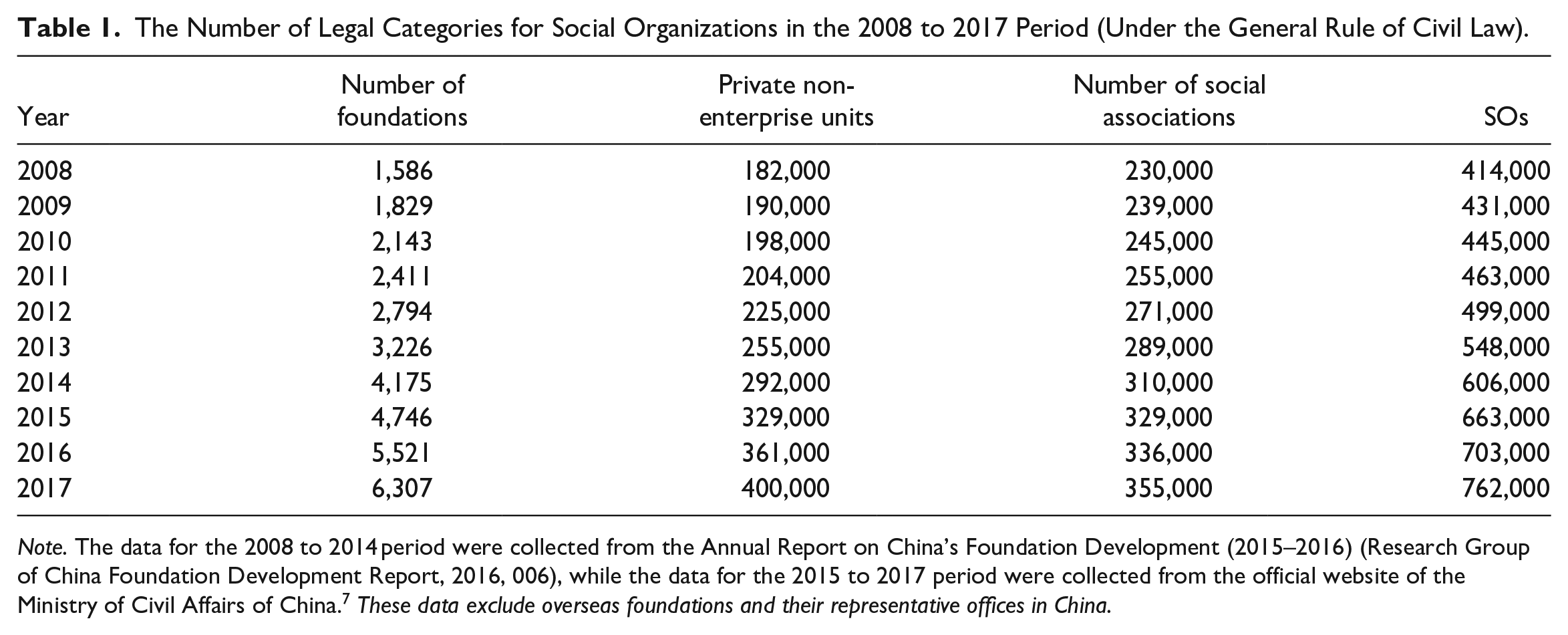
As shown in the Statistical Communiqué of Social Service 2016, there were 703,000 SOs in China at the end of 2016, 6 including 5,521 foundations (PFFs and NPFFs). Although the total number of foundations was comparatively small (Table 1), they became the key recipients of funding within the SO sector. In 2016, the total amount of social funding from donations reached 78.67 billion YUAN for all types of SOs, of which 62.55 billion yuan, or 80 %, was allocated to foundations. Consequently, it is safe to conclude that most of these funding resources are still held by foundations. In other words, numerous grassroots NGOs could not access funding resources.
The Number of Legal Categories for Social Organizations in the 2008 to 2017 Period (Under the General Rule of Civil Law).
Note. The data for the 2008 to 2014 period were collected from the Annual Report on China’s Foundation Development (2015–2016) (Research Group of China Foundation Development Report, 2016, 006), while the data for the 2015 to 2017 period were collected from the official website of the Ministry of Civil Affairs of China. 7 These data exclude overseas foundations and their representative offices in China.
Proliferation of Chinese Foundations
Table 1 summarizes the number of Chinese foundations that were established in the 2008 to 2017 period. The total number of foundations increased steadily from 1,586 to 6,307 over 10 years. Of the 6,307 foundations that were in operation by the end of 2017, 1,678 were PFFs, and 4,629 were NPFFs. The proportion of NPFFs increased from 40.54% (by the end of 2008) to 73.39% (by the end of 2017).
After 2011, the number of NPFFs began exceeding the number of PFFs. Conversely, the development of PFFs stagnated, especially after 2014. This development can be explained as follows. First, the political environment created by RMF-2004 encouraged the establishment of NPFFs instead of PFFs (Kang et al., 2011, p. 21). Registering PFFs thus became more difficult; if government officials could not hold major positions in newly created foundations directly, the government agencies often did not approve their establishment or refused to act as supervising units. Second, the Chinese economy was growing quickly; hence, an increasing number of entrepreneurs were inspired to create private foundations.
Changing policies and political circumstances affected the creation of foundations. In 2016, the promulgation and implementation of the Charity Law of the People’s Republic of China mandated that philanthropy be brought under the rule of law in China. Meanwhile, the Charity Law reduced the differences between PFFs and NPFFs; both types of foundations were now allowed to raise funds from the public if they were accredited as charitable organizations by the Civil Affairs Department. Even NPFFs and SOs established before the Charity Law was established were designated as beginning qualified for pretax deductions for public welfare donations. If they had been registered for 2 years and were accredited as charitable organizations, they could apply for the right to raise public funds. All SOs accredited by the Civil Affairs Department as charity organizations were able to raise funds from the public.
However, the new Charity Law was controversial because it gave the Civil Affairs Department more flexibility in terms of regulating foundations and grassroots NGOs, although the related text of the relevant law was vague. See, for example, this excerpt from Article 23: Where the charitable organization fundraises from the public through the Internet, it shall release the fundraising information on the uniform charity information platform or the charity information platform designated by the Civil Affairs Department of the State Council (Source: Charity Law, 2016, adapted by the author).
According to this passage in Article 60, the expenditures of all charitable organizations were to be limited as follows: “The annual management expenses shall not exceed 10% of its total expenditure in the current year.” However, some NPFFs found the 10% limit too low, since it did not cover the costs of employing professional staff or renting appropriate offices. This law invested the Civil Affairs Department with the power to impose stricter controls besides its function as a supervisory unit and registration department. Only organizations that were designated as “ appropriate” by the Civil Affairs Department could now apply to become accredited charity organizations. 8 Note that, if a foundation made grants to grassroot NGOs or projects working on HIV, human rights, democracy, and similarly sensitive issues, it faced difficulty in gaining follow-up recognition from the government.
The General Provisions of the Civil Law of the PRC, which was established by the National People’s Congress of the PRC in 2017, confirmed the legal position of “a non-profit legal person,” including but not limited to public institutions, social groups, foundations, and social service organizations. Moreover, it revealed that the Chinese government was gradually and systematically increasing its regulation of nonprofit entities at the legislative level.
The Steady Growth of Foundation Assets
The total assets of Chinese foundations increased steadily from 2008 to 2017, as presented in Figure 1. The primary reason for this growth in assets in the rise in the number of foundations from 2008 to 2017. According to the Annual Report on China’s Philanthropy Development 2019 (Yang, 2019, p. 112), the total assets of 6,307 Chinese foundations reached 156.3 billion YUAN ($21.95 billion) by the end of 2017. 9 However, despite substantial growth over a 10-year period, the total assets of Chinese foundations were still less than half of the $51.85 billion in assets held by the Bill & Melinda Gates Foundation in 2017.
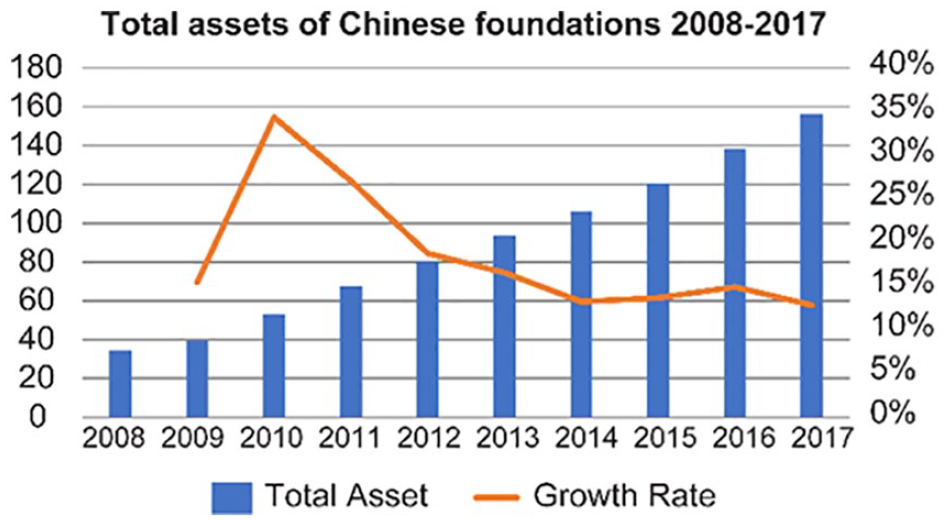
Total assets of Chinese foundations from 2008 to 2017 (million YUAN).
The original funds of the national PFFs were greater than those of the local PFFs, which, in turn, exceeded those of the NPFFs. Moreover, PFFs were more likely to receive multiple incomes each year compared to NPFFs because they could raise funds from the public and acquire funds from the government as well. As shown in Figure 2, more than half of the PFFs possessed net assets worth more than 100 million yuan, whereas more than 70% of NPFFs possessed net assets worth less than 100 million yuan. Deng and Tao (2017) suggested that this difference could be probably attributed to certain RMF-2004 requirements—that is, original funds and fundraising scales for different types of foundations. Article 2 of RMF-2004 states that “the original funds of national PFFs should be not less than 8 million yuan; the original funds of local PFFs should be not be less than CNY 4 million; the original funds of NPFFs should be not less than 2 million yuan.”
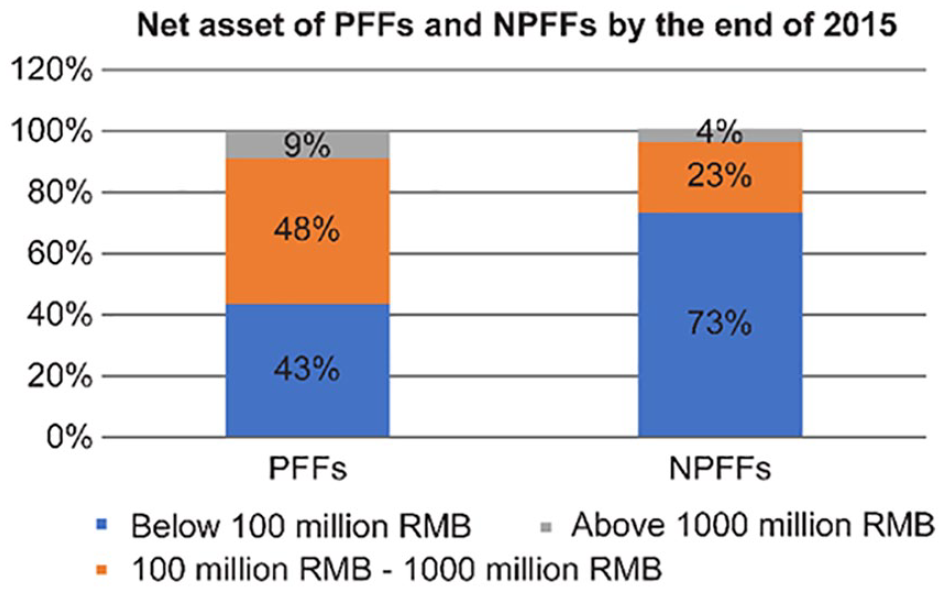
Net assets of PFFs and NPFFs by the end of 2015 (YUAN).
Continuous Growth of Total Income
In recent years, the total income of Chinese foundations has increased annually; however, a statistical study revealed that this could be attributed mainly to the establishment of newer foundations. For example, data showed that the increase in foundations’ income from 2014 to 2015 was largely driven by the establishment of 685 new foundations in 2015 (Yang, 2017).
The data presented in Table 2 reveal that overall donations increased between 2008 and 2017 but encountered two slowdowns in 2009 and 2012, respectively. Compared to 2008, the growth in 2009 was quite normal, though it encountered a slight slowdown, which caused a dramatic increase in donations. The slowdown in 2012 could be attributed to the Meimei Guo scandal of 2011, which hindered the public’s donations to most nonprofits, especially foundations (Ni & Zhan, 2017, p. 731).
Donations and Growth Rates of Chinese Foundations From 2008 to 2017 (Million YUAN) (Deng & Tao, 2017).

Table 3 reveals that, by the end of 2015, the average income of PFFs was more than twice that of NPFFs, although the total number of NPFFs exceeded the number of PFFs.
Average Income of PFFs and NPFFs in 2015 (Yang, 2017, p. 55).

Note. These data were collected from 3,779 foundations until December 31, 2015.
The data presented by Deng and Tao (2017) reveal that 87% of NPFFs accumulated a total income of less than 100 million YUAN, compared to 76% of PFFs. Considering that the number of NPFFs exceeded that of PFFs by the end of 2015, the total number of NPFFs with less than 100 million YUAN exceeded that of PFFs. Furthermore, the total number of PFFs with more than 100 million YUAN exceeded that of NPFFs. Specifically, PFFs exceeded NPFFs in terms of total and average income, even though the total number of PFFs was lower than that of NPFFs, as shown in Figure 3.

Total income of PFFs and NPFFs by the end of 2015 (YUAN).
Donations formed the main income source for both PFFs and NPFFs. They accounted for 58% and 71% of their total income, respectively, by the end of 2015. However, PFFs received more funding from the government than NPFFs (Table 4). Thus, the current development pattern still depends on previous decisions and paths. Applying the HI framework, it could be suggested that it may be difficult to change from operating to grant-making foundations because past policies and ideas that have motivated foundations have become institutionalized.
Percentage of Income Sources of PFFs and NPFFs in 2015.

Source. Yang (2017, p. 68).
Total Expenditures of Chinese Foundations
Figure 4 depicts the increase in such foundations’ expenditures along with their incomes (from 12.9 billion yuan in 2008 to 54.3 billion yuan in 2017).

Total expenditures (billion YUAN/year) and growth rate (percentage increase/decrease in the number of PFFs and NPFFs) from 2008 to 2017.
Table 5 shows that the average expenditures of PFFs far exceeded the average expenditures of NPFFs by the end of 2015. In terms of income, foundation expenditures were also related to the regulations expressed in Article 29 of RMF-2004 (see section 5.1).
Average Expenditures of PFFs and NPFFs in 2015.

Source. Yang (2017, p. 80).
Note. The data were collected from 3,779 foundations in China, which disclosed fundraising qualification types and net assets, until December 31, 2015.
Uneven Geographical Distribution: East Over West
Figure 5 depicts the uneven distribution of such foundations in China. While the Eastern region (such as the provinces of Guangdong, Jiangsu, Zhengjiang, and Shanghai) is home to many such foundations, a small number are found in the Northwestern region (Yang, 2019). The top five places (Guangdong, Beijing, Jiangsu, Zhengjiang, and Shanghai) have 3,429 foundations, which account for more than half of the total number of all foundations in China. The number of such foundations was influenced by the policies and political environment of the 1980s and 1990s; thus, changes in the total number of Chinese foundations has been positively related to the economic situation during this period.

Number of Chinese foundations in different provinces as of December 31, 2017.
Working Areas of Chinese Foundations
In addition to addressing primary areas of interest, foundations must function under the government’s current management system, including its dual registration management system. Corporate donors expect that their donations will be used for short-term projects that will give them credibility at a lower cost, which, in turn, will help them promote corporate social responsibility and generate sound marketing. This means that donations to government-linked groups are used as tax deductions unlike donations to non-governmental organizations.
Previous studies (e.g., Chan & Lai, 2018; Lai et al., 2015) have concluded that Chinese foundations tend to adopt traditional charitable activities that are related to certain issues, such as education improvement, poverty alleviation, or medicine and health enhancement, rather than development and social change.
Table 6 lists such foundations’ main work areas in 2014; education-related projects accounted for more than 50% of all such foundation projects in China. In addition to education, the top five fields included public welfare development, poverty alleviation and community development, medicine and health, and social services. In 2014, PFFs tended to make a greater percentage of investments in these areas compared to NPFFs.
Distribution of Working Areas Adopted by Chinese PFF and NPFF Projects in 2014.

Source. Research Group of China Foundation Development Report (2016, p. 67).
The top ten NPFFs in the 2018 period were the Tencent Philanthropic Foundation, Guangdong He Foundation, Tsinghua University Education Foundation, Beijing Jingdong Philanthropic Foundation, Ningxia Yanbao Philanthropic Foundation, Fanhai Philanthropic Foundation, Ai You Foundation, Laoniu Foundation, Zhejiang Mayun Philanthropic Foundation, and Heren Charity Foundation. One-third of these NPFFs are university foundations that raise funds and operate projects but do not interact with grassroots NGOs (Q. Wang, 2018). They mainly focus on areas such as education, disaster relief, and poverty alleviation rather than on health care, art, culture, public services, community development, and policy advocacy.
Discussion on the Characteristics of Chinese Foundations
Chinese foundations have been developing steadily over the past decades; each period of development in this regard has established a unique legacy and shaped the characteristics of the next. There was minimal interaction between Chinese foundations and grassroots NGOs during the 2004 to 2007 period. Due to the continuation of top-down operation mechanism and the rigidity of rules governing NPFF expenditures, the emergence of NPFFs could not resolve this issue. Long-established operating approaches and public donors’ perspectives regarding Chinese foundations made it difficult for them to alter their funding use patterns. This section examines the characteristics of these different foundation development periods and examines how they affected current foundations.
Characteristics of Chinese Foundations From 2008 to 2017
The rapid growth of NPFFs after 2008 significantly contributed toward the development of foundations in China. Chinese foundations remain small in scope, although they experienced sustained growth in terms of assets, income, and expenditures over the last 10 years due to an increase in their numbers.
Shieh (2017) noted that the “government-organized philanthropic ecosystem dominated China’s philanthropy scene” (p. 1793). Indeed, NPFFs have continued to function like PFFs within a government-organized philanthropic ecosystem; they share similar work areas and operating approaches. Conventions established by the government have continued to strongly influence the development of all Chinese philanthropic foundations in various ways.
Education has remained a priority working area across foundation types; it is followed by other traditional charitable issues including poverty alleviation, health, and children’s and women’s issues. Foundations’ working areas continue to be closely related to their supervisory unit and the relevant civil affairs department’s preference; this has ensured their subordinate position to their relevant supervisory units, civil affairs departments, and even finance bureaus.
Political Restrictions on Foundations’ Registrations and Evaluations
The dual registration management system has become an obstacle to the development of foundations. Before 2004, specific government agencies served as supervisory units for the PFFs that they had established. However, most government agencies were reluctant to undertake the responsibility of supervising NPFFs, particularly when the foundation’s field of work differed from that of the supervisory unit.
In fact, for government departments, designation as a supervisory unit for a given foundation is often a double-edged sword. While such units can be considered irresponsible if they do not oversee the relevant foundation activities properly, if they provide too much departmental oversight, they could create an impression of interference. Moreover, most government officials do not completely understand the activities and roles of their assigned foundations. Accordingly, in March 2013, the State Council promulgated the “Institutional Reform and Functional Transformation Plan,” which explicitly focused on the development and prioritization of social service organizations involved with industry associations, chambers of commerce, science and technology, public welfare and charity, and urban and rural community service. Such organizations were considered as being sufficiently qualified for applying for registration directly to civil affairs departments without the approval of a supervisory unit. However, when the policies were tightened by the government, foundations that had already registered themselves without supervisory units were required to find one.
Transparency and credibility should be emphasized when raising funds from domestic individuals and entrepreneurs. In 2008, the Foundation Evaluation Committee of the Civil Affairs Department issued the 2005 to 2006 Foundation Evaluation Level Results Announcement, which was the first ever such evaluation for foundations in China.
Conclusion
In summary, while reviewing the development history of Chinese foundations, we found that, ever since the founding of the People’s Republic of China in 1949, their development has exhibited path dependence. Even after the promulgation of RMF-2004, foundations displayed a trend of vigorous development, but their approach toward grant-making did not change completely. From the perspective of historical institutionalism, the emergence of PFFs evidences the developmental path of such foundations; mainly, Chinese foundations often intend to continue, with foundations supplementing the activities of administrative departments. Subsequent developments have shown that the PFFs’ working model shaped the development direction of the foundations. Chinese foundations often function as complementary entities, and they provide and support public welfare and social services in order to supplement government responsibilities. Their operations and working areas have continued to be influenced by a top-down approach, which is inconsistent with prioritizing the independence of the third sector.
Government-affiliated foundations have tended to formulate operating models and fundraising approaches that prioritize official channels. Government dominance hindered Chinese foundations’ ability to interact with grassroots NGOs (directly or indirectly) during the early decades of their development. Although the promulgation of RMF-2004 encouraged the development of NPFFs, their proliferation did not reduce such foundations’ dependence on administrative systems. The original intention of RMF-2004 was to encourage the establishment of nonpublic foundations and, through them, make direct grants to grassroot NGOs; however, certain changes in policy were not necessarily implemented properly in the real-world, as the NPFFs continued to be guided by earlier approaches and used the same approaches as those of the PFFs. Thus, NPFFs could not establish deep relationships with grassroots NGOs.
This study has two limitations. First, data availability was limited, and future research should continue to develop strategies for acquiring clearer information that can clearly identify any data discrepancies. Second, in China, it is often difficult to determine the de facto boundary between government organizations and independent organizations, and data that distinguish between government-affiliated and non-government-affiliated organizations can be difficult to collect. Future research may continue to develop strategies to obtain clearer data to better identify problems in the development of the foundation. Additionally, future studies may consider the independence of the Chinese foundation, the internal governance of the foundation, and its interaction with other grantees.
Footnotes
Declaration of Conflicting Interests
The author declared no potential conflicts of interest with respect to the research, authorship, and/or publication of this article.
Funding
The author received no financial support for the research, authorship, and/or publication of this article.
