




Abstract
We study household and context determinants of school dropout using data for 130,000 children in 363 regions of 30 developing countries using multi-level discrete-time event-history analysis. Most (72%) of the variation in school dropout is due to household-level factors, with socioeconomic resources (parental education, father’s occupation, and wealth) being most important. Household structure plays a role too. Earlier born, non-biological children and children living with one parent drop out more. Important context factors are educational resources (availability of schools and teachers) and level of development of the region. Interaction analysis reveals that many effects of household-level factors depend on context characteristics, stressing the importance of a situation-specific approach. Results also indicate that the transition from primary to secondary education is a major breaking point in children’s educational careers and that extending the duration of primary education might be an effective strategy to keep children in school longer.
Introduction
Education is a powerful means to reduce poverty and achieve economic growth (Breton, 2004; Mankiw, Romer, & Weil, 1992). It empowers people, improves individuals’ earning potential, promotes a healthy population, is a major determinant of democracy, and builds a competitive economy (Castelló-Climent, 2008; Hannum & Buchmann, 2005; Hanushek & Wössmann, 2007; United Nations Educational, Scientific and Cultural Organization [UNESCO], 2015; The World Bank, 2006). Since the start of the Education for All (EFA) campaign after the World Education Forum in Jomtien in 1990, remarkable progress has been made in getting young children in developing countries into primary education. However, still millions of children drop out of school at too young an age, shifting the problem from getting children into school to keeping them there. In many countries in South and West Asia and sub-Sahara Africa, one in every four children who start school drops out before completion (UNESCO, 2015). Children who leave school before they have finished the curriculum do not develop their potential to the fullest, and their countries waste scarce resources sorely needed. It is therefore of prime importance to get a better understanding of the factors that drive the decision to drop out of school in developing countries.
Most research on dropout has been conducted in the United States and other highly developed countries. About the situation in less developed countries, much less is known. This is a pity because, as Buchmann and Hannum (2001) already noted, improving our understanding of the determinants of educational participation in developing countries might provide us with new insights into the roots of educational stratification beyond what we already know from Western countries. For example, there is evidence that in poorer countries school characteristics are more important for educational achievement than in richer countries (Fuller & Clarke, 1994; Heyneman & Loxley, 1983), and that in sub-Sahara African countries growing up in a single mother family is less detrimental (and sometimes even beneficial) for children’s education than in more developed regions (Bammeke, 2008; Lloyd & Blanc, 1996; Pellenberg, Smits, & Huisman, 2014).
In this article, we aim to contribute to the literature on school dropout in developing countries by answering the following research questions:
To address these questions, we use a comprehensive theoretical framework derived from literature that structures the many factors that influence the decision to drop out of school (cf. Spierings, Smits, & Verloo, 2010; Webbink, Smits, & de Jong, 2013). This framework distinguishes between three conditions that affect this decision (resources, structure, and culture), which manifest themselves differently at the different levels of analysis (household, district, national). With respect to these conditions, we test three hypotheses.
Besides hypotheses related to our framework, we test an additional hypothesis which is especially relevant from a policy perspective. Given that there are indications that children are more likely to drop out of school right after finishing a specific level, we formulate and test the primary duration hypothesis, which assumes that parents are more likely to pull their children out of school after completion of the primary level. If this hypothesis holds, increasing the duration of primary education might be an effective strategy to keep children longer in school in countries with high dropout rates at young ages.
Besides predicting direct effects, our theoretical framework allows for indirect effects in the form of interactions between the different risk factors for dropout. This increases the possibilities to study determinants in their specific context (Spierings et al., 2010). This “role of the context” is particularly important from a policy perspective, as problems with respect to school dropout are often concentrated within specific groups and regions and may require situation-specific information to be addressed.
To answer our research questions and test our hypotheses, we will apply a multi-level discrete-time event-history analysis on data for 130,000 children, living in the first years of the 21th century in 363 districts 1 in 30 developing countries. This analysis improves earlier research in three important ways. First, we study effects of risk factors at the household and at the context level simultaneously, providing better estimates of the relative importance of the separate risk factors. Second, with context data on 363 districts, our explanatory power for studying context effects is much larger than that in earlier studies using only context information at the national level. Third, we enriched our database with information from administrative sources about the availability and quality of educational facilities in the regions where the children live. This makes a detailed analysis of the role of supply-side factors possible.
Theoretical Framework
To obtain a thorough understanding of the roots of school dropout, we have to analyze the effects of all relevant factors at the various levels simultaneously. To make such an analysis possible, we have built an extensive theoretical framework for understanding school dropout, taking models for labor participation of women and children as a starting point. Following Spierings et al. (2010), our framework is built on the following four ideas: (a) the context in which children live can be divided into different levels (household, community, national); (b) decisions regarding educational participation and school dropout are made at the household level, by parents, caretakers, and/or other family members, including the child itself; (c) different factors at the different levels influence these decisions simultaneously; and (d) the strength of these influences may differ between contexts.
Our framework is presented in Figure 1. At the center is the decision to drop out of school or not. Because we focus on school dropout rates, we restrict our analysis to children who are or have been in school at the time of research. The decision to drop out of school is dependent on the relative value that parents, caretakers of the child, and possibly the child itself ascribe to educational attainment versus its alternatives, that is, helping at home and/or earning additional income for the household. The factors which influence dropping out are shown in ovals. These factors are located within concentric circles that indicate the level at which the factors act, that is, household, district, and national. The lower-level factors are embedded within and affected by the higher-level factors (cf. Spierings et al., 2010).

Model explaining school dropout in developing countries.
The determining factors are further conceptualized as being part of three conditions that should be met for children to enter and stay in school regarding resources, structure, and culture (Webbink et al., 2013). Decisions regarding schooling of children depend first of all on the availability of sufficient resources at household and context level such as household wealth, parental education, and quality and quantity of local educational facilities. Furthermore, even if the necessary resources are available, structural factors influence whether (continuing) schooling is considered the best option for this particular child. For instance, the household might have too many children to send all of them to school, or one of the parents might no longer be part of the household, so that it is considered better to let one or more children leave school to help out in the household. The labor market structure might also be important for the decision to continue schooling. If people with a higher education earn substantially more, parents may decide to let their children stay longer in school. Local norms and values, that is, culture, might be important too. This might influence the degree to which people value education relative to other options. Especially for girls, cultural barriers might prove an important force in reducing the time they spend in school. In the next section, these conditions will be discussed in more detail.
Resources
The household needs to have enough of the right resources to be able to send children to school. There is broad evidence that children from families with more socioeconomic resources are more likely to stay in school (Coleman et al., 1966; Evangelista de Carvalho Filho, 2008; Jencks, 1972; Mingat, 2007; Shavit & Blossfeld, 1993). For wealthier households, direct costs, such as fees, books, and uniforms, and opportunity costs, such as forgone earnings from child labor, are likely to be less important (Basu, 1999). Also children of better educated parents more often go to school and stay in school (Breen & Goldthorpe, 1997; Ersado, 2005; Huisman & Smits, 2009; Shavit & Blossfeld, 1993; UNESCO, 2015). Parents who have reached a higher level of education might be better able to help their children succeed in school. For educational enrollment of girls, having a mother with a higher level of education might be especially important (Emerson & Portela Souza, 2007; Fuller, Singer, & Keiley, 1995; Shu, 2004). Parents in salaried employment, especially in a non-manual occupation, might want their children to obtain a similar kind of employment and might be more willing to invest time and energy in their children’s education (Breen & Goldthorpe, 1997). Self-employed parents, such as (small) farmers, are more likely to expect their older children to drop out to help in the family business as Nicaise, Tonguthai, and Fripont (2000) found for Thailand and Tansel (2002) found for Turkey. Children of a working mother might be taken out of school after receiving some education to help out in the household.
Both availability and quality of educational facilities are important for educational participation, especially of specific groups, like the poor and girls (Buchmann & Hannum, 2001; Ersado, 2005; Handa, 2002; Hou, 2010; Huisman & Smits, 2009). If there are fewer schools available, average distance to school will be longer, which might negatively affect the likelihood to stay in school (Colclough, Rose, & Tembon, 2000; Mingat, 2007; Tansel, 2002). The effect of distance is more likely to be severe for girls, partly due to parents’ concern for their daughters’ safety, which could become more of a hurdle once girls reach puberty. Bad school quality has been found to have a negative effect on the decision to stay in school, the so-called push-out effect (Bergmann, 1996; Brown & Park, 2002; Fuller et al., 1995; Punch, 2004). According to Bergmann (1996), school quality is a gradient running parallel to job opportunities, “peaking in the capital, declining through other urban areas and reaching its minima in remote rural areas” (p. 601). Dropout, therefore, may be highest in the rural areas. Presence of female teachers will be especially important for girls (Colclough et al., 2000; Dee, 2005; Hou, 2010; Huisman & Smits, 2009). Male teachers might not provide girls with enough support, or might even be sexually threatening to them, leading to higher dropout of female pupils. The first hypothesis we will test in this article is therefore on resources. This resource hypothesis predicts that children from households and contexts with more resources available for schooling are less likely to drop out of school.
Structure
The structure of the household determines the degree of dilution of the available resources and consequently the degree to which each child can actually benefit from these resources. The number of siblings has been found to be negatively correlated to educational enrollment both in the United States (Blake, 1989) and in some developing countries (e.g., Knodel, Havanon, & Sittitrai, 1990 for Thailand and Pong, 1997 for Malaysia). This might be because people with more children can devote less time and resources to each individual child (Downey, 1995). However, more children might also mean more helping hands at home, which increases the chance that at least some children stay in school, as has been found for Botswana (Chernichovski, 1985). The same effect might be found in extended households, where relatives, particularly grandparents, may help out or contribute to the household income, making it easier for children to stay in school. Birth order has also been found to be important. Younger children in large families are more likely to stay in school (Buchmann & Hannum, 2001; Emerson & Portela Souza, 2002), because the older children do the household chores or contribute to the household income by earning some extra money (Estudillo, Sawada, & Otsuka, 2009). Girls, especially oldest daughters, have been found to suffer most (Chu, Xie, & Yu, 2007; Ota & Moffatt, 2007). In Western countries and many developing countries, single parenthood has a negative effect on educational attainment (Seltzer, 1994). A possible reason being that single parents have less time and attention to devote to their children. However, in some African countries, female-headed households are associated with greater educational opportunities, probably due to a higher propensity among women than among men to invest in children’s education in situations of restricted resources (Bammeke, 2008; Lloyd & Blanc, 1996). Parents are also expected to favor their own children in staying in school over adopted or foster children (Fafchamps & Wahba, 2006).
When considering the necessity of continuing education beyond a basic level, parents and children might estimate future employment prospects by looking at the current local labor market structure (Chamarbagwala, 2008). Children are less likely to pursue further education if job opportunities for people with few qualifications are good, like in districts where agriculture is a major sector (Buchmann & Brakewood, 2000; Huisman & Smits, 2009; Tansel, 2002), and more likely to stay in school if formal job opportunities for which secondary education is required are realistic. If it is easier for men than for women to find a (well-paid) job, parents may also take their child’s sex into account (Colclough et al., 2000; Song, Appleton, & Knight, 2006).
The second hypothesis we will test in this article is therefore on structure. This structure hypothesis predicts that in households and contexts where the structure is such that children can benefit more from the available socioeconomic and educational resources and from going to school, children are less likely to drop out of school.
Culture
The local culture influences whether education is valued in general. In more modern areas, there is generally more impact of globalization, including value patterns that stress the importance of education and equality among the sexes. In urban areas, the state influence is stronger and there might be more pressure on parents and children to stay in school than in rural areas (Fafchamps & Wahba, 2006; Tansel, 2002). Culture also influences whether education is valued more for some children than for others. In more patriarchal cultures, investments in girl’s education are expected to be lower, as women are supposed to remain in the private domain and not to engage in paid employment (Gündüz-Hosgör & Smits, 2008; Smits & Huisman, 2013). Parents might also be more motivated to invest in their son’s education in cultures where sons are expected to look after their parents in old age (Colclough et al., 2000). Rankin and Aytaç (2006), for instance, found for Turkey that girls from patriarchal families are more likely to drop out. The third hypothesis we will test in this article is therefore on culture. This culture hypothesis predicts that if the local culture is such that education is valued more relative to other options, children are less likely to drop out of school.
Besides this rather generic hypothesis on the role of culture, we will test a more specific one based on existing norms regarding school duration. There are indications that governments can use such norms to increase the age at which children leave school. If the local norm is that children leave school after completing primary education, increasing the duration of primary education might be an effective way to keep children longer in school (Aydagul, 2008; Hossain & Jahan, 2000; Smits & Gündüz-Hosgör, 2006). Consequently, our fourth hypothesis, the primary duration hypothesis, is that children are more likely to drop out after finishing a specific level. The Turkish government, for instance, in 1997, extended the legal duration of primary education to 8 years (Aydagul, 2008; Karakasoglu, 2007). Since that time, the average number of years of schooling in Turkey has increased considerably. However, because the extension was accompanied by other measures aimed at increasing participation, we do not know to what extent the increase was due to the longer legal duration of primary education. In this article, we test this hypothesis in two ways. First, we test whether children have a higher propensity to drop out directly after completing primary education. Second, we test whether countries with longer legal duration of primary education have lower dropout rates in the higher age groups.
The Role of the Circumstances
The fourth pillar of our theoretical model is the supposition that the strength of the effect of the factors in our model may vary among contexts, or, in other words, the causes of school dropout may differ depending on the circumstances. For this reason, standard solutions often do not work and policy measures aimed at improving attainment should be as specific as possible. In this article, this specificity is achieved by incorporating interactions in our models. By studying how the effects of the risk factors discussed differ according to characteristics of the context in which the household lives, we can make our model and predictions more situation-specific.
Regarding the effect of the context in which a child lives on the chances of staying in school, we expect that favorable household conditions, that is, more resources (in terms of wealth and education or work status of the parents) or a more favorable household structure, will compensate children for disadvantageous living conditions. When there are few schools available, parents with more resources or motivation might be better able to get and keep their children in school (Filmer & Pritchett, 1999; Handa, 2002; Mugisha, 2006). These parents might, for example, arrange transportation when traveling distances are longer. Huisman and Smits (2009) found distance to school to be less important for children from fathers with a non-farm job and working mothers. When schooling is of low quality, higher educated parents may be better able to help their children with their homework, or, because they know the school culture, strike the right note with the head master in case of problems. Wealthier parents might hire a tutor. Children from extended households might have grandparents or other relatives who can help with homework or accompany children to school.
Interactions might also give us an indication about the validity of the hypothesis of Heyneman and Loxley (1983). This hypothesis predicts that under the more difficult circumstances found in developing countries, school characteristics would be more important relative to family background characteristics in explaining educational outcomes of children. This hypothesis has since then been tested in many empirical studies (e.g., Baker, Goesling, & Letendre, 2002; Fuller, 1987; Fuller & Clarke, 1994; Huang, 2010), but the findings are mixed and no definitive conclusion has been drawn. In the context of our study, it would imply that in regions with a lower level of development the (positive) effects of a better educational infrastructure are stronger than the (positive) effect of a more favorable family background.
Data and Method
Data
We use data derived from the Database Developing World, a data infrastructure in which household-level datasets from various sources are harmonized, connected, and supplemented with context data (www.datdevworld.org). The data used for this article are from Demographic and Health Surveys (DHS) and the Pan Arab Project for Family Health (PAPFAM) of the League of Arab States. We used data for the 30 countries (26 DHS and 4 PAPFAM) for which also information on educational facilities at the district level was available.
Our combined dataset contains information on 134,608 children and their households (65,098 girls and 69,510 boys) aged 12 to 15. For 7 countries (Bolivia, Colombia, India, Indonesia, Malawi, Peru, Philippines), a random sample of households was taken because the datasets were disproportionately big. The household-level information of the children was supplemented with context information for the 363 districts and 30 countries in which the children live. District-level information was partly obtained by aggregating from the household surveys. This was possible because the surveys involve large samples and have a variable indicating the district in which children live. Information on educational facilities at the district level was derived from administrative sources. Detailed information on the data, including the source and year of the surveys and the administrative data, can be found in the appendix.
Method
The effects of the family background, district and national-level factors on staying in school are studied using multi-level discrete-time hazard models (Omariba & Boyle, 2007; Yamaguchi, 1991). These models deal correctly with right-censoring while taking the clustering of households within districts and countries into account (Snijders & Bosker, 1999). The district and country differences in educational dropout are dealt with by estimating random intercepts at the district and national level. This can be represented by a model with a binary response yijk (staying in school or not) for child-grade i in district j of country k of the form: πijk: yijk ~ Bernoulli (l, π ijk ), with π ijk given by the following equation:

In this equation, β0 represents the mean log odds of staying in school versus dropping out for a specific child grade across the sample. Xijk, Wjk, and Zk represent vectors of household, district, and country-level independent variables, respectively. The parameters u0jk and v0k represent the random differentials from the overall mean at the district and the country levels. In all analyses, robust standard errors (sandwich estimators) are used.
The children included in our analyses were aged 12 to 15 at the time of the interview and had completed at least one grade. The upper age limit was put at 15 because we only have parental information for children who still live with their parents. Each child was represented in the data by one or more child-grade records or spells. Children are represented up to the year of survey or the grade they dropped out. For example, a child who dropped out after completing Grade 5 is represented 5 times in the database. The child-grade records were constructed on the basis of the information on the number of grades the children had completed at the time of the interview. The total number of child-grade records was 688,716.
The age of the children in a specific grade is not exactly known, because we do not know at which age they started primary education or whether they repeated or skipped grades. However, we know exactly how many grades of every level the children had completed at the time of the interview. Our outcomes, therefore, give a better picture of school dropout in a given grade than at a given age.
To test whether the effects of the explanatory variables differ between boys and girls, we computed interactions between all variables and sex. If the interaction was significant, separate coefficients for boys and girls were estimated. To make our findings more situation-specific, we also estimated models with interactions among various relevant context factors (educational facilities, urbanization, level of development) and between these factors and the household-level variables. To compute the interaction terms, centered versions of the involved variables are used. The main effects therefore can be interpreted as average effects. Given the large number of possible interactions, only significant interaction effects are included in our final models.
Variables
Household-Level Variables
Father’s occupation is measured as (1) farm, (2) lower non-farm (manual, sales, and service jobs), and (3) upper non-farm (professional, managerial, technical, and clerical). Employment of the mother is measured by a dummy indicating whether (1) or not (0) she was gainfully employed. Father’s education is measured with three categories: (1) none, (2) at least some primary, and (3) at least some secondary. Given the very low levels of education of most mothers in the countries under study, their education is measured with a dummy indicating whether (1) or not (0) she has at least some primary education.
Household wealth is used as a proxy for income and is measured by an index constructed on the basis of household assets and housing characteristics. Using a method developed by Filmer and Pritchett (1999), all households within a country are ranked based on the available assets and divided into wealth deciles. For living in a rural area, a dummy is used indicating whether (1) or not (0) the area where the household lived was defined “rural” in the surveys.
Presence of parents is measured with two dummies indicating whether (1) or not (0) the mother or father is missing from the household. Extended household structure is measured with three categories: (0) nuclear family, (1) more than two adults in the household but no grandparents, (2) more than two adults in the household, including grandparents. Whether the child is a biological child is measured by a dummy, with (0) for foster, adopted, or unrelated children and (1) for biological children. Birth order and number of sisters and brothers are measured with interval variables. Sex of the child is measured as (0) for boys and (1) for girls. To get a rough indication of the strength of a woman’s position within the household, we included a dummy showing whether (1) or not (0) the mother had her first child below age 18. To test whether dropout is higher directly after completing primary education, we included a dummy indicating whether (1) or not (0) the previous grade was the highest grade of primary education in the national educational system.
Children with a missing parent were given the mean score of the other children in the database on the variables indicating characteristics of the parents. Because there are dummies for missing mother or father in the model, this procedure leads to unbiased estimates of these variables (Allison, 2001). For children with mothers younger than 16 or older than 49, information on occupation of the father, employment of the mother, and the age at which the mother had her first child was not available in the DHS. To be able to include those children in the analyses, we gave them on these variables the average of the children for whom information was available, and we included a dummy indicating whether (1) or not (0) the respective variable was missing from the database. To find out whether the coefficients of the other variables were biased by this procedure, two robustness tests were performed. First, the models were reestimated after (separately) removing the variables for father’s occupation, mother’s employment, and age at which the mother had her first child. Second, the models were reestimated after removing the children with missings on these variables. Both tests showed that the way we handled these missings hardly influenced our results.
Context Variables
The characteristics of the local educational facilities were measured with four variables. School availability in the district was indicated by the area served per school, measured by dividing the number of square kilometers in a district by the number of primary schools in that district. We used the square root of this variable to address the fact that in well-served areas, an additional school makes less of a difference. Because availability is likely to be only a problem in the rural areas, we included an interaction between this variable and urbanization. The interaction term is defined in such a way that the coefficient of availability in our tables represents the effect in rural areas. The Teacher Child Ratio is computed by taking the number of secondary school teachers per 1,000 children aged 10 to 19 in the district. Availability of female teachers was measured by the percentage of female secondary school teachers in the district. For the duration of primary education, we included a national-level variable indicating the legal duration of primary education in years (derived from International Association of Universities, 2009). As this variable is expected to reduce dropout only at the higher levels of primary education, we also included an interaction between this variable and the grade a child is in.
Data for schools and teachers are for public and private school combined, except for Benin, Bolivia, Mozambique, and Senegal. For Benin, only public data were available. For Bolivia, the percentage of private teachers was lacking at the district level. We therefore took the average of the percentages of private pupils and private schools in the district. For Mozambique data for public schools and for Senegal data for public teachers were used because no private data were available for these countries. For six countries (Colombia, Peru, Congo Brazzaville, Madagascar, Namibia, and Bangladesh), the percentage of female teachers was not available at the district level; therefore, national figures were used. For part of the countries, the year of the household survey differed from the year for which data regarding schools and teachers were available. To test whether this might influence our results, we added a variable indicating the difference between the survey year and the school characteristics year to our models. This variable proved to be non-significant in all our analyses.
The labor market opportunities in the district are indicated by the percentage of men working in a white-collar (professional, technical, managerial, clerical) occupation. District level of development is measured by an index constructed on the basis of six variables aggregated from our household datasets: the percentages of households in the district with a fridge, car, telephone, television, electricity, or running water. Of these characteristics, the mean was taken of the standardized values. National development is measured by national gross domestic product (GDP) per capita in Purchasing Power Parity (constant 2,000 international dollar) derived from The World Bank (2009).
Cultural issues related to gender are measured with two district variables. To indicate the degree to which women are disadvantaged, we use the absolute difference between the percentages of men and women working in a white-collar job. To indicate the degree to which women in the district after their marriage come to live in the families of their husbands, we use the percentage of married couples living in a household where also parents from father’s side are living.
Results
Table 1 shows that in almost all countries, the percentage of children in school at time of survey was low at age 7, then increased until it reached its highest level in the 10 to 12 age group, after which it decreased again. In most countries, participation rates at age 15 are substantially lower than at age 12, thus revealing high dropout rates. The low participation rates at age 7 make clear that in the countries included in our study, quite a few children start school later than legally obliged. Hence, besides non-enrollment and dropout, starting late is a problem. In most countries (16 of the 30) a higher percentage of girls than boys is in schools at age 7. As children get older, the percentage of boys in school becomes higher than that of girls in ever more countries.
Percentage of Boys and Girls Aged 7 to 15 Who Are in School.

Source. Computations based on the data used in this study.
Note. MENA = Middle East and North Africa.
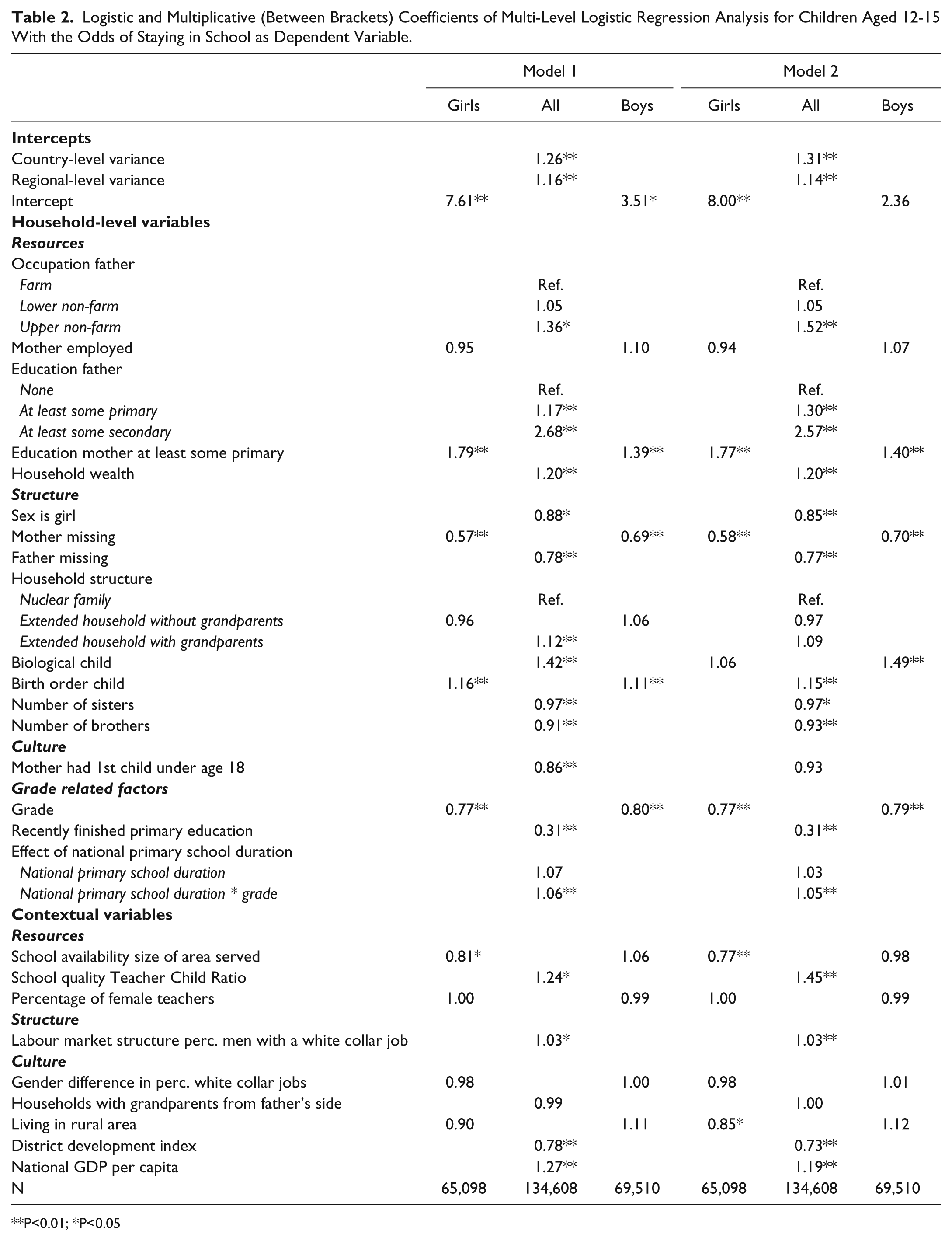
Table 2 shows the results of the discrete-time event-history analyses. Model 1 contains only coefficients of the main effects. Model 2 is similar to Model 1 but with the significant interaction effects added. To keep the table readable, the interaction coefficients are presented separately in Table 3. We present multiplicative coefficients because these are most easily understood. For example, the value of 2.68 for the effect of father having at least some secondary education means that the odds of staying in school are 2.68 times (or 168%) higher for children (girls and boys) whose father has at least some secondary education compared with children whose father has no education. The value of 0.95 for girls whose mother is working indicates that these girls have 0.95 times (or 5%) lower odds of staying in school than girls whose mother is not working. For those variables that interacted significantly with sex, separate coefficients for boys and girls are presented; otherwise, a general coefficient is presented under “All.” Our analyses show that of the total variance in educational participation, 72% is explained at the household level, 23% at the district level, and 5% at the national level. Hence, differences among households are responsible for almost three quarter of differences in educational participation.
Logistic and Multiplicative (Between Brackets) Coefficients of Multi-Level Logistic Regression Analysis for Children Aged 12-15 With the Odds of Staying in School as Dependent Variable.
P<0.01; *P<0.05
Logistic and Multiplicative (Between Brackets) Interaction Coefficients of Multi-Level Logistic Regression Analyses for Children Aged 12-15 With the Odds of Staying in School as Dependent Variable (Model 2 of Table 2 Continued).

P<0.01; *P<0.05
Effects of the household and contextual resources are largely as expected. Father’s and mother’s education, father’s occupation being upper non-farm and household wealth have significant positive coefficients. The effect of mother’s education is stronger for girls, which is in line with earlier findings (Emerson & Portela Souza, 2007). Mother’s employment has no significant average effect on staying in school, but this effect is significantly more favorable for boys.
If there are more teachers available, as indicated by a higher teacher child ratio, chances that children stay in school increase significantly. The average effect of a higher proportion of female teachers in the district is not significant, although its effect is positive for girls. In earlier research (Huisman & Smits, 2009), a higher percentage of female teachers was found to promote girls’ participation in primary education. Hence, female teachers seem to be more important for getting young girls into school than for keeping them there. With regard to the availability of schools in rural areas, we find a significantly negative association between the size of the area served by schools and girls staying in school. For boys, availability seems to be less of a problem.
Regarding the effects of structural factors, we see that when a father or mother is missing from the household, the likelihood of staying in school is significantly reduced. The negative effect of a missing mother is stronger for girls. Living in an extended household with grandparents, being a biological or a later-born child have significant positive associations with a child staying in school, whereas having more siblings is negative for all children. The availability of white-collar jobs in the district is associated with a significant increase in both boys’ and girls’ likelihood to stay in school.
Regarding the role of the local culture, we observe that having a more traditional mother, as indicated by the age she had her first child, is negative for all children. Living in a patriarchal culture, as indicated by a higher percentage of households with parents of the father, is not significant. For girls, the effect of living in a district where the gender difference in the higher echelon of the labor market is wider is negative, but this effect is not significant. These two variables were significant when tested bivariately, indicating that more patriarchal districts tend to differ with regard to other factors in the model that affect children’s chances to stay in school.
Urbanization and national GDP per capita show significant effects in the expected direction. The odds of staying in school are higher in countries with higher levels of GDP per capita and—for girls—also in urban areas (Model 2). However, the effect of our other variable which indicates a more modern context in which education might be valued higher, the district development index, is significantly negative, opposite to what was expected. This may seem counterintuitive. However, bivariately this variable showed the expected positive effect. Hence, the negative multivariate effect is the result of controlling for other development-related factors.
As could be expected, children drop out significantly more in the higher grades. They also have a substantially higher likelihood of dropping out directly after finishing primary school. This last effect seems to be stronger than that of any other factor in the model. We also see that dropout in the higher grades is lower in countries where the legal duration of primary education is longer. Both findings are in line with the idea that children (and their parents) tend to wait until they have completed primary education before they stop schooling.
Interaction Effects
Table 3 presents the coefficients of significant interactions. The likelihood to continue school directly after finishing primary school is increased for boys from extended households with grandparents. This indicates that grandparents consider secondary education for their grandsons important and are prepared to take over tasks or help with homework to facilitate that. Directly after completing primary education, the effects of father’s occupation and education are significantly reduced. Hence, at that time, the decision to drop out seems less influenced by socioeconomic differences than at other points in the school career.
With the teacher–child ratio, we find one significant interaction. The positive effect of this factor is stronger in countries with a higher GDP per capita. This finding runs opposite to the idea of, for instance, Heyneman and Loxley that in less developed countries the impact of schools and teachers is stronger. The significant positive effect of female teachers in rural areas, in contrast, is in line with their idea. Hence, increasing the number of female teachers might reduce rural dropout (which is especially strong for girls). In districts with a higher percentage of female teachers, the positive effects of father’s occupation and household wealth are higher. This indicates that girls from such households (for whom the effect of female teachers is positive) are better able to profit from these favorable educational circumstances, leading to a kind of accumulation of positive effects. However for boys, such household conditions compensate them for the negative effect that female teachers have for them. Moreover, in those districts the negative effect of more brothers is stronger for boys, pointing toward competition within the household. We also found that in districts with a higher percentage of female teachers, the tendency to drop out in the higher grades increases. Hence, older children and children from households with more competition and fewer resources seem to profit less from the presence of female teachers.
Most interactions with urbanization are as expected. In rural areas, children from extended households with grandparents and biological daughters are more likely to stay in school. Thus in rural areas, there seem to be more duties at home that can be taken over by grandparents or put on the shoulders of foster daughters. The negative effects of more siblings and a mother who got her first child young are also stronger in rural areas. This is in line with the idea that in urban areas educational facilities are more accessible, so that children from more difficult or competitive backgrounds have more possibilities to go to school. The negative effect of the presence of (more) sisters for boys in rural areas might as well be interpreted as meaning that boys in cities profit from the presence of sisters.
In more developed districts, a missing father has a stronger negative effect, whereas for boys the effect of a father with an upper non-farm job becomes less positive. However, the effect of paternal education in those districts becomes even more important, which might be interpreted as support for Heyneman and Loxley’s idea that when the level of development is higher, family background characteristics are more important. In countries with a higher GDP per capita, living in an extended household with grandparents is less important.
Conclusion
We studied effects of household and district-level factors on school dropout of young children in the first years of the 21th century by applying multi-level discrete-time event-history analysis on data for over 130,000 children in 363 districts of 30 developing countries. We tested four hypotheses: (a) The resource hypothesis predicts that children from households and contexts with more resources available for schooling are less likely to drop out of school; (b) the structure hypothesis predicts that in households and contexts where the structure is such that children can benefit more from the available resources and from going to school, children are less likely to drop out of school; (c) the culture hypothesis predicts that if the local culture is such that education is valued more relative to other options, children are less likely to drop out of school; (d) the primary duration hypothesis predicts that children are more likely to drop out after finishing a specific level. Besides direct effects of the determining factors, we studied interaction effects to make our study more situation-specific.
Regarding the attendance rates by age, our descriptive analysis reveals two major patterns. First, in almost all of the countries children tend to start schooling at an age that is (often substantially) higher than the legal starting age of primary education. Second, participation rates are highest in the 9 to 12 age group, and then start to decrease. In most countries, participation rates at age 15 are substantially lower than those at age 12, thus revealing high dropout rates.
With respect to the determinants of school dropout, we find that children from households and contexts with more resources are much more likely to stay in school, supporting our first hypothesis. Higher educated parents, a wealthier household, and a father with a higher-level job are strongly positively associated with children staying in school. Parental education and household wealth are most important. If the father has more than primary education, the odds of staying in school for both girls and boys are 157% higher than if the father has no education, and if the household is in a one-step higher wealth decile, this odds increases by 20%. Mother’s education is especially important. The odds of staying in school increases by 77% for daughters and by 40% for sons if the mother is in the higher educational category. This result indicates that mothers with more knowledge are in a better position to keep their children in school. This knowledge probably need not be very extensive; we only distinguished between none and at least some education. Given the substantial difference in school dropout found with this simple variable, it seems that basic skills such as reading and writing are critical.
District availability of teachers (indicated by a higher teacher child ratio) is associated with a significant positive effect on a child’s likelihood to stay in school, and district availability of schools in rural areas is positive for girls. The percentage of female teachers is not associated with a significant average effect on staying in school, but interactions show a significantly positive association in rural areas. Hence, female teachers seem particularly important under more difficult circumstances. In addition, children in lower grades drop out significantly less if there are more female teachers.
We also find support for our second hypothesis on the effect of structural characteristics of households and contexts. Children from households with a structure which is less favorable for them, that is, children with more siblings, children who have younger siblings, and children whose mother or father is missing from the household, are significantly less likely to stay in school. The effect of a missing mother is stronger for girls. However, living in an extended household with grandparents and being a biological child are associated with a higher likelihood to stay in school, whereby grandparents are especially important in poorer countries as indicated by our interaction results. Also a structural context in which education is more valuable, because it makes it more likely to find a higher paid occupation, as indicated by a higher percentage of men with a white-collar job, is associated with a higher likelihood of children staying in school.
The results regarding our third hypothesis on culture are less convincing. Having a mother who got her first child at a young age, an indication of a more traditional household, is not significant. Also the effect of the district-level variables measuring the gender difference on the labor market and the tendency for girls to marry into their husband’s family are not significant, suggesting that variation in school dropout between more and less traditional districts is largely due to variation in other household and district characteristics. A higher national GDP per capita, and for girls also living in an urban area are positively associated with staying in school, indicating that in a more developed environment education is more valued as we hypothesized. However, the district development index (constructed based on assets of households in the district) was negatively associated with staying in school. This might mean that developed districts have better income-earning opportunities for children, so that child labor would be an attractive alternative.
Regarding the fourth hypothesis of this study, about the effect of extending the duration of primary education on school dropout, several pieces of evidence are relevant. First, we found that in countries where the legal duration of primary education is longer, dropout in the higher grades is significantly lower. Second, the odds of continuing schooling were strongly reduced (about 70%) directly after finishing primary education. The magnitude of this effect is larger than that of any other variable in the model, stressing its importance. Third, the increased risk of school dropout after completing primary education was independent of the number of grades the child had completed (no significant interaction between grade and having recently finished primary education). Together, these pieces of evidence clearly indicate that directly after completing primary education there is a critical choice moment with a strongly elevated risk of dropping out of the educational system.
This risk moreover seems not restricted to the lower levels of society. Our interaction analysis makes clear that right after finishing primary education, the advantage of having a father with an upper non-farm job or with at least some primary education is significantly reduced. Hence, the tendency to drop out of school after completing primary education is not restricted to households with the fewest resources. Only children in households with grandparents, especially boys, are less likely to drop out of school after finishing primary education, thus stressing the importance of this form of family capital for educational achievement in poor countries.
Given these findings, it seems advisable for countries with high dropout rates of young children to consider prolonging the legal duration of primary education (as was done in Turkey in 1998) as a policy to keep children in school longer. Of course, such a policy may make a heavy demand on the available primary school facilities and requires a transfer of means from the lower secondary to the primary level.
Regarding the other interactions we conducted to make our analyses more situation-specific, we find that children who were already in a more favorable situation (higher wealth group, father with a higher education, girls with a father with a non-farm occupation, extended households, biological daughters, fewer siblings, a mother who did not have her first child young) profit more from the availability of female teachers, or are less affected by living in a rural or less developed area. The evidence is not conclusive, however, as we also found that in better developed districts, the advantage of the father being present in the household and advantage of having a father with an upper non-farm job are less important.
The finding that female teachers are especially important in rural areas provides support for the Heyneman–Loxley hypothesis that educational facilities make more difference at lower development levels. Only the stronger effect of the teacher–child ratio in higher GDP countries is not in line with this hypothesis.
Some words of caution are needed. First, although the use of context factors at the district level is a major step forward compared with research using such factors at the national level, the degree to which they represent the local context remains restricted, because the districts are still rather big. As a result, our coefficients may underestimate the true effects. Second, some additional measurement error might be expected in the district-level characteristics of the educational facilities, because they had to be collected from other sources, which for developing countries are not always of good quality. District characteristics that we created ourselves by aggregating from our representative household surveys are more reliable. Third, for children who dropped out of school, we do not have reliable information on the age at which this happened. Hence, our conclusions are mainly valid for dropping out in specific grades and not for dropping out at a specific age. Fourth, the substantial number of significant cross-level interactions found in our analyses confirms our expectation that the processes underlying the decision to drop out may differ substantially among contexts. At the same time, it is difficult to give clear interpretations for the outcomes of the interaction analysis, which not always point clearly to one direction. New theories on the role of the context are therefore needed, the development of which constitutes a major challenge to the research community in this field.
Footnotes
Appendix
Overview of data used in this study

| Response rate |
||||||||||
|---|---|---|---|---|---|---|---|---|---|---|
| Household surveySource and year | Householdsurvey | Women’ssurvey | Educational facilities: year of data |
SourceSchools | of dataTeachers | |||||
| World region | Country | Nr. of districts | Schools | Teachers | Female teachers | |||||
| Latin America | Bolivia | 9 | DHS, 2003 | 98.9 | 95.5 | 2003 | 2003 (public) | 2003 (public) | 1 | 1 |
| Colombia | 13 | DHS, 2005 | 88.4 | 92.4 | 2005 | 2005 | 2000 (national) | 2 | 2 | |
| Peru | 25 | DHS, 2000 | 98.1 | 94.6 | 2000 | 2000 | 2000 (national) | 1 | 1 | |
| West Africa | Benin | 6 | DHS, 2001 | 97.0 | 96.4 | 2003 (public) | 2003 (public) | 2003 (public) | 1 | 1 |
| Cameroon | 10 | DHS, 2004 | 97.6 | 94.3 | 2002 | 2002 | 2002 | 2 | 2 | |
| Ghana | 10 | DHS, 2003 | 98.7 | 95.7 | 2003 | 2003 | 2003 | 1 | 1 | |
| Guinea | 8 | DHS, 2005 | 99.2 | 97.2 | 2004 | 2004 | 2004 | 1 | 1 | |
| Mali | 9 | DHS, 2001 | 97.9 | 94.9 | 2001 | 2001 | 2001 | 1 | 1 | |
| Nigeria | 6 | DHS, 2003 | 98.6 | 95.4 | 2003 | 1995 | 1995 | 2 | 2 | |
| Senegal | 11 | DHS, 2005 | 98.5 | 93.7 | 2002 | 2002 (public) | 2002 (public) | 1 | 1 | |
| East Africa | Kenya | 8 | DHS, 2003 | 96.3 | 94.0 | 2003 | 2003 | 2003 | 1 | 1 |
| Rwanda | 12 | DHS, 2005 | 99.7 | 98.1 | 2002 | 2002 | 2002 | 1 | 1 | |
| Uganda | 9 | DHS, 2006 | 97.5 | 94.7 | 2002 | 2000 | 2000 | 1 | 1 | |
| Southern Africa | Congo Brazzaville | 9 | DHS, 2005 | 99.2 | 94.8 | 2004 | 2004 | 2004 (national) | 2 | 2 |
| Madagascar | 6 | DHS, 2004 | 98.2 | 95.3 | 2003 | 2003 | 1999 (national) | 3 | 3 | |
| Malawi | 13 | DHS, 2004 | 97.8 | 95.7 | 2005 | 2005 | 2005 | 1 | 1 | |
| Mozambique | 11 | DHS, 2003 | 90.1 | 90.9 | 2003 (public) | 2004 | 2004 | 2 | 2 | |
| Namibia | 13 | DHS, 2000 | 96.9 | 92.4 | 2001 | 2001 | 2001 (national) | 1 | 1 | |
| South Africa | 9 | DHS, 1998 | 96.9 | 95.2 | 2000 | 2001 | 2001 | 3 | 3 | |
| Tanzania | 11 | DHS, 2004 | 98.8 | 97.3 | 2003 | 2003 | 2003 | 1 | 1 | |
| Zambia | 9 | DHS, 2002 | 98.2 | 96.4 | 2004 | 2004 | 2004 | 1 | 1 | |
| (MENA) | Algeria | 17 | PAPFAM, 2002 | 93.5 | 97.4 | 2004 | 2004 | 2004 | 1 | 1 |
| Morocco | 14 | PAPFAM/DHS, 2003 | 98.8 | 96.3 | 2003 | 2003 | 2003 | 2 | 2 | |
| Syria | 12 | PAPFAM, 2001 | 95.0 | 98.9 | 2001 | 2001 | 2001 | 2 | 2 | |
| Yemen | 15 | PAPFAM, 2003 | 91.7 | 91.6 | 2003 | 2003 | 2003 | 2 | 2 | |
| South and East Asia | Bangladesh | 6 | DHS, 2004 | 99.8 | 98.6 | 2005 | 2005 | 2002 (national) | 1 | 1 |
| India | 26 | DHS, 2006 | 97.7 | 94.5 | 2002 | 2002 | 2002 | 1 | 1 | |
| Indonesia | 26 | DHS, 2003 | 99.0 | 98.3 | 2003 | 2003 | 2003 | 2 | 2 | |
| Nepal | 13 | DHS, 2006 | 99.6 | 98.4 | 2000 | 2000 | 2000 | 2 | 2 | |
| Philippines | 17 | DHS, 2003 | 99.1 | 97.8 | 2003 | 2003 | 2003 | 2 | 2 | |
| Total | 30 | 363 | ||||||||
Note. 1 = National Ministry of Education; 2 = National bureau of Statistics; 3 = Education Policy & Data Centre (www.epdc.org). DHS = Demographic and Health Survey; PAPFAM = Pan Arab project for family health; MENA = Middle East and North Africa.
Declaration of Conflicting Interests
The author(s) declared no potential conflicts of interest with respect to the research, authorship, and/or publication of this article.
Funding
The author(s) received no financial support for the research and/or authorship of this article.