




Abstract
Metaphors in public service advertisements, or PSAs, have played an important role in promoting the knowledge of COVID-19 and China’s anti-epidemic activities. Based primarily on Feng and O’Halloran’s visual representation of multimodal metaphor, this article examines visual and multimodal metaphors created in the online PSAs that were produced in early 2020 to publicize China’s epidemic prevention and control activities. It is found that those metaphors fall into three general groups, namely “coronavirus” metaphor, “anti-epidemic worker” metaphor, and “medical instrument” metaphor. Nearly all of them were created to serve an overarching metaphor, namely ANTI-EPIDEMIC WORK IS WAR, of which coronaviruses were depicted as enemies, anti-epidemic workers as warriors, and medical instruments as weapons. Most of the metaphors were constructed through visual or multimodal anomaly realized through strategies such as participant substitution, verbal/visual superimposition, and verbo-visual integration/fusion in the representational structure, while their metaphorical meanings became supplemented or reinforced by the deployment of compositional and interactive resources such as spatial position, color contrast, gaze, and size. Finally, the causes and implications of the findings are discussed from three aspects: social background, genre, and audience.
Introduction
The COVID-19 pandemic has brought a huge catastrophe to human society. According to Worldometer (https://www.worldometers.info/coronavirus/), till 8 October 2021, 11:36 GMT, there were 237,649,405 cases of coronavirus worldwide, including 4,851,696 deaths. At the time when we completed this article, the pandemic was still taking its toll on humanity. During the early phase of this pandemic, China was the worst-hit country, with more than 4,500 people died of COVID-19 disease. To prevent further spread of this disease, Chinese government called on the whole nation to take strict prevention and control measures, including lockdown, quarantine, wearing masks, social distancing, and so on. Doctors, nurses, community workers, and nearly everyone in this country were called in to combat this disease. Meanwhile, on- and off- line publicity and education campaigns sprung up, among which online public service advertisements (PSAs) featuring visual and multimodal metaphors were particularly noticing. Though PSAs can be seen everywhere, it is not common for them to be disseminated on a large scale on the internet. But this was what often happened during the lockdown of Wuhan, China in 2020. It has become, so to speak, a new way of publicity discourse on anti-epidemic activities. What impressed us most is that the PSAs created lots of novel metaphors that served to promote the knowledge of epidemic prevention and control activities. Most of the metaphors were constructed with not only language but also non-verbal modalities such as image, layouts, and colors. How were the metaphors constructed with these semiotic resources? What types of metaphors were commonly used in the PSAs? And why were they designed as such? These are key issues we are going to address in the present article.
We begin this study by identifying, in terms of conceptual meaning (Lakoff & Johnson, 1980), most commonly used metaphors in the PSAs, and dividing them into different categories according to the target domains described in the discourse. We then examine in detail the forms and functions of these categories drawing on Feng and O’Halloran’s (2013) visual representation of multimodal metaphor, supplemented with Kress and van Leeuwen’s (2006) visual grammar, and Lakoff and Johnson’s (1980) Conceptual Metaphor Theory. The final part discusses how (and why) these categories have worked coordinately to serve an overarching metaphor, namely “ANTI-EPIDEMIC WORK IS WAR.”
Metaphor and Multimodal Metaphor
Metaphor was traditionally viewed as a figure of speech by which two different entities are compared in terms of similarity. Early in 1930s I.A. Richards studied metaphor based on his theory of semantic interaction between the tenor and vehicle in explaining metaphorical meaning. According to him, metaphor is an interaction (or comparison) between two items, namely tenor and vehicle, respectively. Tenor is the original subject to be compared, and vehicle is the object whose attributes are borrowed to compare with the subject. Richards’ theory was effectively developed by Black (1962), who regards metaphor as the interaction of two subjects (the principal and the subsidiary subjects) that interact with each other to produce metaphorical meaning. In other words, metaphor comes into being when the features of the principal subject apply to the subsidiary subject under the interplay of the “focus” (i.e., the subsidiary subject) with the “frame” (the schema containing the two subjects) (Black, 1962, pp. 44–45).
Lakoff and Johnson’s (1980) Conceptual Metaphor Theory (CMT) shifts the research from linguistics to cognitive science. The authors claim that human beings think metaphorically and tend to express and interpret abstract/complex things with concrete/embodied objects and/or experiences. According to them, metaphor is a mode of thought through which we understand and experience “one kind of thing in terms of another” (Lakoff & Johnson, 1980, p. 5). This notion is deeply entrenched in the metaphorical formula: A IS B, in which A serves as a target domain, B as a source domain. For each metaphor, some properties of the source domain are mapped onto the target domain, during which the properties of the target undergo modification in order to match certain properties of the source. Lakoff and Johnson’s CMT has inspired a great deal of metaphor research from cognitive linguistics (e.g., Bowen & Evans, 2019; Cavazzana & Bolognesi, 2020; Ervas, 2021; Fahlenbrach, 2015; Forceville, 1994, 1996, 2008, 2016; Ortiz et al., 2017). Among them, Forceville’s (1994, 1996, 2008, 2016) pictorial metaphor is probably one of the most influential works in advancing the study of visual and multimodal metaphor.
In Forceville’s view, metaphor can be achieved by not only linguistic signs but also non-linguistic modes such as images, gestures, colors, etc. (Forceville, 1996, 2008, 2009). When examining metaphors in advertisements (1996), Forceville identifies four types of pictorial metaphors, including metaphors with one pictorially present term (MP1), metaphors with two pictorially present terms (MP2), metaphors as pictorial similes (PSs), and verbal pictorial metaphors (VPMs). Later on, he (2008) modifies these categories and stipulates them as (1) contextual metaphor (modification of MP1), (2) hybrid metaphor (modification of MP2), (3) pictorial simile, and (4) integrated metaphor. These theorizations have greatly promoted the study of pictorial (or visual) metaphor as well as multimodal metaphor (e.g., Alousque, 2020; Bounegru & Forceville, 2011; Fahlenbrach, 2015; Forceville, 2008, 2017; Forceville & Urios-Aparisi, 2009, just to list a few). Being multimodal can be considered as a way or process in which meaning is produced and interpreted through the interplay of multiple signs/modes, such as words, images, sounds, color, etc. Forceville (2016, 2017) thus distinguishes monomodal metaphor from multimodal metaphor. The former refers to those “whose target and source are exclusively or predominantly rendered in one mode” (Forceville, 2009, p. 23), while the latter concerns the “metaphors whose target and source are each represented exclusively or predominantly in different modes” (Forceville, 2009, p. 24). In other words, monomodal metaphor involves only one mode, no matter it concerns target or source (most metaphors discussed by Lakoff and Johnson (1980) are purely verbal metaphors, thus belonging to this type). By contrast, multimodal metaphor involves not only verbal but also pictorial, auditory, olfactory, tactile, and/or gustatory modes. Forceville (2009) lists nine plausible modes that can represent multimodal metaphors including pictorial signs, written signs, spoken signs, gestures, sounds, music, smells, tastes, and touch. Forceville’s research on pictorial and multimodal metaphors has promoted numerous relevant studies that cover various text and genres such as advertising/billboards (Bolognesi & Lievers, 2020; Feng, 2019; Feng & O’Halloran, 2013; Forceville, 1994, 1996, 2017; Kaplan, 2004), cartoons/drawings (Alousque, 2020; Bounegru & Forceville, 2011; Bowen & Evans, 2019; El Refaie, 2003, 2009; Godioli & Pedrazzini, 2019), and films (Carroll, 1996; Fahlenbrach, 2015; Whittock, 1990), just to mention a few. This article deals with metaphors in the genre of PSAs which involves three types: verbal, visual and verbo-visual, with visual, and verbo-visual metaphors being its focus.
Methodology
This study relies primarily on Feng and O’Halloran’s (2013) visual representation of multimodal metaphor, which derives primarily from Kress and van Leeuwen’s (2006) visual grammar. According to Kress and van Leeuwen, the meaning of visual image can be analyzed based on Halliday’s (1994) Systemic Functional Linguistics (SFL). In SFL, language is modeled as a set of inter-related systems of choices which are organized in terms of three metafunctions, that is, ideational, interpersonal, and textual. Building on SFL, Kress and van Leeuwen (2006) propose that visual images can also be analyzed in terms of representational, interactive, and compositional meaning. Representational meaning is analyzed in terms of processes (e.g., actions), participants (e.g., actors) and circumstances (e.g., location) (Kress & van Leeuwen, 2006), which can be divided into two types of structure: narrative and conceptual. Narrative structure represents the “unfolding of actions and events, processes of change, transitory spatial arrangements,” while conceptual structure represents the participants “in terms of their generalized, stable and timeless essence” (p. 59). Interactive meaning deals with contact, social distance, power relations, and involvement between viewers and participants. Contact is established when participants interact with viewers (e.g., demand or offer) often by way of gaze (and sometimes gesture). Social distance shows “different relations between represented participants and viewers,” often realized through “size of frame” (e.g., close or long shots) (p. 124). Power relation is constructed by vertical camera angle (high or low angles). For instance, participants represented in a high angle may signify power over the viewers, and vice versa. Involvement is determined by horizontal camera angle (frontal or oblique angles) (pp. 136–140). Compositional meaning is analyzed through three interrelated systems: information value, salience, and framing. Information value is presented through the spatial position of visual elements, such as left or right, top or bottom, center or margin, which signifies given or new information, ideal or real values, or nucleus or subordinate status of the participants (pp. 179–200). Salience signifies the degree of importance, and is often realized by such factors as size, sharpness of focus, tonal contrast, color contrast, placement, perspective, and cultural factors (p. 202). Framing signifies connection or separation of the participants through “the presence or absence of framing devices” which “disconnects or connects elements of the image” (p. 177).
Feng and O’Halloran (2013) build their framework based on the above-mentioned three metafunctional meanings, that is, representational, interactive, and compositional (Kress & van Leeuwen, 2006). In terms of representational meaning, they classify metaphors into two types, that is, defamiliarization and domestication. Defamiliarization concerns the “OBJECT IS OBJECT” metaphor whose meaning is “constructed by anomaly, or unconventionality, of visual elements in the representational structure” (Feng & O’Halloran, 2013, p. 324). Such visual configuration involves three types of anomaly, namely (1) narrative anomaly, which is realized by participant substitution and circumstance substitution, (2) classificational anomaly, which is realized by member substitution and unconventional covert category, and (3) analytical anomaly, which is realized by part substitution and part superimposition.
Domestication means “the visual realization of creative and conventional metaphors” which are created to understand “abstract concepts” (Feng & O’Halloran, 2013, p. 327). Feng and O’Halloran elaborate on one typical strategy used in modeling domestication metaphor, that is, “symbolic attributive process” borrowing Kress and van Leeuwen (2006). By this strategy, one domain of the metaphor is seen as the token (usu. realized by images), and the other is the value (usu. labeled with words). The metaphorical meaning is thus understood by reference to the superimposition of the words onto the images. For some cases, in Feng and O’Halloran’s (2013) view, the value in a domestication metaphor may not be explicitly expressed by words, but indicated by the composition of elements or vectors encoded in the image. For example, the position of a participant in the image may suggest metaphors such as “POWERFUL IS UP,” “POWERLESS IS DOWN,” “IMPORTANT IS CENTER,” and “UNIMPORTANT IS MARGINAL.”
Feng and O’Halloran (2013) argue that interactive meaning concerning social distance, subjectivity, etc. can be realized through camera positioning, which can help us to create or interpret metaphorical meanings based on “our basic experience of the world” and “the iconic nature of visual images” (p. 329). They therefore suggest that there is a master metaphor: “IMAGE-VIEWER RELATION IS CAMERA POSITIONING” (pp. 329–330), which entails three subtypes including: (1) SOCIAL DISTANCE IS SHOT DISTANCE, meaning “close relation is close shot” and “distant relation is long shot,” (2) POWER RELATION IS VERTICAL ANGLE, meaning “image power is low angle,” “equality is eye-level angle” and “viewer power is high angle,” and (3) INVOLVEMENT IS HORIZONTAL ANGLE, meaning “involvement is frontal view” and “detachment is back view” (Feng, 2011; Feng & O’Halloran, 2013, p. 330).
Compositional meaning often includes information value, salience, and framing, but Feng and O’Halloran (2013) relate compositional meaning to metaphors by relying mainly on information value though size and distance are also discussed, since they believe that “Salience and framing are not abstract concepts” (p. 331). They therefore sketch compositional-related metaphors as: (1) TIME IS SPACE, (2) IMPORTANCE IS SIZE, (3) SOCIAL CLOSENESS IS PHYSICAL CLOSENESS, and (4) INFORMATION VALUE IS SPATIAL POSITION. The last one can be further classified into subtypes such as (4-1) GIVEN IS LEFT/NEW IS RIGHT, (4-2) IDEAL IS UP/REAL IS DOWN, (4-3) IMPORTANT IS CENTRAL/UNIMPORTANT IS MARGINAL, and (4-4) IMPORTANT IS FOREGROUND/UNIMPORTANT IS BACKGROUND. However, we think that salience and framing may also suggest metaphors, such as “CLOSE IS CONNECTED” and “IMPORTANT IS FOREGROUND,” of which the latter is actually included in their framework (p. 331).
To sum up, Feng and O’Halloran have provided an operational framework for us to explore the visual and multimodal metaphors created in PSAs. However, it should be born in mind that this framework aims at sketching potential resources that may become available for the construction of metaphorical meanings. The resources are not rigid rules that have to be strictly complied with. As Feng and O’Halloran (2013, p. 330) point out, the categorization may be challenged on occasions when the producer designs images not for creating metaphorical meanings but for complying with the consistency of the text or discourse. Secondly, while we agree that metaphor can be achieved at every aspect of representation as Feng and O’Halloran’s (2013) framework suggests, we argue that a metaphor is formed under the interplay of three different metafunctions (i.e., representational, interactive, and compositional), usually with one as the core and the other two as supplements or supporters. For example, the metaphor CORONAVIRUS IS DEMON can be achieved through substitution or superimposition of some features of the demon (e.g., skeleton face, saliva droplets, grotesque facial expressions) with or onto the coronavirus’s body (i.e., representational meaning). But size and color contrast may help reinforce this metaphorical meaning (i.e., compositional and interactive meaning). The analysis in the following sections will incorporate these ideas into Feng and O’Halloran’s (2013) framework.
The data consists of a corpus of 120 PSAs published online between February and April 2020 to promote COVID-19 prevention and control in China. These PSAs were collected from some online exhibitions organized by Chinese universities and art associations, including “Breathing and Symbiosis: 2020 Global International Graphic Design Exhibition” (New Young Designers Alliance, 2020), “National Excellent Works of Anti-epidemic Posters (2)” (Visual Design Committee of Beijing Design Association, 2020a), “Defeating COVID-19, China Will Win” (Visual Design Committee of Beijing Design Association, 2020b), “Unity is Strength: 2020 Anti-COVID-19 International PSA Design Exhibition” (Liaoning Provincial Advertising Association, 2020), and “War against Coronavirus: Public Interest Poster Display” (People’s Daily Online, 2020). Among them, 90 PSAs contained 139 metaphors. Nearly all of the metaphors, whether visual, verbal, or verbo-visual, were designed to promote the knowledge of coronavirus and anti-epidemic activities, including but not limited to metaphors such as “CORONAVIRUS IS DEMON,” “ANTI-EPIDEMIC WORKER IS WARRIOR, SYRINGE IS GUN, etc. These metaphors fall into three general groups judging from target domains, namely, metaphors on coronaviruses, metaphors on anti-epidemic workers, and metaphors on medical instruments. Each of them are further conceptualized through different source domains. The following sections elaborate on these metaphors.
Coronaviruses as Enemies
Coronavirus, or specifically novel coronavirus, has been widely depicted as certain negatively represented participants. At the very beginning, people had little idea about what was novel coronavirus, how it worked to infect the human beings, and how dangerous it was, due to its invisibility and intangibility. As a result, knowledge and information about it was widely circulated in various publications. In PSAs, the coronavirus was visually metaphorically depicted as some dangerous and odious objects such as bombs, demons, enemies, etc. which was associated with the corollaceous shape of the coronavirus, thus forming into some metaphors such as CORONAVIRUS IS BOMB and CORONAVIRUS IS DEMON. Most of these metaphors belong to the category of defamiliarization metaphor which is realized through substitution or superimposition strategies (Feng & O’Halloran, 2013), or the combination of the two, meaning that a participant (or part of it) takes place of or is superimposed onto another participant (or part of it), through which the salient features of the source are added to the target. Figure 1 involves disarming a virus-like bomb. The participants are a bomb and a pen. Seen from the picture that the pen is depicted as a knife acting to cut off the fuse of the bomb, it is clear that the pen has been likened to a weapon that can stop the spread of the coronavirus, thus forming the metaphor: “PEN IS WEAPON” (see Section 6 for more weapon metaphors). But here we focus on the bomb metaphor. As we can see, the profile of the coronavirus, that is, corolla, is superimposed onto a black bomb, hence forming into two objects at the same time, one of which is a bomb, the other coronavirus. As a result, we get the metaphor: CORONAVIRUS IS BOMB. Because the essential property of a bomb is to explode and kill people, the metaphor obviously conveys the meaning that the coronavirus is dangerous. In Figure 2, we see a coronavirus (which can be identified with the crown-like shape of the object that is similar to the original shape of a coronavirus under a microscope) and a skeleton skull-like demon placed at the center of the picture. This skull-like picture is consistent with the image of a demon of death in Chinese culture, which believes that the skull is a symbol of death and a typical feature of demons of hell. The face of the demon is superimposed onto the body of the virus, or we would like to say, part of the demon’s image takes place of the virus’s body. As a result, the two objects, that is, the coronavirus and the demon, are fused into one integrated, odious-looking object (Carroll, 1996; Yus, 2009), forming the metaphor as CORONAVIRUS IS DEMON. Interestingly, the metaphorical meaning of this unconventional object is obviously highlighted compared with the background which is depicted as fuzzy lightening fires and molten lavas just like a hell, as if suggesting that the coronavirus were bringing about hell-like disasters.

《拆弹》(Disarming the Bomb) by Jiachang Wan (“Defeating COVID-19, China Will Win 2020 <https://www.sohu.com/a/388036900_100050512>).

《抗击新型冠状病毒》(Fight against New Coronavirus) by Kai Huo (“Unity is Strength: 2020 Anti-COVID-19 International PSA Design Exhibition,” 2020 <https://www.uisdc.com/resistancevirus-2020>).
If the above two metaphors are realized mainly through substitution and superimposition, the one in Figure 3 concerns verbo-visual integration. Verbo-visual INTEGRATION means that the target or source domain of the metaphor is constructed by either or both of the image and words. This PSA shows a bomb with the word label, “2019-nCOV,” superimposed onto it. The bomb is identified from its bomb-like shape and the burning fuse, while the word label “2019-nCOV” serves to denote the image of a bomb as coronavirus. The image acts to “illustrate” the similar shape of the coronavirus and the bomb, while the word label functions to “anchor” the images borrowing Barthes (1977) The metaphor thus formed is “CORONAVIRUS IS BOMB.” This can also be regarded as a domestication metaphor (Feng & O’Halloran, 2013), in which the image of the bomb is a token while the word label, “2019-nCOV,” is the value. Comparing the virus to a demon or bomb denotes the meaning of danger and damages that coronaviruses may bring about to human health. Interestingly, the fuse of the “virus” bomb appears to have been cut by surgical scissors, thus preventing an explosion. In this way, the surgical scissors have been depicted as a weapon that can stop the transmission of the virus, similar to that functioned by the pen in Figure 1 (See also Section 6 for weapon metaphors).

《剪危机》(Cutting off the Crisis) by Ben Liu (“Unity is Strength: 2020 Anti-COVID-19 International PSA Design Exhibition,” 2020 <https://www.uisdc.com/resistancevirus-2020>).
In terms of interactive and compositional meaning, spatial position, relative size, and color contrast are three major resources deployed to foreground or supplement the meaning of the coronavirus metaphors. The most frequently exploited metaphors regarding spatial position in the images are “POWERFUL IS UP” and “IMPORTANT IS CENTER.” The interpretation of such metaphors depends on our psychological, physiological and cultural experiences (Feng & O’Halloran, 2013; Lakoff & Johnson, 1980). “POWERFUL IS UP” can be explained as follows: participants presented at the upper position are powerful, while participants presented at the lower position are powerless (Zanolie et al., 2012). In Figure 1, the pen with a sharp point (metaphor for weapon) is presented over the “bomb,” which metaphorically shows that the “pen” weapon is more powerful than the “coronavirus” bomb, indicating that the coronavirus will be defeated in the end. The second metaphor, IMPORTANT IS CENTER, is also achieved based on our experience; that is, the objects (all are targeting at the coronavirus and metaphorically depicted as dangerous things) on the center of the above three examples are generally perceived as the most important participants in the images. The participants (i.e., coronaviruses, demons, and bombs) are important (or importantly dangerous) because they may bring terrible harm to human beings. The importance of coronaviruses is denoted by their center position in the pictures, while the unimportance of other elements (e.g., words) is denoted by their marginal position. Size is another dimension of spatial mappings of power (Schwartz et al., 1982), as Feng and O’Halloran (2013) suggest: “POWER IS SIZE.” That said, participants presented in larger size are usually more powerful than those who are presented in smaller size. As we can see in all the three examples, the coronavirus is metaphorically magnified, occupying most part of the pictures, indicating that the coronavirus has more power than others. Power here, of course, means the power of bringing about harm. In other words, drawing the coronavirus big (and powerful) enough is meant to grab viewers’ attention so as to warn them of the potential dangers of the coronavirus. Color contrast is a third factor that acts to supplement or reinforce the meaning of a visual or multimodal metaphor. For instance, in Figure 1, the background is depicted as yellow, whereas the coronavirus/bomb and pen/weapon in the fore are presented in black. In Figure 2, the background is portrayed in fuzzy blue and purple, and embedded with some golden molten lavas and burning fires, while the coronavirus/demon is foregrounded in full purple, white, and black color. And in Figure 3, the bomb/coronavirus is foregrounded as huge and colorful while the background is shown in flat, gray-white color. As a result, the meaning of “coronavirus as enemies” (e.g., demons and dangerous object like bombs, etc.) becomes salient and even ingrained in viewers’ mind.
Anti-Epidemic Workers as Warriors
In this section, we examine metaphors concerning those working at the frontline of the COVID-19 prevention and control. We generally refer to these people as anti-epidemic workers. In our data, the anti-epidemic workers, in particular medical staffs, were often metaphorically portrayed as courageous warriors, powerful animals (e.g., dragon, lion, tiger), and gods of guard (e.g., god of door). These metaphors can be categorized into three subtypes, namely ANTI-EPIDEMIC WORKER IS WARRIOR, ANTI-EPIDEMIC WORKER IS TIGER/DRAGON/LION, and ANTI-EPIDEMIC WORKER IS GOD OF GUARD.
Figure 4 falls into the first subtype. This picture displays an ongoing action that a person in medical suits is shooting at something. Based on our experience and common knowledge, it is usually the policeman or soldier who has the right to shoot or to hold a gun. But in this picture the one doing the act of shooting is a doctor/nurse judging from his medical clothing, gloves, goggles, and mask. He obviously acts as a warrior to be fighting with the coronavirus, thus denoting the metaphor as “MEDICAL WORKER IS WARRIOR.” In this metaphor the conventional participant (a warrior) in the “shooting” process is substituted by an unconventional one (a doctor/nurse), with the former as the source and the latter as the target (Feng & O’Halloran, 2013).

《战役必胜》(The Battle on the Epidemic Will Prevail) by Xin Zhao (“We Are Together” Exhibition, 2020 <https://www.sohu.com/a/387393604_100050512>).
In the second type of metaphor, ANTI-EPIDEMIC WORKER IS TIGER/DRAGON/LION, powerful animal fighters like lions, tigers or dragons are employed as the source domain. Figure 5 depicts a scene that a lion is strangling a coronavirus, which connotes a metaphor as “ANTI-EPIDEMIC WORKER IS LION.” But seeing from the picture, we cannot find any information about the anti-epidemic worker. Nevertheless, our experience and common knowledge tell us that the lion has been depicted as a powerful warrior taking part in the anti-epidemic activities such as community workers, volunteers, and in particular doctors and nurses. In other words, the anti-epidemic workers are substituted by a lion, a way of participant substitution by which the unconventional participant (“a powerful lion”) takes place of the conventional ones (“anti-epidemic workers”) (Feng & O’Halloran, 2013). Since the target is absent, we need to resort to contextual cues to understand the metaphor (Feng, 2011; Feng & O’Halloran, 2013), which include at least the title of the advertisement (i.e., “killing virus”), and the background, that is, in spring 2020 when the anti-epidemic activities were in full swing. We can infer from the title that the doer of “killing the virus” might be “doctors, nurses, and other anti-epidemic workers.” It is then easy for us to understand the metaphor, that is, the anti-epidemic workers are powerful lions. Figure 6 contains a similar metaphor, namely “ANTI-EPIDEMIC WORKER IS TIGER.” The target, that is, anti-epidemic worker, is absent, and hence substituted by the source, that is, tiger, which is explicitly depicted in the image.

《杀毒》(Killing the Virus) by Chunlai Li (“Breathing and Symbiosis: 2020 Global International Graphic Design Exhibition,” 2020 <https://www.sohu.com/a/375926136_282265>).
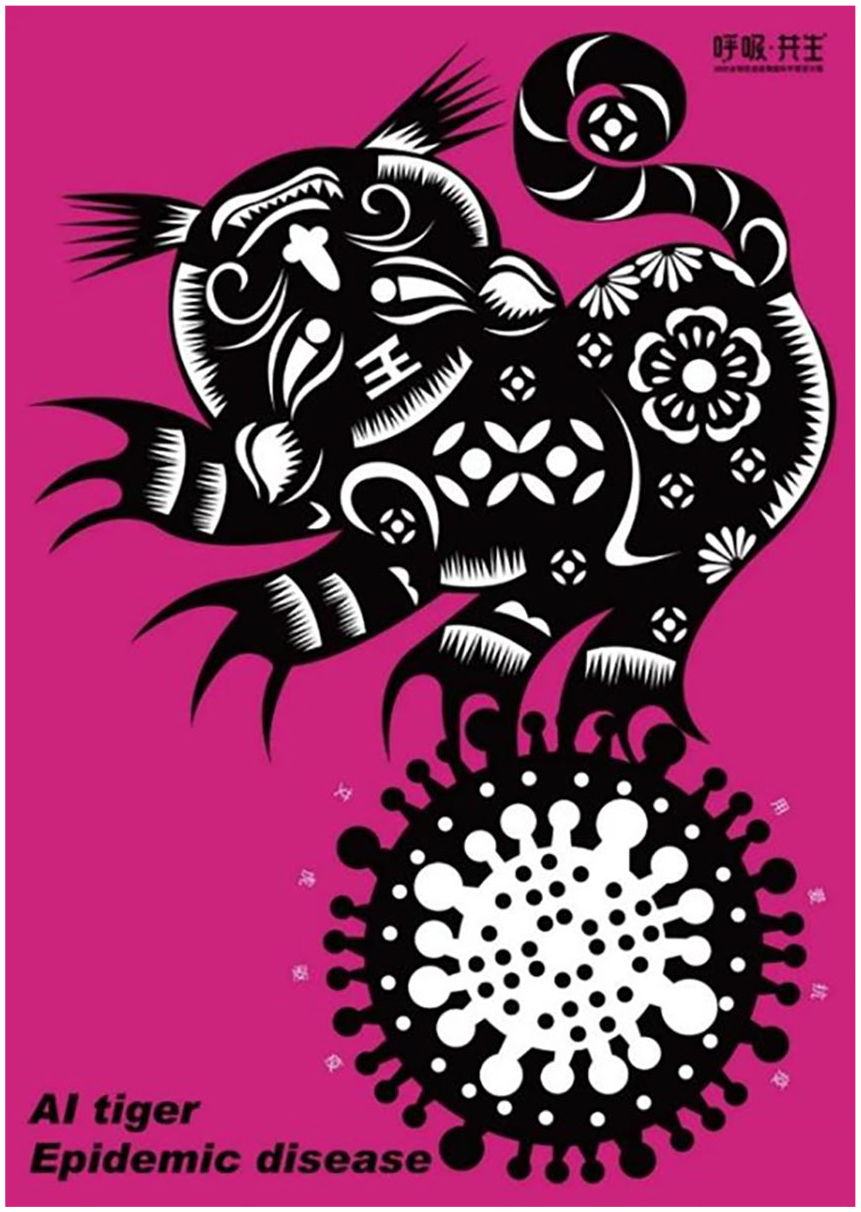
《艾虎驱疫•用爱抗疫》(Fighting the Epidemic with AI Tiger and Love) by Yongfang Wang (“Unity is Strength: 2020 Anti-COVID-19 International PSA Design Exhibition,” 2020 <https://www.uisdc.com/resistancevirus-2020>).
For the third subtype of metaphor, that is, ANTI-EPIDEMIC WORKER IS GOD OF GUARD, the source domain is replaced with god of guard (or “Menshen” in Chinese pinyin), who serves to fight against the evil and protect the good (Clart, 2008). Figure 7 depicts a specific god of door, Guan Yu, who, known as Duke Guan, was a famous general in The Three Kingdoms period in Chinese history. Regarded as a warrior god, he is worshipped by the Chinese people for his strength, courage, and wisdom. In this picture, Guan Yu wears a mask and is fighting against the coronavirus with a sword and a syringe on both of his hands. The syringe and surgical mask indicate that the god acts as a doctor/nurse, while the sword and his image as Guan Yu suggest that he is also a warrior. We hence have the metaphor: MEDICAL WORKER IS GOD OF GUARD, in which the medical worker is substituted by the god of guard/warrior, suggesting that medical workers are powerful enough to defeat the coronavirus and to protect our health.

《抗疫护民》(Fighting the Epidemic to Protect People) by Shaoyang Ren, Xi Zhao and Jiaqi Xuan (“Heart to Heart to Overcome Difficulties” Exhibition, 2020 < http://www.shejijingsai.com/2020/04/409180.html >).
We have already mentioned that contextual cues can help us understand the meaning of metaphors. Cultural background can play the same role (Forceville, 2017; Kövecses, 2005, 2015; Talebinejad & Dastjerdi, 2005), as shown in Figures 5 to 7. Figure 5 shows a traditional Chinese sculpture culture, which suggests that a carved stone lion is often regarded as a god of door that can act to prevent evil spirits from entering the house. Figure 6 shows a Chinese paper-cut art, which portrays a tiger strangling the coronavirus. Like the lion example, tiger is often thought as a warrior god to fight against the evils. In Figure 7, the image of Duke Guan is widely known as one of the paired door gods in China. If we were not familiar with these cultural messages, it would be difficult for us to understand the metaphorical meanings created in these pictures.
Let us now turn to the compositional and interactive meanings of these metaphors. In terms of composition, the positive participants represented in these metaphors (i.e., doctors, tigers, lions, gods of guard, etc.) are all placed in large size at the top or center of the picture. The negative participants (e.g., coronaviruses), however, always appear at the lower and marginal position in much smaller size (see Figures 4–7). According to Feng and O’Halloran (2013), participants placed at the upper/center position or in larger size are more powerful and more important than those at the lower/marginal position or in smaller size. We therefore have the metaphors: POWERFUL/IMPORTANT IS UP/CENTRAL and POWERFUL IS IN LARGER SIZE, and vice versa. Besides, the positioning and size of the images denote interactive meanings. In Figure 4, for example, we see that the doctor was holding a syringe-like gun pointing directly at the viewers. Though the metaphorical meaning is that “the doctor was shooting at the coronavirus,” the direction of shooting itself (“pointing at the viewers”) denotes the meaning of “unexpected demand” for the viewers to act. The viewers would thus become actively involved with this image (Feng & O’Halloran, 2013; Kress & van Leeuwen, 2006). In Figures 5 and 6, both the lion and tiger are siting up high in a leading position with their eyes looking down at the much smaller coronavirus, showing that they are strong and powerful and the coronavirus is weak and likely to be destroyed, hence conveying an ethos of confidence that “we will tide over the COVID-19 pandemic.”
Medical Instruments as Weapons
This section analyzes the metaphors on medical instruments. As we have seen, the coronavirus or COVID-19 has been unanimously depicted as “enemies” such as demons and dangerous objects like bombs, while anti-epidemic workers (e.g., doctors, nurses, community volunteers, etc.) have been portrayed positively as “warriors” such as fighters, powerful animals and warrior gods. In accordance with these metaphors we see some medical instruments or tools such as syringes, masks, and even pens (Figure 1) and scissors (Figure 3) that have been metaphorically depicted as weapons used to fight against the coronavirus. Figure 8 shows one big hand holding what appears to be a syringe. But the barrel of a gun is superimposed onto this syringe, suggesting that SYRINGE IS GUN. By such superimposition, the features of the gun (e.g., a weapon of killing enemies, fast speed, and shooting bullets) are mapped onto the syringe. In addition, we can infer that the hand holding the syringe must be the hand of a medical worker (metonymy). As a result, we get the metaphorical meaning that the medical worker is fighting against the coronavirus with a “syringe” weapon. Since weapons are usually used by warriors in a war, the metaphor, ANTI-EPIDEMIC WORK IS WAR, is constructed. However, since image is multi-interpretable (van Leeuwen, 1991), we shall not read out this meaning by relying solely on the image. To fix this meaning, we resort to verbal messages in the advertisement such as: “硝烟 (gunfire),” “战争 (war).” These messages suggest that anti-epidemic work is like a war characterized with no gunfire but enemies (i.e., coronaviruses). As a result, the word and image function to co-refer to the source (“war”), while the image (“syringe”) serves to refer to the medical “weapon,” and further, the anti-epidemic work.
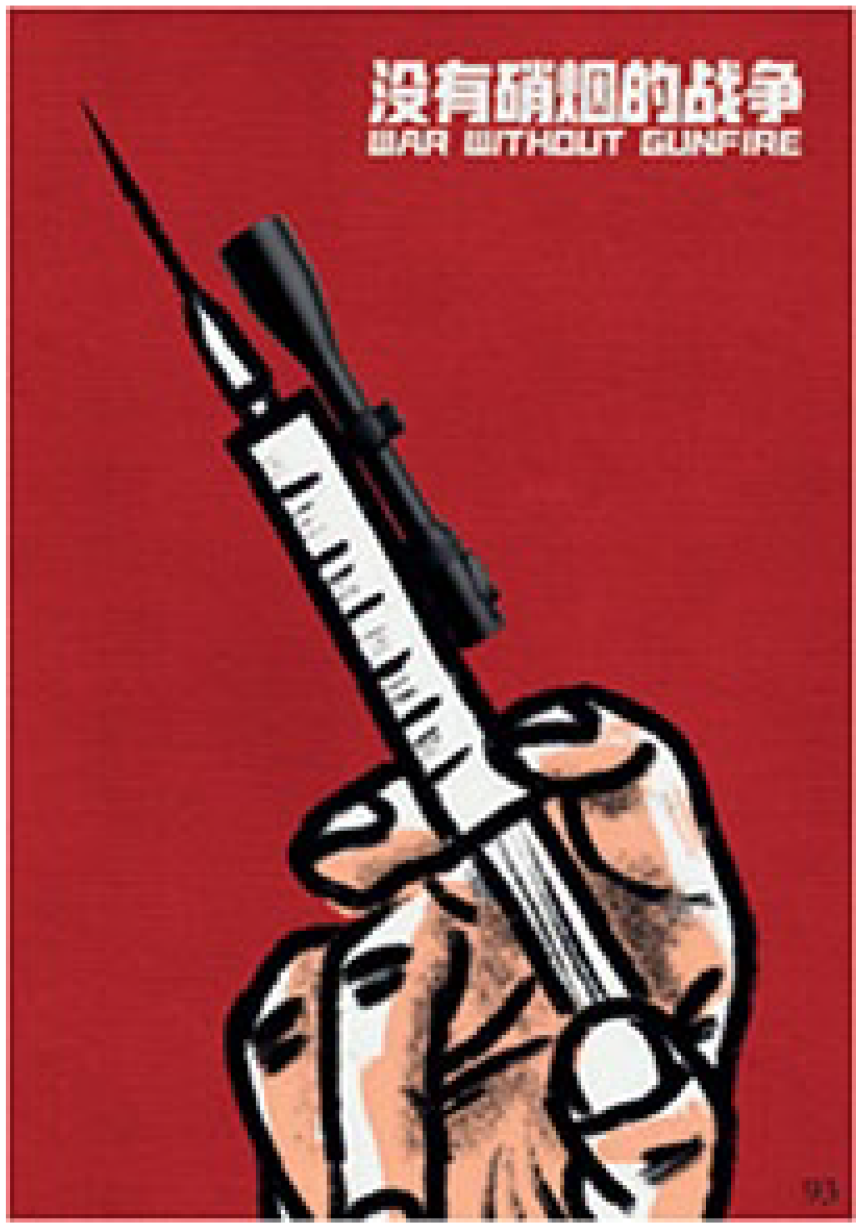
《没有硝烟的战争》(War without Gunfire) by Fan Xia “Love is Boundless” Exhibition, 2020 < https://www.sohu.com/a/505512188_121123945>).
Figure 9 involves two multimodal metaphors. For the first, we see a medical mask which is characterized with a mask itself, a nose clip, and two ear bands. In the meanwhile, a verbal label, “N95,” is superimposed onto the mask, which further anchors the message encoded in the image, namely a mask. But we find that the mask is attached with a strong handle at its middle part, thus shaping into a shield-like image. This visual information is reinforced by the verbal messages “防御” (prevent) and “守” (protect), whose meaning overlaps with the primary function of a shield, that is, “to defense,” hence the metaphor: “MASK IS SHIELD.” A shield is of course a defense weapon often used in the war. But more than that, the shield can also be considered as an attacking weapon. As shown in the picture, the lower part of the mask is depicted as the tip of a big arrowhead, with sparks flying around it, as if the arrow had hit a coronavirus. On the whole, we may find that the mask has been substituted with the head of an arrow, while the handle attached to the mask turns now into the shaft of the arrow. This reading is reinforced by both the feather-like handle on the top right of the picture, and the verbal message, “箭”/arrow, at the bottom right. As a result, we get the second metaphor: MASK IS ARROW. No matter it is compared to a shield or an arrow, both of them can be regarded as weapons used to fight against enemies, thus we have the master metaphor: MASK IS WEAPON.
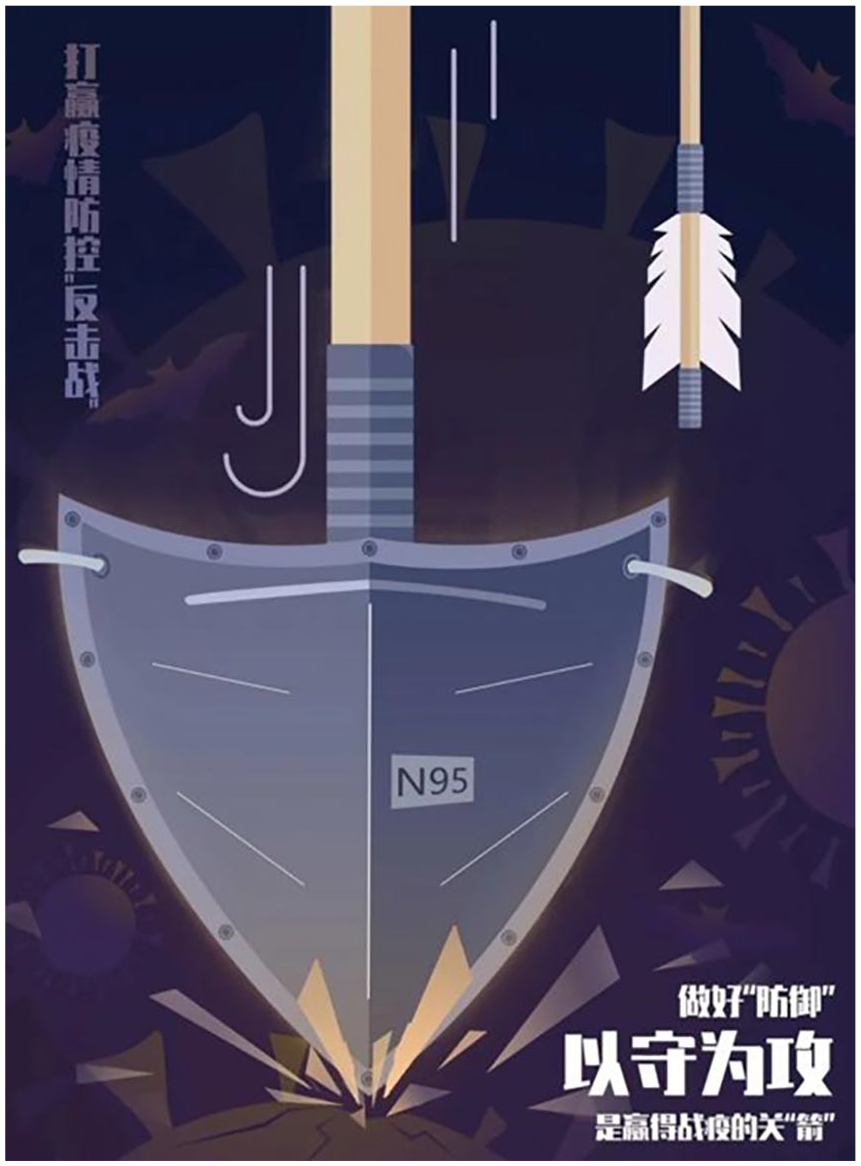
《以守为攻》(Defensive as Offensive) by Feng Liao (“Heart to Heart to Overcome Difficulties” Exhibition, 2020 < http://www.shejijingsai.com/2020/04/409180.html >).
Similar to the metaphors on coronaviruses and anti-epidemic workers, the metaphorical meaning of “medical instruments as weapons” has become reinforced by the use of compositional and interactive resources. For example, Figure 8 makes use of color contrast. The background of this picture is in pure red, thus making the syringe gun standing out distinctive in the foreground. Besides, the way in which the gun and the hand enter into the frame from bottom up, rather than from top down, set a promising tone to us that the war against the coronavirus will be going on and we will eventually get the upper hand. In Figure 9, the mask/shield/arrow is depicted as large and placed in the top center of the picture, suggesting that the weapons and the anti-epidemic workers are powerful, compared with the much smaller and broken coronavirus at the bottom of the picture, hence the metaphors: POWERFUL IS UP and POWERLESS IS DOWN (Feng & O’Halloran, 2013).
Conclusions
To conclude, we have examined the visual and multimodal metaphors created in the PSAs we collected by drawing primarily on Feng and O’Halloran’s (2013) visual representation of multimodal metaphor. The analysis shows that nearly all the “OBJECT IS OBJECT” metaphors are constructed through visual or multimodal anomaly or unconventionality (hence new or unconventional metaphors), which is achieved through strategies such as participant substitution and verbal/visual superimposition (Feng & O’Halloran, 2013), or visual and/or verbal integration or fusion (Carroll, 1996; Yus, 2009). In addition, PSA producers have made use of compositional and interactive resources such as spatial position, color contrast, gaze, and size (Feng & O’Halloran, 2013) (i.e., those derived from visual or multimodal anomaly) to reinforce or support the meanings of the new or unconventional metaphors. As a result, we find some commonly-used conventional metaphors in the pictures that serve to foreground the unconventional ones, such as POWER IS VERTICAL POSITION (powerful is up, powerless is down), POWER IS SIZE (powerful is large, powerless is small), and IMPORTANT IS CENTRAL (or unimportant is marginal).
The analysis shows that the metaphors, in particular unconventional metaphors, in our data fall into three general groups, namely, metaphors on coronavirus, metaphors on anti-epidemic workers, and metaphors on medical instruments. The first type generally compares the coronavirus/COVID-19 as something dangerous, which is mainly realized by two subtypes: CORONAVIRUS IS BOMB and CORONAVIRUS IS DEMON. The second type generally compares the anti-epidemic workers (such as doctors, nurses, community volunteers, etc.) as warriors who act to defeat the coronavirus, which is realized by three subtypes including ANTI-EPIDEMIC WORKER IS WARRIOR, ANTI-EPIDEMIC WORKER IS TIGER/DRAGON/LION, and ANTI-EPIDEMIC WORKER IS GOD OF GUARD. The third type generally compares the medical instruments as weapons that are used to fight the coronavirus, which is realized by subtypes such as SYRINGE IS GUN and MASK IS SHIELD/ARROW. The three types of metaphors account for nearly half (49.7%) of the total number. Seeing form their source domains (e.g., “dangerous objects,” “warriors,” and “weapons”), plus nearly another half (36.0%) of the metaphors that identified as “ANTI-EPIDEMIC WORK IS WAR” (See Table 1), we can safely claim that most of the metaphors in the PSAs we collected belong to an overarching metaphor as follows: “ANTI-EPIDEMIC WORK IS WAR.” The similarities between the target (i.e., anti-epidemic work) and the source (i.e., war) of this overarching metaphor are established by virtue of the sub-metaphors we have analyzed. Specifically, coronaviruses are enemies (described as demons, bombs) in the battlefield (e.g., hospital) while anti-epidemic workers are warriors (e.g., fighters, soldiers, god of guard). Medical instruments (e.g., syringes, masks, scalpels, etc.) are regarded as powerful weapons (See Table 1).
Different Types of Metaphors in PSAs.

Figure 10 is a WORK IS WAR. The picture represents two groups of participants, one is doctors/nurses on the right who are wearing medical protective clothing, holding medical instruments such as syringes, sprays, scalpels, etc., and are facing the coronaviruses. The other is the coronaviruses who are depicted as devilish monsters with not only crown-like profile (the original shape of a coronavirus), but also vicious eyes, noses, fangs, facial expressions, saliva droplets, and animated arms and limbs. Through the superimposition of some features (such as the monster-like actions, behaviors, and facial expressions, saliva droplets) onto the coronaviruses, we see that the coronaviruses became “demons,” while the picture of the coronaviruses and medical staffs facing each other suggests a battle between them, with the former depicted as enemies, and the latter as “warriors,” hence we have the overarching metaphor: ANTI-EPIDEMIC WORK IS WAR.

《必胜》(We Will Win) by Minjing Yu (“Defeating COVID-19, China Will Win,” 2020 <https://www.sohu.com/a/388036900_100050512>).
Let us now turn to the last research question, why were the metaphors designed as such (i.e., most metaphors are visual and multimodal, and are oriented to an overarching metaphor, namely “ANTI-EPIDEMIC WORK IS WAR”)? We answer this question from three aspects, that is, social background, genre, and audience that are related to the creation of those metaphors. First and foremost, the metaphors were produced under a particular social and historical time, when China was experiencing a severe COVID-19 disease. In order to control this disease, the Chinese people and government adopted strict measures such as lockdown of cities, quarantine of patients, and wearing masks, ever since the outbreak of this disease. Doctors and nurses were mobilized from all over the country to participate in the treatment and prevention of this disease; armies and soldiers were deployed to build temporary quarantine points and hospitals at the epidemic epicenter in Wuhan. . . As a result, the whole nation were mobilized to join in the war against the COVID-19 epidemic. Visual and multimodal metaphors undoubtedly functioned to represent and construct those measures and practices, which in turn provided material for the creation of the metaphors.
Second, genre influences the formation of metaphors. Political comics or cartoons may tend to employ exaggerated or ironic images and words to represent public figures or institutions (Alousque, 2020; El Refaie, 2003; Godioli & Pedrazzini, 2019). Pictorial (or visual) metaphors in commercial advertisements may be used to represent products in forms of brand names or logos (Forceville, 1994, 1996, 2008). A PSA shares some properties with commercial advertisements, but its primary goal is to promote publicly acceptable ideas, actions and events, or to publicize new and abstract knowledge rather than sell products. As a result, discursive strategies such as participant substitution, visual/verbal superimposition, and verbo-visual integration are widely employed to form unconventional visual or multimodal metaphors so that the public can easily understand and accept the new knowledge and new practices emerging during the COVID-19 pandemic.
Finally, metaphors are designed for the target audience. Unlike medical workers who were personally involved in treating/preventing the epidemic, the PSA audiences were the ordinary people who were forced by the COVID-19 disease to stay at home to avoid spreading/contracting the disease. They knew little about the coronavirus or about how to prevent/control the disease in particular in the early days of this pandemic, but visual and multimodal metaphors rendered such knowledge concrete and relevant (Tay, 2017). On the other hand, cultural backgrounds may affect the production and understanding of a metaphor (Forceville, 2017; Kövecses, 2005, 2015; Talebinejad & Dastjerdi, 2005). As shown in Section 5, some metaphors compared anti-epidemic workers as powerful animals or gods of guard. Understanding such metaphors requires knowledge on Chinese worshipping practices such as placing a pair of stone lions as gods of guard in front of the gate (Figures 5–7). Since the target audience of the PSAs are Chinese citizens who are familiar with those cultural practices, it is not difficult for them to figure out the metaphorical meanings encoded in the image.
On 8 April 2020, lockdown was lifted in Wuhan, the once worst-hit city in China. Since then, China’s coronavirus cases have been gradually cleared to zero, although there are sporadic cases. People are returning to schools, factories and workplaces, and production is resuming. The effective control of COVID-19 is undoubtedly related to the strict prevention and control measures and active participation of the public in the anti-epidemic activities, among which visual and multimodal metaphors in public service advertisements have undoubtedly played an important role in promoting people’s understanding and acceptance of anti-epidemic knowledge and practices.
Footnotes
Acknowledgements
The authors pay great gratitude to the editors of SAGE Open and anonymous reviewers for their valuable comments and suggestions.
Declaration of Conflicting Interests
The author(s) declared no potential conflicts of interest with respect to the research, authorship, and/or publication of this article.
Funding
The author(s) disclosed receipt of the following financial support for the research, authorship, and/or publication of this article: This work was supported by the Humanities and Social Sciences Planning Fund of China’s Ministry of Education under the Grant [No. 18YJAZH019]; Research Fund for Talented Scholars of Hangzhou Normal University [No. RWSK20200411]; “Hangzhou Center for International Communication and Discourse Strategies of Culture” at Hangzhou Normal University.
