




Abstract
Spending almost US$700 billion to combat insurgents in Afghanistan, the U.S. population should be hopeful that they “bought” something of value as the Afghan War concludes. This exploratory study focuses on evaluating operations within Afghanistan by accounting for enemy and civilian losses. Integration of civilian losses offers an opportunity to evaluate operations that represent societal losses to the Afghan people. Regression estimates using zero-inflated negative-binomial models indicate that military operations resulted in more civilian casualties than enemy losses.
Background
Only a few days after 9/11, U.S. troops were deployed to the Middle East (South-West Asia) to begin preparing their campaign against the terrorist group responsible for destroying New York City’s World Trade Center. Approximately 13 years after this military buildup, this War is expected to be drawing to a close as Afghans will now take the primary role of security (Lila, 2013). Billions of dollars were spent in fighting the war, but the effectiveness of this effort has not yet been accurately assessed. Although assessments have been accomplished, they are questionable in their reliability and validity (Downs-Martin, 2011). In addition, the analysis of data is limited and attempts to forecast (Downs-Martin, 2011). The complexity of assessing the Afghan War is founded in the fact that the U.S. population is hopeful. Spending record amounts on defense, the U.S. population should be hopeful that they are “buying” something of value. Yet, as Downs-Martin (2011) argues, current assessments using past and present data to determine some future accomplishment are dubious.
Introduction
This article focuses on assessing the military in combat operations in Afghanistan. To accomplish this, the military is defined and a review of literature that quantifies and assesses military operations in Afghanistan follows. This article then discusses the impact of the Afghan War on the Afghan people and offers evidence of the widespread impact the Afghan War had on civilians. An analysis and discussion of enemy engagements in Afghanistan follows and focuses on the casualties of war as a measure of military effectiveness.
The Counter-Terrorism Industry’s Purpose
The U.S. military in its current state, including the Department of Defense (DoD), has established infrastructure that is far more advanced than the rudimentary infrastructure necessary in late 2001. These resources come at an increasing cost. Advanced weapons, aircraft, surveillance systems, and other countless associated pieces of equipment are bought and paid for by the American people. Therefore, the American people have a right to know how their resources have been used. Such transparency is purported by some government officials, but others characterize the U.S. Government’s transparency as being little more than smoke and mirrors. Before an assessment can be made, the definition and purpose of the military must be defined. This may seem a simple task, but when one considers the vast array of military institutions, their operations, and the public’s perceptions of what the military should do, the mission of the military becomes less clear. This study will refer to the U.S. Armed Forces as the “military” and reflect only the decisions within the span of military commanders. Thus, political forces and intent are not the focus of this assessment, but rather the actions and decisions of the U.S. Armed Forces.
The Doctrine for the Armed Forces of the United States, published in March 2013, defines the purpose of the armed forces as such: The US Armed Forces fulfill unique and crucial roles, defending the US against all adversaries while serving the Nation as a bulwark and the guarantor of its security and independence. The US Armed Forces function within the American system of civil-military relations and serve under the civilian control of the President, the Commander in Chief. The US Armed Forces embody the highest values and standards of American society and the profession of arms. (U.S. Army, 2013, p. i)
Today’s military is embroiled in a war far different than the wars that shaped the structure, culture, and traditions of the U.S. military. The men and women of the military are trained to survive and win under war conditions. Nation-building and community policing are not the primary objectives for which members of the military are trained. The objectives of military basic training may be considered a clear representation of what the military expects from members; they are a reflection of what leaders demand to be instilled in all service members. Although each branch of service in the U.S. Military (Army, Air Force, Navy, Marines) differs by method and training needs, they do share many similar characteristics. Military training certainly emphasizes physical fitness, but a large component of basic training is changing the way the trainee thinks. Military ethics, values, discipline, and tradition ensure that trainees will obey commands and respect the chain of command. Field training exercises (FTX) and rifle/handgun training both ensure that the trainee is prepared for battle. FTX are designed to mimic austere war conditions. Trainees are required to perform military operations with very little sleep. Rifle and/or handgun training ensures that all trainees know how to fire a weapon with accuracy and maintain that weapon for reliable action. Military basic training serves a critical purpose: It ensures that the men and women of the military will behave as expected when war occurs. Military basic training does not emphasize human rights or government building. As one might expect, emphasis is placed on killing while not being killed. Ethics such as “service before self” are an effort to inculcate the trainee to place the greater good and mission success over that of individual needs. With such a mind-set, it should be of no surprise that military members have difficulty showing kindness to civilians of an enemy state. Military members are best suited to be engaging with combatants.
Often, entities outside of the military are tasked to facilitate the efforts of the War on Terror. Agencies such as the DoD (apart from the military branches), Department of Homeland Security, Central Intelligence Agency, Department of State, and the Department of Justice have fulfilled the mission of the War on Terror and continue to do so. In addition, contractors also provide a great deal of the manpower needed to fight this war. In fact, defense contractors outnumber troops in Afghanistan and have since 2007 (Brewin, 2013; Miller, 2007). Thus, any assessment must encapsulate the efforts of all these participating entities.
Assessment
Assessments should provide a data-driven method to inform policymakers, government agencies, and the public of how well resources are currently being utilized and inform decisions that alter resource allocation in an effort to improve efficiency. Although the value of an assessment is rarely disputed, the measures used in assessment are often criticized. The output of a war is generally nonlinear and measures to determine success are often hidden and/or subjective. Political and economic measures have long been used to determine the effectiveness of the Afghan War. The results of these studies only serve to further cloud the true effectiveness of the Afghan War effort (Downs-Martin, 2011).
If the goals of the Afghan War are to change the political climate in Afghanistan, they have been met equally as well as the goals of the Vietnam War. During that era, assessment of the War endured a significant transition. Determining the value of assessment during military campaigns gained attention during the Vietnam War when the Military Assistance Command, Vietnam (MACV) and federal agencies in the United States expressed their dissatisfaction of techniques used to acquire and analyze data prior to the Hamlet Evaluation System (HES). The HES was a reaction to the lack of validity and reliability of data obtained by the MACV and the Vietnam government which included subjective data using unreliable measures (Gayvert, 2010). The HES, started in 1967, was a concerted effort to collect political and insurgency data at the hamlet rather than the village level in Vietnam because it was a more accurate measure of the population (Gayvert, 2010). The HES was an effort to better assess how the campaign was truly changing the population at a time when U.S. government and population questioned the effectiveness of the war. The granularity for the HES was crucial because it was the hope of the American people that communist ideology would not take hold in Vietnam. Yet, the ideology of the Afghan people is not the central concern of the Afghan War. Defense Secretary Chuck Hagel has made it clear that the purpose of the Afghan War was to combat al Qaeda (Thompson, 2014). The Afghan security forces are tasked with continuing the pressure to keep al Qaeda at bay. Ideology of the people in Afghanistan is not an objective; thus, political measures may be an inconsistent measure.
Downs-Martin (2011) argues that major flaws plague current methods of assessment. The flaws include the potential for overoptimism when military members are asked to determine whether operations are effective. As Downs-Martin points out, overoptimism is a favorable characteristic of leadership as it encourages progress, but in assessment, it can produce inaccurate results. Data collection, analysis, and depiction of trends are also areas for improvement for current methods of assessment. Thus, data may be collected but without consistency, appropriate analysis, and representation; the results can be incomplete or misleading (Downs-Martin, 2011). In addition, assessments based on an end goal are particularly problematic in Afghanistan because the goal has shifted during the span of the war and because political stability is difficult to assess considering the heterogeneous composition of Afghanistan (Downs-Martin, 2011).
Downs-Martin (2011) argues that objective analyses of the complex nature of terrorism and insurgency conducted in a time frame that is useful are highly unlikely and concludes that any “operational/strategic counterinsurgency assessment in Afghanistan must be subjective” (Downs-Martin, 2011, p. 116). Yet, the need for an objective assessment that accounts for the total security situation is crucial (Cordesman, 2015). Ineffective measures and assessments based only on hostile forces have resulted in short-sighted goals (Cordesman, 2015). This study aims to assess operational counterinsurgency operations using a cost-benefit analysis of casualties. As crude as it may be, body count, or casualties, may be one of the only measures that is relatively accurate and may be most useful in determining how well operations are conducted.
Body count is more complex than simply the number of terrorists that were killed. Casualties of friendly forces, noncombatants, and civilians negatively affect populations around the globe. When a parent of a fallen military member is informed of his or her loss, the ensuing pain of that loss is difficult to conceptualize. Although obvious, it is important to note that the pain of loss is no less for the Afghan people who continue to endure losses as result of this war. This impact on a population has the immense potential of changing the course of the War and, thus, the outcome of a campaign assessment.
The Afghan People
The deaths of innocent civilians caught in the middle of war may be the greatest cost of the Afghan War. Shaw (2002) estimates the ratio of “innocent Afghan” civilians to American losses to be more than 1,000 to one (p. 355). The innocent casualties of war can be argued to be a negligible loss for one of two reasons. First, equal or greater losses would have occurred without intervention. Second, the civilians’ losses are small compared with enemy losses.
Many great military members and contractors were lost in this War and that is a terrible price to pay, but those who serve know the danger of serving. When service members are deployed, there is no reason to believe they are out of harm’s way; quite literally, they are putting themselves directly in harm’s way. This in no way diminishes the loss of their lives, but their loss cannot be assumed as unforeseen. On the other hand, the Afghan civilians have little choice but to attempt to survive the conflict. The Afghan people will see the cost of war in their villages, government, and culture. Unlike military members, they are not being compensated for the hazards they face. It is also questionable whether the outcome of the War will benefit them.
In a War fought with the awesome might of the United States, Britain, France, and other superpowers, the Afghan civilians are forced to withstand and survive as bystanders. The greatest atrocities occur when children are killed by an unexploded ordnance or exposed to the toxins created when ammunition having depleted uranium (DU) cores have been reported. Unexploded ordnances can leave children crippled, maimed, or dead. Afghanistan from 2000 to 2002 has the distinction of experiencing the highest number of casualties in the world (Bilukha & Brennan, 2005). Data from the United Nations Mine Action Center indicate that as the number of casualties due to landmine detonations decreased, casualties caused by unexploded ordnances increased. Moreover, the proportion of children being injured or killed by unexploded ordnances increased; children accounted for 42% of all injuries due to unexploded ordnances (Bilukha & Brennan, 2005). Although the United States reports that no ammunition having DU were being used in Afghanistan, the Afghan people suggest they have been used and are the cause of increased cancer rates and birth defects (Miraki, 2006). The use of DU is not central to this study, but it does highlight a substantial and long term cost of the Afghan War.
Ghufran (2008) found that the North Atlantic Treaty Organization’s International Security Assistance Force (ISAF) was having difficulty reducing insurgent activities. In addition, although many Taliban fighters have been killed, this came at a high price in the form of civilian lives. Ghufran identifies the dilemma of the Afghan War: Killing Taliban forces results in killing civilians and the killing of civilians is counterproductive for the Karzi administration. Civilian deaths result in antigovernment and anti-U.S./coalition sentiments. Moreover, the psychological and societal costs of the massive loss of life cannot be understated. Similarly, war-stricken nations have reported high rates of posttraumatic stress disorder (PTSD); 94% of children displaced due to the conflict in Bosnia reported symptoms of PTSD (Bhutta, 2002). The widespread and staggering loss of life in Afghanistan is certainly detrimental to Afghan society, but it may also ensure that peace is less likely in the region. Bhutta (2002) argues that PTSD results in a cycle of violence. Figure 1 depicts operations in which enemies were engaged in Afghanistan.

Operations in which U.S. forces engaged with the enemy.
Figure 1, derived from data from The Guardian, depicts the widespread impact of operations in Afghanistan. Southern areas of Afghanistan have seen the greatest concentrations of enemy action operations, but many operations are scattered around the country. Benini and Moulton (2004) found an “unequal distribution of civilian victims across local communities” (p. 405). Many communities have no civilian losses, but a small portion has a great number of losses. Their data were relegated to Operation Enduring Freedom and does not extend beyond 2003, but their findings seem to be supported by the data in this study. Although operations in Afghanistan are widespread, certain regions have far more violent action than others. To make the direct impact to the population more visible, Figure 2 depicts the population density of Afghanistan. The data depicted in Figure 2 were acquired from The Guardian.

Population density in Afghanistan.
As is visible when comparing the enemy action map (Figure 1) and the population map (Figure 2), the southeastern portion of Afghanistan has a great deal of both people and enemy action. Thus, a greater portion of people in these areas have been directly exposed to war. Although northern areas of Afghanistan are exposed to fewer enemy action operations and western areas of Afghanistan are not as populated, it should be expected that the people of the area have had some exposure to war, albeit indirect.
War is a life-altering event for any military member. Most civilian Americans will never be exposed to war directly but may be told stories of war by a family member or friend. These stories often depict heroic actions of service members defending the very freedom that most Americans take for granted. Afghan civilians will spend generations telling the stories of the Afghan War. The most riveting and surviving stories will likely be those of human tragedy. In 2009, the U.S. military claimed a 28% reduction in civilian casualties due to a shift in strategy that included a reduction in the number of air strikes in populated areas (Mullen, 2010). Yet, United Nations Assistance Missions in Afghanistan (UNAMA) found that civilian deaths increased by 14% in the same period (UNAMA, 2010). The contrary findings between the U.S. Military and UNAMA may be a result of different data sources or procedures in obtaining data. During the Gulf War, military strategy attempted to reduce the number of civilian casualties and the impact of destroyed targets on the civilian population; yet, it was implementation that prevented the strategy from being effective (Knights, 2003). Pilots and targeteers continued to use overwhelming destructive power that resulted in far more suffering than intended (Knights, 2003). Leaked videos from conflicts in Afghanistan reflect the overwhelming use of force on targets. Such evidence, despite the possibility that these incidents occurred infrequently, fuels a lack of confidence for international forces.
Distrust and tension continue to be a concern between the Afghan government and international military forces (Mullen, 2010). This distrust should be expected to be shared among the civilian population via informal social networks. Thus, for every misstep that American missions take, generations of enumerable children will be told of these atrocities and change the very culture, the very reality that these individuals impart on themselves. For this reason, the global community has a right to know the effectiveness of military troops. The global community will suffer the missteps of American and coalition troops for generations to come.
Despite the expectation that Afghans would view American influence as negative, a 2010 study conducted by the Asia Foundation found that 83% of Afghan respondents see the introduction of Western values as positive (Rene, 2010). What complicates these optimistic results is that the Asia Foundation’s survey results also indicate most Afghans (62%) feel that speaking negatively about the government is not acceptable (Rene, 2010). In addition, corruption and nepotism have become rampant; this further deters the growth of the nation and increases the potential for an ineffective government (Maley, 2011).
As stated, assessment of operations in Afghanistan must be a measure that has a quieting effect; that is, the measure must be simple and objective. The most identifiable consumer of the Afghan War is the Afghan people, so any assessment must include the impact to the population. In addition, the Afghan people pay the greatest price of the War. Thus, the cost and benefits most affect the Afghan people. Americans and the U.S. government are interested in eliminating terrorists who target the United States and its interests. Therefore, the most direct method to measure success is to compare the benefit, killing terrorists, against the cost, killing innocent civilians. Operations that kill or injure more terrorists than civilians are a simple yet effective measure of success. The Afghan War was and is more than simply killing terrorists; it is also considered to be a humanitarian effort. Thus, a protection policy is inherent when one of the war’s goals is to help the Afghan people become and feel safe. In meeting this goal, forces should identify those that are directly affected and develop ways to protect them (Bonwink, 2006). Using data from U.S. operations in Afghanistan, this study aims to address the following research question:
The following hypotheses will be tested:
These hypotheses are written such that finding no support for Hypothesis 1 would indicate that Afghan War operations are less likely to kill civilians or that enemy operations are not related to the number of civilian deaths that occur. Support for Hypothesis 2 would indicate that operations in Afghanistan are more likely to kill enemies. On the other hand, if results do not support HA2, operations in Afghanistan were not effective. Hypothesis 3 is focused on how good operations in Afghanistan have become in avoiding civilians over the course of 6 years (2004-2009). Finally, a comparison of losses of all operations between enemies and nonenemies (civilian and noncombat) is tested to address Hypothesis 4.
Method
The greatest cost of war is the loss of lives; it is also the greatest benefit. Dead enemies represent the benefit and dead civilians and friends (known as friendlies) represent the cost. The deaths of the innocent and the enemy can be far-reaching; each in their own respect. The death of a terrorist may act as a deterrent and could potentially stem further recruiting of terrorists. A death of a civilian could feed an antiwar sentiment, promote the agenda of the terrorists, and result in long-lasting societal costs.
Thus, in an effort to assess the success of military operations in Afghanistan, this study utilizes open source data from The Guardian on enemy and civilian casualties during combat operations. Prior to 2008, no assessment plan was put into place, thus including data on operations during this time is vital. It is argued that enemy casualties represent the benefits of operations during the Afghan War because a ubiquitous goal of the Afghan War has been to eradicate al Qaeda. The death of noncombatant and friendlies are considered a cost of war. The data used in this study utilizes information reported on individual missions from 2004 until 2009; these operations culminate into a data set having 76,597 observations. Variables used in this study include the type of operation, year of the operation, the number of enemies killed, enemies wounded, civilians killed, civilians wounded, friendlies killed, and friendlies wounded. To obtain a better understanding of the cost of lives affected, the sum of wounded and killed were calculated to obtain a total number of enemy casualties. In addition, the sum of killed and wounded from civilian and friendlies were calculated to represent the innocent lives that were impacted due to the operation. Below are the descriptive statistics for variables used in this study.
Descriptive Statistics
Table 1 reports the number of incidents of each action when the type of action was recorded. Enemy action events were most common and compose approximately 37% (n = 27,093) of all incidents from 2004 to 2009. Explosive hazards, generally improvised explosive device incidents, occurred second most often and composed approximately 31% (n = 23,083) of all incidents. Counter-Insurgency events occurred least often of known incidents; only .06% (n = 43) of the incidents were of this variety. Together these incidents compose some 74,159 operations/missions in which the U.S. Military engaged.
Military Engagement by Action.

Table 2 reports the descriptive statistics of data used in the empirical analysis. The unit of analysis is each incident. Some operations were not given a designation for the type of operation. In total, 76,911 incidents were recorded from 2004 to 2009. The number of wounded and killed is the focus of this study. Events that resulted in the killing or wounding of enemies can be considered successful engagements while incidents resulting in killed or wounded “friendlies,” hosts, and civilians are considered unsuccessful engagements. Of particular importance is the number of innocent persons that were killed or wounded in respect to the number of enemies that were wounded or killed. An engagement may be considered successful if more enemies were killed/wounded than civilians. Overall, incidents have an 11% chance of resulting in a killed or wounded friend. Civilians are more likely to be killed or wounded; this occurs 17% of the time. Twenty-eight percent of incidents resulted in nonenemies being killed or wounded. On the other hand, enemies were killed or wounded 22% of the time. The maximum number of enemies killed in any operation recorded is 181 persons. Sixty-seven civilians, 27 hosts, and 16 friendlies were the maximum persons killed during these operations.
Friends, Hosts, Civilians, and Enemy Casualties.

Empirical Results
Hypothesis 1 sought to determine whether nonenemies were more likely to be killed during operations when the enemy is engaged. A zero-inflated negative-binomial regression model is used instead of a Poisson regression model to account for the zero-heavy count data. In addition, this regression model was chosen over a negative-binomial regression model because zeros in this data represent significance rather than nothing. Zero losses during a military engagement is meaningful, thus, the zero-inflated binomial model was chosen. Coefficients in these models are reported in incident rate ratio (IRR). Negative relationships are demonstrated with coefficients between 0 and 1. For example, an IRR of 0.5 can be read as an increase of one unit in the independent variable will result in a 2-unit decrease in the dependent variable.
The results, reported in Table 3, indicate that during operations in which enemies were confronted, nonenemies were more likely to be killed or wounded. With a p value of .012, approximately 7% more of a nonenemy is killed or injured when the operation targets an enemy. Stated another way, an additional civilian is killed after approximately 14 enemy engagements. This loss is not dramatic, but it is significant. In addition, the McFadden’s R2 is moderately high (.561), indicating that 56.1% variation in the deaths of civilians is explained by this type of operation.
Operations Engaging an Enemy and Total Civilian Casualties.

Note. Dependent variable is number of civilian deaths and injuries. A zero-inflated negative-binomial model is used and the coefficient is reported in IRR. IRR = incident rate ratio.
In addressing Hypothesis 2, “when engaged in enemy operations, enemy forces are more likely to be killed,” a zero-inflated negative-binomial model is utilized again. The result of this regression is reported in Table 4. The focus of this regression is to determine whether engagements with the enemy are successful, that is, whether enemies being killed or wounded when the purpose of the operation is to kill enemies. The result of this regression indicates that enemies are slightly less likely (p = .002) to be killed during enemy actions when compared with all other incidents. Enemies are 11% (IRR = 0.896) less likely to be killed. The McFadden’s R2 is .576 indicating a moderately strong model in which 57.6% of variation in number of enemies killed can be explained by enemy action under a zero-inflated negative-binomial model.
Operations Engaging the Enemy Impact on Total Enemy Casualties.
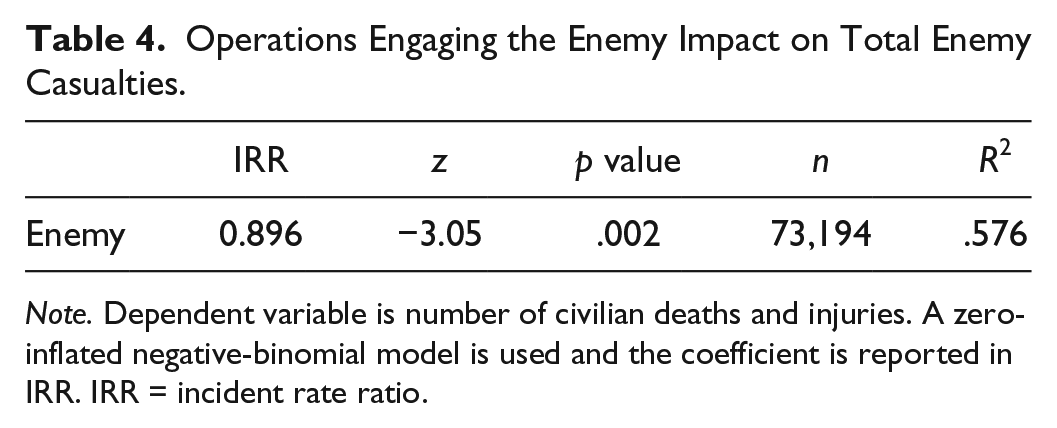
Note. Dependent variable is number of civilian deaths and injuries. A zero-inflated negative-binomial model is used and the coefficient is reported in IRR. IRR = incident rate ratio.
The data used in this study spans from 2004 to 2009, a 5-year period. Over this time, it would be expected by most that operations would become more effective. Gaining control of enemy territory and more accurate intelligence should result in more effective engagements. Thus, the Hypothesis 3 assumes that civilians are less likely to be killed or wounded as the years pass. As reported in Table 5, Model one’s results are contrary to the assumption of fewer civilian losses. Afghan civilians could expect an increase of .04 of a life lost or a person wounded for every year that passes. To investigate this further, Models 2 and 3 report the number of additional lives lost and people wounded, respectively. Model 2 indicates that fewer Afghan civilians (IRR = 0.961) were killed as the years passed, but Model 3 indicates that more Afghan civilians (IRR = 1.057) were wounded for every year. McFadden’s R2 values indicate moderately strong model fit for all three regressions.
The Impact of Time on Civilian Casualties, Deaths, and Injuries.

Note. Dependent variable (DV) is number of civilian deaths and injuries and the independent varaible (IV) is the year. A zero-inflated negative-binomial model is used and the coefficient is reported in IRR. IRR = incident rate ratio.
Although the numbers of nonenemy casualties are certainly unwanted losses, the argument could be made that those losses are necessary to kill or wound enemies. The final hypothesis in this study seeks to find the price of a nonenemy combatant paid in enemy combatants. The results of this regression assume that a nonenemy life is worth as much as an enemy life; it certainly could be argued otherwise, but setting one as being more valuable and to what degree would be quite controversial. The results of the regression using a zero-inflated negative-binomial model are represented in Table 6. As the table displays, for every enemy that was killed or wounded, 1,013 nonenemies were killed or wounded. The result is significant (p = .000) and the McFadden’s R2 is .562.
Impact of the Number of Enemy Casualties on the Number of Civilian Casualties.

Note. Dependent variable is number of civilian deaths and injuries. A zero-inflated negative-binomial model is used and the coefficient is reported in IRR. IRR = incident rate ratio.
Discussion
It has been said that every war has its casualties and every victory its price. As the United States draws down troops from the Afghan region, it is difficult to find closure since no victory or defeat has been evident. Results of this study are mixed but the results do not favor the conclusion that the military has been very effective in killing more enemies than civilians. To assess the military’s effectiveness, four hypotheses were tested, each centering on civilian and enemy casualties.
The first hypothesis assumes that casualties, wounding or death, of civilians during an enemy confrontation would act as a disservice to the overall mission in Afghanistan. The results indicated that, compared with all other operations, civilians were more likely to become casualties during enemy action. Although this offers some insight into the effectiveness of engagements with the enemy in Afghanistan, it focuses only on the losses. Thus, Hypothesis 2 sought to determine whether enemies were also more likely to be killed or wounded when engaged. The results of the analysis indicate that enemies have a lower likelihood of being a casualty when U.S. troops directly engage the enemy.
Hypotheses 1 and 2 assumed that enemy action is of primary concern when considering losses, thus Hypothesis 3 included all operations from 2004 to 2009 in assessing whether U.S. operations have become safer over time. Results of the three models that investigated this hypothesis found that although the number of civilians killed decreased, the number of wounded increased. The result is an overall increase in the likelihood of a civilian casualty.
Although the previous hypotheses shed some light on the effectiveness of military operations, a convincing argument remained unchallenged. That is, although civilian lives are lost, the number of enemies that are killed or wounded is assumed to compensate those losses. Put another way, the number of civilian losses were considered acceptable as long as an increased number of enemies were killed as a result. Because making an assumption that a civilian or enemy life is worth more or less would be wrought with pitfalls, this study assumed that one enemy killed or wounded is worth the same as one civilian casualty. The results of the final analysis indicate that military operations kill or wound slightly more civilians than enemies. In any one operation, this would be acceptable, but this is an analysis of nearly 77,000 operations over a 5-year period.
The results of this study have indicated that between the years of 2004 and 2009, civilians were more likely than enemies to become casualties during operations in which the enemy is engaged. In addition, nonenemies have become slightly more likely to be wounded but slightly less likely to be killed. Finally, the tradeoff between enemy and civilian casualties favors the enemy. That is, in general, for every enemy casualty, more than one civilian is a casualty from U.S.-led military operations. The results of this study are a sobering reminder of the great losses in war. Assessment of the military’s effectiveness during the Afghan War could be subjective, but the data and analyses used in this study are purposed to be objective. Assuming that the lives of the Afghan people are as valuable as those of terrorists/insurgents, U.S. operations were not effective. Yet, this assumption should not be taken lightly. In the safe confines of an office or home, many might argue in support of the humanitarian perspective so evident in this article, but for the military members who fought this war, this perspective may not be practical (Slim, 2003). Actors in the war must grapple with their own perceptions of how much “they” are like “us” (Slim, 2003). Those who are spectators of the war may find it simple to partition enemies and civilians, but actors are charged with deciding upon this partition in a moment when their own lives are in jeopardy.
Limitations
Determining the effectiveness of complex systems can incite passionate arguments. This study sought to measure military effectiveness using variables that are less subjective: the casualties of war. Although simplistic, its purpose is to get to the heart of the problem; if U.S. Armed Forces are injuring or killing more innocent people than enemies, those military operations cannot be considered effective. On the other hand, other measures of effectiveness can be argued. Future research should seek more objective ways to measure military operations using a variety of definitions of effectiveness.
Data on military operations in current conflicts are difficult to obtain. This researcher could only acquire data from 2004 to 2009. Optimally, military operations should be analyzed regularly and these results should be shared with the public. That is not to say that classified information should be available to our enemy; instead, analysis in the aggregate should be shared with the public. Future research should utilize a larger time span of data so that more accurate findings can be established.
In conclusion, it may be that the success or failure of the Afghan War can only be determined decades after U.S. Forces leave the nation. Economic and political institutions that serve the people remain to be fully developed and it could take a significant number of years before that can be accomplished. Thus, the story of the country of Afghanistan may have only just begun. In the future, U.S. operations could be marked as the driving force for prosperous change or they could be identified as the entity that caused so much harm to the Afghan people. This study cannot assess how the Afghan War has changed and will continue to change lives, culture, and the world, but it does imply that the cost to the Afghan people exceeds the costs incurred by the enemy.
Footnotes
Declaration of Conflicting Interests
The author(s) declared no potential conflicts of interest with respect to the research, authorship, and/or publication of this article.
Funding
The author(s) received no financial support for the research and/or authorship of this article.