



Abstract
World Wildlife Fund (WWF) has developed a diverse range of emotionally-charged print Public Service Announcements (PSAs) to draw the public’s attention to wildlife conservation. These PSAs contain images of powerful visual effects, which can resonate with people’s emotions, and thereafter influence their behaviors. This research seeks to unveil how emotions are delivered by these PSAs. To achieve this aim, 144 multimodal print WWF PSAs on wildlife conservation were selected as the corpus. The visuals are prominent in each PSA, with English serving as the accompanying language. The visual emotive meaning of these PSAs was examined by using Martin and Rose’s appraisal system combined with Painter et al.’s theory. The findings revealed that WWF’s persuasive strategies predominantly revolve around evoking negative emotions through negative attitudes, unmediated perspectives, enlarged graduations, and activated ambiance in the PSAs. The use of contrast and metaphor was also revealed to be powerful tools for enhancing emotion. In general, this research expanded the application of appraisal theory to the interpretation of the emotive meaning of images. Meanwhile, by uncovering the emotive meaning of WWF print PSAs, it also contributes to the study of PSAs. Additionally, the framework of analyzing the emotive meaning of visual images in this research can also be applied to assess visual emotions in other types of advertising, textbook illustrations, cartoons, the visual scenes in videos, as well as conservationists’ visual design.
Plain language summary
Many Public Service Announcements (PSAs) in World Wildlife Fund (WWF) campaigns are designed to encourage people to protect wildlife. The images on these PSAs have powerful emotional effects. To explore the visual emotive meaning, 144 multimodal WWF PSAs in English were utilized as the corpus. The analytical framework is based on Martin and Rose’s appraisal system and Painter et al.’s theory. The findings revealed that WWF’s persuasive strategies mainly revolve around evoking negative emotions through negative attitudes, unmediated perspectives, enlarged graduations, and activated ambiance in the PSAs. The use of contrast and metaphor was also revealed to be powerful tools for enhancing emotion. Overall, this research expanded the application of appraisal theory to the interpretation of the emotive meaning of images. The framework established in this research can also be used to explore visual emotions in other types of advertising, textbook illustrations, cartoons, the visual scenes in videos, as well as conservationists’ visual design.
Introduction
The Background of Public Service Announcements (PSAs) in WWF Conservation Advocacy
Animals are losing their habitats due to human activities and global environmental changes. This poses survival challenges for various wildlife species (Powell, 2023; United Nations Environment Program, 2021). It is significant to safeguard wildlife because animals such as tigers, rhinos, marine turtles, and whales play a crucial role in influencing and supporting the survival of other creatures, making it possible to preserve entire landscapes (https://www.worldwildlife.org/species). Yet, there remains a notable gap in public awareness regarding this critical issue (Ibrahim et al., 2023; Miah et al., 2023). To address this crucial issue, organizations like the World Wildlife Fund (WWF), the world’s largest conservation organization whose mission is to conserve the biological diversity on earth, have taken a prominent role in designing emotive Public Service Announcements (PSAs) to raise the public’s awareness of this issue. PSAs are messages created and disseminated by non-profit organizations, government agencies, or similar groups to promote the public good (Pan, 2023). They seek to influence people’s attitudes positively by adopting persuasive expression (He & Cai, 2022; M. Terskikh & Malenova, 2018) and motivate them to take action (Wu & Feng, 2022).
WWF’s PSAs specifically strive to create emotive advertising campaigns to spark the public’s attention. As Makmanee (2013) points out, while increasing public consciousness about endangered species is a challenging feat, the evocative visuals in WWF’s campaigns have effectively spotlighted this concern. WWF print PSAs usually tell a simple story quickly, and most of them use visual elements to resonate with viewers’ emotions directly. For example, in a PSA, Don’t buy exotic animal souvenirs (the source link for each PSA is attached in Appendix I), the whole advertising is almost taken by the visual image. A slender woman was walking to the airport departure lounge with a suitcase. A long blood trail is left by the suitcase, which immediately elicits viewers’ negative reactions. It underscores that emotions, primarily stirred by visuals, play a pivotal role in capturing people’s attention. The words “Don’t Buy exotic animal souvenirs” and the WWF logo are at the right bottom. This pattern is evident in most WWF print PSAs, where imagery takes the lead, complemented by supportive English text.
Gap in Previous Studies
According to M. V. Terskikh and Malenova (2016, p. 140), thanks to its highly persuasive emotional effect, PSA can ultimately change the system of values and lifestyle of a person. However, there has been limited linguistic investigation of the emotions of PSAs. Linguistic scholars have analyzed PSAs from multiple perspectives, including the metaphorical and multimodal representations of autism-related PSAs (Pan, 2023), persuasive strategies in PSAs promoting filial piety (Yao & Feng, 2022), and the construction of attitudinal meaning and values in environmental PSAs (Wu & Feng, 2022). While these studies significantly contribute to understanding the linguistic features of advertising, they do not address the visual emotive meaning conveyed in PSAs.
Emotions play a central role in advertising (Poels & Dewitte, 2019, p. 81) because it employs emotive effect to realize its persuasive function (Bhatia, 2019), so emotional appeals have been extensively utilized in advertising (Poels & Dewitte, 2019). As an effective tool to persuade people’s action on animal conservation, WWF has designed a wide range of PSAs with strong visual emotion. Thus the emotive meaning in this genre is worth analyzing.
The linguistics research on the emotive meaning of text has been conducted based on appraisal system (Zhang, 2022), but the application of this theory has not been expanded into visual image analysis. Martin and Rose (2007) briefly delved into the analysis of visual appraisal meaning, drawing upon Martin and White’s (2005) appraisal system and visual grammar (VG) proposed by Kress and van Leeuwen (1996). Painter et al. (2013) significantly expanded upon Kress and van Leeuwen’s (1996, 2006) visual grammar, aiming to decipher multimodal meanings in children’s picture books. Feng (2015) contends that Painter et al.’s (2013) framework is equally adept at analyzing other genres, including advertising. Painter et al. (2013) also state that their theory not only develops analytical tools for understanding the images in picture books but also broadens the social semiotic account of the visual modality. This includes examining the visual elements that foster emotional engagement with the viewers (Painter et al., 2013). However, the application of Painter et al.’s (2013) theory in visual image analysis remains limited. Meanwhile, few analysts have combined these two theories to conduct discourse analysis on emotions.
Research Aim and Research Questions
In this research, we aim to explore the emotions conveyed by WWF print PSAs in English. To achieve this, we will draw on two existing theories: Martin and Rose’s (2007) appraisal system and Painter et al.’s (2013) visual grammar. Therefore, our research can bridge the previous gap by addressing two main questions: First, how do emotions manifest through the evaluative meaning of WWF print PSAs in English? Second, how are emotions influenced by the ambiance created within these PSAs? By investigating these aspects, we seek a deeper understanding of how WWF print PSAs effectively communicate emotions and impact viewers’ attitudes toward animal conservation.
Literature Review
Previous Studies on the Emotion of Discourse
Aristotle mentioned the effect of language on emotional construction in Rhetoric as early as 384 BC to 322 BC, and he regarded pathos as the appeal to emotions. Speakers need “pathos” to persuade their audience (Aristotle, 2018). In marketing and advertising, human language is a significant driver that codes emotional experience (Bhatia, 2019). Therefore, emotion in language has both significant social and interpersonal functions, which cannot be neglected in the articulation of interpersonal communication.
Language and emotion share a profound connection, as evidenced by Stankiewicz (1964), who asserts that emotion is the primary catalyst for human speech. In our daily communication, languages provide a wide range of verbal techniques and strategies that enable individuals to convey their emotions effectively. All languages can provide communicators with a large number of verbal strategies to convey emotions (Fussell, 2002), and individuals can also describe numerous emotional states through language (Ran & Fan, 2020).
In the linguistic field, scholars interpret the meaning of emotion from various perspectives. Zhang (2022) indicates that it refers to the meaning, position, state and behavior, or the indication of identifying words and deeds and social relations expressed by language, encoded and decoded according to certain principles. Researchers in pragmatics define emotion as a factor, which affects language use and interpersonal interaction and can be presented through human communication (Jiang, 2014). The emotion of language is closely related to culture. From an anthropological linguistic perspective, emotions are understood as cultural symbols that exist in various social relationships (Lutz & White, 1986). Based on the sociolinguistics point of view, emotion is regarded as a social and cultural phenomenon and belongs to social construction, which constructs people’s social attributes and cultural practices through emotion in social interaction (Ran & Fan, 2020). From the above discussion, the emotive meaning of language refers to individuals’ internal representation and subjective experience, which are mediated by discourse practice and constructed by social culture.
To deepen our understanding of emotion, Ran and Fan (2020) studied key topics and methods related to interpersonal emotions, examining the role of emotion in studies of face, (im)politeness, and interpersonal relations. They defined emotion and highlighted the growing interest in studying interpersonal emotion from various disciplines. While their work mainly focused on theory rather than practical examples, it emphasized the importance of research on emotion in interpersonal meaning.
The investigation of emotive meaning in discourse has not been limited to the theoretical dimension, and scholars (e.g., Ogarkova et al., 2016; Polo et al., 2017; Stoica, 2018; Yang & Hu, 2016) have conducted various research to unveil the emotive meaning of text. For instance, Yang and Hu (2016) conducted an extensive analysis of emotive meaning, considering philosophical, psychological, and linguistic perspectives. They discussed the intricate relationship between language and emotion, ultimately proposing a co-constructing relationship between the two. In parallel, other researchers, such as Stoica (2018), Polo et al. (2017), and Ogarkova et al. (2016), explored the analytical frameworks to develop tools for revealing the emotions of the text.
Some linguistic analysts (e.g., Hidalgo-Tenorio & Benítez-Castro, 2021; C. F. Song, 2015) have examined the emotion of discourse based on appraisal theory, but their focus is restricted to the text domain. Recognizing the persuasive power of emotion in political discourse, Hidalgo-Tenorio and Benítez-Castro (2021) analyzed a corpus of seven speeches delivered by former United States President Donald Trump. Their study aimed to understand how Trump leverages emotional appeal to influence audiences. Hidalgo-Tenorio and Benítez-Castro (2021) applied the corpus-assisted analysis method to unveil the strategies and patterns in the emotion-driven language of an unconventional politician, fostering a more inclusive in-group identity among an audience experiencing anger, fear, frustration, and uncertainty. To reveal the emotive expressions of language in specific contexts, C. F. Song (2015) analyzed how the Chinese language interprets emotion in his book, Exploring Affective Meaning from the Perspective of Appraisal Theory. According to C. F. Song (2015), emotion is a part of human experience and language functions as an approach to interpreting experience. He investigated how Chinese emotive words are expressed and their grammatical features. While his research focused solely on the verbal aspect, he suggested that future studies should consider a multimodal approach.
Pioneering academic studies on emotions were also conducted by researchers from perspectives of multimodal critical discourse analysis (Motschenbacher, 2023) and spatial semiotics (Björkvall et al., 2023). Additionally, Lahuerta-Pujol et al. (2022) investigated the multimodal advertising discourse in the banking and automobile sectors during 2019 and 2020, a period marked by the COVID-19 pandemic lockdown. Their research showed a shift in the affective characteristics of advertisements in Spain, moving from a focus on brands and products to a focus on people. Lahuerta-Pujol et al.’s (2022) findings suggest that the emotional content in brand advertisements can be tailored based on specific contexts.
Research by scholars, such as Economou (2009), Bakar (2012), Bouko (2020), and Giaxoglou (2019), all touch upon emotions in multimodal discourses with text and image to a certain extent. Appraisal theory has been utilized to explore emotive meaning by Economou (2009) and Bakar (2012). Economou (2009) developed a visual appraisal system, illustrating how attitude, graduation, and engagement are presented by visual elements. Economou’s (2009) research includes the emotive meaning of the image in the attitudinal system, but it is only partial to her study, and her main focus is to reveal an evaluative stance in visual-verbal news. Bakar (2012) explored gendered identities in online personal advertisements. Bakar’s (2012) research involves exploring the emotive meaning based on Martin and White’s (2005) appraisal theory, but it is restricted to advertisers’ language rather than images. Unlike previous studies, Bouko (2020) selected reactions to the Brexit vote on Flickr as a corpus and developed a model to analyze the emotive meaning of discourses that contain text and images. This model draws on Micheli’s (2014) typology of emotional layers, Kress and van Leeuwen’s (2006) narrative and conceptual representations, and Kong’s (2006) logico-semantic relations between image and text. Moreover, focusing on the emotions in visual narratives, Giaxoglou (2019) examined 230 #JeSuisAylan Instagram posts that emerged after the tragic news broke of 3-year-old Alan Kurdi drowning in the Mediterranean in September 2015. The study assessed emotive expression through the coding of various story frames.
On the whole, much as their studies examined emotions on various multimodal discourses, the appraisal theory or appraisal system has not been widely applied to interpret the emotion of images, and they paid less attention to PSAs.
Discourse Studies on PSAs
PSAs are messages in the media that aim to raise awareness and encourage positive public behavior (Sivakumaran et al., 2023). The educational significance of PSAs is worthy of attention. They not only heighten individual awareness and shift attitudes toward environmental conservation but also steer behaviors to support a healthier ecosystem. According to M. V. Terskikh and Malenova (2016), the messages in PSA can influence people’s attitudes toward a social issue as well as encourage the public to make positive behavioral changes. In addition, as a form of media, PSA is an effective approach to educating people about environmental issues and influencing their behaviors positively. For nearly half a century, strategically designed campaigns have raised awareness about crucial societal issues through the use of PSAs (Krajewski et al., 2019). Due to the significance of PSA, it has attracted numerous scholars’ attention.
A majority of the scholarly explorations into pro-environmental PSAs reside within the domain of communication. For instance, Rainear and Christensen (2022) embarked on a randomized study to discern the relationship between climate change PSAs and both self-efficacy and response efficacy. Their insights bear considerable relevance for environmental communication strategy and effective messaging. Similarly, Krajewski et al. (2019) delved deep into PSAs addressing the global water crisis on YouTube, leveraging the Extended Parallel Process Model and the Elaboration Likelihood Model to gage the PSAs’ potential effectiveness. On a different tangent, Searles (2010) examined the emotional undertones in pro-environmental PSAs, unveiling through a survey experiment that emotional appeals wield a substantial influence over participants’ environmental stances.
Many studies have delved into the exploration of pro-environmental PSAs in communication research, yet the linguistic aspect is often overlooked. Puppin (2020) specifically studied WWF print eco-PSAs to analyze how Chinese elements were presented in these localized campaigns in Mainland China. The findings revealed that visuals with distinct Chinese traits conveyed localized and culturally rich meanings through intertextual references or metaphors. However, it is clear that while there are some multimodal studies on PSAs related to environmental protection, the very limited focus is on the emotional significance of these PSAs. To make up for this, our analysis will explore the emotive meaning of WWF print PSAs in English.
The Analytical Framework
Martin and Rose’s Appraisal System
The appraisal system by Martin and Rose (2007) is central to analyzing emotive meaning in images. Their theory posits that images not only depict emotions but also elicit emotional reactions in viewers. This appraisal system focuses on three facets: attitude, engagement, and graduation. Within this, “attitude” reflects the narrator’s expressed emotions, “graduation” gages the intensity of these emotions, and “engagement” modifies or attributes the source of discourse. The “attitude” component is further subdivided into affect (feelings), judgment (behavioral evaluations), and appreciation (evaluation of things). Both judgment and appreciation are seen as institutionalized affects, spotlighting the centrality of emotion in the appraisal system. As Schwarz-Friesel (2007) highlights, emotions involve both positive and negative evaluations, encompassing self-assessments of various internal and external states. Thus, the appraisal system provides a robust mechanism to decipher emotions in discourse. Though Martin and Rose (2007) offered a preliminary framework for image analysis using attitude, engagement, and graduation, it can be enriched and integrated with Painter et al.’s (2013) theory for a more comprehensive understanding of emotions in imagery.
Painter et al’s Theory
Painter et al. (2013) have revised and supplemented Kress and van Leeuwen’s (1996, 2006) visual grammar in their book, Reading Visual Narratives: Image Analysis in Children’s Picture Books, from three meta-functions. They made revises, especially in illustrating interactive meaning. Painter et al. (2013) also proposed an ambiance system to illustrate the emotions of images through the usage of colors.
Picture books are chosen as a site for multimodal discourse analysis by Painter et al. (2013), and their theory is also applicable to elucidate WWF print PSAs because the design of the WWF print PSAs is very similar to the genre of the children’s picture book. The PSAs are not natural discourses, but combinations of cartoon images, social actors, natural photos or text. For example, in the PSA, Don’t destroy their life for your pleasure, the light focuses on a scarlet macaw with its right leg wrapped by a rope to a cartoon toy car. The words “your child’s joy or my life” appear above. Meanwhile, on the right-bottom lies the WWF logo and a sentence - “don’t destroy their life for your pleasure.” The visual design in this PSA contains the image of a scarlet macaw, the cartoon image of a toy car, the logo of WWF and two sentences. Those factors are designed for narration. Almost all of the WWF print PSAs that had been found are parallel to cartoons since the narrative visual elements are designed to provoke emotion to protect natural resources and wildlife.
Visual Appraisal Meaning
In this section, we established an analytical framework for investigating the emotive meaning of images by combining Martin and Rose’s (2007) appraisal system with Painter et al.’s (2013) theory. We elucidated the emotions of images in WWF print PSAs from the perspectives of visual appraisal meaning, including the visual attitude, visual engagement, as well as visual graduation, and ambiance.
Attitude
Attitude can be identified from three aspects: affect (the feelings expressed by people), judgment (the evaluation of people) and appreciation (the evaluation of things). Whether it is affect, judgment or appreciation subsystems, all of them can be analyzed as either positive or negative (Martin & Rose, 2007). Although attitude system can describe the affect of un/happiness, in/security, dis/satisfaction, or dis/inclination, judgment of social esteem or social sanction, as well as the appreciation of reaction, composition or social valuation for text (Martin & White, 2005), some images cannot deliver the meaning as exact as the language (Economou, 2009), so this analysis will mainly discuss the positive or negative choices for each category of visual attitude, which are affect (positive affect or negative affect), appreciation (positive appreciation or negative appreciation), and judgment (positive judgment or negative judgment).
Engagement
Engagement includes monogloss and heterogloss (Martin & Rose, 2007), and employing subsystem from engagement influences the attitudinal stance (Zappavigna, 2021). Painter et al. (2013) argue that if we only analyze the presence or absence of direct eye contact between participants and readers, the information cannot be conveyed effectively, so they revised this part of Kress and van Leeuwen (2006). Painter et al. (2013) propose the options of contact and observe according to the presence and absence of gaze between visual participants and viewers, and further divide contact into two sub-options: direct and invited. Direct contact refers to the participant in a visual image looking at the readers from the front, while invited contact means that the participant gazing at the reader from one side or looking back (Painter et al., 2013), but in order to keep consistent with the definition proposed by Martin and Rose (2007), direct contact and invited contract are defined as direct and oblique respectively in this article. In addition, Painter et al. (2013) add the option of reading perspective, which is further classified into two sub-options: mediated and unmediated. Mediated perspective means that viewers observe visual participants indirectly, who watch certain images through the eyes of visual participant(s). Unmediated perspective refers to viewers reading in the first person (Painter et al., 2013, p. 21). Therefore, according to Painter et al.’s (2013) theory and combined with Martin and Rose’s (2007) appraisal system, the engagement subsystem for analyzing images is proposed in Figure 1:
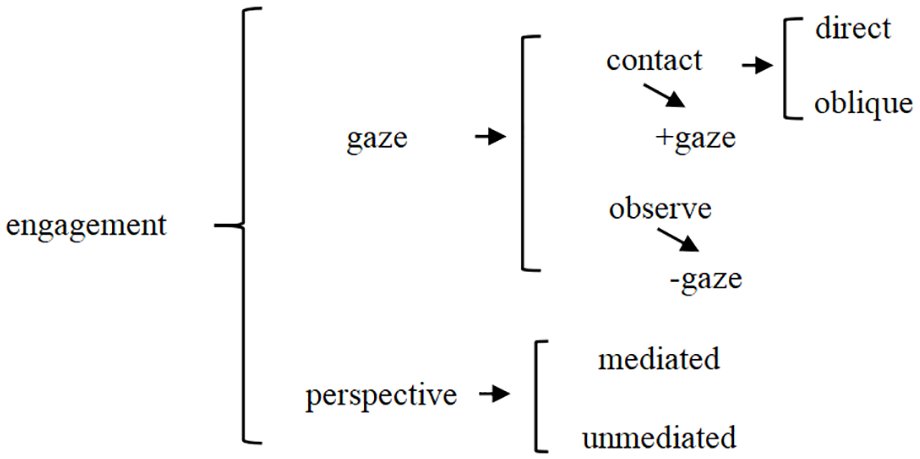
The engagement system of images.
There are two examples to demonstrate how to analyze the engagement of images. In a PSA, Fashion Claims more Victims than you think, two leopards are walking on grass. The larger one in the front is with the size XL marked on its back. Following behind is a smaller cub labeled with size S. They show the postures of walking from left to right with sad facial expressions. These leopards are depicted at an oblique angle, making partial eye contact (+gaze) with the viewers. Meanwhile, since the viewers can see them directly, the picture offers an unmediated perspective. In this case, this PSA depicts contact images with an oblique gaze and unmediated perspective. Whereas, the PSA, Do you believe in a better future?, demonstrates a different engagement. The viewers can see the back of a penguin in the foreground. The penguin gazes upward toward what is labeled a “better future,” only to reveal a desolate, cracked landscape and a heavily polluted industrial city far off. The absence of direct eye contact (-gaze) with any other entities means we only experience an observed gaze. This perspective is mediated through the penguin. As viewers, we subconsciously adopt the penguin’s viewpoint, confronting the bleakness of the touted “better future.” Therefore, the engagement choice is realized through observe gaze and mediated perspective. This portrayal powerfully evokes emotional responses from the audience.
Graduation
Considering the graduation system of images, Martin and Rose (2007, p. 326) point out that “feelings, appreciation and judgment can also be amplified and diminished,” but when outlining for analyzing visual images, they only classified the graduation system into three sub-choices: high, median and low, and did not mention how images upscale or downscale the affect and the force system.
When discussing the force choice in the graduation system, Painter et al. (2013) elucidate how emotion in children’s picture books can be strengthened or reduced by citing Economou’s (2009) analytical framework. The parameter of force is mainly achieved by quantification, including the amount, mass/amount, and extent. According to Economou (2009, p. 174), quantification (number, amount and extent) is relevant to the depicted expression of emotion, in the same way that it is to visual experiential items. The scaling can be up or down through the upscaled or downscaled quantification. There are some examples demonstrated to show how the attitude is upscaled visually.
In PSA, We endanger the future with one shot, the dominoes display images of various animals. The act of the dominoes falling can be interpreted as a symbolic representation of the potential disappearance of these animal species. Such a depiction may elicit a range of emotional responses from viewers, with some possibly interpreting it as a cause for concern. The quantity of depicted species might intensify the perceived urgency of their potential disappearance. The images in PSAs, Stop criminals making a Killing, strengthen the evaluative degree by expanding the size of the rhinoceros in comparison with the far smaller-sized human social actors inside it, which adopts the quantification: mass/amount. In a PSA, The more paper you waste, the less space they have, a chimpanzee’s eyes were closed with teeth clenched and mouth wide open, and one of its paws covering the right eye. The half of the chimpanzee’s head takes up almost the entire page, so it enlarges the extent of the face, thus upscaling the force by adopting extent in quantification.
In contrast, when quantified options are narrowed down, the intensity of attitude decreases (Painter et al., 2013). As for language, Martin and Rose (2007) also mention the second dimension of graduation, focus, which refers to the sharpening and softening of experiential categories. However, this analysis primarily focuses on the emotions of visual images as well as how they are scaled, so focus choice is not discussed. Based on the above analysis, the graduation system for exploring emotions in images is outlined in Figure 2.
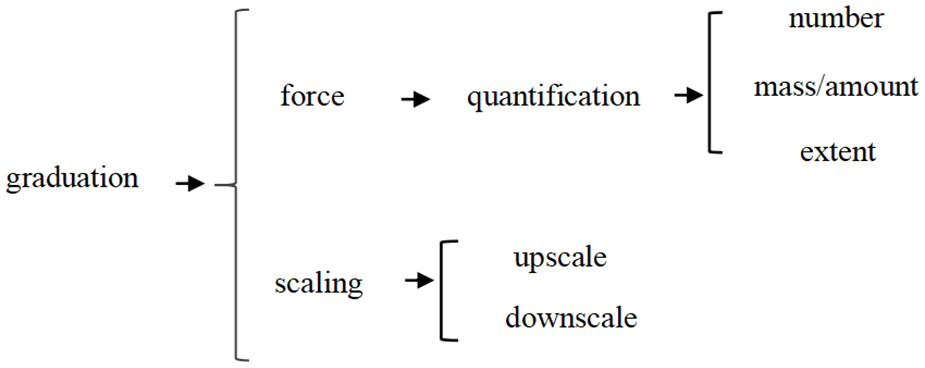
The graduation system of images.
Ambiance
Ambiance in visual narrative pertains to the emotional mood or atmosphere primarily shaped by colors. When analyzing how the colors of images contribute to the emotion in WWF print PSAs, we do not adopt all the choices in the ambiance system proposed by Painter et al. (2013) but apply the summarized and simplified framework for this analysis.
Colors significantly influence the emotional atmosphere or ambiance in images. Kress and van Leeuwen (2006, 2021) regard color as a semiotic tool that meets the three metafunctions of SFL. Painter et al. (2013) highlight color’s role in evoking readers’ emotional reactions, especially in picture books. To analyze an image’s ambiance, one must discern if color is the activator. Vibrant colors intensify emotions, whereas black and white images with shadows or light effects tend to diminish this effect, termed “defused ambiance” by Painter et al. (2013). In this context, we refer to it as “grayscale.” In our WWF PSA analysis, we classify ambiance into two types: ambient and non-ambient. The ambient type has two subdivisions: activated by color to heighten emotion, and downplayed by grayscale for subtler emotions, as illustrated in Figure 3. For example, in the PSA, The more paper you waste, the less space they have, a chimpanzee’s eyes were closed with teeth clenched and mouth wide open, and one of its paws covering the right eye. The whole visual image is grayscale, toning down its ambiance. In another PSA, Help stop whaling, it shows a pair of chopsticks holding a whale without head, its blood dripping onto a plate below. The image is depicted with black and white drawing lines, with only the blood colored in red. Below the image, bold capital letters read: “When should a whale belong on a dish? Never!” The words “whale,”“dish,” and “never” are highlighted in red, with the rest in black. In the bottom right corner, the WWF logo is displayed, accompanied by the words “Help stop whaling.” Since the images on this PSA are pictured in black and white line drawings, its emotion is only activated by the blood-red color present.
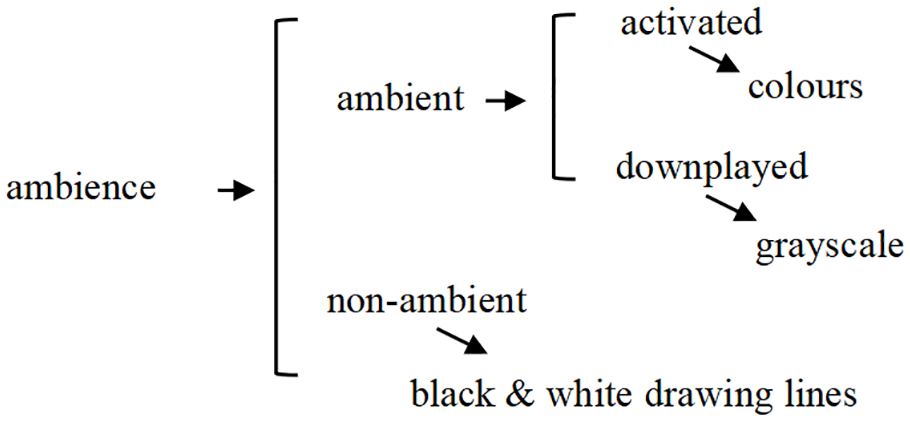
The ambiance system of images.
Methodology
Data Selection
To gather a comprehensive set of data, the phrases “WWF print PSAs in English” and “English PSAs of WWF” were entered into the search boxes of the WWF website (http://wwf.panda.org/), Google (https://www.google.com/), and Bing (https://www.bing.com/). This method helped identify PSAs from both current and past campaigns. Given English’s status as a widely spoken global lingua franca, advertising in this language can craft impactful campaigns appealing to diverse international audiences. Even though the primary emphasis in these PSAs is on imagery, with English playing a supplementary role, they can still engage a vast international audience. This rationale led to our decision to use English WWF print PSAs as our dataset. Over three searches spanning 3 months, 216 English print PSAs were identified. A significant number addressed wildlife conservation, with 31 touching on other environmental subjects. We excluded the latter from our study. PSAs containing solely images without accompanying text, or those integrating English with other languages, were also excluded. There were also three posters where the text size was too small to discern, even with image magnification tools. After filtering out these unsuitable samples, a total of 144 multimodal PSAs were chosen for analysis.
Analytical Procedures
The research mainly adopts the method of qualitative research. To be specific, textual analysis approach is applied to explore how the emotions in PSAs of WWF in English are constructed from two dimensions: appraisal meaning and ambiance system. When annotating each PSA, the UAM ImageTool 2.1 is utilized for recording data. UAM ImageTool 2.1 is a state-of-the-art instrument for annotation of image corpora (http://www.wagsoft.com/ImageTool/). By using this powerful annotative tool, the researcher can annotate multiple images according to the created annotation scheme or the analytical framework established for the design as well as annotate each image at multiple levels. After manual annotation, this corpus tool can search for instances across levels and produce comparative statistics across subsets. Meanwhile, the statistics of image annotation will be stored, which makes the annotations and results recording more easily. Figures 4 and 5 are two clips to show the data processing interface and the table of demonstrating results respectively.

Project interface.

Statistics interface.
Images may reflect eco-beneficial ideology to influence people’s actions (X. Song & Perry, 2023). The emotions of WWF print PSAs are mainly delivered by images, with the language as the supplement. When we conduct analysis, the visual resources prioritize over the English text. Although this research focuses primarily on analyzing the emotions of visual images, the text needs to be taken into consideration for ascertaining the emotive types. When analyzing the data, the emotions of images in PSAs can be inscribed or evoked, but it is difficult to judge the emotions of some pictures without the help of text under some circumstances. Although the image itself has its organization and structure (Kress & van Leeuwen, 2006), all images are polysemous (Barthes, 1977, pp. 38–39), and their extensional meaning is infinite and floating, so the explicit meaning of images needs to be understood with the text (Barthes, 1977). This is also the case with the emotive meaning of images, so the text is used to ascertain the emotion of images, especially for pictures whose emotions are difficult to judge, and then to annotate.
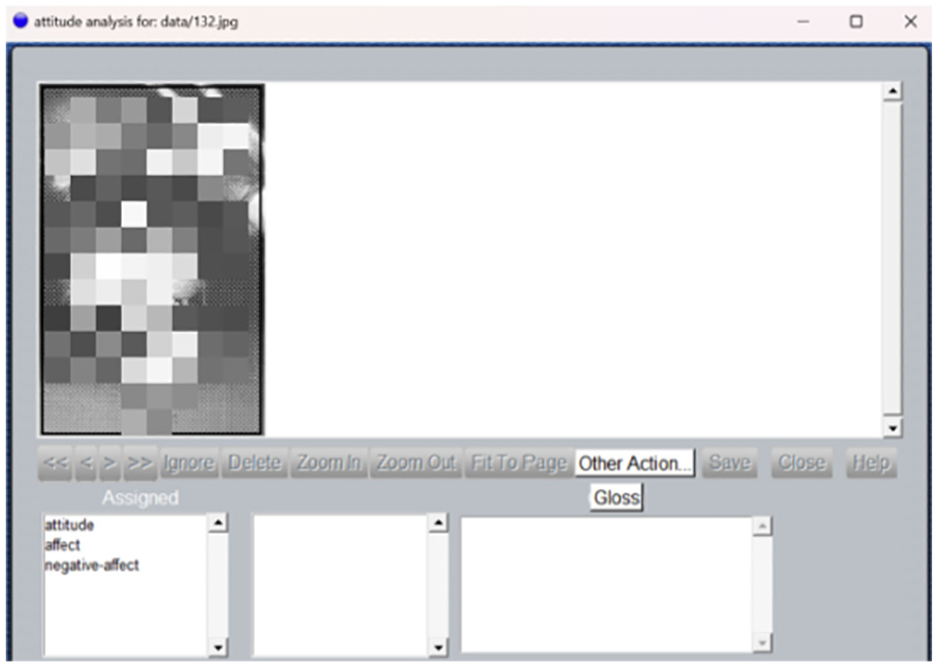
For example, in the previous PSA as we discussed, The more paper you waste, the less space they have, a suffering facial expression of a chimpanzee is inscribed clearly, so it is marked and annotated with negative affect in UAM image tool (as shown in Figure 6). However, not all the images deliver the exact emotion through facial features or physical actions clearly, some are abstract or ambiguous, and their emotions are evoked with the help of text. When we look at the tiger in PSA, Return wildlife, return color, we do not know what is the implied meaning of this abstract composition without text because it depicts the clear head of a tiger in the center but with the body pictured by abstract white and dark ink strokes, which disappear gradually. Only when viewers read the English sentence “Return wildlife, return color,” can they recognize the meaning. It represents a transition from white and dark ink strokes to the beautiful colored tiger head. This means the wild tiger will return to nature, so this picture is annotated as positive appreciation (as shown in Figure 7). The two examples demonstrate how to annotate the affect choice in the attitude system, and it is the same process for annotating other resources in the appraisal system.
Annotation interface (a).

Annotation interface (b).
To ensure precise and objective annotation, two researchers conducted the process simultaneously and then compared their findings. Eight images with discrepancies were reviewed and resolved by an invited expert, whose decisions were taken as the final results of this research.
Research Ethics
The image corpus consists of print PSAs from WWF’s environmental protection campaigns. The selection criteria include: first, every PSA prominently displays the WWF logo; second, although these PSAs were found initially by search engines such as Microsoft Bing and Google, they also can be accessed on other public web pages. Since these PSAs are designed to raise individuals’ awareness about animal conservation, they feature various images related to animals. The images primarily feature cartoons or digitally crafted designs intended to increase awareness about environmental issues. They do not involve real pictures of animal testing. Our research seeks to analyze how these PSAs convey visual emotive meaning through linguistic analysis.
Meanwhile, due to copyright concerns, this research avoided using image PSAs directly when giving examples. Instead, we made the transcription of the visual image of each PSA, with their titles and corresponding source links listed in Appendix I. Since this research gathers comprehensive data on the WWF PSAs in English, the copyright of some images might originally belong to advertising agencies or individual creators, whose work then contributed to WWF environmental campaigns. If researchers are interested in viewing the complete dataset of this research, please contact the corresponding author.
Results and Discussion
Results
After analyzing and annotating 144 WWF PSAs, we searched statistical data in the UAM image Tool to obtain statistics results it records. The results of the distribution of visual resources in expressing appraisal meaning and ambiance are shown and interpreted below.
The Results of Visual Appraisal Meaning
Attitude
After analyzing the attitude types of WWF print PSAs, judgment dominated at 50%, followed by appreciation at 38.89%. Affect constituted the smallest portion at 11.11%, as illustrated in Table 1.
The Distribution of Visual Attitude.
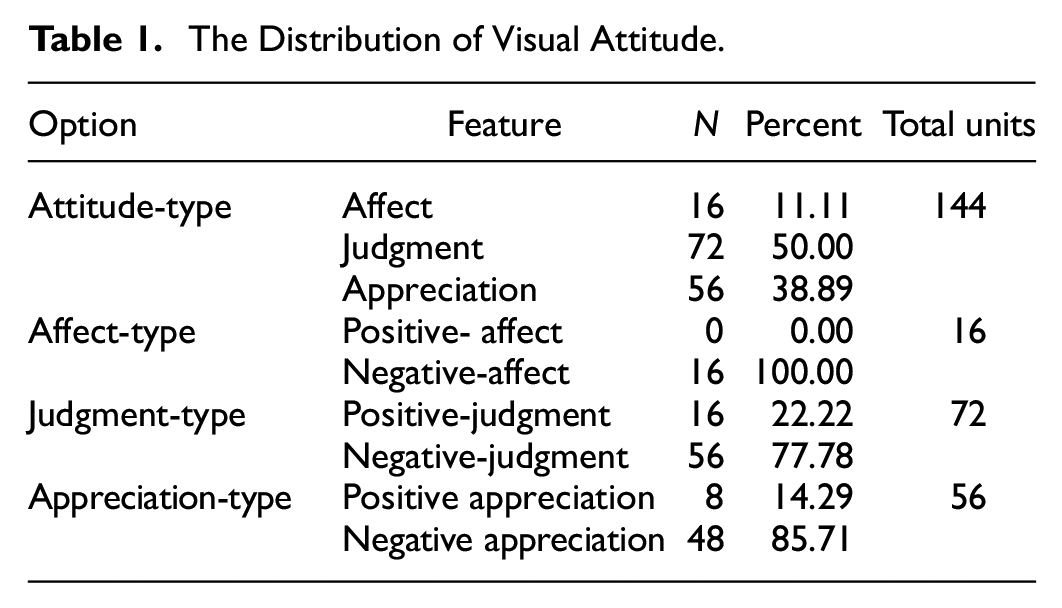
The analysis revealed that the emotions in WWF print PSA images were primarily evoked by judgment and appreciation, rather than being directly inscribed by affect. In delivering affect, no images depicted positive feelings; 16 PSAs displayed negative affect. Meanwhile, the majority were designed to trigger viewers’ emotive evaluation toward people’s actions such as social esteem and social sanction because 56 PSAs showed negative judgment visually, and this accounted for the largest number. Negative appreciation followed in 48 PSAs, compared to only eight showcasing positive appreciation. This suggests that negative attitudes are more predominant in these images across affect, judgment, and appreciation categories, so the negative emotions are accentuated.
Engagement
Table 2 presented the results regarding image engagement. Of the analyzed images, 40.97% (59 images) established eye contact with readers, split almost evenly between direct and oblique gazes. Meanwhile, 53.47% (77 images) employed an observational angle, and the remaining 5.56% utilized a mix of both contact and observational gazes. These findings suggest that a majority of PSAs provide information and position readers as observers, rather than engaging in direct interaction. With regard to perspective, approximately 76% of the images were with unmediated perspective, which is far more than those with mediated ones. The findings showed that the majority of the print PSAs, totaling 109, employed an unmediated perspective. This number is almost three times greater than those using a mediated perspective. This suggests that viewers are often directly immersed in the visual narrative of the PSAs rather than indirectly experiencing emotions through the lens of specific participants.
The Distribution of Visual Engagement.

Graduation
Visual graduation can be used to flag attitude (Economou, 2009; Painter et al., 2013), and how emotion is up-scaled or down-scaled can be achieved by quantification (Economou, 2009). Table 3 revealed that 78 of the analyzed PSAs expressed visual emotions through quantification: 28 images used numbers, 16 depicted mass/amount, and 34 showed extent. However, beyond these quantification methods, additional insights were uncovered. The choices of contrast and metaphor also appeared on WWF PSAs in flagging the degree of emotion. The contrast between the images was about the harmonious state of animals in nature and those recording the scenes where animals are persecuted after being disturbed by malicious human actions. Such layouts reinforce the negative judgment and further strengthen the negative emotion of print PSAs. For instance, in a PSA, Everyone deserves a home to stay safe, a depiction of a leopard peacefully resting in the grass contrasts sharply with an impending bulldozer set to devastate the leopard’s habitat. The implied movement vector between the two scenes suggests the imminent destruction of a pristine natural setting, urging viewers to intervene. This layout accentuates our negative judgment (under the subcategory of social sanction: negative propriety) toward habitat destruction, an emotion intensified by the stark contrast between the two images. Similarly, in the PSA, Stop wildlife crime, the whole picture is divided into two contrasting images. The top depicts a tiger, looking directly at the viewer, labeled with the word “PRETTY.” In contrast, the bottom image portrays a grim scene of wildlife crime, showcasing numerous stacked tiger pelts, overlaid with the bold font word “UGLY.” Although this PSA adopts the devices of extent to depict the head of a tiger and the number to show tiger fur in the quantification of the graduation system, the strongest negative emotion is aroused by the contrast between scenes representing pretty and ugly at first glance.
The Distribution of Visual Graduation.

Additionally, metaphors were identified as a means to intensify image emotions. For instance, in the PSA, Wild shopping kills wild animals, a metaphorical representation that equates leather shoes to zebras. The image presents the shoes as zebras grazing in a field, prompting viewers to realize that where zebras should roam free, they have been turned into footwear due to human consumption. This metaphor effectively heightens the negative judgment emotion associated with the image. In this case, the graduation system of images in Figure 2 is updated into the one (as demonstrated in Figure 8) with contrast and metaphor as the choices in the force system. The whole analytical framework titled, An analytical framework of the emotive meaning of images, is attached in Appendix II after the article.

The supplemented graduation system of images.
The Results of Ambience
Ambiance refers to the atmosphere of emotion, about which colors play a crucial role (Painter et al., 2013). Our study found that a significant majority (89.58%) of WWF print PSAs employ activated emotions, predominantly using highly saturated colors to achieve this effect (as detailed in Table 4). This color strategy aligns with the urgency and passion of environmental conservation themes. However, it is worth noting three distinct PSAs that utilize primarily grayscale or black-and-white outlines but strategically employ blood-red hues to punctuate and activate the emotion of the visual. One striking example is the image of PSA, Do something about it. Here, both the background and the central elephant are depicted in muted grayscale, but the bleeding tusks, painted in a stark blood-red, serve as an emotional epicenter, demanding viewer attention and reflection on the issue of ivory poaching.
The Distribution of Ambiance.

Discussion
Our analysis affirms that WWF print PSAs predominantly utilize images evoking strong negative emotions. The prevalence of negative judgment and negative appreciation in these PSAs suggests that the primary emotional response sought is the condemnation of the hardships wild animals face due to unethical human actions. The imagery largely showcases animals in distress. Paired with vibrant colors that heighten the atmosphere, these visuals aim to motivate viewers to take protective and corrective actions.
As the results demonstrate, the images of WWF print PSAs deliver far more negative emotions, the observe gaze and unmediated perspective, enlarged attitude and activated ambiance on the whole. To be specific, visual images are more focused on expressing their emotion through negative attitude, particularly negative judgment. It accounted for the largest number according to the result. This highlights the PSAs’ focus on urging the public to consider the moral and ethical aspects of animal conservation. Judgment can be seen as the as institutionalized affect (Martin & White, 2005), relating to suggestions or norms about what people should or should not do (Jiang et al., 2020). To have a further examination, most of the enlarged negative feelings, which viewers can feel through observe gaze and unmediated perspective, are from the images of animals suffering, such as the loss of their habitats, being brutally killed by humans, or their turning into some kinds of commodities. The activated ambiance by colors also contributes to increasing the visual emotion or invoking viewers’ thinking. Such visual design can persuade viewers to protect animals as well as trigger their changes in behaviors. According to Lester (2021), images of animals and children suffering, if used sparingly, can be persuasive. In WWF print PSAs, the negative attitudes are mainly aroused by the anguished facial expressions of animals in exhibiting negative affect, the negative appreciation about animals’ situations of losing their habitats, death, and being commercialized, and the negative judgment for humans’ cruelty to animals. Therefore, the persuasive strategy is principally achieved by depicting negative emotions.
Our analysis extends beyond Economou’s (2009) established choices of quantification in image interpretation. We discovered that contrast and metaphor are also powerful tools for amplifying emotions. Particularly striking is the employment of visual contrast, juxtaposing nature’s harmony with the aftermath of human intrusion. This juxtaposition intensifies viewers’ emotional response. Such visual designs will trigger more viewers’ thinking and negative feelings than a single picture of animal suffering. In addition, the prolific use of metaphors—found in over a third in the force type of visual graduation system—further underscores their role in enhancing the emotive and, consequently, persuasive potency of these PSAs. This is because the persuasion of advertising messages can be enhanced by metaphors (Hatzithomas et al., 2021; Septianto et al., 2022). The adoption of visual metaphors to depict animals’ suffering or pains in the graduation system can enhance the emotions of PSAs, thereby achieving its persuasive purpose.
Viewing from appraisal theory, Martin and White (2005) conceive appraisal meaning as a continuum, with discourse semantics on one end and reader interpretation on the other. By this metric, the PSAs in our data adeptly leverage both visual and verbal resources to guide readers toward a predetermined emotional reaction, primarily one of urgency and concern. According to Jiang et al. (2020), appraisal system is also a system by itself, and readers will have an emotive response to the appraisal meaning of a discourse. These designed PSAs promote wildlife conservation from the stance of WWF and convey their values to influence readers’ reactions. The verbal and visual resources are the meaning potential, while the specific text and images chosen are the instantiation. In the selected PSAs, a strong negative appraisal meaning constructed from attitude, engagement, and graduation as well as activated ambiance enables readers to feel the emotion clearly. By receiving negative appraisal meaning, readers will be stimulated to form negative feelings toward the situation of wild animals. Then, their reading feedback will be the action to protect wild animals.
In addition, this analysis extends the application of the appraisal theory to the analysis of the emotive meaning of images. Previous researchers, such as Hidalgo-Tenorio and Benítez-Castro (2021), C. F. Song (2015), and Bakar (2012) focused on exploring the emotive meaning of verbal modes, and this research broadens the scope to probe into the visual emotive meaning. Meanwhile, studies on emotive meaning conducted by Giaxoglou (2019) and Bouko (2020) all involve images, but they did not adopt appraisal theory. In this sense, the analytical framework constructed in this analysis can offer a new approach to exploring the emotion of images. In addition, while the appraisal system is commonly applied in linguistic research, there has been limited in-depth examination of multimodal discourse analysis (Wang & Qu, 2020). Visual imagery plays a critical role in communication (Kress & van Leeuwen, 2021) and often works in tandem with text to produce multimodal meanings. In this case, the analytical framework constructed in this analysis can also contribute to multimodal emotive discourse analysis based on the appraisal system.
Shifting to a psychological lens, the evoked feelings of distress and sympathy in viewers are likely to prompt empathetic reactions. Empathy for suffering, vulnerable, or oppressed others has been argued to be central to moral character and collective well-being (Yaden et al., 2023). When viewers generate empathy by seeing others’ suffering, this will enable them to feel the pain, so in that case they will act to let it go away (Yaden et al., 2023; Zaki, 2016). Therefore, the sheer intensity of negative emotions in these PSAs can incite viewers to champion animal conservation efforts.
This research revealed how WWF print PSAs deliver their emotive meaning visually, which also contributes to environmentalism, especially their work in visual photography. Biodiversity continues to decrease at an alarming rate. The global rate of species extinction is at least tens to hundreds of times higher than the average rate of the past 10 million years, which asks the awareness for the value of biodiversity (United Nations Environment Program, 2021). As concern for biodiversity loss grows, conservationists are under pressure to portray animals in ways that evoke empathy and promote conservation (Whitley et al., 2020). This analysis can offer valuable insights from a linguistic perspective, as it provides an analytical framework for interpreting how emotive meaning is represented through attitude, engagement, graduation, as well as ambiance.
In summation, this study expands the appraisal theory in its application to the social semiotic analysis. By analyzing the emotive meaning of WWF print PSAs, this research not only deepens the understanding of images but also enriches discussions centered on PSAs. While previous scholars focused on exploring the relationship between emotion and language, and some delved into emotive meaning revealed by appraisal theory and emotions depicted through visual grammar, few utilized the theories proposed by Martin and Rose (2007) and Painter et al. (2013) to analyze the emotions evoked by images. We combine both of the two theories to explore the visual emotive meaning of PSAs, so this analysis extends the application of them. Furthermore, in the context of discourse studies of PSAs, while earlier studies explored the connection between emotion and language, our work stands out by emphasizing the emotions elicited by images. Meanwhile, very limited linguistic research has been concerned with the emotions in PSAs of animal conservation up until now. In this case, our analysis fills in this gap. Emotion, as a significant factor in advertising, is effective in resonating with people’s reactions (Poels & Dewitte, 2019), so it is also a crucial factor worth scrutinizing in PSA. In this case, this research also enriches the study on PSAs.
Conclusion
Emotions play a significant role in advertising, and WWF has effectively utilized strong negative emotions in their PSAs to capture the public’s attention and promote animal conservation. For this research, 144 multimodal WWF print PSAs were chosen as the corpus. The aim is to analyze how these PSAs convey emotions from a linguistics perspective. To achieve this, we employed Martin and Rose’s (2007) appraisal system and Painter et al.’s (2013) theory for analyzing images, thus extending the application of SFL theories to visual emotion analysis of print PSAs. In summary, our analysis reveals that WWF PSAs mainly persuade the public by showcasing negative emotions, utilizing an unmediated perspective, amplified graduation, and activated ambiance. Furthermore, the analytical framework we developed can be extended to assess visual emotions in other print advertisements, textbook images, cartoons, the visual scenes in videos, as well as conservationists’ visual design.
While our exploration has been comprehensive, certain aspects remain untouched due to space constraints. Notably, the “focus” aspect of the graduation system and the intricate nuances of color choices in the ambiance system warrant deeper exploration. Future studies could delve into these territories to uncover a richer, more granular understanding of visual emotions in advertising. This would not only enhance academic discussions but also equip advertisers with refined tools and strategies to create powerful narratives.
Footnotes
Appendix I
Acknowledgements
We are deeply grateful for the editor’s prompt communication, as well as the valuable suggestions provided by the article editor and the anonymous reviewers. Special thanks to the first author’s Master’s and PhD supervisors for their inspiration before the writing of this article.
Declaration of Conflicting Interests
The author(s) declared no potential conflicts of interest with respect to the research, authorship, and/or publication of this article.
Funding
The author(s) received no financial support for the research, authorship, and/or publication of this article.
An Ethics Statement
It is not applicable for our research, so we just make a statement here.

Data Availability Statement
The data supporting this study’s findings are available upon request from the corresponding author.