



Abstract
The present research aims to explore the impact of mentoring relationship on college graduates’ job search behavior among Chinese undergraduate students by examining the mediator of job search intention and the moderator of job search self-efficacy. A two-wave survey study was conducted in China (N = 594). Our findings show a positive indirect relation between mentoring and college graduates’ job search behaviors through job search intention. The graduates’ job search self-efficacy positively moderated the indirect relationship such that when job search self-efficacy was higher, the influence of mentoring on behavior via job search intention was stronger. These findings extend the literature by clarifying how and when mentoring facilitates graduates’ job search behaviors and provide practical implications for facilitating a smooth school-to-work transition in China. As the first study that empirically clarifies why (through job search intention) and when (job search self-efficacy) mentoring function is positively related to job search behavior among Chinese undergraduate students, the present study contributes to the existing mentoring and job search literature. Future research is encouraged to extend the findings by integrating theory of planned behavior (TPB) with self-regulation theory toward deepening current understanding of how and when mentoring can contribute to a student’s success in job search behavior.
Keywords
Introduction
Searching jobs happens increasingly often in the modern business world because employees pursuing “an intelligent career” change jobs frequently (Arthur et al., 2018). For college students near graduation, their success in their job search (e.g., becoming employable and receiving a satisfactory job offer) plays a critical role in achieving employment and career success through a series of transitions from school to work (Guan et al., 2014). Significantly, after the 2008 global economic crisis, university students found it harder to obtain employment (Manroop & Richardson, 2016). This was especially a fact in front of Chinese students (Asia Business Council Forum, 2014), where the number of university graduates increased from 1.14 million in 2001 to 8.74 million in 2020. Accordingly, hunting a job is becoming an important issue in the management literature (Kao et al., 2020).
Existing research has suggested personal factors such as psychological attributes (e.g., self-control and emotion regulation) (Van Hooft, E. A. J., Born, M. P., Taris, T. W., & van der Flier, H., 2005; Wang & Yan, 2018) that predict certain consequences relating to job search. Nevertheless, less scholars have paid research attention to the role of situations, even if existing literature has called for examining the role of contextual influences (Boswell et al., 2012) because individuals need to be supported to overcome social, cultural, and environmental constraints to make occupational or career choices (Duffy et al., 2016). Further empirical investigations are thus needed to understand the potential role of contexts and how, if at all, these influence job search issues among new graduate students. Most importantly, given the fact that receiving supports from a senior with more experience can benefit a student’s behaviors and attitudes relevant to career development, scholars have suggested that career support from mentors promotes successful job search behaviors for students (Liu et al., 2014; Renn et al., 2014); however, existing findings overlook the full extent of influences of mentoring in their job search processes. Specifically, previous research only studied one aspect of the mentoring function in educational settings, although mentoring—defined as an inherent formal and informal relationship with communication and interactions in which a senior person provides support, tutoring, and guidance to facilitate a junior individual’s career development and success (Scandura, 1992)—in university settings involves not only providing career-related support (e.g., coaching and protection) but also offering psychosocial guidance (e.g., counseling and role modeling) to students to enable greater career success (Eby et al., 2013). That is, although the theoretical conceptualization of the mentoring function including three dimensions—that is, career mentoring, role modeling, and psychosocial support—has been widely acknowledged by scholars (Castro et al., 2005), previous research related to the mentoring and job search processes has failed to take these three dimensions into consideration. As a result, the effectiveness of mentoring on individuals’ job search issues, such as job search intention and behaviors, is not understood in depth. This is a critical limitation since theoretical research has specified the more significant influences of considering the comprehensive functions of mentoring (Gershenfeld, 2014). For university students, mentoring is characterized by in-depth communication, intensive exchange, and solid relationships (Crisp, 2010), which significantly improve students’ outcomes at work, such as preparation for work, salary, and job satisfaction (e.g., Aryee et al., 1996; Linnehan, 2001). Accordingly, we attempt to consider the three dimensions of the mentoring function simultaneously by conceptualizing and operationalizing the mentoring function as an entire construct containing career mentoring, role modeling, and psychosocial support to impact students’ job search intention and behaviors. Specifically, we explore through what explanatory mechanisms and under what boundary conditions mentoring can promote successful job search behaviors for students.
Given the previous research evidence on individual motivations for job search behaviors (Caska, 1998; Kanfer et al., 2001), scholars have recently shown that individuals are self-regulated to obtain employment by integrating their intention and behaviors related to job search (van Den Hee et al., 2020; Wanberg et al., 2020). Applying this temporal perspective, we draw on the theory of planned behavior (TPB) to propose that job search intention links mentoring and job search behaviors. Highlighting the motivational functions, TPB suggests that the willingness to participate in specific behaviors and the perceptions of social norms would decide an individual’s certain behaviors (Ajzen, 1991). Thus, mentoring can effectively develop students’ thinking, attitudes and behaviors about the importance of jobs search because mentors help students stay aware of evolving career conditions and opportunities (Cialdini et al., 1991; Renn et al., 2014), thereby helping them prepare for the job market (Eby et al., 2013). These psychological attributes directly motivate individual intention in the processes of searching a job (Song et al., 2006; Van Hooft, E. A. J., Born, M. P., Taris, T. W., & van der Flier, H., 2005). Moreover, as TPB asserts that “intentions to perform behaviors of different kinds . . . account for considerable variance in actual behavior” (Ajzen, 1991, p. 179), empirical evidence has indicated that job search intention can positively predict career-relevant activities (e.g., job search goals) (e.g., Lim et al., 2016; Werbel, 2000). Because job search intention is treated as a job search goal that motivates individuals to perform certain activities in searching for jobs (Zikic & Saks, 2009), job search intention can be considered to contribute to successful job search behaviors. Some relevant studies have provided similar results (Van Hooft, E. A. J., Born, M. P., Taris, T. W., & van der Flier, H., 2005).
The TPB further suggests that individuals’ behavioral control influences both their intention and behaviors (Armitage & Conner, 2001); thus, scholars have found that individuals’ behavior is directed by the considerations of attitudes of such a behavior (Ajzen, 1991), that is, individuals’ self-efficacy (as a fundamental belief on their own abilities to display certain behaviors (Bandura, 1986). According to social cognitive career theory that suggests personal career self-efficacy as a key personal element of achieving a desirable outcome(Bandura, 1986), career scholars have acknowledged job search self-efficacy, which is naturally defined as the extent to which job seekers have confidence in their capabilities of searching a job and being employable in the job market (Kanfer et al., 2001). Job seekers who are self-efficacious tend to hunt a good job (Liu et al., 2014), as the theoretical framework of social cognitive theory underlines the critical role of self-efficacy in promote individuals’ motivations to perform specific behaviors. Following this line of reasoning, we expect that the extent to which students’ job search intention fosters their behaviors of searching jobs may depend on the job search self-efficacy.
Furthermore, according to the theoretical arguments in the mentoring literature that the mutual learning exchange relationship can be characterized as the core of the mentoring process (Pan et al., 2011), the mediational links between mentoring function, job search intention, and job search behaviors are likely to change across the development of job seekers’ job search self-efficacy. Specifically, receiving support from mentoring function may not be similar across job seekers who obtain different levels of self-efficacy belief associated with searching jobs, leading to differential intentional and behavioral explanations of the mentoring-job search intention link through job search intention. Taken together, we propose a moderated mediation model; that is, students’ job search self-efficacy moderates the indirect association between mentoring and their job search behavior through job search intention (see Figure 1).

The hypothesized model.
The present research aims to contribute to the existing literature. First, we seek to fill the gap concerning the potential linkage between mentoring and college students’ job search behaviors. In doing so, the study enriches the current understanding of whether social capital resources and support can facilitate undergraduate students’ job search. Second, by applying TPB, our identification of the mediator of job search intention extends the job search literature by deepening the motivational approach. Thus, this paper provides an additional empirical examination of the process by which mentoring can contribute to the success of a student’s job search behavior. Third, based on the theoretical lens of the social cognitive framework, we contribute to the job search process by integrating efficacy belief into the framework of job search dynamics and proposing that mentoring may differ on the basis of students’ job self-efficacy. Additionally, moving beyond previous studies that claimed and tested the relevance of a certain personal belief—that is, self-efficacy—to job search in general, we identify its moderating role by pointing out that job search self-efficacy reflects a job seeker’s capabilities of him- or herself in terms of finding a promising job. In this vein, we enriched the understanding of social cognitive career theory in job search research. Finally, this study adopts a multiphase data collection method enabling us to provide more robust and meaningful outcomes than would otherwise be possible.
Theories and Hypotheses
Mentoring Function and Job Search Behavior
Researchers in the existing literature have acknowledged that certain variables (e.g., motivation and autonomy) may shape personal job search behaviors (e.g., Koen et al., 2016). Consistently, empirical evidence highlights that receiving social support is essential in facilitating the possibilities of job search behaviors successfully (Kanfer et al., 2001). As mentioned above, the mentoring function is characterized as providing various resources to effectively help students develop (e.g., problem solving, decision making and solutions); mentors likely promote students’ preparations for the school-to-work transition by preparing their mentees for professional careers and assisting with their workplace skills. Thus, we propose that mentoring positively influences students’ job search behaviors.
Given that the mentoring function is a favorable program for educating graduate students in China, the idea of mentorship has recently been adopted in undergraduate educational settings (e.g., Yu et al., 2021). Specifically, in addition to the traditional mentoring functions of helping prepare students’ graduation theses, mentoring programs in Chinese universities enable mentors to provide career support and guidance tailored for students, such as discussing career possibilities and building career confidence (Hong, 2010). Consistently, previous papers conducted in the Chinese context have also indicated that mentorship can not only help students complete scientific tasks in order to guarantee that they have the confidence to carry out their projects (Zhang et al., 2016) but also provide significant support in regard to undergraduate career issues (e.g., career choice, career searching).
The mentoring relationship helps graduates strengthen their job-seeking resources, weaken their job-seeking requirements, and promote their job-seeking behaviors for the following reasons. First, mentors frequently provide professional guidance to their apprentices and promote graduates’ attainment of the knowledge, technology, ability and other intellectual resources necessary for employment (Kram & Isabella, 1985). Job-hunting requirements, such as difficulty finding jobs and employment barriers, are correspondingly reduced, rendering graduates more competent in job-hunting behaviors. Second, mentors provide psychological support to their apprentices and promote the psychological resources of graduates, such as the sense of support, self-confidence and resilience (Kao et al., 2014), to better address psychological pressures during the job-hunting process and negative emotions, such as anxiety and loss of happiness, that emerge due to the failure of job hunting (Paul & Moser, 2009). Third, the mentoring relationship has the function of role demonstration. While interacting with teachers, apprentices imitate the behavior of teacher models and learn how teachers use resources to cope with challenges and achieve goals, which has a positive impact on the behavior model of apprentices (Zikic & Saks, 2009) and is conducive to the job-hunting behavior of graduates. Thus, the mentoring relationship can promote the job-seeking behavior of graduates through professional guidance, psychological support, role demonstration and other functions.
H1. Mentoring function is positively related to students’ job search behavior.
Mediation Effect of Job Search Intention
Research thus far has suggested that job search intention is embedded in the theoretical framework of the TPB, suggesting that personal behaviors can be significantly predicted by their intentions (Ajzen, 1991). Specifically, originally derived from the theory of reasoned action (Ajzen & Fishbein, 1988), TPB highlights that individual intention—defined as an sign of personal willingness to execute a corresponding behavior—acts as the most proximal factor of behavior (Ajzen, 2011). Consistently, researchers have indicated similar research findings. Specifically, when a person believes that he/she receives normative supports from important people in their daily lives to implement a certain behavior which is under his/her personal control, he/she would tend to develop a strong intention to act this behavior (Armitage & Conner, 2001). Similarly, career researchers drawing upon this theory have examined the benefits of intention on exploratory career behavior (e.g., Millar & Shevlin, 2003). Moreover, theoretical and empirical arguments demonstrate that personal intention can be significantly influenced by social influence (Ajzen, 1991). Jimmieson et al. (2008) found that persons could act behaviors in a way consistent with their personal attitudes rely on whether they perceive some supports for such attitudes in the working context. Following the research evidence and reasonings above, we propose that the TPB is a theoretical framework to explain the linkage between mentoring function and job search behaviors via increasing personal job search intention.
Scholars have provided empirical evidence to illustrate that individuals who receive and/or perceive social support tend to build a certain intention with regard to social support (Courneya et al., 2000). A typical example is from Saeed et al.’s (2015) research. They empirically showed that various forms of support from universities (e.g., perceived educational support) can exert a beneficial impact on students’ intention of being entrepreneurial because support helps students obtain the essential information relating to entrepreneurship issues and motivates them to pursue their career in the entrepreneurial domain. We thus expect the mentoring function to act as a supportive contextual factor that facilitates the development of job search intention. According to the TPB, job intention primarily depends on variables such as individuals’ attitude toward job seeking behavior, subjective norms and perceived behavioral control (Ajzen, 1991). Through integrating mentoring literature, we argue that mentoring can influence job search intention by exerting an important impact on the three variables above. First, through professional guidance, the mentoring function helps college graduates improve their subjective cognition of job searching and prompts them to objectively judge the importance of job searching for their career development, which significantly supports students in adopting a more positive attitude regarding the school-work transition. Second, as important facilitators, mentors frequently provide positive psychological support and enact the function of role modeling (Scandura, 1992). As a result, mentors signal a commanding norm and exemplary norm to promote the formation of the subjective norms of job searching among college graduates (e.g., Cialdini et al., 1991). Finally, by providing intellectual and psychological resources, mentors objectively improve graduates’ ability to control the job search and subjectively enhance their perceptual and behavioral control over the job search.
H2: Mentoring function is positively related to students’ job search intention.
As the performance of behavior is affected by individuals’ intention of involving in this behavior, TPB theoretically posits that under sufficient conditions of actual control, individuals’ intention directly determines their behavior (Ajzen, 1991). Research has acknowledged that intentions represent an individual’s motivation, which sheds light on individuals’ conscious plans or decisions to exert effort to engage in a particular behavior. Regarding the job search process, students who have a strong intention of hunting for a job are prone to have favorable appraisals of job searching behavior, which directly facilitates them to exert more effort toward the performance of such behavior. This reasoning has been examined in previous relevant empirical studies (e.g., Boswell et al., 2012).
By integrating the theoretical arguments and hypotheses above, we further propose that the mentoring function is indirectly linked to job search behavior through a mediational process of job search intention. Specifically, when students receive support from their mentors (e.g., vocational support, psychosocial support, and role modeling), the students are able to enhance their personal learning and preparation and perform their tasks (e.g., search for a job). Thus, students exhibit strong intentions and engage in job search-related behaviors.
H3: Students’ job search intention mediates the association between mentoring function and their job search behavior.
Moderation Effect of Job Search Self-Efficacy
Accumulated studies have indicated the linkage between intention and behavior, yet some studies show that the role of intention played in the area of entrepreneurship is not as direct as in other research fields (Kautonen et al., 2015). Thus, it is urgent to investigate the boundary conditions under which job search intention contributes to job search behaviors. The TPB highlights that several personal characteristics may exert potential influences on an individual’s development of his/her intention because these characteristics signify his/her evaluation of performing the behavior positively and/or negatively (Ajzen, 1991). Accordingly, we expect a mediation effect—that is, job search self-efficacy, which is a typical personal characteristic, is an effective moderator in the job search intention-behavior association.
Theoretically, base on the theoretical framework of social cognitive theory (Bandura, 1986), personal self-efficacy essentially determines individual initiative, which can not only affect individuals’ adaptation and change but also regulate their behavioral choices by influencing their cognition, emotion, motivation, and physiological arousal (Bandura, 1977). College students with high self-efficacy in job searching have stronger confidence during the process of searching for a job. These students believe that they are approaching goal attainment (i.e., finding a good job) and are more courageous in taking actions, which is conducive to transforming job search intention into job search behavior. Comparatively, if college students are with low self-efficacy, their career outcomes, including job search behaviors, would be not promising. Specifically, even if such students have strong job-seeking intention, they lack the confidence to engage in activities related to job searching because they have a sense that the goal of finding a job is beyond their capability. In this situation, these students are prone to flinch in the face of difficulties (Bandura, 1997), which is not conducive to the transformation of job-searching intention into job-searching behavior. Taken together, job search self-efficacy can strengthen the association between job search intention and job search behavior among college graduates.
H4: Students’ job search self-efficacy positively moderates the relationship between job search intention and job search behavior such that the positive effect of job search intention on job search behavior becomes stronger when job search self-efficacy is high rather than low.
Furthermore, according to the theoretical arguments in the mentoring literature that the process of mentoring relationship has been widely acknowledged as an exchange relationship with mutual learning (Pan et al., 2011), we further propose a moderated mediation effect in which the mediational links between mentoring function, job search intention, and job search behaviors are moderated by the development of job seekers’ job search self-efficacy. Specifically, because job search self-efficacy can offer clear guidance regarding to how to cultivate and improve the quality of job seekers during the process of searching a satisfied job (Bandura, 1995), job seekers with different levels of self-efficacy belief related to searching jobs may influence the extent to which they receive support from mentoring functions, leading to differential intentional and behavioral explanations of the mentoring-job search intention link through job search intention. Integrating the previous discussions, we argue that graduates’ job search self-efficacy acts as a positive moderator in the mediational relationship among the mentoring function, job search intention, and job search behavior, which is aligned with the theoretical idea that self-efficacious individuals are more task-focused and with more motivation of engaging in a specific activity than individuals with a low level of self-efficacy beliefs (e.g., Jones, 1983). Thus, graduates who have more self-efficacy in searching for jobs are more confident about receiving information and support from their mentors toward developing their strong intention to search for jobs in the job market. In contrast, students with low job search self-efficacy are less confident about finding a promising job. In this situation, they are less sensitive to recognizing and utilizing the support from their mentors toward building their job search intention and then related behaviors. It, thus, is reasonable to claim that the perceived benefit gained from mentoring functions becomes weaker among subordinates with higher self-efficacy than for those with lower self-efficacy. Therefore, these graduates can behave more positively in finding a desirable job.
H5: Students’ job search self-efficacy positively moderates the mediation relationship between mentoring function and job search behavior through job search intention, such that the mediation effect is stronger when job search self-efficacy is high rather than low.
Methods
Participants and Procedure
We used a time-lagged survey research design to collect the data. First, we randomly selected subjects (i.e., universities) from the Chinese university pool based on the principle that universities are enacting mentoring programs. Twenty-three public universities responded to join in our research. Anonymous questionnaires were sent online to graduates from 23 Chinese universities. To ensure the quality of the survey design, we introduced the purpose of the survey and defined the concepts, such as the mentoring function, at the beginning of the questionnaire. That is, a mentor is an experienced teacher in your department and/or university who is there to provide guidance and support in any number of ways and situations, including academically and career. The characteristics that were most sought in a mentor concerned personal supportiveness rather than professional competence. In addition, we informed participants that the time period of mentoring relationship was not in the consideration since previous studies have indicated that the effects of mentoring did not depend on the time of mentoring relationship. After confirming that the respondents had “mentors” in universities, the participants were asked to continue to complete the questionnaires. Specifically, we randomly selected students who were in the final (fourth) year of their undergraduate studies. After receiving 974 students’ responses regarding participation in our research, we invited these 974 students to complete the questionnaires, which included measures of the mentoring function and some demographic information (e.g., age and education). In total, 723 questionnaires were collected in Time 1. After 6 months, we collected the other round of survey at the Time 2. We followed previous related studies (Rode et al., 2017) to set the 6-month time interval because job searching during the school-work transition period for new graduate students is a stressful period with many trials. Additionally, regarding educational facts, Chinese universities normally provide a period of 6 months for undergraduates to search for jobs in the job market. Thus, it is plausible that the 6-month time interval enables students to have more preparations and experience more changes in the job market. In addition, considering the potential phenomena that students as job seekers in the current study may change their job search-relevant outcomes (e.g., intentions and behaviors) over time, it is a strength of our study that the time-lagged design can be viewed with caution. Specifically, it enables us to divide time predictors from outcomes measured after 6 months. We asked participants who completed surveys at the Time 1 to complete the Time 2 surveys (including job search intention, job search self-efficacy, and job search behaviors) through e-mail and mobile messaging. In total, 639 questionnaires were collected at Time 2. After removing the invalid questionnaires, 596 valid questionnaires were obtained, representing an effective questionnaire recovery rate of 61.2%. Among the respondents, 50.8% were female. The age ranged from 21 to 25 years, with an average age of 23.2 years; 57.9% of the respondents had a male mentor, and 65.3% of the respondents had a relationship with their mentor for more than 3 years.
Measures
All measures were from previous research with established validity and reliability. We followed the translation–back translation procedures from Brislin (1980) to translate the original English into Chinese. The 6-point Likert scales for the measures were employed, ranging from 1 (strongly disagree) to 6 (strongly agree).
Mentoring function
We used the 9-item scale from Scandura (1992) to measure mentoring function at Time 1 (e.g., “My mentor takes a personal interest in my career.”) (Cronbach α = .941). The KMO value was .932, with the Bartlett test of sphericity achieving statistical significance (p < .001).
Job search intention
The four-item scale from Blau (1994) was used to assess job search intention at Time 2 (e.g., “Intended to send my resume to a potential employer.”) (Cronbach α = .885). The KMO value was .818, with the Bartlett test of sphericity achieving statistical significance (p < .001).
Job search behavior
We measured job search behavior with six items from Blau (1994) at Time 2 (e.g., “Listed myself as a job applicant in a newspaper, journal, online or professional organization.”) (Cronbach α = .904). The KMO value was .885, with the Bartlett test of sphericity achieving statistical significance (p < .001).
Job search self-efficacy
At Time 2, job search self-efficacy was measured with six items from Wanberg et al. (2010) (e.g., “How confident do you feel about being able to do a good job of tailoring your resume to specific jobs.”) (Cronbach α = .902). The KMO value was .899, with the Bartlett test of sphericity achieving statistical significance (p < .001).
Control variables
We controlled the following variables: protégé gender (1 = male protégé; 2 = female protégé); mentor gender (1 = male mentor; 2 = female mentor); and length of the mentoring relationship (in years).
Results
Preliminary Analysis
We tested a proposed four-factor CFA model, and the four-factor model was superior to the other models. The model yielded a good fit to the data: χ2(262) = 846.146, p < .001; RMSEA = .061; GFI = .902; TLI = .938; CFI = .946.
Means, standard deviations, Cronbach’s alphas, and intercorrelations are shown in Table 1. Consistent with our expectations, the mentoring function was significantly and positively correlated with job search intention (r = .329, p < .01) and job search behavior (r = .227, p < .01), and job search intention was significantly and positively correlated with job search behavior (r = .425, p < .01). Meanwhile, job search self-efficacy was also significantly and positively correlated with job search intention (r = .553, p < .01) and job search behavior (r = .375, p < .01).
Means, Standard Deviations, Alphas, and Intercorrelations.
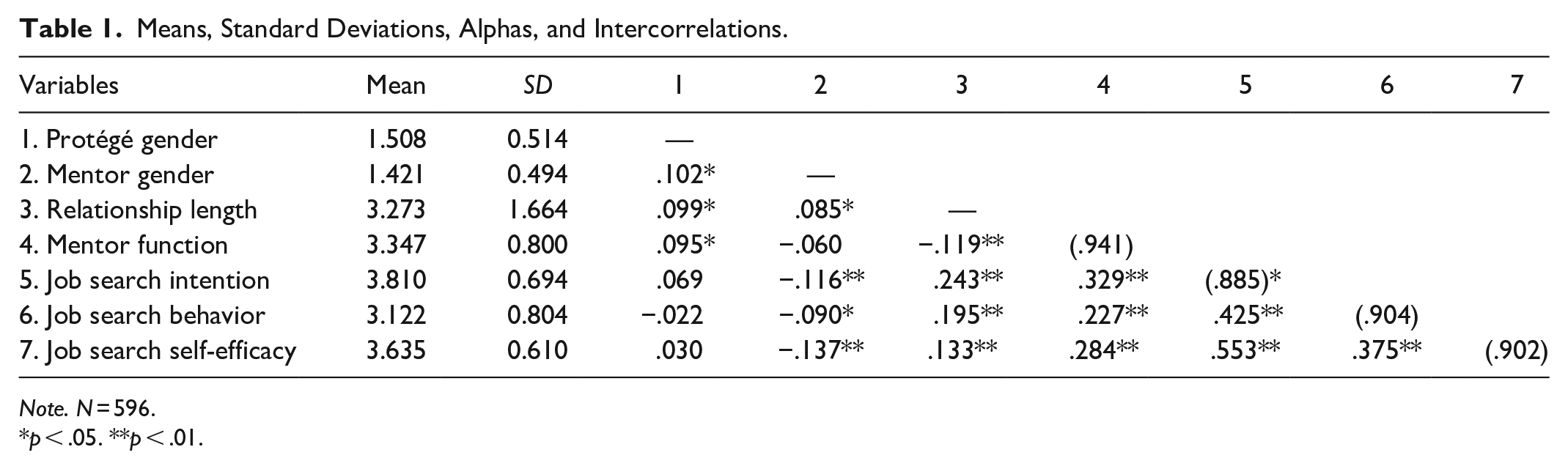
Note. N = 596.
p < .05. **p < .01.
Table 2 shows the factor loadings of the observed variables on the latent constructs and the composite reliability and construct validity. The convergent and discriminant validity of the constructs was examined to evaluate the construct validity. The results in Table 2 indicated that the AVE of each construct was more than .5, the composite reliability of indicators was more than .7, and the AVE of each construct was higher than the squared correlations between pairs of constructs, indicating construct validity.
Results of Confirmatory Factor Analysis and Correlations of Constructs.

p < .05. **p < .01. ***p < .001.
Hypotheses Testing
As shown in Table 3, Model 4 indicates that as predicted, the mentoring function is positively associated with job search behavior (β = .206, p < .001), supporting H1. Moreover, in Model 2, the mentoring function is positively related to job search intention (β = .254, p < .001), thus leading to support for H2. To examine the mediating role of job search intention in the mentoring function-job search behavior association (i.e., H3), mentoring function and job search intention are both entered in Model 5. The results show that the relation between mentoring function and job search behavior was reduced (β = .098, p < .01), while job search intention was positively related to job search behavior (β = .425, p < .001), which indicates that job search intention partially mediates the relationship between mentoring function and job search behavior. Thus, H3 is supported. To further clarify the mediation effect, we used a bootstrap procedure with 5,000 samples to produce a confidence interval (CI) for the indirect effect. As shown in Table 4, the indirect effect through job search intention is significant (indirect effect = .108, SE = .018, 95% CI [0.075; 0.146]). Therefore, the results fully supports H3.
Results of Mediation and Moderation Effects.

Note. N = 596.
p < .05. **p < .01. ***p < .001.
Direct and Indirect Effects of Mentoring Functions on Job Search Behavior.

Note. N = 596.
Regarding to testing H4, we introduce an interaction term (i.e., job search intention × job search self-efficacy) into our regression model. Model 7 presents the results. Specifically, the interaction term is positively related to job search behavior (β = .254, p < .001). We also provide Figure 2 of the pattern of the interaction effect, aiming to display the plot of the moderation effect. It shows that job search self-efficacy significantly strengthens the relation between job search intention and job search behavior. A simple slope test is also conducted. Specifically, the relation between job search intention and job search behavior is stronger when job search self-efficacy is high (simple slope = .508, SE = .063, t = 8.033, p < .001) than when job search self-efficacy is low (simple slope = .201, SE = .059, t = 3.41, p < .001). Therefore, H4 is fully supported.
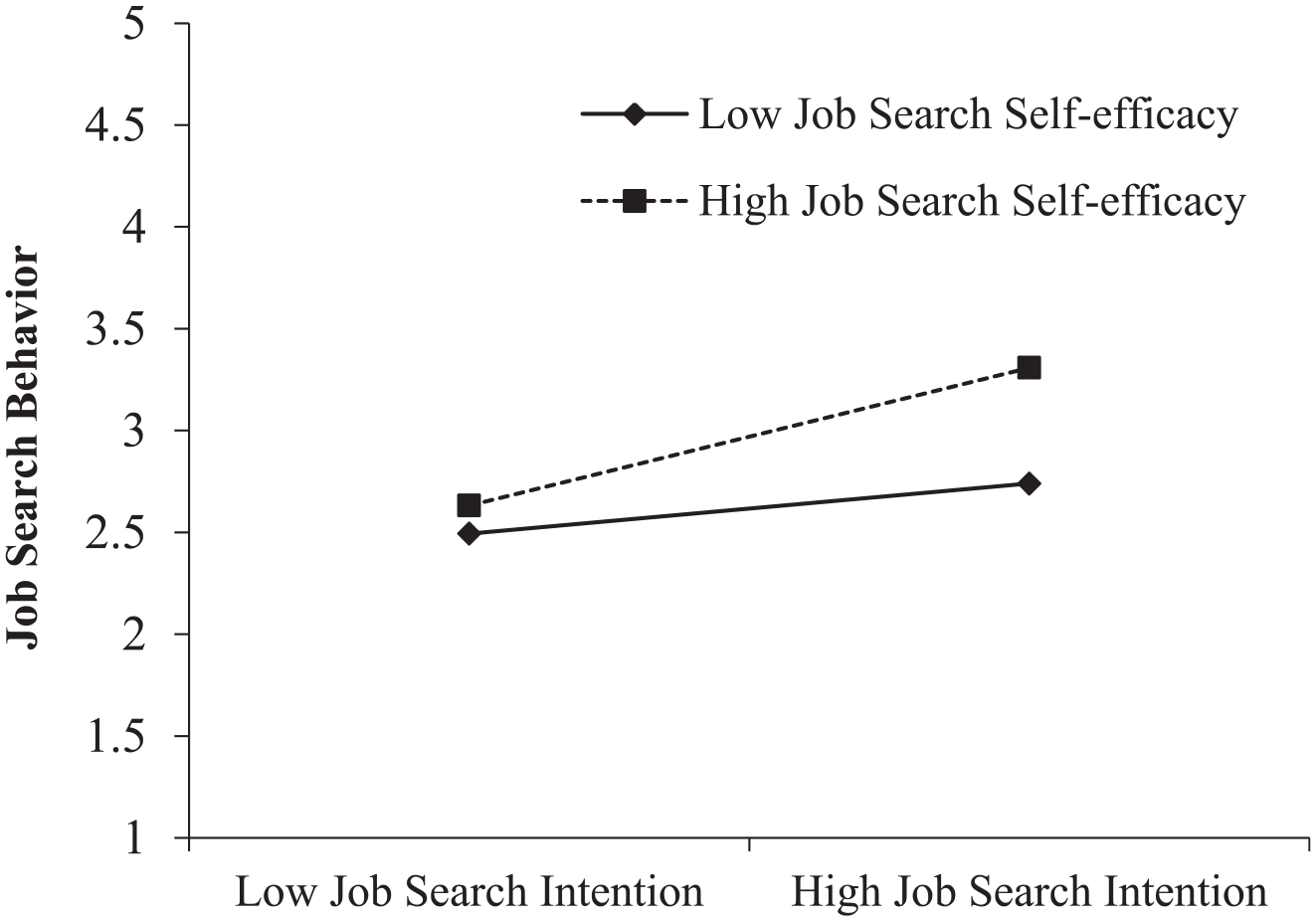
Job search self-efficacy as a moderator in the relationship between job search intention and job search behavior.
Regarding to testing the moderated mediation effect (i.e., H5), we conducted a bootstrapping procedure with 5,000 samples, and we estimated the conditional indirect effect of mentoring function through job search intention on job search behavior at both high and low levels of the moderator of job search self-efficacy. The results of the bias-corrected confidence intervals in Table 5 show that the indirect relation is significant both when job search self-efficacy is higher (indirect effect = .124, 95% CI [0.086; 0.169]) and when job search self-efficacy is lower (indirect effect = .045, 95% CI [0.016; 0.085]). The index of moderated mediation was .06 (SE = .0151, 95% CI [0.038; 0.097]). Thus, H5 was supported.
Results of the Moderated Mediation.

Note. N = 596.
Discussion
Theoretical Implications
First, the present study advances the limited research on students’ job search associated with social support (e.g., Renn et al., 2014). Although successful job search behavior is important for students graduating from universities, existing literature has primarily centered on recognizing the predictive effect of personal differences on job search behaviors (Van Hooft, E. A. J., Born, M. P., Taris, T. W., & van der Flier, H., 2005; Wang & Yan, 2018), ignoring the potential influences of context. We attempt to address this research gap by considering the comprehensive influences of mentoring on the processes of students’ job search; this work is thus consistent with but also extends previous studies indicating the positive effect of specific career support on job search behaviors (Renn et al., 2014). Scholars have indicated that academic mentoring provides students with beneficial support, including career-related and emotional support simultaneously (Eby et al., 2013). Applying these ideas to the current study, we extend existing research by empirically proposing and examining the idea that mentoring functions consist of not only providing career-related support (e.g., coaching and protection) but also offering psychosocial guidance (e.g., counseling and role modeling) to students to enable greater career success during their job search process (Allen et al., 2004; Eby et al., 2013). Consequently, this empirical study provides a better understanding of the beneficial influence of a supportive social context on graduates’ job search behaviors.
Second, through the application of TPB, the results of the mediating role of job search intention shed light on the motivational approach in the job search literature. Consistently, supporting the established evidence that highlighted the motivational process (e.g., van Hooft, E. A. J., Born, M. P., Taris, T. W., van der Flier, H., & Blonk, R. W. B., 2005; van Hooft, 2018), our findings enrich the understanding that the proximal predictor of behavior is the specific intention to execute actions (Song et al., 2006; Van Hooft, E. A. J., Born, M. P., Taris, T. W., & van der Flier, H., 2005; Zikic & Saks, 2009). Specifically, although studies have identified individual factors (e.g., cognitive or affective attitudes and subjective norms) as predictors of individual intention, some scholars have suggested that contextual factors, especially social support, are superior to subjective norms in predicting personal intention (Courneya et al., 2000). We move beyond these arguments by testing a specific type of social support (i.e., mentoring) that acts as an antecedent to promote individuals’ intention to display job search behaviors successfully. Therefore, we advance the job search literature regarding the application of the TPB by deepening our understanding of the processes by which mentoring can contribute to a student’s success in job search behavior.
Third, the recent findings also indicate how individual beliefs (i.e., job search self-efficacy) moderate the mediating mechanism of job search intention in the association between mentoring and job search behaviors. Acting as a key self-regulatory variable in the job search process (Taggar & Kuron, 2016), job search efficacy effectively helps students deal with challenges and then succeed during their endeavors of searching jobs (Kanfer et al., 2001). This finding significantly extends the utilization of social cognitive career theory (Bandura, 1986) in the mentoring and job search literature. In contrast to previous studies that primarily identified self-efficacy belief as an intervening mechanism linking the association between antecedents and job search behaviors (Renn et al., 2014), our study introduces self-efficacy as a moderator and provides new insight into the contingent role of self-efficacy, which enables students to view searching jobs in a more positive light. In this vein, we enrich the literature on job search processes by integrating efficacy beliefs into the framework of job search dynamics and proposing that mentoring may differ on the basis of students’ job search self-efficacy.
Finally, we adopt a multiphase data collection method that enables us to provide more robust and meaningful outcomes than would otherwise be possible. Prior studies primarily employed a cross-sectional research design (e.g., Wang & Yan, 2018) or conducted time-lagged data collection within 1 year (e.g., Pan et al., 2018), which limited the ability to generalize the findings regarding the processes of hunting for a desirable job (e.g., da Motta Veiga & Turban, 2018). To increase the rigor of the time-lagged design, we designed our research using two sessions of students to collect data (i.e., students who graduated in 2017 were asked to complete the survey in 2016, and students who graduated in 2018 were asked in 2017). In doing so, our results are not only more reliable to increase the confidence with which one can draw causal inferences (Mathieu & Taylor, 2006) but also more generalized to provide implications among graduates in universities. The findings also suggest a need for future research on whether the mentoring function is important to postgraduate students.
Practical Implications
First, given the significance of mentoring among college graduates, especially during the period of the school-to-work transition, universities should invest in applying mentoring intervention strategies, such as providing more instrumental mentoring support. Furthermore, training programs should be conducted to effectively display mentoring functions. For example, in addition to imparting knowledge in the classroom, teachers should act as mentors to provide students more support (e.g., professional growth), which may build graduates’ capabilities for entering the job market. Furthermore, to provide graduate resources during the job search process, students should initiatively seek help and support from their mentors. Additionally, considering the strengthening role of job search self-efficacy, universities should emphasize not only the development of students’ confidence of being employable but also the necessity of gaining more of job search intensity. Additionally, some specific trainings focusing on promoting students’ perception of making progress during their job search activities should be provided to graduates.
Limitations
First, the results were generated from self-report data. Thus, more studies should use behavioral or objective indices to replicate our current findings. Second, although our time-lagged research design avoids the problem of common method bias, we cannot be sure that the research findings are convincing and sufficient to reflect the relationships among the variables. Thus, scholars in the future can employ more rigorous research designs (e.g., longitudinal research designs) to provide further insight into the influences of mentoring on job search behaviors. Third, we only collected data from graduates in central and eastern China; thus, future research should generalize our findings by involving students from other sites and countries. Next, although our research target is undergraduates’ job search before graduation, researchers should consider a questionnaire for students who have just graduated and found a job. In this vein, our results can be further enriched to indicate the process of job seekers’ job search behaviors and positions in the workplace. The final limitation regards the potential different influences of mentoring function among undergraduate and graduate students. That is, although the samples in our study were from universities that approached mentoring programs in undergraduate education, the functions of mentoring are different to some extent (Horowitz & Christopher, 2013). The impact of a close teacher-student relationship at the graduate level and a loose teacher-student relationship at the undergraduate level might be different from each other on job-searching behavior. It is, therefore, highly recommended to compare the differences in mentoring functions among undergraduate-level and graduate-level students in the future.
Footnotes
Author Note
Ruirui Lian is now affiliated to Urban Management Research Center of Anhui Province, Hefei, P. R. China.
Declaration of Conflicting Interests
The author(s) declared no potential conflicts of interest with respect to the research, authorship, and/or publication of this article.
Funding
The author(s) disclosed receipt of the following financial support for the research, authorship, and/or publication of this article: This research was supported by Provincial quality project of Higher education in Anhui Province (NO. 2020jyxm0331/2020kfkc165/2020xsxxkc128); Academic Funding Project for Top-notch Academic Talents in Universities (NO. gxyq2020168); Anhui Jianzhu University Doctoral Fund (NO. 2019QDR02); Key Research Project of Humanities and Social Science of Anhui Province (NO. SK2019A0635/SK2020A0272/SK2020A0268); USTC Research Funds of the Double First-Class Initiative (NO. YD2160002010); the National Natural Science Foundation of China (NO. 72002211); Fundamental Research Funds for the Central Universities (NO. WK2160000014).
