




Abstract
The purpose of this article is to search for answers to the following four questions: First, what is the social meaning of the People’s Republic of China’s (PRC) development prior to 1978? Second, how to interpret the Chinese social drive since 1978? Third, what is the balance sheet of the PRC’s development since 1949? Finally, on the basis of the exploration of China’s growth during the two periods, is it possible to extrapolate into a social structure of the country in the foreseeable future? In pursuing its objectives, the article does not judge China’s road as it should be from a theoretical point of view but simply examines it as it is or might be in practice. China’s development from 1949 to present has taken several socioeconomic forms: 1949-1958, from a prevalent nonstate feudalism to a dominant state feudalism; 1960-1966, elements of mixed capitalism within state feudalism; 1966-1976, the split within the state capitalist and feudal bureaucracies; since 1978, authoritarian state capitalism. Thus, the Chinese road turned out to be not that of “socialist market economy with Chinese characteristics” but of state capitalist market economy with, of course, Chinese characteristics. It is argued that remarkable economic achievements of the PRC have not been due to “socialism” but due to various forms of capitalism and feudalism, which the circumstances have forced upon the country’s development.
Keywords
Beaming economic news emanating from and about the achievements of the People’s Republic of China (PRC) has been made since its inception in 1949 (see, for instance, Bergsten, Freeman, Lardy, & Mitchell, 2009; “China and Economic Growth in Asia,” 2007; “China’s Socio-Economic Achievements During the Past 60 Years,” 2009; Jeffries, 2006, p. 517; J. Liu, 2009; megaessays.com; Shige & Burgard, 2008, Wines, 2010a).
Finally, it has been supposed that China’s drive in the late twentieth and early twenty-first centuries may turn out to be one of the greatest transformations in modern history, surpassing even the stunning rise of Japan from the 1960s forward, and the ascendancies of the United States, Germany, and the Soviet Union in the twentieth century. (Bergsten, Gill, Lardy, & Mitchell, 2006, p. 17)
The Framework of Analysis
On October 1, 1949, when the creation of the PRC was announced, it was an extremely poor (Fogel, 2006, p. 12; Jeffries, 2006, p. 12), overwhelmingly agrarian (Fogel, 2006, p. 12), and feudal (Gabriel, 1998c) society.
But this was not all. To add insult to injury, it was a country mortally tired of decades of war, revolution, interclass struggle, chaos, and disorder. It was a country with a deeply painful memory of national humiliation and fear of its repetition (Hart-Landsberg & Burkett, 2005).
Such were the internal circumstances facing the PRC at its inception. They were utterly bleak.
Yet, despite China’s bleak domestic picture, it also faced relatively bright external conditions at this time. The following two were among the most important.
The first was the weakened positions of the major colonial powers (Japan, Great Britain, France, Germany, etc.), which were previously tearing China to pieces but were now fatigued by World War II (WWII).
The second was the existence of the Soviet Union, also damaged by the war, but together with the United States possessing weapons of mass destruction. The ideological rivalry that emerged between these two mighty countries created the appropriate conditions for China, for a time being, to be left alone, and start solving its internal problems inherited by the revolution.
As the Chinese political revolution of the middle of the 20th century entered a world dominated by industrially developed nations, to overcome its socioeconomic backwardness and, thus, not to repeat more than 100 years of history of disgrace, the country desperately needed to industrialize itself.
And, from a societal point of view, China faced a world where the “industrially developed” countries of the time were divided into two capitalist (Marx, 1978, p. 33; Raiklin, 2008, pp. 22-23) types: mixed capitalist, under the supremacy of the United States, and state capitalist (which called themselves “socialist”) under the leadership of the Soviet Union. These two camps had different experiences with industrialization in terms of pace and sequence.
Mixed capitalist industrialization emerged through a relatively slow process, largely beginning with light industry and only then proceeding to heavy industry. This was because the system, predominantly based on nonstate private property, needed a considerable amount of time to accumulate enough money capital to invest into the production of physical capital goods: first, consumer goods and, second, physical capital goods. Not feeling overly threatened by already established industrial nations (due to underdeveloped transportation and world markets), in converting from a predominantly agricultural to a predominantly industrial society, historically, mixed capitalist industrializing countries could afford to take their time.
However, the only known example of a state capitalist industrialization drive in this period was that of the Soviet Union. It was performed in the 1930s in a world already dominated by developed industrial capitalist powers. Thus, the Soviet industrial revolution had to be undertaken under a different set of rules.
For the Soviet Union of the 1920s to remain an overwhelmingly peasant society would mean to meet the same fate of that of many Asian, African, and South American countries: one way or another, to be subjugated, colonized, controlled, and so forth by outside powers. The threat was not simply speculative; it was real.
To the west of the USSR, in Germany, defeated and humiliated in World War I (WWI), voices craving for revenge were becoming ever louder. To the east, in Manchuria, Japan was fortifying its position. Meanwhile, the victors in WWI were also rapidly rearming themselves.
Thus, the emerging Soviet bureaucracy, originating primarily from the ranks of the peasantry, felt an immediate danger to its newly acquired privileged status from without as well as from within (from the growing economic power of the independent peasant of new economic policy [NEP]).
For the nascent Soviet bureaucracy, it was becoming clear that the agricultural nature of the USSR demanded not only to be changed but, more importantly, to be changed rapidly. A process of rapid industrialization at the expense of the country’s peasantry was needed to prepare the country for when the approaching new war would finally come.
The way to accomplish this historic task was through state industrialization. In it, the bureaucracy as the owner of the country’s major nonlabor economic resources allocated them for the development of heavy industry (including the military), first, and of light industry, second. The Soviet Union, guided by the interests of its bureaucracy, had, therefore, no choice, but, under unfavorable international conditions, to pursue a state or bureaucratic form of industrialization.
However, given the favorable international climate, which history offered the new China, it could “choose” between two roads of industrialization: mixed capitalist, and the Soviet, state capitalist type. Fighting economic backwardness, China had an opportunity to experiment, it could change forms from a predominantly state path to some nonstate form, and back, in other words, to slow down or to speed up its journey to industrialization (Yiping & Duncan, 1997, pp. 111, 107).
[But, from the very beginning, the reader needs to be aware of an extremely important aspect differentiating the economic development of the USSR from the PRC: the richness of the natural resources’ endowment in the first and its relative scarcity in the latter. While the USSR sold its resources to finance its industrialization, China, to finance its industrialization, has been compelled to produce and sell low-tech products (toys, to purchase resources all over the world, or to invest in foreign regions with rich resources; Rotberg, 2008)].
Such, in the author’s view, is the general outline of China’s development since 1949. It has been concretized by the specific circumstances of the country’s historical experience and culture.
That is, historically, along with a danger of foreign incursion and domination, China has experienced the permanent pressures of an enormously large population. And because of its geographic terrain and climatic conditions, the large size of the population (Why Are There So Many People in China, wiki.answers.com ) has been a continuous source of fear of anarchy and disorder.
Such anxiety has produced a strong Confucian-type striving for order, harmony, and hierarchy in all strata of postrevolutionary Chinese society. As a consequence, the victorious Chinese revolution was compelled to channel its subjective activities, aimed at industrialization and modernization, within strict objective confines.
These objective confines have been as follows: a postrevolutionary fear of anarchy and disorder leading to centralized state rigidity; centralized state rigidity resulting in stagnation; stagnation requiring a certain degree of decentralization; decentralization bringing about a measure of anarchy and disorder; anarchy and disorder demanding order, harmony, and hierarchy; the need for order, harmony, and hierarchy necessitating a strong centralized state; and so on and so forth.
It is within this objective historical, geographic, and cultural limitation that the Chinese bureaucracy, in pursuing industrialization and modernization, has had the broad subjective power to maneuver in response to its population’s desires, wishes, and interests (Khanna, 2007).
The Societal Meaning of China’s Development From 1949 to 1978
From a Prevalent Nonstate Feudalism to a Dominant State Feudalism: 1949-1958
The coming to power of the Communist Party of China (CPC) in 1949 determined the political configuration of the country (Gabriel, 1998a) and created the necessary law and order conditions for industrialization. But these conditions were not sufficient to alleviate a war-torn agrarian economy of food shortages and high food prices. Sufficiency required the CPC “to move quickly to restructure social relationships in the countryside in a manner that would simultaneously make the rural direct producers [independent peasants] more supportive of the regime and encourage them to produce critically needed agricultural goods in much larger quantities” (Gabriel, 1998d).
The period from 1949 to 1958 was devoted to solving the problem of social stability. At first, helped by the new government, the not-yet independent peasantry broke from the confines of private (nonstate) feudalism and became an independent farmer class (Gabriel, 1998d). But then, because the independent peasant was often not willing or able to supply enough food to the cities, the government “encouraged” the peasants to ditch their independence in favor of state feudalism to make the country self-sufficient in grain production (Gabriel, 1998d; Jeffries, 2006, p. 377).
The reason why the independent peasant “agreed” to this loss of independence is not hard to contemplate. Let us see how this logic played itself out.
In an overwhelmingly peasant country, the new authorities were recruited mostly from the peasantry (Gabriel, 1998g). Thus, in the eyes of peasants, the emerging bureaucracy, unlike its pre-Revolutionary counterpart, was their power (Gabriel, 1998b). That is why the actions directed by the CPC could not but be perceived by the majority of the peasants as being performed for the benefit of the Chinese people, that is, first of all, for the peasantry.
It should also not be forgotten that most peasants, one way or another, were accustomed to feudalism, although largely in a private dress. That is why the new government had no difficulties in “persuading” the peasants to give up their independence. Moreover, the state clothing of the new dependency concealed the latter’s true feudal nature by not having visible feudal personalities. It, therefore, did not arouse class envy and hatred. 1
Also, one should not ignore the fact that the peasants were the major sufferers of the country’s civil war and war with Japan. They, like the rest of the population, had a strong apprehension of a return to instability. It is no wonder, therefore, that the new government was successful in “convincing” the peasants to switch from one policy prescribed by the CPC to another.
State Feudalism as an Attempt to Overcome Economic Backwardness: The Great Leap Forward (1958-1960)
Extending the imperial tradition, the new state had become the omnipotent authority in the PRC by 1958. “Extending,” because the authorities now commanded over not only all the political but also all the economic and ideological affairs of the country.
The “state” in charge meant that the “bureaucracy” was in the saddle. However, China’s rulers could hardly feel comfortable with their now entrenched authority. In a hostile and competitive outside world, although safeguarded for them by the powerful Soviet Union, they still felt insecure.
First, because the “horse” they straddled was malnourished and weak; it could stop carrying its rider at any time. Second, even if they made the “horse” strong, it would still continue to be what it was: just a work animal in a world dominated increasingly by machine-type means of transportation. Finally, belonging to the world’s oldest remaining continuous civilization, the new Chinese authorities were uncomfortable in being patronized by representatives from a much younger and racially different civilization: the “big White brother” of the USSR.
It is mostly for these reasons that China’s government in a desperate attempt launched in 1958 the Great Leap Forward “to transform a peasant society into an industrial powerhouse in one single year” (Levack, Muir, Veldman, & Maas, 2007, p. 924). Under this policy, the bureaucracy, while it felt itself to be omnipotent, nevertheless, had to accommodate itself to the realities of a country with scarce capital and a vast abundance of peasant labor.
An industrial revolution, whose foundation was to be built within a year, was to be launched through the labor-intensive, not capital-intensive methods; by the peasantry in the countryside, not by the worker in the city; with primitive tools created by rural producers at a small-scale level of production, and not with advanced instruments constructed in factories; commandeered by an enthusiastic cadres (bureaucrats), not by knowledgeable professionals; and financed by rural producers within people’s communes (whose average size was 4,550 households) not via budgetary transfer (Jeffries, 2006; Khanna, 2007). The government not only anticipated to begin solving the problem of economic backwardness in the country by raising the peasant’s standard of living but also by administratively attaching peasants to communes through the danwei system, “[t]he urban corollary to the commune” (Khanna, 2007, p. 41), and hukou, the “residence permit system . . . instituted in 1958” (Jeffries, 2006, pp. 389-390), on one hand, and by giving peasants an “incentive” to stay in the village, on the other, the government wanted to prevent them from relocating to the cities. This is because the cities were ill-prepared to accept peasants in the numbers offered (Gabriel, 1998b).
This stark diversion of the illiterate peasantry from agricultural labor, to which it was accustomed, to industrial labor, with which it was completely unfamiliar, combined with extremely bad weather conditions, necessarily resulted in a catastrophic disaster. The Great Leap Forward brought about widespread famine and “led to the deaths of an estimated 30 million Chinese, victims of starvation” (Levack et al., 2007, p. 924).
Elements of Mixed Capitalism Within State Feudalism to Overcome the Economic Disaster: 1960-1966
The Great Leap Forward did not catapult the country via the people’s commune from nonstate feudal backwardness to a communist society. On the contrary, it was a giant step backward to corvee feudalism, but now in state form.
The country’s historical experience with food shortages was well known to the new Chinese authorities. They were perfectly aware that, if unchecked, these would eventually lead to peasant riots and rebellions. And there was no guarantee that peasant unrest would not be exploited by a hostile United States and even Taiwan (Gabriel, 1998f).
Because “[a]gricultural output requires time to adjust and in the intervening period, hunger and starvation would” continue, an immediate change in policy was required (Gabriel, 1998f). And the change could not be toward flexible food prices (which were fixed during the Great Leap Forward), for, being mostly beneficial to urban residents, whose incomes were higher, they would make the situation worse for peasants, whose incomes were much lower (Gabriel, 1998f).
The new regime was thus obliged to abandon its ambitious project of an industrialization performed by the peasantry. The new authorities had to loosen their grip over the peasantry and allow it to do what it knew best served its immediate interests: after fulfilling state obligations, to allow the production and sale of agricultural products more or less on the peasants’ (not on the bureaucracy’s) own terms (Gabriel, 1998f).
Industrialization though was not deserted (Gabriel, 1998f). Rather the government now understood that an overwhelmingly peasant country would not be able to industrialize and modernize itself unless its peasantry was first pacified and its economic status lifted.
In other words, the Chinese bureaucracy had to come to its senses by being not only patient but also by allowing noncapitalist petty commodity production and some mixed capitalist elements of the 1920s-Soviet-NEP-type (Raiklin, 2008, pp. 103-104) into the state feudal structure. These were “mixed capitalist elements,” because a certain relaxation in state control led to higher productivity (Gabriel, 1998f) and some stratification of incomes and wealth within the peasantry, thus giving some prosperous peasants the opportunity even to use hired labor. The introduction of “mixed capitalist elements” in rural areas enhanced the prestige of the CPC among the peasantry.
The Great Leap Forward clearly demonstrated to the government that 20th-century industrialization and modernization could only be achieved in an urban environment. In this respect, a policy of “mixed capitalist elements” was in the interests of China’s remaining urban capitalist firms and urban working class employed by them. Such a policy, of course, also “reduced the dangers of counter-revolutionary activities” (Gabriel, 1998d) and, as a result, greatly improved the status of the CPC among the urban population.
The Split Within the Bureaucracy: The Great Proletarian Cultural Revolution (1966-1976)
But the main problem for the PRC’s regime was that, along with income and wealth differentiation within the most numerous class in society, the peasantry, another layering was taking place within the bureaucracy itself. Although recruited predominantly from the peasantry (Gabriel, 1998g), the bureaucracy was becoming less concerned with the interests of the latter and more with its own at the expense of the peasantry.
[But, to be fair, it must be emphasized that China had a long Confucian tradition of allowing people to rise in their social status based on merit (Khanna, 2007)].
And not only was the bureaucracy losing its ties with the people. It was also gradually becoming differentiated within itself into various horizontal and vertical strata, each with its own agenda, and in this repeating the Soviet experience (Jeffries, 2006).
[This should be of no surprise. The CPC, leading the 20th-century peasant China, was in many ways belatedly following the path of the Communist Party of the Soviet Union (CPSU), directing the 20th-century peasant Russia (Raiklin, 2008). But each road had, of course, is a specific national character].
Those horizontal bureaucratic layers (like their economic counterparts) with a closer proximity to the country’s resources, on one hand, and those lowest on the vertical bureaucratic scale, on the other (such as the managers of state manufacturing, agricultural, and service enterprises), now had the greatest opportunity to steal from state coffers and, at the same time, to bribe higher authorities to avoid being caught and prosecuted.
And it was these lowest bureaucrats with whom the Chinese people had to deal with in their everyday lives. No wonder then that these visible and “touchable” petty bureaucrats were fast becoming the object of anger and hatred of the Chinese people.
And because for them, the petty bureaucrat was the “face” of their “socialist” state, the Chinese people could not but start questioning the sincerity of government promises of brotherhood and equality of the entire “socialist” system.
Seditious thoughts began troubling the Chinese people: For instance, because in essence there seemed to be no difference between the behavior of the CPC and the Kuomintang (KMD), at least at the local levels, was the civil war between the two nationalist, Soviet-supported factions, with all the incumbent people’s sacrifices, really necessary? If it was indeed necessary, then what went wrong along the way?
The Great Proletarian Cultural Revolution was an attempt by the top party bureaucracy using the young and idealistic Chinese intellectuals (students) to provide “correct” answers to these questions. The goal was to prove to the masses that the “socialist” road to equality and brotherhood had not been deserted by the CPC; that rising inequalities and social divisions were not the norm for a peasant country searching for its way to modernity but simply aberrations; and that the culprits were various bureaucrats and intellectuals ideologically close to them who had lost their “socialist” way in following a seemingly more attractive Soviet-type capitalist road to development under Nikita Khrushchev.
Moreover, beginning with the late 1950s to early 1960s, relations between China’s top bureaucracy, desperately trying to shed its country’s backwardness, and the Soviet top bureaucracy, whose country was emerging as the world’s second superpower, were becoming more and more strained. Having successfully exploded its first atomic bomb in 1964, having launched its first nuclear missile in 1966, and having detonated its first hydrogen bomb in 1967 (Nuclear Weapons—China Nuclear Forces, www.fas.org), China’s “socialist” bureaucratic rulers had demonstrated to the Soviet bureaucracy that China no longer wanted to play the role of a younger brother (“Sino-Soviet Border Conflict,” en.wikipedia.org).
Thus, the Great Proletarian Cultural Revolution was launched to enliven the “socialist” Chinese regime and make it palatable to the masses again by stirring them up socially against lower-level bureaucrats, certain higher bureaucratic mentors, and intellectuals within the country and encouraging nationalism against the USSR, which had betrayed its “socialist” ideals.
The inclusion of intellectuals into the list of the deserters from the “socialist” road indicated that the top party bureaucracy, fearful of going too far in the struggle, chose reeducation of the stray cadres as a means to correct their behavior. The educational and cultural fight against “rotten apples” in the superstructure, whose basis, according to official propaganda, remained strongly anticapitalist, proletarian, and “socialist,” was the essence of the Great Proletarian Cultural Revolution.
The Societal Meaning of China’s Development Since 1978
The period between 1976 and 1978 witnessed a power struggle within the highest party bureaucracy of China after the death of Mao in 1976. When the dust settled and Deng became paramount leader of the country at the end of 1978, the situation dictated an approach to China’s socioeconomic problems different from that offered by the Great Leap Forward and the Great Proletarian Cultural Revolution.
What was that situation? In 1978, that is, almost 30 years after 1949 (the end of civil war) and almost 34 years after the end of WWII, China was still a very poor, majority peasant country (80% of the population in 1979; Jeffries, 2006).
For instance, in its levels of gross domestic product (GDP) and literacy, in the shares of its rural population and agricultural production in GDP, the PRC of 1978 was at the same stage which Soviet Russia, devastated by WWI and the civil war, occupied in the 1920s (Mau, 2010).
However, this similar problem (socioeconomic backwardness) faced by two peasant countries but under different world circumstances (the insecurity of a lonely USSR; the relative security of a PRC “protected” by Cold War rivalry between two superpowers, the USA and the USSR) produced vastly dissimilar solutions. For the Soviet Union at the end of the 1920s, the conclusion was the Stalinist model of totalitarian state capitalism with its emphasis on an imbalanced and rapid growth of heavy industry at the expense of agriculture and personal consumption. For the PRC at the end of the 1970s, the solution was an amended Bukharinist model (Mau, 2010) of authoritarian state capitalism with its emphasis on a more balanced yet rapid growth of agriculture, personal consumption, and heavy industry.
That is, the PRC had to abandon an impatient centralized frontal attack on backwardness for the sake of industrialization and modernization in favor of a more modest decentralized and roundabout attempt at tackling the same problem (G. Wang & Wong, 1999).
The new approach was based on recognition of social changes that had taken place within China’s predominantly peasant society during the three decades that had passed since the revolution. Those changes were in the structure of the postrevolutionary bureaucracy whose major feature was its growing power, especially at its lower levels.
Reality forced the regime to stop pretending that the division within Chinese “socialist” society into haves and have-nots was an aberration (Y.-S. Cheng & Tsang, 1997, pp. 416-417). The regime now had to openly acknowledge the split. This fact was finally explained at the Fourteenth Party Congress in October 1992 as China’s “determination to establish a ‘socialist market economy with Chinese characteristics’” (Hart-Landsberg & Burkett, 2005, p. 52).
But “[s]ocialism was never conceived, within [Marxist] communist ideology, as a system that would be developed sui generis in individual countries. There would not be a Soviet form of socialism [or] a Chinese form, for instance” (Gabriel, 1998a).
Thus, like in the Soviet case just as “socialism in one country” turned out to be a form of state capitalist industrial advancement from feudalism, so too the Chinese case of a “socialist market economy with Chinese characteristics” has looked more and more like simply another form of state capitalist industrial development from feudalism.
For, in the author’s opinion, the concept of a “socialist market economy with Chinese characteristics” is in actuality the tacit (because what has openly been proclaimed is that China’s course is still a socialist one) recognition by a confused (Harvie, 1997, p. 67; Zhang & Gang, 1997, p. 50) Chinese top bureaucracy (whose purpose in launching their reform program was not marketing the economy but simply improving it) that socialism, if ever it is to be created, cannot be constructed without building bureaucratic capitalism first.
Obviously, in a country dominated by a bureaucratic class, the march through capitalism to an indefinite socialist (and then to a no less indefinite communist) happiness had to be led by that same bureaucracy. And with the growth in the number and size of enterprises, the state form of “transitional” capitalism could not but imply the strengthening of the economic might of the lower echelons of that bureaucracy (Hart-Landsberg & Burkett, 2005, p. 40, Zhang & Gang, 1997, pp. 26-27).
Briefly, on the Major Economic Reforms Since 1978
Accordingly, beginning in 1978, economic reforms, which “have not been conducted according to a well-defined and time-consistent objective model” (Zhang & Gang, 1997, p. 22) have moved through several major phases.
The first phase was characterized by agricultural and rural reform conducted in the 1978-1984 period. “Key measures included the leasing of land to farmers under the household responsibility system, higher procurement prices for key crops, and the introduction of a two-track price system” (“World Economic Outlook: China—Growth and economic reforms,” 1997).
This reform was not intended directly for the benefit of the lower rural bureaucracies. But by granting more economic freedom to the peasantry, it indirectly enhanced the position of those rural officials responsible for the implementation and control of the new system.
Built on the success of agricultural and rural reform, a second phase (1984-1988) was launched aimed at extending reform to state industrial enterprises in urban areas, and the gradual dismantling of the central planning system. Important measures included experimentation, for instance, granting state enterprises more autonomy in production and employment decisions (the contract responsibility system) and the extension of the two-track system to industrial prices. (“World Economic Outlook: China—Growth and economic reforms,” 1997)
As a result, local bureaucracies in rural (agricultural) and urban (industrial) China have enjoyed an increasing freedom to make economic decisions. Thus, the first two phases have broadened the commanding economic sphere of the local bureaucracies and the subordinating economic sphere of the population at large.
The third phase (1988-1991) deepened and corrected reforms “in reducing inflation but at the expense of slower growth and . . . [their] partial reversal” (“World Economic Outlook: China—Growth and economic reforms,” 1997).
During the fourth phase, which began in 1992, “socialist” (state) market reforms began their full penetration into the Chinese economy. They were caused by the growing power of local economic (state enterprise) and political (administrative; Saich, 2008) bureaucracies, on one hand, and by the inability of the central bureaucracy to handle the increasingly complex and enormous web of economic activities within the country. In their essence, these “socialist” market reforms were intended to build more independent (from the center) and, hence, stronger horizontal economic relations between state enterprises.
The Social (Ownership) Consequences of Economic Reforms Since 1978
Market reforms were intended to build “more independent” (from the center) and, hence, “stronger” horizontal economic relations between state enterprises. The reason is that most formerly state enterprises, which include the banking system, are still state-owned enterprises (SOE). And as such, their motives and, hence, the incentives of their managers (petty economic bureaucrats), while becoming more and more self-oriented, are still “very different from the profit-maximizing firms of market economies” (Goodhart & Zeng, 2007, p. 108).
The predominant state form of Chinese enterprises is the essence of state capitalism, which in China is called “socialism with Chinese characteristics.” It needs to be stressed that whаt has been “predominant” for “socialist” market reforms has also affected the nonstate sector of China’s economy.
The latter now includes (Jeffries, 2006, p. 507)
the private sector, although in China the distinction is made between “individual” enterprises (employing fewer than eight people) and “private” enterprises (employing eight or more people);
foreign-invested enterprises;
collectives [which are] “mainly ‘town-village enterprises’ (TVEs).”
Let us look at each of these separately. What does it mean to be “individual” or “private” within the private sector of the Chinese economy? Does it really imply “nonstate”?
And why should this question even be asked, since several sentences above the private sector were defined as being part of the nonstate sector of China’s economy? The question is legitimate, because nothing is that simple under “socialism with Chinese characteristics.”
The difficulties in determining whether a firm in China is a private (or individual) enterprise are as follows.
First, there are no land ownership rights in China, because to “eliminate possible ambiguity, the 1982 constitution set the record straight that all urban land belonged to the state and all rural land belonged to collectives [that is, in reality also to the state]” (Khanna, 2007, p. 87). Thus, in China there are only user rights (Jeffries, 2006).
But even if this issue were settled, there would still be another obstacle that would prevent the creation of genuinely private enterprises in China: the strength and greedy corruption of the local administrative bureaucracy: If [a company] . . . became a purely private . . . local officials would not receive a cut of the firm’s profits and would therefore have no incentive to further its interests. Being “too private” appears to open a company up to unwanted attention. In addition, a company that is “too private” may find itself less eligible to receive bank loans. . . Loans . . . tend to be made [more] through relationships than on the basis of available collateral, and banks are not entirely sure to whom they are lending. (Khanna, 2007, p. 139)
Hence, in China, paradoxically, more or less private firms are those that either originated as shadow companies organized by local administrative or economic bureaucrats themselves (Hart-Landsberg & Burkett, 2005) or those that have remained extremely small and thus not appetizing to local administrative bureaucrats (Hart-Landsberg & Burkett, 2005).
Thus, it can be seen that, with the exception of such insignificant firms, China’s private and individual enterprises are nonstate only formally, while in actual fact they are still state or, in the best case scenario, semistate economic units. Their “privateness,” if one can use this term, consists in the ability of local bureaucrats, whether administrative (political) or enterprise (economic) to siphon off financial and material benefits from previously (before the 1978 reforms) all-bureaucratic (all-state) property by means of their (after the 1978 reforms) current group-bureaucratic ownership. According to the author, this is the essence of the transformation from a totalitarian to an authoritarian form of state capitalism (see Raiklin, 2008; 2009).
Now, could it be that a less ambiguous nonstate situation within China exists in foreign-invested companies? Here, the author is referring to Chinese-foreign joint ventures that have been allowed to operate in the country since 1979 (Bergsten et al., 2009).
As joint ventures, foreign-invested companies in China are not of a small size (“Foreign Companies and Investment in China,” factsanddetails.com).
As such, from the Chinese perspective, they cannot be private in nature, if, again, “private” is understood as “nonstate.” That is, because a rotten apple in a basket of good apples eventually makes all the apples rotten, then no matter how “private” a foreign firm may be and/or how big the foreign contribution to the joint venture is (and overall to China’s economy; (“China’s Socio-Economic Achievements During the Past 60 Years,” 2009) it must follow the same corrupt state capitalist rules of China’s domestic enterprises.
Let us now, finally, look at collectives. According to their formal status in China, they are nonstate entities. It is true that legally they do not belong to nor are they run by all-state bureaucratic agencies. But it is equally true that their real masters simultaneously are the local administrative and economic bureaucracies (Kwong, 1997; Tian, 2000).
Moreover, many firms that are formally nonstate use the collective structure of ownership as an umbrella so as “[t]o sidestep restrictions on . . . [themselves] and get better treatment from the government authorities . . . This strategy is variously known as wearing a red hat” (Khanna, 2007, p. 139). Thus, by “kowtowing” to administrative bureaucracies, such firms actually operate as semistate enterprises disguised as collectives.
It can be seen that no matter what legal form of property China’s socioeconomic development takes, the pattern is the same: post-1978 “market-socialist” China is on the road to authoritarian state (i.e., group-bureaucratic) capitalism.
{Think, for instance, about the following statistics showing the “symbiosis” between so-called private business and the local party bureaucrats: the 2001 [was the year of the] official recognition of the emergence over the last decade or so of a new class of entrepreneurs—often known as red capitalists—who also held Party membership . . . In the late 1990s some 40% of surveyed entrepreneurs across several provinces were deemed CCP [Chinese Communist Party] members. (Khanna, 2007, p. 43)}
The Balance Sheet of the PRC’s Development Since 1949
More than 60 years have passed since the establishment of the PRC. Looking back at the major problems that were required by circumstances for the 1949 revolution to solve and at the goals the revolution promised to achieve, let us evaluate the country’s performance thus far.
It should also be remembered though that a solution to one problem inevitably creates another problem, which, in turn, must be solved (Gabriel, 1998b). That is why, together with the most important prerevolutionary problems and their resolution, the most significant postrevolutionary problems and their resolution will be discussed by the author. In this connection, the status of the revolution’s pledged objectives will be observed as well.
The Major Problems Inherited by the New Chinese Society
Table 1 summarizes what has been said above about China’s inherited problems and their resolution. (On these problems and their solutions, see, for instance, Bergsten et al., 2006, p. 30, 118; “China’s Socio-Economic Achievements during the past 60 years,” 2009; Connor, 2009, pp. 28-29, 32, 34, 44; Gabriel, 1998g; Hill & Zhou, 2009, pp. 2-3, 49-55, 66; Jeffries, 2006, pp. 3, 4; Rozelle & Huang, 2006, p. 43; Taylor, 2008, p. 91).
The Major Inherited Problems and Their Resolution: A Summary.

The Major Problems Created by the New Chinese Society
As the summary in Table 2 demonstrates, China has a very long way to go to eliminate or even to reduce those obstacles to development it inherited from the pre-PRC period. But, in the discussion in the following section, to the current problems facing the new China, older issues must also be added.
The Major Problems Created and Their Resolution: A Summary.
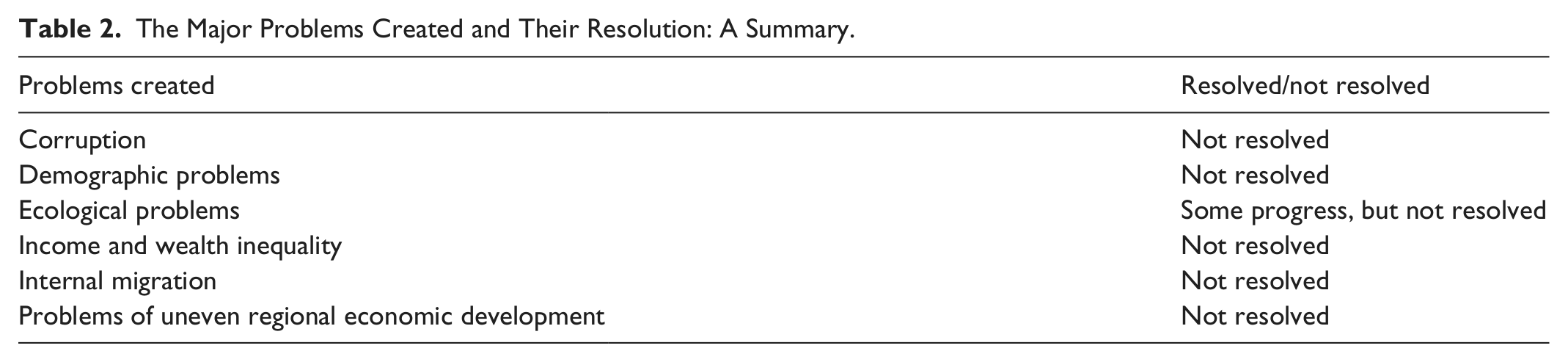
A list of the major problems created by the PRC and of their resolution is offered by Table 2. (On these problems and their solution, see, for instance, Bergsten et al., 2006, pp. 6, 31, 32-33, 43, 46, 47, 48-49; Bergsten et al., 2009, pp. 77, 91, 97; Ding & Neilson, 2004, p. 1; Ding & Wing, 2004, p. 493; Feng & Zhang, 2004, p. 291; Foroohar & Liu, 2010, pp. 38, 39; Gabriel, 1998g; Hill & Zhou, 2009, p. 3; Jeffries, 2006, p. 389; J. Liu, 2009; Lu & Song, 2004, p. 521; Mau, 2010; “Preferential Policies for China Western Development,” www.sccom.gov.cn; Raiklin, 2008, pp. 399-400, 438-453; Pei, 2008, pp. 229-230; Shi & Du, 2004, p. 219; Song & Woo, 2008; Solinger, 2008, p. 252; Steinfeld, 2008, p. 162; Tisdell & Chai, 1997; Yusuf & Nabeshima, 2008, pp. 2, 3, 6; T. Wang, 2009, pp. 72-73, 78-79; Wong, 2010; Zhang & Gang, 1997, pp. 34, 48, 49).
[In the opinion of the author, these are the major problems currently faced by the PRC. On the problems not discussed by the author, see, for instance, some other sources (Bergsten et al., 2006, pp. 23, 29-30, 33, 34, 36, 37, 38-39; Bradsher, 2010; Bradsher & Barboza, 2010; Jeffries, 2006, pp. 393, 395, 397, 398, 407; Wines & Ansfield, 2010)].
Again, these are the problems of any “normal” capitalist country. But in China’s case, capitalist “normality” is broken (therefore, the problems created are greatly aggravated) due to the following two important factors: first, to the form China’s capitalism has taken (authoritarian state); and, second, to the unresolved problems the PRC has inherited from its feudal predecessor.
Conclusion
For the most populous country in the world, whose population already in 1952 was estimated at 572 million (Perkins, 1975); for a huge country, situated on the fourth-largest land mass on planet Earth (The World Bank, 2007), to become, despite all the problems China has faced and still faces, an economic giant in less than 60 years is in reality a remarkable achievement (“In 2009, China Built Six New Airports,” 2010; Mao & He, 1997).
What could account for such a success-story? The following factors might provide an answer to this question.
The first is the Chinese model of management, which is, in the first place, territorial. In other words, it is a model where regional leaders play a key role. And, operating within a vertical political structure, the career of a regional leader depends on the economic accomplishments of his region; this stimulates him or her to supervise high rates of economic growth (Markevich, 2010).
The second is that very industrial revolution, which has been transforming China’s economy from one of lower-productivity agriculture to higher-productivity industry (“World Economic Outlook,” 1997).
The third is the country’s high level of savings and investment (“World Economic Outlook,” 1997). The major source of these is the country’s authoritarian system, which, despite decentralization, is still able to collect and channel people’s savings into capital accumulation (Wines, 2010b).
The fourth, and, probably, the most important domestic reason, is a willingness on the part of a majority of the people (who are still rural dwellers; Aleksashenko, 2010; J. Liu, 2009), in century-old Confucian-type fashion, to follow and submit to the zigzags of the CPC’s policies (discussed earlier in this article). “In short, policy changes were the reason for keeping past growth high, and they will have to continue if future growth is to remain high” (Wing, 2007, p. 25).
According to the author, it is the country’s historical traditions bound within the new socioeconomic structure of authoritarian state (bureaucratic) capitalism that have been the major drivers of China’s phenomenal development.
Afterword
Obviously, the overall change described in this book cannot continue forever: quantitative economic development, and especially at such a rapid speed, will eventually bring about profound qualitative societal changes. In other words, to slightly paraphrase a famous proverb, success sooner or later will create the seeds of its own failure.
Two questions are then in order.
The first is “How soon or how late will this happen?” (Aleksashenko, 2010; Bergsten et al., 2006, p. 9; J. Liu, 2009).
The second question then is “Where will the trends outlined above eventually lead China? The answer to this question can be reduced to the phenomenon known as “Catch-22.”
If, over time China is able to sustain relatively high rates of economic growth, then, on the current authoritarian state capitalist road, it will continue to produce and reproduce the major problems outlined in this article, the most serious of which are corruption, and regional and social (income and wealth) inequality. This undoubtedly over time will tend to ignite the growing resentment of those multitudes that will inevitably be left behind. Such a psychological atmosphere will threaten the stability and harmonious relations of a nation that has always been afraid of lawlessness and disorder.
If, however, the law of diminishing marginal returns becomes stronger than China’s initial situation backwardness, so that the country slows its economic advance along the authoritarian state capitalist line, then, to the existing unresolved problems, it will add increased unemployment and joblessness. The result will be the same as in the first scenario: the real danger of national instability.
Thus, both scenarios are filled with the perils of chaos and even disintegration. The bureaucracy is fully aware of this and, to preserve its power, has begun to adopt a “carrot-and-stick” approach to both scenarios (Bergsten et al., 2009, pp. 108, 109, 111; Ji, 2006, p. 36; Jing, 2008, p. 94; M. Liu, 2010, pp. 38-39; Miller, 2008, p. 77; Stone Fish, 2010, p. 8).
Will these carrots and sticks help the Chinese bureaucracy keep the country and its current system intact during the remaining decades needed to make China as a whole a modern developed nation? If so, then, in the opinion of the author, the present regime of authoritarian state capitalism will be able to successfully transfer the entire country into the structure of authoritarian mixed capitalism (Bergsten et al., 2009, p. 58).
It will be “authoritarian,” because “the collective mind of the Chinese people is strongly wedded to the idea that chaos and political instability may result from a transition to democracy” (L. Cheng, 2008, p. 6; Nathan, 2008, p. 39; Yu, 2008, pp. 53-54). And it will be “mixed,” because the state, or bureaucratic, form of capitalism, suited for the current period of take-off, will not be appropriate for a future urban, industrial, and modern China. For, even at present, “most [Chinese leaders] would support further marketization of the economy and greater scope for China’s private sector, at least to the extent that it did not affect the Party’s political monopoly” (Clarke, 2008, p. 13).
If, however, the current “carrot-and-stick” approach turns out to be too weak in helping to complete the industrialization and modernization drive, then the next several decades will witness the PRC repeating a Soviet-type experience of geographical and social disintegration (an opposite view is expressed by Bedeski, 2004, p. 45). 2
Footnotes
Declaration of Conflicting Interests
The author(s) declared no potential conflicts of interest with respect to the research, authorship, and/or publication of this article.
Funding
The author(s) received no financial support for the research and/or authorship of this article.
Notes
Author Biography