




Abstract
As a part of China’s energy conservation and emission reduction policy system, the China Energy Label plays an important role in promoting energy-efficient technology progress and product sales. In this article, we comprehensively review China’s energy labeling policy portfolio, consisting of the Energy-Efficiency Label Management Approach, the financial subsidy, and “top runner” programs. To evaluate the effectiveness of the energy labeling policy portfolio, we further analyze the influence of the energy labeling policy portfolio on the electricity consumption of household appliances. According to our results, the China Energy Label played an active role in slowing the growth rate of residential electricity consumption during 2007–2010, but its effectiveness was not satisfactory in the period 2011–2012. The reasons and countermeasures are discussed herein to address this problem. Moreover, to further enhance the effectiveness of the China Energy Label, policy implications are proposed for long-term successful implementation.
Introduction
Energy-efficiency information labels can guide consumers to purchase energy-efficient household appliances by providing key information concerning energy efficiency (Wiel & McMahon, 2003; Zha et al., 2020) and is a practice that has been widely adopted in many countries, mainly in three forms: rating labels, comparative labels, and information-only labels. A well-known example of rating labels is the European Union (EU) Energy Label implemented in the 1990s, which has been seen as a significant policy for promoting the usage of energy-efficient household appliances by informing consumers of credit ratings (Bull, 2012; Mills & Schleich, 2010). In addition, the Energy Guide in the United States, a typical comparative label program pushed by the government, has been observed as a more successful program than private counterparts due to the credibility, financial stability, and long-term feasibility (Banerjee & Solomon, 2003). Furthermore, information-only labels implemented on air conditioners in the Philippines in 1994 saved 6 MW of power installed capacity, or 17 million kilowatts of electricity, in the first year of implementation; this was evaluated as a successful program as well (Xin & Zhu, 2000).
China’s sustained economic development has been accompanied by a rapid growth in energy demand (Lo, 2014; Wang, 2007) and a serious growing climate problem over the past 30 years (Duan & Wang, 2018; Li et al., 2019). In the household sector, the implementation of the energy labeling policy is of great significance for promoting sustainable development (Zhan et al., 2011). Based on the experience of previous energy labeling policies in developed countries, the Chinese government established and implemented a mandatory energy-efficiency information label in 2004 that could indicate the energy efficiency of energy-using products (Zhou et al., 2010). Furthermore, financial subsidy and energy-efficiency “top runner” (defined as the products, enterprises, or units that have the highest energy efficiency in the comparable range) programs have been introduced step-by-step to encourage consumers to buy more energy-saving products on the demand side (Lopes et al., 2005; Murakami et al., 2009; Risch, 2020; Wang et al., 2020) and to encourage enterprises to produce more energy-saving products on the supply side. The policy mix has stimulated the internal vitality in the end-use market and improved the energy efficiency of household appliances as an effective mode of innovative policies for energy-saving management (“Strengthen the supervision of China Energy Label and improve the product quality,” 2018).
The China Energy Label can not only promote energy-efficient technology progress on the supply side (“Strengthen the supervision of China Energy Label and improve the product quality,” 2018; N. Zhou, 2008) but also promote energy efficiency on the demand side (Khanna et al., 2013; Zhou & Bukenya, 2016). Owing to the role that the energy labeling program is playing in China’s energy-saving management in the household sector, the China Energy Label has instigated a number of studies in literature since its implementation. For instance, Zhan et al. (2011) criticized that there is still a gap between China’s energy-efficient household appliances and the global advanced level; thus, the energy-efficiency standards for household appliances should be continuously updated. Liu et al. (2017) argued that the energy-efficiency labels need to be effectively transmitted to manufactures as well as bring significant market pressures or economic incentives to ultimately induce energy-efficiency technological innovations. In addition, whether the energy-efficiency labels can stimulate consumers to purchase energy-efficient household appliances is another important issue. Wiel and McMahon (2003) claimed that the effectiveness of energy-efficiency labels has depended to a large extent on how information was delivered to consumers. Shen and Saijo (2009) used refrigerators and air conditioners as research objects and concluded that consumers could obtain information through labels that, in turn, affects consumers’ choices of household appliances. In addition, the International Energy Agency (IEA) has argued that replacing old household appliances with energy-efficient ones is a very cost-effective short-term energy-saving measure (Galarraga, González-Eguino, Markandya, 2011; Galarraga, Heres, Gonzalez-Eguino, 2011; IEA, 2009). Moreover, Mahlia and Saidur (2010) summarized the requirements and specifications of various international evaluation standards for air conditioners and refrigerators and stated that China adopted energy-efficiency standards and energy-efficiency labeling programs simultaneously. Some scholars have analyzed the energy-saving effect of China’s energy labeling program and predicted that China’s program had great energy-saving potential (Chunekar, 2014; Li et al., 2017; Zhou et al., 2013). Other scholars have also pointed out that due to the relatively high price of energy-efficient products, residents have little incentive to buy them, so energy-saving subsidy policies should be implemented as a supplement to energy labeling programs (He et al., 2019; Wang et al., 2017).
The existing studies have mostly focused on either the introduction or the effectiveness of energy-efficiency labels. However, China’s energy labeling program plays an important role only when it coordinates with the financial subsidy program and energy-efficiency “top runner” program, whereas, at present, few researchers have reviewed China’s energy labeling policy in the form of a policy portfolio.
The possible contributions of this study are as follows. First, we comprehensively review China’s energy labeling policy portfolio, consisting of the Energy-Efficiency Label Management Approach, the financial subsidy, and “top runner” programs. We further analyze the background of the three policies and their mutually supporting relationship, and we believe that the mutually supporting relationship makes the policy more effective in China. Second, to evaluate the effect of the energy labeling policy portfolio, we further analyze the influence of the energy labeling policy portfolio on the electricity consumption of household appliances and identify a rebound effect after it has worked for several years. The layout of this article proceeds accordingly. Section “The Energy-Efficiency Label Management Approach” introduces the “Energy-Efficiency Label Management Approach.” Next, section “Financial Subsidy Policy” describes the financial subsidy policy for energy-efficient household appliances. Section “Energy-Efficiency ‘Top Runner’” then illustrates the energy-efficiency “Top Runner” policy system. Then, section “Discussion and Evaluation of the China’s Energy Labeling Policy Portfolio” examines the effectiveness of the China’s Energy Labeling policy portfolio, and, finally, section “Conclusion and Policy Implication” offers conclusions and implications.
The Energy-Efficiency Label Management Approach
Introduction of the “Energy-Efficiency Label Management Approach”
On August 13, 2004, the National Development and Reform Commission (NDRC) and the State Administration for Quality, Supervision, Inspection, and Quarantine (AQSIQ) jointly formulated and promulgated the “Energy-Efficiency Label Management Approach” (NDRC & AQSIQ, No. 17), which took effect on March 1, 2005. The objectives of this management approach can be summarized in the following three aspects: first, to strengthen energy conservation management; second, to promote energy-saving technological advancement; and, third, to improve energy efficiency. In addition, to clarify the division of duties, the management approach stipulated that the NDRC, AQSIQ, and Certification and Accreditation Commission of China (CNCA) should formulate the “Catalogue of Products for the Implementation of the Energy-Efficiency Label of China” and the corresponding implementation rules. At the same time, the NDRC and CNCA were appointed to formulate and publish uniform energy-efficiency label styles and specifications for applicable household appliances.
The formulation of the “Energy-Efficiency Label Management Approach” (NDRC & AQSIQ, No. 17) was not only a realistic consideration of the status quo of energy consumption but also a fulfillment of the “Law of the People’s Republic of China on Conserving Energy.” On the one hand, in 2003, China surpassed Japan for the first time and became the second biggest energy consumer after only the United States (Crompton & Wu, 2005). Furthermore, in the residential sector, with the rapid development of the national economy, the proportion of residential electricity consumption out of the total residential energy consumption had increased yearly, and in 2004, the proportion was up to 12.87%. Moreover, as an important contributor to residential electricity consumption, household appliances have been highlighted for the key potential to lower residential energy consumption. So it is of great significance to improve the energy efficiency of household appliances through energy-efficient policies such as “Energy-Efficiency Label Management Approach.” On the other hand, given energy conservation is a long-term strategic guideline for the Chinese government, the aim of the ‘Law of the People’s Republic of China on Conserving Energy’ is to promote energy conservation, improve energy efficiency, protect the environment, and boost comprehensive, coordinated, and sustainable development between the economy and society. The law clearly states that technically feasible, economically sound, and environmentally and socially affordable measures should be taken to reduce losses and wastes from energy production to consumption, and energy use should be more efficient and rational, which could be simultaneously addressed by the management approach. The “Energy-Efficiency Label Management Approach” (NDRC & AQSIQ, No. 17) contributed not only to promoting energy-efficient technology progress and the adjustment of product structure on the product manufacturing side but also to promoting energy-efficient products on the product consumption side. Furthermore, it has also played an active role in achieving the energy conservation and emission reduction target during the 11th Five-Year Plan (Price et al., 2011; Yuan et al., 2011; Zhou et al., 2011).
However, as China surpassed the United States in 2009 to become the world’s largest energy-consuming country, it had been an important theme of China’s energy strategy to restrict the extensive energy consumption mode and to control excessive energy consumption growth. In the residential sector, it has become clear that improving the energy efficiency of energy-using products has played and will continue to play an important role in energy consumption; therefore, the promotion of energy-efficient household appliances will help improve energy-consuming efficiency. Therefore, to adapt to new requirements for energy development, which have been proposed by China’s new economic norms and development concepts, it is necessary to adjust the existing management approach. At the same time, China has developed a more solid legal foundation to support the work of energy conservation, and a series of guidelines and policies, such as the “Medium and Long-term Plan for Energy Conservation,” “Circular Economy Promotion Law of the People’s Republic of China,” and “Opinions on Strengthening Energy Conservation Standardization Work,” were introduced. These guidelines and policies posed new challenges and requirements for promoting energy-efficient household appliances. Thus, under the new realistic and political context, in 2016, the NDRC and AQSIQ formulated and promulgated the “Energy-Efficiency Label Management Approach” (NDRC & AQSIQ, No. 35) to meet the need for promoting energy-efficient household appliances in the new situation. The new version of the management approach was implemented in June 1, 2016, and at the same time, the old version was abolished.
The objectives of the new version of the management approach are the same as the prior one, which still focus on strengthening energy conservation management, promoting energy-saving technology progress, and improving the energy efficiency of energy-using products. Furthermore, the new version follows the same structure distribution as before, which can be described as the “General Principle, Implementation of Energy-Efficiency Label, Supervision and Management, Punishment and Supplementary Provision.” However, the new version is different in some details from the previous one in terms of clearer and stricter regulations concerning the content order, legal basis, division of duties, implementation mode and step, scope of supervision and management, system and mechanism, responsibilities of illegal subjects, and intensity of punishment measures (“Annual meeting of the energy-efficiency label and energy efficiency ‘Top Runner’ product launch conference held,” 2016). Moreover, the new version also actively responds to the national policy call of “Internet +,” adding energy-efficient information codes to the basic content of energy-efficiency labels to use information technology to narrow the distance between manufacturers and consumers.
The Implementation Model and Steps of the China Energy Label
According to the “Energy-Efficiency Label Management Approach,” the China Energy Label adopts the implementation model of “producer or importer self-declaration + application to the authorized institution for filing + supervision and management of relevant governments’ departments” (Zhan et al., 2011). Furthermore, according to the new version of the “Energy-Efficiency Label Management Approach” (NDRC & AQSIQ, No. 35), the implementation steps of the China Energy Label are shown in Figure 1. First, producers or importers of energy-using products, which are listed in the “Catalogue of Products for the Implementation of the Energy-Efficiency Label of China,” use their own testing laboratories or trust third-party inspection and test institutions to determine the energy-efficiency grade in accordance with the national mandatory energy-efficiency standards. Second, producers or importers submit prepared materials to the NDRC- and AQSIQ-authorized Standardization Administration of China (SAC). In addition, SAC completes the filing of energy-efficiency labels within 10 days from the date of receiving materials and announces the sample of energy-efficiency labels within five working days from the date of completed filing. Finally, the relevant government’s departments implement supervision, special inspections, and verification management concerning the use of the China Energy Label.

The implementation steps of the China Energy Label.
Overview of the products with the China Energy Label
The China Energy Label is a type of mandatory and categorical energy-efficiency information label based on the EU Energy Label (Zeng et al., 2014). According to the statistics, at the end of 2015, the overall qualification rate of the China Energy Label on the market was 91.81% (“Annual meeting of the energy-efficiency label and energy efficiency ‘Top Runner’ product launch conference held,” 2016). Furthermore, until December 2017, the NDRC, AQSIQ, and CNCA had released 14 batches of product catalogues for the China Energy Label, including a total of 37 types of household appliances.
There are two kinds of energy-efficiency grade system in the developing process of “Energy-Efficiency Label Management Approach” in China: 5-grade and 3-grade system. Before 2009, the Chinese government adopted the five-level energy-efficiency labeling system, in which 1 represents the best energy efficiency and 5 represents the worst energy efficiency. After 2009, the Chinese government introduced stricter energy-efficiency management measures, which only allowed products above the third-grade energy efficiency to be sold on the market, so it became the three-level energy-efficiency labeling system now. In the three-level energy-efficiency labeling system, 1 represents the best energy efficiency and 3 represents the worst energy efficiency. Using a simple numerical grade, the energy efficiency of energy-using products can be more clearly and intuitively conveyed to consumers, helping eliminate information asymmetry between producers or importers and consumers. Furthermore, with the increase in improvement in consumers’ energy conservation awareness, low-efficiency household appliances would be gradually eliminated by the market, thereby promoting the adjustment of product structure and pushing technological progress.
It should be stated specifically that the implementation rules for the energy-efficiency labels of household appliances are not static but revised in due course with environmental changes and technological progress. The largest revision occurred in 2016, when the “Catalogue of Products for the Implementation of the Energy-Efficiency Label of China (released in 2016)” revised the implementation rules of 33 types of household appliances that had previously been implemented in the China Energy Label. In this revision, the energy-efficiency standards of most household appliances were modified and improved. As an example, the household refrigerator, which had first been implemented in the China Energy Label in 2004, has undergone two revisions that relabeled the refrigerator due to changing standards. The first revision occurred in 2009, and the energy-efficiency standard was revised from GB 12021.2-2003 (released in 2004) to GB 12021.2-2008 (released in 2009). The second revision occurred in 2016, when the energy-efficiency standard was revised from GB 12021.2-2008 (released in 2009) to GB 12021.2-2015 (released in 2016).
Financial Subsidy Policy
The high growth rate of the energy demand has presented serious problems, which limits the sustainable development of energy sector in China (Yuan et al., 2011). It becomes clear to the Chinese government that expanding domestic demand by transforming the potential demand of consumers into actual demand through financial subsidies is a good solution based on the idea of demand-side management. Therefore, “Energy-Efficient Products Benefiting the People Project” issued jointly by Ministry of Finance, NDRC, clearly put forward that producers of energy-efficient products with Grade 1 and Grade 2 energy-efficiency levels will be subsidized by the central government, which will then sell them at subsidized prices (“Ministry of Finance, National Development and Reform Commission launch ‘Energy-Efficient Products Benefiting the People Project’”). The program was in accordance with the “Decision of the State Council on Strengthening Energy Conservation Work” and the “Notice of the State Council on Further Strengthening Fuel Saving and Power Saving Work.” The program provided financial subsidies for three major categories, including household appliances, automobiles, and industrial products.
As a part of the “Ten-Key Projects” during the 12th Five-Year Plan, the implementation objectives of the program can be summarized in three aspects: expanding domestic consumption demand, improving energy efficiency, and promoting industrial upgrade. Given that household appliances are recognized as one of the major contributors to residential electricity consumption as well as a key field with potential for energy conservation, financial subsidies for household appliances, especially energy-efficient household appliances, will help promote energy-efficient products and improve energy efficiency. The program, as one of China’s three major household appliance subsidy policies (see Table 1), can help to assist the implementation of the China Energy Label and to promote the market circulation of energy-efficient household appliances (Zeng et al., 2014). According to the program, the financial subsidy objects should meet the requirements of the national energy-efficiency standards, indicating that the energy-efficiency grade of these financial subside objects should be either Grade 1 or Grade 2. Moreover, different from the Household Appliances Trade-in Program or the Household Appliances to the Rural Areas Program, the program’s financial subsidies for energy-efficient household appliances belong to indirect subsidies.
China’s Three Major Household Appliance Subsidy Policies.

Since its implementation, the program has gradually developed into an important policy platform for the stability of economic growth, expansion of domestic consumption, promotion of energy conservation, and benefit for people. In addition, the program has helped China achieve a consumption and production system of energy-efficient household appliances that combines financial subsidies, mandatory standards, and market mechanisms.
Energy-Efficiency “Top Runner”
The “Top Runner” program originated in Japan in 1998 (Huang et al., 2016; Lopes et al., 2005), which was proposed to encourage all industrial manufactures to catch up with energy-efficient leading manufactures, being considered to be extremely successful (Murakami et al., 2009). As the two largest economies in Asia, China and Japan are both facing the great pressure of energy conservation and emission reduction. Thus, the success of Japan’s “Top Runner” program has provided valuable experiences for China (Nie et al., 2018). In this context, China followed the Japanese pattern and released the “Energy Efficiency ‘Top Runner’ Implementation Plan” (2014).
The “Top Runner” was defined as the products, enterprises, or units that have the highest energy efficiency in the comparable range (Nie et al., 2018). The objectives of the policy can be summarized into the following four aspects: first, enhancing the power of energy conservation and emission reduction of the whole society; second, promoting the development of energy conservation and the environment protection industry; third, saving energy resources; and fourth, protecting the environment. In addition, the policy attempts to establish a long-term mechanism to promote continuous improvement in the energy efficiency of products, enterprises, or units by establishing benchmarks, policy incentives, and raising standards.
Given that the “Energy-Efficiency Label Management Approach” has divided the energy efficiency of end-use energy products into 3-grade energy efficiency or 5-grade energy efficiency, on this basis, the “Energy Efficiency ‘Top Runner’ Implementation Plan” has more stringent requirements in terms of the energy efficiency of end-use energy products, which requires the energy-efficiency grade of these products to be Grade 1. According to the implementation plan, the end-use energy products that are judged as the “Top Runner” can be marked with the “Top Runner” label on the products’ obvious locations or packaging (see Figure 2), or the “Top Runner” label can be printed directly on the China Energy Label (see Figure 3). The Energy-Efficiency “Top Runner” product catalogue (2016) included household refrigerators, flat panel TVs, and speed-controllable room air conditioners, and 150 products were selected from 447 models based on comprehensive consideration of the product market size, energy-saving potential, technological development trend, standard specifications, testing capabilities, and more. Furthermore, the Energy-Efficiency “Top Runner” product catalogue (2017) was enriched in 2017, and there were a total of five types of products, including household refrigerators, flat-panel TVs, speed-controllable room air conditioners, electric washing machines, and lighting products in the new catalogue.

The symbol of the Energy-Efficiency “Top Runner” label.
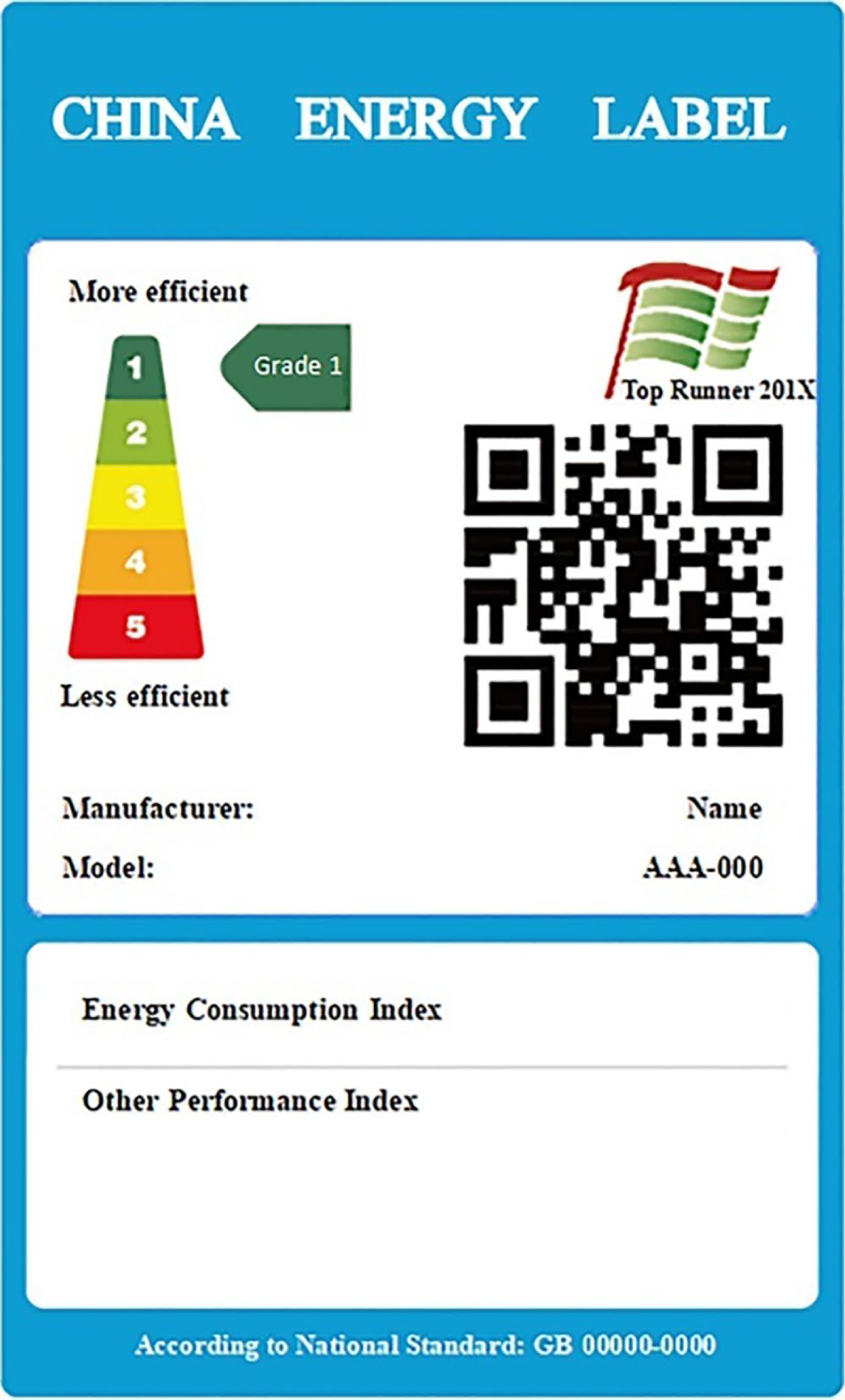
The symbol of adding the Energy-Efficiency “Top Runner” label to the China Energy Label.
As the Energy-Efficiency “Top Runner” is an important measure to promote energy conservation work using the market-oriented mechanism, its implementation can influence the China Energy Label in two ways. On the one hand, the “Top Runner” can promote the improvement of energy efficiency, which will affect the energy-efficiency standards and energy-efficiency grades of the China Energy Label. On the other hand, the combination of the China Energy Label and the “Top Runner” label can provide consumers with more information about energy efficiency, which is of great significance for promoting energy-efficient products.
Discussion and evaluation of the China’s energy labeling policy portfolio
According to the review of the three energy labeling policies above, we find that a series of energy labeling policies have been gradually formed. The application scope and technical specifications of China Energy Label were defined in “The Energy-Efficiency Label Management Approach,” which provides consumers with information on the energy-efficiency level of household appliances as a basis and guarantee for the subsequent introduction of relevant policies. However, because the prices of energy-efficient products are generally higher than those of less efficient products, consumers have less incentive to buy energy-efficient products even though they already know they are more energy-efficient. By providing subsidies for energy-efficient products, “Financial Subsidy Policy” has solved the problem of high price of energy-efficient products and provided a good incentive for consumers to buy energy-efficient products. Not only should consumers be encouraged to buy more efficient products, but companies should also be encouraged to improve the energy efficiency of their products through technological innovation. “Financial Subsidy Policy” provides effective incentives to consumers, whereas “Energy-Efficiency ‘Top Runner’” provides effective incentives to the supply side, which can encourage manufacturers to maintain sustainable innovation capacity and level so as to ensure continuous improvement of products’ energy efficiency.
The current China Energy-Efficiency labeling portfolio not only provides basic information on the energy efficiency of products but also further improves incentive policies for both consumers and manufacturers. The following assessment of China’s energy-efficiency label portfolio can well reflect its effectiveness in saving residential energy consumption.
The effectiveness of the China Energy Label could be assessed by investigating the electricity consumption of household appliances with the implementations of China Energy Label. Household appliances are considered as one of the major contributors to residential electricity consumption (Cao et al., 2019), the changes of electricity consumption of which could be used to measure the effectiveness of China Energy Label. Through comparing the growth rate of residential electricity consumption and that of household appliance ownership, we can obtain the improvement in the efficiency of household appliances (Guo et al., 2016; Nie & Kemp, 2014; Sun et al., 2014). Furthermore, the improvement in efficiency of household appliances was attributed to energy-efficient policies by some scholars, which provided evidence on the effectiveness of China Energy Label on improving the energy efficiency of household appliances (Cao et al., 2019; Zhan et al., 2011). The studies mentioned above show the feasibility of assessing the improvement in the household appliances’ energy efficiency by analyzing the relationship between household appliance ownership and residential electricity consumption, which could also be used to evaluate the effectiveness of the China’s energy labeling policy portfolio.
We will examine the effectiveness of the energy labeling policy portfolio for improving the energy efficiency of household appliances by studying the relationship between household appliance ownership and residential electricity consumption. Of course, in addition to the quantity and efficiency of household appliances, there are other factors that affect electricity consumption. For example, the use of household appliances for a longer period of time or the use of larger household appliances will increase electricity consumption. However, it is certain that the energy efficiency of household appliances has the most significant impact on residential electricity consumption (Guo et al., 2016; Murata et al., 2008; Nie & Kemp, 2014; Sun et al., 2014).
The ownership and energy efficiency of household appliances as two important factors for residential electricity consumption from household appliances influence residential electricity consumption in a different way. To better understand the effectiveness of the China Energy Label, we need to study the tendency of ownership of household appliances first. Considering the popularity of household appliances and the availability of data, we select five types of products as research objects: washing machines, refrigerators, color TV sets, air conditioners, and computers. However, since 2013, the China Statistical Yearbook has changed the statistical caliber of the indicator that represents the average number of durable consumer goods owned by urban and rural residents per 100 households at the end of the year (National Bureau of Statistics of China, 2017). Therefore, we only collected data on these five types of products from 2000 to 2012.
We use the China Statistical Yearbook to collect data on residential electricity consumption from 2000 to 2012 (National Bureau of Statistics of China, 2017). With the development of the domestic economy and the improvement in living standards, residential electricity consumption will continue to increase. Therefore, slowing the growth rate of residential electricity consumption is conducive to alleviating the electricity shortage problem in China. The data show that the residential electricity consumption growth rate has gradually slowed down since 2007, the reason for which is worth exploring. Through a literature review, we can conclude that there are many factors influencing residential electricity consumption, and among these, ownership of household appliances is one of the most important factors (Kondou et al., 2011). However, with the continuous growth in the ownership of household appliances, the growth rate of residential electricity consumption has slowed down since 2007, which can be preliminarily explained by the improvement in energy efficiency. By further analyzing the relationship between household appliance ownership, energy efficiency, and residential electricity consumption, we examine the effectiveness of the China Energy Label.
It is easy to conclude that energy-efficient household appliances have a dual impact on residential electricity consumption; on the one hand, the growth in the number of household appliances will lead to an increase in residential electricity consumption, and on the other hand, the improvement in the energy efficiency of household appliances will lead to a decline in residential electricity consumption. Given that one objective of the China Energy Label is to improve the energy efficiency of energy-using products, the effectiveness of the China Energy Label can be examined according to whether the policy has worked in reducing residential electricity consumption by improving energy efficiency. So, to further explain the impact of the China Energy Label on the relationship between household appliance ownership and residential electricity consumption more clearly as well as to examine the effectiveness of the China Energy Label, we drew an X–Y graph, which is shown in Figure 4.

The relationship between household appliance ownership and residential electricity consumption.
Figure 4 shows that in the residential sector, with the continuous growth of household appliance ownership, the growth rate of residential electricity consumption has slowed down after a period of rapid growth, although the growth rate accelerated again after 2011. Assuming that energy efficiency remains constant, residential electricity consumption will inevitably increase with the increase in household appliance ownership. However, with the increase in household income, residents are likely to replace smaller household appliances with larger ones or to increase the use time of household appliances, which will further accelerate the growth of residential electricity consumption (Auffhammer & Wolfram, 2014; Yao et al., 2014). This explains why electricity consumption is growing faster than the ownership of household appliances in the absence of an energy labeling policy. The slowdown in residential electricity consumption since 2008 partly explains the effectiveness of the energy labeling policy.
To better explain the effectiveness of the energy labeling policy portfolio, we calculated the electricity consumption per household appliance (ECPA) and its changing rate shown in Figure 5. The changing rate of ECPA kept on fluctuating and increasing until 2007, and fell rapidly after 2008 and turned negative in 2010. The evolution of the changing rate of ECPA can be explained by the energy labeling policy portfolio. Although the Energy Labeling Policy was implemented in 2005, only refrigerators and air conditioners are included at that time. And more appliances were included in the energy labeling policy in 2008, in which year the changing rate of ECPA started to decline rapidly. In addition, the financial subsidy policy named “energy-saving products and civilian-benefiting project” was launched in 2009 on air conditioners, refrigerators, flat panel televisions, washing machines and so on (Zhan et al., 2011), which was a very powerful way to improve the energy efficiency of household appliances and furthermore make the changing rate of ECPA fall into negative territory in 2010 and 2011. To sum up, the evolution process of the changing rate of ECPA can well reflect the effectiveness of energy labeling policy portfolio, especially the financial subsidy policy.

Residential electricity consumption per appliance and its changing rates.
However, during the 2011–2012 period, the China Energy Label failed to perform as expected. It is of great significance to explore the reasons why the effectiveness of the China Energy Label has not been satisfactory, as well as the countermeasures to solve this problem. This is very important and beneficial for adjusting and revising the China Energy Label to make it work better. A possible reason for this is the energy rebound effect from household appliances (Lin & Liu, 2013). With the improvement in the energy efficiency of household appliances, their use cost will gradually decrease, and the rebound effect will appear (Liu et al., 2016; Ouyang et al., 2010; Zhang & Peng, 2017), which may partially or even entirely offset the expected energy savings of energy-efficiency policies (Dianshu et al., 2010; Wen et al., 2018). When the energy efficiency of household appliances was improved by implementing the China Energy Label, the electricity cost for doing the same work (washing, heating, cooling, etc.) decreased, which, in turn, could lead to a change in consumers’ behaviors; for example, consumers may pursue more comprehensive household appliances or extend the use time of household appliances; thus, residential electricity consumption could increase. For instance, a household energy consumption survey in Beijing in 2010 showed that for air conditioners and washing machines, either a direct rebound effect or an indirect rebound effect existed significantly. The respective average upper bound of the direct rebound effects for them was 60.76% and 106.81%, respectively, whereas the respective upper bound of the total rebound effects was 88.95% and 100.36%, respectively (Yu et al., 2013).
Conclusion and Policy Implication
Conclusion
An energy label policy is the inevitable choice of China for achieving the target of energy conservation and emission reduction. The main objective of this article was to comprehensively review the implementation process of the China Energy Label policy portfolio and to examine the effectiveness of the policy portfolio in residential electricity consumption. We first reviewed a host of policies that China has formulated during the implementation process of the China Energy Label. Then, we examined the effectiveness of the China Energy Label portfolio. Finally, we explored the reasons for the problem of unsatisfactory effectiveness of the policy during a certain period. Thus, we may safely draw some conclusions as follows based on what has been discussed above.
First, while still a work in progress, it is clear that China has already developed a solid political foundation and has the key elements to support the development and enforcement of the China Energy Label. Moreover, the objectives of the China Energy Label have strength in stability, which is beneficial to the publicity and implementation of the policy. Furthermore, considering the new economic situation and the new development ideas, the Chinese government has revised the “Energy-Efficiency Label Management Approach” and constantly issued new editions of the “Catalogue of Products for the Implementation of the Energy-Efficiency Label of China” so that the scope of products covered by the China Energy Label becomes wider and wider. Second, as the major focus of policy makers and researchers, the effect of the China Energy Label plays an important role in energy conservation management. The implementation of the China Energy Label contributes to reducing residential electricity consumption by improving the energy efficiency of household appliances, which can not only reduce greenhouse gas emissions and bring public benefits but also reduce the cost of electricity consumption and bring private benefits so as to achieve a win-win situation. Third, the effectiveness of the China Energy Label in reducing residential electricity consumption is sometimes not as expected, which may be caused by the energy rebound effect.
Policy Implications
Since the implementation of the China Energy Label, the Chinese government has made outstanding contributions to fulfill the target of energy conservation and emission reduction, and its impact is being felt throughout the entire economy (Chunekar, 2014; Song et al., 2019). However, the review of the implementation process of China’s energy-efficiency labeling policy portfolio indicates that there are still some unresolved issues which have not been addressed by the current policy portfolio. First, the information asymmetry between consumers and manufacturers of household appliances will hinder consumers from making energy-saving decisions. In addition, China Energy Label is technology-oriented rather than function-oriented, which makes it impossible to directly compare the economic benefits of products with different levels of energy efficiency and makes consumers’ decisions difficult. Although China’s energy-efficiency standards for household appliances have become increasingly strict, they still fail to reach the international advanced level, which makes Chinese household appliance enterprises lack motivation for energy-saving innovation.
The issues above call for a long-term progress in continued support for energy conservation management. First, the Chinese government should further improve the two-dimensional code information platform for the China Energy Label to narrow the distance between manufacturers and consumers by timely providing consumers with the latest information on the progress of the energy-efficiency information label. Second, the Chinese government should enhance the information efficiency of the China Energy Label to solve the problem where products with the same function cannot be directly compared due to the fact that the China Energy Label is technology-oriented rather than function-oriented (Mahlia et al., 2002). Finally, the Chinese government should strengthen supervision in all aspects from production to circulation, update energy-efficiency standards to reach the international advanced level, and further increase the international competitiveness of Chinese energy-efficient household appliances. Given the potential for rebound effects and its effect on energy efficiency of household appliances (Ouyang et al., 2010) and residential electricity consumption (Su, 2019), the Chinese government should enhance consumers’ awareness of the important environmental and welfare advantages that could come from energy-efficient household appliances and further guide consumers’ energy consumption and emission reduction behaviors by introducing policies in conjunction with the China Energy Label. For example, the introductions of the “Circular Economy Promotion Law of the People’s Republic of China,” “Decision of the State Council on Strengthening Energy Conservation Work,” and “National Energy Conservation Action Plan for the 13th Five-Year Plan” are conducive to raising awareness of energy conservation, enhancing knowledge of energy efficiency, and strengthening the practice of energy saving so that the implementation effect of the China Energy Label can be better utilized.
Footnotes
Declaration of Conflicting Interests
The author(s) declared no potential conflicts of interest with respect to the research, authorship, and/or publication of this article.
Funding
The author(s) disclosed receipt of the following financial support for the research, authorship, and/or publication of this article: This research is supported by Foundation for the Humanities and Social sciences of the Ministry of Education of China, grant number 20YJC790101; National Natural Sciences Foundation of China, grant No. 71503026; and Key research base of Jilin university, grant No. 2018XXJD04.
