




Abstract
Port cities will be the important growth poles along the Belt and Road, including coastal and inland ports. But the innovation stimulus driven by the Belt and Road Initiative on the coastal and inland port cities is imbalance. This research takes two groups of Chinese port cities as empirical objects, one has coastal port and the other has inland port, and then establishes a system dynamics model based on the theory of triple helix to analyze port cities’ innovation features. The empirical case shows that the positive stimulation of Belt and Road Initiative to innovation activities of coastal port cities is better than that of inland cities in general. If the decision makers of inland cities want to achieve innovation output like that of developed coastal areas, they need to encourage local universities and research institutes to conduct more market-oriented research on one hand. On the other hand, they need to cooperate with multinational companies; meanwhile, they need to provide more technical resources for local start-ups. In addition, stimulating local house prices and living pressure in a reasonable range can stimulate the innovation enthusiasm of existing R&D personnel, attract top talents to join in, and then drive the innovation output of the whole region.
Keywords
Since 2013, the Chinese government has proposed to establish Silk Road Economic Belt in the inland region of Eurasia and 21st-Century Maritime Silk Road in the coastal region. In 2015, Chinese government condensed the two concepts into the Belt and Road Initiative (BRI) and promoted it as an international public product around the world. BRI aimed at promoting orderly and free flow of economic factors along it through infrastructure improvements. So far, this initiative has got positive responses from many relevant countries. To promote the common development of the Belt and Road region, the port cities along it will play their more and more important roles.
Considering China’s strong transport transformation capability, including the expansion of China’s coastal port facilities in the 1990s and early 21st century and the construction of high-speed rail network at the end of the 21st century, it is expected that at least part of BRI will occur. However, such major government initiatives are nothing new, take the example as the United States’ Interstate Highway System (IHS) beginning in the 1950s, which was trying to change the domestic transportation and regional system, so as to promote the regional economic development of the surrounding areas (Ng et al., 2018). There is no doubt that initiatives of this scale will have a direct and multifaceted impact on the transport system, spatial structure, economic and social development of the region concerned.
BRI and the Port City
The primary issue of the Belt and Road initiative is the common development of the regions along it. Its theoretical basis lies in the growth axis theory. As early as the 1950s, after World War II ended, international trade promoted the growth of the world economy. Perroux (1950) proposed that a series of “growth poles” had emerged, which were clusters of economic factors based on trade that could drive the development of regions around them. As growth poles continued to evolve, their economic factors extended to adjacent regions through their main geographic routes and formed linear flows spatially. Many growth poles were in arranged in a series and shaped as a “growth axis.” This would spur the development of whole districts, such as China’s Yangtze River Economic Belt and the Eastern Coastal Economic Belt (D. D. Lu, 2001). Normally, the growth axes were located in one country only. Now, the Belt and Road initiative has been raised and is considered the multinational version of growth axis theory. The Silk Road Economic Belt and the 21st-Century Maritime Silk Road are the two axes crossing the Eurasian continent. They have a broader coverage area, and the characteristics of their economic factors are more diverse (Liu, 2015).
In recent years, new technologies and new economic situations have led to the development of different modes of transportation. It is necessary, therefore, to study the relationships among ports, port cities, and the regionalization and the hinterland from a dynamic perspective (Ng et al., 2014; Notteboom & Rodrigue, 2005). For the region along the Belt and Road, port cities have shown the obvious features of regional growth poles. This is because ports are the connection points for water and land transport. Port logistics is the primary source of city development. With the globalization of the economy, international industry transfer continually increases. Tangible international factors accumulated in ports through the convenience of logistics. This has led to a large number of intangible and domestic factors clustering in the surrounding areas of ports. Different intensities among clustering factors as well as differing degrees of factor utilization have led to differences in regional development.
BRI includes the Silk Road Economic Belt and the 21st-Century Maritime Silk Road. The Silk Road Economic Belt mainly focuses on land transportation; the same as in ancient times (G. S. Lu & Deng, 2015). However, the 21st-Century Maritime Silk Road aims to exceed the limits of the ancient Silk Road. This is because geographical restrictions caused by the ocean are reduced now. A network based on the Maritime Silk Road should be built from China to any country with distribution requirements, which is the platform for China and its trading partners. The port cities in those countries will play more important roles as connection nodes (Yu & Xu, 2015). Therefore, to determine the characteristics of the Belt and Road’s growth pole, the development of port cities should be studied.
Integration of Inland Port and Sea Port
The growth poles along BRI include coastal port cities and inland port cities. However, the cost of land transportation is much higher than that of sea transportation. What are the advantages and endowments of inland port compared with sea port? One answer is let the former be a spatial supplement to the latter (Gonzalez-Aregall & Bergqvist, 2019). With the further development of globalization, multimodal transportation combined with land and sea has been applied on a larger scale. This requires the inland port to further improve its transportation facilities and become an effective bridge to embed the vast inland area into the global production networks (Notteboom et al., 2017). At the same time, the improvement of inland port infrastructure will help to achieve a more competitive regional logistics system (Raimbault, 2019).
Just as Lakshmanan (2011) pointed out that, one successful example of inland economic development through infrastructure investment was the expansion of the U.S. rail system, which had clearly affected many parts of the United States. The larger market brought about by the railway encouraged the early maturity of mass production technology in New England industry, which was then applied to a range of other industries. He believed that the long-term result of these developments caused by the expansion of major railways was the integration of the Northeast and the Midwest, forming the “manufacturing belt” of the United States. Meanwhile, without the continental bridge of the United States’, Japan’s, and South Korea’s multimodal transport route from the Pacific to Europe is impossible.
To build an influential inland port, the government’s huge investment and preferential policies in the initial stage are essential. However, the long-term survival of the dry port depends largely on their ability to respond to market forces and add value to the supply chain. Refers to the researches on the inland ports of the United States (Lakshmanan, 2011), Sweden (Gonzalez-Aregall & Bergqvist, 2019), India (Gujar et al., 2019), and Brazil (Ng et al., 2013), if the government policy violates the market law, it will hinder the development of this dry port. In addition, with the development of globalization, new requirements are put forward for the development of seaports. All of these require decision makers to think constantly to find the best way to integrate the sea port and the dry port, so as to achieve a win–win situation.
Therefore, the current strategy of decision makers in many port cities in the world is to give the right of choice to the market and to realize sustainable innovation in port areas by supporting local start-ups to capture new market opportunities. Witte et al. (2018) made an in-depth analysis of two cases in the port cities of Montreal and Rotterdam. The result showed that the initiative of local government to actively promote the entrepreneurship of preindustrial port area was quite successful. Among them, capital, cooperation, and proximity were more important factors. In this regard, in addition to the municipal authorities and port authorities, more participants were needed to build a port city innovation and entrepreneurship ecosystem.
Innovation Imbalance Between Coastal and Inland Regions
BRI is likely to significantly improve the infrastructure of the areas along the line in the short term, especially in the relatively backward inland areas. But does this mean that the local economy can be on the ideal track of sustainable innovation? The cases of Witte et al. (2018) are concentrated in developed countries, but can the same policy be implemented in inland areas? Where are the short boards? BRI hopes to achieve common development of coastal and inland areas, but innovation is not evenly distributed around the world. To study the geographical distribution characteristics of innovation activities, since Feldman and Florida (1994) systematically proposed the theory of innovation geography, relevant research has been emerging. Due to the high level of innovation in the developed regions with high economic agglomeration (Sultan & Dijk, 2017), it is more likely to attract scholars’ attention. However, less attention has been paid to the underdeveloped areas than the former. According to Coenen and Morgan (2019), the rise of basic economy is a manifestation of local innovation, which requires new forms of common governance. This is in line with the idea of BRI. But the problem is that even if the basic economic development is balanced, inland cities have less opportunity to obtain innovative knowledge than coastal cities due to geographical constraints. Therefore, the probability of sustainable development of inland cities through knowledge innovation is less than that of coastal cities (Quartey & Howard, 2019).
Mikhaylova et al. (2019) used a series of indicators of regional innovation system and innovation security to analyze the innovation spatial differentiation in Russia’s coastal and inland areas. They pointed out that global factors still tend to gather along the Haitian region. But even in coastal areas, if there is no effective transnational cooperation policy put forward, the effect of scientific and technological innovation is not obvious (Degelsegger-Marquez & Remoe, 2019). The proposal of BRI is likely to be an opportunity to narrow the development gap between the coastal and inland areas, and between the developed and underdeveloped coastal areas. In addition to external policies, the role of universities is essential for underdeveloped regions to acquire more knowledge. Industrial transfer from developed areas will bring about knowledge spillover. This can be transformed into the innovation resources for the underdeveloped areas themselves through research institutions such as universities (Martin, 2019).
Mechanism and Measurement of Innovation
High-ranking production factors play increasingly important roles in the movement of the port city into the innovation-driven stages. These flows—including trade (Coe et al., 1997; Fernandes, 2007), investment (Lin, 2013; Shireen, 2012), and personnel exchanges (Almeida & Kogut, 1999; Neffke et al., 2012)—spur knowledge spillover. In other words, the agglomeration of human, financial, and material resources is the basis for the regional innovative evolution. When enterprises, suppliers, service providers, and institutions gather together in a specific geographical area, agglomeration effect is formed. Although there are differences in the size and nature of organizations among the participants in the cluster, they share the important benefits brought by the cluster, such as knowledge spillover and sharing resources together (Dangelico et al., 2008; Kerr & Konminers, 2012).
However, whether knowledge spillover is effectively absorbed by the target area and promotes its development needs to be studied according to the area’s actual situation. The three helix theory describes the dynamic mechanism of factor agglomeration and innovation diffusion through the effective interaction of government, University, and industry (Uriona & Grobbellar, 2019), Han et al. (2013) proposed specific evaluating indicators of regional absorptive capacity, such as the number of scientific researchers and the intensity of scientific resource input. Therefore, in addition to human, financial, and material resources, research and development (R&D) input and the number of researchers are required to measure a port city’s innovation effects. Various kinds of R&D input are important for a port city’s innovative economic growth.
The gathering of factors brings about the innovation and development of the region. According to Zhang et al. (2019), Uriona and Grobbellar (2019), and Stoimenova (2019), the mechanism of factor agglomeration and innovation diffusion can be expressed by three feedback loops as follows:
R1: Agglomeration attractiveness
R2: Agglomeration attractiveness
R3: Agglomeration attractiveness
Among the three feedback loops mentioned above, R1 is a positive feedback loop, with the increasing activities of companies, suppliers, service providers, and other participants in the cluster, realizing the growth of knowledge spillover. R2 is a negative feedback loop. It reduces the repulsion of aggregation, reduces the number of participants in aggregation, further increases the attraction of aggregation, and strengthens the effect of R1. R3 is the equilibrium ring to counteract the crowding effect. When more and more participants enter a cluster, the way of sharing resources will become more and more intense, which has a crowding effect. Because the carrying capacity of a specific region is limited, when all parties compete for a fixed number of resources, the attraction of agglomeration will decline. In this case, the simple factor-driven model is no longer sustainable. If we want to improve the factor utilization by innovation, we need a set of effective innovation management rules.
Research Idea
This study focuses on different types of port cities in China, which are located along the Belt and Road, and compares the trend of development indicators of these cities to determine whether BRI can achieve sustainable economic growth of these port cities through innovation. What are the differences between the innovation characteristics of coastal port cities and inland port cities? How to solve their imbalance through BRI? In this research, system dynamics is proposed to build the mechanism model of port cities’ innovation-driven development.
Model Selection
This study selects system dynamics to construct a port city interaction model. Based on feedback control theory, system dynamics establishes a model of a complex system. The interaction between port and city is a typical complex social system. Thus, it should be modeled using system dynamics for the following reasons:
System dynamics’ diagram of cause and effect and flow chain can reflect the linkages among different economic factors in a port city system.
System dynamics can do calculations by analyzing the relationships among all elements in a fixed structure. It can avoid simulation failure caused by insufficient observation data.
System dynamics is suitable for finding solution of long-term, cyclical problems. The interaction between the port and its host city’s economics has this characteristic (Uriona & Grobbellar, 2019).
Empirical Object Selection
In this research, Guangzhou, Shenzhen, Xian, and Lanzhou are selected as the specific empirical objects to carry out a comparative study. Both Guangzhou and Shenzhen are important nodes of the 21st-Century Maritime Silk Road. Similarly, both Xian and Lanzhou are important node cities of the Silk Road Economic Belt. In the Belt and Road, the locations of the four cities are shown as Figure 1.

Position of the four cities in the Belt and Road.
Guangzhou locates on the center of the Pearl River Estuary. Shenzhen is about 128 km east of Guangzhou. They are one of China’s four first-tier cities, Guangzhou the third, and Shenzhen the fourth. In terms of port capacity, Guangzhou and Shenzhen ports were important transportation hub ports in the Pearl River Delta. Since 2004, the container throughputs of them have been among the top 10 in the world. In terms of science and technology, the number of invention patents in Shenzhen for every million people is ranked first in China. Guangzhou is the city with the most universities in South China. Many advanced enterprises and institutions are gathered there, promoting the industrial growth through hardware and software improvements. With the transportation convenience and the technology progress, Guangzhou’s and Shenzhen’s secondary and tertiary industries have developed rapidly.
Xian is the main city in the interior of Western China and the capital of several dynasties in ancient China. Lanzhou is located in a desert area to the west of Xian. Modern China’s economic focus is mainly on the eastern coastal areas, so the economic development of Xian and Lanzhou has been relatively backward. Xian’s gross domestic product (GDP) ranked in the top 20 of China, and Lanzhou’s GDP fell to the top 100 of China. But after BRI proposed, China and Europe have increased their train service schedules. As the nodes along these railways, the freight volume of Xian and Lanzhou is increasing year by year, and the investment of related projects is also increasing. BRI has brought new opportunities for development of these inland port cities. In addition, to balance the development of East and West China, the Chinese government has set up many key universities and scientific research institutions in Xian and Lanzhou, and their R&D and innovation capabilities are not too much lower than those of coastal cities.
The cities’ data range selected for this study was 2009–2018. The reason is that after the 2008 world financial crisis, Chinese city conducted different economic policies since 2009, and the latest available statistics cover the period until 2018. The macro-policy environment was more stable during this period. The GDP and population data of these cities and the amount of patent granted reflecting innovation output are shown in Figures 2 to 4.

Gross domestic product of the four cities in 2009–2018 (108 Yuan).

Population of the four cities in 2009–2018 (104 people).

Patent granted of the four cities in 2009–2018.
Modeling
The system dynamics model is built on the basis of three feedback loops of the three helix theory. To construct a model of a port city, the relationship between port and city should be determined first. A port is very important for its host city. In the next generation of ports, the development trends will involve the whole city’s industrial layout and functional positioning. To study the port city system, the specific factors of the city surrounding the port should be considered. Ducruet and Lee (2006) measured the relative concentration of port–city functions in the context of globalization. They found that port evolution appears to be largely influenced by regional factors and local strategies. Grossmann (2008) noted that global technological, organizational, and economic developments affected port-dependent jobs. Hou (2010) found that the expansion of port functions enhanced the development of port economics. A shipping service industry based on port development can bring jobs to the city population. Jacobs et al. (2010) suggested that when port cities act as nodes in global commodity flows, they are centers of advanced services related to shipping and port activities. This can help them be promoted to a higher position in the world-city hierarchy. Shan et al. (2014) used data from China’s major port cities to show that port throughput has a positive impact on the economic growth of its host city. Park and Seo (2016) empirically studied South Korea and found that when port throughput capacity is insufficient, it limits the freight volume and seriously affects the regional economy. To meet the requirements of the port business, more reasonable port facilities are needed. Bottasso et al. (2014), Ducruet et al. (2015), and Song and Mi (2016) investigated port cities in Europe, Japan, and China, respectively. They found that fixed-asset investment, especially in infrastructure, can improve the traffic flow of port cities and enhance commodity turnover capacity. This can significantly promote economic growth.
Model Setting
To reflect the above feedback loops to the specific objects of the port city, the following settings are made in this research.
GDP and population of port city are used to reflect the attractiveness of the cluster. The higher the GDP is, the more likely the city is to coordinate resources, and the more attractive it is to talent. With more population, the natural resources and social resources of the city can be more effectively integrated, so that most of the local residents can achieve the expected living conditions and will not leave the cluster.
Employment population, financial institutions’ loan amount, and freight volume are used to reflect the behavior of each actor in the cluster. The change of GDP and population will lead to the corresponding evolution of various actors. The effective operation of any actor can be shown by the total change of human, financial, and material resources. The agglomeration of these three basic resources in the city represents the operation efficiency of actors and also determines the output scale of the city. In the specific model construction, the employment population, the loan amount of financial institutions, and the freight volume are the effective alternative variables of the three resources.
Ratio of house price to income is used to reflect the city’s aggregation resilience. When a city gathers too many factors, the price of resource acquisition will rise rapidly, such as the cost of living, which is the representation of crowding effect. When the growth rate of residents’ income fails to catch up with the growth rate of cost of living, some people may leave with important innovation resources, resulting in the decline of innovation efficiency. And a comparable index to measure the cost of living is the ratio of income to house price. However, the rapid rise of house prices does not necessarily lead to the reduction of the total population size. In another case, some more competitive talents are attracted to the cluster by the high price of the region, so as to realize the rapid appreciation of their assets. This entrepreneurial spirit of pursuing high returns is also one of the important sources of innovation.
R&D activity–related indicators are used to measure the knowledge spillover process of a city. As a large-scale cluster like a city, its development will bring the rapid gathering of three basic resources: human, financial, and material resources. To achieve capital gains and social development, government policy makers will issue various policies to encourage the increase of R&D expenditure and then improve the treatment and quantity of R&D personnel. On the contrary, business activities improve the local freight volume, which will bring knowledge spillover and the growth of application scenarios. At this time, R&D personnel will try more and more patent applications to overcome the problems of different application scenarios. For the relationship between patent granting and patent application, the higher the salary of R&D personnel, the higher their professional ability and the higher the probability to get authorization.
The amount of patent granted is the main index to reflect the effect of innovation output. The application of new patents will greatly stimulate the development of local industries in the direction of high added-value and then realize the sustainable economic growth of the city. That is to say, the index of patent granted amount can unify the government, enterprises, and universities under the common goal of promoting regional economic and social development. Although the three have different value systems, the three helix theory of innovation forms them in one in the field of knowledge, administration, and production.
Model Construction
In summary, variables related to port city development include GDP, industry output, freight turnover, financial institutions’ loan, labor force, R&D input, and others. These variables interact and promote each other. Innovation prosperity can drive the development of the local economy. This can attract more talent, capital, and cargo clustering to promote innovation, which would form a sustainable mechanism and enhance the competitiveness of the port city. According to the above modeling ideas and referring to Rocha et al. (2019), Fu and Jiang (2019), and Uriona and Grobbellar (2019) on the system dynamics modeling method, the specific port city model is as Figure 5.

System dynamics flow diagram of port city.
Model Inspection
According to the yearbook statistics from the above four cities, the historical test results are shown in Table 1.
Deviation Rate Between Simulation and Statistics Data of the Four Cities in 2009–2018 (%).

Note. GDP = gross domestic product; R&D = research and development.
According to Table 1, most of the simulated and actual values of the above four cities are fitted. In other words, the model can be used to analyze the mechanism of port city innovation promoting economic and social development. This study intends to compare the coastal port group and the inland city group to analyze their characteristics of innovation and development, and provide enlightenment for the innovation path of the less developed cities.
Discussion
BRI can bring a lot of factors circulation and agglomeration to port cities along. The mechanism of factor agglomeration and innovation development is shown in Figure 5. But is the innovation of coastal and inland regions balanced or unbalanced? The following three aspects are analyzed.
The Relationship Between Local Freight Volume and Innovation Output
The primary task of BRI is to ensure the infrastructure connectivity along the Belt and Road. Therefore, the direct consequence of the implementation of BRI is that the freight volume of port cities can continue to grow. To further investigate the relationship between the above four cities’ freight volume and innovation output, this research set the variable A as Equation 1:

Let the curve formed by the A value of Guangzhou as A1, Shenzhen as A2, Xian as A3, and Lanzhou as A4. Figure 6 shows the changes of A of the above four cities over the years.

A of the four cities in 2009–2018.
As shown in Figure 6, A2 is significantly larger than A1, A3, and A4. This shows that Shenzhen can make more effective use of the logistics convenience brought by its port cities to promote innovation activities. According to the field investigation of four cities in this study, it is found that Shenzhen is different from other three cities, and its main transportation object is container cargo. Containers are generally used to ship high value-added semi-finished products or finished products. The freight transport in the other three cities also includes a large proportion of low-cost primary products, including minerals and agricultural products. Keller (2002) believes that when the materialized technology carrier, namely, the goods with advanced technology, trades among different regions, there is an opportunity to imitate and learn the cutting-edge technology. However, there are not many technologies carried by primary products, and the promotion of regional innovation is not obvious. Decision makers need to expand the proportion of high value-added product logistics through industrial policies to effectively improve local innovation effectiveness (Grillitsch et al., 2019).
On the other hand, the slope of A4 is smaller and flatter. This means that the innovation of Lanzhou is less from the increase of logistics activities. Coastal cities can do business with the world, but inland cities are more likely to trade with other countries in less developed regions. Most of the opportunities for Lanzhou to obtain innovation sources through logistics growth come from China–Europe Express, which means that customers from other continents pay almost no attention to Lanzhou. And the relatively developed parts of China Europe train coverage area gather at both ends, namely, Europe at the west end and China’s coastal area at the east end. Other countries in the middle of the China Europe train route are relatively backward. To realize the innovation and sustainable development of inland cities, policy makers need to actively cooperate with multinational companies from developed countries to build industrial parks (Poonjan & Tanner, 2019) and increase high value-added logistics activities.
The Relationship Between Local Financial Activities and Innovation Output
According to the idea of BRI, after the infrastructure is convenient, the logistics will be smooth, and the capital and labor will be more convenient to gather in the port cities along, so as to find better investment opportunities and obtain reasonable returns. To further investigate the relationship between financing and innovation output of the above four cities, this research set the variable B as Equation 2:

Let the curve formed by the B value of Guangzhou as B1, Shenzhen as B2, Xian as B3, and Lanzhou as B4. Figure 7 shows the changes of B of the above four cities over the years.

B of the four cities in 2009–2018.
As shown in Figure 7, the gap between B1, B2, and B3 is still obvious in 2009, but by 2018, B2 is more and more flat, and the growth trend of B1 and B3 is similar. These three curves tend to converge at the same level. This shows that the stimulation effect of capital investment brought by BRI on innovation activities of port cities along is similar. The main reason is that market-mediated technological innovation is a key source of innovation and growth in a region (Seo & Sonn, 2019). As BRI is an international public product proposed by China, its investment focus and management rules maintain the same level for port cities along. As long as the R&D personnel understand the market opportunities brought by BRI and allocate the relevant capital, its innovation effect will always converge in the end. In this part, the performance of some inland cities is no worse than that of coastal cities. Although Xian is an inland city, B3 converges with B1 and B2, which shows that Xian’s capital utilization efficiency is similar to that of coastal cities. The reason is that Xian, as one of the most important cities in Western China, has a profound historical and cultural heritage. The local residents are well educated and have a number of high-level universities and research institutes. The Chinese government often introduces high-quality projects into Xian when inviting foreign investment for inland cities. To retain these projects, the market sensitivity of local R&D personnel to innovation activities is no worse than that of coastal areas (Lyu et al., 2019).
However, B4 shows a relatively flat growth trend, and its level is relatively low. That is to say, capital has no immediate stimulating effect on Lanzhou’s innovation output. According to the field research of Lanzhou, a relatively backward inland port city, it is difficult to retain high-level R&D talents facing market competition. Local R&D personnel are more concentrated in public universities with state financial stability funding. Because there is no living pressure, these R&D staff is keener to get a better reputation in the academic community. For this reason, they will be more engaged in basic research without obvious economic returns. If policy makers want to rely on financial investment to drive the growth of local innovation activities, they need to transform the innovation evaluation system to be more market-oriented. For example, universities should be encouraged to establish deeper ties with multinational enterprises (Fischer et al., 2019) and to provide necessary technical resources for local start-ups (Link & Sarala, 2019). These measures can release the research potential of local R&D personnel, enable universities to contribute to the value chain and technology upgrading, and promote them to create more effective results related to the local economy.
The Relationship Between Local Living Pressure and Innovation Output
According to the statistics, the salaries of R&D personnel in these four cities are significantly higher than the local average salary, ranging from about 15% to 40%. But in fact, the living pressure of the above cities is very different, which leads to different work efficiency of local researchers. The purpose of this study is to analyze the relationship between researcher’s efficiency and living pressure.
This research set the variable researcher’s efficiency as Equation 3:

Figure 8 shows the changes of researcher’s efficiency of the above four cities over the years.

Researcher’s efficiency of the four cities in 2009–2018.
Figure 8 shows that Shenzhen has the highest personal R&D efficiency, with Guangzhou second, Xian third and Lanzhou fourth. That is to say, the total amount of innovation achievements in Shenzhen is so high, which attracts the world’s attention. It is not just a simple gathering of a large number of R&D personnel. Its personal output efficiency is also quite high, which is significantly higher than other Chinese cities along the BRI. But with such high innovation efficiency, do Shenzhen R&D personnel have better living conditions than other cities? For this reason, let us compare the living pressure level of four cities.
This research set the variable living pressure as Equation 4:

Figure 9 shows the changes of living pressure of the above four cities over the years.

Living pressure of the four cities in 2009–2018.
According to the definition of living pressure, the smaller the area of a year’s income that R&D personnel can buy a local house, the higher the living pressure. Figure 9 shows that after the implementation of BRI in 2013, the living pressure level in Shenzhen soared. Guangzhou, which is also a coastal city, is facing increasing living pressure year by year. On the contrary, although the Chinese government has invested a lot in revitalizing the inland cities along the Belt, the attraction of the inland cities has always been less than that of the coastal areas, and the house prices still remain at the lower middle level. However, R&D investment has significantly increased the salaries of R&D personnel, making their living pressure in Xian and Lanzhou reduce year by year. Does this mean that there is a positive correlation between living pressure and researcher efficiency?
To further clarify the relationship between them, this research set the variable C as Equation 5:

Let the curve formed by the C value of Guangzhou as C1, Shenzhen as C2, Xian as C3, and Lanzhou as C4. Figure 10 shows the changes of C of the above four cities over the years.
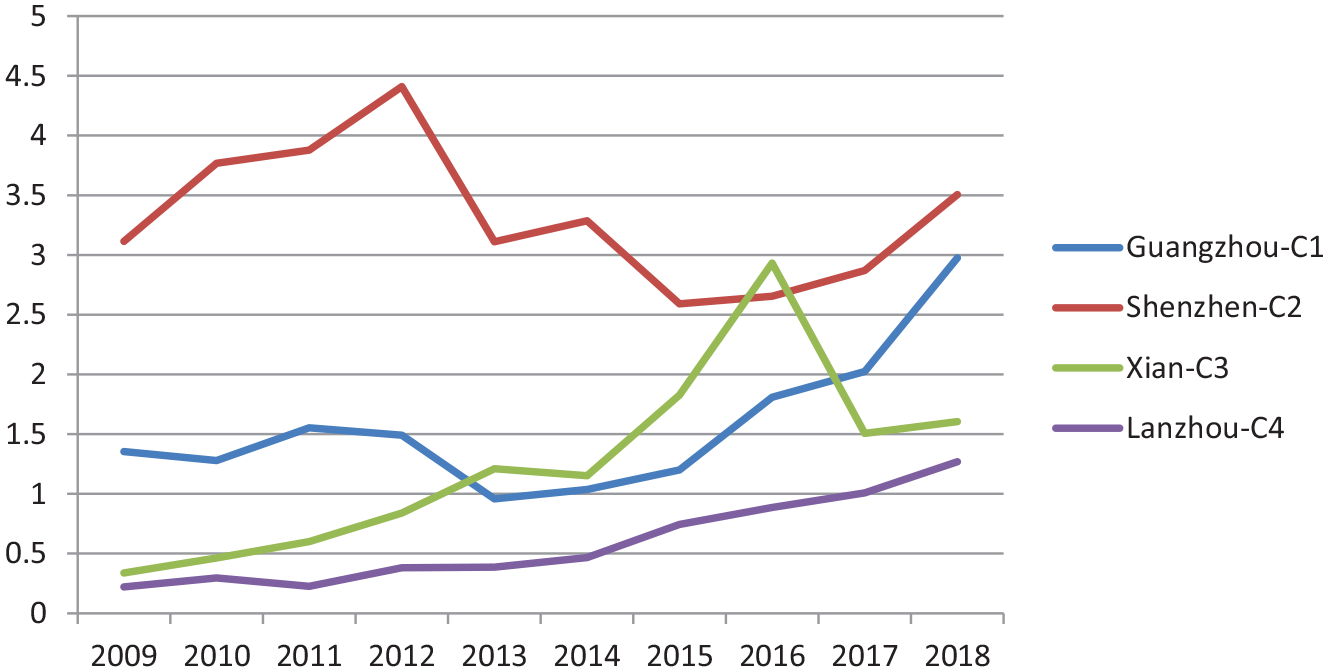
C of the four cities in 2009–2018.
According to Figure 10, after the implementation of BRI, C1, C2, C3 and C4 are converging in one direction year by year. For Shenzhen, the trend was significantly lower before the BRI was proposed in 2013. According to the field investigation of Shenzhen, the hard work of R&D personnel in Shenzhen has brought significant innovation output to the city, but has not improved their own living standards. At the same time of increasing living pressure year by year, in the face of fierce competition in science and technology, Shenzhen R&D personnel have shown fatigue. However, after the BRI was proposed in 2013, factor agglomeration has provided more innovative application scenarios. This kind of stimulation makes the growth rate of personal R&D efficiency in Shenzhen higher than that of living pressure. Shenzhen R&D personnel are becoming more active.
The coastal port city Guangzhou is similar to the inland port cities Xian and Lanzhou. C2, C3 and C4 all increased year by year. After the BRI was proposed in 2013, the growth rate of personal R&D efficiency in these cities is higher than that of living pressure, which proves that the opportunities brought by BRI to researchers are generally positive and sustainable stimulus.
There are both positive and negative effects of living pressure on individual innovation efficiency. As mentioned above, the higher the house price, the greater the pressure of life, and researchers will be more eager to engage in research projects with high economic returns to improve their income. This is a positive impact. But as in Shenzhen, the fierce competition among R&D personnel will make them all fall into a state of fatigue and then pull down the efficiency of innovation, which is a negative impact. However, in inland cities with relatively low living pressure and less fierce competition, such as Xian and Lanzhou, the overall economic environment is not as good as that in coastal areas, so they have little attraction for outstanding R&D personnel. Lack of high-quality talents, the R&D efficiency of these cities is not high. In this case, the low living pressure of inland cities has no significant positive impact on innovation efficiency.
Conclusion
As an international public product, BRI provides a new development cooperation platform for the regions along. Through the interconnection of infrastructure, it promotes the agglomeration of various production factors in the areas along the line (Wiig & Silver, 2019). This directly benefits the port cities, whether coastal ports or land ports. After the implementation of BRI, they have been obviously developed. However, to improve the developing quality, these cities need to stimulate local innovation activities through reasonable mechanisms.
This study constructs a system dynamics model based on the triple helix theory to reflect the interaction mechanism of factor concentration, innovation, and regional development in port cities. Four China’s port cities along the Belt and Road are then compared with their innovative development. The conclusion is as follows:
The implementation of BRI has obviously promoted the innovation activities of port cities along, thus realizing the sustainable development of regional economy. Compared with the coastal port city and the inland port city, under the premise of similar urban freight volume, the former achieves better economic development through innovative activities. One reason is that the development history of coastal port cities is longer and the foundation is better. The other reason is that coastal port cities can carry out trade and commodity transportation with more developed areas and then bring innovation and integration of knowledge. A considerable part of the trade objects of inland port cities come from the neighboring underdeveloped areas. On the contrary, the higher the proportion of industrial products in the freight volume, the more innovation output. If a port city concentrates too much on the trade and logistics of primary products, its stimulation to innovation activities is not obvious.
When the education level of R&D personnel in port cities is similar, their sensitivity to the income of innovation activities will be similar. Financial investment brought by BRI will have the same stimulating effect on local innovation activities. Whether it is coastal or inland ports, the gap is not large, as in Guangzhou and Xian. However, for the backward port cities with weak foundation, due to the poor overall attraction, the degree of talent concentration with market awareness is not high. R&D personnel are more willing to work in more stable organizations, such as universities and research institutes, even if they live in the local area. They pay more attention to engage in basic research that can gain more academic reputation, and their research results have less effect on local economic development.
The development of port cities has increased the cost of living in these areas. If there is no unique external stimulation, when the living pressure increases, the R&D personnel will show fatigue due to fierce competition, and the efficiency will gradually reduce. After BRI was put forward in 2013, factor concentration brought new market demand and innovative application scenarios, which greatly encouraged innovation enthusiasm of R&D personnel in port cities along the line. Although the cost of living in these cities is increasing year by year, R&D personnel can get higher returns through innovation. On the contrary, BRI makes the income growth of R&D personnel in inland cities higher than that of housing prices, and the living pressure is lower than that in coastal cities. But it did not attract more senior researchers. Due to the lack of outstanding research leaders, the innovation efficiency of inland areas is always lower than that of coastal areas.
In conclusion, the positive stimulus of BRI to innovation activities in coastal port cities is better than that in inland port cities in general. Top talents are not afraid of the increase of living cost, but enjoy the research and development convenience and competition fun brought by factor concentration. However, the living pressure of inland cities is relatively small, which can also attract some subexcellent talents to settle down, so as to ensure the local innovation and development to maintain a medium level.
If the decision makers of inland cities want to achieve the innovation output like the developed coastal areas, they need to revise the innovation incentive policies. They should encourage market-oriented research by universities and research institutes through in-depth cooperation with multinational companies and, at the same time, encourage universities and research institutes to provide more technical resources for local start-ups, so that researchers can participate in applied research with higher economic returns. In addition, it can raise the local house price within a reasonable range, increase the living pressure, stimulate the innovation enthusiasm of the existing R&D personnel, and attract the top talents to join in, so as to drive the innovation output of the whole region.
Footnotes
Declaration of Conflicting Interests
The author(s) declared no potential conflicts of interest with respect to the research, authorship, and/or publication of this article.
Funding
The author(s) disclosed receipt of the following financial support for the research, authorship, and/or publication of this article: This research is supported by Foundation of Ministry of Education of China (18YJC630018), Natural Science Foundation of Guangdong Province (2018A030313421), and Special Innovative Scientific Research Projects of Guangdong Education Department (2017WTSCX078).
