




Abstract
The mobility industry is experiencing an in-depth transformation looking for higher efficiency, and this evolution has relevant impact from the economic and social perspective. Nevertheless, technological and mobility trends involve uncertainty on users, policy makers, and businesses. Thus, the analysis of the technologies and their associated trends is relevant for enabling a general understanding of new features and social benefits that can shape the mobility trends toward a better experience. This paper intends to forecast and understand the impact of the new trends on general public through qualitative research deployed with experts from different European countries. It aims at clarifying the predisposition to adapt daily habits to adopt autonomous and connected vehicles, electrical motorizations and servitization. Those areas of deployment in the mobility industry represent relevant dilemmas in terms of social exchange. Businesses, technical and physical infrastructures, public services and regulations are among those areas highly affected by this evolution. Despite the reported advantages of those trends, those innovations will only be supported by specific groups of population and policy-makers unless they show similar benefits to traditional mobility means. Mobility-as-a-Services will be widespread in parallel with the improvement of the service offered, cost reduction, and geographical coverage.
Introduction
The mobility industry, especially inland transportation, is experiencing in-depth changes. After a decades of mobility supported by combustion engines and a mastery of personal versus collective mobility, the incoming trends reveal a conceptual evolution (Barr, 2018). The mobility, as we know it nowadays, affords economic and social benefits, but it has also problems with global warming and health because of pollution, traffic jams or social inequality (DBEIS, 2017). In fact, transport is responsible of 14% of global greenhouse emissions, reaching 25% to 27% in developed countries, with road transport as main emissary (Black et al., 2016; Greene & Parkhurst, 2017). And researchers are focusing on mitigating those problems through new mobility solutions, social behavioral change, autonomous vehicles, new regulations, and motorization alternatives (Becker et al., 2020; Liu et al., 2017; Whittle et al., 2019).
Indeed, the increasing awareness on the environmental benefits of sharing transports is contributing to changing the society’s mentality. European statistics suggest a change in the cultural landscape as the number of driving-license and car-ownership could reach their maximum and is starting to decline in several countries (Focas & Christidis, 2017). Although this phenomenon, called “Peak Car,” is still under analysis, it reveals a change on the utilization of mobility (Tilley & Houston, 2016;). Some researchers associate the Peak Car to the socio-economic situation such us family incomes, fuel price and high cost of utilization (Stapleton et al., 2017), while others attribute it to a change on internal combustion engine vehicles (ICEVs) dependency (Alaerts et al., 2019; Geels, 2018; Lyons, 2015). Both approaches show a different behavior between younger and older population; youngest generations demand an economical and versatile mobility service, while the older population still needs transport, but they have difficulties to manage their own vehicles (McCarthy, 2005). Thus, a series of mobility companies known as Mobility-as-a-Service (MaaS) are offering new services which some entrepreneurs and policymakers hope will be relevant for the changing nature of demand. But their recent irruption requires a clear demonstration, because its success in some segments in certain places and groups cannot be generalized. The early stages of technological development aggregate a great alternative concepts guide by investor interest (Roeth, 2021). Furthermore, its outbreak also influences different factors (infrastructure, regulation, traffic, safety, environmental pollution) and enlarges the traditional transport mobility scope, including new technologies and business (Clarke et al., 2010).
Servilization is positively supported by the implementation of Information Technology (IT) specially Internet of Things (IoT), Data Management and Big Data due to their features. IT enables connect vehicles, mobility agent, and population (King, 2014). Furthermore, IT can allow a more efficient shared mobility thought on Autonomous and Connected Vehicles (AVs; González-Zamar et al., 2020; Wadud et al., 2016). The information shown to population, encourages them to use different forms of mobility to arrive in the most efficient way. Different means (e.g., cycling, scooter, bus, train, car) combined in an intermodal way provide greater adaptability to the user than just the use of only one mobility mean (Epting, 2019).
These circumstances foster the mobility innovation toward AVs and other vehicles with alternative motorization to traditional ICEVs, favoring the commercialization of more sustainable, versatile and compatible means of mobility in line with MaaS (Whittle et al., 2019). The mobility is evolving toward more sustainable systems to fight against climate change, a trend that has its origin on societal demands. Phenomena such as Peak Car, MaaS or new engines are analyzed with the purpose of studying their impact on current and future mobility trends. Therefore, it is necessary to deepen on social-psychological issues to understand users as drivers or barriers to new trends’ success (Barr, 2018), making the social perspective essential in the analysis of innovations (Paddeu et al., 2020). Indeed, according with Social Exchange Theory (SET), habits modification required a quid pro quo between involved parties (Organ, 1988). Thus, the behavioral change requires a proactive support by enhancers (rewards) when the trust is not high, it implies initiating actions to include organizational bolster and commitment to motivate citizens (Riggle et al., 2009). For this social exchange, technical, and economic factors should be considered to favor a more sustainable transport, but also more affordable to substitute traditional mobility (Alaerts et al., 2019).
The objective of this research is exploring and analyzing the new social trends that can affect mobility (servitization, automation, electrification). Particularly, we have highlighted its main drivers and retarders. Thus, an exhaustive analysis of mobility trends will allow designing, planning, and preparing the infrastructure and regulation according to future behaviors (Rogers & Hunt, 2019). This study of trends allows understanding mobility demands and needs for the short-term from a social-exchange approach. When the trend is analyzed as the purposes of a long-term forecasting, it begins to assess the tendency of certain niches of population and research lines (GOfS, 2009). However, the fast evolution of technologies, particularly those related to AV, and their subsequent effects in potential services and business models, requires a wide analysis including multiple points of view. This is necessary to understand psycho-social changes of society related to MaaS, its evolution, and its relationship with sustainability. Thus, in order to identify these trends and understand the perspectives applicable, it has been qualitatively applied Multi-Level Perspective (MLP) to analyze, compare and discuss different approaches regarding the incoming mobility (Geels, 2011; Johnson, 2015), differentiating three levels in society depending on their predisposition to innovate: niches, regime and landscape (Geels & Schot, 2007). For this study three target groups are identified: intervention policies, government and technological development (Whittle et al., 2019). Those groups must be analyzed separately to gain different points of view. Afterward, the combinations of outcomes afford an extensive perspective of trends and more robust conclusions about these forecasts. Indeed, governance, as a participatory process may consider the perspectives of diverse users and other interested parties (Epting, 2019). Furthermore, in order to avoid self-restriction for certain niches, the technological development analysis must consider users’ accessibility, usability and functionality (Morgan et al., 2017).
The paper is structured as follows. Section 2 presents a review of existing studies in order to analyze the related literature. Section 3 details the MLP and how it is used on this paper. Section 4 analyzes the obtained data through the qualitative methodology with purpose to detail the new mobility trends. Finally, Section 5 presents a conclusion of the analyzed trends.
Theoretical Background
The investment in infrastructure, service, and technology related to mobility, was considered as a proxy of the progress in a certain area since centuries ago (Mackie et al., 2011). The governments must thus consider the role of mobility and technology due its capacity to influence in the economic and social development in a country. Accordingly, those investments are crucial to reduce production costs and foster GDP, increasing the opportunities and quality of life of citizens, especially in large cities (González-Zamar et al., 2020; Mishra, 2019).
Although the tendency is to increase conglomerations in business centers and productive areas, daily commute distances have generally been increasing (Mishra, 2019; Whittle et al., 2019). The everyday life (work and leisure) fosters the use of mobility systems, leading to the increasing of individual vehicles (IV) such as cars, particularly, due to their economic accessibility, among other advantages (Lucas, 2009). IV provided to the user the maximum flexibility in schedule, high selection of destinations, and route combinations with a moderate cost comparing with others mobility options. As a result, the geographical area where people carry out their activities has been growing, increasing the distance between working places, leisure areas and their residences (Metz, 2008; Toole-Holt et al., 2005). Despite this feeling of time saving, the time spent on transportation has increased at a rate of two minutes per year since 90’s (Toole-Holt et al., 2005). However, the citizenship feeling is the opposite, associating it with a higher freedom.
Those IV (e.g., cars and motorbikes) became a symbol not only of freedom, but a way of living and self-identity. Therefore, the ownership of IV used to be a symbol of social status and personal distinctiveness (Kanger & Schot, 2016). However, this consideration is evolving in a certain part of the population, considered a niche yet, where the concept of mobility is changing and there is already a detachment toward ownership (Lyons, 2015). This behavioral change is based in a cost-benefit exchange analysis, as users perceive a reward from their behavioral change. Simultaneously, the trust transmitted by the actors to the objective is a vital part of the decision-making process highlighted in the SET (Riggle et al., 2009). Thus, establishing a high-quality and mutual beneficial relationship becomes central to favor habits modifications (Cropanzano et al., 2017). In this regard, the implication of organization managers, governments, or social influencers will foster and engage the adoption of the new behavior on their subordinate’s levels or followers (Brown & Mitchell, 2010; Weaver et al., 2005). This holistic approach can generate a positive social to adopt the incoming trends (Cropanzano et al., 2017).
Simultaneously, the trends are cohabitating with a change on mentality suggesting an opportunity window for trends consolidation. The “millennial” and “Z” generations show signs of greater independence, and reject owning ICEV vehicles (Focas & Christidis, 2017). As a result, this sense of freedom led to the phenomenon of Peak Car (Tilley & Houston, 2016), that reveals not only a lower interest in driving and being in possession of a license, but also shows a change in mentality regarding mobility. Younger generations consider other mobility options such as walking, cycling, going by bus or other options instead the ownership (Athanasopoulou et al., 2019; UK Department for Transport, 2018; Whittle et al., 2019). Furthermore, the increasing awareness on climate change led population to consider more sustainable transportation systems. European Institutions are promoting and encouraging the use of collaborative and shared means of mobility in detriment of IV and encouraging a new regulation (Eckhardt et al., 2018; European Commission, 2018; Material Economics, 2018). In parallel, collaborative mobility promotion should be coupled by a financial support to business stakeholder (Jittrapirom et al., 2018; Riggle et al., 2009). The circular economy logic applied to mobility contributes to a better use of current resources, leveraging as maximum as possible their capacity while reducing vehicles to satisfy the same level of demand. There is also a need to increment re-utilization and lifetime of vehicles (Alaerts et al., 2019). The circular economy logic through car-sharing has improved the accessibility to mobility systems with lower cost (Alaerts et al., 2019). Indeed, its economic, accessibility and versatility of use turns it into the mobility system where purchasing power is less involved (Mayer et al., 2019).
Relying on the use of car-sharing fleets, less polluting propulsion systems began to be used on a large scale. The replacement of thermal fossil fuel engines with other more sustainable engines is basic to reducing the impact of mobility on climate change. Electric Vehicles (EV) and hydrogen vehicles possess higher environmental advantages than ICEVs (Globisch et al., 2019; Whittle et al., 2019). However, these technologies are still immature and present inconveniences such as the high cost of purchase, being inaccessible for most population (Globisch et al., 2019).
Therefore, it exists a wide variety of newly created solutions, sponsored by investors, but without a clear implementation, increasing the consumer’s uncertainty (Roeth, 2021). Private users thus intend to avoid purchasing new vehicles and they are starting to rent or using a collaborative mobility (Pütz et al., 2019). As the information of planned trips flows easily and quickly to others potential travelers, increasing the potential usage of a private transport and making it more accessible and creating an alternative to other potential users (Guyader & Piscicelli, 2019). The ownership culture is thus transforming the utilization of personal IV into a commercial usage (Marletto, 2019).
Methodology
The present research employs qualitative techniques because they allow investigating a great variety of social perspectives through inductive approach (Creswell, 2007) by integrating existing theory and expert opinions to foster the current knowledge in an innovative field (Olsen et al., 2004). This approach is necessary due to the limitations in current literature, the emerging nature of the technologies and the uncertain impact on citizens behavior. Particularly, the trend analysis follows the MLP methodology aiming at comparing alternative socio-psychological conducts and technological issues to better understand the mobility progress (Geels, 2011). MLP identifies three groups of population in the society based on their level of open mind on innovations and changes: niches, regime, and landscape (Geels & Schot, 2007). The identification of the perceptions shown by the population groups allows a better vision of the characteristics that the new mobility systems should have, and the social exchanges users must face (Rahimi et al., 2020).
Most innovations and complex changes emerge in the niches, meanwhile the regime uses dominant technologies and is integrated by the general population and institutions. The regime and the niches interact creating synergies and conflicts derivatives of opposite behavior to the principal innovations and changes (Geels & Schot, 2007). Modifications and innovations at the regime level require high investments, bureaucracy, and collaboration of the principal stakeholders of society. These requirements increase the stability but at the same time constrain and limit the opportunities that innovation brings. Nevertheless, at the niche level these requirements are lower due to a higher flexibility of actors and the lower investment required, opening an opportunity window to new business and services in mobility. Landscape represents barriers and drivers of the disruptive changes as macro-level trends, being affected by the environmental and economic framework along population and temporal horizon (Whittle et al., 2019).
With the purpose to analyze the landscape, the method developed is based on concepts from multiple sources to address the mentioned trends. The fundamental background of this methodology is the comprehensive theory review, complemented by the expert insights provided by interviews. Aiming at complementing, supporting, contrasting, and refuting the information, several interviews with experts in diver mobility levels are carried out. Nevertheless, as the qualitative methodology does not guarantee the reliability, validity, and generalizability of the results without a proper triangulation (Campbell & Fiske, 1959; Decrop, 1999; Denzin & Lincoln, 1994; King et al., 2009;
Zhang et al., 2013). The whole methodological process is explained next:
(a) First, theoretical review focused on the theoretical perspective of mobility as reflection in sections 1 and 2. The commercial terms constitute general nomenclatures that allow access to certain technologies or research flows. The keywords used are related to mobility innovation: “trends,” “service,” “vehicle sharing,” “development,” “innovation,” “new methods,” “technology,” “autonomous,” and “vehicles.” To increase the impact of the search, Boolean query has been used. As terminology used by the researchers is diverse, the following chain was used: “car” or “vehicle” or “transport” or “mobility.” The search string was combined with the previous keywords.
(b) Second, a group of experts from different countries was identified. Although their origin countries are located in Europe, the questions posed have worldwide focus. Those participant were selected following academic criteria and business experience at different levels of the mobility value chain, ensuring they had no relationship between them, and they represent different social situations to obtain a wide vision according to Triangulation Technique (Decrop, 1999; Denzin, 1970). Thus, the sample selection was judgmental, as all experts required to have a high experience on the field of research of the mobility industry. Selected participants can be seen as an “elite” and, thus, mobility perceptions are considered significant.
(c) Data collection and data analysis are developed in parallel to maximize findings. So, the conversation based on the script can include several nuances until achieving the saturation point, it means no additional insights are obtained from data (Johnson, 2015).
A total of 18 interviews were performed, an amount that offers wide variability in the points of view. The experts’ participation occurs between November 2019 and April 2020 (Table 1 shows the characteristics of the sample). All interviews were designed to obtain the maximum value, recorded and transcribed for a posterior detailed analysis (King et al., 2009). The recorded interviews, realized in person or by telephone, had a duration of 30 to 80 minutes. Subsequently, they transcribed verbatim for deeply analysis obtaining more than 130 pages and 55,000 words. The main topics guiding the interviews were:
What is the role and influence capacity of governments to promote mobility trends or technologies?
What is the relationship between the mobility companies and the social-political agents?
Will there be a total replacement of drivers by full autonomous vehicles?
How will the connectivity between infrastructure, vehicles and users affect mobility?
What motorization or power source will be predominant to achieve clean mobility?
What will mobility be like in the near future (10, 15, and 20 years)?
Characteristics of the Sample.

Note. aAs many companies are embedded in the new mobility value chain, start-ups or recently are created ventures to take advantage of the changes.
As Glaser and Strauss (2009) suggests, interviews have been made looking for the widest sectorial scope to encompass different points of view. It includes private and public sector actors in different European countries with relevant roles in current new mobility framework. The second European country in the automotive industry in number of units produced (Spain), one of the European leader countries in innovation and research (UK), and an emerging country in new automotive technologies (Portugal).
Analysis and Discussion of Findings
Toward MaaS? Psycho-Social Changes in Society
Since the financial economic crisis, many people returned to use collective and alternative transport; particularly, users have started using different mobility modals in short distances. Furthermore, UN and other organizations such as European Governments’ reflect the importance of innovation and eco-business industries, being remarked the importance of sharing mobility transports to maximize their percentage of utilization (Alaerts et al., 2019; European Commission, 2018; Mayer, et al., 2019). The combination of both trends suggests a change in particular niches of citizens for whom vehicle has not of identity as freedom, becoming only a tool to travel (Kanger & Schot, 2016). Indeed, this change in ownership benefits is associated with a change in habits, MaaS users intend to optimize the transport, adapting their activities to the mobility service (Hazée et al., 2017).
However, any change in habits requires efforts, and according to the interviewees, public will not change their mentality toward MaaS if they have to make important efforts in comparison to the expected rewards. Consequently, service providers, OEMs, and other stakeholders have not only to offer a product or service, but also making them more accessibility for users. Otherwise, the customer will be reluctant to change their habits as reflect the next quotation:
“OEMs not only can stay in selling the car, but also provide the service and offer modalities on how to give it.”
Instead of using their own resources, citizens can adopt mobility services. It involves leaving the comfort area and the adaptation of their life toward a new service model. But the extent of the necessary change will be core in this social exchange. The less the degree of change in habits to use a service, the greater the acceptance. Otherwise, it will be very restrictive and only useful for certain niches of population. An example of this situation is the extract mentioned below:
“I think that public transport will be used for what is strictly necessary [. . .] we will use the private car again for the daily routine in which we don’t have that problem.”
For this reason, it is imperative a study on people’s needs. The services must be conceived to cover general needs of the population. Surely, on demand services will be difficult to achieve, but if they cover most needs and, particularly those services provide more advantages that private media, MaaS will prevail because they provide a better use of scarce resources. This perspective of MaaS’ adoption to population is reflected in the following excerpt.
“If it has been studied the population’s flows the public services will better, and the population will start to let the private car at home because they don’t need it for their daily movements.”
Alaerts et al. (2019) defined mobility as an indicator on satisfactions of society’s needs, like housing, nutrition. . . These needs can be satisfied by products or services. Thus, it is very important the benefit perceived beyond the product offered. In concordance, interviewed experts have expressed their vision about the mobility purpose. For them, society seeks to reach their destination comfortably. Even though there are a wide number of aspects to be valued in decision-making, the degree of comfort offered by the transport’s choice will be one of most influential drivers on decision making.
“Climate change is important for me, but for the idea of social justice is fundamental. We should have a more efficient mobility. Why do people have to spend hours on a bus to travel 10 km?”
One of the major findings is that users do not seek to own vehicles, but rather own them to benefit from the possibility to use it. Therefore, as suggested in the following fragment, policy makers should strengthen vision of the service offered by the alternatives to mobility properties. Thus, the use of mobility services should be promoted rather than ownership. The change of habits should be reinforced by change of mentality.
“[. . .] we have to be ready because people don’t want vehicles, people want to use them. People do not want the property, people want the service that the vehicle gives them, people just want to use it.”
Sharing mobility platforms provide several benefits: economic, social and environmental (Guyader & Piscicelli, 2019). MaaS, as a sharing mobility, is based on the savings originated due the elimination of private vehicles, the maintenance, parking and others related expenses. Thus, Governments and main actors should promote the economic benefit of changing the social behavior and habits of mobility consumption toward MaaS, especially in regions where, after times of crisis, a large percentage of society lacks the economic capacity to continue the current model.
“People want to quickly use a car when they need it. It is a cultural change that is going to happen in society.”
Ideas reinforce by the variety and professionalization of services instead the own vehicle dependence (Münzel et al., 2017). The variety of mobility services allow users to choose the service that best suits the specific needs, eliminating the restrictions linked to the use of a unique vehicle. Thus, choosing a service over a property can have a long-term reinforcement related to making the right decisions. In recent years, the services have improved and the diversity of them let choose the most suitable and near for each user. Therefore, the use of resources is optimized, and may be different throughout the same day. At the same time, by using MaaS, the user can employ the service regardless of the place, city, or country.
“That, through an App, you could move in a city or between countries pay in a very comfortable way when you need. You have a car, a motorcycle, a bicycle in the palm of your hand. Where, when and how you want.”
However, MaaS’ advantages linked to diversity such as leasing for intensive use, to ridesharing for maximum savings, could be reduced to minimum or even being null if the availability of services is insufficient. The MaaS should be designed based on specific needs and the social accessibility. Therefore, the mobility services must have a general character, being economically accessible, and being available throughout the country with an elevated quality performance. To the contrary, the MaaS will be exclusive urban and could increase the rural exodus toward the cities, accentuating a problem, and social inequality. An example of this situation is the extract mentioned below:
“On the other hand, very poor people living in cities or in rural areas. I think this service is very expensive for them. This is the group that I think is really going to suffer. Because the traditional public transport service is going to be reduced due to shared transport services like Uber.”
Autonomous Vehicles: Connections and Interdependencies
AVs have the capacity to disrupt and change mobility (Shergold, 2019). AVs will allow mobility dependent sectors including minors (Fagnant & Kockelman, 2015), disabled and elderly (Shergold, 2019). In addition, AV usage will enable to develop other activities to the users instead the exclusive driving task (pleasure, talking, eating, and working). In this way, it would dilute the “muda” or squandering of resources (time and money) linked to transport (Ory et al., 2004). Therefore, this technology allows to reinforce the balance through a better experience. This time and cost savings during transport generate positive economic effect on companies in not value-added tasks, without conditioning its performance. The data management will allow optimizing infrastructure, routes, human, and financial resources.
“Data is important for citizens, cities and operators. With Big Data, Block Chain and AI, it can be predictively analyzed movements and create better infrastructure and move flows appropriately.”
In parallel, the emission, capture and management of data from AVs significantly increases road safety, while increasing the response of emergency services, reducing the consequences of incidents. Thus, safety advantages must be promoted to the futures users as a central value. AVs must be able to adapt to changes in the road (e.g., objects), being able to choose the best option to avoid risks and congestion, but also the predicting behaviors before they happen and give real-time preventive responses.
“It is necessary to digitize all the elements of the roads and infrastructures to inventory that existing objects in them and study the trajectory of the AV real-time. If an obstacle arises, it is detected by management SW based on real time image and AV consequently changes its behavior.”
However, the data generated must be properly treated in accordance with Data Protection Law (DPL) of each country. It becomes a very important point as data cannot be analyzed without a consensus, and the optimization and advantages linked to mobility information would be lost. On the other hand, this information will have a very important commercial value and, therefore, their trade should be regulated and secured against possible cyber-attacks. To secure data is essential otherwise potential users could appreciate risk of intrusion of privacy and refuse AVs. An example of interviewer’s misgivings about their security and cost are reflected below.
“We need to be very careful, in terms of what we collect and how we collect it, how we store it and it is a great concern to be sure that we comply with the DPL.”
It is also worth to mention certain disadvantages of automation. AVs may imply a displacement of transport professionals (bus drivers, trucks drivers, cabmen. . .), and their jobs could be lost. On the contrary, others task with a higher value-add will appear. Transport regulation should be adapted in order to be ready to new transport technology and not becoming a barrier to innovations development.
“If we reach a point where the vehicle is autonomous and is able to go to point A, to point B, from a factory and finally to a warehouse. There has to be a person who takes care of the stowage, everything. In the absence of a driver, another person will have to do it.”
Nevertheless, it is important that the change takes place in an orderly manner and allows professionals to be reconverted so that qualified positions are created (Pettigrew et al., 2018). Due to the magnitude of the investments necessary to adapt the infrastructure to the new technology and the change of vehicles, it will take a long period of time in which AVs technologies coexist with traditional vehicles. According with the experts, at the same time, the change must be progressive for companies to adapt to it.
“Autonomous mobility will make its way, step by step, starting on specific expressways, then all expressways, and finally cities [. . .] the problem is socio-political, rather than technological.”
However, OEMs, regulators and users will not be respectively willing to sell, allow their use and use them, until clarifying legal and moral issues. Currently, there is a gap in moral study, about how to act in case of tragic events, accidents, who is responsible. . . . Despite the efforts made by the authorities, their publications indicate recommendations for the law regulations and some ethical guidelines while they provide guidelines for designing, testing, and introducing AVs (US Department of Transportation, 2016, 2017). But they do not clarify or establish a clear criterion on the scope of legal responsibilities. This legal insecurity is expressed by experts. The scope of who is responsible in case of accident, infringement, maintenance and securing of cargo are some of the concerns that the experts reflect. The following extract show the lack of criterium of responsibility evidenced by experts:
“Imagine that an autonomous car has an accident. Whose fault is it? I didn’t drive. . . Do OEMs have to pay all the insurance on his cars? How long do you have to be the policyholders? Someone has to be responsible. . .”
There exist a series of ethical dilemmas that concern experts. Since several years it has been developing ethical theories of a philosophical nature, about the safety and decision-making linked of automation, robots, and similar. In the trolley problem, the driver of the trolley has to choose between kill five people or dead itself (Lin, 2015). There are different points of view regarding the right choice. Some authors indicated that the most ethical is to give the opportunity to the weakest and avoid causing maximum damage (Gogoll & Müller, 2017). However, others believe the different manner. OEMs prioritize the safety of their passengers over pedestrian or users of others mobility services like bicycles, motorbikes or scooters (Taylor, 2016). In order to try to combine positions, recently, the European Parliament, and US Government plans to prepare the future of transportation to AVs with the scope of advancing multi-modal safety and reducing policy uncertainty (European Parliament, 2016; US Department of Transportation, 2018). Nevertheless, experts point out that whatever would be the ethical and moral choice, it should be unique and equal for all countries. An ethical standard is required to avoid ethical and law inconveniences after crossing borders with AVs. Hereunder is reflected the doubts express by interviewed people:
“Automation can happen or not, it depends on the legal basis, it depends on the technology of the vehicles, policy and legislation.”
“You can have in the same country, 15 cities, each with its rules and that can be a total confusion.”
Sustainable Mobility and the Motorization Shift
ICEVs provided an affordable, agile, and economically acceptable prestige by most population. The actual system of mobility is based on the usage of private transports as motorbikes and cars. Although the increment on the usage of public mobility in developed countries, the status quo in mobility is defined as “automobility” (Whittle et al., 2019). Over the years, and thanks to technological advances on electric motorization, EVs are gaining performance and affordability. However, despite this progress, the limited battery range prevents the EV widespread (Globisch et al., 2019). Even though there are population groups that can satisfy most of their journeys with the range offered by electric cars, it will not be implemented globally until the increasing of batteries range and the higher presence of recharging points. The time and method of recharging is, indeed, the main concern. Users show a great unease for the duration of recharging process and accessibility of charging stations, being considered more relevant than the battery range (Turienzoet al., 2020). Interviewed experts point out that to be able to replace all ICEVs with EVs, the change has to be global. The electrical infrastructure has to be adapted to the new requirement and it should have enough capacity to supply energy to charging points on private and public locations.
“We estimate that, in about 5 years, 40% of cars will be electric [. . .] but it has to be a global change. Buildings must transform to be able to supply electricity or even stablish many “electric stations [. . .] and global electric system have to be ready.”
However, increasing the number of fast charging stations is extremely complex as it requires large investments. On the one hand, they must be close to high-capacity roads and inside cities, and, on the other, near electrical substations. At the same time, in order to be attractive, the usage price must be moderate compared to the current price of service stations for ICEVs. Currently the cost of an EV is much higher than that of an ICEV with similar performances. As long as this situation continues, the change will not be able to materialize as many people will not be able to attend the cost derived from the change.
“Today, if the electric car is installed there will be people who will not have a mobility solution in their pocket and then we will see a change very little by little.”
According with interviewed experts, there is not a single solution and combined technology and transports methods are necessary to correctly innovate. On one side, finding new efficient methods to recharge or swapping batteries at charging stations. Whatever is the solution, the recharging station must be next to the main infrastructures or recharge during the circulation itself on Electric Road Service. Nevertheless, electric vehicles can rely on so-called ecological engines that are being investigated such as hydrogen fuel, which is currently being investigated. Meanwhile, in order to develop an ecological mobility transition, other alternatives are being studied. On the one hand, combustion vehicles, that use more neutral fuels with the environment. Biofuel, with naturals origin has the inconvenience of the elevate cost and deforestation, as well as rising cost of food crops, for their replacement in favor of biofuels’ plantations (Roubík et al., 2016). Liquefied petroleum gas has as advantage their lower price, technology already developed and combined with the actuals ICEVs, it remains a fuel of fossil origin and therefore polluting. On the other hand, hydrogen vehicles offer a clean energy with low obtained cost, but hydrogen storage and distribution are resulting extremely complex and expensive (Morris et al., 2019). An example of these ideas is reflected on following extracts:
“There are a number of problems, if the batteries are larger, the vehicles may travel greater distances, but I think we are escaping to solve the problems. Particularly if we continue with the large fleet of vehicles that exist today. The resources to make these batteries, the recharging facilities are big problems. So, if there is a better solution as inductive load is a possibility, hydrogen energy is an alternative.”
“[. . .] a 100% electric car that has a small, very small gasoline, diesel, gas, or whatever engine, that in case the battery is reaching its limit, start and can generate enough current to continue running [. . .]. The problem is their exorbitant price.”
As interviewees show, there exist a high a variety of possible solutions to achieve sustainable mobility. But it brings uncertainty to market and potential users. Thus, due to the magnitude of the investment involved in changing vehicles, most buyers are postponing the purchase due to the insecurity about the new engines and the possible restrictions.
Conclusions and Implications
Theoretical Contributions
The theoretical review in combination with the experts’ insights through MLP are used as the main framework to discuss and contrast alternative psychological and socio-cultural behaviors and technological approaches related to mobility development trends (micro and macro; Geels, 2011; Turienzo et al., 2020a). Subsequently, combining the results from different points of view, and analyzing groups separately, it is possible to get a wide perspective of trends and their possibilities of widespread.
This research can reflect the beginning on certain niches of societal trend on the servitization literature; paying by services instead of acquire products (Focas & Christidis, 2017; Lyons, 2015), particularly in big cities. It currently affects the psycho-social perspectives of society on mobility. However, and according with Social Exchange, Theory, only those very specific segments of the society that understand the benefits in relation to the costs will adopt these trend, except that MaaS’ features and benefits exceed the ICEVs’ ones (Turienzo, Cabanelas, & Lampón Caride, 2020). In certain niches of citizens, the vehicle is not associated to freedom, and it is considered just as a mobility mean. In parallel, the evolution from property toward usage (MaaS), and the increasing offerings in this area, has helped modifying habits in citizens when the benefits of this options are higher than inconveniences. Consequently, this segment of population will expand its influence on the regime if the MaaS increase the users’ satisfaction in cities. Nevertheless, this evolution could be partial because of economic and geographic limitations. However, Governments, could influence on the landscape promote the expansion of the niche’s behavior to the regime and enhancing the value of MaaS of a multimodal travel option (Alyavina et al., 2020) and act as foster of change agents (Hirschhorn et al., 2020) and trust building.
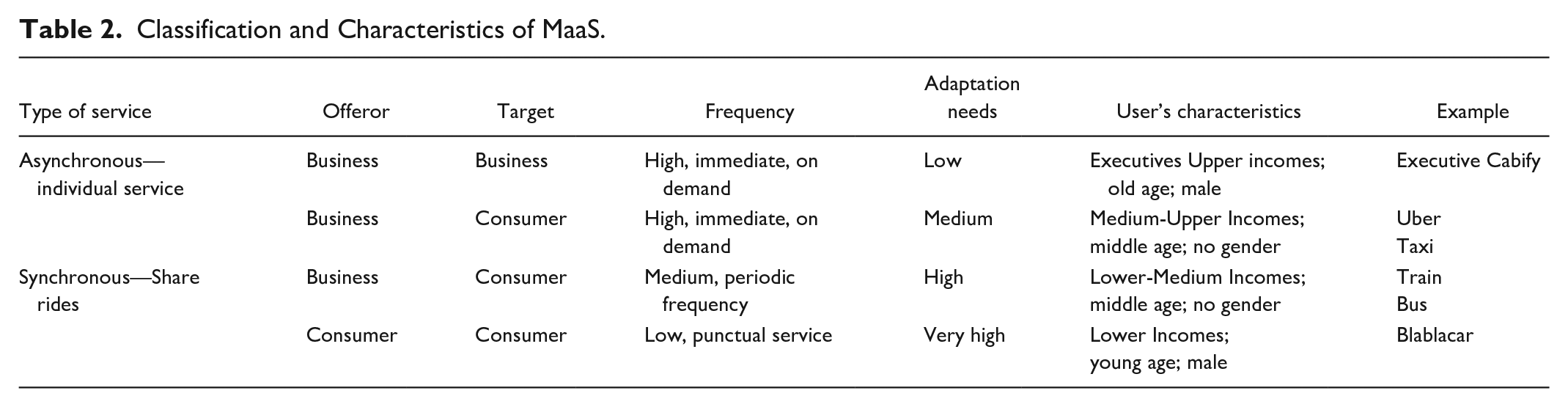
In accordance, based on the very specific characteristics of mobility, and the need for adaptation of potential users, a series of services are developed. Thus, by increasing the range of services, the reward obtained associated with the new mobility mode is greater depending on the effort required. Those services could be classified according to whether they are a shared or individual. On the other hand, regardless the type of service, they can be offered and used by companies or consumers. It includes the frequency, the socio-demographic characteristics of potential users, and some examples (see Table 2).
Classification and Characteristics of MaaS.
In addition, autonomous vehicles can enable the mobility to dependent population groups, for example, minors or elderly. Furthermore, AV will permit to realize concurrent activities instead driving, mitigating the “muda” or cost linked to transport and congestions. It will also gather great amount of data that could be used to managing and optimizing mobility resources, including vehicles, human resources, road infrastructure and public services. The OEM and business promote the total AV implementation due to its advantages. However, AV deployment depend on landscape to resolve legal and ethical inquiries. Policymakers must standardize the regulation concerning to new trends. Nevertheless, mobility actors must plan an organized transition between AVs and human driven ICEV to achieve a successful coexistence and the full implementation. In the course of this coexistence, Government must realize an extensive effort to update infrastructure and to prepare the population to new jobs.
Concerning the advances related to vehicle electrification, although EVs are becoming cheaper and gaining features, their limited battery range prevent and slow down the generalized adoption. Users reveal important concerns for the recharging batteries in terms of time, availability, location and pricing, even more important worries than the battery range. Thus, actor should solve this issue in order to rebalance the social implications. In parallel, expert remark an insufficient electrical infrastructure, and economic capacity, to support the EVs full implementation. As potential alternative, expert suggests implementing EVs supported by biofuels motorization or hydrogen powered systems. However, the extensive number of alternative technologies create high uncertainty to society and customers. It is needed clarify the value add of the emerging propositions (Merkert & Wong, 2020).
As mentioned above, the knowledge acquired of the main barriers and inconveniences that motivate the rejection of change, enables the design of mobility services and systems that minimize them. In addition, Governments must promote the mobility transformation, allowing the transition to the regime. It means supporting those trends through the reduction of the main socio-psychological barriers associated to public administration; it may and favors the cost-benefit balance for users (Riggle et al., 2009). Accordingly, the support of influencers, acting as leaders could set the overall tone of the population or organization (Brown & Mitchell, 2010).
Practical Implications
The trend of servitization reflected in literature depend on to the compulsion of users to adjust their habits, requiring a change of their behaviors. To obtain a larger usage of MaaS, business agents and Governments must plan services founded on very specific social needs and economic characteristic. Mobility services must be economically accessible and available throughout countries with an adequate quality standard to get a general character. On the contrary, the MaaS will be exclusive for urban and could increase the rural exodus toward cities, accentuating the social inequality and agglomeration problems.
The application of automation technologies to transport devices is used in controlled areas and with a strong presence in the industry. Its deployment was rejected by workers and, therefore, labor unions due to the perception of being a method of eliminate jobs, as occurs nowadays to AVs. Policymakers must regulate the AVs’ deployment with an ethical perspective. Those regulations may be enacted by governments and supranational organizations together with OEMs and academic institutions, which will be actors on the technical and ethical development and in the dissemination and training activities. Governments and institutions should work aligned with OEM, high-tech firms, freight, and service companies in order to develop, aid, and support a controlled change to AVs.
In line with the emerging demand to replace fossil fuel with electricity, the usage of EVs is linked to electrical infrastructure (e.g., availability of charging points or fast charging systems) and technological improvements. Governments and electricity companies, have to work hand in hand with principal manufacturing companies to study the viability of EV in all regions in terms of technology. Nevertheless, the social perspective should not be forgotten for EV. As certain niches of population have economic limitations for purchasing them, governments and OEMs together may develop policies to balance potential customer decision toward this motorization. That is, that those advantages associated to social and environmental values (e.g., lower pollution, renewable energy, etc.) can minimize those in terms of product (e.g., high price) and service (e.g., limited time use).
Limitations and Future Research
While the research interviewed are experts in the topic, and belong to different countries and have different background, there exist an inherent risk to obtain a different perspective from end-users. It is a limitation of qualitative research, as it let obtain a snapshot in a very specific period, with its consequent nuances. For this reason, and as the topic is in ongoing development, it is recommended to carry out an extension of this research to a longer sample, including representatives from general population. Therefore, it is very important to perform a study of attached opportunities of those trends and potential MaaS’ businesses.
On the other hand, it has been detected a lack on existing literature regarding the effect on present businesses and the incoming ones due the capabilities of AVs. Further research is necessary on this regard. Finally, from the expert’s insights it has been evidenced the need of an exhaustive analysis of the combination of electrical motorizations with other technologies.
Footnotes
Declaration of Conflicting Interests
The author(s) declared no potential conflicts of interest with respect to the research, authorship, and/or publication of this article.
Funding
The author(s) disclosed receipt of the following financial support for the research, authorship, and/or publication of this article: The research presented in this paper is developed in the lines of investigation of the research projects in which we are collaborating. Research projects are the European project called COST WISE-ACT (https://wise-act.eu/), the Spanish-Portuguese interregional project called MOBAE (https://mobae.eu/), and the national project funded by the Spanish Ministry of Science and Innovation under the reference: PID2020-116040RB-I00. International networks are GERPISA (http://gerpisa.org/en) and RSAI ( ).
).