




Abstract
Most current transportation systems around the world are cause for pressing concern and a menace to sustainability of social justice, and economic and environmental vitality. From a universal agreement that transportation needs an urgent alteration in travel modes, policies, planning, and behaviors through to the emergence of sustainability in the transportation sector, a significant and central vision has emerged to guide urban policymakers, transportation planners, and public health officials. During the last four decades, a shift in transportation modes toward use of active modes of transportation has been encouraged, and it is one of the main sustainability movements appearing in many developing and developed countries. This research provides a narrative review and parsing of existing literature, which focuses on promoting active modes of transportation. The aim is to clarify key determinative variables that must be considered by planners and policymakers toward promoting use of active modes of transportation for daily mobility.
Keywords
Introduction
In the last decades of the 19th century and throughout the 20th century, the industrial revolution, technological advances, and economic development have generated various environmental, social, and economic changes throughout the world. During this period, cities worldwide have acted as attraction centers serving as platforms for economic growth, social exchange, and scientific and technological developments (Bayramoğlu, 2012; Liang et al., 2013).
These conditions generated uncontrolled growth in urbanization, population, spatial expansion, and per capita income, which generally expressed negatively in environmental, social, cultural, and economic arenas globally (Davoodi & Dehghanmongabadi, 2015; Qureshi & Lu, 2007). Such that today more than 50% of the world’s population is living in urban settlements, and by 2050, this percentage will is projected to be over 70% (Liang et al., 2013; Ye et al., 2017). Citizens of the world must provide and support more sustainable planning to safeguard our planet from deterioration.
Nevertheless, governments across the world must acknowledge this shift and encourage policies and strategies with the intention of providing access to the environment and economic and social opportunities for all people. Because of increasing awareness of the interrelatedness of these arenas and increasing concerns about social justice, economic vitality, and environmental durability, the concept of sustainable development has emerged and become a significant and central vision of various disciplines (Dur & Yigitcanlar, 2015; Haghshenas & Vaziri, 2012; Yazid et al., 2011).
The definition of sustainable development is accepted globally as an approach that must pay attention to the environmental, economic, and social needs of present generations while also considering the ability of later generations to meet their own needs (Bayramoğlu, 2012; Dehghanmongabadi & Hoşkara, 2018; Haghshenas & Vaziri, 2012).
One of the most substantial urban challenges of our century is the transportation, and current transportation system immediately needs change in travel modes, strategies, planning, designing, and behaviors for declines of transport-related negative impacts (Babalik-Sutcliffe, 2013; Bayramoğlu, 2012; Grimes & Baker, 2020; Zhao et al., 2013).
In recent years, the concept of sustainable transportation has become a leading research topic around the world (Dehghanmongabadi et al., 2014). The application of sustainability measures in the transportation sector would help ameliorate its issues (Babalik-Sutcliffe, 2013; Bayramoğlu, 2012). Diverse movements and strategies to relieve compounding issues and enhance the level of sustainability in the transportation sector are surfacing in many countries. These strategies differ greatly from city to city and country to country relating to dissimilar travel patterns within specific social, political, economic, and cultural contexts (Gössling, 2013; Litman, 2007, 2017; Zuidgeest, 2005).
However, based on arguments provided by Shiau (2013), Litman (2016), Bayramoğlu (2012), and Gössling (2013), there are indispensable and universal aspects that can serve as foundations to planning movements and enhance levels of sustainability in the transportation sector. These aspects include (a) land-use, (b) use of clean energy, (c) shifting transportation modes, and (d) use of education and information technology (IT) systems.
Within these parameters, individual scholars emphasize on particular aspects to provide detailed tactics for moving toward sustainability in the transportation sector. Table 1 displays four overarching movements toward enhancing sustainability in the transportation sector. To achieve a successful and sustainable transportation system, these movements and related strategies must be considered and employed parallel to each other since each of them focuses on a different affective aspect.
Movements Toward Enhancing Level of Sustainability in Transportation Sector.

Source. Adopted from Hickman et al. (2013), Bayramoğlu (2012), Litman (2016), Shiau (2013), Gössling (2013), and Buehler and Pucher (2012).
This article focuses on the Active Transportation Move-ment for shifting transportation toward the combination of active modes of transportation. Many transportation planners and urban designers have placed substantial emphasis on promoting and supporting active modes of transportation for daily mobility because of its abundant advantages in balancing current and future environmental preservation, social qualities, economic improvement, and community health. Building on this, additional movements and their related strategies are identified to enhance the use of active modes of transportation and the sustainability of the transportation sector in urban settlements.
Accordingly, this article provides an extensive literature review to clarify the lack of consistency in research regarding the main determinative variables that must be considered by planners in the way of promoting use of active modes of transportation. Numerous research has attempted to address this gap but this research aims to provide a comprehensive set of main variables in a framework through a massive narrative literature review.
Material and Method
This research is a qualitative study; hence, the performance of a comprehensive and narrative literature review is primary to its methodology. The literature review is based on published journal articles (SCI and SSCI), books, published conference papers, reports, and published research works. The key search terms include both “sustainable transportation,” “sustainable mobility,” and “active transportation.” The search parameters also restricted the selected publications to the period of 1959 to 2020.
The references used in this research show the diversity of disciplines, which are addressing the urgency of promoting use of active modes of transportation for daily mobility. Including studies from different disciplines provides the opportunity to compare and contrast the opinions of scholars from different fields on the promotion of active modes of transportation. From the surveyed resources, 40 research papers from journals of various disciplines were selected based on their aims among a huge number of existing literature on the topic of this research for further review. This narrative literature review focuses on promoting use of active modes of transportation for daily mobility as a means of enhancing the level of sustainability in the transportation sector. In the following sections, explanations clarify the wide-ranging aspects of active modes of transportation, while the main determinative variables that must be considered by planners for promoting use of active transportation for daily mobility are revealed.
An Overview of the Active Transportation Movement
All travel related to walking, cycling, or the use of public transportation (PT) systems—because reaching a transit stop commonly involves walking or cycling—are defined as active transportation (Dehghanmongabadi & Hoşkara, 2018; Genter et al., 2008; James et al., 1999; Murray, 2001). Bassett et al. (2008), Genter et al. (2008), and Dehghanmongabadi and Hoşkara (2018) highlight that active modes of transportation work best when there are strong synergies and sufficient support between them (Figure 1).

Active modes of transportation.
Active transportation is based on walking and cycling as primary modes. Pooley et al. (2013) explain that walking is a simple mode of movement independent of any tools and it is the oldest mode of transportation and an inseparable part of human behavior. Active modes can fulfill leisure, health, or transit purposes and are suitable transportation modes across age, gender, and culture, providing mobility, exercise, and pleasure altogether. Pooley et al. (2013) express that short walking distances of 1 to 2 km inside urban areas are most suitable, except for individuals with physical limitations.
The propensity for walking in an urban community has a direct effect on the level of health and quality of life (Blecic et al., 2017; Klicnik & Dogra, 2019; Woodward & Wild, 2020). Although walking is the slowest transportation mode, this trait gives people the chance to spend more time in their environments, thereby increasing social interactions and cognitive awareness of their surroundings. Of the transportation modes, walking is the best means of enhancing interaction and cognition by providing enjoyable and real experiences. Besides, walking can serve as an environmentally friendly alternative to motorized travel inside urban settlements (Dehghanmongabadi & Hoşkara, 2018; Litman, 2003b; Millward et al., 2013).
The second most commonly used mode of active transportation is bicycling (Zhao et al., 2013). Because travel by bicycle is 3 times faster than walking, it can be a better choice for medium trip distance and affects users’ physical activity (Basu & Vasudevan, 2013; Grimes & Baker, 2020; Winters et al., 2010). Cantell (2012) stated that trips less than 5 km can be covered easily by bicycle. Many countries highly encourage this mode through the provision of bicycle accommodations since it has the most potential to be a replacement for motorized trips (Grimes & Baker, 2020; Xie et al., 2019). Many scholars, including Brand et al. (2014), Pucher et al. (2010a), and Rahul and Verma (2014), have stressed this point. Cycling is efficient for medium trip distance and a feeder and supporter mode of public transportation systems (Karanikola et al., 2018; Rastogi, 2011). As with walking, promotion of this mode of active transportation has a direct influence on health conditions among citizens and by reducing emissions related to motorized transportation the health of the environment is also improved (Rojas-Rueda et al., 2016; Xie et al., 2019; Zhao et al., 2013).
The characteristics and benefits of an active transportation network give it priority over the use of private automobiles (Cantell, 2012; Davoodi & Dehghanmongabadi, 2015; Kim et al., 2020; Rabl & De Nazelle, 2012). In the mid-1990s, active transportation appeared as a fundamentally interdisciplinary field amid transportation planning, public health, and urban design (Cantell, 2012; Killingsworth et al., 2003; Millward et al., 2013; Sallis et al., 2004). Active transportation has superior potential to substitute for automobile travel because of its capacity for direct, personalized access and individual timing. It can provide direct access to a great variety of destinations within a neighborhood over long distances at faster speeds because of its flexibility and accessibility (Dill, 2009; Killingsworth et al., 2003; Klicnik & Dogra, 2019; Rabl & De Nazelle, 2012). The World Health Organization (WHO) adds that trips of less than 5 km are appropriate for pedestrians and cyclists. In combination with public transportation, they support access to places outside this distance (Dehghanmongabadi & Hoşkara, 2018; Edwards & Tsouros, 2006).
As active modes of transportation combine regular activity with daily habits and transportation needs, they are the most popular form of physical activity. Encouragement of active transportation is the most feasible approach to increasing public fitness and health according to studies presented by Litman (2003b), Handy et al. (2002), and Bassett et al. (2008). The effects of active modes of transportation in protecting and enhancing public health are reinforced by the expansion of facilities for such physical activity while also decreasing motorized transportation’s negative issues like pollution (Genter et al., 2008; Rabl & De Nazelle, 2012; Saelens et al., 2003). Besides, Litman (2003b) pointed out that promoting use of active modes of transportation advances social equity for community members and increases economic opportunities inside urban neighborhoods by facilitating interactions with local industrial and retail stores.
Promoting use of active modes of transportation versus using private automobiles makes available a variety of benefits to the environment, societies, individuals, and businesses. Enhancing the level of people’s understanding of benefits related to active modes of transportation can be affected by people’s propensity to choose active modes of transportation in their daily mobility (Khan et al., 2020; Stappers et al., 2018). These benefits can be categorized into four clusters: environmental, economic, social, and health (Rojas-Rueda et al., 2016). Litman (2003b), Giles-Corti et al. (2010), and Shay et al. (2003) all indicate replacement of the many short automobile trips inside cities with active transport modes can reduce greenhouse gas (GHG), traffic congestion, air and noise pollution, the use of natural energy resources, and consumption of land. In combination with the social interactions and cognitive awareness mentioned above, when the number of trips by automobile is reduced, improvements to local amenities tend to occur. Together these shifts have compounding effects on the health of the environment and people based on the argument of Giles-Corti et al. (2010).
Switching to use of active modes of transportation in compeer to use of private automobiles can lead to significant and wider economic benefits of which several are enumerated by Lavin (2011). Active transportation can reduce health care costs, lessen expenses for new infrastructure and infrastructure improvements, and lower the costs and time wasted for users in comparison to car-based transport (Genter et al., 2008; Giles-Corti et al., 2010). Users of active modes also tend to contribute more to local businesses and economy since they linger longer, visit more shops, and spend more money overall in local shops (Kim et al., 2020; Lavin, 2011; Litman, 2003a). Furthermore, Giles-Corti et al. (2010), Lavin (2011), and Litman and Burwell (2006) reasoned that promoting active transportation develops the community’s economic viability by improving access to jobs and services.
Reducing traffic congestion, air and noise pollution, and GHG emissions via increases in active transportation can provide wider societal benefits (Litman, 2003b; Panter, 2010; Woodward & Wild, 2020). First, it contributes to environmental–social justice for those who do not have alternate means of mitigating the effects of pollution and GHGs in their day-to-day lives. Second, active modes of transport have a great potential to increase social equity, generate social interactions, foster social capital and a sense of place, and enhance levels of positive social norms (Giles-Corti et al., 2010; Panter, 2010). Third, community well-being, health status, the perception of safety, and level of accessibility and mobility for active users will be improved (Deakin, 2002; Giles-Corti et al., 2010; Litman, 2003b; Panter, 2010). Finally, active transport systems can make a community more livable through enhancements to the quality of the urban environment (Kim et al., 2020; Litman, 2003a; Tsai, 2014; Woodward & Wild, 2020).
Public health organizations around the world are alarmed at reductions in the level of physical activity in urban communities. Based on research prepared by Litman (2003c) and Reis et al. (2013) such reductions induce physical health problems. For this reason, authorities attempt to shift people from inactive travel modes by encouraging active transportation and introducing increased levels of physical activity into daily life (Genter et al., 2008; Glazener & Khreis, 2019; Litman, 2003a; Rabl & De Nazelle, 2012). Moreover, the research completed by Killingsworth et al. (2003) and De Nazelle et al. (2011) indicates increased usage of active transport modes within communities can lead to fewer injuries and deaths from road traffic. On the topic of physical health in relation to atmospheric conditions, less road traffic will decrease GHG emission and noise pollution causing related health benefits. Active transportation also contributes to improved mental health by raising the level of social interaction between people (Glazener & Khreis, 2019; Karanikola et al., 2018; Lavin, 2011; Litman, 2003a). Consistent with research presented by Cantell (2012), Garrard (2009), and De Nazelle et al. (2011), O’Hern and Oxley (2015) contend that promoting and utilizing active modes of transportation provide a greater opportunity to enhance levels of overall public health. Table 2 provides a list of benefits related to promoting use of active modes of transportation based on all arguments mentioned above.
Benefits Related to Promoting Use of Active Modes of Transportation.

Main Determinative Variables in Planning Process Toward Promoting Use of Active Modes of Transportation
Diverse variables influence whether authorities promote the use of active transportation modes. Consideration of these variables may enhance residents’ ability and preference to choose walking or cycling for short journeys in combination with public transportation modes for longer journeys (Gotschi & Mills, 2008; Klicnik & Dogra, 2019; Lavin, 2011). Table 3 lists the variables that are considered in 40 selected studies.
List of Selected Studies and Their Variables Associated With Promoting Use of Active Modes of Transportation.

IoT: internet of things.
The study of these variables reveals that promoting active modes of transportation is mostly related to either social or built environment aspects. Thus, the determinative variables can be categorized into two main groups: (a) variables related to social context, and (b) variables related to the built environment context.
The variables related to social context can be subdivided into two groups: (a) sociodemographic and socioeconomic variables, and (b) community attitude and belief variables. Burbidge and Goulias (2009); and Lavin (2011) claim sociodemographic and socioeconomic variables are significant variables that play an important role in the choice of active modes of transportation by citizens.
Age is one of the significant variables that have a very significant effect. Fishman et al. (2015), Giuliano and Dargay (2006), and Lavin (2011) observed that throughout studied communities, younger people (under 18 years) and older people (over 65 years) are more interested in using active modes of transportation. Thus, in the planning process of promoting active modes of transportation in urban neighborhoods, understanding the residents’ average age plays a very substantial role. This understanding helps policymakers and urban designers provide suitable policies and design solutions to increase the use of active modes of transportation by such population groups.
The second important and affective variable is the gender that plays a significant role. According to numerous studies completed around the world, it is argued that women are more interested in walking while men are likely to cycle (Adams, 2010; Fishman et al., 2015; Scheepers et al., 2013). Interestingly, women are more likely than men to take part in any active transportation regardless of mode (Adams, 2010).
Another notable sociodemographic variable is the level of education. Based on several studies, people with higher levels of education are more likely to use active modes of transport than those with lower levels of education (Burbidge & Goulias, 2009; Fishman et al., 2015; Lavin, 2011). Whereas the last sociodemographic variable, household type, relates whether a household has children or not to their transit mode, the sole socioeconomic variable says active transportation usage fluctuates with income level. First, households with children are more interested in using private automobiles, whereas households without children tend to be more active during their commutes (Adams, 2010; Cerin et al., 2009; Dieleman et al., 2002). Second, high-income levels have a direct positive correlation with automobile ownership and trip counts. Since communities with higher levels of income tend to live in more remote suburban areas, their trip counts will increase and their use of active transportation will decline (Adams, 2010; Cao et al., 2006; Feng, 2016).
By deduction, lower income households are more likely to use active modes of transportation. Variables related to community attitudes and beliefs include perspectives on travel, perceived appropriateness, and responses to past experiences of using any mode of travel. Community transportation attitudes and beliefs are more complex, difficult to observe, and considered latent variables, but Atasoy et al. (2013), Lavin (2011), and Hurtubia et al. (2010) consider them to have a significant influence on travel behavior. Because of their links to culture, lifestyle, and individual attitudes, these variables play an extremely important role in societies where citizens have choices of transportation modes (Buehler, 2011; Hurtubia et al., 2010; Lavin, 2011). Accordingly, Figure 2 reveals the determinative variables related to social context.
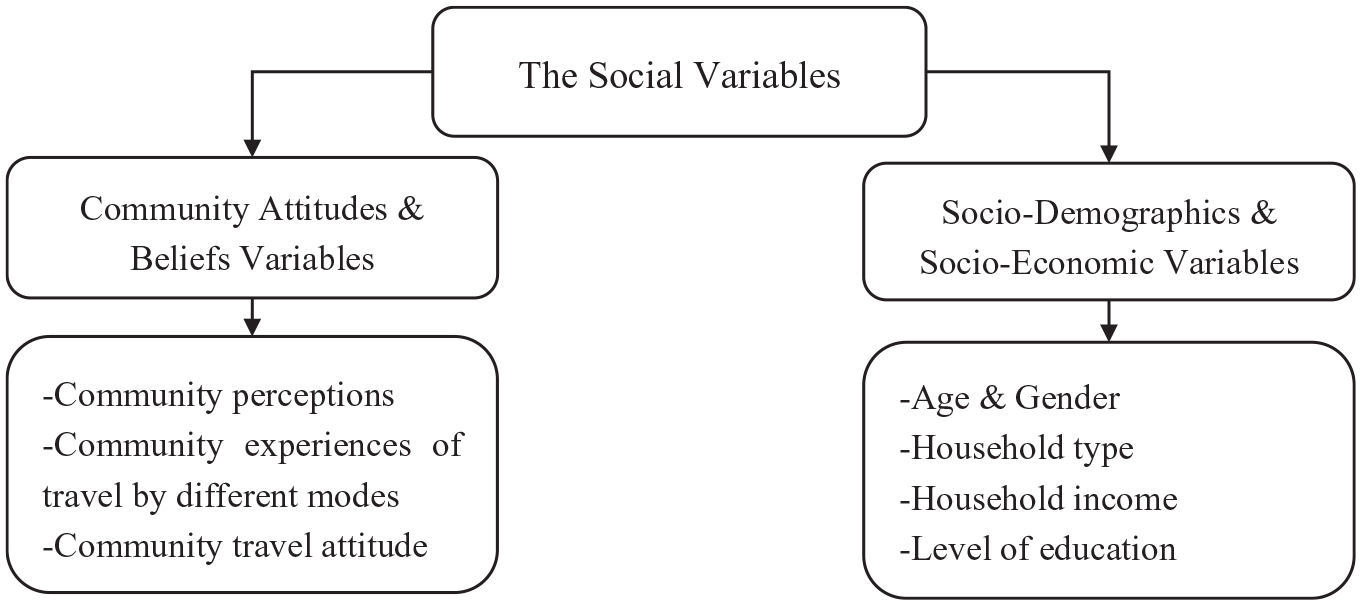
The main variables related to social context.
The built environment is defined as “all of the physical structures and elements of the human-made environment in which we live, work, travel, and play” (Frank & Engelke, 2005; Stappers et al., 2018). Figure 3 includes the main variables related to the built environment and the following sections sort them into two general categories: (a) variables related to land-use, and (b) variables related to community design.

The main determinative variables related to the built environment.
The main variables related to land-use include mixed land-use development, density and intensity of development, and proximity. Mixed land-use development refers to an area with a diversity of land-use functions (Barton, 2009; Cervero & Kockelman, 1997; Clark et al., 2013), such as homes, stores, and offices (Bassett et al., 2008; Cantell, 2012; Panter, 2010; Ye et al., 2017). There is no standard way of measuring the land-use mixture. For example, in a research study by Handy et al. (2002), the distance from each house in a neighborhood to the nearest shop is used for measuring the land-use mix. In another study, Cervero and Kockelman (1997) used a “dissimilarity index.” With this technique, an area is divided into a grid of cells, and for each cell, the number of neighboring cells with dissimilar land-uses is counted and assigned. Where cells have higher counts, the diversity is higher.
Density and intensity of development together indicate the rate of activity established in an area and perhaps is the easiest to measure of the indicators related to the built environment (Cervero & Kockelman, 1997; Handy et al., 2002). Typically, density and intensity are computed as people per acre, occupations per square mile, or building square footage per unit of the area in concern (Freeman et al., 2013; Owen et al., 2010). One of the popular methods of measuring density is floor–area ratio, wherein the floor space (the combined area of all stories) in a building and the size of the parcel that the building sits upon are calculated in proportion to each other (Handy et al., 2002).
The proximity variable is affected by a combination of density and diversity (Cantell, 2012; Frank & Engelke, 2005; Lavin, 2011). As such, proximity relates to both the distances between trip origins and destinations, whether they are close together or far apart (density) and distances between different land-uses such as residential and commercial areas (diversity) (Eva Leslie et al., 2007; Saelens et al., 2003; Sallis et al., 2004). Proximity is therefore correlated with more mixed and higher density areas that produce shorter distances between residential areas and destinations such as services, commercial areas, workplaces, and public transport stops (Frank & Engelke, 2005; Owen et al., 2007, 2010).
Of the selected studies in Table 3, determinative variables related to community design can be categorized into three main sets. The first variable related to community design is infrastructure and facilities. This variables, together with aesthetics, attractiveness, and quality of facilities, play an important role in encouraging people to use active modes of transportation based on studies done by Burbidge and Goulias (2009), Badland and Schofield (2005), Eva Leslie et al. (2005), Stappers et al. (2018), and Shay et al. (2003). At present, almost everything humans do is through the internet and some modern cities are using the internet of things (IoT) technologies for building an intelligent active transportation system (Brincat et al., 2019). Accordingly, IoT-based facilities relate to active modes of transportation are playing a substantial role in the future of sustainable mobility all around the world (Zhao et al., 2013).
The second variable is directly dependent on the first; accessibility includes journey duration; access to facilities related to transport modes; and access to destinations such as markets, houses, jobs, goods, and services (Freeman et al., 2013; Mavoa et al., 2012). As a dependent variable, accessibility monitors the performance of the land-use and transportation systems in a neighborhood or region and affects the quality of life in urban settlements (El-Geneidy & Levinson, 2006; Mavoa et al., 2012). Scholars developed the initial methods for measuring accessibility more than four decades ago. The place-based measure of accessibility looks at the spatial separation of individuals from activities. Another early method is the cumulative opportunity measure (Vickerman, 1974; Wachs & Kumagai, 1973). Other methods for measuring accessibility are utility-based measure, constraints-based measure, composite accessibility measure, and place rank measure (El-Geneidy & Levinson, 2006; Miller, 1999). In recent years, methods of measuring accessibility are more people-based (El-Geneidy & Levinson, 2006; Miller, 1999) and one of the most widely used methods for measuring accessibility is the gravity-based measure (El-Geneidy & Levinson, 2006; Hansen, 1959).
The third variable is the street design and includes street connectivity, street scale, and street pattern (Badland & Schofield, 2005; Handy et al., 2002; Killingsworth et al., 2003; Owen et al., 2010). A street connectivity indicator refers to an attempt to measure the number of routes and transportation options, and directness of transportation linkage among origins and destinations (Cantell, 2012; Frank & Engelke, 2005; Millward et al., 2013; Saelens et al., 2003). Handy (1996) chose to measure connectivity using the number of intersections per square mile, and Hess (1997) identified a method to measure connectivity by the ratio between the straight-line distance among two points and the distance along with the network between these points. The average block length is used as a technique to measure connectivity in planning practices.
The scale of the street is another tool to measure three-dimensional space along a street as restricted by buildings, trees, and walls that are generally described in terms of “human-scale” or “automobile-scale” (Ben-Joseph & Southworth, 1997; Handy et al., 2002). The scale of the street is measured as the ratio of building heights to street widths or by building setback—the average distance from the street to the building façade. The scale of the street is illustrated graphically in section rather than measured statistically (Hall, 2012; Handy et al., 2002; Jacobs, 1993).
Street pattern refers to design approaches or arrangement of streets and blocks (Forsyth et al., 2008; Pooley et al., 2013) and plays a very important role in attracting people to choose active transport modes. Enhancing street patterns and using suitable patterns can increase active living through transportation and can provide more direct and shorter paths to destinations (Killingsworth et al., 2003; Owen et al., 2010; Paydar & Said, 2012).
Discussion and Conclusion
The concept of sustainability emerged in the transportation sector as a vital approach to provide a serious balance between social equity, economic growth, and environmental integrity (Richardson, 2005; Song et al., 2013; Yazid et al., 2011). Working from this foundation, the concept of sustainable transportation emphasizes the fundamental need for change in existing transportation systems and the balance between transportation supply and demand (Liang et al., 2013; Song et al., 2013). This review of topical literature demonstrates there is a rising affirmation for and encouragement of active modes of transportation alongside the formulation of related strategies to address negative impacts of the transportation sector throughout the world (Black et al., 2002; Klicnik & Dogra, 2019; Qureshi & Lu, 2007).
Endorsing the use of active modes of transportation has emerged as one of the particular movements focused on encouraging travel related to walking, cycling, and the use of public transportation systems. This study reveals that the main determinative variables that must be considered by planners and decision-makers toward promoting use of active modes of transportation in communities can be categorized into two main groups (Figure 4).

Determinative variables related to social and built environment contexts that must be considered in planning process of promoting use of active modes of transportation.
Although the effects of variables related to the built environment are more quantitative and measurable than variables related to the social context, this research emphasizes that consideration of social characteristics is of utmost importance in the process of promoting use of active modes of transportation. Unfortunately, these variables are also not efficiently considered since they are latent variables. Therefore, exaggerated attention should be paid to social context variables despite the difficulty of measuring variables like community attitudes and beliefs. Regardless of the challenges, variables related to social contexts can give decision-makers very comprehensive knowledge of the social and behavioral characteristics of communities where a project is to be applied. Deeper understanding helps planners and designers confirm which strategies and approaches are appropriate within the context of their community, and which fulfill the transportation needs of all the residents.
Ultimately, determinative variables related to social psychology, behavioral economics, and transportation sciences must come together toward shaping travel behavior, transport policies and strategies, and design transport systems to encourage people to use active modes of transportation for their daily mobility. It is worth mentioning here that, within the choice-making and decision-making processes in transportation sciences, some current political and economic approaches may resist to social psychology and behavioral economics but instead may support “nudge theory” as a flexible change-management—Nobel economics prize-winning concept, introduced by Richard Thaler. Besides, the role of IoT and using smartphones in the process of planning and promoting use of active transportation must be considered seriously. These both can be a debatable and another researchable issue, which is kept out of the scope of this article, but reserved for future research.
Footnotes
Author Contributions
The research was designed by A.D. in collaboration with co-author. The first and final drafts were written by A.D. The defects of draft were critiqued and corrected by Ş.H.
Declaration of Conflicting Interests
The author(s) declared no potential conflicts of interest with respect to the research, authorship, and/or publication of this article.
Funding
The author(s) received no financial support for the research, authorship, and/or publication of this article.
