




Abstract
The purpose of this article is to analyze why work life representatives are engaging themselves in joint knowledge production with academia. We intend to deepen our understanding of how the practitioners’ trust in academia is constituted, that is what trust-building practices conditions their trust. The article is based on interviews with practitioners who are cooperating with a Swedish research center. The result indicates that practitioners’ trust in cooperation is based on a combination of different trust-building practices, among which the academy as a dependable supplier of objective and authoritative knowledge production is still important. At the same time, practitioners’ trust is also dependent on the existence of shared and integrated knowledge production relevant to their professions. The main conclusion of the study is that academia has to manage a set of different conditions demanding that different trust-building practices be combined and managed for trust to be maintained.
Introduction
When it comes to changes within academia during the past 20 years, the research done recurrently depicts an emerging landscape of universities that are trying to master an increased competition with others (Halffman & Leydesdorff, 2010; Orr, Jaeger, & Schwarzenberger, 2007; Zeichner, 2010). To stand strong in an increasing national and international competition, universities are developing clear market strategies and new modes of cooperation with companies, public authorities, and NGOs in surrounding society—that is, they are mobilizing both legitimacy and resources from external actors to strengthen and sometimes expand their ongoing work. This change is sometimes described in more general terms as New Public Management or Mode 2 initiatives (Gibbons et al., 1994; Munch & Baier, 2012; Nowotny, Scott, & Gibbons, 2001). The daily work of individual researchers then involves listening to what type of education and research society wishes academia to engage in. They are working in an emerging entrepreneurial academia (Guerrero & Urbano, 2010; Vorley & Nelles, 2011), which to a greater degree concerns gaining trust from companies, public authorities, or NGOs (Craig, Hess, Lindberg-McGinnis, & Gray, 2009; Grey, Sundstrom, Tornatzky, & McGowen, 2011; Oudhuis & Rolandsson, 2007).
Research dealing with this change often focuses on the challenges that emerge at a policy level. Studies concentrate on technology and natural sciences, and on how various governmental initiatives may raise growth by fostering universities to take part in so-called innovation systems that include businesses such as biomedicine, vehicle industry, or the telecom industry. A range of studies also investigate national and international differences in such innovation systems by using quantitative measures (Benner & Sörlin, 2007; Etzkowitz, 2008; Schubert, 2010). In addition, the effect on universities is often examined from the perspective of academia, depicting a rather straightforward development where academics cease being exclusive experts or authorities holding conventional academic knowledge and start being partners engaged in joint knowledge production (Gibbons et al., 1994; Nowotny et al., 2001; Rolandsson & Oudhuis, 2008). However, research also takes it for granted that the different external interests that become partners in this type of cooperation demand an increasingly instrumental or entrepreneurial knowledge production and rarely investigate how these interests actually perceive the changes and daily conditions that make their relationship with the researchers and academia durable.
The following article analyzes the daily cooperation between social science researchers and a broad spectrum of representatives of working life in a Swedish case. It is an ethnographic study focusing mainly on the external perception of the continuous creation of trust in the academy as an arena for cooperation and knowledge-sharing among various parties (managers, union representatives, representatives of municipalities, and others) that all have different knowledge interests. Just like in many other Western countries, this kind of shared and co-produced knowledge is perceived today as highly relevant within a Swedish context of higher education and research. The academy as well as working life is noticeably trying to find ways to encourage or achieve research that will play a more important part in the social and economic development (Gustavsen, 2003; HSS, 2001; HSV, 2004; Svensson et al., 2002). In line with both New Public Management and Mode 2 ideas, academics engaged in practice-oriented research are expected not only to enhance the quality and innovative content in the knowledge produced but also to underscore the usefulness of their research (cf. Gibbons et al., 1994). However, by encouraging this new and contextualized mode of research, academia may also emerge as an arena in which various knowledge interests will be demonstrated. Hence, academia may not only improve the problem-solving capabilities of research; problems may arise when engaging diverse participants that are asking themselves how being part of the arena will be of benefit to them. A problem with making these cooperative initiatives durable emerges and forces academia to legitimate itself in new and diverse ways that will keep up both participants’ interest in participating and the conditions enabling them to go on realizing joint knowledge production.
The purpose of this article is to analyze why work-life representatives, taking part in such an initiative, engage in this type of joint knowledge production. Hence, we intend to deepen our understanding as to how practitioners’ trust in academia is constituted through trust-building practices that condition their inclination to stick with the ongoing cooperative activities. Two questions have guided the analysis: Under what conditions do practitioners gain trust in cooperative knowledge production with the academy? In what way can academia maintain trust within this kind of shared knowledge production?
The article continues with a section in which we elaborate and describe the conceptual framework that has directed how the analysis has been conducted. The next section will depict the methodological considerations that have guided our collection of empirical material, which is then followed by the result section that describes how the practitioners perceived problems and reasons to be part of this type of cooperative knowledge production. The last two sections discuss implications of the results and the demands on trust-building practices that are traced in the article. The article ends with a concise conclusion.
Practitioners’ Trust in Academia as an Arena for Cooperation
Research often distinguishes between personal trust based on informal relations between, for example, family members or acquaintances, and organized trust in a social system based on formal or more institutionalized relations manifested in contracts, education, or formal criteria for how justice and expertise is achieved (Giddens, 1984; Luhmann, 1968/1979; Miztal, 1996). Trust in public organizations, such as universities, has traditionally depended on professional interests, norms, and standards (Brunsson & Sahlin-Andersson, 2000, 2005), implying the importance of system-based trust. Formal accountability to a political agenda or society is often said to be shouldered by professionals who are considered to be capable experts, working relatively autonomously, as parts of a wider collegial arena based on professional norms, certifications, and political recognition (Gibbons et al., 1994; cf. Mintzberg, 1983). At the moment, however, researchers in academia are increasingly facing demands on building professional trust on their ability to manage both competition between universities and on increasing interaction with regional industry. Academics are no longer able to rely only on the collegial guidance or control from equals; they are rather becoming involved in new forms of knowledge production—the so-called Mode 2—where the focus is on delivering defined expertise, solving problems, and the ability to meet the external demands articulated by diverse political groups, professions, companies, and associations (Etzkowitz, 2008; Gibbons et al., 1994; Nowotny et al., 2001; Slaughter & Leslie, 1997). This type of change has also been described as New Public Management reforms (Munch & Baier, 2012; Schubert, 2010) nurturing a move away from trust built on conventional academic expertise toward an academy building new types of trust on an arena for joint knowledge production where explorative research gives way to knowledge generation serving more instrumental purposes.
The type of negotiated trust depicted above also implies that a larger number of actors are included, and a durable cooperation would thereby also require that academia establish trust by balancing between different interests in influencing the joint production of knowledge. Regarding the trust concept and how it refers to these rather complex conditions in the article, we assume a broad definition by defining these external interests as subjects struggling to manage both their uncertainties and perceived profits from this type of inter-organizational knowledge production (Luhmann, 1968/1979; Nooteboom, 2002). Trust is seen as a resource that is used to reduce uncertainty and achieve coherence; it becomes the glue that enables the cooperation to last by reflecting how participants perceive their possibilities to both realize motives and knowledge interests and enhance a mutual and effective exchange of perspectives (Rolandsson & Oudhuis, 2008). These two aspects have to be combined but are not always compatible with each other; in other words, there is a potential trust problem present in joint knowledge production that participants must always take into account. They will have to find ways of generating knowledge in which both practitioners and researchers perceive each other’s contributions as important, and thereby continue to trust that their cooperation with each other will remain meaningful. In this study, we analyze the way these types of trust problems are managed in an ongoing cooperation between practitioners and researchers, as trust building practices, that is, as established modes of actions mutually constructed by involved actors (Bourdieu, 1990).
Trusting Knowledge Production Together With the Academic World
If we try to point out some trust-building practices that can be used to prevent a joint knowledge production from falling apart and, instead, enable durable procedures enhancing continuous generation of knowledge to progress, we can start by stressing that previous research find it far from obvious that the parties, researchers, and working life representatives have the same knowledge interest (Fuller, 2003). To begin with, previous research suggests that practitioners’ and researchers’ knowledge interests differ in the sense that researchers emphasize problem-oriented theoretical and generalizable knowledge, while practitioners are more interested in applicable knowledge provided for problem solving (Hartley & Benington, 2006; Nilsen, 2010b). Another way of conceptualizing this difference in knowledge interests is to point out that the trust-building practices that take shape will have to be sensitive to both learning and productivity logic (Ellström, Ekholm, & Ellström, 2003). A company director could be expected to consider the economic effect that collaboration with academia will have on production. They make use of result-oriented production logic by emphasizing a utilitarian and instrumental knowledge production. Researchers, on the other hand, are looking for latent interpretations that are not always meant to be put into action. Rather, they organize their knowledge production in the explorative way that is valid in an academic context. Hence, instead of achieving instrumental solutions, they often focus on problem-oriented knowledge, which to a larger extent has a value in itself.
This difference in practitioners’ and researchers’ knowledge interests could also be perceived as a precondition for trust-building practices aiming at encouraging confidence in a more reflective and academic approach to knowledge production (Nilsen, 2010b). There are studies that suggest that research-based knowledge can create conditions for practitioners to reflect on their daily work practice and thus stimulate them to broaden their horizons and make them think in new and different ways (Svensson, 2002). At the same time, the researchers would have to establish practices through which they may explain that this is the case. In fact, other studies show that getting practitioners to recognize the opportunities for them to integrate research-based theoretical knowledge with their own context- and situation-bound knowledge often becomes problematic (Ekebergh, 2001; Robertson Hörberg, 1997). A key feature in the building of trust in cooperation between working life and research thus seems to be stressing the importance of practices that point out how practitioners may apply and value research-related theoretical knowledge. This means that clarifying how they may perceive problem-oriented and theoretical knowledge as applicable and important enough becomes highly significant.
A fundamental requirement that we may also point out as important for building practitioners’ trust in joint knowledge production is the institutional respect for the academy as a dependable supplier of correct and reliable knowledge production. Previous research claim that it is these conditions that are changing at the moment (Nowotny et al., 2001), but as a trust-building practice, we may still expect researchers to have to manage expectations on them as experts, capable to act as an authoritative medium for a broader system of scientifically produced knowledge. Trust in the researcher will thus depend on more clearly conventional academic prerequisites than prescribed by Mode 2 ideas, and emerging trust building practices are then also expected to be shaped by considerations about expectations that are well institutionalized (Putnam, 2000; Rolandsson & Oudhuis, 2008). Trust will depend on practitioners’ confirmation of academia as an authority that offers systematically confirmed and theoretical knowledge. The researchers will then have to present themselves in a way that corresponds with the idea of researchers as educated, serious, and critical, but they will also have to express their scientific reasoning in a way that is understandable to practitioners (Nooteboom, 2002).
That kind of conventional academic approach, however, is, according to previous research, not always compatible with another critical aspect of trust in cooperation between working life and academia, based on whether the researchers are dialogue-oriented or not. Joint knowledge production is said to require extensive dialogues and negotiation, facilitating attempts to over-bridge the differences that exist in their various knowledge interests (Oudhuis & Rolandsson, 2007; Rolandsson & Oudhuis, 2008). Reminding us of Habermas (1981/1984), trust-building practices that encourage a lasting cooperation may therefore have to focus on establishing interference-free conversation. To trust each other, initiatives should aim at achieving a dialogue between practitioners and researchers characterized by respect, honesty, and transparency. Previous research has shown that closed networks provide good conditions for such trust, where openness and participation create opportunities for mutual understanding and learning (Nooteboom, 2002). However, during quite a long period, closed forms of collaboration may also create a lack of new perspectives, and a shortage of learning opportunities, and eventually also affect trust in any collaboration negatively. A resolving strategy could then be to supplement the closed network with more multiple and open relationships, maintaining conditions that encourage the creation of new knowledge through provision of new perspectives (Nooteboom, 2002; Putnam, 2000). By combining closed and open forms of collaboration, the involved actors can thus obtain trust, participation, and transparency, supplying each other with new modes of understanding.
Rather than summing up a general change, in which previous trust in conventional academic expertise simply is replaced by the search for instrumental and problem-solving knowledge, we may now suggest that a set of different trust-building practices could become crucial in the daily ongoing joint knowledge production. It becomes important to recognize that different and sometimes parallel trust-building practices may affect opportunities to stop joint knowledge production from falling apart. We have for example described practices enhancing (1) instrumental knowledge production, (2) the production of problem-oriented theoretical knowledge, (3) the reproduction of conventional academic expertise, and (4) dialogues over bridging different knowledge interests. These are all examples of practices that will be treated in the study as social actions reducing a range of uncertainties about cooperation with academia (Bourdieu, 1990; cf. Luhmann, 1968/1979). They enable the establishment of a more lasting cooperation between practitioners and academia. However, they consist of a different and not always compatible content, meaning that the respondents may have to struggle with the tension emerging between these practices. By recognizing the possibility that work-life representatives engaged in joint knowledge production can have expectations on rather complex combinations of trust-building practices, the current suggestion enables us to contribute with nuanced knowledge about trust problems and trust-building practices that emerge in today’s many cooperative initiatives with academia. Eventually, this will help us discuss a more fine-grained description of the often-claimed change away from a trustworthy conventional academic mode, toward the encouragement of a Mode 2 inspired and instrumental mode of academic knowledge production.
Method
The article is based on interviews with practitioners (representatives of working life) who at the time of the interviews were involved in a center called the Center for Work Science (CAV), which is a part of the University of Borås, Sweden. The center comprises 24 member organizations from working life that together with academia constitute an arena in which actors from working life, education, and research are expected to develop knowledge based on different experiences (Appelqvist & Oudhuis, 2002). They all pay a fee to be part of this collaboration, which according to the official manifesto should be an innovative force enhancing organizational change and creating attractive workplaces where the keywords are participation, empowerment, social sustainability, and learning. This is manifested in the form of seminars that are normally initiated by two lecturers, one by a researcher and another by a practitioner, who talk about their research and experiences of, for example, organizational development. Group discussions follow after the lectures, and eventually a joint discussion in a plenary session takes place. The themes of the seminars are decided by a program board with representatives from universities, companies, and other establishments. CAV also consists of three smaller networks characterized by similar arrangements, but in contrast to the seminars, they are limited to a small number of practitioners and researchers. It is stressed that participation in these networks are private under the banner “openness in closed association.” We may finally add that a course is offered to the member organizations each semester and that practitioners from these organizations are involved in conventional education at the university, both as guest lecturers and mentors.
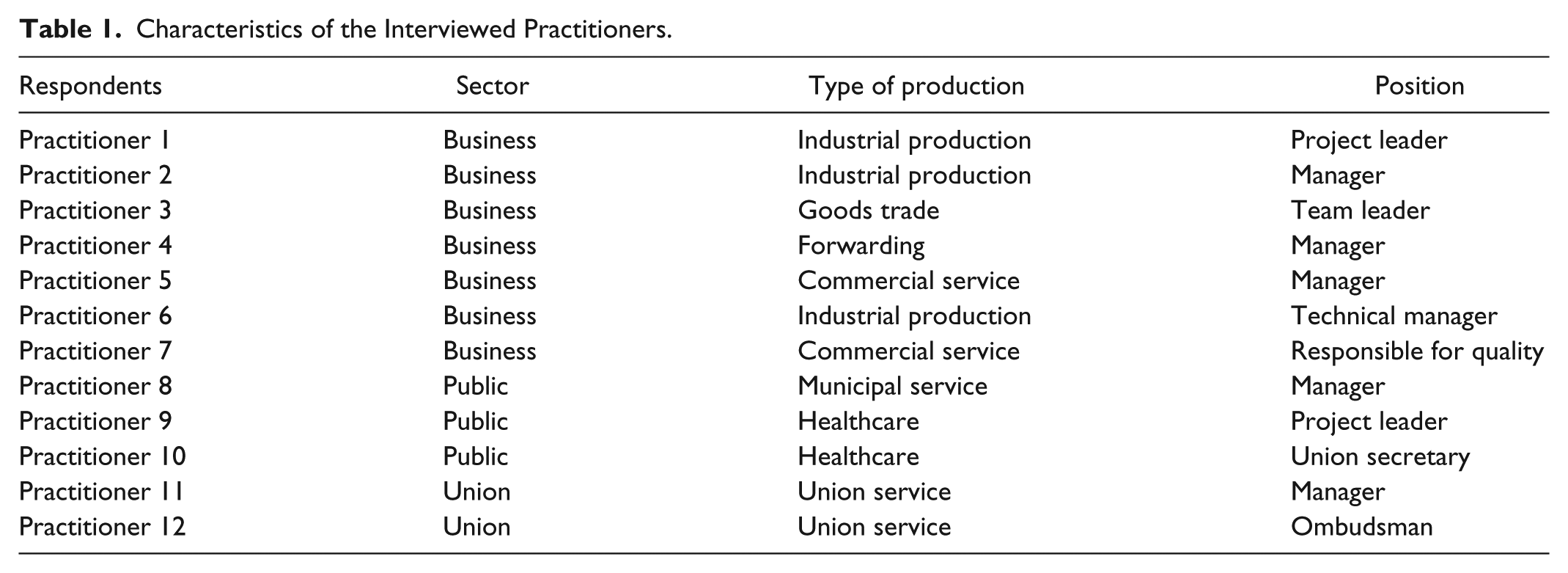
In the study, we have chosen to interview 12 practitioners representing organizations that are characterized by a set of knowledge interests. Table 1 shows that the respondents operate in different types of domains or production—7 of them are active in private business, 3 in the public sector, and 2 in the union. Furthermore, we may point out that 9 of them either have some kind of managerial or leading position in the firm they work for.
Characteristics of the Interviewed Practitioners.
Interviews with practitioners who represent a broad variation of interests support our explorative research approach. A variation of perspectives has continuously forced us to revise our understanding of the empirical material. In several cases, the interviews also took place at the university and hence allowed relaxed conversations in which practitioners could explore their own statements without any risk of cross-talk from the managers and colleagues. The interviews are semi-structured, which means that we followed some general themes but were also open to more dialogue-based information. The aim of the interviews was to obtain a better understanding of implications of different forms of cooperation for issues of trust and knowledge-building content. The fact that our interviews are limited to practitioners in the research center means that the conditions for empirical generalizations are limited. The theoretical tools used in combination with a variety of members located in the center nevertheless give possibilities for exploratory discussing organizational mechanisms affecting trust that is created between the parties in an interactive organized knowledge production.
The analysis of the empirical material was initially carried out as a descriptive analysis based on three themes. These were cooperation for personal development, cooperation for organizational development, and cooperation for the regional development. With this thematization as a starting point, we coded meaning-bearing units in the empiric material (Kvale, 1996). In correspondence with the process of the creation of our theoretical framework and specification of the aim of the article, we distinguished in a second step two alternative and theoretical based main themes that captured key aspects of the interviewed practitioners’ trust in the cooperation with the academy (Aspers, 2011). These themes were trust based on mutual exchange and trust and orientation of knowledge production. In addition, the analysis resulted in a further specification of these main trust themes in the shape of subthemes that further specified the core of each main theme. Regarding trust based on mutual exchange, the subthemes were exchange with the university and exchange between practitioners and, regarding the main theme trust and orientation of knowledge production, the subthemes were problem-oriented knowledge production and problem-solving knowledge production.
Interview quotes have been used to illustrate, concretize, and validate the analysis results. The quotations have to some extent been “stewed” for greater readability, with great care taken to avoid distorting their content and meaning. It should also be mentioned that the authors of this article have been involved in the center studied. To participate in the analyzed object is an advantage and a disadvantage in the research process. The trust built between the members of the cooperation and us as researchers has given us opportunities to understand implicit perspectives among the practitioners and generate further knowledge important for the analysis (Gustavsen, 2003). It has meant possibilities to address problems of relevance by caring for the research relationships with management personnel (Kvale, 1996). A disadvantage with authors who are too close to the case under study is, naturally, that researchers may end up neglecting different problems in the cooperation and overriding unpleasant criticism. During the interviews made for the study, this problem was addressed by alternating between questions about personal and general perceptions of their firms. It made it possible to avoid turning the interviews into polite and less informative conversations. Respondents could express criticism from different angles, enabling us to discuss the problems that could stop them from participating in the cooperation. The fact that one of the authors left the center while this study was being conducted also improved our opportunities to discuss whether critical information in the analysis were neglected or not and to continually test the interpretations of the interview material in a critical way. Critical discussions have also taken place during seminars where further researchers without connection to the center scrutinized our interpretations.
In the research process, we have been guided by ethical principles (HSFR, 1990). The informants’ consent has been obtained and the interview material treated according to the requirements of confidentiality. We have ensured that it is not possible to identify the informants in the results and that the interview material is only being used for research purposes. Everyone who was asked to participate in the study was informed that it was voluntary and that participation could be interrupted at any time. Printed interviews have been stored and processed anonymously.
Results
The empirical results of the study have been organized with the help of the themes that have been generated in connection with our coding of the data. If we look closer at the empirical results, we may start by repeating that our focus lies on how practitioners gain trust in cooperation with the academy. Our analysis shows that two themes were expressed when trust issues were discussed with the practitioners—namely, trust based on mutual exchange and the trust and orientation of knowledge production. The content of these themes are described in more detail below.
Trust Based on Mutual Exchange
Mutual exchange is the basis of the practitioners’ trust in the cooperation being studied. Key aspects of trust in this context are the practitioners’ exchange with the university and the practitioners’ exchange with one other.
Exchange with the university
The practitioners describe CAV as an arena that contributes to an improved interaction between university and business, something that strengthens their trust in the university. They emphasize that the cooperation provides conditions for a win-win situation. The member organizations can offer university internships and mentors, as well as provide empirical data for student- and research projects that may allow businesses to benefit from improved access to new ideas that make the organizations of the region more efficient and attractive. According to the practitioners, internships, mentoring, and business-related student projects will also ensure competence in the local labor market by making students more employable.
The availability of scientific knowledge is crucial to the practitioners’ trust in their collaboration with the university. Scientific knowledge has a trust-building function in that it is perceived as authoritative and reliable by most interviewees. As a consequence, the practitioners use research results to legitimize organizational changes. One of the interviewees expressed the following view: When you have access to this research, then I think it’s easier to make people understand that they should consider something because it’s actually that way.// And that is nothing that can be ignored. (Practitioner 3)
This quote illustrates how practitioners use research to legitimize organizational changes. They depict academia as an institution guaranteeing objective knowledge production, and in their roles as experts, researchers thereby also become authoritative mediums for the knowledge conveyed (cf. Fuller, 2003; Nowotny et al., 2001). Yet, it is important to point out that objective knowledge production is not a sufficient condition to maintain trust in the academy and in the researcher role. The data provide examples of circumstances that can put this aspect of trust at risk. Researchers who are unable to express research results in a comprehensible way and are poor at providing feedback are examples of this: It’s clear that researchers need to state things in the abstract, but sometimes I think they miss the point. I think most of the researchers I’ve been listening to could pursue their point of view much harder. Then they ought to be more specific in their feedback, it’s a way to really capture their audience’s interest, to really arouse an interest in what you’re talking about. In this respect, I think there have been some shortcomings. (Practitioner 6)
Another trust problem is that the respondents consider that, related to the exchange with the university, CAV is not sufficiently offensive in acting as a broker of human capital. This concerns, for example, the success of this partnership in finding areas of improvement for the member organizations. For this reason, an intensified interaction with the university is demanded to improve internal training courses and reduce absenteeism and staff turnover in the member organizations. Overcoming such problems by using the intellectual capital of the university is an important incentive for membership in CAV, an inexpensive alternative to ordinary consulting services in the market.
There are also practitioners who see the local business as the cause of the poor exchange with the university. The local businesses are considered not to be open-minded toward the university by not hiring graduates and not letting the students do their graduate work at the workplaces: I think the university has too little impact on the local business. If you look at the company I work for, only a handful of us have attended university.// I think this is a problem with the local business. There are a lot of small businesses and commerce and networking, so I do not think they hire graduates from college as much. They are not so prone to let university students in to do research or graduate work. (Practitioner 1)
We can conclude that the practitioners have the expectation of a reciprocal exchange with the university, where companies provide internships and mentors as well as empirical data of student work and research. This in turn ensures competence and access to new ideas for local businesses. Furthermore, we note that the practitioners’ exchange with the university is based on trust in the academy as a supplier of authoritative and at the same time comprehensible knowledge.
The exchange between practitioners
Trust in CAV is not just based on exchange with the university representatives; the exchange of experience among practitioners also seems to be very important. The role of the academy and CAV is in this context a relations broker, and the practitioners stress that the cooperation provides conditions for discussion with practitioners from other companies. One of the interviewees who work with HR issues says, for example, that one of the networks has provided her with a continuous learning through encounters with people with other skills than hers, skills related to production principles and quality: It’s a continuous learning process and I think that I dare to approach quality issues to a greater extent than before. Someone asked me a while ago “how come you as HR representative are so engaged in talking about modes of production?” I think you take the idea further if you are engaged in this type of network. (Practitioner 2)
In a corresponding manner, a union representative says that she learns new ways of thinking when she talks with employers with other values and views than she is used to within the union. One possible interpretation of these practitioners’ statements is that trust in the university as an arena is based on the possibilities to come into contact with practitioners with different skills, competencies, and values. These kinds of possibilities seem to be of great importance to the trust in the university as an arena for cooperation of the practitioners.
Trust and Orientation of Knowledge Production
If trust in CAV is to be obtained, the direction of knowledge formation must be in line with the practitioners’ knowledge interests and personal motives for participation. One of the most important knowledge interests is related to the development of the practitioners’ own organizations, but there are also expectations for personal growth. Central trust aspects in this context concern the issues of problem-oriented and problem-solving knowledge production.
Problem-oriented knowledge production
The practitioners’ trust in CAV, as an arena for problem-oriented knowledge production, seems to be good. The respondents argue that they have acquired a comprehension of different organizational phenomena, knowledge that seems to be difficult to define and articulate. One practitioner says that it is knowledge that is difficult to define, but it has been valuable in his daily work as a manager. The balance between homo- and heterogeneity is a key trust factor in problem-oriented knowledge building. The practitioners emphasize the importance of discussing organizational and leadership issues with people in similar positions. At the same time, they emphasize the importance of professional development through exchange with new people with experience from different organizations. Heterogeneity is perceived as inspiring and provides opportunities for reflection and learning. The respondent argues that this is accomplished through lectures followed by discussions in small groups and, finally, in plenary sessions with people from different companies.
At our company we liked the seminars. We also thought it was a good concept to have a discussion after the lectures where you have an opportunity to meet participants from other companies, and then finally a discussion in plenary. (Practitioner 3)
But at the same time, as plurality and heterogeneity are highlighted as key factors for problem-based knowledge building, some practitioners also express a fairly clear consensus orientation.
They emphasize that joint knowledge production requires a dialogue—that you are open-minded and really listen to the other person and thereby gain an understanding of his or her view. According to these respondents, trust in CAV as an arena for problem-oriented knowledge production requires heterogeneity and pluralism within the framework of a consensus-oriented dialogue.
The academic context that CAV is a part of is also an important basis for trust in the cooperation. Researchers are described as experts, and CAV is perceived as an arena in which practitioners and academics meet and develop through problematizing organizational issues: I look upon CAV as an arena where we meet and develop both as researchers and practitioners. I hope that the researchers feel the same way, that’s what they say at least. In this arena it’s possible to actually express these kinds of problems that we have in our organizations, but also to raise the problems to another level and problematize them. (Practitioner 2)
Other practitioners express a similar view: The academic arena that CAV acts on provides opportunities for problem-oriented knowledge production based on the practitioners’ self-perceived work-related problems. In this context, the respondents emphasize the academic knowledge and environment as a key driving force behind their involvement. For practitioners working in organizations with few academics, it may be exciting to participate in CAV.
I don’t know how many graduates are employed in my company at the moment, but we have had periods when there have been less than a handful of graduates. There are a lot of engineers, technicians and managers with no academic background whatsoever.// But that is perhaps also a reason to why it has been exciting to participate in CAV. (Practitioner 1)
The practitioners find it exciting to interact with researchers and other practitioners to problematize their own professional experiences based on research literature. In this context, it is important to emphasize that all practitioners do not express the same attitude, something that possibly indicates variations in conditions for trust. Some practitioners mainly problematize their own experiences of actively producing knowledge through discussions with others. An example of this approach is a practitioner who has made use of one of the networks as a sounding board with which it has been possible to discuss dilemmas related to her profession. Other practitioners problematize their own experiences mostly by listening to researchers and practitioners from different types of domains or production. The following quote gives an example of this kind of attitude.
You always learn something when you listen to people, whether it is a professor, an employer, or a union representative. They see things in different ways. But then it is important to understand why they see things differently. Maybe my own view is not always the right one. The way I look at things depends on my circumstances and my work life experiences. (Practitioner 11)
In this context, it is important to note that different approaches to problem-oriented knowledge production vary not only among individuals but also among different forms of cooperation within CAV. Compared with seminars with an open invitation, the respondents express that closed networks provide better conditions for participation and transparency, which in turn provide better opportunities for active knowledge production. This does not mean that the practitioners’ trust in the cooperation is solely based on closed networks. An important prerequisite for problem-oriented knowledge production is the supply of new information, and the interviewees express that the open seminars complement the closed networks through dissemination of new information. Thus, there is reason to believe that trust in CAV as an arena for problem-oriented knowledge production is based on open as well as closed forms of cooperation.
In summary, the practitioners’ trust in CAV seems to be high in terms of opportunities to problematize and to understand organizational issues and problems. Nevertheless, among the interviewees, we also find an ambition for cooperation to have an impact on their own businesses, which in turn requires that the practitioners believe that it is possible that some sort of problem-solving knowledge can emerge within their cooperation with the academic world.
Problem-solving knowledge production
The practitioners associate their trust in CAV with expectations on knowledge production, which they can take advantage of for professional purposes. As three-quarters of the interviewees are managers, the expectations on this kind of knowledge are often about how to develop or address problems within the organization, problems that are often highlighted by a management and an employer perspective. It is about knowledge that can be put into practice to deal with perceived problems related to organizational and leadership aspects.
The interviewees stress that the research may have a problem-solving function. They argue that research is reliable and therefore supportive in organizational changes. The fact that research is perceived as reliable also means, as previously discussed, that this form of knowledge can have a legitimizing function in organizational changes. The respondents also emphasize that the research provides a different angle on organizational phenomena compared with their own perspective. Research organizes the experience and serves as information that the practitioners feel that they can take advantage of in organizational change.
Not all participants of the study express such high trust in CAV as an arena for problem-solving knowledge production. Two managers criticize the direction of the cooperation. One of them thinks that it has been fruitful for some limited time to problematize organizational dilemmas based on personal experiences without a need for solutions and action plans. However, the absence of problem solving, combined with the repetition of discussion topics, is now stated as an argument to end the involvement in CAV. The second manager expressing criticism of the orientation demands stronger brokerage of human capital from the university, in the form of business-related student projects, to highlight for the management urgent problems of absenteeism and staff turnover. She regards this as a cheap alternative to ordinary consulting services in the market: Our company is not eager to spend too much money when it comes to consultants. We are interested to have an interaction with the university, to get their perspective on how we work with the sick, how we work with staff turnover. (Practitioner 5)
The practitioners also emphasize that problem-solving knowledge, which in fact makes an impact on the member organizations, requires a large number of employees and managers from each of the member companies to be involved. They emphasize that an active involvement in the cooperation from a large number of employees at their workplace will create good conditions for organizational impact by enabling discussions and reflections on current development projects in the workplace. One manager says that active participation in CAV’s activities by the staff at his workplace means that they are able to use their shared knowledge to strengthen and support each other in staff development issues: I work together with Mr/Mrs x and y who are also engaged in CAV. We strengthen and support each other in staff development issues with the aid of our shared knowledge that we have acquired through our participation in CAV. (Practitioner 8)
CAV is an arena not only for producing new knowledge but also for legitimizing communication. This can be regarded as another form of problem solving related to the practitioners’ organizations and professional practice. The aim of this kind of interaction is not to produce new knowledge but to justify and reinforce already established perceptions. One example is a personnel manager drawing on other practitioners with views regarding employees on sick leave consistent with her own. This is an example of how a discourse in which the employees’ individual responsibilities for their health can be established and reinforced by interaction at a micro level: There’s been so much fuss about this labor law. As employers we have such major responsibility for the employees, making it interesting to find out how others argue the other way around to get a give-and-take relationship with the employees. We have many young employees at work who are thinking—“Oh, have I been sick half the working time last year? I did not know. But I have such pain in my back.” “But what are you doing yourself not to get back pain?” No, they haven’t thought about that. (Practitioner 5)
Problem solving through legitimized communication of this kind can have a trust-building effect, if the other part is ideologically consistent and does not have expectations of new knowledge production. However, if the other part has expectations of new knowledge, there is reason to believe that legitimized communication rather affects trust in the cooperation in a negative way.
In summary, trust in CAV appears to vary with respect to opportunities for problem-solving knowledge production. Some practitioners think that content and orientation of the cooperation provide opportunities for problem solving, while others do not think that this is the case. Furthermore, it appears that the practitioners’ trust in the potential of this cooperation with academia as an arena, which may have an impact on its member organizations, requires a large number of people from each organization to be involved. Finally, the result gives an example of problem solving that is not about new knowledge production but rather about enhancing an already established idea by legitimized communication. This can have a trust-building function but only if interested parties are ideologically consistent and have the same knowledge interest.
Discussion
Previous research has often investigated the academic perspective on contemporary changes at universities, from being conventional centers of academic expertise toward being centers for entrepreneurial knowledge production, with greater emphasize on joint knowledge production together with business and other parts of working life (Etzkowitz, 2008; Munch & Baier, 2012; Slaughter & Leslie, 1997). The purpose of this article has been to analyze under what circumstances practitioners, taking part in such an initiative, perceive this type of joint knowledge production together with social science researchers as worthwhile to engage in. More precisely, our intention has been to deepen an understanding of how practitioners’ trust in academia is constituted and what are the trust-building practices that condition opportunities to avoid ongoing cooperation with researchers falling apart. Two questions have been guiding our analysis: Under which conditions do practitioners gain trust in cooperative knowledge production with the academy? In what way can academia maintain trust within this kind of shared knowledge production? The following analysis answers these questions by referring to a set of different and sometimes incompatible trust-building practices conditioning how practitioners gain trust in joint knowledge production, that academia as a consequence would have to recognize.
Table 2 concludes the central results of the article. The trust of practitioners in joint knowledge production with the academy seems to be related to five different types of trust, each linked to specific trust-building practices. First, there is reason to believe that an initial and fundamental prerequisite for practitioners’ trust in the cooperation with the researchers that is analyzed in this study is access to academic expertise through practices reproducing institutionalized modes of conventional academic knowledge. Academy is here perceived as a dependable supplier of objective and reliable knowledge production—that is, by referring to institutional trust in the academy, practitioners in the study are able to use research to legitimize, for example, organizational change. Trust is in this case related to the researcher as a conventional academic expert or medium for the knowledge conveyed (Fuller, 2003; Nowotny et al., 2001). However, this rather formal trust is at the same time associated with their experiences of different individual researchers—that is, they modify their reliance on institutional trust depending on their perception of individual researchers as serious, critical, and pedagogical (Nooteboom, 2002). The empirical data described above also provide examples of circumstances that may jeopardize this formal trust in the researcher role; for instance, when the respondents describe personal experiences of researchers that are perceived as intangible and less good at providing feedback. In accordance with previous research, personal experiences also seem to be important for personal engagement (Svensson, 2002). This appears to require practices of recognizing work-life representatives’ personal knowledge interests and motives for participation, which may be provided through problem-based joint knowledge production. A reasonable conclusion, based on these results, is that practitioners’ trust has to be built on conventional and institutional academic prerequisites on the one hand, and personal engagement and knowledge interests on the other (cf. Luhmann, 1968/1979).
Type of Trust and Trust Building Practices.
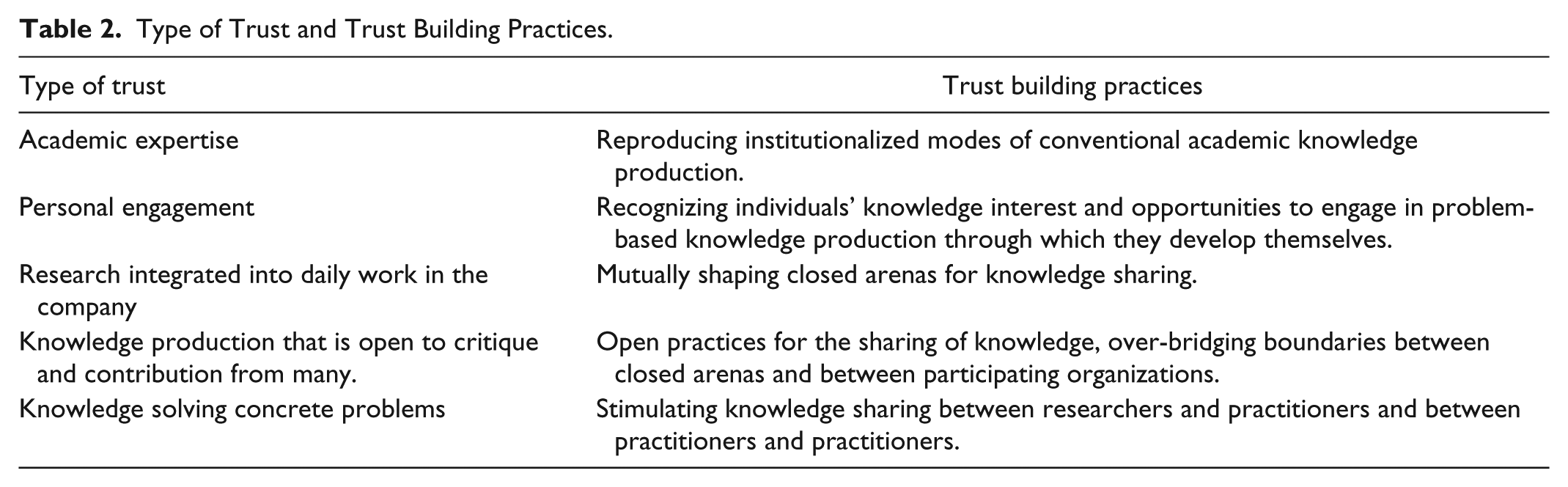
The practitioners in the study also have expectations on research-based knowledge that provide opportunities for knowledge production relevant to their professional practice in general, and in accordance with earlier studies, they indicate that it can be difficult to integrate research-based theoretical knowledge with context- and situation-bound knowledge in their daily work (Ekebergh, 2001; Robertson Hörberg, 1997; Svensson, 2002). Nevertheless, the respondents describe some of the central practices that may be used to integrate research in the daily work of the companies in which they operate. To begin with, knowledge integration of this kind is said to require a mutual exchange of experiences between practitioners and researchers that is perceived as meaningful (cf. Rolandsson & Oudhuis, 2008). The interviewees depict how this could be done with the help of small closed networks that provide opportunities for participation, trust, and transparency. This is said to enable active knowledge production where the practitioners can discuss issues related to their professional practice with researchers and other practitioners (Nooteboom, 2002). It enhances a kind of integrated and joint knowledge production that becomes meaningful through the establishment of a consensus-oriented dialogue, reminding us of the “interference-free conversation” discussed in Jürgen Habermas’ (1981/1984) theory of communicative action.
It can be pointed out that previous research has shown that, in the long run, closed forms of collaboration often create an absence of new perspectives and new information, that is, factors that are essential to joint knowledge production (cf. Miztal, 1996; Putnam, 2000). Cooperation between work-life representatives and researchers would then also run the risk of being perceived as less meaningful (Nooteboom, 2002). This could of course become a trust problem to the respondents in this study as well, if they only used small closed networks of researchers and practitioners to integrate research-based and work-context-bound knowledge interests. Thus, this gives rise to a potential tension. However, one strategy to overcome this problem that they also suggest is to supplement the closed network with more over-bridging and open relationships, which maintain conditions for generating new knowledge by adding new information and new perspectives (Oudhuis & Rolandsson, 2007). In line with these findings, the respondents of this study perceive open seminars to be a complement to closed networks. Open forms of cooperation create conditions for knowledge production that is open to critique and contributions from many over-bridging boundaries between closed arenas and between participating organizations. A reasonable conclusion is that trust in the academy as an arena for common knowledge building is strengthened by a combination of open and closed forms of cooperation.
Remaining trust complications that then have to be considered are that the practitioners claim that the knowledge that is generated in cooperation with these social scientists is problem-based rather than problem-solving. Contrary to practitioners’ interest in pragmatic solutions, previous research frequently suggest that research-based knowledge is often perceived as more problem-oriented (Hartley & Benington, 2006; Nilsen, 2010b) and, despite the fact that the practitioners seem to rely on formal trust in institutionalized academic expertise, there are indications that this may result in a lack of trust in this cooperation with the academy. Hence, potential tensions related to incompatible trust practices may emerge, forcing academia to manage the fact that the practitioners in the study ask for more solution-oriented knowledge. At the same time, it should be mentioned that they also recommend problem-oriented knowledge production based on a more academic understanding of various phenomena. Thus, the picture is not clear-cut, as the practitioners do not only demand a practice that enhances more efficient and solution-oriented knowledge (Ellström et al., 2003). A preliminary conclusion could be that the respondents try to balance between trust built on problem-oriented and problem-solving practices. They demand both these aspects to maintain their trust in their cooperation with the academy. It may also be added that the results indicate that trust in problem-oriented and cooperative problem-solving practices as approaches that actually makes an impact on the member organizations depends on the commitment of each organization. The respondents recurrently describe how the high involvement of managers and employees from all member organizations create opportunities for discussions and reflections regarding changes and dilemmas in their workplaces—that is, the trust that makes them inclined to continue collaborating with the university is related not only to exchange with academia but also to opportunities for interaction between practitioners. The presence of other practitioners provides a practitioner-oriented perspective in which conditions are given for discussions with and visits to other member organizations. Hence, the result shows that relationships established between practitioners may also strengthen conditions for sustaining a reflective and learning-oriented practice that includes researchers (Ellström et al., 2003; Rolandsson & Oudhuis, 2008).
Conclusion
Conclusions may now be drawn from the study’s empirical findings. To begin with, the practitioners’ trust in the analyzed cooperation depends on a combination of practices, implying that trust under these circumstances do not only rely on whether universities have the capacity to become a new problem-solving Mode 2 type of academia, which has often been stressed in previous research (Gibbons et al., 1994; Nowotny et al., 2001). The study rather suggests that a set of both conventional and new trust-building practices have to be managed by the academy to establish a cooperative knowledge production that will not easily fall apart. It has to be recognized that there are expectations on researchers to live up to the established image of what the academy stands for, that is, to practice objective knowledge production and expertise. In times when the political demand for changes toward a more pragmatic and entrepreneurial academia is increasing, maintained trust, which enables practitioners to stick with the academic research, still depends on institutional trust being based on conventional ideas of what academic expertise is supposed to offer (cf. Fuller, 2003). However, the study also suggests that this is not a sufficient condition for the practitioners to maintain their trust in cooperation with academia. The practitioners’ trust is dependent on the existence of shared and integrated knowledge production relevant to their daily work as well. They have expectations on forms of collaboration that make it possible to use research both in order to problematize and solve problems related to their profession. The respondents imply that there must be a balance between problem-oriented and problem-solving knowledge production, if trust is to be maintained (Svensson, 2002). This further confirms that it is important for academics that are establishing this type of cooperation to retain trust by both aligning their research practice with conventional ideas of academic expertise and considering strengthening trust by combining closed and open forms of exchange of knowledge among all participants. The exchange among practitioners may then also enhance the problem-solving approach of the cooperation and thereby strengthen conditions for achieving durable trust in the cooperation.
We may thereby conclude that this type of knowledge production demands a rather complex set of trust-building practices, and that these practices may not always be compatible with each other or with idea of a simple change toward a new instrumental and market-driven Mode 2 academia (Gibbons et al., 1994; Munch & Baier, 2012). The new demands on trust in knowledge production that we point at rather encourage academia to manage parallel practices and as a consequence potential tensions within the emerging arrangement of collaboration. An interesting future research topic would therefore be to look closer at specific tensions that such sets of trust-building practices may cause and how different sections of academia will manage them. By scrutinizing how academia combines entrepreneurial knowledge production and conventional academic expertise in practice, we would then also improve our understanding of how different academic actors contribute to these tensions. For instance, the increasing interest at universities in managing academic competition will offer them reasons to look on external relations as assets that strengthen their position in relation to other universities (Halffman & Leydesdorff, 2010). Rather than being problem-solving partnerships, researchers could then also start perceiving external collaborations primarily as competitive resources in their struggle for academic prestige and competitiveness. Such an instrumental approach to relations with surrounding organizations could obviously foster tensions that in the end also threaten their partners’ trust.
Footnotes
Declaration of Conflicting Interests
The author(s) declared no potential conflicts of interest with respect to the research, authorship, and/or publication of this article.
Funding
The author(s) received no financial support for the research and/or authorship of this article.