




Abstract
This paper investigates the characteristics of the indigenous linguistic landscape and the features of traditional visual language under the conceptual framework of Geo-semiotics, which has been generally overlooked in the literature. As a case study of the indigenous linguistic landscape situated in ancient waterfront towns of China, the ethnographic data was collected through a field-based survey for 3 months by recording hundreds of photographs of top-down and bottom-up signs, conducting semi-structured questionnaires, and in-depth interviews in the heritage precincts. The results show that the Chinese language firmly occupies a dominant position. The use of Chinese semiotic assemblages and historical linguistic objects including handwritten font, traditional Chinese characters, and calligraphic nameplates facilitate the nostalgia visual communication in the context of urbanization. In this light, this paper contributes to preserving the indigenous linguistic landscape and Chinese semiotic artifact in the sociolinguistics approach.
Keywords
Introduction
Since the 1970s, with the rapid growth of urban renewal worldwide, the use of multiple languages in public spaces has attracted the attention of several researchers who have studied the phenomenon of linguistic diversity. As a landmark study of “Linguistic Landscape,” Landry and Bourhis (1997) first defined the term as “The language of public road signs, advertising billboards, street names, place names, commercial signs and public signs on government buildings combines to form the linguistic landscape of a given territory, region or urban agglomeration” (Landry & Bourhis, 1997, p. 25).
Interestingly, many scholars who have different understandings of linguistic landscape. For example, Scollon and Scollon (2003) proposed the concept of “Geo-semiotics” as a new approach to study the physical appearance of signs and the meaning of “semiotic assemblages” in the material world. Ben-Rafael et al. (2006) considered linguistic landscape as“Linguistic objects that mark the public space.” Spolsky (2009) argued that “linguistic cityscape” may be more appropriate for labeling urban linguistic landscape. In addition, Jaworski and Thurlow (2010) proposed the notion of “semiotic landscape” which concerned with the construction of spatial discourse in the landscape “the interaction of language, visual discourse, spatial practice and social changes brought about by the trend of globalization in public space with visible inscription made through explicit human interaction and meaning making” (Jaworski & Thurlow, 2010, p.23).
As a new field in sociolinguistics in recent years, linguistic landscape research aims to focus on public signs and investigate various social actors from the perspective of social and cultural realities (Gorter, 2013; Shohamy, 2015). To date, a series of empirical studies have been conducted in major cities of the world today, which are collection points for researchers to collect, document, and classify language use in urban public spaces. For example, the book “Linguistic landscape in the city” written by Shohamy et al. (2010), not only opens a new and fascinating dimension for the readers to look at multilingualism in the urban context but also explain the interaction between verbal signs and social processes in metropolitan areas.
While most linguistic landscape researchers have studied public displays of multilingualism in the urban realm (Backhaus, 2007; Cook, 2013; Rong, 2018; Yao & Gruba, 2020), relatively few empirical studies have been conducted in small towns, suburban spaces or villages involving strong ethnographic and nostalgia orientations (Blommaert, 2013). In particular, less attention has been paid to the written displays of semiotic resources and visual analysis of linguistic minorities in primitive speech communities, which have been overlooked in the previous literature of linguistic landscape (Gorter, 2013). Notably, a growing number of studies have attempted to explore the linguistic landscapes of rural destinations, such as Xu and Ren (2015) who argued that the purity of minority languages is greatly influenced by the various foreign language influences brought about by the international tourism. Lu et al. (2020) discussed the code preference and language choice in Hongcun, China, highlighting the role of multilingualism in the world heritage. However, indigenous linguistic landscape associated with traditional visual language have not been studied and historical semiotic artifacts embedded in linguistic signs are rarely addressed which pose a specific need to examine.
It is estimated that by the end of 21st century, approximately more than 65% of indigenous languages are threatened with extinction due to accelerating trends of globalization and urbanization, which unconsciously affects the linguistic behaviors and attitudes of local language groups and ultimately alters the original language ecology (Cook, 2015, p. 14). Therefore, further linguistic landscape research should revolve around more applied themes such as language conversion and maintenance in certain geographical domains or the preservation and sustainability of indigenous languages as well as semiotic resources of historical heritage in order to fill the research gaps of previous studies and broaden the scope of empirical research on indigenous linguistic landscape (Edelman, 2014; Sheng & Buchanan, 2019; Song, 2020).
Therefore, this paper attempts to establish a spatio-temporal database of the indigenous linguistic landscapes of ancient waterfront towns, using a typical heritage precinct as an example. On the one hand, it aims to demonstrate the traditional visual language of indigenous linguistic landscape by examining linguistic signs in order to raise people’s attention and preserve the currently disappearing edges of the historical linguistic landscape. On the other hand, this paper emphasizes the visual analysis of Chinese symbols from the perspective of the “semiotic landscape” of heritage precinct to guide people in building a regional linguistic landscape that adheres to their own historical style and inherits local cultural identity .
The Theoretical Framework and Analytical Model
Geographical Semiotics Framework
Heavily grounded in Scollon and Scollon’s (2003) work “Discourse in place: Language in the material world,” which advocated the theoretical framework of “Geographical semiotics” refers to “the study of social meaning of the material placement of signs” (p. 110) sought to investigate the dynamic and dialogical relationship between discourse and space.
As shown in Figure 1, this framework conceptualizes a multi-analytical model based on major semiotic systems, including interaction order, visual semiotics, and place semiotics which tend to examine the dialogic interaction between textual and visual resources, spatial practices, and cultural dimensions. To recapitulate, the framework of “Geo-semiotics” is the study of the aggregation of semiotic systems that combine a range of linguistic, semiotic, artifactual, and historical resources with spatial configurations to facilitate the meaning-making process of discourse in time and space (Pennycook, 2017, p. 12). More precisely, the framework of “Geo-semiotics” is outlined as follows:
(1) Interaction order, the first component of “Geo-semiotic” borrowed by Scollon and Scollon (2003) from the theory of interaction order (Goffman, 1982) which serves as an analytical tools for examining signs related to the representational space by analyzing interpersonal distance between readers and text designers, units of interaction order covering social and cultural activities such as contact, encounter, procession, and others.
(2) Visual semiotics, the second part of “Geo-semiotic” inspired by visual grammar (Kress & van Leeuwen, 1996) which is summarized as “all of the ways in which pictures (signs, photos, graphics, paintings, and others) are generated structure meaning for visual interpretation” (Scollon & Scollon, 2003, p. 11). Moreover, it addresses a range of material aspects of visual language, such as inscription, code preference, and emplacement which are intrinsic to the interpretation of symbolic features of signs. In a sense, this semiotic system related to spatial presentation is concerned with how visual images represent real world activities and how the position of texts reflects the indication of the material world and how people react to images after the text is visualized.
(3) Place semiotics, the third semiotic system of “Geo-semiotics,” which refers to “the semiotic aggregate of spatial planning and cultural geography” (Scollon & Scollon, 2003, p. 8). Hall (2004) developed a sensory perception of space that considers visual, auditory, haptic, and other different sensory properties as bridges to perceive the physical environment by exploring the social interactions and language usage at micro-level. It is also include the typology of spaces involving public (frontage) or private (backstage), regulatory (official notice), commercial (display of goods) or transgressive (gambling) according to different spatial types of spaces helps to understand the meaning system of space organization.
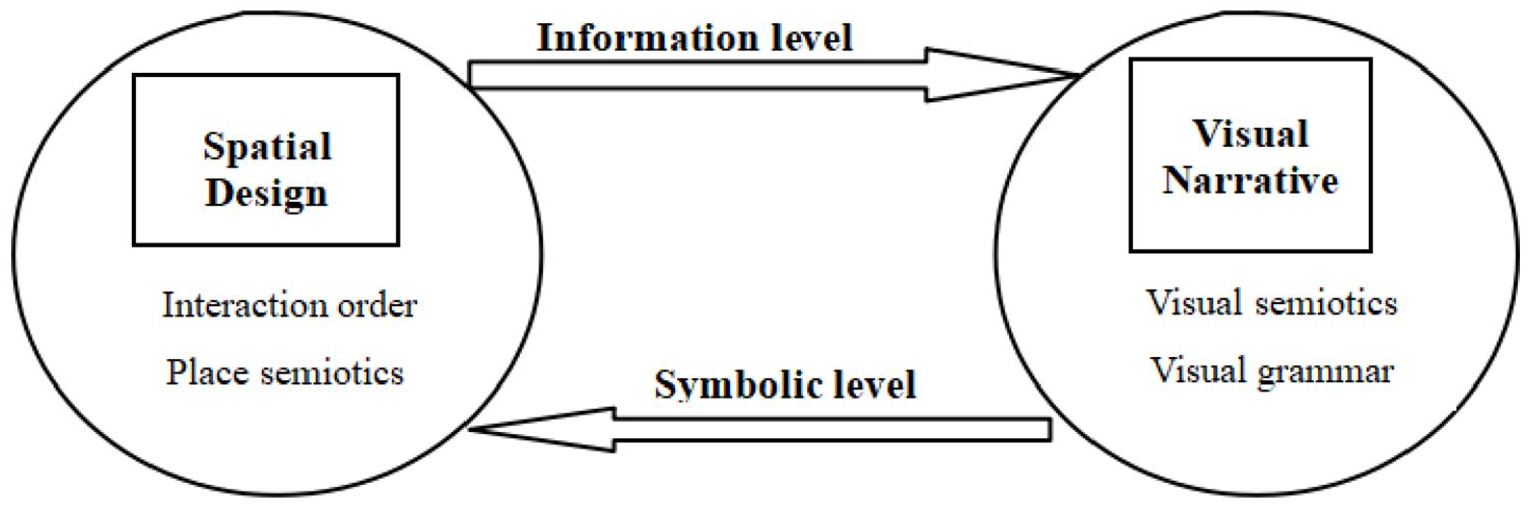
The framework of geo-semiotics.
To some extent, the “Geographical semiotics” framework for the study of discourse in the time and space consists of three main semiotic systems and other subsystems for analyzing the connotative and denotative meanings of signs in the material world, providing a more comprehensive and social semiotic analysis of empirical study of indigenous linguistic landscape .
Analytical Model of Visual Language
It is acknowledged that traditional Chinese symbols with profound content and long history have played an important role in Chinese visual culture practice (Hu et al., 2019). Arguably, with the help of diverse Chinese symbols in visual communication deign, it not only conveys the connotation of Chinese culture but also reflects the regional ideology (Li, 2015).
Guided by the inspirational “Geo-semiotics” framework, this paper also adopts a pragmatic model of visual language related to Chinese semiotic assemblages through a social semiotic and Chinese semiotic analysis of traditional Chinese cultural symbols in heritage precincts, with the aim of gaining insights into the meaning of cultural identity and social ideology in the indigenous linguistic landscape.
As shown in Figure 2, this model of visual language helps one understand the cultural significance of traditional Chinese visual language. To begin with, visual analysis constitutes an important part of meaning-making for signs and symbols from theory to practice by analyzing textures, colors, iconography, writings, and other material aspects of the subject matter. Then, as many practitioners of semiotics have stated “a sign is anything that symbolizes for something else” (Hoopes, 1991; Panofsky, 1983), thus the social semiotic analysis identified by Kress and van Leeuwen (1996) acts as an explanatory tool to interpret meaning of representational, interactive, and compositional behind visual language in the linguistic landscape.

Analytical model of visual language.
There is no doubt that the signification of Chinese symbols is meaningful and it conveys specific messages for Chinese people (Peng, 2013). As such, the multi-hub connection of TCVL (Traditional Chinese Visual Language) and Chinese semiotic analysis helps to understand the referential meaning of traditional Chinese symbols in the linguistic landscape based on theoretical lens of Saussure’s semiotics concepts and provides insights for practitioners to preserve cultural identity and traditional Chinese visual elements in the linguistic landscape in the context of globalization and modernization as Figure 3 shown.

Datong ancient waterfront town.
Methodology
Research Design
The method of data collection used in this paper combined the approach of quantitative-distributive with qualitative-descriptive. On the one hand, 158 photos of visual semiosis and textual signs were taken along with distributing more than 156 questionnaires to different groups of participants and conduct interviews during 3 months of fieldwork in situ. On the other hand, as Scollon and Scollon (2003) mentioned the framework of “Geo-semiotics” thus quantitative distributional method alone cannot explain meaning-making from the perspective of spatial and material. Therefore, the linguistic signs and ethnographic data were systematically coded in a Microsoft Excel spreadsheet and underwent descriptive statistical analysis (sampling, coding scheme) via modern instruments such as SPSS to get an in-depth analysis of the characteristics and features of the indigenous linguistic landscape.
Research Site
This paper attempts to interpret Chinese semiotic assemblages and traditional visual language of the indigenous linguistic landscape in the heritage precinct of Datong. It is an ancient waterfront town in the south of Yangtze River situated at Anhui province, which has been built for over 1000 years with a population of approximately 23,000 residents and occupies an area of 70.72 km2.
Historically, it has been known as the “Four Major Commercial Ports” since the Tang dynasty due to its geographical location and enjoyed the reputation of “Little Shanghai” at the end of Qing dynasty. Thus far, there are many precious historical relics and cultural heritage in the ancient town of Datong, it still preserves the traditional nostalgic style of linguistic landscape. Precisely speaking, the research site of Lanxi old street (heritage precinct) built in Yuan Dynasty as the central business hub of Datong ancient town and still maintains historical outlook, as shown in Figure 4.

Heritage precinct of Datong ancient town.
However, the increasing trend of globalization and modernization in China has threated to keep the original linguistic landscape, especially for the historical patterns of signs and traditional Chinese visual language in the ancient towns. Therefore, it is essential to conduct this empirical study to protect endangered language and semiotic resources in the heritage precinct.
Research Questions
(1) What are the characteristics and features of the top-down and bottom-up indigenous linguistic landscape in Datong ancient waterfront town?
(2) How do inhabitants and visitors respond to the status quo of the indigenous linguistic landscape in the heritage precinct against the background of globalization?
(3) How do sign holders (designers) respond to the preservation and protection of traditional visual language in an era of urbanization and modernization?
Research Procedures and Instrument
First of all, this paper aims to establish a Spatio-temporal corpus based on the number of 158 visible linguistic signs recorded by the camera during the fieldwork survey in the research site. In light of Ben-Rafael et al. (2006) and Backhaus (2007) standpoints about classification methodology of linguistic landscape, the 158 linguistic signs categorized into top-down (official signs regulated by the government) and bottom-up signs (commercial signs issued by the business owners or private institution). Additionally, the taxonomies method of “coding scheme” (Shohamy, 2012) further classify the data of linguistic signs into monolingual, bilingual, and multilingual signs according to the number of languages used in the signs and other variables, including the material of signs (wooden, stone, fabric, etc.) the script type of signs (traditional Chinese character, simplified character, etc.), and so forth.
Secondly, as Scollon and Scollon (2003) noted, the combination of place semiotics, interaction order, and visual semiotics help understand the meaning-marking process of semiotic assemblages such as code preference, emplacement embedded in the signs. Besides, the visual literacy of Chinese semiotic resources and spatial arrangement of traditional visual elements conveyed cultural identities and ideologies (Kress & Leeuwen, 2006, p. 25). Thus, it is essential to analyze the hidden issues such as cultural connotation, symbolism, and others of the visual language from the perspective of social semiotics in the heritage precincts.
Thirdly, the ethnographic data of this paper combined with an online in-depth interview with different groups of participants (government regulators, inhabitants, tourists, shop owners) and a semi-structured questionnaire survey (see Appendixes 1 and 2). There are approximately 159 questionnaires distributed in the research site to investigate the attitudes, satisfaction, and perception toward the status-quo of indigenous linguistic landscape and protection of historical linguistic landscape in Datong ancient waterfront town.
Last but not least, all the above data collected in situ were systematically coded in the Microsoft Excel spreadsheet to attain the statistic data of linguistic signs such as language dominance, language combinations, minority languages in the indigenous linguistic landscape. In addition to that, it will also undergo quantitative as well as qualitative analysis in Statistical Package for Social Science (SPPS) to gain the data of ethnographic vitality of heritage precincts.
Results and Discussion
Based on the taxonomies method of “coding scheme” (Shohamy, 2012), a total of 158 linguistic signs were categorized into different groups as shown in Table 1. Draw the support of the modern instrument of SPSS, these signs are counted and divided into top-down (official) and bottom-up (private) based on the attribute of signs.
Composition and Proportion of Language Signs.

As presented in Table 1, the number of bottom-up signs (N = 93, 58.9%) accounted for a large percentage than top-down signs (N = 65, 41.2%) in the heritage precinct. There are different variables of bottom-up (commercial) signs issued by the shop owners such as hotels (N = 25, 15.8%), grocery stores (N = 19, 12%), drug stores (N = 12, 7.6%) constitute the vast majority. In contrast, according to the data of SPSS that top-down signs consist of road signs (N = 24, 15.2%), introductory signboards (N = 13, 8.5%), public institutions signs (N = 12, 7.6%) which generally are issued by the local government. Therefore, the top-down and bottom-up of signs mapping the overall indigenous linguistic landscape of the heritage precinct.
Characteristics of the Top-Down Linguistic Landscape
In light of Ben-Rafael et al. (2006) and Backhaus (2007) standpoints about classification methodology of linguistic landscape, the data collected of top-down (official) signs put into Microsoft Excel spreadsheet categorized into monolingual, bilingual, and multilingual signs based on the number of languages on the sign as shown in Table 2.
Top-Down Linguistic Landscape in the Heritage Precinct.

As can be seen in Table 2, the total of 65 top-down signs are categorized into three types: monolingual (N = 42, 64.62%), bilingual (N = 15, 22.29%), and multilingual (N = 13, 13.09%) language signs in terms of different language choice. In particular, the prominent characteristic of top-down signs lies in multi script systems of the Chinese language consist of traditional, simplified Chinese characters and Pinyin (alphabetic scripts) despite other foreign languages. In addition to that, another noticeable characteristic is different varieties of linguistic patterns of language signs and the various combination of different languages in top-down linguistic signs as Table 2 shown.
Based on the above data, the monolingual linguistic units especially the simplified characters (44.62%) accounted for the largest proportion, which in line with the government and authorities’ requirements to accelerate the pace of standard Chinese characters in our society. Besides, the bilingual and multilingual signs comprise nearly 28.32%, which largely corresponds with the rapid trend of urbanization and modernization of this ancient town extensively influenced the preference of language choice in constructing international linguistic landscape for attracting foreign tourists.
Here are some examples of bilingual and multilingual modern signs shown as follows:
Based on the place semiotics of the “Geo-semiotic” framework, the rule of placement including the order of languages or the size of the print, helps us to know the language prominence and the ideology implied in bilingual and multilingual signs. For instance, Chinese characters have a high position in modern signs can be attributed to the rules “if two or more than two languages are in the same size, then that which is on the right or the top of the sign is the main language; if the size is different, the one which is the most conspicuous (biggest or most colorful), then is the prominent language on the sign.” (Scollon & Scollon, 2003, p. 23).
In general, the Chinese language occupies the upper position (top placement) in bilingual and multilingual signboards, “the preferred code is always on the top, on the left or in the center position of a sign” (Spolsky, 2009, p. 21). Interestingly, a visual hierarchy phenomenon exists in bilingual and multilingual signs since it’s impossible to assign both the same space and size of different languages, as shown in Figures 5 and 6. Thus, according to the code preference and preference system (Ben-Rafael & Ben-Rafael, 2015; Spolsky, 2009), Standard Chinese characters topped the visual hierarchy of top-down signs compared with other languages.

Chinese + Pinyin bilingual sign.

Chinese + Pinyin + Korean.
Though the Chinese characters are dominant in the top-down linguistic landscape, Pinyin (alphabetic scripts) also plays a vital role in top-down signs, regarded as a distinct nature of the top-down linguistic landscape in the heritage precinct compared with the top-down linguistic landscape in big cities of China.
Patterns of the Bottom-Up Linguistic Landscape
After collecting the data of bottom-up signs in the heritage precinct, most of these signs are issued by ancestral business owners and inherited by one generation after another. Draw the support of the instrument of Microsoft Excel spreadsheet and SPSS, the corpus database of bottom-up signs divided into several categories as Table 3 shown.
Patterns of Bottom-Up Linguistic Landscape.

As shown in Table 3, the general pattern of the bottom-up linguistic landscape consist of shopfront signboards (N = 42, 45.15%), outdoor signage (N = 22, 23.42%), and calligraphic plaque (N = 29, 31.43%), which carries distinctive historical features respectively.
Here are some typical examples of bottom-up linguistic objects in the heritage precinct which carries out the distinct nature of traditional visual language and Chinese semiotic assemblages. As Van Leeuwen (2011) holds that signs should endow a broader meaning, they could be any material object that refers to something else. Besides, the implementation of visual semiotics (Scollon & Scollon, 2003) helps explain stylistic features from the perspective of textual, visual, and contextual in different social and cultural circumstances.
As Figure 7 shows, the hand-painted traditional Chinese characters and the visual image (a duck) on a wooden board, viewed as historical shopfront signboards of the bottom-down linguistic landscape in the heritage precinct. “保國土鴨” (literally, Baoguo’s farmland duck), associated with the owner’s name “BaoGuo” and the product information “duck” which represents authentic Chinese semiotic assemblage of signs in the heritage precinct. However, “土鴨” (literally, native duck or farmland duck) as the local dialects and the visual image of the duck used in this signboard tend to transmit an appeal of cultural identity to visitors that this store has been selling native ducks for a long time. Notably, this old-style shopfront signboard refers to “Zhao Pai” (招牌, Nameplate), which has been not common in modern times. Thus, it should be protected and preserved in this town since the localized language and Chinese semiotic resources are disappearing and the number of original “Zhao Pai” is also declining.

“Zhao Pai” shopfront signboard.
Another case in point of historical object is “Zhao Huang” (literally, traditional Chinese commercial posters, billboards) as Figure 8 shown, which represents antique outdoor signage in heritage precinct. When it comes to “Zhao Huang” or “Huang zi” (招幌, 幌子) called in the past refers to advertising signs hang on long poles sticking out of the shop front, which is normally designed as the physical shape of flags or banners (Sheng & Buchanan, 2019, p. 12).

“Zhao Huang” outdoor signage.
In Figure 8, the slogan of this advertising sign expressed in traditional Chinese characters “老字號金方記” (literally, time-honored brand Fangji) which sent a clear message for the viewers that Fang’s store is established for many years in history and respected as a time-honored brand in this place. Here, it is interesting that the character “金” (literally, golden) is not mean the sign is golden but indicate that the store enjoys high reputation and gained the precious title of time-honored. Meanwhile, the design of this sign takes the advantage of semiotic resources in terms of visual and cultural connotations (Kress & Leeuwen, 2006).
Further, the most impressive pattern of the bottom-up linguistic landscape in this heritage precinct is calligraphic nameplate (匾额), as Figure 9 shown. According to Shang and Guo (2017), they stated that “nameplate is a distinctive cultural symbol in China, it is a comprehensive artistic work that integrates the Chinese language, Chinese character calligraphy as well as Chinese traditional architecture and sculpture.”

“Bian E” calligraphic plaque.
It is found that the calligraphic plaque of Lanxi old Street possesses five major Chinese writing scripts, namely seal character, official script, regular script, running script, and the cursive script appeared in different physical signboards. As Figure 9 shown, it is also a valuable artistic, historical relic, and antique written by the famous calligrapher “佘飈 She Biao,” thus it delivers a strong sense of cultural atmosphere in the heritage precinct.
In the view of the “Geosmiotics” theoretical framework, it is necessary to take a look at the intriguing aspect of inscription in this calligraphic plaque such as the presentation of the calligraphy scripts opt for traditional Chinese characters “醉夢居” (literally, ZuiMeng Ju) in big font size compared with “文房四寶” (literally, four treasures of the study) in smaller font size. In addition to that, the adoption of a black horizontal wooden board as the material carrier and the classical element of yellow font color all made this calligraphic plaque become a precious heritage in the bottom-up linguistic landscape.
Frankly speaking, most of the bottom-up signs are designed by the business owners who are the inheritors of ancestral business and they seek to restore the ancient-style linguistic signs in this heritage precinct. Most importantly, there are some bottom-up signs listed as authentic relics and antiques and protected by the local government. In a sense, the bottom-up linguistic landscape in Lanxi old street is of great significance under the circumstance of modernization and urbanization in Datong ancient waterfront town.
Findings of a Field-Based Survey
This paper conducted a field-based survey incorporate in-depth focus-group interviews and an online questionnaire survey in October 2020, approximately 189 individuals participated in this field-based survey as Chart 1 shown consist of shop owners (N = 60, 32%), residents (N = 66, 35%), tourists (N = 44, 23%), and government officials (N = 19, 10%).

Proportion of participants.
In practice, there are two versions of questionnaires (see Appendixes 1 and 2) designed for sign holders and regulators (shop owners and government officials) and the readers (residents and tourists). The data was collected by distributing the generalized questionnaire via the online social media platform “questionnaire star,” which is convenient for potential participants to attend the survey. At the same time, a total of 159 valid questionnaires was assessed and tabulated by adopting the technique instrument Microsoft Excel and Statistical Package for Social Science (SPSS).
Investigation of Shop Owners
There are 60 shop owners of different background participant in this survey and the semi-structured questionnaire consist of two sections including general information of respondents and 10 questions. Hence, the variables of questionnaire data such as demographic details and their perceptions of the indigenous linguistic landscape were recorded and tabulated in a Microsoft Excel spreadsheet.
According to the acquired data statistical analysis in the SPSS, the majority of the shop owners prefer the historical patterns linguistic landscape and are worried that the recent surge in international signage will significantly influence the preservation of the traditional visual language. In contrast, some shop owners hold different attitudes and are more willing to adopt bilingual and multilingual signs instead of monolingual signboards for their shops since the old-style signs probably can not be recognized by the upcoming foreign customers. As Ben-Rafael (2009) viewed that sign holders of individual business prefer to use sign language fulfill linguistic readers’ needs reasonably, thus an increasing number of foreign tourists may encourage shop owners to employ bilingual, multilingual signs to attract customers in running their own business.
Meanwhile, the middle-aged shop owners who accepted interview stated that the vitality of historical linguistic landscape in heritage precinct is declining gradually because new generation youngsters of this town move to cities thus the inheritance of traditional linguistic and semiotic resources faced with the threat of extinction in the future. For example, middle-aged respondents account for a high percentage of the ability in using traditional Chinese characters. However, the young respondents under 30 years old are not able to write and read all traditional Chinese characters.
Suggestions of Sign Regulators
Furthermore, there are 19 government officials also invited to this survey to know how the authority generates impact in terms of linguistic usage on signs. Specially, we interviewed four staff who worked in the tourism bureau of Datong ancient town, community service center, and town government, acquiring some valuable suggestions about protecting indigenous linguistic landscape at the contemporary age.
In the interview, they admitted that bilingual and multilingual signs occupied a higher percentage in top-down signs such as traffic signs, road signs, introductory signs, providing parallel translation service in scenic spots for foreign tourists. According to the regulation documents of scenic spots, the design of top-down signs equipped with English and other foreign languages is required to improve tourism development (Lu, 2020, p. 17). But, shop owners must be awared that top-down signs designed should be coordinated with the characteristics and features of the indigenous linguistic landscape in this ancient town. For instance, pinyin in top-down signs helps young people and visitors recognize traditional Chinese characters. It serves as the tool of transliteration and annotation in bilingual or multilingual signs. It also highlights the conventional identity and cultural connotation of the historical linguistic landscape in the heritage precinct.
Most importantly, they emphasized the irreplaceable status of traditional Chinese semiotic and visual language in signs against the background of urbanization in China and the issue of historical linguistic landscape inheritance and further development is strongly echoed by the administration.
Satisfaction of the Readers
As the primary readers of the indigenous linguistic landscape, residents and tourists engaged in the new style of top-down linguistic landscape and attracted by the beauty and value of bottom-up linguistic landscape in the heritage precinct. With the help of the online evaluation system in the questionnaire survey, the Five-point Likert scale was also adopted to gain the data of overall satisfaction toward the indigenous linguistic landscape, as displayed in Table 4.
Satisfaction Rating Scale of Indigenous Linguistic Landscape.

The descriptive data of the overall satisfaction with the “Five-point likert scale” was subjected to statistical analysis in SPSS. As Table 4 shows, most tourists show their attitudes, which accounted for a large percentage of 62.9% (15.7% highly satisfied and 47.2% satisfied) in contrast to the group of residents who are likely unsatisfied since most of them hold the dissatisfied attitude (38.2%). In the meantime, the results of the questionnaire survey revealed that most tourists live in big cities and are exposed to modern and international urban linguistic landscape. Thus, the historical bottom-up linguistic landscape in the heritage precinct is deemed to be precious for them.
However, the minority of 11.3% of tourists (9.7% dissatisfied and 1.6% highly dissatisfied) pointed out the obvious spelling errors and incorrect translation in some introductory signs and the necessity to construct more high-level top-down linguistic landscape in the heritage precinct to better guide tourists. It is noted that, over 48.7% of residents (38.2% dissatisfied and 10.5% highly dissatisfied), they argued that the rapid modernization landscape in this town will be pose threat to localized language ecology and the traditional visual signs will eventually lose their characteristics and disappearing in the future.
Conclusion
This paper observed traditional visual language and semiotic assemblages in the indigenous linguistic landscape of the heritage precinct, which has not yet received much attention in research on linguistic landscape. Based on the conceptual framework of “Geo-semiotics” combined with the analytical model of visual language, it has been found that first, the Chinese language firmly occupies a dominant position and has a higher visual hierarchy than other languages in the modern linguistic landscape. Second, Chinese semiotic assemblages such as symbols, colors, textures, writings, and traditional visual elements including nameplate, calligraphic plaque, etc. played an essential role in the historical linguistic landscape. Thirdly, the indigenous linguistic landscape coordinated with localized language resources and semiotic artifacts in the ancient waterfront township to show its own cultural identity.
Notably, the ethnographic data of this study also argued the issue of linguistic landscape preservation and protection of this ancient waterfront town via a semi-structured questionnaire and in-depth interview. With the help of a field-based survey, this study demonstrates the attitudes, suggestions, and satisfaction from different groups of people, which contribute to scholars’ attention to focus on the vitality of the indigenous linguistic landscape at the contemporary age.
However, as a corpus-based linguistic landscape case study, it is still limited in scope and needs to be improved and refined in the future. To start with, the research samples are not enough. More research sites of ancient towns in China should be selected as research targets and attempt to do a comparative study to get more valuable data in supporting rural area linguistic landscape empirical studies. Also, the participants of the survey is not diversified due to the lack of foreign people thus large-scale of field-based survey will be implemented by attracting more respondents, especially people who come from different places and countries in the world to participate in collecting maximum pluralistic viewpoints. Last but not least, while we emphasized the Geo-semiotics framework and visual analysis model, it is not fully discussed of how to apply the framework and analytical model to the collected data.
Despite these limitations, this study demonstrates a renewed and situated interpretation of indigenous linguistic landscape in the heritage precinct of an ancient waterfront town, which shed light on our understanding of rural area linguistic landscape, this empirical study is of great significance suggests that Geo-semiotics and visual semiotics is worthy of further research in the field of applied linguistics and sociolinguistics.
Footnotes
Appendix 1
Appendix 2
Acknowledgements
I wish to avail this opportunity to express my sincere gratitude to my co-author for his great suggestions and wonderful inspirations in writing this paper. At the same time, I want to thank the blind reviewers for their expert comments and further directions of this paper.
Declaration of Conflicting Interests
The author(s) declared no potential conflicts of interest with respect to the research, authorship, and/or publication of this article.
Funding
The author(s) disclosed receipt of the following financial support for the research, authorship, and/or publication of this article: This research is supported by the first author’s project (Grant/Award Number: 2020CX140) on Social Science Innovation and Development in Anhui Province, entitled “Research on the Inheritance and Innovation Development of the Linguistic Landscape in Huizhou ancient towns”
