



Abstract
This study is aimed at investigating the association between child-pedestrian severity levels of collisions and physical environmental variables. The outcome of this study could be applied to road safety intervention for improving engineering modifications related to children pedestrians. The retrospective analysis was carried out using 6-year data from Royal Malaysia Police records from the years 2009 to 2014. Multinomial logit modeling (MNL) was applied. The results demonstrated that the injury severity of the collisions is related to road geometry, road surface material, road surface condition, traffic system, road marking, traffic control type, lighting condition, speed limit, time of collision, type of location, and land use characteristics. Specifically, fatal injury collisions are significantly increased by t/y intersection; concrete and earth-road surfaces; two-way traffic and dual carriageways; posted speed limits of 70 to 90 km/h; time of collision: 0 to 0659 hours (early morning) and 0700 to 0959 hours (morning); lighting conditions, including dark without street light, and dark with street light; and control type involving police. Meanwhile, cross intersections’ posted speed limits of 80 km/h to 90 km/h and the time of collision from 0 to 0659 hours (early morning) and 1900 to 2459 hours (night), significantly increased serious injury collisions. Notably, the findings revealed the importance of more in-depth studies on physical environmental features that relate to child-pedestrians’ severity level of collisions. This is essential for improvements to physical environmental designs by policymakers. Thus, policymakers and stakeholders can utilize the findings to further improve the physical environment through structure and design.
Introduction
Child-pedestrians are considered to be one of the most vulnerable road users (VRUs) in non-motorized traffic groups (Dissanayake et al., 2009). Child-pedestrians are highly vulnerable to traffic injury due to their underdeveloped physical, cognitive, developmental, behavioral, and sensory functions (Barton et al., 2012; Oxley et al., 1997; Schieber & Thompson, 1996; Sminkey, 2008; Vinje, 1981). In general, child-pedestrians are still developing, resulting in a high incidence of accidents and severe injuries. For instance, their diminutive size impairs their ability to see and be noticed by other road users (Oxley et al., 2012; Schieber & Thompson, 1996; Solagberu et al., 2014). Consequently, this increases the risks of severe and fatal injury (Rothman et al., 2010; Yao et al., 2006).
Growing research indicates that children’s cognitive development has an effect on child-pedestrians’ safety. In a study done by Sandels (1970), the author concluded that children under the age of 10 are unable to engage with the traffic environment owing to their weak sensory and cognitive skills. Tiwari (2020) also highlighted that conventional pedestrian instruction is ineffective for young children, particularly those under the age of 10, whereas earlier research has shown a link between cognitive abilities and pedestrian age (Barton et al., 2012; Pitcairn & Edlmann, 2000; Sandels, 1970; Whitebread & Neilson, 2000). For example, Barton et al. (2012) investigated the relationship between children’s age, gender, the two elements of cognitive functioning (visual search and efficiency), and child-pedestrians’ route choices. The study discovered that males, particularly younger children, choose riskier pedestrian routes. Nonetheless, many studies have shown that other development skills, including perceptual and motor abilities that overlap with cognitive abilities, affect the safety of child-pedestrian interactions (Pitcairn & Edlmann, 2000; Schwebel et al., 2012).
However, according to the World Health Organization (WHO) (Peden, 2004), child-pedestrians of all ages are at risk of being involved in a road traffic collision. WHO also highlighted that 38% of children under 19 years old are injured or killed as pedestrians on the roads each year (Toroyan, 2015). In Malaysia, the statistics of child-pedestrian fatalities in Malaysia are particularly worrying due to a high rate of fatal road collisions (Mohamed et al., 2011). The authors highlighted that 12% of children aged 1 to 18 years old were involved in fatal road collisions from 2007 to 2009. This figure is higher than that of high-income countries, which only have 5% to 10% of fatalities (Sminkey, 2008). In particular, a recent study by Darus et al. (2018) found a total of 2,243 child-pedestrian (aged 0–18 years) casualties were reported between 2009 and 2012, accounting for about 27.9% of the total number of pedestrian casualties. As a result, this scenario implies that child-pedestrians are among the most susceptible road users to traffic injury.
As stated by the World Health Organization (WHO) (Sminkey, 2008), a distinguishing aspect of the physical environment, particularly the road environment, is the unique contributing variables associated with children. By and large, the road environment is constructed by adults for the benefit of adults. As a result, this scenario has increased the danger of harm for children.
Physical Environment Risk Factors
The physical environment refers to the elements of the physical surroundings that contribute to the occurrence of potential injury or produce events that cause injury (Haddon, 1980; Runyan, 2003). The physical environment can be classified as natural or man-made (Peek-Asa & Zwerling, 2003). In the Haddon Matrix model developed by Willam Haddon Jr., the physical environment is one of the important risk factors within the conceptual framework in all types of injury control (Haddon, 1980; Peek-Asa & Zwerling, 2003; Runyan, 2003). While, Peek-Asa and Zwerling also pointed out that one of the best injury prevention strategies is by changing the physical environment. Generally, by understanding the association between the natural/man-made environment and injury risk, it may suggest significant avenues for injury intervention (Peek-Asa & Zwerling, 2003).
In relation to road injuries, the physical characteristics of the roadway, such as road conditions, the number of traffic lanes, the road’s location, the speed limit, and the volume of road conditions, the number of traffic lanes, the volume of traffic, play areas, and buildings, are examples of a man-made environment (Peek-Asa & Zwerling, 2003; Wazana et al., 1997). Meanwhile, weather, extreme temperatures, and lighting are part of the natural environment.
Numerous risk variables in the physical environment have been linked to the severity of accidents between child-pedestrians and vehicles. These include road and traffic characteristics, weather and lighting conditions, the passage of time, the play area, and the neighborhood (Agran et al., 1996; Davis & Rice, 1994; Dissanayake et al., 2009; Grechkin et al., 2013; Hobday & Knight, 2010; Koopmans et al., 2015; Leden et al., 2006; Steinbach et al., 2010). For example, Koopmans et al. (2015) examined pedestrian collisions in Illinois, US, using a multivariate logistic regression model to estimate injury severity. The findings showed that risk variables related to physical settings, such as lighting condition, darkness, midblock position, traffic management, and road quality, were linked with injury severity in children. Additionally, the authors investigated the interplay of two factors: intersection and traffic control. The results indicate that being located in the middle of a block without traffic control has a substantial effect on the severity of injuries.
Meanwhile, in a case control study done by Stevenson et al. (1995), Australia, the volume of traffic, in combination with the proportion of vehicles exceeding the speed limit, and the presence of footpaths, significantly increased the likelihood of injuries to child-pedestrians. Moreover, in a review study done by Wazana et al. (1997), the volume of traffic (13 times), the speed limit (6.0 times), the predominant type of dwelling (up to 5.5 times), the absence of a play area (5.3 times), the location on the road (4.2 times), the protection of the play area (3.5 times), the proportion of curbside parking (3.4 times), the street mean vehicle speed (3.3 times), the shared driveway (3.2 times), the type of road (2.9 times), and the time of day (up to 2.7 times) were all found to be significant in increasing the probability of child-pedestrian injury.
Thus, the primary objective of this research is to ascertain the impact of physical and traffic environment characteristics on the severity of accidents involving child-pedestrians aged 18 years or younger in Malaysia. The models are built specifically utilizing multinomial logistic analysis (MNL), which include critical information about the physical environment. The models produced may be used to inform intervention and environmental change efforts aimed at reducing injury severity.
Materials and Methods
Data Source and Method of Analysis
The dataset was extracted from the Royal Malaysia Police (RMP) by the Malaysian Institute of Road Safety Research (MIROS). The dataset consists of physical environmental characteristics which provide information on the roadway characteristics, weather and traffic conditions, and the collision time and location.
A total of 2,518 vehicle collisions involving child-pedestrians (events based) were analyzed after excluding about 4.6% of the total records due to discrepancies such as overlapping report numbers, incomplete records, etc. The analysis focused on collisions involving child-pedestrians (≤18 years) aged 18 years and below for a 6-year period from January 2009 to December 2014 in 14 states of Malaysia.
In this study, the multinomial logit model (MNL) and the associated relative risk ratio (RRR) are obtained and estimated using the Statistical Package for the Social Sciences (SPSS) version 23. The Small-Hsiao test of IIA assumption is estimated using the Stata 17 software package.
Malaysia Accident Database
Data source
The source of data was recorded by the Royal Malaysia Police (RMP) for all types of road accidents. RMP started using the revised accident reporting forms known as Form POL 27 nationwide on 1st January 1992 (Saidon & Baguley, 1994). Overall, the form includes 91 variables, as reported by Ahmed et al. (2020). Basically, the form “POL 27” is divided into eight sections which include reference details of the report/time of occurrence, carriageway details, environment, location, details of the vehicle, details of the driver, details of passengers and pedestrians, and also sketch diagrams of the accident and location. Then, the data will be keyed in manually into the Computerized Accident Recording System (CARS) (Hashim & Rahim, 2009).
Definitions
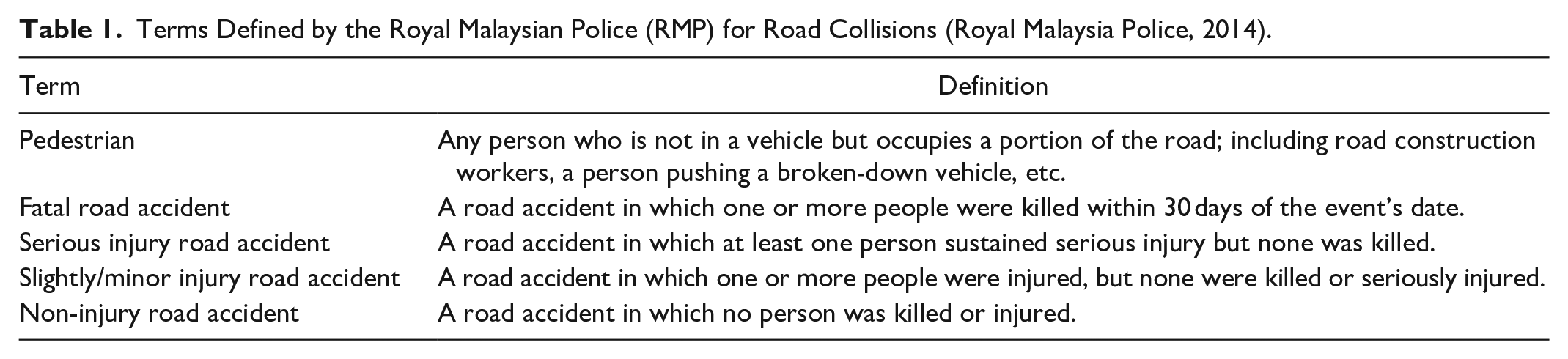
In Malaysia, severity of collision is divided into four levels; fatal, serious, slight, and non-injury. There are no pedestrian-vehicle accidents recorded as non-injury collisions in this data set. As a result, only three severity levels are evaluated. The current research makes use of the definitions set out in Table 1. In contrast to worldwide statistics, the majority of nations utilized the same definition of a fatal traffic accident as Malaysia, namely (dying within 30 days after a crash occurs). However, there are no established definitions of (severe) injuries, and they may vary across nations (OECD, 2010).
Terms Defined by the Royal Malaysian Police (RMP) for Road Collisions (Royal Malaysia Police, 2014).
International Comparison of Road Accident Database
An international comparison database may lead to an increase in our understanding of road safety and subsequent countermeasures in different countries. For this purpose, Table 2 was adapted from Montella et al. (2013) and Casado-Sanz et al. (2019) to describe the international comparison between national databases of selected countries (US, New Zealand, Australia, Spain databases including the requirement of EU Directive). Twenty eight variables were considered for the comparison. It is noted that in Malaysia, police reports do not link to the hospital data. Also, specific information such as road segment gradient, average daily traffic (ADT), curve radius and length are not included in the database.
International Comparison in the Road Accident Database. Casado-Sanz et al. (2019).

Source. Table adapted from Montella et al. (2013) and Casado-Sanz et al. (2019).
Directive 2008/96/EC of the European Parliament and of the Council of 19 November 2008 on road infrastructure safety management, bMinimum Uniform Crash Criteria Model (MMUCC). Guideline Model minimum uniform crash criteria. National Highway Traffic Safety Administration (NHTSA), conly pedestrian and cyclist ages in coded crash listing. Other ages in police crash reports, dspeed limit recorded since 2015, eaverage daily traffic.
Theory of Multinomial Logit Model
The severity levels of the collision were adopted as the dependent variable. These severity levels were defined and recorded by the Royal Malaysian Police (RMP) as shown in Table 1. A total of three levels of severity are considered, which are slight/minor injury collision, serious injury collision and fatal injury collision. In this study, a multinomial logit model was used to increase flexibility in the model specification (Rifaat et al., 2011; Tay et al., 2011). The model was developed as described in previous studies (Çelik & Oktay, 2014; Rifaat et al., 2011; Shankar et al., 1996; Tay et al., 2011; Ulfarsson & Mannering, 2004).
The probability of a child-pedestrian collision nth with a severity level i, is as follows:

where I denotes a set of possible mutually exclusive severity levels of collisions.
The Uni can be expressed as follows:

where β denotes a vector of coefficients, while xn denotes a vector of explanatory variables, and εni denotes an unobservable random error. εni is assumed to have a generalized extreme value distribution. From the assumption, the MNL can be expressed as follows:

where βi is a vector of coefficient that can be estimated for severity level i using standard maximum likelihood methods. As the explanatory variables do not vary across injuries, the I−1 log-odd ratios of the model become:

Only the difference in coefficient is identifiable, therefore, the coefficient is identifiable up to an additive constant. The coefficients of one outcome (the base case) are set to zero to resolve inter determinacy (Carson & Mannering, 2001). The slight injury collisions are used as a base case following (Amoh-Gyimah et al., 2017; Tay et al., 2011).
As the MNL is a nonlinear model, the estimated coefficients of the explanatory variables (independent variables) do not represent their effect on the dependent variables. So, the relative risk ratio (RRR) was computed relative to the base category to show the effect of significant risk factors. From equation (4), the relative probability of an injury accident (i = 2) to the base case (i = 1) is:

The relative risk ratio (RRR) for binary variables is written as follows:

Generally, the RRR refers to an increase if the RRR is more than 1 (RRR > 1) or a decrease if the RRR is less than 1 (RRR < 1) in the risk of a specific severity level of collision compared to the base case (Çelik & Oktay, 2014; Rifaat et al., 2011). SPSS version 23 was used to estimate the MNL and the RRR.
Results and Discussion
From the total of 2,518 vehicle collisions involving child-pedestrians, 14.5% were classified as fatal injury collisions, 30.1% were classified as serious injury collisions, and 55.4% were classified as slight/minor injury collisions. Table 3 presents the distribution of child-pedestrian collisions based on 16 risk factors and 3 injury severity levels.
Distribution (%) of Collision Severity and Contributing Factors.
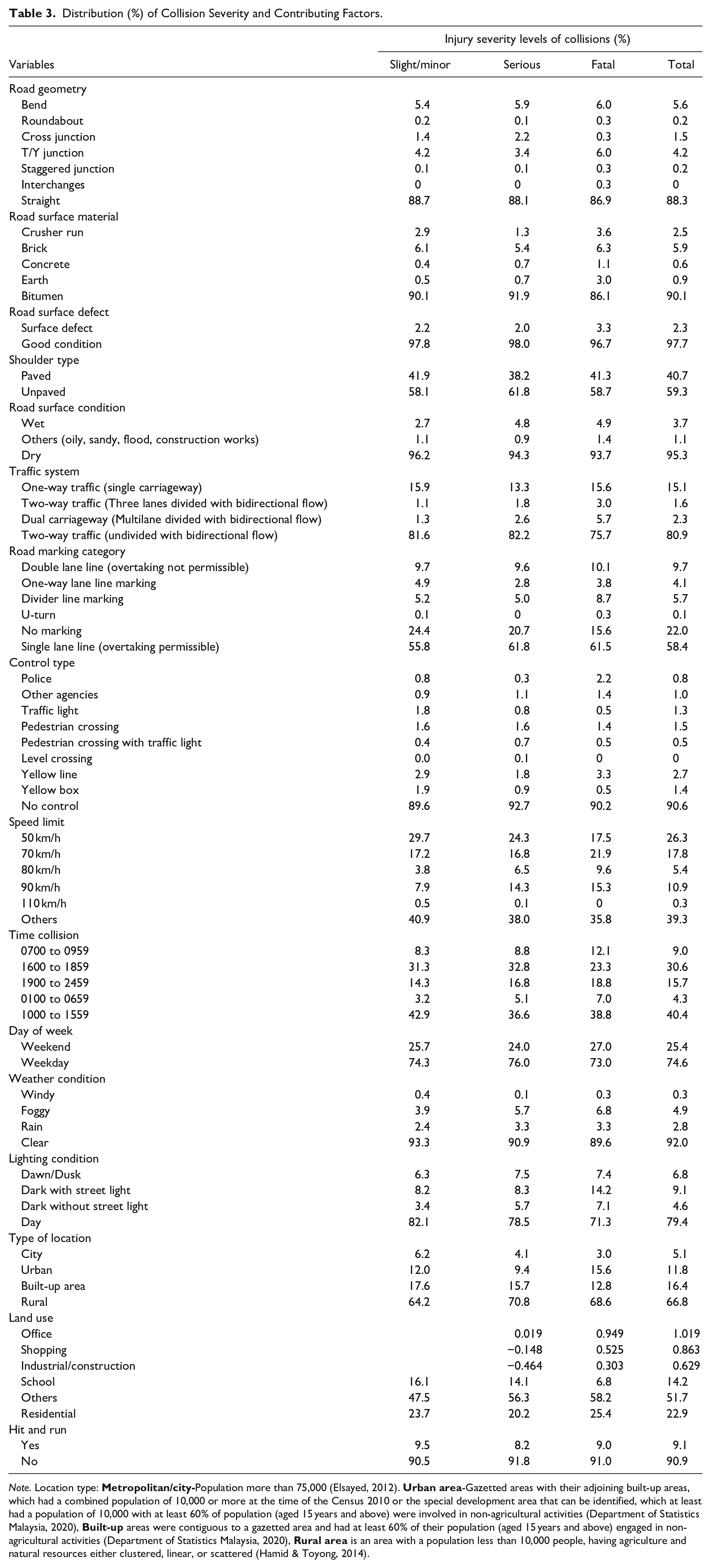
Note. Location type:
Multinomial Logit Model
The estimation of the multinomial logit model is displayed in Table 6. First, multicollinearity was tested during the variable selection process. There was no multicollinearity issue in the current study (Table 4). Multicollinearity among the independent variables was checked using the VIF test. It was found that there was no multicollinearity issue among the independent variables as all the VIF values were less than 2. Second, the Small-Hsiao test of the IIA assumption was examined (Table 5). The results reject the null hypothesis. It can be concluded that the IIA assumption has not been violated. In the next step, multinomial logistic regression analysis was performed using a stepwise backward elimination method to estimate the model. Table 6 adopted a design by Tay et al. (2011) and slight injury collision was selected as the reference category based on previous studies (Tay et al., 2011). As demonstrated in Table 6, the likelihood ratio chi-square of 302.573 with a small p-value of <.0001 demonstrates that the model fits the data significantly. The results demonstrate that 11 explanatory variables had significant relationships between specific road and traffic environment characteristics and the injury severity level of child-pedestrian collisions. The variables with a significant level at α = .1, α = .05, and α = .01 were included (Pour-Rouholamin & Zhou, 2016; Rifaat et al., 2011; Tay et al., 2008). It should be noted that some variables were retained, although only one category in the same factor demonstrated a significant value (Kockelman & Kweon, 2002; Tay et al., 2011). The effects of each significant variable were interpreted using the estimated coefficients and relative risk ratios (RRR).
Results of the Multicollinearity Test.

Small-Hsiao Test of IIA Assumption.

Note. A significant test is evidence against Ho.
Multinomial Logit Model of Child-Pedestrian Collisions Severity.
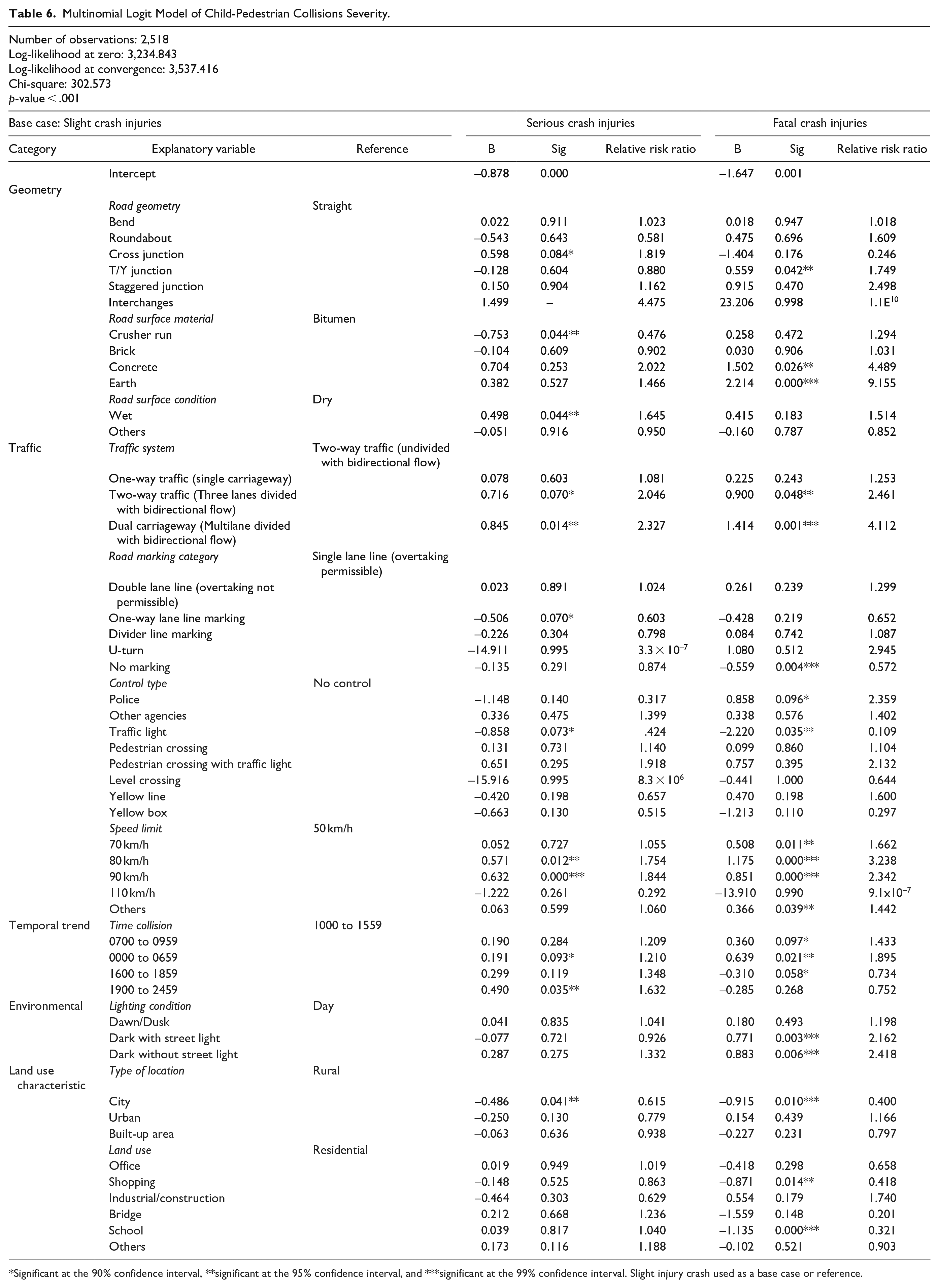
Significant at the 90% confidence interval, **significant at the 95% confidence interval, and ***significant at the 99% confidence interval. Slight injury crash used as a base case or reference.
With regard to geometry segment characteristics, cross intersections and T/Y intersections lead to severe and fatal injury collisions. Serious injury collisions are 1.8 times more likely to occur at the cross intersection (p = .084, RRR = 1.819) than slight injury collisions. On the other hand, child-pedestrians who were hit at the T/Y intersection are 1.7 times more likely to result in fatal injury collisions (p = .042, RRR = 1.749).
The estimate findings showed that accidents involving serious injuries occurred at the cross intersection (four-legged intersection) and the T/Y intersection (three-legged intersection). In a study conducted in New York by Ukkusuri et al. (2012), it was discovered that four-legged and five-legged intersections were linked with an increase in collision frequency. This is consistent with the fact that a larger number of legged intersections results in a greater number of conflict sites, implying a greater probability of collisions at intersections (Lee et al., 2016). Ewing and Dumbaugh (2009) also noted that vehicle-vehicle and vehicle-pedestrian accidents occur mostly near intersections. Additionally, several studies have demonstrated that the density of road intersections may also have a traffic impact on child-pedestrians. For example, previous scholars (Dissanayake et al., 2009; Steinbach et al., 2010) revealed that the higher density of road intersections was associated with higher child-pedestrian casualties. In a recent study conducted in Ulsan, Korea, Lee et al. (2016) discovered that the population density, number of marked crosswalks, main road width, and number of building entrances at the intersection were associated with the occurrence of child-pedestrian collisions at intersections.
The severity of injury collisions is significantly associated with the types of road surface materials on collision severity and three types of road surface materials. The estimation results indicated that serious injury collisions are less likely to occur on crusher run surfaces (p = .041, RRR = 0.471) in comparison to bitumen. Meanwhile, child-pedestrians who were hit by vehicles on concrete (p = .027) and earth surfaces (p < .001) significantly resulted in fatal injury collisions. The fatal collisions are nearly 4.4 times (RRR = 4.435) and 9.7 times more likely to occur on concrete surfaces and earth surfaces (RRR = 9.697), respectively. The findings showed that the presence of concrete and the ground surface enhanced the likelihood of sustaining a fatal injury. The crusher run surfaces may serve as a warning to drivers to slow down, thus reducing the effect of collisions on youngsters on the road. While the flat surfaces of concrete and dirt result in greater impact collisions. These instances may be associated with the function of surface roughness. Additionally, prior research established that the roughness level was strongly associated with the frequency of vehicle collisions and the degree of injuries (Anastasopoulos & Mannering, 2009, 2011). Nevertheless, no literature was found on road surface conditions related to the child-pedestrian severity collision.
Overall, the association between severity levels of collisions and road surface conditions was found to be statistically significant. The results of the current study indicate that the risk of serious injury collisions generally increases on wet road surfaces. The occurrence of serious injury collisions is 1.6 times more likely to occur in wet surface conditions (p = .044, RRR = 1.645) compared with slight injury collisions. Similarly, previous studies have reported the effects of wet road surfaces on child-pedestrian collisions. For example, Koopmans et al. (2015) demonstrated that wet surface conditions were significantly associated with child-pedestrian (aged ≤19 years old) fatalities. Meanwhile, a study done in South Africa by Hobday and Knight (2010) showed that the highest percentage of fatal injury collisions involving child-pedestrians (<15 years old) occurred on freeways involving buses and trucks in wet surface conditions. In addition, the relative risk of far-side accidents had a significant effect when the road surface was wet, as reported by Dunbar (2012). This exploratory variable was tested for a specific age group and it was found that it was significantly related to all age groups. This could be due to wet road surfaces affecting tire-pavement skid resistance, which is one of the important factors in controlling vehicle direction, speed and short braking distances (Kokkalis & Panagouli, 1998), and might have a higher collision impact on child-pedestrians on roads. Other studies confirmed that friction between tires and wet roads had a significant effect on vehicle collisions (Najafi et al., 2017), as well as ineffective braking systems, causing vehicles to have less control (Graham & Glaister, 2003).
The impact of traffic system categories was also examined in this study. It should be noted that the classification of the traffic system category level is adopted from “Form POL27” designed by the Royal Malaysian Police. Every category level varies with regard to the number of lanes, the type of median (divided or undivided), or the type of flow (bidirectional or unidirectional). The findings indicated that collisions occurring on three lanes (two-way divided) and dual carriageways (divided) are positively significant with both serious (three lanes, p = .07 and dual carriageways, p = .014) and fatal injury collisions (three lanes, p = .048 and dual carriageways, p = .001) with reference to the two-way (undivided) system. Serious injury collisions are two times more likely to occur on three lanes (RRR = 2.046) and 2.3 times (RRR = 2.327) on dual carriageways. Moreover, child-pedestrians are 2.5 times and 4.1 times more likely to sustain fatal injuries if they are hit on three lanes (RRR = 2.461) and dual carriageways (RRR = 4.112). The results indicate that child-pedestrians are at a greater risk of fatality and serious injuries in traffic system categories with multilane roadways (more than two lanes), divided medians, and bidirectional traffic flow (two-way). This result is in agreement with a study conducted in Hong Kong (Sze & Wong, 2007) and Riyadh (Al-Ghamdi, 2002). Besides, Wong et al. (2007) found that two-way and multi/dual carriageways were significantly related to an increased probability of severe injury levels. While, Al-Ghamdi (2002), reported that two-way divided roadways (two-way with median) are the most frequent locations for pedestrian-vehicle collisions in Riyadh. Nonetheless, several studies examined each characteristic of the traffic system associated with severity level separately. For example, several studies (Agran et al., 1996; Mueller et al., 1990) found that roadways with more than two travel lanes and wider lanes are related to higher risks of child-pedestrian collisions. The results indicate that wider lanes may be correlated with higher traffic speed and lead to higher occurrence rates and risks of child-pedestrian collisions (Abdel-Aty et al., 2007; Al-Ghamdi, 2002; Ewing & Dumbaugh, 2009). Nevertheless, Abdel-Aty et al. (2007), revealed that the higher collision involvement among school-aged children in Florida increases as the number of lanes increases on divided roads. This study indicated that a multilane roadway with a median presence influences the risk of collisions. With regard to the type of flow, Al-Ghamdi (2002) found that high levels of injuries were associated with two-way roadways with a median. Therefore, the risk of injury collisions may be caused by any characteristics of the traffic system, which are the number of lanes, the type of median (divided or undivided), and the type of flow (bidirectional or unidirectional), or any combination of the aforementioned characteristics.
As for the road marking category, serious (p = .07, RRR = 0.603) collision injuries were found to be less likely to occur on roads with a one-way line. Also, fatal (p = .004, RRR = 0.572) collision injuries are less likely to occur on roads with no marking lines. As such, serious injury collisions are 1.7 times (1/0.603) and fatal injury collisions are almost 1.7 times (1/0.572) more likely to occur on roads with a single line compared to roads with a one-way line and no marking line, respectively. This result might be due to the fact that vehicles are allowed to overtake other vehicles on roads with a single line, which can lead to higher severity of collisions. For example, Leden et al. (2006) found that child-pedestrians in Finland were frequently involved in collisions involving overtaking vehicles at mid-block. With regard to traffic control devices, the results of the current study demonstrate that collisions at traffic lights were found to be less likely to result in serious (p = .073, RRR = 0.424) and fatal injury collisions (p = .035, RRR = 0.109). This finding indicated that the presence of traffic lights reduced the probability of serious and fatal injuries, which was in agreement with previous studies (Çelik & Oktay, 2014; Lee & Abdel-Aty, 2005; Rifaat et al., 2011). In the presence of traffic signals, drivers might be more cautious and tend to slow down, thereby resulting in a lower impact of injury collisions (Lee & Abdel-Aty, 2005; Rifaat et al., 2011). Nevertheless, fatal injury collisions (p = .086, RRR = 2.430) are 2.4 times more likely to occur at a location controlled by the police. No reference was found related to the location controlled by the police.
Additionally, the effect of various kinds of speed limit indications was investigated, with roads having a speed limit indication of 70 km/h (p = .007, RRR = 1.726) being substantially linked with fatal injuries. Additionally, highways with speed limit signs of 80 and 90 km/h were strongly linked with severe and fatal injury accidents. Additionally, accidents involving speeds of 80 km/h (p = .001, RRR = 3.417) and 90 km/h (p = .001, RRR = 2.347) are 3.4 times and 2.3 times more likely to result in fatal injuries, respectively. This result indicates that highways having posted speed limits of 70 km/h more are linked with a higher severity level. Similarly, prior research has shown that locations with higher speed limit signs are associated with higher impact speeds and a larger probability of fatal collisions (Davis, 2001). Additionally, Davis (2001) created a discrete outcome model that links the degree of an injured pedestrian’s injury to the hitting vehicle’s speed. Additionally, it was shown that child-pedestrians aged 0 to 14 years old are more likely to have severe injuries when collision speeds exceed 40 km/h. Additionally, if they are struck at a speed greater than 75 km/h, fatal injuries are quite probable.
With respect to the time of collisions, the findings revealed that collisions occurring from 000 to 0659 hours (midnight to early morning) were significantly related to serious (=0.093, RRR = 1.210) and fatal injury collisions (p = .021, RRR = 1.895). Also, collisions are likely to be fatal (p = .097, RRR = 1.433) from 0700 to 0959 hours (morning). While, serious injury collisions are likely to occur from 1900 to 2459 hours (night). Nevertheless, collisions are less likely to cause fatal injury collisions from 1600 to 1859 hours (late afternoon). This finding implies that child-pedestrians in Malaysia experienced more severe injury collisions during the early morning, morning, and night time. This may be related to peak traffic periods and school opening and closing times, as observed in previous studies (Pitt et al., 1990; Yiannakoulias et al., 2002). Nevertheless, fatal collisions during midnight might be due to negligence factors by other road users. Moreover, fatigue, tiredness, stress, speeding, and lack of visibility at night may be attributed to driver factors (Amoh-Gyimah et al., 2017).
The natural lighting conditions were found to be significant with fatal injury. Dark conditions with street lights (p = .003, RRR = 2.162) are positively associated with fatal injury collisions. Additionally, fatal injury collisions are 2.4 times more likely to occur in the dark without street light (p = .006, RRR = 2.418) compared to slight injury collisions. This result indicates that child-pedestrians are at a higher injury risk in darkness. This result is consistent with previous findings (Amoh-Gyimah et al., 2017; Koopmans et al., 2015; Mohamed et al., 2013; Rifaat et al., 2011), which demonstrated that darkness may affect the visibility of drivers and pedestrians. Rifaat et al. (2011) highlighted that drivers may struggle to identify hazards and other road users. Additionally, drivers may be unable to perform appropriate evasive maneuvers and slow down, resulting in more severe accidents.
In relation to location characteristics, the results reveal that city areas were less likely to have serious (p = .041, RRR = 0.615) or fatal injury collisions (p = .010, RRR = 0.400) compared to rural areas. This result indicates that child-pedestrians in urban areas may be exposed to fewer severe injuries compared to those who live in rural areas. This finding is similar to a few other studies (Afukaar et al., 2003; Doukas et al., 2010; Singh et al., 2016). Evidence indicated that lack of road maintenance, poor quality of public transport, low awareness of traffic rules, higher vehicle speeds, fewer separated pedestrian facilities, and limited access to medical emergency services might be contributing factors to severe injuries in rural areas (Afukaar et al., 2003; Singh et al., 2016). This finding shows that the specific carriageway features in different locations will impact the road accident severity levels. Alternatively, past researchers (Yiannakoulias et al., 2002) also suggested that the association between physical environmental characteristics in combination with spatial analysis with different analytical approaches could be adopted for a comprehensive overview of the influence of accident location on severity levels.
Besides that, the effect of different types of land use characteristics was examined. From the model estimation, it was found that slight crash injuries (p = .014, RRR = 0.418) are nearly 2.4 times (1/0.418) more likely to occur in shopping areas compared to fatal crash injuries. Similar to this finding, Clifton and Kreamer-Fults (2007) found that commercial land uses near public schools were associated with higher pedestrian-vehicular collision severity. Meanwhile Elias and Shiftan (2014) and Mohamed et al. (2013), reported that children who live in areas of mixed land use (including commercial land use) are significantly exposed to road collisions. Clifton and Kreamer-Fults (2007) revealed that the location characteristics were likely associated with higher levels of pedestrian demand and thus high absolute numbers of crashes. Elias and Shiftan (2014) demonstrated that metered parking facilities, which are located in commercial areas where speeds tend to be lower, have a significant effect on reducing fatality risks. Also, it was found that slight crash injuries (p = .000, RRR = 0.321) are nearly 3.1 (1/0.321) times more likely to occur in school areas. This finding is similar to other studies (Clifton & Kreamer-Fults, 2007; Pitt et al., 1990). Pitt et al. (1990) found that the lower incidence rates and lower severity of injuries in the vicinity of schools might be correlated to the success of road safety education programs and other traffic safety measures, while Clifton et al. (2007) found that the presence of a driveway and turning bay decreases the incidence rates and severity of injuries in school areas. Nevertheless, this finding contradicts Abdel-Aty et al. (2007), whose study demonstrated that school children are at greater risk due to the fact that the middle and high schools in Orange County, Florida, tend to be located near multi-lane high-speed roads.
Conclusion
The current study identified several risk factors associated with the increasing severity of vehicle collisions involving child-pedestrians. The explanatory variables associated with increased probability of fatal injury collisions include: t/y intersection; concrete and earth-road surfaces; two-way traffic and dual carriageways; posted speed limits of 70 to 90 km/h; time of collision: 0 to 0659 hours (early morning) and 0700 to 0959 hours (morning); lighting conditions, including dark without street lights and dark with street lights; and control type involving police. Also, cross intersections, posted speed limits of 80 to 90 km/h, and time of collision, which are from 0 to 0659 hours (early morning) and from 1900 to 2459 hours (night), significantly increased serious injury collisions.
From a traffic engineering perspective, road characteristics, road designs, and traffic operations play an important role in providing safe walking conditions for vulnerable road users (Oxley et al., 2018). Fundamentally, child-pedestrians should be provided with good and protective facilities based on their abilities (Assailly, 1997) and skills. For example, there should be special attention given to locations with complex road geometrics and traffic systems, such as t/y intersections, cross intersections, and multilane roads with bidirectional flows, as all these locations tend to be more severe. The reduction in child-pedestrian collisions is associated with lighting conditions and road surface conditions. It should be noted that child-pedestrian collisions may be attributed to drivers’ negligence and irresponsible behavior. Importantly, dark areas should be installed with adequate street lighting to increase visibility. Furthermore, road safety educational programs and campaigns should also be targeted at drivers to increase their awareness of pedestrians’ and cyclists’ activities (Desapriya et al., 2011; Tay et al., 2011). Moreover, modifications to the physical environment should be combined with effective training techniques involving children, especially in school zones, to reduce the selection of poor routes (Schwebel et al., 2012). Notably, future research should examine the human factors concerning children’s behavior and development in order to better understand child-pedestrians’ abilities and limitations in designing pedestrian facilities.
Limitation
There are a few limitations to this research. To begin, data on physical environmental features was recorded separately from data on human aspects (age, gender, behavior, etc.). As a result, association between human factors variables and physical environmental features has not been examined. Second, the database does not include spatial features such as the dimensions of pedestrian pathways, the layout and usage of the area between the road and the sidewalk. It is recommended that the analysis of physical environment characteristics in combination with spatial analysis with different analytical approach should be further investigated. Another drawback of the research was that the database was only available until 2014. In terms of future work, it may be prudent to do further analysis of current data in order to enhance the predictability of the MNL models. Despite data limitations, these statistics offer sufficient information on road and environmental factors for preventive measures.
Footnotes
Acknowledgements
The authors wish to thank Malaysian Royal Police (RMP) and Malaysian Institute of Road Safety Research (MIROS) for providing road accident data for this project and financial support from Ministry of Education, Malaysia.
Declaration of Conflicting Interests
The author(s) declared no potential conflicts of interest with respect to the research, authorship, and/or publication of this article
Funding
The author(s) disclosed receipt of the following financial support for the research, authorship, and/or publication of this article: This research was funded by Ministry of Education, Malaysia research Grant no. FRGS/1/2021/TK02/UKM/02/1.
