




Abstract
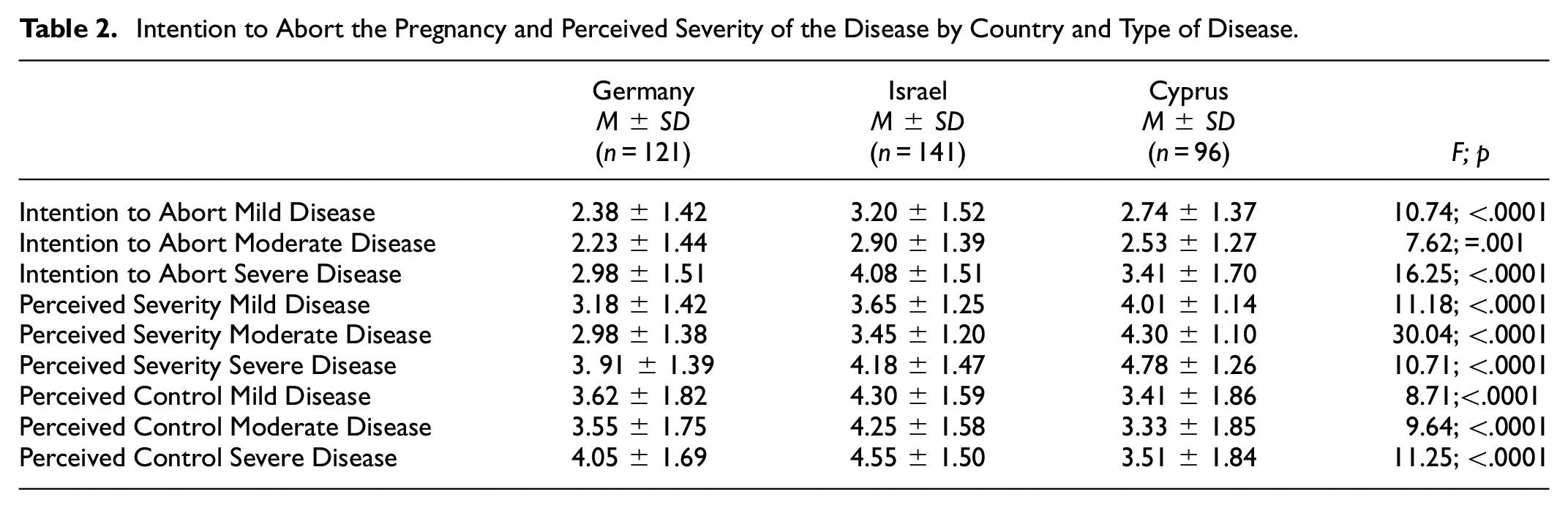
Developments in genetics enable detection of fetal genetic abnormalities. The decision whether to abort is affected by culture, perceived severity of abnormality, and legal regulations. The study aimed to assess the cultural differences in women’s intention to abort if their fetus is diagnosed with a genetic disease. A cross-sectional study was conducted in Israel, Germany, and Cyprus. A questionnaire presented six scenarios where the fetus of a pregnant woman is diagnosed with a mild, moderate, or severe genetic disease. For each scenario, the participating women were asked to rate their perceived severity of having a child with the disease, sense of control over performing an abortion, and intention to undergo an abortion. 141 Israeli, 121 German, and 96 Cypriot women participated in the study. The results revealed that Israeli women were more inclined to perform an abortion (Israel: Mild-Disease M ± SD = 3.20 ± 1.37; Moderate-Disease 2.90 ± 1.39; Severe-Disease 4.08 ± 1.51) compared to Cyprus (Mild-Disease SD = 2.74 ± 1.52; Moderate-Disease 2.53 ± 1.27; Severe-Disease 3.41 ± 1.70) and Germany (Mild Disease, M ± SD = 2.38 ± 1.42; Moderate Disease 2.23 ± 1.44; Severe-Disease 2.98 ± 1.51). In all cases, Israeli women reported a higher sense of control over performing an abortion and Cypriot women expressed the highest perceived severity. Sense of control, perceived severity, being Israeli, and increased age explained 31% of the variance in the intention to abort (F = 54.39). Intention to abort following the diagnosis of a fetus with a genetic disease varies by country. There is a greater intention to abort when women feel more control, and have a higher perceived severity, regardless of the severity of the disease.
Introduction
Developments in assisted reproduction and genetics now enable early detection of abnormalities in the fetus and neonate (de Jong et al., 2015; Gekas et al., 2016). Diagnostic tests, which are readily adopted by prospective parents, offer potential information regarding the health of the fetus (Ravitsky et al., 2021). When the results are normal, they grant confidence, however when an abnormality is identified the prospective parents face a dilemma and must decide whether to continue or terminate the pregnancy (Kratovil & Julion, 2017; Lou et al., 2017). The accessibility of these tests and the information they provide, as well as the increasing recognition of a women’s rights to her own body, place much of the responsibility for the decision whether to continue or terminate the pregnancy on the woman (Lou et al., 2017; United Nations, 2014). However, it is reasonable to suppose that the severity of the genetic disease is a consideration in the decision whether to perform an abortion (Pena et al., 2019).
Induced abortions are now common in western society. According to a survey conducted in 60 countries between the years 1990 and 2014, one of four pregnancies ended in an induced abortion. One-tenth of the abortions were due to a genetic disease (Bearak et al., 2020; Guttmacher Institute, 2022). The rate of abortions differs by country according to culture, legislation, and regulations. For example, the rate of pregnancy terminations in developing countries is much higher than in developed countries (Sedgh et al., 2016). According to an Israeli Ministry of Health (2017) report, the rate of induced abortions in Israel is lower than the average in European Union countries, 13.9 per 1,000 women in Israel compared to 20 per 1,000 in EU countries.
In Israel, during 2020, 99.6% of 16,492 requests for pregnancy termination were approved, where a fifth of the requests were due to fetal abnormalities (Guttmacher Institute, 2022; Israel Central Bureau of Statistics, 2022). The corresponding number for Germany is not known since the German “Protection of Individual Privacy” law from 1995 bans documentation of the causes of pregnancy termination (Büchner, 2009). In Cyprus, which does not maintain records of the abortion rate or of the underlying reasons (Sedgh et al., 2011), studies estimate that approximately 5% of abortions are performed due to a fetal genetic disorder (Cyprus Statistical Service, 2014).
Israel, Cyprus, and Germany are all western, multicultural immigration countries, with different religious and sociopolitical contexts, and have secular abortion laws that approve induced abortions in certain circumstances, including a risk to the mother’s life or physical health or cases of severe fetal impairment (Remez et al., 2020; Yurdakul et al., 2019). Nonetheless, differences in legislation and conduct exist between the countries. For example, in Israel, all selective abortions, including those due to fetal impairments, require the approval of a medical center committee for termination of pregnancies in the early weeks of pregnancy. After the 24th week of gestation, approval from the high Regional Committee is required (Israeli Ministry of Health, 2017). In contrast, abortions due to fetal abnormality are legal in Germany up to the 22nd week of gestation, as long as the counseling took place at 3 days prior to the abortion (Levels et al., 2014). Abortions up to the 12th week of gestation can be approved after consultation with a recognized center, while after the 12th week, approval by two physicians is required. Legislation in Cyprus was recently updated to allow abortions up to 12 weeks of gestation, but they require a mandatory psychological consultation (Psyllidews, 2018). It should be noted that the law in these countries considers the severity of the genetic defect as a factor in approving an abortion (Yurdakul et al., 2019).
The decision to undergo an abortion following the diagnosis of a genetic disorder is influenced by a wide range of culture-related factors such as religion, government policy, and customs (Jerman et al., 2016). With regard to religion, Christianity, and specifically the Catholic Church opposes abortions under any circumstance (Hussein, 2020). In contrast, Islamic and Jewish law permit abortion in cases where a severe condition such as Tay Sachs disease, that would cause death in early childhood, is diagnosed in the fetus (Bagheri, 2021; Wehbe-Alamah, 2008). Religiosity is also associated with the decision to perform an abortion, with stronger religious beliefs associated with less inclination to perform selective abortions (Adamczyk & Valdimarsdóttir, 2018).
In the decision making process of whether to undergo an abortion, the severity of the genetic abnormality of the embryo is usually a consideration for prospective parents. It has been reported that 65% of Greek women would request late pregnancy termination if a severe disease was diagnosed in the fetus. Moreover, the more negatively they perceive the ability of the future child to lead a healthy lifestyle, the more likely they are to terminate the pregnancy, where one important factor was the age of illness onset (Ngan et al., 2020; Souka et al., 2010). For example, a fetus diagnosed as a carrier of the BRCA gene mutation, which increases the risk of developing breast and ovarian cancer in later life, was perceived by women as less severe, such that only one-third of women faced with this situation decided to abort or use reproductive technologies to ensure a healthy fetus (Vadaparampil et al., 2009). Another study conducted in the United States reported that when the genetic disease was likely to cause severe physical disability in early life, 76% of women expressed a desire to perform an abortion (Learman et al., 2005). A recent Israeli study reported that 46% of participants were in favor of performing induced abortion following the detection of a fetal abnormality (Grinberg, 2021).
In Cyprus, where one of every seven people is a carrier of β-thalassemia, the government introduced quasi-mandatory premarital genetic testing for the disease, a step taken with the cooperation of the Cypriot Orthodox Church. Accordingly, couples intending to marry in church must be screened and receive counseling prior to their marriage. During counseling, the risk of thalassemia major and the options of preimplantation genetic diagnosis (PGD) or prenatal screening followed by an abortion if the fetus is affected, are discussed. As a result, some couples decide to change their marital plans. When implemented in 1983, this course of action dramatically reduced the birth of children with thalassemia. However, the rise in the number of overseas workers and the option of civil weddings have since resulted in an increase in the birth of children with thalassemia (Kolnagou & Kontoghiorghes, 2009; Kountouris et al., 2021).
Recently, a classification of the severity of genetic diseases was published, which defines four categories by age of onset and severity of symptoms. The gravest diseases are classified as profound, and diseases with more minor manifestations are classified as minor. The authors also present a flow chart for categorizing disease severity (Lazarin et al., 2014). The intention to perform an induced abortion due to the diagnosis of a genetic disease in the fetus is affected by disease severity (Hans & Kimberly, 2014). The present study examined the intention to abort a fetus diagnosed with a genetic disease of varying severity.
Variables found to be associated with the likelihood of selective abortions are living in a more permissive country, being younger, secular, more educated, divorced, and employed (Loll & Hall, 2019). An Israeli study found that the more a woman believes that the act of abortion is moral, justified, or desirable, the stronger her behavioral intention of undergoing an abortion regardless of the views of significant others (Sigal, 2008). A recent study reported three factors that are evaluated when facing the decision to terminate an unwanted pregnancy: capital, values, and access barriers (Klann & Wong, 2020).
Social pressure was reported to be a strong factor in increasing behavioral intention, especially with regard to issues with a high impact on society such as pregnancy (Ngan et al., 2020; Wallace et al., 2005). In other similar fields, such as fertility, women from a variety of cultures were shown to be influenced by their social environment. For example, in Germany, the negative context of Nazi history, as well as current legislation and statements by politicians, encourage the population to avoid selective abortions (Braun, 2017; Raz & Schicktanz, 2009). In Israel, however, there is a high fertility rate and strong peer pressure to raise a healthy baby, so selective abortions are socially acceptable (Hashiloni-Dolev & Weiner, 2008; Raz & Timmermans, 2018). Similarly, in Cyprus, abortions in cases of thalassemia have become more acceptable with the advent of quasi-mandatory premarital genetic testing for the disease (Kolnagou & Kontoghiorghes, 2009; Kountouris et al., 2021).
The rapid development in diagnostic capabilities regarding malformations and diseases during pregnancy have generated a reality where when a fetus is diagnosed with an abnormality in any degree of severity, parents face a dilemma of whether to continue or terminate the pregnancy. The cultural environment at present is more permissive with regard to induced abortions in general and in case of fetal abnormalities. Since perceptions of the severity of the abnormality might stem from cultural beliefs, it was of interest to examine women’s intentions to abort a pregnancy when fetal abnormalities of different severity are diagnosed. This was done specifically in three Western multicultural countries with diverse religious influence and different legal frameworks and conduct, that is, Germany, Cyprus, and Israel.
The present study was designed to examine these issues, focusing on the effect of the severity of the genetic disorder according to the published classifications (Lazarin et al., 2014). In addition to the perceived severity of the disease, we also examined the impact of perceived control over performing an induced abortion, as defined by Ajzen and Madden (1986), and the intention to undergo an induced abortion, in three countries with different abortion laws: Cyprus, Germany, and Israel, as representing different cultures. Since genetic diseases are rare, using scenarios made it possible to manipulate the severity of the genetic disease and to create identical situations in terms of the type of disease encountered by the women and their decision whether to perform an abortion.
Methods
Tools
Data on demographics and characteristics of the participants were collected, including age, marital status, having children, religion and religiosity, country of birth, years of education, and the presence of known genetic diseases in the close or extended family.
The questionnaire utilized was constructed following Ajzen’s (2002) fundamental instructions, according to the questions template. Hence, the questionnaire is specific to each behavior. However, face validity was performed by three professors who are experts in nursing research and by a group of eight academic nurses working in the obstetrics field. They were requested to review the questionnaire and make sure that its wording is understandable by the readers, and that the scenarios represent the requested content world. The questionnaire was scenario based, with each scenario representing a situation where the fetus of a pregnant woman is diagnosed with a genetic abnormality.
The literature review illuminated the importance of relating to the severity of the disease. Therefore, we classified fetal abnormalities into three groups as described by Lazarin et al. (2014), who defined four degrees of severity of a genetic disease from profound to mild. Because profound disease was very likely to result in an abortion, we selected diseases that fall into the three categories of severe, moderate, and mild. The list of diseases was defined in consultation with a senior geneticist. The final disease list was approved by two senior gynecologists. Accordingly: 1. Fragile-X and thalassemia were classified as severe disorders, 2. Albinism and being a carrier of the BRCA mutation were classified as moderate diseases, and 3. Triple X and Van der Woude, syndromes were classified as mild.
Six scenarios were presented to the women participants, who were requested to imagine that they are pregnant and have received genetic test results indicating that their fetus is affected by one of the diseases described above, accompanied by a short description of the disease symptoms. The participants were requested to indicate their perceived severity of the disease, ranked on a six-point scale ranging from not at all severe = 1 to very severe = 6. They were also asked to rate their intention to undergo a selective abortion if the disease was detected in their fetus, on a 6-point scale ranging from strongly disagree = 1 to strongly agree = 6. The results of each group of questions were averaged according to the type of disease (severe, moderate, or mild). The internal consistency of the questionnaire according to Cronbach’s alpha ranged from .88 to .92.
Statistical Analysis
Data were analyzed using SPSS for Windows (version 25). Statistical tests included χ2 for categorical variables. In order to determine whether there were any statistically significant differences between the means of the groups, one-way analysis of variance (ANOVA) was used with Tukey’s-b post hoc tests. Multiple linear regressions were used to detect variables associated with the intention to terminate the pregnancy.
Procedure
The process of selecting clinics included choosing similar cities in terms of multiculturalism. Hence, in each country we selected a large city with a multicultural population, where the citizens have high accessibility to health services (i.e., Tel Aviv, Berlin, and Nicosia). In each country the research team contacted several public gynecological clinics in the community that provide care to a large number of women. After we received the consent of one clinic in each country to disseminate the research questionnaires, as well as ethical approval, data collection began.
Prior to data collection, in order to evaluate the questionnaire’s clarity a “pre-study” was conducted among 10 women in each country, while visiting the clinics. The “pre-study” showed that the questionnaire is clear and easy to answer. Then, data were collected from women visiting gynecological clinics for routine check-ups in central Israel (Tel-Aviv), Germany (Berlin), and in the Greek-speaking region of Cyprus (Nicosia). Pregnant women were not included in the study.
The questionnaire was translated into Greek and German, and women who were not fluent in the local language were excluded from the study. Women were asked to participate in the study; those who gave their oral consent received a short explanation regarding the aim of the study and completed the questionnaire. Altogether, 358 questionnaires were collected: 96 in Cyprus, 121 in Germany, and 141 in Israel. The response rate was 90%.
Results
Sample
Sample size was determined using G*power program (Faul et al., 2009). Accordingly, the sample size required for achieving an effect size of 0.25, power of 0.95, and α of .05 was 91 participants in each group. The sample consisted of 358 women from Cyprus (N = 96), Germany (N = 121), and Israel (N = 141) who attended a gynecological clinic for routine check-ups. Their ages ranged from 18 to 45 years, with the women from Germany being younger and having fewer children than those from Israel and Cyprus. Women from Cyprus had more years of education than the participants from Israel and Germany. About half the women were married or living with a partner, with the lowest number of single women in Cyprus. About one-third of the sample was secular, with most of the women in Cyprus defining themselves as religious. Most women from Israel were Jewish, from Cyprus Christian, and about 40% of German participants identified as Christian, with about 50% defining themselves as atheists. Only 23 and 27 of the participants (the majority from Israel) reported the presence of a genetic disease in their close and extended family, respectively. Table 1 presents the socio-demographic details of the sample.
Sample Characteristics by Country and Comparison Between the Samples.

One-way ANOVAs between countries were performed with Tukey’s-b post hoc analyses to investigate the cultural differences in perceived severity of having a child with the disease, perceived control over performing an abortion, and intention to terminate the pregnancy. The results reveal that, across the three disease types, severity perception was significantly lower in the German women, while the Cypriot women had the highest severity perception. For all disease types, Israeli women had a higher sense of control over performing an abortion than German and Cypriot women. Tukey’s-b post hoc analyses revealed that these differences were significant. Intention to terminate the pregnancy in all types of disease was highest among Israeli women and lowest among German women. Tukey’s-b post hoc analyses showed that for severe and mild diseases Israeli women had a significantly higher intention to abort compared to both German and Cypriot women, while for moderate diseases Israeli women differed significantly only from German women. The results are presented in Table 2.
Intention to Abort the Pregnancy and Perceived Severity of the Disease by Country and Type of Disease.
Three multiple stepwise linear regression analyses were carried out to examine the variables related to intention to abort for the three types of disease severity. The variables entered were perceived severity, perceived control over carrying out an abortion, age, years of education, number of children, marital status, and country. For country, two dummy variables were computed, one where Israel = 1 and Germany and Cyprus = 0, and the second where Germany = 1 and Israel and Cyprus = 0. As there was a high correlation (Spearman’s Rho) between country and religiosity and a significant difference in the distribution of religion between the counties, only the country was entered into the regressions. The results are presented in Table 3, showing that only perceived control over performing an abortion, perceived severity of the disease, country (Israel), and age were significant. For all disease types, higher control and higher perceived severity, as well as being Israeli, predicted intention to terminate the pregnancy. Age predicted the intention only for mild and moderate diseases. The models explained between 24% and 32% of the variance.
Stepwise Linear Regressions for the Intention to Abort a Fetus With a Mild, Moderate, and Severe Diseases.
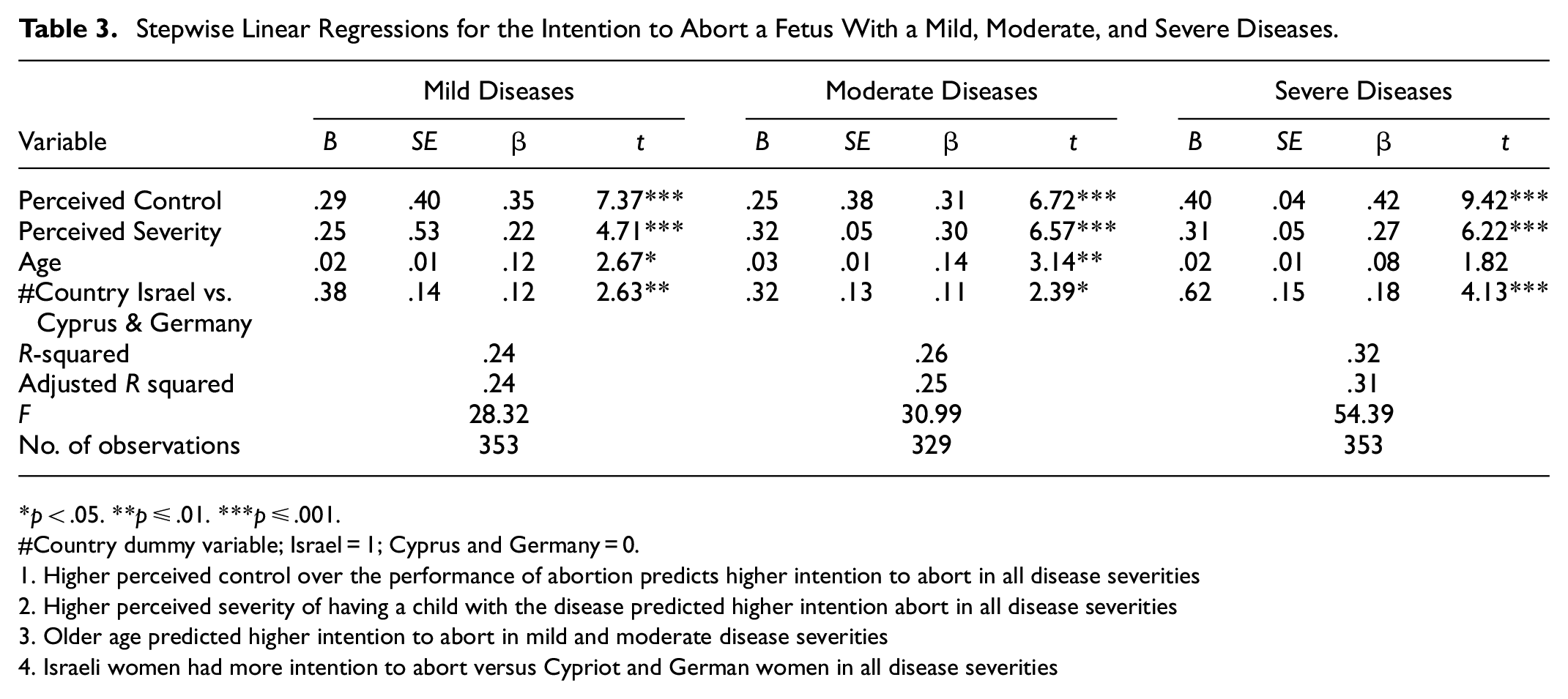
p < .05. **p ≤ .01. ***p ≤ .001.
#Country dummy variable; Israel = 1; Cyprus and Germany = 0.
1. Higher perceived control over the performance of abortion predicts higher intention to abort in all disease severities
2. Higher perceived severity of having a child with the disease predicted higher intention abort in all disease severities
3. Older age predicted higher intention to abort in mild and moderate disease severities
4. Israeli women had more intention to abort versus Cypriot and German women in all disease severities
Discussion
The present study examined severity perception and sense of control over performing an abortion, and the intention to perform an abortion in case of a fetal abnormality, among women from three cultures (Israel, Germany, and Cyprus). The results show that the intention to terminate the pregnancy, regardless of the severity of the illness, was higher among Israelis than among either Cypriot or German women. This might be related to the impact of unique Israeli cultural features on the decision to carry out abortions. In Israel, where the society is pro-natalist, giving birth is considered a natural and even necessary stage of life. Israeli society is family oriented, and childbearing is perceived as a national institution. In addition, the memory of the holocaust and the continuous wars underlie the social and medical emphasis on the importance of producing healthy, strong, and viable offspring. This is promoted by encouraging the performance of diagnostic tests and approval of pregnancy termination (Raz et al., 2019; Sigal, 2008). Moreover, the understanding that there is poor governmental support for infants with special medical needs might be another reason that affects a woman’s decision to abort (Raz et al., 2019; Remennick, 2006). All three countries provide adequate care for sick children, yet there are additional costs that are not subsidized and that require expenditures (Efstathiou et al., 2020; Institute for Quality and Efficiency in Health Care, 2015; Sabbah, 2019).
Interestingly, for a moderate disease, Cypriot women conveyed similar intentions to terminate the pregnancy to Israeli women. This finding may be due to the fact that one of the moderate diseases in the study was thalassemia, which is very common in Cyprus and for which abortions have become more acceptable (Kolnagou & Kontoghiorghes, 2009; Kountouris et al., 2021). German women exhibited the lowest intention to terminate the pregnancy for all types of illnesses. This might be explained by the lower fertility among the German sample and their higher age compared to the Israeli and Cypriot samples, pointing to the societal preference for ascribing high value to all pregnancies. This result might also be explained by the fact that following World War II, the German government is very cautious about any issue that can be interpreted as an improvement of race or Nazism, and therefore has fostered appropriate expectations and standards (Braun, 2017; Hashiloni-Dolev & Raz, 2010; Raz & Schicktanz, 2009).
The results of the study revealed that German women had the lowest severity perception of the three cultures. Since the more the genetic problem is perceived as severe, the more confident women report in their decision to abort (Souka et al., 2010), this might explain the low intention of German women to terminate the pregnancy in all types of disease. Again, this should be seen in the context that, in Germany after World War II, selective termination of pregnancy and genetic improvement were seen by the population as undesirable (Braun, 2017; Hashiloni-Dolev & Weiner, 2008) and German women tried to preserve their pregnancies at any cost (Hashiloni-Dolev & Raz, 2010). As a consequence, a woman who wanted to undergo an abortion required a strong reason to ask for pregnancy termination. This policy might have influenced the perception of disabled and sick children and promoted the development of tolerance toward such children.
The finding that Cypriots exhibit the highest severity perception might stem from the fact that most of the women in Cyprus are Orthodox Christians for whom abortions are forbidden (Conrad Sours, 2019). Hence, they feel that in any case, the burden of raising the child will be the family’s responsibility. Israeli society is characterized by large and supportive families (Ritblatt & Rosental, 2018), in Germany, familial solidarity between generations is described (Knauthe et al., 2021). The familial characteristics in Israel and Germany suggest supportive families, especially in the case of a sick child in the family. Another finding was that Israeli women felt a higher sense of control over performing an abortion for all disease types than did women from Cyprus and Germany. We suspect that this high sense of control can be explained by the fact that almost every Israeli woman who wants an abortion will probably be able to do so, since medical committees approve 99% of the requests for pregnancy termination (Israeli Ministry of Health, 2017). Furthermore, this higher sense of control might also stem from the notion that if they have future fertility problems, they will receive support from the government, as the Israeli health system provides more free fertility treatments than either Germany or Cyprus (Shenhav-Goldberg et al., 2019). The study results also indicate that the lowest sense of control was reported by Cypriot women. This might be explained by the intervention of the government, the church, and other health organizations in preventing the marriage of two thalassemia carriers, which may have a strong effect on a woman’s sense of control over her body (Bagheri, 2021; Bornik & Dowlatabadi, 2008).
Our results indicate that age predicted the intention to abort only for moderate and mild diseases and was not a factor in considering an abortion in the case of a severe disease. It has been reported that older women believe that they have positive social support when they decide to have an abortion in the case of fetal anomalies (Alemayehu et al., 2019; Schechtman et al., 2002). It is possible that with age comes an understanding of the expected burden of raising a child with special needs. However, it should be remembered that age had no effect on the intention to abort a fetus with severe genetic problems. This might be linked to the fact that in such cases, there is stronger confidence in the decision regardless of age.
Interestingly, the variables that predicted the intention to terminate a pregnancy in all types of diseases were the perceived severity of giving birth to a child with the disease and perceived control over the act of abortion. This supports the views expressed in the theory of reasoned action (Ajzen & Madden, 1986), whereby in order to predict how individuals will behave, we should understand their pre-existing attitudes, subjective norms, and perceived behavioral control. Accordingly, the more favorable the attitudes and the greater the perceived control, the stronger the person’s intention to perform the behavior. Attitudes in this theory represent the degree to which a person evaluates and judges a particular situation or behavior and its consequences (Ajzen & Madden, 1986). For example, a perception of high severity related to a genetic problem may suggest an intention to undergo an abortion. Moreover, the sense of control represents the individual’s perception of his/her ability to succeed in conducting the behavior. Thus, the more the individual believes that he/she has the opportunity and resources to carry out the behavior, the less he/she will feel threatened by obstacles and the higher the intention exhibited to actually perform the behavior. Translating this to the current study, a higher severity perception and a higher sense of control predict the intention to terminate a pregnancy in case of fetal genetic abnormalities.
Implications for Future Research, Practice, and Policy
The fact that the degree of severity does not lead to a significant difference in behavioral intentions to perform an abortion indicates that it is important to disseminate information and to explain the implications of mild genetic diseases and the treatments for such diseases. This information will assist parents in making informed decisions on whether to abort a fetus diagnosed with a genetic disease. This should be done by the healthcare providers after a diagnosis is made. Also, countries should adopt a policy of providing support to help raise children with disabilities, specifically in Germany, where birth rates are among the lowest in the world, with a high rate of single women (Knauthe et al., 2021).
The research results point to cultural differences between the three countries regarding sense of control over performing an abortion, disease severity, and the intention to perform an abortion. It is recommended to repeat the study in other cultures and also to extend the study to include more diseases and to examine further factors that might affect the decision to abort a fetus with genetic abnormalities. In addition, as fathers too are involved in the decision to perform an abortion, repeating the study among men is recommended.
Limitations
The main limitation of the present study is that it is scenario-based that only simulates reality, so the participants responded theoretically, citing the action that they would have taken in each case. However, previous studies using scenarios to simulate real situations have shown that they do represent a suitable method for predicting respondents’ actual behavior (Barnoy et al., 2020; Persky et al., 2007). In addition, the finding that a more severe disease was indeed perceived by the respondents as more severe, validates this approach. Another main concern is related to the validity and reliability of the questionnaire constructed for the present study. Only face and content validity were performed and this might impair the ability to generalize the findings to different populations and the reliability of the results. Also, there are always concerns regarding the reliability and validity of a newly constructed questionnaire. But in this case, these are the requirements of the theory of reasoned action, and the tool was constructed according to the guidelines (Ajzen, 2002) and validated by experts. Nonetheless, there is room to ask whether the tool and the results are valid. The fact that cultural differences were found between the countries implies that the questionnaire indeed examines the intended question. Despite this, it is recommended that the questionnaire be retested in an additional similar study as well as in different cultures.
Conclusions
The intention to abort when a fetus is diagnosed with a genetic disease is influenced by culture. When women feel that they have more control and have a higher severity perception of giving birth to a child with the disease, there is a greater intention to terminate the pregnancy regardless of the severity of the disease. Hence, when an abnormality is identified in a fetus, it is important to explain the situation and to discuss the specific implications of the disease with the family. Specific consideration should be given to the severity of the disease while taking into account cultural aspects. It is also important to highlight all legal options and rights regarding abortion. Finally, although this study is based on samples from only three countries and related to fetus abnormalities, it can generally conclude that cultural factors may influence decisions to undergo induced abortions for other reasons such as for the sake of maternal health.
The current results call for further studies. First, in order to understand whether the same variables affect the decision to terminate pregnancies in other cultures, it is worthwhile to evaluate these elements in additional cultures. Examining a wide range of genetic problems would help understand more about the features of the genetic abnormalities that might influence the intention to terminate a pregnancy. In addition, it would be very interesting to measure the research variables in immigrant women in order to discover whether their opinions are influenced more by their original or by their adopted culture. Finally, it would be very informative to conduct a similar study with women who face an actual diagnosis and must decide whether an abortion is warranted.
Footnotes
Declaration of Conflicting Interests
The author(s) declared no potential conflicts of interest with respect to the research, authorship, and/or publication of this article.
Funding
The author(s) received no financial support for the research, authorship, and/or publication of this article.
Ethics Approval and Consent to Participate
The Helsinki committee of the HMO where the data were collected gave approval to the study. The ethical approval given sought to maintain the anonymity of the clinics where the data were collected. Data collection were carried out in accordance with their guidelines and regulations. This approval was accepted by all clinics with no further need for regional ethical approval. The women were fully informed and decided to participate in the study of their own free will. Informed consent was obtained by signing an informed consent form to participate in the study. Data were collected and managed in such a way that ensured the privacy and confidentiality of the participants.
Consent for Publication
Not applicable.

Availability of Data and Materials
The dataset underlying the conclusions is available from the corresponding author upon reasonable request.