




Abstract
Most road traffic crash reports published in Nepali media provide little information about their causes, impacts, or preventability. Three workshops involving 31 journalists from diverse media platforms were held using published World Health Organisation resources, to provide training in good road safety reporting. Participants were invited to complete a survey exploring their motivation for participation and knowledge gained. Thirteen (42%) participants responded, reporting the acquisition of new knowledge for content generation, finding facts, active application of learning, and purposeful communication, and an intention to apply the skills learned in their work. A before and after assessment of 94 media outputs from workshop participants found an improvement in the use of story angles and ideas recommended in WHO resources. The study suggests that journalists are interested in developing their road safety reporting skills and that running such workshops has the potential to improve responsible reporting and the promotion of road safety.
Introduction
The deaths and injuries caused by road traffic crashes are preventable (Peden et al., 2004) and the impact of road traffic injuries (RTIs) on families and society is unacceptable (World Bank, 2017). RTIs primarily affect the most productive members of societies and therefore the economic burden of road traffic injuries is very high globally (Chen et al., 2019; World Bank, 2017), regionally (Alam & Mahal, 2016) as well as at a country level, as can be seen in Nepal (Banstola et al., 2020; Nepal et al., 2015; Schafer, 2021). The frequency of road traffic crashes is increasing in Nepal, in association with yearly increases in road building and registrations of motorized vehicles (Borowy, 2013), predominantly motorcycles (IRIN, 2012). Road crashes continued to occur and be reported even during the nationwide Covid-19 lockdown in 2020 when vehicular movement was strictly restricted for 3 months (Sedain & Pant, 2021). The World Health Organisation has estimated RTIs to be the 10th leading cause of death in Nepal at a rate of 16.3 deaths per 100,000 population, and the second leading cause of death for those aged 10 to 34 years (WHO, 2021). However, there is an urgent need to improve the quality and completeness of data on road traffic crashes and associated casualties (ITF, 2012; WHO, 2018a), in order to take informed action. A study conducted in Makwanpur district, Nepal, found that less than 20% of all crashes were captured by the police reporting system (Khadka et al., 2022), and that people living near the crash locations often knew details about the circumstances of the crash.
Road traffic crashes make news headlines regularly in Nepal, being reported across multiple media formats (Agnihotri & Joshi, 2006; Jha, 2005; Karkee & Lee, 2016; Maunder & Pearce, 1998). The need for action to reduce crashes is recognized in the media both nationally (House of Representatives Nepal, 2019; Paudyal, 2020) and internationally (BBC, 2018; IRIN, 2012; Scultz & Bhandari, 2016; Xinhua, 2020). Engaging the media to disseminate information can help support prevention activities (Brownson et al., 2018), particularly when crashes are framed as a public health issue and of public concern (Henderson & Hilton, 2018 ; Seale, 2002). The global road safety community has recognized the media as a major stakeholder in the prevention of crashes and the World Health Organisation (WHO) have developed a “Reporting Guide” (WHO, 2015) and a set of “Story Ideas” for journalists to support them (WHO, 2018b). These two resources have the potential to improve road safety reporting by encouraging publications on how and why such events could be prevented.
Most road traffic crash reports published in the Nepali media provide little in-depth information about their causes and impacts because they largely focus on counts of the incidents, casualties (deaths and/or injuries), the vehicle type, and the name of the crash location. Often the local police office is the major source of their information. Few reports explore the potential causes of the crash, such as road user behavior or road and vehicle safety standards (WHO, 2018c). Thus, media reports currently contribute very little toward a necessary debate on the future of road safety in Nepal. In this study, we aimed to improve road safety reporting through the engagement and follow up of a group of journalists in Nepal.
Materials and Methods
Three workshops were conducted for Nepali journalists over 9 months, with the aim to improve the quality of road safety reporting. Journalists from different media platforms: print, radio, TV and online were invited to attend the workshops by first contacting the editors of the media outlets by either email and/or telephone, and requesting they nominate colleagues to attend who were interested in road safety reporting. The workshop utilized two resources developed for journalists by the WHO (2015, 2018b) that were produced in the Nepali language by the WHO Nepal Office. The workshops introduced the concept of road safety and preventability and explored different angles for reporting crash events. The first two workshops were each delivered over a full day, and the third over 1.5 days (Box 1). The participants received copies of the WHO guides for journalists so that they had access to these resources for future reports following the training.
Summary of the Program of Workshops.

To keep in contact with the participant journalists and engage them beyond the workshops, all of the participants were invited to join a closed group in Facebook. We evaluated the impact of the workshops on the journalists’ reporting and producing news articles using two methods: (a) a self-completed questionnaire and (b) a critical review of published articles.
Self-Completed Questionnaire
A survey was developed by PRP and SD to assess the engagement of the workshop participants in road safety reporting. The questionnaire included 16 open questions, with free text responses, grouped into four topics: Commitment and engagement; Skills development; Application and practice; and Strategic plans. A copy of the questionnaire is available in Supplemental File 1. The questionnaire was translated into Nepali and sent with an information sheet and consent form to all the participants via email in February 2020. The participants completed the questionnaires themselves and returned it. No individual information about the participants was collected through the questionnaire. Email and messages on the closed Facebook group were used to send reminders twice during the data collection period (February to June 2020). Questionnaire responses were analyzed using content analysis (Hsieh & Shannon, 2005; Mathers et al., 2009). Responses were synthesized and illustrated with participants’ quotes.
Critical Review of Published Outputs
To assess changes in the reporting of road crash incidents by participants, we evaluated media outputs produced before and after the workshops. To be included in this analysis, participants needed to (i) have attended at least one workshop and (ii) produced outputs identified through either a Google search for their name + key words “road crash” or “road accident” or “death” or “injured,” or a search of their outputs on the website of their media organization. Journalist’s outputs could be written in either Nepali or English and were published in the period between 1st January and 4th September 2018 (8 completed months before the workshops) and had further outputs in the period after the commencement of the workshops and up to 1 year after completion of the last workshop (5th September 2018 to 31st May 2020). Outputs could include news reports, feature writing, in-depth stories or opinion pieces. One participant had produced 106 outputs, therefore, to avoid this journalist inappropriately influencing the analysis, 27/106 outputs from this individual were randomly selected for this study. A list of all outputs (Supplemental File 2) was prepared in a MS Excel spreadsheet including the date, author and weblink. Nepali text was translated into English prior to analysis. Analysis was conducted by first producing a descriptive report of each output, including the word count, and secondly, by recording the degree to which each output included the following items from the WHO guides for journalists (WHO, 2015); (a) focus of the story (one of seven “story angles”), (b) the inclusion of injury prevention and epidemiology key elements (one or more of seven “tips”). Box 2 lists the seven Story Angles and seven Key Elements (“Tips”) described in the WHO resources.
Story Angles and Key Elements Described in the WHO Guides for Journalists.

Results
A total of 31 participants attended one or more of the three workshops representing 23 different media outlets, and of these 13 participants (42%) completed the questionnaire. The critical review included 94 outputs produced by 10 participants. Five participants were included in both the questionnaire and the analysis of outputs.
Self-Completed Questionnaire
The number of participants in the workshops and those completing the survey are described, by media outlet type, in Table 1. We have presented the findings of the questionnaire using the four headings used by the WHO to describe “guiding topics” for data collection that is, commitments and engagement; knowledge gained; application and practice; and strategic plans ahead.
The Distribution of Workshop Participants and Study Respondents.

Online magazine also available in print versions.
SSTN is a Road Safety Advocacy Organization that also produce multimedia products.
Commitment and Engagement
The 13 participants completing the questionnaire (respondents) came from 10 different media outlets across Radio stations, Newspapers, Institutions, Online & Magazines, and Television broadcast organizations. The respondents reported that they had prepared a total of 442 (62%) news/articles, 187 (26%) photos, and 83 (12%) audio/visual materials on road safety between September 2018 and May 2020. Twelve (92%) respondents said that the frequency of publication of media outputs had increased after attending the workshop. All of them reported reading the booklet “story ideas” and 11 (85%) had read the “road safety reporting guide for journalists.” However, only three (23%) were able to remember a case study from the “guide for journalists.” The description of respondent’s motivation for attending the workshop revealed five factors: desire to gain knowledge, the profile of the organizer/facilitators, a colleague’s recommendation, work affiliation with road traffic safety-related media, and frequently being asked to report road crashes. One respondent said: “… I work in place where at leastthreebig road crashes have occurred. I am motivated because this workshop focused on this problem (Respondent #6).” Another respondent said: “My desire [is] to rise above the traditional way of reporting [road crashes] because I work in a district with a high occurrence of road traffic crashes” (Respondent #1). Nearly half attended to get up-to-date knowledge. For example, one respondent said: “I attended the workshop because I want to acquire additional and genuine information in the context where road safety is becoming grave issue due to poor understanding and perceptions about road safety in Nepal as well in the world (Respondent #8).”
Knowledge Gained From the Workshops
The respondents were asked to report memorable learning from attending the workshops. All responses, grouped into four categories, are described below:
(1) Gaining knowledge to support the generation of output content:
• Knowledge about road safety furniture, catchy angles, headlines related to road traffic crashes and road safety
• New terminologies related to road safety and how to use them appropriately
• New tips about sourcing road safety related content
• Knowledge about new techniques for writing news
(2) Developing skills to help identify facts
• Finding facts and evidence related to road crashes and the main causes behind them.
• Investigating the causes of crashes along with the consequences
• Techniques for finding data and for searching road accident data
• Investigating the causes of road crashes from different perspectives that is, driver, witnesses, and security personnel
• Finding relevant sources of information about road crashes and road safety
One of the participants provided an example they learned after attending the workshops, which described the comparative burden of tuberculosis and road injuries, although both kill the same number of people, road safety is neglected in Nepal compared to action against tuberculosis.
(3) Applying learning into practice
• Adding variety in how to report road crashes
• Presenting the news in different ways, and using more sources
• Forming questions that help identify facts for reporting
• Identifying and using different angles in the road safety stories
• Developing materials for radio that focus on reducing road accidents
• Using images appropriately in reports and outputs
One participant described how they had learned to include information about the road conditions at the time of the crash and explore drivers’ behaviors when preparing news stories after attending the workshop
(4) Generating impactful communication
• Knowing who to contact and what to ask in an interview
• Working in collaboration and with a team spirit
• Understanding that road safety is a multidisciplinary subject
• Producing solution-oriented reporting based on experts’ opinion
• Improving social interrelations on issues related to road traffic injuries
• Being respectful of the ethics of reporting road crashes and working within a code of conduct
• Identifying weaknesses in national policies
The workshop participants who completed the survey felt they were applying the skills they learnt, and they had been doing things differently than before the workshop. For example, one respondent said: “I used to give importance to the road crash incident, but now I focus on how to prevent it and keep [the public] safe from it (Respondent #4).” Another participant reported that: “I have felt a huge difference; before I used to focus on the incident, and the numbers of dead and injured persons. But I have been including underlying causes of the road accidents and recommending measures to minimise them (Respondent #12).” The respondents gave examples of using “pedestrian safety,”“human rights perspectives,”“inviting experts,”“multifaceted approach,” and “diversity in presentation.” Ten respondents (77%) described 24 sources of information or data that could be used for reporting road safety. The Police were the most common source of data reported (by five respondents) followed by survivors of crashes (mentioned by four respondents). Bystanders, witnesses, and injured persons were each mentioned by three respondents.
Application and Practice
Respondents were asked three questions regarding the application of their new knowledge, the benefits of networking and whether they had shared their learning further. Respondents described three ways they were applying their learning to their work; Three respondents described raising the profile of road safety and placing it on the national agenda by reporting the policy implications, for example, one respondent said: “There is a need to consider the road accident-related news as a matter of national importance and review them with much importance (Respondent #5).” Secondly, respondents described the need to conduct research to report on this subject. Five respondents described preparing in-depth articles while others said they would develop investigative and solution-oriented materials. For example, one respondent said: “I think one should do more research to prepare the news materials before publishing them (Respondent #3).” Lastly, five respondents described changes to their own road behaviors. For example, one respondent said: “I have a plan to follow road safety rules as a road user; and as a journalist, I will write news and reports reflecting the things learnt during the workshop (Respondent #10).” The survey respondents reported they benefited by developing a social network with each other, as well as the workshop facilitators. These networks were particularly helpful for accessing and sharing information; “The workshop developed a network group between the participants of the workshop as well as expert facilitators. This has facilitated identification of sources of information, which is very important (Respondent #10).” Respondents were actively engaged with one another beyond the workshop events and sometimes beyond this group of respondents. For example, one respondent said: “I have developed a social network of local journalists from road crash prone districts (Respondent #1).” However, the networking among the respondents was primarily aimed around the identification of the most reliable sources of information that may help produce better quality outputs. For example, one respondent said: “From the workshop we learned about where to contact and to whom to contact to investigate about the causes of the crash, who can provide useful information (Respondent #12).” All of the respondents expressed their intention to share what their learning; either among their own colleagues (five participants), through providing training to others (five participants) or through publications and outputs (three participants).
Plans for the Future
The respondents were asked how they plan to contribute to improve road safety in the future. Their responses centered around three areas: (1) sensitizing policymakers and stakeholders, (2) improving the quality of their outputs, and (3) focusing on the safety of a particular road user group. Regarding engagement of stakeholders, one respondent said: “Recently I have been involved [in] road safety focused news and I will be working to transform the style of presentation of news and interaction with different stakeholders” (Respondent #6). One respondent who planned to improve the quality of his outputs said: “I have plans to contribute to the improvement in road safety situation by reporting more effective and evidence-based news” (Respondent #10). Another was keen to improve safety for pedestrians; “I wish to contribute to pedestrian safety by focussing [on] their problems and highlighting the need for removing the problems of road travel and hazards in this regard” (Respondent #12). Some respondents felt that the media can play an important role in advocacy for road safety and spreading awareness among road user groups and policymakers. For example, one respondent said: “Journalists are key actors in society to change the behaviour of the masses. They can teach, educate, guide and coordinate the people to make them more aware of road safety issues [and] to minimize the accidents and the crime. They can change the understanding of the policymakers and the public through their writing.” (Respondent #8). Others cautioned against being too critical, with one saying, “it becomes difficult to get public support if only criticism and negative aspects are highlighted in the publications.” (Respondent #12).
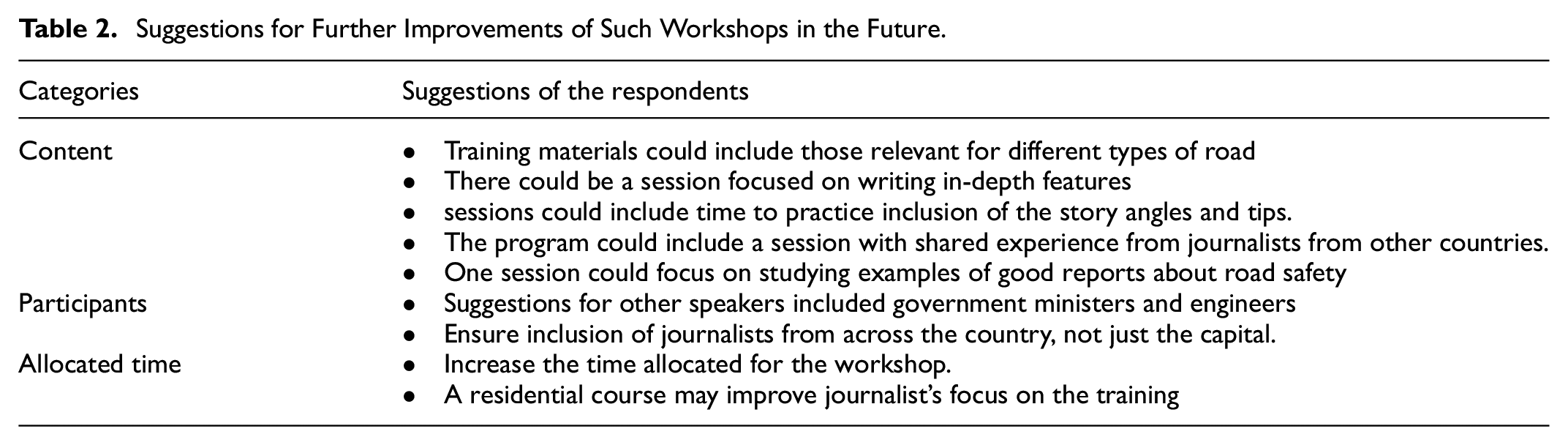
The respondents provided suggestions for how such workshops could be further developed in the future (Table 2).
Suggestions for Further Improvements of Such Workshops in the Future.
Critical Review of Published Articles
The following section describes the findings from the assessment of 94 published articles and/or stories produced by 10 participants. We were not able to identify named outputs for the remaining 21 participants. Three participants attended all three workshops, five attended two and two attended one workshop. The number of participants and number of outputs included for assessment are shown in Figure 1. Five of the 10 journalists had produced outputs before the first workshop, while the remaining five only produced road safety outputs after attending one of the workshops.
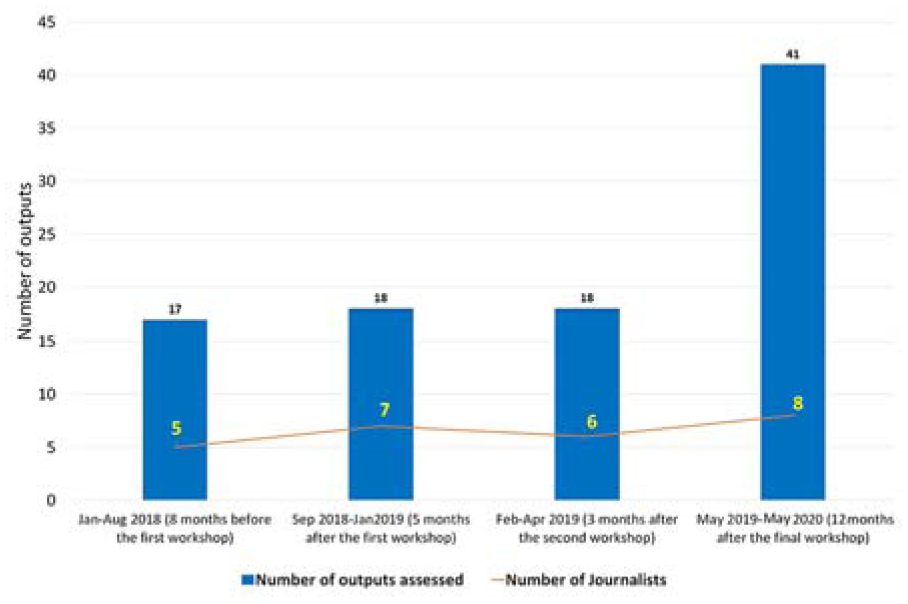
Number of outputs produced by the participants during different time periods.
Figure 2 shows the number of included outputs and the number of authoring journalists at different time points covering a span of 2 years that is, 8 months before the first workshop through 12 months after the third workshop. The intervals between the three workshops were not equal. Seventeen outputs (22%) were published before the first workshop (5 September 2018) and 77 were published after the first and subsequent workshops.

Number of outputs assessed for the period before- and after- the workshops, by journalist.
The outputs of five journalists who produced road safety pieces both before and after the workshops were explored to determine whether the content of their writing changed over time (Figure 2, Table 3).
Story Angles (SA) Used in the Outputs by the Participants Before- and After- the Workshops.
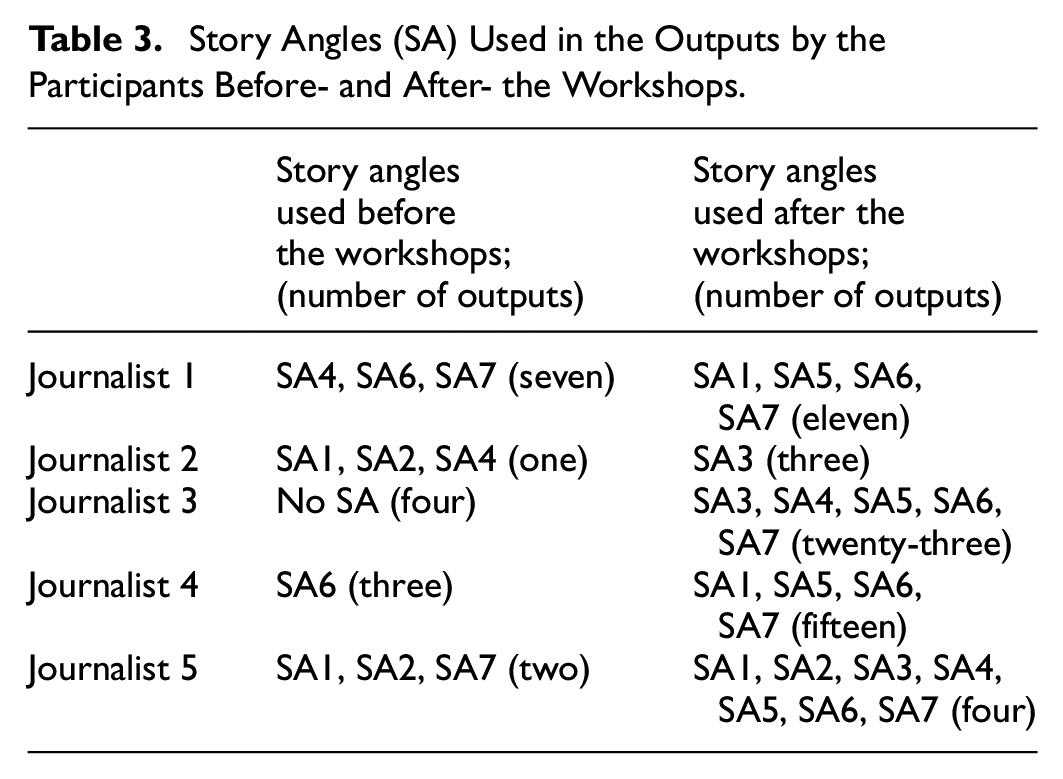
All five journalists increased the number of road safety outputs after attending the workshops. The 56 outputs published by these five participants in 20 months after attending the first workshop included all seven story angles (Table 3). The breadth of different story angles increased after the workshops. Story angles 1, 6, and 7 all increased in use after the training with four out of five journalists including story angles 6 and 7. These included arguing for improved legislation and its implementation (SA6) and a greater inclusion of evidence and data (SA7). The story angle 2 related to the impact of road injuries on quality of life was found to be the least commonly used. Figure 3 provides a comparison of the use of story angles before and after attending the workshops.

Story angles used in the stories by the participants before- and after- the workshops.
The frequency data on the use of Story Angles for the period Sept 2018 to May 2020 and shown in Figure 3, were obtained from the outputs produced by all 10 participants included in this study. In addition to the Story Angles found in the outputs, we also identified the road safety issues raised through those outputs. Table 4 summarizes the issues raised in the outputs published by the participants before and after attending the workshops.
Issues Covered in the Stories by the Participants Before- and After- the Workshops.

*The smart driving licenses are similar to ATM cards issued by banks. The license contains an electronic chip similar to a SIM card where the driver’s identity and vehicle registration number are stored. https://bit.ly/3z0dpz7
Table 4 illustrates the breadth of topics used by the journalists and highlights similarities and differences both between journalists and over time for individual journalists. The outputs published by the participants prior to the first workshop, tended to report a crash, including a description of its location and casualties. In addition, these outputs explored nine broad issues around the factors causing crashes, the safety of vulnerable road users and roadside environment obstructions. In contrast, the outputs published after attending one of the workshops were more diverse, covering 16 different issues. Common issues included after the workshop, that were less frequent before the workshops included the need for road traffic laws and their enforcement; the burden of death and injuries from road crashes; the provision of post-crash services including treatment and rehabilitation; the factors responsible for causing road crashes, the safety of pedestrians, and public transportation.
Discussion
Road safety is a neglected issue at policy- and decision-making levels in Nepal (Paudyal, 2020; Sathian et al., 2018). In other countries also, the concept of in-depth reporting about road crashes is not established and road crash reporting does not get enough space in media (Mogambi & Nyakeri, 2015) resulting in under-reporting of crashes (Das, 2021), injuries (Khadka et al., 2022) and potential solutions (Gupta et al., 2021). Media reports frequently only cover a description of the incident, without describing key factors leading to the crash or its preventability (Daniels et al., 2010; Das, 2021; Heng & Vasu, 2010; Yankson et al., 2010). These studies indicate how seldom journalists’ outputs consider broader issues such as the impact and preventability of road crashes. Many of the studies reporting on this topic evaluate outputs published in a specific type of media for a specified period. Only one has evaluated media outputs against the story angles described in the WHO Guide for journalists (Gupta et al., 2021). Our study followed the participants who attended the road safety reporting workshops we conducted to elicit their views on the training and to observe the impact on their outputs. We observed the adoption of the seven story angles described in the WHO guide for journalists after attending the workshops and application of the taught content. Most of the participants who completed the survey emphasized the role that the media and/or journalists can have in improving road safety awareness and influencing policy makers through their writing. Whilst some story angles were commonly adopted by participants, such as focusing on pedestrians as a vulnerable road user, other story angles such as the additional pressure placed on the health system by road traffic injury patients were seldom utilized.
We observed an interest among workshop participants to form a network where journalists could exchange information on road traffic injuries and road safety in Nepal and meet other journalists with similar interests. However, we noted a reluctance to share story ideas or concepts which is perhaps to be expected, considering the competition in producing materials through their media outlets. Such competition between journalists and editors has previously been described by the WHO (2015), along with the different perceptions of newsworthiness by journalists and editors.
Road crashes are the outcome of multiple and complex circumstances (Peden et al., 2004) and awareness of the various angles from which to explore a crash or its consequences could help create alternative solutions. An unbiased and factual report of a traffic crash needs an investigative journalism approach (Ralph et al., 2019; WHO, 2018b). However, many journalists are found to use a convenience approach (Yaqub et al., 2020). All of the Nepali media platforms lack separate bureaus of investigative journalism, although there is some work on exposing corruption, financial misappropriation and abuse of authority (Dhungel, 2018). The UK newspaper “The Guardian” started producing road safety features in 2012 under its Global Road Safety Focus program and since then a number of road crash stories from Nepal have been published (IRIN, 2012; Pattison, 2016). Recently, some Nepali media are following this international trend of featuring road traffic crashes and raising the need for road safety (Nepali Times, 2021; Pant, 2018; Phuyal, 2020; Sapkota, 2020).
Through our critical review of journalists’ outputs, we observed that most follow an episodic framing approach which describes road crashes as discrete incidents, where often the blame is reported to be with an individual (the driver in most cases). This, and a focus on certain conditions around specific incidents rather than highlighting potential solutions, has been noted by others such as Benjamin (2007). A recent study of Indian media articles (Gupta et al., 2021) noted that episodic descriptions were common, and the breadth of story angles promoted by the WHO were rarely employed. Guttman (2014) summarized the challenges posed to the discourse on road safety due to this dominant approach to how news media cover road traffic crashes. Challenges include the omission of safety measures; an over-emphasis on individual responsibility; a lack of emphasis on law enforcement; and an amplification of controversies around framing government’s actions aiming at transport management or road crash reduction. Some examples were related to the enforcement of mandatory helmet wearing for motorcyclist and pillion rider (Salokya, 2021; Setopati, 2019), enforcement of double driver rule for long-route public buses (Paudel, 2019a) and driving under the influence of alcohol (Paudel, 2019b; Sangroula, 2020).
The introduction of training and resources on road safety reporting to the journalists in our study encouraged them to engage in producing outputs covering a range of issues using multiple story angles. From the analyses of the outputs produced by the participants of our study, changes were observed in their contents before and after attending the training. After the training, some journalists adding the angle of needing better laws and implementation of those laws (SA6). Their arguments were found to be supported by evidence and data gathered from different sources (SA7).
Researchers have cited findings from road safety studies from the USA, UAE, South Korea, South Africa, Ireland, and Australia where road traffic fatalities and injuries were greatly reduced with the help of media advocacy between 1990 and 2008 (Heng & Vasu, 2010). Despite two decades promoting the term “road traffic crash,” (Davis & Pless, 2001; Evans, 1993) the term “accident” is still observed in Nepal due to a public perception of fatalism and a lack of understanding about the predictability of traffic crashes. The findings of our study support the findings of Gupta and colleagues (2021), suggesting that engaging journalists in solution-oriented reporting of road safety is possible and may result in the gradual improvements in quality outputs.
Strengths and Limitations of the Study
We used two methods to explore the impact of the workshops for journalists; including feedback from participants and an objective review of outputs against standards described in the published WHO resources. We included outputs published in either Nepali or English languages, increasing the number of outputs identified. By comparing outputs prepared before and after they attended the workshops, we were able to explore differences in reporting approaches over time. When inviting journalists to attend the workshops we asked the Editors of media outlets to recommend which of their staff should participate. It was anticipated that participants would already have experience of reporting road traffic crashes, yet during our review of outputs before the workshops, we did not find crash outputs for some attendees. It is possible that our retrospective searches for outputs missed some publications and collating this information prospectively may have identified additional outputs. We acknowledge that those who returned the questionnaire may differ from those who did not and may indicate those more engaged in the topic.
Conclusion
With the technical support of the World Health Organisation office in Nepal, the Nepal Injury Research Centre organized a series of three workshops to improve road safety reporting for Nepali journalists. To our knowledge, this is the first event of its kind and we found that editors and journalists were willing and interested to be involved. The workshops provided opportunities for the participants to reflect on their previous work, and to share experiences and ideas about working in this field. The Nepali versions of the WHO’s Guides for Journalists were reported to be used by the participants working across multiple types of media after the workshops, and an analysis of outputs suggests a change in the breadth and depth of story ideas reported after participation. The study suggests that journalists are interested in developing their road safety reporting skills and that running such workshops has the potential to improve responsible reporting and the promotion of road safety.
Supplemental Material
sj-docx-1-sgo-10.1177_21582440231204161 – Supplemental material for Engaging Nepali Journalists in Good Road Safety Reporting: Evaluation of the Impact of Training Workshops
Supplemental material, sj-docx-1-sgo-10.1177_21582440231204161 for Engaging Nepali Journalists in Good Road Safety Reporting: Evaluation of the Impact of Training Workshops by Puspa Raj Pant, Sudhamshu Dahal, Sunil Kumar Joshi and Julie Mytton in SAGE Open
Supplemental Material
sj-xlsx-1-sgo-10.1177_21582440231204161 – Supplemental material for Engaging Nepali Journalists in Good Road Safety Reporting: Evaluation of the Impact of Training Workshops
Supplemental material, sj-xlsx-1-sgo-10.1177_21582440231204161 for Engaging Nepali Journalists in Good Road Safety Reporting: Evaluation of the Impact of Training Workshops by Puspa Raj Pant, Sudhamshu Dahal, Sunil Kumar Joshi and Julie Mytton in SAGE Open
Footnotes
Acknowledgements
We would like to thank Mr Kannan Krishnaswamy of the George Institute for Global Health India for his contribution as a facilitator of the first workshop conducted in Kathmandu. We also like to thank the World Health Organization Nepal country office team for providing the Nepali version of the Road Safety Reporting Guide for journalists and 16 Story Ideas and support related to the final workshop conducted in Dhulikhel. We are also thankful to all the journalists who participated in the workshops and in this study.
Declaration of conflicting interests
The author(s) declared no potential conflicts of interest with respect to the research, authorship, and/or publication of this article. The lead author PRP is an Editorial Board Member of SAGE Open.
Funding
The author(s) disclosed receipt of the following financial support for the research, authorship, and/or publication of this article: The workshops and evaluation were funded by the HEIF Small Grants Scheme of the University of the West of England, UK. The time of the lead author was funded by the National Institute for Health and Care Research (NIHR) (Project ref 16/137/49) using UK aid from the UK Government to support global health research. The views expressed in this publication are those of the author(s) and not necessarily those of the NIHR or the UK Department of Health and Social Care.
Ethics Statement
Ethical clearance was obtained from the Institutional Review Board of the Kathmandu Medical College (Ref. 090820192). All procedures involving human participants in this study were in accordance with the ethical standards.
Informed Consent
Informed consent was obtained from all individual participants included in the study. Voluntary participation and confidentiality were assured.

Supplemental Material
Supplemental material for this article is available online.
References
Supplementary Material
Please find the following supplemental material available below.
For Open Access articles published under a Creative Commons License, all supplemental material carries the same license as the article it is associated with.
For non-Open Access articles published, all supplemental material carries a non-exclusive license, and permission requests for re-use of supplemental material or any part of supplemental material shall be sent directly to the copyright owner as specified in the copyright notice associated with the article.
