



Abstract
This study investigates the relationship between diversity in the Top Management Team (TMT) of Spanish firms and the firms’ willingness to further expand in China, as a proxy for their international success. Data from Spanish companies with direct investment in China were collected through a questionnaire. Regression analyses were carried out to test the differential influences of multiple forms of TMT demographic diversity (age, gender, tenure, and functional experience). The moderating effect of conflict in an uncertain environment is also examined, as this offers potentially novel insights into the determinants of success in emerging countries. Results show that the effects of TMT diversity on international success are very much influenced by the perception of the conflict related to investment in a non-traditional market. The findings highlight the relevant negative role that conflict can exert in diverse TMTs in a growing developing economy.
Introduction
The importance of the Chinese market as a destination for foreign direct investments (FDI) has stimulated the interest of companies and academic researchers. The potential benefits are high, as are the associated risks (Agarwal & Ramaswami, 1992). A company that continues investing abroad has successfully overcome the obstacles of undertaking foreign investment (Buckley et al., 1988) and, insofar as success implies growth (Penrose, 1956), international success could be understood as the willingness to further expand in the host country (De Clercq et al., 2005).
A company is unlikely to succeed internationally unless its TMT is adept at taking advantage of business opportunities in complex and foreign environments. At least in some cases, this ability is related to the TMT’s specific composition and characteristics (Fernández-Ortiz & Lombardo, 2009). In this respect, the upper echelons theory, developed by Hambrick and Mason (1984), is one of the most relevant theoretical perspectives for studying the implications of the TMT characteristics associated with achieving organizational results and developing successful business strategies (Nielsen, 2009). Managers do not normally act alone or independently. To address the influence of TMT composition on strategic company issues, the literature frequently analyzes the TMT as a group (Homberg & Bui, 2013; Richard et al., 2019). There is a stream of strategic literature analyzing the effects of the heterogeneity of the TMT in corporative decisions such as strategic change, internationalization or innovation (Jiang et al., 2021; Li, 2017; Puthusserry et al., 2021). This leads to the need to consider disparity among its members because that interferes with decision-making (Pelled et al., 1999; Simons, 1995). Conflict impacts teamwork processes such as cohesion, communication or creativity, and it has been studied as a factor that affects business decision processes and company performance (Cai et al., 2013; Ensley et al., 2002). It has been traditionally considered as a consequence of teams’ diversity, however in a context of environmental uncertainty, like in emerging market investments, conflict can also be understood as a contingency due to the higher expected discrepancies among TMT members when they face this kind of uncertain environment (Simons et al., 1999).
There are many studies relating TMT diversity and conflict to company performance variables such as return on assets, sales growth or success (Jackson & Joshi, 2004; Simons et al., 1999), but only a few studies have addressed internationalization issues (Carpenter, 2002; Fernández-Ortiz & Lombardo, 2009; Meng et al., 2019). Internationalization strategy implies risk and, therefore, potential disagreement or discussion within the TMT (Tihanyi et al., 2000). The characteristics of each manager can influence decision-making individually or as a group. The literature is sparse and inconclusive about the effects of TMT’s diversity on strategic decisions, especially when disagreement is high. Therefore, it is especially interesting to analyze the role of conflict in this international context of emerging markets where managers have less experience than in traditional environments.
The paper’s objective is to contribute to the strategic management literature by shedding some light on the antecedents of the decision to expand further in a foreign country as a measure of international success. To do so, it examines the effects that TMT diversity, as well as conflict within the TMT, could exert on international success in an emerging economy. The conflict could be especially relevant in the investment decisions, and expansion of western companies in these emerging markets (EM) and might play a distinct role given the cultural differences and the limited experience of previous investments. Therefore, it could lead to more strategic discussions within the TMT, not merely because of diversity among members but also motivated by the perception of environmental uncertainty.
Literature Review
Strategic choices are influenced by the personal background and prior experiences of top managers. Age, tenure, functional experiences etc. are used as proxies for the values and beliefs of members of governing bodies and, therefore, as determinants for their decisions (Hambrick & Mason, 1984). Besides, since the TMT is a group, the mixture of personalities, qualities and experiences of the members might lead to other processes having positive or negative effects on strategic decisions (Hambrick et al., 1996).
Focusing on group-level constructs, previous social research on diversity in organizations has already referred to the dilemma of whether heterogeneity or homogeneity within the TMT is better. Lenses rooted in social psychology theories (Homberg & Bui, 2013), such as the information decision-making perspective, state that heterogeneity leads to broader perspectives and a greater quantity of shared information, which consequently enhances decision quality (Williams & O’Reilly, 1998). These consider diversity to be of value for firms. However, a similarity-attraction perspective, or social categorization theory, highlight the negative aspects of diversity in creating social divisions and report negative outcomes for the group. Similarities between workgroup members in attributes, backgrounds or experiences explain easier interaction between team members and, therefore, an increase in team cohesion, group identity and commitment (Williams & O’Reilly, 1998). These are often associated with speedy and efficient coordination (Carpenter, 2002).
Many studies in the business literature investigate the effects of TMT diversity and refer to the conflict as a “double-edged sword” (Hambrick et al., 1996; Milliken & Martins, 1996) because of its multidimensionality (Amason, 1996). In general, the authors agree that two types of conflict exist: cognitive or task-related and affective or emotional. The former is more associated with positive consequences (Jehn et al., 1999), while the latter is usually harmful to performance (Jehn, 1994). However, De Dreu and Weingart (2003) concluded that any type of conflict is disruptive for performance since no differences in the consequences of different kinds of conflict could be detected. Along the same lines, Janssen et al. (1999) highlighted the connections between different types of conflict, arguing that both types are interdependent.
In conclusion, it seems that diversity and conflict influence firms’ performance and success, although the direction of any influence is inconclusive and deserves further research.
On the other hand, previous literature assessed international success as the growth of sales abroad (Fernández-Ortiz & Lombardo, 2009) or improvement of company performance in the foreign country (Cannella et al., 2008; Carpenter, 2002). These measures lose their effectiveness in the short term because internationalization effects in terms of sales or performance normally take time (Dess & Robinson, 1984). The willingness to expand further in the host country indicates whether the investment is successful without waiting several years to see if sales or profitability in the foreign country have increased.
In order to identify the relation between the composition of the TMT and company’s international success, we analyze diversity, understood as variety (Harrison & Klein, 2007), for three observable TMT characteristics proposed by the upper echelons theory: age, tenure, and functional experience (Knight et al., 1999; Simons et al., 1999). Moreover, we include gender diversity because, although it is omitted in most TMT studies, there is an increasing presence of women on corporate elites in today’s business landscape, and their influence on international success might well be significant (Krishnan & Park, 2005).
The arguments we use to build our hypotheses relating TMT diversity to international success will, in some cases, be the same as those we would use for performance since the effects are expected to be similar.
Age Diversity
Previous empirical research based on the upper echelons theory has confirmed that younger managers will be more inclined to pursue risky strategies. Consequently, firms run by young managers will experience greater growth (Fernández-Ortiz & Lombardo, 2009) and internationalization (Saeed & Ziaulhaq, 2019). However, the effect of age diversity is inconclusive. On the one hand, this theory assumes, in general, that team heterogeneity in turbulent environments will be positively associated with profitability. This general assumption could also be applied in the case of age diversity. Some authors have attempted to demonstrate that age diversity provides different perspectives and angles regarding the source of knowledge and information. Their hypotheses, however, were not always supported (Wiersema & Bantel, 1992).
On the other hand, there are arguments related to the negative influence of age diversity on performance because it can impair coordination, cohesion and agreement seeking among TMT members and, as a result, they might be slower and less efficient (Knight et al., 1999; Williams & O’Reilly, 1998). Tanikawa et al. (2017) found a significant and negative relationship between TMT age diversity and firm financial performance (as measured by ROE) in a sample of listed companies in South Korea. Also, Richard and Shelor (2002) verified that age diversity was negatively related to company ROA, but positively with sales growth. To further investigate these inconsistent findings, other authors in the literature added some contingent variables to identify the cases in which age diversity was beneficial for company outcomes. Variables such as environmental uncertainly or complexity are commonly used (Carpenter & Fredrickson, 2001). One such study found that low levels of TMT age diversity are positively related to performance, suggesting that homogeneous teams perform better in uncertain environments context (Richard & Shelor, 2002).
Thus, it seems that the benefits of group diversity in demographic characteristics cannot be expected for age, and the following hypothesis is proposed:
H1: Age diversity of the TMT negatively affects further expansion in EM.
Gender Diversity
Many studies have related company performance to whether men or women lead the organization (Croson & Gneezy, 2009). As noted below, we find contradictory evidence relating to gender diversity to company success and a lack of specific studies addressing this issue regarding international investments.
It should be stressed that the presence of women in TMTs is usually low (Dezsö & Ross, 2012), especially in internationalized firms (Ng & Sears, 2017). For this reason, they are sometimes not influential in company performance and are considered to be token (representation of 15% or less (Kanter, 1977)), which means that their presence has no real impact (Torchia et al., 2011). However, Reinert et al. (2016), in their study of financial institutions in Luxemburg, found that an optimal range (between 20% and 40%) of female management improved performance during periods of economic downturn, suggesting that gender-balanced management helps to improve success.
Some theoretical approaches, such as a resources-based view or dependency resource theory argue that gender diversity is positively related to company success. Women could be a valuable resource given the degree to which each gender contributes to management tasks with different and complementary competencies (Dezsö & Ross, 2012). Additionally, Krishnan and Park (2005) extended the upper echelons framework to gender diversity in TMT and showed a positive relationship between gender diversity and organizational success. They suggested that companies with gender diversity were more successful because they based promotion on merit rather than stereotypical assumptions.
On the contrary, theories of psychosocial research, such as similar attraction or social categorization, suggest that gender diversity neither increases performance nor is beneficial for company success. They suggest that it may slow the decision-making process due to the appearance of “in-group” bias and a preference toward individuals belonging to similar social categories (males/female) (Williams & O’Reilly, 1998). Regarding this psychosocial theoretical approach, gender-homogeneous teams have greater communication and higher group cohesion, which positively affects group decision making (Zimmerman & Brouthers, 2012). Moreover, Post (2015) stated that women provided greater cohesion in large and dispersed teams when coordination requirements were high, homogeneity perhaps best being feminine in these cases.
The literature thus suggests that gender diversity may add value but also entail some risks. In the context of the present study, where we aim to relate gender diversity to further expansion, we expected the relationship to be positive because the potential benefits of gender diversity, such as novel insights, perspectives, creativity and experience, appeared to foster and support expansion into new markets. Moreover, it might improve productivity in growth-oriented companies (Dwyer et al., 2003).
H2: Gender diversity of the TMT positively affects further expansion in EM.
Organizational Tenure Diversity
The effect of organizational tenure diversity (years of service in a company) on strategic decisions is not entirely clear, despite this being one of the most investigated aspects of the TMT (Homberg & Bui, 2013; Nielsen, 2009).
Hambrick et al. (1996) gave greater support to the upper echelons theory proposition concerning the positive relationship of tenure heterogeneity and profitability. During a highly turbulent period, their study of the airline industry found that TMTs with diverse organizational tenures had superior competitive and adaptive capabilities, which led to high growth rates in profits and market share.
Other authors critique this theory and show the negative side of heterogeneity in tenure (Carpenter, 2002; Carpenter & Fredrickson, 2001; Meng et al., 2019). They argue that, at high levels of internationalization complexity, tenure diversity is negative for company performance. It is the outcome of workplace socialization processes and ties that may prevent resolution and, therefore, be counterproductive under time pressures and accompanying high uncertainty. Zhang (2007) confirmed that tenure diversity was worst for firm performance. He argued that members with similar tenure have a similar understanding of the firm’s status quo and strategies and are familiar with the manner of expressing opinions, all of which facilitate communication, cooperation, and agreement in decision-making. In turbulent environments, where continuous changes require managerial responses, and much time must be spent on decision making, then having different points of view within the team does not result in a functional or effective process (Carpenter & Fredrickson, 2001).
Therefore, considering the complexity and uncertainty associated with investments in EM, this study hypothesizes that:
H3: Tenure diversity of the TMT negatively affects further expansion in EM.
Functional Experience Diversity
Managers’ functional background influences their strategic decisions. Managers with experience in marketing, sales, or R&D, emphasize growth and the search for new opportunities, whereas managers from the law or financial sectors relate positively to the degree of unrelated diversification and increased administrative complexity in the firm (Hambrick & Mason, 1984). On the other hand, based on upper echelons theory, and supported by the information decision-making perspective, different functional backgrounds positively affect company performance as they can provide different views and skills (Carpenter, 2002; Hambrick et al., 1996). Some authors, however, argue that this is true only under certain circumstances, for example, if an open debate is generated within the TMT (Cai et al., 2013; Simons, 1995) or if participation in decision making and information exchange is high (Boone & Hendriks, 2009).
On the other hand, functional diversity has negative effects on company and group processes, and these processes are mediators between diversity and performance (Kochan et al., 2003). According to Knight et al. (1999), it is harder to reach a consensus between members with different functional backgrounds as they may interpret the firm’s strategy differently. Moreover, members coming from different areas of expertise have less cohesiveness and higher disagreements (Ancona & Caldwell, 1992; Carpenter & Fredrickson, 2001). It is negatively related to the speed-response to environmental changes (Hambrick et al., 1996). As our study is in an emerging market, a non-traditional investment destination and one where more disagreements can appear, we propose that:
H4: Diversity of functional experience in the TMT negatively affects further expansion in EM.
Conflict
Conflict has been studied in the business literature, mainly from social psychology theories as a factor affecting team performance (Ancona & Caldwell, 1992).
It has been studied as a mediator of the relationship between diversity and performance (Cai et al., 2013; Ensley et al., 2002; Inegbedion et al., 2020), but also as a moderator since conflict can be focused on specific behaviors rather than on a general perception of difference resulting of heterogeneity (Janssen et al., 1999; Simons, 1995; Simons et al., 1999). In this sense, Simons et al. (1999) found that the effects of conflict were stronger for more job-related forms of diversity as it stimulates constructive debate.
Conflict has the positive effects of overcoming group thinking and stimulating more creativity in problem-solving issues (Jaw & Lin, 2009). However, it can also negatively affect business success as teams are less effective because they spend more time arguing or managing disagreements (Williams & O’Reilly, 1998). For example, diverse groups have referred to communication problems (Ferrier, 2001) and lower coordination that can delay the ability to act (Kanadlı et al., 2018).
Conflicts themselves do not exert a fixed influence on the outcomes (Tjosvold et al., 2006). Previous research highlighted that depending on the diversity, the influence of conflict on company outcomes varies (Homberg & Bui, 2013; Nielsen & Nielsen, 2013; Pelled et al., 1999). Environment or managerial complexity also may affect the role of conflict on company performance or success (Carpenter, 2002; Ramos-Garza, 2009; Williams & O’Reilly, 1998; Zimmerman & Brouthers, 2012). The complexity of the environment could induce higher levels of conflict within the TMT, at the precise moment when managers need more consensus (Liang et al., 2010) to make effective decisions and achieve organizational success (Ramos-Garza, 2009). Therefore, at high levels of conflict within the TMT provoked by the uncertainty typical of an emerging market, the positive effects of diversity may not balance the negative effects of a slower decision-making process if the market demands quick responses (Carpenter, 2002; Hambrick et al., 1996).
This study proposes a set of hypotheses regarding the negative moderating effect that conflict can exert on the relationship between the different types of diversity and further expansion in the context of an emerging environment:
H5a: Conflict negatively moderates the relationship between age diversity and further business expansion in EM.
H5b: Conflict negatively moderates the relationship between gender diversity and further business expansion in EM.
H5c: Conflict negatively moderates the relationship between tenure diversity and further business expansion in EM.
H5d: Conflict negatively moderates the relationship between functional experience diversity and further business expansion in EM.
These hypotheses are diagrammed in Figure 1.

The top management team and its impact on further business expansion.
Method
This study was carried out using a sample of Spanish companies having FDI in China. The first motivation for focusing the study on China was the importance as a recipient of FDI. The second was that it is not a common destination for Spanish companies, making it an excellent example of a complex and uncertain environment and a good candidate for the emergence of conflict within their TMT.
Data were collected during the period 2012‒2013, by contacting all 377 Spanish companies that had a joint venture or a Wholly Foreign-Owned Enterprise in China in 2012. The data sources for this were the Spanish Institute of Foreign Trade and the SABI database (Sistema de Análisis de Balances Ibéricos).
Companies were first contacted by telephone to explain the nature of the study, with follow-up via an e-mail questionnaire addressed to the Chief Executive Officer (CEO), which asked for information on all the team members included in the TMT, on different aspects of the company, and its internationalization process.
Subsequently, responses were received from 82 teams (i.e., 82 companies), which represented a response rate of 21.8% and one similar to other studies dealing with business strategy issues (Karami et al., 2006). To determine if there was a significant difference in terms of size (employees) and profitability (ROE) between the respondents and non-respondents, a t-test was conducted. When comparing these control variables, no significant differences were found at the 95% confidence level—the value for size being .362 (p = .717) and profitability −.425 (p = .671).
Empirical Data and Analysis
Dependent Variable
The willingness of the company to expand further in China was used as a proxy for international success. This variable was built using the opinion of the managers gathered from the questionnaire. As Karami et al. (2006) mentioned, this subjective way of defining the dependent variable is widely used and appropriate when the objective variables are unavailable (Dess & Robinson, 1984). It was necessary for our study—most foreign direct investors typically consider a time horizon of roughly 10 to 15 years when setting up a foreign investment (Novotný & Podpiera, 2008).
Items for building the variable were developed by following a sequential process (Hinkin, 1998). Firstly, questions to assess the willingness for further expansion were generated from previously published qualitative studies concerned company internationalization in China. Secondly, to evaluate the appropriateness of the scale (content validity), two experts in the internationalization process rated them. This allowed several items to be deleted, thus leaving only five questions for inclusion in the questionnaire. Items were scaled by using a 5-point Likert scale (where 1 means “strongly disagree” and 5 means “strongly agree”). Thirdly, an exploratory factor analysis (EFA) was conducted for validating the scale (internal validity) and items <.70 were proposed for removal (DeVellis, 1991), which finally left three questions concerning this issue.
An EFA was conducted from the managers’ responses by using principal component analysis as the extraction method and varimax as the rotation method. The result was consistent considering that the Kaiser-Meyer-Olkin measurement of sampling adequacy (.661), and the Bartlett test of sphericity were significant (p < .000). The factor with an eigenvalue greater than 1 that explained 67.5% of the variance was labeled as further expansion (Table 1). Cronbach’s alpha for this scale was .753.
Results of the Factor Analysis (Component Matrix).

Independent Variables
TMT demographics and diversities were used as independent variables in our models. For demographics, we used the age and tenure mean of the TMT members and the proportion of women in each TMT. Among TMT demografics, we decided to include just this one, gender measured as the proportion of women, and excluded functional experience, due to the high number of categories included in this variable. In the case of diversity, for categorical variables (gender and functional experience) we used the Blau Heterogeneity Index (Blau, 1977) with the formula 1−Σpk2, where pk is the proportion of unit members in the kth category. On the other hand, we used the variation coefficient for quantitative diversity variables (age and organizational tenure).
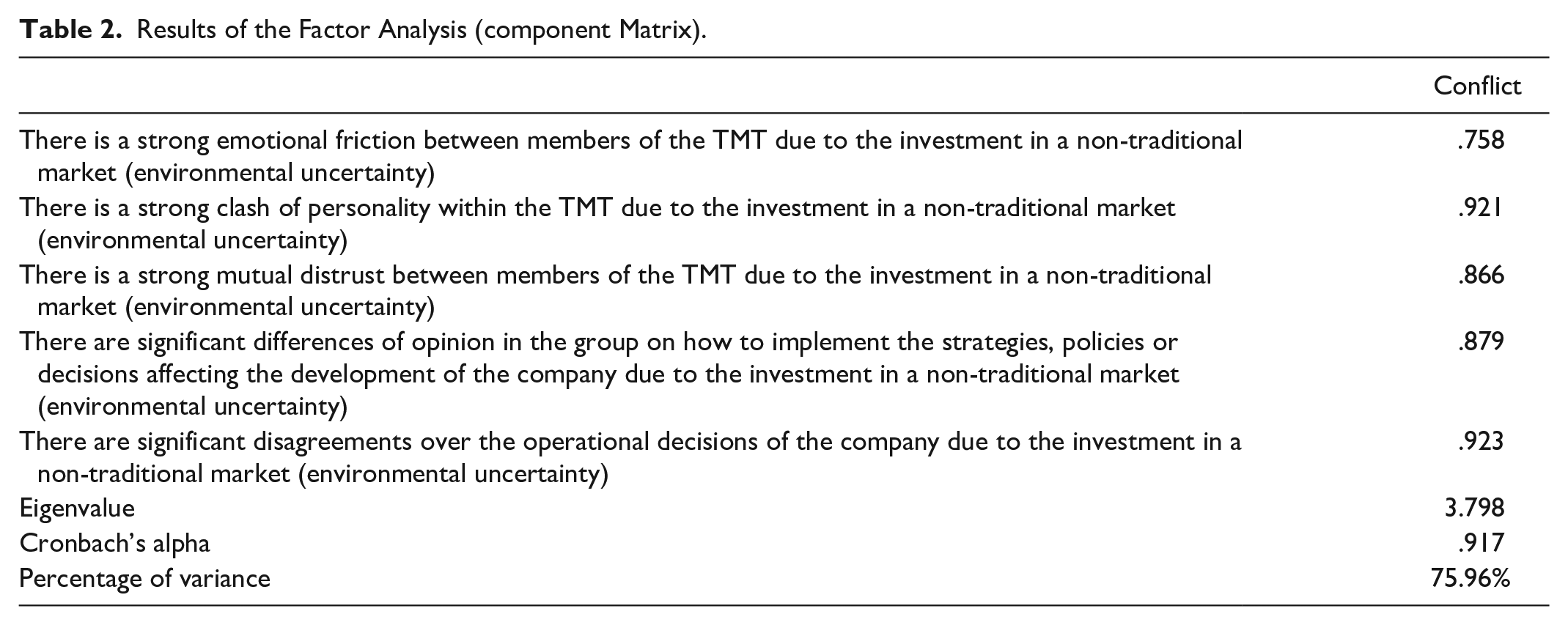
Finally, five questions were included in the questionnaire to measure the perception of conflict of managers within TMT due to their companies’ investment in a non-traditional market. The items used the same 5-point Likert scale described above (an adaptation of Jehn, 1994). An EFA was conducted by PCS with varimax rotation, and the result was consistent with the Kaiser-Meyer-Olkin measurement of sampling adequacy (.835), and the Bartlett test of sphericity was significant (p < .000). The result supported a single factor with an eigenvalue greater than 1 that explained 75.96% of the variance (Table 2). Therefore, the conflict factor was used as the independent variable and to generate interaction terms with diversity variables. The objective was to test if the relationship between each diversity and the willingness for further expansion changed with the managers’ perception of conflict originating from the investment. Cronbach’s alpha coefficients for this five-item scale were .917.
Results of the Factor Analysis (component Matrix).
Control Variables
Variables related to international company success were found to be: company size, previous performance and international company diversification (Cannella et al., 2008; Carpenter, 2002).
Concerning company size, the log number of total employees was considered because this variable showed a large dispersion, and the transformation allowed its normalization. It is widely recognized in the business literature that size affects company performance, also in terms of internationalization because large companies tend to have more resources (Javalgi et al., 2003).
Regarding ROE, the relationship should also be positive since profits are an indicator of success. Size and profitability (ROE) values referred to 2013.
Finally, the degree of international diversification has been associated with a firm’s performance and managerial complexity (Carpenter, 2002). It was calculated by using the Blau Heterogeneity Index (used above) for grouping countries where a company had a presence by continent, and the proportion per continent was then estimated.
Descriptive statistics and correlations are provided in Table 3. Regarding the average team demographic variables, the high mean of tenure should be highlighted. Members of the same TMT are, on average, in their mid-forties, and used to work together according to the data. On the other hand, the proportion of women is low, 20%.
Descriptive Data and Correlations.

Note. Correlation significant at the level of *.05 and **.01 (bilateral).
The mean values for age and gender diversity in their TMT were relatively low for companies in the sample. The greatest diversity was for tenure and functional experience. Another interesting result is the low mean level of conflict (1.88) among the members of the TMT in our sample. Regarding control variables, it was noted that, although there were financial difficulties for Spanish companies in 2013 due to the economic and financial crisis, those companies that specifically were investing in China had positive ROEs. Besides, the high mean diversification of overseas operations (.60) should be mentioned. China is typically not the first destination for Spanish companies investing abroad. They prefer closer destinations geographically and culturally, such as France or Latin America (Niñerola et al., 2017). Therefore, it was expected high degree of countries diversification in the sample.
While some independent variables had significant correlations, only the ones included in the same model should be considered, and they were normally quite low. Additionally, the highest VIF (variance inflation factor) was 3.97, which was well below the benchmark of 10 indicative of collinearity problems (Hair et al., 1995).
Results
Hierarchical regression analysis was conducted as in previous studies (Carpenter, 2002). We considered appropriate to test different models, some of them do not seek to test directly the hypotheses, but will be helpful to better know the variables related to TMT that better explain the international expansion in China of the companies in the sample. Model 1, considering control variables, explained 22.5% (p < .01) (Table 4). Model 2, which considered TMT demographics had an adjusted R2 of 22.1% (p < .05), representing a decrease of the first model of a 1.8%. In Model 3, diversity variables are included improving the explanation of the model but losing signification (adjusted R2 of 23.1% (p < .1)). Model 4 include all the variables, demographics and diversity. It had an adjusted R2 of 27.2% (p < .1). Finally, Model 5, considering conflict and its interaction effects, had an adjusted R2 of 56.6% (p < .01), increasing 33.5 percentage points on Model 3. This meant that the moderating role of conflict within the TMT provided a better explanation for a company’s success abroad.
Regression Results .

Note. Dependent variable: Further expansion.
p < .01. *p < .05. †p < .10 (bilateral).
The results confirmed that TMTs with high gender diversity and lower functional experience diversity were more likely to undertake further expansion in China.
Gender diversity was positive and marginally significant in Models 3 and 5 (β = .306, p < .1 and β = .229, p < .1, respectively), which means support for H2 (gender diversity positively affects further business expansion in EM).
The other hypothesis that appeared to be significant was functional experience diversity. Therefore, H4 was retained because, as can be seen, its beta coefficient was negative (β = −.325, p < .01, and β = −.549, p < .01, in Models 3 and 5, respectively), indicating that having a functional heterogeneous team negatively affects further expansion in China.
The hypotheses related to age and tenure diversity (H1 and H3) could not be retained or rejected, as they were not statistically significant in either model.
When the effects of conflict among members of the TMT were introduced, the results showed two significant interaction terms. Conflict and gender diversity, and between conflict and functional experience diversity. This means that the effects of gender diversity and functional experience diversity on further expansion in China depended on the level of conflict perceived.
The effect of conflict in Model 3 is not statistically significant (β = .278, p > .1). Conflict itself does not have negative or positive influences on further expansion. Instead, it is its interaction with diversity that negatively or positively influences the relationship between diversity and further expansion, according to the type of diversity.
In the case of gender diversity, its influence on further expansion was positive, meaning that greater gender diversity is related to higher expansion in China. However, when conflict within the TMT increased, the previous influence between gender diversity and further expansion diminished, even becoming negative in the case of high conflict (β = −.290, p < .1) (Figure 2). Therefore, H5b stating that conflict negatively moderates the relationship between gender diversity and further business expansion in EM could be retained, confirming the negative moderator effect of conflict.
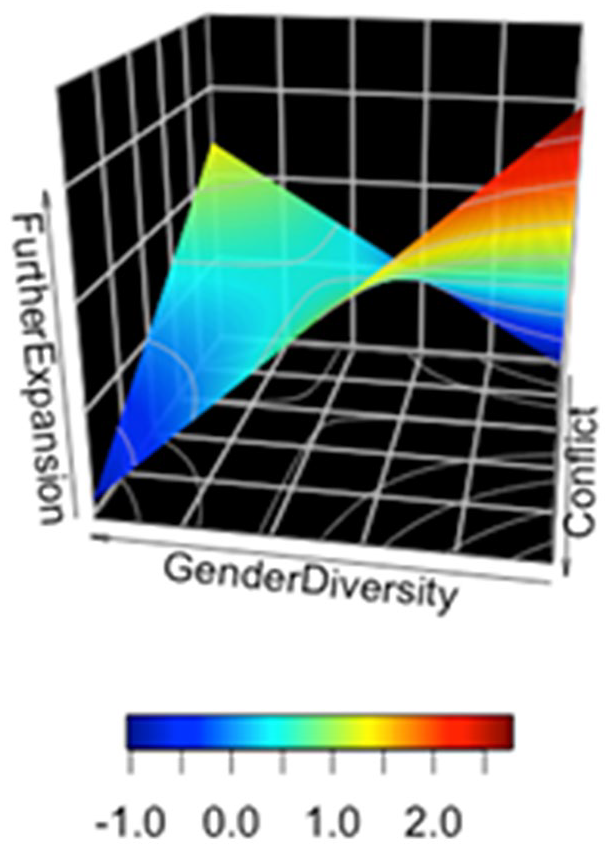
Interaction effect between conflict, gender diversity and further expansion.
The other relationship concerning functional experience diversity was significant and negative, as expected. However, conflict changed the strength of this influence, which meant that, when the level of conflict within the TMT grew, this negative effect became even more negative (β = −.707, p < .01) (Figure 3). Therefore, H5d was retained because the results confirmed that functional experience diversity had a negative impact on further expansion in China, which was more negative in a high level of conflict among the TMT members.
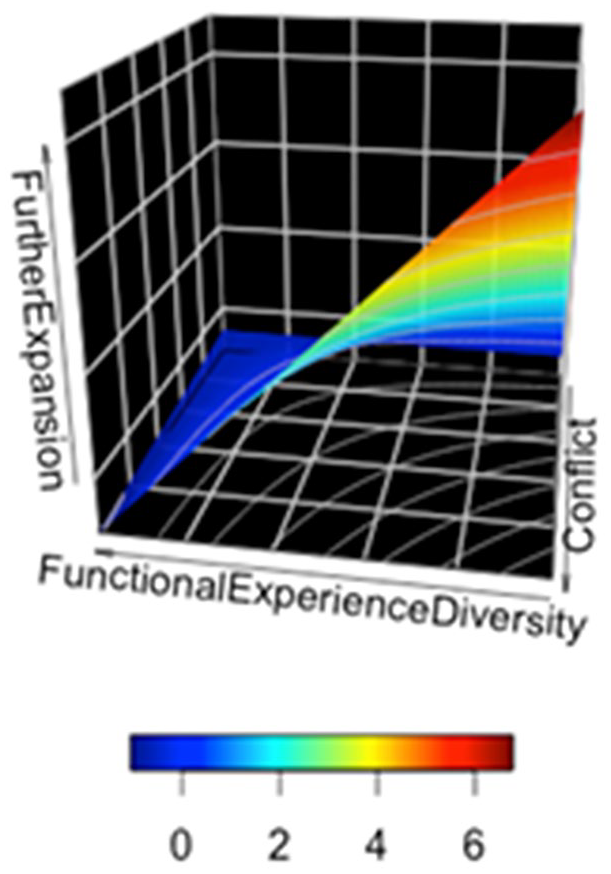
Interaction effect between conflict, functional experience diversity and further expansion.
Hypotheses H5a (Conflict negatively moderates the relationship between age diversity and further business expansion in EM) and H5c (Conflict negatively moderates the relationship between tenure diversity and further business expansion in EM) could not be retained or rejected, as they appeared to be statistically non-significant in Model 5.
Finally, in Model 5, international diversification was positively related to further business expansion because highly internationalized companies tended to continue growing (β = .373, p < .05).
Discussion
As in the literature, this study argues that TMT diversity influences firm’s success (Milliken & Martins, 1996; Simons, 1995). Our findings confirm that gender and functional experience diversity affect further expansion. However, the negative influence of age and tenure diversity is not confirmed.
Results regarding gender diversity show that having women on the management team was positive for success (Krishnan & Park, 2005). Despite the proportion of women in our sample is low (20%), we believe that this result is still valid since, in general, the proportion of women in managerial positions is lower than men. So having women on the team adds up (Hernández-Lara et al., 2021). The behavior of men and women managing organizations differs (Croson & Gneezy, 2009), and their views and leadership styles, among other aspects, may also be different which means that they can provide different and richer solutions in the same scenario. As Dwyer et al. (2003) also showed, gender diversity is positive for making better decisions because of the different perspectives. Moreover, the participation of women influences managerial functions implicating changes in power, political savvy, conflict management and trust (Klenke, 2003).
The study also demonstrates that this previous effect changes when there is no agreement on decisions within the TMT. The positive influence of gender diversity on company expansion is diluted at high levels of conflict. Conflict acts as a moderator of this relationship. As in previous studies, our research finds that, in this case, conflict does not enhance strategic debate but rather negatively affects company strategic decisions (Ensley et al., 2002; Joshi & Roh, 2009; Zimmerman & Brouthers, 2012). It is justified because the differences between men and women within the TMT in an uncertain environment that motivates conflict within the team hampers the cohesion needed to make effective decisions in changeable markets (Zimmerman & Brouthers, 2012). Consequently, although the presence of women brings new insights and more creativity (Dwyer et al., 2003), it is necessary to manage gender differences within the TMT in order to avoid conflict.
On the other hand, findings regarding functional experience diversity contradict previous literature that argued its positive effect on foreign direct investment (Li, 2017; Meng et al., 2019). Diverse TMT members can enrich the team’s knowledge, facilitate efficient team learning, and enhance the decision-making capacity on overseas expansion. However, the negative influence of functional experience diversity on further business expansion in China was expected within the study context (Carpenter & Fredrickson, 2001).
The explanation of this relationship is based on the fact that teams with different functional backgrounds generate slower decision-making processes (Kanadlı et al., 2018) as they experience a lower degree of cohesion (Ancona & Caldwell, 1992). Moreover, this is exacerbated in geographically dispersed teams, as in companies with a high level of internationalization (Cannella et al., 2008). Managers coming from output functions (marketing, sales or R+D), throughput functions (production, accounting or engineering) or peripheral functions (law, finances, etc.) have different objectives or emphasize different aspects of the internationalization process, with consequent negative effects.
According to the study results, when perceived conflict within the TMT is high, its negative effect on further expansion is even higher. Simons et al. (1999) already found that conflict moderated the effect of diversity on firm performance, making its effect stronger in types of job-related diversities. In this sense, the functional experience is highly job-related (Joshi & Roh, 2009), confirming previous findings. It must be stressed that functional diversity is very high in our sample. For this reason, the negative result for the relationship between functional experience diversity and further business expansion is interesting because the companies had multifunctional TMTs.
Our findings contrast with previous studies that highlighted the dual role of conflict (Ensley et al., 2002; Pelled et al., 1999). In the specific case of Spanish companies investing in China, conflict seems harmful to further expansion.
Although TMTs tenure, in terms of diversity and average, seems not to affect our finding statistically, it is high in our sample. This fact could be relevant for interpreting our results. Previous results found that the current composition of the team determines what the effect of tenure diversity would be in performance (Yi et al., 2018). In this sense, some authors argue a moderation role of group tenure and resilient performance of a firm in the international context suggesting more elevated levels of cohesion (Chen et al., 2015). Jukka (2020) also found that TMT members with long firm tenures would benefit TMT performance as they integrate their behavior or act more like a team. In fact, in our data, conflict is not very high (mean 1.88 out of 5), supporting the statement that long tenure within the firm blur the perception of conflict. Our study shows that the correlation between the average tenure and the conflict is negative, despite it being very small and not significant. Therefore, we could not statistically demonstrate the relationship between long tenure and low conflict. However, we observe indeed that these two characteristics of the TMT coexist in our sample, and it is likely that configure a reality where demographic diversity in the TMT could diminish its potential influence on the arise of conflict. It is worthy to say that more research, with more data, would be necessary to corroborate these findings. Finally, our results also confirm a relevant matter on what could be more relevant for explaining the expansion in emerging markets regarding the TMT demographic composition, corroborating that the influence of the team demographics in average terms is not as relevant as the influence of demographic diversity.
Overall, conflict within the TMT, motivated by investing in an emerging and complex market, having diversity in the team might not be fruitful because this jeopardizes the need for quick responses and the higher consensus demanded in these situations (Liang et al., 2010). Consequently, revisiting the question of TMT composition is recommended. Our findings strongly support De Dreu and Weingart (2003), who argued that conflict was negative, although it may have positive consequences under particular circumstances. However, in our context, the negative aspects of conflict usually have more weight and damage decision-making.
Conclusions, Limitations and Future Directions
Although previous research examined links between the TMT and certain performance variables, to the authors’ best knowledge, there are no studies that have addressed the relationship between the characteristics of the TMT and a firm’s internationalization success through the willingness to invest further in the host country. Therefore, this method of measuring success, which allows gathering current information, constitutes the first contribution of this study.
Second, the study supports the hypothesis that, based on TMT demographics, companies will have greater or less propensity for further expansion. The upper echelons theory was an appropriate conceptual framework for analyzing this strategic issue. We find that conflict moderates the relationship between demographic diversity (gender and functional experience diversity) and international success. We justify the moderation of conflict under specific circumstances rather than its mediation of the relationship between diversity and company success. Conflict is considered as intrinsic to emerging market expansion. Lower levels of perceived conflict by the TMT are better for improving success, supporting similarity-attraction perspective arguments. In this sense, the study sheds some light on the open debate concerning the controversial effects of conflict on strategic decisions, specifically those related to internationalization.
Third, the study examines this issue in a growing, developing economy with different characteristics from the usually-studied European or American developed economies (Homberg & Bui, 2013). In an emerging and changing context, the effects of conflict may be different and have different proportions since they are markets where we have less experience, so decision-making discrepancies may be more relevant. In this sense, having higher tenure within the TMT may reduce the perception of conflict and promote the company expansion strategy.
While the results expand our knowledge of TMT and firm international expansion, there are limitations in this study. Considerable effort was made to collect a representative sample and avoid biases but data only consists of firms from a single country. The sample size, although representative of the total population that we wished to study, was too small to generalize the results. Moreover, Spanish companies investing in China are not inexperienced in internationalization since China is not usually their first destination country. For this reason, they are usually companies with experience and managers with long tenures. So, our findings should be considered with caution as companies with other compositions of TMT members may experience other behavior. This particularity could decrease the generalizability of the results.
On the other hand, although the sample was obtained in 2013, the results can also be valid today since the effects of diversity are timeless. The study implications are derived from the composition of the TMT at the moment when the data was collected. This does not depend on the specific year, but future research could collect new data to test whether the results are reaffirmed with the variations produced in the TMT’s composition.
The small sample size did not allow us to consider a more complex model. Moreover, some other aspects affect groups dynamics that can be explored in the future as further research. In this sense, previous research also introduces the analysis of demographic faultlines when address groups diversity affecting decision-making and strategic change (Lau & Murnighan, 1998; Richard et al., 2019). They suggest that team members’ attributes can influence a team’s behavior performance. In this study, our data was not propitious for drawing these hypothetical dividing lines for splitting groups. Perhaps if most companies were JV, including managers from different companies, nationalities or cultural values, which was not the case, it would be clearer to make groupings and analyze the dynamics of these subgroups. It is, therefore, a line that we can explore in future works.
Footnotes
Declaration of Conflicting Interests
The author(s) declared no potential conflicts of interest with respect to the research, authorship, and/or publication of this article.
Funding
The author(s) received no financial support for the research, authorship, and/or publication of this article.
