




Abstract
The article examined “managing diversity for organizational efficiency.” It sought to find out the extent to which diversity management influences organizational efficiency through the management of conflict, cultural diversity, and employees’ perception of marginalization as well as teamwork and employee work attitude. The survey design was employed. A sample of 178 respondents from nine multinational companies in south-south Nigeria was employed. Research data were analyzed using structural equation modeling, with diversity management and organizational efficiency serving as latent variables. The results show that the management of cultural diversity, employees’ perception of marginalization, and conflict significantly influences diversity management. Furthermore, diversity management and teamwork significantly influence organizational efficiency. The need for managers of diverse workforces to give priority to diversity management, to ensure its effective implementation, was suggested, among others.
Keywords
Introduction
The workplace is becoming more and more diverse than ever, owing to the impact of worldwide economic integration, also known as globalization, which has now made the world a global village. Workplace diversity has several dimensions ranging from ethnic to linguistic, national, economic, and organizational cultures. No doubt, globalization is an on-going process that is concretizing the linkages between people, cities, neighborhoods, regions, as well as countries closer together than they have ever been before (UNESCO, 2013). A direct consequence of this development is the intertwining of the lives of people from one part of the world with people from other parts, through various mediums such as clothing, food, music, information, and ideas. The rate at which organizations have become complex and ambiguous, coupled with enormous work pressure, in the wake of strong competition, has necessitated the building of a global culture capable of inspiring and attracting employees from different parts and regions of the world to be suitable for employment in any organization without any feeling of incompatibility (Panda, 2010).
The ability to fit into any organization in any part of the world without any feeling of estrangement is a global corporate culture which thrives under effective diversity management. It is for this reason that diversity management appears to have assumed significant importance in management literature in recent times with various academics from across a wide spectrum of interrelated intellectual disciplines researching and examining the concept from different perspectives. They include Ikeije and Lekan-Akomolafe (2015), Green et al. (2015), Edewor et al. (2014), Wambui et al. (2013), Olsen and Martins (2012), Panda (2010), Henry and Evans (2007), as well as Edewor and Aluko (2007), among others.
A significant number of previous studies investigated diversity management to ascertain its influence on organizational success or effectiveness as well as the challenges of workforce diversity. Panda (2010) investigated the influence of cultural diversity management on organizational success. Henry and Evans (2007) reviewed workforce diversity to determine how it influences the success of an organization. “The benefits of diversity” was the focus of Smith and Schonfeld (2003). Ikeije and Lekan-Akomolafe investigated the influence of employee’s diversity and inclusion on organizational management. Green et al. (2015) investigated the benefits and constraints of diversity in the workplace and the required tools for managing it. Edewor and Aluko (2007) examined the constraints and prospects in multicultural organizations. Olsen and Martins (2012) focused on “understanding organizational diversity management programs.” Shena et al. (2009) investigated “diversity management through human resource management.” Wambui et al. (2013) investigated “diversity management in the workplace” from the perspective of Kenya, whereas Edewor et al. (2014) adopted a national perspective to the study of diversity.
From the numerous studies done by previous researchers, it is evident that not much has been done to ascertain the influence of diversity management on organizational efficiency. Given the preponderance of workplace diversity in contemporary organizations, its influence on organizational efficiency deserves attention as it is crucial to organizational competitiveness. This underscores the essence of this study.
Conceptual Clarification
This section examines the concept of diversity and two key concepts used in this study—marginalization and organizational efficiency. Diversity refers to the differences in employees as a result of the various backgrounds to which they belong. These backgrounds include but are not limited to gender, age, race, color, ethnicity, and physical ability. Marginalization refers to the domination of a group by another group in an organization as a result of diverse backgrounds (gender, age, race, color, ethnicity, and physical ability) in an organization. Thus, there could be gender, age, race color, as well as physical ability marginalization, and domination as the case may be.
Organizational efficiency is the relationship between inputs and outputs of a given activity. Farrell (1957) sees efficiency as success in producing as much output as possible from available input. It is for this reason that Aubyn et al. (2009) regard “efficiency as the rate at which outputs compare with inputs. The lower the ratio of input to outputs the more efficient the system or organisation” (p. 5). Thus, efficiency summarizes an organization’s competence in producing at cheaper and better ways.
Objectives of the Study
The main objective of the study was to investigate the extent to which diversity management enhances organizational efficiency. The specific objectives were to examine (a) the extent to which the management of employee perception of marginalization, cultural diversity, and conflict, as well as work attitude influence diversity management and (b) the extent to which teamwork and diversity management influence organizational efficiency.
Literature Review
Workforce diversity has characterized most contemporary organizations in recent times with its attendant challenges and increasing complexity. Diversity management has thus assumed monumental importance in the mitigation of the challenges of workforce diversity (Edewor et al., 2014; Ikeije & Lekan-Akomolafe, 2015; Panda, 2010; Patrick & Kumar, 2012; Suri & Sharma, 2011, as well as Edewor & Aluko, 2007). The differences in employees as a result of the coming together of people from various backgrounds are called workplace diversity. The backgrounds that cause differences in people include race, nationality, religion, and sex, among others. Thus, the convergence of people from different races, nationalities, religions, age groups, and sexes to form a group, organization, or community constitutes workplace diversity (Tenas, 2012). It is the continuous interaction of people or employees from diverse sociocultural backgrounds in an organization.
Shena et al. (2009) observe that the major factors of diversity are gender, age, race, color, ethnicity, and physical ability, among others. The broader definition of diversity may include “age, national origin, religion, disability, sexual orientation, values, ethnic culture, education, language, lifestyle, beliefs, physical appearance and economic status” (Wentling & Palma-Rivas, 2000, p. 72). Some of the characteristic features of a diverse workforce include ways of viewing the world, diverse beliefs, understandings, values, and unique information (Shena et al., 2009). To this end, diversity involves multifaceted viewpoints and cultures (Panda, 2010). Diversity recognizes that people are unique and that everyone is different in a variety of visible and nonvisible ways. Diversity is any factor that distinguishes one individual from another, that is, any factor by which two or more individuals are dissimilar. Such differences are often found in their races, ethnicity, as well as socioeconomic, geographic, and academic/professional backgrounds. To express this succinctly, diversity concerns the heterogeneous nature of people due to certain dimensions, especially gender, race, ethnicity, personality, and culture.
Dimensions of Diversity
Understanding the dimensions of diversity helps to determine the dimensions that significantly influence employee behavior at work. This makes the concept important to policy makers, especially strategic managers of organizations, because knowledge of the significant dimensions and the consequences of such dimensions enhance diversity management. Four layers of dimension include “Personality; which includes an individual’s likes and dislikes, values, and beliefs. Internal dimension, which include aspects of diversity that are beyond the control of the individual and which forms the core of many diversity efforts” (Gardenswartz & Rowe, 1998); external dimensions, which consists of those aspects of diversity that are under our control and organizational dimensions, which focuses on the organizational culture. According to Gardenswartz and Rowe (1998), “while much attention on diversity is focused on the internal dimensions, major issues of preferential treatment and opportunities for advancement or promotion are influenced by the aspects of external dimensions.” Carnegie Mellon University’s (2014) typology grouped diversity into primary and secondary orientations. Age, race, ethnicity, gender, physical abilities/qualities, and sexual orientation constitute the primary orientation, whereas education, family status, income, work background, religious beliefs, geographical location, military experience, and relationship status constitute the secondary orientation University of Washington (2018) identified age, gender, ethnicity, race, cultural heritage, and religions and sexual orientation as six dimensions of diversity. Irrespective of the categorization, there are certain factors that are germane to diversity which accompany employees from various backgrounds to their respective organizations; they include the individuals’ personality, gender, race, age, ethnicity, and religion.
Challenges of Diversity
Empirical literature indicates that gender discrimination, communication barriers, ethnic marginalization, discrimination, resistance to change, and age are the major challenges of workplace diversity (Finn, 2015; Greenberg, 2015; Lyknis et al., 2014; Renee, 2014; Wengrzyn, 2015).
Benefits of Diversity
Despite the challenges of diversity, there are conspicuous benefits that can make a diverse workforce yield a positive trade-off. This is what makes a diverse workforce attractive in the contemporary global environment. The benefits of workplace diversity include rapid adaptability, availability of a greater variety of alternative techniques for solving problems, in-service sourcing, and allocation of resources (Duke, 2012; Greenberg, 2015). Other benefits are wider range of service, diverse assemblage of skills/experiences, diverse languages and cultural background (Duke, 2012; Greenberg, 2015), and diverse viewpoints (Greenberg, 2015; Philips, 2014). The diverse assemblage of skills and experiences coupled with the variety of alternative techniques for solving problems leads to efficiency and effectiveness in the execution of projects (Greenberg, 2015).
Managing Diversity
Some aspects of business operations and societal life, such as employee supervision, group cohesion, as well as employee and customer service, are influenced by workplace diversity. The diverse assemblage of skills and experiences in a diverse workforce increases innovation as well as growth and creativity, which all contribute to business competiveness in the global economy. Diversity management aims “to create and maintain a positive work environment that values the similarities and differences of individuals” (Patrick & Kumar, 2012, p. 5). It seeks to acquire the knowledge and dynamic skills necessary for efficient and effective management of such work environments. Diversity management enables an organization to look beyond the complexities of diversity and value the differences in people occasioned by diversity (Tenas, 2012) with a view to leveraging the benefits of the widest possible range of views and experiences associated with it. Specifically, diversity management seeks to promote the acceptance and respect for the uniqueness of individuals as well as the recognition of individual differences owing to their uniqueness in the dimensions of diversity. It is the recognition of these diverse differences in an environment through a mutual understanding and a deliberate and common resolve not just to tolerate one another, but to embrace and celebrate the rich and diverse dimensions inherent in each individual. To this end, diversity management seeks to capture the heterogeneity of groups or people and explore the same for the benefit of the group in particular and the society at large. Given the expected benefits of workforce diversity vis-à-vis the associated challenges, diversity management becomes very important because it aims to sufficiently minimize the challenges while leveraging the benefits associated with a diverse workforce to enhance efficiency and thus maximizing profits. This makes diversity management sacrosanct to the success of organizations with diverse workforces.
Empirical Review
Kundu and Mor (2017) examined “workforce diversity and organizational performance of IT industry in India.” The purpose was to determine the extent to which employee perceptions of diversity management influence performance as well as find out whether employee perceptions of diversity are related to their backgrounds in the Indian IT industry. They used primary data elicited from 402 respondents. Factor analysis, correlations, analysis of variance, means, grand means, and regression were performed to analyze the data. Results indicated that there was no significant relationship between employees’ background and diversity management, but perceived promotion of gender diversity by employees was found to have a significant positive influence on their performance. Odita and Egbule (2015) investigated workforce diversity and organizational effectiveness in Nigerian brewing industry with a view to assessing the effects of workforce diversity on effectiveness in the brewing industry using selected breweries in Nigeria. They employed the survey design and used stratified random sampling to select respondents. The data elicited were analyzed using linear regression and correlation. They found that workforce diversity and organizational effectiveness were positively related and the relationship was statistically significant. Specifically, cultural diversity was found to be more effective; also, team building and group training were found to mediate between workforce diversity and organizational effectiveness.
Guillaume et al. (2014) developed a multilevel model to identify workgroup factors, organizational factors, and societal factors that may influence the effective management of diversity in organizations. They present a model which seeks to lay the foundation for future research and identify possible limitations and practical implications of the model for managing diversity in organizations. Sabharwal (2014) investigated organizational inclusion and its association with performance beyond diversity management. Survey design was employed to elicit data from public managers in Texas agencies. Results showed that diversity management alone is not sufficient to enhance performance in organizations. Goyal and Shrivastava (2013) review models and measurement of organizational diversity climate to present a visible picture of an organization’s diversity climate as well as show how diversity management and diversity initiatives and programs contribute to the overall organizational diversity climate.
Suri and Sharma (2011) investigated diversity management and organizational effectiveness in Indian organizations with a view to ascertaining the degree of diversity management and organizational effectiveness in public and private sector organizations. They elicited information from 60 middle-level managers from private and public firms in Delhi. Two scales (diversity scale and organizational effectiveness scale) were employed. Data were analyzed using t test and correlation. Results indicated that public and private sector organizations differed significantly in diversity management and diversity management was found to have a significant positive influence on organizational effectiveness of private firms.
Simons and Rowland (2011) investigated diversity and its impact on organizational performance. They employed thematic analyses to the definitions of diversity in management literature to ascertain the extent to which the differentiation is consistent with theoretical or practical discussions of diversity management.
Gap in literature
Although diversity management appears to be attracting attention in contemporary organizations in recent times, few researchers have investigated its relevance of organizational strategy. Kundu and Mor (2017) found that employees’ perception of promotion of gender diversity was positively related to organizational performance. Odita and Egbule (2015) found that cultural diversity, team building, and group training mediate between workforce diversity and organizational effectiveness. Suri and Sharma (2011) found a significant positive relationship between diversity management and organizational effectiveness of private firms. However, it is doubtful whether any empirical studies have examined the possible influence of diversity management on organizational efficiency. Furthermore, it is not certain if any studies have attempted to model the relationship between key dimensions of workplace diversity, especially employee perception of marginalization and organizational outcomes. This study sought to bridge these gaps.
Method
The population of the study consisted of multinational companies in south-south Nigeria. Specifically, nine multinational companies (Coca-Cola, Guinness, MTN, Nestle, Julius Berger, Mobil Oil and Gas, Total Plc., Cadbury Plc., and Airtel Nigeria) were randomly selected and studied. The sample consisted of 76 online respondents as well as 102 MBA alumni of the University of Benin, consistent with Inegbedion and Obadiaru (2018), Inegbedion (2018), and Inegbedion et al. (2016). A structured questionnaire served as the research instrument. The instrument featured items of the Likert-type scale type. Cronbach’s alpha was used to test for reliability of the instrument, whereas the data were analyzed using structural equation modeling. The choice of structural equation modeling was informed by its suitability in analyzing problems involving latent variables, bearing in mind that diversity management is a latent variable. Organizational efficiency was also treated as a latent variable as it was measured by respondents’ perception. Management of employees’ perception of marginalization and management of cultural diversity, conflict management, and work attitude served as mediating variables between diversity management and organizational efficiency. Teamwork and diversity management served as explanatory variables of organizational efficiency. Stata software was used to implement the data analysis.
Model Specification
The model specification is given as follows:


The models’ equations are


The structural equation model (SEM) is

where Sem = structural equation model; wa = employee work attitude; mepm = management of employees’ perception of marginalization; mcd = management of cultural diversity; cm = conflict management; tw = teamwork; L1 = diversity management; L2 = organizational efficiency;
Equation 5 is the SEM of the study. The first bracket shows that work attitude, management of employees’ perception of marginalization and management of cultural diversity and conflict management are the explanatory variables of diversity management (L1), whereas diversity management (L1) and teamwork are the explanatory variables of organizational efficiency (L2). Thus, work attitude, management of employees’ perception of marginalization, and management of cultural diversity and conflict management are mediating variables in the model because they explain the link between diversity management and organizational efficiency.
Decision rule
The asymptotic significant probability served as the decision variable. Values less than 1% (.01) indicate significance at 1% (99% confidence level), whereas values less than 5% (.05) but greater than 1% indicate significance at 5% level (95% confidence level).
Results
Results of the SEM indicate that management of employees’ perception of marginalization (mepm) and management of cultural diversity (mcd) and conflict management (cm) are significant predictors of diversity management; the first latent variable (L1) at 1% level because the asymptotic significant probabilities associated with the tests are less than 1% (.01) the assumed levels of significance. This is shown by the calculated Z and associated asymptotic significant probabilities, which are 2.88 (.004), 3.04 (p < .001), and 2.71 (.007) for management of employees’ perception of marginalization and management of cultural diversity (mcd) and conflict management, respectively (see Table 1). But as L1 is diversity management, we can conclude, at 99% confidence level, that management of employees’ perception of marginalization (mepm), which leads to reduction in marginalization, and management of cultural diversity (mcd) and conflict management (cm) are significant predictors of diversity management. Work attitude was not significant because the associated significant probability was .13, which is not less than .05.
Summary of Results.
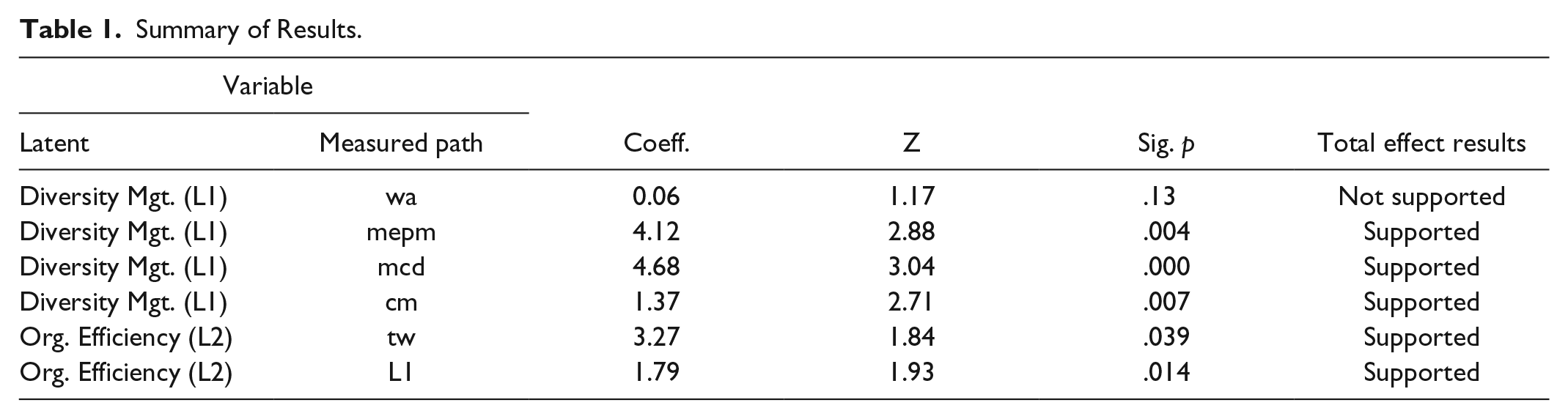
Furthermore, diversity management and teamwork (tm) are significant predictors of organizational efficiency, the second latent variable (L2), because the asymptotic significant probabilities of .039 and .014 are both less than 5% the assumed level of significance but greater than 1%. These are indicated in the calculated Z and associated asymptotic significant probabilities of 1.83 (.039) and 1.93 (.014) for teamwork and diversity management, respectively (see Table 1). Consequently, at the 95% confidence level, we may conclude that teamwork and diversity management significantly influence organizational efficiency.
Results of the goodness of fit test show that the likelihood ratio test had a calculated chi-square value of 2.69 with an associated significant probability of .312. Thus, we cannot reject the hypothesis that a good fit exist because there was no significant difference between the expected and observed matrices. The implication is that the model is a good fit to the data (see Table 2). Also, the stability analysis of simultaneous equations shows that all the eigenvalues are inside the unit circle and the stability index is 0, thus indicating that the structural adjustment model satisfies stability condition (see Table 3). The results of the Wald test are consistent with the goodness of fit and stability tests (see Table 4). The outcome of the goodness of fit test, which indicates that the SEM is a good fit to the data, serves to give credence of the findings with respect to the relationships established between diversity management and organizational efficiency, through the mediating variables.
Goodness of Fit—Ethical Dilemma Constructs Versus Ethical Dilemma: estat gof.

Stability Analysis of Simultaneous Equation Systems: Eigenvalue Stability Condition.
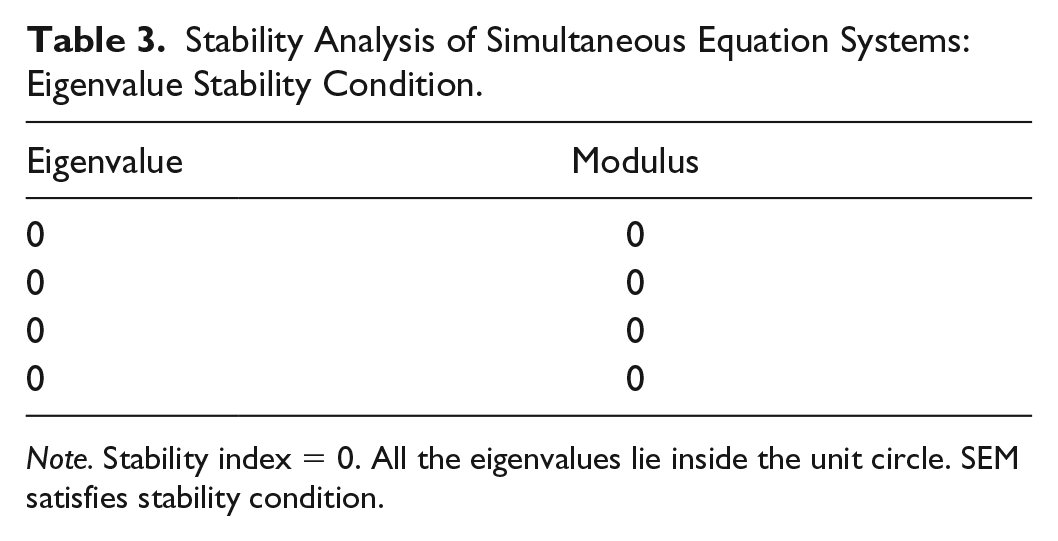
Note. Stability index = 0. All the eigenvalues lie inside the unit circle. SEM satisfies stability condition.
Wald Tests for Equations.

Note. N = obs. used in calculating BIC; see [R] BIC note. AIC = Akaike information criterion; BIC = Bayesian information criterion.
Discussion of Findings
The results of the study show that the management of employees’ perception of marginalization and management of cultural diversity and conflict management have significant positive influences on diversity management. In other words, the higher the management of employee perception of marginalization, conflict, and cultural diversity, the more effective the organization’s diversity management; and the more effective diversity management and teamwork, the more efficient the organization. Specifically, management of employees’ perception of marginalization and management of cultural diversity and conflict management mediate between diversity management and organizational efficiency. The results are consistent with Kundu and Mor (2017) and Odita and Egbule (2015) as well as Suri and Sharma (2011). Furthermore, diversity management and teamwork positively influence organizational efficiency because organizational harmony and teamwork, which are fallouts of diversity management, stimulate organization’s competence in finding strategies to produce at cheaper and better ways and better allocation of resources. This is consistent with Duke (2012) and Greenberg (2015). It thus implies that the management of the variables—employee perception of marginalization, conflict and cultural diversity—is subsumed in teamwork. In other words, effective management of employees’ perception of marginalization and conflict as well as cultural diversity in an organization will reduce friction among workers and thus enhance teamwork. To this end, continuous and effective management of diversity through effective management of employees’ perception of marginalization, conflict, and cultural diversity gives a feeling of inclusion for employees and enhances teamwork. This will enable the organization to reduce conflicts and pave way for organizational cohesion and ultimately result in efficiency in performance. This is consistent with Kundu and Mor (2017) and Odita and Egbule (2015), Guillaume et al. (2014), as well as Suri and Sharma (2011).
Proposed Model of Diversity Management
Based on the findings, a model that seeks to explain how diversity management influences organizational efficiency is proposed. The model shows that employee perception of marginalization and cultural diversity leads to organizational conflict if the organization does not manage diversity; organizational conflict leads to inefficiency. However, if there is diversity management, attention will be given to the management of employees’ perception of marginalization, cultural diversity, and conflict. The management of the three factors (employees’ perception of marginalization, cultural diversity, and conflict) significantly influences diversity management in the organization. Furthermore, diversity management through the management of employee’s perception of marginalization, cultural diversity, and conflict as well as teamwork enhances organizational efficiency (see Figure 1). Also, employees’ perception of marginalization influences teamwork in the organization because a negative perception may make it more difficult to have cohesive teams, but management of employees’ perception of marginalization enhances teamwork. The relationship between managing diversity and employees’ perception of marginalization, conflict, and cultural diversity, as well as that between organizational efficiency and teamwork, is of significant importance to strategic managers of corporate entities.

Proposed model of diversity management and organizational efficiency.
Policy Implications and Recommendations
Workplace diversity has the propensity to trigger conflicts in the organization owing to the challenges associated with the perceptual differences and communication barriers associated with the diverse backgrounds of the employees. These challenges could undermine the benefits of diversity if conscious efforts are not made to manage a diverse workforce. This underscores the need for diversity management which has the capacity to tackle employees’ perception of marginalization as well as control cultural differences and conflicts, thereby engendering teamwork and enhancing organizational efficiency. The implication is that strategic managers should recognize, value, and manage workplace diversity to leverage the associated benefits. They should then institutionalize diversity management to ensure that the challenges of a diverse workforce do not constrain the benefits and thus jeopardize the fortunes of the firm.
Conclusion
The proposed model of diversity management and organizational efficiency in Nigeria has both practical and theoretical importance. From the theoretical point of view, it gives sufficient insight into the major factors that influence diversity management in Nigerian firms from the point of view of employees of selected multinational firms by presenting a robust explanation of the predictors of diversity management in Nigeria. It also gives insight into the influence of diversity management on organizational efficiency through the mediating variables (management of employee perception of marginalization and cultural diversity as well as conflict management). To this end, it makes a significant contribution to management research in Nigeria. This makes it to be of significant importance to management practitioners, strategic managers, and other management stakeholders. The authors made bold attempts to extend the concept of diversity management along a number of unique dimensions. It is pertinent to note that this study is one of the very first few large-scale empirical studies to have investigated diversity management in this manner in Nigeria. Therefore, it provides deep insight into the key factors that influence diversity management and how diversity management might contribute to organizational efficiency in multinational organizations operating in Nigeria. The inclusion of management of employees’ perception of marginalization in the proposed model is unique.
The study encountered some methodological imperfections which pose some limitations to the findings. These limitations thus suggest the need for further studies. The first constraint is that although the proposed model gives insight into the factors that influence diversity management and how diversity management influences organizational efficiency in Nigeria, there is the need to replicate the proposed model in other countries with a view to ascertaining whether it is sensitive to location or not. This is very important, given the fact that the respondents are employees of multinational corporations. A successful replication of this study across the borders of Nigeria will help to determine its generalizability. A second reason for future research is to compare the possible significant factors influencing diversity management in such studies with those of this study to know the possible factors not captured in this model. This will help to fully understand the key factors that significantly impact diversity and diversity management as well as the extent to which diversity management influences organizational efficiency outside Nigeria. Such outcome will also help to present a more general perspective based on the constructs captured in the proposed model. To this end, there is the need for future studies which should use this model as a yardstick for investigating the factors that predict diversity management and the extent to which diversity management predicts organizational efficiency in other countries. A third limitation relates to the sample selection. A significant percentage of the respondents were members of UNIBEN MBA Alumni contacted online. Although the respondents were strengthened by additional online respondents, the tendency that these alumni respondents may possess certain cultural characteristics cannot be ruled out. Finally, there may be other factors that influence diversity management that are not captured in this study or by previous studies. Besides, similar studies in other countries may have employed some instruments that may give some useful insights into the possible factors that may significantly influence diversity management. There is the need for further studies to help unravel such relevant factors as well as refine adapted models and investigate the possibility of implementing them in Nigerian organizations.
Hypotheses
Supplemental Material
Data-Diversity_Management_and_Orga-Efficiency – Supplemental material for Managing Diversity for Organizational Efficiency
Supplemental material, Data-Diversity_Management_and_Orga-Efficiency for Managing Diversity for Organizational Efficiency by Henry Inegbedion, Eze Sunday, Abiola Asaleye, Adedoyin Lawal and Ayeni Adebanji in SAGE Open
Footnotes
Questionnaire
Declaration of Conflicting Interests
The author(s) declared no potential conflicts of interest with respect to the research, authorship, and/or publication of this article.
Funding
The author(s) disclosed receipt of the following financial support for the research, authorship, and/or publication of this article: The study was funded by the Management of Landmark University, Omu Aran, Nigeria.

Supplemental Material
Supplemental material for this article is available online.
Author Biographies
References
Supplementary Material
Please find the following supplemental material available below.
For Open Access articles published under a Creative Commons License, all supplemental material carries the same license as the article it is associated with.
For non-Open Access articles published, all supplemental material carries a non-exclusive license, and permission requests for re-use of supplemental material or any part of supplemental material shall be sent directly to the copyright owner as specified in the copyright notice associated with the article.
