



Abstract
In the digital era, tourists are surrounded by online reviews, social word-of-mouth and destination branding that shape their expectations long before a trip begins. Yet it remains unclear how these digital information sources and brand perceptions are translated into tourist satisfaction through on-site tourism experiences. Based on expectation–confirmation theory, this study examines the relationships among online reviews, word-of-mouth, brand image, tourism experience and tourist satisfaction with a particular focus on the mediating role of tourism experience. A total of 517 valid responses were collected through a structured questionnaire from visitors to major tourist attractions in Henan Province, China. Data were analyzed using structural equation modeling (SEM). The results show that online reviews, word-of-mouth, and brand image have significant positive effects on tourist satisfaction. Tourism experience plays a partial mediating role in all three paths, strengthening the relationship between external perceptions and satisfaction. These findings provide both theoretical insights and practical implications for tourism destination managers. Specifically, enhancing the quality of tourism experiences and cultivating a positive brand image can effectively boost tourist satisfaction in the digital age.
Introduction
Tourist satisfaction, as a core variable in tourism research, refers to tourists’ emotional state or overall evaluation of the entire travel process while enjoying the tourism experience, such as their satisfaction with tourism products and services (Oliver, 2010). With the rapid development of the global tourism industry, tourist satisfaction is not only related to individuals’ travel experiences but also to the maintenance of destination reputation, the stimulation of revisit intentions, and the achievement of sustainable industry development (Hoang et al., 2024; Miah et al., 2025; Nian et al., 2024). As one of the most populous countries in the world, China has a large and diverse tourism market, with continuously growing domestic demand and increasingly sophisticated tourism consumption. This situation places higher demands on the refined management and high-quality supply of tourism services (Gao et al., 2024; Nian et al., 2025). According to the latest Economic Impact Research published by the World Travel and Tourism Council (2025), China is emerging as one of the most dynamic travel and tourism markets worldwide. Against this backdrop, tourist satisfaction has become a focal concern for government agencies, tourism enterprises, and the academic community. Therefore, uncovering the formation mechanisms of tourist satisfaction has become a key issue in tourism research and destination management.
Research indicates that the formation of tourist satisfaction is not determined by a single factor but rather results from a complex psychological evaluation process shaped by the interaction of tourist perceptions, destination attributes, and tourism experiences (Arranz Val et al., 2024; Ho et al., 2024; X. Sun et al., 2024). Prior to travel, tourists often rely on digital informational resources including online reviews, word-of-mouth (WOM), and brand image (BI) to form initial perceptions of a destination. These perceptual cues not only influence expectation setting but also have a significant impact on post-travel satisfaction evaluations (Contu et al., 2024; Limonta et al., 2024; Lin et al., 2024; Nguyen et al., 2022). Nguyen et al. (2022) emphasize that online reviews, by providing abundant user-generated content, help reduce perceived risks, whereas WOM enhances credibility through interpersonal recommendations (Lin et al., 2024). BI reflects tourists’ overall identification with and emotional attachment to a destination (Jagani & Saboori-Deilami, 2025). Furthermore, tourism experience, as the actual contact and sensations tourists have at the destination, serves as a crucial bridge linking perceptions to satisfaction (Zhou et al., 2025). In this context, examining how online perception factors shape tourist satisfaction can deepen understanding of tourist psychology and behavior while also guiding improvements in destination services and communication.
In recent years, studies on tourist satisfaction have expanded considerably, generating extensive empirical evidence, particularly on the relationship between tourism experience and behavioral intentions (Pratminingsih et al., 2025; Su, 2025). However, gaps remain at both the theoretical and mechanistic levels. First, most studies focus on external factors influencing satisfaction, with limited attention to the formation of tourists’ expectations prior to travel and the confirmation process after travel. In particular, the crucial psychological pathway of “expectation–confirmation–satisfaction” has been insufficiently examined, especially regarding the mechanisms through which perceived information is transformed into final satisfaction evaluations. Second, with the development of digital media, tourists are increasingly relying on perceived information such as online reviews, WOM, and BI when making travel decisions. As key sources of expectations, these forms of information not only shape tourists’ psychological anticipation of a destination but may also indirectly affect satisfaction through the confirmation or disconfirmation of actual tourism experiences. Nevertheless, existing research often treats these perception-related variables as independent predictors, lacking integrative analyses and failing to adequately uncover their roles in the expectation–confirmation process. Against this backdrop, this study adopts Expectation–Confirmation Theory (ECT) to develop a framework linking online reviews, WOM, and BI to tourist satisfaction through tourism experience. By clarifying how digital perception-related information is transformed into satisfaction evaluations, this study extends the application of ECT in the digital tourism context and provides implications for destination branding and service management.
Literature Review and Hypotheses
Expectation-Confirmation Theory
This study adopts ECT (Oliver, 1980) as its theoretical foundation to explain how tourists’ perceptions shaped by digital information are transformed into satisfaction through actual tourism experiences. According to ECT, satisfaction results from individuals’ cognitive assessment of how perceived performance aligns with their prior expectations (Cao et al., 2025; Yuan & Marzuki, 2024). Within digital tourism, online reviews, WOM, and BI serve as the primary external antecedents of expectation formation (Aboalganam et al., 2025; Chen & Kim, 2025). Online reviews help tourists form cognitive expectations of service quality through abundant user-generated content (Nawawi et al., 2024), while WOM strengthens affective expectations through interpersonal trust (Vidosavljević & Đurić, 2025). BI, as a long-term and stable cognitive framework, reinforces tourists’ overall expectations through value identification and emotional attachment (Jimenez-García et al., 2025; Tahir et al., 2024). During the actual trip, these expectations are either confirmed or disconfirmed through tourism experience. Tourism experience represents the critical stage where expectations interact with reality, encompassing tourists’ sensory perceptions, emotional responses, and cognitive evaluations (Cao et al., 2025; Seow et al., 2024). When the actual experience meets or exceeds expectations, positive confirmation occurs, leading to greater satisfaction (Gao et al., 2025). By positioning tourism experience as a mediating mechanism, this study integrates digital perception factors and satisfaction formation within a unified ECT framework, revealing how external information is internalized and transformed into evaluative judgments in the digital tourism context.
Online Reviews and Tourist Satisfaction
Online reviews are user-generated product-related information provided by tourists based on their personal experiences (De Pelsmacker et al., 2018). Recent studies have revealed that the content quality and emotional tone of online reviews significantly influence tourists’ expectation formation and post-experience evaluations, especially within digital tourism (Aboalganam et al., 2025; George & Ramos, 2024). Tourists hold high expectations based on online reviews, and when their actual experiences match or surpass these expectations, satisfaction levels rise markedly (Kang et al., 2022; Pooja & Upadhyaya, 2025). For instance, Kang et al. (2022) emphasize that the credibility, richness, and authority of information in online reviews play a critical role in shaping tourist satisfaction. Shi et al. (2025) further revealed that online reviews not only reduce tourists’ perceived uncertainty in the destination selection process but also enhance their decision confidence and emotional assurance, thereby strengthening overall satisfaction. According to ECT (Oliver, 1980), external informational cues, such as online reviews, shape tourists’ expectations prior to travel and generate confirmation or disconfirmation when actual experiences are compared with those expectations, thereby directly influencing the level of satisfaction. Therefore, this study proposes the following hypotheses:
Word-of-Mouth and Tourist Satisfaction
WOM refers to informal communication between private parties concerning evaluations of or information about a target object (Anderson, 1998). Rapidly disseminated through social media and digital platforms, WOM enables tourists to access authentic evaluations of destinations, directly influencing their choices and satisfaction (Aravindan et al., 2023; Pham et al., 2025; Xu et al., 2023). Liu et al. (2025) pointed out that positive WOM enhances tourists’ trust and emotional attachment to a destination, forming positive expectations and increasing satisfaction. In contrast, negative WOM reduces perceived credibility and triggers psychological resistance, leading to more stringent subjective evaluations that lower satisfaction (H. Sun et al., 2024). As a widely disseminated type of information, WOM plays a critical role in shaping tourist satisfaction, significantly influencing destination choice. Within the framework of ECT (Oliver, 1980), the distinct feature of WOM lies in its reliance on the credibility of the communicator and the strength of interpersonal relationships. Such interpersonal trust is more likely to elicit affective expectations, which, during the confirmation process of actual experiences, often exert a more pronounced influence on changes in satisfaction. Therefore, this study proposes the following hypotheses:
Brand Image and Tourist Satisfaction
BI has become a crucial component of a brand; it refers to the ideas, beliefs, or perceptions associated with an entity (Kotler, 2004). Through distinctive characteristics in the market, perceived value, and brand associations, BI fosters tourists’ trust in a destination, thereby enhancing the quality of their tourism experience and significantly increasing satisfaction (Agapito & Sigala, 2024; Jimenez-García et al., 2025; Kumar et al., 2024; Tahir et al., 2024). Agapito and Sigala (2024) revealed that satisfaction rises significantly when the actual experience meets or exceeds expectations set by BI. Chiwaridzo and Chiwaridzo (2024) further pointed out that the formation of BI depends not only on visual and symbolic recognition but also on maintaining consistent value expression across multiple communication channels. This consistency strengthens tourists’ trust and satisfaction. Within the framework of ECT (Oliver, 1980), BI, as a long-term and stable cognitive framework, not only helps tourists establish overall expectations prior to travel but also shapes their anticipated evaluations of the destination through value identification and emotional attachment. The consistency between these expectations and actual experiences largely determines the level of satisfaction. Therefore, this study proposes the following hypotheses:
Tourism Experience and Tourist Satisfaction
Tourism experience refers to the overall perceptions and meaning construction that tourists acquire during the travel process through multiple dimensions, including sensory, emotional, cognitive, and behavioral aspects (Larsen, 2007). Previous studies have found that tourists’ tourism experience is significantly positively correlated with their satisfaction (Liu et al., 2022; Su et al., 2023; Tešin et al., 2025). Su et al. (2023) found that satisfaction significantly increases when tourists’ actual experiences align with their expectations. Meanwhile, Zhou and Wang (2024) argued that a high-quality tourism experience is reflected not only in material or functional satisfaction but also in the psychological engagement and emotional resonance that generate feelings of joy and achievement. Sthapit et al. (2025) further found that the influence of tourism experience on satisfaction is enduring, as it strengthens tourists’ immediate positive emotional responses and extends to their future behavioral intentions, including intentions to revisit the destination and recommend it to others. Poor experiences can lead to a significant drop in satisfaction, even affecting future travel choices (Ye et al., 2021). Therefore, this study proposes the following hypotheses:
The Mediating Role of Tourism Experience
Online reviews serve not only as an essential source of tourism information but also indirectly influence tourist satisfaction by shaping the tourism experience (Kang et al., 2022; Sun et al., 2023; X. Sun et al., 2024). Before traveling, tourists draw on online reviews to construct mental representations of destinations, thereby forming expectations about service quality and experiential authenticity (Islam et al., 2025). High-quality and credible reviews help reduce uncertainty and enhance tourists’ perceived control, encouraging more active participation in various activities during their trips (Yadav et al., 2023). Moreover, Zhou and Wang (2024) reported that emotionally rich and experience-based reviews can evoke tourists’ anticipatory emotions and promote deeper psychological immersion during their actual travel experiences. When tourists’ real experiences align with the contexts and emotions conveyed in online reviews, this perceived congruence strengthens their positive experiences and enhances overall satisfaction (Guerreiro et al., 2025). Therefore, by influencing the tourism experience, online reviews become a key factor in enhancing tourist satisfaction.
As another important source of tourism information, WOM also plays a significant role in shaping tourists’ tourism experiences (Liu et al., 2025; Ribeiro & Kalro, 2023; Schoner-Schatz et al., 2021). Schoner-Schatz et al. (2021) found that positive WOM, such as recommendations from friends and family or authentic feedback from previous tourists, significantly enhances tourists’ trust in the destination, leading to higher expectations before their visit. This positive WOM information improves tourists’ actual experiences, further boosting their satisfaction (Su et al., 2023). Conversely, negative WOM reduces perceived credibility and heightens risk awareness, which not only lowers pre-trip expectations but may also trigger more critical subjective evaluations and negative interpretations during the experience (Pham et al., 2025).
BI, as the product of long-term market positioning and communication, not only builds an overall expectation for tourists before travel but also shapes their travel experiences through value identification and emotional connection (Ho et al., 2024; Mohamed & Ünsalan, 2025; Sukaatmadja et al., 2023). Sukaatmadja et al. (2023) emphasized that a strong BI not only provides tourists with a sense of security and trust but also raises their psychological expectations before travel, fostering positive anticipation toward the destination. Moreover, Ho et al. (2024) found that when the BI aligns with the actual experience, the congruence between expectation and reality significantly boosts satisfaction, making tourists more receptive to and appreciative of the destination’s services and facilities. BI shapes tourists’ travel experiences by providing clear value propositions and service promises that guide their attention and expectation scripts, enhancing the perceived authenticity and emotional security of on-site experiences, and thereby improving the overall quality of their travel experience (Wu, 2025). According to ECT (Oliver, 1980), tourists form expectations based on external information prior to travel, and during the actual tourism process, they confirm or disconfirm these expectations through their experiences. Therefore, tourism experience plays a critical mediating role between external information and satisfaction. Therefore, this study proposes the following hypotheses:
Based on the above hypotheses, the research model of this study is proposed, as shown in Figure 1.

Theoretical hypothesis model.
Methods
Research Design
This study adopted a quantitative cross-sectional design to investigate the relationships among online reviews, WOM, BI, tourism experience, and tourist satisfaction. Data were collected through a structured questionnaire administered to tourists at several key scenic areas in Henan Province, China. The participants covered a wide range of ages, occupations, and places of residence, ensuring sample heterogeneity and generalizability. The research model was constructed based on prior theoretical frameworks and empirical findings, with a specific focus on how perceived online factors (i.e., online reviews, WOM, BI) affect tourist satisfaction indirectly through the mediating role of tourism experience.
Data Collection
This study utilized a random sampling approach for questionnaire distribution and data collection, with data gathered from May to November 2024. The sample selection process was as follows: first, five popular tourist attractions in Henan Province, including Shaolin Temple Scenic Area, Longmen Grottoes, and Yuntai Mountain Scenic Area, as well as Qingming Riverside Landscape Garden (Millennium City Park) and Guoliang Village Scenic Area (known for their significant cultural and natural heritage), were randomly selected as sample sources. Kaifeng, being a recent tourism hotspot, received particular focus. Additionally, popular attractions in Luoyang and Zhengzhou were included to ensure regional representation. Then, according to the visitor registration information on the official website of each scenic spot, the samples were randomly selected.
The questionnaire was distributed via the Wenjuanxing platform (https://www.wjx.cn/) and shared with target tourists through social media, email, and tourism platform links to obtain a broader sample. All participants provided informed consent before completing the questionnaire. According to Kline (2018) guideline for sample size estimation, at least 10 respondents are required per questionnaire item. This study comprised 26 items; allowing for an anticipated attrition rate of approximately 20%, the minimum required sample size was determined to be 312. A total of 550 questionnaires were distributed, and 531 were returned, yielding a response rate of 96.5%. The exclusion criteria were as follows: (1) incomplete responses (e.g., missing answers or an entire section left unanswered); and (2) patterned or careless responding, including selecting the same response option throughout the questionnaire or exhibiting invariant response patterns (Meade & Craig, 2012). After removing incomplete and careless responses, 517 valid questionnaires were retained for analysis, with 320 male respondents (61.9%) and 197 female respondents (38.1%; Bo, 2025). Table 1 presents the basic demographic characteristics of the tourists and the distribution of satisfaction levels.
Demographic Characteristics.

Measurement Tools
The survey is structured into two sections: collects information from participants and evaluate the constructs relevant to this study. Established and validated scales were used to measure each of the research’s constructs. Apart from demographic factors, variable was assessed using a five-point Likert scale.
Online Reviews Scale
This study utilized an online reviews scale (ORS) to assess the impact of online reviews on tourists. The scale was adapted from the ORS designed by Liu and Meng (2024) and includes 10 items, such as “Online reviews of the destination are authoritative.” Higher scores reflecting a better perception of online reviews of the location. The Cronbach’s alpha is .940, indicating high internal consistency.
Word-of-Mouth Scale
Drawing on the framework established by Seow et al. (2024), this research employed five indicators to assess how WOM influences tourists’ decisions regarding their destination selection. These items include: “Knowing that such a destination leaves a good impression on others,”“Ensuring that the destination I choose is worth visiting,”“Regularly gathering information about destinations from others,”“Overcoming my concerns about choosing a destination,” and “Feeling confident about visiting the destination.” Higher scores on the scale indicate a more favorable WOM perception of the destination. The Cronbach’s alpha is .908, indicating high internal consistency.
Brand Image Scale
This study employed the brand image scale (BIS) developed Nie and Zeng (2024) to assess the impact of BI on tourists. The scale includes four items, such as “This tourist destination is very attractive.” Higher scores reflecting a more favorable evaluation of the destination’s BI by tourists. The Cronbach’s alpha is .916, indicating strong internal consistency.
Tourism Experience Scale
The measurement of tourism experience in this study primarily references the scale by Hung et al. (2021), which includes four items. Tourists were asked about their tourism experience, including statements such as “This trip helped me enhance my confidence,”“This trip helped me build a sense of personal identity,”“This trip allowed me to understand myself better,” and “This trip helped me learn new skills.” Higher scores in this study indicate a better tourism experience. The Cronbach’s alpha is .881, demonstrating high internal consistency.
Tourist Satisfaction Scale
This study used a tourist satisfaction scale (TSS) to assess tourists’ satisfaction with the destination, derived from the scale by Jebbouri et al. (2021). It includes three items, such as “I am happy with my decision to visit this place.” Elevated scores correspond to greater levels of tourist satisfaction. The Cronbach’s alpha is .865, demonstrating high internal consistency.
Statistical Analysis
A multi-stage analytical approach was applied to test the proposed research model. First, descriptive statistics and Pearson correlation analysis were conducted to understand the data distribution and preliminary relationships among variables. Second, PLS-SEM was used due to its suitability for predictive analysis, handling non-normal data, and supporting complex models with latent variables and mediation paths (Shmueli et al., 2019). Third, the measurement model was assessed for internal consistency and validity. Reliability was evaluated using Cronbach’s alpha and composite reliability (CR), while convergent validity was assessed via average variance extracted (AVE; Henseler et al., 2015). Discriminant validity was examined using the Fornell–Larcker criterion and the Heterotrait–Monotrait ratio (HTMT; Brown, 2002). Fourth, the structural model was evaluated by examining multicollinearity (variance inflation factors, VIF; Hair et al., 2021), explained variance (R2), and predictive relevance (Q2), providing insight into the model’s explanatory and predictive power (Hair et al., 2021). Finally, a bootstrapping procedure with 5,000 resamples was used to assess the significance of path coefficients and test the mediating effect of tourism experience in the relationships between OR, WOM, BI, and tourist satisfaction (Preacher & Hayes, 2008). This comprehensive procedure ensured the robustness and credibility of the measurement tools and structural relationships proposed in the study.
Results
Descriptive Analysis
This study examined the relationships among online reviews, WOM, BI, tourism experience, and tourist satisfaction. As shown in Table 2, online reviews (r = .741, p < .001), WOM (r = .705, p < .001), BI (r = .731, p < .001), and tourism experience (r = .735, p < .001) were all significantly positively correlated with tourist satisfaction.
Mean Value, Standard Deviation and Correlation Analysis (r) of Each Variable.
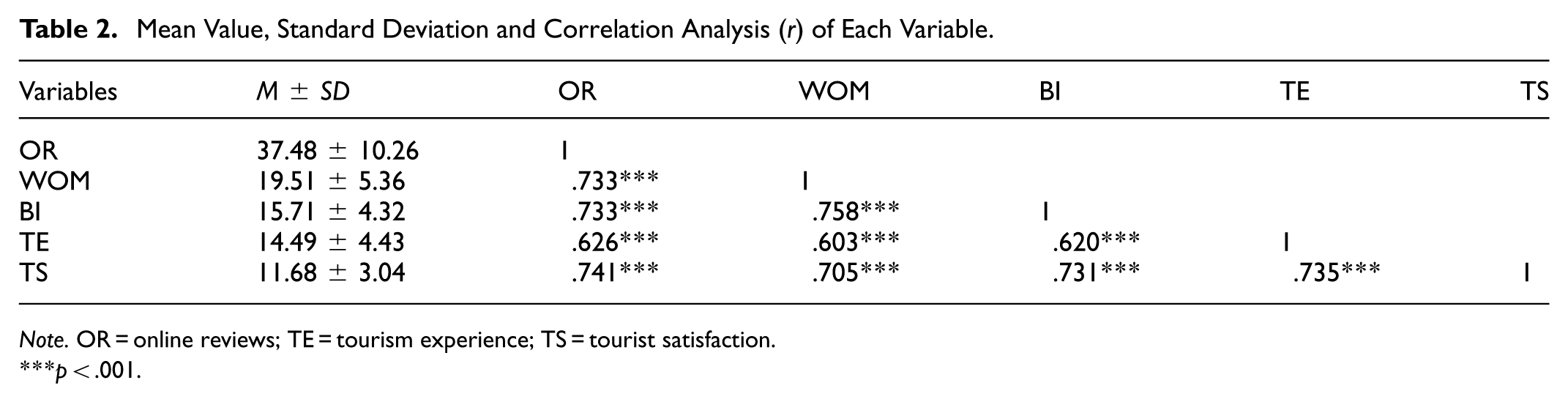
Note. OR = online reviews; TE = tourism experience; TS = tourist satisfaction.
p < .001.
Measurement Model
Table 3 presents the factor loadings and reliability results, showing that all AVE values exceeded the threshold of .5 (Henseler et al., 2015) and that all measured items and constructs demonstrated good internal consistency. In addition, all HTMT values were below the acceptable threshold of .85 (Brown, 2002), and the square roots of the AVE values were greater than the correlations between the corresponding constructs and other constructs (Tables 4 and 5). The measurement model in this study demonstrates good validity.
Reliability and Validity of the Model.

Fornell–Larcker Criterion.

Note. The square roots of AVE values are shown in bold on the diagonal of the table.
Heterotrait–Monotrait Criterion.

Note. OR Rtonline reviews; TE = tourism experience; TS = tourist satisfaction.
Structural Model
Collinearity Test
The VIF values for the underlying constructs were first evaluated in order to evaluate multicollinearity within the model (Hair et al., 2021). The fact that all of the latent constructs’ VIF values fell below the crucial 3.3 threshold indicates that multicollinearity is not an issue (Table 6).
Collinearity Test of the Structural Model.
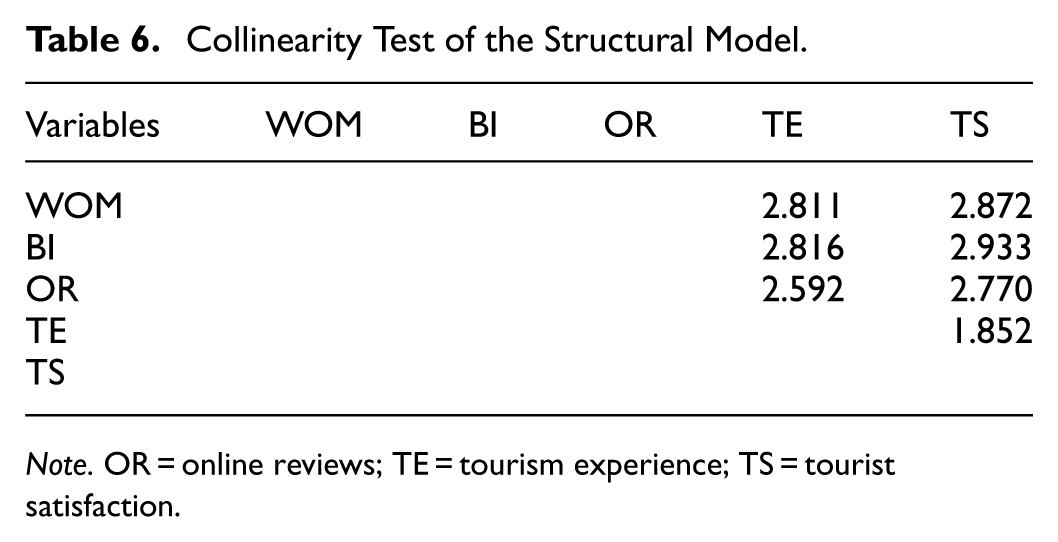
Note. OR = online reviews; TE = tourism experience; TS = tourist satisfaction.
Path Hypothesis Test
Table 7 and Figure 2 indicates that all hypotheses are supported. Among the key predictors of tourist satisfaction, tourism experience (β = .383, t = 7.326, p = .000) emerges as the most influential factor, succeeded by online reviews (β = 0.249, t = 4.805, p = .000), BI (β = .212, t = 3.687, p = .000), and WOM (β = .131, t = 2.734, p = .006). Similarly, among the factors influencing tourism experience, online reviews (β = .310, t = 3.687, p = .000) have the greatest impact, succeeded by BI (β = .252, t = 3.975, p = .000) and WOM (β = .182, t = 3.004, p = .003).
Test Results of Path Hypothesis.

Note. OR = online reviews; TE = tourism experience; TS = tourist satisfaction.

Path coefficient.
Model Interpretability
Finally, as presented in Table 8, the R2 value for tourist satisfaction suggests that its predictors explain 71.9% of the total variance in tourist satisfaction. Likewise, the R2 value for tourism experience shows that its predictors account for approximately 46.0% of its total variance. Additionally, all Q2 values exceed 0, suggesting that the empirical model demonstrates strong predictive capability.
Explanatory Power of the Model.

Note. TE Ettourism experience; TS = tourist satisfaction.
Analysis of Mediating Effect
To assess the mediating role of tourism experience in the connections among online reviews, WOM, BI, and tourist satisfaction, a mediation analysis was conducted. Table 9 reveal that tourism experience serves as a mediator in the effect of online reviews, WOM, and BI on tourist satisfaction.
Mediation Analysis.

Note. OR = online reviews; TE = tourism experience; TS = tourist satisfaction; CPM = complementary partial mediation.
Discussion
This research thoroughly explored the impact of online reviews, WOM, BI, and tourism experience on tourist satisfaction. The findings suggest that online reviews, WOM and BI can not only directly enhance tourist satisfaction but also further strengthen this effect by improving the tourism experience. The following section provides an analysis of the study’s results.
Online reviews has a significant positive effect on tourist satisfaction, which aligns with the results of Zhang et al. (2022). Online reviews not only help tourists develop deeper insight into the characteristics and credibility of a destination before traveling but also effectively raise their expectations, which positively influences their satisfaction (Pooja & Upadhyaya, 2025). Through online reviews, tourists are able to make more confident decisions about destinations and services, reducing uncertainty in their choices and boosting trust in the destination (George & Ramos, 2024). Positive reviews increase the destination’s appeal, while negative reviews may deter potential tourists (Farias et al., 2022). For tourism businesses, managing online reviews content and responding to tourist feedback is essential.
WOM exerts a significant positive effect on tourist satisfaction, consistent with the results of Arumugam et al. (2023). WOM not only provides tourists with more authentic evaluations when selecting a destination but also offers insights into other tourists’ experiences and feedback, enabling potential visitors to more accurately assess whether the destination meets their needs (Stanovčić et al., 2021). Positive WOM enhances tourists’ trust in the destination and their expected outcomes, thereby increasing overall satisfaction (Liu et al., 2025). Additionally, tourism practitioners can collect and analyze this feedback to identify service shortcomings and continually improve service quality, leading to increased satisfaction and loyalty over the long term (Hussain et al., 2023). Therefore, tourism providers should pay close attention to tourist feedback and deliver exceptional experiences to foster positive WOM, ultimately boosting overall tourist satisfaction.
BI has a noteworthy positive effect on tourist satisfaction, confirming the findings of Ho et al. (2024). BI not only enhances tourists’ sense of trust and belonging but also increases satisfaction by shaping positive brand perceptions. A strong BI instills confidence in tourists that their choice of destination or service aligns with their expectations, thereby boosting overall satisfaction (Agapito & Sigala, 2024; Kumar et al., 2024; Tahir et al., 2024). Moreover, when tourism businesses face rapid changes in the market environment, BI, as a key resource for differentiated competition, can help tourism practitioners respond more effectively to shifts in tourist behavior (Ezzatian et al., 2025). By leveraging BI to strengthen competitiveness, businesses can better adapt to evolving tourism behaviors (Absah et al., 2024).
Tourism experience has a noteworthy positive effect on tourist satisfaction, in agreement with the findings of Su et al. (2023), highlighting the influence of tourism experience on satisfaction. When tourists receive high-quality service and enjoy rich experiences during their journey, their satisfaction significantly increases (Kim & So, 2022). Furthermore, the enhancement of tourist satisfaction largely depends on a comprehensive tourism experience, suggesting that attention to detail in service delivery and activity design can significantly affect overall satisfaction (Liu et al., 2023; Sthapit et al., 2025).
Tourism experience serves as a mediator in the link between online reviews and tourist satisfaction, in accordance with the results of Kang et al. (2022). Kang et al. (2022) analyzed numerous online reviews, revealing their effect on tourists’ experiences. Positive online reviews help tourists select suitable destinations, leading to a better experience during the trip (X. Sun et al., 2024). Conversely, negative or misleading reviews may create unrealistic expectations, resulting in disappointment during the trip and reducing overall satisfaction. Online reviews influence tourists’ experiences, enhancing their trust in the destination and sense of expectation fulfillment, which in turn increases their satisfaction (Guerreiro et al., 2025; Sun et al., 2023).
Tourism experience serves as a mediator in the relationship between WOM and tourist satisfaction. This study corroborates the findings of Schoner-Schatz et al. (2021), indicating that tourists evaluate a destination’s reputation based on multiple dimensions, such as scenic attractions, local cuisine, historical culture, and natural environment, which significantly influence their tourism experience. Positive WOM helps tourists select destinations that better suit their needs, leading to a higher-quality experience during their journey (Pham et al., 2025; Ribeiro & Kalro, 2023; Su et al., 2023). Conversely, if WOM information is inaccurate or biased, it may result in a poor experience, thereby reducing satisfaction (Ribeiro & Kalro, 2023). WOM shapes tourists’ expectations, enhancing their experience and increasing satisfaction with the destination.
Tourism experience acts as a mediator in the relationship between BI and tourist satisfaction, affirming the results of Sukaatmadja et al. (2023). This research explored the influence of BI on tourist satisfaction and assessed the mediating role of brand experience in this relationship. BI not only directly enhances tourists’ loyalty to the brand but also further increases loyalty and satisfaction through a positive brand experience (Ho et al., 2024; Mohamed & Ünsalan, 2025; Sukaatmadja et al., 2023). BI has a significant positive impact on the tourism experience, with a strong BI helping tourists form higher expectations and leading to a more enjoyable experience during their journey. Additionally, when tourists perceive consistency between the BI and their actual experience, their overall satisfaction increases significantly (Kumail et al., 2022).
Building on the existing literature, this study makes several contributions. First, it integrates online reviews, WOM, and BI into a unified research model, and, drawing on ECT (Oliver, 1980), systematically reveals the psychological mechanisms linking digital information perception to tourist satisfaction. The combination of multiple information sources within a single theoretical framework is relatively rare in tourism research and helps address the limitations of prior studies in which variables were examined in isolation and explanatory mechanisms were insufficiently developed. Second, this study not only investigates the direct relationships between the independent and dependent variables but also introduces tourism experience as a mediating variable, providing an in-depth analysis of how external information indirectly affects satisfaction through internal experiential processes. This approach uncovers the complete pathway linking information, experience, and satisfaction, extends the application of the experience economy theory, and offers a theoretical basis for future studies on chain or parallel mediation involving related variables. Finally, this study conducts an empirical analysis based on a sample of visitors to major tourist attractions in China, presenting the behavioral characteristics and decision-making logic of tourists in a non-Western cultural context under digitalization. This provides a culturally diverse perspective to enrich tourism behavior research dominated by Western contexts and offers contextually relevant empirical insights for destination management and digital marketing strategy development.
Implications
Theoretical Implication
First, this study integrates multiple information sources (online reviews, WOM, and BI) and tourism experience into a single theoretical model, using Expectation–Confirmation Theory as the core framework to systematically reveal how digital information perception influences satisfaction through tourists’ subjective experiences. Compared with prior studies that have largely focused on a single information source or a single pathway, this study constructs a comprehensive theoretical framework encompassing the interactive relationships among external information, internal experience, and satisfaction, thereby addressing the gap in existing literature regarding multi-factor integrative research.
Secondly, this research investigates the mediating role of tourism experience in the effect of online reviews, WOM, and BI on tourist satisfaction, highlighting the critical role of tourism experience in the interaction of multiple factors. By introducing the mediating effect of tourism experience, this research enriches the understanding of the mechanisms influencing tourist satisfaction, clearly demonstrating the indirect effects of online reviews, WOM, and BI on satisfaction. This invention offers a theoretical basis for future research that aims to investigate the mediating function of experience, in addition to expanding the scope of satisfaction studies.
Finally, the model in this study accounts for 71.9% of the variance in tourist satisfaction, highlighting its significant predictive capability and further confirming the model’s rationality and scientific rigor. This finding emphasizes the importance of combining several aspects into a single framework in addition to confirming the efficacy of a multidimensional model. The model provides a new theoretical perspective for satisfaction research, helping both academia and industry better understand the complex factors influencing tourist satisfaction and their underlying mechanisms.
Practical Implication
First, this study identifies tourism experience as the most critical factor influencing tourist satisfaction. Therefore, destination managers should prioritize enhancing on-site experiences. Specific measures include optimizing service processes, strengthening the training of front-line staff, and improving intelligent navigation systems and infrastructure to enhance visitor convenience and immersion. In addition, managers should ensure consistency between visitors’ expectations and their actual experiences to avoid discrepancies between promotional content and reality. Since online reviews and BI also have significant impacts on satisfaction, managers are advised to actively respond to feedback, encourage positive user engagement, and utilize user-generated content to promote the destination brand. These efforts can help build a clear, trustworthy, and attractive image of the destination.
Second, as direct participants in the tourism experience, tourists themselves should improve their awareness of information gathering and decision-making. The findings suggest that online reviews, WOM, and BI not only shape tourists’ expectations but also enhance satisfaction through their influence on the actual tourism experience. Tourists are encouraged to consult others’ reviews and assess brand reputation when planning their trips, making choices that align with their personal needs. Maintaining an open and positive mindset during the trip can foster engagement and emotional immersion, enhancing the overall experience. After the trip, tourists should also actively share their feedback and suggestions. This not only contributes to service improvement but also provides valuable reference information for other travelers, creating a virtuous cycle of information sharing.
Finally, local governments play a vital role in improving tourist satisfaction and shaping the destination image. Public investment in tourism-related infrastructure and services should be strengthened, particularly in areas such as transportation, sanitation, and safety, to ensure a high-quality visitor experience. At the same time, stronger regulation of tourism businesses and online platforms is needed to ensure the accuracy and transparency of information, fostering a trustworthy and equitable tourism environment. Moreover, governments should support regional brand development and the integration of culture and tourism. Encouraging community involvement, cultural heritage projects, and eco-tourism initiatives can help create distinctive, culturally rich experiences, thereby enhancing tourist satisfaction and boosting the destination’s overall competitiveness.
Limitations and Future Research
This study has some limitations. First, although this study sample includes several popular tourist attractions in Henan Province, it has certain regional limitations. The findings may not fully reflect other regions or international tourist destinations. Thus, future research could broaden the sample scope to encompass tourists from diverse cultural backgrounds and various types of destinations. Second, this study used self-reported questionnaires to measure variables such as online reviews, WOM, and tourism experience, which may be influenced by participants’ subjective biases, potentially introducing response bias. Future research could incorporate other methods, like in-depth interviews, observational studies, or third-party data, to improve objectivity and reliability. Third, this study employs a cross-sectional design, which, although revealing the mediating role of tourism experience in the relationships among online reviews, WOM, BI, and tourist satisfaction, still has certain limitations in causal inference. Future research could adopt longitudinal tracking or scenario-based experimental approaches to further examine the stability and dynamic changes of this mechanism across different time periods or tourism contexts, thereby strengthening the causal reasoning underpinning the conclusions.
Conclusion
This study, grounded in ECT, examines the relationships among online reviews, WOM, BI, tourism experience, and tourist satisfaction, with particular emphasis on the mediating role of tourism experience. An empirical study with 517 participants revealed that online reviews, WOM, and BI all have a notable positive effect on tourist satisfaction. Tourism experience acts as a mediator in the influence of online reviews, WOM, and BI on tourist satisfaction. Online reviews and WOM enhance satisfaction by shaping tourists’ expectations and choice decisions, while BI boosts satisfaction through strengthening tourists’ emotional connections. Overall, tourism experience spans the entire travel process and plays a crucial role in enhancing tourist satisfaction. These findings provide empirical evidence for tourism operators to optimize tourism services, enhance tourist satisfaction, and improve market competitiveness. Future study could investigate the relevance of these relationships across diverse cultural and economic contexts, providing broader theoretical support.
Footnotes

Ethical Considerations
The researchers confirms that all research was performed in accordance with relevant guidelines/regulations applicable when human participants are involved (e.g., Declaration of Helsinki or similar). This study was approved by the Ethics Committee of Henan Finance University (Approval Number: 2024-0025).
Consent to Participate
The participants received oral and written information and provided written informed consent before participating in the study.
Author Contributions
Conceptualization, Methodology, Formal analysis and investigation, Writing – original draft preparation, Writing – review and editing, Supervision: Lixia Bo. The author has read and agreed to the published version of the manuscript.
Funding
The author disclosed receipt of the following financial support for the research, authorship, and/or publication of this article: Science and Technology Research Project of Henan Province, China (242102321145) Research on the application of artificial intelligence technology to enhance tourist well-being under the background of smart tourism. Supported by the Key Research Project of Higher Education Institutions in Henan Province (22A630007); Systematic Quantification and Path Selection for National Innovation High-lands (242400411139).
Declaration of Conflicting Interests
The author declared no potential conflicts of interest with respect to the research, authorship, and/or publication of this article.