




Abstract
This research study explores the moderating effect of managerial support and mediating effect of continuance and affective commitment on the association of employees’ pay satisfaction and their task performance. Data were collected from the university’s faculty members of Kingdom of Saudi Arabia (N = 610) at two phases in time through random sampling technique. For data analysis, descriptive statistics, Pearson’s correlation analysis, and Preacher and Hayes’s PROCESS macro were utilized. The result showed that commitment positively mediates the relationship between pay satisfaction and manager-rated task performance, whereas pay satisfaction has an indirect positive relationship with task performance through continuance and affective commitment and was stronger in faculty having high managerial support. The continuance commitment mediation for the relationship of pay satisfaction and task performance is stronger compared with the mediation of affective commitment for the same relationship. This study provides a significant contribution to the literature of pay satisfaction by proposing and analyzing the associations between pay satisfaction and task performance as mediated by forms of organizational commitment and first- and second-order moderation of managerial support. The current study adds to the limited research on the effect of managerial support and commitment on the association of pay satisfaction and their task performance in higher education sector of Saudi Arabia.
Keywords
Introduction
Pay is a major component of employee compensation in all organizations, and employees’ pay satisfaction (PS) is a major element in achieving organizational goals and objectives (Milkovich et al., 2014; Tran, 2017). After exploring few of groundbreaking motivational theories such as expectancy theory (Blau, 1964), equity theory (Adam, 1963), and reinforcement theory (Skinner, 1968), it was proven that employees’ satisfaction with compensation triggers employees’ attitudes that organizations usually desire (i.e., commitment and performance) (Adam, 1963; Blau, 1964; Gieter & Hofmans, 2015; Vroom, 1964).
Organizations have to ensure that employees are satisfied with their pay because pay dissatisfaction can negatively influence employees’ retention, commitment, trust, and, most importantly, their performance levels (Jung & Yoon, 2015; Miao et al., 2014). Employees’ PS signifies their positive and negative feelings for their pay (Panaccio et al., 2014) and is an important factor that ensures their effective performance (Gieter & Hofmans, 2015). The construct of PS is developed from different compensation aspects, including pay level, increment level, administration and structure of pay, and benefits (Milkovich et al., 2014; Panaccio et al., 2014), whereas the construct of employees’ job performance includes those activities that are essential and formal components of an employee’s job (Smith et al., 2018).
Research studies conducted by different scholars in the last decade provide evidence of indirect but positive relationship between PS and employee task performance (ETP) (Chiang & Birtch, 2012; Gieter & Hofmans, 2015; Kappagoda et al., 2014; Ren et al., 2017; Sieweke et al., 2017), but how PS influences ETP is still vague. All these studies show that employees’ perception of their PS can affect their work-related attitudes, including job satisfaction and motivation and in turn employee in role and extra role performance. So, the first contribution of this study is to explore the mediating influence of an essential work-related attitude organizational commitment (affective commitment [AC] and continuance commitment [CC]) on PS and task performance relationship. AC signifies an employee’s emotional affiliation with the organization, whereas CC represents an employee’s perception of cost related to leaving the organization (H. K. Kim, 2014). As employees’ satisfaction with pay can improve employees’ emotional affiliation with the organization, it can also influence employees’ perception of cost for leaving the organization. If compensation or pay is higher, then the cost of leaving the organization will also be higher (H. K. Kim, 2014). As both forms of commitment are related to ETP (H. K. Kim, 2014; Yousaf et al., 2015), it seems rational that PS and ETP relationship is mediated by CC and AC.
This study also investigates the moderating effect of managerial support (MS), especially in relation to the influence of PS on CC and AC on ETP. MS is a latest addition in perceived organizational support (Travaglione et al., 2017). It identifies that managers have to support their subordinates in facing challenges by developing secure psychological environment and trust culture within the organization, which can result in enhancing employee commitment and performance levels (Boxall & Macky, 2009; Travaglione et al., 2017).
This research study has explored the influence of MS in three directions. It examines the influence of MS on PS–commitment (AC and CC)–ETP relationships. First, MS as a moderator has a positive influence on employees’ indirect relationships of PS–AC–CC; it is expected that it will strengthen the relations. Second, as a moderator of indirect associations between CC–ETP and AC–ETP, MS is also expected to strengthen this relationship. Third, as probably PS would have certain direct influence on task performance, this direct relationship can be moderated by MS. Higher PS would result in expected enhanced employee performance and it is expected that this relationship would be strengthened with high levels of MS. Managers have to deal and confront many of employees’ work- and non-work-related issues such as interpersonal conflict, workplace bullying, ambiguous tasks, financial stresses, and concern for family members. So, higher levels of MS can help employees to become more satisfied with available pay and improve work performance (Travaglione et al., 2017).
Significance of the Study
Over the last two decades, Middle Eastern countries, including Saudi Arabia, have an increasing focus on their higher education sector. They have realized that they need to build their knowledge economies with the help of high-skilled experts and have to reduce their dependence on fuel resources. Saudi Arabia currently is a leading educational hub because of its high per capita income and high-level spending on its educational setup. This high-level spending in educational sector specifies the commitment of Saudi Arabia for national development (Nikolaidis et al., 2018).
Moreover, the first university in Saudi Arabia (i.e., King Saud University) was established in 1957. There are now 32 public sector and 10 private sector universities with more than 140 campuses. Some 20 colleges and vocational and technical training corporation are also part of the higher education sector of Saudi Arabia (Subbarayalu & Al Kuwaiti, 2019). The higher education sector was selected for research because it reflects the importance that these higher education institutes (HEIs) have for the future development of the country (Fallatah & Syed, 2018; Subbarayalu & Al Kuwaiti, 2019). As Kingdom of Saudi Arabia (KSA) represents an interesting underresearched location having a unique religious and cultural framework and has a key strategic role in the world economy, it could be a valuable addition in our understanding. This study also aims to explore the significance, direction, and strengths of the relationships among PS, two forms of commitment (AC and CC), MS, and ETP.
Research Objectives
This study includes the following core research objectives:
To explore and understand the mediation of CC and AC on PS–ETP association;
To explore and understand a moderated condition of MS that associates with direct relationship of PS and ETP;
To explore and understand a moderated condition of MS that associates with indirect association of PS and ETP through CC and AC.
Literature Review
Theoretical Background
Reinforcement theory proposed that individuals shape their behavior through a process by controlling the consequences of the behavior (Skinner, 1968). It suggests that employees’ PS is related to their ETP, and organizations use it as a supporting mechanism to achieve their individual and organizational objectives (Khan & Baloch, 2017). Expectancy theory (Vroom,1964) proposed that individuals will involve in activities and behaviors that give them valuable outcomes (i.e., satisfaction, pay), to only that level they think they are able to give (i.e., performance). Equity theory (Adam, 1963) posits that employees perceive their pay fair and they also feel satisfied depending on their pay compared with the referent others. Also, employees adjust their work outputs (i.e., performance) compared with their pay. Employees with high PS, AC, and CC levels put more efforts in attaining high performance levels (Buttner & Lowe, 2017; Shaw, 2014; Wang et al., 2015). The theoretical explanation for the PS–ETP relationship, AC, CC–ETP relationship, and MS–ETP relationship can be referred to in Blau’s (1964) social exchange theory which specifies that when employee and employer both accept and follow the exchange rules, they will have a more positive, strong, and fruitful relationship. Organizations would provide fair and equivalent pay and provide MS to the employees, and in exchange employees would feel gratified to respond with a higher level of attitudinal work outcome such as commitment and task performance (Krishnan et al., 2018). According to these theories, organizations should administer pay in a very careful manner, that is, higher pay depends on higher level of future task performance, to expand the incentive effect.
PS, Commitment, and ETP
Many studies have worked on the relationship between employee satisfaction and their pay and task performance levels (Gieter & Hofmans, 2015; Muse et al., 2008), but still this relation is unclear because employee performance is a multidimensional factor and can be measured in different ways (e.g., self-rated, supervisor rated, or objective performance). PS is defined as the overall amount of positive feelings of an employee toward his or her pay (Danish et al., 2015). Employees’ job performance consists of two subcomponents (i.e., task performance and contextual performance; Kluemper et al., 2013). Task performance includes all those activities that are the important and formal components of an employee’s job, whereas contextual performance includes activities that are informal aspects of an employee’s job (i.e., coordination, cooperation, citizenship behavior) (Kluemper et al., 2013; Smith et al., 2018). In organizational context, ETP is more critical for organizational survival than contextual performance (Smith et al., 2018), so for understanding the relationships among PS, AC, CC, and employee performance, more attention is given to ETP. There are very limited studies available that examine PS relationship with employee performance, along with the mediation of AC and CC (Abdullah & Ramay, 2012; Mohammed & Eleswed, 2013).
The reason for anticipating the influence of AC on PS–ETP relationship is based on Blau’s social exchange theory (Blau, 1964). According to that, if employees are satisfied with their pay, it may give them a perception that the organization appreciates and recognizes their contributions. By this, the organization satisfies employees’ socio-emotional needs (i.e., need for affiliation and recognition), which would result in the employees working for organizational welfare (higher work performance) in exchange (Schreurs et al., 2013).
The study also provides an argument regarding the influence of PS on CC. CC is more associated with the financial value of employment with the organization (i.e., cost of leaving the job), so it will more likely be influenced by PS and hence would affect employee efforts to perform better and sustain the job (Cherian et al., 2018). Hence, higher PS level would increase the value of associated outcomes and would enhance employee efforts to sustain the job (increase in performance level). The findings of the study conducted by Malik et al. (2016) demonstrated that satisfaction with pay had a significant positive influence on the AC and CC of faculty members, and it consequently influences employee performance.
According to Nakra (2014), normative commitment represents an employee’s moral obligation toward organization and PS involves cognitive judgment of fair compensation of an employee’s job, so normative commitment was not included in the study model. Moreover, according to the studies of Fu and Deshpande (2014) and Tolentino (2013), normative commitment being felt obligation has a strong correlation with AC and has insignificant impact on job performance outside the influence of AC. The study conducted by Lapointe et al. (2011) describes that PS is associated with normative commitment but has no impact on its outcome. On these bases, normative commitment was not included in this study. Both AC (affective) and CC (calculative) have distinct ways in nature that influence PS and ETP relationship. Thus, the following hypotheses were proposed:
PS and ETP
PS is a subdimension of general job satisfaction (Dawson, 2017; Parker & Brummel, 2016), that is, an emotional outcome of an employee’s working environment that can influence his work outcomes (task performance) independently (Arya et al., 2019).
Employees’ low performance could be an outcome of low PS (Chaudhry et al., 2011). According to Lawler’s (1971) model, the relationship between PS and ETP is very important. Employees’ actual performance is related to internal and external pay equity, which in turn is related to PS (Talukdar, 2012). In general, pay is one of the most important aspects of a job, and to some extent it motivates an employee to perform better, but studies conducted by Talukdar (2012) and Mohamed et al. (2017) found a negative and small but significant association between PS and ETP. This provides us an opportunity for further in-depth research. Thus, the following hypothesis was proposed:
The Moderating Role of MS
MS refers to the readiness of managers to accommodate employees’ schedules and tasks and provides assistance that can help employees in managing their work and making it better (T. Kim & Mullins, 2016). It can be a crucial organizational cultural factor that can influence employees’ organization-related attitudes and behaviors (improve productivity, retention, commitment) (Saridakis et al., 2018). MS has gained the attention of researchers and is found to have an influence on organizational and employee outcomes such as performance and retention (Wassem et al., 2019). He et al. (2011) suggested that organizational commitment shows the organizational leadership quality, so it could be rationalized that MS would have a significant influence on developing organizational commitment.
To raise the AC level of employee, PS is more important than actual pay level of employees. If pay levels reach a certain level, then factors like MS and organizational support become crucial (Olafsen et al., 2015). According to Adam’s (1965) equity theory and Blau’s (1964) social exchange theory, if employees perceive that there is fairness in the organization (both procedural and distributive justice) in pay (i.e., PS), a range of positive behaviors will be pursued within the organization. Moreover, high MS produces a give-and-take relationship between the manager and the employee and it will strengthen employee’s association with the organization (Jose & Mampilly, 2015).
While exploring the role of emotional commitment (i.e., affective) and employee performance, especially in Middle Eastern countries, it was concluded that more committed employees tend to have higher performance levels (Zeffane & Bani Melhem, 2017). Moreover, those employees who perceive existence of high MS within their organizations have higher AC and employee performance levels (Huey Yiing & Zaman Bin Ahmad, 2009). Studies show that employees would show more AC and hence have higher performance when their managers are supportive, whereas in the absence of MS, employees would feel frustrated and angry toward the organization (i.e., absence or reduced level of AC), thus resulting in lower levels of employee performance (Ma Prieto & Pilar Perez-Santana, 2014). Thus, the following hypothesis was proposed:
MS could also influence the association of PS and CC, and afterward the association of CC and ETP. In general, it is argued in this study that these relationships became stronger in employees as MS increases.
CC is an exchange framework where benefits and rewards are given in exchange for loyalty. Hence, it is essential for the organizations to identify those factors that can help employees to boost their morale to not only retain their jobs but also enhance their performance (Malik et al., 2016). Employees having CC only remain with the organization because they do not have any better alternative available or they need that job for financial or personal reasons (H. K. Kim, 2014). According to Dar and Sharma (2016), CC has a weak and negative relation with ETP. So, Celik and Findik (2012) suggest that managerial and organizational support can reduce the feeling of entrapment of an employee, which may be developed because of the high cost of leaving the organization.
It is expected that PS influences both subdimensions of CC (i.e., the perceived sacrifice related to leaving and the perceived lack of alternatives). If an employee has PS, then it will increase cost in case of exit (Vandenberghe & Tremblay, 2008). According to fairness heuristic theory, PS also provides information regarding employees’ status within the organization, and higher PS means higher perceived value of the employee within the organization, which enhances CC based on perceived last of alternatives (Asrar-ul-Haq et al., 2017).
The favorable or unfavorable treatment that an employee receives from his or her manager depicts the manager’s supportive or unsupportive behavior toward them (Shoss et al., 2013). PS is strongly related to CC, and this relation becomes stronger as an employee’s manager or supervisor is more supportive (He et al., 2011). MS is enhanced by the positive treatment of the manager, which increases employee’s commitment because MS increases the cost of leaving the job.
For improving ETP, employees should be satisfied with their earnings (pay/compensation) (Jung & Yoon, 2015). But for those employees who are already satisfied with their pay, financial compensation is not the best motivator for enhancing performance. Managers should consider other aspects such as creating a conducive working environment or providing MS (Schreurs et al., 2013).
In a specific pay grade, a slight variation exists in pay; however, a variation in ETP exists. So, employees’ PS might not relate to ETP (Edwards et al., 2008). PS in the absence of MS has a weak relation to employee outcomes (i.e., performance, turnover, commitment) (Bhatnagar, 2014; Raza et al., 2017).
Method
Sample and Procedure
The current study was conducted among teaching staff of HEIs (i.e., 22 universities and eight colleges) located in KSA (i.e., Jeddah, Makkah, Riyadh, Madinah, Yanbu, Dammam, and Jazan cities). According to the statistics provided by Planning and Development Agency of Ministry of Education in Saudi Arabia, the total number of faculty members in HEIs is approximately 70,000 in the selected cities (Planning and Development Agency, 2018). After presenting survey forms to the university deans and heads of colleges and taking their approvals, the survey was circulated among faculty members (N = 3,100). Data were collected through self-administered survey forms and by using online surveys in two phases having a time gap of 12 months from research assistant, lecturer, assistant professor, associate professor, and professor level of faculty members. A random sampling technique was used for data collection in the first phase because it provides each member with every possible sample of the same size. Moreover, simple random sample technique and a large sample size have to be developed to reduce the sampling error. On the basis of this technique, almost 10 to 15 questionnaires were given to each department head depending on the size of their department. For self-administered survey forms, they were collected after 2 days although it took only 7–9 min to complete them. For online survey forms, two reminders were sent to nonrespondents after a gap of 1 week. Respondents were provided assurance regarding the confidentiality of their responses and that it would be used for research purposes only. Phase 1 of the data collection was conducted in September 2017 and Phase 2 of the data collection was conducted in September 2018. This time gap was selected because faculty members have 2-month vacations (from June till August) and they get their annual increment in September. At Phase 1, 1,040 faculty members provided us usable responses (response rate = 33.55%). In this phase, information regarding PS, AC, CC, MS, and demographics was collected. For the second phase of data collection, questionnaires were distributed to all the supervisors of respondents of first phase of data collection. The data regarding ETP were collected in Phase 2. According to Saudi Ministry of Labor, higher education sector constitutes more than 60% expatriates. So, for data analysis at Phase 2 of data collection, 657 respondents provided their responses, and after using Cook’s distances and leverage value methods of outlier detection, 47 responses were removed and only 610 responses were used for further data analysis. As suggested by Baruch (1999), a response rate of 35% is appropriate if the study involves data collection from top management and organizational representatives.
The final sample includes 75.1% male respondents and 24.9% female respondents; 20.24% of respondents were between the age group of 21 and 30 years, 52.68% were between the age group of 31 and 40 years, 18.05% were between the age group of 41 and 50 years, and 9.02% of respondents were more than 50 years old. In total, 365 respondents (59.8%) had a PhD, whereas 245 respondents (40.2%) had a master’s degree. Respondents’ monthly income levels were distributed as follows: SAR 6,000 to 10,000 (20.20%), SAR 11,000 to 15,000 (36.6%), SAR 16,000 to 20,000 (32%), SAR 21,000 to 25,000 (9.5%), and more than SAR 25,000 (1.7%).
To verify that subject attrition has led to nonrandom sampling, the probability of remaining in the sample in Phase 2 (N = 610) among Phase 1 respondents (N = 1,040) could be predicted by demographics and independent variables. Results of logistic regression analysis showing nonsignificant values for demographic (age, gender, education, and income level) and independent variables (PS, AC, CC, and MS) predict that respondent attrition was random.
Measures
The original questionnaire was developed in English, and then by using the backward translation method it was translated into Arabic. The questionnaire includes gender, age, education, and income level as demographic variables. In Phase 1 of data collection, PS was measured using the 11-item PS questionnaire (PSQ) of Heneman and Schwab (1985). Four aspects of PS were measured in the study (i.e., pay level, benefits, pay raise, and pay administration), but because of high intercorrelation among these four aspects of PS, it was considered as one variable. The same approach was adopted by Panaccio et al. (2014). A sample item is “I am satisfied with the value of my benefits.” MS was measured using the 12-item scale of Kang et al. (2015). A sample item is “My supervisor cares about whether or not I achieve my career goals.” Manager-rated ETP was measured by the 5-item scale of Gong et al. (2009). A sample item is “He or she performs tasks that was expected of him or her.” AC was measured by the 6-item scale of Lapointe et al. (2011). A sample item is “I really feel as if this organization’s problems are my own.” CC was measured by the 6-item scale of Hekman et al. (2009). A sample item is “I feel that I have too few options to consider leaving this organization.” Kaiser–Meyer–Olkin (KMO) measure of sampling adequacy for MS was .85 (Sig. = .00), for ETP was .89 (Sig. = .00), for AC was .87 (Sig = .00), and for CC was .93 (Sig. = .00), which show that the sample is enough to achieve these test results and do not have high inter-item correlations. The multicollinearity statistics (variance inflation factor [VIF] and tolerance) show (Table 2) that there is no multicollinearity (VIF values are less than 10 and tolerance values are less than 1). Reliability statistics (i.e., Cronbach’s α) for all the variables are above .80 and validity statistics (i.e., average variance extracted) are above 50% (see Table 2). These statistics show that the construct’s reliability and convergent validity are according to the recommended criteria (Chaoyun & Tsorng-Lin, 2014).
Data Analysis
Confirmatory Factor Analysis
To examine the dimensionality of our research variables (MS, PS, AC, CC, and ETP), confirmatory factor analysis was conducted by using LISREL (linear structural relations). To simplify our model, items were combined resulting in three indicators per construct (MS, ETP, CC, and AC), and for PS construct one indicator was created for each pay dimension (i.e., four indicators for PS construct, a total of 16 indicators). The theoretical model was then analyzed and compared for more practical solutions by utilizing the chi-square difference test (Bentler & Bonett, 1980).
Table 1 represents the four-factor hypothesized model including PS, MS, and dimensions of AC and CC, yielding good fit to the data: χ2(93) = 242.73, p < .001, comparative fit index (CFI) = .96, nonnormed fit index (NNFI) = .92, root mean square error of approximation (RMSEA) = .066. For parsimonious representation of data, results of Table 1 supported the model. These findings prove that the variables of the study are distinct.
Confirmatory Factor Analysis of Measurement Models.

Note. N = 410. NNFI = nonnormed fit index; CFI = comparative fit index; RMSEA = root mean square error of approximation; MS = managerial support; AC = affective commitment; CC = continuance commitment; PS = pay satisfaction.
p < .001.
Descriptive and Correlation Statistics
Table 2 represents the descriptive, multicollinearity, and correlation statistics of the variables. The mean value of the variables ranges from 4.43 to 5.15 and the standard deviation ranges from 0.60 to 0.97. To measure the relationships among variables, Pearson’s correlation analysis was conducted. As suggested by Singh and Sharma (2016), the data were examined for normality (i.e., skewness and kurtosis), outliers (Cook and leverage), and missing values. PS is positively correlated with ETP (r = .77), MS (r = .53), AC (r = .58), and CC (r = .40). These results can be better described with further tests and are then discussed accordingly.
Descriptive, Reliability, Average Variance Explained, Multicollinearity, and Correlation Statistics.
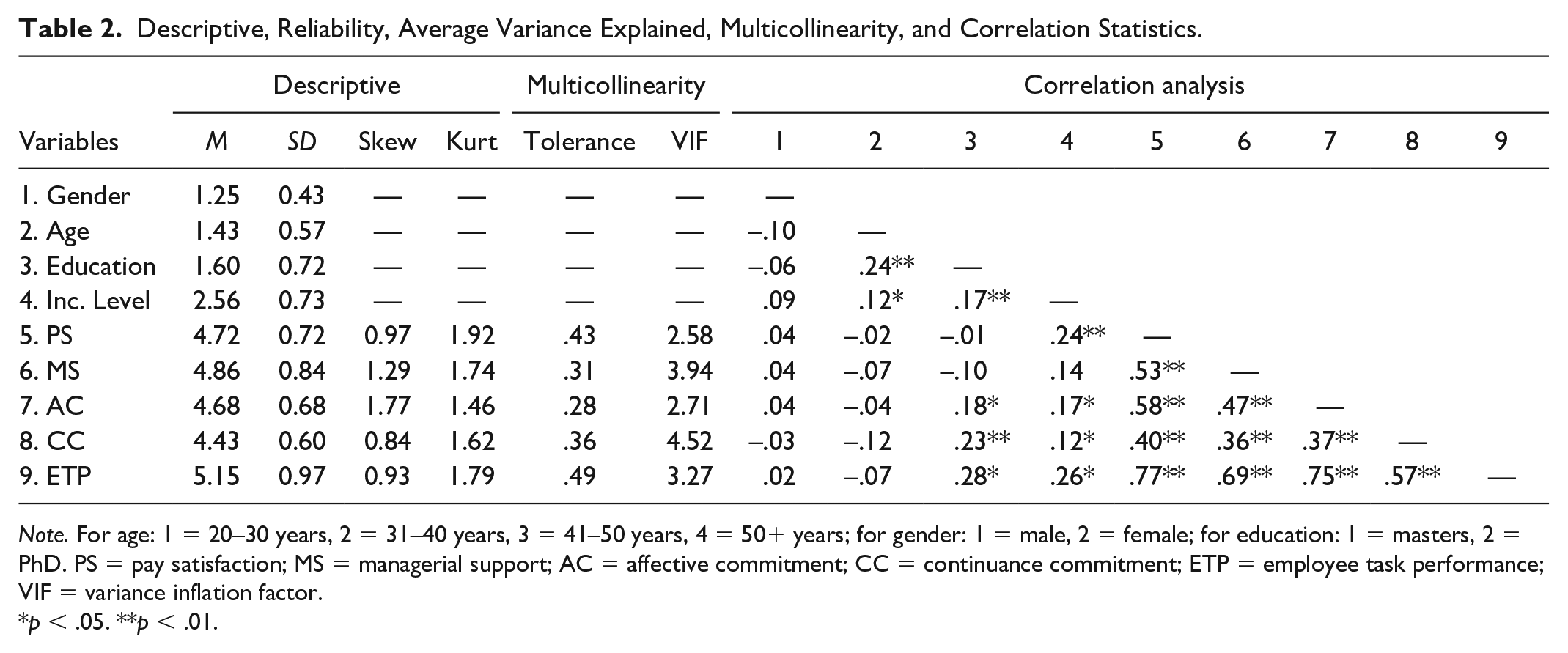
Note. For age: 1 = 20–30 years, 2 = 31–40 years, 3 = 41–50 years, 4 = 50+ years; for gender: 1 = male, 2 = female; for education: 1 = masters, 2 = PhD. PS = pay satisfaction; MS = managerial support; AC = affective commitment; CC = continuance commitment; ETP = employee task performance; VIF = variance inflation factor.
p < .05. **p < .01.
Logistic Regression Analysis
Moderated logistic regression analysis was conducted by using ETP as the dependent variable. In the first step, age, gender, and pay levels were entered as control variables. In the second step, centered MS and PS were entered. In the third step, product term of MS and PS was entered, and in the last step, CC and AC were entered.
As per the results of Table 3, model variables contribute significant variance in ETP, χ2(10) = 70.38, p < .001, −2 log-likelihood (LL) = 346.32, Nagelkerke’s R2 = .33. In the second step, PS was positively associated with ETP (β = 0.83, p < .001). In the third step, the interactional term of MS and PS was also associated with ETP (β = 0.98, p < .01). The significant values of coefficient variables reveal that PS, CC, AC, and MS are positively associated with ETP.
Moderated Logistic Regression Analysis for Employee Task Performance.

Note: Exp(B) refers to the odds ratio. The ΔR2 row includes Nagelkerke’s ΔR2 values. Final model statistics: χ²(10) = 70.38, p < .001, −2LL = 346.32, constant = 0.421, Nagelkerke’s R2 = .33. PS = pay satisfaction; MS = managerial support; AC = affective commitment; CC = continuance commitment; LL = log-likelihood.
p < .05. **p < .01. ***p < .001.
Associations between odds ratios and logistic regression coefficients of the variables are also presented in Table 3. These odd ratios reveal the factor by which the probability increase in ETP is multiplied for each unit increase in the PS. Ratios which are significant and below 1 are related to the likelihood of increase in ETP. In the last step, AC (β = 0.63, p < .001) and CC (β = 0.51, p < .01) were significant predictors of increase in ETP, whereas the interactional term MS × PS was also significant (β = 0.99, p < .01) and the coefficient of PS became nonsignificant (β = 0.35, NS). These results imply that PS, MS, AC, and CC are engaged in mediation and moderation relationships.
Hayes’s Moderated Mediation Analysis
For hypotheses testing, a combination of Hayes’s (2013) moderation and mediation analytical framework was utilized. The theoretical framework shown in Figure 1 hypothesizes that MS will moderate the (a) PS to ETP path, (b) PS to AC and CC path (first stage of indirect effect), and (c) AC and CC to ETP path (second stage of indirect effect). This model can be evaluated through Hayes’s PROCESS macro (Model 59). For evaluating this moderated mediation model, it requires estimation of the following equations:




Theoretical framework.
Equation 1 evaluates the moderation impact of MS on PS effect on AC, whereas Equation 2 evaluates the moderation impact of MS on PS effect on CC. Finally, Equation 3 evaluates the moderating impact of MS on the relationships of PS, AC, and CC to ETP. Thus, it presents the total moderated mediation effect model containing direct, indirect, and total effects.
By using Preacher and Hayes’s PROCESS macro Model 59, coefficients of Equations 1 to 3 were estimated with age, gender, and pay levels of respondents as control variables. Table 4 represents coefficients for Equations 1 and 2, whereas coefficients of Equation 3 are presented in Table 5.
Results of Equations 1 and 2.

Note. N = 410. Entries are unstandardized coefficient estimates from Equations 1 and 2, the coefficients of which are reported by utilizing the Hayes’s PROCESS macro Model 59. PS = pay satisfaction; MS = managerial support; AC = affective commitment; CC = continuance commitment.
p < .05. **p < .01. ***p < .001.
Results of Equation 3.

Note. N = 410. Entries are unstandardized coefficient estimates from Equation 3, the coefficients of which are reported by utilizing Hayes’s PROCESS macro Model 59. PS = pay satisfaction; MS = managerial support; AC = affective commitment; CC = continuance commitment.
p < .05. **p < .01. ***p < .001.
Coefficients of Equations 1 and 2 are reported in Table 4, whereas coefficients of Equation 3 are presented in Table 5. As shown in Table 4, PS has a significant and positive association with AC (β1PS = 0.58, p < .001), whereas as per Table 5, AC was associated with ETP (β1AC = 0.33, p < .001). In addition to that, by utilizing the bootstrap approach, a significant and indirect relationship of PS to ETP through AC was found (0.041, 95% confidence interval [CI] = [0.046, 0.016]). Thus, it provides support to Hypothesis 1a. Alike AC (as shown in Tables 4 and 5), PS has a significant and positive relation with CC (β1PS = 0.31, p < .001) and CC was related to ETP (β2CC = 0.41, p < .05). In addition to that, a similar bootstrap approach was utilized reporting the significant and indirect association of PS with ETP through CC (0.046, 95% CI = [0.059, 0.033]). Thus, it provides support to Hypothesis 1b. Moreover, Table 5 reports that PS has a positive and direct relationship with ETP (c1′PS = 1.22, p < .001), thus confirming Hypothesis 2.
As per the results of Table 4, to estimate AC, PS interacted with MS (β3PSMS = 0.17, p < .05); moreover, as per the results of Table 5, AC also interacted with MS to predict ETP (β3ACMS = 0.42, p < .01).
Results presented in Table 6 further analyze these relationships by showing the first and second stage of moderation and direct and indirect relationships among variables. The first stage of indirect effect (i.e., path from PS to AC) and the second stage of indirect effect (i.e., path from AC to ETP) were both significant and positive, thus supporting Hypothesis 3a.
Analysis of Simple Effects.

Note. First-stage coefficients refer to the impact of MS on PS to AC and CC path, and second-stage coefficients refer to the impact of AC and CC to ETP path. Direct effect coefficients refer to the direct impact of MS on PS to ETP, indirect effect coefficients refer to the impact of MS on PS to ETP through AC and CC, and total effects refer to the combined direct and indirect effect. MS = managerial support; PS = pay satisfaction; AC = affective commitment; CC = continuance commitment; ETP = employee task performance.
p < .05. **p < .01. ***p < .001.
The moderated indirect impact is represented in Figure 2. As the PS increases, ETP also increases when MS is available.

Indirect effect of PS on ETP through AC for high and low levels of MS.
As per the results of Table 4, to estimate CC, PS interacted with MS (β3PSMS = 0.24, p < .01); according to the results of Table 5, CC also interacts with MS to predict ETP (β3CCMS = 0.74, p < .01). Results presented in Table 6 further analyze these relationships by showing the first and second stage of moderation and direct and indirect relationships among variables. The first stage of indirect effect (i.e., path from PS to CC) and the second stage of indirect effect (i.e., path from CC to ETP) were both significant and positive, thus supporting Hypothesis 3b; thus, the moderated indirect impact is presented in Figure 3. As the PS increases, ETP also increases when MS is available.

Indirect effect of PS on ETP through CC for high and low levels of MS.
Results of Table 5 revealed that to estimate ETP, the PS interacted with MS (β3′PSMS = 1.09, p < .01). Results of Table 6 show that the direct effect of PS on ETP was significantly positive with the presence of high MS (direct = 0.19, p < .01).
This moderating effect of MS is shown in Figure 4, which represents that ETP increases more as PS increases when MS is high than when it is low, thus supporting Hypothesis 4.

Direct effect of PS on ETP for high and low levels of MS.
Discussion
The findings of this study explain the important function of AC, CC, and MS between PS and ETP relationship. Particularly, AC and CC both mediate a positive and significant relationship between PS and ETP. The indirect relationship of PS to ETP through AC was strong in employees having high MS, as AC has strong association with ETP in faculty members with high MS. However, the indirect effect of PS on ETP through CC was stronger among employees having higher MS, as PS was more strongly related to CC among them. In the last residual of PS, direct relation to ETP was also strong in employees having higher MS. These multifaceted relationships have important implications for academicians and practitioners.
Theoretical Implications
The current study showed development in prior research studies by exhibiting important mediation of CC and AC between the relationship of PS and ETP, whereas the research study conducted by Panaccio et al. (2014) had found the mediation of both forms of commitment between PS and employee voluntary turnover. This study also explains that both forms of commitment independently mediate the relationship of PS and ETP. The findings presented in this study also highlight the implications of reinforcement and equity theory as it provides a unique procedure through which PS can influence ETP.
PS as described by Miao et al. (2014) is an employee’s overall positive and negative feelings toward their pay, which can affect their emotional and cognitive association toward the organization. On one hand, AC represents employees’ emotional association toward the organization (H. K. Kim, 2014); on the other hand, CC represents employees’ perception of cost of leaving the organization and it is calculative and cognitive in nature (Solinger et al., 2008). The results of the study also highlight that PS not only enhances employee performance through emotional association with the organization but employee performance is more affected by PS association with CC than AC. Results of the study also affirm principles of social exchange theory and expectancy theory by portraying the relationships between PS, AC, CC, and ETP. In this era of economic downturn, organizations need to enhance their performance levels by working on employees’ task-related outcomes, so they have to work on enhancing both emotional and cognitive associations of employees for the organizations.
The study also provides findings related to MS moderation on the relationships of PS, AC, CC, and ETP. High MS is related to the association of AC and ETP, which induces an indirect association of PS and ETP through AC being stronger among employees having high MS. Moreover, high MS also strengthens the PS and CC relationship, which indirectly also strengthens PS and ETP relationship. Apparently, Blau’s (1964) social exchange theory is apparently confirmed also in the Saudi context: If employees have higher levels of MS, that will increase their positive association with the organization, which will induce more CC within the employees, and to maintain their relation with the organization, their ETP will be improved. Moreover, higher PS level in employees may influence employees having higher MS to be more conscious about the cost of leaving the job and hence try to improve their work performance (Richards & Schat, 2011). For the future research studies in this field, it would be more valuable to explore the stronger association of PS and CC by influencing the emotional and obligatory association.
Practical Implications
This study provides practical implications for the organizations and suggests that working on enhancing PS can be a valuable organizational strategy for improving employees’ commitment levels and hence their ETP. PS can be achieved through implementing procedural justice and procedural transparency in employees’ pay-related decisions (Muse et al., 2008). Ensuring pay-related internal equity (i.e., equity within the organization) and external equity (i.e., equity with the competing organization and same profession) also enhances CC of the employees (Zein el din & Mabrouk, 2013). In recent research studies, the perceived sacrifice subdimension of CC has shown a significant impact on ETP than other employee outcomes (e.g., contextual performance and retention; Lapointe et al., 2011; Panaccio et al., 2014). To enhance the PS of the employee, organizations also need to offer rewards to employee which not only organizations want but also that employees need. The attractiveness of rewards will affect their commitment levels but also improve employee performance (Caza et al., 2015).
Saudi Arabia is among one of those countries which provide tax-free pay to their faculty members. So, they are paying better than universities in other countries. So faculty members do not leave their jobs for better opportunities in other countries, but within the same HEIs and HEIs of even the same city they have different pay scales. This differential exists on the basis of nationality, country of last degree, and experience, resulting in high level of inequity among faculty members (Patton, 2014). To enhance PS, HEIs have to work harder in reducing this inequity in pay, which will help them not only in enhancing ETP, AC, and CC but also in retaining high-quality faculty members. Moreover, it will help Saudi Arabia to increase their human development index (Fallatah & Syed, 2018).
The moderating effect of MS provides managers understanding of the means by which PS influences ETP. Implementing PS could be more successful in employees having high MS, due to the indirect association of PS and ETP through CC and AC. Managers should give individual consideration to their faculty members; in turn, there is more chance of faculty members perceiving the warmth and consideration of their managers. Such MS can raise the faculty member’s awareness about the importance of MS toward other stakeholders (i.e., students and subordinates) (Mushtaq et al., 2017). Moreover, those employees who receive MS from their managers usually feel obligated to return their managers’ support by helping them reach their own goals and objectives (Yoon, 2017). Organizations should develop mechanisms and procedures that can enhance employees’ perceptions of MS to enhance CC and AC, as they are established predictors of enhancing ETP (Nazir et al., 2016).
Limitations
Results of this research study are subject to limitations in its methodology. The first limitation is regarding the data collection of variables through self-reporting questionnaire, and the data were collected in two phases, because of which the response rate was only 34% for the first phase, and in the second phase because some of the respondents left their organizations, the response rate was around 65%. However, the findings of this study were strengthened as we followed Podsakoff et al.’s (2012) suggestion by making respondents’ identity anonymous and by making questionnaires short and simple for the respondents. Harman’s one-factor test was also conducted to statistically test for common method bias, and it is believed that the common method bias is not significant. Second, our sample consists of faculty members from HEIs of Saudi Arabia and may not be generalized to population working in other sectors. So, it could be noteworthy to examine whether findings of this study differentiate with the change in organizational or occupational characteristics. Finally, in this study, the impact of PS on ETP was examined, whereas the relation between PS and employees’ contextual performance still has to be developed.
Future Directions and Recommendations
The study utilizes information on faculty members’ pay in ranges, and their pay information would be of more interest in comparison with the pay received by peers or superiors. From this type of information, future researchers should explore the perception of pay transparency, communication, and fairness-related issues. The PS and ETP relationship should be examined in the light of economic conditions to better understand this relationship in the changing Saudi economic conditions. Different measurement scales should be used to analyze the accuracy of results in the higher education and different sectors. Researchers should also utilize mixed-methods and cross-cultural approaches for data collection to have a much broader perspective.
Conclusion
This study provides an extension into the literature regarding PS by emphasizing the key mediation of CC and AC on the relationship of PS to ETP. This research study also explores the role of MS as a moderator of PS to ETP relationship via CC and AC, in addition to its direct association with ETP. The study signifies that in higher education sector of Saudi Arabia, MS positively moderates both first and second stages of indirect effects for both mediating variables (AC and CC). Furthermore, the presence of MS strengthens PS–ETP relationship. So, the findings of this study explain that the processes of linking PS with ETP are multifaceted and more complicated than suggested by previous studies. To clarify these complicated procedures, this study also emphasizes the differences that exist in each employee.
Footnotes
Declaration of Conflicting Interests
The author(s) declared no potential conflicts of interest with respect to the research, authorship, and/or publication of this article.
Funding
The author(s) received no financial support for the research, authorship, and/or publication of this article.
