



Abstract
It is still unclear whether the green proactiveness orientation (GPO) adopted by agricultural new ventures boost firm performance, and what is its internal mechanism, especially in the transition economies where agriculture accounts for a significant proportion. Therefore, drawing on the theory of green entrepreneurial orientation and natural-resource-based view, this study used the structural equation model combined with Bootstrapping to test the direct and indirect effects of GPO on firm performance. Results from 301 agricultural new ventures in China demonstrate that GPO has a positive influence on environmental performance, but its influence on financial performance is not significant. Sustainable opportunity recognition (SOR) partially mediates the relationship between GPO and environmental performance and fully mediates the relationship between GPO and financial performance. Besides, we find that environmental performance plays a mediating role between SOR and financial performance. This study, the first of its kind, focuses on green entrepreneurship of agricultural new ventures in the transition economy to enrich the literature on green entrepreneurial orientation through GPO. It also provides some valuable references for managers to recognize sustainable entrepreneurial opportunities through GPO to improve their environmental and financial performance. These could be important in terms of both management and policy implications.
Keywords
Introduction
Environmental pollution and ecological degradation have seriously damaged economic development, human health, and living conditions. Business activities are not only the “perpetrators” of environmental issues, but also play a key role in successfully solving environmental problems. The role of green entrepreneurship should not be underestimated (Hörisch, 2015; Shrivastava, 1995). Green entrepreneurship is based on the premise of green entrepreneurial orientation, which has identified and consistently used three dimensions: green innovativeness, green proactiveness, and green risk-taking (Ge et al., 2016). Although some literature emphasized the importance of green entrepreneurial orientation in firm performance (Jiang et al., 2018; Shafique et al., 2021), the focus on the sub-dimension of green entrepreneurial orientation is more telling than the overall portfolio study, because each sub-dimension may have different relationships with key outcome variables (George, 2011). Proactiveness emphasizes the launching of new products or services ahead of competitors and occupying the market to gain first-mover advantage, which allows us to test the effectiveness of green entrepreneurial orientation more accurately (Ge et al., 2016). Unfortunately, there was very little evidence of the specific role of proactiveness on performance (Tang et al., 2014). Only a few studies focused on GPO and the link between GPO and firm performance (e.g., Ge et al., 2016; Hockerts & Wüstenhagen, 2010). For example, Ge et al. (2016) identified that compared with competitors, green start-ups adopting GPO could obtain green performance advantages, however, they did not pay attention to its impact on financial performance.
Hart (1995) argued that the constraints and challenges brought by the natural environment were the significant driving forces for the development of new resources and capabilities. Therefore, based on the resource-based view, he integrated the natural environment factors into the theoretical framework and proposed the natural-resource-based view. It emphasized that to cope with the growing challenges and constraints created by the natural environment, some firms drive new resources and capabilities to facilitate sustainable economic activity. These resources and capabilities are embedded within the organization, through a reasonable strategic allocation can improve financial performance and sustainability (Hart, 1995). GPO is a dynamic capability that helps companies achieve differentiation (Jiang et al., 2018). Environmental-based opportunity recognition is considered as a significant contributor to superior performance and competitive advantage (Memon et al., 2020). Therefore, in this study, we hold that GPO and SOR are firm-specific, rare, valuable, and difficult to imitate resources and capabilities by others, which can bring sustained competitive advantage to enterprises (Hart, 1995; Menguc & Ozanne, 2005).
Compared with the manufacturing sector, the agricultural sector with eco-friendly practices has a greater impact on opportunities and capabilities, leading to a closer link to firm performance (Galdeano-Gómez, 2008). However, there have been more studies in transitional China based on the principles of sustainable development for the industrial sector than for its agricultural sector (Shen et al., 2018). It is worth noting that the green entrepreneurship of agricultural enterprises in transition economies offers an interesting research background different from that of western culture. First, since the reform and opening-up policy, agriculture has played an essential role in China’s economic growth. However, outstanding achievements have been made at the cost of enormous energy consumption and environmental pollution (Yang et al., 2018). Some forms of agricultural pollution, such as chemical oxygen demand emissions and ammonia nitrogen emissions, have replaced industrial pollution as the number one pollution source (Liu & Feng, 2019). Second, China’s policies have strengthened environmental protection in various industries, especially the agricultural sector. The Chinese government has proposed “Five development concepts” (i.e., innovative, coordinated, green, open and inclusive development) and the 19th National Congress of China focused on the “Rural revitalization strategy,” both of them highly emphasized the sustainable development of agriculture, rural areas, and farmers, and the green agricultural enterprises closely revolve around these policy objectives. Although the public and policies are increasingly concerned about environmental issues, it is still unclear whether Chinese agricultural new ventures can achieve a “win-win” situation—ecological degradation reducing and performance growth—through entrepreneurial activities (Li, 2014). Finally, compared with developed countries, Chinese agricultural enterprises have the characteristics of a late start and a small scale. Enterprises face instability and insufficient development in the institutional environment and market environment. These volatilities provide chaos and difficulties for agricultural new ventures. Whether they can overcome the liability of newness through first-mover green entrepreneurship and enhance performance is still unclear. It is necessary to further verify the path between GPO and the performance of agricultural new ventures.
All in all, we have two questions to answer. One is, whether agricultural new ventures under a transitional economy setting can obtain a first-mover advantage by virtue of GPO and achieve economic and environmental development? The other is, are there any significant direct and indirect links between GPO, SOR, environmental performance, and financial performance? Therefore, this study takes 301 Chinese agricultural new ventures to empirically examine the relationship between GPO and two types of firm performance (i.e., environmental and financial performance). Furthermore, from the perspective of the natural-resource-based view, this study analyzes the mediating effect of SOR and discusses the internal mechanism between GPO and firm performance.
The main contributions of this study are as follows: First, we expand the green entrepreneurial orientation literature and develop a nuanced understanding of GPO by empirically examining effects of GPO on agricultural new ventures performance. Second, the theoretical guidance is provided for new ventures to decide “whether and how” to employ GPO. Third, the findings provide strong valuable references for managers to identify sustainable entrepreneurial opportunities through GPO to improve firm performance. The rest of the paper is set out as follows. Part 2 reviews the literature based on green entrepreneurial orientation, GPO, SOR, and performance of agricultural new venture, furthermore, the relevant hypotheses are proposed. Part 3 discusses sample analysis and data collection methods. The empirical research results are discussed in Part 4. Part 5 provides theoretical and managerial implications. Finally, the limitations and prospects of future research are presented.
Theoretical Development and Hypotheses
Green Entrepreneurship and Green Entrepreneurial Orientation
“Green entrepreneurship” was first proposed in 1960 when environmental degradation was caused by the rapid development of industrialization, and spurred developed countries to institute regulations for environmental protection. Since then, more and more scholars have believed that green activities can promote the growth of new ventures, and green entrepreneurship has gradually gained widespread attention in the academic and business circles. Generally, green entrepreneurship is also called “ecopreneurship,” “eco-entrepreneurship,” “environmental entrepreneurship,” “sustainable entrepreneurship” and so on. Concerning the concept and connotation of green entrepreneurship, scholars have defined it from different perspectives. Walley and Taylor (2002) defined green entrepreneurship as carrying out green business activities with environmental orientation and pursuing profit maximization. Hockerts and Wüstenhagen (2010) argued that green entrepreneurship refers to the behavior of enterprises taking green resources as their core competencies to develop new markets and build green organizations. Dean and McMullen (2007) from the perspective of new institutional economics, pointed out that green entrepreneurship is the process of discovering, evaluating, and utilizing the economic benefits brought by market failure related to environmental problems. It is the most widely recognized definition at present, and this definition is also used in our study.
Green entrepreneurial orientation is derived from the combination of entrepreneurial orientation and green entrepreneurship (Guo et al., 2020). It is the premise of green entrepreneurship and the decisive factor for the success of green entrepreneurship. The entrepreneurial theory emphasized the realization of economic performance through entrepreneurial orientation, while the green entrepreneurship theory emphasized the development of economic, environmental, and social equilibrium through green entrepreneurial orientation. That is to say, green entrepreneurial orientation not only reflected the market competition orientation of enterprises, but also reflected green participation orientation (Ge et al., 2016). However, green entrepreneurial orientation is not the same as corporate social responsibility or organizations engaged in charitable public welfare undertakings. Its core is still based on entrepreneurship, emphasizing the integration of environmental, social, and economic goals through the initiation of green entrepreneurial activities (Dixon & Clifford, 2007).
Entrepreneurial orientation as a strategic posture relating to innovativeness, proactiveness and risk-taking (Miller, 1983). Based on this, most scholars divided green entrepreneurial orientation into green proactiveness orientation, green innovativeness orientation and green risk-taking orientation (e.g., Ge et al., 2016; Guo et al., 2020; Jiang et al., 2018), respectively representing the tendency to move ahead of competitors by taking green actions, the tendency of trying out new ideas to produce green new technology or products, and the tendency to make bold and aggressive decisions under uncertainty. According to the natural-resource-based view, in addition to the internal resources, the natural environment management strategy is also an essential source of competitive advantage (Hart, 1995). Therefore, green entrepreneurial orientation is regarded as an essential intangible resource that can bring sustained competitive advantage to enterprises.
GPO and Performance of Agricultural New Ventures
GPO reflects the tendency or behavior of taking more initiative than competitors in introducing green products, services, or technology in advance to meet customer needs (Miller & Friesen, 1983; Shafique et al., 2021). As a crucial dimension of green entrepreneurial orientation, GPO is a combination of proactiveness and behavioral orientation, it represents the enterprise being more proactive in green entrepreneurial behaviors than passive acceptance (Ge et al., 2016). Therefore, taking this entrepreneurial posture of pursuing green may positively make the enterprise gain a first-mover advantage (Pacheco et al., 2010). Environmental performance directly reflects the effectiveness of the firm environmental strategy (Hart, 1995). With the increasing awareness of environmental issues and the call for eco-friendly activities from the customers, public, and governments, companies are facing increasing pressure (Chiou et al., 2011; Hoffmann, 2007), especially agricultural enterprises which are closely related to people’s lives. The agricultural new ventures refer to established for no more than 8 years and engaged in agricultural planting, processing, marketing, social services, and other agricultural enterprises (Yang & Li, 2013).
The implementation of environmental strategies is conducive to improving environmental performance and reducing environmental issues (Klassen & McLaughlin, 1996). Agricultural new ventures with strong GPO can respond to the green needs of society faster than competitors, thus they can become the pioneer of green entrepreneurial practices in entrepreneurial activities and improve their environmental performance. Ge et al. (2016) took 235 start-ups, including agricultural enterprises, empirically tested that green start-ups which conduct business based on proactiveness orientation to obtain green performance advantages better than competitors. On the other hand, the natural-resource-based view emphasizes that the relationship between firms and the natural environment can be an important source of competitive advantage in the coming years. Nehrt (1996) pointed out the existence of first-mover advantage, and he found that among the 50 paper pulp manufacturers in eight countries, firms that invested in pollution-reducing manufacturing technologies earlier would achieve higher profit growth. Martin-Tapia et al. (2008) indicated that proactive environmental strategy is positively related to financial performance in the survey of SMEs food export companies in Spain. Similarly, raising barriers by establishing rules, regulations, or standards to build a reputation and differentiated products as an early mover in agricultural domains can gain competitive preemptive advantages (Hart, 1995). These competitive advantages can be further translated into financial performance (Porter & van der Linde, 1995a). That is, GPO can enable agricultural new ventures to take the lead in building green barriers, and obtain competitive advantages and returns higher than the average level of the industry (Galdeano-Gómez, 2008). Based on this, the following hypothesis can be set:
The existing literature on the performance of agricultural new ventures concentrates on overcoming the “weakness” and mainly focuses on the financial performance or growth performance (Gellynck et al., 2015; Grande, 2011; Pindado & Sánchez, 2017), with limited discussion on environmental performance. Environmental performance mainly refers to the firm’s effectiveness in meeting and exceeding society’s expectations for the natural environment, including the reduction of waste emissions and the efforts of enterprises in ecological restoration (Judge & Douglas, 1998). In the study of the relationship between environmental performance and financial performance, different scholars draw linear, non-linear, or even irrelevant conclusions from different perspectives and data availability (Klassen & Whybark, 1999; Porter & van der Linde, 1995b; Triebswetter & Hitchens, 2005). In addition, due to factors such as industry characteristics and the external environment, there are many possibilities for the impact of environmental performance on financial performance (Hart & Dowell, 2011).
Pollution reflects an inefficient use of resources (Porter & van der Linde, 1995a). Agricultural enterprises are more dependent on resources and environment. In the process of reducing the consumption of chemical fertilizers and pesticides and improving the environmental quality of soil, air, water, etc., it is easier to obtain unique resources and capabilities related to ecology for these enterprises. These not only help enterprises save costs but also help gain sustained competitive advantage (Hart, 1995). For example, Chambers and Eisgruber (1998) show that farm managers adopt diverse crop rotations, recycling, and composting to improve environmental performance and gain more market value. In addition, good environmental performance also can bring a good reputation, shape brand effects as well as sales revenue for agricultural new ventures (Lankoski, 2006; Shrivastava, 1995). Based on this, the following hypothesis is proposed in this study:
The Mediating Influence of SOR
SOR refers to the discovery, creation, and exploitation of green opportunities to create future goods and services to maintain the natural or public environment and provide development benefits to others (Hanohov & Baldacchino, 2018; Patzelt & Shepherd, 2011), that means SOR emphasizing the “triple bottom line” of economic, environmental and social performance. Thus, unlike traditional opportunity recognition that considers only economic aspects, SOR pays more attention to the opportunities that can not only promote natural sustainable development but also bring about the improvement of firm performance (Hanohov & Baldacchino, 2018). This salient feature makes entrepreneurial opportunity recognition for sustainable development increasingly attractive as a potential source of new products, services, markets, profits, and competitive advantage.
GPO represents that enterprises move toward green voluntarily and proactively (Guo et al., 2020). This voluntary initiative encourages enterprises to identify business opportunities that are also conducive to environmental development constantly. Therefore, these enterprises tend to focus on taking the initiative to identify green opportunities in the entrepreneurial process. Due to the early stage of the enterprise life cycle, agricultural new ventures have a small scale, relatively weak technology, and limited market information. Their survival and growth largely depend on opportunity identification, especially those eco-friendly opportunities. For example, a firm that relies on natural resources of green agricultural products and nature-based tourism must put sustainable development before economic growth (Lundberg et al., 2014). GPO reflects the tendency first to introduce green products, services, or technologies to create or meet consumers’ green needs. Environmental economics points out that environmental deterioration is the result of market failure, while entrepreneurship theory holds that opportunities are inherent in market failure (Dean & McMullen, 2007). All of them provide possibilities for sustainable opportunity recognition. In order to respond to consumer demands faster than competitors and overcome the dual effects of natural and market risks, agricultural new ventures that adopt green first-mover behaviors or tendencies could be more active in finding green opportunities and achieving sustainable development. Hockerts and Wüstenhagen (2010) take green start-ups in agriculture as examples, pointing out that they usually adopt a pioneering strategy to discover, evaluate and exploit green entrepreneurial opportunities to create green brands and develop niche markets. Based on this, the following hypothesis is proposed in this study:
Opportunity recognition can not only help improve environmental performance, but also stimulate the financial performance of the enterprise (Memon et al., 2020). For new ventures, SOR is one of the most critical capabilities and the source of competitive advantage (Lumpkin & Lichtenstein, 2005; Patzelt & Shepherd, 2011). It could provide different information and ideas critical for agricultural new ventures, and result in multiple performance goals. On the one hand, Bocken et al. (2014) stresses the fact that sustainable opportunity mainly falls under eight archetypes: maximize material efficiency; create value from “waste”; substitute with renewables and natural processes; deliver functionality; adopt a stewardship role; encourage sufficiency; re-purpose the business for society; and develop scale-up solutions. In order to cope with the environmental pressures brought by resources, customers, institutions, and other aspects, some agricultural new ventures focus on identifying and utilizing entrepreneurial opportunities that help prevent environmental degradation and improve environmental quality (Ploum et al., 2018). These opportunities may reflect one or more archetypes of the above. In any case, it will inevitably bring about an improvement in environmental performance. On the other hand, SOR reflects the ability of whether an enterprise can recognize good green ideas, such as finding new market and territory, acquiring new technology, and turning them into capabilities that increase environmental value and generate returns (Lankoski, 2006; Memon & Memon, 2020), so it can be regarded as an important sustained competitive advantage, bringing financial performance growth (Memon & Memon, 2020). Therefore, we propose the following hypothesis:
Integrating H3 and H4a, as well as H3 and H4b, we propose that SOR mediates the influence of GPO on environmental and financial performance of agricultural new ventures. According to the theory of natural resource-based view, SOR can be regarded as an ability related to enterprise strategy and may play a bridge role in the path of GPO and firm performance. The more entrepreneurial opportunities, the more growth outcomes in conjunction with a strategic posture (Anderson & Eshima, 2013). As people continue to pay attention to environmental and ecological issues, customers’ attitudes toward environment-friendly enterprises are increasingly positive, and the need to move to the purchase and use of ecological products or services is also growing (Menon & Menon, 1997). Indeed, “green development” is one of China’s five development concepts, entrepreneurship opportunities related to sustainable development in agriculture are rapidly growing. Agricultural new ventures with GPO not only have market competition orientation but also have a strong green participation orientation. Therefore, they are more concerned with developing potential profitable green entrepreneurial opportunities through first-mover advantage to mitigate market failure and its subsequent achieve a win-win situation between the economy and the environment. Langerak et al. (1998) also show that enterprises adopting a green first-mover strategy in marketing could better identify and take advantage of green market opportunities to improve their business performance. In summary, GPO helps agricultural new ventures identify sustainable entrepreneurial opportunities. These environmentally friendly practices and activities enhance the development of resources and capabilities that are scarce and difficult to imitate, and then improve both environmental and financial performance. Therefore, the following hypothesis can be set:
Integrating H2 and H4a, we propose that the environmental performance of agricultural new ventures mediates the influence of SOR and financial performance. In other words, SOR enhances environmental performance, which in turn influences the financial performance of agricultural new ventures. According to Klassen & McLaughlin (1996), there is a positive relationship between environmental management and financial performance that is mediated by environmental performance. As mentioned earlier, SOR focuses on entrepreneurs and the performance of the triple bottom line, and it is an important management activity for agricultural new ventures. Agricultural new ventures, capturing environmentally friendly entrepreneurial opportunities and using a systemic approach that emphasizes source reduction and process innovation, can build differentiated capabilities and resources (Porter & van der Linde, 1995b; Russo & Fouts, 1997). This process can not only improve their environmental performance, but also translate them into a sustained competitive advantage, which ultimately leads to an increase in financial performance (Hart, 1995). Furthermore, agricultural new ventures can boost their environmental performance by providing green products or services, which can also enhance their image and reputation, so as to increase customer loyalty and sales revenue. Based on this, the following hypothesis is proposed in this study:
To sum up, drawing on the theory of natural-resources-based view and green entrepreneurial orientation, this study develops a model of the mechanism and attempts to open the “black box” between GPO and performance of agricultural new ventures in the context of transitional economy. The framework of the study is shown in Figure 1.

The framework of this research.
Research Design
Sample and Data Collection
The questionnaire was originally designed in English and then translated into Chinese, and five experts in the field of entrepreneurial management were invited to review the questionnaire. Before the formal investigation, the study selected 20 agricultural new ventures to conduct a pilot study in Jilin province in China, checked and modified the measurement items to improve the questionnaire clarity.
The formal data collection lasted for 4 months, from August 2019 to December 2019. The survey was mainly distributed in Shandong, Guangdong, Sichuan, Jiangsu, Heilongjiang, and Jilin province, regions that are not only the major agricultural provinces, but also represent different levels of economic development, geographical location, and ecological status of China. Specifically, Heilongjiang and Jilin, located in northeast China, are the main production areas of corn, soybeans, rice and other grains, representing a low level of marketization and economic development. Jiangsu and Guangdong are respectively located in the Yangtze River Delta and Pearl River Delta regions in southern China, representing a relatively high level of marketization and economic development. Shandong is located in the eastern coastal area, and Sichuan is located in the southwest of China, representing a moderate level of marketization and economic development.
Compared with listed companies, it is difficult to obtain the contact information of agricultural enterprises and their managers in different provinces in China. Therefore, we adopted snowballing, which is useful for accessing hard to reach populations (Baltar & Brunet, 2012). Questionnaires were sent to the entrepreneurs and general managers or directors who are familiar with the overall performance and strategic development direction of the firm. And anonymity was emphasized in the answering process. In order to improve the response rate, emails and telephone calls were used. We also promised to provide a detailed analysis report to respondents. A total of 500 questionnaires were distributed in this study, and 301 valid questionnaires were recovered after eliminating data loss and illogical questionnaires, with an effective recovery rate of 60.2%. The main characteristics of the sample include firm age, firm size, ownership, and firm category, as provided in Table 1.
Characteristics of the Sample (N = 301).

To evaluate non-response bias, we used the t-test to compare firm size and ownership between early and late responses, and we found that all t-value was no significant. Thus, the non-response bias is negligible (Armstrong & Overton, 1977).
Several approaches are adopted in this study to reduce the potential threat of common method variance (CMV). First, the questionnaire was anonymous, and the order of the items was mixed. Second, Harman’s single-factor test suggested that one single factor could not explain most of the covariance (Podsakoff et al., 2003). Finally, one-factor model resulted in poor fit indices: χ2/df = 5.904, RMSEA = 0.128, CFI = 0.701, IFI = 0.704, TLI = 0.651 (Hu et al., 1992). Thus, CMV is not a significant concern.
Measures
First, we used three items adopted from Jiang et al. (2018) for measuring GPO. Second, we used five items adopted from Bhave (1994) and Zhang et al. (2017) and modified according to the Chinese situation and research theme for measuring SOR. Finally, in our study, the firm performance includes two aspects: environmental and financial performance. Environmental performance was measured using four items adopted from Jiang et al. (2018), and three items adopted from Covin et al. (2006) and Sheng et al. (2011) for measuring financial performance. All items were measured on 7-point Likert scales, ranging from 1 (strongly disagree) to 7 (strongly agree). For details of constructs and items, see the Appendix.
According to previous relevant literature, we have included three control variables in this study: firm age, size, and ownership (Ge et al., 2016; Luu & Ngo, 2019). Firm age was measured by the years a firm had operated, “1” = fewer than 1 year, “2” = 1–3 years, “3” = 3–5 years, “4” = 5–8 years, “5” = more than 8 years; firm size was measured by the number of employees; ownership included the dummy indicators for state-owned, privately owned, foreign-funded and others.
Results
Descriptive Analysis and Correlation
Table 2 shows the means, standard deviations, and correlations of all variables. GPO was positively related to environmental performance and financial performance (r = .373, p < .01; r = .372, p < .01, respectively). Environmental performance was positively related to financial performance (r = .484, p < .01). A positive correlation between GPO and SOR was also found (r = .442, p < .01). In addition, SOR was also positively related to environmental performance and financial performance (r = .349, p < .01; r = .443, p < .01, respectively).
Means, Standard Deviations, and Correlations.

Note. SD = standard deviation; GPO = green proactiveness orientation; SOR = sustainable opportunity recognition; EP = environmental performance; FP = financial performance; similarly hereinafter.
p < .05. **p < .01. The diagonal elements are square root of AVE.
Reliability and Validity
To explore whether the measured construct is evident in China, we adopted SPSS 24.0 and AMOS 24.0 to test the reliability and validity of all variables. In this study, we used Cronbach’s α coefficients to evaluate reliability. Table 3 illustrates that all the Cronbach’s α coefficients are greater than .7, indicating that all the variables measured in this study have acceptable reliability (Fornell & Larcker, 1981). Besides, the resulting estimates of composite reliability (CR) for four constructs were 0.863, 0.878, 0.850, and 0.859, which means all the variables were greater than 0.7, ensuring reliability in this study (Gerbing & Anderson, 1992).
Measurement Properties (N = 301).

Note. AVE = average variance extracted; CR = composite reliability.
The results also indicate that the average variance extracted (AVEs) of all variables were more than 0.5, which means that the convergent validity of the four constructs was acceptable (showed in Table 3). In addition, the CFA results suggest that the model fitting results are as follows: CMIN/DF = 1.381, RMSEA = 0.036, CFI = 0.978, IFI = 0.979, TLI = 0.973. Therefore, the model provided a good fit for the data (Hu et al., 1992).
As the results in Table 2, it suggested that the square root of AVEs of all the variables are greater than their correlations with other variables (Fornell & Larcker, 1981). Thus, the discriminant validity can be verified in this study. Given these results, all variables used in the main study have adequate reliability and validity.
Hypothesis Testing
Given the nature of the data and our research objective, the hypotheses were tested with the structural equation model, in combination with the bootstrapping method (with 10,000 resamples estimate and confidence intervals), to assess the presence of the direct and indirect relationships (Hair et al., 2016; Preacher & Hayes, 2004). These statistical techniques have been widely used in society science during the last decade (Guerrero & Urbano, 2014), because they allow testing a set of relationships between independent and dependent. The structural equation model can trace the causal paths of multiple dependent variables in the same model, and estimate the structural paths simultaneously, instead of estimating one at a time. Furthermore, although there is a direct effect between an independent and dependent variable, an indirect effect also existing between an independent and dependent that mediated by other variables. These analyses are particularly suitable for testing the mediation relations and without the need to make assumptions about the central tendency and multicollinearity of the estimates of these effects (Iacobucci et al., 2007; MacKinnon et al., 2004).
Direct effect
The direct effects of each path between variables in the model is shown in Table 4 and Figure 2. GPO is positively related to environmental performance (β = .389, p < .001), so hypothesis 1a is supported. However, GPO did not show a significant relationship with financial performance (β = .100, p > .05), thus hypothesis 1b cannot receive support. Moreover, environmental performance has a direct positive effect on financial performance (β = .453, p < .001), so hypothesis 2 is supported. The path association between GPO and SOR is also significant (β = .523, p < .001), which supports hypothesis 3. SOR is positively associated with environmental performance (β = .255, p < .01), so hypothesis 4a is supported. We also found that SOR had positive path associations with financial performance (β = .287, p < .001), which supports hypothesis 4b.
Regression Weights in the Research Model.

p < .001 significance level.
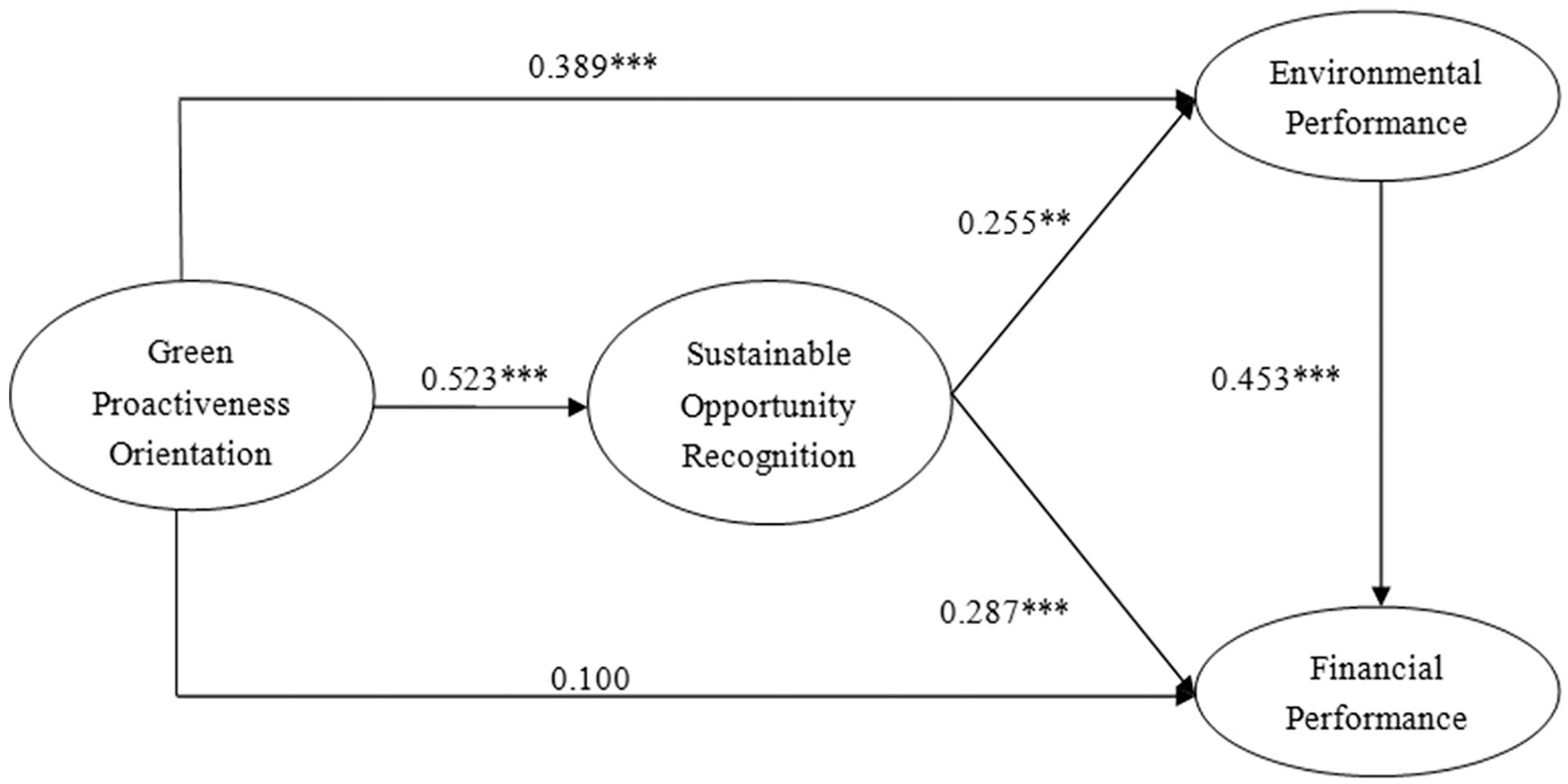
Path model (direct effect).
GPO is important because a green proactive new venture in agriculture has a high possibility of SOR and demonstrates high environmental performance (Ge et al., 2016). Moreover, the results show that better environmental performance leads to better financial performance. In other words, the more the agricultural new venture creates environmental value in products or services, the higher the financial viability. The analysis also recognized the importance of SOR which can bring high environmental and financial performance. In this way, all the direct paths set in the model except hypothesis 1b were proven to be valid.
Indirect effect
Table 5 presents the indirect effects of SOR and environmental performance. Using bootstrapping, we found that the statistical significance of the indirect effect of each mediator was verified. The indirect effect of GPO on environmental performance through SOR is statistically significant (β = .133, 95% bias-corrected confidence interval [95% CI] = [0.033, 0.267]). The direct effect of GPO on financial performance is not significant, but the indirect effect of GPO on financial performance through SOR is statistically significant (β = .150, 95% CI = [0.048, 0.296]). In other words, SOR fully mediated the link between GPO and financial performance. The indirect effect of SOR on financial performance through environmental performance is significant (β = .115, 95% CI = [0.033, 0.242]). As bootstrapping results, SOR partially mediates the relationship between GPO and environmental performance, and environmental performance shows a partial mediating effect between SOR and financial performance. Hence, SOR shows a complete mediating effect between GPO and financial performance. In this way, hypothesis 5a, 5b, and 6 were shown to be valid.
Bootstrapping Analysis of Intermediate Effect.

p < .05. **p < .01.
Discussion and Conclusion
China has an ancient and grand agricultural economic pattern, with a substantial proportion of agricultural enterprises. Most previous studies have neglected the complex impact of green entrepreneurial orientation sub-dimension on the performance of agricultural new ventures (Jiang et al., 2018; Shafique et al., 2021), however, seldom of them are related to SOR. Based on the theory of green entrepreneurial orientation and natural-resource-based view, this study is the first to construct a theoretical framework of the relationship between GPO, SOR, environmental and financial performance. Through theoretical derivation and empirical analysis of 301 questionnaires on Chinese agricultural new ventures, the results point out that: GPO positively influences the environmental performance of agricultural new ventures, but has no significant influences on financial performance; SOR partially mediates the relationship between GPO and environmental performance and fully mediates the relationship between GPO and financial performance. In addition, we also find that environmental performance plays a mediating role between SOR and financial performance. This study makes important theoretical and managerial contributions to understanding how the mechanism of GPO affects agricultural new ventures performance, and how SOR and environmental performance play roles in this process. These several interesting findings that have both theoretical and managerial implications are discussed as follows.
Theoretical Implications
Although some scholars have empirically studied the relationship between green entrepreneurial orientation and firm performance (e.g., Shafique et al., 2021; Jiang et al., 2018), the results are still controversial. This study suggests that the dimensions of green entrepreneurial orientation often vary independently, and not always be associated with successful performance. The findings extend the literature on green entrepreneurial orientation. Specifically, first of all, our results reveal that GPO has a significantly positive effect on the environmental performance of agricultural new ventures in the transition economy, which is consistent with prior studies (Ge et al., 2016; Shafique et al., 2021). However, Ge et al. (2016) and Shafique et al. (2021) mainly emphasized the influence of the external institutional environment, our study explains the reason from within the organization, that is, the difference between green proactive-oriented entrepreneurs and conventional proactive-oriented entrepreneurs that do not have environmental performance as a prerequisite is one of the reasons. Second, our results do not support a significant direct impact of GPO on financial performance, which is contrary to the research of Jiang et al. (2018). It demonstrates that not all agricultural new ventures that adopt GPO will enhance business performance (Pacheco et al., 2010). The possible reason is that this study chose agricultural new ventures with a time of less than 8 years, which require a large upfront investment (include green practice activities) and may have some hysteresis effect. In addition, “orientation-outcomes” is a complex process, and there are other influencing factors that need further exploration and analysis. In fact, SOR provides some references for us.
Based on the organizational level, this study interprets the transformation mechanism and path of GPO and firm performance from the perspective of SOR. Compare with conventional entrepreneurial opportunity recognition, SOR focuses on green opportunities that can not only bring profits to enterprises but also promote natural and sustainable development (Hanohov & Baldacchino, 2018). On the one hand, the empirical results confirmed that agricultural new ventures with GPO are more likely to identify sustainable opportunities in the market, which also breaks the entrepreneurship opportunities recognition for sustainability only from the individual level of antecedent variables (e.g., Pacheco et al., 2010; Patzelt & Shepherd, 2011); On the other hand, it is indicated that SOR partially mediates the relationship between GPO and environmental performance, and fully mediates the relationship between GPO and financial performance, as well as environmental performance plays a mediating role in the impact of SOR on financial performance. All in all, our findings better explain the inherent reasons for the relationship between GPO and firm performance, and provide a new research perspective for agricultural new ventures to take advantage of GPO to overcome the liability of newness and improve core competitiveness to achieve performance growth.
Managerial Implications
First, in the face of increasingly serious environmental issues, agricultural new ventures need to conduct business activities in a sustainable manner that is competitive and environmentally sensitive (Sher et al., 2019). GPO provides a development direction for managers. GPO can directly improve environmental performance. Therefore, the manager and government should pay attention to cultivate and establish a proactive green-oriented culture, encourage enterprises to take green entrepreneurial actions before competitors that to gain a greater competitive preemption.
Second, even agricultural new ventures with relatively insufficient capital, technology, and resources, can identify sustainable entrepreneurial opportunities from GPO to achieve better environmental and financial performance. Consequently, agricultural new ventures and managers should develop the ability to identify opportunities for sustainable entrepreneurship, such as developing entrepreneurial skills, environmental knowledge, or individual networks (Patzelt & Shepherd, 2011), to achieve economic profits and minimize environmental impact through green entrepreneurial actions.
Third, SOR positively influences the environmental performance of agricultural new ventures and translates into better financial performance. Enterprises’ environmental performance will be transformed into potential competitive resources and gain greater competitive advantages in development (Chiou et al., 2011; Porter & van der Linde, 1995b; Russo & Fouts, 1997). Therefore, managers need to change their concepts further to cultivate a strategic vision, and regard environmental performance as a competitive means to improve their financial performance, so as to lay a good foundation for subsequent improvement of financial performance.
Limitations and Avenue for Future Research
The findings should be considered in light of several limitations of the current study, which should not go unmentioned. First, all variables in the questionnaire were filled out by a single informant and using self-reported data. Although several measures were taken to reduce the common method bias and the test results were within acceptable limits, it may still exist. Therefore, further research can assess the degree of green entrepreneurial orientation by connecting multiple answers from employees and entrepreneurs. Second, the measurement index of GPO adopts a universal subjective measurement method. In the future, it can be considered to add objective performance indicators and develop a scale for agricultural enterprises. In this way, the influence of GPO on agricultural enterprise performance in different development stages can be comprehensively analyzed by using subjective and objective data. Third, cross-sectional data cannot reveal the dynamic changes of green entrepreneurship. In the future, longitudinal data can be used to distinguish the time interval between GPO and firm performance. Fourth, this study only examines the influence of the sub-dimension of green entrepreneurial orientation (i.e., GPO) on path relations. Future studies can consider other dimensions for verification and analysis. In addition, this study only examined the mediating role of sustainable opportunity recognition. To expand the research path, further study can consider other factors’ roles and boundaries, such as dynamic capabilities, green culture, and sustainable business model innovation. Finally, the samples were collected in the specific context of China. Future studies can be further extended to other economies in transition and industries to expand the universality and applicability of the research results, which will provide valuable insights into the connection mechanism between GPO and firm performance in different situations.
Footnotes
Appendix
Acknowledgements
We would like to thank the National Social Science Foundation of China for supporting this research.
Author Note
Qing Li is now affiliated to School of Management, Changchun University, Changchun, China.
Declaration of Conflicting Interests
The author(s) declared no potential conflicts of interest with respect to the research, authorship, and/or publication of this article.
Funding
The author(s) disclosed receipt of the following financial support for the research, authorship, and/or publication of this article: This research was supported by the National Social Science Foundation of China (grant 20BGL059).
