




Abstract
This study investigates the relationship between psychological contract breach (PCB) and three employee attitudes, namely organizational citizenship behavior (OCB), trust in the organization, and intention to leave the job. The study was carried out in an industrial plant in the chemical sector situated in Malta, which was in the process of a takeover from a multinational. Survey data were collected from 258 employees, representing 47% of the workforce in the plant. Results indicate that PCB is negatively related to trust and positively related to the intention to leave the job. The negative relationship between PCB and trust is stronger among female employees. On the other hand, the positive relation between PCB and intention to leave the job is strongest among workers with longer tenure. PCB is only moderately related to OCB among female workers. A number of conceptual and managerial implications are highlighted.
Keywords
Rationale and Context
Work organizations rely on structured relationships between individuals who interact with each other in particular contexts to achieve the desired goals. Formal roles are defined in written contracts agreed upon and signed by management and employees. But the working lives of employees and their relationship with management are also shaped by the less obvious psychological contracts, defined as “individual beliefs in a reciprocal obligation between the individual and the organization” (Rousseau, 1989, p. 121). Psychological contracts are favorable conditions perceived by employees during employment, built on promises, statements, or even attitudes made by management.
Research indicates that the breach of a psychological contract may have an adverse effect on the employee–employer relationship (Rousseau, 1995). More than 20 years ago, Robinson (1996) highlighted the need to develop a more thorough understanding of psychological contract breach (PCB), especially in view of the then apparent prevalence of the phenomenon. The link between restructuring exercises and PCB is well known in literature (Turnley & Feldman, 1998). The concept of PCB has become increasingly relevant with the growing pace of globalization and the continuous economic cycles leading to inevitable restructuring exercises and loss of jobs. Among the considerable research that has been carried out on the topic in recent years, some studies linked the psychological contract to HRM strategies and practices. For example, McDermott, Conway, Rousseau, and Flood (2013) acknowledge the relevance of the psychological contract in HRM and suggest to align it with the HR strategy in order to maintain positive workers’ attitudes and behaviors. Similarly, according to Bal, Kooij, and De Jong (2013), HR plans that cater for the development of all employees can favorably influence job outcomes as a result of more balanced psychological contracts between employees and employers.
The current study investigates the relevance of PCB within a manufacturing plant in the chemical sector situated in Malta, the smallest country in the European Union. The plant was set up several decades ago and traditionally had stable employment relationships, as demonstrated by the employees’ long tenure. Indeed, resignations were uncommon as the extrinsic and intrinsic needs of the workers appear to have been fulfilled throughout the years by the organization. However, the employees’ morale started deteriorating when it was announced that the mother company was in the process of being acquired by another company. Company acquisitions and mergers create shareholder “value” by saving money on redundancies in the period of consolidation (Foroohar, 2016), a situation that understandably translates into concern among the employees undergoing the stress of this process. The acquisition, which included planned restructuring and redundancies, took a whole year to materialize and created fears and uncertainties among employees, potentially fuelling the feelings of PCB.
The current study was conducted during such turbulent times and examines the interaction of PCB with three important work-related attitudes that affect organizational well-being and productivity, namely organizational citizenship behavior (OCB), trust in the organization, and intention to leave the job. Data were collected through a survey distributed among all the population of employees of the above-mentioned plant.
The following sections explore the concept of psychological contract and its breach, and examine the literature focusing on its relationships with OCB, trust, and intention to leave the organization.
Psychological Contract and Social Exchange Theory
Employment relations are characterized by the employees’ beliefs that the employees and the organization have mutual obligations. These subjective perspectives may even start shaping as early as in the recruitment interview, when discussions on the working conditions with the organization’s representative take place (Rousseau, 1995; Rousseau, 1989). Unlike the work contract which is signed and agreed upon by both parties when the employee is chosen for the job, the promises and considerations forming part of the psychological contract are both subjective and mostly implicit in nature (Lucero & Allen, 1994). It is typically assumed by the employee that this genre of contract which is not written in a document is implemented according to the principles of good faith, fair dealing, and trust. The psychological contract embraces perceptions and beliefs on an array of items that were promised, mentioned, or in some way perceived but not written on the formal written legal contract.
By assessing the distinct components of the psychological contract at the individual level, Rousseau (1989) views this form of contract as a cognitive model whereby exchanges reciprocally influence the employee–management relationship. Thus, the psychological contract is seen as broader and deeper in relation to the formal contract. The psychological contract may be said to reside “in the eye of the beholder” (Rousseau, 1995). In other words, it is based in large part on the employees’ personality, attitudes, and other characteristics, through which they make sense of reality. Indeed, considerable research focuses on the importance of employees’ interpretation in the study of psychological contracts (e.g., Kickul & Lester, 2001).
Thomas, Au, and Ravlin (2003) affirm that the broader social cultural contexts as well as the organizational culture further contribute in the shaping of the psychological contract. On the other hand, Rousseau (1989) asserts that while psychological contracts can also be perceived by managers while interacting with their subordinates, they cannot be felt by the organizations as these are not human. This last point is debatable, as organizations are living things and sometimes impose their values so strongly that even if senior managers might not agree with some obligation or expectation, they have to execute them in line with the organization.
The social exchange theory provides a framework through which psychological contracts can be explained. Blau (2009) distinguishes between social and economic exchanges, and states that social exchanges entail unspecified obligations, while the obligations in economic exchanges are more commonly tangible in nature. Social exchange relationships create priceless and long-lasting social patterns. Therefore, according to this theory, employees’ personal values determine the relationship outcomes with peers and employers. Scholars developed these concepts and placed the social and economic exchanges in the context of the psychological contract, labeling them as transactional and relational contracts. Thus, transactional contracts are based on extrinsic factors and focus on tangible, mainly monetary factors, for a specific period of time—they are explicit, stagnant, and narrow in scope (De Cuyper & De Witte, 2006; Rousseau, 1990). On the other hand, relational contracts focus on intrinsic factors such as status and recognition, the potential for creativity, employment security, work–life balance, healthy work ethics, and career advancement—they are based on indefiniteness, dynamism, and expanded objectives (Rousseau, 1990). It has been argued that human resource managers should influence the relations between employees and organizations by shifting from transactional contracts to more relational ones which are more focused on the human welfare (Bal et al., 2013). This shift may limit the chances that the employees’ psychological contracts are breached.
PCB
Gakovic and Tetrick (2003) view a breach within the psychological contract as the employees’ perceptions that the business concern is falling short of its obligations and promises. This signifies that employees can feel deceived by their employers if any aspect of the mutually agreed terms and obligations are not respected (Rousseau, 1989). As happens when there is a breach of the social exchange relationship (Morrison & Robinson, 1997; Rousseau, 1995), employees in this situation may try to “get even” by reducing commitment and collaboration with his colleagues, thus affecting the organization’s performance (Turnley, Bolino, Lester, & Bloodgood, 2003).
In their qualitative study, Parzefall and Coyle-Shapiro (2011) classify the events that lead to the breach of contract into four categories, namely breach of a specific obligation, chains of breaches, secondary breaches, and everyday breaches. Breach of specific obligation occurs in the course of employment contracts and temporary layoffs that in return result in feelings of frustration. Chains of breaches are linked to management styles and decisions that are seen unacceptable by employees and can impair industrial relations. Morrison and Robinson (1997) perceive secondary breaches in terms of knock-on effects. Their research sustains that a variety of job-related outcomes are directly correlated to the degree of contractual breach and violation. Finally, everyday breaches are not particularly significant on their own but become important when these frequent minor breaches accumulate over a period of time.
Instinctively, employees try to clarify and label a perceived breach. They commonly ask if the breach really occurred or else if it was misunderstood or misinterpreted, while forming their idea on who or what is responsible for the perceived breach. Through this process, employees take into account factors such as their exchanges with management. There are different ways to react to breach. Some employees get emotional and angry when they feel deceived and expect justifications why this happened. Others change their attitude toward work by reducing commitment toward the organization; they adopt a low motivation level to venture beyond their formal obligations, and ultimately exit the business entity. In addition, some other employees reframe the event by portraying a different interpretation for the perceived breach. This new perspective is influenced by the character or knowledge of the concerned employees. Rousseau (1995) refers to such situation and explains that these employees achieve intellectual consistency by analyzing information in objective terms.
The reactions to the perceived PCB depend on how employees label and understand such breach. Rousseau (1995) distinguishes between PCB and violation, by drawing attention to the difference in the employees’ cognition and the emotional reactions to the manifested breach. While breach is only assimilated to the awareness that an obligation has not been honored by the employer, violations frame the emotional reactions from this awareness that tends to be generated from perceived breaches (Morrison & Robinson, 1997). These negative emotional reactions found in psychological contract violations can include feelings of unfaithfulness and resentment due to the perception that the transgression from the employer was intentional unlike those in breach that are considered not deliberate.
The Relationship Between PCB, OCB, Trust in the Organization, and Intention to Leave the Job
OCB may be defined as workers’ voluntary actions in favor of their organization that do not form part of their contractual obligations. Podsakoff, MacKenzie, Paine, and Bachrach (2000) list seven main types of OCB, namely helping behavior, sportsmanship, organizational loyalty, organizational compliance, individual initiative, civic virtue, and self-development. Several studies established the negative link between PCB and OCB (e.g., Coyle-Shapiro, 2002; Liu, Huang, Huang, & Chen, 2013). Employees who perceive breaches of their psychological contracts may react by decreasing both their in-role and extra-role behaviors. One assumes that the employees who experience PCB in the plant under investigation should reduce the voluntary helping behaviors toward their colleagues and the organization. Thus, the first hypothesis proposes a direct negative relationship between PCB and OCB:
McAllister (1995) define trust as “the extent to which a person is confident in, and willing to act on the basis of, the words, actions and decisions, of another” (p. 25). Dietz and Den Hartog’s (2006) model of the cycle of trust in organizations is based on three characteristics, namely “belief,” “decision,” and “action.” Thus, when employees have positive expectations of their employer, they become willing to render themselves vulnerable, which leads them toward risk-taking behaviors and voluntary extra-role attitudes and behaviors that benefit their organization (Dietz & Den Hartog, 2006). Such dynamics enable an enterprise to adapt swiftly to evolving and highly competitive markets, such as those in the chemical industry which is currently being investigated. Several studies confirm that PCB is negatively related to the employees’ trust in their management (e.g., Jafri, 2012; Liu et al., 2013; Robinson & Rousseau, 1994; Zhao, Wayne, Glibkowski, & Bravo, 2007). “The relationship between trust and psychological contract breach is strong and multifaceted” (Robinson, 1996, p. 574). For example, trust plays a mediating role between PCB and OCB (Restubog, Hornsey, Bordia, & Esposo, 2008). Based on these findings, the second hypothesis proposes a direct negative correlation between PCB and Trust in the organization. In other words, the higher the employees’ perception of PCB, the less trust they demonstrate toward the organization.
The intention to leave one’s job could be triggered by a wide spectrum of reflections, such as lack of employee engagement, poor job enrichment, poor leadership, lack of rewards or recognition, poor remuneration, or as in case under investigation, lack of job security due to the merger process. Mor Barak, Levin, Nissly, and Lane (2006) suggest that intention to quit one’s job may lead to decreased productivity, and in a number of cases anticipates the actual resignation. On the contrary, Zhao et al.’s (2007) meta-analysis illustrates that perceived PCB is positively related to employees’ intention to leave the job, though not to actual turnover. The process that leads to the decision to leave one’s job is a complex one involving an evaluation not just of one’s current job and the cost of quitting, but also the attractiveness of potential alternatives (Robyn & Du Preez, 2013). Psychological aspects such as exchange fairness and organizational trust (OT) may also mediate the relation between PCB and actual turnover (Clinton & Guest, 2014). Furthermore, Turnley and Feldman (1999) propose that employees start thinking to quit their job after losing trust in their employer due to PCB. Based on such research, the third hypothesis proposes a positive correlation between PCB and intention to leave the organization.
While the above hypotheses derive from the findings of several studies across different countries, Cassar and Briner (2009) argue that cultural variations are important when interpreting the psychological contract. Thus, the current study aims to contribute to PCB research by examining the relevance of the concept within the specific circumstances of a manufacturing plant in the chemical industry in Malta during a takeover process. The next section outlines the methodology used in this study.
Method
A quantitative research design was adopted to test the three hypotheses within the industrial plant described above. All the 550 employees of the manufacturing plant were asked through an email to participate in an online questionnaire. A reminder email was sent to increase the response rate. Besides, a number of employees preferred to answer a printed version of the survey.
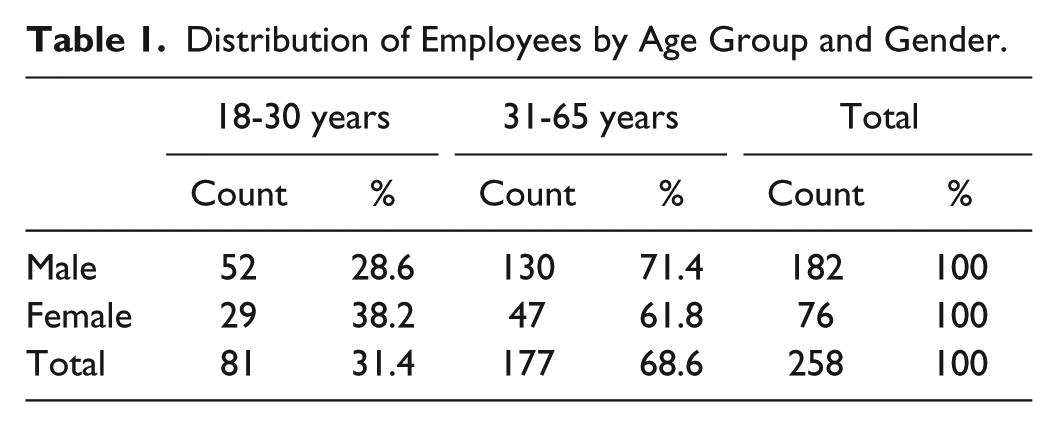
A total of 258 participants anonymously responded to the survey (resulting in a response rate of 47%), of which 71% were male and 29% were female. Most respondents were 31 years or older (see Table 1). Moreover, about three quarters of all respondents have been employed for 5 years or more in this enterprise.
Distribution of Employees by Age Group and Gender.
The survey, which took about 15 min to complete, included three socio demographic questions and the following four measures: (a) PCB which was measured with the five-item PCB measure developed by Robinson and Morrison (2000); (b) OCB which was examined through a 10-item scale developed by Spector, Bauer, and Fox (2010) on the basis of a previous longer measure; (c) OT which was measured with the seven-item measure adapted by Robinson and Rousseau (1994). (d) Intention to leave the job which was adapted from the four-item scale of Bluedorn (1982). The survey was piloted among four employees, and some changes were made before it was finalized.
Results
Descriptive Statistics of Main Variables
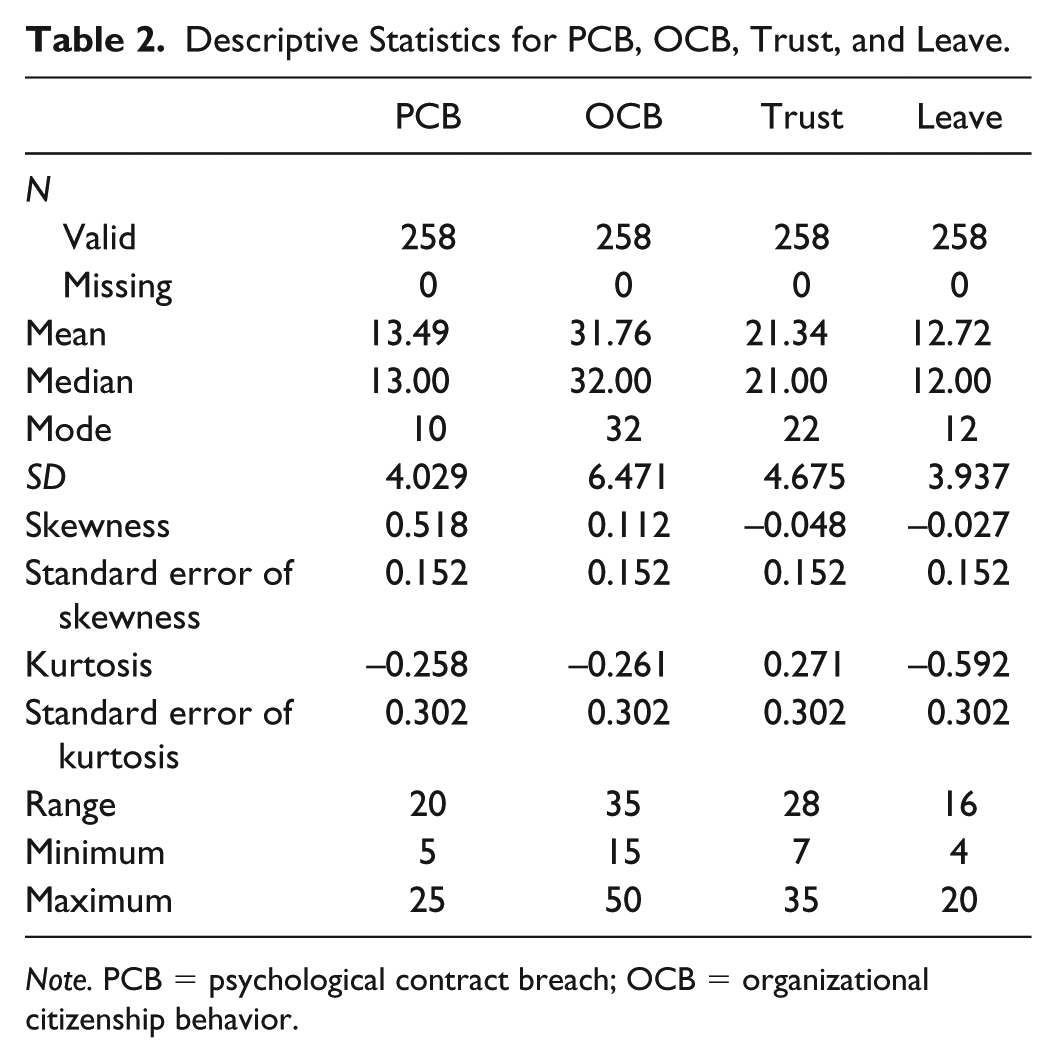
In the first step of the data analysis, descriptive statistics are derived of the four main variables measured in this study, namely PCB, OCB, trust in the organization (Trust), and intention to leave the job (Leave; see Table 2). All the four variables display similar trends—they are normally distributed, with an acceptable level of skewness and kurtosis, resulting in the mean, median, and mode values being close to each other.
Descriptive Statistics for PCB, OCB, Trust, and Leave.
Note. PCB = psychological contract breach; OCB = organizational citizenship behavior.
Independent Sample t Tests of Attitudes by Gender and Tenure
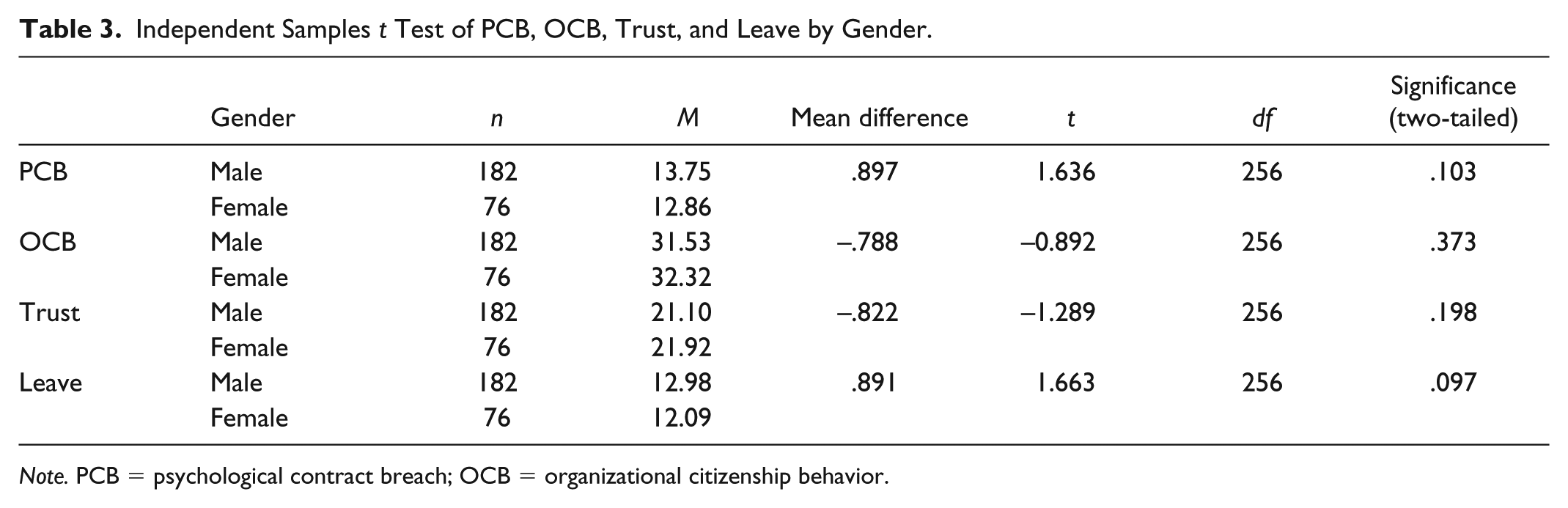
The second step of the data analysis examines potential differences in PCB, OCB, Trust, and Leave based on gender and tenure. As can be seen in Table 3, independent samples t tests indicate no significant gender differences across the variables PCB, OCB, Trust, and Leave.
Independent Samples t Test of PCB, OCB, Trust, and Leave by Gender.
Note. PCB = psychological contract breach; OCB = organizational citizenship behavior.
Similarly, the independent samples t tests in Table 4 indicate that PCB, Trust, and Leave are not significantly related to tenure. On the contrary, the difference in OCB in relation to tenure is statistically significant (t = −4.538, df = 256, p < .001, two-tailed). Employees who worked with the company for less than 5 years declare lower levels of OCB than those who worked for 5 or more years (respective Ms: 28.7 and 32.8).
Independent Samples t Test of PCB, OCB, Trust, and Leave by Tenure.

Note. PCB = psychological contract breach; OCB = organizational citizenship behavior.
Equality of variance not assumed.
Correlation Tests by Hypothesis
The third step of the data analysis derives inferential statistics relating to each of the three hypotheses. Pearson’s r correlation tests are used to investigate the relationship between PCB and the other three variables, OCB, Trust, and Leave. As a further step in the analysis, such correlations are carried out taking into consideration gender and tenure.
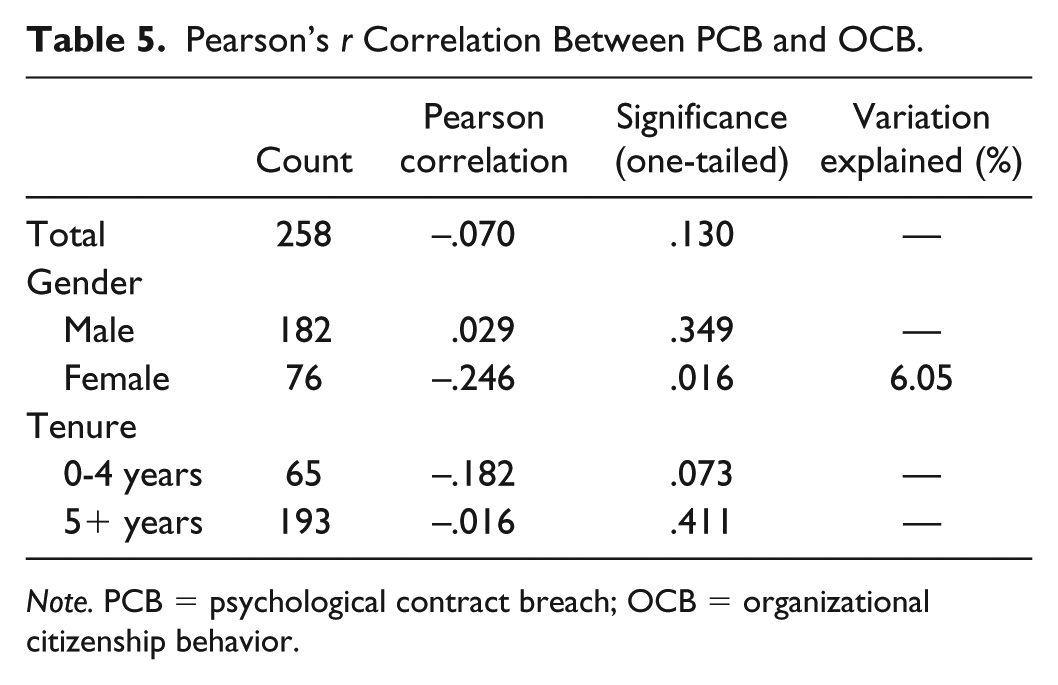
As can be seen from Table 5, Pearson’s r correlation indicates no significant relationship between PCB and OCB. Correlations between PCB and OCB were also performed according to gender. No significant relationship between the two variables was found among male employees. However, a significant negative relationship between PCB and OCB resulted among female employees (r = –.246, n = 76, p ≤ .05, one-tailed). This is a fairly weak correlation as it explains only 6.05% of the variation of the two variables. Finally, the relationship between PCB and OCB was investigated according to job tenure. No significant correlation was found either among those who worked with the company between 0 and 4 years, or those who had 5+ years of experience with the same company.
Pearson’s r Correlation Between PCB and OCB.
Note. PCB = psychological contract breach; OCB = organizational citizenship behavior.
As can be seen from Table 6, a Pearson’s r correlation test indicates that there is a significant negative correlation between PCB and Trust (r = –.571, N = 258, p < .001, one-tailed). The correlation is of moderate strength and explains 32.6% of the variation between the two variables. A significant negative relationship between PCB and Trust exists both among male (r = –.515, n = 182, p ≤ .001, one-tailed) and female employees (r = –.687, n = 76, p ≤ .001, one-tailed). However, whereas the correlation among male employees explains 26.52% of the variation in the two variables, the figure increases to a stronger 47.19% among female employees. Significant negative correlations also arise among workers who have worked with the company for 4 years or less (r = –.578, n = 65, p < .001, one-tailed) and those with a longer tenure (r = –.562, n = 193, p < .001, one-tailed). Short and long tenure explain 35.88% and 31.58% respectively of the variation between PCB and Trust.
Pearson’s r Correlation Between PCB and Trust.
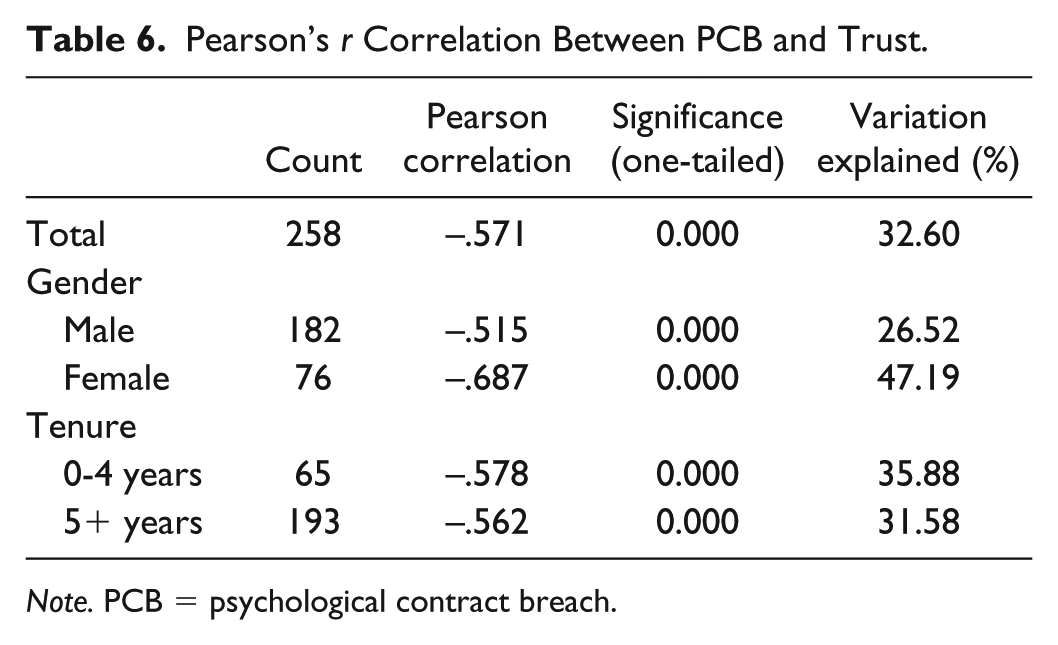
Note. PCB = psychological contract breach.
Table 7 indicates a significant positive correlation between PCB and Leave (r = .445, p < .001, N = 258, one-tailed). This is a moderate correlation that explains 19.8% of the variation between the two variables. Furthermore, such relation exists among both male (r = .449, n = 182, p ≤ .001, one-tailed, explaining 20.16% of the variation) and female employees (r = .402, n = 76, p ≤ .001, one-tailed, explaining 16.16% of the variation). Similarly, PCB and Leave are correlated among workers with both short tenure (r = .345, n = 65, p < .01, one-tailed) and long tenure (r = .481, n = 193, p < .01, one-tailed). However, while the Pearson’s r correlation explains 11.9% of the variance within the two variables among the workers within the 0 to 4 years tenure bracket, it explains a larger 23.13% of the variation among the workers who have worked with the current company for 5 years or more.
Pearson’s r Correlation Between PCB and Leave.

Note. PCB = psychological contract breach.
Discussion
The objective of this study was to examine the relationship between PCB and three work outcomes, namely OCB, trust in the organization (Trust), and intention to the leave the job (Leave). This section first discusses the conceptual implications of the findings in relation to the three hypotheses outlined earlier, then it highlights some managerial implications of the findings, and finally it examines the study’s limitations and suggests potential future research.
Conceptual Implications
In general, PCB is not significantly related to OCB among the workers investigated in the current study, and so Hypothesis 1 is not confirmed. It is also interesting to note that while workers with longer tenure display higher OCB than those with shorter tenure, PCB is not related to OCB in either of the two groups. These findings do not support mainstream research which indicates that the perceived breach experienced by the employees will lower their voluntary helping behavior (Liu et al., 2013; Restubog et al., 2008). However, while uncommon, some studies report positive relationships between these two variables. In one such case, Jafri (2012) describes OCB as “personal and discretionary in nature” (p. 33), implying that the strong bond among employees eases the helping behavior and as a result, frequently supersedes the negative feelings felt when breach occurs. In line with Jafri’s (2012) rationale, the absence of a significant relationship between PCB and OCB in the current study may be due to a strong bond among the workers which enables them to collaborate with each other on a voluntary basis even though they feel that their psychological contract has been breached. This tentative explanation also reflects the social exchange theory (Blau, 2009) which argues that personal obligations, gratitude, and trust are important attitudes that are hardly infringed in the context of the social exchange.
The difficulty in the above interpretation arises from the fact that further analyses of the results reveal that there is a significant, even if not particularly strong, negative relationship between PCB and OCB among the female employees. Career choice literature indicates that when compared with men, women traditionally prefer job attributes consistent with gender roles and stereotypes and favor more jobs that involve working with others, helping others, and making friends, though the situation is changing (Konrad, Ritchie, Lieb, & Corrigall, 2000). Similarly according to Diefendorff, Brown, Kamin, and Lord (2002), women are more likely to engage in OCB than men. Such literature could provide a rationale for the current findings—if women invest more than men in OCB and trust in the organization, it is likely that they would feel more aggrieved when faced with PCB. However, in the current study, both genders exhibit similar levels of OCB and Trust. A better explanation to the gender difference in the relation between PCB and OCB might reside in the conclusions reached by Croson and Gneezy (2009) in their review of literature on gender differences in preferences. The authors claim that rather than being more socially oriented, women’s social preferences are more malleable than those of men; women are more sensitive to social cues in determining their behavior, whereas men’s decisions are less context-specific. This explanation offers a plausible reason why unlike men, women tend to reduce their OCB when they experience PCB.
In line with previous research (Jafri, 2012; Liu et al., 2013; Robinson, 1996; Robinson & Rousseau, 1994), a significant negative correlation between PCB and Trust emerges in the current study, thus supporting Hypothesis 2. As explained by Robinson and Rousseau (1994), “broken promises produce anger and erode trust in the relationship and thus are expected to have more significant repercussions than unmet expectations” (p. 247). Further analysis reveals that once more, gender plays a noteworthy mediating role in the relationship between the variables under consideration. In particular, the negative relationship between PCB and Trust is considerably stronger among female than male employees. Research indicates that women are more risk aversive than men (Croson & Gneezy, 2009). This notion offers a plausible explanation why they would be more likely to reduce their trust in the company when they experience PCB.
PCB is significantly and positively related to intention to leave the job. This result supports Hypothesis 3, and is in line with mainstream research (Tekleab, Orvis, & Taylor, 2013; Zhao et al., 2007). Further analysis of this relationship reveals a potentially more interesting finding, namely that the link between PCB and Leave is much stronger among those who worked for longer years in the company. This finding may be viewed as counterintuitive, because objectively, those who have worked for longer with the company would probably experience greater difficulties in finding new employment elsewhere, due to factors such as ageism and lower job seeking skills. Indeed, the study does not show to what extent this intention to quit results in the handing of their resignation. Besides, previous research indicates that PCB is either not related to actual turnover (Zhao et al., 2007), or that the relation is a complex one, mediated by other variables (Clinton & Guest, 2014). Irrespective of the issue of actual quitting the job, the finding in the current study may indicate the greater grievance felt by workers with longer tenure in the plant under investigation when they perceive their management not respecting their psychological contract. These workers experienced more prosperous years at the company when compared with the newer employees, who mainly experienced turbulent times. The turnover of employees was very low in the last decade, a situation that may have been linked to the then existing good remuneration and labor conditions, learning opportunities, career advancement, job flexibility, and security. The takeover appears to have negatively affected these favorable conditions through the announcements of collective redundancies, changes resulting in lower wages, and a lack of a clear vision for the future. In view of these changes, it appears reasonable for persons with a longer tenure to feel more aggrieved than those with a shorter one. This reasoning follows the literature distinguishing between PCB and psychological contract violation, with the latter framing the emotional reactions stemming from the perceived breaches (Morrison & Robinson, 1997).
Managerial Implications
Management may consider the existing positive reciprocal exchanges between workers as an asset to develop for the future recovery. Ugboro (2006) recommends that managers should act on this crucial issue and suggests that they empower survivals of downsizing to revitalize the enterprise and accomplish the objectives of restructuring. This strategy can lead to strengthen the bond in teams and their individual members and make it easier to reach the targets. It is also important to redesign the jobs to fit the new workforce size and distribute workload in a reasonable manner. These empowerment policies and job redesign should also serve to override the skepticism and reduce turnover intentions.
Management has to work hard to regain the trust of employees affected by PCB by improving vertical and lateral communication. In-group communication is a prerequisite for trust in manager–employee relationships (Willemyns, Gallois, & Callan, 2003). It is important to examine whether in the plant there are specific elements that may further erode trust, such as “ingrained culture of mistrust, scarcity of resources, job security, political alliances and rivalries” (Willemyns et al., p. 126), and make an effort to act on each scenario. Management should also consider providing communication training to all those at managerial or supervisory level. Research indicates that “effective communication reduces perceived breach of the psychological contract and is associated with better employee-related outcomes from [the] management of the contract” (Guest & Conway, 2002, p. 35). Thus, managing PCB through effective communication could overturn the intention to leave for some of the employees who survived the downsizing.
The company should focus on reducing the employees’ intention to quit, as it cannot afford to lose more experienced and well-trained employees. This can be very costly not only for the high expenses of recruitment and training, but can also jeopardize efficiency and competitiveness which is crucial to win the internal competition offered by other plants of the same company. Bal et al. (2013) suggest that human resource managers should shift to relational contracts, which are more focused on human welfare than monetary-based contracts. This shift is crucial to keep tight valid employees who are vital for the future plans of this plant. Managers could have more discretion to deal with their subordinates’ conditions such as leave allocation, flexible hours, job sharing, and other similar inducements that are important elements of work–life balance. Having these conditions could mean a happier workforce and less turnover intentions.
The company also needs to better target women and workers with longer tenure, because these might experience more negative outcomes as a consequence of PCB.
Study Limitations and Future Research
The correlational nature of the study does not allow for definitive conclusions about causality. Future research could take a mixed-method approach, combining quantitative and qualitative research, to approach the current topic of investigation. Such approach would reduce the limitations in each method and provide better understanding of the research questions (Creswell, 2013).
This study focused on only one place of work in a particular industrial sector which was going through a process of takeover, and so its findings cannot be generalized to other situations. Future research could take a larger sample of chemical plants in Malta, thus providing a stronger and broader evaluation of the work dynamics through the sector. Repeating the study over a period of time would provide a clearer perspective on how the relationship between contract breach and other variables develops during both normal and exceptional circumstances such as those examined in the current study.
The study does not include a scale for psychological contract violation, thus limiting information about the negative feelings experienced by the employees who perceived the PCB. Future research could include such scale and also explore a broader range of attitudes such as counterproductive work behaviors, perceived organizational support, and organizational commitment, among others.
Conclusion
This research highlights the importance of PCB in a specific industrial setup during a process of takeover. PCB is significantly related to lower trust levels in the organization and stronger intentions to leave the job. On the contrary, the voluntary helping behaviors, which are paramount for the smooth running of the plant’s operations, are not strongly related to the breach of the psychological contract. The relation between PCB and OCB and Trust is stronger among women than men. Besides, when compared to workers with shorter tenure, workers with longer tenure tend to consider more leaving the company if they suffer from PCB. Management should react promptly to fulfill the obligations expected by the employees in their psychological contract. It should work on the strength of employees’ helping behaviors to recover the trust of the employees and reduce as much as possible the harm inflicted to the organization. Unfortunately, while the topic of PCB has gained international recognition over the past years, it is still not given its due importance in Maltese places of work, where management tends not to be sensitive toward constructs such the psychological contract. Cassar (2001) suggests that management of Maltese enterprises “should attempt to understand how employers perceive these obligations within an employment relationship, and more importantly, how employers should attempt to manage those obligations” (p. 205). Competitiveness in the ever increasing globalized world is becoming fierce, and in this context, management should start giving much more importance to the psychological aspects of the workforce, which may lead to more highly competitive organizations.
Footnotes
Declaration of Conflicting Interests
The author(s) declared no potential conflicts of interest with respect to the research, authorship, and/or publication of this article.
Funding
The author(s) received no financial support for the research, authorship, and/or publication of this article.
