



Abstract
Coronavirus Disease 2019 (COVID-19), a highly infectious virus transmitted through droplets from sneezes and coughs, was declared a global pandemic in 2020. Measures implemented by organizations as a result of COVID-19 were controversial among United States (U.S.) citizens. Perceptions of governmental and scientific information further divided U.S. citizens and distrust in science fostered conspiratorial thinking toward the origin of the virus. The purpose of this study was to determine if critical thinking style (CTS), the use of COVID-19 information sources, and social media connections were predictors of origin of COVID-19 beliefs. A survey was disseminated to 1,048 U.S. adults in May 2020 when most states were under shelter-in-place orders. Results indicated select COVID-19 information sources used and social media connections predicted origin of COVID-19 beliefs. CTS was not a significant predictor. Findings revealed a partisan divide between COVID-19 information sources. Implications for science communicators engaging the public during crisis were discussed.
Introduction
A global pandemic was sparked in December 2019 when a novel coronavirus (COVID-19) emerged. COVID-19 is highly infectious and transmitted between people through droplets from sneezes and coughs (Heymann & Shindo, 2020). Within 3 months, the virus caused 4,291 deaths in 114 countries, leading the World Health Organization (WHO) to declare a global pandemic on March 11, 2020 (Hart et al., 2020; Van Bavel et al., 2020). The pandemic led to global public health campaigns aimed at slowing the spread of COVID-19 by increasing hand washing, wearing face masks in public, and social distancing. Many infections, however, were concentrated in the United States (U.S.), with COVID-19 infecting at least 1.8 million and killing 100,000 individuals by the end of May (Centers for Disease Control and Prevention [CDC], 2020; Johns Hopkins University of Medicine, 2020). Organizations implemented measures to reduce the spread of the disease, including encouraging remote work and online program delivery (Narine & Meier, 2020), while political leaders around the world implemented strict social distance requirements known as shelter-in-place orders (Zambrano-Monserrate et al., 2020). Shelter-in-place orders were intended to help prevent the spread of COVID-19 by ensuring healthcare institutions could accommodate sick patients. However, shelter-in-place orders imposed large financial costs on society due to decreased economic activity, making these orders one of the most controversial policy decisions made during the pandemic (Hart et al., 2020; Thunström et al., 2020).
U.S. citizens were divided in their perceptions of governmental and scientific information and actions provided in response to COVID-19 (Hart et al., 2020). Recent research has shown reactions to the pandemic correlated with political ideology (Imhoff & Lamberty, 2020). Democrats, the more liberal political party in the U.S., had much greater confidence that scientists would act in the best interest of the public; while Republicans’, the more conservative political party, confidence remained flat (Funk et al., 2020). Partisan opinions paralleled behavioral differences: Republicans participated in social distancing practices less than Democrats (Allcott et al., 2020; Goldstein & Wiedemann, 2021; Kushner Gadarian et al., 2020; Painter & Qiu, 2021). For example, due to the politicization of mask-wearing to prevent the spread of droplets (Thacker, 2020), the acceptability of and adherence to mask-wearing varied among the U.S. population, despite evidence that masks reduced the transmission of COVID-19 (Malecki et al., 2021). Recent data, however, demonstrates greater convergence of mask-wearing among Republicans and Democrats (80% and nearly 100%, respectively, in late July [Makridis & Rothwell, 2020]). Political ideology is only one aspect of information processing during the COVID-19 era; by examining the cognitive style of critical thinking, which describes how an individual prefers specific methods for processing information, communicators can develop a better understanding of information-seeking and processing behaviors to enhance the effective distribution and uptake of public health messaging (Gorham et al., 2014).
Current studies suggest maintaining and strengthening trust in science and politics is critical for overcoming the COVID-19 pandemic, as trust is crucial for the adoption of protective measures and adherence to governmental restrictions (Dohle et al., 2020; Siegrist & Zingg, 2014). While trust in science is of utmost importance during a pandemic (Hendriks et al., 2016), the politicization of science in the U.S. impacted the role and perception of medical and public health experts during the COVID-19 pandemic (Dohle et al., 2020; Hart et al., 2020). Understanding individuals’ information-processing during the COVID-19 pandemic related to disease emergence may help bolster crisis communication strategies in the future, though information-processing and critical thinking style preference, rather than critical thinking ability, has not been examined in a crisis context. Thus, the current study examines the role of critical thinking style on information processing, through COVID-19 information sources and social media, during initial COVID-19 shelter-in-place orders.
Communication in Times of Crisis
Responding to crises, such as COVID-19, requires research and communication, though the surprising emergence of a crisis complicates related communication strategies and other forms of risk management (Sellnow et al., 2017). Information about COVID-19 changed frequently during the early months of the pandemic, due to the complexity of researching the virus (Malecki et al., 2021). Research is necessary for comprehending the disease, its spread, diagnoses and treatments, potential vaccines, and spread prevention (Reynolds & Seeger, 2005). Although prevention of COVID-19 requires research-driven evidence, misinformation about prevention and cures for the disease are circulating public spaces and the internet (Kim et al., 2020). The challenge for communicators is then to translate highly complex and changing research into understandable and practical messages for the public (Sellnow et al., 2015).
The role of news media in science communication has attracted scholarly attention for more than 50 years (Hanson-Easey et al., 2015). The media has played a critical role in informing the public during times of crisis. Individuals generally select news media sources based on political preference and the congruence of a news outlet with political ideology (Hills, 2019; Sandman, 2006). U.S. news sources are highly polarized and were especially so during the COVID-19 pandemic (Hart et al., 2020). Additionally, popular news sources in the U.S. tend to align with a political leaning (Mitchell et al., 2014). According to the Pew Research Center, Fox News tends to attract a more conservative and Republican audience, Columbia Broadcasting System (CBS) News and American Broadcasting Company (ABC) News are fairly moderate, and Cable News Network (CNN) attracts a more liberal and Democratic audience (Grieco, 2020; Mitchell et al., 2014).
However, the news media landscape has changed resulting from the advent of social media (Malecki et al., 2021). Specifically, social media plays a role in shaping public perceptions of risk and outrage during crises (Ophir, 2018; Quinn, 2018; Rossman et al., 2018). Cohen (2020) examined the influence of celebrities who shared their COVID-19 experiences on social media on public risk perceptions and found the presence of celebrities influenced public perception of disease susceptibility and increased public engagement in prevention behavior. Though social media provides opportunities for experts to quickly share information to the public, barriers exist in using social media for effective risk communication as members of the general public also share inaccurate information (Malecki et al., 2021). Social media creates echo chambers of media attention, as individuals share information with like-minded followers. Though some users will sort through different information, this increases the chances of finding conflicting messages, and the potential of reading material aimed at discrediting experts. Contradicting information can increase a lack of understanding and reduce individuals’ perceptions of their agency, leading to feelings of loss of control (Malecki et al., 2021). Additionally, social media platforms are increasingly a source of community-building among users, developing online communities through the communication of shared interests (Dobbins et al., 2021; Pan et al., 2017). People associate the trustworthiness of communication messages with their lived experiences and values, often negotiated through various affiliations in their own communities (Gikerson et al., 2016; Merzdorf et al., 2019). Competing messages from both social media exposure and dissonance between the scientific community and one’s personal offline community may contribute additionally to feelings of loss of control (Malecki et al., 2021). One way to reclaim feelings of control during crises is to engage in conspiracy thinking (Imhoff & Lamberty, 2020).
Conspiracy Belief and COVID-19
In times of crises, conspiracy thinking increases substantially (Imhoff & Lamberty, 2020). Conspiratorial thinking is highly correlated with feelings of uncertainty (Miller, 2020). Conspiracy theories here refer to “an effort to explain some event or practice by reference to the machinations of powerful people, who attempt to conceal their role [. . .] until their aims are accomplished” (Sunstein & Vermeule, 2009, p. 205). Disease-related examples of conspiracy theories include the beliefs that the U.S. developed HIV as a biological weapon (Geissler & Sprinkle, 2013), that AIDS was a conspiracy to kill African Americans (Bogart & Thorburn, 2005), and that the Zika virus outbreak in 2015 was caused by genetically modified mosquitoes (Imhoff & Lamberty, 2020).
COVID-19 has been described as an ideal breeding ground for conspiracy belief emergence (Bolsen et al., 2020; Van Bavel et al., 2020) due to the complexity of a casual explanation for the disease, its effect on people’s lives around the globe, and uncertainty surrounding all aspects of the pandemic (Imhoff & Lamberty, 2020). Epidemiologists posit that genetic sequencing suggests SARS-CoV-2, the virus causing COVID-19, originated in bats and transitioned to humans (Ignatius, 2020; Sansonetti, 2020; Sun et al., 2020), though the precise animal source of the virus remains unknown (Bolsen et al., 2020; Mallapaty, 2020). This uncertainty has led to conspiracy theories regarding the origin of the virus (Van Bavel et al., 2020).
Currently, several conspiracy theories exist related to COVID-19 (Imhoff & Lamberty, 2020). Many downplayed COVID-19, saying it was no worse than the flu. Those individuals suspected people who claimed otherwise to be doing so for their own political advantage. Others claimed COVID-19 did not evolve by mutation (Andersen et al., 2020); rather it was intentionally manufactured and spread as a bioweapon (Imhoff & Lamberty, 2020). This conspiracy posits the virus was intentionally or accidentally leaked from a CDC-affiliated research laboratory in Wuhan, China where it was deliberately engineered as a bioweapon (Bolsen et al., 2020; Gertz, 2020). The Chinese bioweapon conspiracy persisted in the U.S. due to the Trump administration dubbing COVID-19 as the “Chinese virus” (Bolsen et al., 2020; Rogers et al., 2020). Conversely, Miller (2020) found 8% of survey respondents believed the virus was not real. A U.S.-based survey conducted in the beginning of March 2020 showed that 49% of respondents believed COVID-19 was a man-made epidemic, while 44% thought COVID-19 was exaggerated for political reasons, and 13% believed it a hoax (Frankovic, 2020).
Conspiracy theories can impact engagement in prevention behavior, such as not wearing facial coverings or participating in social distancing during the COVID-19 outbreak (Bogart & Thorburn, 2005; Bolsen et al., 2020; Imhoff & Lamberty, 2020). For example, Bolsen et al. (2020) examined conspiracy theories related to COVID-19 by exposing U.S. residents to short articles about the origin of COVID-19 that mimicked either factual or false news stories and found the framed messages influenced public belief in the origin of COVID-19. In addition, Bolsen et al. (2020) noted the worrisome nature that a single exposure to a conspiracy theory “reduced individuals’ intentions to practice urgently necessary public health behaviors” (p. 576). Conspiracy mentality has been connected to generalized distrust in science (Imhoff & Lamberty, 2020). Thus, those with a worldview more inclined toward conspiracy thinking are less likely to trust expert recommendations for reducing spread (Bolsen et al., 2020).
Conspiracy beliefs can be understood as expressions of a particular political attitude or a way to bolster a political worldview (Imhoff & Lamberty, 2018; Miller, 2020). The context of the COVID-19 pandemic in the U.S. is one where a Republican president (Donald Trump) was criticized for his handling of the crisis, threatening the political worldviews of those aligned with the president’s political beliefs (Miller, 2020; Uscinski et al., 2020). Thus, evidence suggests Republicans are more likely to believe COVID-19 conspiracy theories as compared to Democrats (Uscinski et al., 2020). However, political leaders during crises often deal with blame for their response, regardless of political affiliation (Boin et al., 2010). Miller (2020) found independents were also more likely than Democrats to believe these conspiracy theories.
Communicating public health information is critical during a pandemic; yet politicization and polarization of the media limits the efficacy of science communication efforts (Hart et al., 2020; Kahan, 2012). This complexity is compounded by the advent of conspiracy thinking (Imhoff & Lamberty, 2020). While studies have examined the relationship between conspiracy belief and critical thinking ability (Lantian et al., 2021), literature is scant on how critical thinking style, not a measurement of ability but a measurement of preference (Lamm, 2015), impacts participation in conspiracy thinking. This research aimed to determine if critical thinking style (CTS), use of COVID-19 information sources, and social media connections predicted origin of COVID-19 beliefs. Determining the relationships between these factors and belief in the origin of COVID-19 may help inform future crisis communication strategies around disease outbreaks.
Conceptual Framework
The conceptual framework for this study was based on the concept of CTS developed by Lamm and Irani (2011). Critical thinking is “. . .purposeful, self-regulatory judgment which results in interpretations, analysis, evaluation, and inference, as well as an explanation of the evidential, conceptual, methodological, criteriological, or contextual considerations upon which that judgmentjudgement is based” (Facione, 1990, p. 2). Critical thinkers are well-informed, use reason and evaluative thinking in making judgments, and seek relevant information for problems and issues (Facione, 1990). Lamm and Irani (2011) furthered the concept by positing that each critical thinker has “an individual style of thinking about a topic that resonates with each specific issue” (Owens & Lamm, 2016, p. 121).
CTS, rather than denoting an individual’s ability to think critically, measures how one chooses to think about and reach solutions to a problem (Gay et al., 2015; Lamm, 2015). It represents the formalized process of how individuals think through a problem and reach a final solution (Owens & Lamm, 2016). According to the CTS framework, there is no correct or incorrect way to reason critically; rather, people process information differently and experience the critical thinking process in a variety of ways (Lamm & Irani, 2011). CTS is a continuum, ranging from a preference for engagement (engagers) to a preference for seeking information (seekers) (Lamm, 2015; Putnam et al., 2017).
Engagers benefit from interactive communication and open discussion within a group (Gay et al., 2015; Lamm & Irani, 2011). They are confident in their reasoning, problem-solving, and decision-making skills and communicate their reasoning processes effectively (Lamm, 2015). Engagers seek opportunities for collaborative, hands-on approaches to problem solving (Lamm, 2015; Putnam et al., 2017). Those with an engaging CTS are highly engaged with their surroundings, able to predict problems requiring critical thinking before they occur (Lamm & Irani, 2011).
Conversely, seekers take a researched approach to decision-making and problem-solving (Gay et al., 2015; Lamm & Irani, 2011), considering divergent viewpoints and new knowledge to arrive at a solution (Lamm, 2015). Seekers recognize the complexity of finding solutions for problems and will actively seek the truth of a statement, even if contradictory to their own opinion or belief. These individuals actively search through information to enhance their knowledge on a subject, while remaining aware of their biases influenced by their environment and experiences (Lamm & Irani, 2011).
The CTS framework was developed with the intention to inform communication strategies based on critical thinking style preference, helping researchers and practitioners determine how to create communication approaches appropriate for both seeking and engaging audiences, with the hope of encouraging behavior change. Gorham et al. (2014) examined CTS in the context of encouraging water conservation behavior, and Leal et al. (2017) examined CTS in the context of food safety behavior. However, the CTS framework (Lamm & Irani, 2011) has not been used to investigate seeking and engagement behavior within the context of how information sources and social media connections are used to think critically during times of crisis. Examining the convergence and divergence of this framework within the politically-charged context of COVID-19 may yield insight into its robustness, as well as help scholars understand how CTS can be used to tailor messaging for COVID-19 information sources and social media for individuals with diverse information processing preferences. COVID-19 presented unprecedented communication challenges, and research investigating communication practices and strategies in this context can enhance future crisis communication resilience.
Purpose and Objectives
The purpose of this study was to identify what impacts U.S. residents’ abilities to process information in a time of crisis. The following research objectives guided the study:
Describe respondents’ origin of COVID-19 beliefs, CTS, COVID-19 information sources, and groups of people connected with on social media while most states were under shelter-in-place orders;
Examine relationships between respondents’ origin of COVID-19 beliefs, CTS, COVID-19 information sources and the groups of people connected with on social media while most states were under shelter-in-place orders; and
Determine if origin of COVID-19 beliefs are predicted by CTS, use of COVID-19 information sources, and social media connections while most states were under shelter-in-place orders.
Methods
The study utilized a quantitative research design and was part of a larger research effort to investigate how the public sought and processed information during the COVID-19 pandemic. The study addressed four parts of the survey instrument: belief in the origin of COVID-19, CTS, COVID-19 information sources, and groups of people connected with on social media while most states were under shelter-in-place orders.
The survey instrument included demographic, select-all-that-apply, and Likert-type questions. One select-all-that-apply question was used to determine why respondents believed the COVID-19 pandemic had occurred. The following options were included: COVID-19 is a virus that moved from animals to humans, COVID-19 is the result of the will of a higher power, COVID-19 is a way for the Earth to clean itself, COVID-19 is a form of biological warfare, COVID-19 is a hoax, or other.
CTS was measured using the University of Florida Critical Thinking Inventory (UFCTI; Lamm & Irani, 2011). The UFCTI included 20 items on a five-point Likert-type scale (1 = Strongly Disagree; 2 = Disagree; 3 = Neither Agree nor Disagree; 4 = Agree; 5 = Strongly Agree) where respondents indicated their associated level of agreement or disagreement. Learners are either identified as an engager or seeker of information on the UFCTI continuum. Possible scores can range from 26 to 130 with seekers identified as those with scores of 78.5 and above and engagers with scores of 78.4 and below (Lamm & Irani, 2011). Reliability was calculated ex post facto for the overall instrument (α = .935), the engager construct (α = .856), and the seeker construct (α = .900).
The COVID-19 information sources respondents used while most states were under shelter-in-place orders was determined with five questions measured on a seven-point Likert-type scale (1 = Almost constantly; 2 = Several times a day; 3 = About once a day; 4 = Several times a week; 5 = Once a week; 6 = Less than once a week; 7 = Never). Respondents were asked to indicate how often they used the following COVID-19 information sources: WHO, CDC, State Government website, Fox News, CBS News, CNN, and NBC News. Responses were then grouped into dichotomous variables to identify high users, respondents who viewed the COVID-19 information source at least once a day (coded as one), and low users, respondents who viewed the COVID-19 information source less than once a day (coded as zero).
The groups of people respondents connected with on social media while most states were under shelter-in-place orders was determined with one select-all-that-apply question. The following options were included: family, friends, colleagues I have met face to face, colleagues I have not met face to face, individuals I don’t know but whose opinions I value (non-celebrities), celebrities, and other. Connecting with people on social media was defined for respondents in the survey item as “various interactions such as reading posts, following, liking, retweeting, commenting, etc.” The definition of colleagues that respondents had met face-to-face and colleagues that respondents had not met face-to-face was not provided to respondents in the survey and should be taken into consideration when interpreting the results. Dichotomous variables were used for the groups of people respondents connected with on social media. Specifically, respondents who indicated they did not connect with a group on social media were coded as zero and respondents who indicated they did connect with a group on social media were coded as one. A panel of experts in survey design, communication research, and cognition reviewed the survey for face and construct validity.
Data were collected from U.S. residents in May 2020 through Qualtrics, an online survey platform. Non-probability opt-in sampling techniques, often used in public opinion research, were used to acquire respondents (Baker et al., 2013; Lamm & Lamm, 2019). U.S. residents aged 18 or older who were representative of the population based on age, gender, race/ethnicity, and geographic location were targeted (United States Census Bureau, 2010). Pilot test data from 50 respondents were analyzed for content validity prior to full distribution. No modifications to the survey were made based on pilot responses.
The survey was completed by 1,048 individuals. The data were weighted using 2010 Census data based on geographic location, gender, age, and race/ethnicity to ensure respondents were representative of the target population (Baker et al., 2013). Respondents were fairly equally distribution in regards to sex with 52.1% female and 47.9% male. The majority of respondents were White (85.5%), 35 years and older (78.3%), and had at least some college education (84.9%). The full demographic profile of respondents can be viewed in Table 1.
Demographics of Respondents (N = 1,048).

Descriptive statistics (frequencies and means) and inferential statistics (correlations and logistic regression) were used to analyze the data in SPSS 26. Correlations were determined based on Cohen (1988). The study was approved by the University of Georgia Institutional Review Board.
Results
Objective 1
Survey respondents indicated their belief in the origin of COVID-19 (Table 2). The majority of respondents indicated they believed COVID-19 originated as a virus that moved from animals to humans (59.9%) and very few respondents believed it was a hoax (6.6%). Respondents were fairly likely to believe COVID-19 was a form of biological warfare (35.2%). Moreover, respondents’ UFCTI scores (M = 78.82, SD = 4.46) were fairly evenly distributed with slightly more engagers (554) than seekers (494).
Belief in the Origin of COVID-19 (N = 1,048).

Survey respondents indicated how often they used COVID-19 information sources while most states were under shelter-in-place orders (Table 3). Over half of respondents were high users of the CDC (51.1%). Respondents were also likely to be high users of WHO (46.8%), CNN (47.5%), and Fox News (45.5%).
Mainstream Information Sources Frequently Used (N = 1,048).

Survey respondents indicated the groups of people they connected with on social media while most states were under the shelter-in-place orders (Table 4). The majority of respondents connected with family (80.8%) and friends (81.7%) on social media. They were less likely to connect with colleagues they met face to face (41.4%), colleagues they had not met face to face (21.4%), individuals they did not know but whose opinions they valued (30.2%), and celebrities (20.2%).
Groups of People Connected With on Social Media (N = 1,048).

Objective 2
The relationship between respondents’ belief in the origin of COVID-19, CTS, COVID-19 information sources, and the groups of people connected with on social media while most states were under shelter-in-place orders were examined in order to determine any issues of high multicollinearity (Table 5). Respondents use of the WHO as a COVID-19 information source was strongly correlated with use of the CDC (Cohen, 1988). Similarly, all COVID-19 information source variables had a moderate or strong relationship with other COVID-19 information source variables. For example, use of the WHO had a moderate relationship with use of Fox News, ABC News, and CBS News. Respondents who connected with family on social media had a moderate relationship with respondents who connected with friends on social media. Similarly, respondents who connected on social media with colleagues they had met face to face had a moderate relationship with respondents who connected with colleagues they had not met face to face (Cohen, 1988). Based on these findings, the relationship among the independent variables were small or moderate indicating the results of the logistic regression models should not be affected by the rate of multicollinearity.
Relationships Between Respondents’ Belief in the Origin of COVID-19, CTS, COVID-19 Information Sources, and the Groups of People Connected With on Social Media.

Note. 1 = COVID-19 is a virus that moved from animals to humans, 2 = COVID-19 is the result of the will of a higher power, 3 = COVID-19 is a way for the Earth to clean itself, 4 = COVID-19 is a form of biological warfare, 5 = COVID-19 is a hoax, 6 = University of Florida Critical Thinking Inventory (UFCTI) score, 7 = WHO, 8 = CDC, 9 = State Government website, 10 = CNN, 11 = Fox News, 12 = ABC News, 13 = CBS News, 14 = family, 15 = friends, 16 = colleagues I have met face to face, 17 = colleagues I have not met face to face, 18 = individuals I don’t know but whose opinions I value (non-celebrities), 19 = celebrities; variables 1 to 5 are beliefs in the origin of COVID-19, variables 6 to 13 are COVID-19 information sources used while most states were under shelter-in-place orders, and variables 14 to 19 are groups of people respondents connected with on social media while most states were under the shelter-in-place orders.
p < .05; **p < .01.
Objective 3
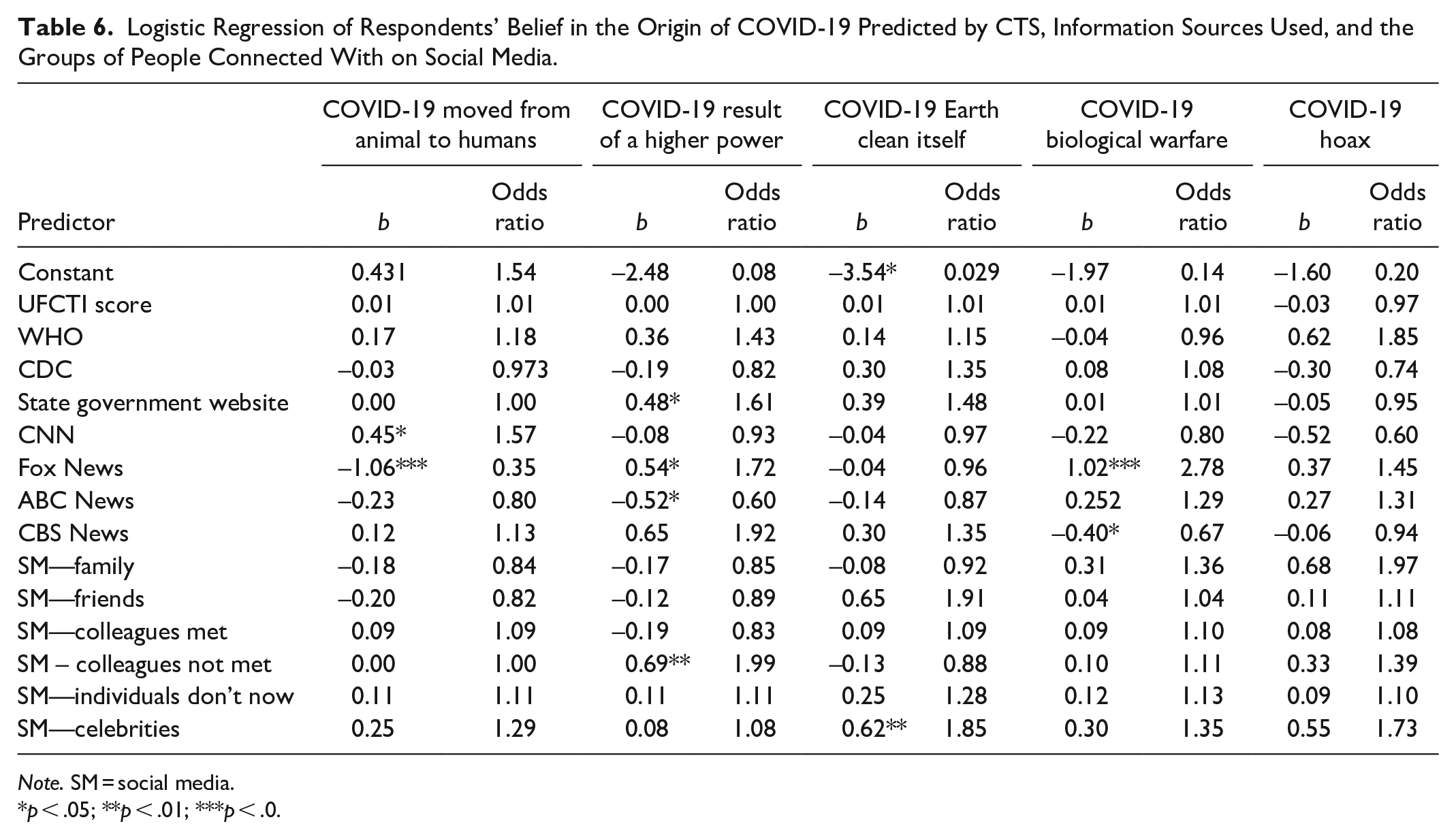
A logistic regression analysis was used to determine if origin of COVID-19 beliefs were predicted by CTS, COVID-19 information sources, and individuals engaged with on social media while most states were under shelter-in-place orders (Table 6). Origin of COVID-19 beliefs was the dependent variable. CTS, COVID-19 information sources, and individuals engaged with on social media were the independent variables.
Logistic Regression of Respondents’ Belief in the Origin of COVID-19 Predicted by CTS, Information Sources Used, and the Groups of People Connected With on Social Media.
Note. SM = social media.
p < .05; **p < .01; ***p < .0.
COVID-19 moved from animal to humans
High use of CNN and Fox News were significant predictors of respondents’ belief that COVID-19 moved from animal to humans. High use of Fox News (b = −1.06, p < .001, odds ratio [OR] = 0.35) was found to be a negative, statistically significant predictor of respondents’ belief that COVID-19 moved from animal to humans, indicating that for every unit increase in high use of Fox News, respondents were 0.35 times more likely to not believe COVID-19 moved from animal to humans. High use of CNN (b = 0.45, p < .05, OR = 1.57) was found to be a positive, statistically significant predictor of respondents’ belief that COVID-19 moved from animals to humans, indicating that for every unit increase in high use of CNN, respondents were 1.57 times more likely to believe COVID-19 moved from animal to humans.
COVID-19 was the result of the will of a higher power
High use of respondents’ state government website, Fox News, ABC News, and connecting on social media with colleagues that respondents had not met face to face were significant predictors of respondents’ belief that COVID-19 was the result of the will of a higher power. High use of respondents’ state government website (b = 0.48, p < .05, OR = 1.61), Fox News (b = 0.54, p < .05, OR = 1.72), and connecting on social media with colleagues respondents had not met face to face (b = 0.69, p < .01, OR = 1.99) was found to be a positive, statistically significant predictor of respondents’ belief that COVID-19 was the result of the will of a higher power. High use of ABC News (b = −0.52, p < .05, OR = 0.60) was found to be a negative, statistically significant predictor of respondents’ belief that COVID-19 was the result of the will of a higher power.
COVID-19 was a way for the Earth to clean itself
Connecting with celebrities on social media was a significant predictor of respondents’ belief that COVID-19 was a way for the Earth to clean itself. Connecting with celebrities on social media (b = 0.62, p < .01, OR = 1.85) was found to be a positive, statistically significant predictor of respondents’ belief that COVID-19 was a way for the Earth to clean itself.
COVID-19 was a form of biological warfare
High use of Fox News and CBS News were significant predictors of respondents’ belief that COVID-19 was a form of biological warfare. High use of Fox News (b = 1.02, p < .001, OR = 2.78) was found to be a positive, statistically significant predictor of respondents’ belief that COVID-19 was a form of biological warfare, indicating that for every unit increase in high use of Fox News, respondents were 2.78 times more likely to believe COVID-19 was a form of biological warfare. High use of CBS News (b = −0.40, p < .05, OR = 0.67) was found to be a negative, statistically significant predictor of respondents’ belief that COVID-19 was a form of biological warfare.
COVID-19 was a hoax
There were no significant predictors of respondents’ belief that COVID-19 was a hoax. In addition, respondents’ CTS did not predict any of the effects.
Conclusion and Discussion
The complexity of the COVID-19 pandemic has led to conspiracy theories interfering with safety measures that protect the public (Bogart & Thorburn, 2005; Imhoff & Lamberty, 2020; Van Bavel et al., 2020). Science communicators must determine the most effective ways to implement crisis communication strategies around disease outbreaks in order to mitigate spread. This study sought to identify how CTS, COVID-19 information sources used, and groups interacted with on social media impacted U.S. residents’ abilities to process scientific information in a time of crisis. One limitation of the study was that the respondents were more educated than the general public they were meant to represent. The demographic data were only weighted based on gender, age, race, and ethnicity; thus, the higher level of education across respondents may have influenced the results. Overall, the findings indicated select COVID-19 information sources and groups of people connected with on social media predicted respondents’ beliefs in the origin of COVID-19, though CTS was not a significant predictor. The results of this study, however, are preliminary and future studies may benefit from conducting interviews or focus groups to determine to what extent COVID-19 information sources and groups of people connected with on social media influence respondents’ beliefs in the origin of COVID-19.
CTS was not a predictor of beliefs in the origin of COVID-19, which was the measurement of conspiracy belief in this study. This may be attributed to the fact that individuals’ normal ways of processing information may change during times of crisis and/or the shelter-in-place orders restricted engagers ability to lean on their natural information processing tendency when thinking critically. This is relevant to COVID-19, due to feelings of loss of control and uncertainty within the public of who to trust (Depoux et al., 2020; Malecki et al., 2021). The UFCTI instrument has not been tested in a crisis setting, and future research could investigate potential gaps in the instrument limiting its robustness to explain information-processing during times of crisis. Lantian et al. (2021) found that high conspiracy belief was associated with a low critical thinking ability, so there may be a relationship between conspiracy belief and critical thinking. However, the UFCTI gages a preference for methods of receiving information and, due to the seemingly content-neutral development of a preference rather than a capacity for critical thinking, the UFCTI may not impact engagement in a particular belief. Individuals can receive conspiracy-related content through both engagement methods and seeking methods of information processing, depending on where the information source is located. Thus, the content-dense media of COVID-19 information sources may have contributed to the higher predictive value for conspiracy belief when compared to CTS.
COVID-19 information sources were predictors of respondents’ beliefs in the origin of COVID-19. Within the logistic regression model, high users of Fox News were less likely to believe COVID-19 moved from humans to animals and were more likely to believe COVID-19 was the result of the will of a higher power or a form of biological warfare. Conspiracies indicating COVID-19 was the will of a higher power or a form of biological warfare may exacerbate the pandemic as previous studies have found conspiracy belief impacts engagement in prevention behavior (Bogart & Thorburn, 2005; Imhoff & Lamberty, 2020). Thus, Fox News viewers pose a challenge for effective communication of factual information about the pandemic, as their engagement in conspiracy thinking indicates they are a population who likely distrusts science (Imhoff & Lamberty, 2020). One limitation of the study that must be acknowledged is that respondents who believed COVID-19 was the result of the will of a higher power might not be engaged in conspiracy thinking but rather influenced by their religious beliefs. Therefore, belief that COVID-19 was the result of the will of a higher power does not directly imply conspiracy thinking and may need to be considered separately from the other conspiracy beliefs examined in the current study.
High users of CNN were more likely to believe COVID-19 moved from humans to animals. The divide between Fox News and CNN viewers’ belief that COVID-19 moved from humans to animals may be reflected in the partisan divide of the news sources. Previous studies have found Fox News viewers often align with the Republican Party whereas CNN viewers often align with the Democratic Party (Grieco, 2020). In addition, COVID-19 exacerbated the polarization of news sources in the U.S. (Hart et al., 2020). The findings are similar to Miller (2020) who found partisanship significantly predicted conspiratorial thinking related to COVID-19. Similarly, the current findings align with Bolsen et al. (2020) who discussed concerns about the public consuming media that reinforces their perspectives, leading to some individuals being frequently exposed to conspiracy messages. The content in these media spaces then may have had more of a predictive value than CTS on engagement with conspiracy thinking, especially due to the high contribution of political ideology to viewer preference for engaging with specific channels (Mitchell et al., 2014).
An increase in respondents viewing their state government website was associated with an increase in the belief that COVID-19 was the will of a higher power. Future studies would benefit from determining what factors on a state’s website influence respondents to engage in this thinking and if that cause was controlled by political leaning in the state. Future studies would also benefit from determining the direct influence of political affiliation and ideology on conspiracy theories surrounding the origin of COVID-19 in order to provide a basepoint for managing conspiracy thinking amidst a pandemic (Bolsen et al., 2020).
Groups of people connected with on social media predicted beliefs in the origin of COVID-19. Within the logistic regression model, connecting with colleagues that respondents had not met face-to-face on social media was associated with their belief that COVID-19 was the will of a higher power. Moreover, connecting with celebrities on social media was associated with the belief that COVID-19 was a way for the Earth to clean itself. The findings are consistent with Malecki et al. (2021) who noted social media creates barriers for effective risk communication as members of the general public share inaccurate information. Respondents who interacted with celebrities on social media may trust them for information and, even if inaccurate, not bother to sort through conflicting messages (Malecki et al., 2021). In addition, respondents who connected with colleagues on social media they had not met face-to-face may be related to the echo chambers that social media creates. Considering respondents had not discussed the COVID-19 pandemic with these colleagues face-to-face, the information may be misinterpreted or correlate with feelings rather than factual information (Malecki et al., 2021; Miller, 2020). Previous studies have found social media contributes to a considerable amount of community-building among platform users, and often these communities are built upon shared interests (Dobbins et al., 2021; Pan et al., 2017). Perhaps due to the relationship-building process which occurs in these online communities, both perceived and actual, participants valued the perspectives presented by those on social media contributed to a high predictive value of these variables on conspiracy thinking when compared to CTS.
Effective crisis communication may improve trust in science during a pandemic; however, these communication strategies should include transparency about what is known and unknown about a disease and experts unanimously communicating about preventative behaviors across media platforms (Dohle et al., 2020). Additionally, Miller (2020) recommended co-partisan amplification of corrective information to mitigate partisan reasoning. This is a lofty goal; however, evidence is clear that misinformation during a pandemic has epidemiological implications. Crisis communication strategies aimed at reducing the partisan divide and increasing transparency may help members of the public avoid conspiracy thinking.
The goal of the study was to investigate the role of CTS in the engagement of conspiracy belief. CTS did not have a predictive capacity in this setting, leading researchers to conclude that preference for information processing had less to do with conspiracy thinking than content presented through news and social media, which have more relevance to participants’ value systems than a preference for a specific CTS. Understanding the importance of value-related content and its ability to engage people in conspiracy belief, especially during times of crises, helps communicators focus on more effective communication messaging strategies. While CTS has been found to be significantly related to engagement in behavior change, thereby informing communication strategies (Gorham et al., 2017), the context of COVID-19 may limit the effectiveness of CTS-informed communication strategies when combined with other factors, such as political polarization in the media. Regardless, social media and COVID-19 information sources disseminate both accurate and inaccurate information. Strategies for communicating through these channels remain unclear; therefore, future studies should investigate effective ways to communicate through media channels during crises. In addition, future studies should explore if misinformation was presented in an international setting and if there were effective communication strategies to target misinformation.
Footnotes
Declaration of Conflicting Interests
The author(s) declared no potential conflicts of interest with respect to the research, authorship, and/or publication of this article.
Funding
The author(s) disclosed receipt of the following financial support for the research, authorship, and/or publication of this article:This work was supported by the USDA National Institute of Food and Agriculture, Hatch project 1021735. Any opinions, findings, conclusions, or recommendations expressed in this publication are those of the author(s) and do not necessarily reflect the view of the National Institute of Food and Agriculture or the United States Department of Agriculture.
Ethics Statement
The research design was approved by the University of Georgia Institutional Review Board (IRB # 00006482).
