




Abstract
Parenting style affects self-regulation in school pupils, yet its long-term influence on academic behavior is rarely studied. A pilot study was conducted on 83 teacher college students, who filled in a questionnaire measuring recollections of parenting styles (Parental Authority Questionnaire [PAQ]) and self-regulation in learning (Motivated Strategies for Learning Questionnaire [MSLQ]). Unlike in results known about adolescents, authoritative parenting was not significantly associated with students’ present self-regulation skills, except for human resources. Authoritarian parenting was the only parenting style correlated with motivation, self-efficacy, and cognitive strategies and strongly correlated with critical thinking. These results suggest new ways of evaluating the relationship of authoritarian parenting with academic skills.
Keywords
Introduction
Self-Regulation in Learning
According to the constructivist model of learning, learners themselves build the knowledge they acquire. When this process is actively and consciously driven by the learner, it is called self-regulated learning (SRL). In this process, “the learners set goals for their learning and then attempt to monitor, regulate, and control their cognition, motivation, and behaviour, guided and constrained by their goals and the contextual features in their environment” (Pintrich, 2000). Hence, the construct of SRL describes the triadic interaction between personal (beliefs), behavioral (actions), and environmental influences (Zimmerman, 1989), when typical beliefs are self-efficacy beliefs or motivational goals (Pajares, 2008), a typical emotion is test anxiety, and typical actions are cognitive processes and self-regulatory processes relying on metacognition (self-observation, self-assessment, and self-reaction). SRL has been noted as a factor leading to academic achievement in addition to intellectual capacity (Credé & Phillips, 2011).
From a developmental point of view, the ability to self-regulate in learning appears not to be a native skill but is rather acquired by the child through social interaction with peers, grown-ups, and the environment (Pressley, 1995). In this process, the parents play a crucial role (Schunk & Zimmerman, 1997).
Parenting Styles
Global parenting practices are usually studied according to the model of Baumrind’s parenting styles, which describe parents’ influence according to the two axes of “control” (i.e., regulating child’s behavior according to social norms through demandingness, limit setting, and guidance) and “acceptance” (i.e., warmth, responsiveness, and emotional involvement in child’s life) (Baumrind, 1967) or the two corresponding axes of “demandingness” and “responsiveness” (Maccoby & Martin, 1983). The major aspects, which distinguish between these types of parenting, refer to the extent to which the parent sets limits and directions, reasons and justifies demands and expectations, uses control and power, and provides emotional support (Yaffe, 2013). This model usually allows the theoreticians to describe three global categories of parenting styles: authoritative, authoritarian, and permissive (Baumrind, 1971). The authoritative parent combines consistent discipline and limit setting, along with warmth and emotional support, reasoning, and negotiation. She tends to educate her offspring upon rational grounds (Baumrind, 1968, 1971, 1978). In this framework, during adolescence, a pattern of granting “psychological autonomy” emerges, which is expressed by the extent to which the parent allows and encourages the development of self-opinions and personality (Steinberg, 1990; Steinberg et al., 1989). The authoritarian parenting style is characterized by a high level of control, along with a low level of warmth and emotional support. To carry out her doctrine, the authoritarian parent will punish and use any coercive means at her disposal as long as the child’s behavior contradicts her will and beliefs (Baumrind, 1968, 1971, 1978). Finally, the permissive parenting style is a pattern consisting of a low level of control along with a high degree of warmth and emotional support. In contrast to the former types of parents, the permissive parent allows the children to control and regulate their own behavior by themselves as much as possible and avoids punishment. The parent may clarify rules, yet she encourages negotiation of decisions concerning the child (Baumrind, 1968, 1971, 1978). In general, the parenting style of actual parents does not belong to a single type of parenting but it is a mixture of the different parenting styles described here, which can therefore be considered as three non-orthogonal components of parenting.
Parenting Styles and SRL
Baumrind’s model of parenting has proven to be a powerful framework for the conceptualization of parenting behaviors and practices, which is consistently associated with a vast range of developmental aspects in children and adolescents. The connection between parenting and SRL can be described according to the conceptual framework proposed by Strage (1998). Strage grounds her model on attachment theory, which explains how some attachment patterns with the parents help the child to develop self-efficacy, self-confidence, and sense of self and how other patterns handicap it. Based on this, she introduces Baumrind’s parenting characteristics of warmth and support as the fundamental components of the parent–child interaction fostering self-monitoring and self-regulation in the child. Along with effective control, these parental components of behaviors also contribute, in turn, to developing better academic behavior in the child (Strage, 1998).
Based on the experimental data analysis, other authors have proposed models of parenting influences that go beyond Baumrind’s taxonomy. For instance, Grolnick and Ryan (1989) defined three dimensions of parenting that influence the SRL of primary school pupils: autonomy support (encouragement of children’s independence and decision-making), structure (provision of clear guidelines and expectations of what constitutes appropriate behavior), and involvement (parental interest and active participation in children’s lives). Pino-Pasternak and Whitebread (2010) proposed two different basic factors together with autonomy: challenge (the extent to which parents encourage and expose children to high-level cognitive and metacognitive demands as part of their mediation) and contingency scaffolding (the extent to which parents are attentive to their children’s cognitive and emotional needs and respond to them in an appropriate and timely fashion) (Mattanah et al., 2005).
Empirical findings support the theory describing the positive influence of Baumrind’s authoritative parenting style on various parameters of children’s and adolescents’ well-being, such as educational performance, health behaviors, and emotional and behavioral adjustment (Pinquart & Kauser, 2018; Spera, 2005; Steinberg, 2001; Yaffe, 2018b). Thus, authoritative parenting, which relies on a balance of control and responsiveness, and which is based on the explanation of rules and the granting of autonomy, has been linked with children’s independence, collaboration skills, and psycho-social maturity (Baumrind, 1967, 1971; Baumrind & Black, 1967; Maccoby & Martin, 1983). Authoritarian parenting, however, which is more demanding and less responsive and is typically based on intangible rules and punishments, is more often associated with children’s low self-esteem and self-efficacy, low social compliance, and low autonomy and creativity (Singh, 2017). It also seems that some of these developmental differences between offspring from families with different styles of parental authority tend to persist through adulthood (Steinberg, 2001).
Recent research has shown correlations between the different components of SRL and the parenting styles. SRL has been experimentally found to be an important mediator between parenting styles and children’s academic achievement (Lee et al., 2012), as these links between parenting practices (as experienced by the subjects) and components of learning behavior and academic performance have been demonstrated for both children and adolescents (for reviews, see Pino-Pasternak & Whitebread, 2010, for children; Spera, 2005, for adolescents). Thus, at school level, children’s grades are usually positively correlated with their parents’ degree of authoritativeness and negatively correlated with their parents’ degree of authoritarianism or neglect (Pinquart, 2016).
Self-regulation in learning is traditionally divided into value components (motivation type and the value the learner confers upon the subject she learns), expectancy component (beliefs about own capability and locus of control), affective components (like test anxiety), cognitive strategies (the different cognitive routines which the learner employs when learning, like rehearsal, elaboration on learned information, organization of knowledge, or critical thinking), metacognitive self-regulation (the ways the learner consciously directs and monitors her learning activity, like forcing herself to read again a text that has not been understood, or changing her learning style according to the subject), and resource-management strategies (the ways the learner manages the available resources: time, place, learning material, her own effort, peer learning, and help in general).
Among the value components of SRL, intrinsic motivation for learning, that is, the motivation to learn out of pure interest in the subject learned, was shown to be mostly linked to authoritative parenting (Gonzalez et al., 2002; Rivers et al., 2012; Tang et al., 2018). At the same time, extrinsic motivation, that is, the motivation to learn to gain external advantages (rewards or consideration), seemed to increase in cases of authoritarian parenting (Gonzalez et al., 2002; Leung & Kwan, 1998; Tang et al., 2018) and in some cases of permissive parenting (Gonzalez et al., 2002). With that being said, it should be noted that some studies did not find significant differences in motivation for learning between adolescents of authoritarian and authoritative parents (Watabe & Hibbard, 2014).
The two expectancy components are self-concept, which is the persons’ general view of themselves (Pajares & Schunk, 2001), and self-efficacy, which is the beliefs the learners hold about their capabilities (Bandura, 1986), which were generally found to be positively correlated with children’s parents’ authoritative component and negatively correlated with their authoritarian component (McClun & Merrel, 1998) and permissive component (Keshavarz & Mounts, 2017). Some only found a positive correlation with mothers’ authoritativeness but no negative influence of permissiveness (Erden & Uredi, 2008) or no link to authoritarianism (Alnafea & Curtis, 2017; Piangruthai & Parvathy, 2016). Similarly, control of learning beliefs, that is, “students’ beliefs that their efforts to learn will result in positive outcomes” (Pintrich et al., 1991), was also shown to be linked to authoritative parenting (McClun & Merrel, 1998). These two results can be rationalized in Baumrind’s model by the understanding that the development of self-concept requires both warmth and challenge from the parents: coercive authoritarian parenting lacks the former and permissive parenting lacks the latter. Yet, authoritarian parenting was also shown to positively influence assertiveness in African American girls (Baumrind, 1972) and self-efficacy in Iranian adolescents (Keshavarz & Mounts, 2017).
Test anxiety was shown to be lower in children of authoritative and permissive parents (Erden & Uredi, 2008; Gruener et al., 1999; Muris et al., 2000; Wolfradt et al., 2003). In contrast, authoritarian parenting is known to be associated with increased anxiety among children (Muris et al., 2000; Wolfradt et al., 2003; Yaffe, 2018a), presumably because of increased demandingness and lower responsiveness and emotional support.
The use of cognitive and metacognitive strategies was found to be enhanced in adolescents, whose parents used authoritative parenting, significantly decreased when the parenting style was permissive (Alnafea & Curtis, 2017; Erden & Uredi, 2008; McClun & Merrel, 1998), and even lower when the parenting style was authoritarian (Erden & Uredi, 2008). These results reflect the link between learning strategies and the development of autonomy, which is optimal in Baumrind’s theory when parenting is responsive enough and demanding enough.
Effort regulation was found to be positively linked to parents’ authoritative parenting and slightly negatively linked to authoritarian parenting (Alnafea & Curtis, 2017). This has been explained by the autonomy fostering component existing in authoritative parenting.
Help-seeking behavior was found to be positively linked to authoritative parenting, although there was a difference between boys and girls in the influence of parents’ nurturance on positive help seeking (Puustinen et al., 2008), and another study showed a link between authoritarian parenting and help seeking in Iranian elementary school pupils (Alnafea & Curtis, 2017). This link has been explained by the better bidirectional communication between parents and child in this type of parenting (Durkin, 1995).
Regarding older learners like college students, the link between self-regulation in learning and parents’ parenting style has been studied much less. On one hand, some of the available research studies on this age group show that globally, parenting styles continue to influence students’ achievements (Abar et al., 2009; Kenney et al., 2015; Turner et al., 2009, for African Americans; Chan & Chan, 2005; Joshi et al., 2003; Silva et al., 2007), academic adjustment (Alt, 2016), intrinsic motivation (Gonzalez et al., 2001), and self-efficacy (Turner et al., 2009) in the same way as they did in the younger years: authoritative parenting increases and authoritarian parenting decreases these characteristics. A link between authoritative parenting and effort management was also found in college students (Strage, 1998), independent of whether the students lived with their parents or not.
But these effects were found to decrease when students progressed into their college years (Strage & Brandt, 1999). And in parallel, several studies show results with college students that differ from the ones observed with high school pupils. Silva and colleagues (2007) asked 298 college students to fill in a questionnaire measuring their parents’ style and their motivation and to give both their high school and current college average. In their case, they found that at the college level, mothers’ authoritarian parenting positively influenced college students’ achievements just like fathers’ authoritative parenting, and that students’ motivation at the college level was not linked to students’ parents’ parenting style. Other results show even more extreme trends: Joshi et al. (2003) found that parenting style was not linked to GPA for American Asian and Hispanic college students, and so did Masud et al. (2016) for Pakistani students. Huang et al. (2015) found that critical-thinking skills are enhanced in college students by parenting styles, which is considered as negative.
The present pilot study was motivated by the consideration of these contradictory results and by awareness that in general, there is a lack of data describing the long-term effects of the parental behaviors and practices on children as they persist after they have become grown-ups. The study’s main objective in this context was to investigate the links between parenting styles and self-regulation functioning in each of the dimensions of learning among undergraduate college students. Our specific research question was whether authoritative parenting, rather than non-authoritative parenting, experienced in childhood (i.e., using recollection reports of students about their parents’ parenting styles in the past) is linked to better self-regulation in learning among adult learners in the present time.
Method
Instruments
Parenting styles (authoritative, authoritarian, and permissive) were measured using the Parental Authority Questionnaire (PAQ; Buri, 1991), which is based on recollections of parenting styles by descendants and contains 30 items (10 for each parenting style) on a 5-point Likert-type scale. SRL was measured with the Motivated Strategies for Learning Questionnaire (MSLQ; Pintrich et al., 1991), containing 81 questions and graded on a 7-point Likert-type scale. To these two questionnaires, which were translated to Hebrew, we added items intended to collect demographic data.
Sample
Our research question was checked on a population of teacher college students studying in a teacher college in Northern Israel. After the research questionnaire obtained the permission of the college’s board of ethics, the students were requested to answer it as it was sent to them as an internet link. The questionnaire was anonymous, but those students who agreed to write their e-mail address were sent back at the beginning of the following academic year an analysis of their MSLQ scores as information about their learning style. In total, 65 students completed the whole questionnaire and 18 failed to answer only one question in some scales, and in this case, the mean of the answers of the remaining students was adopted as their interpolated answer. Additional students who failed to answer whole scales were not included in the sample.
For the 84 students who were retained, the mean age was 26.7 ± 8.4 years (maximum 53, minimum 16). The sample included 71 women (85%) and 13 men (15%), 68 Hebrew speaking (81%) and 16 Arabic speaking (19%), and overall 27 (35%) students with some learning disability.
Results
Table 1 summarizes the descriptive statistics of the parenting style variables. In our sample, the highest score among parenting styles was obtained by the permissive component.
Cronbach’s Alpha, Mean, and Standard Deviation for Students’ Parenting Styles.

Table 2 presents the descriptive statistics for different SRL skills. Some of the SRL skills are presented apart from their global component, because they display remarkable correlations with experienced parenting styles, as will be shown hereunder. This is the case for intrinsic and extrinsic motivation, critical thinking in the cognitive component, effort regulation, peer learning, and help seeking, among other resource-management strategies in the resource-management component.
Cronbach’s Alpha, Mean, and Standard Deviation for Self-Regulated Learning Skills.

The data in Table 3 display the correlations between the SRL skills and the parenting style scores of the students’ parents. There was no significant difference between males and females in our sample, nor between students with a learning disability and the others, except for a significant difference in test anxiety (score 5.04 out of 7 vs. 3.80, t = 3.128, p =.003). Therefore, we did not split our sample into groups according to these variables. Students’ age was negatively correlated with external motivation (–.299) and positively correlated with control of learning beliefs (.227*).
Self-Regulated Learning Skills and Their Correlation Coefficients (Pearson’s) With Students’ Parenting Styles.

p < .05. **p < .01.
The analysis of the correlations showed a different picture from what can be expected based on the research on adolescents. The authoritative style was the only style correlated with peer learning and help seeking as expected, but surprisingly, it was not correlated with any other scale in SRL. Both permissive and authoritarian parenting styles were negatively correlated with effort management. The only positive correlation of the permissive style was with peer learning. And as expected, the authoritarian parenting style was strongly correlated with external motivation and test anxiety. But unexpectedly, it was the only parenting style which was weakly but significantly correlated with task value, control of learning beliefs, self-efficacy, and cognitive strategies. The authoritarian style was also the only style correlated with critical thinking, and this was a strong correlation. Regression analysis was conducted to determine the net contribution of each parenting style to the different aspects of SRL.
Concerning the value components of SRL (Table 4), a very small proportion of the variance of intrinsic motivation (R2 = .033) was explained by linear regression on the three parenting styles, and the sole parenting style, which was significantly but slightly linked to the students’ intrinsic motivation, was the authoritarian parenting style. In parallel, as expected, a significant part of the variance of extrinsic motivation (15.8%) was linked to parenting style, with the authoritarian parenting as the strongest predictor of this kind of motivation.
Regression Analysis Results of Predicting “Value Components” of Self-Regulated Learning in Students From the Parenting Styles of Their Parents (N = 83).
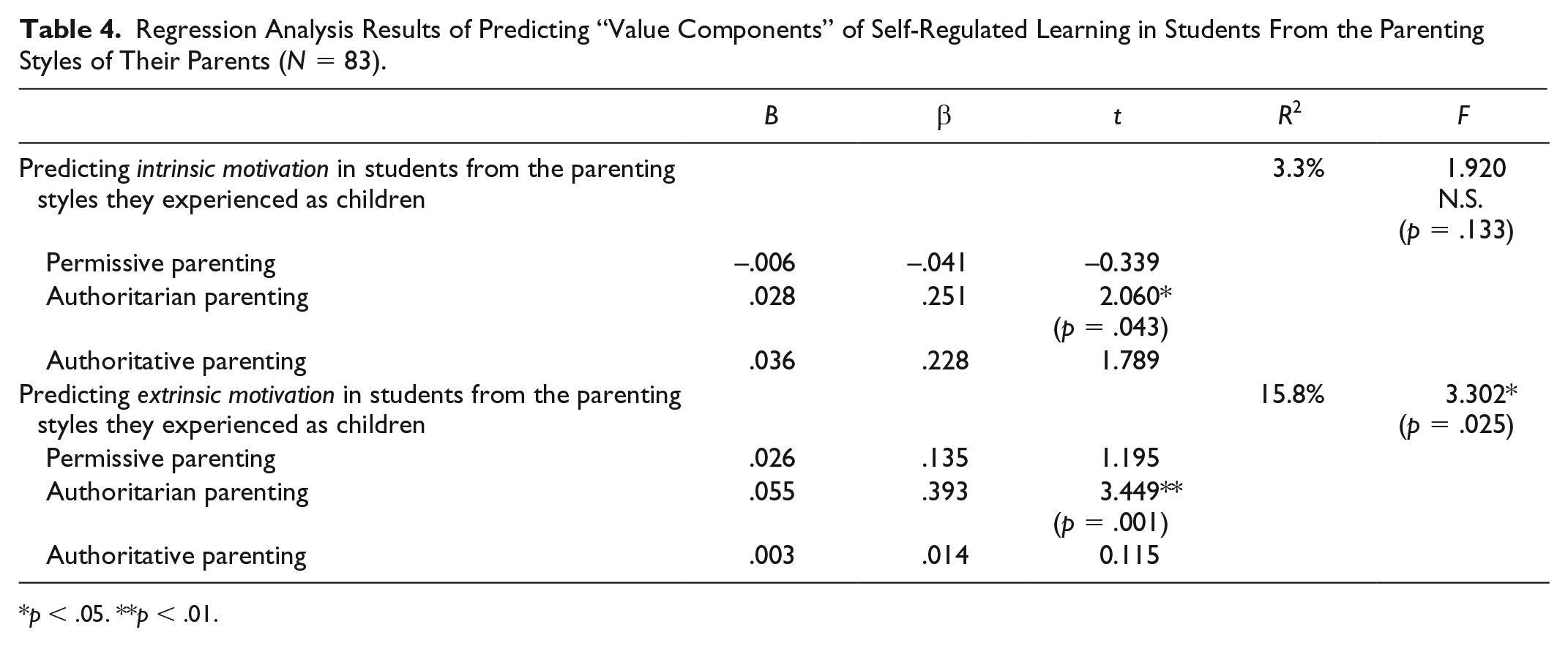
p < .05. **p < .01.
Concerning the expectancy components of SRL, the authoritarian component of parenting was the only parenting style to be significantly correlated with self-efficacy and control feeling of the grown-up students, but the part of the variance explained by parenting styles in these two components was rather small (Table 5).
Regression Analysis Results of Predicting “Expectancy Components” of Self-Regulated Learning in Students From the Parenting Styles of Their Parents (N = 83).
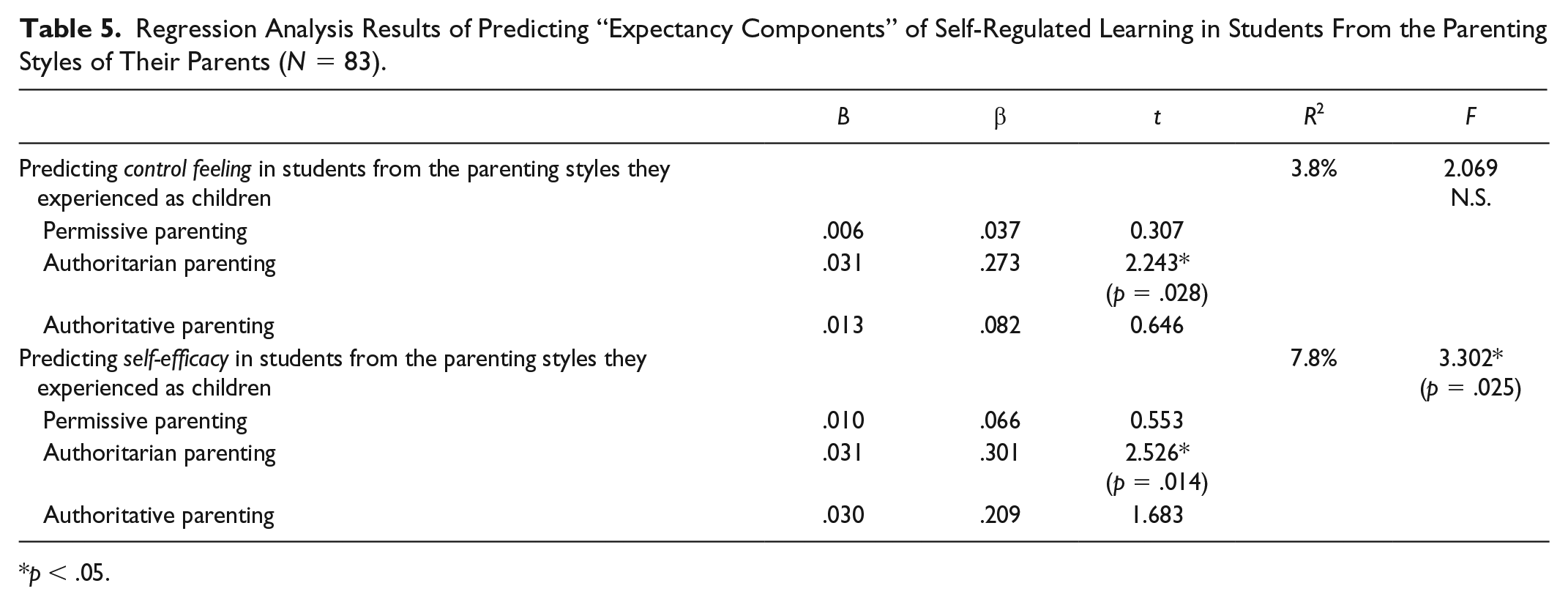
p < .05.
No significant correlation was found between test anxiety and the reported parenting styles (Table 6).
Regression Analysis Results of Predicting Test Anxiety of Students From the Parenting Styles of Their Parents (N = 83).

Cognitive skills were slightly but significantly correlated with the authoritarian parenting style (6.8% of variance linked), and among them, a considerable portion of students’ critical thinking variance (15.4%) was found to be explained by this parenting style (Table 7). Metacognitive skills were linked to authoritative parenting (Table 7).
Regression Analysis Results of Predicting Cognitive and Metacognitive Skills of Students From the Parenting Styles of Their Parents (N = 83).

p < .05. **p < .01.
Among the environment management skills (Table 8), our results reproduce the known correlation between authoritative parenting and help seeking and peer learning. Yet, we did not find any significant correlation between effort management and a specific parenting style (although in this case, the regression upon parenting styles did globally explain 7.6% of variance).
Regression Analysis Results of Predicting Environment Management Skills of Students From the Parenting Styles of Their Parents (N = 83).

p < .05.
Discussion
Table 9 summarizes the results we obtained with our college students and compares them with known data about adolescents. A small part of our results corroborate data on adolescents, which shows the influence of the authoritarian parenting style on extrinsic motivation and the influence of authoritative parenting on learning skills involving other persons (peer learning and help seeking). Besides these two points, our results are quite different from the results obtained with adolescents (Table 9). In adolescents, intrinsic motivation for learning is usually strongly correlated with authoritative parenting style, and with our college students, there was no significant correlation between them. Instead, there was even a significant correlation with authoritarian parenting (7.3% of variance explained by parenting styles). Beliefs of control about learning and self-efficacy, which are usually partly explained by authoritative parenting in adolescence, were partly but significantly correlated in our college students’ sample with authoritarian parenting only. Similarly, critical thinking was strongly correlated with authoritarian parenting, as it was in the research work of Huang and colleagues (2015). This is all the more remarkable since the subjects in our sample describe their parents are mostly permissive.
Comparison of Parenting Styles’ Correlation With the Different Aspects of SRL as Reported in Adolescents in the Literature, and as Measured in College Students in Our Sample.

SRL = Self-regulated learning.
significant correlation (p < .05). **significant correlation (p < .01).
Since our findings cannot reveal any causal relationship between parenting styles and SRL, they can have two possible meanings. The first possible meaning is that students with certain self-regulatory characteristics (high critical thinking, high external motivation) have a stronger tendency to view their parents as more authoritarian than authoritative or permissive (see Spera, 2006). In particular, it is possible that students with critical-thinking skills have a tendency to view their parents as more controlling and less supportive, since they are more able to criticize their parents’ behavior. Yet, since critical thinking is not correlated in our sample to characteristics such as external motivation, this explanation cannot extend to all the relevant self-regulatory skills.
The second possible meaning of our findings corresponds to the reverse causal link. Possibly, when adolescents grow up, the deleterious effect of authoritarian parenting on intrinsic motivation and self-concept lessens, and what remains are the different motivations and abilities that the authoritarian parenting succeeded in awakening, while concurrently the consequences of authoritative parenting return to the common baseline. This change may be explained by the consideration of the differences between the social situation of college students and that of adolescents. Indeed, the first consequence of excessive control and too little support experienced by adolescents under the climate of authoritarian parenting is the presence of affective states such as worry or depressive thoughts, which diminish motivation and keep the mind busy and less able to invest efforts in cognitive and metacognitive processes. These states strongly disturb the enacting of academic skills but they do not necessarily impair the skills themselves (Brackney & Karabenick, 1995). Hence, when the students transfer from high school to college and take some distance from their parents, it is logical that these negative affective states diminish, so the students’ cognitive and metacognitive skills are less disturbed and they can express themselves positively. This hypothesis can explain, for instance, the correlation of authoritarian parenting with higher critical thinking and other cognitive skills. Indeed, although authoritarian parenting does not initially foster critical thinking in children, it is a parenting style that unfortunately provides an excellent training in critical thinking, since it involves a lot of criticism of the child by the parents. It may be that once the subjects take some affective distance from the influence of their authoritarian parents, they can consolidate the tendency to criticism that they experienced and internalized with their parents into a useful critical-thinking skill. This possible interpretation can be reinforced by the link found in general between authoritarian parenting and compulsive or perfectionist personality in children (Aycicegi et al., 2002), since both conditions are based on close analytic abilities.
The second issue associated with authoritarian parenting is a sense of lack of control which may also impair academic behavior in high school. Yet, when the adolescents turn into college students (especially in Israel), they are already rather independent from their parents economically and psychologically. Some have already built themselves a group they belong to. In this situation, their feeling of control in life is also stronger and the academic behavior changes correspondingly. This second hypothesis can explain the unexpected correlations in college students between authoritarian parenting and control of learning beliefs or self-efficacy. These two hypotheses do not exclude the long-term influence of authoritarian parenting on deeper affective characteristics (Steinberg, 2001) such as examination fear and effort regulation.
Finally, we should mention the possibility the that two possible meanings of our findings are not exclusive but rather reinforce each other: indeed, it may be possible, for instance, that authoritarian parenting enhances critical thinking in offspring, and that this in turn leads them to judge their parents as even more authoritarian than they were.
In summary, if our results represent trends which can be generalized, they add evidence to a line of research showing how parental influence transforms when adolescents grow up (Huang et al., 2015; Joshi et al., 2003; Masud et al., 2016; Strage & Brandt, 1999).
Limitations
It is worth considering possible biases that can be at the source of our results. One possible source of bias is the research procedure. First, like in most studies in this field, the sampling procedure was based on voluntary consent to fill in the questionnaire (without reward or other facilitating means and without a screening process), and this may impair the representativeness of the sample. Second, the data collection method through recollection of parental practices by offspring may have introduced a discrepancy between what we measured and the actual parenting. At younger ages, there is an agreement that recalled parenting styles reflect actual parenting styles (Glasgow et al., 1997). Yet, when the subjects become adults, the gap between recalled and actual styles may increase: subjects may be more likely to develop understanding toward their parents’ failures and to consider them as less authoritarian than they were. This bias could explain why in our sample, the proportion of permissive parenting is higher than usual. But it does not explain the main result, which is the predominant link between authoritarian parenting and SRL.
The second possible source of bias, as noted earlier in this article, is the personal specificity of our students. Some differences have been studied between male and female students with respect to the effect of parenting style on learning (Baumrind, 1972; Chan & Chan, 2005; Keshavarz & Mounts, 2017) and between ethnic groups ((Gonzalez et al., 2001, 2002; Joshi et al., 2003; Steinberg & Dornbusch Brown, 1992). Yet, our population was mainly composed of students belonging to ethnic groups who behave like occidental people at the stage of adolescence (Alt, 2016, on Palestinian adolescents; Yaffe et al., 2018, on Jewish and Bedouin adolescents; Hatem, 2014, on Druze adolescents). And therefore, our results do not seem to stem from cultural specificities.
Conclusion
Knowing the problematic influence of the authoritarian parenting style on the affective components of the personality (Baumrind, 1971; Deci & Ryan, 1987; Maccoby & Martin, 1983; Nolen-Hoeksema et al., 1995; Singh, 2017), we are cautious in suggesting a possible link between authoritarian parenting and improved SRL at an adult age. From the parenting point of view, trying to optimize children’s education to foster both high achievements and well-being, and finding the right equilibrium between the different components of parental influence, is still an unsolved question. The insight brought by our results could help to refine this issue.
From the child’s point of view, according to what our results suggest, if adults who underwent authoritarian parenting indeed have increased critical-thinking skills, this ability can also enhance the efficacy of their cognitive efforts to overcome affective and behavioral difficulties in appropriate setting. This could have the interesting meaning that although authoritarian parenting is linked to some more dysfunctional tendencies in the offsprings, it could also be linked to enhanced abilities to rectify them.
Footnotes
Acknowledgements
The authors thank Marom Alterovich for helpful comments.
Declaration of Conflicting Interests
The author(s) declared no potential conflicts of interest with respect to the research, authorship, and/or publication of this article.
Funding
The author(s) disclosed receipt of the following financial support for the research, authorship, and/or publication of this article: This research was supported by the Mofet Institute, Israel.
