




Abstract
During covid-19 pandemic, health education was performed by using online media, such as smartphone apps-based health communication media. Furthermore, middle and older individuals, 45 to 60 years old, were categorized as vulnerable during the pandemic. Thus, it was important to study smartphone apps-based health communication media usage of 45 to 60 years old individuals during the pandemic. However, there was no previous research that developed and tested a model of smartphone apps-based health communication media usage of 45 to 60 years old individuals during the pandemic. Given this, this study aimed to develop and test a model of smartphone apps-based health communication media usage of 45 to 60 years old individuals during the COVID-19 pandemic. More specifically, this study aimed to test the effect of system quality factors (ease of use, security, and interactivity), information timeliness, information completeness, information sources trustworthiness, perceived threat of COVID-19, and social environment support on smartphone apps-based health communication media usage. The research was conducted using a cross-sectional design. The data were collected through a survey method in the district and city of Tangerang. The survey locations were chosen due to the location’s internet access and the COVID-19 pandemic problems. The number of samples was 105. The data were analyzed using multiple regressions analysis. The results of the research showed that the smartphone apps-based health communication media usage of the 45 to 60 years old individuals was affected by ease of use, information completeness, social environment support, and perceived threat of COVID-19. However, information timeliness, information source trustworthiness, security, and interactivity were not proven to have a significant impact on the media usage. The managerial and policy implications were identified based on the findings.
Introduction
Background
The COVID-19 pandemic has disrupted the pattern of human activities (Khalifa et al., 2021). It has limited the physical movements and encounters a person could have (Khalifa et al., 2021). This pandemic has also forced people to move their physical life into digital life using information and communication technology (ICT) (Adedoyin & Soykan, 2023; Dannenberg et al., 2020; Király et al., 2020).
Indonesia was one of the countries experiencing the COVID-19 pandemic. In Indonesia, up to December 6th 2022, the total cases of COVID-19 was 6,682,437 (Worldometer, 2022). Furthermore, the mortality rate of COVID-19 in Indonesia was 2.39% (Worldometer, 2022).
In Indonesia, the COVID-19 pandemic has changed the pattern of social and economic activities. The COVID-19 pandemic also changed the pattern of the public health extension activities initiated by the government and non-governmental institutions in Indonesia (Sumaedi et al., 2020, 2021a). The Indonesian government tended to perform online public health extension during the pandemic (Sumaedi et al., 2020). For example, both central and local governments in Indonesia utilized websites and social media to provide COVID-19 related information (Sumaedi et al., 2020). In addition, the government cooperated with many digital health communication media, such as ALODOKTER (2022), Halodoc (2022), and KlikDokter (2022), to provide health extension and services.
Digital health communication media was housed on various platforms, such as conventional websites, social media, and smartphone apps (Sumaedi et al., 2021a, 2021b). The advancement of ICT and industrial revolution 4.0 has encouraged a massive and more convenient development of smartphone apps. Apps had fundamental advantages compared to other platforms. They had more personalized, interactive, and user-friendly features (Ibrahim et al., 2012). Many smartphone apps have been available in various sectors, including health (Carter et al., 2013). The abovementioned health communication media—ALODOKTER, Halodoc, and KlikDokter—also provided smartphone apps for their users. The smartphone apps could be downloaded freely for the users. The apps could be used by both medical and non-medical/public communities.
A public health extension that used smartphone apps can be categorized as the cafeteria approach-based extension (Sumardjo & Mulyandari, 2010). The effectiveness of the extension relied heavily on the level of smartphone apps-based health communication media usage (Sumaedi et al., 2021a). Thus, research on the smartphone apps-based health communication media usage became essential.
During the COVID-19 pandemic, middle and older individuals, 45 to 60 years old, were categorized as vulnerable. This was because humans tend to experience health decline after 45 years old (Kurniasari, 2017). COVID-19 was consistently tied to immune and mobility levels. Someone who had a low immune system and high mobility would have a higher risk of contracting COVID-19. The 45 to 60 years old individuals could be categorized as the productive age group that generally has not entered retirement. On the other hand, under the same lifestyle conditions, the 45 to 60 years old individuals tended to have lower immunity than other productive age groups. This age group holds the highest mortality rate in Indonesia compared to other productive age ranges (Lidwina, 2021). More than 30% of COVID-19 related deaths came from this age group (Lidwina, 2021). It indicated that this age group required massive health extension. Furthermore, the massive health education was also important due to the possibility of the presence of COVID-19 pandemic related health behavior hesitancy, such as vaccine hesitancy (C. Wang et al., 2021; Yousaf et al., 2022).
As previously explained, during COVID-19 pandemic, the public health extension that used smartphone apps is performed. As a cafeteria approach-based extension, the extension’s object needs to use the apps. The middle and older individuals are not a part of millennial generation that is familiar with information technology and internet (Fishman, 2016; Indonesian Statistic Bureau, 2021). Thus, the use of smartphone apps based public health extension for middle and older individuals might become a problem. Thus, in order to ensure the effectiveness of smartphone apps based public health extension on middle and older individuals, research on their smartphone apps-based health communication media usage was needed.
Previous Research and Research Gaps
There were many studies on digital health communication media usage (e.g., Castrén et al., 2008; Czaja et al., 2013; Deng & Liu, 2017; Kontos et al., 2012; Mou et al., 2016; Paramastri et al., 2020; Thielsch et al., 2019; Walker et al., 2017). However, studies in the context of the pandemic were still limited. The available studies were conducted by Al-Dmour et al. (2020), Sumaedi et al. (2020, 2021a, 2021b), and Dadaczynski et al. (2021). Furthermore, there were at least three research gaps on the existing literature. First, previous studies on digital health communication media usage generally focused on conventional websites or digital health communication media in general. A study that focused on the smartphone apps-based platform has not been done.
Second, previous studies tended to specifically focus on Millennials or society in general. A focused study for the 45 to 60 years old age group was absent.
Third, these specific contexts: smartphone apps-based health communication media, the 45 to 60 years old age group, Indonesia and the pandemic, would conjure different antecedent factors of smartphone apps-based health communication media usage compared to previous research. In the context of an smartphone app-based platform, the usage may be influenced by the factors that reflected the app’s system quality, such as ease of use, security, and interactivity (D. Shin & Hwang, 2017). Interactivity is a concept that represents the app’s feature that can be used by a user to communicate with other users/parties (Le et al., 2020; D. Shin et al., 2016; Zheng et al., 2013). From the perspective of 45 to 60 years old age group, the timeliness and completeness of the message, the trustworthiness of the source, and social environment support might become the important factors that affect smartphone apps-based health communication media usage. Social environment support might also influence the usage of 45 to 60 years Indonesians since Indonesians tended to have a communal culture (Sumaedi et al., 2012). In addition, in the context of COVID-19 pandemic, another factor, like the perceived threat of the COVID-19 might also affect smartphone apps-based health communication media usage (Sumaedi et al., 2020, 2021a, 2021b). To date, there was no study that have simultaneously tested the influence of system quality factors (ease of use, security, and interactivity), information timeliness, information completeness, information sources trustworthiness, perceived threat of COVID-19, and social environment support on smartphone apps-based health communication media usage.
Objectives
To fill the gaps in the literature, the study aimed to develop and test a model of smartphone apps-based health communication media usage of 45 to 60 years old individuals during the COVID-19 pandemic. More specifically, this research aims to examine:
The effect of system quality factors (ease of use, security, and interactivity) on smartphone apps-based health communication media usage of 45 to 60 years old individuals during the COVID-19 pandemic.
The impact of information timeliness on smartphone apps-based health communication media usage of 45 to 60 years old individuals during the COVID-19 pandemic.
The influence of information completeness on smartphone apps-based health communication media usage of 45 to 60 years old individuals during the COVID-19 pandemic.
The effect of information sources trustworthiness on smartphone apps-based health communication media usage of 45 to 60 years old individuals during the COVID-19 pandemic.
The impact of perceived threat of COVID-19 on smartphone apps-based health communication media usage of 45 to 60 years old individuals during the COVID-19 pandemic.
The influence of social environment support on smartphone apps-based health communication media usage of 45 to 60 years old individuals during the COVID-19 pandemic.
Theoretical Framework
Smartphone Apps-Based Health Communication Media Usage
Smartphone apps-based health communication media could be categorized as digital health communication media. The use of digital health communication media was a technology adoption phenomenon (Sumaedi et al., 2021a). In the digital communication media technology adoption studies, many researchers viewed that digital health communication media usage was people’ activities in using the media for their specific purposes (F. C. Chang et al., 2015; Walker et al., 2017). Generally, digital health communication media usage could be represented by the information searching activity and the information sharing activity (Sumaedi et al., 2021a, 2021b). Thus, this study viewed smartphone apps-based health communication media usage included the activity of health information searching in smartphone apps-based health communication media and the sharing activity of the health information obtained from the smartphone apps-based health communication media.
Technology adoption literature has identified several main models used to elaborate technology adoption phenomenon, including the use of digital health communication media, such as the Theory of Planned Behavior (TPB) (Ajzen, 1991), the Technology Acceptance Model (TAM) (Davis, 1989), and the Social Cognitive Theory (SCT) (Bandura (1998, 2004)). However, these models had limitations to explain smartphone apps-based health communication media usage. TAM only focused on the technology characteristics. On the other hand, TPB and SCT focused on social aspects, facilitating conditions, and individual assessment of the behavior being investigated. The three models did not involve the perception of disease threats and the content aspects of communication media. The Health Belief Model (HBM) revealed that the perception of disease threats was an important determinant of health behavior (Rosenstock, 1974a, 1974b). The digital health communication usage media could also be viewed as a health behavior (Sumaedi et al., 2021a). Since smartphone apps-based health communication media usage could be seen as both a technology adoption phenomenon and health-related behavior, this research integrated the factors based on TAM, TPB, SCT, and HBM to explain smartphone apps-based health communication media usage among people in the 45 to 60 years old age group during COVID-19 pandemic. Technology adoption influencing factors could be different among people with different age group (Venkatesh et al., 2012). Thus, a smartphone apps-based health communication media usage model that designed for the 45 to 60 years old age group should identify the factors that are relevant for the age group. Given this, the factors proposed as the determinants of this research’s smartphone apps-based health communication media usage model consisted of system quality (ease of use, security, and system interactivity), message characteristics (timeliness, completeness, and source trustworthiness), perception of the threat of COVID-19 and social environmental support. Visually, the conceptual model of research could be seen in Figure 1.

Conceptual model.
System Quality
System quality showed the superiority of the system of the smartphone apps-based on users’ evaluations (D. Shin & Hwang, 2017). The factors related to system quality include ease of use, security, and interactivity (Le et al., 2020; D. H. Shin, 2014; D. Shin et al., 2016; D. H. Shin, 2015; D. Shin & Hwang, 2017). Ease of use referred to how far a system can be operated with minimum efforts (Kim & Niehm, 2009; Le et al., 2020; Noh & Lee, 2016). This factor was identified by TAM as an essential factor that affects technology adoption (Noh & Lee, 2016). Security represented to what extent users feel protected while using the media (Le et al., 2020; Zheng et al., 2013). The most frequently cited security threat was the breach of personal information (Zheng et al., 2013). Interactivity, as the name suggests, reflected how well the system can facilitate communication between users and other parties (Le et al., 2020; D. Shin et al., 2016; Zheng et al., 2013). Several studies showed that digital communication media usage was influenced by ease of use (Kim & Niehm, 2009; Le et al., 2020; Noh & Lee, 2016), security (Le et al., 2020; D. Shin et al., 2016; Zheng et al., 2013), and interactivity (Le et al., 2020; D. Shin et al., 2016; Zheng et al., 2013). In the context of smartphone apps-based health communication media, those three factors were vitals since smartphone apps-based platforms pride themselves in terms of ease of use and personalization. Thus, we expected that ease of use, security, and interactivity influence smartphone apps-based health communication media usage positively. The first, second, and third hypotheses were formulated as follows.
H1: Ease of use significantly and positively influences smartphone apps-based health communication media usage
H2: Security significantly and positively influences smartphone apps-based health communication media usage
H3: Interactivity significantly and positively influences smartphone apps-based health communication media usage
Message Characteristics
This was an important concept in communication media literature. This concept was often referred as information quality (Deng et al., 2015; Tao et al., 2017; Zhang et al., 2015). Message characteristics represented users’ perceptions of the content provided by digital health communication media (Deng et al., 2015; Tao et al., 2017; Zhang et al., 2015). This research focused on three factors: information timeliness, information completeness, and information source trustworthiness. Timeliness was an evaluation of whether the information given in the communication media is up to date (Deng et al., 2015; Zhang et al., 2015; Zhou, 2013). Completeness referred to the coverage of the information (Tao et al., 2017; Zhang et al., 2015), while the source trustworthiness represented users’ perceptions of the sources’ credibility (Bates et al., 2006; Y. S. Chang et al., 2021; Hocevar et al., 2017). Completeness was different with timeliness since completeness related with the presence of various domains of information while timeliness related with the time domain of information (Deng et al., 2015; Tao et al., 2017; Zhang et al., 2015; Zhou, 2013).
Several studies showed that digital communication media usage was influenced by information timeliness (Deng et al., 2015; Tao et al., 2017; Zhang et al., 2015), information completeness (X. Wang et al., 2021), and information source trustworthiness (Hong, 2006; Sillence et al., 2007a, 2007b). Hence, we expected that information timeliness, information completeness, and information source trustworthiness influence smartphone apps-based health communication media usage positively. The fourth, fifth, and sixth hypotheses were formulated as follows.
H4: Information timeliness significantly and positively influences smartphone apps-based health communication media usage
H5: Information completeness significantly and positively influences smartphone apps-based health communication media usage
H6: Information source trustworthiness significantly and positively influences smartphone apps-based health communication media usage
The Perceived Threat of COVID-19
This factor was based on the HBM (Sumaedi et al., 2020), often used to explain health-related behaviors. The perceived threat of COVID-19 was an individual evaluation of the risk, danger, and adverse effects of COVID-19 (Sumaedi et al., 2021a, 2021b). According to HBM, the perceived threat would create a positive impact on health-related behavior (Rosenstock, 1974a, 1974b). If people perceived that they had a high risk of contracting COVID-19 and that it would create detrimental effects on their life, they would engage in health-related behavior that could prevent COVID-19 including searching the health information through smartphone apps-based health communication media and sharing it. Several studies showed that perceived threat was a significant predictor of health behavior (Abraham & Sheeran, 2005; Iftikhar & Yousaf, 2021). Therefore, during pandemic COVID-19, we expected that perceived threat of COVID-19 influences smartphone apps-based health communication media usage positively. The seventh hypothesis was formulated as follows.
H7: perceived threat of COVID-19 significantly and positively influences smartphone apps-based health communication media usage
Social Environment Support
This factor showed the push, help, and encouragement provided by the social environment, family members and friends for example, to use digital health communication media (Al-Azzam et al., 2019; Duarte & Pinho, 2019; Yuan et al., 2015). Both TPB and SCT emphasized the importance of this factor in technology adoption (Taherdoost, 2018). If someone gets the necessary social support to access digital health communication media, he or she will have a higher likelihood to utilize digital communication media to support their activities (Taherdoost, 2018). Several studies supported the positive impact of social environment support on digital communication media usage (Al-Azzam et al., 2019; Duarte & Pinho, 2019; Yuan et al., 2015). Hence, we expected that social environment support influences smartphone apps-based health communication media usage positively. The eighth hypothesis was formulated as follows.
H8: social environment support significantly and positively influences smartphone apps-based health communication media usage
Research Method
Variables and Measures
This research used a cross-sectional design. There were nine main variables for the study, namely system ease of use, security, interactivity, information timeliness, information completeness, information source trustworthiness, perceived threat of COVID-19, social environment support, and smartphone apps-based health communication media usage. The dependent variable of this research is smartphone apps-based health communication media usage. Those variables were measured using indicators that are adapted from previous research and literature to ensure content validity (Sekaran & Bougie, 2010). Table 1 showed the indicators of each variable. A four-points Likert scale was used to avoid central tendency bias (Lee et al., 2002).
The Indicators of The Research’s Variables.

Validity and Reliability of Instrument
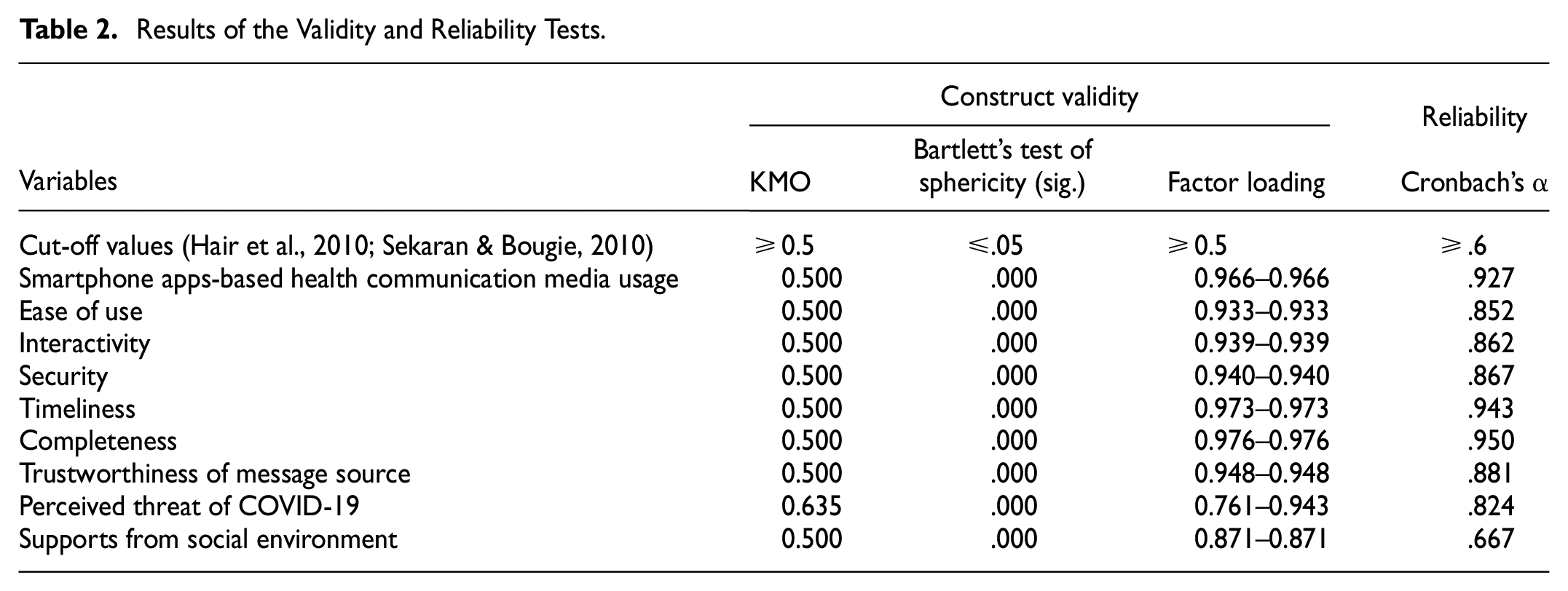
The research instrument was a questionnaire. Before the main survey was performed, the questionnaire was pre tested by involving 30 smartphone apps-based health communication media users. The validity of the instrument was analyzed using factor analysis, while its reliability was evaluated through the Cronbach’s Alpha coefficient. Table 2 showed the cut off value used in the validity and reliability tests and the results of the tests. The instrument was deemed valid and reliable since all variables fulfilled the cut of value of the validity and reliability test In other words, all indicators of the variables were valid and reliable.
Results of the Validity and Reliability Tests.
Sample and Data Collection
Survey method was performed to collect the data of this research, The survey was performed in Tangerang City and Regency, Indonesia. The locations were chosen because two reasons. First, the areas have good internet connections and more than 50% of their citizens frequently access the internet. Second, the locations were the areas that experienced the red zone of the COVID-19 pandemic and also had non-communicable disease problems. This condition indicated the need for smartphone apps-based health communication media based public health extension.
The population of this study was 45 to 60 years old citizens of Tangerang City or Regency that had accessed smartphone apps-based health communication. In other words, the population of this study is a smartphone apps-based health communication media user, 45 to 60 years old, and lives in Tangerang City or Regency. Since the data of the population characteristics was not available, the minimum sample size was decided based on the requirement of the main analysis tool. The sample size was 105. This number of samples fulfilled the requirements of the main analysis tool, namely multiple regression analysis. According to Hair et al. (2010), the minimum number of sample sizes for multiple regression analysis is 5 x number of indicators. Given the number of indicators of this study as many as 19 indicators, the minimum sample number was 95. The demographic profile of the study respondents could be seen in Table 3.
Demographic Profiles.

Since the data related to the users that has accessed smartphone apps-based health communication media is not available and there were mobility restrictions during the COVID-19 pandemic, purposive sampling technique was conducted. The respondents were recruited in their homes and participation in the survey was voluntary. The respondents were selected according to population criteria. Based on Sekaran and Bougie (2010), purposive sampling technique is acceptable if the population-related information is unknown as this study.
Data Analysis
A multiple-regressions analysis was employed to examine the conceptual model and proposed hypotheses. The method was selected because the conceptual model of this research involved one dependent variable and eight independent variables. Furthermore, the method has also implemented in other technology usage studies. The analysis was done using the Statistical Package for the Social Sciences (SPSS) 17.0 software.
Results
Table 4 showed the results of multiple regressions analysis. Based on Table 4, it could be seen that the factors that positively and significantly affected smartphone apps-based health communication media usage of the 45 to 60 years old individuals are ease of use, information completeness, social environment support, and perceived threat of COVID-19. On the other hand, the factors that were not significantly affect smartphone apps-based health communication media usage of the 45 to 60 years old individual are security, interactivity, information timeliness, and information source trustworthiness. Furthermore, Table 4 also showed that the regression model’s coefficient of determination was 57.3%. This means 42.7% of usage variance remains inexplicable by this model.
The Results of Multiple Regression Analysis.

R 2 = 57.3, F = 16.095, p = .000.
Significant at .05, **Significant at .1.
Discussion
Ease of use positively and significantly affected smartphone apps-based health communication media usage of the 45 to 60 years old individuals. This means if people perceived that using smartphone apps-based health communication media is easy, they will be more likely to utilize it. This finding supported TAM, which stated that ease of use encouraged technology adoption. This finding also corroborates previous studies by Kim and Niehm (2009), Noh and Lee (2016), and Le et al. (2020).
Information completeness had a positive impact on smartphone apps-based health communication media usage of the 45 to 60 years old individuals. This finding implied that when someone perceives an app-based communication media to have comprehensive coverage of information, he or she will feel inclined to use the media. Information completeness reflected the level of usefulness of the app. TAM argued that a higher level of perceived usefulness would lead to a higher probability of technology acceptance. Previous research, such as X. Wang et al. (2021), also found a similar result.
Social environment support was also proven to have a positive effect on smartphone apps-based health communication media usage of the 45 to 60 years old individuals. This means that if people had the necessary help or support to use the media, they would be more likely to use it. This support might be particularly important for the 45 to 60 age group since they did not grow up surrounded by the internet as the Millennials did. This finding supported the TPB and SCT that emphasized the importance of social factors in technology adoption. Findings from Yuan et al. (2015), Al-Azzam et al. (2019), and Duarte and Pinho (2019) also came to the same conclusion.
The perceived threat of COVID-19 positively affected smartphone apps-based health communication media usage of the 45 to 60 years old individuals. It implied that when people perceived that they have a high risk of contracting COVID-19 and the virus will have a significant adverse effect on their lives, they would feel encouraged to use smartphone apps-based health communication media. The use of smartphone apps-based health communication media, in this case, was health-related behavior. This finding corroborated the HBM, which highlighted the vital impact of the perception of the threat of diseases on health-related behavior. This finding was in line with Ahadzadeh et al. (2015 and 2018).
Information timeliness and information source trustworthiness seemed to have no impact on smartphone apps-based health communication media usage of the 45 to 60 years old individuals. This finding was in contrast with previous studies by Deng et al. (2015), Zhang et al. (2015), and Tao et al. (2017). They found that the timeliness of the information provided by a communication media played an important role in its usage. The same thing could be said for the trustworthiness of the information source. Previous studies by Hong (2006), Sillence et al. (2007a), and Sillence et al. (2007b) concluded that if people trusted the message source, they would use the health communication media that provided the message.
The insignificant effect of information timeliness and information source trustworthiness on smartphone apps-based health communication media usage of the 45 to 60 years old individuals might due to two reasons. First, health information could be categorized as a credence attribute, which is hard to evaluate by the public. On the other hand, the respondents were mostly high school graduates. They might have difficulties evaluating the content of the message and the source of information in the media. Thus, they did not consider those two factors as determinants to use app-based health communication media. Second, the apps available in the market, such as Alodoc, KlikDokter, and Halodoc, tend to have similar characteristics in terms of information sources. They use medical doctors as information sources. These doctors wrote articles, answered questions, and provided one-on-one paid consults. In the literature, the public believe doctors (Hu & Shyam Sundar, 2010), which means they are already preconditioned to believe the content and the source of information in the app.
Interactivity and security also did not affect smartphone apps-based health communication media usage of the 45 to 60 years old individuals. This finding was different with Zheng et al. (2013), D. Shin et al. (2016), and Le et al. (2020). Their research revealed that interactivity and security were essential determinants of digital media communication usage.
There were three reasons behind the non-significant effect of security on smartphone apps-based health communication media usage of the 45 to 60 years old individuals. First, security was an order qualifier. An order qualifier was a compulsory attribute of any product or service (Noshad & Awasthi, 2018). The nonexistence of this attribute would automatically make a product unacceptable for use, while its existence does not create additional usefulness (Noshad & Awasthi, 2018). Second, there was no negative security issue related to smartphone apps-based health communication media. This fact has made people lenient. Third, people used the smartphone apps-based health communication media to manage their health concerns or the health concerns of people around them, which might be urgent. This condition might make people position security as a non-priority.
The insignificant effect of interactivity on smartphone apps-based health communication media usage of the 45 to 60 years old individuals might be due to three causes. First, the apps already provided a search feature. The users could find information on their own without the need to interact with other people. Thus, the interactivity factor became negligible. Second, people used smartphone apps-based health communication media to seek information related to their health, not to conduct social interaction. Third, smartphone apps-based health communication media currently available in the market have similar interactive characteristics. It is an aspect that has not gained much attention from users because they thought of it as a prerequisite.
Theoretical Implications
Theoretically, this research has generated four contributions. First, this study filled a literature gap on smartphone apps-based health communication media usage of 45 to 60 years old individuals during COVID-19 pandemic. It has developed a model to explain app-based health communication media usage of 45 to 60 years old individuals during COVID-19 pandemic based on eight variables: ease of use, security, interactivity, information timeliness, information completeness, information source trustworthiness, the perceived threat of COVID-19, and social environment support. This model can be used to understand smartphone apps-based health communication media usage of 45 to 60 years old individuals during COVID-19 pandemic.
Second, the findings suggested that system aspects and message characteristics have different effects on smartphone apps-based health communication media usage of 45 to 60 years old individuals during COVID-19 pandemic. In terms of system, the ease of use had a significant impact on the smartphone apps-based health communication media usage, while other system aspects, interactivity and security were proven to have no effect. In terms of message characteristics, information completeness positively affected the smartphone apps-based health communication media usage, but information timeliness and information source trustworthiness did not. These findings insinuated that those aspects have different positions, rank-wise. In business and management literature, the position of an attribute can be categorized as an order qualifier or order winner (Prajogo & Sohal, 2004). These findings suggested that the condition also applies in the context of smartphone apps-based communication media.
Third, this research has proven the importance of support from the social environment in shaping users’ behaviors. Indonesians live in a communal society. The results of this research showed that technology adoption models related to health communication media in a communal society need to consider the effect of supports from the social environment.
Fourth, this research revealed that smartphone apps-based health communication media utilization of 45 to 60 years old individuals during COVID-19 pandemic was not only a technology adoption phenomenon but also a form of health-related behavior. The finding proved that the perception of the threat of COVID-19 was one of the most significant determinants of smartphone apps-based health communication media usage. Models that aim to explain health communication media usage or health-related technology adoption should consider this factor. Current models, such as TAM, TRA, and TPB, did not consider factors related to technology adoption as health-related behaviors.
Managerial Implications
This research has generated at least three managerial implications for the smartphone apps-based health communication media providers and health extension programs organizers in order to improve smartphone apps-based health communication media usage of the 45 to 60 years old individuals during COVID-19 pandemic. First, smartphone apps-based health communication media providers and extension agents who utilize apps during COVID-19 pandemic should pay careful attention to the app’s quality, especially its ease of use. App developers should ensure that middle and older generations can use the app with minimum effort (e.g., the setup does not require much time or effort, the interface is user friendly, and the app itself is compatible with easy-to-use payment methods).
Second, smartphone apps-based health communication media providers and extension agents who utilize smartphone apps-based health communication media during COVID-19 pandemic need to consider the characteristics of the information given through the app. The priority is the completeness of the information. Thus, it is important to cover a variety of topics or issues thoroughly.
Third, smartphone apps-based health communication media providers and extension agents who utilize smartphone apps-based health communication media during COVID-19 pandemic need to consider their users’ social environment. They need to create users’ communities or promote family-based programs to help each other utilize the app-based health communication media.
Fourth, smartphone apps-based health communication media providers and extension agents who utilize smartphone apps-based health communication media during COVID-19 pandemic need to exploit the app-based health communication media to promote and popularize the use of health app as a means to prevent COVID-19. The smartphone apps-based health communication media should also create a dedicated page for COVID-19 updates.
Policy Implications
Health extension programs that utilize smartphone apps-based health communication media is needed, especially during the COVID-19 pandemic. Based on the research result, there are at least three policy interventions needed. First, the government should improve the number of free smartphone apps-based health communication media, especially for the age group more at risk of COVID-19. Second, the government needs to create policies that support the smartphone apps-based health communication media industry so that they can produce easy-to-use apps. The government should facilitate ICT research for the industry. The government could also run a reward program for companies that can generate superior apps. App certification can also be utilized to improve app quality.
Information completeness was proven to be crucial. So, the second policy intervention that should be taken by the government is to encourage doctors and medical professionals to share information through smartphone apps-based health communication media. The government could provide monetary and non-monetary incentives for doctors and other medical professionals. The government could also present rewards for doctors and other medical professionals who have significantly contributed to smartphone apps-based health communication media.
Limitations
This research has revealed several facts related to the use of smartphone apps-based health communication media for a specific age group (45–60 years old). Those facts have generated theoretical, managerial, and policy implications. However, there are a few limitations that need to be addressed. First, this research was limited in terms of area. Second, the number of samples was also limited. Third, this research employed a cross-sectional design so that the findings may be different when the survey was performed in another time. Given this, Another research that covers a large area and respondents is needed to test the stability of the finding.
Conclusion and Future Research
The utilization of smartphone apps-based health communication media is an important topic during the COVID-19 pandemic and the 4.0 industrial revolution. It is an important tool for health extension programs. This research showed that smartphone apps-based health communication media usage of the 45 to 60 years old individuals was affected by many factors, such as ease of use, information completeness, social environment support, and perceived threat of COVID-19. This study also revealed that information timeliness, information source trustworthiness, security, and interactivity were not proven to have a significant impact on the media usage.
The regression model’s coefficient of determination was 57.3%, which means 42.7% of usage variance remains inexplicable by this model. The incorporation of other variables might be able to improve this coefficient. This research also found the insignificant effects of security, interactivity, information timeliness, and information source trustworthiness. There might be other factors that moderated the relationships between those insignificant factors and the usage of app-based health communication media. Future research should strive to identify other variables and integrate them into the model.
This research revealed the importance of the ease of use, information completeness, social environment support, and perception of the threat of COVID-19 as the significant determinant factors of smartphone apps-based health communication media utilization level. Detailed investigation of those determining factors will be beneficial for formulating a better social intervention. Thus, future studies should identify factors that affect ease of use, information completeness, social environment support, and perception of the threat of COVID-19.
Footnotes
Acknowledgements
We would like to thank to the respondents of survey. Author Contribution: Conceptualization, Methodology, Data Collection & Analysis: A.S. and S.S.; Validation and Writing: A.S., S.S., and J.D.W.
Declaration of Conflicting Interests
The author(s) declared no potential conflicts of interest with respect to the research, authorship, and/or publication of this article.
Funding
The author(s) received no financial support for the research, authorship, and/or publication of this article.

Data Availability Statement
Data sharing not applicable to this article as no datasets were generated or analyzed during the current study.