




Abstract
The study has aimed to investigate the factors affecting university students’ attitude toward intention to use social media for learning. This study embraced a cross-sectional approach and gathered quantitative data via a Google form survey, which was collected by using social media platforms, from a total of 720 respondents. The hypotheses were tested using the partial least squares (PLS) method. The study found that social media literacy, perceived ease of use, perceived behavioral control, and perceived risk has significant positive influence on users’ attitude to use social media, while ICT facility and perceived usefulness has no significant impact on attitude. Users’ attitude has a significant relationship with their intention to use social media for learning. The users’ attitude was also found to successfully mediate the relationship of social media literacy, perceived ease of use, perceived behavioral control, and perceived risk with intention to use social media. Social media literacy and perceived risk have been measured as an influential construct since it is unreasonable to anticipate the correlation between social media literacy and perceived risk dimensions in social media.
Keywords
Introduction
Users can quickly connect with one another on social networking sites, and advertisers have a power to influence and engage with consumers (Appel et al., 2020). Facebook, Twitter, LinkedIn, and ResearchGate are examples of popular social networking platforms. These sites provide a platform that is open to people all over the world. Users of social media often engage with one another and share ideas. With the largest number of users around the world, Facebook is the biggest social networking site (Kim et al., 2017). Various socio-technical web platforms concentrate on activating updated features. According to Ma and McGroarty (2017), Twitter uses crowdsourcing to improve decision-making skills by bringing together a diverse group of people. Content generated by the users on Twitter about goods and brands could be used to forecast firm-level revenues, and that the predictive capacity is based on the collective wisdom of the users (Tang, 2018).
The user’s presence on Twitter during crisis response will serve as human sensors (Ogie et al., 2018). Appel et al. (2020) found that over the years, the use of social media to manipulate consumer behavior has become an international business trend, resulting in a significant shift in how consumers make purchasing decisions. The growth of the internet and social media websites have moved control away from corporations to customers (de Oliveira Santini et al., 2020). Social media enables the customers to share their opinions and knowledge about the purchase on the Internet or social media sites (Babić Rosario et al., 2020). Thus, social media literacy can play a significant role and incorporates understanding how social networking sites encode person privacy or security. Although there is a less self-evident how a social media literacy tactic can assist people. A unique aspect of social media is that it encodes social communication. Consumers are increasingly relying on “F-Factors” (friends, family, Facebook fans, and followers) for purchasing behavior, which has rendered conventional marketing communications ineffective (Kotler & Setiawan, 2016; Kotler et al., 2016; Li et al., 2021). As a result, users all around the world are favorably assessing user-generated information on social media, which affects their purchasing decisions (Batra & Keller, 2016).
People using social media platforms is having fun and passing the time by engaging in activities such as product discussions, interacting, and looking for marketing strategies. As a result, entertainment is an essential key element that encourages long-term usage of social media platforms (Al-Debei et al., 2013; Ifinedo, 2016; Naqvi et al., 2019). The consumer attitudes toward intention to use social media can be a critical indicator when determining the value of the products or services offered online. Users’ attitudes toward social media sites can influence their long-term intention to use online technologies for learning and sharing knowledge. User motives, according to most research, can be used to predict long-term intentions to use social networking website like Instagram (Lin, 2007a). The operators of social networking sites, on the other hand, want to know what motivates people to stick to a particular social media platform and to continue using specific products or services (Phua et al., 2017). An individual’s purchasing behavior is influenced by their lifelong experience with products and services, and an online firm’s ability to reach these individuals ultimately determines its success or failure (He et al., 2017). Individuals generally use social media networking sites to express themselves, to learn about goods and services, schooling, to express personal creativity, and to form new relationships with friends, family, and others. In view of these, this study aims to investigate the determinants of users’ attitude toward intention to use social media for learning and sharing knowledge.
Literature Review
Underpinning Theory
This study uses the concept of theory of planned behavior (TPB; Ajzen (1991) that is an extension of the theory of reasoned action (Ajzen & Fishbein, 1975). According to the TPB, users’ behavioral intention reliably predicts whether or not a person will engage in the behavior in question if the individual can consciously choose to do so. The more intensely a person intends to carry out a behavior, the more likely that person is to carry it out (Ajzen, 1991). TPB is a commonly used model for forecasting the relationship between a person’s attitude, intentions, and behavior. As a consequence, predicting a person’s motive depends heavily on three antecedents: the person’s attitude toward behavior, subjective norms, and perceived behavioral control. Ajzen (1991) found that attitude, subjective norm, and perceived behavioral control all determine intentions. According to Baker and White (2010), the positive or negative evaluations of the affective and instrumental variables that make up the action in question are referred to as attitude. The perceived behavioral control means the extent of control that a person feels while performing the behavior (Baker & White, 2010). Many studies have used the TPB to help explain the psychosocial variables that predict people’s use of social media as a promotional tool to read the news, exchange content, watch event videos, and participate in events. For example, TPB was used in empirical research to determine users’ preferences to exchange information appropriately in the purchase networks of products and services (Kim et al., 2018). It has also been used to predict youth media use (Baker & White, 2010; Pelling & White, 2009). Based on the concept of TPB, this study aims to measure the determinants of users’ attitude and their intention to use social media for learning.
Social Media Literacy
The social media literacy can be defined media and information literacy which is a set of competencies that empowers people to access, retrieve, understand, evaluate, use, create, share information in personal professional and societal activities. It suggests that media literate person must not only be a user of information and media material, but also a responsible inquirer, creator of knowledge and innovator who is able to use a variety of information, communication tools and media (UNESCO, 2020). Media literacy is a means of understanding where, when, and how to select while using emerging technology in compliance with their desired purpose (Ata & Yıldırım, 2020). Few studies have been conducted to investigate the relationship between the intent of using social media websites and media literacy. For example, the relationship between critical thinking and media literacy of pre-service teachers have been found positive by Eristi and Erdem (2018), Celik (2018), Semerci and Semerci (2017), and Audiences should properly address both negative and positive developments of healthy information and mass media (Adhiarso & Suyanto, 2018). Grabher and König (2017) found that from individual perspective, media literacy refers to the ability of a media literate person to use the platform by engaging with specific accounts that they want to see content from more frequently. For instance, if anyone intents to communicate with his closest friend, but there is nothing important to share with his friend because they do not live in geographically close places, he or she may do it and make the best use of the platform Facebook to regularly be in touch by checking for his friend’s Facebook profile or other social media sites and sharing the posts. Thus, we formulated that:
H1: Social media literacy has a positive impact on users’ attitude to use social media.
ICT Facility
There are many social media platforms, such as Facebook, YouTube, WhatsApp, Messenger, WeChat, Instagram, Tik Tok, Tencent QQ, QZone, and SinaWeibo ranking as the most prominent social networking sites (Statista, 2020). Information and communication technologies (ICTs) and social media have become indispensable parts of people’s lives in recent years (Karanasios & Parker, 2018). The ICT is an inherent part of daily life, modern society cannot work in its absence (Gërguri-Rashiti et al., 2017). Students could interact to their classmates using the ICT facility on social media. Basri et al. (2018) studied that university students use ICT for interaction and social interactions with friends and family in addition to looking for information on the internet. That is why it represents a great boost to university students’ academic success. Students may frequently use ICT to initiate discussions and guidance on educational activities from professors, peers, and colleagues, and this type of interaction is needed to develop their research and study skills (Basri et al., 2018). In the sense of business development, the ICTs and social media assist companies in innovating and improving their results (Emami & Khajeheian, 2018; Karakara & Osabuohien, 2020), and communicating and attracting more clients (Palalic et al., 2021). Therefore, we proposed the following hypothesis:
H2: ICT facility has a positive impact on users’ attitudes to use social media.
Perceived Usefulness
The perceived utility measures a person’s belief that a system helps him/her to better perform his/her job (Corkindale et al., 2018). Davis (1989) defined the perceived usefulness is the extent a person considers to boost his or her work output using a particular system. Nevertheless, from the social media viewpoint, Phang Ing and Ming (2018) found perceived usefulness as one of the key factors shaping the attitude of consumers regarding the suggestion of bloggers posted on social media. In the same vein, Popy and Bappy (2020) examined that perceived usefulness is directly linked to the attitude of clients toward positive reviews on social media. On the other hand, use of social networking to share information by the concerned stakeholders has a perceived impact, such as endorsing social media to expand higher education by knowledge sharing among students, faculties and other administrative in educational institutions (Goswami & Agrawal, 2019). The intention to use social media will be better when users believe a social media tool uses is necessary for the efficient exchange of information, users will be inspired in order to obtain knowledge from knowledge contributors who are aware of its usefulness (Read et al., 2019). Based on the above discussions, we formulated the following hypothesis:
H3: Perceived usefulness has a positive influence on users’ attitude to use social media.
Perceived Ease of Use
The perceived ease of use denotes to the belief of an individual of how convenient the use of the technology is. The better the method, the more likely it is that the users would consider it (Davis, 1989). Likewise, perceived easy-to-use tests an individual’s perception that a system is effortless (Corkindale et al., 2018). Very often, people felt they would get benefit from using the easy-to-use technology (Scott et al., 2016). Moreover, perceived ease of use of individuals and their perceived utility of technology precede their motive to use them (Venkatesh & Davis, 2000; Venkatesh et al., 2003). Lin (2007b) found that a higher degree of perceived ease of the use of social media produces a positive feedback of consumers. Correspondingly, Hua et al. (2017) confirmed that increased perceived ease of use of social media would lead to an increased degree of a positive attitude toward its strong mindset in favor of destinations for travel. Setiawan and Setyawati (2020) and Pitafi et al. (2020), presented proof of a positive relationship between ease of perception and attitude. Thus, we proposed the following hypothesis:
H4: Perceived ease of use has a positive influence on users’ attitude to use social media.
Perceived Behavioral Control
The perceived ease or difficulty of executing a behavior is referred to as perceived behavioral control (López-Mosquera et al., 2014). Perceived behavioral control was divided into three categories: behavioral, decisional, and cognitive by Zhang and Gupta (2018). To begin, the behavioral characteristic denotes to a user’s propensity to respond to changing circumstances. The user’s ability to effectively achieve the desired goals from situations based on his or her acts and conclusions is referred to as the decisional attribute. The cognitive attribute indicates if the user is capable of comprehending the situation. Moreover, if a person believes that he or she has the technical capabilities, computer skills, and social networking abilities to respond in social media, he or she may believe they have behavioral control (Boehm, 2019). Hansen et al. (2018) found positive impact between the intention to use social networking sites for purchases, as well as the perception of behavioral control. According to Alzahrani et al. (2017) the most powerful impact on practical use is perceived behavioral control. On the contrary, Lawson-Body et al. (2018) disclosed that the relationship between perceived behavioral control can be influenced by social media presence. Thus, the following hypothesis is proposed:
H5: Perceived behavioral control has a positive impact on users’ attitude to use social media.
Perceived Risk
When government workers use Web 2.0 and/or social media for work-related purposes, there is a perceived risk of fraud or hacking, as well as eventual leakage of classified or sensitive information to unauthorized users (Mhina et al., 2019). Despite this, the idea of perceived danger is synonymous with the likelihood of experiencing bad impacts such as losses in an unpredictable circumstance, which typically include performance degradation, economic loss, loss of time, emotional loss, societal loss, security loss, and overall risk (Featherman & Pavlou, 2003). An earlier study of Mhina et al. (2019) implied that the perceived risk has a substantial negative impact on government employees’ attitudes and intentions to use Web 2.0 and/or social networking sites. Nawi et al. (2017) demonstrated that perceived risk has a major impact on student entrepreneurs’ adoption of social media as a business platform in Malaysia, indicating that student entrepreneurs understand and acknowledge the risk of negative outcomes when using social media as a business platform. The users’ confidence has an effect on intentions to use social media, and it was discovered that these connections vary based on the gender and age of the social media participant (Benson et al., 2019). Hence, we hypothesize that:
H6: Perceived risk has a positive impact on users’ attitude to use social media.
Users’ Attitudes
Attitude is a result of one’s cognitive values, and it expresses whether a person feels positively or negatively about performing a specific behavior (Ajzen & Fishbein, 1975). Nonetheless, an individual’s attitude can influence how they feel about using a social networking platform, which in turn affects the users’ interaction with the site. Several observational studies have previously revealed that attitudes have a positive impact on social networking sites. For example, Hua et al. (2017), Tariq et al. (2017), Phang Ing and Ming (2018) have discovered a link between attitude and intention to use social media sites. The users’ attitude toward social media use can affect their behavioral intention to use social media (Popy & Bappy, 2020). Erkan and Evans (2016) implied that consumers’ positive attitude toward word of mouth knowledge in social media has a positive influence on purchasing intention. This shows that the user’s attitude toward use of social media would have a positive effect on users’ decision to use social media for learning. Based on this discussion, it is hypothesized that:
H7: User attitude has positive effect on intention to use social media for learning.
Mediating Effect of Attitudes
This study also considered the mediating role of attitude in investigating users’ intention toward the usage of social media. Previously, there are several studies have been considered that attitude is a mediating construct to anticipate the impact of various prior factors on behavioral intention to use social media. For instance, Hua et al. (2017) illustrated that the attitude with respect to the utilization of social media mediates the positive impact of perceive usefulness and perceive ease of use on the behavioral intention of the travelers. Likewise, it has been shown that attitude is the mediating variable through which information quality directly affects purchase intention (Phang Ing & Ming, 2018). Several experimental studies have been conducted to test the relationship between intention to use and actual use. For example, Dumpit and Fernandez (2017), Lu and Yang (2014), Zhou et al. (2011) investigated how motivations affect the intention of using social networking sites. According to another report, little information can be gathered about how positive service feedback on social networking apps can influence consumers’ purchasing intentions and service perceptions (Ha & Lee, 2018). Nadeem et al. (2015) revealed that customers’ purchasing intentions are influenced by users’ attitude. Therefore, we propose the following hypothesis:
H8: User attitude mediates the effect of (a) social media literacy (b) ICT facility (c) perceived usefulness (d) perceived ease of use (e) perceived behavioral control, and (f) perceived risk on intention to use social media.
Based on the review of literature and underpinning theory, Figure 1 shows the conceptual model of this study.

Conceptual model.
Methodology
Survey Instrument
The measurement items were developed from the previous studies. To measure the social media literacy, three items were adopted from Dalpiaz (2020). These items were measured to identify different forms of social media and to understand the information accuracy. Four items were adopted from Venkatesh et al. (2003) to evaluate the ICT facility. Based on the study of Davis (1989), Seidman (2013), Venkatesh and Davis (1996), four items were modified for evaluating perceived usefulness while three items were adopted from Venkatesh et al. (2003), Umrani-Khan and Iyer (2009) for measuring perceived ease of use. To evaluate the perceived behavioral control, three items were adopted from Cameron (2010), Eyrich et al. (2008), Hsu and Chiu (2004), and four items were modified from McKnight et al. (2002) for measuring the perceived risk of the social media users. Four items were modified from Davis (1989), Shen and Chiou (2009), Suh and Han (2002), Eyrich et al. (2008), and Hsu and Chiu (2004) for evaluating user attitude, and four items were adopted from Venkatesh et al. (2003), Bhattacherjee (2001), Davis (1989), Shen and Chiou (2009), and Suh and Han (2002) for measuring user intention to use social media. Five points Likert scale range from 1 = strongly disagree to 5 = strongly agree were used for the factors of social media literacy, ICT facility, perceived usefulness, perceived ease of use, perceived behavioral control, perceived risk, attitude, and intention to use social media.
Data Collection and Sample
Individual users of social media networks, preferably university students aged 18 to 45, are the analysis unit of this study. Since this study focuses on social media literacy, we therefore assume that university students are able to use various sources of information, source to publication, accuracy of information, and information evaluation. In our study, a targeting unit like this could help us improve accuracy. Purposive sampling was used for this study, with university students in Malaysia as the focus group. From January to March 2021, data was collected on an online database for 3 months. Face-to-face contact is not advised due to the COVID-19 pandemic. As a result, we conducted our research solely through an online questionnaire. Questionnaires are created using Google Survey, an online survey tool, and transferred through electronic means like social networking sites, email, and Facebook messenger. Friends and relatives, coworkers, website, and social networking sites are all given access to the online questionnaire. Until the final study, five social media experts were asked to study the content and validity of the questionnaire for further analysis. The experts were required to assess the items’ readability, clarity of vocabulary, smoothness of flow, and overall sufficiency for the concepts being assessed. Finally, it aids in offering some true and important suggestions for improving vocabulary and sentence structure. The wording of a specific query is changed based on expert recommendations. Overall, the questions are straightforward and include the majority of the components needed for this analysis. To ensure continuity and responsiveness in the later stages, changes were made in response to feedback.
Malaysian households were given the survey questionnaire. Respondents enthusiastically participated in this survey because it was self-administered and there was no incentive given. The distribution via electronic communication (social media, email and Facebook messenger) was made up of approximately 1200 sets of questionnaires. Only university students from the University of Malaya and University Malaysia Kelantan in the Kuala Lumpur and Kelantan regions were surveyed. During the data scanning process, we discovered seven Non-Malaysian survey responses and later had been deleted. Following the initial data scanning, a total of 720 questionnaires with no missing values and usable for data processing were discovered, representing a response rate of 60%. According to Cohen (1988), the sample size determines the sample’s reliability. One of the elements to evaluate the strength of the test is the sample size. A power analysis using G*Power statistics software was conducted to measure whether the number of responses is adequate to continue with our research. The results show that for seven predictors, at least 74 sample sizes are needed. The rate of response for this study on users’ attitude and intention to use social media networking sites is therefore sufficient.
Data Analysis
Demographic Information
The findings revealed 61.4% male respondents and 38.6% female respondents. In ethnic circumstances, Malay made up the majority of responders (34.3%) followed by Chinese (26.5%), others (21.2%), and Indian (18%). The respondents’ age stands out of 39.1% from the age group of 18 to 25, 37.7% from 26 to 35, and 23.2% from the age group of 36 to 45. This study focuses on the intention of university students to use social media in a city area, which takes up 61.6% from Kuala Lumpur and 38.4% from Kota Bharu. When we were looking into education level, the results revealed that 57.3% of respondent participated were from Undergraduate, while 32.5% of Masters, and 10.2% were from PhD.
Measurement Model Evaluation
The data was analyzed using a partial least square (PLS) statistical method. In comparison to multiple linear regressions, PLS is a more appropriate statistical technique since it can prevent specification errors and improve the reliability of the results, as well as provide better outcomes and minimize structural errors. Furthermore, PLS can provide a calculation of overall model fit and can analyze several relationships at the same time (Fornell & Larcker, 1981; Schumacker & Lomax, 2016). This analysis used structural equation modeling (PLS-SEM) for evaluating the model using partial least squares. PLS-SEM is an appropriate tool that can handle small sample sizes and multidimensional models (Sarstedt et al., 2017). In the model measurement, Smart PLS software 3.0 was used (Ringle et al., 2015). A reflective model is used in this analysis to quantify first-order variables, which are indices of constructs. All variables had their outer loadings tested. The value for the standardized loading should be greater than or equal to .70. Indicators with outer loadings less than .60 were removed from the model (Sarstedt et al., 2017). According to Chin and Newsted (1999), loadings between .50 and .70 are still generally acceptable and deemed fine if other products in the same construct have higher loadings. The majority of the indicator loading values on their corresponding latent variables were greater than .70, according to the findings. Moreover, some elements (SML4, PEU4, and PBC4) have a result of less than .70, indicating that they should be omitted according to the composite reliability (CR) and average variance extracted (AVE) values.
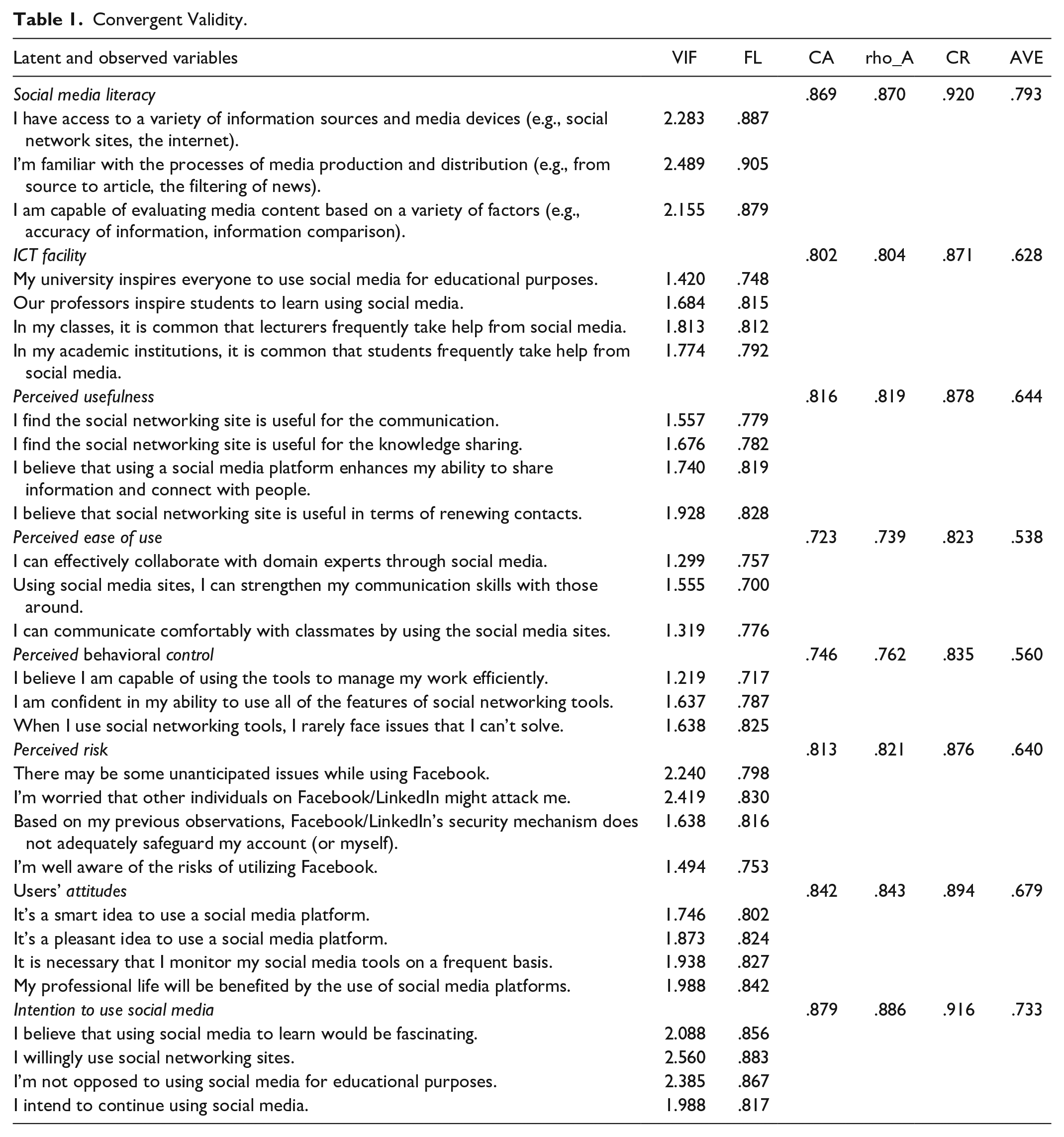
Reliability is concerned with the instrument’s accuracy and stability in assessing the theory. Cronbach’s alpha and the composite reliability indices were used to measure the internal consistency reliability. Cronbach’s alpha can be used to determine internal consistency reliability, along with composite reliability as the lower bound. Higher values for the composite reliability criterion indicate a higher degree of reliability (Sarstedt et al., 2017). Nunnally and Bernstein (1978) suggested that a value of .70 be used as an acceptable alpha. To establish internal consistency, Gefen et al. (2000) proposed a composite reliability of .7 or above. Table 1 shows that Cronbach alpha (α) value achieves the reasonable threshold between .723 and .879, whereas composite reliability ranges from .823 to .920. Both outcomes have been demonstrated to be effective and have met the recommended value. Convergent validity refers to how closely the indicators of a given construct share or converge in terms of common variance. It assesses the extent to which the construct captures the same concept (Sarstedt et al., 2017). The mean of the squared loadings of each indicator associated to the construct is used to calculate AVE. The average variance extracted (AVE) should be more than .50 to indicate good convergent validity (Fornell & Larcker, 1981). According to the outcomes in Table 1, all indicators are above the threshold (AVE > .50), with the lowest AVE being .538. As a result, the result matched the recommended threshold, and it can be stated that no further indicator elimination is required for loading values less than .70. The researchers used the bootstrapping approach with 5,000 subsamples to examine the statistical significance and relevance of the indicator weights. VIF assessment determined that the values of the collinearity vary from 1.291 to 2.560, and provided an acceptable outcome. The higher the VIF, the greater the level of collinearity. To avoid the issue of collinearity, VIF values suggested to be less than 5 (Sarstedt et al., 2017). According to the findings of this investigation, the VIF value of each underlying construct does not surpass 5, implying that no multicollinearity problem exists.
Convergent Validity.
In this study, we are using the heterotrait-monotrait (HTMT) ratio to investigate the discriminant validity of the model. According to the Fornell and Larcker (1981) criterion, to demonstrate discriminant validity, the AVE for each variable must be greater than the squared correlations among the construct and the other variables (Chin & Newsted, 1999; Fornell & Larcker, 1981). The square roots of the AVEs for the components are found to be greater than the correlations among the constructs, showing that the model has discriminant validity (Table 2). For all constructs, the HTMT criterion recommended a value of less than .85 (Kline, 2015) or .90 (Sarstedt et al., 2017), in order to prove discriminant validity. The results demonstrate that none of the constructs have a value higher than .85, indicating the appropriateness of discriminant validity. Table 3 summarizes the findings of cross-loadings. This paper established sufficient discriminant validity for all constructs, as loadings for all constructs were greater than for other constructs.
Discriminant Validity (HTMT).

Note. ICT = ICT facility; IIUM = intention to use social media; PBC = perceived behavioral control; PU = perceived ease of use; PR = perceived risk; PU = perceived usefulness; SML = social media literacy; UA = users’ attitude.
Cross-Loading.

Structural Model Evaluation
The structural model was evaluated by learning about the model’s predictive capabilities, as evidenced by the coefficient of determination R-square (
After the blindfolding process was carried out, and the
Hypothesis Test.

Note. t-Value ≥ 2.326 considers at **p < .01 and t-value ≥1.645 considers at *p < .05.
Multiple Group Analysis
Researchers can use multi-group assessment to investigate if data from pre-defined data groups differs in their group-specific parameter assessment. To clarify the differences between the model based on participants’ gender and educational qualifications, multiple group analyses were included. Table 5 showed the path values for the two groups as well as the p-value differences between them. The results of the two sample groups depending upon gender showed that the association between perceived ease of use on attitude and user’s attitude on intention to use social media was significantly different. The effect of perceived ease of use on users’ attitude was high among the male users, whereas the outcome of attitude on users’ intention to use social media was significantly higher among the female users. Findings of two groups based on educational qualification indicated that the consequence of perceived risk on users’ attitude among the social media users with masters’ level was significantly lower than undergraduate level. The results highlighted that users’ attitude plays a greater role in intention to use social networking sites among the larger educated portion of undergraduate level in Malaysia.
Multi-Group Analysis.

Discussion
In the case of Malaysia, this study examines the moderating impact of university students’ attitudes on the correlations between selected variables and their desire to use social media. The study found that social media literacy had a considerable effect on users’ attitudes regarding social media use, which is balanced with Dalpiaz (2020) conclusions. The study stated that users’ social media literacy can influence their attitude to use social media. In addition, the perceived ease of use and attitude toward utilizing social networking sites are strongly correlated. ICT facility was not significant with users’ attitude. These findings are related to Balakrishnan et al. (2017) who explained the key determinants for using social media for learning educational institutions. Perceived usefulness was insignificant in affecting the attitude of users in the direction of social media usage. However, Balakrishnan et al. (2017) concluded that perceived usefulness was significant for customers’ intention to use social networking sites for knowledge gathering. The findings also revealed that perceived ease of use, perceived behavioral control, and the perceived risk seemed to be a significant determinant for users’ attitude to use social media, as specified by the significant path coefficient of this study. Other studies came up with similar results, for instance, perceived ease of use was discovered as a key component for using social media (Balakrishnan et al., 2017; Umrani-Khan & Iyer, 2009). Users are more comfortable utilizing social media for having to learn because platforms like YouTube and Facebook are prominent among them.
The outcomes of the research have shown that, perceived behavioral control is an important determinant for user’s attitude to using social media. This finding is relevant to Johe and Bhullar (2016), who examined the roles of consumers perceived behavioral control and intention to purchase products. Individual users have a favorable evaluation of using social networking platforms that affect users’ attitude to use social media. Perceived risk is associated with users’ attitude to use social media. This is consistent with another study, which found a link between perceived risk and willingness to use social media networking sites (Currás-Pérez et al., 2013). The study found that attitude has a positive impact on users’ intention to use social media. This finding is relevant to Pai and Yeh (2014) who examined the connection between information sharing and intention to use social media networking sites. Positive attitudes in individuals are frequently mirrored in their behaviors; for instance, people who believe that regular exercise is beneficial may take the time and effort to workout. Likewise, students who have a positive impression of utilizing social media in education can make easy use of learning resources or be motivated to use in comparison to people who have a negative perception in the direction of using social media to learn. Students at the university agree that social networking sites may be used for educational purposes because it facilitates cooperation, networking, and improved communication with others. As a result, lecturers and instructors should take advantage of these observations and explore opportunities to integrate social media features into their teaching practices. Then it would be beneficial to students who are worried about communicating with their professors face to face.
Implications
Managers may utilize this research to determine which components of their communication strategy to emphasize in order to improve social networking site utilization and positive word-of-mouth. The findings of the study reveal that in order to boost user attitude, social networking website contents should be entertaining and encourage user involvement. There are also instructions to decrease perceived risk dimensions and practical solutions to improve university students’ attitudes toward social networking sites and their desire to utilize social media for learning. The study describes the notion of the theory of planned behavior, which identifies the elements which may influence the attitude and intention of students at universities to use social media for educational purposes. The majority of those surveyed were positive toward the idea of using social media for education. The study discovered that social media literacy, perceived ease of use, perceived risk, and perceived behavioral control are the most important factors influencing university students’ attitudes about utilizing social media. While the studies showed that ICT facilities and usefulness are not significant in use of social media, they could be opener to the concept of teaching—learning process because most undergraduate students use social media. Managers should try to improve interactivity and information sharing, as well as address user feelings and attitudes, to encourage university students to use social media platforms for learning. Both professors and students must be motivated to use social networking sites for academic reasons in order to realize the advantages of using it. Furthermore, tertiary institutions can take action by encouraging their faculties and students to use social media in their classrooms.
Social media also supports a variety of functions, such as allowing people to communicate in a variety of ways. Students, for example, may post queries regarding on academic subjects on their timelines in order to engage in open discussion. A shy student, on the other hand, can use the private messaging feature to convey his or her queries or remarks directly to the appropriate parties. Students can also upload course-related videos to get better ideas by discussing among them. Social media’s extensive communication alternatives not only facilitate students’ communication process, but also allow quick access to educational resources. University students are enthusiastic about using media to gather knowledge. However, other problems exist regarding the use of education resources, including privacy and the appropriateness of using social media like Facebook for academic purposes. The enormous popularity of social networking sites among the younger generations demonstrates that university students are usually familiar with new technologies. They would discovery it easier to use social media for academic purposes because they are more technologically adept. Even individuals who are new with social media would likely to find it simple to learn how to use it for educational purposes.
Limitation and Future Study
There are certain limitations to the research. The survey questionnaires were delivered to a random sample of university students across Malaysia, with the bulk of respondents coming from urban areas such as Kuala Lumpur and Kelantan. This was partially predicted because students often have access to strong, reliable social networking sites or internet connections in these places. As a result, the findings of this study should be interpreted with caution. This study only looked at the viewpoints of university students when it came to using social media for learning. To ensure the successful adoption of social media in learning and teaching, both academics and university students need to be cooperative. Future study might replicate the current research design to see if academics share the same thoughts about using social media as a part of their teaching effort.
Footnotes
Author Contributions
Deli Yuan and Muhammad Khalilur Rahman designed the overall framework of the research, and drafted the manuscript. Md. Abu Issa Gazi and Md. Atikur Rahaman conducted a literature review, Mohammad Mainul Hossain and Shaharin Akter collected the data and reviewed the draft. All authors read the final manuscript and approved it for final submission.
Declaration of Conflicting Interests
The author(s) declared no potential conflicts of interest with respect to the research, authorship, and/or publication of this article.
Funding
The author(s) disclosed receipt of the following financial support for the research, authorship, and/or publication of this article: This research was funded by the School of Management, Jiujiang University, China. The taxpayer identification number of Jiujiang University is: 12360400491423170W.
Institutional Review Board Statement
The study was conducted according to the guidelines of the Declaration of Helsinki, and approved by the Ethics Committee of School of School of Management, Jiujiang University, China.
Informed Consent Statement
Informed consent was obtained from all subjects involved in the study.
Data Availability Statement
The data that support the findings of this study are available from the corresponding author, upon reasonable request.
